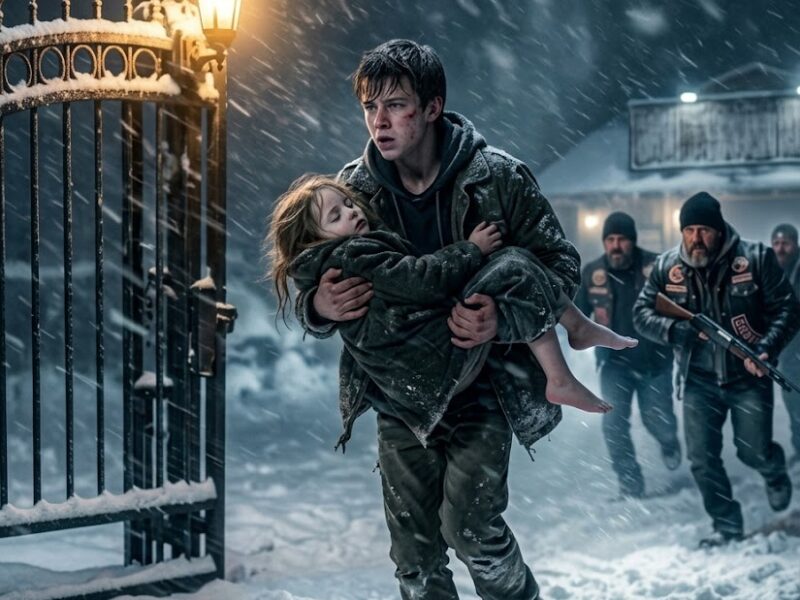
A Homeless Boy Carried a Biker’s Toddler Six Miles Through a Storm—Then 200 Riders Learned Who Had Saved Her
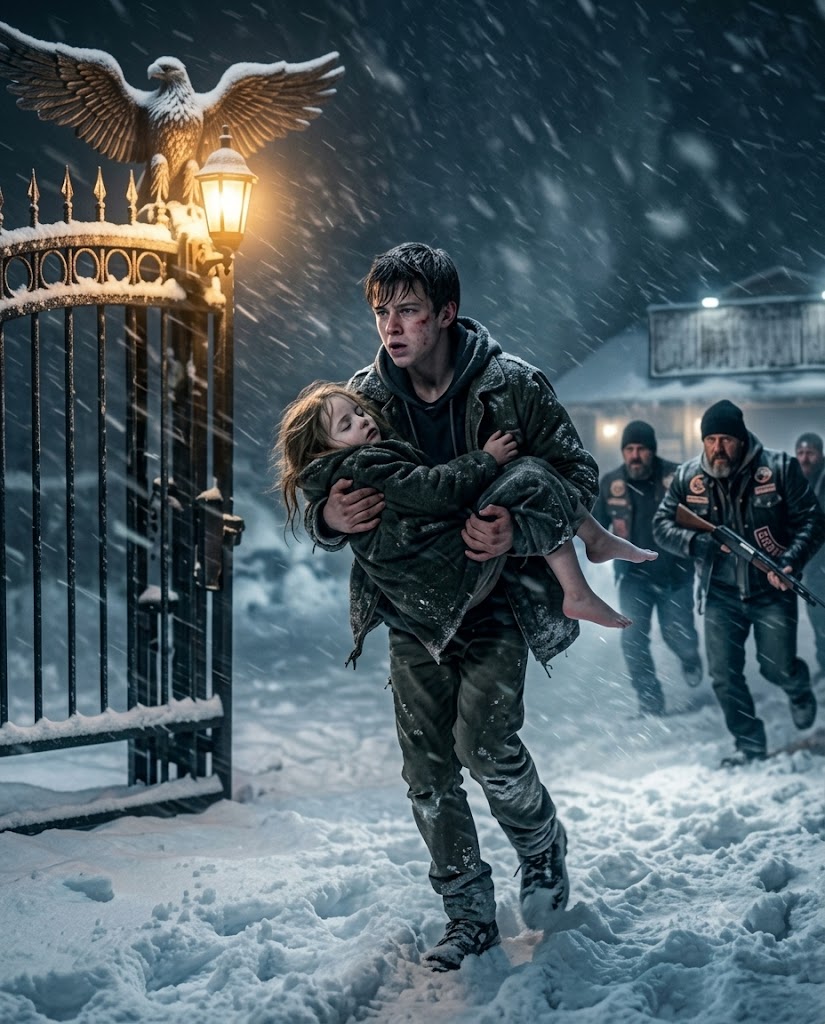
The wind came off the mountains like a blade that night, cutting through the streets of Milbrook with a fury that made even the streetlights flicker as if they too were afraid.
Snow fell in thick, blinding sheets, piling against doorways, burying parked cars, turning the world into a silent, freezing tomb.
Noah Carter walked alone through that storm, his hands shoved deep into the pockets of the threadbare jacket that had stopped keeping him warm hours ago.
At 16, he had already learned more about survival than most people learn in a lifetime.
He knew which alleys held warmth from restaurant vents.
He knew which shelters filled up before dark.
He knew the particular ache of a stomach that hadn’t eaten in two days and the strange hollow calm that came after the hunger stopped hurting and started to numb.
He was heading toward the old parking garage near St. Agnes Hospital, a place he’d slept before, tucked between a concrete pillar and a dumpster out of the wind.
It wasn’t much, but it was something.
Tonight, with the temperature dropping past zero and the wind screaming through the streets, something might be the difference between waking up and not.
That was when he heard it.
A sound so small it almost vanished beneath the howl of the wind.
A whimper.
A child’s whimper.
Noah stopped walking.
Every instinct in his tired, frozen body told him to keep moving, to save what little strength he had left for himself.
He had nothing to give anyone.
He barely had anything to give himself.
But the sound came again, thin, scared, human, and his feet were already turning toward it before his mind had finished deciding.
Behind a row of newspaper stands near the hospital side entrance, curled into a ball against the cold, was a little girl.
She couldn’t have been more than five years old.
She wore a thin cotton dress, no coat, no gloves, her small feet bare against the ice.
Her lips had gone a pale shade of blue, and her whole body trembled uncontrollably.
“Hey,” Noah said softly, crouching down despite the way his knees screamed in protest.
“Hey, it’s okay. I’m not going to hurt you.”
The girl looked up at him with wide, terrified eyes and said nothing.
She was too cold, too frightened, too far gone into shock to form words.
But she didn’t pull away when Noah reached out.
She let him wrap his own jacket, the only warmth he had, around her tiny shoulders.
“Where’s your mom? Your dad?” he asked, scanning the empty street.
Nothing.
No answer.
No sign of anyone searching for her.
Just the storm and the two of them and a silence that felt like the whole world had forgotten this child existed.
Noah’s mind raced.
He should take her inside the hospital, hand her to a nurse, let the professionals handle it, and disappear back into the night like he always did.
That was the safe thing, the smart thing, the thing that wouldn’t risk exposing a homeless 16-year-old to questions from social workers.
Questions that could land him in a system he’d already run from once.
But when he tried to stand and lead her toward the hospital doors, the girl’s hand shot out and gripped his sleeve with a strength that startled him.
“No,” she whispered, her first word.
“Not there, please.”
“Why not, sweetheart? They can help you. They can get you warm, find your family.”
“They’ll take me away,” she said, her voice cracking.
“Like they took me before. Please, I want—I want the bikemen.”
Noah blinked.
“The bikemen?”
She nodded, tears freezing on her cheeks.
“The ones with the loud bikes by the big gate with the eagle.”
Her small fingers dug into his arm.
“Papa said if I ever get lost, go to the eagle gate. He said they’d keep me safe.”
Noah knew exactly what she meant.
Everyone in Milbrook knew the Iron Guardians motorcycle brotherhood.
Their clubhouse sat on the edge of town, marked by an enormous iron gate topped with a carved eagle, wings spread wide.
Men covered in leather and tattoos, riding thunderous machines.
Men most people cross the street to avoid.
It was miles away, through a blizzard in the dark.
Noah looked down at this trembling, barefoot child who trusted a group of strangers more than the hospital fifty feet away.
And he understood something in that moment that would change the course of both their lives.
She had no one else.
And neither, really, did he.
“Okay,” he said, scooping her into his arms despite the way his body screamed in protest.
“Okay, we’ll go to the eagle gate.”
He had no way of knowing that this decision, made in the freezing dark by a boy with nothing left to give, would unravel a secret that had been buried for years and would save not just her life but his own.
To understand why Noah Carter didn’t just walk away, you have to understand what his life had become.
A year and a half earlier, Noah had a home.
Not a grand one, not even a particularly happy one, but a home.
A small apartment on the east side of Milbrook, where he lived with his mother, Diane, a woman who worked double shifts at a diner and came home smelling like coffee and fried onions, too exhausted most nights to do more than kiss his forehead before collapsing into sleep.
It wasn’t much, but it was theirs.
Then the accident happened.
A drunk driver ran a red light on a Tuesday evening, and Diane Carter never came home from her shift.
Noah was 14.
There was no father in the picture, a man who’d left before Noah could form memories of him.
There were no grandparents, no aunts or uncles willing to take in a grieving teenage boy.
The system swallowed him whole.
A group home that smelled like bleach and despair.
Then a foster placement where the man of the house drank too much and used his fists too easily.
Then another group home.
Then the streets, because at least the streets didn’t lie to him about being safe.
For a year and a half, Noah had learned to survive on nothing.
He learned which churches gave out sandwiches on Wednesdays.
He learned to sleep with one eye open.
He learned that kindness from strangers was rare enough that when it came, you remembered it for weeks.
The trucker who bought him a coffee.
The elderly woman who once pressed a $20 bill into his palm and told him to be safe.
The diner cook who sometimes accidentally made extra food and let him finish it in the alley out back.
He had also learned something harder—that he still had a conscience, even when the world had stopped extending him any mercy.
He still couldn’t walk past someone who needed help.
It was, in some strange way, the last piece of the boy he used to be.
The boy whose mother had taught him that decency wasn’t about what you had, but about what you were willing to give, even when you had nothing.
That was why, when he heard a child crying in the snow, his frozen, starving body turned toward the sound instead of away from it.
He didn’t know her name yet.
He didn’t know why a five-year-old girl was alone outside a hospital in a blizzard, wearing nothing but a thin dress.
He didn’t know that the answer to that question would lead him somewhere he never expected, toward a family he never thought he’d have.
All he knew was that she needed him.
And for the first time in eighteen months, someone needed him more than he needed anything for himself.
The girl’s name, he would later learn, was Lily.
But that night, she offered him nothing more than her trembling body and the two words that had guided her through the storm.
Eagle Gate.
As Noah carried her through the empty streets, snow biting at his exposed hands and face, he pieced together fragments from her frightened, half-formed sentences.
“Papa rides with them,” she murmured against his shoulder, teeth chattering.
“He has a jacket. Iron on the back.”
“Your dad’s a Guardian?” Noah asked, adjusting his grip on her small body, trying to shield her face from the wind with what remained of his own warmth.
She nodded weakly.
“He said if bad men ever came, go to the gate. The eagle gate. They’d keep me safe, even if he wasn’t there.”
“Where is he now, sweetheart? Your dad?”
Her face crumpled, and for a moment, Noah feared she’d stopped breathing from the cold.
Then a small sob escaped her.
“I don’t know. The bad lady took me. She said Papa didn’t want me anymore. She said we were going somewhere fun, but then she left me at a big building and told me to wait, and she never came back, and I got scared, and I ran, and I got lost.”
“Hey, hey, it’s okay. You’re not lost anymore. I’ve got you.”
The hospital, Noah realized with a chill that had nothing to do with the storm, was likely where this “bad lady” had abandoned her.
Perhaps hoping the girl would be found and processed through the system.
No questions asked, no trail left behind.
It had the ugly shape of something deliberate.
Someone had wanted Lily gone from her father’s life, and they’d used the anonymous machinery of hospitals and social services to make her disappear.
Noah didn’t know the details, but he knew evil when it wore human skin.
And the way this girl trembled—not just from cold, but from a fear that lived somewhere much deeper—told him enough.
Miles stretched ahead of them.
The Iron Guardians clubhouse sat on the far edge of Milbrook, past the industrial district, past the last row of gas stations, out where the town gave way to open road and pine forest.
Under normal circumstances, it was a twenty-minute drive.
On foot, in a blizzard, carrying a child with a body already weakened by hunger and cold, it might as well have been the moon.
Noah didn’t let himself think about that.
He simply started walking, one foot after the other, cradling Lily against his chest, whispering reassurances he wasn’t sure he believed himself.
“We’re going to make it to the Eagle Gate,” he told her.
“I promise.”
He had broken plenty of promises to himself over the last year and a half.
He was not going to break this one.
By the time they reached the edge of the industrial district, Noah’s body had begun to betray him.
His fingers, wrapped around Lily’s small frame, had gone from painfully cold to a terrifying, distant numbness.
His feet, in shoes with soles worn thin as paper, no longer felt like they belonged to him.
Every breath came sharp and ragged, the frigid air scraping his lungs like broken glass.
The hunger that had gnawed at him for two days had transformed into something worse—a deep, weakening fatigue that made his vision swim at the edges.
He knew, somewhere in the rational part of his mind that hadn’t yet frozen over, that this was dangerous.
That hypothermia killed people.
That he was exhausted, malnourished, and pushing his body past every limit it had.
But every time he thought about stopping, about finding shelter, waiting out the storm, resting even for a few minutes, Lily’s small voice would murmur against his shoulder, half-conscious now, mumbling fragments of nursery rhymes her father must have sung to her.
And something in Noah’s chest would tighten with a resolve stronger than his exhaustion.
If I stop, she might not wake up again.
That thought alone kept his legs moving through snowdrifts that reached his knees, kept his arms locked around her small body even as his own strength failed.
The wind picked up as they crossed an open stretch near the old rail yard, howling with a violence that nearly knocked him off his feet.
Snow blew sideways, stinging his face, blinding him.
For a terrifying moment, Noah lost his sense of direction entirely, turning in a slow circle, searching for any landmark, any light, anything to orient himself in the whiteout.
Panic clawed at his chest.
What if I get us both killed out here?
What if this was the wrong choice?
Then, through the storm, he saw it.
A faint glow off in the distance, warm and orange against the churning white.
A light.
Maybe a house.
Maybe help.
He staggered toward it, half carrying, half dragging his own exhausted body forward, Lily growing heavier and heavier in his failing arms, though she likely weighed no more than forty pounds.
It wasn’t her weight that was breaking him.
It was everything.
Eighteen months of hunger, of cold, of a body that had been surviving on fumes for far too long, finally reaching its absolute limit.
“Almost there,” he whispered to her, though he had no idea if that was true.
“Almost there, Lily. Just hold on.”
She didn’t respond.
Her small body had gone slack against his chest, her breathing shallow.
Noah’s own vision began to tunnel, black creeping in at the edges.
His legs moved on instinct alone now, no longer following any conscious command.
He was running on nothing but the sheer refusal to let this child die in the snow because he had given up.
Just a little further.
Just a little further.
He didn’t know it yet, but the light he’d seen wasn’t a house at all.
It was the security lamp above the iron gate.
The Eagle Gate.
Its wings cast in shadow and snow, exactly where Lily had said it would be.
Noah didn’t remember the last hundred yards.
Later, the men who found him would describe it in halting, disbelieving words.
A boy stumbling out of the whiteout like a ghost.
Snow crusted thick on his eyelashes.
His lips a shade of blue that shouldn’t belong to a living person.
A small child clutched against his chest with an iron grip that not even unconsciousness could loosen.
The first to see him was a Guardian named Frank “Bear” Higgins, a mountain of a man with a gray beard and forearms like tree trunks, who’d stepped outside for a smoke and nearly missed the shape collapsing against the gate in the storm.
“Hey! Someone get out here!”
Bear’s voice tore through the clubhouse, and within seconds, the yard filled with men in leather vests, boots crunching through snow, flashlights cutting through the storm.
Noah’s knees had buckled the moment his hand touched the iron of the gate, as if his body had understood on some primal level that they had made it, and only then allowed itself to stop.
He collapsed into the snow, Lily still cradled against him, his arms locked so tightly around her that it took three men to carefully pry them apart without hurting either of them.
“She’s breathing. Kid’s breathing, but she’s freezing. Get them inside now!”
Chaos erupted into purpose.
Blankets appeared.
Someone shouted for the clubhouse’s resident nurse, a former Guardian’s wife named Carol, who lived close enough to be there in minutes.
Bear scooped Lily into his massive arms with a gentleness that seemed impossible for a man his size, cradling her head against his shoulder as he rushed her toward the warmth of the clubhouse.
Two other men lifted Noah, who was barely conscious, murmuring incoherent fragments.
“The eagle gate. She needed—promise. Keep her safe.”
It was Marcus Webb, the club’s vice president, a lean, sharp-eyed man in his fifties with a scar through one eyebrow, who knelt beside Noah as they laid him near the fireplace and peeled back the edge of the blanket wrapped around Lily’s small shoulders.
That was when Marcus went very still.
Around Lily’s neck, half hidden beneath the collar of her thin dress, hung a small silver locket.
One Marcus recognized instantly, because he’d been there the day it was given.
“Oh my God. Is that—is she—?”
He turned the locket over with trembling fingers and saw the engraving on the back, faint but unmistakable.
To my Lilybug, love always. Daddy.
Marcus’s eyes shot up, searching the room until they found the man standing frozen near the door, having just walked in from patrol duty, snow still on his shoulders, unaware that his entire world was about to change.
“Danny,” Marcus said, his voice cracking.
“Danny, get over here. Now.”
Daniel “Ghost” Reyes, one of the club’s most trusted members, a man who had spent the last eight months in a private hell of grief and desperate searching, turned toward the fireplace and saw his daughter.
The daughter he’d been told was dead.
The scream that tore from Danny Reyes’s throat was not a sound of joy.
Not yet.
It was raw, disbelieving agony.
The sound of a man whose entire understanding of reality had just been shattered.
“That’s not—that can’t be—”
He staggered forward, dropping to his knees beside the unconscious child, his hands hovering over her small face as if he was afraid touching her would prove this was a hallucination, a cruel trick of grief and exhaustion.
“Lily? Lily, baby, is that you?”
Carol, the nurse, was already working, checking Lily’s pulse, her breathing, wrapping her in warmed blankets, calling for the emergency services that would take twenty minutes to arrive through the storm.
“She’s alive,” Carol said firmly, cutting through the rising chaos.
“Hypothermic, exhausted, but alive. She needs a hospital, but she’s alive.”
Danny made a sound like something breaking inside him.
Half sob, half laugh, entirely shattered.
Eight months earlier, Danny Reyes had been told his daughter died in a car accident along with her mother, Rachel—his ex-wife—during a custody exchange gone wrong on an icy highway two states away.
He’d received a phone call, a death certificate, even attended a small, closed-casket funeral arranged hastily by Rachel’s new boyfriend, a man named Victor Kesler, who had cited the severity of the crash as reason for the closed casket and rushed cremation.
Danny had grieved for eight months.
He’d nearly left the club.
He’d nearly ended his own life twice, saved only by his brothers in the Iron Guardians, who refused to let him spiral alone.
He had planted flowers on an empty grave and told himself every single day that his little girl was gone.
And now she was here.
Breathing.
Alive.
In front of the fireplace of his own clubhouse.
“How?” Danny looked up at Marcus, at Bear, at the room full of stunned faces, desperate for an explanation that made sense.
“How is this possible? I buried her. I buried my little girl.”
That was when everyone’s attention turned to the other collapsed figure near the fire.
The frozen, starving teenage boy who had carried her here.
Noah stirred weakly, his eyes fluttering open to a blur of concerned faces and firelight.
His throat was too raw and dry to speak much, but he managed a few broken words before slipping back into unconsciousness.
“She said bad lady took her. Hospital. Left her. Told her papa didn’t want her.”
Danny’s face went white with a fury that had nowhere yet to aim itself.
A bad lady.
Someone took her.
Someone faked her death and kept her somewhere for eight months.
Marcus’s jaw tightened as pieces began clicking into place.
Pieces he hadn’t wanted to examine too closely before, when Rachel’s sudden death and Victor Kesler’s rushed handling of the funeral had struck him as strange but not worth questioning during a time of grief.
Now, with Lily alive in front of him, those strange details took on a far more sinister shape.
“Victor,” Marcus said slowly.
“It has to be Victor. He never wanted you in her life, Danny. Even before Rachel—”
He stopped himself, glancing at the unconscious child.
“We need to call this in. Now. The police. Everyone. If he faked her death, God knows what else he’s done. And God knows what he’ll do when he realizes she’s alive and talking.”
The clubhouse, moments ago filled with the chaotic joy of a miracle, now buzzed with a different, harder energy.
The protective, dangerous focus of men who had just realized that the little girl sleeping by their fire was in more danger than any of them had first understood.
And somewhere out in the storm, unaware that his carefully constructed lie was unraveling, Victor Kesler had no idea that the girl he’d hidden away for eight months had just walked—carried by a homeless, exhausted stranger—straight into the hands of the one man in the world capable of undoing everything he’d built.
The next twenty-four hours unfolded in a blur of sirens, hospital corridors, and hushed, urgent conversations.
Lily was rushed to St. Agnes, the same hospital she’d fled hours earlier.
This time, she was surrounded by a small army of leather-clad men who refused to leave the waiting room, and Danny, who held her hand through the bars of her hospital crib as if letting go might make her disappear again.
Doctors confirmed mild hypothermia and dehydration, but no lasting physical damage.
A small miracle in itself, one they attributed largely to Noah’s jacket and his relentless, near-fatal effort to get her warm and get her there in time.
Noah was admitted to the same hospital, two rooms down, treated for severe hypothermia, exhaustion, and malnutrition so significant that the attending doctor quietly informed the Guardians that another few hours in that storm might have killed him.
It was while Noah lay recovering, hooked to an IV, that the truth about Victor Kesler began to surface in full.
Detective Sarah Munz, called in by Marcus’s contacts within the local police department, moved quickly once Lily’s identity was confirmed.
Records showed irregularities in the accident report from eight months earlier.
No confirmed identification of the child’s body.
An unusually fast cremation authorized solely by Kesler.
A death certificate signed by a doctor later found to have financial ties to Kesler’s family.
The full, ugly truth emerged over the following days.
Rachel Reyes had indeed died in the crash.
But Lily had survived, thrown clear, found and rescued by a passing motorist before Kesler, arriving on the scene shortly after, realized the opportunity in front of him.
Kesler had never wanted Danny in Lily’s life.
He’d seen a chance to erase the girl’s father permanently, and he’d taken it.
Paying off a corrupt coroner, forging documents, and hiding Lily in a rented house two counties over under a fabricated identity.
Planning, investigators believed, to eventually move her out of state entirely and raise her as his own, erasing every trace of the Reyes family from her life.
It had worked for eight months.
Until Lily, terrified and increasingly suspicious of the strange “aunt” hired to watch her while Kesler traveled for business, had overheard a phone call that confirmed her father was alive and made a desperate five-year-old’s decision to run.
The “bad lady,” it turned out, was the hired caretaker, who—faced with police questioning—broke almost immediately, confirming every detail and revealing that she’d panicked when Lily ran from a gas station stop, abandoning her search rather than risk being caught, hoping the girl would simply be found and swallowed by the system.
No questions asked.
No trail leading back to Kesler.
Victor Kesler was arrested three days later attempting to board a flight to Portugal.
He would face charges of kidnapping, fraud, falsification of records, and conspiracy.
Charges that, given the extent of his corruption of a public official, carried the near certainty of decades behind bars.
Danny Reyes, for his part, barely registered any of it.
He sat by his daughter’s hospital bed for three straight days, sleeping in the chair, refusing to leave, even to shower, holding her hand every moment she was awake and murmuring apologies for a betrayal that had never been his fault.
“I thought you didn’t want me,” Lily told him quietly on the second day, her voice small and healing.
“I have never, for one single second, stopped wanting you,” Danny said, his voice breaking.
“Not for one second, baby girl. I love you more than anything in this world. I always will.”
Noah woke on the third day to find Danny Reyes sitting in the chair beside his hospital bed.
For a moment, disoriented and half asleep, Noah tensed, the reflexive readiness to defend himself or run kicking in.
But Danny’s face held none of the threat those instincts had trained him to expect.
It held something Noah hadn’t seen directed at him in a very long time.
Gratitude.
Overwhelming, humbling gratitude.
“Hey, kid,” Danny said softly.
“You’re awake.”
“Where’s—” Noah’s throat was still raw.
“Lily? Is she—?”
“She’s fine. Better than fine. She’s down the hall driving the nurses crazy, asking for extra pudding cups.”
Danny’s laugh was watery, thick with emotion he was fighting to control.
“She’s alive because of you. You understand that? If you hadn’t found her, if you hadn’t carried her all that way in the storm—”
His voice cracked entirely, and he had to stop, pressing a fist against his mouth for a long moment before continuing.
“She would have died out there. And I would never have known. I’d have spent the rest of my life thinking my baby girl died in that crash eight months ago.”
Noah didn’t know what to say.
Gratitude aimed at him felt foreign, almost uncomfortable, like a language he’d forgotten how to speak.
“She trusted you,” Noah said finally.
“The Eagle Gate. She said you told her if she was ever lost to come find the Guardians.”
Danny nodded, wiping his eyes with the back of his hand.
“I told her that when she was three years old. Never thought—never imagined she’d actually have to use it. Never imagined some kid, some incredible kid, would be the one to carry her there.”
Over the following days, as Noah’s body slowly recovered—nourished, warmed, and for the first time in eighteen months, genuinely safe—the Iron Guardians did something that would have seemed impossible to Noah just a week earlier.
They refused to let him go back to the streets.
It started with Bear, who showed up at Noah’s hospital room with a duffel bag of clothes that happened to be his exact size, gruffly insisting it was leftover stock from a charity drive and definitely not purchased that afternoon specifically for him.
Then came Carol, the nurse, who began quietly making sure Noah’s discharge paperwork listed a real address—the clubhouse’s guest quarters—instead of a homeless shelter.
Then Marcus, who sat Noah down with a stack of papers and gently explained the process of becoming a certified foster placement, something he and his wife had discussed and decided, without much debate at all, that they wanted to pursue for this particular sixteen-year-old boy who had nearly died saving a child he’d never met.
“You don’t have to say yes right away,” Marcus told him.
“But the offer’s there. A real home. A real family, for as long as you want it.”
Noah, who had learned not to trust promises, who had learned that adults said things they didn’t mean, who had built walls around himself thick enough to survive a year and a half of being forgotten by the world, did something he hadn’t done since his mother’s funeral.
He cried.
“Why?” he asked, his voice breaking.
“Why would you do this for me? You don’t even know me.”
Bear, standing in the doorway with his arms crossed, answered before Marcus could.
“Kid, you walked through a blizzard, half starved, freezing to death, to save a little girl you’d never met because she was scared and needed help. We know everything about you that matters.”
There is a particular kind of courage that asks for nothing in return, and Noah Carter’s decision that night embodied it completely.
He had every reason in the world to walk away.
Hunger, exhaustion, the very real danger of hypothermia, the fear of what questions and complications a lost child might bring into his already fragile existence.
And yet, when he heard a whimper in the dark, he chose to give what little he had left—not because he expected reward, but because some part of him refused to let a frightened child face the storm alone.
This story is a reminder that compassion is rarely convenient.
It rarely arrives at a moment when we have surplus strength, spare resources, or comfortable circumstances to offer.
Real kindness—the kind that changes lives—often demands something from us precisely when we feel we have nothing left to give.
Noah gave his jacket when he was freezing.
He gave his strength when he was starving.
He gave his last reserves of hope when hope itself had abandoned him months ago.
And in doing so, he discovered that generosity has a strange, quiet power to return to us multiplied in forms we could never have predicted.
The story also speaks to the danger of judging people by appearances.
The Iron Guardians—men covered in tattoos, riding loud motorcycles, feared by many who never bothered to look closer—turned out to be exactly what a frightened little girl instinctively knew them to be.
Protectors.
Safety.
Family.
It is a powerful lesson in humility, reminding us that toughness and tenderness are not opposites, that the roughest exteriors often guard the gentlest hearts, and that we do a disservice to ourselves and others when we mistake someone’s appearance for their character.
Equally important is the story’s portrayal of found family.
The idea that the family who saves us, who shows up for us, who chooses us again and again, matters as much as the family we are born into.
Noah lost his mother and was failed again and again by a system meant to protect him.
Yet, in the aftermath of one selfless act, he found people willing to build him a home from nothing.
Danny lost his daughter to a lie and grieved her as though she were truly gone, only to have her return to him by the actions of a stranger with nothing to gain.
These reunions remind us that hope, however buried, however unlikely, can survive even the cruelest circumstances, and that love, once given honestly, has a way of finding its way back to those who need it most.
Finally, this story asks us to consider what we owe to strangers, particularly the most vulnerable among us.
Children.
The homeless.
The forgotten.
Noah had been failed again and again by nearly every system meant to catch him when he fell.
And yet, when given the chance, he became the very thing that had been missing from his own life.
Someone who showed up.
Someone who cared.
Someone who refused to let another person suffer alone in the cold.
In saving Lily, Noah did not just rescue a stranger’s daughter.
He proved to himself and to everyone who later heard his story that even those the world has discarded carry within them the capacity for extraordinary grace.
The weeks that followed brought a strange new rhythm to Noah’s life, one he didn’t quite trust at first.
He moved into the guest quarters at the Iron Guardians’ clubhouse, a small but clean room with a real bed, a dresser, and a window that looked out over the pine forest behind the property.
For the first three nights, he barely slept, convinced that at any moment someone would knock on the door and tell him there had been a mistake, that he didn’t belong here, that he needed to leave.
No one came.
Instead, Bear showed up every morning with breakfast, grumbling about how “kids these days don’t eat enough” while piling pancakes onto a plate.
Carol checked in twice a week, monitoring his recovery, adjusting his diet, and quietly slipping him multivitamins that he pretended not to notice.
Marcus and his wife, Elena, a warm woman with kind eyes and a laugh that filled a room, began the paperwork to become his foster parents, a process that would take months but that they pursued with a determination that left Noah speechless.
And then there was Danny.
Danny, who had lost eight months with his daughter and was now making up for it with a fierce, almost desperate devotion.
Danny, who visited Noah every single day, sometimes just to sit in silence, sometimes to talk about nothing in particular, sometimes to thank him again in ways that words couldn’t quite capture.
Danny, who brought Lily with him on the days she was well enough to travel, watching with quiet emotion as the little girl climbed into Noah’s lap and demanded he read her the same picture book over and over.
“You’re her hero, you know,” Danny said one afternoon, watching Lily scribble with crayons at a small table in Noah’s room while Noah pretended to read a magazine.
Noah shrugged, uncomfortable with the label.
“I just did what anyone would do.”
“No,” Danny said, his voice firm.
“No, that’s not true. Plenty of people heard her that night. Plenty of people walked past. You’re the only one who stopped.”
Noah didn’t have an answer for that.
He wasn’t sure he ever would.
The trial of Victor Kesler dominated local headlines for weeks.
The evidence against him was overwhelming, the corruption he’d orchestrated so sprawling and deliberate that even his own lawyers seemed to struggle to mount a defense.
Lily, too young to testify, was spared the ordeal of the courtroom, but her recorded statements, given in the presence of a child psychologist, painted a picture of confusion, fear, and a desperate longing for her father that had never wavered.
Kesler was convicted on all counts.
Kidnapping.
Fraud.
Falsification of records.
Conspiracy.
The judge, in delivering the sentence, called his actions “a breathtaking betrayal of every principle of decency and law.”
He was sentenced to forty years in federal prison without the possibility of parole.
The corrupt coroner who had signed off on the falsified death certificate received fifteen years.
The hired caretaker, who had cooperated fully with investigators, received a reduced sentence of five years and a permanent revocation of her childcare license.
For Danny Reyes, the verdict brought closure, but not peace.
The eight months he had lost with his daughter, the grief he had endured, the nights he had nearly given up—those could never be returned to him.
But Lily was alive.
Lily was safe.
And that, Danny told Noah one evening, was enough.
“I keep thinking about what would have happened if you hadn’t been there,” Danny said, his voice quiet.
“If you hadn’t heard her. If you hadn’t made that choice.”
“I almost didn’t,” Noah admitted.
“I almost kept walking. I was so tired, so hungry. I didn’t think I had anything left.”
“But you did.”
“I did.”
The winter slowly gave way to spring, and with it, the rhythms of a new life took root.
Noah enrolled in the local high school, a month behind but determined to catch up.
The Iron Guardians, in a move that surprised no one who knew them, had quietly ensured that his tuition, books, and supplies were covered, a fact they refused to discuss when Noah tried to thank them.
“They’re stubborn like that,” Marcus said with a shrug.
“Best not to fight it.”
Lily started kindergarten at a small school near the clubhouse, driven there each morning by Danny, who had taken a leave of absence from his construction job to be with her as she healed.
The nightmares came less often now, though they still visited sometimes—dark dreams of cold rooms and strange faces and the terrible, gnawing fear of being forgotten.
When they did, Danny was there, holding her hand, whispering that she was safe, that she was loved, that she would never be alone again.
Noah, too, began to heal.
The walls he had built around himself, thick and high and impenetrable, started to come down.
It happened slowly, in small moments—a shared meal, a joke that made him laugh before he could stop himself, a night when he realized he had slept through the dark without waking in fear.
It happened in the way Elena hugged him without asking, in the way Marcus asked his opinion on things that mattered, in the way Bear pretended not to notice when Noah’s eyes got misty during a particularly heartfelt moment in a movie.
It happened in the way Lily ran to him every time she saw him, her small arms wrapping around his legs, her voice bright with joy.
“Noah! Noah! Come play with me!”
And Noah, who had spent eighteen months believing he was invisible, who had learned to survive by being unseen, found himself wanting to be seen.
He found himself wanting to belong.
The one-year anniversary of that night fell on a cold December evening, much like the one that had changed everything.
The Iron Guardians held a small ceremony at the clubhouse, a gathering of the men who had been there that night and the few others who had become part of Noah’s life.
There was food, and laughter, and more than a few tears.
Marcus gave a speech, brief and heartfelt, about the power of one choice, one moment, one act of courage.
Danny spoke too, his voice thick with emotion, thanking Noah for the gift he could never repay.
And then, to Noah’s utter shock, Bear stood up, cleared his throat, and said in his gruff voice that the club had voted unanimously to make Noah an honorary member of the Iron Guardians.
“You didn’t just save a kid,” Bear said.
“You showed us what we’re supposed to be. What we’ve always been, when we remember. You’re one of us now, kid. Whether you like it or not.”
Noah, speechless, could only nod.
Lily, sitting in Danny’s lap, clapped her small hands together and shouted, “Yay, Noah!”
The room erupted in laughter.
The ceremony ended with a toast, glasses raised to the boy who had walked through a blizzard to save a stranger.
To Noah Carter.
The one who stopped.
The one who carried.
The one who gave everything he had, even when he had nothing.
And as the fire crackled and the snow fell softly outside the windows, Noah looked around the room at the faces of the people who had become his family.
He thought of his mother, of the lessons she had taught him about decency and kindness, of the boy he had been before the world had tried to break him.
He thought of the little girl who had trusted him, who had held on to him in the dark, who had led him to a place he never expected to find.
Home.
The word felt strange on his tongue, unfamiliar and fragile.
But it was real.
It was real, and it was his, and no one—not the streets, not the system, not the cold—could take it away.
The snow continued to fall, soft and silent, blanketing the world in white.
And somewhere in the heart of the Iron Guardians’ clubhouse, surrounded by the warmth of family and the promise of a new beginning, Noah Carter finally allowed himself to believe that he was exactly where he was meant to be.
The story of Noah and Lily did not end that night.
It continued, as all stories do, in the small moments and quiet choices that make up a life.
Noah graduated from high school two years later, with honors, surrounded by a crowd of leather-clad men who cheered louder than anyone else in the auditorium.
He went on to college, the first in his family to do so, studying social work—a decision that surprised no one who knew him.
“I want to be the person I needed,” he said simply, when asked why.
“I want to be the one who shows up.”
Lily grew up strong and bright and fierce, her laughter filling every room she entered.
She never forgot the boy who had carried her through the storm, who had given her his jacket and his warmth and his last reserves of strength.
She called him her brother, and no one ever corrected her.
Danny Reyes remained a Guardian, but he also became something else—a mentor to Noah, a friend, a father figure in the ways that mattered.
He taught Noah how to ride, how to fix an engine, how to stand up for what was right even when it was hard.
He taught him, in a thousand small ways, what it meant to be a man.
And Bear, gruff, enormous Bear, became the grandfather Noah had never had—a constant presence, a steady hand, a reminder that family was not always about blood.
It was about showing up.
It was about staying.
It was about choosing, again and again, to love.
Years later, when Noah was a grown man with a family of his own, he would tell this story to his children—the story of the night he walked through a blizzard to save a little girl, and how that one choice had changed everything.
He would tell them about the Eagle Gate, and the men who waited there, and the family he had found when he had stopped looking.
He would tell them that kindness was never wasted, that courage was not the absence of fear but the decision to act despite it, and that even the smallest person could make the biggest difference.
And he would tell them, always, to remember the boy he had been.
The boy who had nothing.
The boy who stopped anyway.
Because that, in the end, was the truest measure of a life.
Not what you have, but what you give.
Not who you are, but who you choose to become.
The storm had passed.
The sun had risen.
And Noah Carter, the boy who had walked through the dark, had finally found his way home.
In the years that followed, the Iron Guardians became more than just a motorcycle club.
They became a community, a network of support for foster children, homeless teens, and families in crisis.
Noah’s story, once it became known, inspired others to act—to volunteer, to donate, to open their homes and their hearts to those who needed them most.
The clubhouse expanded, adding a small dormitory for at-risk youth and a counseling center staffed by volunteers.
They partnered with local schools and shelters, providing meals, clothing, and mentorship to kids who had been forgotten by the system.
It wasn’t a solution to every problem, but it was something.
It was a start.
And it all began with a boy who refused to walk past a crying child in the snow.
Noah often thought about that night, especially when the winter winds blew cold and the snow fell thick.
He thought about the fear, the exhaustion, the desperate certainty that he couldn’t go on but somehow did.
He thought about Lily’s small voice, her cold hands, her unwavering trust.
And he thought about the moment he saw the Eagle Gate through the storm, the light cutting through the darkness like a promise.
He had been looking for shelter that night.
Instead, he had found a life.
In a world that often seemed dark and indifferent, Noah had learned that even the smallest light could guide the way.
He had learned that kindness, freely given, was never lost.
It echoed.
It multiplied.
It found its way back, in time, to the one who had given it.
And so, whenever he saw someone struggling, someone lost, someone forgotten, Noah Carter stopped.
He reached out.
He gave what he had.
Because he knew, better than anyone, that one act of kindness could change everything.
That one person could make a difference.
That even in the midst of a storm, there was always hope.
There was always a way home.









