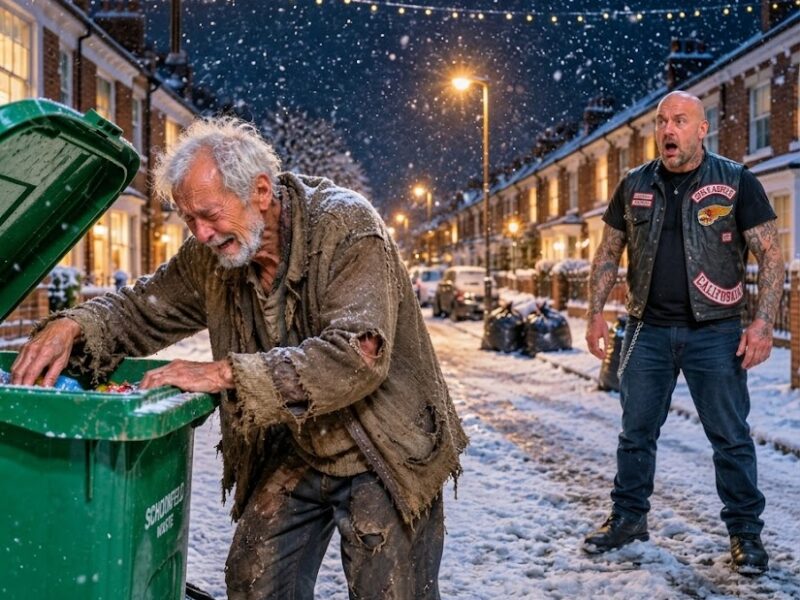
A Hells Angel saw an old man digging through trash on Christmas Eve. What he did next wasn’t just kindness. It was a debt paid in full.
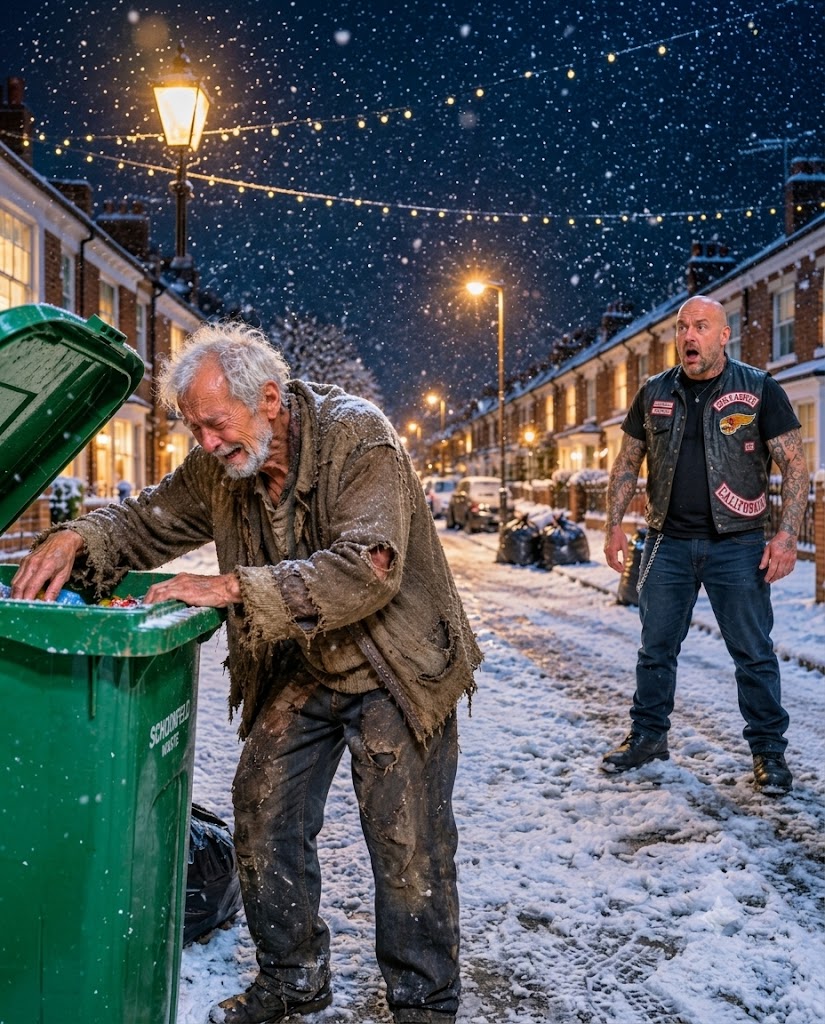
A hand shoved hard into an old man’s chest. He stumbled back and hit the dumpster with a hollow bang.
A plastic bag of cans spilled across the ice. He went down on one knee, fingers scraping the frozen pavement for a half-eaten sandwich that had rolled under a car.
Snow was falling. Nobody stopped.
A man in a clean red vest stood over him, pointing a finger, shouting about customers and cops. Then a motorcycle engine cut out across the lot.
Boots hit the ground. A big man in black leather walked over to them slow, a one-eyed shepherd at his heel.
That old man’s name was Walt Hensley. And the rider kneeling down beside him in the snow was a Hell’s Angels Road Captain named Dutch Mercer.
What Dutch did in the next three hours would empty an entire clubhouse before midnight. Stay with me on this one.
Now, here’s the thing you need to understand about Dutch Mercer. He was not a man who went looking for trouble.
Fifty-one years old, gray coming in thick at his beard. He’d ridden with the Duluth chapter almost thirty years.
And the last fifteen of those he’d worn the road captain patch, which meant when forty bikes rolled out, Dutch was the one up front deciding where they went and how fast.
Men listened to him, not because he was the loudest, because he was the calmest. In a club full of hard cases, Dutch was the one who talked people down.
He’d broken up more fights than he’d ever started. He’d buried friends and raised money for their widows and sat in more than one hospital hallway all night.
Thirty years teaches a man the difference between noise and trouble, and Dutch had stopped confusing the two a long time ago. He’d only stopped at that gas station for fuel and a coffee.
It was Christmas Eve. The temperature had dropped to nine below with the wind, the kind of cold in northern Minnesota that gets into your teeth.
Dutch had his big shepherd riding in a sidecar bundled in a blanket. Diesel, one eye gray muzzle, lost the other to a coyote years back.
The two of them were headed to the clubhouse for the chapter’s Christmas dinner. Fuel, coffee, home. That was the whole plan.
Then he saw the old man at the dumpster. Dutch had seen plenty of rough luck in his life, but something about this stopped him cold.
The man was small and bent in a coat too thin for the weather, and he worked that dumpster with a kind of quiet method. Not frantic, not crazy, just careful.
Sorting cans into one bag, setting aside anything that still looked like food. A man doing a job he’d clearly done before and hated every second of.
He didn’t look around to see who was watching. He’d gotten past that part a while ago. That was the part that got Dutch.
A man stops caring who sees him only after he’s run clean out of other choices. And then the kid in the red vest came out.
He couldn’t have been more than thirty. Store manager by the little badge. He came out fast and mean, and he didn’t ask the old man to leave.
He shoved him right in the chest, called him garbage, said he was scaring off paying customers, and that he’d have the cops haul him away before the night was out.
That was when Dutch cut his engine. He didn’t rush. He never rushed.
He swung his leg off the bike, told Diesel to stay, and the dog’s one eye tracked him across the lot. Dutch walked over through the falling snow, and the manager heard the boots and turned.
And for a second, the kid’s face did that thing a bully’s face does when the math changes. Because Dutch in black leather with that beard and those shoulders and that patch was a different kind of arithmetic than a freezing old man.
Dutch didn’t look at the manager at all. He crouched down in the snow next to the old man and put one big hand on his shoulder, gentle.
“You hurt?” Dutch asked. The old man shook his head.
His hands were shaking though, and not just from the shove. The cold had him. His lips were going blue at the edges.
“Can you stand?”
“I can stand,” the old man said, and there was something in his voice. Steadier than you’d expect. A man who’d been knocked down before and knew how to get up. “I’m not looking for any trouble. I’ll move along.”
“You’re not moving anywhere yet,” Dutch said. Then he looked up at the manager. “What’s your name, son?”
The manager puffed himself up. “I’m the manager, and this is private property, so unless you’re buying something, you can take your biker buddy and—”
“I asked your name.”
Something in the way Dutch said it made the kid stop. “Kyle,” he said.
“Kyle.” Dutch nodded slow like he was filing it away. “You put your hands on this man, Kyle.”
“He’s been digging through our trash for an hour. Customers complained. I’m within my rights to—”
“I didn’t ask about your rights. I asked if you put your hands on him.”
Kyle didn’t answer. That was answer enough.
Dutch helped the old man to his feet. The bag of cans he picked up himself and tied off careful like it mattered because he could see that it mattered to the man who’d collected them.
And that was when he got his first real look at the old man’s face. Weathered, sharp blue eyes, and on the back of one shaking hand faded almost to nothing, an old tattoo.
An eagle. Military.
“You serve?” Dutch asked.
The old man straightened a little. “Army. Twenty-two years. Motor pool mostly. I fixed things.” A small tired smile. “I was good at it once.”
Dutch went very still. Here’s what you don’t know yet. And here’s where this whole thing turns.
“What’s your name?” Dutch asked.
“Hensley,” the old man said. “Walt Hensley.”
For a long moment, Dutch didn’t say anything at all. The snow kept falling. Kyle was still standing there, cold and impatient and not understanding why this huge biker had gone quiet.
But Dutch understood because he knew that name. He’d grown up hearing that name.
Walt Hensley. Decades back, before Dutch ever wore a patch, when the Duluth chapter was young and broke, and half their bikes were held together with spit and prayer, there had been a mechanic.
An army man who worked days at the base motor pool, and nights in a cold garage off Superior Street, fixing Harleys for a club full of men most of the town crossed the road to avoid.
He charged them half what the shops downtown would, and when they couldn’t pay that, he ran a tab and never once came to collect. He never judged them.
When a founding member named Ray Kowalski wrapped his bike around a guardrail, and the ambulance wouldn’t come fast enough to that stretch of county road, it was Walt Hensley who kept Ray breathing in the back of his own truck all the way to the hospital.
Ray lived forty more years because of that. Ray had been dead six years now, but every man in that clubhouse still knew the story. And the mechanic in the story had a name.
Walt.
Dutch looked at this freezing old man digging cans out of a dumpster on Christmas Eve, and he felt something go tight in his chest.
“Walt,” he said quietly. “Walt Hensley, you used to run a garage off Superior. You fixed bikes for the club a long time ago.”
The old man blinked. Snow on his lashes. “How in the world would you know that?”
“Because you kept Ray Kowalski alive,” Dutch said. “And I’m Dutch Mercer. I ride with the same club. We never forgot you, old man. We just lost track.”
Walt’s face came apart a little. Then, not crying, just something letting go that he’d been holding a long time. For a second, he looked like he didn’t quite believe his own ears, like a man who’d been talking to himself so long he’d forgotten anybody else might answer.
Kyle finally found his voice again. “This is touching and all, but I’ve got a store to run and he still can’t be here. I’m calling the police.”
Dutch stood to his full height and turned around. And for the first time, he gave Kyle the full weight of his attention.
“You do that,” Dutch said. “Call them. I’ll wait right here. And when they get here, you can explain why you put your hands on a seventy-eight-year-old disabled veteran in nine-below weather on Christmas Eve. I’m sure that’ll go great for you, Kyle.”
Kyle’s mouth opened and closed.
“Go back inside,” Dutch said. “Warm up. We’ll talk in a minute.”
And the kid went, not because he wanted to, because he didn’t have a single good card left to play. Dutch walked Walt over to his bike.
He pulled the blanket off Diesel, who grumbled but allowed it, and wrapped it around the old man’s shoulders himself. Then he dug a thermos out of his saddlebag and poured coffee into the cup and pressed it into Walt’s hands.
“Drink,” he said. “Slow.”
Walt drank. His hands steadied. And under that falling snow, the whole story came out of him. He told it plain. The way old men tell the truth once they decide to.
After the army, he’d kept the garage going. Married a woman named Ruth. No kids. He fixed cars and bikes for thirty years and was happy enough.
Ruth kept the books, packed his lunch, left the porch light on. He said that part like it still surprised him that a man could have thirty good years and not notice how good they were until they were gone.
Then Ruth got sick. Cancer. The medical bills ate the garage first, then the savings.
He sold the shop. He sold the house and moved them into a little rented apartment so he could spend every last dime keeping her comfortable. He didn’t regret a cent of it. He’d spend it all again twice over.
Ruth died four years ago in the spring. And then Walt said it just got away from me. The money.
“I had my army pension. Should have been enough. But there was a mix-up with the paperwork after Ruth passed. Something about her survivor benefits getting tangled with mine and the check stopped. I’ve been fighting it three years.”
“You call, you wait on hold. They tell you to send a form. You send it. Nothing. Then you call back and it’s a new person and they can’t find the first form. So you start all over.”
“I’m not good with all that. Ruth did the paperwork. She was the smart one.”
He took another sip of coffee.
“I get a little from social security. Covers the rent and not much else. So the last week of every month when it’s thin, I come out and collect cans. Eight cents a piece. It’s honest. I’m not ashamed of it.”
But his voice caught on that last part, and both of them heard it.
“Where are you living now?” Dutch asked.
And here’s where it got worse. Because Walt looked down at his boots and he didn’t answer right away.
“Walt, where are you living?”
“The Pinewood,” Walt said finally. “Off Central. Been there since Ruth.” But he stopped.
The building got sold last year. New company. They’ve been pushing the old tenants out. Raising the rent, letting things break. My radiator’s been cold since November.
You call, nobody comes. You get the feeling that’s the point, that they’d just as soon the cold did their work for them. I fell behind two months. I’ve got an eviction notice.
He pulled it from his coat pocket, folded into a tight little square, soft at the creases from being read too many times.
“Sheriff’s supposed to come tonight. Midnight. They said it for tonight on purpose, I think. To make a point.”
Dutch took the paper and read it under the sign light. His jaw worked.
“They’re putting you out on the street on Christmas Eve at midnight.”
“That’s what it says,” Walt said quietly.
“I came out here tonight because I didn’t want to sit in that apartment and watch the clock. Figured I’d rather be moving. Collect a few cans. Keep busy.”
He managed a small broken laugh. “Didn’t plan on getting shoved into a dumpster. That’s a new low even for me.”
Dutch folded the eviction notice back up and handed it to him. For a long moment, he just stood there in the snow, one hand on Walt’s shoulder, the other on the seat of his bike.
Diesel leaned against his leg, and then something in Dutch’s face eased. The anger went somewhere else, somewhere colder and more useful.
“All right,” he said. “You listen to me now, Walt. You’re done collecting cans tonight. You’re freezing and you’re exhausted and I’m not having it.”
“There’s a diner attached to the station. We’re going in there and you’re going to sit in a warm booth and eat a hot meal and I’m buying. No argument. Then I’ll run you home. Okay?”
Walt studied him. Thirty years of hard luck had taught him not to trust much. He’d had people be kind before and found there was a bill attached to it later.
But there was something in this big man’s eyes that he decided finally he could trust.
“Okay,” Walt said. “Okay. Thank you.”
So they went inside. Dutch held the door. He walked Walt past Kyle, who was pretending to count register receipts and wouldn’t look at either of them, and settled the old man into a booth near the heater.
He ordered him the Christmas special, turkey and mashed potatoes and gravy, and a slice of pie and more coffee. He let Diesel in too, and dared anyone to say a word about it, and nobody did.
Walt ate slow at first, then faster, like a man who’d forgotten what a full plate felt like. The color came back into his face.
He told Dutch a funny story about Ray Kowalski and a carburetor. How Ray had once ridden forty miles on a bike Walt swore shouldn’t have started just to prove him wrong. And how it died right in the clubhouse lot the second he got there.
Dutch laughed. Really laughed. And for a few minutes the whole terrible night just melted away.
It felt sitting there like the worst was over. Like maybe it was just going to be a sad story with a warm ending. A hot meal, a ride home, a kind stranger on a cold night.
Walt wiped his mouth, leaned back in the booth, and let out a long, contented breath. “First time I’ve been warm in two days,” he said. He closed his eyes for just a second. “I could sit here forever.”
That was the moment the glass door swung open and the cold came back in. Kyle was standing by the register with a phone pressed to his ear and he was smiling now. A nasty little smile.
He hung up and walked over to the booth and looked down at the two of them.
“Just talked to the owner,” Kyle said. “My uncle. He owns this station. He let that hangar and a few other things in this town, including the Pinewood apartments over on Central.”
His smile got wider. “Small world, huh, Walt?”
The whole thing changed shape right there because this wasn’t a mean kid and a store anymore. Dutch understood it in a second. The way you understand a shadow is a snake.
The same family that owned this gas station owned the building putting Walt out on the street. The company raising the rents, letting the pipes freeze, serving midnight eviction papers on old veterans to clear them out faster.
It all ran back to the same people. This wasn’t one bully. This was a machine. And the old man at this table was being ground up by it quietly. On the one night of the year nobody was supposed to be alone.
“My uncle says if the squatter’s giving you trouble, Kyle, you call the sheriff and move the timeline up,” Kyle said, reading off his phone, enjoying every word.
“Says he can have a deputy clear the Pinewood unit by ten tonight instead of midnight. Early Christmas present.”
He looked at Walt. “So finish your free dinner. Your biker friend can’t buy you a home.”
Walt’s face had gone gray again. The warmth was already draining out of him. His hand found the folded eviction notice in his pocket like a man reaching for something to hold on to.
But Dutch didn’t get angry. That’s what Kyle wanted. That’s the whole trap of a man like that. He wants you loud so he can call the cops and be the victim.
Dutch did something else. He reached into his vest, took out his phone, and stood up from the booth.
He put one hand on Walt’s shoulder. “Eat your pie, Walt,” he said quietly. “I’ll be right back.”
He walked to the far corner of the diner by the window where the snow was piling up on the sill and made one phone call. Nobody heard what he said.
It was short, maybe twenty seconds. Then he slid the phone back into his vest and came and sat back down across from Walt, calm as still water, and picked up his coffee.
Kyle frowned. “Who’d you call?”
“Friends,” Dutch said. “Sit down if you want, Kyle. Might be a few minutes.”
If you’re still with me this far and you want to see how this ends, do me one favor. Hit that subscribe button. Because what rolls into this parking lot next is the part nobody in that diner ever forgot.
Kyle didn’t sit down. He hovered. He kept checking the window, kept checking his phone, waiting for his deputy to show up and solve his problem.
The minutes stretched out. He tried a couple more times to needle the old man. Something about the pie. Something about how the shelter downtown might still have a cot if Walt hurried.
Dutch didn’t rise to any of it. He just drank his coffee and watched the window. And after a while, even Kyle ran out of things to say.
Walt ate his pie slow because Dutch had told him to. And because a man who’s been hungry doesn’t waste pie no matter what’s coming.
And then they heard it. It started low under the wind. A rumble.
Then it grew and it kept growing until the window glass began to buzz in the frame and the coffee trembled in the cups and the Christmas lights over the register shivered on their wire.
It was the sound of engines. A lot of engines.
Kyle went to the window. His face changed.
Headlights were pouring into the lot. Not two or three. A river of them. Motorcycles rolling in two by two out of the falling snow. Engines thundering. Chrome catching the gas station light.
Forty of them. Leather and patches and frost on their beards filling every inch of that parking lot and spilling onto the shoulder of the road.
The Duluth Chapter. Dutch’s phone call had gone to the clubhouse in the middle of their Christmas dinner, and every single man had put down his fork, pulled on his jacket, and rolled out into nine-below weather without asking why.
Because the road captain had called, and the road captain only called like that for one reason.
They cut their engines all at once. The silence after was enormous.
Then the diner door opened and they came in. Not all of them. The place wasn’t big enough. But enough big men, cold dread in their beards, filling the doorway and the aisle.
At the front was a huge older man with a white beard and a cane and a patch on his chest that said the one word that mattered most in that room. He was the chapter president.
His name was Bear, and he was Ray Kowalski’s younger brother.
Bear walked straight past Kyle like the kid wasn’t even there. He stopped at the booth. He looked down at the small bent old man in the borrowed blanket and his eyes filled up.
“Walt Hensley,” Bear said, and his voice cracked right down the middle. “My God. My brother told me about you my whole life. You kept Ray breathing in the back of your truck on County Road 7. You gave my family forty more years with him.”
He reached out and took Walt’s thin hand in both of his huge ones.
“We’ve been looking for you two years, old man. Ray made us promise before he went that we’d find you and look after you. We went by the old garage. It was a nail salon. We didn’t know you were right here. We didn’t know.”
Walt couldn’t speak. His mouth worked and nothing came out. Tears ran down into the gray stubble on his cheeks.
That’s when Kyle made his last mistake.
“Okay, this is a fire code violation and I’ve got a deputy coming, so all of you need to—”
Bear turned around slowly and forty men turned with him. And the diner went so quiet you could hear the snow hitting the window.
“You’re the one,” Bear said. “You put your hands on him in the lot. Dutch told me on the phone.”
He took one step toward Kyle. “And your family’s the one throwing him out tonight. Christmas Eve midnight.”
Kyle’s bravado finally cracked because forty men do a particular kind of math to a bully.
“I’m just doing my job,” he said, and his voice had gone thin. “It’s not personal. It’s business. The rent’s the rent.”
“How much?” Bear said.
“What?”
“How much does he owe? The back rent. The whole thing. Say the number.”
Kyle swallowed. “It’s two months. With the late fees and the—it’s about twenty-two hundred.”
Bear didn’t even look back. He just said, “Boys.”
And it was the most remarkable thing. Forty men reached into forty jackets. Crumpled bills, cold-stiffened fingers, a Christmas dinner’s worth of men emptying their wallets into a snow-dusted pile on the diner table.
Twenties and fifties and hundreds. Nobody counted what he put in. Nobody made a show of it. It took about ninety seconds.
When they were done, there was far more than twenty-two hundred on that table. Closer to nine thousand.
“Count out what he owes,” Bear told Kyle. “You’re going to call your uncle right now on speaker and tell him the Pinewood unit is paid current in full tonight with witnesses. And then you’re going to tell him the eviction is cancelled.”
“And then you and me are going to have a longer conversation about how a company that takes government housing money freezes out old veterans at midnight on Christmas. Because I know people at the city too, son. The newspaper, the housing board, a couple of lawyers who do this kind of thing for free just because it makes them feel good. And they’re going to be real curious about the Pinewood.”
Kyle made the call. His hand was shaking so bad he could barely hold the phone. His uncle, a smooth voice on speaker that went very careful, very fast once he understood exactly how many Hell’s Angels were standing in his gas station diner, agreed to everything.
The rent was marked paid. The eviction was cancelled in writing, texted to Walt’s own phone while they stood there. The uncle even offered unprompted to review the other tenants’ situations in the building.
Bear told him he’d be checking, and he meant it. That part was real and it stuck. The Pinewood stopped its midnight evictions after that night. The heat got fixed. A whole building full of old folks got to stay in their homes because one road captain stopped for coffee.
But the money and the paperwork, that wasn’t the thing. Here’s the thing.
Dutch stood up and put his arm around Walt’s shoulders and faced the room. “There’s one more piece of business,” he said.
He looked down at the old man. “Walt, you spent twenty-two years fixing things for this country and ten more fixing bikes for this club when nobody else in this town would give us the time of day. You kept Ray alive. You never asked us for one thing in return. Not once.”
“Well, we’re asking you for something now.”
He nodded to Bear. Bear reached inside his own jacket and pulled out something small and set it on the table in front of Walt.
It was a patch. A club patch, worn soft, stitched by hand. It read: Walt “Doc” Hensley, Honorary Lifetime Member, Duluth.
“Ray had this made thirty years ago,” Bear said, his voice breaking all over again. “He wanted to give it to you himself. The crash, then the years. It never happened. I’ve carried it in my jacket for six years, hoping I’d find you so I could finish what my brother started.”
He pushed it across the table. “Your family, Walt. You always were. We just lost the thread for a while. You’re not spending another night of your life alone. Not one. You hear me?”
And the old man who’d been shoved into a dumpster three hours earlier for the crime of collecting cans to survive. The old man who’d lost his wife and his home and his place in the world picked up that patch with both shaking hands and held it against his chest and wept.
Forty of the hardest men in northern Minnesota stood in a gas station diner on Christmas Eve and wept right along with him, and not one of them was ashamed.
They did not drive Walt home to a cold apartment that night. They took him to the clubhouse, his home now, as much as anyone’s.
They bundled him onto the back of Bear’s trike with Dutch’s blanket around his shoulders and Diesel in the sidecar beside him. And forty engines fired up at once and shook the snow off the gas station roof.
And they rode out of that lot in a thunder you could hear across half the city.
Kyle stood in the window and watched them go. He got fired two weeks later when his uncle decided a nephew who’d caused all that was more trouble than he was worth. But nobody at that clubhouse ever thought about Kyle again.
He wasn’t part of the story. He was just the small cold thing the story had to push past to get where it was going.
The clubhouse was warm and loud and smelled like turkey and woodsmoke. They sat Walt at the head of the long table in the president’s own chair and brought him a plate piled so high he laughed out loud.
Old men and young ones crowded around him all night asking about Ray, about the old garage, about the army, and Walt talked and talked. Decades of stories finally finding ears that wanted them.
Somebody found a guitar. Somebody else burned the second batch of rolls. Diesel slept under the table with his gray head on Walt’s boot, that one good eye closing slow in the warmth.
Around midnight, the exact hour a deputy was once supposed to put him out on the frozen street, Walt stepped onto the clubhouse porch for a little air.
Dutch found him there, looking up at the snow coming down soft through the floodlights.
“You all right, Doc?” Dutch asked. The name had already stuck. It would stick for the rest of his life.
“I keep waiting to wake up,” Walt said. He had the patch in his hand. He hadn’t let go of it all night.
“I was going to be on the street tonight, Dutch. I made my peace with it best I could. I figured this was the year I didn’t make it through the winter.”
He said it plain, the way he said everything. “And instead I’m standing here and I’ve got more family than I know what to do with and a bed waiting and this.”
He held up the patch. “A man can’t take that in all at once.”
“You don’t have to take it in all at once,” Dutch said. “You’ve got time now. We’ll see to that.”
Walt was quiet a while. The snow fell inside. Somebody started singing off-key and everybody laughed.
“You know what I was reaching for,” Walt said finally. “When that boy shoved me into the dumpster. A half-eaten sandwich. Rolled under a car. I was going to be glad to have it.”
He shook his head slowly. Wonder and grief all mixed up together. “Three hours ago. Three hours.”
Dutch put a hand on the old man’s shoulder. The same shoulder he’d steadied in the snow at the start of the night.
“Come inside, Doc,” he said. “Your plate’s getting cold, and you’ve got forty guys in there who have been waiting thirty years to say thank you. Don’t make them wait any longer.”
So Walt Hensley went back inside into the warmth and the light and the singing. And he was not alone that Christmas or any Christmas after it.
He lived another six years. He spent most of them in that clubhouse fixing bikes again when his hands would let him, telling stories when they wouldn’t, sitting at the head of the table in the president’s chair that nobody ever asked him to give back.
When he passed in his sleep, warm with people who loved him, forty motorcycles rode behind the hearse through the streets of Duluth in a thunder you could hear across half the city.
And every year on Christmas Eve, that chapter sends a few riders out to drive the cold streets of the city. They look in the doorways. They check the dumpsters. They stop for the bent old figures that everybody else drives past.
Because one of their own, a quiet man who fixed things and never asked for a thing, taught them what it costs a person to be invisible on the coldest night of the year.
And what it’s worth to somebody.









