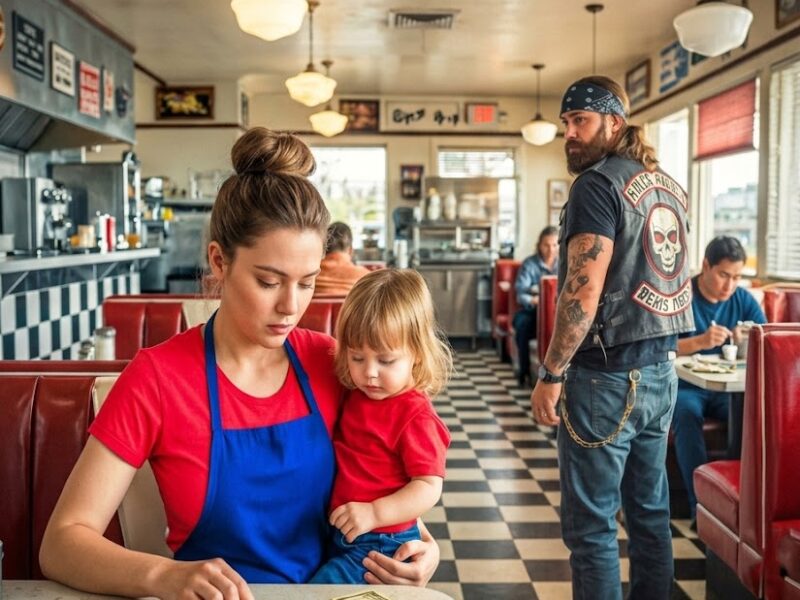
A Hell’s Angel left a $0 tip — and what the single-mom waitress found under his plate changed her life forever.
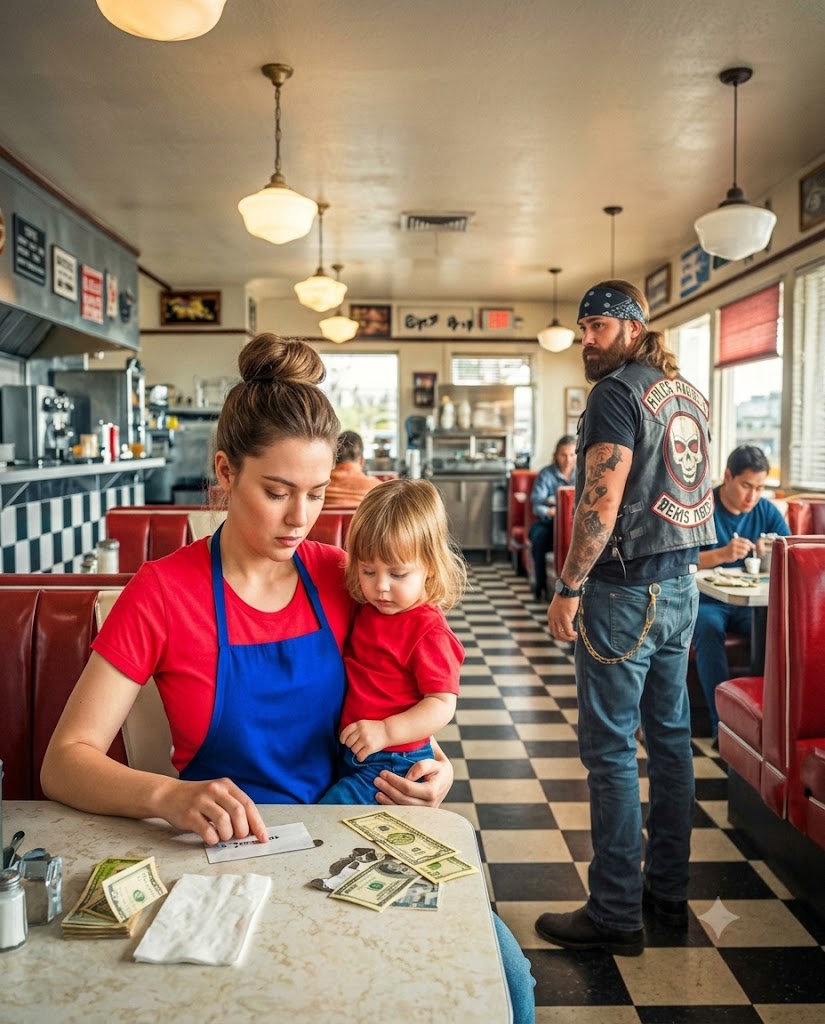
The receipt lay on the worn Formica table like a small betrayal.
Zero dollars, not even loose change, just that blank line where gratitude was supposed to live.
For Natalie Cross, standing in the corner booth of the Lonesome Highway Diner, with the smell of fried onions and diesel fuel mixing in the air, that empty space felt like another door closing.
She folded the receipt slowly, tucking it into her apron pocket next to the grocery list she’d been mentally revising all afternoon.
Because this wasn’t just about the tip, it was about another confirmation that survival required more than hard work and hope.
Natalie was twenty-nine, a single mother holding together a life that felt perpetually balanced on the edge of a knife.
She worked the dinner shift at the Lonesome Highway Diner, a truck stop on the outskirts of Millbrook, a town so small it didn’t appear on most maps.
Her days began at three hundred p.m. after she’d walked her six-year-old son, Tyler, to her sister’s apartment three blocks away.
Tyler was bright and curious, always asking questions about stars and dinosaurs and why the sky changed colors.
Natalie answered what she could while mentally calculating how many shifts she needed to cover his new shoes, the overdue electric bill, the ever-growing stack of things that needed fixing but would have to wait.
She wore her exhaustion quietly, the way you carry something heavy for so long you forget what it feels like to put it down.
Her uniform, a red and white checkered shirt and black jeans, had been washed so many times the fabric felt thin as paper.
But she showed up every shift on time with a smile that was real, even when everything else felt like it was falling apart.
The diner itself had character, the kind that comes from decades of service.
Vinyl booths patched with duct tape, a jukebox in the corner that still played scratchy vinyl, walls covered in faded photographs of truckers and travelers who’d passed through over the years.
Natalie knew every crack in the floor, every sticky spot on the counter, every quirk of the ancient coffee maker that required exactly the right touch to work properly.
This place had become her second home, though she dreamed of something more for Tyler, something better than watching his mother’s dreams dissolve into double shifts and late nights.
That evening had been especially brutal.
The Saturday crowd came in waves, truckers passing through, families escaping their own kitchens, regulars who knew Natalie’s name and left reasonable tips.
She’d been on her feet for six hours straight when they arrived.
Three motorcycles roared into the parking lot just after eight p.m., their engines cutting through the din of conversation and clinking silverware.
Everyone noticed.
Conversations paused mid-sentence.
A few customers glanced toward the door with expressions that ranged from curiosity to concern.
The sound was thunderous, then suddenly silent as the engines cut off one by one.
When the door swung open, three men walked in wearing leather vests decorated with patches and symbols Natalie couldn’t quite read from across the room.
Hell’s Angels, or at least that’s what the whisper suggested.
The one who led them was impossible not to notice.
Tall, broad-shouldered, with silver threading through his dark beard and eyes that seemed to take in everything without judgment.
His vest bore more patches than the others, intricate designs that spoke of years and miles and stories Natalie would never know.
Tattoos crawled up his neck, disappearing into his collar.
His hands were scarred, the kind of scars that come from real work and real life.
His name, she’d learned later from the credit card slip, was Jackson Reaper Stone, a name that carried weight in circles she’d never traveled.
They took the corner booth, the largest one, and settled in with the easy confidence of men who’d sat in a thousand diners just like this.
Natalie approached their table with the same professionalism she brought to everyone, notepad ready, water glasses already filled.
Her hands trembled slightly, not from fear exactly, but from the accumulated stress of the day and the intimidating presence of men whose very appearance seemed designed to keep people at a distance.
“Evening, gentlemen, what can I get you?”
Reaper looked up at her, and something in his gaze made her pause.
It wasn’t threatening.
It wasn’t cold.
It was searching, the way someone looks when they’re trying to understand something important.
He studied her name tag, then her face, then the small cross necklace she wore, a gift from her grandmother that she never took off.
“Coffee,” he said, his voice rough but not unkind.
“Black, and whatever your breakfast special is, even though it’s dinner.”
The other two ordered burgers and fries, speaking less, watching more.
One had kind eyes despite his imposing appearance.
The other seemed perpetually amused by something only he understood.
Natalie wrote quickly, repeated the order back, and headed to the kitchen.
Behind her, she heard the manager, Carl, muttering something about “those types” and keeping an eye on things.
Natalie didn’t respond.
She’d learned years ago that judging people by their appearance was a luxury she couldn’t afford.
She’d been judged enough herself, the single mother who couldn’t make it work, the woman who trusted the wrong man and was now paying for it alone.
She brought their food promptly, refilled their coffee without being asked, checked back once to make sure everything was to their satisfaction.
Reaper nodded each time, barely speaking, but his eyes followed her movements around the diner.
Not in a way that made her uncomfortable, but with attention that felt oddly respectful, like he was taking notes on something only he understood.
She watched him from the corner of her eye as she served other tables.
He ate methodically, occasionally speaking in low tones to his companions.
Once she saw him look toward the window, toward the parking lot where a beat-up Honda Civic sat under the flickering street light.
Her car, the one with the taped-up window and the engine that coughed every morning like it was trying to remember how to live.
The one she prayed would make it through one more winter.
Another time she caught him watching her interact with an elderly couple in the next booth.
The woman had dropped her napkin, and Natalie had retrieved it before the woman could even reach down, offering it back with a genuine smile and a gentle joke about how the napkins were trying to escape tonight.
The old woman had laughed, and Natalie had moved on to the next table without a second thought.
But Reaper had seen it.
She could feel his attention like a physical thing.
When they finished, Reaper stacked the plates neatly, a small gesture that surprised her.
Most customers left chaos behind.
He stood, nodded to his companions, and they filed out without fanfare.
The door swung shut behind them, and the diner slowly exhaled, returning to its normal rhythm.
Someone turned up the jukebox.
A trucker at the counter laughed at something his companion said.
Life resumed.
Natalie approached the table with a bus tub, already composing herself for the disappointment she’d felt a hundred times before.
People who looked like they had money often didn’t tip.
People who looked like they didn’t sometimes surprised you.
She’d stopped trying to predict it.
She’d learned to accept whatever came and adjust her budget accordingly, stretching dollars like taffy until they finally snapped.
The receipt was there, signed in sharp, angular handwriting.
She glanced at the tip line.
Zero.
Her jaw tightened, not with anger, but with resignation.
She thought about Tyler’s upcoming field trip, the permission slip that required a fifteen-dollar fee she’d been trying to figure out how to cover.
She thought about the medicine he needed for his asthma, the inhaler that cost more than a week of groceries.
She thought about the parent-teacher conference next week where she’d have to explain again why she couldn’t volunteer for the holiday party because she’d be working.
She reached for the plates, stacking them with practiced efficiency, when her finger caught on something.
Paper, folded and tucked beneath the largest plate, hidden from view.
Her heart stuttered in her chest, a strange mix of hope and dread that felt almost painful.
Natalie glanced around the diner.
Carl was in the back.
The few remaining customers were absorbed in their own worlds.
She carefully pulled the paper free, unfolding it with hands that had started to tremble.
It wasn’t money.
Not at first glance.
It was a note written in the same handwriting as the signature on the receipt.
The words were simple, direct, unadorned by sentiment.
“I’ve been watching you tonight, not because I’m strange, but because I recognize something.”
“You serve everyone the same, smile the same, work the same.”
“You don’t see patches or leather.”
“You see people.”
“That’s rare.”
“That matters.”
Natalie’s breath caught in her throat.
She read on.
“I saw you look at that car in the lot.”
“I saw you count your tips three times during your break.”
“I saw the way you wrote something on your notepad that wasn’t an order, probably a bill or a list of things you can’t afford yet.”
“I know that look.”
“I wore it for years.”
Her eyes began to blur.
The diner sounds faded to a distant hum.
“This isn’t a tip because tips are for service.”
“This is different.”
“This is for noticing something in you that most people never see in themselves.”
“Dignity.”
“You work with dignity.”
“You parent with dignity.”
“You survive with dignity.”
“And that’s worth more than money.”
“But money helps.”
Beneath the note was a cashier’s check.
Not cash that could be pocketed and forgotten, but an official check made out to her name.
Natalie’s vision swam as she read the amount.
Five thousand dollars.
She sat down hard in the booth, the bus tub forgotten beside her.
Five thousand dollars.
Rent for four months.
Tyler’s field trip and new shoes and asthma medication.
The car repair she’d been postponing.
Groceries without anxiety.
A buffer, however small, between her and the cliff edge she’d been walking for years.
But there was more.
Clipped to the check was a business card.
Simple, black with white lettering.
Jackson Reaper Stone, Founder, Road to Redemption Foundation.
“We invest in people who invest in themselves.”
And a handwritten line at the bottom.
“Call if you want more than a check.”
“No strings, just opportunity.”
Natalie sat in that booth for five full minutes, the note pressed against her chest, tears streaming down her face in the semi-darkness of the corner.
Carl called her name twice before she heard him.
She wiped her eyes, composed herself, and finished her shift in a daze, moving through the motions on muscle memory alone.
Every time she touched the check in her pocket, she wondered if it was real.
If this was some elaborate joke the universe was playing on her weary heart.
That night, after she picked up Tyler and tucked him into bed, Natalie sat at her tiny kitchen table and read the note again and again.
She studied the business card, running her finger over the embossed letters.
She looked up Jackson Stone online, her old laptop taking forever to load each page.
She found articles about a former Hell’s Angel who’d turned his life around, who now ran a foundation helping single parents and people overlooked by traditional systems.
A man who’d been homeless once, who’d spent time in prison for mistakes he’d made as a young man, who’d lost everything and built it back through grit and unlikely generosity from strangers who saw past his patches.
There were photos of him at community centers, at job fairs, at high schools, talking to at-risk youth.
In every picture, he wore the same vest, the same patches, never hiding who he was or where he’d come from.
The articles called him controversial.
Some praised his work.
Others questioned whether a man with his past should be given platforms and funding.
But the people he’d helped, the testimonials scattered through the articles, they all said the same thing.
He saw them when no one else did.
She didn’t sleep that night.
She thought about dignity, about being seen, about the fact that someone wearing a leather vest covered in symbols she’d been taught to fear had looked at her and recognized something worth investing in.
She thought about all the assumptions she’d made about people, about the boxes she’d put them in based on nothing more than appearance.
She felt ashamed and grateful and terrified all at once.
The next morning, Natalie called the number on the card.
A woman answered, warm and professional.
And when Natalie stammered through her story, the woman simply said, “Reaper told us you’d call.”
“He’s usually right about people.”
“When can you come in?”
The foundation’s office was in a renovated warehouse an hour away.
Natalie drove there on her day off, Tyler strapped in the back seat, asking endless questions about where they were going and why.
The building looked industrial from the outside, but inside it was warm, filled with light and the sound of people working together.
There were desks and computers, a kitchen area where someone was making coffee, and walls covered with photos of success stories.
Weeks became months.
Natalie didn’t quit her job immediately.
She learned that Road to Redemption Foundation worked differently than traditional charities.
They didn’t just hand out money.
They provided mentorship, training, resources, and networks.
They connected people to opportunities that had always existed but had been invisible from where Natalie stood.
They taught her about budgeting, about credit, about the systems that kept people trapped in cycles of poverty and how to navigate them.
Reaper met with her twice.
Once at a coffee shop where he sat across from her in jeans and a plain t-shirt, looking more like a professor than a biker, explaining his philosophy.
“Everyone deserves a second chance.”
“Sometimes a third or fourth.”
“I got mine from people who didn’t look like they should care.”
“An old lady who gave me a place to sleep when I was on the streets.”
“A judge who gave me work release instead of more time.”
“A stranger who hired me when no one else would.”
“Now I pass it on.”
He told her his story, not to impress her, but to show her that transformation was possible.
He’d grown up in poverty, fallen into gang life, made mistakes that cost him years of his life.
But somewhere along the way, someone had invested in him, not with money, but with belief.
And that belief had changed everything.
The second time was at the Lonesome Highway Diner.
He sat in the same booth, ordered the same meal, left the same zero tip, and the same hidden note.
This one simply said, “You’re doing great.”
“Keep going.”
“Tyler’s lucky to have you.”
The mention of her son’s name made her cry right there in the booth because it meant Reaper remembered.
It meant this wasn’t just charity, it was care.
Natalie used the foundation’s resources to take online courses in business management.
She discovered she had a talent for logistics and organization that she’d been using all along, just without recognition.
The foundation connected her with a small business owner looking for an operations manager.
The pay was better, the hours were stable.
For the first time in years, Natalie could afford to breathe.
But she didn’t forget the Lonesome Highway.
On weekends, she still picked up occasional shifts, not because she needed the money, but because she remembered what it felt like to work there, to be invisible.
And now she could see others the way Reaper had seen her.
She started small, leaving her own hidden notes for servers who looked exhausted.
Twenty-dollar bills tucked under plates for single parents she recognized by the tired eyes and quick calculations.
She couldn’t leave thousands, but she could leave hope.
And sometimes hope was worth more than any dollar amount.
Two years later, Natalie stood in a small community center in Millbrook, helping to open a satellite branch of Road to Redemption Foundation.
Tyler, now eight, sat in the front row, proudly wearing a button that said, “My mom helps people.”
The center would provide resources, mentorship, and small grants to local families struggling the way Natalie once had.
Reaper came to the opening.
He still wore his vest, still rode his motorcycle, still looked like someone people would cross the street to avoid.
He stood in the back, arms crossed, watching Natalie speak about second chances and dignity and the importance of seeing past surfaces.
Afterward, he approached her, extending his hand.
“You did good, Natalie.”
She shook it, then pulled him into a hug that surprised them both.
“You saw me when I was invisible.”
He stepped back, a rare smile creasing his weathered face.
“You were never invisible.”
“You were just surrounded by people who weren’t paying attention.”
Before he left, he sat once more at a table in the community center’s small cafe area.
Natalie brought him coffee, black without asking.
When he stood to leave, she checked the table and found what she expected.
A receipt with a zero-dollar tip and a folded note.
“Some angels wear wings, some wear leather.”
“Keep looking past the surface.”
“You’ll find more of us than you think.”
Natalie kept that note in a frame on her desk, not as a reminder of the money, which had been spent long ago on practical things that changed her life in practical ways, but as a reminder of something more valuable.
The moment someone looked past her exhaustion and her circumstances and saw the person underneath, the person who’d been there all along, working with dignity, loving with dedication, surviving with grace.
Years passed.
Natalie’s story inspired others.
The foundation grew.
Tyler thrived, asking questions about how to help people the way his mom did.
Natalie still worked hard, still worried sometimes, still struggled with bills and life’s unexpected turns.
But she no longer walked along the cliff edge.
She’d built something sturdier beneath her feet.
And every year, on the anniversary of that night at the Lonesome Highway Diner, Natalie returned.
She sat in the corner booth, ordered whatever the special was, and left a note under her plate for whatever server happened to work that shift.
Sometimes it was just encouragement.
Sometimes it was a check.
Always it ended the same way.
“This is not a tip.”
“This is for your dignity.”
“Pass it on when you can.”
Because she’d learned that the world doesn’t change through grand gestures alone.
It changes in the quiet moments under plates and inside folded notes.
It changes when someone wearing an unexpected uniform sees you, really sees you, and decides that your dignity is worth investing in.
It changes when angels arrive on motorcycles instead of clouds, wearing leather instead of robes, offering not salvation but something more practical, a second chance.
And it changes when you accept that chance, use it well, and then spend the rest of your life looking for others standing where you once stood, invisible and exhausted, and worthy of being seen.
Because sometimes the angel you need doesn’t look like what you expected.
And sometimes zero dollars on a receipt means everything.
—
The fluorescent lights of the Lonesome Highway Diner hummed their familiar electric hymn as Natalie Cross wiped down the counter for the third time that hour, not because it needed it, but because idle hands made room for anxious thoughts she couldn’t afford.
Her reflection in the stainless steel napkin dispenser showed a woman who looked older than twenty-nine, shadows under her eyes that no amount of concealer could hide, a tightness around her jaw that had become permanent sometime in the last three years.
She thought about the stack of envelopes on her kitchen table, the ones she’d been avoiding opening because they all said the same thing in different ways, that she owed more than she had, that time was running out, that the grace period was over.
The bell above the door jingled, and Natalie looked up, ready to greet whoever walked in with the same warmth she gave everyone, because that was who she was, even when she felt hollow inside.
A man in a gray suit walked in, carrying a briefcase, looking about as out of place as a penguin in the desert.
He glanced around the diner with barely concealed disdain, then chose a booth near the window, the one with the cracked vinyl seat that Natalie had been meaning to tell Carl about for weeks.
She grabbed a menu and headed over, notepad already in hand, smile already in place.
“Welcome to the Lonesome Highway, what can I get started for you?”
The man looked up at her, and something in his expression shifted, a flicker of recognition that made Natalie’s stomach tighten with unease.
“You’re Natalie Cross?”
The question caught her off guard.
“I am.”
“Can I ask who’s asking?”
The man reached into his briefcase and pulled out a manila envelope, thick with documents, the kind that made Natalie’s heart rate spike because nothing good ever came in envelopes like that.
“My name is Gerald Pines.”
“I’m an attorney with Hargrove and Associates.”
“I’ve been trying to reach you for several weeks.”
Natalie’s hands went cold.
“Is this about the medical bills?”
“I’ve been making payments, I swear, I just need a little more time.”
The attorney held up a hand, his expression softening slightly.
“This isn’t about debt collection, Ms. Cross.”
“This is about an inheritance.”
Natalie blinked.
“I’m sorry?”
“An inheritance.”
“From whom?”
“Your grandmother, Margaret Cross.”
“She passed away three months ago.”
Natalie felt the world tilt beneath her feet.
“My grandmother died?”
“But I didn’t even know she was sick.”
“We weren’t close, but I would have…”
She trailed off, realizing she didn’t even know what she would have done, because she hadn’t spoken to her grandmother in years, not since the old woman had disapproved of Natalie’s pregnancy, had called her foolish and reckless and told her she was throwing her life away.
The attorney opened the envelope and spread documents across the table.
“I understand this is a shock.”
“Your grandmother left specific instructions in her will.”
“She wanted you to have this.”
He slid a cashier’s check across the table.
Natalie looked down at it, her vision blurring, because the number didn’t make sense, couldn’t make sense, because it was more money than she’d ever seen in her life.
Fifty thousand dollars.
She looked up at the attorney, her mouth opening and closing like a fish gasping for water.
“I don’t understand.”
“We hadn’t spoken in years.”
“She didn’t even like me.”
The attorney smiled, a genuine smile that crinkled the corners of his eyes.
“Your grandmother was a complicated woman.”
“She had her reasons for the distance.”
“But she never stopped loving you.”
“She told me that before she passed.”
“She said she was proud of you, of the woman you’d become, of the mother you are to your son.”
Natalie pressed a hand to her mouth, trying to hold back the sob that was building in her chest.
“She also left a letter.”
The attorney pulled out a smaller envelope, sealed with wax, the kind of thing that belonged in another century.
“I’ll leave you to read it in private.”
He stood, gathering his briefcase.
“If you have any questions, my card is in the envelope.”
“And Ms. Cross?”
Natalie looked up at him, tears streaming down her face.
“Your grandmother wanted me to tell you that she was sorry.”
“For everything.”
“For the years she wasted being stubborn.”
“She hoped you could forgive her.”
The attorney left, the bell above the door jingling behind him, and Natalie sat alone in the booth, the check and the letter in front of her, the weight of both pressing down on her chest like a physical thing.
She opened the letter with trembling hands.
The handwriting was shaky, the letters uneven, the penmanship of a woman who’d been ill for some time.
“My dearest Natalie,” it began.
“If you’re reading this, then I’m gone, and I’m sorry I didn’t have the courage to say these things to your face.”
“I was wrong about you.”
“I was wrong about so many things.”
“I thought I was protecting you by pushing you away, by making you prove yourself, but all I did was hurt you, and I’ll never forgive myself for that.”
“You are the strongest person I’ve ever known.”
“You raised Tyler on your own, you worked yourself to the bone, you never gave up, not once, even when the world gave you every reason to.”
“I watched you from a distance, you know.”
“I saw you at the diner, serving coffee with that smile of yours, the one that reminded me of your mother.”
“I saw you with Tyler at the park, pushing him on the swings, laughing like you didn’t have a care in the world.”
“I saw the way you carried yourself, with dignity, with grace, with a strength that I never had.”
“I should have told you then.”
“I should have walked up to you and said, ‘I’m proud of you.'”
“But I was too scared, too proud, too stubborn.”
“So I’m telling you now, in this letter, in the only way I have left.”
“I’m proud of you, Natalie.”
“I love you.”
“I’m sorry.”
The letter continued, but Natalie couldn’t read anymore, because the tears were coming too fast, because the grief was hitting her like a wave, because she’d spent years thinking her grandmother hated her, and now she knew the truth, and it was too late to do anything about it.
She folded the letter carefully, tucked it into her apron pocket next to the grocery list and the receipt from earlier, and sat in the booth until her shift ended, until Carl came looking for her, until the fluorescent lights felt like the only thing holding her to the earth.
That night, she picked up Tyler from her sister’s apartment and held him tighter than usual, breathing in the smell of his hair, the smell of childhood, the smell of everything she was fighting for.
“Mommy, you’re squeezing me,” he said, laughing.
“I know,” she said.
“I just love you so much.”
“I love you too, Mommy.”
She tucked him into bed, read him three stories instead of one, and then sat at her kitchen table, the check and the letter in front of her, the weight of both pressing down on her chest.
She thought about her grandmother, about all the years they’d wasted, about all the things she’d never get to say.
She thought about the foundation, about Reaper, about the way he’d seen her when no one else did.
She thought about dignity, about being seen, about the fact that sometimes the people who hurt us are the ones who love us most, and sometimes the people who love us most are the ones we least expect.
She didn’t sleep that night.
She thought about forgiveness, about grace, about the fact that her grandmother had been watching her all along, had been proud of her all along, had loved her all along.
She thought about all the assumptions she’d made about people, about the boxes she’d put them in based on nothing more than appearance.
She felt ashamed and grateful and terrified all at once.
The next morning, Natalie called the number on the attorney’s card.
A woman answered, warm and professional.
And when Natalie stammered through her story, the woman simply said, “Your grandmother spoke very highly of you.”
“She said you were the best thing she ever did.”
“When can you come in?”
The attorney’s office was in a tall building downtown, all glass and steel and the kind of quiet that made Natalie feel like she should whisper.
Gerald Pines met her at the elevator, shook her hand warmly, and led her to a conference room with a view of the city that made her feel small and significant all at once.
“There are some things we need to discuss,” he said, settling into a chair across from her.
“Your grandmother’s estate was more complicated than we initially thought.”
Natalie’s stomach tightened.
“Complicated how?”
“She had investments, properties, accounts that we’re still untangling.”
“But there’s one thing in particular she wanted you to know.”
He slid a folder across the table.
“This is the deed to a property she owned in Millbrook.”
“The building on Main Street, the one that used to be a bakery.”
Natalie’s heart stopped.
“The one that’s been empty for years?”
“That’s the one.”
“She wanted you to have it.”
“She said you’d know what to do with it.”
Natalie opened the folder, staring at the deed, at her grandmother’s signature, at the address she’d walked past a thousand times, never knowing it belonged to her family.
“She wanted me to have a building?”
“She wanted you to have a future.”
“She said you were always talking about opening your own place someday, a cafe or a bakery or something like that.”
“She wanted to give you a head start.”
Natalie felt the tears coming again, the grief and the gratitude and the guilt all mixed together in a way that made her chest ache.
“I don’t know what to say.”
“You don’t have to say anything.”
“Just know that your grandmother loved you.”
“She was proud of you.”
“And she wanted you to have every chance she never gave you.”
Natalie sat in the conference room for a long time after the attorney left, staring at the deed, at the letter, at the check, at all the pieces of a future she’d never dared to imagine.
She thought about Tyler, about the life she wanted for him, about the life she’d been fighting for, shift after shift, tip after tip, night after night.
She thought about the Lonesome Highway Diner, about the corner booth, about the note that had changed everything.
She thought about Reaper, about the foundation, about the way one person’s belief in her had opened doors she hadn’t even known were there.
And she thought about her grandmother, about the years they’d lost, about the forgiveness she’d never gotten to offer, about the love that had been there all along, hidden beneath layers of pride and fear and stubbornness.
She thought about all the people out there who were invisible, who were struggling, who were walking the cliff edge like she had been, waiting for someone to see them.
She thought about what it would mean to be that someone for somebody else.
And she knew, in that moment, what she was supposed to do.
—
Weeks became months.
Natalie didn’t quit her job immediately, because she was practical, because she was cautious, because she’d learned the hard way that good things could disappear as quickly as they arrived.
But she started making plans.
She used the inheritance to pay off her debts, to fix her car, to put a down payment on a better apartment for her and Tyler.
She used the building on Main Street to start something new, something that had been growing in her heart for years without her even realizing it.
A cafe, she decided.
A place where people could come and feel seen, where the coffee was always fresh, where the pastries were always warm, where the staff knew your name and remembered your order and asked about your day like they actually cared.
She called it The Corner Booth, in honor of the place where everything had changed, in honor of the note that had reminded her of her own worth, in honor of the man who’d seen her when she was invisible.
The foundation helped her with the business plan, with the permits, with the endless paperwork that came with starting something from nothing.
Reaper came to the grand opening, of course, still wearing his vest, still riding his motorcycle, still looking like someone people would cross the street to avoid.
He stood in the back, arms crossed, watching Natalie speak about second chances and dignity and the importance of seeing past surfaces.
Afterward, he approached her, extending his hand.
“You did good, Natalie.”
She shook it, then pulled him into a hug that surprised them both.
“You saw me when I was invisible.”
He stepped back, a rare smile creasing his weathered face.
“You were never invisible.”
“You were just surrounded by people who weren’t paying attention.”
Before he left, he sat once more at a table in the cafe’s small seating area.
Natalie brought him coffee, black without asking.
When he stood to leave, she checked the table and found what she expected.
A receipt with a zero-dollar tip and a folded note.
“Some angels wear wings, some wear leather.”
“Keep looking past the surface.”
“You’ll find more of us than you think.”
Natalie kept that note in a frame on her desk, next to the letter from her grandmother, next to the receipt from that first night at the diner, next to all the reminders of how far she’d come and all the people who’d helped her get there.
The Corner Booth became a gathering place, a community hub, a beacon of warmth in a world that often felt cold and indifferent.
Natalie hired people who needed second chances, people who’d been overlooked, people who were struggling the way she once had.
She paid them fairly, treated them with dignity, gave them the kind of opportunities that had been given to her.
And every year, on the anniversary of that night at the Lonesome Highway Diner, Natalie returned.
She sat in the corner booth, ordered whatever the special was, and left a note under her plate for whatever server happened to work that shift.
Sometimes it was just encouragement.
Sometimes it was a check.
Always it ended the same way.
“This is not a tip.”
“This is for your dignity.”
“Pass it on when you can.”
Because she’d learned that the world doesn’t change through grand gestures alone.
It changes in the quiet moments under plates and inside folded notes.
It changes when someone wearing an unexpected uniform sees you, really sees you, and decides that your dignity is worth investing in.
It changes when angels arrive on motorcycles instead of clouds, wearing leather instead of robes, offering not salvation but something more practical, a second chance.
And it changes when you accept that chance, use it well, and then spend the rest of your life looking for others standing where you once stood, invisible and exhausted, and worthy of being seen.
Because sometimes the angel you need doesn’t look like what you expected.
And sometimes zero dollars on a receipt means everything.
—
Tyler grew up knowing the story by heart.
He’d heard it a hundred times, a thousand times, sitting at the kitchen table while his mother cooked dinner, sitting in the corner booth at The Corner Booth while she told it to new employees, sitting in the front row at the foundation’s annual gala while she told it to a room full of people who’d come to celebrate second chances.
He knew about the note, about the check, about the man with the leather vest and the scarred hands and the eyes that saw everything.
He knew about his great-grandmother, about the letter, about the building on Main Street that had become the foundation of everything they had.
He knew about dignity, about grace, about the importance of seeing past surfaces.
And he knew, from the time he was old enough to understand, that he wanted to be the kind of person who saw people the way Reaper had seen his mother.
The kind of person who looked past the patches and the leather and the scars and saw the human being underneath.
The kind of person who believed in second chances, who invested in people who invested in themselves, who left notes under plates for servers who looked exhausted and single parents who were struggling and anyone who needed to be reminded of their own worth.
When Tyler was sixteen, he got his first job at the Lonesome Highway Diner.
Not because he needed the money, but because he wanted to understand, wanted to walk in his mother’s footsteps, wanted to see the world from the perspective of someone who served coffee and cleaned tables and smiled through the exhaustion.
He worked the dinner shift, just like his mother had.
He learned every crack in the floor, every sticky spot on the counter, every quirk of the ancient coffee maker.
He met truckers and travelers and regulars who knew his name and left reasonable tips.
And one night, a group of bikers walked in.
Three of them, wearing leather vests decorated with patches and symbols, looking like trouble, looking like the kind of people his mother had once been taught to fear.
Tyler approached their table with the same professionalism his mother had taught him, notepad ready, water glasses already filled.
“Evening, gentlemen, what can I get you?”
The one who led them looked up, and something in his gaze made Tyler pause.
It wasn’t threatening.
It wasn’t cold.
It was searching, the way someone looks when they’re trying to understand something important.
He studied Tyler’s name tag, then his face, then the small pin he wore on his apron, the one that said, “See past the surface.”
“Coffee,” he said, his voice rough but not unkind.
“Black, and whatever your breakfast special is, even though it’s dinner.”
Tyler wrote quickly, repeated the order back, and headed to the kitchen.
Behind him, he heard the cook muttering something about “those types” and keeping an eye on things.
Tyler didn’t respond.
He’d learned years ago that judging people by their appearance was a luxury he couldn’t afford.
He brought their food promptly, refilled their coffee without being asked, checked back once to make sure everything was to their satisfaction.
The leader nodded each time, barely speaking, but his eyes followed Tyler’s movements around the diner.
Not in a way that made him uncomfortable, but with attention that felt oddly respectful, like he was taking notes on something only he understood.
When they finished, the leader stacked the plates neatly, a small gesture that surprised Tyler.
Most customers left chaos behind.
He stood, nodded to his companions, and they filed out without fanfare.
The door swung shut behind them, and the diner slowly exhaled, returning to its normal rhythm.
Tyler approached the table with a bus tub, already composing himself for whatever he might find.
The receipt was there, signed in sharp, angular handwriting.
He glanced at the tip line.
Zero.
His jaw tightened, not with anger, but with something else, something that felt like anticipation.
He reached for the plates, stacking them with practiced efficiency, when his finger caught on something.
Paper, folded and tucked beneath the largest plate, hidden from view.
His heart stuttered in his chest, a strange mix of hope and dread that felt almost painful.
Tyler glanced around the diner.
The cook was in the back.
The few remaining customers were absorbed in their own worlds.
He carefully pulled the paper free, unfolding it with hands that had started to tremble.
It wasn’t money.
Not at first glance.
It was a note written in the same handwriting as the signature on the receipt.
The words were simple, direct, unadorned by sentiment.
“I’ve been watching you tonight, not because I’m strange, but because I recognize something.”
“You serve everyone the same, smile the same, work the same.”
“You don’t see patches or leather.”
“You see people.”
“That’s rare.”
“That matters.”
Tyler’s breath caught in his throat.
He read on.
“I knew your mother.”
“She worked this same shift, stood in this same corner, smiled that same smile.”
“She was invisible once, too.”
“But someone saw her.”
“Someone left her a note.”
“Someone believed in her.”
“And she spent the rest of her life passing it on.”
“I’m passing it on to you.”
“Not because you need it, but because you’ll know what to do with it.”
“Because you’ll see someone else the way I saw your mother.”
“Because you’ll leave a note under a plate for someone who needs to be reminded of their own worth.”
“Because that’s what dignity looks like.”
“That’s what grace looks like.”
“That’s what second chances look like.”
Tyler folded the note carefully, tucked it into his apron pocket, and finished his shift in a daze, moving through the motions on muscle memory alone.
That night, after he got home and told his mother everything, after they sat at the kitchen table and cried and laughed and remembered, Natalie pulled out a frame from her desk.
Inside was a receipt with a zero-dollar tip and a folded note.
“Some angels wear wings, some wear leather.”
“Keep looking past the surface.”
“You’ll find more of us than you think.”
She handed it to Tyler, her eyes shining with tears.
“Your turn,” she said.
“Pass it on.”
Tyler took the frame, feeling the weight of it in his hands, the weight of all the years and all the notes and all the second chances that had brought them to this moment.
He thought about Reaper, about the man who’d seen his mother when she was invisible, about the legacy of kindness that had been passed down from stranger to stranger, from note to note, from generation to generation.
He thought about the server who’d look exhausted tomorrow night, the single parent who’d be counting tips three times during their break, the person who’d be writing something on their notepad that wasn’t an order, probably a bill or a list of things they couldn’t afford yet.
He thought about dignity, about grace, about the importance of seeing past surfaces.
And he knew, in that moment, what he was supposed to do.
—
Years passed.
Tyler grew up, went to college, studied business and social work and all the things he’d need to run a foundation that helped people who’d been overlooked.
He took over the Road to Redemption Foundation when Reaper retired, when the old man’s hands were too scarred to ride anymore, when his eyes had seen enough and his heart had given enough and it was time for someone else to carry the torch.
He expanded the foundation’s reach, opening branches in cities across the country, hiring people who’d been through the system, who understood what it meant to be invisible, who knew how to see past surfaces.
He married a woman who’d been a single mother once, who’d worked double shifts at a diner just like the Lonesome Highway, who’d received a note under a plate from a stranger who believed in her.
They had children, and they told them the story, the one about the waitress and the biker and the zero-dollar tip that had changed everything.
They taught them about dignity, about grace, about the importance of seeing past surfaces.
They taught them that sometimes the angel you need doesn’t look like what you expected.
Sometimes the angel wears leather instead of robes.
Sometimes the angel rides a motorcycle instead of a cloud.
Sometimes the angel leaves a note under a plate instead of a miracle.
And sometimes, if you’re lucky enough to be that angel for someone else, you get to watch them pass it on, note by note, plate by plate, generation by generation, until the world is a little kinder, a little warmer, a little more full of people who see each other the way we’re all meant to be seen.
—
The Corner Booth was packed on the night of its twentieth anniversary.
Natalie stood at the front of the room, older now, grayer, but still carrying herself with the same dignity she’d had that night at the Lonesome Highway, the night everything changed.
Tyler stood beside her, tall and proud, wearing a button that said, “My mom helps people.”
Reaper sat in the front row, older now, frailer, but still wearing his vest, still carrying himself with the same quiet confidence that had made Natalie pause all those years ago.
He’d come a long way from the man he’d been, the man who’d made mistakes, the man who’d spent time in prison, the man who’d lost everything and built it back through grit and unlikely generosity.
He’d spent the last twenty years running the foundation, helping single parents and at-risk youth and anyone who’d been overlooked by traditional systems.
He’d seen hundreds of Natalies, hundreds of people who’d been invisible, hundreds of second chances that had turned into first chances and third chances and fourth chances.
He’d left hundreds of notes under hundreds of plates.
And now, sitting in the corner booth of The Corner Booth, watching Natalie speak about second chances and dignity and the importance of seeing past surfaces, he felt something he hadn’t felt in a long time.
Peace.
Afterward, he approached her, extending his hand.
“You did good, Natalie.”
She shook it, then pulled him into a hug that surprised them both.
“You saw me when I was invisible.”
He stepped back, a rare smile creasing his weathered face.
“You were never invisible.”
“You were just surrounded by people who weren’t paying attention.”
Before he left, he sat once more at a table in the cafe’s small seating area.
Natalie brought him coffee, black without asking.
When he stood to leave, she checked the table and found what she expected.
A receipt with a zero-dollar tip and a folded note.
“This is not a tip.”
“This is for your dignity.”
“Pass it on when you can.”
Natalie kept that note in a frame on her desk, next to all the others, next to all the reminders of how far she’d come and all the people who’d helped her get there.
She thought about her grandmother, about the letter, about the building on Main Street that had become the foundation of everything she had.
She thought about Reaper, about the note that had changed everything, about the man who’d seen her when she was invisible.
She thought about Tyler, about the legacy she’d passed on to him, about the note he’d received and the note he’d leave and the notes that would be left long after she was gone.
She thought about dignity, about grace, about the importance of seeing past surfaces.
And she knew, in that moment, that she’d done what she was supposed to do.
She’d passed it on.
—
The world doesn’t change through grand gestures alone.
It changes in the quiet moments under plates and inside folded notes.
It changes when someone wearing an unexpected uniform sees you, really sees you, and decides that your dignity is worth investing in.
It changes when angels arrive on motorcycles instead of clouds, wearing leather instead of robes, offering not salvation but something more practical, a second chance.
And it changes when you accept that chance, use it well, and then spend the rest of your life looking for others standing where you once stood, invisible and exhausted, and worthy of being seen.
Because sometimes the angel you need doesn’t look like what you expected.
And sometimes zero dollars on a receipt means everything.
—
The Lonesome Highway Diner closed down in 2019, a casualty of changing times and shifting traffic patterns and the slow death of small-town America.
But before it closed, before the building was torn down and replaced with a chain pharmacy, Natalie Cross bought the corner booth.
She had it restored, polished, placed in the entryway of The Corner Booth, where it still sits today.
A reminder of where she came from, of the night everything changed, of the man who’d seen her when she was invisible.
People sit in it sometimes, not knowing the story, not knowing that this booth was where a waitress received a zero-dollar tip and a note that changed her life.
They drink their coffee, eat their pastries, check their phones, never realizing they’re sitting in a piece of history.
But every once in a while, someone recognizes it.
Someone who’s heard the story, who’s been touched by the foundation, who’s received a note under a plate themselves.
They sit in the booth and they smile, and they order a coffee, black without asking, and they leave a note under their plate for the server who looks exhausted, the single parent who’s counting tips, the person who’s writing something on their notepad that isn’t an order.
And the cycle continues.
Note by note.
Plate by plate.
Generation by generation.
Until the world is a little kinder, a little warmer, a little more full of people who see each other the way we’re all meant to be seen.
Because that’s what dignity looks like.
That’s what grace looks like.
That’s what second chances look like.
And that’s what happens when an angel leaves a zero-dollar tip and a note under a plate for a single mom waitress who’d almost forgotten what it felt like to be seen.
—
THE END









