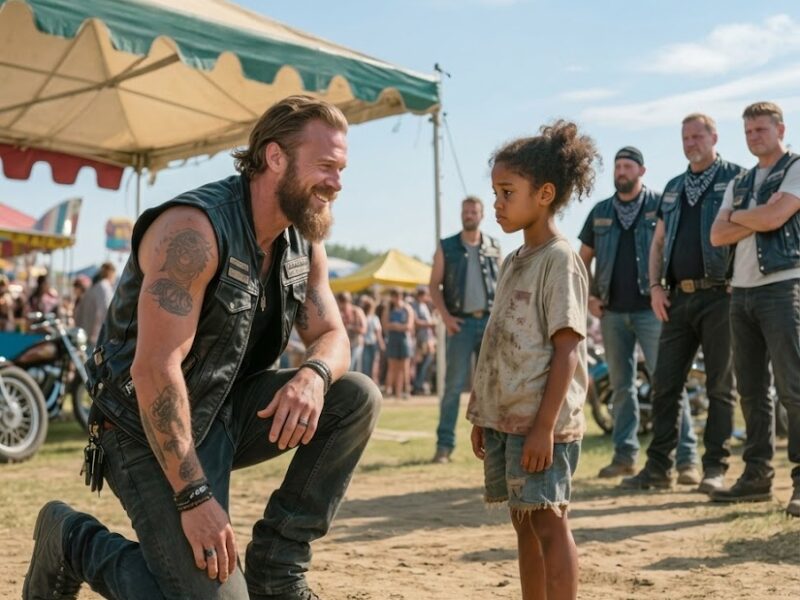
A Hells Angel Helped a Lost Girl Find Her Mom—What Happened Next Warmed the Whole Town’s Heart
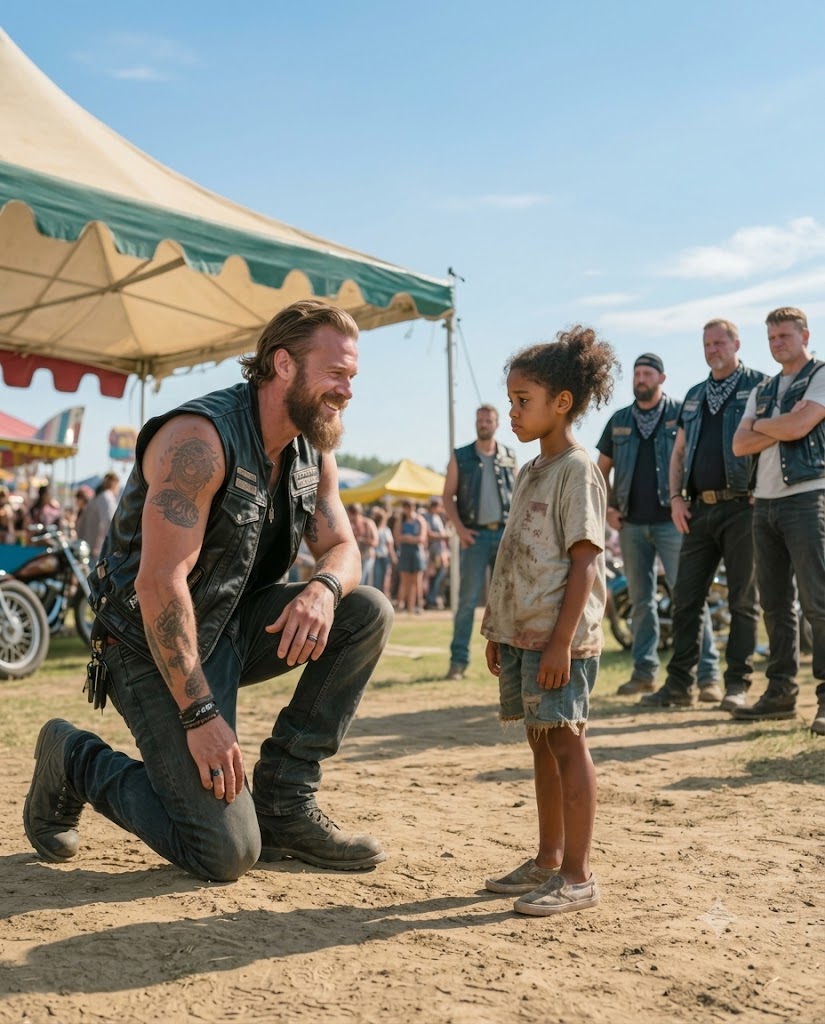
The Minnesota State Fair was a thunderous orchestra of color, motion, and chaos that August evening.
A sea of people surged between rides and food stalls, the air thick with the scent of corn dogs, caramel popcorn, and engine grease.
Neon lights blinked in manic rhythm above, painting the world in flickers of electric blue and pink.
Screams from the Sky Glider cut through the country music blaring from the speakers.
This was no place to be small or slow.
But Emily Gardner was both.
She was seven, just shy of four feet tall, with wild brown curls pinned back in mismatched clips and a red plaid shirt tucked into her faded jeans.
Her sneakers, once white, were dulled by summer dust.
She had been holding her mother’s hand one second, and the next it was gone.
One wrong step, one careless ripple in the human tide.
Emily had tried to scream her mother’s name, but her voice drowned in the roar of the crowd.
People brushed past her, not seeing her, not stopping, not caring.
She stumbled backward, caught off balance by a jolt to the shoulder.
Another body hit her from the side, a teenager darting out from the funhouse exit.
She fell.
Her knees scraped hard against the asphalt.
Her left palm landed in something sticky, maybe ice cream, maybe soda, maybe both.
Her cotton candy, still clutched in her other hand, smashed into the ground, now flattened and crawling with ants.
The impact knocked the breath from her chest.
She sat there for a second, stunned, blinking through tears, blinking through fear.
And then came the laughter.
Three kids, maybe ten or eleven, stood nearby.
A boy pointed at her and nudged his friend.
“Hey, look, baby lost her mommy,” he mocked.
Another girl snickered.
“She even dropped her cotton candy. What a baby.”
Emily said nothing.
Her throat burned.
Her knees throbbed.
Her lip quivered, but she bit it hard to stop the sob.
She didn’t want to give them that satisfaction.
The kids walked off eventually, still laughing.
The crowd paid them no mind.
A clown on stilts passed by juggling flaming pins.
He didn’t even glance down.
Nearby, a group of cheerleaders posed for photos under the Ferris wheel.
No one saw the little girl crumpled on the ground, surrounded by strangers and loud music and the cruel indifference of too many feet walking by.
She pulled herself up slowly, one leg trembling, using a trash can for balance.
Her knees were bleeding, her face streaked with tears and dirt, and she had lost one shoe somewhere in the crowd, her sock squishing when she stepped.
That’s when she remembered her mother’s rule.
Rachel Gardner had always been a little different than the other moms at Emily’s school.
She wore denim jackets instead of cardigans, had a tattoo of a compass on her wrist, and never told Emily to just find a police officer if she ever got lost.
“If you can’t find a police officer,” Rachel would say in her calm, serious voice, “find someone with motorcycle patches, especially if you see the name Hells Angels.”
Emily had repeated that to her teacher once during a safety drill and was promptly sent home with a note.
But Rachel had her reasons.
Now wobbling slightly and clutching her squashed cotton candy like a security blanket, Emily peered across the fairgrounds.
Everything looked too big, too fast, too bright, too loud, and she felt so, so incredibly small.
A slow panic crept through her ribs.
It wasn’t the kind that made you cry.
It was worse.
The kind that made you feel invisible, like the world could swallow you and no one would notice.
She wiped her face with the back of her sleeve, which only smeared the dirt and tears.
Her cotton candy dripped onto the ground like melted dreams.
People still moved around her like she didn’t exist.
One woman brushed past her shoulder and muttered, “Watch it, kid.”
Emily looked up, searching for something familiar, a booth, a ride, anything.
That’s when she remembered.
Earlier that evening, before the crowd thickened, she and her mother had walked past a group of bikers gathered near a rust-streaked bar called The Rusty Spoke.
Their motorcycles had gleamed under the dying sun, metal beasts lined in a row, chrome shining, engines growling low.
Most parents pulled their children closer when they passed, whispering warnings under their breath.
Rachel had done the opposite.
She had nodded toward them with a small smile.
One of the bikers had nodded back.
Emily remembered that man.
He had a long gray beard and a vest covered in strange patches.
Her chest tightened again, but this time not with fear, with hope.
One shaky breath, then another.
She turned, squinting past the blinking lights and crowds toward the distant corner of the fair where the bar stood.
Her left sock was soaked.
Her knees stung.
Her cotton candy was a mess, but she gritted her teeth and started moving.
The path to The Rusty Spoke felt like a battlefield.
People bumped her shoulder.
A woman spilled lemonade near her feet.
Someone swore loudly as they tripped over a stroller.
But Emily kept walking because her mother had taught her something most people would never believe.
And now she had to find out if it was true.
Her legs ached.
Her sock made a wet slap against the pavement with every step.
Her scraped knees throbbed with each bump from the crowd.
The sounds of the fair blurred together, laughter, shouting, distant music, the constant buzz of voices.
But none of it reached her fully.
Her focus tunneled toward that one memory.
The gray-bearded man with the patches, the one who nodded at her mother like they shared a secret.
The deeper she moved toward the edge of the fairgrounds, the more the noise shifted.
The bright cheer of the midway gave way to a darker rhythm.
Guitar riffs thumping from old speakers.
The deep idle of motorcycle engines.
The soft clink of bottles behind a weatherworn bar.
The Rusty Spoke loomed just ahead, its red neon sign flickering like it was deciding whether to stay on or not.
Outside the bar, a cluster of motorcycles gleamed under string lights.
The bikes looked like monsters to Emily, big, loud, alive, but she didn’t turn back.
She spotted them then.
A dozen men and women stood talking near the curb, wearing worn black leather vests covered in patches she couldn’t read from this far.
Some had tattoos that curled down their arms like vines.
Others wore sunglasses even as the sun dipped low behind the trees.
They laughed deep booming laughs, voices like sandpaper and smoke.
Emily’s chest tightened.
What if she was wrong?
What if they weren’t the same people?
What if her mother’s rule only applied to that one night long ago?
She hesitated near the edge of the parking lot, her one bare foot sinking slightly into a patch of dirt.
Her cotton candy had long since been dropped.
Her hands were scratched, her face smeared.
She looked, quite frankly, like she’d been chewed up and spit out by the entire fair.
And then came the final blow.
A loud laugh rang out behind her.
“There she is.”
It was the same group of kids who had bullied her earlier.
They weren’t done.
The tallest boy grinned cruelly.
“Still crying for mommy?”
He stepped toward her.
“You lost or just dumb?”
Emily turned, panic rising up again.
She backed away until her shoulder bumped into a thick leather vest.
The man turned.
It was him, the one with the gray beard that fell down to his chest.
His eyebrows furrowed instantly when he saw her tear-streaked face, the blood on her knees, the sock on one foot.
“You got a problem, little one?” he asked, his voice deep and rough, but not unkind.
Emily opened her mouth, but nothing came out.
Only a small squeak of breath.
Behind her, the boy stepped forward again.
“She’s nobody, man. Just a baby who got lost.”
The big man’s head turned sharply.
“That right,” he said, low and even.
Suddenly, the parking lot shifted.
Like wolves stirred from rest.
The rest of the bikers straightened, eyes narrowing, posture changing.
The laughter stopped.
Every single person in a leather vest turned to look at the group of kids.
One woman, tall with silver streaks in her black hair, folded her arms slowly and raised an eyebrow.
The boy hesitated now.
The girl beside him tugged at his arm.
“Let’s go,” she whispered.
“Let’s just go.”
They fled, vanishing into the crowd like smoke.
Silence returned.
Emily blinked up at the man.
His face had changed.
The edges softened, the lines around his eyes bent with concern as he crouched down to her level.
This mountain of a person making himself small for her.
“Hey there,” he said gently.
“You okay?”
Her voice trembled.
“I, I lost my mom.”
The woman with the silver hair stepped closer, her boots quiet on the pavement.
“What’s your name, sweetheart?”
“Emily Gardner,” she whispered.
“My mom is Rachel. She has a blue jean jacket and dark hair.”
The gray-bearded man’s eyes lit up slightly.
“Rachel Gardner,” he repeated, almost to himself.
“That’s a name I haven’t heard in a while.”
Emily looked up confused.
The woman smiled.
“And how did you end up here, Emily?”
She took a breath.
“My mom told me if I ever got lost and I couldn’t find a police officer to find someone with motorcycle patches, especially if they said Hells Angels.”
The man blinked, then grinned.
“Well, kid,” he said, “your mom’s got good instincts. I’m Hank. This here is Clara. You’re safe now.”
He stood up tall again and let out a whistle so sharp it seemed to cut through the air like a blade.
Immediately the entire group of bikers turned toward him.
“Missing parent situation,” Hank called out.
“Name’s Rachel Gardner, denim jacket, dark hair. This is her daughter. Fan out.”
Without hesitation, they moved.
Hank turned to Clara.
“You stay with her.”
Clara nodded.
“Always.”
Emily sat down on the bench outside the bar, Clara beside her, warm and solid.
Within seconds, the bikers were gone, disappearing into the crowd, splitting off in pairs and groups, scanning faces, calling into radios.
Clara placed a hand on Emily’s back, steady and reassuring.
“You did the right thing,” she said.
“Most people wouldn’t have remembered something like that.”
Emily swallowed, watching the last of the leather vests vanish into the night.
Clara smiled.
“But your mom? She’s not most people.”
And Emily, battered, exhausted, but no longer alone, felt something she hadn’t felt in what seemed like hours.
Hope.
And somewhere out in the crowd, Rachel Gardner was still searching, and she was about to come face to face with the past she never thought she’d see again.
Emily leaned into the woman’s side, her small frame trembling with every breeze that passed.
The bench creaked beneath them, the roar of the fair still thundered in the distance.
But here, at the edge of the chaos, everything had stilled like the eye of a storm.
Clara kept her phone close, occasionally pressing a button and murmuring updates to the search party.
Her other hand never left Emily’s shoulder.
Meanwhile, deep in the labyrinth of carnival rides and concession stands, Rachel Gardner was moving like a woman possessed.
She weaved through the crowd near the funhouse, her eyes scanning every child, every red shirt, every flash of brown curls.
Her voice was ragged from shouting.
“Emily! Emily!”
No answer.
Her throat burned, her hands trembled.
She had already checked every ride near the entrance, flagged down two food vendors, and begged the cotton candy guy to keep watch for a little girl missing one shoe.
But Emily was nowhere.
Panic had bloomed into something darker.
Guilt.
The paralyzing kind.
Rachel’s mind spiraled with worst-case images she fought to push down.
She had been right there, just feet away when it happened.
One careless second, one lost grip.
And now she rounded a corner near the Tilt-A-Whirl and spotted a uniform.
A police officer stood lazily beside a lemonade stand, chatting with a carnival worker.
“Officer!” she shouted, hurrying toward him.
“My daughter is missing.”
He turned with a sigh, his expression already annoyed.
“Ma’am, slow down. What happened?”
“She’s seven,” Rachel said breathlessly.
“Her name’s Emily. Brown hair, red plaid shirt, jeans. We got separated near the funhouse about forty minutes ago. I’ve looked everywhere. I can’t find her.”
The officer squinted like he wasn’t fully processing.
“You said Emily, shirt color?”
Rachel gritted her teeth.
“Red plaid. She’s seven, one shoe. Probably scared out of her mind by now.”
He finally reached for his radio slowly.
“We’ll put out an alert, but honestly, ma’am, kids wander off all the time at these events. It’s not uncommon. Most turn up near the toy booths or food trucks.”
She stared at him.
“You don’t get it. My daughter’s smart. She wouldn’t just wander. She knows what to do if something goes wrong. She knows.”
“Sure, ma’am. We’ll keep an eye out.”
Rachel didn’t wait for the rest.
She turned sharply, disgusted by the indifference.
She pushed back into the crowd, adrenaline rising again.
Then out of the corner of her eye, movement.
A large figure moved through the sea of people like a freight train cutting through fog.
The leather vest hit her like a memory, the patch glinting under the fair lights, a flaming skull wrapped in angel wings with Hells Angels Minneapolis Chapter embroidered in a bold arc.
Rachel froze.
He saw her, too.
His face broke into something almost like relief.
“Rachel Gardner?” he asked.
She stared.
“Yes. Wait, how do you, have you seen my daughter?”
“She found us,” he said simply, pulling out his phone as he motioned for her to follow.
“She’s with Clara, safe and sound. Your girl’s got a head on her shoulders, remembered exactly what you taught her.”
Rachel’s legs almost gave out from under her.
She forced herself to move, following him as he parted the crowd.
“You’re with Hells Angels.”
He gave a little chuckle.
“Still am. Name’s Hank. You probably don’t remember me, but I remember you.”
Rachel blinked.
Her mind jolted like it had tripped over a long-buried thread.
And suddenly she did remember.
The rain, the empty road, the broken-down car on Route 35, eleven years ago.
She was three months pregnant, bruised, shivering in a denim jacket that couldn’t stop the storm.
And then came the roar of motorcycles, headlights appearing like angels in the dark.
They had pulled over, a dozen of them.
One worked under the hood of her car.
Two others stood facing the road with arms crossed.
And a woman, tall, confident, had sat beside her in the back seat, gently wiping blood from her temple with a sleeve.
She remembered that hand squeeze, that voice.
“Whatever you’re running from, you don’t ever have to go back.”
“Clara,” Rachel whispered almost to herself.
“That was her name.”
Hank smiled without looking back.
“Still is.”
As they turned the corner near the edge of the fairgrounds, Rachel spotted them.
Clara sitting tall and calm on the bench.
And next to her, Emily.
The little girl leapt up the moment their eyes met.
“Mom!” she cried, launching forward.
Rachel caught her mid-run, dropping to her knees and pulling her daughter close.
Emily clung to her like she would never let go again.
“You were right,” she sobbed into her chest.
“They really helped me. They were nice and, and they made the mean kids go away, and they didn’t even yell.”
Rachel held her tighter.
“You remembered what I told you.”
Emily nodded furiously.
“You said if I couldn’t find a cop to find the motorcycle people, so I did. I found them. They came right away.”
Rachel looked up through tears, locking eyes with Clara.
It had been over a decade, but the woman hadn’t changed much.
The silver now streaking her dark hair only made her seem stronger, more solid somehow.
Clara stepped forward.
“You’re the nurse,” she said gently.
“Back then. Route 35. Pregnant. Bruised.”
Rachel laughed through a breathless sob.
“And you’re the woman who told me I didn’t have to go back. I never forgot you.”
“Well,” Clara smiled, eyes crinkling, “looks like you passed that trust on to the next generation.”
Behind them, Officer Simmons approached from the crowd, his frown still etched into his face.
“Ma’am,” he called stiffly.
“Is everything under control here?”
Rachel turned, one arm still around Emily.
“Everything’s fine, officer.”
Simmons looked at the circle of leather vests surrounding them.
“With them?”
Rachel didn’t hesitate.
“Yes, them. They found my daughter in under twenty minutes. They moved like a search and rescue team. They were kind, and they didn’t waste time blaming the parents.”
The officer shifted uncomfortably.
“Well, glad it worked out.”
He gave one last glance toward Hank and Clara, then turned and disappeared back into the crowd.
Hank chuckled.
“Some things never change.”
Rachel looked around, seeing now how the bikers had formed a quiet perimeter.
They weren’t just watching.
They were guarding her daughter.
“Let us walk you to your car,” Hank said, already gesturing to two others.
“It’s getting late for the little one.”
Rachel nodded, pulling Emily closer.
And as they began their walk, mother and daughter, surrounded by a silent circle of leather and chrome, curious stares followed them.
Some whispered, others stared.
But not all looks were suspicious this time.
One man standing beside a lemonade cart narrowed his eyes in thought.
His name was Walter Finch, and tomorrow, everything he thought he knew about Hells Angels was about to change.
Walter Finch watched them go.
The little girl with her scraped knees and wide eyes.
The mother clinging tight.
And the bikers walking in perfect sync like a silent honor guard.
The image lingered in his mind all night.
Through the final cleanup at Betty’s Diner.
Through his quiet drive home.
And even as he closed up and turned the lights off.
Something about it clung to him.
He’d run this diner for thirty-two years, watched tourists pass through, watched the town change and change again.
He’d always told his wait staff to keep an eye out whenever bikers rolled into town.
Hells Angels especially.
Not because of anything they’d done here, but because of what people said they did elsewhere.
Rachel Gardner had walked into his diner a hundred times since moving back to Stillwater, always with her little girl in tow.
He never guessed that she’d be the type to smile at a biker, let alone teach her kid to trust one.
The next morning, Betty’s Diner was packed.
As usual, the state fair always brought in families, vendors, out-of-towners looking for real coffee and eggs that didn’t come from a booth.
Rachel and Emily slipped in quietly and slid into their usual booth near the window.
Emily wore a fresh outfit, yellow sundress, denim jacket, but still walked with a tiny limp.
Walter had just poured himself a fresh cup behind the counter when the bell above the door jingled again.
The diner hushed.
Every fork paused midair.
Hank stepped inside first, his massive frame making the door frame look too small.
Behind him came Clara, then two other bikers with vests covered in patches and names.
They didn’t say a word.
They just stood for a moment, scanning the room as if unsure if they’d made a mistake even walking in.
Rachel stood up and waved.
“Over here.”
That broke the silence.
The bikers made their way to the booth, heads held high, but clearly aware of every eye tracking them.
Hank slid into the booth next to Emily, who immediately beamed.
“Morning, sweetheart,” he said gruffly.
“We’re doing great,” Emily replied, proud and loud.
“I told my teacher everything.”
Rachel laughed softly.
“We just wanted to say thank you again. Properly.”
Walter stood behind the counter, coffee pot in hand, staring.
Every instinct told him to stay out of it.
But that picture from last night.
The girl, the circle of bikers, the stunned faces in the crowd.
Kept flashing in his head.
He approached slowly.
The bikers looked up.
Their postures tightened as if bracing for the usual.
But Walter simply leaned over and filled each of their mugs with coffee.
“I heard what you folks did last night,” he said, voice low but firm.
“Finding the little girl. Protecting her.”
Clara smiled slightly.
“Just doing what anyone would do.”
Walter shook his head.
“Not anyone. Most people would have kept walking.”
He set the pot down on the edge of the table.
“Breakfast is on the house.”
From the counter, Officer Simmons scowled, his lips curling as he sipped his coffee.
“Careful, Walt,” he said loud enough for half the diner to hear.
“Next thing you know, you’ll have a row of motorcycles out front scaring off your regulars.”
Walter turned slowly.
“Seemed to me these folks were better at finding a lost kid than some others I could mention.”
Simmons flushed, slapped a ten on the counter, and walked out without another word.
A beat passed, then another.
And suddenly the air shifted.
A woman at the next table leaned over.
“That your little girl?” she asked Rachel.
“The one they found.”
Rachel nodded.
“My granddaughter’s around that age,” the woman said softly.
“If she ever got lost, I’d pray someone like them found her.”
Clara turned.
“Tell her to look for the patches,” she said with a wink.
“We look out for kids.”
The conversation spread like syrup on a warm plate.
One by one, people approached the booth, some timidly, others with genuine warmth.
A trucker offered to pay for the bikers’ gas.
A father of three shook Hank’s hand.
Even the teenage hostess, who had once rolled her eyes when bikers entered, brought over extra syrup and didn’t charge for it.
Over bacon and eggs, Rachel told the story.
The whole story.
About that night eleven years ago on Route 35.
About the bruises, the rain, the car that wouldn’t start.
How they’d fixed her engine, given her cash for a motel, and made a wall around her so her ex couldn’t find her.
“I went to nursing school after that,” she said.
“I work at the VA hospital now. Maybe I’ve treated some of your brothers without even knowing it.”
Hank nodded.
“Wouldn’t be surprised. Lot of vets ride with us.”
Clara added, “We’re actually on the way to Charleston next weekend. Ride for the VA PTSD program. Fifty bikes raised thirty grand last year.”
Walter, now standing nearby with refilled mugs, blinked.
“Thirty grand?”
Hank smiled.
“From all over the state.”
That didn’t match any headline Walter had ever read.
By the time the plates were cleared, the mood in Betty’s Diner had changed.
The stares had softened.
The tension had faded.
Something quiet and real had taken its place.
Understanding, maybe.
Or the start of it.
Emily leaned her head on Hank’s shoulder as he told her what each of the patches on his vest meant.
She listened like he was reading her a fairy tale.
And from the corner, Walter watched it all, quietly rewriting every assumption he’d held for three decades.
Because sometimes it takes one small moment to change the way a whole town sees.
And change, as it turned out, had only just begun.
Three weeks later, Betty’s Diner looked a little different.
The old sign out front had been freshly repainted.
And beneath the classic cursive “Betty’s,” a smaller line had been added in neat, bold letters.
“All Welcome.”
The parking lot had been restriped to include a few clearly marked motorcycle spaces.
And not a single regular customer had complained.
If anything, more people showed up on weekends now, drawn by something they couldn’t quite name.
Something warmer.
More human.
Rachel and Emily kept their Saturday morning ritual.
Same booth, same smiles.
But now they were rarely alone.
Hank often joined them.
Sometimes Clara.
Sometimes others from the chapter who’d become familiar faces in town.
What once drew quiet suspicion now drew nods of recognition.
Even the occasional wave.
It wasn’t just Betty’s Diner, either.
When old Mrs. Peterson’s roof started leaking after a storm, it was a group of Hells Angels who showed up that Saturday with ladders, tarps, and elbow grease.
No one asked why.
They just worked.
A week after that, six of them volunteered to run the grill and set up tents for the elementary school fundraiser.
They didn’t ask for payment.
Just smiled and said, “Tell the kids to watch for the patches.”
Emily now wore a small denim vest of her own.
Clara had stitched it by hand.
On the back, in white thread, was a single patch.
“Protected by the Road Family.”
She wore it with quiet pride, especially when they walked into Betty’s and the regulars greeted her by name.
One Saturday, Emily was perched on a stool at the counter, deep in conversation with Hank about motorcycles.
How they worked.
How loud they were.
Which one had the shiniest chrome.
When Walter slid into the booth beside Rachel.
He sipped from his mug before speaking.
“Never thought I’d see the day,” he said, nodding toward the scattered tables filled with bikers and locals all chatting like old friends.
“Used to tighten up every time those vests came through town.”
Rachel smiled.
“People are usually more than what they seem. Sometimes it just takes the right moment to see it.”
Walter nodded slowly.
“Like a little girl getting lost at a carnival.”
“Exactly.”
There was a pause between them.
Warm.
Easy.
“You know,” Rachel said after a beat, “Emily’s school is hosting career day next month. They’re looking for guests with interesting jobs to come talk to the second graders.”
Walter raised an eyebrow.
“You thinking what I think you’re thinking?”
Rachel’s smile deepened.
“I think some kids might benefit from meeting the real people behind those leather vests.”
He chuckled into his cup.
“Now that would be something.”
A month later, the second-grade classroom at Stillwater Elementary was abuzz with chatter.
Posters decorated the walls, and desks had been arranged into a semicircle.
In front of them stood Hank, wearing his full vest, every patch carefully explained one by one.
He wasn’t what the kids expected.
And that was the point.
One small boy raised a hand timidly.
“Are bikers bad guys?”
Hank dropped to a crouch, just like he had with Emily.
“We’re just regular folks,” he said gently.
“We love the open road. We ride loud bikes. But more than anything, we look out for each other. Especially for kids who need help. That’s our most important rule.”
In the back of the room, Rachel watched quietly, arms folded, heart full.
Emily stood proudly beside Hank, introducing him like a VIP.
“This is my friend Hank,” she said clearly.
“He’s got patches and promises, and he keeps both.”
Outside the school, sunlight caught on the chrome of the row of motorcycles parked at the curb.
A few parents walking by did a double take.
Some frowned.
Others smiled.
A few even waved.
To some, they still looked intimidating.
But to one little girl with a healed scab on her knee, a denim vest on her shoulders, and a protective circle of unexpected guardians, they were something else entirely.
They were angels.
Just not the kind with wings.
And in the town of Stillwater, thanks to one mother’s memory and one child’s trust, they had finally been seen for what they really were.
Family.
Twice over.
And forever.
The story didn’t end there, though.
Stories like this never really do.
They ripple outward, touching lives in ways no one can predict.
Six months after that night at the state fair, a young mother named Danielle was driving through Stillwater when her car broke down on the highway.
She had a toddler in the back seat and fear in her heart.
Her phone was dead.
The sun was setting.
She didn’t know anyone in town.
But she remembered a story she’d seen on the local news.
About a little girl who got lost at the fair.
About the bikers who found her.
About the town that changed.
So when she saw a group of motorcycles parked outside Betty’s Diner, she didn’t hesitate.
She walked in, toddler on her hip, tears in her eyes.
“I don’t know who to ask,” she said.
“But I heard this was a place where people help.”
Walter was behind the counter.
He didn’t even blink.
He just pointed to the corner booth where Hank and Clara were sitting.
“Those are the folks you want,” he said.
“Tell them Walt sent you.”
Danielle walked over.
Hank looked up.
Before she could say a word, he was on his feet.
“What do you need, ma’am?”
“My car,” she stammered.
“It’s broken down. I don’t have money for a tow. My husband’s deployed. I don’t know what to do.”
Clara was already reaching for her phone.
“We’ve got a mechanic in the chapter,” she said.
“He’ll be here in twenty minutes. You sit down. I’ll get you some coffee. And your little one? Does she like pancakes?”
The toddler nodded shyly.
Clara smiled.
“Then pancakes it is.”
Danielle sat down, stunned.
“I don’t understand,” she said.
“Why are you helping me?”
Hank sat back down across from her.
“Because that’s what we do,” he said simply.
“Look out for folks who need it. Especially kids. You never know when a small kindness might change everything.”
Danielle wiped her eyes.
“I saw the story,” she said.
“About the little girl at the fair. I didn’t believe it at first. I thought it was just, you know. A feel-good piece. But it’s real.”
Clara nodded.
“It’s real.”
By the time the mechanic arrived, Danielle’s daughter was giggling at a pancake shaped like a bear.
And Danielle was already planning how she could pay it forward.
She didn’t have money.
But she had time.
And she had skills.
She was a graphic designer.
By the end of the month, she’d designed new signage for Betty’s Diner.
Free of charge.
Because that’s how it works.
Kindness begets kindness.
And the cycle continues.
The following spring, Stillwater Elementary hosted its annual community day.
There were booths and games and food and music.
And right in the middle of it all was a motorcycle display.
Six gleaming bikes lined up in a row.
Children climbed on them, pretending to ride.
Parents took pictures.
Hank stood nearby, answering questions, laughing with the kids.
Emily was there, of course.
She was eight now.
Taller.
Braver.
She wore her denim vest with pride.
And when a little boy came up to her, crying because he’d lost his mom in the crowd, she didn’t hesitate.
She took his hand.
“Don’t worry,” she said.
“I know exactly what to do.”
She led him to Hank.
And Hank crouched down.
And the cycle continued.
Because that’s what happens when a community learns to trust.
When a town learns to see people for who they really are.
When a little girl remembers her mother’s rule.
And when a group of bikers decides to be something more than the sum of their stereotypes.
They become family.
Twice over.
And forever.
The story spread beyond Stillwater, too.
A local reporter named Marcus Chen picked it up.
He’d been at the state fair that night.
He’d seen the bikers walking Rachel and Emily to their car.
He’d seen the looks on people’s faces.
He’d wondered what it meant.
So he started asking questions.
He talked to Walter.
He talked to Officer Simmons, who was surprisingly candid about his own assumptions.
He talked to Rachel.
He talked to Hank and Clara.
He talked to Emily, who told him the whole story with the seriousness of a child who knew exactly what mattered.
Marcus wrote an article.
It was titled “The Angels Among Us.”
And it went viral.
Not because it was sensational.
But because it was true.
Because it showed a side of something people thought they knew.
Because it reminded readers that everyone has a story.
And that stories can change.
The article brought more attention to Stillwater.
More people visited Betty’s Diner.
More people donated to the VA PTSD ride.
More people started looking for the patches.
Not because they were scared.
But because they were hopeful.
Because they wanted to believe that there were still people out there who would stop.
Who would help.
Who would protect.
And there were.
There always had been.
They just hadn’t been seen.
Until now.
A year after that night at the fair, Emily turned nine.
She had a birthday party at the park.
There were balloons and cake and games.
And there were bikers.
Hank was there.
Clara was there.
A dozen others, too.
They brought gifts.
A leather bracelet with Emily’s name stamped into it.
A small motorcycle helmet, painted pink.
A photo album filled with pictures from the past year.
Emily hugged each of them.
Then she stood on a picnic table and made a speech.
“I used to think getting lost was the scariest thing in the world,” she said.
“But then I found out it wasn’t. The scariest thing is being alone. And I’m never alone. Because I have my mom. And I have Hank and Clara. And I have all of you.”
She paused.
“And I have patches.”
Everyone laughed.
Then they ate cake.
And the sun set over Stillwater.
And the world felt a little smaller.
A little kinder.
A little more like home.
The diner stayed busy that summer.
Walter hired two new waitresses.
One of them was Danielle, the young mother whose car had broken down.
She’d moved to Stillwater permanently.
She wanted her daughter to grow up in a place where people helped each other.
Where strangers became friends.
Where a little girl’s trust could change a whole town.
Walter didn’t hesitate.
He hired her on the spot.
“You’re family now,” he said.
And she was.
Everyone was.
Because that’s what happens when a community decides to open its heart.
When it decides to see people not as threats, but as neighbors.
When it decides to believe the best instead of assuming the worst.
Betty’s Diner became a gathering place.
Not just for locals.
But for travelers.
For people passing through.
For anyone who needed a hot meal and a warm smile.
And on the wall, right next to the register, hung a framed copy of Marcus Chen’s article.
“The Angels Among Us.”
Below it, a small plaque.
“In memory of the night a little girl got lost, and a town found itself.”
People read it while they waited for their food.
They asked questions.
They learned.
They left with something more than a full stomach.
They left with hope.
And hope, as it turned out, was contagious.
The Hells Angels chapter grew.
Not in numbers, necessarily.
But in presence.
They became a fixture in Stillwater.
They helped with fundraisers.
They showed up at community events.
They looked out for kids.
They looked out for everyone.
And in return, the town looked out for them.
When one of the bikers had a heart attack, the town rallied.
When another lost his job, three local businesses offered him work.
When Clara’s mother passed away, half the town showed up to the funeral.
Because that’s what family does.
And they were family.
Not by blood.
But by choice.
By circumstance.
By the simple act of one little girl walking up to a group of strangers and saying, “I need help.”
That was the moment everything changed.
That was the moment the world shifted.
Not with a bang.
But with a whisper.
With a child’s voice.
With a mother’s rule.
With a group of bikers who decided to be heroes.
Not because they had to.
But because they could.
Because they wanted to.
Because they knew what it felt like to be judged.
To be feared.
To be misunderstood.
And they wanted something different.
For themselves.
For their community.
For the little girl who trusted them.
Emily grew up with that trust.
She never forgot it.
She carried it with her through middle school and high school.
Through good times and bad.
Through moments of doubt and moments of clarity.
She knew that there were people in the world who would help.
Who would protect.
Who would care.
And she wanted to be one of them.
So when she turned eighteen, she went to nursing school.
Just like her mom.
She wanted to help people.
To heal them.
To show them the same kindness that had been shown to her.
And when she graduated, she came back to Stillwater.
She got a job at the local hospital.
And on her days off, she volunteered at community events.
Sometimes she’d see a group of bikers.
Sometimes she’d see a vest with patches.
And she’d smile.
Because she remembered.
She always remembered.
The night she got lost.
The night she was found.
The night a whole town learned to see.
And she knew that she was part of something bigger than herself.
Something that started with a rule.
And ended with a family.
Twice over.
And forever.
The story continues, of course.
It always does.
Because every day, somewhere, a child gets lost.
And somewhere, someone finds them.
And somewhere, a community learns to trust.
And somewhere, a stereotype shatters.
And somewhere, a heart opens.
And somewhere, a town changes.
Because of one small moment.
One small act of kindness.
One small decision to help.
That’s all it takes.
One person.
One gesture.
One rule.
“Find someone with motorcycle patches.”
And if you can’t find them?
Look for the people who help.
They’re out there.
They always have been.
And they always will be.
Because that’s what it means to be human.
To care.
To protect.
To love.
To be family.
Twice over.
And forever.
The End.









