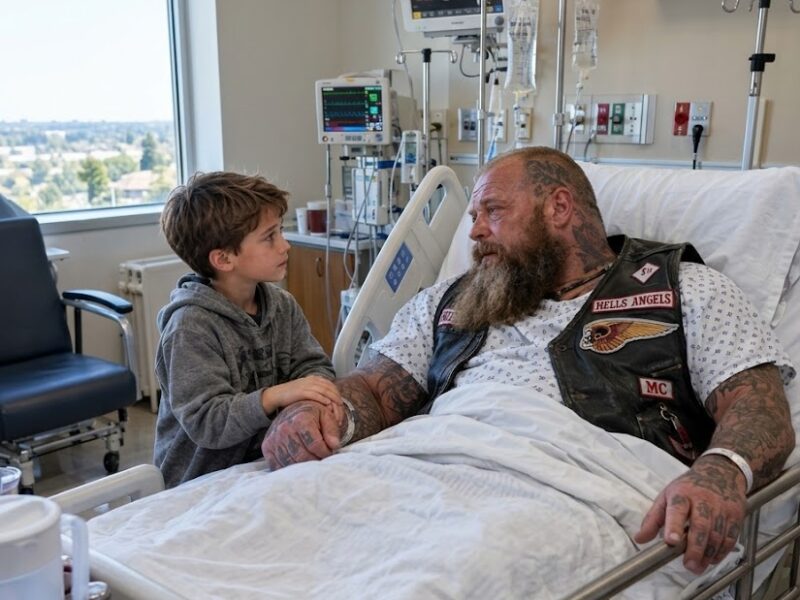
A Hells Angel had a stroke and lost his ability to speak. His brothers couldn’t understand a word—except one little boy.
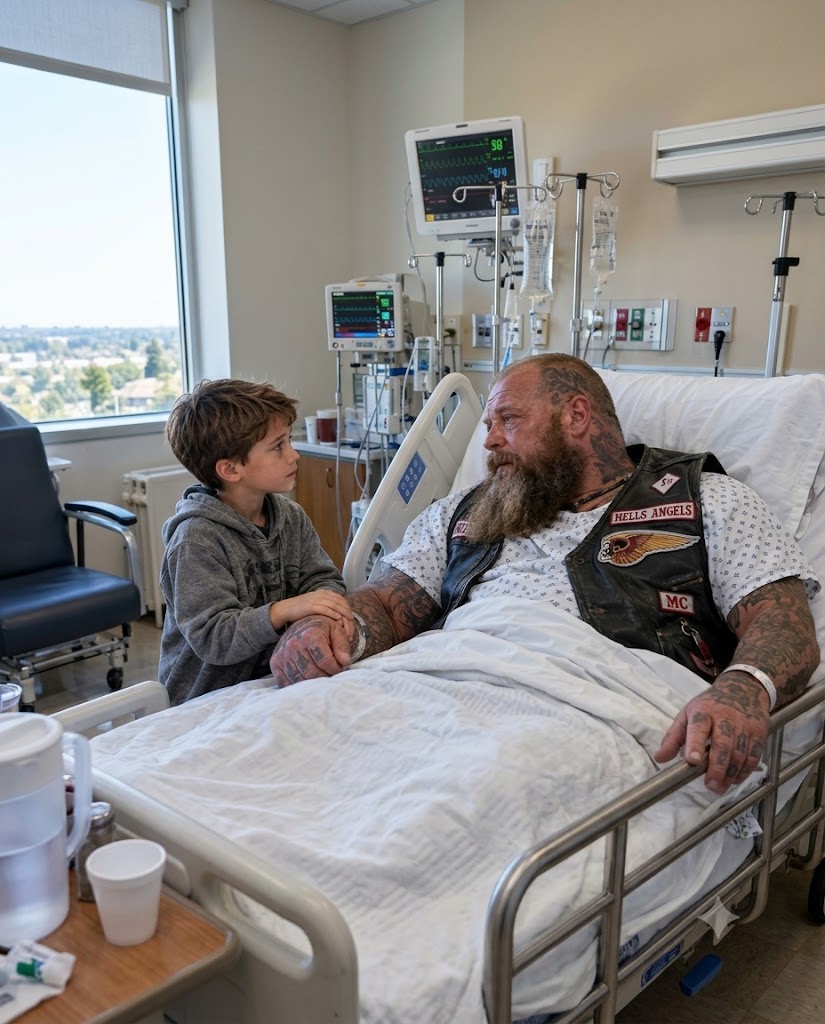
The man on the garage floor couldn’t lift his right arm. He couldn’t close his mouth, but his eyes were screaming and I was the only one who saw it.
They loaded him into the ambulance. A man across the street said, “Probably drunk.”
The doctors wrote the word combative on his chart. The hospital called him confused, and a social worker started filling out transfer papers, but he kept saying the same three words over and over.
Blue Saturday, cold. Everyone heard noise. I heard a message.
And I had one week to prove it before they sent him a hundred miles away. And before the one thing he tried so hard to say disappeared forever.
The heat in Bakersfield does not arrive in August so much as it settles. The way dust settles on a windowsill quietly and then everywhere.
By 8:30 on that Saturday morning, the thermometer outside the Stop-and-Go on Union Avenue already read 96 degrees and 10-year-old Owen Harrove was pedaling hard. Saturday Garage didn’t start until 9, but his mother Tessa worked the overnight shift at a nursing home on the east side, and she liked him out of their stuffy apartment before the heat made it unbearable.
So Owen did what he had done for 11 Saturdays in a row. He rode to Whitaker Cycle and Repair, sat on the curb out front, and waited for the big man to roll up the door.
Everyone in the neighborhood knew who Jason Whitaker was. He was 57 years old and 6’3″ with a gray beard that reached the second button of a leather vest covered in patches.
The vest said “Hells Angels” across the back, and the woman at the dry cleaners crossed the street when he walked by. The man who ran the Stop-and-Go watched him from behind the register as if trouble followed him through the door.
What Owen knew was different.
In June, his bike had been stolen from outside the public library, and he had cried the whole walk home. A woman at his mother’s work told them the big biker on Union fixed kids’ bikes for free on Saturdays.
Owen had gone in terrified. Jason Whitaker had looked down at him for a long moment, said, “Wheel size.” And that was the whole conversation.
By the end of the day, Owen had a red bike built out of three other bikes. The man barely talked at all. He showed you how to true a wheel by folding your hands inside his scarred ones.
He wrote every kid’s name in a battered blue notebook along with whatever their bike needed, and he checked off each line with a pencil stub when the job was done. Twenty-three names filled the pages now. Owen’s was near the top.
At 8:40, the garage door was still down.
Owen frowned. In 11 Saturdays, it had always been up by 8:30 with the radio playing old country songs low. He leaned his bike against the wall and knocked on the side door.
Nothing. He tried the knob. It turned.
“Mr. Whitaker?”
Inside the garage was dim and hot, lit by a single bulb above the workbench. The radio was on, but the volume was strangely high. A man’s voice reading farm prices.
Then Owen saw the boots. Two heavy boots stuck out from behind the workbench, and one of them was twitching against the concrete.
Jason Whitaker lay half on his side, his back against a toolbox. A socket wrench was still in his left hand. His right arm rested across his stomach like something that belonged to somebody else.
The right side of his face had slid downward as if a hand had wiped it, and a thread of spit ran into his beard. His eyes found Owen and went wide, and his mouth worked to make a sound.
What came out was wet and broken. “T…bl…”
Owen’s stomach dropped to his shoes, but his mind did something strange. It went quiet and clear because he had seen this before.
Eleven months earlier, he had watched his grandfather Gerald, whom he called Pop, sit down at the kitchen table with a cup of coffee and start speaking words that did not fit together while one side of his face fell. His mother had screamed. Owen had stood frozen beside the refrigerator.
Pop had died three weeks later after a second stroke in the hospital. Owen had promised himself he would never freeze again.
“Face, arms, speech, time,” he whispered. His mother had taped that list to the refrigerator afterward.
He dropped to his knees. “Mr. Whitaker, can you lift both arms?”
The left arm rose. The right one trembled, slid off his stomach, and did not rise.
“Okay. Okay. Don’t move. I’m getting help.”
A beige landline hung on the wall by the parts shelves with a curly cord gone gray with dust. Owen didn’t own a cell phone. He dialed 911 with fingers that wouldn’t stop shaking.
“A man is having a stroke,” he told the dispatcher, his voice climbing higher than normal. “His face is drooping and his arm won’t work and he can’t talk right. It’s Whitaker Cycle and Repair on Union Avenue. Please hurry.”
Jason’s good hand clamped around Owen’s wrist. It was a huge hand, rough as a boot sole, and Owen flinched, but the grip wasn’t angry. It was desperate.
Jason’s pale eyes locked on his. “Sat… sat day,” he rasped, the word bending out of shape. “Blur… blur… kids.”
Jason shook his head against the concrete. Slowly, furiously, he tried again, and a different word fell out entirely. “Cold, cold, cold.”
The air in the garage was 90 degrees. Something inside Owen cracked at the frustration in those eyes.
Sirens finally wailed down Union Avenue. Two paramedics came through the side door. A woman with a gray braid and a name tag that read “Voss,” and a younger man pulling a stretcher.
Linda Voss took one look and moved with the speed of someone who had done this a thousand times. “Sir, I need you to smile for me.”
Half a smile appeared. “Stroke,” she said to her partner. She turned to Owen. “When did you find him?”
“8:40. The door was down. It’s always up by 8:30.”
They lifted Jason onto the stretcher. As they wheeled him out into the white glare of the morning, he twisted his head and found Owen standing in the doorway. His good hand reached back, fingers spread, pointing past Owen at the workbench, at the corner where something blue sat beside the radio.
Linda paused on the ambulance bumper. “You did good, kid. You may have saved his life.”
The ambulance pulled away, lights flashing, and the street went quiet. Across the road, the man from the Stop-and-Go stood in his doorway with his arms crossed.
“That’s the Hells Angel,” he said to no one in particular. “Probably drunk.”
Owen looked at the workbench. The radio mumbled farm prices. Beside it sat a battered blue notebook, its cover curled by years of grease and heat.
He picked it up and held it against his chest, and he did not yet understand why his hands were shaking harder than before.
At Greenhorn Valley Medical Center, the emergency room was loud and cold and smelled like floor cleaner. Linda Voss pushed the stretcher through the double doors at 9:08 and gave her report before anyone had asked for it.
“57-year-old male, right-sided facial droop, right arm weakness, expressive speech disturbance. Last known well, a little before 8:30. Suspected acute stroke.”
The triage nurse, a heavyset man named Todd Merrick, looked at the vest cut off and folded on the end of the stretcher, then at the tattoos on the patient’s forearms, and then at the beard still wet with spit. He picked up his pen.
On the intake form in the box marked “Presenting Concerns,” he wrote: “Slurred speech. Found down. Possible intoxication.”
Linda saw it. “Todd, no. This is not intoxication.”
“He’s got the look, Linda. We get a lot of guys like him with—”
“You can’t smell alcohol on him because there isn’t any. Slurred speech from a stroke and slurred speech from a bottle look the same if you only look at the vest.”
Her voice dropped. “Call the stroke alert right now. Every minute you spend on that form is brain he doesn’t get back.”
For a second, nobody moved. Then a young resident named Dr. Craig Hollis looked at Linda’s face, looked at the clock, and said, “Call it.”
They got him into the scanner in 11 minutes. The neurologist on call, Dr. Susan Callaway, a brisk woman in her 50s with reading glasses pushed up into her hair, studied the images and found a clot in the left side of Jason’s brain.
The clot-dissolving medication went into his arm with minutes to spare.
By late afternoon, he was awake in the neurology unit on the fourth floor, alive and silent—not entirely silent. Dr. Callaway sat beside his bed that evening and explained what she saw.
“Mr. Whitaker, you’ve had a stroke on the left side of your brain. It’s affecting your right arm and leg, and it’s affecting your ability to produce language. It is called expressive aphasia. You may understand much of what I say, but the words you want won’t come out right.”
Jason stared at her, his left hand opened and closed on the blanket. “Sat… sat day,” he said, then with a flash of fury, “Cold.”
“That’s all right,” Dr. Callaway said gently, though she wrote something on her chart that she did not say out loud.
By Sunday afternoon, word had spread. Twelve men in leather vests filled the waiting room on the fourth floor. They didn’t shout. They didn’t do anything, really. They sat in the vinyl chairs with their hands on their knees and their sunglasses folded in their pockets.
And that was enough to make two nurses whisper behind the desk, and a security guard materialize near the elevators.
The hospital administrator, a trim man named Gordon Pierce with a lanyard and a careful smile, came upstairs and spoke to the oldest of them, a lean 61-year-old with a white ponytail and a face like worn saddle leather.
His name was Ray Dunmore and he was the vice president of the Bakersfield chapter.
“Mr. Dunmore, we appreciate your concern, but for the safety of our patients and staff, we will need to limit visitors to two at a time.”
“That’s fair,” Ray said quietly. “We’ll rotate.”
Pierce blinked. He had been ready for an argument. “And we’ll be asking you to keep your, uh, attire covered while in the building.”
Ray looked down at the vest, then back up. “Whatever makes people comfortable. Jason would say the same. All we want is to sit with him.”
It would have been a good moment if it had ended there. Instead, the nurse’s notes from that night read: “Patient agitated. Repeating nonsensical phrases. Attempted to grab staff. Combative at 2140.”
What actually happened at 2140 was that Todd Merrick bent to adjust the IV and Jason seized his sleeve with his left hand, pulled him toward the window, and pointed at the dark parking lot again and again, shouting the same thick syllables.
“Saturday! Blue! Blue!”
Todd pulled free. The doctor on call ordered a sedative.
Diane Puit, the hospital social worker, started a file on Monday morning. She was a tired, kind woman with a lanyard full of pins, and she was good at her job.
The first line she typed was the hardest: “No identified next of kin. Patient unable to communicate wishes. Recommend long-term placement evaluation.”
That same afternoon, a 10-year-old boy stood in the hallway of the fourth floor with a battered blue notebook clutched against his chest. His mother, Tessa, stood behind him in her scrubs, exhausted from a night shift and an uncertain morning.
“I’m sorry, honey,” the nurse at the desk said. “The neurology unit doesn’t allow children under 12, and honestly, he’s not doing well. He’s very confused and upset.”
“He’s not confused,” Owen said. “He’s trying to tell somebody something.”
“Sweetheart, please—”
“I’m the one who found him. I called 911.”
Something moved in the nurse’s face. Then she glanced at Todd Merrick across the hall, who shrugged and looked away. “Five minutes,” she said. “With your mother. I’ll have to ask Dr. Callaway.”
Dr. Callaway, as it happened, was already walking down the hall. She looked at the boy, then at the notebook, and then—to everyone’s surprise—she said, “Five minutes is fine. I’ll walk him in myself.”
Jason lay propped against the pillows, thinner somehow, his right hand curled on the blanket like a dead leaf. His eyes were closed.
Owen stepped up to the bed rail and the man’s eyes opened. They found the boy and the notebook. And then the whole big ruined face changed.
Jason’s left hand shot out and closed over the notebook. He held it against his chest as if somebody might take it. Tears ran down into his beard.
“Owen,” he said. It came out thick and slow, but it was clear. His name. Not a nonsense word, not a wrong one.
Dr. Callaway went very still. In the doorway, the nurse put a hand over her mouth.
“Kids,” Jason said, his voice cracking. “Sat day. Kids.”
“See,” the nurse whispered. “That’s the same thing he’s been saying all weekend.”
“It’s just perseveration,” said a voice behind them. Gordon Pierce had followed them down the hall, and now he stood in the doorway with his hands folded. “A repetitive loop. It’s very common after a stroke. I’m sure the boy means well, but he is reading meaning into noise.”
Owen looked at the man in the bed, at the fear and the effort in those pale eyes, and then back at the administrator.
“No,” he said. His voice shook, but it did not stop. “He’s not making noise. He’s telling me.”
Owen’s grandfather had called the stove the radio. For nine weeks after his first stroke, Pop had stood in the kitchen every morning and said, “Turn on the radio” when he meant the burner, and “Where’s my shoes?” when he meant his hat.
At first, Owen’s mother had corrected him. Pop would grow so frustrated that he went and sat on the porch alone. Then Tessa, who had watched hundreds of residents at the nursing home struggle through the same thing, changed her approach.
She stopped correcting. She started asking, “Is it hot? Is it in the kitchen? Does it start with an S?”
“The wrong word almost always lives near the right one,” she had told Owen back then. “You just have to be patient enough to walk to it.”
So when Owen sat down beside Jason Whitaker’s hospital bed that Tuesday, he did not ask what Jason wanted. He asked a smaller question.
“Mr. Whitaker, can you show me how you’d say yes?”
Jason stared at him. Then slowly his left hand rose and tapped the bed rail once. And no—two taps.
“Okay,” Owen said. “Is it about the garage?”
One tap.
“Is it about the kids who come on Saturday?”
One tap, hard. The man’s eyes were wet and fierce.
“Are you scared they’ll think you quit on them?”
A long pause, then one tap, very soft.
That night at the kitchen table, Owen opened a spiral notebook of his own and started a list, the way his mother had once done for Pop. Cold—maybe heat, maybe the space heater. Blue—the notebook. Saturday—Saturday.
He wrote the question marks small because Pop had taught him that a guess is only a doorway. You walk through it and check whether the room on the other side is real.
Owen’s throat ached. But when he pushed further, the system fell apart. He asked too many things too quickly, and Jason stumbled over his own half-formed answers, and on the third day, in a burst of frustration, Jason swept the water cup off the tray with his good hand. It hit the wall and bounced across the floor.
Owen did not cry in front of him. He waited until he reached the stairwell, where the concrete walls echoed his sobs back to him.
His mother found him there and sat on the step beside him. “Maybe it’s time to leave this to the professionals, baby.”
“The professionals think he’s making noise.”
“Owen—”
“Pop said it wasn’t the words that were the hardest part.” He wiped his face with the back of his wrist. “He said it was when people stopped asking him things, when they just talked over him like he wasn’t there.”
Tessa Harrove didn’t say anything for a long moment. Then she squeezed his shoulder. “Fifteen minutes a day. I come with you, and you tell me the second it’s too much.”
Meanwhile, the town was making up its mind without him.
By Wednesday, someone had posted in a local Facebook group: “Anyone else here? The Hells Angel from Union Ave is at Greenhorn Valley. Hope security is on its toes.”
Forty-one people had commented. Two said they wished him well. The rest were not so kind.
The man at the Stop-and-Go added his own contribution in the form of a hand-lettered sign on his counter reading “No Colors Inside,” which he had never needed before.
On Thursday morning, Diane Puit placed a call to a skilled nursing facility in Fresno, 110 miles up Highway 99. They had a bed. It was a good facility.
She told herself it was what the paperwork said was best for a man with no next of kin who couldn’t speak for himself. A care conference was scheduled for the following Thursday at 2:00.
Ray Dunmore learned about it from a nurse who felt guilty. He drove straight to Union Avenue that evening and found Owen sitting on the garage curb with the blue notebook open on his knees.
Ray had gotten the garage keys from Jason’s own jacket. He wasn’t sure what to say to a 10-year-old, so he sat down on the hot concrete beside him and said nothing for a while.
“They’re going to move him,” Ray finally said. “A care facility in Fresno. And the landlord, Marvin Coyle, called me this morning. He saw the news. He says if the lease isn’t renewed by the 1st of September, he’s going to rent the building to somebody else.”
Owen looked at the notebook. “Mr. Whitaker’s been trying to tell me something. He keeps saying blue and Saturday and cold.” He frowned. “Mr. Dunmore, why would he say cold?”
Ray considered it. “Jason doesn’t like to talk about it, but last winter he was cold all the time. The building has no heat. He kept saying he’d get a space heater for the kids.” He paused. “Not much of a clue.”
“The first sound is usually right,” Owen murmured. “Pop always got the first sound right. Stove, sink—S—or the feeling was right. Cold wasn’t the word. It was close to the word.”
He turned the notebook over. “Blue. B. Book. Notebook. He’s been telling us about the notebook, Mr. Dunmore. He’s been pointing at it since the beginning. We’ve all seen the notebook, but we haven’t looked inside it. Not all the way.”
Together, they turned the pages. Twenty-three names, bikes, tires, brake cables. A note beside Owen’s own name read in blocky pencil: “Likes the red one. Tell him he’s getting faster.”
Ray had to look out at the street for a moment.
Near the back, the pages grew stiff. Tucked behind the last one, held in place with a rubber band, was a long white envelope. It was addressed in the same blocky hand to Marvin Coyle, Coyle Properties.
Inside was a lease renewal signed on the bottom line. Pinned to it was a cashier’s check for the full year’s rent—$14,400. A single sticky note was attached to the front: “Mail Friday. Don’t forget. Kids need the garage.”
Friday was the day before the stroke.
Ray read the note twice. His rough hands were trembling now. “He wrote it a week ago. He was going to mail it. And then—”
“And then he couldn’t say it,” Owen whispered. “He was trying to tell somebody to mail it. He wasn’t confused. He knew exactly what he needed to say. He just couldn’t make his mouth do it.”
Ray took a breath that shook on the way in. “Son, we have seven days before that conference. Seven days to make a room full of people believe a 10-year-old over a chart.”
Owen pulled the notebook against his chest the way Jason had. “Then I’d better be ready,” he said.
The conference room on the second floor of Greenhorn Valley Medical Center had a long oval table, a pitcher of water nobody touched, and a window that looked out onto a parking garage.
At 2:00 sharp, nine people sat down around it, and a tenth arrived in a wheelchair.
Gordon Pierce sat at the head. To his right sat Diane Puit with her thick folder, and beside her Dr. Susan Callaway with her reading glasses. Todd Merrick sat at the far end with his arms crossed, and next to him sat a soft-spoken woman in her 40s named Karen Ellison, the hospital’s speech-language pathologist who had met Jason for the first time two days earlier.
Across from them sat Ray Dunmore in a clean flannel shirt, with Tessa Harrove at his side, and at the corner, with a blue notebook on his lap and his feet not quite touching the floor, sat Owen.
Jason Whitaker was parked at the table’s other end, his right arm propped on a pillow, his gaze moving from face to face.
“Thank you all for coming,” Pierce began. “Mr. Whitaker has made a remarkable physical recovery in the first 12 days. Unfortunately, his communication deficits are severe. He has no legal next of kin. He is unable to express his preferences. Miss Puit has identified an excellent skilled nursing facility in Fresno that’s equipped for long-term care.”
“Long-term,” Ray said. “He’s 57.”
“It’s what’s best for him, Mr. Dunmore,” Diane said softly, and she believed it. “He can’t live alone. He can’t make decisions. He needs a place with full-time support.”
At the far end, Jason made a sound low in his throat. “No.” It was thick, but unmistakable.
Pierce gave him a patient look. “I understand your distress, sir, but that kind of automatic response doesn’t indicate—”
“It’s not automatic,” Owen said.
Every head turned. He felt the heat climb up his neck, but he kept his chin up the way Jason had taught him to hold a wrench—firm and steady. “He can understand everything you’re saying. He just can’t make the words come out right. He’s been trying to tell us something for 12 days, and nobody asked him the right questions.”
“Young man,” Pierce said, not unkindly, “this is a medical decision.”
“Mr. Pierce,” Dr. Callaway took off her glasses. “He is right about the comprehension. I’ve tested it three times. His understanding is largely intact, which is far more than I expected.” She turned to Karen. “Karen, would you?”
Karen Ellison slid a laminated sheet across the table and a thick marker. “Mr. Whitaker, I’m going to ask you some questions. Tap once for yes, twice for no, or point to the card. Is that all right?”
One tap.
“Is your name Jason?”
One tap.
“Are you in Fresno right now?”
Two taps, with a flash of dry impatience that made Ray bark out a startled laugh.
“Do you want to go to the facility in Fresno?”
Jason looked straight at Pierce. “No, no, no.” The word came out cracked, but each one landed like a hammer.
“Mr. Whitaker, is there something you’ve been trying to tell us?”
One tap, then another, then a third, harder, until the table shook.
Todd Merrick uncrossed his arms. His face had gone gray. “The sleeve,” he said hoarsely. “That night. The night I called the sedative.” Everyone looked at him. “He was pointing at the parking lot. I thought he was agitated. I think he was pointing toward the garage, toward Union Avenue. I wrote combative on his chart.” His voice cracked. “He was trying to ask me to go get the notebook.”
The room had gone very quiet.
Karen nodded slowly. “It’s called supported conversation. The boy has been doing it by instinct.” She set down the marker. “Mr. Whitaker, could you try to write one word for me? Anything. With your left hand.”
It took nearly two minutes. The pen skidded and the letters leaned like fence posts in a storm. But when Jason put the marker down, five letters sat on the page, each one a different size.
K. I. D. S.
Under it, with a visible effort that made the cords stand out in his neck, he wrote a second word.
S. A. T.
“The Saturday Garage,” Owen said softly. “He runs a free bike repair every Saturday for kids in the neighborhood. Twenty-three kids this summer.”
He lifted the notebook and set it on the table, then opened it to the back page and slid out the long white envelope. “He wrote this the Friday before his stroke. It’s the lease. It’s signed. The check is inside. It has to be mailed by September 1st or the landlord will rent the building to somebody else. That’s what ‘blue’ meant. That’s what ‘Saturday’ meant. He’s been trying to say, ‘Mail the lease. Keep the garage open. Don’t let the kids think I quit.'”
Nobody spoke.
Pierce cleared his throat. “That is remarkable, but I’m not sure how a child can—”
“Because my pop had a stroke,” Owen said. “Last year. I watched my mom learn how to talk to him. You don’t talk to somebody like that by fixing what they say. You listen for what’s close to it.” He swallowed hard. “Everybody here was so busy figuring out what Mr. Whitaker was. Nobody asked what he was saying.”
Under the table, Tessa found her son’s hand and squeezed it.
At the end of the table, Jason Whitaker was crying openly now, without any attempt to hide it. A big gray-bearded man in a hospital gown with tears running into his collar. Slowly, painfully, he raised his left hand, pointed at Owen, then at his own chest.
“Boy,” he said. The word dragged like a boot through gravel. “Here. Me.”
Diane Puit pressed her fingertips against her eyelids. When she lowered them, she was a different person. “I wrote ‘unable to communicate wishes’ in this file,” she said quietly. “That was wrong. It was incomplete. He’s been communicating all along. We weren’t equipped to hear it.”
Dr. Callaway nodded. “I’ll document that his capacity is intact with communication supports. He can choose where he goes and who speaks for him.”
Karen slid the sheet toward Jason again. “Who would you want to help make decisions, Mr. Whitaker?”
Jason’s finger shook above the paper. Then it landed. He pointed at Ray.
“I’m honored,” Ray whispered.
Pierce was silent for a long time. When he finally spoke, the careful smile was gone. “Our own rehabilitation unit has a bed available. It’s on the third floor. It’s staffed for aphasia.” He looked at Jason, and for the first time he looked at the man instead of the vest. “I owe you an apology, Mr. Whitaker. I looked at your jacket and decided I already knew your story.”
Jason looked at him for a long moment. Then he lifted his good hand and, with enormous effort, held it out across the table.
Pierce shook it.
Ray Dunmore drove the lease to Marvin Coyle’s office on Monday, August 31st, and handed the envelope across the desk with both hands.
Marvin was a bald, bony man who had already pulled up the listing for a tire shop. He opened the envelope and read the sticky note, then the signature, then the cashier’s check for $14,400.
He sat very still. In the margin of the lease, in blocky pencil, someone had written a short list: “23 kids. Bikes. Free Saturdays.”
“I had my mind made up,” Marvin said at last. “I saw the news and I figured, well, you know. A guy like that.” He rubbed his jaw. “Funny how a signed check changes the story. Tell him the heat’s on me. I’ll fix the furnace before winter.”
Three floors up that same afternoon, Jason Whitaker began therapy with Karen Ellison. It was brutal work. He relearned how to hold a pen, how to say “water” without saying “cold,” how to build a sentence out of three words, then four.
There were days he threw the cards across the room. There were days he sat with his left hand over his eyes and would not speak at all.
Owen came three afternoons a week, backpack over one shoulder, and sat on the edge of the chair and asked small questions until the big man’s shoulders loosened.
“Is it a tool?”
One tap.
“Does it turn?”
Two taps.
“Does it start with a P?”
A slow, crooked half smile on the left side of Jason’s mouth. “Pliers. Pliers.”
Owen punched the air, and Karen, writing at the corner desk, laughed out loud.
News of the notebook spread the way news does in a midsize city—a little distorted and very fast. A reporter from the local station came and left without much to say, because Ray wouldn’t allow Jason to be filmed.
The Facebook group that had worried about security posted a new thread, and this time it was shorter: “Anyone know if Whitaker Cycle needs donations? My kids’ old bikes are in the garage.”
Fifty-three people answered yes.
The woman at the dry cleaners brought a box of used bike helmets. The man at the Stop-and-Go quietly took down his sign and told no one.
Linda Voss visited on her day off, still in her paramedic jacket. She stood at the foot of Jason’s bed with her braid over her shoulder.
“I’ve been on the job 22 years,” she said. “I’ve never had a patient send me a thank-you card from the neurology unit. Left-handed, no less.” She held up the crooked envelope. It read, in jagged capitals: “Linda. Thank you. Jay.”
“Kids,” the one who called,” she said gently. “Don’t forget him.”
“Never,” Jason said, and the word came out clean.
Gordon Pierce did something nobody expected that month. He rewrote the hospital’s intake guidance for suspected strokes so that a presenting note could include only symptoms and last known well time—never a guess about a patient’s lifestyle.
Todd Merrick volunteered to teach the first training session. He opened it by holding up a form with the word “Intox” circled in red ink.
“I wrote this,” he told the room. “It almost cost a man his life. Don’t be me.”
Linda Voss, in the back row, didn’t say a word. She just nodded.
October arrived with a mild breeze for the first time in months. On the second Saturday of the month, after six weeks of therapy and three weeks of arguing with the physical therapist about the cane, Jason Whitaker was discharged to the care of Ray Dunmore, who had cleared out a first-floor room.
And on the third Saturday at 8:30 in the morning, a gray-bearded man with a cane stood in front of Whitaker Cycle and Repair on Union Avenue and looked up at a rolled-down door.
Ray stood on one side of him. Owen stood on the other in a clean T-shirt with the red bike’s frame tucked under his arm.
Behind them, on the curb, in the street, and across the road, sat 23 kids. Some had brought their bikes. Some had brought their parents. A few of the parents had never set foot on this block. And they stood in a clump with their arms crossed, uncertain.
“You want to do it?” Ray asked quietly.
Jason shook his head. He looked down at the boy beside him. “Owen,” he said. The syllables came slowly, and every one of them was clear. “You.”
Owen blinked. “Me?”
“Open the doors.”
So Owen walked up, took the chain in both hands, and pulled. The old door rattled up on its tracks, and morning light poured into the garage across the workbench, and the oil-stained concrete, and the radio that still played country music low.
The smell of coffee and grease rolled out into the street. A cheer went up, thin at first, then loud, and in the middle of it, the woman from the dry cleaners was clapping.
By 10:00, the garage was full. Ray worked the tire machine. A retired plumber named Walt, whom nobody had met before that morning, volunteered to straighten rims.
Jason sat on a stool at the workbench with a socket wrench in his left hand and showed a small girl how to tighten a nut by folding her fingers inside his. The right hand lay in his lap, still weak. It would always be weak. He didn’t hide it anymore.
At noon, Dr. Susan Callaway stopped by on her way home from a shift in jeans and sneakers. She watched for a while from the doorway. Then she bought a cup of coffee from the kids’ lemonade stand and left a $10 bill in the jar.
Tessa Harrove arrived at one with a box of sandwiches and found her son crouched beside a boy half his size, teaching him to patch an inner tube.
“Mom,” Owen said without looking up. “Mr. Whitaker says I’m getting faster.”
“He’s right,” she said, and her voice caught.
At the end of the day, when the last kid had pedaled off, Jason sat alone on the stool with the blue notebook open in front of him. Owen came and stood at his elbow.
Jason’s pencil moved slowly over the page, forming letters one at a time. Beside Owen’s name in blocky capitals, he wrote a new line: “He heard me.”
Owen read it twice. Then he looked up at the big, scarred, silent man who had spent weeks screaming in a language nobody wanted to learn, and he found he had nothing clever to say.
“I just asked,” he said finally. “That’s all. Everybody else was too busy deciding what you were.”
Jason put down the pencil. He lifted his good hand and laid it on the boy’s shoulder, heavy and warm and steady.
“Thank you,” he said. Each word was slow, and each one was whole.
“For asking.”
Outside, the Bakersfield sun slid toward the horizon and turned Union Avenue gold. A kid rode by on a red bike with a fresh chain, ringing the bell twice.
And in the doorway of Whitaker Cycle and Repair, a man and a boy sat side by side in the warm light, finally understanding each other without anyone needing to translate.









