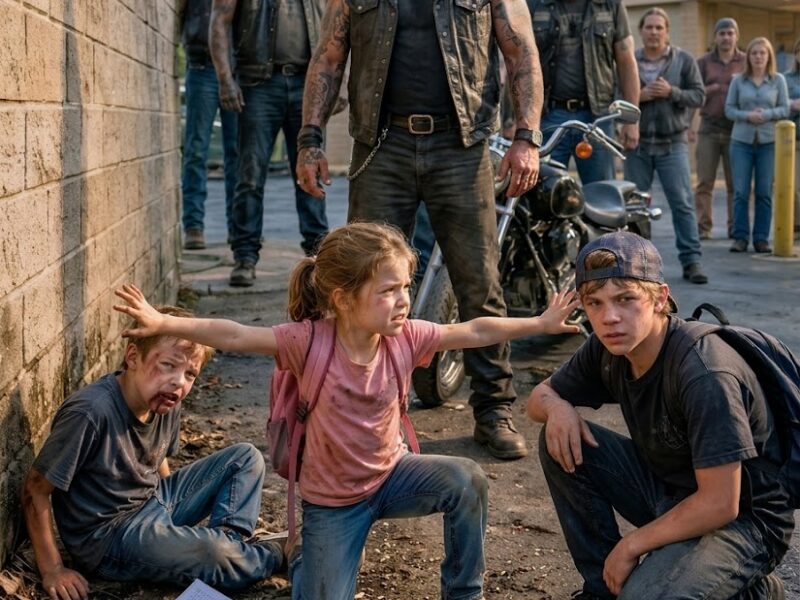
A group of Hells Angels watched a little girl stand alone against a gang of bullies—then what they did next shocked everyone.
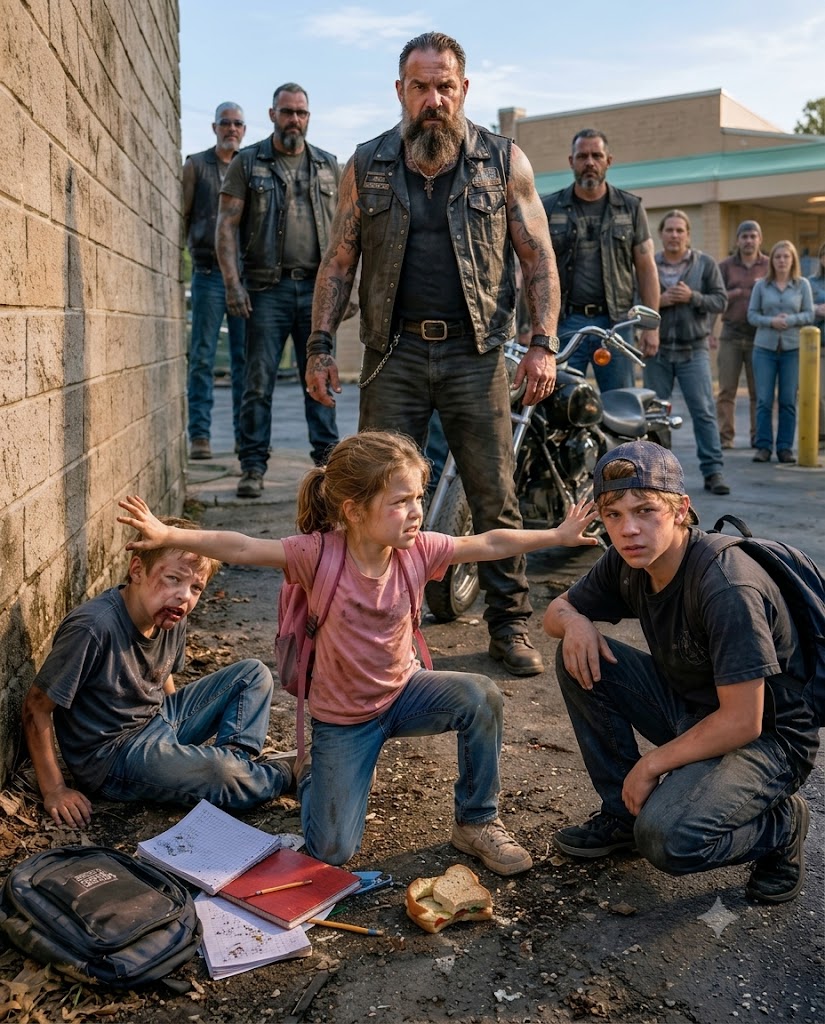
The afternoon sun baked the cracked asphalt outside the Dollar General, turning the air thick and stale.
Ellie was only eight years old, all scraped knees and a crooked ponytail, but she moved like lightning when she saw her brother hit the ground.
She slammed her tiny body between the boys and Tyler before anyone could pull another punch, her pink backpack sliding off one shoulder as she planted her feet wide.
Tyler was twelve, skinny, and shaking hard enough to make the brick wall rattle behind him where he curled against it, blood running from the corner of his mouth to his chin.
His backpack had split open across the pavement—spiral notebooks, two pencils, and a crushed bologna sandwich had spilled into the dust.
Dax Mercer, sixteen and already broad through the shoulders, nudged the sandwich with his boot and laughed like the whole thing was a game, wearing his father’s confidence like armor.
“Look at him,” Dax said. “He can’t even cry right.”
Ellie’s jaw trembled once, then it set.
“You touch him again,” she said, voice high and sharp and carrying farther than anyone expected, “and everybody here will know you’re cowards.”
The parking lot went still in that ugly, suspended way violence sometimes did when something unexpected cut through it.
A woman loading canned soup into her trunk froze, an old man at the propane cage looked over and then looked away, and two teenagers by the ice machine stopped laughing.
Dax blinked at Ellie as if she had broken some rule children weren’t supposed to know.
“Move,” he said.
“No.”
Wade Collins stepped forward and pointed at Tyler. “He took my brother’s pocketknife.”
Tyler’s face twisted. “I didn’t.”
Ellie never looked back at him. “If you’re right, say it where grown men can hear it.”
That landed harder than a scream would have, because boys like Dax knew exactly how brave they were in front of smaller kids and exactly how careful they got around real witnesses.
But he also knew people in town usually let him do what he wanted.
He reached down, grabbed Ellie by the strap of her backpack, and yanked.
She stumbled, hit one knee, and skidded across the hot pavement, her palm scraping raw.
Tyler lunged up on instinct, but Wade drove a sneaker into his chest and sent him crashing back into the wall.
That was the moment the engines rolled in.
Three Harleys turned off Main and into the lot with a sound like metal thunder, chrome flashing in the afternoon sun as heads snapped toward them before the bikes even stopped.
Leather cut through the stale smell of gasoline and fried food from the convenience store next door, and the patches on their backs changed the air all by themselves.
The Hells Angels parked in a row near the curb, and for one second nobody moved.
The biggest rider killed his engine last—early forties, thick in the chest, beard threaded with gray, forearms roped with old scars.
His road name was Cole, though most people in town only knew him as the kind of man mothers warned their kids not to stare at.
He had seen bar fights, prison yards, wrecks on county roads, and men twice Dax Mercer’s size crumble under consequences they never imagined.
But what made him go still now was not Tyler on the ground.
It was Ellie getting back up.
She rose with blood on her palm, one shoelace loose, cheeks flaming, and stepped in front of her brother again as if pain had not changed the math for her at all.
Cole took off his gloves one finger at a time.
Dax noticed the bikers and immediately tried to rearrange the scene, letting out a laugh too loud to sound real.
“Kid stuff,” he called. “Family business.”
Ellie pointed straight at him. “You threw him into the wall.”
Cole’s eyes shifted from Dax to the little girl, and he did not speak.
Dust floated in the hard afternoon light between the loading dock and the cracked cinder block wall, turning the whole alley into something that looked almost still from a distance.
Up close, nothing about it was still.
Tyler was on one knee, one hand braced on the pavement, trying not to cough after having his back slammed into the wall.
Ellie stood in front of him with both fists balled so tight her knuckles had gone white.
Dax and his two friends were smiling for the benefit of anyone who might be watching, but their eyes had already changed.
They had seen the cut of the leather vest.
They had seen the patch.
Cole slipped his gloves into his back pocket and finally moved—not fast.
That was the first thing everybody noticed.
No charge, no shouting, no movie scene swagger, just a big man stepping forward with the kind of calm that made other people feel loud all of a sudden.
The scrape of his boots on gravel sounded sharper than Dax’s fake laugh.
“Family business,” Dax repeated, weaker now.
Cole stopped three feet away. “Then why’s the whole town invited to watch?”
The line hit harder than a threat would have.
One of the boys behind Dax glanced toward Main Street, where a school bus had just hissed to a stop at the corner.
Two women unloading groceries had frozen beside a pickup, and a mail carrier stood with one hand on an open box, pretending not to stare.
What had happened in the alley was no longer hidden by the alley.
Ellie looked up at Cole, breathing hard, one braid loose, chin shaking from anger more than fear.
“He lies,” she said. “They wait for my brother every Friday.”
That changed the shape of the moment.
Until then, this could have been explained away as roughhousing, a bad shove, a bunch of teenage boys getting carried away.
But the little girl did not say they fought.
She said they waited.
“Planned,” Cole repeated, and the difference landed on every face around them.
Dax heard it too. “You need to shut her up,” he snapped at Tyler before catching himself.
Cole’s head turned slowly back to him. “Interesting choice of words.”
Tyler pushed himself upright against the wall, maybe thirteen, all elbows and fear, one sneaker lace torn loose and dragging.
Blood showed at the corner of his mouth, and he kept his eyes down—not from guilt, but from habit, like someone who had learned eye contact only made things worse.
Cole noticed.
So did Ellie.
“Tell him,” she said to her brother, and there was no pleading in it.
It sounded more like a command from someone too young to have earned that tone, but forced to use it anyway.
“Tell him what they take.”
Tyler swallowed.
Dax took one step forward.
Cole did not touch him—he only shifted his body an inch into the path, and somehow that inch became a wall.
“Try it,” Cole said.
Dax stopped.
The silence stretched. Somewhere behind them, a truck door shut.
More people were watching now, public pressure replacing physical danger, and Dax hated it.
Boys like him knew how to dominate a hallway, a bus seat, a blind corner behind a building.
Open daylight was different.
Witnesses turned cruelty clumsy.
“They take my lunch money,” Tyler said at last, voice scraped thin.
“Sometimes my backpack. Sometimes my homework if they want me in trouble at home. If I don’t give it over, they say they’ll catch her walking from school.”
Ellie did not look at her brother when he said it.
She kept staring at Dax as if she wanted him to hear the whole thing without being allowed to escape into denial.
One of the grocery women muttered, “Jesus.”
Dax’s ears flushed red. “That’s not what happened.”
“No?” Cole asked.
Dax spread his hands, trying to recover. “He owes people. Everybody knows it. He runs his mouth, then cries when somebody pushes back.”
“That true?” Cole asked Tyler.
A shopping cart rattled somewhere near the front doors, ordinary store noise carrying through the heat as if the town had decided this was just another afternoon.
In the alley, nobody moved for a beat after Cole’s question.
Tyler stayed against the wall, one hand pressed near the rip in his backpack, books and loose papers scattered around his boots.
He looked smaller than he had a minute earlier—not because of his size, but because every eye in the alley had turned him into a problem to be judged.
His mouth opened, then closed.
Dax seized the silence like it belonged to him.
“See,” he said too fast, “he can’t even answer.”
Ellie took one sharp step forward before Tyler could force out a word.
“Because you don’t let him,” she said.
The sound of her voice cracked through the alley harder than anybody expected from a girl her age.
A couple of people near the loading dock turned fully now.
One of the grocery women stopped pretending to sort bags in her trunk.
Even the teenage cashier in a green vest froze with a case of soda balanced against his hip.
Dax gave a short laugh meant for the crowd. “This ain’t your business.”
“It became my business when you slammed him into a wall in broad daylight,” Ellie said.
She pointed, not at Tyler this time, but at the brick behind him—the smear where his shoulder had hit was still visible in the dust.
Then she pointed at the split backpack on the pavement, then at the papers under Dax’s boot.
“You keep saying words,” she said, louder now, so everyone could hear.
“But that wall is real. His bag is real. What you did is real.”
The laugh died on Dax’s face.
Wade shifted his weight and glanced toward Cole as if waiting for him to take over again.
Cole did not move.
He stood with his arms loose at his sides, expression unreadable, giving the alley back to the one person nobody there had expected to hold it.
Ellie saw that and kept going.
“If he owes somebody money,” she said, “you call the cops. If he broke something, you tell his mama. If he lied, you say what he lied about. You do not get to throw him around and then act like that makes you right.”
Dax’s friend snorted. “Listen to this little lawyer.”
“No.” Ellie shot back, turning toward him. “You listen.”
The words came out clean and hard, and that changed something—not fear, position.
The kind that shifts when one person says the thing everyone else was too cowardly to say first.
A few feet away, Tyler finally looked at her.
Shock sat plain on his face. So did embarrassment.
She could feel it, and for half a second her own cheeks warmed.
Then she remembered his notebooks in the dirt and the red mark on his jaw, and the shame burned off into anger again.
“You all keep saying everybody knows,” Ellie said, sweeping her hand toward Dax and the others.
“That’s what people say when they don’t have proof. That’s what cowards say when they want a whole crowd to help them lie.”
One of the grocery women let out a breath that sounded suspiciously like agreement.
Dax heard it too. His face tightened. “Watch your mouth.”
“Why?” Ellie asked. “You scared of a kid now?”
That landed hard.
The cashier with the soda lowered it slowly to the ground.
A man by a pickup truck muttered, “Damn.”
No one laughed this time.
The heat seemed to thicken around Dax where he stood.
He took a step toward her.
Tyler pushed off the wall at once, putting himself between them despite the pain still plain in his shoulders.
“Don’t,” he said.
It was the first word he had spoken since Cole asked him the question.
Dax stopped—not because Tyler looked dangerous, but because moving past him toward a little girl in front of witnesses would look exactly as bad as it was.
At the mouth of the alley, two men in black leather vests had not moved on when the shouting started.
They had come around the side of the store looking for shade and a place to smoke, then stayed when they saw a little girl plant herself in front of Tyler like she believed her body was enough to hold back the world.
One was Cole—tall, gray at the beard, broad through the chest in a way that age had not softened.
The other, a rider they called Mick, had a cigarette pinched between two fingers and a look on his face that had gone from amusement to something harder to name.
Neither of them stepped in.
They watched.
That was what made the moment sink under Cole’s skin.
The afternoon noise from the front of the store kept going as if this corner of town were not tilting.
A pickup rolled past out on Main. A cart clattered over a cracked strip of pavement. Somewhere a kid laughed.
And in the middle of all that ordinary life, a small girl stood in cheap sneakers and a faded T-shirt with both arms spread in front of a boy bigger than she was, her chin raised toward boys old enough to know shame and mean enough not to feel it.
Cole had seen bar fights, knife wounds, wrecks on county roads, marriages split open in parking lots, and men twice Dax’s size come apart under less pressure than that child was taking without blinking.
It was not bravery in the way people liked to describe bravery later.
It was raw.
More offensive to the people around her.
She had made a public choice.
She had decided somebody else would have to go through her first.
Mick let a little ash drop to the concrete. “Kids got more spine than half the men in this town.”
Cole did not answer.
His attention stayed locked on the girl and on Tyler behind her—still pale from the blow he had taken earlier, still trying not to sway.
Tyler’s right hand was braced against the wall. His left hung close to his ribs.
Hurt, Cole thought. Not weak. Hurt.
There was a difference, and that difference seemed to matter to the girl more than anybody else standing there.
Dax glanced toward the alley mouth and finally clocked the leather cuts.
The swagger in him faltered for half a second.
“This ain’t your business.”
“Then why are you performing it in public?” Mick asked mildly.
The words were not a threat. They landed worse than one.
Dax’s friends shifted, suddenly aware of where they were, of how open the alley was, of the front doors just beyond the corner, and all the witnesses coming and going with grocery bags.
Their power had lived in a smaller story until now—one hurt boy, one loudmouth, one easy target.
The sightlines had changed. So had the audience.
The girl did not look back at the bikers.
She kept her eyes on Dax. “You heard him.”
Cole’s gaze sharpened.
Not fear, he thought, not even borrowed courage.
She was using the pause she had been given, taking hold of it.
The men in leather had only made the alley wider.
She was the one filling the space.
Dax gave a short laugh that fooled nobody, least of all himself. “You think this is over because they’re standing there?”
Tyler straightened a little behind her. “Leave.”
The single word came rough, but it carried farther this time.
The pain in his shoulder showed when he lifted his head, and the effort of staying upright was written plain through his body.
The word hung in the alley like something heavier than sound.
Leave.
For one beat, nobody moved.
Then Dax’s grin thinned around the edges.
The swagger stayed in his shoulders, but his eyes flicked past Tyler, down toward the men in cut leather waiting by the mouth of the alley.
He was trying to measure distance, numbers, consequences.
That small hesitation told Ellie more than any threat had.
For the first time all afternoon, the boys weren’t certain the town still belonged to them.
“Come on,” one of them muttered.
Dax backed away a step, then another, keeping his stare locked on Tyler as if refusing to admit who had actually stopped him.
“This ain’t done.”
Tyler didn’t answer.
Neither did the men beyond Ellie.
Their silence worked better than shouting ever could.
The boys peeled away at last, sneakers scraping wet pavement, knocking shoulders against each other as they pushed out into the brighter street.
Their laughter came back once, forced and brittle, then disappeared under the rumble of a passing truck.
Only after they were gone did Ellie realize how hard she was gripping the strap of her backpack.
The bottom seam had torn. A pencil rolled near the curb and settled in a shallow puddle.
Tyler swayed beside the brick wall.
Ellie turned at once. “Easy.”
He tried to straighten again, still breathing hard, trying to look bigger than the pain that had climbed into his back and shoulders.
It was a useless effort now.
Up close, the strain showed everywhere—in the tight line of his mouth, in the way his right hand stayed half curled as if fully opening it hurt, in the sweat gathered near his hairline despite the cool air.
Ellie glanced over her shoulder toward the street, then stepped aside.
That was when she saw one of the others separate from the group.
Everything in her tightened.
The shape of him alone was enough to set every warning bell in her body ringing again.
Heavy boots, road-worn denim, leather cut dark with age and weather.
Not rushing, not posturing, not smiling.
Just walking toward them with the calm of somebody who never needed to prove he could be dangerous.
Ellie instinctively shifted, placing herself half in front of Tyler.
The man stopped a few feet away and took off his gloves one finger at a time.
It should have made him look less threatening. Somehow it didn’t.
His face held no mockery, no drunken edge, no cheap excitement at scaring people.
That made him harder to read.
“Ma’am,” he said, and the simple courtesy hit her almost as strangely as the jacket.
Tyler didn’t move, but his attention sharpened.
Tyler lifted his head, weary and exhausted both.
Ellie kept her voice flat. “If this is where you tell me we owe you something, save your breath.”
The man looked at the torn grocery bag, the bruising already darkening along Tyler’s jaw, then back to her.
“Not why I walked over.”
He said it so evenly that she couldn’t decide whether to trust him less or more.
“What do you want?”
“A couple answers.” He nodded toward Tyler, but his eyes came back to Ellie, as if he understood who would decide whether this conversation happened. “How long has it been going on?”
Ellie didn’t pretend not to understand. “Long enough.”
“They let them every time?”
Tyler tried to speak first. “Doesn’t matter.”
“It does if they keep circling back,” the man said, no threat in it, no promise either, just fact.
Ellie studied him.
The men by the street had not closed in. They stood where they were, watching traffic, smoking, giving the alley a wide ring of space—not trapping them, guarding it, maybe, or making sure nobody interrupted.
She hated that she couldn’t tell the difference.
“They’ve been after him since school started,” Ellie said before she meant to.
Fatigue had opened a crack in her caution. “It got worse this month.”
A siren wailed somewhere three blocks over, thin and distant, and for a second it made the alley feel even smaller.
Ellie wished she had kept her mouth shut the moment the words left her.
“School started.” “Worse this month.” Too much truth handed over too easily.
Across from her, Cole did not react with surprise or pity.
That almost unsettled her more.
He only looked at Tyler the way a mechanic looked at a machine making the wrong sound—quiet, focused, already fitting the broken pieces together.
Tyler stayed close to the brick wall, one shoulder tipped toward it, trying to hide how much standing there cost him.
The wrongness in his voice still hung in the air after that single order to leave, but the boys at the alley mouth had not gone far.
They had drifted back toward the sidewalk like they were bored, like none of this mattered.
One kicked an empty soda can into the street. Another laughed at something said too low to hear.
Then Ellie saw the one thing that changed the shape of the afternoon.
The tallest of them lifted his phone chest high—not at his own friends, but pointed back into the alley.
Recording.
Her stomach dropped.
Bruises were one thing, rumors were another. Video could live forever.
“Don’t,” she snapped, stepping forward before she thought better of it.
The boy grinned without warmth. “Public sidewalk.”
Cole moved half a step, not threatening, just enough to pull the line of attention toward himself.
That should have ended it.
Instead, it sharpened the boys.
Ellie understood too late what they wanted—not a fight, not yet, something cleaner, something they could carry into school by morning and spread through every phone in town before first bell.
One of them pitched his voice loud enough for the street to hear. “Look at Tyler hiding behind a little girl and his mommy.”
The words hit harder because they were designed to.
Tyler flinched, not outwardly, but Ellie saw it in the way his jaw locked and his fingers curled.
Wade shifted beside him, angry enough to shake.
“Say it again,” Wade muttered.
“Don’t,” Ellie said quickly, but the boys were already closing the distance in a new way—not with fists, with audience.
A pickup stopped at the light nearby.
A woman at the bus bench turned her head.
A man coming out of the corner market slowed with a plastic sack in one hand.
The alley was becoming a stage.
The tall boy angled the phone wider. “Tell them why you miss gym, Tyler. Tell them why you won’t look anybody in the eye.”
Another boy barked a laugh. “Tell them what happened in the locker room.”
Ellie felt Tyler go rigid beside her.
Whatever had happened at school, this was the center of it.
Not random shoving. Not lunch money. Shame.
Humiliation carefully repeated until a kid started believing it belonged to him.
Cole turned his head slightly toward Ellie.
And in that tiny glance she understood he had caught it, too.
“Enough,” Ellie said louder now.
The tall boy ignored her. “Maybe show them the picture.”
He flicked his thumb across the screen and spun the phone toward the others.
A burst of ugly laughter followed.
Tyler lunged before anyone could stop him.
It was not a smart move. It was a child’s move—all pain and instinct.
He shot toward the phone trying to knock it away.
And the boys had clearly been waiting for exactly that.
One sidestepped. Another stuck out a foot.
Tyler hit the pavement hard on both knees and one palm, skin scraping against grit and broken glass.
Ellie cried out and dropped toward him.
By then the phone was aimed straight down, catching every second.
“Get up,” one boy cheered. “Come on. Be tough.”
Tyler pushed off the wall, but pain folded through him so sharply he stumbled after two steps.
Broken glass bit into Tyler’s palm as Ellie dropped beside him, one hand already reaching for his shoulder before she even thought about the boys still filming.
The alley smelled like hot brick, spilled soda, and blood.
Tyler had made it only two limping steps off the wall when pain bent him in half again.
The laugh that followed from the boys was louder than the siren had been.
Ellie spun toward them with a fury so raw it almost shocked her. “Stop recording and help him.”
One of them grinned and tilted the phone higher. “Why? So you can cry louder?”
Before Ellie could move, a motorcycle engine rolled in from the mouth of the alley.
Not a roar. Not a dramatic charge.
Just one deep, steady sound. Controlled enough to make every other noise seem childish.
Then a second engine answered. Then a third.
The boys looked up first.
Mick stood at the alley entrance with one boot on the ground and both hands resting on his bars, his face unreadable under the afternoon light.
Behind him, two more bikes blocked the street side without touching the curb—close enough to stop anyone from drifting past, far enough not to trap anyone.
It was not chaos. It was arrangement.
The phones lowered.
Ellie felt the shift before a word was spoken. The air itself changed.
The boys had spent all day feeding on spectacle, on the safety of numbers, on the confidence that everyone else would keep pretending not to see.
That confidence cracked the second they understood they were now the ones being watched.
Mick did not raise his voice. “Ambulance coming?”
Ellie nodded once. “I called.”
His eyes moved to Tyler. Then to the phone still clutched in one boy’s hand.
“Keep that,” he said. “Don’t delete a thing.”
The boy swallowed. “Why would I?”
“Because if it disappears,” Mick said, “people start wondering what else disappeared with it.”
That landed harder than a threat.
The boys tried to gather themselves, to wear their swagger again, but it sat wrong now.
One muttered something about leaving. Another stepped back toward the street.
Mick only glanced over his shoulder.
One of the other riders shifted his bike half a foot.
No one was blocked in. No one was touched.
But the message was plain. Walking away from this would no longer be simple.
Ellie stared at him, confused by the restraint.
After everything that had happened, after the bruises and the taunts and the public humiliation, she had braced herself for an explosion.
Instead, he was building something.
The paramedics arrived first.
Questions came fast. Who started it? Who struck first? Who had video? Who was injured?
Ellie answered what she saw.
Tyler, pale and sweating, tried to wave off help until one medic touched his ribs and his face turned gray.
Wade stayed silent while they cleaned his hand, jaw tight, eyes fixed on the pavement as if looking at anyone might break whatever was holding him together.
When the gurney rolled Tyler toward the ambulance, Mick stepped aside and let it pass.
Only then did Ellie realize he had not looked away from Tyler once.
Later, outside the small emergency room entrance, the heat of the day gave way to a damp evening breeze.
Fluorescent light spilled across the concrete.
Ellie stood with her arms folded, watching mothers, workers, and old men come and go through the sliding doors.
She expected Mick to leave. He did not.
Instead, he made calls. Sure calls. Precise ones.
A rider was sent to the gas station near the school. Another to the laundromat parking lot where the boys liked to gather.
Another to the baseball field concession stand where half the town traded gossip before sundown.
He was not calling for a brawl. He was calling for witnesses, copies, names, timestamps, angles, presence, planning, pressure.
Ellie listened from the vending machines and slowly understood that he was hunting something far more dangerous than a fistfight.
By the time the first engines rolled into the gas station across from the school, the heat had turned the blacktop soft enough to shine like oil.
Parents on their way home slowed without meaning to.
A cashier came out from behind the counter with a dish towel still over one shoulder.
Two kids abandoned their bikes by the ice machine.
Word moved faster than traffic in a town like this, and by six o’clock the rumor had already twisted itself into something wild.
It got quiet anyway when they saw there was no roar, no rush, no circle closing in for a fight—just motorcycles lined up in plain sight, just men taking off helmets, just phones coming out.
Mick stepped onto the curb beside the air pump and looked over the lot as if he were checking weather before a storm.
Blood had dried dark along his knuckles. His cut was still dusty from the alley.
He did not hide either one.
Tyler stood three feet to his left with fresh gauze taped over his split cheekbone and one arm stiff at his side.
Ellie stayed near the newspaper rack, close enough to hear him breathe, far enough to let him choose what came next.
The boys who had cornered Tyler arrived ten minutes later in the back of a pickup, loud until they saw how many people were there.
Dax hopped out first. Wade came after him, baseball cap backward, grin already fading.
The tall boy stayed in the truck bed for one extra beat, scanning faces, looking for an opening that was not there.
Behind them, more locals had gathered at the edge of the lot.
Two women from the laundromat, the assistant coach from the field, a mail carrier still in uniform, a man from the hardware store, three high schoolers holding fountain drinks and pretending not to stare.
No one blocked the truck. No one threatened them.
That was the first thing that unsettled them.
Mick lifted one hand and pointed, not at the boys, but at the gas station wall where the owner had dragged out an old extension cord and plugged in a flat-screen TV usually used for football on Friday nights.
A laptop set open on the hood of a sedan beneath it.
A rider named Dex, who had spent most of the afternoon collecting clips, stood beside the keyboard with a legal pad full of names and times.
“Since everybody likes recording things,” Mick said, his voice carrying across the pumps without needing a shout, “everybody can watch the whole thing.”
The grin vanished completely from Wade’s face.
Dax laughed once, sharp and fake. “What is this supposed to be?”
“Order,” Mick said. “Dex—everyone hit play.”
At first, the screen showed nothing but the school side sidewalk, bright enough to hurt the eyes.
Kids crossing. Cars passing.
Then Tyler came into frame, backpack hanging low, trying not to react to the first shoulder check.
Someone in the crowd muttered under their breath.
The footage jumped to another angle from near the concession stand—Tyler stumbling, a hand swatting his books, Wade circling wide so he could stay out of the first camera shot.
Then another clip from the laundromat lot, grainier but clear enough to catch faces, words, the way they boxed him in where no teacher could see.
A few people turned and looked straight at the boys.
Wade opened his mouth. “That’s not—” But the next clip was not blurry, not uncertain.
His hand was on Tyler’s collar.
Then the next file started.
A little figure cutting into frame at a run.
Ellie felt the entire lot shift before anyone made a sound.
Tyler’s sister looked even smaller on video than she had in real life—all elbows, fierce eyes, and a cheap backpack bouncing against one shoulder.
There was no dramatic entrance, no movie miracle, just a child planting herself between her brother and boys bigger than she was.
Chin shaking, but feet fixed to the concrete.
The gas station went so quiet that even the idle engines seemed to lower their voices.
On the screen, the girl stayed where no child should have had to stand, between Tyler and the boys circling him.
She was trembling hard enough for it to show in the grainy footage, but she did not move.
She spread both arms like they were somehow enough.
One of the boys shoved her.
She stumbled, caught herself, and stepped right back into the space she had lost.
That was the moment Ellie understood why Tyler had not wanted pity, and why he had looked half sick when he asked for help.
It had never just been about him.
It had been about what his sister had already learned—that grown men in that town could watch cruelty in broad daylight and call it none of their business.
Nobody in the lot spoke for several long seconds.
Dax stared at the screen as if it had struck him across the mouth.
Wade looked away first.
The tall boy took off his sunglasses and wiped them slowly with the edge of his shirt, buying himself a second to steady his face.
Someone muttered a curse under his breath.
Dex did not say anything at all. He simply held out his hand.
Ellie gave him the phone.
He replayed the clip once.
Then he looked across the road at the school, at the chain-link fence, at the pickup trucks parked crooked along the curb, at the men who had been pretending for years that fear was normal if it happened to somebody poorer than they were.
When he handed the phone back, his expression had changed. Not harder—clearer.
“Bring the kids,” he said.
It was not what Ellie expected. It was not what anyone expected.
No one revved an engine. No one reached for a weapon. No one crossed the street looking for blood.
Instead, every rider there got back on his bike and rolled, slow and controlled, past the school, past the feed store, past the diner windows full of faces, and into the center of town where everybody could see them.
They parked in a long black line beside the courthouse square under the punishing afternoon sun.
Leather vests, road dust, gray beards, tattooed arms, heavy boots—the kind of sight that usually made people lock their doors and watch from behind curtains.
But this time they waited.
Ellie stood with Tyler and his sister near the courthouse steps.
The boy stayed close at first, one hand twisted in the hem of his father’s shirt.
Then he saw that none of the bikers were posturing. None of them were laughing. None of them were treating him like a mascot for somebody else’s anger.
They were making room.
One by one, children began to appear.
A girl from the laundromat came first, still in a summer camp T-shirt.
Then two brothers from the trailer park.
Then a skinny kid Ellie recognized from the grocery store.
Then another. Then more.
Some came with mothers. Some came with grandmothers.
Some came alone, eyes darting, as if they expected to be told they had no right to be there.
Mick dragged over a folding table from the courthouse basement.
Dex found a box of markers from the church office next door.
Wade taped butcher paper across the front of the table with strips of silver duct tape.
At first the square did not understand what it was seeing.
Then Dex picked up a marker, uncapped it, and wrote in big block letters across the top of the paper: Who is hurting our kids?
He set the marker down and stepped back.
No speech. No threat. No sermon.
Just a question no one in town could dodge anymore.
For a moment, the whole square held its breath.
Then Tyler’s sister let go of her brother’s shirt, walked up to the table, and wrote the first name with both hands because she was pressing so hard the marker squeaked.
The name was Dax Mercer.
A woman in the crowd gasped.
Another woman—the one from the laundromat—stepped forward and wrote a second name.
Then a teenage boy in a church youth group shirt wrote a third.
By sunset, the butcher paper was covered in names, some written in careful print, some scrawled in anger, some blurred by tears.
And the Hells Angels stood quietly at the edges of the square, not as enforcers, but as witnesses.
The next morning, the story broke wide open.
A local reporter picked it up. Then a regional paper. Then a television crew from two counties over.
By the end of the week, the school board had called an emergency meeting.
The police chief, who had spent years looking the other way, suddenly found reasons to open cases.
Dax Mercer’s father, a man who had built his reputation on quiet intimidation, found himself answering questions he could not dodge.
And the butcher paper with all those names was photographed, copied, and hung in the window of the hardware store, where everyone could see it.
Tyler went back to school the following Monday with a new backpack and a healing cut on his lip.
His sister walked beside him, her crooked ponytail swinging.
Three Hells Angels sat on their bikes across from the school that morning, not saying a word, just watching.
They did the same the next day, and the next.
By the end of the month, the bullying had not entirely stopped—cruelty rarely dies that quickly—but it had changed shape.
It had gone underground, where cowards always retreat when the light gets too bright.
And Tyler’s sister, the girl with the scraped knees and the fierce eyes, had become something of a legend in that town.
People said she had stared down boys twice her size.
People said she had made a biker take off his gloves.
People said she had written the first name on a piece of butcher paper that changed everything.
But what Ellie remembered most was not the fear or the anger or the cheers.
What she remembered was the moment Cole knelt down beside her outside the emergency room, his leather creaking, his scarred hands resting on his knees, and said something she would carry for the rest of her life.
“You did good, kid,” he told her. “Not everybody gets to be brave when it counts. You did.”
And then he stood up, walked back to his bike, and rode away into the evening, the sound of his engine fading like thunder rolling off toward the mountains.









