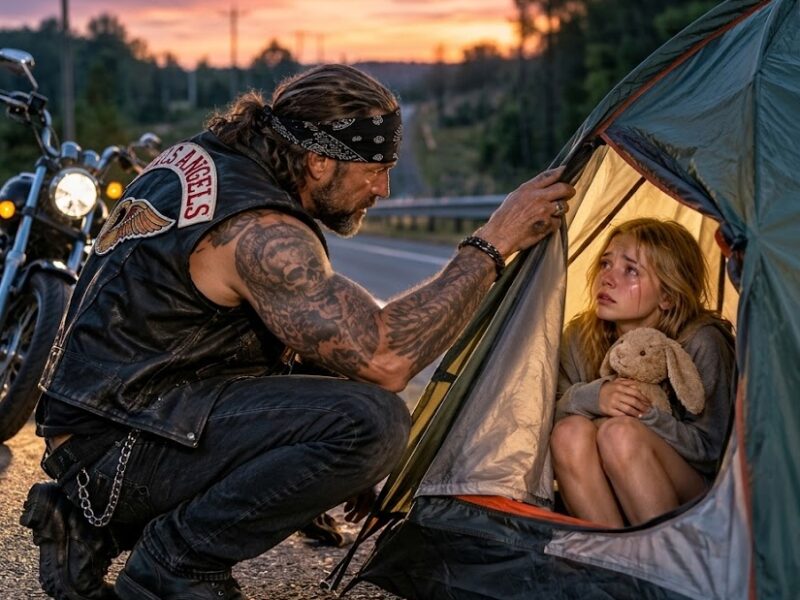
A group of Hells Angels watched a little girl stand alone against a gang of bullies—then what they did next shocked everyone.
**Part One**
Late afternoon was fading over Route 27 when Elias “Eli” Brandt, 56, saw the tent. The highway stretched empty and pale beneath a sky the color of old denim, just wind moving through the dry grass. Near mile marker 19, tucked close to the shoulder like something abandoned, stood a small tent. Its blue fabric had faded under years of sun and dust, the kind of faded that happens slowly, the way forgotten things age.
It was too small for camping. Too careful to be a mistake.
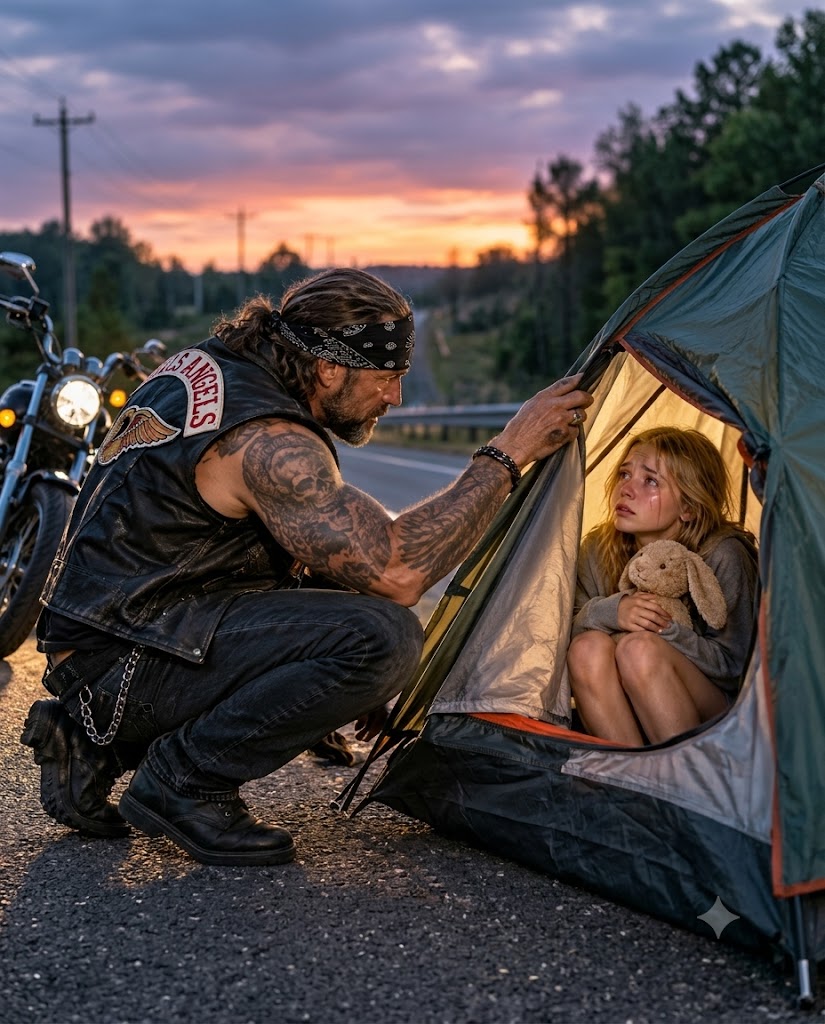
Eli slowed his motorcycle, the engine rumbling low beneath him. He pulled over, killed the engine, and sat there for a moment without moving closer. His leather vest carried the patches of his club, and he knew how he looked to strangers. He knew the weight of that look.
Inside the open flap, a little girl with blond hair sat curled up, knees to her chest, hugging an old stuffed rabbit. The rabbit was worn thin, one ear stitched back on with uneven thread, the kind of stitching done by hands that loved more than they knew how to sew. Beside her sat a water bottle and crackers, placed neatly, like she had been there longer than a few hours.
Her eyes were wide and watchful. Every time a car passed, she counted it, as if waiting for someone or watching for someone.
Eli took a bottle of water from his saddlebag, set it on the ground a good distance away, then stepped back, hands where she could see them. “I’m not here to take you anywhere,” he said quietly.
She stared at him, then her face crumpled. “I can’t go home,” she whispered. “If they find me, they’ll take me away again.”
Eli did not reach for her. He did not pull her from the tent. He just nodded, memorized the spot, and waited until dark before he left. As he rode away, the little tent shrank in his mirror, and he already knew he would come back.
—
The next morning, the little blue tent was still there at mile marker 19, smaller in the daylight than it had looked in his mirror the night before. Eli rode in slowly, cut the engine a good distance away, and sat for a moment with his hands on the handlebars, just looking.
He had not slept much. Every time he closed his eyes, he saw that small tent shrinking in his mirror.
This morning he had brought water, bread, and a thin blanket folded over his arm. He did not walk straight to the tent. He stopped a few steps short, set the water and bread on the dry grass where she could see them, laid the blanket beside them, and stepped back. His hands stayed where she could see them.
Inside the tent, Nora was still there. She had made it through the cold night on her own.
The blanket she had yesterday was spread out beneath her now, smoothed down like she had tried to make a real bed out of it. Her blond hair was tangled from sleep. Her eyes were tired, but she was awake and watching him the way she had watched the road. She did not run.
She pulled her old stuffed rabbit closer to her chest and waited.
“Morning,” Eli said, keeping his voice low. “I brought you some water and bread, and a blanket if you want it. It’s yours either way.”
Nora looked at the food, then at him, then back at the food. She did not reach for it right away.
“What’s your name?” Eli asked.
“Nora,” she said, and that was all. She hugged Barnaby tighter as if the rabbit could answer for her if she ran out of words. She did not ask for money. She did not ask for a ride. She did not ask him to stay.
“Please don’t tell anyone about this tent,” she whispered. “I’m okay here. Just don’t tell.”
Eli nodded, slow and steady, the way you nod to someone who is already braced for you to argue. “I won’t,” he said.
He sat down on the ground, far enough away that she would not feel crowded, and he kept his movements small. “I used to be a firefighter,” he told her. “A firefighter and a paramedic. My job was to show up when people were scared and hurt and try to make things a little calmer, not louder. I’m not going to pull you out of here,” he said. “I’m not going to drag you anywhere. If you’re hungry or scared, you just tell me. Okay?”
Nora studied him for a long time. Then, almost too quiet to hear, she nodded.
After a while, she started to talk in small pieces but about the road. She knew when the big trucks came through and when the road went quiet again. She knew the gas station about two miles down the road had water outside and that nobody bothered you if you filled a bottle and left. She said it the way a kid says a route she has walked before, not a place she stumbled on by accident.
“I’ve been here before,” she said, looking past the tent toward the trees. “I used to come here with my mom.”
She did not say more. She hugged Barnaby again and Eli understood that this tent was not random. She had a plan. She had a memory tied to this spot.
Before he left, Eli took a photo of the mile marker 19 sign just to remember exactly where she was. He told Nora he would be back, then rode to the nearest diner and asked if anyone knew the little girl by the road.
The woman behind the counter went still when he described her. She looked out the window, then back at Eli. “That little girl looks like Sarah’s daughter,” she said. “The nurse who died last year.”
Eli froze.
—
**Part Two**
Eli stood still in the diner while the woman behind the counter disappeared into the back room. When she came back, she held a small creased photograph. She slid it across the counter without a word.
Eli picked it up. In the picture, a young woman with kind, tired eyes knelt beside a small blue camping tent. Next to her stood a little girl with blond hair grinning, her arms wrapped around an old stuffed rabbit. The trees behind them were the same trees. It was mile marker 19.
He thanked the woman, slipped the photo into his jacket pocket, and rode back slower this time as if the road itself had changed.
When he pulled over again, Nora was still there, knees to her chest, Barnaby held tight against her. She watched him stop, watched him set his helmet on the ground a good distance away. He did not walk straight toward the tent. He waited for her small nod, then sat down in the dust, far enough away that she could breathe.
He held the photograph where she could see it without pushing it toward her. “The lady at the diner gave me this,” he said. “Is this you?”
Nora stared at it for a long time. Her eyes filled, and she nodded. “That’s Mom,” she whispered. “And that’s me, and Barnaby.”
It was the first time she had said her mother’s name out loud to him. And something in her seemed to loosen, like a knot pulled too tight for three days was finally starting to give.
She began to talk, not in small pieces this time, but in a longer story. “Mom used to bring me here,” she said. “Lots of times. We’d come in the evening and look at the stars. She said this was our place.” She looked toward the faded sign down the road. “Mile marker 19. Mom said if I ever got lost, I should remember 19. She said, ‘No matter what happens, this place will always be home for the two of us.'”
Eli listened. He did not interrupt. He did not correct her.
“After Mom died,” Nora went on, “I lived with Grandpa Harold. He takes care of me. He makes breakfast, even when he burns the toast. He walks me to the bus stop. He reads me stories, even when he forgets where he left off.” Her voice caught. “Three days ago, Aunt Vanessa came from Chicago. She said she was going to take me back to Chicago with her. She said it would be better. I didn’t want to leave Grandpa. He’s the only one I have left. So, I packed my tent, and I came here. I brought Barnaby because Mom gave him to me.”
She pressed Barnaby closer, the way a child holds something that is more than a toy. She had held him that way since Eli first saw her, and she had never let anyone take him or open him. He was worn thin, one ear stitched back on with uneven thread, but to her, he was still a piece of her mother, something she could hold when everything else felt like it was slipping away.
“If I stay right here, in our place,” she said, “maybe Mom will find me somehow.”
Eli’s throat tightened. He had learned, long ago, that a hurting child does not need a perfect promise. She needs the truth, spoken gently.
He kept his voice low and steady. “Your mom isn’t here anymore, Nora,” he said. “I know that hurts to hear, but I won’t leave you alone.”
For a moment, Nora said nothing. The wind moved through the dry grass. She just looked at Eli, as if she were trying to decide whether to believe him. Then, in a voice so small it almost disappeared, she asked, “Do you think I’m bad for running away?”
Eli shook his head. “You’re scared,” he said. “Scared is different from bad.”
—
**Part Three**
Eli left Nora at the tent with a promise to return. But first, he had to find the person she kept talking about—her grandpa.
The woman at the diner had scribbled an address on a napkin. Twelve miles from mile marker 19, down a narrow road that turned to gravel, stood a small wooden house with peeling white paint. Eli parked at a careful distance and walked up slowly, the way he had approached the tent.
An old man stood on the porch, patting his pockets and turning in a slow circle. He tried the front door, frowned, then looked down at the key already in the lock. “Oh,” he said. “I already locked it.”
Eli kept his hands where they could be seen. “Mr. Bennett?”
“Harold Bennett.” The man looked up, surprised but not afraid. “That’s me. Seventy-nine years old and still losing my glasses.”
Then Eli saw them, perched on top of the old man’s head.
Inside, the house told a story before Harold said a word. On the wall hung a framed photograph of a young woman with Nora’s smile, and beside it, a certificate honoring Harold for years of safe driving as a school bus driver. On the kitchen table sat a bottle of prescription medicine and a thick notebook. Its pages were filled with Harold’s own handwriting. Lists, reminders, times, names.
Eli did not start with the tent. He started with Nora.
He said her name gently, and Harold’s whole face changed. “Nora? She’s over at her friend’s house. At least, that’s what I thought. She said she was going to her friend’s house.” He said it with certainty, then paused as if the certainty had slipped a little.
Harold invited Eli to sit. His hands shook slightly as he poured coffee, but his voice was steady when he talked about Sarah. She had been a nurse who stayed late for others. When she died in a car accident a year ago, Harold said, “The world had gone quiet.”
“I didn’t think twice,” he said. “She was my granddaughter. I took her in. I promised Sarah that Nora would still have a home.”
From that day on, he had been the one to get her up in the morning, make her breakfast, and drive her to school. And in the summer, he taught her to plant tomatoes in the little garden behind the house.
“She talks to them,” Harold said, smiling. “Every morning, she goes out and talks to those tomatoes like they’re going to answer her back.”
Then Harold’s smile faded. He looked down at his notebook.
“My memory isn’t what it was,” he admitted. “Some days, I walk into a room and forget why I came. Once, I left the stove on. I smelled it in time, thank God, but I still think about it. Another time, I forgot the name of our own street. I stood there like a stranger in my own town.”
Eli listened without interrupting. He had seen this before as a firefighter and paramedic. Good people trying to hold a life together with shaking hands. Harold was not careless. He was not cruel.
“I worry I’m becoming a burden,” Harold said, “but I can’t let go of her.” He looked straight at Eli. “She’s the only family I have left, and I’m the only family she has left.”
That was when Eli told him the truth. “Harold, I found Nora. She’s safe at the tent by mile marker 19. She ran away because she was scared of losing you.”
Harold reached out and held Eli’s hand with both of his. “You found her, didn’t you? Please don’t let anyone separate us.”
Eli held his hand back. “I’m not going to hide this from you,” he said. “We’re going to bring her home together.”
—
**Part Four**
Eli could still feel the weight of Harold’s hands in his own when he rode back to mile marker 19 that afternoon. The old man had held on like a man afraid that if he let go, everything else would slip away, too. Eli had promised him they would bring Nora home together, and he meant it.
But first, he had to get back to the tent, back to the little girl who was still waiting by the road, and make sure she knew she had not been forgotten.
When he pulled over, Nora was sitting just inside the flap of the tent, Barnaby tucked against her chest. She looked up at the sound of his bike, and some of the tightness left her shoulders.
Eli did not walk straight up to her. He stopped where she could see him and set a fresh bottle of water on the ground between them. He told her Harold was safe, that he knew where she was, and that no one was going to sneak her away in the dark.
They had only been talking a few minutes when a dark SUV slowed on Route 27 and pulled onto the shoulder near the tent. Dust rose around its tires.
Nora went still. Her fingers tightened around Barnaby until her knuckles turned white.
A woman stepped out first. She was in her late thirties, neat and tired at the same time, with Sarah’s eyes and a face Nora knew. Behind her came a man in a button-down shirt carrying a slim briefcase, just papers.
“Nora,” the woman said, her voice breaking a little. “It’s me. Aunt Vanessa.”
Nora did not answer. She slid back until the tent was between her and the road, until only her eyes and Barnaby’s worn ear showed.
Vanessa turned to Eli. “I’m Vanessa Bennett, Sarah’s sister. I came from Chicago. This is Mr. Hayes,” she gestured to the man beside her, “my assistant. He’s here to help with the paperwork.” She held out a folder as if it could explain everything. “I have temporary custody. Nora was reported as a runaway. I’m here to take her home.”
Eli did not reach for the folder. He did not snatch it, or push it away, or raise his voice. He looked at it from where he stood, far enough away that Nora could see his hands were empty.
Vanessa opened it herself. Inside was a temporary order, stamped and signed, giving her short-term care of Nora after the report that she had left home. It was real. Eli could see that. It was not a trick, but it was also not a final decision. It said temporary, and that word mattered.
Then Vanessa laid out the rest of her plan. Nora would go back to Chicago with her and start school there. Harold would move to a care facility in another state, because, in her words, he could no longer take care of himself, let alone a nine-year-old.
Behind the tent, Nora was shaking, not crying loudly, just trembling, the way a child does when she is trying not to fall apart.
Eli kept his voice low. “I’m not the one who decides,” he told Vanessa, “but I’m not going to stand here and let a scared little girl be taken away while she’s shaking like this. We’re going to call the local police, and we’re going to wait for a child protective specialist. That way, everybody hears the same facts, and nobody has to decide this on the side of the road.”
Vanessa looked from the papers to Nora, and for a moment the confident plan slipped. She stepped closer but did not try to pull Nora out. “Nora, please,” she said. “I only want what’s best for you.”
Nora held Barnaby tighter and looked up at her. “If you want what’s best,” she said, “don’t separate me from Grandpa.”
—
**Part Five**
Nora’s words were still hanging in the air when the sound of tires on gravel broke the silence on Route 27.
Two vehicles pulled in slowly, a patrol car and a plain county car. The local police chief stepped out first, followed by a child protective specialist with a clipboard. Neither rushed. Neither raised their voice. They took in the scene—the tent, the little girl holding her worn rabbit, Harold nearby, Vanessa with papers in hand, and Eli standing a few steps back.
Vanessa was the first to speak. She held out the temporary papers again and explained that she had legal authority to take Nora to safety.
The chief took the papers carefully, read them without hurrying, and handed them to the specialist. He did not say they were real or false. He said they would be checked, and no decision would be made on the side of the road.
Then he turned to Eli.
Eli told it straight from the beginning. He had been riding alone when he noticed the small tent. He had stopped, kept his distance, and left water where Nora could reach it. He had not pulled her from the tent. He had not taken her anywhere. He had come back to check on her, brought food and water, and stayed close enough to help but far enough that she would not feel trapped. Then he had gone to Harold.
While Eli spoke, the specialist knelt near the tent, but not too close. She asked Nora if they could talk for a few minutes. Nora looked at Harold, then at Eli, then nodded.
The specialist led her a short distance away, still where Eli and Harold could see her clearly, still within earshot if Nora called out, and sat with her on the grass. She asked simple questions. What was her name? Where did she live? What school did she go to? Who took care of her at home?
Nora answered clearly. She gave her full name, her street, her school, and her teacher’s name without hesitation. She said her grandpa made her breakfast and walked her to the bus stop. She said she was not hurt, that she had eaten and drunk enough, and that no one had hurt her.
When asked what she wanted, she did not hesitate. She wanted to stay with her grandpa.
The specialist wrote it all down.
By then, Harold had reached the tent. He did not run. He walked slowly, as if one sudden move might frighten her away again. When Nora saw him, something in her shoulders loosened. She took two small steps forward and let him wrap his arms around her.
He did not lift her. He did not carry her off. He just held her, and Nora stopped trembling. Her breathing slowed. She pressed Barnaby to her chest and leaned into her grandfather. And for the first time that afternoon, she looked like a child who felt safe.
A driver who had pulled over spoke up from beside his truck. He looked at Eli’s vest and motorcycle and shook his head. “This is none of your business,” he said. “You’re sticking your nose into somebody else’s family.”
Eli did not stiffen or raise his voice. “I’m not deciding for this family,” he said. “I just won’t look away when I see a child sleeping in a tent.”
The driver drove away.
The chief waited until the road was quiet again. “No one would take Nora out of the county tonight,” he said. “Nothing would change until a formal meeting.”
Nora would go home with Harold tonight, with the specialist checking in. Vanessa would stay nearby and be heard. The meeting was set for the next morning at the county office, with Harold, Vanessa, Nora, the police, and the specialist all together.
Eli had not won anything with his fists. He had kept her safe and called the right people.
—
**Part Six**
The road grew quiet after the chief spoke. Harold held Nora close, and her breathing slowed at last. Eli stayed a few steps back, close enough to help and far enough to let a grandfather hold his granddaughter.
No one would take Nora anywhere that night. She would go home with Harold, and everyone would meet in the morning at the county office.
That night, long after Nora had fallen asleep with Barnaby tucked against her chest, Harold sat at the kitchen table and opened the box where he kept Sarah’s things. He had not gone through it in months. Inside were photographs, a hospital badge, and a worn notebook in Sarah’s handwriting.
Clipped inside the notebook was an old envelope, its edges soft with age. Harold set the notebook aside to bring with him in the morning.
By morning, the small county office felt crowded and still. Harold came in with Nora beside him. Nora held Barnaby with both arms, the way she had held him in the tent. Vanessa sat across the table with her papers in a neat folder. Eli sat near the door, saying little.
The child protective specialist waited until everyone was settled, then spoke to Nora in a low, unhurried voice. “Nora,” the specialist said, “I’ve noticed you never put Barnaby down. Can you tell me why he matters so much to you?”
Nora looked down at the rabbit’s worn fur and the ear sewn back on with uneven thread. “Mom sewed his ear back on before she went away,” she said. “She told me not to let anyone open it.”
Her voice did not shake. It sounded like a promise she was trying to keep.
The specialist did not reach for the rabbit. She looked at Harold, then at Vanessa, then back at Nora. “Would it be all right if Grandpa opened that stitch, just here, while we all watch?” she asked. “Only if you say yes. No one will take Barnaby away from you.”
Nora glanced at Harold. Harold kept his hands on the table, waiting. After a long moment, Nora nodded and held Barnaby out, just a little.
“Okay,” she whispered, “but be careful with him.”
Harold took the rabbit as gently as if he were holding something alive. With Vanessa and the specialist watching, and Eli watching from his chair, he worked the uneven thread loose, one small stitch at a time.
The ear opened.
Inside the hollow of the rabbit’s head, folded small and pressed flat, were two pieces of paper.
Harold’s hand stopped. He looked at Nora first, and she nodded again.
The first paper was a letter in Sarah’s handwriting. The second was a short copy of a will.
Harold read the letter aloud, slowly. Sarah wrote that if anything ever happened to her, she wanted her father, Harold, to be Nora’s guardian. She asked Vanessa to help them, to stand beside them, not to take Nora’s place or to separate them. The signature and date matched the handwriting in the notebook Harold had brought.
Nora listened with Barnaby back in her arms. When Harold finished, she began to cry, not with fear, but with a deep, breaking relief. For the first time, she understood that her mother had thought about this and had planned for her.
Harold pulled her close, and Vanessa pressed her hand to her mouth.
That was why Nora had never let Barnaby go. The tent was the place she had once gone with her mother, and Barnaby was the last thing her mother had mended for her. She had not been guarding a toy. She had been guarding her mother’s words.
The specialist waited until Nora’s crying eased. Then she spoke carefully. The signature, the date, and the legal standing of the will would have to be verified before anyone could draw a conclusion. The letter would be kept safe, and no decision about Nora’s future would be made from this room alone.
—
**Part Seven**
The specialist slipped Sarah’s letter into a clear envelope and sealed it in front of everyone. Then she said the signature and date would have to be checked, and that would take time.
No one would decide anything that morning.
Nora went with the specialist to a quiet room down the hall, Barnaby tucked tight against her chest. Harold stayed behind with Eli and Vanessa, his notebook open on his lap like a lifeline.
For a while, no one spoke.
Vanessa stared at the folder on the table, the same folder she had carried when she first arrived. Then she pushed it away as if she could no longer stand to look at it.
“I need to tell you something,” she said, her voice low. “Something I should have said before I showed you those papers.”
Three weeks ago, she said, Harold had called her. It was late, and he was frightened. He had left the stove on again, and the smell had woken him up to how close he had come to a real disaster. On the phone, he had said that if he ever forgot Nora, she should come and help.
Harold stared at her. “I don’t remember that call,” he said. “I don’t remember calling you at all.”
His face went pale, not with anger, but with the sick feeling of a man who could not trust his own mind. There was no acting in Harold’s eyes, only shock.
Slowly, Harold turned the pages of his notebook. His hand shook as he searched for the date Vanessa had named. Then he stopped.
There, in his own handwriting, were the words: “Called Vanessa, afraid I’ll forget.”
He read them twice.
Eli asked, quietly, if they could check the phone. Harold nodded and handed it over. The call history showed the same evening, the same hour Vanessa had described. It had really happened. Harold had really reached out for help, and then his memory had let the call slip away.
Vanessa covered her face with her hands. “I came because you asked me to,” she said. “At first, that was all it was.”
Then her voice broke. She told them she was in debt deeper than she had admitted to anyone. She had looked at Harold’s cabin and seen a way to pay what she owed.
“I told myself I was being practical,” she said. “That if Nora came to Chicago and you went to a facility, the house could be sold and everyone would be taken care of. But I knew what I was doing. I took your fear and turned it into a plan that helped me. I don’t hate you, Dad,” she said, and this time she was crying. “I’m just afraid I can’t carry both of you. I was afraid of the bills and afraid of failing you and afraid of failing Nora. So I tried to solve my fear by moving everyone around instead of asking for help.”
Harold did not raise his voice. He reached across the table and put his hand over hers, steady and gentle.
“If you’re scared, tell Dad,” he said. “Don’t use Nora as a way to fix it.”
Eli stayed quiet for a moment, letting the words settle. Blame would not make anyone safer now.
“That call explains a lot,” he said at last. “You had real papers because Harold really asked you to come. But asking for help is not the same as giving someone permission to take a child away.”
Vanessa wiped her eyes and nodded. She said she did not want to fight for custody anymore. She asked if she could stay for the meeting as a support person instead.
Harold looked at Eli, then back at his daughter, and did not answer right away.
She had told the truth at last, but was it enough to forgive her?
—
**Part Eight**
The morning after Harold had left Vanessa’s question hanging in the air, the cabin felt quiet in a way that made every sound seem too loud.
Vanessa arrived early with a man in a clean jacket who carried a measuring tape and a clipboard. He walked slowly around the cabin, looked at the porch, peered through the windows, and asked about the roof and the land. Vanessa stayed close beside him, answering in a low voice.
Nora was standing in the doorway with Barnaby pressed to her chest. She did not understand all the words, but she understood enough. A stranger was looking at her home like it already belonged to someone else.
Her breath quickened. The fear she had carried for days rose all at once, sharp and certain. They were going to take her away right now.
She did not wait to be told to pack. She did not wait for an explanation. She turned, clutched Barnaby tighter, and ran.
She ran the way she had run before, toward the one place that had always felt like hers.
The little tent at mile marker 19 was still there on Route 27. Its blue fabric faded by sun and dust, its flap open. It was the place she had gone with her mother. It was the place she had hidden when she thought no one would listen. And now, when she was scared again, it was the place she ran to first.
Eli was already on his way to check on Harold and Nora before the final meeting at the county office. He saw the small figure running along the shoulder of the road, blond hair flying, Barnaby bouncing against her chest.
He pulled over at once, killed the engine, and got off his bike. He did not run after her. He simply stood by the tent and waited, hands where she could see them.
Nora reached the tent and slipped behind him, breathing hard. Her small fingers found the back of his vest and held on.
Eli did not turn and pull her into his arms. He did not lift her. He stayed where he was, a steady wall between her and the road, and let her choose the distance that felt safe.
Minutes later, Vanessa hurried up the road with the buyer close behind her. Her face was pale, and she kept saying Nora’s name.
The buyer did not slow down. He stepped closer to the tent, raised his voice, and demanded to enter the tent. He said he had come to see the property, and he wanted to see everything, including the tent.
Eli did not move. He did not raise his voice. He stood squarely in front of Nora, his arms at his sides, his hands open and still. His voice was low and clear enough for everyone on the roadside to hear.
“You don’t have to face this alone anymore,” he said. “But no one is going to touch you or take you away without an official decision. We are going to wait for the police and the child protective specialist, and we are going to let them handle this the right way.”
The buyer argued and pointed toward the tent. Eli did not argue back. He did not threaten him. He did not push him away. He kept his body between Nora and the stranger.
Behind him, Nora pressed closer, her cheek against his vest, Barnaby crushed between them. Vanessa stepped back, her hands shaking.
Then the police car and the specialist arrived. The officer asked everyone to step back from the tent. The specialist spoke softly to Nora, then led her to the specialist’s own car—not to Vanessa’s car, not to the buyer’s car, and not to Eli’s bike.
No one chased anyone. No one grabbed anyone.
Nora paused and gripped Eli’s shirt. “I’m not scared anymore,” she whispered.
Eli looked down at her. “Good,” he said. “Now let the adults do their part right.”
—
**Part Nine**
After Nora let go of Eli’s shirt, the specialist walked her to her own car and closed the door gently. Eli stayed where he was until the car pulled away. The little tent still stood behind him, its blue fabric moving in the wind.
Nothing felt finished yet.
In the days that followed, the letter and copy of the will found inside Barnaby were sent for verification. The signature was compared with the handwriting in Harold’s notebook and with papers Sarah had left behind. The dates matched. The wording matched.
Sarah had named her father, Harold Bennett, as the person she trusted to raise Nora, and she had asked Vanessa to stand beside them, not to take Nora’s place.
When the official conclusion came, it was read aloud in a small room, not argued on the roadside. Harold would keep guardianship of Nora with a supervised support plan written down so no one had to rely on memory alone.
A community nurse would visit regularly to check on Harold and Nora and make sure help arrived before a small problem became dangerous. The school would keep watch quietly, making sure Nora was attending, learning, and feeling safe. Harold’s notebook became part of that plan, a place to write appointments, medicine times, and people to call.
Vanessa would stay in town for three months to help manage the house and finances. The house could not be sold without agreement and approval. That rule was not a punishment. It protected the home Nora had known and gave the family time to decide slowly.
Vanessa canceled the sale. She did not pretend the debts had disappeared. She found a new job nearby and began paying them down a little at a time. It was steady work, and she no longer had to carry her fear alone or turn it into a plan that moved everyone around.
Nora went back to school. She still carried Barnaby on the walk there because he was still her mother’s rabbit, stitched and worn and loved. But she no longer held him like a lifeline. At recess, she sat him beside her backpack. At home, he sat on her bed while she did homework.
She no longer had to guard her mother’s words alone.
One weekend, Eli returned with a few members of his club. They came with tools and ladders, not noise or show. Together, they repaired the wooden roof of Harold and Nora’s house, patching where rain had found its way in. Harold handed up nails and checked each step off in his notebook. Nora brought water and watched from the yard, Barnaby tucked under one arm.
That night, they went back to where the story had started. They carried the small tent to mile marker 19 and set it up in the open field, not to hide, but to remember.
The sky was clear, and the stars came out one by one. Nora placed a paper star inside the tent for Sarah, small and uneven, made with careful hands. Harold sat beside her and told her how Sarah had loved this spot and how she had once said the stars made the world feel less lonely.
Eli sat a little apart, close enough to listen, far enough to let the family have its moment.
When the wind moved through the grass, Nora looked at him and smiled.
“I’m not your family,” Eli said quietly, “but I’ll always stop by.”
Nora shook her head, gentle and certain. “You’re my road uncle.”
Behind them, the little tent glowed in the open field. It was no longer a place to run away from home. From now on, it would be a place they returned to each year, to sit together, to look at the stars, and to remember Sarah.
And the man who had once looked the most frightening on that road had done the simplest, hardest thing. He had stood still, kept his distance, called the right people, and let a family stay a family.









