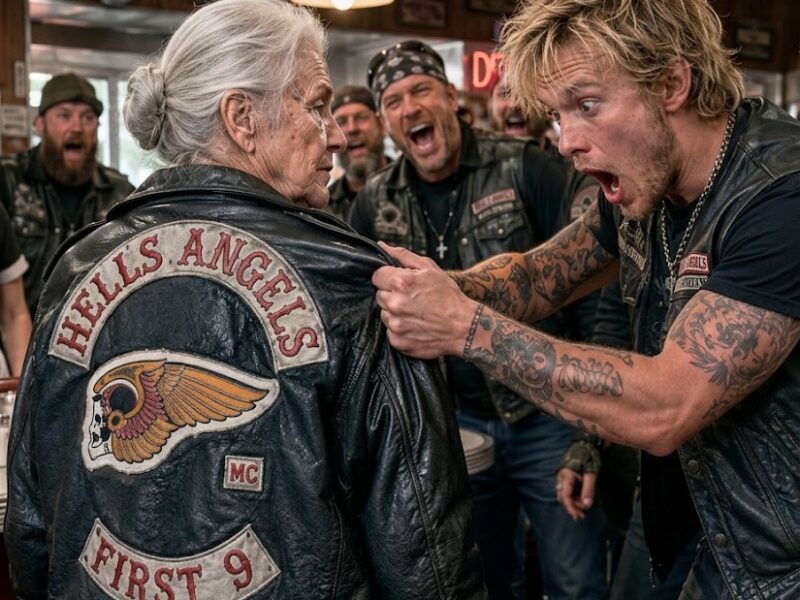
A group of bikers laughed at an old woman’s worn-out jacket. They had no idea the patch on it would silence every single one of them.
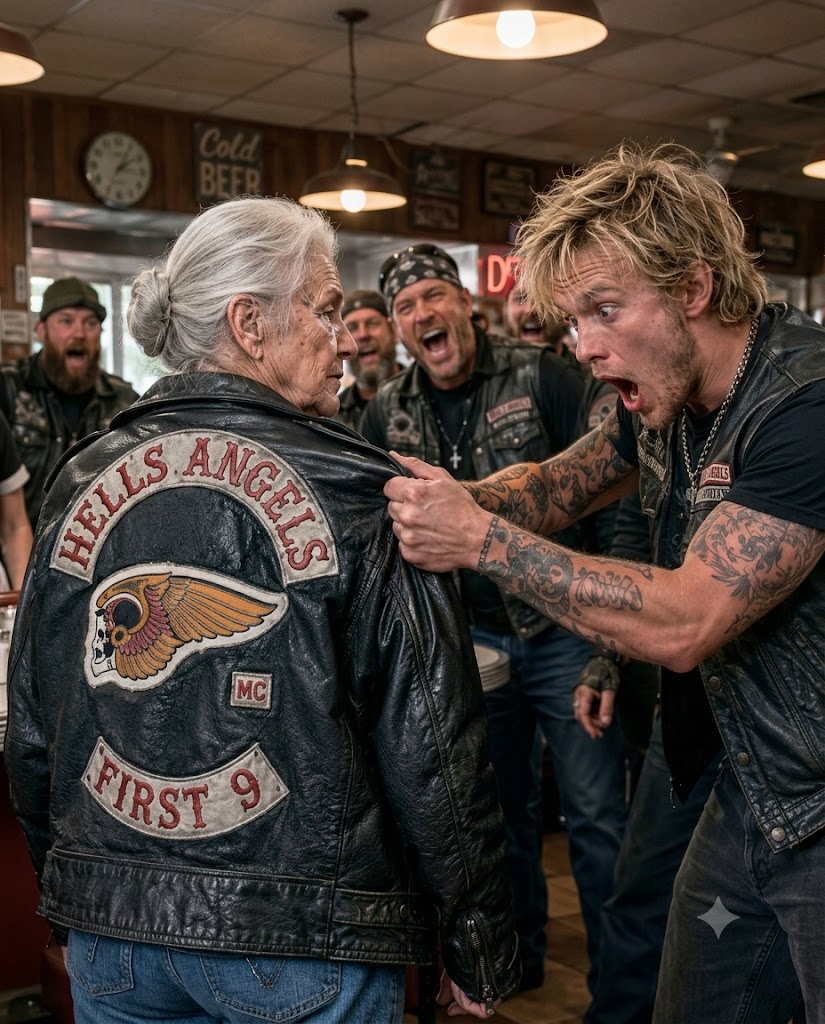
The highway diner smelled of burnt coffee and old grease, the kind of smell that soaked into your clothes and stayed there like a bad decision.
When twenty Hells Angels kicked the door open, the place went dead silent.
Everyone looked down.
Everyone except the eighty-year-old woman in the booth, swimming in a leather jacket three sizes too big, sipping her tea like she owned the room.
The heat off Route 66 was the kind that warped the horizon and made the asphalt bleed.
Inside Rusty’s Diner, the air conditioning had surrendered sometime around 1998, leaving the ceiling fans to push thick, fry-scented air in lazy circles.
It was a Tuesday afternoon in late September, the kind of day where the desert forgets it’s supposed to be autumn and just keeps baking everything in sight.
The lunch rush had died, leaving only the stragglers.
A tired long-haul trucker nursing a black coffee at the counter, his CB radio crackling softly with distant chatter.
A young couple whispering in a corner booth, their hands intertwined across the Formica table like they were the only two people in the world.
And Martha.
Martha sat alone at the counter’s end, a fragile silhouette against the blinding glare of the window.
She was eighty-two years old, her spine slightly curved by time, her hands spotted and mapped with blue veins that looked like rivers on an old map.
Yet she sat upright, anchored by the sheer weight of the garment draped over her shoulders.
It was a heavy, scuffed black leather biker jacket.
The shoulders hung down past her biceps, the sleeves rolled up in thick, clumsy cuffs just to free her hands.
It looked absurd, a suit of armor on a sparrow.
She took a slow, deliberate sip of her Earl Grey tea, the china cup rattling softly against the saucer from a slight tremor in her hands she couldn’t quite hide anymore.
The diner’s lone waitress, Brenda, a woman in her mid-forties with bleached blonde hair and tired eyes, watched Martha from behind the counter.
She’d served the old woman tea every Tuesday for the past three years, ever since Martha’s daughter had moved her to the assisted living facility off Highway 18.
Martha always ordered the same thing: Earl Grey, no sugar, no cream, and a single slice of dry toast she never ate.
She always paid with crumpled dollar bills and exact change, counting out quarters like each one was a small victory.
And she always wore that jacket.
Brenda had asked her about it once, a year or so back, when the diner was empty and the silence felt heavy enough to fill with small talk.
Martha had just smiled, a sad, knowing smile that didn’t reach her eyes, and said, “It belonged to someone who mattered.”
That was all she ever said about it.
Brenda never asked again.
Then, the rumble started.
It didn’t begin as a sound, but as a vibration in the floorboards, a low, guttural growl that seemed to come from the earth itself.
The trucker looked up from his coffee, his eyes widening slightly.
The young couple stopped whispering, their hands pulling apart as they glanced toward the windows.
Brenda froze with a glass coffee pot mid-pour, the dark liquid trembling in the carafe.
The low hum swelled into a deafening mechanical roar, a sound that seemed to shake the very bones of the diner.
Outside the greasy windows, a column of heavy motorcycles pulled into the gravel lot, their chrome flashing under the desert sun like drawn knives.
Engines cracked and popped, echoing off the diner’s aluminum siding like gunfire.
It was a pack of Hells Angels, twenty deep, returning from a run.
They cut their engines in unison, and the sudden silence was heavier than the noise had been.
The diner door didn’t just open.
It was thrown wide.
They flooded in, a tide of denim, sweat, heavy leather, and road dirt.
The smell of hot exhaust and stale tobacco rolled in with them, overwhelming the burnt coffee and old grease.
Leading the pack was Cole.
He was a massive man in his late fifties, his face deeply lined and partially obscured by a graying, unkempt beard.
A thick white scar cut through his left eyebrow, a permanent reminder of a bar fight in Reno that had gone sideways back in ’89.
As the chapter’s vice president, he didn’t need to speak to command the room.
He just took up space, his eyes scanning the diner with the casual indifference of a predator assessing a very small enclosure.
Behind him was Jax.
Barely twenty-two, Jax was loud, twitchy, and trying too hard.
He had just earned his full patch three months prior and wore his cut like a crown he was terrified of losing.
His boots stomped harder than necessary on the linoleum, each step a declaration of his presence.
He laughed too loud at jokes no one told, his voice a sharp, grating sound that bounced off the walls.
“Take the back,” Cole grunted, his voice a low gravel drag.
The bikers swarmed the rear booths, their heavy bodies squeezing into the vinyl seats with grunts and curses.
The trucker dropped a five-dollar bill on the counter and practically jogged to the exit, keeping his eyes firmly on the floor.
The young couple shrank into the vinyl of their booth, trying to become invisible, their hands now clenched into fists under the table.
Brenda swallowed hard, her hands shaking as she grabbed an order pad, terrified to approach the sea of leather and aggressive ink.
“Hey, sweetheart,” Jax barked, slamming his hand on the table.
“We ain’t got all day. Coffee, black, and keep it coming till the pot melts.”
Cole shot Jax a sideways glance, his eyes narrowing.
“Dial it back, kid. We’re here for ten minutes.”
Jax smirked, leaning back in his chair, hooking his thumbs into his belt.
“Just having some fun, Cole. Place is dead anyway. Look at these locals, shaking like leaves.”
He wasn’t wrong.
The atmosphere was suffocating, the tension a physical thing that wrapped around the throats of the few civilians left.
The bikers owned the space.
They were the law of the room, the apex predators of the highway.
Brenda moved toward the back booth, her legs feeling like they were made of wet sand.
She took their orders, her voice barely above a whisper, her eyes fixed on her notepad like it was a lifeline.
Jax ordered a burger, rare, and made a point of commenting on her shaking hands.
“You nervous, sweetheart?” he asked, his grin wide and cruel. “We don’t bite. Unless you ask nice.”
The other bikers laughed, a low, ugly sound that made Brenda’s skin crawl.
She retreated to the kitchen, her heart pounding in her chest, and leaned against the stainless steel counter for a moment, trying to catch her breath.
Then, Jax’s eyes swept the counter.
They stopped on Martha.
She hadn’t moved.
She hadn’t looked back.
She just brought the tea cup to her lips, her silver hair catching the dull light from the fan overhead.
The massive, battered leather jacket swallowed her tiny frame, making her look even smaller than she was.
Jax nudged Miller, a silent mountain of a man sitting next to him, his arms crossed over his massive chest.
“Hey. Look at that,” Jax sneered, his voice carrying easily across the quiet diner.
Miller grunted, barely looking.
Cole was busy wiping a streak of grease off his knuckles with a napkin, ignoring the kid’s chatter.
“Look at the jacket,” Jax continued, standing up slowly.
A cruel, bored smile played on his lips.
“Looks like somebody’s grandma raided the lost and found. What is that, cowhide? Thing weighs more than she does.”
A few of the younger bikers at the table turned to look.
A low ripple of laughter spread through the group, an ugly, sharp sound.
The kind of laughter that precedes cruelty.
“Probably belongs to her dead husband,” one of them joked.
“Or she bought it at a thrift store thinking it made her look tough.”
Martha set her teacup down.
Clink.
She didn’t turn around.
She just pulled a paper napkin from the dispenser, folded it neatly into a square, and dabbed the corner of her mouth.
Jax stepped out from the booth.
He was bored, running on adrenaline from the ride, and looking for an audience.
“I’m going to go ask her what chapter she rides with,” Jax laughed, rolling his shoulders.
Cole looked up from his hands, his eyes narrowing.
“Leave the civilian alone, Jax. Sit down.”
“Just making conversation, boss,” Jax said over his shoulder, already walking toward the counter.
“Just paying my respects to a fellow enthusiast.”
The heavy thud-thud of Jax’s boots crossed the diner floor.
The young couple held their breath.
Brenda squeezed her eyes shut behind the counter, praying it wouldn’t get ugly.
Martha picked up her spoon.
She stirred her tea.
Slow.
Steady.
She knew they were behind her.
She knew what they were.
But as the shadow of the young biker fell over her small frame, Martha didn’t flinch.
She just kept stirring.
Jax stopped two feet behind Martha’s stool.
Up close, the contrast was almost comical.
Jax was six-two, broad-shouldered, radiating aggression.
Martha was barely five feet tall, a fragile bird wrapped in old, cracked leather.
“Nice jacket,” Jax said.
His tone was dripping with sarcasm, loud enough for the entire diner to hear.
The younger bikers at the back snickered.
Cole frowned, shifting his weight in his booth, his instincts prickling.
There was something off about the jacket.
The leather was ancient, deeply creased, and worn white at the elbows.
It wasn’t fashion.
It was a relic.
Martha didn’t turn.
She slowly brought her spoon out of the cup and laid it perfectly parallel to the saucer.
“It serves its purpose,” Martha said.
Her voice was surprisingly steady.
It wasn’t loud, but it had a gravelly, grounded resonance.
The voice of a woman who had spent a lifetime surviving things worse than a loud-mouthed boy.
Jax smirked, leaning heavily against the counter right next to her, invading her space.
“Yeah. What purpose is that? Keeping the dust off? Cuz it looks like you stole it off a scarecrow, Grandma.”
More laughter from the back.
Jax was feeding off it.
“You know,” Jax continued, reaching out a heavily tattooed hand.
“People who don’t ride shouldn’t play dress up. It’s disrespectful to the lifestyle. You might give somebody the wrong idea.”
“Jax.”
Cole’s voice cracked like a whip across the room.
“I said knock it off.”
Jax held his hands up in mock surrender, looking back at Cole.
“Relax. I’m just telling her. Don’t want her getting in trouble down the road.”
He turned back to Martha, his voice dropping to a patronizing drawl.
“Why don’t you do yourself a favor and take it off? I’ll buy you a sweater.”
Martha finally turned her head.
She looked up at Jax.
Her eyes were a faded, piercing blue.
They were not frightened.
They were completely, utterly unimpressed.
She looked at his crisp new cut, the bright white thread of his patches, and the arrogant sneer on his face.
“You’re standing in my light, boy,” she said.
The diner went graveyard silent.
Brenda gasped softly.
Even the young bikers at the back stopped laughing.
Jax’s face flushed red.
The smile vanished, replaced by a tight, ugly mask of offended pride.
To be spoken to like a disobedient child by an eighty-year-old woman in front of his chapter was intolerable.
“Listen here, old lady,” Jax snarled, taking a step closer, his hand reaching out to grab the shoulder of the oversized jacket.
“Don’t touch me,” Martha said.
The command was absolute.
Jax hesitated for a fraction of a second, but his pride pushed him forward.
His fingers brushed the heavy, cracked leather of her shoulder.
Before his grip could tighten, a hand the size of a catcher’s mitt clamped around his wrist.
Jax gasped, his arm twisting as Cole yanked him back.
The older biker had moved with terrifying speed, crossing the diner silently.
Cole stepped between Jax and Martha, his grip on Jax’s wrist tight enough to grind the bones.
“I told you to sit down,” Cole said, his voice a lethal, vibrating hum.
“She was giving me lip,” Jax protested, struggling against the grip.
“She’s an old woman drinking tea, you stupid son of a bitch,” Cole hissed, shoving Jax backward.
Jax stumbled, catching himself on a stool.
Cole turned to apologize to the woman.
He wasn’t a good man, but there were rules.
You didn’t lay hands on civilians, especially the old.
“Ma’am, I apologize for the—”
Cole stopped.
Martha had stood up.
The movement was slow, her knees stiff with arthritis, but she stood tall.
As she turned fully away from the counter to face them, the oversized jacket shifted, revealing the back.
Cole’s breath caught in his throat.
The diner was deadly quiet.
Only the rattling hum of the ceiling fan filled the space.
On the back of the heavy, scuffed leather jacket, there was no top rocker.
There was no bottom rocker.
There was only a single, massive center patch, hand-stitched with thick, fading yellow thread.
It was the death’s head, the winged skull of the Hells Angels.
But it wasn’t just any patch.
It was ancient.
The canvas was stained dark with age, oil, and something deeper, something rusted and brown.
It was an original 1960s cut, the kind worn by the absolute founders.
Below the skull, where a bottom rocker would normally sit, was a custom rectangular patch.
It was frayed at the edges, the lettering cracked, but still legible.
Frank “Iron” Hayes, Founder.
He wrote so you could.
And beneath that, a smaller, delicate rocker.
A rocker that was whispered about, but almost never seen in the modern era.
A patch granted only by a unanimous vote of an entire coast’s leadership.
Mother of the Chapter.
Cole stared at it.
The blood drained from his heavily scarred face.
He had heard the stories when he was a prospect thirty years ago.
Frank “Iron” Hayes, the man who had taken three bullets in the chest outside a bar in ’73 to cover the escape of five of his brothers.
A man whose name was still spoken with reverence at the clubhouse.
And this frail eighty-year-old woman swimming in his jacket.
Cole slowly took a step back.
He didn’t realize he had taken his hat off until he felt the rough fabric of it in his hands.
Jax, having recovered his balance, stormed back up, his face twisted in rage.
He saw the patch, but his young arrogant brain didn’t process the history.
He only saw a civilian wearing club colors.
The ultimate insult.
“What the hell is this?” Jax roared, pointing a finger at Martha.
“You’re wearing our ink? I’ll rip that off your back right now, you crazy old crack—”
The sound was like a gunshot.
Cole’s backhand caught Jax square across the jaw.
Jax’s eyes rolled back, his legs gave out, and he crumpled to the linoleum floor in a heap, out cold.
The other bikers in the back leaped to their feet, chairs scraping violently against the floor.
Cole turned to them, raising one hand.
His eyes were wild, furious, and commanding.
“Sit down,” Cole roared, his voice shaking the glass in the windows.
The nineteen men froze.
They looked from Cole to the unconscious Jax, and finally to the old woman standing quietly by the counter.
Miller, the massive enforcer, stepped forward, his eyes locked on the back of Martha’s jacket.
He stared at the name.
Frank “Iron” Hayes.
Miller slowly removed his sunglasses.
He bowed his head, a gesture of profound, shocking submission.
Seeing their enforcer and their VP submit, the rest of the bikers slowly sat back down.
The diner was paralyzed in a breathless, heavy silence.
Cole turned back to Martha.
The hardened, cynical biker, a man who had broken jaws and outrun police cruisers, stood before her with his hands trembling slightly.
Martha looked at him.
Her face was calm.
She reached down, picked up her purse, and adjusted the heavy collar of her husband’s jacket.
“You boys,” Martha said quietly, “make an awful lot of noise.”
Cole swallowed hard.
The air in the diner felt thin, suddenly stripped of the gasoline bravado that had flooded it minutes before.
He looked at the cracked leather hanging off Martha’s frail shoulders.
He saw the bullet hole on the lower left side, repaired with thick, uneven lacing.
The stories weren’t just campfire myths told to drunk prospects.
The blood had been real.
The man had been real.
“Mrs. Hayes,” Cole managed, his voice dropping the gravelly pretense, softening into something remarkably close to a plea.
“I am—I am profoundly sorry. The boy is a fool. He doesn’t know the history. He doesn’t know the blood.”
Martha looked down at Jax, who was currently groaning on the linoleum, a thin line of drool pooling by his cheek.
She didn’t look angry.
She just looked tired.
“They never do,” Martha said.
She pulled the lapels of the heavy jacket closer together over her chest.
The leather creaked, a dry, ancient sound.
“They think it’s about being loud. They think the patch makes them bulletproof. Frank thought that once.”
Cole stepped aside, giving her a wide berth, treating her like she was made of high explosives.
He gestured to the back booths.
The nineteen remaining Hells Angels were frozen.
Some had taken their sunglasses off.
Others were staring at the floor.
The ones who recognized the name Iron Hayes were pale beneath their road grime.
“Miller,” Cole barked softly, snapping his fingers.
The mountain of a man stood up instantly.
He didn’t strut.
He walked with heavy, deliberate steps toward the front counter, keeping his eyes respectfully lowered.
When he reached Martha, he stopped a solid three feet away and offered a stiff, formal bow of his head.
“Ma’am,” Miller rumbled.
His voice was deep enough to rattle the loose change on the counter.
“It is an honor. Truly.”
Martha studied the giant.
She saw the fresh ink on his neck, the knuckles scarred from a hundred roadside brawls.
She saw the same reckless loyalty that had gotten her husband killed fifty years ago.
“You ride a panhead?” she asked, her blue eyes narrowing slightly.
Miller blinked, caught off guard.
“Uh, yes, ma’am. Custom built. ’62 engine.”
“Frank rode a ’62,” she said, her voice drifting for a fraction of a second before snapping back to the present.
“Leaked oil like a stuck pig. Broke down outside Barstow in August of ’69. He had to push it three miles.”
A tiny, almost imperceptible smile broke through Miller’s thick beard.
“They still leak, ma’am. Some things don’t change.”
“No,” Martha said, her gaze sweeping over the diner, taking in the terrified young couple, the trembling waitress, and the unconscious boy at her feet.
“I suppose they don’t. Still making messes for other people to clean up.”
Cole winced.
The rebuke stung, not because it was insulting, but because it was true.
They had stormed into a quiet place, throwing their weight around, bullying locals who were just trying to eat a cheap meal.
Frank Hayes hadn’t built the chapter to terrorize waitresses and truck drivers.
He built it as a brotherhood for men who didn’t fit anywhere else.
It had meant something different then.
“We lost our way today,” Cole said quietly.
“I take responsibility for that.”
Martha turned back to the counter.
She pulled a worn leather coin purse from her handbag.
Her arthritic fingers fumbled slightly with the brass clasp.
Cole instinctively reached out to help, then froze, pulling his hand back.
You didn’t coddle the Mother of the Chapter.
You respected her independence.
She extracted three crumpled dollar bills and a handful of quarters, placing them carefully next to her empty teacup.
“Tell the boy on the floor,” Martha said, not looking at Cole, “that this jacket isn’t a costume. It’s a tombstone. Every time I put it on, I carry a dead man on my back. If he wants to wear his patch, he needs to understand that he’s signing up for a funeral, usually his own.”
She closed her purse.
“It’s not about scaring people,” she added, her voice dropping to a whisper meant only for Cole.
“It’s about having brothers who will stand in the dirt with you when the scaring stops and the dying starts. Teach them that, or take their patches away.”
Cole swallowed.
“Yes, Mom.”
Jax groaned, his eyes fluttering open.
The harsh fluorescent light of the diner stabbed at his retinas.
His jaw throbbed with a sickening, heavy pulse.
He tried to sit up, spitting a mouthful of coppery blood onto the linoleum.
He expected to see his brothers laughing.
He expected to be pulled up, slapped on the back, and handed a black coffee.
Instead, he saw a wall of boots.
He looked up.
The entire chapter was standing.
All twenty men.
They had formed a silent, disciplined double line leading from the counter to the front door.
It was an honor guard.
Jax scrambled backward, panic spiking in his chest.
Cole stood at the head of the line, his arms crossed, staring down at Jax with a look of absolute disgust.
“Get up,” Cole hissed, kicking the heel of Jax’s boot.
“Get up and shut your mouth. You don’t speak. You don’t look her in the eye. You just pray she doesn’t tell us to take your cut.”
Jax dragged himself to his feet, leaning heavily against the counter.
He finally saw her.
Martha was walking toward the door.
She moved slowly, her steps careful and measured.
The oversized leather jacket swallowed her.
The ancient death’s head patch faced the room, dominating the space.
As she passed the first two men in the line, they bowed their heads.
“Mom,” they muttered in unison.
She took another step.
The next two men bowed.
“Mom.”
Jax watched in utter disbelief.
These were men who didn’t bow to judges.
Men who spat at police officers and laughed in the face of rival gangs.
And here they were, standing at attention in a greasy spoon diner, showing absolute reverence to a fragile eighty-year-old woman.
He looked at the patch on her back.
He finally read the words.
Frank “Iron” Hayes, Founder.
The blood drained from Jax’s face.
The throbbing in his jaw was suddenly completely forgotten, replaced by a cold, hollow dread in the pit of his stomach.
He had mocked the widow of Iron Hayes.
He had threatened to rip the jacket off the Mother of the Chapter.
In the harsh, unforgiving laws of their world, men had been beaten half to death for much less.
Martha reached the end of the line.
She stopped right in front of the door.
Cole stepped forward and pulled the glass door open for her, holding it wide.
She paused on the threshold.
The blinding desert sun cast a long, heavy shadow behind her, stretching across the diner floor and falling right over Jax’s boots.
She didn’t look back.
She didn’t need to.
“Keep the rubber side down, boys,” Martha said to the open air.
“Yes, ma’am,” the diner echoed as twenty rough voices answered as one.
She stepped out into the heat.
Inside the diner, nobody moved.
The silence held for a long, heavy minute.
Through the greasy front window, they watched her walk across the gravel lot.
She didn’t walk toward the gleaming row of heavy motorcycles.
She walked past them, stopping at a rusted, faded green 1994 Ford Taurus parked under the shade of a dead cottonwood tree.
She opened the door, tossing her handbag into the passenger seat.
She climbed in, the heavy jacket making it difficult to navigate the steering wheel.
The engine turned over with a painful, whining screech before finally catching, settling into a rough, uneven idle that sounded remarkably like a smoker’s cough.
She put the car in gear and slowly pulled out of the gravel lot, merging onto the shimmering asphalt of Route 66.
Cole watched the tail lights until they disappeared around the bend.
Only then did he let the door swing shut.
He turned back to the room.
The trucker in the corner was staring, mouth slightly open.
Brenda, the waitress, was clutching her order pad to her chest, her eyes wide.
Cole ignored them.
He walked slowly toward Jax.
Jax shrank back against the counter, his hands coming up defensively.
“Cole, man, I didn’t know. I swear to God, I didn’t know who she was. The jacket, it just looked—”
“Shut up,” Cole said.
It wasn’t a yell.
It was a flat, dead statement of fact.
Cole reached out and grabbed the lapels of Jax’s pristine, stiff leather vest.
He pulled the younger man close until they were nose-to-nose.
Jax could smell the stale coffee and tobacco on Cole’s breath.
“You think this patch makes you a king?” Cole whispered, his voice trembling with a terrifying, controlled rage.
“You think it gives you the right to walk into a room and make people feel small? You think it’s a license to act like a thug?”
Cole shoved him backward.
Jax stumbled, hitting the edge of the counter hard.
“That woman lost her husband so this chapter could exist,” Cole said, turning to address the rest of the younger members who were watching in stunned silence.
“She buried the man she loved when she was thirty-two years old. She raised three kids by herself on a waitress’s salary while the state tried to take everything they owned because of what he was. She paid the price for this life. We just ride the coattails.”
Cole looked around the diner, making eye contact with every single patched member.
“We don’t terrorize civilians. We don’t disrespect our elders. And if I ever—ever—see one of you pull a stunt like this again, I won’t just take your patch. I’ll take the skin it’s pinned to. Do we understand each other?”
“Yes, VP,” the room mumbled.
“I said, do we understand each other?” Cole roared, the sound bouncing off the aluminum ceiling.
“Yes, VP!” they shouted back.
Cole turned back to Jax.
“Get outside. Wait by the bikes. You’re riding in the back, eating dust all the way home, and tomorrow you’re scrubbing the clubhouse floors with a toothbrush.”
Jax didn’t argue.
He kept his eyes on his boots, nodded quickly, and scrambled out the front door.
Cole took a deep breath, letting the tension bleed out of his shoulders.
He turned toward the waitress, Brenda.
He reached into his pocket and pulled out a thick wad of bills.
He peeled off a crisp hundred-dollar bill and laid it gently on the counter next to Martha’s three crumpled ones and the quarters.
“For the tea,” Cole said quietly.
“And for the noise.”
Brenda just nodded.
Too terrified to speak.
Cole gave a sharp whistle.
“All right, let’s roll out. We’ve overstayed our welcome.”
The bikers filed out of the diner silently.
There was no swagger left.
The heavy, intimidating stomp of their boots had been replaced by a quiet, disciplined retreat.
They didn’t look at the trucker or the young couple.
They kept their heads down, completely humbled.
Outside, the engines roared to life.
But this time, they didn’t crack and pop with aggressive flare.
They idled low, a steady rumbling line.
Cole swung his leg over his bike, pulling his helmet on.
He looked down the highway in the direction Martha’s rusted Ford had gone.
He tapped his chest right over his own patch, a silent salute to the ghost on the highway.
Then he kicked the bike into gear and led the column away, leaving Rusty’s Diner to the quiet heat of the desert afternoon.
Inside, Brenda walked slowly over to the counter.
She picked up the hundred-dollar bill.
Then she looked at the three dollars and the handful of quarters Martha had left.
She carefully scooped the coins into her apron pocket, leaving the crumpled bills on the Formica.
The diner was silent again, save for the rattling hum of the ceiling fans.
The scent of hot exhaust lingered for a few minutes before fading away, replaced once more by the smell of burnt coffee and old grease.
But the air felt different.
It felt lighter.
The apex predators had been tamed by a ghost, and the highway, for a little while at least, belonged to Martha.
—
The sun was setting by the time Cole pulled into the clubhouse lot, the sky streaked with orange and purple like a fresh bruise.
The other bikes rumbled in behind him, their engines cutting one by one until the only sound was the distant hum of the highway and the chirping of crickets in the dry grass.
Jax had ridden at the back of the pack, exactly as ordered, eating dust and swallowing his pride with every mile.
His jaw still throbbed, a constant reminder of Cole’s backhand and his own stupidity.
He parked his bike at the far end of the row, away from the others, and dismounted slowly, his legs stiff from the ride.
The other bikers filed into the clubhouse, a converted warehouse on the outskirts of town, its walls covered in faded murals and old concert posters.
Nobody spoke to Jax.
Nobody even looked at him.
It was worse than being yelled at.
It was like he didn’t exist.
He stood by his bike for a long moment, staring at the gravel at his feet, before finally following them inside.
The clubhouse smelled like stale beer, cigarette smoke, and leather.
A few of the older members were already at the bar, nursing whiskeys and speaking in low voices.
Cole was standing by the pool table, his arms crossed, his face unreadable.
Jax approached him slowly, his boots scuffing against the concrete floor.
“Cole,” he said, his voice hoarse. “I want to apologize. For real. I messed up.”
Cole didn’t look at him.
He just stared at the pool table, his jaw tight.
“You don’t apologize to me,” Cole said quietly. “You apologize to her.”
Jax swallowed hard.
“I don’t even know where she lives.”
“Neither do I,” Cole said, finally turning to face him. “But I know where she’ll be next Tuesday. Same time, same booth, same cup of tea. You’re going to be there. You’re going to walk in, sit down across from her, and you’re going to tell her you’re sorry. And you’re going to mean it.”
Jax nodded, his throat tight.
“And Jax,” Cole added, his voice dropping to a low growl. “If you ever embarrass this chapter like that again, I won’t just take your patch. I’ll make sure you never ride again. Not with us. Not with anyone. You understand?”
Jax nodded again, unable to speak.
“Good,” Cole said, turning back to the pool table. “Now get out of my sight. You’ve got floors to scrub.”
Jax walked toward the supply closet, his shoulders slumped, his mind racing.
He had spent three months wearing his patch like a badge of honor, like a symbol of everything he had become.
But he had never stopped to think about what it actually meant.
He had never stopped to think about the men who had come before him, the ones who had built the club from nothing, the ones who had bled and died so that he could wear that patch on his back.
He had never stopped to think about Frank “Iron” Hayes.
But he was thinking about him now.
He was thinking about the bullet hole in the jacket, the one repaired with thick, uneven lacing.
He was thinking about the woman who had worn that jacket for fifty years, carrying a dead man on her back every time she put it on.
He was thinking about the words she had said, the ones that cut deeper than any punch.
“If he wants to wear his patch, he needs to understand that he’s signing up for a funeral. Usually his own.”
Jax grabbed a bucket and a scrub brush from the supply closet and knelt on the concrete floor, his hands shaking as he dipped the brush into the soapy water.
He scrubbed until his knuckles bled, until the floor was spotless, until the only thing he could see was the reflection of his own ashamed face in the wet concrete.
And he made a promise to himself, a promise he intended to keep.
He would go back to that diner next Tuesday.
He would sit down across from Martha Hayes.
And he would tell her he was sorry.
—
The following Tuesday, the diner was quiet again.
The lunch rush had come and gone, leaving only a few stragglers.
Brenda was wiping down the counter, her mind wandering, when the bell above the door jingled.
She looked up, and her heart skipped a beat.
Jax stood in the doorway, alone.
He wasn’t wearing his cut.
Just a plain black t-shirt and jeans, his hands shoved deep into his pockets.
He looked smaller somehow, less sure of himself.
Brenda tensed, her hand instinctively reaching for the phone.
But Jax didn’t move toward her.
He just stood there, scanning the diner, his eyes landing on the booth at the end of the counter.
Martha was already there, her tea cup in front of her, her hands wrapped around it like she was trying to draw warmth from the porcelain.
The oversized leather jacket hung over the back of the booth, its ancient patches facing the wall.
Jax took a deep breath and walked toward her.
He stopped at the edge of the booth, his hands still in his pockets, his eyes on the floor.
“Mrs. Hayes,” he said, his voice barely above a whisper. “Can I sit down?”
Martha looked up at him, her faded blue eyes studying his face.
She didn’t smile.
She didn’t frown.
She just nodded, gesturing to the seat across from her.
Jax slid into the booth, his hands resting on the table, his fingers intertwined.
He didn’t speak for a long moment, his eyes fixed on the Formica, his jaw tight.
“I’m sorry,” he finally said, his voice cracking. “For what I said. For what I did. It was wrong. It was disrespectful. And I’m sorry.”
Martha watched him, her expression unreadable.
She took a slow sip of her tea, the china cup rattling softly against the saucer.
“Do you know why I wear that jacket?” she asked.
Jax shook his head.
“Because it’s all I have left of him,” Martha said. “Frank was a lot of things. A husband. A father. A brother. But he was also a fool. He thought he was invincible. He thought the patch made him bulletproof. And in the end, it killed him.”
She set her cup down, her hands trembling slightly.
“He died in my arms, you know. Outside a bar in Bakersfield. He took three bullets meant for his brothers. He was thirty-four years old. I was thirty-two. We had three kids. The youngest was barely a year old.”
Jax felt his throat tighten.
He had never heard the story before, not the real version.
Only the legends, the myths, the tales told around campfires by men who had never known the man.
“I’m not telling you this to make you feel guilty,” Martha said. “I’m telling you this so you understand. The patch isn’t a toy. It’s not a costume. It’s a promise. A promise to protect your brothers. A promise to stand by them no matter what. A promise to carry their memory when they’re gone.”
She leaned forward, her eyes locking onto his.
“Do you understand what I’m saying?”
Jax nodded, his eyes wet.
“Yes, ma’am.”
“Good,” Martha said, leaning back.
She picked up her tea cup and took another sip.
“Now drink your coffee. You look like you haven’t slept in days.”
Jax let out a shaky laugh, wiping his eyes with the back of his hand.
Brenda appeared at the table, a cup of black coffee in her hand.
She set it down in front of Jax, her eyes flicking to Martha, who gave her a small nod.
Jax wrapped his hands around the cup, the warmth seeping into his fingers.
He took a sip, the bitter taste grounding him.
“I’m going to do better,” he said quietly. “I’m going to be better.”
Martha nodded, a small smile playing at the corners of her lips.
“I know you will,” she said. “Frank would have liked you. You’ve got the same fire. You just need to learn how to use it.”
They sat in silence for a while, the only sound the rattling hum of the ceiling fans and the distant rumble of trucks on the highway.
When Jax finally left, he felt lighter than he had in months.
He had come to apologize, to make amends.
But he had left with something more.
He had left with an understanding.
He had left with a purpose.
He had left with the memory of an old woman in an oversized jacket, sipping tea like she owned the room.
And he knew, deep in his bones, that he would never forget her.
—
The years passed, as they always do.
Jax rose through the ranks, earning his place among the chapter’s leadership.
He never forgot the lesson he had learned that day in Rusty’s Diner.
He never forgot Martha Hayes.
He visited her every Tuesday, sitting with her in that same booth, drinking black coffee while she sipped her Earl Grey.
They talked about everything and nothing.
About Frank, about the club, about the long, winding road of life.
And when Martha finally passed away, at the age of ninety-one, Jax was there.
He stood at her graveside, surrounded by his brothers, as they laid her to rest next to her husband.
He looked at the headstone, at the simple inscription carved into the granite.
Martha Hayes, Beloved Wife, Mother, and Mother of the Chapter.
And he knew, as he stood there with tears streaming down his face, that he had been changed by her.
Changed by her strength, her dignity, her quiet, unshakeable grace.
Changed by the story of a man who had died for his brothers and the woman who had carried his memory for fifty years.
He looked down at his own jacket, at the patches he had earned, and he understood now what they truly meant.
They were not a license to be feared.
They were not a badge of power.
They were a symbol of sacrifice, of loyalty, of brotherhood.
They were a reminder that the men who came before had paid a price for this life, and it was his duty to honor that price.
And as the sun set over the cemetery, casting long shadows across the graves, Jax made a silent promise.
He would honor Martha’s memory.
He would honor Frank’s sacrifice.
And he would teach the next generation what it truly meant to wear the patch.
He would teach them about the woman who had tamed twenty Hells Angels with nothing but a teacup and a jacket.
He would teach them about the legacy of Iron Hayes.
He would teach them about the power of true respect, the kind that wasn’t demanded, but earned.
The kind that lived on long after the engines stopped roaring and the dust settled on the highway.
The kind that belonged to Martha.
—
The diner closed down a few years later, a casualty of the new interstate bypass that redirected traffic away from Route 66.
The building sat empty for a while, a forgotten relic of a bygone era.
Then, in 2018, a group of preservationists bought the property and restored it to its former glory.
They kept the original name, Rusty’s Diner, painted it a bright teal, and installed a new HVAC system that actually worked.
But they also added something else.
A framed photograph on the wall, right above the counter where Martha used to sit.
It showed an elderly woman in an oversized leather jacket, a teacup in her hand, a small, knowing smile on her face.
Below the photograph was a small brass plaque.
It read: “Martha Hayes, 1926–2017. Mother of the Chapter. She taught us that true strength doesn’t shout.”
The diner became a popular spot for bikers passing through, a waypoint on the long road between here and there.
They would stop for coffee and pie, and they would see the photograph on the wall.
They would ask the waitstaff about the woman in the picture, and the waitstaff would tell them the story.
The story of the old woman who had tamed twenty Hells Angels with nothing but her presence.
The story of the jacket and the patch and the promise.
The story of respect.
And sometimes, if they were lucky, they would see an old biker sitting in the corner booth, a cup of black coffee in front of him, his eyes fixed on the photograph.
They would see the way he raised his cup in a silent toast, the way he whispered something under his breath.
They would see the tears in his eyes.
And they would know, without asking, that he had been there.
That he had seen the jacket, and the patch, and the old woman who wore them.
That he had been changed by her, just as countless others had been changed before him.
That he had learned what it meant to carry a dead man on his back.
And that he would carry that lesson with him for the rest of his life.
—
The highway stretched on, endless and indifferent, a ribbon of asphalt cutting through the heart of the desert.
The sun beat down, the heat warped the horizon, and the asphalt bled.
But somewhere on that highway, if you looked closely, you could still see her.
An old woman in a faded green Ford Taurus, an oversized leather jacket draped over her shoulders, driving toward the horizon.
She didn’t drive fast.
She didn’t need to.
She had nowhere to be and all the time in the world.
She just drove, the wind in her hair, the ghost of her husband riding shotgun.
And when she reached the end of the road, she would pull over and watch the sunset.
She would think about Frank, and the life they had built together, and the children they had raised.
She would think about the boy she had met in the diner, the one with the loud mouth and the wounded pride.
She would think about the lesson she had taught him, and the man he had become.
And she would smile.
Because she knew, in her heart, that the story wasn’t over.
It would never be over.
It would live on, in the memory of a patch, in the creak of old leather, in the quiet dignity of those who understood.
It would live on in the lives of the men who wore the patch, and the women who loved them, and the children who looked up to them.
It would live on in the diner on Route 66, where a photograph of an old woman hung on the wall, a reminder of a time when respect was earned, not demanded.
And it would live on in the highway, the endless highway, where the ghost of Martha Hayes still drove, her jacket flapping in the wind, her teacup rattling softly in the cupholder.
She was the Mother of the Chapter.
And she would never be forgotten.
—
**The End**









