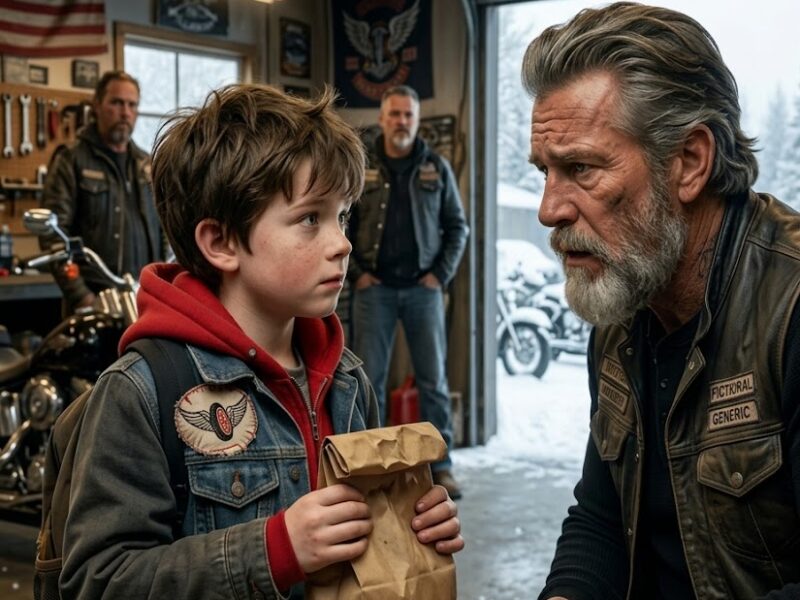
A group of bikers laughed at a boy’s fake patch — then they saw what he was eating for lunch, and the laughter died instantly.
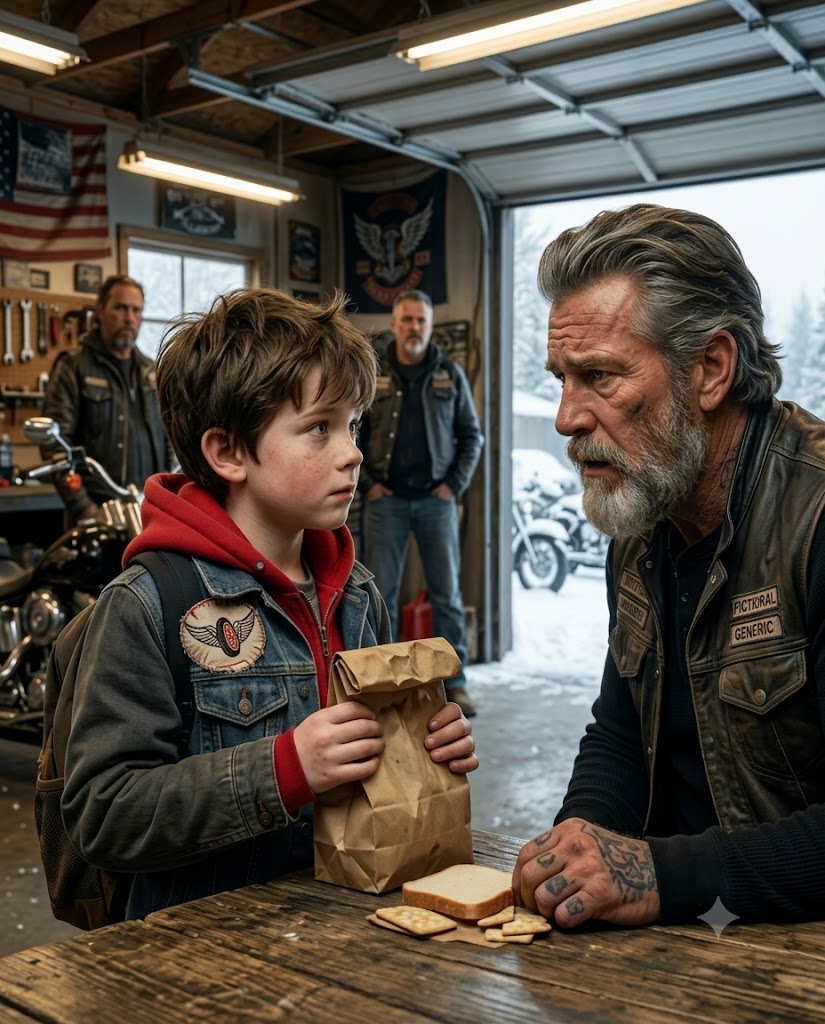
The Storm Riders clubhouse usually smelled like grilled onions, motor oil, and whatever soap Mama Joy used on the counters.
It was loud, chaotic, a place where people argued over engines and card games with equal intensity. That’s why the room went strangely quiet when an 11-year-old kid pushed the door open and stepped inside like he’d rehearsed it.
He wore an oversized denim vest held together by three safety pins.
On the back, in black Sharpie letters, he’d drawn a patch: “Future Prospect.” The handwriting slanted and shaky, like someone had worked on it under bad lighting.
First, the men inside laughed—not cruelly, just surprised. Kids came by now and then for charity rides or barbecues, but none walked in alone wearing a fake patch.
Thomas, the road captain, set down the wrench he’d been using and approached with the kind of patience that made him seem bigger than he already was.
“What’s your name, kid?”
“Milo,” he said quietly.
“Where did you get the vest?”
“Found it.” Milo didn’t elaborate.
The laughter faded into curiosity. William, the club president, leaned back in his chair watching. Mama Joy peeked from the kitchen window. Dennis, tall and broad-shouldered, crossed his arms.
Something about the boy’s posture—chin up, shoulders stiff—didn’t match the patched-up vest.
Thomas tried again. “You lost?”
“No.” Milo took a breath that sounded too practiced. “I want to join.”
That earned a few chuckles, but Thomas didn’t smile. He crouched so their eyes were level.
“You eat today?”
Milo hesitated. “Ketchup counts.”
It hit the room like a dropped tool—sharp and metallic. Even the card players turned. Dennis uncrossed his arms. Mama Joy pushed the kitchen door open fully.
“Ketchup counts as what?” she asked.
“Dinner,” Milo answered.
Thomas didn’t move for a long moment. His voice dropped. “Where do you live, kid?”
That was the question Milo had hoped wouldn’t come. He blinked at the floor. “Library. But only until closing.”
Silence wrapped the clubhouse tight. No one laughed now.
Mama Joy stepped closer. “Who’s supposed to be taking care of you?”
“My mom’s away.” Milo’s voice thinned. “And Grandpa—he was helping me. But he’s gone.”
Dennis asked, “Gone where?”
Milo didn’t flinch. “Heart attack. Three days ago.”
The riders exchanged looks—quick, sharp, full of things unsaid. William stood up slowly, the way he did when something important shifted in the air.
Mama Joy reached out a hand. “Come here, sweetheart.”
Milo hesitated, then let her guide him into the kitchen. She sat him on a stool, handed him a plate the riders usually fought over, and watched him eat like she was afraid he’d disappear if she blinked.
He didn’t talk much, just kept one hand on his backpack as if someone might take it.
Thomas sat beside him. “How long you been staying at the library?”
“Two weeks.” Milo swallowed hard. “The night guard lets me stay quiet behind the shelves. I don’t cause trouble.”
“You shouldn’t have to hide to sleep,” Thomas said.
Milo shrugged. “It’s warm.”
William and Dennis joined them. The president studied the boy—not in judgment, but in assessment, the way he looked at a broken engine to understand where it failed.
“You got anyone else?” William asked.
Milo shook his head.
No one told him they were sorry. No one used soft tones meant for fragile kids. The riders weren’t built that way. Instead, Dennis slid a fresh glass of milk in front of him, and Mama Joy added a second helping without asking.
Thomas rested a gentle hand on Milo’s shoulder. It wasn’t pity. It was recognition.
After he finished eating, Milo reached for his backpack. “I can go,” he said. “Didn’t mean to bother anyone.”
Thomas stopped him. “Kid, you’re not leaving hungry. And you’re not walking back to that library alone.”
Milo froze.
William nodded toward the vest. “You came in wearing a patch. So let me give you one that actually means something.”
He walked to a drawer, pulled out a small embroidered piece of cloth, and held it out. Bold letters read: “Protected.”
Milo stared at it like it was a trick. “What’s that for?”
“Means you’re under our roof now,” William said. “You don’t owe us anything. You get a roof, a plate, and people who notice when you walk in.”
A tremor flickered across Milo’s face. Relief or fear? Maybe both.
Mama Joy placed a warm hand on his back. Dennis stood behind him like a wall built out of muscle and quiet loyalty.
The night outside hummed with engines cooling in the gravel lot. Inside, the riders rearranged their evening plans without discussing it. Someone laid out a spare cot. Someone called the school to ask about his absences. Someone else started making a list of supplies he’d need.
Milo understood just enough to know they weren’t letting him face this alone.
—
Milo woke up the next morning to the smell of bacon and the low rumble of motorcycles warming up outside.
For a few seconds, he didn’t know where he was. The cot, the patched couch nearby, the hum of early chatter—none of it matched the library’s cold carpet or the fluorescent lights he had gotten used to.
When Mama Joy poked her head in and said, “Breakfast’s ready, sweetheart,” something in his chest tightened and loosened at the same time.
By the time he shuffled into the main room, the riders were already scattered around the clubhouse. Some polishing chrome, some arguing over a parts catalog, some sipping coffee with the discipline of monks.
Thomas waved him over, pulling out a stool. Milo hesitated, unsure he belonged in the middle of all that noise, but Dennis nudged the seat with two fingers.
“Food doesn’t eat itself,” he said.
Milo ate quietly. He wasn’t used to plates that stayed full. He wasn’t used to adults asking if he wanted more. And he definitely wasn’t used to anyone noticing when he answered a question too fast or too soft.
Thomas watched him carefully—not the way teachers watch disruptive kids, but the way someone studied weather before a long ride.
“What’s school like for you?” Thomas asked.
Milo chewed slowly. “I go most days.”
“Need a ride?”
Tiny shrug. “They don’t like me being late.”
Dennis stood up immediately. “Helmet or no helmet, I’ll get you there on time.”
Milo stared at him. “You’d drive me?”
“Every morning,” Dennis replied, as if it were the simplest thing in the world.
That was the first day of a new routine.
Dennis picked him up after breakfast and drove him in the old blue pickup he refused to part with. Milo liked the truck. It smelled like pine, engine grease, and something like warm paper—the scent of someone who’d lived too many miles and survived them all.
Dennis even waited in the school lot for a few minutes, making sure Milo went in without flinching at the doors.
Every afternoon, Milo came back to the clubhouse with homework folded tightly in his backpack. Mama Joy helped him with reading when the words got blurry. Howl, the grumbling mechanic with hands like steel pipes, explained fractions using a stack of metal washers.
Sometimes William wandered past, pretending not to listen, but correcting Milo’s history facts when he got dates wrong.
At first, Milo stayed near the wall, keeping an eye on exits like he always had. But as days passed, he sat closer to the group tables. He watched the men talk about repairs, long rides, and dumb mistakes they mocked each other for.
He didn’t join in, but he listened—really listened—as if each story filled some quiet space in him that had been empty too long.
Then came the paperwork.
One Thursday morning, Dennis returned with a tight jaw, sharper than usual. He called Thomas and William outside. Milo followed with his eyes, heart thudding.
The men talked quietly for several minutes before forming a circle around him.
Dennis crouched down. “Kid, somebody finally spotted your school absences. A case worker’s coming by tomorrow.”
Milo’s stomach dropped. Case workers meant rooms with bunk beds, strangers with name tags, locks on the wrong side of doors. He’d seen enough of his friends get shuffled around to know the rules.
Kids didn’t get a say.
“I can’t go,” Milo whispered. “I don’t want to leave.”
William put a hand on his shoulder—firm, steady. “No one’s sending you anywhere without a fight.”
But there was more. The case worker wasn’t just showing up. She had the authority to take Milo immediately if she thought the situation wasn’t safe.
Mama Joy spent that night scrubbing the kitchen until the counters shined. Howl fixed a broken railing on the back stairs, even though no inspector had asked. Thomas and Dennis sat at the table drafting notes—details about how long Milo had been staying, the meals they provided, the routines they’d built.
When the case worker arrived the next afternoon, Milo stood in the doorway gripping his backpack.
She was polite but firm, dressed in neutral tones and carrying a stack of forms. Her eyes swept the clubhouse with clinical precision.
“I understand Milo has been staying here temporarily,” she said.
“Temporarily,” William answered. “Until someone stepped up.”
“That’s us.”
She asked to speak with Milo privately. The riders stepped aside but didn’t go far.
Milo sat across from her, feet barely touching the floor.
“Do you feel safe here?” she asked.
Milo nodded.
“Do they feed you?”
He nodded again.
“How do they treat you when nobody’s looking? When you make mistakes? When you’re tired?”
Milo shook his head vigorously. “They don’t get mad when I mess up. They help. They pay attention.”
The case worker noted something without reacting. “Milo, do you understand that you need a legal guardian?”
He swallowed. “I want to stay here.”
She didn’t smile, didn’t frown, just wrote.
Then she went to speak with Mama Joy, Dennis, and William one by one. She inspected the kitchen, checked the sleeping arrangements, examined every space with the caution of someone who’d seen too many homes pretend to be safe.
By the time she left, Milo was pale with worry. The riders didn’t say much, but their silence hummed with tension.
Later that evening, Thomas found him sitting on the back steps, his fake patch turned between his fingers. The man sat beside him.
“You think she’s taking you?” Thomas said.
Milo didn’t answer.
“We’re not letting that happen.” Thomas continued. “You hear me? Not when you finally have a shot at something steady.”
Milo looked at him, eyes wet but stubborn. “Why do you care?”
Thomas took a slow breath. “Because someone cared about me when I didn’t expect it. And because you walked in here asking for nothing but a place to stand. That means something.”
Inside, the club lawyer arrived with a folder and a plan. Papers needed signatures. Statements needed to be prepared. Mama Joy volunteered first. Dennis followed without hesitation. William sat long after others had spoken, writing his account with slow, deliberate care.
By nightfall, the clubhouse buzzed with a different kind of energy—less rowdy, more protective. They weren’t preparing for a ride or settling a score. They were getting ready to defend a child who had finally stopped expecting to be forgotten.
Milo closed his eyes on the cot that night, clutching his patched vest. The dark didn’t feel empty. It felt watched, guarded.
—
The case worker’s visit left a tension in the clubhouse that didn’t fade with the morning sun.
The riders went about their routines—cleaning parts, checking routes, handling repairs—but there was a heaviness behind their movements, a sense that something waited just beyond the edges of their awareness.
Milo felt it, too. He stayed closer to the kitchen, closer to Mama Joy’s comforting presence, closer to the doorway where Dennis always seemed to appear before anyone needed him.
But school still called, and Dennis insisted Milo keep showing up.
“Routine helps,” he said, handing Milo the lunch Mama Joy packed with almost ritual precision. “If we start acting scared, the wrong people notice.”
Those wrong people noticed anyway.
It began with small things. A black SUV parked across from the school two days in a row. A man at the gas station wearing an Iron Fangs cut, pretending to browse snacks but watching Milo’s reflection in the cooler door.
Dennis spotted both encounters and didn’t comment, but he tightened his grip on the steering wheel on the ride home.
The riders already had their suspicions. Word traveled fast between clubs—even rival ones. The Iron Fangs had been struggling: membership dropping, finances drying up, leadership growing desperate for leverage against the Storm Riders.
And nothing screamed leverage louder than a vulnerable kid the riders had claimed as their own.
One Friday afternoon, the danger stepped fully into the open.
Milo lingered after the last bell, collecting worksheets with unnecessary care. He wasn’t avoiding the clubhouse. He simply wasn’t ready for the weekend’s unknowns.
Dennis was usually parked outside, but today Milo didn’t see the familiar blue truck when he stepped through the school doors.
Instead, he saw two men leaning against a rusted van at the far end of the lot. One smoking, the other pretending to check his phone. Both wore jackets too heavy for the weather. Both watched him in a way that made the air around him tighten.
Milo recognized the stance—the angle of their shoulders, the way they glanced at each other before looking back at him. His grandfather had once taught him how to read danger like street signs.
“If someone looks at you like you’re a job,” he’d said, “you don’t wait to see what kind.”
Milo kept walking, steady, pretending not to notice. His heart pounded so hard it felt loud enough to carry across the lot.
The men stepped off the curb.
He slipped behind a row of parked cars, crouching low, scanning for exits. No Dennis. No familiar engine rumble. Only quick footsteps approaching—deliberate, closing in.
Milo ducked behind a dumpster near the maintenance building and pressed himself against the metal, trying to quiet his breathing. He didn’t cry, didn’t freeze. He only counted.
One. Two. Three.
Until he heard one of them say, “Kid couldn’t have gone far.”
A truck engine growled at the entrance of the lot. Then another. Then a third.
Not Dennis’s pickup this time. Three motorcycles rolled in like a warning. Thomas at the front, William behind him, Dennis in the rear.
They didn’t shout. They didn’t swing fists. They simply parked with slow precision, blocking the exit without a word.
The two men stiffened immediately. Only one of them had the sense to back away. The other tried to keep his cool, but his bravado cracked under the riders’ silent stare.
Thomas stepped forward. “You boys seem lost.”
The man swallowed. “Just waiting for a friend.”
“Kid-sized friend?” William asked.
Silence.
That was enough. The Fangs didn’t fight. They retreated—walking fast, not running, trying to salvage dignity that didn’t exist anymore.
When they were gone, Thomas turned to the dumpster.
“Milo.” He called, voice steady. “It’s clear. You can come out.”
Milo stepped into the open, trembling but holding himself upright. Dennis checked him over with the quiet thoroughness of someone who had survived too many close calls.
“You did good,” Dennis said. “Smart hiding spot.”
They didn’t go straight back to the clubhouse. Instead, the riders split—William firing off calls, Thomas checking routes, Dennis driving Milo in the truck with constant glances at the mirrors.
It wasn’t chaos. It was coordination. A pattern they’d used in real conflicts long before Milo entered their lives.
Word spread quickly. Within an hour, safe houses connected to the Fangs reported unexpected visits from Storm Riders. Nothing violent—just precise disruptions. Engines revving outside doors. Locks checked. Certain names mentioned. Certain operations exposed.
A message delivered with surgical clarity: You cross the line, you don’t get to cross it twice.
Back at the clubhouse, Mama Joy’s hands shook when she saw Milo, but she hid it behind a tight smile and a plate of food. Howl muttered curses under his breath—half at the Fangs, half at the universe for thinking a child could be used as a bargaining chip.
Milo didn’t eat much that evening. He sat between Thomas and Dennis, fingers hooked through the patched vest William had given him. He wasn’t afraid of staying at the clubhouse.
He was afraid of what the Fangs might try next—and of being the reason the riders risked anything.
William placed a steady hand on his shoulder. “Listen carefully,” he said. “What happened today wasn’t your fault. You didn’t bring trouble. Trouble saw something good and tried to steal it.”
Milo blinked hard. “Are they coming back?”
Thomas answered before anyone else could. “Not after today. They wanted leverage. Instead, they got a reminder: we don’t negotiate with cowards.”
Dennis added, “And you’re not going anywhere. Not now, not later.”
The clubhouse seemed smaller that night. Not cramped, but enclosed, guarded—as if every wall and every engine outside leaned inward to shield Milo.
He didn’t understand all the logistics or the calls William made, but he understood this much: the riders had chosen him, and the Fangs finally understood why the Storm Riders never walked away from their own.
—
The weekend after the Fangs’ attempted grab arrived with a quiet that felt earned, not fragile.
The clubhouse still buzzed with engines and arguments, but beneath it all was a steady hum of vigilance. The riders weren’t paranoid—they were prepared. Someone always watched the driveway. Someone always checked the back lot.
And when Milo walked from room to room, at least one pair of eyes followed gently, making sure he never drifted out of sight.
He didn’t complain. If anything, he held his vest tighter. He still kept the hand-drawn patch tucked into the inside pocket, folded carefully so the letters wouldn’t smudge.
Monday morning, Dennis drove him to school again—this time with Thomas following on his bike like a silent escort. Milo pretended not to notice the extra layer of security, but when Thomas gave him a small nod before roaring off toward the highway, Milo felt something warm settle inside him.
Protection didn’t feel like pity. It felt like belonging.
After school, the club’s lawyer showed up with a briefcase full of paperwork and eyes that looked like they had slept three hours in two days. He sat with Milo at the kitchen table asking simple things: what mornings looked like now, who helped with homework, what dinners felt like with people around.
Milo answered honestly, sometimes haltingly, but always with the same truth: the clubhouse was the only place where he didn’t feel like he was slipping through cracks no one noticed.
Next came the interviews.
A different case worker—a supervisor this time—arrived to reassess the situation. She was older, sharper, and carried herself like she had seen too many cases where good intentions weren’t enough.
Thomas sat beside Milo while she asked questions. Mama Joy provided documents, school notes, teacher comments. Dennis listed every appointment, every meal, every morning pickup and afternoon drop-off.
The supervisor walked the clubhouse with a notebook. She didn’t say much, but her raised eyebrows softened whenever she saw how the riders had rearranged space for Milo: a small bookshelf next to his cot, new clothes folded neatly, a lamp Howl installed so he wouldn’t sleep in the dark, a corner of the dining area where Milo’s homework now lived.
When the supervisor asked if Milo had a trusted adult he could go to in emergencies, he didn’t look uncertain. He looked at Mama Joy.
“She’s like someone who remembers I’m here,” he said quietly.
Mama Joy’s lips pressed together, but she didn’t cry until she turned away.
The supervisor noted every detail. Two days later, the hearing was scheduled.
The courthouse felt cold compared to the clubhouse—too quiet, too polished. Milo sat between Mama Joy and Dennis wearing the denim vest William had given him. He didn’t wear the hand-drawn patch on the back anymore. It stayed in his pocket like a secret, but the “Protected” patch was sewn firmly into place.
The judge was middle-aged, serious-looking, with glasses he cleaned twice before starting. He reviewed reports, statements, logs, and the supervisor’s evaluation.
Milo’s hands trembled slightly on his knees. Dennis rested one warm palm on Milo’s back, grounding him without drawing attention.
The judge finally spoke. “Milo, would you like to say anything?”
Milo looked up. No one had warned him this might happen.
He swallowed. “I don’t want to move again,” he said, voice steady but small. “The riders don’t treat me like a problem. They treat me like someone who has a place.”
The judge considered him with a long, thoughtful silence.
Then came the decision. He approved guardianship jointly to Mama Joy and Dennis, with full placement at the Storm Riders Clubhouse.
The words didn’t echo, but they didn’t need to. They felt loud enough to fill every corner of Milo’s chest.
Mama Joy squeezed his hand. Dennis nodded once, slowly, as if acknowledging a responsibility he’d already accepted days ago.
Outside the courthouse, the riders waited. Not all of them—just enough to make the sidewalk feel like home. Thomas crossed his arms with a rare smile. Howl muttered, “Bout time,” but his eyes were warmer than his tone.
William stepped forward and rested a hand on Milo’s shoulder. “Let’s get you back,” he said. “You got things to unpack.”
Back at the clubhouse, they’d prepared something.
Milo didn’t realize it until Mama Joy guided him toward the dining area where a box sat on the table. William lifted the lid.
Inside was a new denim vest—still rough around the edges, but properly fitted this time. On the left chest: “Protected.” On the back, another patch waited, blank and ready for the club’s vote someday.
But what mattered most was the right front pocket. They had stitched his hand-drawn patch onto it—crooked letters and all. “Future Prospect,” exactly as he’d made it.
Milo touched the inked fabric. “You kept it.”
Thomas answered, “That little patch walked you through the door. Kid, that’s part of your story.”
The evening rolled into laughter, the smell of Mama Joy’s cooking, the clatter of forks against plates, the soft rumble of bikes cooling outside. Milo ate surrounded by people who didn’t flinch at responsibility, who didn’t look at him like a burden, who seemed ready—eager—to be in his corner.
Later, when the clubhouse lights dimmed and the last engine shut down for the night, Milo lay on his cot wearing the new vest like a blanket. The hum of distant motorcycles drifted through the walls.
He no longer pictured the hard carpet of the library. The taste of ketchup for dinner had faded to a distant echo. Even the fear of the Fangs—the shadows that once kept him awake—felt far away now.
He thought about the door near his cot, how it stayed open, how someone always seemed to pass by, how the darkness didn’t feel empty anymore.
It felt like a place where someone would hear him if he whispered.
—
Three weeks after the hearing, Milo had settled into something that looked almost ordinary.
He woke to bacon and engines. He ate breakfast surrounded by people who argued about carburetors and called him “kid” in a way that felt like an nickname instead of a dismissal. Dennis drove him to school. Mama Joy packed his lunch. Thomas checked in after homework.
But ordinary didn’t mean easy.
The Iron Fangs hadn’t forgotten. Their presence lingered at the edges—a rumor here, a parked car there. William doubled the club’s vigilance. He made calls to allied clubs, spread word that the Storm Riders were watching, and quietly ensured that anyone who threatened their own would face consequences.
Milo didn’t know all the details. He didn’t need to. What he knew was simpler: the riders had his back, and that knowledge settled into his bones like warmth.
One afternoon, Thomas took him for a ride.
Not far—just along the highway that curved past the edge of town, where the fields opened up and the sky stretched wide. Milo sat behind him, arms wrapped tight, helmet too big but secure.
The wind roared. The engine hummed. And for the first time in longer than he could remember, Milo felt something that wasn’t fear or survival.
He felt free.
When they pulled back into the clubhouse lot, Mama Joy was waiting with her hands on her hips and a smile she tried to hide. Dennis leaned against the doorway, arms crossed, watching.
Milo climbed off the bike, legs shaky, heart full.
“How was it?” Thomas asked.
Milo looked at the clubhouse—the worn wood, the gravel lot, the people who had become his people.
“Good,” he said. “Real good.”
That night, William called a meeting. The riders gathered around the long table, coffee cups and engine parts pushed aside. Milo sat at the end, unsure why he was there but too curious to leave.
William stood at the head of the table.
“We’ve got something to settle,” he said. “The kid’s been with us almost two months. He’s kept up with school. He’s kept his head down. He’s earned more than a patch that says ‘Protected.'”
Milo’s breath caught.
Thomas spoke next. “He walked in here with a fake patch and a backpack. He didn’t ask for charity. He asked for a place to stand.”
Dennis nodded. “He’s got grit. He’s got heart. And he’s got us.”
William looked around the table. “All in favor of making Milo an official prospect?”
Hands went up. One by one. Howl. Thomas. Dennis. Mama Joy, wiping her eyes. Even the quiet ones, the ones who rarely spoke.
Milo sat frozen, eyes wide.
William walked over, a small patch in his hand—embroidered, real, with the Storm Riders’ emblem.
“You came in here with Sharpie and safety pins,” William said. “Now you get the real thing. But you gotta promise me something.”
Milo nodded, unable to speak.
“You keep being the kid who walked through that door. You keep showing up. You keep asking for nothing but a place to stand—and you let us give you more.”
Milo’s voice cracked. “I promise.”
William sewed the patch onto Milo’s vest himself, stitches uneven but strong. When he finished, the room erupted—not in chaos, but in something warmer. Congratulations. Backslaps. Mama Joy pulling him into a hug that smelled like flour and soap.
Milo touched the patch on his chest. It felt heavier than the fabric should. Heavier than the fake one. Heavier than anything he’d ever worn.
But it didn’t weigh him down.
It held him up.
—
Weeks turned into months. The seasons shifted. The clubhouse stayed loud, chaotic, alive.
Milo grew taller. He learned how to change oil, how to read a map, how to hold his ground when someone tested him. He still struggled with math, still flinched sometimes when doors slammed, still kept his hand-drawn patch in his pocket like a talisman.
But he also laughed more. Slept deeper. Trusted wider.
The Iron Fangs faded into the background—not gone, but contained. The Storm Riders had made their point. No one touched their own.
One evening, Milo sat on the back steps watching the sun set behind the hills. Thomas joined him, coffee in hand.
“You ever think about your grandpa?” Thomas asked.
Milo nodded. “Sometimes. He taught me how to read people. How to stay safe.”
“He’d be proud of you.”
Milo looked at him. “You think?”
“I know.”
They sat in silence, the kind that didn’t need filling.
Milo pulled the hand-drawn patch from his pocket. The Sharpie letters had faded, but the words were still there: “Future Prospect.”
“I used to think I had to earn a place,” Milo said quietly. “Like I had to prove I deserved to be somewhere.”
Thomas took a slow sip of coffee. “And now?”
Milo looked at the clubhouse behind him—the lights, the noise, the people who had become his family.
“Now I know I just had to show up. And let people see me.”
Thomas nodded. “That’s the hardest part. Letting people see you.”
Milo folded the patch carefully and tucked it back into his pocket. He didn’t need to wear it anymore. But he kept it close. It reminded him where he’d come from—and how far he’d walked.
“Hey, Thomas?”
“Yeah?”
“Thanks for letting me in.”
Thomas smiled—rare, genuine. “You let yourself in, kid. We just held the door open.”
—
Stories like this remind us that family isn’t always the one we’re born into. It’s often the one that steps up when no one else does.
What would you have done if a kid like Milo walked into your world asking for nothing but a little safety?









