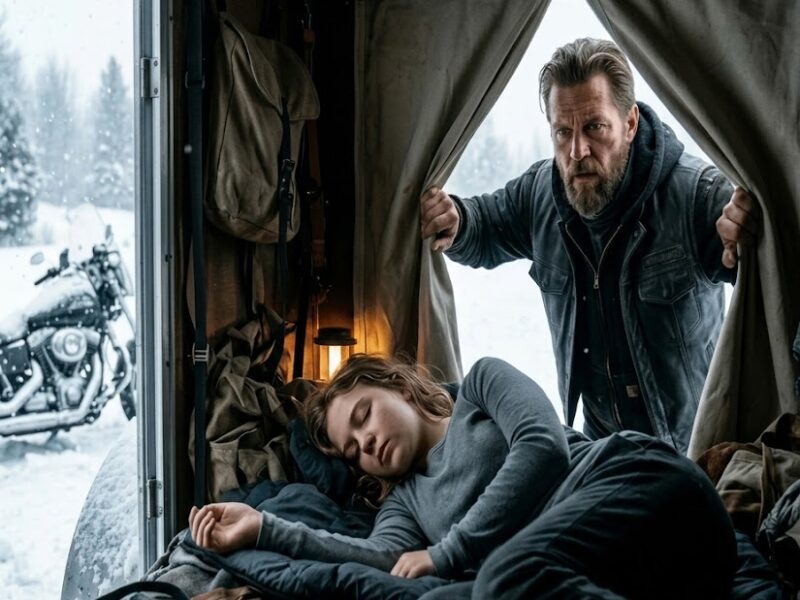
A group of bikers heard a desperate cry — “There’s a girl in the trailer!” — but when they broke in and saw her face, they froze. They recognized her.
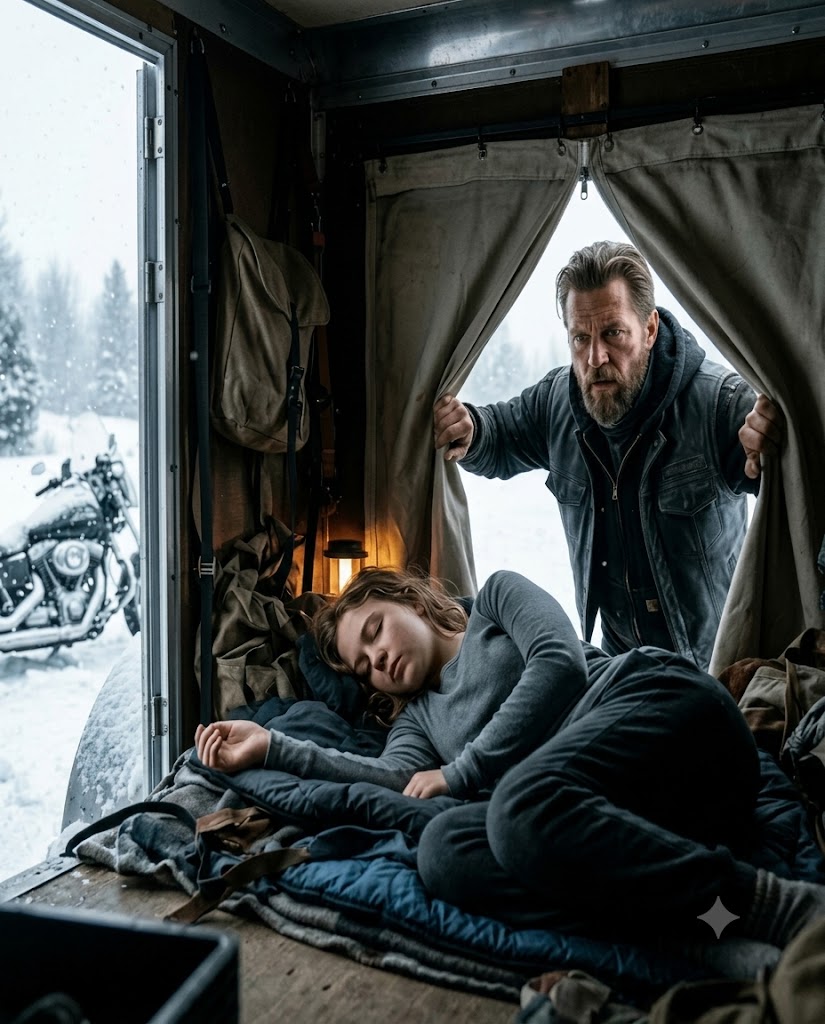
When Jake lifted the tarp on his trailer that night, he expected tools, spare parts, anything but a child.
She was asleep, barely breathing, her clothes worn thin from months on the road.
She didn’t scream, didn’t run, and that’s what terrified him most.
This wasn’t a girl who’d been taken.
She’d been surviving.
The question was why.
The Road Runners MC annual rally had been running for three days straight, and Jake Henderson was ready for his own bed.
The fairground lot outside Bakersfield was down to its last stragglers, a few diehards nursing beers around the dying bonfire, smoke curling into the September night.
Jake had parked his trailer at the far edge of the lot, away from the noise, same spot he’d claimed for the past eight years.
He walked across the gravel, boots crunching, keys jingling on his belt.
Tomorrow morning, early, he’d hitch up and head back to Reno.
Simple plan, clean exit.
The trailer sat in shadow, illuminated only by a distant floodlight that cast everything in washed-out yellow.
Jake ran his hand along the hitch, checking the lock by muscle memory.
Secure.
He moved to the back, where the tarp covered his gear.
Toolboxes, spare parts, camping equipment he hadn’t bothered to unpack this time around.
That’s when he felt it.
Wait, movement.
Something that didn’t belong.
Jake froze, his hand still gripping the tarp’s edge.
He’d been hauling bikes and equipment for thirty years.
He knew what settled cargo felt like.
This wasn’t that.
He yanked the tarp back hard, half expecting a raccoon or maybe some drunk who’d passed out in the wrong spot.
Instead, he found a kid, a girl, maybe ten years old, curled between his toolbox and a duffel bag.
She was small, wearing jeans that were too big and a faded hoodie with the sleeves pushed up.
Her face was pale in the bad light.
Her breathing shallow but steady.
Asleep.
Completely, impossibly asleep.
Jake’s hand went slack on the tarp.
He didn’t touch her.
Didn’t know if he should.
His mind raced through possibilities.
Kidnapping, trafficking, some kind of setup.
But she didn’t look tied up.
No visible injuries.
No tape over her mouth.
Just a kid sleeping like she’d climbed in there on purpose.
“Hey.” Jake’s voice came out rougher than he meant. “Kid, wake up.”
She stirred slowly, like someone coming out of deep water.
Her eyes opened, dark and strangely focused for someone just waking.
She blinked at him once, twice.
Took in the tarp hanging from his hand, the trailer walls around her, his leather vest with the Road Runner’s patch.
She sat up carefully, brushing hair out of her face.
“Is this Nevada yet?” she asked.
The question hit Jake sideways.
Not where am I or who are you.
Not crying, not screaming.
Just a logistical question asked in a voice that sounded way too calm for a kid who’d just been discovered hiding in a stranger’s trailer.
“No,” Jake said slowly. “This is Bakersfield, California.”
She nodded, processing this.
Her gaze moved past him, scanning the lot, the remaining bikes, the distant bonfire.
Calculating.
“I need to get west,” she said, like they were negotiating a ride.
Jake’s stomach dropped.
He turned and shouted toward the bonfire.
“Watcher, get over here.”
Within two minutes, half a dozen club members had formed a loose circle around the trailer.
Watcher arrived first, a lean man in his sixties with sharp eyes and a reputation for reading people.
He took one look at the girl and pulled out his phone.
“We’re calling 911,” he said quietly.
The girl didn’t argue.
She climbed out of the trailer on her own, steady on her feet despite how thin she looked.
Someone offered her water.
She drank it in careful sips, like she’d learned not to gulp.
The paramedics arrived before the police.
They checked her vitals with professional efficiency.
Dehydrated, malnourished, but no acute distress.
No signs of assault.
When they asked her name, she said nothing.
When they asked where she’d come from, she stared at the ground.
The police treated it like a standard runaway.
They were kind but procedural, asking the Roadrunners the same questions three different ways.
Had anyone seen her before tonight?
Did she arrive with anyone?
Was there any indication of foul play?
None of it checked out.
While the officers conferred near their cruiser, Watcher crouched down next to the girl.
She was sitting on the trailer’s lowered gate now, wrapped in someone’s jacket, looking more tired than scared.
“You know how to pick locks?” Watcher asked, nodding toward the trailer’s secure hitch.
She shook her head. “It wasn’t locked, just the tarp.”
“You’ve done this before.”
It wasn’t a question.
She met his eyes, and for just a second Watcher recognized something he’d seen in lifers.
An exhaustion so deep it had settled into her bones.
“I needed a ride,” she said simply.
Watcher glanced at Jake, who looked like he’d been punched.
Kids didn’t talk like this, not runaways.
This was someone who’d made a calculated decision and gotten caught.
The police ran her description through their databases.
No hits on missing children matching her age and appearance.
No Amber Alerts.
No frantic parents calling from nearby towns.
She became a Jane Doe in the system, another lost kid with no clear origin point.
By midnight, social services had been contacted.
A placement would take a few days to arrange.
Until then, she’d stay in temporary county care.
The Road Runners watched her leave in the back of a social worker’s sedan, still wearing someone’s jacket.
Her face turned toward the window.
Jake stood by his trailer long after everyone else had drifted back to the bonfire.
He kept replaying that moment, pulling back the tarp, finding her there.
The way she’d woken without panic, the way she’d asked about Nevada like she’d been reading a map in her sleep.
“She wasn’t scared of us,” Jake said when Watcher came back over. “That’s what gets me. She should have been terrified. Instead, she asked about Nevada like she was checking a bus schedule.”
Watcher lit a cigarette, exhaled slowly.
“She’s been around riders before. You could see it. The way she looked at the bikes, the vests. She knew what she was looking at.”
“So where the hell did she come from?”
Watcher didn’t answer, but something in his expression had shifted.
A shadow crossing his face that Jake had only seen a few times in twenty years of riding together.
“I don’t know yet,” Watcher said quietly, “but I’m going to find out.”
The county group home sat on a residential street that tried too hard to look cheerful.
Bright yellow siding, flower boxes in the windows, a swing set in the yard that nobody used.
Watcher parked his truck across the street and sat there for a minute, engine ticking as it cooled.
He told himself he was coming to check on her welfare, make sure she was being treated right.
But that was only half true.
The other half was the look on her face when she’d asked about Nevada, like she was following a route only she could see.
Inside, a tired social worker led him to a common room where the girl sat alone at a table, working through a bowl of cereal.
She looked up when he entered, recognized him immediately, and went back to eating.
“Mind if I sit?” Watcher asked.
She shrugged.
He took the chair across from her, noting details he’d missed in the chaos three nights ago.
Her hands were rough for a kid her age, calloused around the fingertips.
There was a faint scar on her left forearm, the kind you get from scraping against something sharp and not getting it properly cleaned.
“They treating you okay here?”
“It’s fine.” She didn’t look at him. “Better than some places.”
The phrasing caught him.
“Some places.”
Not other places or where I was before.
Like she’d developed a ranking system.
Watcher leaned back, keeping his posture loose.
“Jake’s trailer. You picked that one specifically?”
“The hitch coupler looked newer. Figured he maintained his equipment.” She pushed the cereal around. “And it was parked away from the main group. Quieter.”
“You know hitches?”
“Two-inch ball mount, class three. Standard for that weight capacity.”
She said it matter-of-factly, the way other kids might recite their times tables.
“Is he mad I used his trailer?”
“No. He’s worried about you.”
She absorbed this without comment.
Watcher let the silence stretch, a technique he’d learned from years of negotiating deals and reading tells.
People filled silence.
Eventually, they always did.
“I heard the bikes before I saw them,” she said finally. “From the highway. That rally sound, you can tell the difference between a Softail and a Dyna if you know what to listen for. Softails have that deeper rumble because of the hidden rear suspension. Dynas sound sharper, more aggressive.”
Watcher felt something cold settle in his chest.
“Where’d you learn that?”
“My dad taught me. He could identify bikes blind.”
There it was.
The door opening.
“Where’s your dad now?” Watcher kept his voice neutral.
Her jaw tightened.
She set down the spoon carefully, precisely.
“Dead. Four months ago. My mom, too.”
The social worker had mentioned possible family tragedy, but the case file was thin.
No confirmed relatives, no background.
Just a kid who appeared out of nowhere.
“I’m sorry,” Watcher said, and meant it. “What happened?”
She told him in pieces, stopping and starting, her voice flat in the way people get when they’ve told themselves the story too many times.
“The accident on Highway 299,” she said. “The semi crossed the center line.”
She paused, choosing her words.
“I was with them. On the bike.”
Watcher stiffened.
“We clipped the guardrail. I remember the sound, metal tearing. Then I was gone. When I woke up, I was down the embankment. The bike was in the river. They were already gone.”
Her voice stayed flat, but her hands clenched in her lap.
“I crawled into the trees and waited,” she said. “I thought they’d come back for me.”
And Reese, that was her name, she said Reese Wilder, found herself alone with a choice she shouldn’t have had to make.
“I knew what happened to kids without parents,” she said quietly. “Foster system, group homes, people who don’t understand. So I ran.”
“You’ve been out there four months, by yourself?”
“I’m good at it. My parents taught me to be self-sufficient.” She finally met his eyes. “We never had a house, never stayed anywhere longer than a season. I was born in a van near Flagstaff. This—” she gestured at the walls around them, “—this is weird to me, not the road.”
Watcher processed this.
A childhood spent entirely in motion.
No schools, no doctors, no paper trail.
Just highways and campgrounds and the kind of freedom most people romanticized but never actually lived.
“You’ve been following the circuit,” he said. “The harvest route. Third stop is usually Bakersfield, then west toward the coast, up through Oregon if the season’s good.”
She picked at a loose thread on her sleeve.
“I thought maybe someone at the rally knew them. My parents ran with different groups over the years. Not club members, but road family. I was looking for anyone who remembered.”
“What were their names?”
She hesitated, like giving up the information meant giving up the last thing she had.
“Cole Wilder. Road name was Nomad. My mom was Marissa. Everyone called her Rissa.”
Watcher’s coffee went cold in his hand.
He had trained himself not to react, to keep his face neutral through bar fights and business deals and bad news delivered at midnight.
But this punched through every defense he had.
Marissa, with her dark hair always escaping whatever tie she’d used.
Her laugh loud enough to turn heads two tables over.
The girl who’d chosen freedom over everything else, including him, thirty years ago.
He’d heard she’d paired up with a drifter named Cole.
Heard they’d gone full nomad.
Then nothing.
The road swallowed people if you let it.
“You knew her.” Reese’s voice was sharp now, reading his reaction. “You knew my mom.”
Watcher’s throat felt tight.
“Yeah. Long time ago. Before you were born.”
“Were you friends?”
The question was innocent, but the answer was complicated.
“We were close. She chose a different path.”
Reese studied him with an intensity that reminded him painfully of Marissa.
That same way of looking at people, like she could see past whatever they were showing to what they were hiding.
“She talked about her life before,” Reese said slowly. “Before my dad. She said she’d loved someone once, but he couldn’t understand why she needed to leave.”
Watcher’s jaw worked, but nothing came out.
“That was you,” Reese said, not a question.
He nodded once.
She leaned back, processing this new information, recalculating.
“So what happens now?”
“Now,” Watcher said, his voice catching, “we figure this out together.”
The Road Runners Clubhouse smelled like motor oil and old leather.
Decades of road stories soaked into the walls.
Watcher stood at the head of the scarred oak table while eleven members settled into their chairs.
Jake sat closest, arms crossed, waiting.
“The girl’s name is Reese Wilder,” Watcher began. “Her mother was Marissa Sims. Some of you older guys might remember her.”
A few heads nodded.
Marissa had been legendary in her own way.
The girl who’d hung around the club scene in the early ’90s, turned down a dozen marriage proposals, and finally disappeared with a drifter who promised her the whole country instead of one town.
“She was my girl,” Watcher said quietly. “Before she left.”
Chairs stopped creaking.
Someone set down their beer.
Watcher never talked about his past.
Never explained the distance in his eyes when couples rode past, or why he’d never settle down.
Now they understood.
“She’s been dead four months. Motorcycle accident up on 299. The kid’s been surviving alone this whole time, following the routes Marissa taught her.”
He paused, letting that sink in.
“She was looking for us. For anyone who knew them. For family.”
Jake spoke first. “So what are we saying here?”
“We take her in.”
“I’m saying she’s not just some random kid. She’s legacy. She’s one of ours.”
The vote was unanimous.
But days later, everything got complicated.
A Bakersfield Gazette reporter had been covering the rally when the story broke.
Mysterious child found at biker event.
She’d done some digging, pulled accident reports, connected dots.
Within days, wire services had picked it up.
By the end of the week, it was national news.
Mystery girl found living in biker trailer.
Daughter of nomadic couple spent months surviving alone.
The coverage wasn’t malicious, but it was loud.
Cameras showed up at the county offices.
Advocates for child welfare weighed in.
The narrative spun beyond their control.
Tragic orphan, dangerous lifestyle, questions about who’d failed her and how.
Watcher watched it unfold from a bar stool, nursing a beer he wasn’t drinking.
While the television above the counter showed Reese’s picture next to helicopter footage of the accident site, his phone rang.
Unknown number.
“This is Henry Briggs?”
“Yeah.”
“My name is Martin Wilder. I’m Reese’s grandfather.”
The conversation that followed was tense and careful.
Martin explained that he’d been estranged from his son Cole for fifteen years.
They’d fought about Cole’s refusal to grow up, to take a real job, to give his eventual children a stable home.
Cole had left and never looked back.
When the accident happened, Martin had tried to find Reese.
But authorities assumed she’d been swept away by the river.
Missing.
Presumed dead.
Watching her face on TV had been like seeing a ghost.
“I want to meet her,” Martin said. “I want to make this right.”
Watcher heard what Martin wasn’t saying.
That finding Reese was less about her and more about Cole.
About getting a second chance at something he’d already lost.
The meeting happened in a county conference room that tried too hard to be cheerful.
Plastic chairs, motivational posters, fluorescent lights that hummed.
Martin Wilder arrived twenty minutes early, wearing slacks and a button-down shirt, carrying a folder of photographs like evidence.
Reese arrived with her social worker, spotted Martin through the window, and stopped walking.
“That’s him?” she asked.
“Your grandfather, yes. He’s come a long way to see you.”
Reese’s expression was unreadable.
She walked in slowly, sat across from him, and waited.
Martin’s hands shook as he opened the folder.
“I brought pictures. This is your dad when he was about your age. This one’s from his Little League team. And this—” his voice cracked, “—this is him on his first bike. Twelve years old.”
Reese looked at the photos without touching them.
The boy in the pictures wore baseball uniforms and school clothes.
His hair was cut short.
He smiled at the camera like someone who’d never questioned where he belonged.
“That’s not him,” Reese said flatly.
Martin’s face fell. “What do you mean?”
“That boy in the picture, that’s not my dad. My dad had long hair and wore boots and could fix any engine he touched. He never played baseball. He never lived in a house like that.”
She pointed at a background photo showing a suburban home.
“You’re showing me someone he stopped being.”
Martin’s hands went still on the photographs.
“I’m trying here. I’m trying to connect.”
“You can’t connect to something you never wanted to understand.” Reese’s voice wasn’t cruel, just factual. “My parents left because you thought their life was wrong. Now you want me to be like him—” she tapped the Little League photo, “—and pretend the last ten years didn’t happen.”
The social worker intervened gently, suggesting they take a break.
But Martin leaned forward, desperate.
“I failed your father. I know that. But I’m here now. You’re my family. Let me give you what he wouldn’t take. A home, stability, a future.”
Reese stood up, her chair scraping against linoleum.
“I don’t need saving. I need to be where I belong.”
She looked at him with something like pity.
“And that’s not with someone who thinks my whole life was a mistake.”
She walked out.
Martin sat there with his folder of photographs, looking at pictures of a son he’d lost long before the accident, and a granddaughter who might as well have been born on a different planet.
Outside, Watcher was waiting by his truck.
Reese climbed in without being asked.
“He means well,” Watcher said carefully.
“I know.” She stared straight ahead. “But meaning well isn’t the same as understanding.”
Watcher started the engine.
“No, it’s not.”
The custody hearing drew reporters like a crash scene.
Camera crews lined the courthouse steps.
Inside, the gallery was packed with advocates, journalists, and a handful of Roadrunners wearing their cleanest vests.
Martin’s attorney was polished and prepared.
She presented school enrollment forms, pediatrician appointments already scheduled, a bedroom decorated in soft blues.
She spoke about structure, normalcy, the kind of childhood every child deserved.
Martin sat rigid in his suit, looking like a man bracing for impact.
Then the Roadrunners took the stand.
Watcher went first.
He described finding Reese, her competence, her uncanny knowledge of mechanics and survival.
“She wasn’t lost,” he said carefully. “She was navigating. There’s a difference.”
Jake testified about the toolbox incident, how Reese had identified his trailer’s specifications without being told, how she’d chosen the safest place to sleep based on maintenance quality.
“That’s not luck. That’s skill. Someone taught her to read situations, to stay safe in unstable environments.”
The prosecutor pushed back.
“Isn’t it concerning that a ten-year-old child has these skills? That she needs them?”
“What’s concerning,” Jake said evenly, “is that we’re calling survival skills a problem instead of recognizing that this kid adapted to circumstances most adults couldn’t handle.”
The turning point came with Dr. Sarah Wood, a child psychologist who’d spent two weeks evaluating Reese.
She’d expected trauma markers, attachment issues, developmental delays.
What she found was different.
“Reese doesn’t fit conventional models,” Dr. Wood told the court. “She’s grieving profoundly, yes, but she’s not damaged by her upbringing. She’s defined by it. Her parents gave her a non-traditional education focused on practical skills, critical thinking, and independence. She reads at grade level. She has advanced mechanical knowledge. Most importantly, she has a clear sense of identity.”
“And that identity is?” the judge asked.
“A child of the road. Trying to force her into a traditional framework could cause more psychological harm than supporting her in the lifestyle she understands.”
The courtroom buzzed.
Martin’s attorney objected, arguing that children need structure regardless of preference.
But Dr. Wood held firm.
“Structure, yes. But whose structure? Reese needs boundaries and care. She doesn’t need to be remade.”
The judge took three days to deliberate.
When she returned, her ruling surprised everyone.
“Reese will reside with her grandfather, Martin Wilder, as primary guardian. However—” she raised her hand against the murmurs, “—this arrangement will be non-traditional. Reese will attend a hybrid distance learning program, allowing flexibility. She will spend weekends and extended periods with the Roadrunners Motorcycle Club under supervised mentorship. This court recognizes that family takes many forms.”
Martin sat frozen, processing.
Around the courtroom, the Roadrunners shifted.
This wasn’t the win they’d hoped for, but it wasn’t a loss either.
Reese, sitting between worlds, nodded once.
October became November, then December.
The house stayed quiet.
Martin’s house had too many rooms and too much silence.
Reese moved through it like a guest, polite but detached.
She completed her schoolwork efficiently, answered questions in short sentences, and spent hours in the garage Martin cleared out for her, working on an old lawn mower engine.
But something shifted the day Martin stopped trying to fix things and started asking questions instead.
“Show me how you check the carburetor,” he said, pulling up a stool beside her workbench.
She glanced at him, suspicious.
“Why?”
“Because I don’t know, and you do.”
So she taught him, and in teaching, she started talking about the van she was born in, about learning to read using road signs, about her mother’s laugh and her father’s steady hands.
Martin listened without interrupting, without trying to correct the story into something he wished it had been.
“I was wrong,” he said one evening, months in, “about your dad. I thought freedom meant running away. I didn’t understand he was running toward something.”
Reese looked up from the carburetor she was cleaning.
“He used to say you can’t build roots in cement. They need room to spread.”
Martin turned away, blinking hard.
“That sounds like him.”
Meanwhile, the Roadrunners kept their promise.
Reese spent weekends at the clubhouse, learning to rebuild transmissions, balance books, negotiate with suppliers.
Jake taught her to back up a trailer in three moves.
Watcher showed her how to read maps the old way, with landmarks instead of GPS.
On her sixteenth birthday, they unveiled a rebuilt 1986 Harley Sportster, her mother’s favorite model.
The entire club had worked on it in secret, restoring it piece by piece.
“It’s not finished,” Watcher said, handing her a wrench. “You complete it.”
Reese spent three months doing exactly that.
Martin drove her to the clubhouse every Saturday, started staying for coffee, eventually started asking mechanical questions himself.
The Road Runners, to their surprise, found they liked him.
The day Reese finished the bike, Martin stood in the garage doorway watching her fire it up.
The engine caught clean, rumbling to life like something remembering how to breathe.
She looked at him, waiting.
“You want to take it for a ride?” he asked.
“You want to come with?”
Martin’s answering smile was genuine.
“On my own bike? I do.”
Years later, when journalists circled back asking what became of the mystery girl, the answer defied easy headlines.
Reese Wilder grew up between two worlds and made them one.
She became a traveling mechanic.
Summers meant the road, different crews, different states.
Winters meant Martin’s shop, the one he’d named after her mother.
She never settled in one place.
Home wasn’t a location.
It was the people who’d stopped trying to change her and started listening instead.
The trailer that started it all still sat in Jake’s yard, tarp replaced, hitch maintained.
Every now and then, Reese would visit, run her hand along the coupler, and remember the night she’d climbed inside, hoping for a ride west.
She’d found more than that.
She’d found a family that didn’t need her to be anyone other than who she already was.
And for a kid who’d spent four months alone on the road, that was everything.
The tarp flapped in the wind, same washed-out yellow light, same gravel crunching under boots.
But this time, when someone lifted it, they found exactly what they expected.
Nothing hidden.
Nothing lost.
Just a girl who’d finally found her way home.









