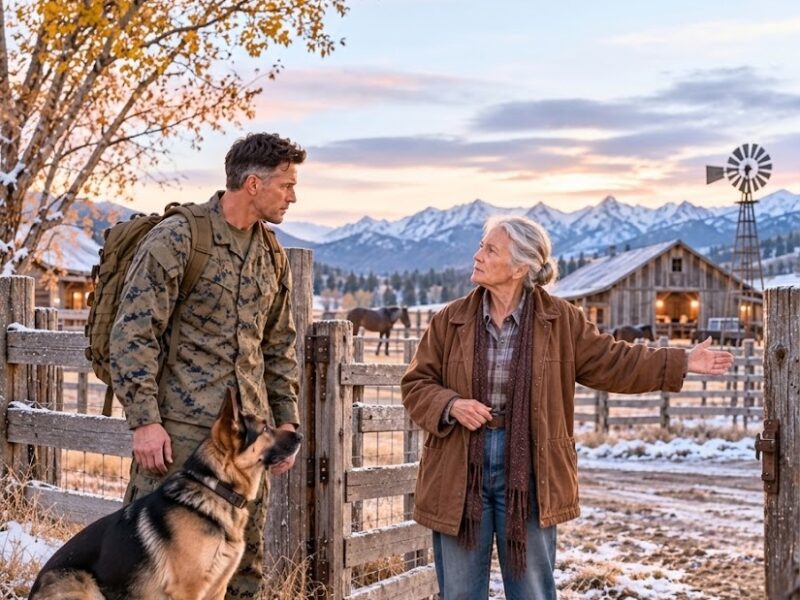
A Grieving Marine Wandered With Only His K9—Until an Elderly Rancher Opened Her Gate and Called Him by Name
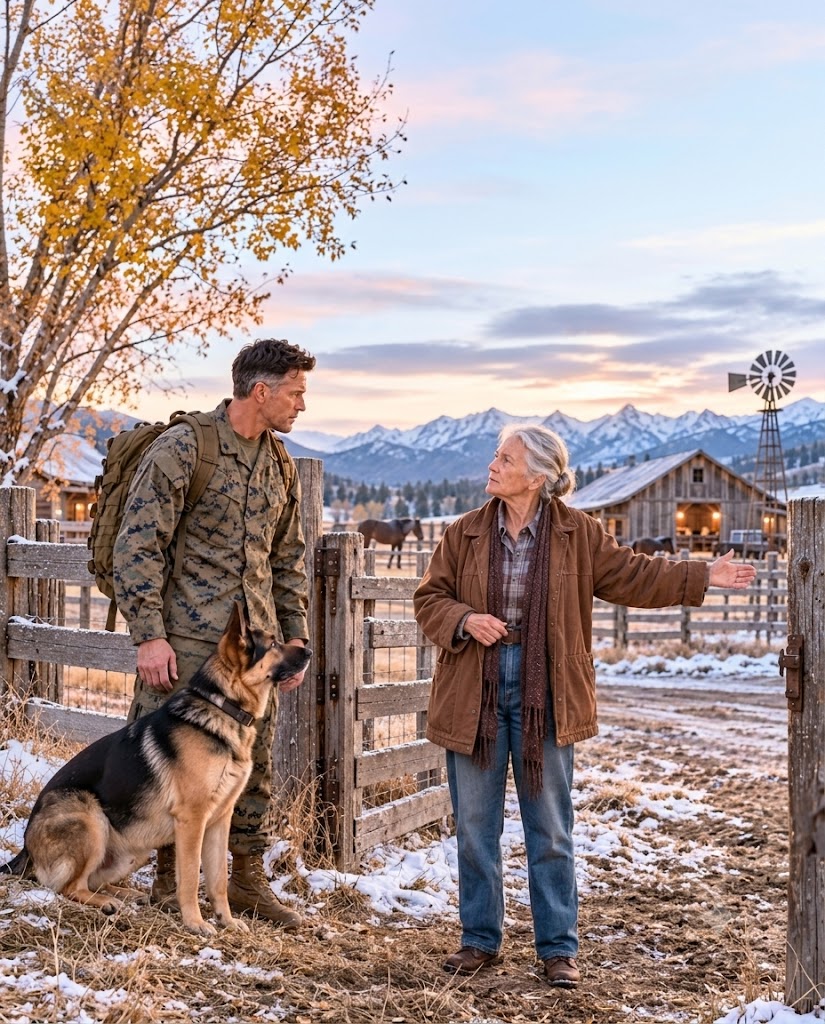
The snow came early that year in southwestern Montana, thin and mean, the kind that didn’t blanket so much as sting.
Gunnery Sergeant Callum Reeves walked west along a county road with a canvas pack riding high between his shoulders, his breath clouding in the cold October air.
At his left heel moved Torin, a retired German Shepherd K9 with a dark saddle and amber eyes that still scanned every fence line like it might hide an ambush.
Eight months ago, Callum had a wife named Audrey and a nine-year-old son named Miles.
Eight months ago, he had a house in North Carolina with a front door he could open without his hands shaking.
Eight months ago, he had a reason to stop walking.
Now he had a dog, a pack, and a question he kept answering the same way.
“Where are you going?”
“Don’t know yet.”
“Where are you sleeping?”
“Wherever dark catches me.”
—
The road bent past a weathered fence post just as the afternoon light began to drain from the valley.
Torin stopped first.
His ears rose sharply, body still without going tense, the way he’d been trained to signal without spooking.
A horse screamed somewhere beyond the fence.
Callum followed the dog’s gaze and saw a young bay mare racing the inside of a pasture, neck high, eyes wide with panic.
Fifty yards farther down, an open gate hung crooked against a post.
An elderly woman struggled to hold it while a man inside the paddock moved carefully across the mare’s path.
Callum dropped his pack outside the fence.
Torin folded immediately onto the grass, belly down, watching.
—
The woman at the gate was Marabel Harlow, seventy-six, widowed owner of Juniper Hollow Ranch.
She was barely five-foot-four and lean rather than frail, with weathered fair skin, silver-gray hair twisted into a low knot, and clear hazel eyes that seemed to judge a person before deciding whether he deserved a question.
Years outdoors had left fine lines around her mouth and deeper ones at the corners of her eyes.
She wore a faded brown work coat, denim trousers, and scuffed leather boots.
Even while fighting the weight of the gate, she carried herself with the stubborn economy of someone accustomed to solving her own problems.
The man inside was Everett Sloan, sixty-six, Juniper Hollow’s longtime ranch hand.
Tall but slightly stooped through the shoulders, with a narrow sunburned face, close-cropped iron-gray hair, and a short gray mustache.
He had the deliberate manner of a man who had worked around horses long enough to know that impatience usually created twice the work.
Callum stopped outside the opening rather than barging through it.
“What do you need?”
Everett glanced once at him, then at Torin lying motionless beyond the fence.
“Hold that gate. If she comes this way, make yourself wide. Don’t chase her.”
Callum nodded.
“Got it.”
That was all.
He did not pretend twenty years of military discipline had taught him horses.
He followed Everett’s instructions.
When the mare wheeled toward the opening, Callum stepped sideways and spread his arms without advancing.
She hesitated.
Everett used that hesitation, approaching from an angle and gradually turning her toward the paddock.
Minutes later, the mare passed through the inner gate, blowing hard but safe.
Marabel released a breath.
Callum examined the outer latch.
One bolt had worked loose from rotten wood.
With Everett’s tools and a better screw point farther into the post, Callum made a temporary repair strong enough to hold until the wood could be replaced.
He handed the wrench back, whistled once for Torin, and shouldered his pack.
Marabel stared at him.
“That’s it?”
Callum looked at the gate.
“It’ll hold tonight.”
“I meant you.”
He did not understand until she nodded toward the road.
“Where are you going?”
Callum looked west.
The light had begun draining from the valley.
“Don’t know yet.”
“Where are you sleeping?”
“Wherever dark catches me.”
Marabel glanced at the frost already silvering the shaded grass.
“Dark already caught you.”
—
The bunkhouse stood beyond the barn.
One room with a narrow bed, an old iron stove, and a roof Marabel assured him did not leak.
Callum offered money.
She refused it and told him he could split firewood in the morning if his pride required a receipt.
Something about the phrasing almost made Everett smile.
Callum accepted one night.
The next morning, he split enough wood for several days.
He was fastening his pack when he noticed water spilling uselessly from a trough valve.
By the time that was fixed, Everett needed help shifting bedding undercover before afternoon rain.
The following morning, there was another small job, then another.
Nothing dramatic enough to explain why Callum remained, which perhaps was why he did.
“Leaving tomorrow?” Marabel asked on the second evening.
“Probably.”
She asked again the next night.
“Probably.”
On the third morning, Callum woke before sunrise and remained still for several seconds.
Torin slept across the threshold, his body positioned between Callum and the outside world, even in sleep.
Beneath spare clothes at the bottom of Callum’s pack lay one small object he had carried across every state and had never once taken out where another person could see it.
Callum looked toward the window.
Beyond the glass, Juniper Hollow was beginning to wake.
A barn door opened.
A horse stamped somewhere in the cold.
Work was waiting.
For the first time in eight months, Callum rose because there was somewhere he needed to be that morning.
He left the pack closed.
—
November came quietly to Juniper Hollow, whitening the fence rails before dawn and softening the distant Montana ridges beneath low clouds.
Most afternoons warmed enough to uncover the grass again, but every morning carried the warning that winter was getting closer.
Callum never asked Marabel for a job, and Marabel never treated him like a man who needed rescuing.
On his fourth morning, she placed a ruled notebook on the kitchen table and explained the arrangement while pouring coffee.
She recorded the days he worked, the meals he ate, and whatever supplies he used from the ranch.
His labor covered the bunkhouse and food.
If the balance ever leaned too far in either direction, they would settle it.
No charity, no obligation, no promise about next week.
Callum could leave whenever he wanted.
The simplicity appealed to him.
He had spent most of his adult life understanding exactly what was expected of him.
Grief had destroyed enough boundaries without kindness making the remaining ones unclear.
Juniper Hollow kept roughly twenty horses, some still used regularly and others old enough that their hardest working years were behind them, along with a flock of about thirty-five sheep.
Within a week, Callum understood something equally important.
Being a gunnery sergeant did not make him a rancher.
He could repair a hinge, organize supplies, identify weak points in a system, and remain useful when other people became hurried.
Everett knew which pasture held water after prolonged rain, which mare might kick if crowded from the wrong side, how much hay cold horses would need, and what a change in wind meant when clouds gathered above the ridges.
Callum respected expertise too much to confuse it with confidence.
Before moving anything that affected livestock, he asked Everett.
Before changing a routine, he asked why the routine existed.
Torin required adjustment as well.
Callum never turned him loose among the sheep and never allowed him to wander through a paddock simply because he obeyed commands.
During the first days, two of the horses stiffened whenever the German Shepherd appeared near the fence.
So Callum increased the distance and let familiarity do what force could not.
Torin seemed content with that arrangement.
He watched from beside gates, followed Callum between buildings, and occasionally slept in patches of weak November sunlight while humans did work that apparently required far more effort than dogs considered reasonable.
By the second week, fewer equine heads lifted when he passed.
One horse, however, seemed to occupy a different place at Juniper Hollow.
Fern was a twenty-two-year-old chestnut mare with a graying muzzle, a narrow white star between gentle dark eyes, and the slightly hollowed topline of an animal whose age had begun to show without diminishing her dignity.
She moved carefully on cold mornings and no longer did hard ranch work.
One afternoon, Callum found Marabel brushing her long after the other horses had been tended.
The old woman worked slowly over Fern’s shoulder, untangling burrs from her mane with more patience than necessity required.
“Why keep a horse that old?” Callum asked Everett quietly.
Everett was repairing a leather strap nearby.
He raised his eyes toward Marabel.
“Ask her.”
Callum looked again.
Marabel had stopped brushing.
She rested one hand against Fern’s cheek, then leaned forward until her forehead touched the mare’s.
Callum did not ask.
Everett told him several days later without ceremony.
Marabel’s husband had bought Fern when the mare was young.
For years, Fern had carried Marabel across those pastures beside him.
Her usefulness could not be measured by what she could pull, carry, or earn anymore.
Callum absorbed that without comment.
He was beginning to understand that Juniper Hollow contained things people kept for reasons that would look inefficient on paper.
Efficiency, however, was something he understood.
—
As the weeks accumulated, Callum noticed how many necessary items depended upon a single location or system.
Veterinary supplies, spare halters, blankets, and several frequently needed tools were concentrated in the main barn.
The water pump depended on electricity.
Fuel reserves were stored conveniently but not strategically, and emergency lights and rope were sometimes farther from the places they would most likely be needed than Callum liked.
He did not propose new buildings or expensive equipment.
Instead, he sat with Everett and Marabel and suggested dividing essential supplies between two dry locations, keeping reserve water available, placing lights and rope where someone could reach them quickly, and making sure one failure could not remove every option at once.
Everett challenged several ideas.
Callum changed them.
Marabel approved the inexpensive ones first.
Then Callum demonstrated exactly why knowing systems was not the same as knowing land.
A low equipment shed near one paddock seemed ideal for storing extra bedding and several emergency supplies.
It shortened the distance from storage to where the material would most often be used.
Everett watched Callum stack the first load and frowned.
“Low ground. Drainage ditch runs behind it.”
“Should hold,” Callum said.
Everett examined the grade, the ditch, and the forecast.
“Your stack.”
Cold rain began after midnight two days later and continued for hours.
By sunrise, runoff from higher ground had overwhelmed the shallow ditch and pushed muddy water beneath the shed door.
Callum arrived to find several bales of bedding soaked along the bottom and water standing around boxes he had deliberately moved there to make them easier to reach.
For a long moment, he simply stared.
Everett stopped beside him.
“I solved the distance,” Callum said. “Forgot the ground.”
“Ground usually gets the last word.”
There was no accusation in Everett’s voice, which somehow made the mistake easier to own and harder to dismiss.
Callum did not explain his reasoning again.
He did not offer to buy his way out of it.
He pulled on gloves.
They spent most of the day fixing what Callum had created.
Usable material went to dry ground.
Ruined bedding was separated and discarded.
Together, they deepened the drainage path, cleared debris from its outlet, and chose a higher storage point that required a longer walk but would remain dry when the pasture shed did not.
Everett showed Callum where water had traveled during bad autumn rains years earlier.
This time, Callum listened before touching a shovel.
Near sunset, Everett leaned on the handle of his shovel and looked over the corrected drainage.
“You learn quick.”
“Would’ve been quicker to listen yesterday.”
The corner of Everett’s mouth moved.
“That too.”
Something changed between them after that.
Not friendship, not yet.
Everett simply stopped watching Callum like a temporary guest who might disappear before finishing what he started.
—
Days continued accumulating.
Callum still kept his pack ready in the bunkhouse, though he had stopped checking bus schedules.
Work acquired a rhythm.
Gates, water, feed, repairs, questions, cold hands warmed around coffee.
Nothing at Juniper Hollow asked him to explain himself.
Then one morning, Callum opened the bunkhouse door and found the threshold empty.
He stood still.
“Torin.”
The dog was nowhere beside the barn.
Callum crossed the yard and finally saw him stretched across Marabel’s porch, head resting comfortably between his paws while Marabel sat nearby with a steaming mug.
She looked at Callum, then at the German Shepherd.
“Seems he’s changed sides.”
Callum studied Torin.
The dog opened one eye and made no attempt to move.
“He’s retired,” Callum said. “Apparently discipline went with it.”
Marabel laughed.
The sound caught him off guard.
Then, before Callum could stop it, something unfamiliar escaped him too.
A laugh, small, rough, and gone almost immediately, but real.
Torin closed his eye again, and for once Callum let him stay.
—
By late November, the Montana mornings arrived hard and silver, frost sealing the trough edges and whitening the pasture grass.
Juniper Hollow had not yet seen real winter, but the mountains were disappearing behind clouds more often now.
Nearly a month had passed since Callum walked through the ranch gate.
One afternoon, Marabel crossed to the bunkhouse carrying a pair of work gloves she had repaired after noticing a split along one palm.
The door stood partly open.
She lifted a hand to knock, then stopped.
Callum sat on the edge of the narrow bed, elbows on his knees.
Torin lay quietly across his boots.
In Callum’s hands was a child’s baseball glove, old enough that the brown leather had darkened around the pocket and softened at the fingers.
A name had once been written inside the wrist in black marker, though years of use had blurred most of the letters.
Marabel did not enter.
“Your boy?”
Callum’s thumb moved across the worn leather.
“He was.”
She placed the repaired gloves on the small table beside the door and left.
That evening, Callum came to the kitchen after chores were finished.
Marabel had made stew and did not mention what she had seen.
She asked whether the north trough was holding pressure after the repair.
She complained that Everett had once again left a muddy pair of gloves where she could find them.
She poured Callum coffee.
Her refusal to ask eventually became harder to resist than questions would have been.
“His name was Miles,” Callum said.
Marabel kept both hands around her mug.
“My wife was Audrey.”
The names changed the room.
Until then, they had existed at Juniper Hollow only as absences Callum carried with him.
He told Marabel the accident had happened eight months earlier while he was away.
He did not describe twisted metal or emergency rooms.
Those details belonged to a day he had replayed enough without giving it another audience.
Instead, he told her about what came afterward, returning to his unit because routine was the only language he still understood.
Doing the work, answering when spoken to, convincing people he was functioning because technically he was.
Then he told her about North Carolina.
“The house is still there.”
Marabel looked at him.
“Still yours?”
“Yes.”
“Someone keeping it?”
“No.”
Callum stared into his coffee.
“Bills are automatic. Power’s still on. Audrey’s clothes are still in the closet. Miles left his shoes beside the door.”
He could see them as clearly as if eight months had not passed.
One shoe upright, the other tipped against the baseboard because Miles almost never put anything down properly.
“So you have a house,” Marabel said.
“Yes.”
She studied him for a moment without pity.
“Just don’t know where you can stand being home.”
Callum said nothing.
Marabel did not tell him grief needed time.
She did not tell him Audrey and Miles would want him to move on.
She simply reached for the coffee pot and refilled his cup.
—
Two days later, a dark pickup came through Juniper Hollow’s gate shortly before noon.
The man who stepped out was Duncan Harlow, Marabel’s forty-six-year-old nephew.
Duncan stood about five-eleven, solidly built without being heavy, with sandy brown hair thinning slightly at the temples, a square jaw, and a neatly trimmed beard beginning to gray around the chin.
His hazel eyes resembled Marabel’s, though his expression carried more impatience than hers.
He dressed like someone accustomed to working outdoors but no longer doing it every day.
Clean work jacket, sturdy boots, denim without mud ground permanently into the seams.
Duncan managed a building supply business several towns away and had spent years watching Marabel grow older while Juniper Hollow’s machinery did the same.
Concern had gradually made him practical, and practicality had sometimes hardened into the belief that a problem left unsolved long enough became his responsibility to solve.
He noticed Torin first, then he noticed Callum carrying supplies from the feed room.
“Who’s that?”
Marabel barely looked up from the invoice she was reading.
“Callum.”
“I gathered he had a name.”
Duncan had come with numbers, not accusations.
Feed prices had climbed.
An aging tractor needed work.
Several horses consumed money while producing little income, and sections of distant acreage required maintenance Marabel could no longer handle as easily as she had ten years earlier.
Duncan believed selling part of the farthest land and reducing the ranch’s scale could protect what remained.
His argument was not foolish.
Then he learned Callum had been staying nearly a month.
“You gave him access to the feed room.”
“He works here.”
“The tack room when he needs it. And the fuel shed.”
Marabel closed the invoice.
Duncan lowered his voice.
“Do you even know who he is?”
“Enough.”
That answer satisfied neither of them.
Later, Duncan found Callum in the barn reorganizing emergency lamps.
Torin lay outside the doorway, far from the horses.
“You planning to stay?”
Callum set one lamp down.
“Haven’t planned that far.”
“My aunt says you’ve been changing things.”
“Some storage. Backup supplies. Everett approves anything involving livestock.”
Duncan folded his arms.
“You always move into someone’s place and start improving it?”
Callum looked at him.
“No.”
The answer was so flat that Duncan had nowhere useful to take it.
—
That afternoon, Marabel spread ranch expenses across the kitchen table.
Duncan explained his proposal again.
Callum had no intention of joining the conversation until Duncan pushed the ledger toward him.
“You’ve got opinions about everything else. Tell her I’m wrong.”
Callum read quietly.
Feed, repairs, fuel, veterinary expenses, equipment, maintenance.
He turned two pages back, then closed the ledger.
“He’s not wrong about the numbers.”
Marabel’s face tightened.
Duncan leaned back, almost triumphant.
Callum continued.
“You’re carrying costs that aren’t going away because nobody likes talking about them.”
“Exactly,” Duncan said.
“But being right about the problem doesn’t make the decision yours.”
Duncan’s expression changed.
Callum looked toward Marabel.
“It’s her land. If she’s competent to understand the numbers, she’s competent to decide what they mean.”
“I am sitting right here,” Marabel said.
“I noticed.”
Her eyes narrowed.
Duncan gave a humorless breath.
“So whose side are you on?”
“Didn’t know there were sides.”
No one at the table appeared pleased with him after that.
Callum considered that preferable to being useful only when he agreed.
—
That night he returned to the bunkhouse.
Torin circled once before settling near the stove.
Callum placed the baseball glove back inside his pack, but this time he did not bury it beneath everything else.
He sat on the bed and tried to remember the last bus schedule he had checked.
He couldn’t.
Then he tried to remember how many miles he had walked since arriving at Juniper Hollow.
He couldn’t remember that either.
For months, distance had been how Callum measured survival.
Another town, another road, another place behind him.
Juniper Hollow had never asked him to stay.
Marabel had never closed the gate.
And Callum finally understood that nobody here had stopped him from leaving.
He had stopped leaving on his own.
—
December arrived gently by Montana standards.
Snow came in thin overnight layers, whitening Juniper Hollow’s pastures before melting under weak afternoon sun or hardening into crust by the following morning.
The deeper cold remained somewhere beyond the mountains, waiting.
Callum had accumulated three keys without ever asking for one.
The first opened the feed room because Marabel grew tired of being summoned whenever he needed supplies.
Everett handed him the tack room key several days later after Callum had begun checking emergency equipment before dawn.
The fuel shed key came last, attached to a plain steel ring without ceremony.
Callum treated each the same way.
A key did not mean the room behind it belonged to him.
It meant there was now one more door he was responsible for locking.
One more inventory he was expected to notice running low.
One more place that had to remain accessible when somebody needed it.
Duncan noticed that.
He also noticed Callum never carried Marabel’s keys casually, never entered spaces without a reason, and never spoke about Juniper Hollow as though his usefulness had earned him ownership.
One evening after supper, Marabel placed a fourth key on the kitchen table.
It was smaller than the others.
Callum looked at it.
“What’s that?”
“Office off my bedroom.”
He waited.
“Land records, bank statements, accounts, insurance. Everything Duncan thinks I hide from him and everything I wish involved less paper.”
Callum did not touch it.
Marabel nudged the key across the table.
“If something happens and I can’t get to it, somebody should know where things are.”
“Duncan knows.”
“He knows most of it.”
“Then he can know the rest.”
Her expression sharpened.
“I’m giving it to you.”
Callum studied the small brass key for several seconds, then pushed it gently back across the wood.
“You asked me to help keep this place running. You didn’t ask me to own your life.”
Marabel’s hand remained beside the key.
“You think that’s what I’m doing?”
“I think trust works better when it has edges.”
Everett, seated at the far end of the table, said nothing.
But Duncan did.
He had begun coming to Juniper Hollow more frequently since their argument over the ranch’s finances, and he was leaning against the counter with his arms folded.
“That’s the first thing you’ve said since I met you that I completely agree with.”
Callum glanced at him.
“Enjoy it.”
Duncan almost smiled.
—
The conversation that followed was less dramatic than the one two weeks earlier and far more useful.
Marabel retained every decision involving land, accounts, and money.
Everett had final operational judgment regarding horses, sheep, pasture conditions, and anything else where experience mattered more than a spreadsheet.
While Callum remained at Juniper Hollow, he would oversee supply placement, backup systems, and immediate response when something failed.
Duncan would be included when major expenses or long-term decisions affected the ranch.
But concern did not give him authority to overrule Marabel.
“Everybody satisfied?” Marabel asked.
“No,” Duncan said.
“Good. Means nobody got everything.”
This time, even Everett smiled.
—
Duncan’s suspicion did not disappear that evening.
It simply lost some of its justification.
Over the following days, he began directing questions toward Callum instead of questions about him.
When a load of feed arrived, Duncan asked where Callum wanted the emergency portion stored.
When they checked the generator, he handed Callum a wrench without making a comment about Marines and machinery.
Respect came grudgingly, measured in ordinary gestures rather than apologies.
The ranch prepared for colder weather in much the same way.
Nothing Callum proposed looked impressive by itself.
Reserve water was stored where a pump failure would not immediately become a livestock emergency.
Dry bedding and blankets were divided between two locations, so fire, flooding, or a blocked door could not isolate all of them.
Flashlights were hung at predictable entrances instead of wherever someone last used them.
Rope was checked and placed where hands could find it in darkness.
Everett insisted on extra sand for icy footing, and Callum made sure it remained dry.
Duncan helped clear brush and debris from a secondary route to the paddocks in case the primary path became inaccessible.
The generator started cleanly during its first test.
During the second, it coughed.
Callum shut it down, checked the line, and looked toward Duncan again.
Duncan restarted it.
The engine settled into a steady rhythm.
Everett stood several yards away.
“You planning for the end of the world?”
“No,” Callum said. “Just one thing breaking at the wrong time. Things usually do.”
That was precisely the point.
Callum no longer wanted one pump, one door, one storage shed, or one person’s memory carrying the entire weight of a problem.
Juniper Hollow could not be made failure-proof.
It could be given another option.
—
The forecast changed three days before Christmas.
Everett heard it first on the radio in the barn and turned the volume higher.
Moist air was moving toward the valley.
Temperatures would remain warm enough for rain at first, then drop rapidly below freezing overnight.
Duncan looked through the open barn doors at the dull sky.
“How bad?”
Everett’s face had gone still.
“Depends how much falls before the temperature drops.”
Callum understood without needing the rest explained.
Rain on frozen ground was one problem.
Rain that coated everything before freezing was another.
“No blizzard,” Duncan asked.
“Don’t need one,” Everett said. “Ice will do plenty.”
They checked everything again.
By the final evening, the ranch looked almost unchanged.
That pleased Callum.
Good preparation rarely looked dramatic before it was needed.
Water waited where it should.
Sand stayed dry.
Blankets were separated.
The generator had fuel.
The secondary paddock route was open.
Nothing depended entirely on a single solution.
Near dusk, Callum took Torin on one final circuit.
The German Shepherd moved beside him through grass stiffening under the cold.
They checked gates, the outer fence, the water points, and the path behind the barn.
At the older horse paddock, Callum slowed.
Fern stood near the fence.
Her winter coat had thickened, making the old mare appear softer around the shoulders, but age remained visible in the careful way she shifted her weight.
She watched Torin without alarm.
Callum stopped outside the rail.
Torin stopped with him.
Fern breathed into the cold, a pale cloud forming around her muzzle.
Callum remembered Marabel resting her forehead against hers weeks earlier.
He checked the latch twice.
Then he and Torin continued.
—
The first drops of rain struck the bunkhouse roof after dark.
Callum sat on the edge of the bed, listening to them.
Torin settled near the stove.
Outside, the temperature was already falling.
Callum reached for his pack.
The baseball glove came out more easily this time.
He held it only briefly before setting it on the small table beside the bed.
For months, he had carried it hidden beneath everything else he owned, as if keeping it buried made carrying it possible.
Tonight, he did not put it back.
Callum turned off the lamp.
The glove remained on the table.
Outside, rain continued falling into the cold.
—
Rain fell across Juniper Hollow through the evening, darkening the barn roof and running from every fence rail.
Near midnight, the temperature dropped hard.
By dawn, the ranch glittered beneath a clear shell of ice that made every familiar surface dangerous.
Callum knew how bad it was before he crossed the yard.
His boot touched the ground and slipped half an inch.
Fence wire sagged beneath frozen beads.
Gates had sealed along their lower edges, and the barn roof shone like glass beneath the gray morning.
Then a heavy crack sounded beyond the house.
A cottonwood limb came down across the power line, and Juniper Hollow went silent.
No lights, no pump, no steady electrical hum from the buildings.
The road climbing away from the ranch had become a polished incline no sensible driver would attempt.
There was no deep snow and no whiteout.
The danger was under their feet.
Everett kept the horses from unnecessary movement while the sheep remained inside their dry shelter.
Duncan spread sand between the house and barn.
Callum kept Torin close on command, unwilling to risk four paws simply because they offered better balance than two boots.
They were checking water when Marabel’s voice cut across the paddock.
“Fern.”
The old mare had slipped beside the trough.
Callum moved instinctively toward the gate.
Everett’s arm came across his chest.
“Wait.”
Fern lay awkwardly on one side, frightened but alert.
She tried to gather her legs beneath her.
Her hooves scraped uselessly across the ice and slid outward again.
Callum looked at Everett.
Beyond him, Marabel stood gripping the gate, her face drained of color.
“You want to help her?” Everett said. “Then listen.”
Months earlier, Callum might have measured the distance and acted.
Now he stopped.
“What do you need?”
“Sand, bedding, rope, and nobody rushing that horse.”
Callum turned immediately.
Duncan was already moving.
They worked under Everett’s direction.
Sand went down first around Fern’s hooves, then dry bedding over the slickest ground to create a rougher surface.
Callum brought rope but did not put it on the mare until Everett told him where and how.
Torin remained outside the paddock in a down-stay, ears forward but body still.
Everett kept Fern from exhausting herself while Callum and Duncan widened the patch of traction.
“Give her room,” Everett said.
They backed away.
Fern tried once.
Her hind legs slipped and she dropped again.
Marabel flinched but did not enter.
Everett waited.
The second attempt brought Fern halfway upright before she lost purchase.
Callum’s hands tightened at his sides.
Everything in him wanted to intervene simply because standing still felt like failure.
Everett waited again.
On the third attempt, Fern found the sand.
Her hindquarters rose first.
One foreleg trembled, slid several inches, then caught against the bedding.
She pushed.
For one long second, the old mare seemed suspended between falling and standing.
Then she was up.
Nobody cheered.
Fern stood trembling while Everett checked her carefully.
Only when he nodded did Marabel come through the gate.
She moved slowly across the treated ground and placed both hands against Fern’s neck.
The mare lowered her head toward her.
Marabel said nothing.
She did not need to.
—
There was more work waiting.
The dead pump would have become an immediate crisis months earlier.
Instead, reserve water bought them time.
When Callum and Duncan started the generator, the engine caught, stumbled, and died.
The fuel line problem they had noticed during testing had returned in the deeper cold.
They worked beside each other with numb fingers until fuel moved cleanly again, and the engine settled into a steady vibration.
Later, another ice-loaded branch crashed across the primary route to the paddocks.
Duncan stared at it.
“We can cut through.”
Callum looked at the glazed slope beneath the limb.
Duncan followed his eyes, then glanced toward the secondary route they had cleared weeks earlier.
“Other way.”
They used it.
Nothing worked perfectly.
The reserve water had to be rationed.
One flashlight failed.
A section of fence collapsed under falling timber.
Ice tore part of the roofing from an equipment shed.
The generator required attention twice more, but every failure met another option before it could become a catastrophe.
By the time warmer air finally loosened the ice, Juniper Hollow looked battered rather than broken.
Fence needed rebuilding.
Roofing needed replacing.
Everyone was exhausted.
Every horse was alive.
Every sheep was alive.
Fern stood in a dry stall chewing hay.
—
Duncan found Callum outside the barn that afternoon studying a damaged fence post.
“You replacing that now?”
“Tomorrow. Ground’s still bad.”
Duncan nodded.
A month earlier, he might simply have started the work.
“What do you think we should brace it with?”
Callum looked at him.
Duncan frowned.
“Don’t make it a moment.”
Callum almost smiled.
“Wasn’t planning to.”
—
Winter eventually released Montana.
Ice withdrew from the shaded ground.
Pasture grass returned beneath dirty remnants of snow.
And Juniper Hollow entered spring with a list of repairs instead of a list of losses.
One evening, Callum sat alone in the bunkhouse with his phone in his hand.
Torin slept near the door.
The baseball glove rested on the bedside table.
Callum called a Marine friend in North Carolina.
“I’m coming back,” he said.
He did not say he was healed.
He did not know whether he would keep the house, sell it, empty Audrey’s closet, or leave it untouched another month.
He did not know exactly what life after active service would look like.
He knew only the first thing he had to do.
Open the door.
—
On the morning he left Juniper Hollow, Duncan drove the pickup to the nearest bus station.
Marabel came with them.
Everett had said goodbye at the ranch, claiming somebody needed to remain where the animals had more sense than people.
Torin stood beside Callum’s leg as the bus approached.
Marabel reached into her coat pocket.
A key rested in her palm.
Callum recognized it immediately.
The bunkhouse.
“Unless you found another room I’ve forgotten about.”
He looked at the key but did not take it.
“I already have a house.”
“I know.”
Marabel placed the key in his hand and folded his fingers around it.
“This one’s for when that house gets too quiet.”
Callum swallowed once, then slipped the key into his coat pocket.
The bus door opened.
Torin climbed aboard first.
He walked several steps down the aisle, stopped, and turned, waiting.
Callum stood on the pavement for one second longer.
Then he followed.
Miles’s baseball glove was inside his pack.
The Juniper Hollow key was in his pocket.
Neither replaced what he had lost.
Neither was supposed to.
Months earlier, Callum had stepped off buses because destinations no longer mattered.
He had walked until another road offered somewhere else to disappear.
Now he sat beside the window with Torin at his feet as the bus pulled away from the station and turned east.
Juniper Hollow disappeared behind them.
Callum Reeves was not leaving to outrun the past.
He was going home to open the door.
—
Sometimes God’s miracles do not arrive as thunder from the sky or answers that erase our pain.
Sometimes they arrive quietly as an open gate, a faithful dog walking beside us, a stranger who gives us a place to rest, or one small reason to get up again tomorrow.
Callum could never change the day he lost Audrey and Miles.
But perhaps God was never asking him to rewrite the past.
Perhaps he was reminding him that even after unimaginable loss, there can still be something ahead worth caring for.
Life can leave all of us standing before doors we are afraid to open.
Grief, regret, loneliness, and fear may convince us that moving forward means leaving someone behind.
But healing does not mean forgetting.
Sometimes it simply means carrying the love with us while finding the courage to take one more step.
If this story touched your heart, please share it with someone who may need that reminder today.
Tell us in the comments where you’re listening from and what this story meant to you, and subscribe for more stories of loyalty, courage, kindness, and second chances.
May God bless you and your family, protect those you love, and give strength to anyone watching tonight who is still searching for the courage to open their own door.









