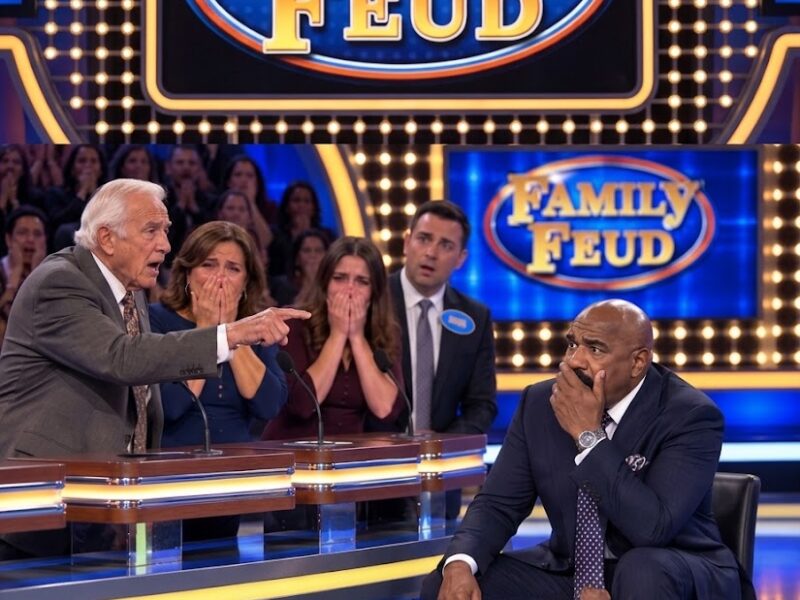
A grandpa walked onto Family Feud and dropped a bombshell nobody saw coming. Steve Harvey didn’t laugh. He didn’t make a joke. He just sat down in shock.
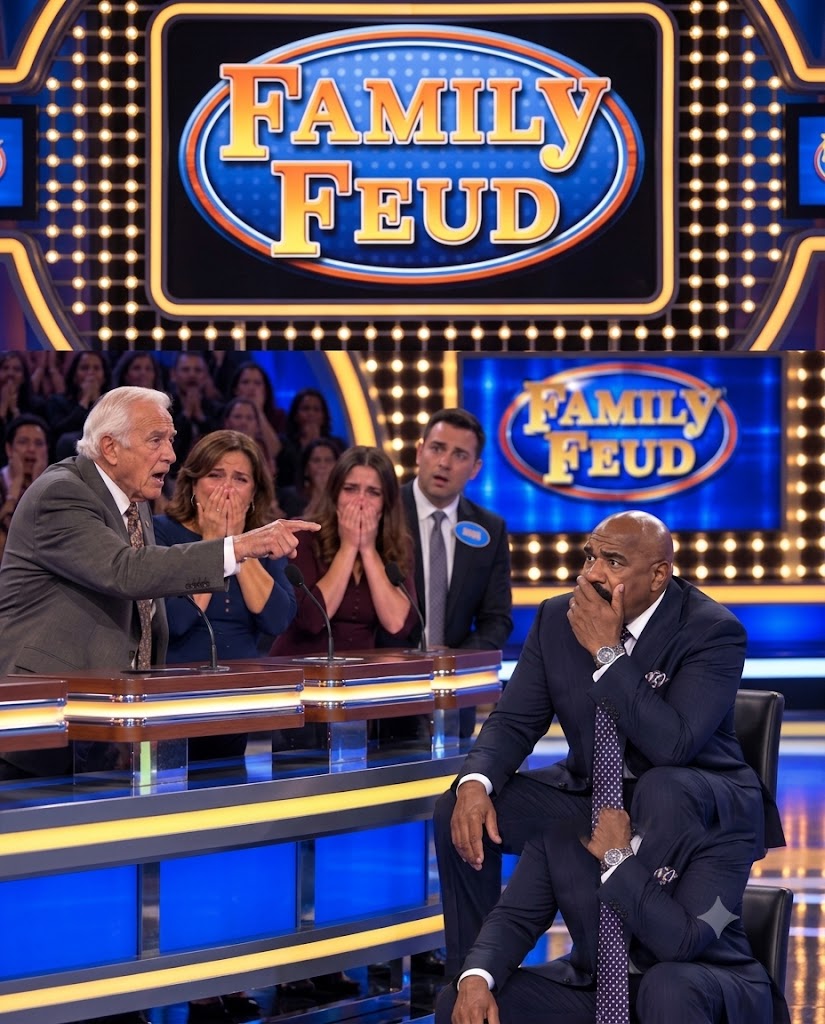
Steve Harvey has hosted thousands of Family Feud tapings over the years, but he has sat down on that stage exactly once.
This is the story of why.
His name was Earl Thomas Sr., and he was 79 years old.
He had come to Los Angeles from Memphis, Tennessee, because his granddaughter Tiffany had organized this trip, and when Tiffany organized something, you went.
He had dressed in his best suit, a navy three-piece that had been pressed by his daughter Ruthie the morning they flew out, and that fit him the way clothes fit a man who has worn good clothes his whole life with a settled authority.
He had his hat.
He had his pocket square.
He was, by every visible measure, a 79-year-old man who had shown up for his granddaughter and intended to enjoy himself.
But he had a secret he had been carrying for 51 years.
He had not planned to say it on television.
He had not planned to say it anywhere.
It had been living inside him for 51 years in the place where things live when a person has decided they will carry them until they no longer have to, which for Earl Thomas Sr. had always meant until he was gone.
He had told no one.
Not his late wife Louise.
Not his three children.
Not Tiffany, who was 26 and who was the one person in the family who made him feel sometimes that the world had more room in it than he had been raised to believe.
The date was April 7th, 2023, Studio 36, and the Thomas family, Tiffany, Earl Sr., Ruthie, Tiffany’s cousin Damon, and Ruthie’s husband Clarence, faced the Murphy family from Nashville, Tennessee.
The room was warm and full.
The Murphy family was fast and competitive and had arrived with the specific confidence of people who had watched a lot of Family Feud and had opinions about strategy.
Earl Thomas Sr. was the event of the taping from the moment he walked through the studio door.
He had the natural authority of a man who has been the oldest and most dignified person in every room he has entered for 40 years and has made a quiet peace with that position.
Steve Harvey found him within the first minute of the warm-up and spent four minutes in material that Earl received with the gracious patience of someone who could have given the material himself if he had been inclined to.
The first two games were genuinely good.
Tiffany was excellent.
Ruthie was sharp.
Damon was enthusiastic in the way that is distinct from being good but compensates adequately.
Earl answered twice, both times correctly, both times with the cadence of a man who knows exactly what he wants to say and takes precisely the time required to say it.
Then, between the second and third games, Steve Harvey came to the Thomas family row.
He went to Earl.
He said, “Sir, I need to hear your story. Not the game story. Your story. A man who looks like you and carries himself like you has a story.”
Earl Thomas Sr. looked at Steve Harvey.
He looked at his daughter, Ruthie.
He looked at his granddaughter, Tiffany.
He looked at his hands for a moment, the hands of a 79-year-old man who had worked 41 years in a printing factory and whose knuckles bore the specific record of that work.
He said, “I have a son that nobody in this family knows about.”
The studio fell completely silent.
Tiffany turned and looked at her grandfather.
Ruthie made a sound.
Clarence reached for Ruthie’s hand automatically.
Damon looked at the ceiling.
Earl said, with the unhurried pace of a man who has decided and is now proceeding, “1972. I was 28 years old. I was not yet married to Louise. I was with a woman named Carol Ann for a year. She became pregnant. Her family took her away. I did not fight for her the way I should have. The child was born in 1973, and I was told it was a boy. And I signed papers. And that was the last I knew.”
He paused.
“I have thought about that boy every day for 51 years.”
Steve Harvey placed his microphone on the podium rail.
He placed it very carefully, as though it needed to be somewhere safe.
He stood completely still.
Then, he sat down.
Not on the podium edge, he walked to the nearest chair a production assistant had near the stage, and he sat in it.
He sat down because the information had arrived with enough weight that standing seemed like an insufficient response to it.
The audience did not make a sound.
Earl Thomas Sr. was looking at his daughter.
Ruthie was looking at her father with an expression that was moving through things too fast for any one of them to settle on her face.
She said, “Finally, Daddy.”
He said, “I know.”
She said, “Why didn’t you?”
He said, “Because I did not know how. And then the years went. And then I thought it was too late. And then more years went.”
He paused.
“There is never a right time to say something like this. There is only the time that is left.”
He looked at Tiffany.
He said, “I’m telling it now because you asked me to come here. You said you wanted one good day. I decided that a good day and an honest day should be the same thing.”
He stopped.
“I am 79 years old. I have run out of reasons to keep carrying this.”
Tiffany looked at her grandfather.
She pressed her lips together.
She did not look away from him.
She said, quietly, “Okay, Grandpa.”
Two words.
She held them with both hands.
He nodded once.
Steve Harvey stood up from the chair.
He walked back to the stage.
He stood in the center and looked at the Thomas family, and at the Murphy family, and at the audience, and at the camera.
He spoke slowly.
“I want to say something to everyone watching at home,” he said. “There are people in this world right now, good people, people who have lived long and worked hard and loved their families, who are carrying something from 50 years ago that they have never said out loud.”
He paused.
“Not because they are bad people, because they were young and afraid and the moment to say it passed, and the next moment passed, and the silence became the shape of their life.”
He stopped.
“I want to say to those people, the time that is left is enough time. If Earl Thomas Sr. at 79 years old, on a Family Feud stage in Los Angeles, can say the thing he has been carrying since 1972, then there is still time.”
He looked at Earl.
“And the family around you, look at them. Look at what they are doing. They are staying. They are staying right there.”
He was not done.
He held up his hand.
He connected Earl Thomas Sr. with a DNA Registry and Biological Family Search organization, a non-profit that helped people locate biological relatives through genetics and records.
He announced the connection on camera.
He said the organization had agreed to begin a search on Earl’s behalf within the week.
He said it with complete matter-of-factness, as if it were simply what came next, which it was.
He looked at Ruthie.
He said, “You have a brother somewhere. How do you feel about that?”
Ruthie was quiet for a moment.
Then she said, “I feel like I want to find him.”
Earl Thomas Sr. looked at his daughter.
He said, “You’re sure?”
She said, “Daddy, you have been carrying this alone for 51 years.”
She stopped.
“You don’t carry it alone anymore.”
The Murphy family had been completely, respectfully still through everything.
Their matriarch, a woman named Evelyn Murphy, who was 72, walked across the stage.
She stood in front of Earl.
She said, “I am 72 years old and I have made mistakes that I carry. Hearing you say this today gave me something.”
She paused.
“I don’t know what to call it yet, but it’s something.”
Earl looked at her.
He said, “I know.”
She said, “I know you know.”
She went back to her family.
The episode aired June 13th, 2023, after extended communication with the entire Thomas family, each member of whom had been contacted individually and had given their consent.
Earl Thomas Sr. himself had made the first call to the production team to confirm.
He had said, “I want it to air. I want him to see it, in case he is watching.”
The clip was viewed 29 million times in its first 10 days.
The response was specific and concentrated.
Thousands of messages from people with adoption in their histories, from people who had been searching for biological relatives, from people who were carrying a 1972 of their own and had watched a 79-year-old man in a navy suit say it out loud in a television studio and had understood something about the time that was left.
The Biological Family Search organization received 8,400 new case inquiries in the 2 weeks following the broadcast, the largest single period intake in the organization’s history.
3 months after the taping, the search was active.
Earl Thomas Sr. had submitted his DNA.
The organization had located a record trail.
6 months after the taping, contact was made.
The man born in 1973, whose name was James, who was 50 years old, who had known he was adopted and had conducted his own periodic searches over the years without resolution, was located in Atlanta, Georgia.
He was a retired postal worker.
He had two children.
He had his father’s hands.
A year after the taping, Earl Thomas Sr. and James met for the first time.
Tiffany organized the meeting because Tiffany organized things.
She booked a restaurant in Atlanta.
She arranged for Ruthie and Damon and Clarence to be there.
She made a reservation for seven.
Earl Thomas Sr. wore the navy suit.
Steve Harvey was told about the meeting by the production team.
He did not make a public statement.
He sent Earl Thomas Sr. a letter.
Earl has confirmed the letter exists.
He has not shared its contents.
He has said only that it is the kind of letter a man keeps.
Today, Earl Thomas Sr. is 80 years old.
He and James speak on the phone every Sunday.
Ruthie has met James twice and has said publicly that he laughs like their father.
James has said that finding his biological family at 50 years old felt, in his words, like a door opening in a room he had lived in his whole life and finding sunlight on the other side.
Some secrets are carried for 51 years because there is no good time and no right room and the years keep passing.
Earl Thomas Sr. found his room on a Thursday afternoon in April in Los Angeles in a navy suit with his granddaughter standing beside him and his daughter staying right there.
The time that was left turned out to be enough.
—
The studio lights in Studio 36 had a particular warmth to them, the kind that made everyone on stage look like they belonged in a portrait, and Earl Thomas Sr. had noticed that warmth the moment he walked in.
He had been in studios before, once in 1987 when he had won a radio contest and got a tour of a local Memphis station, but nothing like this.
Nothing with this many cables and this many people holding clipboards and this many young men and women in headsets walking with the focused urgency of people who believed that everything would fall apart if they stopped moving.
Tiffany had told him it would be fun.
She had told him it would be a good day, one good day, and he had looked at her face, the face of his son’s daughter, the face of a young woman who had inherited her grandmother Louise’s cheekbones and her grandfather’s stubbornness, and he had said yes.
He had said yes because Tiffany had asked.
He had said yes because at 79 years old, you started to understand that the yeses were running out, that every invitation from a grandchild was a small gift you did not get to open twice.
He had said yes because Louise would have wanted him to.
And he had said yes because there was something inside him that had been sitting in the dark for 51 years, and maybe, just maybe, a trip across the country to sit on a television stage was the kind of thing that could let a little light in.
He had not known he would say it.
He had not planned to say it.
The plan had been to sit in the audience, to clap when Tiffany got an answer right, to eat whatever they served in the green room, and to fly home to Memphis with a new story about Steve Harvey’s suits.
That had been the plan.
But plans, Earl Thomas Sr. had learned over 79 years, were just the things you made before life showed up with something else.
The Murphy family from Nashville had walked in with the energy of people who had been rehearsing in their living room for weeks.
Evelyn Murphy, the 72-year-old matriarch, had a cane with a carved wooden handle and a smile that suggested she had already decided she was going to enjoy herself regardless of the outcome.
Her son Marcus, 44, kept saying “We got this” every few minutes, and her daughter Denise, 39, kept telling him to stop saying that.
They were a family the way most families are, a collection of people who love each other and also cannot stand each other for more than four hours at a time.
The Thomas family had that same energy but quieter.
Ruthie, Earl’s daughter, had inherited her mother’s calm and her father’s watchfulness, and she spent the first hour before the taping making sure everyone had eaten and no one had to use the restroom.
Damon, Tiffany’s cousin, was 31 and had worn a bright orange sweater that Ruthie had tried to talk him out of, and he had responded by saying, “Auntie, I am an adult man,” which had made Ruthie laugh because Damon was, in fact, still living in his parents’ basement.
Clarence, Ruthie’s husband of 22 years, was the kind of man who brought snacks in a cooler because he did not trust the food at events, and he had already made friends with a production assistant who admired his foresight.
And Tiffany, 26, was the one who had put this whole thing together.
She had won a radio contest that got the family an audition, then a callback, then a spot on the show.
She had organized the flights and the hotel and the matching navy blue sweaters that the family wore for the pre-show photos.
She had done all of it because she loved her grandfather and because she had noticed, in the last few years, that he had started to get quiet in a way that was different from his usual quiet.
Earl Thomas Sr. had always been a man of few words.
But there was a difference between a man who chose silence and a man who was being held hostage by it, and Tiffany had seen the difference in her grandfather’s eyes.
She had asked him once, last Christmas, if there was anything he wanted to talk about.
He had said, “I have had a good life, baby.”
She had said, “That’s not what I asked.”
He had looked at her for a long moment and then said, “Let me have this one good day first.”
She had not known what that meant, not then.
She would understand later, watching him sit on that studio stage in his navy suit, what he had meant.
He had meant: let me have one day where the secret stays in the dark, and then, maybe, I will find the courage to bring it into the light.
The warm-up comedian had a routine that Earl did not really follow, something about airline food and wives and the difference between men and women, and Earl laughed when the audience laughed because that was polite.
Steve Harvey had come out in a suit that was the color of a blueberry at midnight, and he had done his own warm-up, telling the audience about his kids and his wife and the farm he owned in Georgia, and he had that way of making a room of 200 strangers feel like they were sitting in his living room.
Then the games began, and Earl Thomas Sr. watched his granddaughter shine.
Tiffany had always been quick.
She had been the kind of child who corrected adults’ grammar at the dinner table and then smiled so sweetly that no one could be mad at her.
On the Family Feud stage, she was even sharper, buzzing in with answers that made the audience cheer and made Steve Harvey point at her and say, “I see you, young lady.”
Ruthie was good too, steady and thoughtful, giving answers that were not always the most popular but always made sense.
Damon was loud and enthusiastic and gave an answer about “things you do at a wedding” that made the audience groan because he said “cry” and the survey had said “dance.”
Clarence gave an answer about “things that are in a garage” that had the top response, “car,” and he looked so pleased with himself that Ruthie kissed him on the cheek.
And Earl Thomas Sr. answered twice.
The first time, the question was “Name something a man might carry in his pocket every day,” and Earl buzzed in and said, “A pocket square,” and it was not on the board, but Steve Harvey nodded at him and said, “That’s a gentleman’s answer, and I respect it.”
The second time, the question was “Name something you might keep for 50 years,” and Earl buzzed in and said, “A secret,” and the audience went quiet for just a second, and Steve Harvey looked at him and said, “That’s a real answer right there,” and then the board revealed “a secret” was not on the survey, but everyone in the room knew that Earl Thomas Sr. had said something true.
The first two games went to the Thomas family.
They won the first by 12 points and the second by 3, and Tiffany hugged her grandfather after the second game, and he patted her back and said, “You did good, baby.”
She said, “We did good, Grandpa.”
He said, “Yeah. We did.”
And then there was a break between the second and third games, the kind of break where the production team adjusted lights and the audience got water and Steve Harvey walked around the stage talking to the families.
He walked down the line of the Thomas family, shaking hands and making jokes, and he got to Earl Thomas Sr. and stopped.
He looked at him.
And then he said the thing that changed everything.
“Sir, I need to hear your story. Not the game story. Your story. A man who looks like you and carries himself like you has a story.”
Earl Thomas Sr. looked at Steve Harvey.
He had known this moment was coming.
Not in a specific way, not in a way he could have planned for, but in the way that you know, when you have been carrying something heavy for a long time, that at some point you will either put it down or it will put you down.
He looked at his daughter, Ruthie, who was watching him with her mother’s eyes.
He looked at his granddaughter, Tiffany, who had asked him for one good day.
He looked at his hands, the hands that had worked 41 years in a printing factory, the hands that had held Louise’s hand when she died, the hands that had signed papers in 1973 that he had never told anyone about.
And he decided.
He said, “I have a son that nobody in this family knows about.”
The studio fell completely silent.
The kind of silence that is not empty but full, the kind that happens when 200 people all stop breathing at the same time.
Tiffany turned and looked at her grandfather.
She had known something was in him, but she had not known what.
She had thought maybe it was grief for Louise, or regret about his career, or the ordinary sadness of getting old.
She had not thought it was this.
Ruthie made a sound, a small sound, the sound of a woman who had just heard something that rearranged the furniture of her life.
Clarence reached for Ruthie’s hand automatically, the way he had reached for it when they found out her mother had cancer, the way he had reached for it when their son had broken his arm, the way he reached for it whenever the ground shifted.
Damon looked at the ceiling, not because he did not care, but because he did not know where else to look.
And Earl Thomas Sr. kept talking.
He said, “1972. I was 28 years old. I was not yet married to Louise. I was with a woman named Carol Ann for a year. She became pregnant. Her family took her away. I did not fight for her the way I should have. The child was born in 1973, and I was told it was a boy. And I signed papers. And that was the last I knew.”
He paused.
“I have thought about that boy every day for 51 years.”
Steve Harvey placed his microphone on the podium rail.
He placed it very carefully, as though it needed to be somewhere safe.
He stood completely still.
Then, he sat down.
Not on the podium edge, he walked to the nearest chair a production assistant had near the stage, and he sat in it.
He sat down because the information had arrived with enough weight that standing seemed like an insufficient response to it.
Steve Harvey had been doing this for a long time.
He had heard a lot of stories on that stage.
He had heard stories of loss and reunion and illness and hope.
He had heard stories that made him laugh and stories that made him cry.
But he had never heard a story that made him sit down.
He sat down because Earl Thomas Sr. had just done something that very few people ever do, which is to say the true thing, the thing that has been waiting, the thing that costs something.
The audience did not make a sound.
Earl Thomas Sr. was looking at his daughter.
Ruthie was looking at her father with an expression that was moving through things too fast for any one of them to settle on her face.
She said, “Finally, Daddy.”
He said, “I know.”
She said, “Why didn’t you?”
He said, “Because I did not know how. And then the years went. And then I thought it was too late. And then more years went.”
He paused.
“There is never a right time to say something like this. There is only the time that is left.”
He looked at Tiffany.
He said, “I’m telling it now because you asked me to come here. You said you wanted one good day. I decided that a good day and an honest day should be the same thing.”
He stopped.
“I am 79 years old. I have run out of reasons to keep carrying this.”
Tiffany looked at her grandfather.
She pressed her lips together.
She did not look away from him.
She said, quietly, “Okay, Grandpa.”
Two words.
She held them with both hands.
He nodded once.
Steve Harvey stood up from the chair.
He walked back to the stage.
He stood in the center and looked at the Thomas family, and at the Murphy family, and at the audience, and at the camera.
He spoke slowly.
“I want to say something to everyone watching at home,” he said. “There are people in this world right now, good people, people who have lived long and worked hard and loved their families, who are carrying something from 50 years ago that they have never said out loud.”
He paused.
“Not because they are bad people, because they were young and afraid and the moment to say it passed, and the next moment passed, and the silence became the shape of their life.”
He stopped.
“I want to say to those people, the time that is left is enough time. If Earl Thomas Sr. at 79 years old, on a Family Feud stage in Los Angeles, can say the thing he has been carrying since 1972, then there is still time.”
He looked at Earl.
“And the family around you, look at them. Look at what they are doing. They are staying. They are staying right there.”
He was not done.
He held up his hand.
He connected Earl Thomas Sr. with a DNA Registry and Biological Family Search organization, a non-profit that helped people locate biological relatives through genetics and records.
He announced the connection on camera.
He said the organization had agreed to begin a search on Earl’s behalf within the week.
He said it with complete matter-of-factness, as if it were simply what came next, which it was.
He looked at Ruthie.
He said, “You have a brother somewhere. How do you feel about that?”
Ruthie was quiet for a moment.
Then she said, “I feel like I want to find him.”
Earl Thomas Sr. looked at his daughter.
He said, “You’re sure?”
She said, “Daddy, you have been carrying this alone for 51 years.”
She stopped.
“You don’t carry it alone anymore.”
The Murphy family had been completely, respectfully still through everything.
Their matriarch, a woman named Evelyn Murphy, who was 72, walked across the stage.
She stood in front of Earl.
She said, “I am 72 years old and I have made mistakes that I carry. Hearing you say this today gave me something.”
She paused.
“I don’t know what to call it yet, but it’s something.”
Earl looked at her.
He said, “I know.”
She said, “I know you know.”
She went back to her family.
The taping continued after that, because tapings always continue, because there are schedules and budgets and people who have flown in from Nashville and Memphis and who need to finish the thing they came to do.
The Thomas family won the third game too, and Steve Harvey announced it with a voice that was still carrying the weight of what had happened, and the audience cheered, but the cheering was different.
It was softer.
It was the kind of cheering that happens when people are not just celebrating a game but celebrating something else, something they had witnessed and would not forget.
After the taping, the Thomas family stood in the hallway outside the studio, and no one knew what to say.
Tiffany was crying, and Ruthie was holding her, and Damon was standing with his hands in his pockets looking at the floor, and Clarence was talking to a production assistant about where to get good barbecue in Los Angeles.
And Earl Thomas Sr. was standing by himself, just a little apart from the rest, looking at his hands.
Ruthie walked over to him.
She said, “Daddy.”
He said, “Yeah, baby.”
She said, “Why didn’t you tell me?”
He said, “Because I was ashamed.”
She said, “Of what?”
He said, “Of not fighting for him. Of signing the papers. Of letting her family take her away. I was 28 years old, Ruthie. I was old enough to know better.”
She said, “You were young.”
He said, “That’s not an excuse.”
She said, “No. But it’s a reason.”
He looked at her.
She said, “I’m not mad at you, Daddy.”
He said, “You should be.”
She said, “I’m not. I’m just sad that you carried it alone for so long.”
He said, “I didn’t know how to put it down.”
She said, “You just did.”
He nodded.
He said, “I guess I did.”
Tiffany came over then, her eyes still red, and she hugged her grandfather, and he held her for a long moment.
She said, “I’m proud of you, Grandpa.”
He said, “For what?”
She said, “For telling the truth.”
He said, “It took me 51 years.”
She said, “It took you exactly as long as it took.”
He said, “That’s a nice way to look at it.”
She said, “It’s the only way to look at it.”
The episode aired June 13th, 2023, after extended communication with the entire Thomas family, each member of whom had been contacted individually and had given their consent.
Earl Thomas Sr. himself had made the first call to the production team to confirm.
He had said, “I want it to air. I want him to see it, in case he is watching.”
The clip was viewed 29 million times in its first 10 days.
The response was specific and concentrated.
Thousands of messages from people with adoption in their histories, from people who had been searching for biological relatives, from people who were carrying a 1972 of their own and had watched a 79-year-old man in a navy suit say it out loud in a television studio and had understood something about the time that was left.
The Biological Family Search organization received 8,400 new case inquiries in the 2 weeks following the broadcast, the largest single period intake in the organization’s history.
3 months after the taping, the search was active.
Earl Thomas Sr. had submitted his DNA.
The organization had located a record trail.
6 months after the taping, contact was made.
The man born in 1973, whose name was James, who was 50 years old, who had known he was adopted and had conducted his own periodic searches over the years without resolution, was located in Atlanta, Georgia.
He was a retired postal worker.
He had two children.
He had his father’s hands.
A year after the taping, Earl Thomas Sr. and James met for the first time.
Tiffany organized the meeting because Tiffany organized things.
She booked a restaurant in Atlanta.
She arranged for Ruthie and Damon and Clarence to be there.
She made a reservation for seven.
Earl Thomas Sr. wore the navy suit.
Steve Harvey was told about the meeting by the production team.
He did not make a public statement.
He sent Earl Thomas Sr. a letter.
Earl has confirmed the letter exists.
He has not shared its contents.
He has said only that it is the kind of letter a man keeps.
Today, Earl Thomas Sr. is 80 years old.
He and James speak on the phone every Sunday.
Ruthie has met James twice and has said publicly that he laughs like their father.
James has said that finding his biological family at 50 years old felt, in his words, like a door opening in a room he had lived in his whole life and finding sunlight on the other side.
Some secrets are carried for 51 years because there is no good time and no right room and the years keep passing.
Earl Thomas Sr. found his room on a Thursday afternoon in April in Los Angeles in a navy suit with his granddaughter standing beside him and his daughter staying right there.
The time that was left turned out to be enough.
—
The restaurant in Atlanta was called The Pecan Grove, and it had white tablecloths and a menu that Ruthie said was too expensive and a hostess who recognized Earl Thomas Sr. from the video that had been everywhere.
She did not say anything, but she smiled at him in a way that said she knew, and she led them to a table in the back, a round table with a lazy Susan in the middle and a view of a small courtyard with a fountain.
Tiffany had arrived early to make sure everything was right.
She had put name cards on the table, not because anyone needed them, but because she liked the order of it.
She had put Earl Thomas Sr. at the head of the table and James at the other end, and in between were Ruthie and Clarence and Damon and herself.
And one empty chair.
The empty chair was for Louise.
Tiffany had put a small framed photo of her grandmother at that place setting, and when Ruthie saw it, she had to step into the bathroom for a minute.
When she came back, her eyes were red, but she was smiling.
She said, “Mama would have loved this.”
Earl Thomas Sr. said, “She would have.”
James arrived at exactly 6 p.m.
He was a tall man with gray hair and a quiet way of moving, and he stood in the doorway of the restaurant for a moment, looking at the table, looking at the people who were waiting for him.
Earl Thomas Sr. stood up.
He had practiced what he was going to say.
He had practiced it in the mirror in his hotel room that morning, and he had practiced it on the plane, and he had practiced it in his head a thousand times over the last year.
But when he saw James, when he saw the face of the boy he had never held, the man who had his hands and his height and his quiet way of standing, he forgot every word.
He just said, “James.”
And James said, “Yes, sir.”
And Earl Thomas Sr. said, “I’m sorry.”
James said, “I know.”
Earl said, “I’m sorry it took so long.”
James said, “You’re here now.”
Earl said, “I’m here now.”
They stood there for a moment, two men who had been connected by blood and separated by time, and then James walked forward and hugged his father.
The table was silent.
Ruthie was crying.
Clarence was holding her hand.
Damon was looking at the ceiling again.
Tiffany was smiling, the kind of smile that comes from seeing something you helped make happen.
The dinner lasted three hours.
They talked about everything and nothing.
James talked about his childhood, about the parents who had adopted him, about how they had been good people who had loved him and who had told him early that he was adopted so he would never have to wonder.
He talked about his wife, who had died five years ago, and his two children, a son and a daughter, who were in their twenties and who had encouraged him to keep searching.
He talked about how he had found the video online, how he had watched it 14 times, how he had cried every time.
He said, “I knew it was you. I don’t know how. I just knew.”
Earl Thomas Sr. said, “I knew it was you too. When they told me your name was James. That was my father’s name.”
James said, “I know.”
Earl said, “You know?”
James said, “The organization told me. They told me a lot of things.”
Earl said, “What else did they tell you?”
James said, “They told me you worked in a printing factory for 41 years.”
Earl said, “That’s true.”
James said, “They told me you loved your wife very much.”
Earl said, “That’s true too.”
James said, “They told me you looked for me.”
Earl was quiet for a moment.
He said, “I didn’t.”
James said, “You did. You just didn’t know how.”
Earl said, “That’s a generous way to put it.”
James said, “I’ve had a lot of time to think about it. I’ve had 50 years to think about it. And I decided a long time ago that if I ever found my biological father, I wasn’t going to be angry. I was going to be grateful. Because he gave me life. He gave me a chance. He did the best he could with what he had.”
Earl said, “I could have done better.”
James said, “We all could have done better. That’s not a reason to stay apart.”
Ruthie leaned across the table.
She said, “James, I have to tell you something.”
He said, “Okay.”
She said, “You laugh like our father.”
He said, “I do?”
She said, “You do. I noticed it the moment you walked in. You have the same laugh.”
James looked at Earl Thomas Sr.
He said, “Is that a good thing?”
Earl said, “It’s a good thing.”
James said, “Then I’ll take it.”
The dinner ended with dessert, peach cobbler that Earl Thomas Sr. said was not as good as what he made at home, and coffee that Clarence said was too strong, and a toast that Tiffany gave that made everyone cry.
She said, “To family. To the family we have and the family we find. To the truth that sets us free. And to my grandfather, who taught me that it’s never too late to say the thing that matters.”
Earl Thomas Sr. raised his glass.
He said, “To Louise. Who would have loved every minute of this.”
Everyone said, “To Louise.”
And in the empty chair, the photo of Louise smiled at them all.
—
The letter from Steve Harvey arrived two weeks later.
It was in a plain white envelope with no return address, just the name “Earl Thomas Sr.” written in a careful hand.
Earl opened it in his kitchen in Memphis, sitting at the table where he had eaten breakfast for 40 years, the table where Louise used to read the newspaper and complain about the headlines.
The letter was two pages long, handwritten, and it said:
“Dear Mr. Thomas,
I have hosted a lot of shows and met a lot of people. I have seen people win cars and lose cars and scream at each other over answers that don’t matter. I have seen people come on my stage with all kinds of stories. But I have never seen anyone tell the truth the way you did.
You sat there in your navy suit with your pocket square and your hat, and you told a story that had been inside you for 51 years. You did it in front of your family and my audience and millions of people you will never meet. And you did it with a grace that I will remember for the rest of my life.
I sat down because I didn’t know what else to do. I sat down because standing seemed too easy for what you had just done. I sat down because I wanted you to know that I was listening, not as a host, but as a man.
You have taught me something. You have taught me that the time is always now. You have taught me that the truth is always worth telling. You have taught me that a man who has carried something heavy for a long time can still put it down.
I don’t know if you will ever read this letter. But I wanted you to have it. I wanted you to know that what you did mattered. It mattered to your family. It mattered to the people watching. It mattered to me.
I hope you find your son. I hope you get to hold him. I hope you get to tell him all the things you have been wanting to say for 51 years. And I hope you know that you did a brave thing on that stage, and that brave things are not always loud. Sometimes they are quiet. Sometimes they are a man in a navy suit telling the truth.
With respect and admiration,
Steve Harvey”
Earl Thomas Sr. read the letter twice.
Then he folded it carefully and put it back in the envelope.
He walked to his bedroom and opened the drawer of his nightstand, the drawer where he kept his watch and his wallet and the letters Louise had written him when they were first dating.
He put the envelope in the drawer, on top of everything else.
He said, “Louise, you would not believe the week I’ve had.”
And then he went back to the kitchen to make himself a cup of coffee.
—
Today, Earl Thomas Sr. is 80 years old.
He and James speak on the phone every Sunday.
They talk about the weather and about James’s kids and about the way the world is changing.
They talk about Louise, who Earl tells James about in stories that make James laugh and sometimes cry.
They talk about the years that were lost and the years that are left.
Ruthie has met James twice and has said publicly that he laughs like their father.
James has said that finding his biological family at 50 years old felt, in his words, like a door opening in a room he had lived in his whole life and finding sunlight on the other side.
Some secrets are carried for 51 years because there is no good time and no right room and the years keep passing.
Earl Thomas Sr. found his room on a Thursday afternoon in April in Los Angeles in a navy suit with his granddaughter standing beside him and his daughter staying right there.
The time that was left turned out to be enough.
—
The video of that moment, the moment when Steve Harvey sat down, is still online.
It has been watched by millions of people.
It has been shared by people who have secrets and people who have found the courage to tell them.
It has been translated into languages Earl Thomas Sr. does not speak.
It has been made into a meme that Tiffany thinks is funny and Ruthie thinks is disrespectful.
But for Earl Thomas Sr., it is not a video.
It is not a meme.
It is the moment when he put down the thing he had been carrying for 51 years.
It is the moment when he chose the truth over the silence.
It is the moment when he found his son.
He has said, in interviews that he rarely gives, that he does not think of himself as a brave man.
He says he was just a man who ran out of time to be afraid.
He says the truth is not always easy, but it is always lighter than the secret.
He says that at 79 years old, he learned something he should have learned at 28.
He learned that the time to say the thing you need to say is always now.
Because the years will pass whether you say it or not.
And the family who loves you will stay right there when you do.
—
If this story moved something in you, please subscribe and hit that thumbs up.
Share this with someone who is carrying something that deserves to be said before the time runs out.
Have you ever discovered a part of your family’s history that changed everything?
Tell us in the comments and ring that notification bell for more moments that prove it is never too late to say the truth and that the family who loves you will stay right there when you do.









