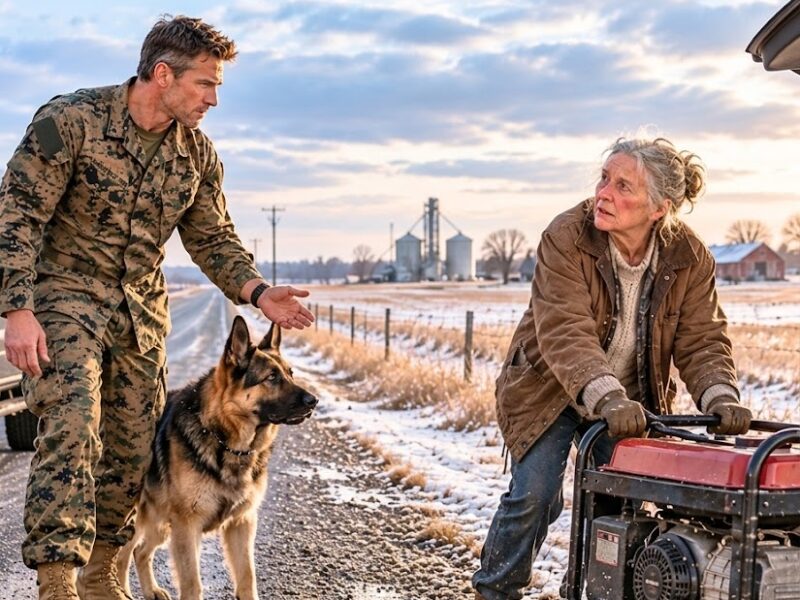
A grandmother and her little girl were stranded in the freezing snow — until a Marine and his K9 opened the door, and everything changed.
Cold November winds swept across the harvested cornfields outside Carney, Nebraska, bending the dry stalks beneath a pale afternoon sky.
The narrow county road stretched ahead, empty except for a few distant farm trucks moving like slow insects toward the horizon.
Gunnery Sergeant Tobias Ror drove his dark Ford F-150 with both hands resting lightly on the wheel, his gray-blue eyes scanning the roadside the way they had scanned foreign streets for two decades.
At forty-three, he stood six-foot-two with broad shoulders, a square jaw, and a face weathered by years of military service.
His dark brown hair was cut close, with a little gray beginning to show at the temples, and he was clean shaven in the careful way of a man who had learned that discipline was a form of respect.
Tobias was courteous with strangers, but rarely invited them into his private life.
Years of deployments had taught him how to remain composed, and losing his father had taught him how easily composure could become silence.
On the back seat lay Bracken, his seven-year-old retired military working dog.
The black and tan German Shepherd had a dark saddle across his back, intelligent amber-brown eyes, and a small scar along his right ear.
His muzzle was beginning to gray, though no longer on duty, Bracken retained the patient alertness of a dog trained to observe before reacting.
He was affectionate in quiet ways, preferring to settle near Tobias rather than demand attention.
Bracken suddenly lifted his head.
Tobias glanced at the rearview mirror and saw the dog staring through the passenger-side window toward an old irrigation pump station.
Beside its weathered concrete building, a silver pickup stood with its tailgate lowered.
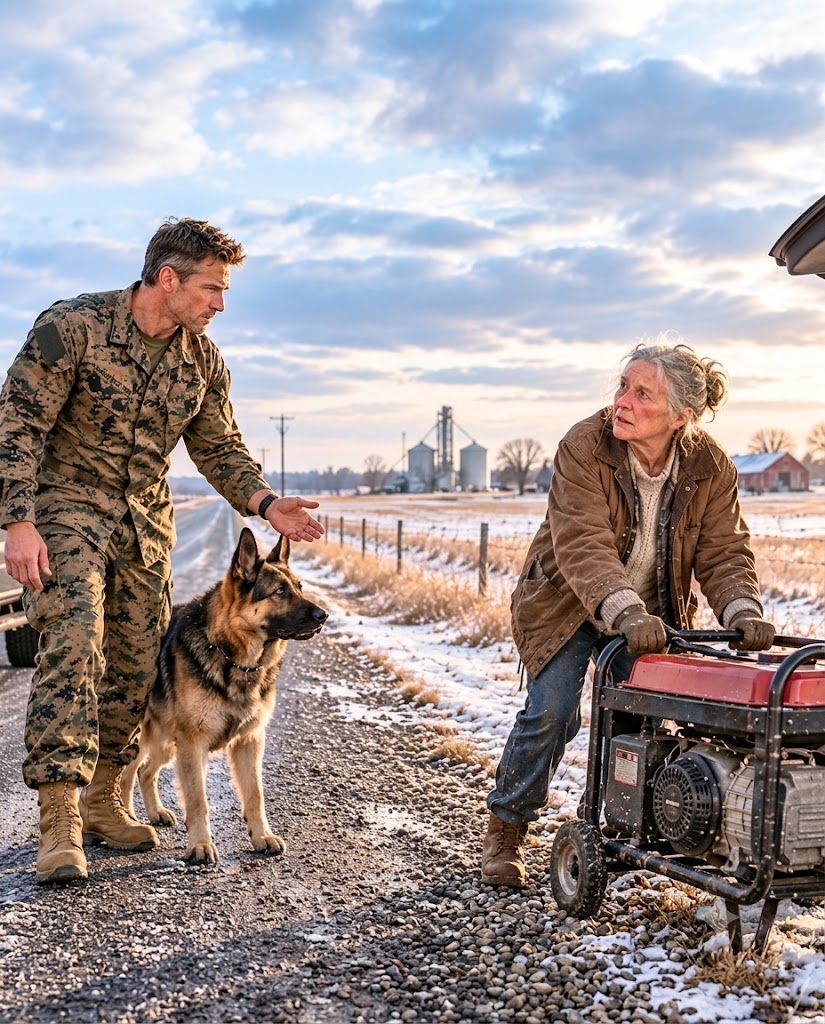
An elderly woman was trying to guide a bulky generator up a loading plank.
The generator shifted sideways, and she stopped it before it slipped, but Tobias could see the effort in her shoulders.
He pulled onto the gravel shoulder and murmured, “Good eye, buddy.”
By the time Tobias approached, the woman had set the generator back on level ground.
She was small and slender, perhaps five-foot-three, with silver hair gathered into a low bun beneath a faded wool cap.
Her lined face was pale from the cold, but her hazel eyes were remarkably sharp.
She wore a brown work coat over a thick cardigan, dark trousers, and scuffed leather boots, and there was grease on one glove.
She looked tired, not helpless.
“I’ve nearly got it,” she said before he could offer assistance.
“I believe you,” Tobias replied. “Would another pair of hands make it safer?”
She studied him, then the generator.
“That depends. Do you know how to use a come-along?”
“Enough to keep my fingers out of it.”
A faint smile crossed her face. “Then you can hold the plank steady while I rig the pole.”
Her name was Dorothia Fenwick, and she explained that the pump station stood on leased land being transferred to a new tenant.
The generator belonged to her family, and she wanted it home before the weather turned worse.
Tobias followed her directions rather than taking over.
Dorothia secured the cable, checked the angle of the plank, and showed him where to brace it.
Together, they eased the generator onto the truck bed.
She insisted on positioning the wheel chocks herself, then inspected his first tie-down before approving the second.
“You’ve done this before,” Tobias observed.
“Long enough to know that a heavy machine doesn’t care how confident you feel.”
As she checked the straps, her glove brushed a metal panel on the generator, and it rattled against its mounting.
Dorothia pressed a finger against the panel, silencing the noise.
“Loose heat shield,” she said. “I’ll tighten it when I get home.”
Tobias looked at her with renewed respect, because she had identified the problem without needing to start the engine.
He brought Bracken out on his leash while Dorothia finished checking the load.
The shepherd stepped down carefully, then stood beside Tobias, calm and attentive.
Dorothia’s expression softened.
“Military dog, retired,” Tobias said. “His name’s Bracken.”
“I thought so. He watches everything without making a fuss.”
She offered the back of her gloved hand, and Bracken sniffed it, then accepted a gentle scratch beneath his chin.
“My husband would have liked you,” she told the dog.
“Was he a dog man?”
“He was a Marine first, a mechanic for the rest of his life.”
Her smile lingered. “Franklin Fenwick, stubborn as a fence post, but he could bring an old tractor back to life with tools most people would have thrown away.”
After leaving the Marines, Franklin had returned to Nebraska and opened a small agricultural repair workshop with Dorothia.
They had worked side by side for decades.
She spoke of him without dramatics, yet Tobias noticed the way she used the word we before quietly correcting herself.
“He passed away?” Tobias asked.
“Two years ago.”
“I’m sorry.”
Dorothia nodded, accepting the words without asking for more.
She mentioned that she and her son were sorting through Franklin’s old equipment.
Some machines had already gone, and others would soon follow.
Tobias looked across the empty fields. “My family had a farm once.”
Dorothia waited.
“We sold the equipment while I was deployed. My father handled the auction.”
Tobias rubbed a thumb along Bracken’s leash. “I got a photograph of our last tractor. By the time it reached me, the machine was gone.”
“Did you ever find out who bought it?”
“No.”
“Did you want to?”
“I told myself I didn’t.”
He had not meant to say so much, but Dorothia had asked without pity, and that made the truth easier to offer.
“My father died the following year,” Tobias continued. “I came home for the funeral. Never got to say goodbye to the tractor. Never really talked to him about selling it either.”
Dorothia rested a hand on her pickup’s tailgate.
“People think grief belongs only to people,” she said. “But sometimes a place or a machine holds the years you spent beside someone. When it goes, you feel as though those years are being carried away, too.”
Tobias swallowed.
He had spent years dismissing his regret as foolish, and hearing it described so simply left him with nothing to argue against.
Dorothia checked the final strap, thanked him, and climbed into her truck.
Tobias waited until she had started the engine before returning Bracken to the F-150.
As she drove away, Bracken watched the silver pickup disappear beyond the fields.
“Yeah,” Tobias said quietly. “I liked her, too.”
The next morning, Tobias arrived at his friend’s agricultural hauling company.
His three-week leave had been approved, as had the short-term civilian work he had arranged.
His commercial driver’s license remained current, and the company had already confirmed the necessary insurance arrangements.
His friend Martin Hail met him beside the dispatch desk.
Martin was a stocky man in his late forties with sandy hair, a neatly trimmed beard, and the easy manner of someone who had spent more years solving problems than complaining about them.
He and Tobias had known each other since their teens.
“One of my drivers woke up sick,” Martin said. “Any chance you can cover a tractor pickup?”
“Where?”
“Farm outside town. Pick up this morning, delivery to Pritchard Equipment by this afternoon. Straightforward load.”
Tobias agreed.
He arranged for Bracken to stay with Martin’s family during the commercial run, then took the paperwork.
The first line listed the pickup address: Fenwick Farm.
His eyes moved to the equipment description: 1965 John Deere 4020.
Below it, the manifest identified the tractor as the final machine in the family’s equipment liquidation.
Tobias stared at the page.
Yesterday, Dorothia had spoken of losing the things that held a lifetime of memories.
He had understood her because he knew that loss himself.
Now he had been hired to carry hers away, and she had no idea he was coming.
Morning frost silvered the fence posts outside Carney, Nebraska.
Beyond the Fenwick farmhouse, harvested fields lay quiet beneath a washed-out sky, and an old green tractor waited in the open doorway of a machinery shed.
Tobias Ror slowed his Ford F-150 at the entrance to the farm.
Bracken sat upright in the back seat, watching the gravel lane through the window.
Tobias had spent much of the drive rehearsing how to explain yesterday’s coincidence.
He had accepted a hauling assignment before recognizing its address.
Nevertheless, arriving to take away Dorothia’s tractor felt uncomfortably close to betraying her trust.
Dorothia emerged from the shed before he reached the porch.
Her silver hair was tucked beneath the same faded wool cap, and she carried a socket wrench in one gloved hand.
When she recognized Bracken through the window, her expression brightened.
“Well, there’s my handsome visitor.”
Tobias opened the rear door and clipped on Bracken’s leash.
The German Shepherd stepped down carefully, sniffed the cold air, and settled beside him.
“I came ahead to check the driveway for the transport truck,” Tobias said. “I didn’t realize the tractor was yours until I saw the paperwork.”
Dorothia’s smile faded, but she did not turn away.
“Then you’re the driver.”
“Yes, ma’am.”
“Come see what you’ll be carrying.”
She led them into the shed.
The 1965 John Deere 4020 stood beneath the rafters, its green paint worn smooth around the steps and controls.
Fresh grease marked several fittings, and Dorothia had already checked the tires and disconnected a battery maintainer.
“Franklin believed a machine deserved care, whether it was worth fifty dollars or five thousand.”
She said he could tell which bearing was failing by listening from the doorway.
She showed Tobias the tractor’s service points and the separate fuel shut-off.
Bracken remained near the entrance, quietly observing as they moved around the machine.
Dorothia glanced at him. “Franklin would have approved of a dog who knows when to stay out of the way.”
Tobias smiled, then looked toward the empty space beside the tractor.
Pale rectangles on the wall marked places where tools had once hung.
A man entered from the yard carrying a folder.
Calvin Fenwick was forty-nine, tall and lean with work-hardened hands, close-cut sandy brown hair, and a clean-shaven face whose sharp cheekbones made him look more severe than he intended.
Deep lines bracketed his mouth.
Years of difficult harvests had made him careful with money and impatient with vague promises, though he greeted Tobias politely and offered his hand.
“Calvin Fenwick. Mom said you helped her yesterday.”
“Glad I was there.”
Calvin looked at the tractor. “Wish the timing were better.”
Outside, he explained the sale while Dorothia went to put away her wrench.
Two poor seasons, rising repair costs, and a loan payment approaching its deadline had forced the family to sell equipment they could no longer justify keeping.
The John Deere had been used less often in recent years, but it remained valuable.
Graham Pritchard, a local equipment dealer, had bought it as part of the liquidation.
“Mom agreed,” Calvin said. “I need you to understand that. I didn’t sell it behind her back.”
“I understand.”
“She also knows the money keeps us from losing more of the farm.”
Calvin stared at the shed. “Knowing doesn’t make it easier.”
Tobias checked the driveway and turning space, then drove Bracken to Martin Hail’s home.
Martin’s family had agreed to keep the dog during the commercial run.
Only after Bracken was safely settled did Tobias return in the hauling company’s truck with a lowboy trailer.
By then, Dorothia was sitting on a wooden stool beside the tractor.
Calvin had moved the loose equipment clear of the loading route.
Tobias completed his inspection, positioned the trailer, and lowered the ramps.
“Before you start,” Dorothia said, “may I sit up there once more?”
“Of course.”
She climbed carefully onto the tractor using the handholds she knew by heart.
Her fingers closed around the worn steering wheel.
Tobias stepped away, giving her room.
From the ground, he watched her gaze travel across the instrument panel, the hood, and the doorway beyond it.
Franklin had driven this machine through spring planting and autumn harvest.
When neighbors’ equipment failed, he had used it to pull a suitable trailer loaded with tools and parts.
Dorothia had ridden beside him on countless short trips around the farm, arguing about repairs and laughing when he insisted an engine sounded better after he spoke kindly to it.
Now the seat beside her existed only in memory.
A white utility truck rolled into the yard.
Its driver climbed out without waiting to be greeted.
Warren Kesler was fifty-four, broad through the chest with a heavy jaw, thinning iron-gray hair, and a closely trimmed mustache.
His expensive work jacket was spotless.
He ran a repair and equipment rental business in the area, and years of competing for the same customers had taught him to regard generosity as a threat to his margins.
“Calvin,” he called. “I’m here about those remaining implements.”
Calvin met him halfway. “They’re around back.”
Warren’s attention shifted to Dorothia on the tractor. “Still saying goodbye?”
He asked.
“Franklin spent years fixing everybody else’s machines for next to nothing. Seems he couldn’t keep his own equipment in the family.”
Dorothia lowered her eyes.
Calvin’s shoulders tightened. “That’s enough.”
Warren spread his hands. “I’m only saying business has consequences.”
Tobias approached, keeping his voice even.
“Mrs. Fenwick asked for a few minutes. Please give her that.”
Warren studied him. “And you are?”
“The driver. I need this area clear for loading.”
For a moment, Warren appeared ready to argue.
Then he turned toward Calvin. “Show me what else you’re selling.”
When they disappeared behind the shed, Dorothia climbed down.
She stood beside the tractor, breathing slowly.
“Franklin kept a maintenance ledger,” she said. “I should send it with the machine.”
She opened a metal cabinet and withdrew a thick notebook.
Several receipts slipped from between its pages.
Tobias helped gather them, noticing dates, names, and handwritten amounts.
Besides some repair entries, Franklin had written, “Labor waived.”
Others listed replacement parts paid for by Franklin and Dorothia.
Calvin returned as his mother was stacking the receipts.
He picked up one invoice, then another. “These were ours?” he asked.
Dorothia nodded. “Some farmers couldn’t afford the parts. Your father thought they could repay us after harvest.”
Calvin turned a page.
More names appeared, followed by smaller payments, or none at all.
“How many times did you do this?”
Dorothia looked at the notebook. “More than we meant to.”
Calvin’s face went still.
Tobias recognized the expression, not anger yet, but the moment before it, when a person begins adding together things he wishes he had never learned.
Dorothia asked Tobias whether the tractor could remain one more day.
He called Graham, a brisk matter-of-fact dealer, who confirmed that the sale was complete and the scheduled delivery still stood.
He would not extend it.
Dorothia accepted the answer.
She kept the family ledger and placed a separate copy of the tractor’s service records with the delivery documents.
Tobias loaded the John Deere, secured it, and drove away.
He delivered it to Graham’s yard within the agreed window, completed the handover, and returned the truck to Martin’s company.
At the Fenwick farm, Dorothia stood in the shed with a tractor-sized absence beside her.
Calvin joined her, holding the ledger against his chest.
The empty floor showed four pale tire marks.
He opened the notebook to a page dated years earlier.
Beside a costly repair for a neighboring farm, Franklin had written two words: “No charge.”
Calvin looked at his mother.
“Mom,” he said quietly. “Where did the money for all of this come from?”
Dorothia did not answer.
And for the first time that day, the missing tractor was not the thing Calvin feared most.
Three days after the tractor left, a hard wind rattled the empty machinery shed at Fenwick Farm.
Dust gathered in the pale rectangles where Franklin’s tool cabinets had stood, and the concrete floor still bore the marks of the John Deere’s tires.
Calvin sat at his father’s workbench with the maintenance ledger open beside a stack of invoices.
He had begun reading to understand the tractor’s history.
Instead, he had found a record of money leaving the household in small, persistent amounts.
A hydraulic hose for a neighbor who could not pay until harvest.
A replacement bearing charged to Franklin’s account.
Labor written off entirely.
Calvin recognized dates from years when he had postponed repairs on the family’s own equipment because there was not enough cash.
Dorothia entered carrying two mugs of coffee.
She set one beside him and noticed the receipts arranged in careful rows.
“You’ve been here since breakfast.”
“I found the parts bill for the Hensley combine,” Calvin said. “Six hundred forty dollars. We paid it.”
“They were going to lose their crop.”
“That was the same month I borrowed money to repair our grain auger.”
Dorothia lowered herself onto a stool.
“Your father meant to tell you.”
“But he didn’t.”
Calvin turned another page. “Neither did you.”
She had prepared herself for anger over the tractor.
This was different.
Calvin was looking at years of decisions he had never been allowed to question.
Tobias arrived later that morning with Bracken.
He had returned to check on Dorothia after the delivery, but stopped when he heard raised voices through the open shed door.
He waited outside until Calvin called him in.
Tobias noticed how carefully Franklin had arranged the workshop.
Every drawer was labeled.
Service intervals were recorded beside machine serial numbers, and sketches showed repairs that could be completed with ordinary tools.
The work was disciplined, not careless.
Yet the unpaid invoices revealed a second truth.
Franklin’s skill had made it easier for him to promise help the family could not always afford.
“He wanted small farms to have somewhere they could get a machine fixed without losing the season,” Dorothia said.
Calvin held up a receipt. “And what happened when we needed the money?”
“We thought we could manage.”
“You thought I could manage?”
His voice cracked despite his effort to control it.
“Dad helped everybody. But when our family needed help, who came?”
Dorothia looked down at her hands.
She remembered signing checks while Franklin assured her that next harvest would be better.
She remembered deciding not to worry Calvin because he already worked too hard.
At the time, silence had felt protective.
Now she saw that it had left him responsible for consequences he did not understand.
“No one came enough,” she said. “And we should have told you what we were doing.”
Calvin’s expression tightened.
An apology did not restore the borrowed money, but he had expected another defense of his father.
Hearing his mother admit the cost unsettled him more.
He left the shed before either of them could speak again.
Over the following days, Calvin considered whether Franklin’s workshop might reopen as a community service.
Several neighbors expressed interest.
One offered weekend labor.
Another promised to bring equipment for routine maintenance.
Word traveled quickly through the farming community, and it reached Warren Kesler.
Warren responded with discounted service contracts for customers willing to commit to his business for the coming season.
He also raised questions about whether a volunteer workshop would carry adequate insurance or accept responsibility if a repaired machine failed.
His prices were designed to protect his customer base, but the safety questions were real.
By Friday, two farmers had withdrawn their offers to help Calvin.
A third said he would wait until the workshop had a proper operating plan.
Calvin stared at the messages on his phone.
He had barely begun, and already he was asking people to trust a project with no budget, no insurance, and no clear limits.
He could hear his father saying that someone had to help.
He could also see the invoices spread across the workbench.
That afternoon, Tobias found him beside the fence.
Bracken walked at his side on a loose leash, then settled in the grass when Tobias stopped.
The shepherd watched a distant truck pass without rising.
“I think Warren’s right about one thing,” Calvin said. “Good intentions don’t pay for a broken machine.”
“No,” Tobias agreed. “They don’t.”
Calvin looked down at Bracken. “You ever miss having him work?”
“I missed knowing exactly what our days were supposed to look like.”
Tobias rested a hand on the dog’s shoulders.
“When Bracken retired, I kept looking for ways to give him another job. He’d spent years doing what he was trained to do. I thought he needed that to be himself.”
“What changed?”
“He didn’t.” Tobias smiled faintly. “I did. He still notices everything, but he can spend an afternoon lying in the sun, and I don’t have to turn it into a mission.”
Bracken shifted closer to Tobias’s boot and closed his eyes.
Calvin watched him for a moment.
His father’s workshop had been built around an admirable purpose, but Franklin’s way of pursuing it had not been the only possible way.
“I don’t want to shut the door on people who need help,” Calvin said. “I just can’t keep writing checks we don’t have.”
“Then don’t build the same workshop.”
The answer sounded almost too simple, but Calvin carried it back inside.
He began a new plan with fixed operating hours, a limited repair list, paid replacement parts, and a separate fund for hardship assistance.
Volunteers would work only within their qualifications.
Jobs beyond the workshop’s equipment or expertise would go to professional businesses.
The family’s household accounts would remain separate.
A neighboring farmer named Ellis Mercer, a broad-shouldered man in his early sixties with sun-browned skin and a weathered gray beard, visited after hearing about the proposal.
Ellis spoke slowly and rarely made promises he could not keep.
Franklin had once helped him repair a boiler, but Ellis understood why Calvin refused to repeat the old arrangement.
“There’s an agricultural cooperative east of town,” Ellis said. “They have an equipment program. I can introduce you.”
The cooperative’s coordinator, a brisk middle-aged woman named Helen Voss with short black hair and rectangular glasses, listened to Calvin’s proposal over the phone.
She agreed to review it, but made no promise of funding.
She wanted evidence of demand, an operating budget, qualified workers, insurance arrangements, and a written agreement covering use of the Fenwick shed.
Calvin wrote down every requirement.
For the first time since the tractor left, the work ahead looked difficult rather than impossible.
That evening, Ellis called again.
He had spoken with Graham Pritchard while collecting a part at the equipment yard.
Warren had contacted Graham about buying the John Deere.
“No deal yet,” Ellis said, “but Graham’s willing to sell.”
Calvin looked through the shed doorway at the empty space on the floor.
He had begun to see how his father’s work might survive without repeating his mistakes.
Now he faced another possibility.
The workshop might have a future while the machine his mother loved became someone else’s property forever.
He closed the ledger and reached for his notebook.
He could not save everything.
He would have to decide what mattered most.
A gray November morning settled over Fenwick Farm, bringing a thin mist that blurred the harvested fields.
Inside the machinery shed, the empty space where the John Deere had stood was slowly filling with folding chairs, toolboxes, and handwritten plans.
Calvin had spent four evenings turning his father’s unfinished dream into figures that could survive a difficult harvest.
Ellis Mercer brought two farmers willing to volunteer on Saturdays.
Another neighbor offered access to a trailer when parts needed collecting.
Small donations arrived in envelopes, each accompanied by a name Calvin recognized from Franklin’s ledger.
He accepted them carefully, recording every dollar and making clear that the money would belong to the proposed community program, not the Fenwick household.
The total was encouraging until he compared it with the equipment list.
Their contributions could cover the deposit needed to make a serious offer on the John Deere or purchase the diagnostic tools, lifting equipment, and safety supplies required to open the workshop.
They could not do both.
Calvin checked the numbers three times, hoping he had overlooked something he had not.
Tobias sat across the workbench, reviewing the proposed transport arrangements.
He did not offer money or tell Calvin which choice to make.
He had learned that a person carrying a family’s responsibilities needed room to decide what those responsibilities meant.
“Graham says he’ll consider an offer,” Calvin said. “But he won’t hold the tractor without an agreement.”
“Then you have a real choice,” Tobias replied.
“I was hoping for a better one.”
Later that afternoon, Graham confirmed that Warren Kesler had submitted a higher purchase offer.
Warren wanted an extended inspection period and would not commit to payment until it was complete.
Graham had not accepted those terms.
He intended to keep marketing the machine, and Calvin understood that another buyer could appear before the cooperative finished its review.
Warren’s offer was not a threat he could report or challenge.
It was a business proposal, and that made Calvin feel even more powerless.
Dorothia learned about it when she overheard him speaking to Ellis.
She did not ask Calvin to spend the donations on the tractor.
Instead, she drove to Warren’s repair business the following morning, determined to understand why he wanted it.
Warren met her in an office overlooking a yard of rental equipment.
His neatly trimmed mustache framed a mouth that rarely softened, and his broad hands rested on a desk covered with service contracts.
He seemed unsurprised to see her.
“Come to make me an offer, Dorothia?”
“I came to ask you a question. Do you need Franklin’s tractor, or do you just want to make sure we never see it again?”
Warren leaned back. “It’s a usable machine. I can rent it, sell it, or keep it for parts. That’s what equipment is for.”
“And the workshop?”
“If Calvin wants to compete, he’s welcome to try.”
Warren tapped a contract.
“But your husband spent years teaching people that repairs ought to cost almost nothing. Someone always paid the difference. Usually you.”
Dorothia felt the words strike where Calvin’s questions had already left her raw.
She had come prepared to defend Franklin, yet she could no longer pretend that every choice they had made was wise.
“Franklin wanted families to keep farming,” she said.
“Then tell me what he left his own family after all that helping.”
She held his gaze.
She could have listed the neighbors who still spoke his name with gratitude.
She could have told Warren about the workshop plans.
Instead, she realized she had come hoping he would give her a reason to hate him, because anger would be easier to carry than grief.
Dorothia turned and walked out.
That evening, Tobias found her sitting alone in the shed.
He had brought Bracken in his pickup, and the shepherd followed him through the doorway on a loose leash.
Dorothia occupied Franklin’s old wooden chair, facing the vacant place on the floor.
Bracken approached, sniffed her hand, and lay down beside her boots.
She rested her fingers against his neck.
His steady breathing filled the silence between them.
“Warren asked what Franklin left us,” she said.
Tobias sat on an overturned crate. “What did you tell him?”
“Nothing.”
Her fingers moved slowly through Bracken’s fur.
“I used to know the answer. Now I’m afraid that when I’m gone, nobody will remember what Franklin tried to do.”
Tobias looked at the labeled drawers, the orderly shelves, and the workbench where Calvin had spent so many nights.
He thought of the tractor his own father had sold, and the years he had treated that loss as proof that a part of his childhood was gone forever.
“Calvin’s been reading every page your husband wrote,” he said. “He’s making plans Franklin never had the chance to finish.”
“He’s angry with us.”
“He has reasons to be, and he’s still here.”
Dorothia lowered her eyes to Bracken.
The dog had once served a demanding purpose.
Retirement had not erased his years of service, nor had it made his quieter life less worthy.
Tobias loved him without asking him to prove himself again.
She wondered whether she had been asking the tractor to keep proving that Franklin’s life mattered.
“I thought if I could bring it home, I could keep him close,” she whispered.
Bracken shifted his head against her boot.
Dorothia bent to stroke his scarred ear. “But Calvin was here all along.”
The next morning, Calvin laid the figures before his mother.
He explained the donations, the equipment costs, and the deposit Graham would require before seriously considering their offer.
He expected Dorothia to ask for the tractor.
She read the figures instead.
“If we buy the tools,” Calvin said, “we can start. If we put the money toward the John Deere, we may have a tractor and no workshop.”
Dorothia reached across the table and covered his hand.
“Then start the workshop.”
“You know what that means?”
“Yes.”
Her voice trembled, but she did not withdraw it.
“Your father wanted that shed to help people. I won’t ask you to risk the future of it just so I can look at his tractor.”
Calvin stared at her.
He had spent days preparing to disappoint his mother.
He had not imagined she would free him from the choice he feared making.
That afternoon, he signed the purchase agreements for the essential tools and safety equipment.
The committed donations were allocated to the workshop startup costs.
There would be no tractor deposit.
Calvin completed the proposed operating budget, insurance arrangements, volunteer qualifications, and written terms for using the family shed.
Before he left for the cooperative meeting, Dorothia brought him Franklin’s original ledgers.
She placed them in his hands rather than on the workbench.
“These were our decisions,” she said. “Some helped people, some hurt us. Learn from both.”
At the meeting, Helen Voss asked the question Calvin had been dreading.
“Can this program operate if the John Deere never comes back?”
Calvin looked down at the plan, then answered without hesitation.
“Yes. The tractor would be useful. It is not what makes the workshop possible.”
He explained the work they could perform with the equipment they had funded, the repairs they would decline, and the limits that would protect volunteers and customers alike.
Helen listened, made notes, and told him the cooperative would review the completed proposal.
No approval was promised.
When Calvin returned to the farm, the shed was still missing its tractor.
Warren might buy it.
Another customer might take it away.
Calvin had no assurance it would ever come home.
He set Franklin’s ledgers beside the new operating plan and switched off the workbench lamp.
For the first time, he was not waiting for the old machine before beginning his father’s work.
Early December sunlight fell across the Fenwick machinery shed, catching the frost along its open doors.
Inside, the workbench held newly purchased tools, and the empty space where the John Deere had stood was no longer the center of everyone’s attention.
Calvin had spent the previous week answering the agricultural cooperative’s questions.
Helen Voss had reviewed the budget, confirmed the volunteers’ qualifications, and checked the proposed insurance coverage.
She had also walked through the shed with an inspector, marking where equipment could be stored and where customers would need to stand clear.
When she finally called, her voice was as businesslike as ever.
“The cooperative has approved a trial program,” she said. “Six months. We’ll review the results before discussing anything longer.”
Calvin closed his eyes. “Thank you.”
“Thank your mother for letting us use the building. And remember, approval isn’t permission to take every repair that comes through the door.”
“I know.”
He did know.
The Fenwicks still owned the shed and the land beneath it, but a written agreement allowed the program to operate there.
Equipment purchased for the program would be managed by the cooperative.
The money from the tractor’s original sale had already gone toward the family’s overdue loan, exactly as Calvin and Dorothia had agreed.
None of it had been quietly redirected to reopen the workshop.
On the first morning, three farmers arrived before Calvin had finished unlocking the doors.
Dorothia stood beside a worktable, sleeves rolled above her wrists, while Ellis Mercer checked the volunteer schedule.
A young farmer brought in a starter motor that could be tested safely on the bench.
Another asked about a damaged hydraulic assembly.
Calvin examined the job, then referred him to a fully equipped commercial repair shop.
“We can’t do that one here,” he explained. “Not safely.”
The farmer looked disappointed but accepted the referral.
Calvin watched him leave, feeling the old temptation to promise more.
Then he looked at the budget taped inside the office cabinet.
His father had wanted people to receive help when they needed it.
Calvin intended to make sure that help would still exist next season.
Dorothia guided the starter motor repair without lifting anything too heavy.
She showed the young farmer how to inspect the worn connection, then let him make the correction himself.
When the motor passed its test, he grinned.
“Franklin used to say I’d learn faster if I stopped reaching for the wrong wrench,” Dorothia told him.
“Was he right?”
“Usually. He enjoyed being right far too much.”
Her laughter carried across the shed.
Calvin heard it from the office and paused over his paperwork.
For weeks, he had feared the building would hold nothing but reminders of what his family had lost.
Now he could hear work being done inside it.
The cooperative tracked each repair, each hour volunteered, and every part purchased.
Hardship assistance came from a limited approved fund.
Customers who could pay did so.
By the end of the first week, the records showed enough demand to justify continuing the trial.
They also revealed a practical problem.
Parts and equipment had to be moved between farms, and borrowing a suitable tractor whenever the program needed one was unreliable.
The cooperative had an equipment budget approved before the Fenwick proposal, intended for machinery that could support several member services.
Helen asked whether a tractor could serve the workshop as well as other agricultural tasks.
Calvin answered with a list of appropriate uses: moving a compatible trailer around farm property, positioning equipment, and assisting with work within the machine’s rated capacity.
He did not mention the John Deere until Helen asked what was available locally.
“Graham Pritchard has a 4020,” he said. “He said it used to belong to us.”
Helen looked at him for a long moment. “Then we’ll evaluate it like any other machine.”
The cooperative arranged an independent mechanical inspection.
The John Deere passed with several routine maintenance items noted and priced into the proposed purchase.
Helen submitted a firm offer backed by the existing equipment budget, with payment ready upon acceptance.
Graham considered it alongside Warren Kesler’s higher proposal.
Warren still wanted more inspection time and had not committed to a definite payment date.
The cooperative’s offer was lower, but its inspection was complete and the funds were available.
Graham chose the certain sale.
When Tobias received the hauling assignment, he read the destination twice.
He called Martin Hail to confirm the delivery instructions, then arranged for Bracken to stay with Martin’s family during the commercial run.
He had carried the tractor away as a job he could not refuse without leaving someone else to do it.
Bringing it back was also a job.
Yet as he secured the machine to the trailer, his hands moved with a care he could not quite separate from the memory of Dorothia sitting behind its wheel.
At Fenwick Farm, Calvin was helping his mother organize a drawer of electrical connectors when the sound of a heavy truck reached the shed.
Dorothia glanced toward the yard. “Are we expecting a delivery?”
“Some equipment for the program,” Calvin said.
He had kept the details from her until the purchase was certain.
Even now, he could scarcely believe it.
The truck turned through the gate.
Dorothia stepped into the doorway and saw the green tractor above the trailer wheels.
She stopped moving for several seconds.
She watched Tobias climb from the cab as though the machine might disappear if she spoke.
She had made peace with never seeing it again.
She had chosen the workshop over the possibility of buying it back, and she had meant that choice.
“Calvin,” she whispered.
“It’s real, Mom.”
Tobias completed the unloading, and the cooperative’s receiving representative signed the handover documents.
Only then did Calvin approach his mother.
“It belongs to the cooperative now,” he said. “They bought it for the work. It isn’t another debt for us.”
Dorothia nodded, but her eyes remained on the tractor.
“Would you like to put it away?” Calvin asked.
She climbed into the seat slowly.
Her hands found the steering wheel without searching.
After the agreed safety checks, she started the engine.
Its familiar rumble filled the yard, and Tobias stepped back beside Calvin as she drove the short distance into the shed.
Dorothia parked, shut off the engine, and sat for one last moment before climbing down.
Calvin met her at the steps.
“I understand more of what Dad was trying to do,” he said. “But I won’t let helping people become something we hide from each other again. I’m sorry we made you carry so much without telling you.”
Dorothia touched his cheek.
“You don’t have to live exactly as Franklin did. Keep what was good. Build the rest your own way.”
Calvin embraced her.
Beyond them, the John Deere stood among the tools of a workshop that no longer depended on it for its future.
A few days later, before his leave ended, Tobias returned in his F-150 with Bracken.
Dorothia was showing a young farmer how to inspect an engine connection while Calvin recorded the work.
Bracken walked to her on his leash, and she bent to stroke his head.
“You were the one who noticed me at that pump station,” she told him.
She gave Tobias a copy of a photograph showing Franklin beside the John Deere, smiling beneath a summer sky.
On the back, she had written, “Some things are worth bringing home. Thank you for helping us find our way back to each other.”
Tobias studied the photograph.
His father’s tractor would never return, and the goodbye he had missed could not be recovered.
But the memory no longer felt like an empty place he had to keep guarding.
He tucked the photograph safely into his truck.
Bracken settled on the back seat, and Tobias drove toward the county road.
In the mirror, the Fenwick shed grew smaller.
Its doors remained open, and inside, the old John Deere waited for the next day’s work.
Sometimes God’s miracles do not arrive as thunder from the heavens.
Sometimes they come quietly through a stranger who stops to help, a faithful dog who notices someone in need, or a family that finds the courage to forgive.
Dorothia thought she had lost the last piece of her husband’s memory when the old tractor was taken away.
But God was already working through the kindness of others, showing her that love is not held in a machine.
It lives in the people who carry its purpose forward.
In our own lives, we may lose something precious, face difficult choices, or wonder whether our sacrifices mattered.
But never underestimate what God can rebuild through faith, compassion, and an open heart.
If this story touched you, please share it with someone who needs hope today.
Tell us in the comments what this story meant to you, and subscribe to The Final Mile for more stories of loyalty, kindness, and second chances.
May God bless you and your family, protect your loved ones, and fill your home with peace.
And may He remind you that even after loss, beautiful things can still come.









