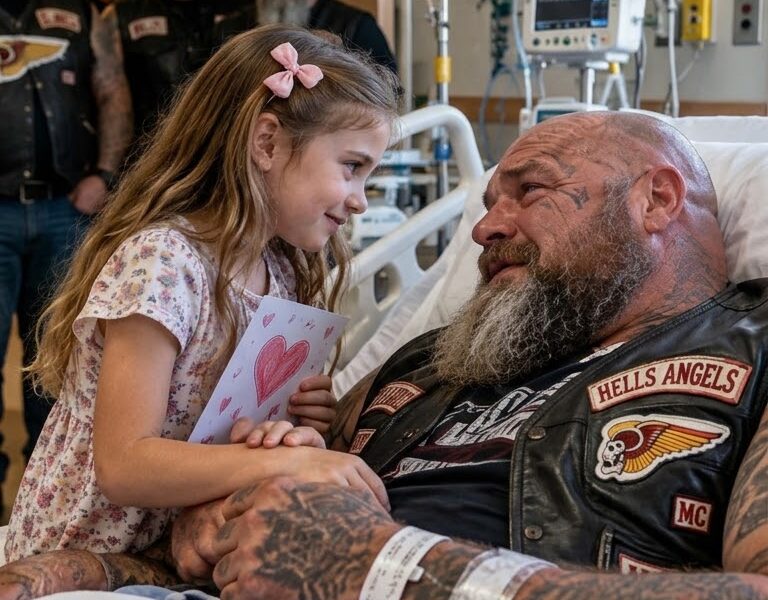
A girl visited the same hospital room every single day—until a biker finally asked her why. Her answer left him frozen.
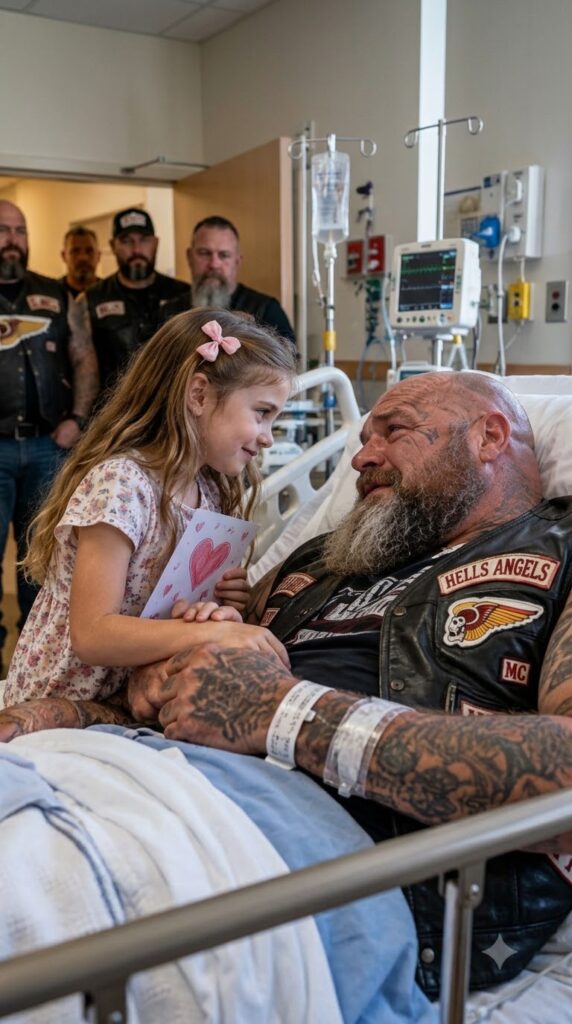
The little girl stood in the rain in her socks, and the man kneeling in front of her was six-foot-two, covered in tattoos, and about to lose everything. Headlights swept the road. A black SUV skidded onto the shoulder. The driver’s door flew open. “Get away from her!” the man shouted, and the child’s whole body went rigid, but not because of the stranger who had given her his jacket. It was because of the man who claimed to be her family.
Nine days later, that same child was sitting in a hospital chair beside the biker’s bed, and the biker had no idea who she was.
The rain had been falling on Columbus for six days straight when a little girl in a yellow coat walked into room 412 for the fourth time. Logan Mercer watched her come in without turning his head because turning his head still sent a hot wire of pain down through his ribs. He was forty-seven years old, six-foot-two, with a gray-flecked beard and forearms covered in faded ink, and he had spent nine days learning exactly how breakable a man like him could be.
Steel rods held his left leg together. His spleen was gone. A cracked collarbone kept his right arm strapped across his chest like a package he had forgotten to deliver. The girl did not say hello. She never did. She crossed the room in small, careful steps, climbed into the vinyl chair by the window, tucked her sneakers under her, and looked at him. She had two brown braids and a coat bought for a smaller child, the sleeves stopping an inch above her wrists. She held a paper cup of apple juice in both hands as if it might be taken from her. Then she just sat. Every afternoon around 3:40 for about forty minutes, she sat and watched him breathe.
“Hey, kiddo,” Logan said, the way he had the three days before. His voice came out like gravel in a coffee can. Her eyes flicked to the tattoos on his forearm, the eagle and the faded date beneath it, then back to his face. She said nothing. Logan was not a man who frightened easily, but he was a man who frightened other people easily, and he had known it since he was seventeen. He had learned to keep his voice low, his hands where people could see them, and his body a little farther back than felt natural.
The leather vest hanging in the closet with the Iron Hollow Riders patch stitched across its back did most of the talking before he ever opened his mouth. Grocery clerks watched him. Mothers steered strollers around him. He had stopped taking it personally somewhere around his thirtieth birthday. He ran a motorcycle repair shop on the east side of the city. Before that, he had spent twelve years in the army as a mechanic, keeping trucks alive in places where a broken axle could get people killed. Every December, his club collected toys for the children’s ward at this very hospital, and Logan personally loaded the trailer. None of that showed on the outside. What showed was the beard, the ink, and the size of him.
There was one more thing that did not show because he could not see it himself. Nine days ago, sometime after ten o’clock on a Friday night, he had left his friend Buck Tanner’s garage on his Harley. The next thing he remembered was a ceiling full of white lights and a nurse saying his name. The whole stretch between was simply gone. Dr. Raymond Pierce called it retrograde amnesia, a common result of a head injury like his. “It may come back,” the doctor had said. “It may not.” What Logan did know was that the police had come by twice, and that neither officer had looked him in the eye.
The door swung open, and Diane Foster came in with a blood pressure cuff over her shoulder and a clipboard under her arm. She was fifty-two, the head nurse on the fourth floor, with reading glasses on a beaded chain and the calm, level stare of a woman who had seen everything twice. She checked his IV first. Then she saw the girl in the chair, and her whole posture changed.
“Well, hello,” Diane said, softening her voice. “Sweetheart, are you supposed to be in here?” The girl looked at her, then at Logan, then down at her juice. “Where’s your mama, honey?” Nothing. Diane turned her head slowly toward the bed, and her eyes had gone flat. Logan had seen that look on a thousand faces, and he had never once been able to argue with it. “Sir,” she said, “do you know this child?”
“No, ma’am.” He said it quietly, which was the truth, and he watched it land as a lie. “She’s been coming by for a few days. She doesn’t talk. I figured she got turned around and liked the chair.”
“Four days in a row,” Diane said. It was not a question. She had been counting, too. She went back to work, but she kept her body angled toward the girl, the way a person stands between a child and a road. When she finished, she told the girl she would be right back with somebody who could help, and she left the door open behind her. Her shoes squeaked away down the hall. The room went quiet, except for the rain and the slow beep of the monitor.
Logan turned his good hand over on the blanket, palm up, empty. “Kiddo,” he said gently, “I’m sorry to ask, but I got hit on the head pretty hard, and my memory’s got some holes in it. Who are you?” For the first time, the girl looked directly into his eyes. Hers were brown and enormous, and much too tired for an eight-year-old.
“You don’t remember me,” she whispered. “I wish I did.” Her fingers tightened on the paper cup until it crumpled, and a little apple juice ran down her wrist. “You told me I could keep your jacket,” she said. “You said you wouldn’t let him take me.”
Logan’s heartbeat jumped on the monitor beside him. In the doorway, back much too soon, Diane Foster stood perfectly still with a phone in her hand. She had heard every word.
By 4:15, the fourth floor had decided who Logan Mercer was. Nobody said it out loud. That was not how hospitals worked. Instead, the words moved through the corridor in glances and lowered voices, the way news travels in a small-town diner. Two aides who had been chatting with him about the Buckeyes that morning found reasons to skip his room. A janitor pushed his cart past the door without looking in. Logan lay flat under the fluorescent light and understood that something had ended and something worse had begun.
Walt Gibbons arrived ten minutes later. He was fifty-eight, thick through the middle, with a gray crew cut and a security badge clipped to a belt that also carried a radio, a flashlight, and a lifetime of suspicion. He had worked twenty-two years as a county deputy before his knees gave out, and he stood at the foot of the bed with his arms folded, the same way he had probably stood at a thousand traffic stops.
“Mr. Mercer,” he said, “I’m going to ask you some questions, and I’d appreciate straight answers.”
“Ask.”
“Why is an eight-year-old girl visiting your room?”
“I don’t know.”
“You don’t know.”
“I don’t know who she is or why she’s here. I told the nurse. I took a hit to the head. There’s an hour of that night I can’t get back. She says I gave her a jacket.”
Walt studied him for a long moment, and Logan watched a man make up his mind. “Until this gets sorted, there won’t be any more visits. Not from her, not from anybody who isn’t family. Understood?”
“Understood.”
Down the hall in the family lounge with its stale coffee and its rack of faded magazines, Diane sat next to the girl and tried to get her to say anything at all. She learned the child’s name only because it was written in marker inside the collar of the yellow coat. Grace Holloway. Diane also learned from a phone call to the second floor that Grace’s mother worked in the billing department and that Grace waited for her there every day after school. Melissa Holloway came up the stairs so fast she was gasping. She was thirty-six and thin, with a hospital badge and the hollowed look of a woman who had not slept well in a long time. She dropped to her knees in front of Grace and gripped her by the shoulders.
“What did I tell you? What did I tell you about wandering?”
“I wasn’t wandering,” Grace said. It was the first full sentence Diane had heard from her. “I was visiting.”
“Grace. He’s the one who—” Melissa’s voice cracked on it, then dropped, and she glanced toward the elevator as if somebody might be listening there. “I’m so sorry,” she told Diane. “She has a big imagination. It won’t happen again.”
Diane, who had raised two boys and been a nurse for thirty years, noticed three things. Melissa wore a long-sleeved cardigan despite the warm, stuffy hallway. She had tugged Grace’s sleeve down over her wrist before anyone could see it. And when she said the word again, her eyes had gone to the elevator, not to the room where the biker lay. Diane filed all of it away. She was not ready to put it together yet.
At six o’clock, Detective Nathan Cole came to room 412 with a notebook and an expression like a closed door. He was in his late thirties, tired and polite in the careful way of a man who has heard every kind of lie.
“Mr. Mercer, I wanted you to hear this from me. A man named Dennis Rowe filed a statement after your accident. He says his stepdaughter ran from their house that night and that he found her on the shoulder of Route 33 with a man in a leather vest. He says when he tried to take her back, you refused. And when he drove off with her, you chased his vehicle at high speed until you lost control.”
Logan stared at him. “That’s not—” He stopped because the honest end of that sentence was, I don’t know.
“The prosecutor’s office is reviewing it. Attempted unlawful restraint of a minor, among other things.” Cole flipped a page. “And now the same girl is showing up in your hospital room. You can see how that looks.”
“I can see exactly how it looks,” Logan said. “I’ve been looking at it my whole life.”
Cole didn’t smile. He left his card on the tray table.
That night, Buck Tanner came at the end of visiting hours and the lobby downstairs got very quiet. Buck was fifty-five, wide as a doorway, with a white ponytail and a road-weathered face, and he had brought four club members with him in their vests. Logan could hear the effect through the floor, the security desk phoning up, the elevator held, the murmur. By the time Buck reached 412, Walt Gibbons was standing in the hall like a man guarding a bridge.
“Ten minutes,” Walt said. “One visitor.”
Buck took the chair. He looked older under the fluorescent light, and he kept rubbing his beard as Logan told him everything. The girl, the jacket, the hour of nothing, the allegations. When Logan finished, Buck sat in silence.
“You’ve never laid a hand on a kid in your life,” he said finally. “I’ve known you twenty years.”
“Nobody here’s known me twenty years. They’ve known me nine days.”
“Then we make them know you.” Buck leaned in, lowering his voice. “Logan, your helmet cam. Were you wearing it that night?”
Logan closed his eyes. He had bolted that little camera to his helmet after a pickup truck nearly killed him on the interstate in 2019. He wore it on every ride, the way other men wear seat belts. “Always,” he said.
“Then it’s somewhere. I’ll find it.”
The next afternoon at 3:40, the visitor chair stayed empty. Logan checked the clock four times. At 3:52, he heard small footsteps in the hall, and then Walt’s voice, low and not unkind. “Sorry, kid. Not today.”
“Please,” said Grace’s voice. “He didn’t do it. He gave me his jacket because I was cold.”
“Go on back to your mother now.”
Logan turned his head, wincing, and through the narrow window in the door he saw her, a small yellow shape in the corridor. Then he saw a man walking toward her from the elevators. Tall, mid-forties, gray suit, expensive haircut, a smile as smooth as a showroom floor. He extended his hand to Walt’s as if they were old friends.
“Officer Gibbons, Dennis Rowe. I believe you’ve been looking out for my little girl.”
Logan watched Grace’s face. She had not flinched at his tattoos. She had not flinched at the vest, the beard, or the steel in his leg. But when the man in the good suit set a hand on her shoulder, she went still all over, like a rabbit in an open field, and the yellow sleeve tightened in her small fist.
Sleep did not come easily in room 412 after that. Walt Gibbons moved a chair into the hallway and sat outside the door in shifts, and every hour or so, Logan heard the creak of his weight shifting. Someone had also taped a note to the whiteboard by the door, and Logan could read it from the bed. Security alert. No unauthorized visitors. He had served twelve years in the army and never once been treated as a threat by his own side. It turned out a hospital could be harder.
By Wednesday, the doubt had started. That was the part no one warned him about. It wasn’t the stairs or the note. It was the hour after midnight when he lay looking at the ceiling and asked himself whether they might be right. Somewhere in the missing hour, something had happened. He did not remember stopping for a child. He did not remember anything. What if a blow to the head could make a man forget the worst thing he had ever done? He had spent his life being unfairly judged, and now he was judging himself with the same unfair eyes.
Dr. Pierce came at seven o’clock with his tablet. He was forty-nine, soft-spoken, in wire-rimmed glasses, and he was the only person in the building who spoke to Logan exactly the way he spoke to everyone else.
“Physically, you’re healing better than I expected.” A pause. “I heard about the trouble. For what it’s worth, I don’t treat allegations. I treat patients.”
“Doc, do you think a man could do something terrible and not remember it?”
Dr. Pierce set the tablet on his knee. “Memory loss like yours usually erases the moments around the injury. It doesn’t rewrite who you are. If anything, people act on instinct, and instinct comes from their whole life.” He looked at Logan over his glasses. “Ask yourself what your instincts would have told you to do.”
It was the kindest thing anyone had said to him all week, and it did not settle the question.
Near midnight, Diane Foster came in to check his vitals. She worked briskly and said little until she was at the door with her hand on the light switch.
“Mr. Mercer, I heard what that girl said to you.” Logan waited. “I’m not deciding anything yet. I want you to know that I’m not deciding.” The lights went out. It was not an apology. It was, he understood, an open door, however narrow, and it was more than anyone else had offered him.
Diane was not sleeping much either. She had told herself the yellow coat was none of her business. She had told herself that Melissa Holloway was an adult, that the man who shook Walt’s hand looked like a respectable father, and that the danger she was paid to worry about lay in room 412. And yet the child’s words would not leave her alone. You said you wouldn’t let him take me. Him. In the doorway, she had first heard it as a girl describing her kidnapper, but the sentence made no sense that way. You do not thank a kidnapper for promising to protect you from himself.
On Thursday, she took the stairs to the second-floor billing department using an insurance form as her excuse. She found Melissa at her desk in a gray cardigan staring at a monitor without typing. A phone buzzed beside the keyboard. The screen read Dennis, and Melissa flinched so hard she nearly knocked over her coffee. She read the message, typed a reply with shaking thumbs, and set the phone face down.
“Is everything all right?” Diane asked.
“Everything’s fine.” Too quickly. “Dennis worries. He’s just protective. He’s a good man. He provides for us. He—” She stopped and pressed her lips together. “Grace is home with him today. She’s not feeling well.”
“Melissa, is Grace safe?”
“Of course she’s safe.” Melissa smiled, and the smile looked painful to hold. “Please don’t make this into something, Diane. Please.”
Diane went back up to the fourth floor with the sick feeling of having stood beside a door she could not open.
Buck showed up that evening, not through the front lobby but through the service corridor, alone, carrying a battered gray backpack. Walt caught him at 4:12 and tried to turn him away. “Five minutes,” Buck said in a voice that had been gentle for so long it was hard to argue with. “Then I’ll leave.” Walt hesitated, glanced at Logan, and looked away. He let him in.
Buck set a cracked black helmet on the bed tray. A camera the size of a thumb was still clipped to the side. Its lens was spiderwebbed with scratches. “The ER bagged it with your stuff. Nobody thought about it.” He exhaled. “The memory card is damaged. I took it to a data shop on Cleveland Avenue. The guy says he might recover something. Give him a couple of days and don’t count on anything.”
“A couple of days,” Logan said. “Buck, I might be in handcuffs by then.”
“Then hang on until Friday.”
Walt Gibbons, still in the doorway, cleared his throat. It was the first time he had spoken to Logan voluntarily. “Is that a unit patch on your forearm under the eagle?”
Logan looked down. “Third Infantry Division, motor pool. Twelve years.”
“Marine Corps,” Walt said. “’89 to ’93. Lot of engines.” He stared at the floor for a second. “My son rides. I know what the vests are. I know what your club does at Christmas.” He shook his head. “That’s the problem. I know it, and I still put that sign on your door.”
“You saw a big man in leather,” Logan said. “That’s most people’s first look.”
“It shouldn’t be mine,” said Walt. He left it there.
On Friday morning, Grace Holloway came back. She was not supposed to be there. Diane found her in the stairwell at the end of the hall, sitting on the top step with her knees pulled up and a folded piece of paper in her hands. She had climbed alone from the second floor in a hospital where a security guard’s chair blocked her way.
“I had to bring it,” Grace said. She held out the paper. It was a crayon drawing. A big man on a motorcycle, a small girl in a yellow coat, and a black car with a scribbled figure inside drawn with heavy, angry lines. “He said he wouldn’t let him take me. That’s what he said.”
Diane crouched. She took the drawing gently, and as Grace reached out, the yellow sleeve slid back. On the thin wrist and the pale skin above it were four small purple-yellow bruises in a line, the unmistakable shape of a man’s fingers.
“Sweetheart,” Diane said, and her own voice sounded strange to her. “Who did that?”
Grace looked at the floor, and then she told her.
Diane Foster did not hesitate. Twenty minutes after Grace finished talking, the girl was sitting in Diane’s small office with a blanket around her shoulders and a cup of cocoa from the vending machine, and Diane was on the phone with Detective Nathan Cole. She used a voice she had not used in years, the voice of a woman who had once reported a case on this very floor, been told she was overreacting, and been right.
“Detective, this is Diane Foster on the fourth floor. I have a child with bruises in the shape of fingers on her arm, and she’s telling me her stepfather put them there. Her name is Grace Holloway. You’ll want to come now.”
There was a long silence on the line. “I’m on my way,” Cole said.
She was about to hang up when she heard the elevator chime. Dennis Rowe stepped off it at 10:20 a.m. in a charcoal suit and a silk tie, phone in hand. He had come, Diane would learn later, because Melissa had not answered his three calls and Grace had not been at school. He walked to the nurses’ station with the easy confidence of a man used to rooms rearranging themselves around him.
“Nurse, I’m looking for my stepdaughter. I was told she’s been wandering this floor. That patient in 412 has been coaching her.” He smiled, and the smile was a beautiful piece of work. “I don’t want a scene. I want my daughter.”
“She’s with me,” said Diane, stepping out of her office and closing the door behind her. “And she’ll stay with me until the detective arrives.”
The smile did not move, but something beneath it did. “I’m her father, Ms. Foster.”
“Stepfather,” Diane said.
Grace, who had opened the door a crack, made a small sound. Dennis’s head turned toward it. He crossed the space in three long strides and took Grace by the upper arm, the same arm, the same place, and pulled her out of the doorway. “We’re leaving.”
“Let go of her.” Everyone in the corridor turned. Walt Gibbons was on his feet, his chair skidding behind him. He had guarded a door for four days because of a man’s tattoos, and he had just watched a man in a nice suit do exactly what he’d been afraid of the whole time. “Take your hand off that child, sir. Right now.”
“You’re taking his side? A criminal in a hospital bed?”
“I’m taking the child’s side,” said Walt. His hand rested on his radio, and his voice had gone quiet. “Let go. Now.”
Dennis looked at the faces around him. The security guard, the head nurse, two aides, a visitor filming with her phone. His grip loosened. Grace slid away and ran to Diane, burying her face in her scrubs. That was when the elevator chimed again, and Detective Cole stepped out with Buck Tanner a pace behind him, a laptop under one arm.
“Mr. Rowe,” Cole said. “I need you to stay right where you are.”
They watched the recording in room 412. All of them crowded around a laptop on the bed tray. Logan propped on his pillows, Buck at the keyboard, Diane with Grace in her arms, Walt beside the door, Cole at the foot of the bed. Melissa Holloway came in last, out of breath, still wearing her badge lanyard, and stood against the wall. Dennis Rowe waited in the hall with an officer on either side.
The shop on Cleveland Avenue had worked through the night. “It’s mostly there,” Buck said. “The first few minutes are corrupted, but the rest—” He pressed a key.
The video was grainy and rain-streaked, shot from a rider’s eye level, headlights on a black road, a clock in the corner, 10:41 p.m. Then, far ahead on the shoulder of Route 33, a small yellow shape in the dark. The bike slowed. Logan’s own voice came through, muffled by wind. “What in the world?”
The camera swung down as he stopped and climbed off. The girl stood in the rain in her socks, arms wrapped around herself, shivering hard enough that the picture shook with her. He knelt. Everyone in the room noticed that. The way a man that size crouched until his eyes were level with hers.
“Hey, sweetheart,” said the voice in the video. “It’s okay. I’m not going to hurt you. Are you hurt?”
“Please don’t take me back,” the little voice said. “He gets so mad.”
On the bed, Logan’s good hand closed slowly on the blanket. On the screen, he watched himself take off his leather jacket and wrap it around her. And something loosened in his memory, like a rusted bolt turning. He remembered the weight of that jacket sliding off his shoulders. He remembered her socks. He remembered dialing. The recording had captured the call.
“911, what’s your emergency?”
“I’ve got a little girl alone on Route 33 near the Hilliard exit. She’s eight, maybe nine. No shoes. She said she ran from home. Please send someone.”
The time code read 10:47. Headlights swept across the frame. A black SUV skidded onto the shoulder, and a man in a gray coat jumped out. Dennis Rowe’s face was easy to recognize, even blurred by rain.
“Get away from her!” he shouted. “She’s mine! What did you do to her?”
“Sir, she’s cold and she’s scared. The police are on their way. Let’s wait for them together.” Logan’s voice on the tape was calm as a stopped clock.
Dennis leaned down past the edge of the camera’s view and said something quietly to Grace. Then he grabbed her arm and dragged her toward the SUV, and the recording caught his voice, low and cold and unmistakable. “Nobody’s going to believe a guy covered in tattoos over me. Get in the car.”
Melissa made a sound against the wall as if someone had struck her. The SUV pulled onto the road. On the video, Logan muttered something under his breath, ran back to his motorcycle, and went after them—not to chase, as the dispatcher’s voice made clear, but to keep them in sight.
“Ma’am, I’m following at a distance. He took the girl. I’m reading you the plate now.”
The SUV slowed on a curve, then braked hard, a white flash of brake lights in the rain. The camera lurched, then noise, then dark. The room was completely silent.
Then Diane’s voice, shaky. “He braked on him.”
“On purpose,” Walt said.
Melissa slid down the wall until she was sitting on the floor. When she spoke, it was barely a whisper, and she was not speaking to the room. “Grace,” she said. “Baby, did he ever—”
Grace lifted her face from Diane’s shoulder. She looked at her mother for a long moment, then she nodded.
Detective Cole closed the laptop with great care. He looked at Logan, and it was the first time he had looked him in the eye. “Mr. Mercer,” he said. “I owe you an apology.” He turned to the door. “Excuse me, I have a man to arrest.”
By that evening, Dennis Rowe was in the Franklin County Jail, and by the end of the week, the charges had a long list attached: child endangerment, domestic violence, unlawful restraint, filing a false statement with police, and reckless operation of a vehicle causing serious harm. His expensive lawyer said very little. The footage said everything. Two of Melissa’s co-workers came forward to describe bruises they had seen and explained away. A neighbor had once heard Grace crying through a wall and told herself it was none of her business. A lot of people, Logan thought, had looked at that house and seen a nice man in a nice suit.
Melissa did not go home. She took Grace to her sister’s in Dayton the same night with a victim advocate helping her file for a protection order. Before she left the hospital, she stopped outside room 412 with her hand shaking on the doorframe.
“I should have seen it,” she said. “I did see it. I just—I told myself it was a rough patch, that he was stressed, that if I were better at everything—” Her voice broke.
“You got her out,” Logan said. “That’s what matters now. You walked her out of that house and you’re not going back.”
She nodded and wiped her eyes, and for a moment it seemed she might say more. She only whispered, “Thank you,” and went.
Diane Foster came to see him after her shift when the fourth floor had gone dim and the rain had finally stopped. She stood at the foot of the bed with her hands clasped in front of her, and for the first time since he had been admitted, she looked uncertain.
“I owe you an apology, and I’d like to do it right,” she said. “I saw you, and I made up my mind before I knew one thing about you. I decided you were dangerous because you looked like something I was afraid of. And while I was busy watching you, that child was walking past me with finger marks on her arm.” She drew a breath. “I’ve been a nurse thirty years. I like to think I don’t do that. I did.”
Logan considered it before he answered. He was tired and sore, and there were some old familiar things he could have said. He didn’t say them.
“Ma’am, you’re also the one who made the call. You could have let it go. Most people would have. You heard a little girl say something that didn’t add up, and you pulled on the thread.”
“Only after four days of staring right at it.”
“Four days is faster than most.” He offered a crooked smile. “I won’t tell you it doesn’t sting. It stings. But I know what I look like. All I’ve ever asked is for people to look twice.”
“I’ll look twice,” Diane said. “From now on, I’ll look twice at everybody.”
Walt Gibbons came in the following morning, took his security badge off, and stood there turning it over in his hands. “I put a sign on your door,” he said. “I sat outside it four days. I think I’d like to take the sign down myself.” He did, and Logan heard the tape peel off the whiteboard. It was the sweetest sound he had heard in that whole hospital.
The charges against Logan were dropped on Monday. Detective Cole delivered the news himself in a fresh shirt with a manila envelope holding a formal letter from the prosecutor’s office. He shook Logan’s hand and held it a second longer than necessary.
“For what it’s worth, my first instinct was to take one look at you and stop asking questions. That’s a mistake I’d like to make only once.”
“That makes two of us who won’t forget it,” Logan said, and Cole nearly laughed.
The club came up in a group that afternoon—twelve big men and two women in leather vests—and this time Walt himself walked them to the elevator and held the door. In the corridor, the aides stopped and stared. Then one of them, a young woman who had avoided Logan’s room for a week, came to his door with a shy wave and a get-well card the whole floor had signed.
Logan was discharged twenty-three days after the crash on a gray November morning in a wheelchair with a walker across his lap. He had months of physical therapy ahead. Buck wheeled him to the curb where a pickup truck waited with the club’s toy trailer hitched behind it. And beside the truck, holding a garment bag with both arms, stood Grace Holloway. She had grown, it seemed, in three weeks. Her hair was in a single braid now, and she wore a new red coat that fit her properly, with room in the sleeves. Her mother stood a few steps behind, thin but upright, her cardigan sleeves pushed up to her elbows.
“I brought it back,” Grace said. She held out the bag. Inside was his leather jacket, cleaned and folded, and it smelled like laundry soap and the inside of somebody’s home. “Mom washed it. It got rained on a lot.”
Logan looked at the jacket for a while. He was not a man who cried in front of people, and he wasn’t going to start on the sidewalk outside a hospital, but his voice was rough when he spoke. “Grace, you keep that.”
“I can’t. It’s too big.”
“You’ll grow into it.” And anyway,” he said, “I told you that you could.”
Her whole face changed then, the tired part of it rearranging itself into an eight-year-old’s grin. “Can I ask you something?” she said. “Why did you stop? Everybody else drove right by. I counted seven cars.”
Logan thought about it. “Because you looked like you needed somebody,” he said finally. “That was all it took. It doesn’t matter who’s standing there.”
“You knelt down,” Grace said. “The other grown-ups stood over me. You got down where I was. Your eyes were the same height as mine.”
“Best decision I made that night,” said Logan.
Diane Foster had come out to the curb without her clipboard, and Walt stood beside her, arms folded, smiling. Melissa put her hand on Grace’s braid. The rain, which had fallen on Columbus for nearly a month, finally held off, and a strip of pale sun lay across the wet asphalt like something the sky had decided to lend them.
In December, the Iron Hollow Riders came to the children’s ward with their annual trailer of toys. This year, Logan came in on crutches, and the first hand to reach out and shake his belonged to the head nurse. Behind her stood Walt with a stack of gift bags. Nobody flinched. Nobody stared at the tattoos except a small girl in a red coat who walked straight up to him and took his hand.
There is a moment in almost every life when a stranger looks at you and decides what you are. It rarely takes more than a second, and it is almost never right. Logan Mercer had lived with those seconds for thirty years. What he learned in room 412 from a child who never once judged him was the simplest thing in the world. It costs nothing to look twice, and it can save a life.









