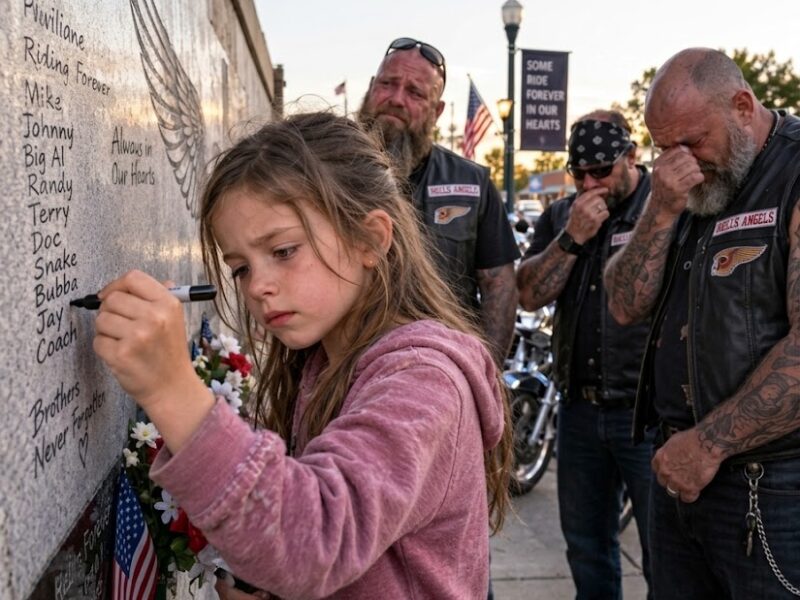
A girl spent months painting the name of every fallen biker on a wall — and when 500 riders saw it, grown men broke down and wept.
## Part 1
Rebecca stood in the pouring rain, watching three hours of work wash down a brick wall in streaks of green paint.
Her father’s friend’s name ruined. Seventeen names still waiting, and she had nothing left to give.
She had promised forty-five families she would finish this. She had promised herself she would finally say goodbye to a father she never got to see one last time.
But standing there soaked and shaking, she wondered if grief had asked more of her than she could actually pay.
Then a stranger appeared with an umbrella and four words that would change everything.
“You’re not doing this alone.”
Rebecca Hartwell had walked past the old brick wall behind Doyle’s Garage almost every day of her life without truly seeing it.
It stood at the dead end of Cypress Street. Three stories of crumbling red brick that had once belonged to a textile mill shut down before she was born.
Weeds grew thick along its base, and someone years ago had spray-painted a crude skull that had faded to a ghostly gray under two decades of Ohio winters.
To most people in Springfield, it was just a wall.
To Rebecca at twenty-two, it was the backdrop of her entire childhood, the place where her father used to park his motorcycle before walking her to the ice cream stand two blocks over.
Her father, Daniel Hartwell, had been a rider. Not a criminal, not a rebel without a cause, just a machinist at the Clark Auto Plant who loved the feeling of wind on the open back roads of Clark County on Sunday mornings.
He’d ridden with a loose group of local men and women who called themselves the Iron Valley Riders, a club that wasn’t about outlaw patches or trouble, but about brotherhood, barbecues, and toy runs for the children’s hospital every December.
Rebecca had grown up sitting on picnic tables at the clubhouse, drawing pictures while grown men with beards and leather vests debated the best route to Cincinnati.
Daniel had died three years ago. Not on the bike, which was the cruel irony of it.
A heart attack in his own garage, wrench still in his hand, working on the same Harley he’d ridden for eighteen years.
Rebecca had been away at community college in Columbus when it happened. She hadn’t been there. She hadn’t said goodbye.
And in the three years since, she had drifted further from the world her father loved, taking a job at a print shop, moving into a small apartment above a laundromat, and doing her best not to think about engines or leather jackets or the particular sound of a V-twin idling at a red light.
But grief has its own timeline, and lately Rebecca’s had been catching up to her.
It started with a phone call from Michael Doyle, the man who had run the garage behind that old brick wall for thirty years and who had been her father’s closest friend.
Michael was sixty-one now, broad-shouldered but slowing down, his hands permanently stained with motor oil no soap could fully remove.
He called Rebecca on a Tuesday evening in early April.
“Bex,” he said, using the nickname only her father’s friends still used. “You got a minute?”
She did. She always did for Michael.
He was the closest thing to her father she had left, even if their conversations these days were shorter, quieter, weighted with things neither of them said out loud.
“I need to tell you something,” Michael continued, his voice rougher than usual. “We lost another one. Tommy Ashford. Heart, same as your dad. Found him this morning.”
Rebecca sat down hard on her kitchen chair.
Tommy Ashford had taught her to ride a bicycle when she was six, running alongside her with one hand on the seat, laughing every time she wobbled.
“Michael, I’m so sorry.”
“That’s four of us gone in three years,” Michael said. “Your dad, Big Pete, Sarah Nakamura, now Tommy. Four riders who used to fill up that clubhouse, and pretty soon there won’t be enough of us left who remember them at all.”
The younger guys joining the club now, they never even met your dad. They don’t know what Big Pete did for the flood relief in ’09.
They don’t know Sarah rode cross-country solo when she was sixty-three years old to prove she could.
Rebecca understood in a distant way what Michael was saying, but she didn’t yet understand what it would come to mean for her.
That night, she couldn’t sleep.
She kept thinking about the wall behind the garage, the one she’d stared at a thousand times without seeing.
She thought about how easily a person’s whole existence, the roads they rode, the jokes they told, the goodness they carried, could evaporate into nothing more than a name on a headstone that fewer and fewer people visited each year.
The next morning, she drove to the garage. She hadn’t been there in over a year.
Michael was in the bay changing the oil on a customer’s truck, and when he saw her, something in his face softened with relief, as if her visit alone was a form of comfort.
“I want to see the wall,” she told him.
Michael raised an eyebrow but didn’t ask questions. He led her around back, past stacked tires and a rusting dumpster to the same brick wall she’d known her whole life.
Up close, it was worse than she remembered. Cracked, stained, littered with the debris of decades.
But it was enormous, a blank canvas thirty feet wide and just as tall.
“Michael,” Rebecca said slowly, an idea forming with a clarity that frightened her. “How many riders has the club lost? Not just recently. Ever since it started.”
Michael thought for a long moment, doing math in his head that clearly pained him.
“Founded in 1987, I’d guess forty, maybe forty-five names going all the way back. Accidents, old age, sickness. Forty-five men and women who rode with us and aren’t riding anymore.”
“I want to paint their names,” Rebecca said. “All of them. Right here on this wall so nobody forgets.”
Michael stared at her for a long moment, and Rebecca watched something complicated move behind his eyes.
Grief, hope, and something that looked almost like fear, as though the size of the task frightened him as much as it moved him.
“That’s a hell of an undertaking, Bex,” he said quietly. “You have any idea what that would take? Getting the names right, the dates, doing right by every family.”
“I have time,” Rebecca said, though she wasn’t sure yet if that was entirely true. “And I have a reason.”
She didn’t tell him the rest of it.
That lately she’d felt like she was losing her father twice. Once when he died, and now again slowly, as the specific details of him blurred at the edges of her memory.
The exact sound of his laugh. The way he held a wrench.
If she didn’t do something to hold on to him and onto all the others like him, she was terrified that in another ten years none of it would remain at all.
Not even in the minds of the people who loved them.
Michael nodded slowly, understanding more than she’d said aloud.
“Let me talk to the club,” he said. “This isn’t just your decision to make alone. There’s forty-five families involved.”
Rebecca nodded, but as she looked up at that enormous, cracked, forgotten wall, she felt something settle into place inside her chest for the first time in three years.
Not peace. Not yet.
But purpose.
And in Springfield, Ohio, that was sometimes the only place a person could start.
—
The club meeting was held on a Thursday night at the Iron Valley Riders Clubhouse, a converted warehouse on the edge of town with a bar built from salvage motorcycle parts and walls covered in faded photographs.
Rebecca had not set foot inside in three years, and walking through the door felt like stepping into a museum of her own childhood.
Twenty-three riders sat scattered around folding tables, some she recognized from her youth, others strangers who had joined after her father’s death.
All conversation stopped when Michael stood at the front of the room with Rebecca beside him.
“Some of you know Daniel Hartwell’s daughter,” Michael began. “Rebecca has an idea, and I think you all need to hear it.”
Rebecca’s hands trembled as she explained her plan. The wall, the names, the paint.
She watched faces shift from confusion to something warmer as she spoke, particularly among the older riders who had known her father, known Tommy, known Big Pete and Sarah Nakamura.
An older woman near the back, whom Rebecca vaguely recognized as Big Pete’s widow, Dorothy, began quietly crying.
But not everyone was moved.
A younger rider named Anthony Briggs, who couldn’t have been more than thirty, folded his arms and spoke bluntly.
“No offense, but why does a mural matter? These people are gone. Painting their names on a wall doesn’t bring them back, and it costs money and time we could spend on things that actually help people who are still alive. The toy runs, the veteran support programs.”
The room grew tense.
Rebecca felt her chest tighten, understanding his point even as it stung.
Before she could respond, an unexpected voice answered him.
Dorothy, Big Pete’s widow, wiping her eyes but speaking with sudden clarity.
“You’re thirty years old, Anthony. You didn’t know my husband. You don’t know that he pulled three kids out of a flooded car during the ’09 storm and never told anyone because he didn’t think it was a big deal.”
“You don’t know that when he died, half this town came to his funeral because of the quiet good he did for thirty years. And now it’s already fading. Give it another twenty years and it’ll be like Pete never existed at all outside of a few photographs nobody looks at.”
The room fell silent.
Anthony, to his credit, looked genuinely affected, his earlier certainty cracking.
“I didn’t mean any disrespect,” he said quietly.
“None taken,” Dorothy said. “But that’s exactly why this matters. Not for the dead. For everybody still walking around who deserves to know what kind of people came before them.”
The vote, when Michael called for it, was nearly unanimous in favor, with only two abstentions.
Rebecca felt something like relief flood through her, immediately followed by the crushing weight of what she’d committed herself to.
—
Compiling forty-five names turned out to be far harder than she’d imagined.
The club’s records were incomplete. Old newsletters, scattered photographs, and the fading memories of aging members.
Some names came easily. Her father, Tommy Ashford, Big Pete Coleman, Sarah Nakamura.
Others required weeks of detective work, phone calls to family members who had scattered across the country, dusty boxes of paperwork in Michael’s garage office, even a trip to the county historical society to verify a name and death date from 1994.
Rebecca began visiting the widows, widowers, sons, and daughters of the fallen riders one by one.
Some conversations were brief and awkward. Families who had drifted from the motorcycle community and viewed the project with polite indifference.
But many were profound.
She sat in the kitchen of an eighty-one-year-old man named John Whitfield, whose wife, Linda, had been one of only three female founding members of the club in 1987, and listened to him describe how Linda had ridden through a snowstorm to deliver medicine to a sick neighbor two decades before she died of cancer.
“Nobody ever asked me about Linda’s stories,” John told her, his voice thick. “My own grandkids don’t know she used to race the boys at the county fairgrounds and beat every one of them. If you’re really going to put her name up there, would you put ‘The Fastest Rider in Clark County’ underneath it? That’s what we used to call her.”
Rebecca began keeping a notebook, not just of names and dates, but of these small luminous details.
Michael Doyle’s late wife’s brother, a rider named Ryan Castellano, who had died saving a stranded motorist from a burning car on Route 68 in 2003.
A woman named Amanda Ferris, one of the club’s founding members, who had continued riding until she was seventy-nine, insisting that age was just a number the DMV keeps track of.
Each name became a small excavation of a life Rebecca had never fully known existed.
Lives that had unfolded in parallel to her own childhood without her ever fully understanding their weight.
The project began consuming her.
She reduced her hours at the print shop, spending her free time researching, sketching layout designs for the mural, and practicing her lettering technique on scrap plywood behind Michael’s garage.
She had some art background, two semesters of a graphic design program before she dropped out to work full-time, but nothing had prepared her for a mural of this scale and emotional weight.
Michael watched her transformation with a complicated mixture of pride and concern.
“You’re losing yourself in this, Bex,” he told her one evening, finding her still sketching at nearly midnight in his garage office, surrounded by photographs and handwritten notes on all forty-five riders.
“I’m not losing myself,” Rebecca said. “I think I’m finding something. I don’t know what to call it yet.”
But privately she wondered if Michael was right.
The project had become a way to avoid her own unprocessed grief, filling every waking hour so she never had to sit still with the specific ache of missing her father.
She hadn’t cried about Daniel Hartwell in over two years.
She had simply worked around the hole he’d left, the way water flows around a stone.
Now immersed in the stories of forty-four other people who’d left similar holes in similarly ordinary lives, she felt that carefully constructed avoidance beginning to crack.
—
The breaking point came on a Tuesday afternoon in June when she visited the modest home of Sarah Nakamura’s daughter, a soft-spoken woman named Grace, who worked as a school teacher.
Grace showed Rebecca a photograph of Sarah at sixty-three, sitting astride her motorcycle at the edge of the Pacific Ocean, having just completed a solo cross-country ride from Ohio to California.
“She called me from a pay phone in California,” Grace said, smiling through tears. “She said, ‘Gracie, I made it and I’m not done yet. Fifty more years and I’ll still be riding.'”
She died four months later. Aneurysm. Completely sudden.
She never got those fifty years.
Rebecca sat in Grace’s living room and finally, after three years of holding herself together through sheer force of will, began to cry.
Not just for Sarah Nakamura, a woman she’d barely known, but for her father, for Tommy, for Big Pete, for all forty-five names in her notebook, and for herself.
Twenty-two years old and grieving more deeply than she’d ever allowed herself to admit.
Grace held her hand and said nothing, letting her cry, understanding perhaps better than anyone the particular grief of loving someone whose absence the wider world would eventually forget.
—
By late July, Rebecca had confirmed all forty-five names along with birth and death dates, and the small distinguishing details families had shared.
Nicknames. Achievements. Single sentences that captured the essence of who these people had been.
She had also, with Michael’s help, secured donated paint supplies from a local hardware store whose owner had lost his own brother to a motorcycle accident decades earlier and refused to accept payment.
But the mural itself proved to be a far greater physical and emotional challenge than Rebecca had anticipated.
The wall was thirty feet wide and eighteen feet tall at its highest point, requiring scaffolding that Michael rented from a construction supply company.
Rebecca had never worked at that scale before, and her first two weeks were consumed by trial and error.
Paint that ran in the summer heat. Lettering that looked elegant on paper but clumsy blown up to three-foot-tall letters. Colors that shifted unexpectedly against the aged brick.
She worked most days after her shift at the print shop, often until well past dark, illuminated by a work light rigged up on an extension cord run from the garage.
Her hands developed calluses from gripping brushes for hours. Her shoulders ached constantly from reaching overhead.
She lost weight without meaning to, skipping meals in favor of another hour of work while the light held.
Word of the project spread slowly through Springfield’s small motorcycle community, then beyond it.
A local reporter named Rachel Kim from the Springfield News-Sun stopped by after hearing about it from a customer at the hardware store, and her subsequent article, “Local Woman Honors Fallen Riders with Memorial Mural,” brought a modest wave of attention.
People began stopping by the garage. Some to watch. Some to offer help. Some simply to stand and look at the growing list of names taking shape on the brick.
Not everyone approved.
Rebecca’s own aunt, her father’s older sister, Patricia, called her in August, concerned in the particular way relatives can be when they’ve decided your grief is being expressed incorrectly.
“You’re spending all your money and time on this,” Patricia said. “Your father wouldn’t want you throwing away your twenties on a wall. He’d want you finishing school, building a career.”
“He’d want me to remember him,” Rebecca replied more sharply than she intended. “This is how I’m doing that.”
“There are other ways to remember someone besides exhausting yourself on scaffolding every night,” Patricia said. “I worry about you, Rebecca.”
The conversation left Rebecca shaken, not because she thought Patricia was entirely wrong, but because some small, tired part of her wondered the same thing.
Was this healthy grief or an elaborate form of avoidance?
Was she honoring her father or hiding from the harder, quieter work of simply learning to live without him?
She brought these doubts to Michael one evening in early September, sitting on an overturned bucket beside the half-finished wall.
Twenty-eight names painted. Seventeen remaining.
The letters gleamed dark green against the brick, a color the club had chosen because it had been the color of the original Iron Valley Riders patches back in 1987.
“Some days I don’t know if I’m doing this for them or for me,” Rebecca admitted. “Is that selfish?”
Michael sat down heavily beside her, his knees protesting audibly.
“Bex, I’ve known you since you were born. I watched your dad hold you at the hospital. And I’ll tell you something. Grief isn’t clean. It’s not one thing.”
“You can be doing this for your dad and for Tommy and for Sarah and for Big Pete and also be doing it for yourself all at the same time, and none of those reasons cancel each other out.”
“Patricia thinks I’m avoiding real life.”
“Patricia,” Michael said carefully, “buried her brother and went back to work three days later because that’s how she copes. That doesn’t make her right about how you should cope. Grief isn’t a uniform. It doesn’t fit everybody the same way.”
Rebecca appreciated the sentiment, but doubt continued to gnaw at her through September, compounded by mounting exhaustion and a growing awareness of how much the project had cost her.
Financially, in the print shop hours she’d sacrificed. Physically, in the toll the work had taken on her body.
There were nights she stood before the half-finished wall and felt overwhelmed by the seventeen names still ahead of her, wondering if she’d taken on something beyond her actual capacity to finish.
The lowest point came on a rainy evening in mid-September when a sudden thunderstorm caught her mid-brushstroke, ruining nearly a full day’s careful lettering work on the name of a rider named Frank Kowalski, one of the club’s founding members who had died in 1998.
Rebecca stood in the rain, watching three hours of careful work run down the brick in streaks of green, and finally completely broke down.
Michael found her there twenty minutes later, still standing in the rain, staring at the ruined lettering.
He didn’t say anything at first. He simply retrieved two umbrellas from the garage, handed her one, and stood beside her in silence.
“I can’t do this,” Rebecca finally said, her voice barely audible over the rain. “I thought I could, but there are still seventeen names, and I’m exhausted, and I ruined Frank’s name, and I don’t know if I have anything left.”
“You’re not doing this alone,” Michael said quietly. “You never were. You just haven’t asked for help yet.”
—
The next morning, Michael made a series of phone calls.
By that afternoon, four club members with painting or construction backgrounds had arrived at the garage, along with folding chairs, a canopy tent to protect against future rain, and Dorothy, Big Pete’s widow, carrying a cooler full of sandwiches and lemonade.
“You don’t finish something this size alone, honey,” Dorothy told Rebecca, setting up a small folding table beside the scaffolding. “Nobody ever expected you to.”
With help, the work accelerated, though Rebecca insisted on personally repainting every name herself, unwilling to have the mural become a patchwork of different hands and styles.
The others instead handled preparation, mixing paint, steadying scaffolding, tracing pencil guidelines for her lettering, and managing the growing crowd of onlookers that gathered most evenings to watch the mural’s progress.
The onlookers became, in their own way, part of the project’s meaning.
Rebecca began to notice the same faces returning night after night.
An elderly man who stood silently for twenty minutes each evening before walking away without a word.
A young mother who brought her son to watch and explained who each name belonged to.
A group of teenagers on bicycles who had initially come to mock the project and instead found themselves quietly watching, asking questions, occasionally helping carry supplies.
One evening in early October, with thirty-eight names completed, an unfamiliar man approached Rebecca as she took a break, sitting on the scaffolding’s lowest platform, drinking water and resting her aching arms.
He was perhaps fifty, dressed not in leather but in a modest button-down shirt, and he introduced himself as Gerald Ashford.
Tommy Ashford’s estranged older brother, who Rebecca hadn’t known existed.
“Tommy and I didn’t speak for the last fifteen years of his life,” Gerald admitted, his eyes fixed on his brother’s name near the top of the wall.
“Stupid argument about our father’s estate that neither of us ever let go of. I found out he died from an obituary in the newspaper three weeks after the funeral.”
Rebecca didn’t know what to say, so she simply listened.
“I drove up from Cincinnati when I heard about this mural,” Gerald continued. “I don’t know what I expected to feel seeing his name up there, but I think I needed to see that other people valued him. Even if I threw away fifteen years I could have had with my own brother.”
“I think I needed to know he mattered to somebody, since apparently he didn’t matter enough to me while he was alive.”
“He mattered to a lot of people,” Rebecca said gently. “He taught me to ride a bicycle when I was six.”
Gerald’s composure finally broke, and he wept quietly beside the scaffolding while Rebecca sat with him, understanding in that moment something essential about the true purpose of what she was building.
Not merely a memorial to the dead, but a bridge for the living. A way for grief, regret, and love to find somewhere concrete to land.
—
That encounter changed how Rebecca approached the mural’s final weeks.
She began actively inviting family members to visit while she worked, encouraging them to share stories she recorded in a growing notebook, eventually deciding to compile these stories into a small printed booklet the club could distribute at the mural’s eventual unveiling.
She interviewed Frank Kowalski’s daughter about his forty-year career as a volunteer firefighter alongside his riding.
She spoke with the sons of a rider named Robert Ellison, who had served two tours in Vietnam before finding peace on Ohio’s back roads.
Each story deepened her understanding of what her father’s community had actually been.
Not merely a hobby club, but a genuine network of people who had shown up for each other and for their town in ways large and small for nearly four decades.
Her own father’s story, she realized while researching the others, was one she’d never fully known either.
She learned from an old club newsletter that Daniel Hartwell had organized the annual toy run for eleven consecutive years, expanding it from a modest twenty-bike gathering into an event that eventually delivered gifts to over three hundred children annually at the county children’s hospital.
She learned that he had personally paid for a teenage rider’s motorcycle repairs after an accident left the boy’s family unable to afford it, never mentioning it to anyone.
A story that only surfaced when the now-grown man, Matthew Reyes, contacted the club after hearing about the mural and asked to share it.
“Your dad never told anyone,” Matthew told Rebecca over the phone. Now thirty-one years old and living in Dayton.
“I found out years later he’d paid Doyle’s Garage directly so I wouldn’t know it was him. I’ve been trying to figure out for years how to pay that forward, and I think this mural is exactly the kind of thing he’d have wanted.”
By late October, with the wall nearing completion, Rebecca had accumulated not just forty-five painted names, but an entirely reconstructed understanding of her father, her community, and herself.
The exhaustion remained. The ache in her shoulders and hands had become a near-permanent condition.
But the doubt that had plagued her through September had transformed into something steadier, a conviction that whatever this project had cost her, it had given her back immeasurably more.
Michael watched the final weeks of painting with visible emotion he rarely allowed himself to show.
“Your dad would lose his mind seeing this,” he told her one evening as she completed the forty-third name. “He’d be so damn proud of you, he wouldn’t know what to do with himself.”
“I hope so,” Rebecca said, though for the first time in three years, she found she could say it without the accompanying grief threatening to swallow her whole.
Something had shifted.
The wall had become not a monument to loss, but somehow, impossibly, a monument to continuation.
Proof that the people who had shaped Springfield’s motorcycle community, and by extension the town itself, had not simply vanished when their hearts stopped or their final rides ended.
—
The mural was completed on the first Saturday of November, seven months after Rebecca had first stood before the blank brick wall and proposed her impossible idea.
Michael and the club had spent the final two weeks organizing an unveiling event, reaching out to every family Rebecca had interviewed, posting notices in motorcycle forums and local newspapers, and coordinating with riding clubs from across Ohio and neighboring states who had heard about the project through word of mouth.
Nobody, including Rebecca, anticipated the scale of what arrived that Saturday morning.
By nine o’clock, the streets surrounding Doyle’s Garage were lined with motorcycles as far as the eye could see.
Riders from Iron Valley’s own roster, but also visitors from clubs across Ohio, Indiana, and Kentucky who had heard about a memorial that honored not one famous rider, but forty-five ordinary people whose lives had mattered to their communities.
Michael estimated the crowd at nearly five hundred riders by the time the ceremony began, alongside hundreds more community members, family, and Springfield residents who arrived on foot.
Rebecca stood before the covered mural, still hidden beneath a canvas tarp, feeling a wave of nervousness unlike anything she’d experienced during the seven months of physical labor that preceded this moment.
Michael stood beside her along with Dorothy, Grace Nakamura, Gerald Ashford, and dozens of other family members whose loved ones’ names now covered the brick behind the fabric.
“I never expected this many people,” Rebecca whispered to Michael as she looked out over the crowd stretching down Cypress Street.
“Your dad had that effect,” Michael said. “So did all of them. People just didn’t always realize it until somebody like you reminded them.”
Michael spoke first, briefly, thanking the crowd for coming and explaining the project’s origin.
A daughter’s grief transformed into something that had ultimately touched an entire regional riding community.
Then he turned the moment over to Rebecca.
Standing before five hundred strangers and friends alike, Rebecca found words she hadn’t planned, speaking not from notes but from seven months of accumulated understanding.
“Seven months ago, I asked Michael how many riders our club had lost since 1987,” she began, her voice carrying clearly in the cold November air. “He told me forty-five.”
“And something about that number broke my heart, because I realized that in another twenty years, if nobody did anything, most of those forty-five people would simply be forgotten.”
“Not because they didn’t matter, but because that’s what happens to ordinary people who do extraordinary things quietly without seeking recognition.”
“My father was one of those people. He ran a toy drive for eleven years and never once mentioned it, like it was something special. He paid a stranger’s motorcycle repair bill and never told anyone.”
“He was extraordinary, and I almost let his story disappear into nothing more than a name on a headstone.”
She paused, looking at the covered wall behind her.
“This mural isn’t just forty-five names. It’s forty-five entire lives. People who showed up for their communities, who rode through snowstorms to help neighbors, who raised children and mentored strangers and quietly made this town better in a thousand small ways nobody ever documented.”
“I painted their names so that in fifty years, when none of us are here to remember them personally, somebody will still walk past this wall and know that these people existed and that they mattered.”
As Rebecca finished speaking, Michael and two other club members pulled the canvas tarp free, revealing the completed mural in full daylight for the first time.
Forty-five names in deep green lettering stretched across the entire thirty-foot wall, each accompanied by birth and death dates, and beneath many of them, the small distinguishing phrases Rebecca had gathered from families over seven months of research.
*The Fastest Rider in Clark County.*
*He Never Missed a Toy Run.*
*Two Tours, 10,000 Miles of Peace.*
*Forty Years of Volunteer Firefighter.*
Her father’s name appeared near the center, flanked by Tommy Ashford and Big Pete Coleman, with a simple line beneath it that Rebecca had insisted upon.
*He Made Sure No Child Went Without at Christmas.*
The reaction from the assembled crowd was immediate and overwhelming.
Five hundred hardened riders, many of whom had spent decades cultivating tough exteriors, wept openly at the sight of the mural.
Some finding their own lost friends’ names for the first time. Others simply moved by the scale and care evident in the work.
Dorothy sank to her knees before Big Pete’s name, and three other riders immediately moved to support her.
Gerald Ashford stood motionless before his brother’s name for nearly ten minutes, tears streaming freely down his face while his own children, whom he’d brought for the occasion, stood beside him in silent support.
Rachel Kim, the reporter who had covered the project’s early stages, captured photographs that would eventually be picked up by regional news outlets across Ohio, transforming Rebecca’s quiet, personal project into a story that resonated far beyond Springfield’s small motorcycle community.
The image that ran most widely showed five hundred motorcycles parked in careful rows down Cypress Street, their riders standing in respectful silence before a wall of names.
Capturing something that words alone struggled to convey. The sheer scale of ordinary lives that had accumulated into something extraordinary through simple, sustained care.
—
In the weeks following the unveiling, the mural became something of a pilgrimage site for Ohio’s motorcycle community, with riders traveling from across the state to see it.
Several other clubs reached out to Rebecca asking for guidance in creating similar memorials for their own fallen members.
She found herself, somewhat to her own surprise, becoming an informal consultant for memorial projects, a role she’d never anticipated but which felt like a natural extension of everything she’d learned over the previous seven months.
Patricia, her aunt, attended the unveiling despite her earlier skepticism, and afterward found Rebecca near the edge of the crowd, her expression uncharacteristically soft.
“I was wrong,” Patricia admitted. “I thought you were running from grief. I didn’t understand you were running toward something. I’m sorry I doubted you.”
“You weren’t entirely wrong to worry,” Rebecca said. “It cost me more than I expected in every way. But I don’t think I could have gotten through losing Dad any other way. I needed this.”
As the crowd slowly dispersed that afternoon, riders climbing back onto motorcycles that stretched in unbroken lines down Cypress Street and beyond, Rebecca remained behind with Michael, standing before the completed wall in the fading November light.
The names caught the late afternoon sun. Forty-five lives rendered permanent against brick that had stood forgotten for decades before she’d looked at it and seen possibility instead of ruin.
“Your dad’s proud of you,” Michael said quietly. “Wherever he is, whatever that means, I believe that completely.”
Rebecca reached out and touched the cool brick beside her father’s name, feeling something settle inside her that had been unsettled for three long years.
“I think I finally believe it, too,” she said.
Behind them, the last of five hundred motorcycles pulled away down Cypress Street, engines fading into the distance, leaving behind a wall that would ensure forty-five ordinary, extraordinary lives would never again be forgotten by the town they had spent their lives quietly serving.
—
## Part 2
The weeks after the unveiling brought a strange quiet to Rebecca’s life.
For seven months, she had woken every morning with a task waiting, a purpose that pulled her out of bed and into the day.
Now, the wall was finished. The names were painted. The families had been honored.
And Rebecca was left alone with the silence she had been running from since her father died.
The first few days, she slept. Fourteen hours at a stretch, her body finally surrendering to the exhaustion it had been fighting for months.
She woke in the late afternoon, ate whatever was in her small refrigerator, and went back to sleep.
On the fourth day, she sat at her kitchen table in the apartment above the laundromat and realized she had nothing to do.
No names to research. No paint to mix. No scaffolding to climb.
Just the quiet hum of the dryers below and the weight of everything she had not allowed herself to feel.
She cried for three hours.
Not the cleansing tears she’d shed in Grace Nakamura’s living room, but something rawer, deeper, a grief that had been waiting patiently for her to stop moving long enough to feel it.
When she finally stopped, she felt hollowed out but also, strangely, lighter.
As if she had been carrying a stone in her chest for three years and had finally, painfully, set it down.
The next morning, she called Michael.
“I think I need to get back to work,” she said. “Real work. At the print shop.”
“You sure?”
“I’m sure. I need something normal. Something that doesn’t require me to feel everything all the time.”
Michael laughed, that low, rumbling laugh she remembered from childhood.
“Welcome back to the land of the living, Bex.”
She returned to the print shop the following Monday.
Her boss, a perpetually harried woman named Carol who had been patient with Rebecca’s reduced hours and distracted demeanor, welcomed her back with a raised eyebrow and a stack of backlogged orders.
The work was tedious and repetitive. Printing business cards. Designing flyers for local garage sales. Formatting menus for a new restaurant downtown.
Rebecca found comfort in the ordinariness of it.
For the first time in months, she wasn’t thinking about death or grief or legacies. She was thinking about font choices and color proofs and whether the restaurant owner wanted his menu in matte or glossy finish.
It was, she realized, exactly what she needed.
—
But the mural had changed things in ways Rebecca was only beginning to understand.
People recognized her now. Not everywhere, not all the time, but often enough that it became a regular occurrence.
She’d be standing in line at the grocery store and someone would tap her shoulder.
“Are you the one who painted the wall? The biker memorial?”
“Yes,” she’d say, and then they’d tell her a story.
About their uncle who rode with the Iron Valley Riders in the nineties. About their neighbor who had been one of the forty-five names. About how they’d driven past the mural last week and had to pull over because they started crying.
Rebecca listened to every story. She had learned, over seven months of research, that people carried these stories with them always, waiting for someone to ask.
The mural had given them permission to tell.
One afternoon in early December, a woman came into the print shop carrying a small cardboard box.
She was in her late fifties, well-dressed, with the kind of careful composure that suggested she had spent years practicing it.
“Are you Rebecca Hartwell?”
“Yes.”
“I’m Ellen Marchetti. My brother was David Marchetti. He’s on the wall.”
Rebecca set down the print proof she’d been reviewing.
David Marchetti had been one of the harder names to trace. He had died in 2008, a year Rebecca hadn’t been able to find much information about.
The club’s records from that period were incomplete, and the family had moved away from Springfield shortly after his death.
“I’ve been living in Florida for the past decade,” Ellen said. “I didn’t know about the mural until a friend sent me the article from the News-Sun. I flew up last week to see it.”
She paused, and Rebecca saw her composure waver.
“I stood in front of my brother’s name for an hour. I hadn’t said his name out loud in years. Nobody around me knew him. Nobody around me even knew I had a brother.”
Rebecca waited.
Ellen opened the cardboard box and placed it on the counter.
Inside were photographs, letters, and a worn leather jacket with the Iron Valley Riders patch still sewn onto the back.
“I want you to have these,” Ellen said. “I don’t have children. When I’m gone, nobody will remember David. But you will. You remembered all of them.”
Rebecca stared at the box, her throat tight.
“I can’t take this. These are your brother’s things.”
“I’ve been carrying them around for fifteen years,” Ellen said. “Packing them up every time I moved, never opening the box, never looking at them. They’ve been a weight I didn’t know how to put down.”
She met Rebecca’s eyes.
“You put the weight down for me. You painted his name on a wall where people will see it for generations. You gave him back to the world. The least I can do is give you the things that were his.”
Rebecca reached into the box and lifted out a photograph.
A young man with dark hair and a wide grin, standing beside a motorcycle, an Iron Valley Riders patch on his jacket, the Ohio countryside stretching behind him.
He looked happy. He looked alive.
“Tell me about him,” Rebecca said.
Ellen smiled, and for the next hour, she did.
David Marchetti had been a high school teacher who rode his motorcycle to work every day, rain or shine.
He had coached the school’s debate team for twelve years and had taken three students to national championships.
He had been engaged to be married when he died, and his fiancée had never married anyone else.
He had written letters to his sister every month, even after she moved to Florida, even when he was busy with teaching and coaching and planning his wedding.
“I still have all of them,” Ellen said. “Maybe I’ll give those to you too. So someone remembers him the way I do.”
Rebecca thought about her own father, about the details she had already lost, about the relief of seeing his name on the wall, knowing that it would be there long after she was gone.
“Yes,” she said. “I’d like that.”
—
The box of David Marchetti’s belongings sat in Rebecca’s apartment for a week before she opened it again.
She had been avoiding it, she realized. Avoiding the weight of another person’s grief, another family’s loss.
But on a cold Sunday morning in mid-December, she made a cup of coffee, sat down at her kitchen table, and began to go through the contents.
There were more photographs than she had expected. David as a child, standing beside a bicycle. David as a teenager, awkward and grinning in a school portrait. David as a young man, standing with a group of other riders, the Iron Valley Riders clubhouse visible behind them.
There were letters, dozens of them, written in careful handwriting, documenting the small details of an ordinary life.
*I took the bike out to Buck Creek State Park yesterday. The leaves are turning. You’d love it here in October.*
*The debate team made it to regionals. I’m so proud of them I could burst.*
*I think I’m going to ask Maria to marry me. Don’t tell Mom yet. I want to do it in person.*
Rebecca read every letter.
By the time she finished, she felt as if she had known David Marchetti personally. As if he were a friend she’d lost rather than a stranger she’d painted on a wall.
She understood, then, what the mural had truly become.
Not just a memorial. Not just a monument.
A repository. A place where ordinary lives, with all their small details and quiet moments, could be preserved against the forgetting that time always brought.
She thought about the other forty-four families, about the stories they had shared with her, about the stories they might still have hidden in boxes and drawers and the backs of closets.
She thought about how much more there was to know. How much more could be saved.
—
That evening, she called Michael.
“I want to expand the project,” she said. “I want to create a digital archive. A website where people can submit photographs, stories, letters. Everything about the riders we lost.”
Michael was quiet for a moment.
“That’s a big undertaking, Bex. Bigger than the wall.”
“I know. But the wall is just names. This could be everything else. The letters David wrote to his sister. The story about your dad paying for that kid’s motorcycle repairs. The photographs from the old newsletters.”
“So their stories don’t just live in your notebook. So they live somewhere everyone can find them.”
Michael exhaled slowly.
“You’ve thought about this.”
“I’ve thought about nothing else for two days.”
“This is going to take time. Money. You’re going to need help.”
“I know.”
“And you’re going to need permission from every family. Some of them might not want their loved ones’ private letters online.”
“I know that too. I’ll ask. I’ll make it optional. But I think most of them will want to share. I think they’ve been waiting for someone to ask.”
Michael was quiet for a long moment.
“Your dad,” he said finally, “would have called this a ‘big damn deal.’ And then he would have asked how he could help.”
Rebecca laughed, and it felt good, like stretching a muscle she’d forgotten she had.
“So you’ll help?”
“I’ll help. But I’m not building any websites. I can barely check my email.”
“You don’t have to build it. I’ll figure that part out. I just need you to help me reach the families. You know them better than I do.”
“Deal,” Michael said. “But first, you’re coming to the club’s Christmas party. You’ve been hiding in that apartment for a month. People are asking about you.”
Rebecca hesitated. The clubhouse held so many memories, so many ghosts.
“I don’t know if I’m ready.”
“You’re never going to be ready. That’s not how it works. You just show up anyway.”
She thought about Dorothy, about Grace, about Gerald Ashford. About all the people who had stood with her at the unveiling, who had wept and hugged her and thanked her.
“Okay,” she said. “I’ll come.”
“Good. Bring your notebook. People have been asking if you’re still collecting stories.”
Rebecca smiled.
“I never stopped.”
—
The Christmas party was held on a Saturday night in mid-December, and by the time Rebecca arrived, the clubhouse was already full.
The same converted warehouse, the same bar built from salvage motorcycle parts, the same walls covered in faded photographs.
But it looked different to her now.
She saw the photographs with new eyes, recognizing names and faces she had spent months researching.
She saw the older riders with new appreciation, understanding now the weight of the history they carried, the losses they had absorbed, the quiet resilience that had kept the club alive for nearly four decades.
Dorothy spotted her first, crossing the room with a plate of cookies.
“You came,” she said, pulling Rebecca into a hug. “We’ve missed you.”
“I’ve missed you too.”
“You’ve been hiding.”
“I’ve been… processing.”
Dorothy nodded, understanding in her eyes.
“Processing is good. But you can’t process alone forever. That’s what community is for.”
She gestured around the room.
“These people. They’re your family now. Not just because of what you did for the wall, but because of who you are. Your father’s daughter. A rider at heart, even if you don’t ride.”
Rebecca felt her eyes sting.
“I don’t know how to be part of this. I spent so long trying to avoid it, trying to pretend the motorcycle world wasn’t part of me.”
“Nobody’s asking you to be anything other than what you are. You don’t have to ride. You don’t have to wear leather. You just have to show up. That’s all anyone ever has to do.”
Rebecca looked around the room at the faces she had come to know over seven months of research and painting.
The widow who had cried at her husband’s name. The estranged brother who had reconciled with his grief. The young rider who had questioned the project and then become one of its most vocal supporters.
“I want to build something,” she said. “A digital archive. A place where all the stories can live. Not just the names on the wall, but everything else. The letters, the photographs, the memories.”
Dorothy’s eyes widened.
“That’s… that’s a beautiful idea.”
“I need help. I need families to share their stories.”
Dorothy squeezed her hand.
“You’ll have it. I’ll talk to everyone I know. Big Pete’s letters, his photographs, his old riding jacket. It’s all been sitting in boxes for years because I didn’t know what to do with it.”
“Now I do. Now I know exactly what to do with it.”
—
The digital archive launched in March, three months after Rebecca first had the idea.
It was a modest website, built with the help of a web designer she’d found through a local community college’s small business program.
It had a page for each of the forty-five riders, with photographs, biographies, and the small distinguishing details that families had shared.
It had a section for letters, where Rebecca had transcribed dozens of documents that families had contributed.
It had a guestbook where people could leave messages, share memories, and connect with others who had loved the same people.
It had, within the first month, over ten thousand visitors.
Rebecca had not anticipated the scale of the response.
Riders from across the country wrote to share their own stories of loss, their own memories of fallen friends.
Families who had drifted apart reconnected through the site, finding each other in the guestbook comments.
Other motorcycle clubs reached out, asking for guidance in creating similar archives for their own members.
A documentary filmmaker from Cleveland contacted Rebecca about making a short film about the project.
A professor from Ohio State asked if she could use the archive as a case study in a course on public history.
Rebecca said yes to all of it.
She had learned, over the past year, that saying yes was sometimes the only way forward.
—
The documentary premiered at a small film festival in Columbus in the fall, a year after the mural’s unveiling.
Rebecca sat in the darkened theater, watching her own story unfold on the screen.
The wall. The names. The families. The stories.
She saw herself at twenty-two, standing in the rain, watching three hours of work wash away.
She saw herself at twenty-three, standing before five hundred riders, speaking words she hadn’t planned but had somehow always known.
She saw her father’s name on the wall, flanked by the names of his friends, the phrase beneath it that she had insisted upon.
*He Made Sure No Child Went Without at Christmas.*
When the film ended, the audience applauded, and Rebecca felt a hand on her shoulder.
She turned to find Michael, his eyes wet, his face creased with something that looked like pride and grief and love all at once.
“He’d be so proud of you, Bex. I know I’ve said it before, but I mean it. He’d be so damn proud.”
Rebecca reached up and squeezed his hand.
“I know. I finally know.”
—
After the film festival, Rebecca drove back to Springfield alone.
It was late, past midnight, and the streets were empty.
She drove past Doyle’s Garage, past the mural that had changed her life, past the wall that had become a monument to forty-five ordinary, extraordinary lives.
She pulled over and got out of the car.
The mural looked different in the moonlight. The green letters gleamed softly, the names of the dead catching the pale light like stars against the brick.
Rebecca walked to her father’s name and stood before it, her breath fogging in the cold autumn air.
“Hey, Dad,” she said.
The silence stretched around her, but it didn’t feel empty anymore. It felt full, somehow, of all the stories she had gathered, all the lives she had honored, all the love she had finally allowed herself to feel.
“I did it. I finished the thing I started. And I found something I didn’t know I was looking for.”
She touched the brick beside his name, feeling the rough texture under her fingers.
“I found a way to keep you with me. Not just the memory of you, but the truth of you. All the things you did that nobody knew about. All the people you helped. All the lives you touched.”
“I found your community. And I found that I’m part of it too. Even if I don’t ride. Even if I never wear leather. I’m part of it because of you.”
She paused, and a single tear slid down her cheek.
“Thank you for being the kind of person worth remembering. Thank you for being the kind of father worth grieving. Thank you for everything you gave me, even after you were gone.”
She stood there for a long time, alone with the names of the dead.
And when she finally walked back to her car, she felt, for the first time in four years, that she was not walking away from her father.
She was walking with him.
—
The years that followed were not always easy.
Rebecca still had days when the grief caught her off guard, when she would hear a motorcycle idling at a red light and feel her chest tighten with missing him.
She still had nights when she dreamed of her father, standing in his garage, wrench in hand, turning to smile at her the way he used to.
But the grief was different now. It was lighter, somehow, woven into the fabric of her life rather than a weight she had to carry.
She continued to work at the print shop, eventually buying it when Carol retired.
She continued to update the digital archive, adding new stories as families sent them.
She continued to consult with other clubs, helping them create memorials for their own fallen members.
She never became a rider herself. But she learned to appreciate the world her father had loved, attending club events, joining charity rides as a passenger, and eventually learning to ride herself, at twenty-six, on a used Honda Rebel that Michael helped her pick out.
“You don’t have to do this,” Michael said when she told him.
“I know. I want to. I want to feel what he felt. I want to understand the thing that gave him so much joy.”
She learned to ride on the same back roads her father had loved, the open stretches of Clark County where the wind felt like freedom and the horizon seemed endless.
She never rode alone. There was always someone from the club with her, a rider who had known her father, who could share stories of the man she was learning to understand.
She kept the wall clean. Every spring, she repainted the green lettering, fresh and bright against the brick.
She added new names when the club lost new members, honoring them the way she had honored the others.
And each year, on the first Saturday of November, she stood before the wall and remembered.
Remembered the forty-five names. Remembered the stories. Remembered the man who had made her who she was.
Remembered that grief, in the end, was just another form of love.
—
A decade after the mural was completed, Rebecca stood before the wall once more.
She was thirty-three now, older and steadier, her hair darker than she remembered, her face bearing the traces of a life fully lived.
The wall had grown. Not physically, but in meaning.
What had once been forty-five names was now fifty-two, new names added as the old riders passed and the club continued its slow, inevitable transformation.
Rebecca had painted every one of them. She would continue to paint every one, for as long as she was able.
Beside her stood a young woman, not yet twenty, with dark hair and a quiet intensity.
Her name was Maya, and she had ridden with the Iron Valley Riders for two years.
She had grown up hearing about the mural, about the woman who had painted the names of the dead, about the community that had gathered to honor them.
She had joined the club because of the mural. Because of what it represented. Because of what it proved was possible.
“Can I ask you something?” Maya said.
“Of course.”
“Why do you still do this? After all these years? You could have moved on. You could have done something else with your life.”
Rebecca looked at the wall, at the names of the dead, at the stories they carried.
“Because someone has to remember,” she said. “Because these people were ordinary, and they were extraordinary, and both of those things matter. Because the world forgets too easily, and I refuse to let it.”
She paused, thinking of her father, of Tommy, of Big Pete, of all the riders who had come before.
“Because I loved them. And this is how I love them still.”
Maya was quiet for a moment.
“Do you think anyone will remember me? When I’m gone?”
Rebecca turned to look at her.
“I’ll remember you. I’ll paint your name on this wall, if it comes to that. And I’ll tell your stories to whoever will listen. That’s what the wall is for. That’s what it’s always been for.”
Maya smiled, a small, tentative smile.
“Then I’ll do the same. For whoever comes after me.”
Rebecca nodded.
“That’s how it continues. Not through grand gestures, but through small ones. Through showing up, year after year, and refusing to forget.”
She reached out and touched the brick beside her father’s name, the way she had done a thousand times before.
“That’s how ordinary lives become extraordinary. That’s how they last.”
Behind them, the sun set over Springfield, Ohio, casting long shadows across the wall.
The names caught the fading light, forty-five and more, each one a life, each one a story, each one a promise that no one would be forgotten.
Rebecca turned and walked away, leaving the wall to stand watch over the town her father had loved.
She would return tomorrow. She would return the day after that. She would return for as long as she was able.
Because that was the promise she had made. To her father. To the families. To herself.
That no one would be forgotten. That no story would be lost. That the ordinary people who had lived ordinary lives would be remembered for the extraordinary things they had done.
The wall stood in the fading light, a testament to that promise.
And Rebecca Hartwell walked home, carrying it with her.
—
**END**









