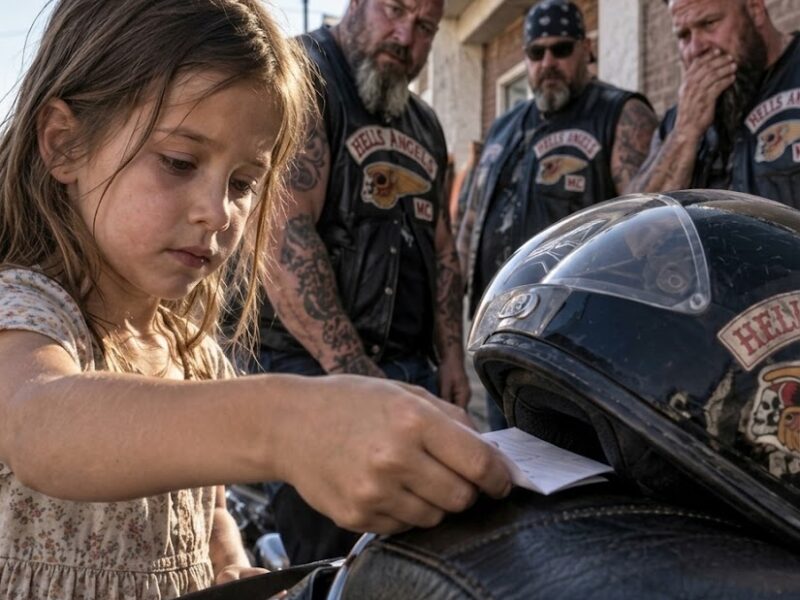
A girl slipped a handwritten note under every single biker’s helmet — and what it said stopped the entire club cold.
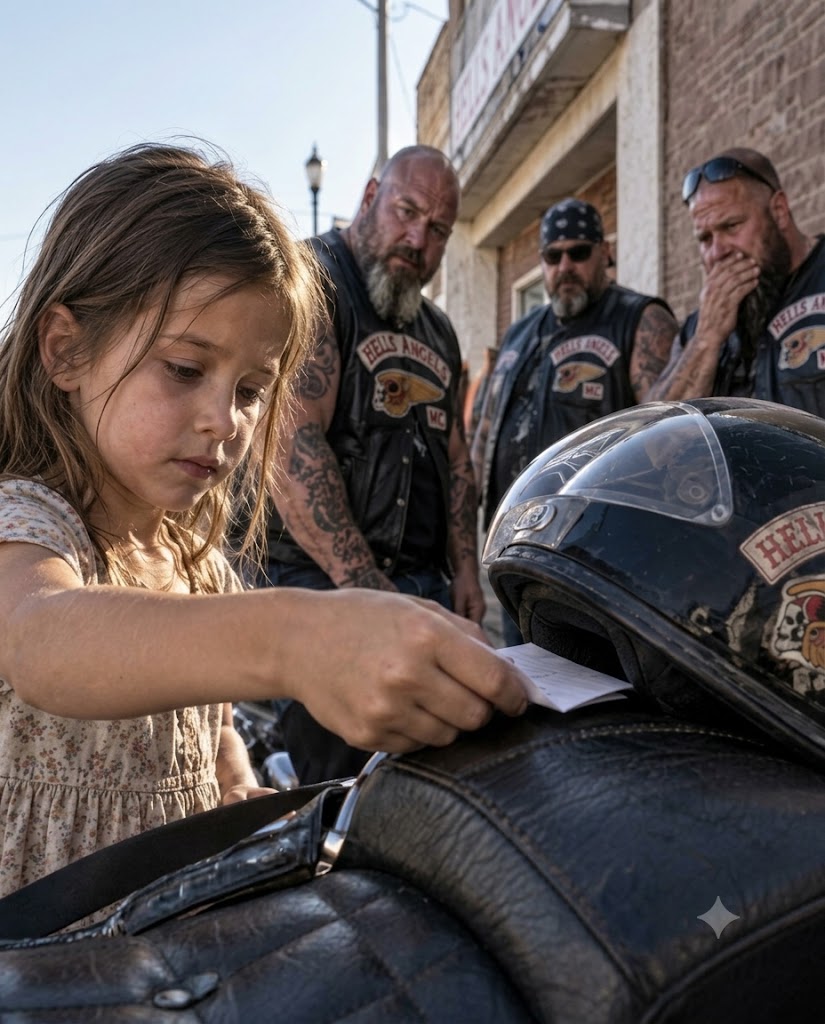
She folded the note with shaking hands, standing alone in a biker clubhouse parking lot before sunrise, terrified of being caught doing something she couldn’t fully explain.
Seventeen years ago, one of these men had ridden into a blizzard to save her mother’s life and her own.
Nobody knew which one.
Nobody had ever been thanked, so she started leaving notes one at a time under different helmets, hoping someone would recognize the story.
She never expected the whole club to start searching for her.
She never expected the answer to walk up behind her in the cold, calling her by name, already knowing exactly who she was.
—
Sarah Whitfield had worked the early shift at the Blue Kettle Diner for almost a year, and in that time, she had learned the rhythm of Milldale, Ohio, better than she knew her own heartbeat.
The town woke up slow.
Frost clung to the windows of Main Street through most of March, and the corn fields on the edge of town stayed brown and stubbled until well into April.
By 6:00 in the morning, the only sounds outside were the hiss of the coffee machine and the distant rumble of engines from the garage two blocks down—the clubhouse of the Iron Anchors Motorcycle Club.
She was seventeen, quiet in the way people mistake for shyness, though it was really just carefulness.
Her mother, Diane, waited tables at the same diner most afternoons, and between the two of them, they kept the lights on in the small rented house on Poplar Street.
Sarah’s father had died when she was three, a construction accident that she remembered only in fragments—more feeling than memory.
What she did remember vividly was a story her mother told her every year on the anniversary of his death.
That in the worst week of her life, a group of strangers on motorcycles had appeared and made sure she and her baby daughter didn’t fall through the cracks.
Diane never had all the details.
She knew there had been an ambulance ride through a snowstorm, a stretch of Route 9 that should have been impossible, and a stranger in a leather jacket who had ridden ahead of the ambulance the whole way, clearing a path, flagging down a snowplow, refusing to let the storm win.
She knew that afterward, when the funeral costs threatened to bury her along with her grief, an envelope of cash had appeared on her porch with no name attached.
She knew the Iron Anchors had, for two years after that, quietly left firewood on her steps every winter without ever knocking on the door.
But she never learned who had organized it.
The club had a strict, almost old-fashioned code about that kind of thing.
Help was given, not advertised.
When Diane once worked up the courage to walk into the clubhouse and ask the man behind the counter, a broad-shouldered rider named Curtis Boone, he had simply told her, “Ma’am, we don’t do this for thank-yous,” and changed the subject.
Sarah grew up half in awe of the club and half afraid of it.
The Iron Anchors were loud, tattooed, unshaven men—and a few women—who rode in from all over the county on weekends, and Milldale’s polite society tended to whisper about them the way people whisper about anything they don’t understand.
But Sarah had also seen them fill grocery bags at the food pantry every Thanksgiving.
She had seen them escort funeral processions for veterans with more solemnity than the town’s own police department managed.
And she had seen, every single year without fail, a folded fifty-dollar bill left under the diner’s sugar dispenser on the anniversary of her father’s death.
No note.
No name.
Just a fact repeated so many times it had become a kind of unspoken promise.
This year, something in Sarah decided the promise deserved an answer.
It started small.
She noticed that the club’s president, James Callaway—a broad, silver-bearded man in his late fifties who had led the Iron Anchors for over two decades—had begun looking tired in a way that worried the regulars at the diner.
Membership was down.
Younger riders were drifting to cheaper clubs two counties over, and the clubhouse’s roof needed repairs the treasury couldn’t quite cover.
Curtis mentioned, low and unguarded one morning over black coffee, that James had started talking about maybe letting the whole thing go quiet.
Sarah, wiping down the counter three stools away, felt something tighten in her chest at those words.
She didn’t fully understand yet why it hit her so hard.
It wasn’t until that night, lying awake in her small bedroom, listening to the wind rattle the window frame, that she put it together.
The club that had once ridden through a blizzard to save her mother’s life was quietly giving up, and almost nobody outside its own members would ever know what it had done to deserve saving in return.
The next morning before her shift, Sarah sat at the kitchen table with a pad of yellow note paper and a pen that kept skipping.
She didn’t know exactly what she wanted to say.
She only knew that somebody in that clubhouse—she didn’t even know which one, not for certain—had once ridden into a snowstorm for a widow he had never met, and that this fact deserved to exist somewhere outside of her mother’s memory.
She wrote: “You probably don’t remember doing it, but seventeen years ago, someone from your club rode through a snowstorm for a woman named Diane Whitfield and her baby girl. That baby is alive because you didn’t stop. Thank you.”
She folded it into a small, tight square.
Then she did something that terrified her more than she expected.
She walked down to the clubhouse parking lot before sunrise, when the row of parked motorcycles sat glistening with dew and nobody was awake to see her, and she slipped the note under the strap of the nearest helmet.
She didn’t sign it.
She didn’t wait around.
She went to work, poured coffee with shaking hands, and told herself it was a small, harmless thing—a single note under a single helmet that would probably be forgotten by lunchtime.
She had no idea it was only the beginning.
—
The note belonged to a man named Mike Sullivan, one of the newer Iron Anchors, only two years into his patch.
He found it at seven that morning, squinting at the unfamiliar handwriting in the cold parking lot light, and read it twice before he understood it wasn’t a joke.
He didn’t recognize the story.
He’d only moved to Milldale five years ago.
But something about the plain, unpolished honesty of it stuck with him all day.
That evening at the weekly club meeting, he read it aloud, mostly as a curiosity.
The room went quieter than Mike expected.
Curtis Boone set down his coffee mug.
Frank Dawson, the club’s oldest surviving founding member, rubbed a hand over his face and said nothing for a long moment.
And James Callaway, sitting at the head of the scarred wooden table that had anchored two decades of meetings, went very still.
“Diane Whitfield,” James said finally, like the name had weight he hadn’t expected to carry again.
“I haven’t heard that name in years.”
He didn’t explain further that night, and nobody pushed him.
But something shifted in the room.
A kind of quiet electricity.
The sense of a door creaking open on a room nobody had entered in a long time.
Three days later, a second note appeared.
This one tucked beneath the mirror of Frank Dawson’s Harley.
“My mom said one of you gave her firewood every winter for two years and never once let her thank you for it. I don’t know your name, but I know what you did, and it mattered.”
Frank read it standing in the cold, and for the first time in longer than he could remember, the old biker had to walk around the block before he trusted himself to go back inside.
Sarah kept writing.
She told herself each time that it would be the last one, that she’d said her piece, that the debt—if it could even be called that—had been acknowledged.
But every night, lying in bed replaying her mother’s stories, she found another detail worth putting into words.
The ambulance escort.
The anonymous envelope.
The Thanksgiving groceries that had shown up on their porch three separate years when money was especially tight.
Each memory became a note, and each note found its way before dawn under a different helmet in that parking lot.
The Iron Anchors began to notice a pattern nobody could quite name.
The notes were never signed, always in the same careful handwriting, always specific enough to prove they weren’t guesswork.
Dates.
Small details.
The exact color of a truck that had once pulled a stranded family out of a ditch during a summer flood.
Whoever was writing them clearly wasn’t inventing gratitude.
They were returning it.
—
James Callaway found his own note on a Tuesday, tucked into the strap of his helmet exactly the way the others had described.
He unfolded it, standing alone in the garage, and the words hit him harder than he expected.
“I don’t know if it was you specifically, but someone from your club rode ahead of an ambulance in a blizzard once, clearing the way for a woman and her newborn daughter. I am that daughter. I’m alive because somebody refused to let a storm decide whether my mother and I made it to the hospital. I don’t need to know who it was. I just needed you to know it mattered, even seventeen years later.”
James sat down on an overturned crate, note in hand, and didn’t move for a long time.
He remembered that night better than almost any other in his life.
He remembered the ice on Route 9, the ambulance’s tires spinning uselessly, the moment he’d made the decision to gun his own bike out ahead of it into the whiteout, trusting instinct and twenty years of riding those roads more than he trusted his own eyesight.
He remembered flagging down a county snowplow driver he barely knew and half shouting him into clearing a lane.
He remembered afterward telling no one the full story, because in his mind it hadn’t been heroism.
It had simply been the only decent thing to do.
He had never once imagined that baby growing up, going to school, pouring coffee two blocks away at the Blue Kettle Diner every single morning he walked past on his way to open the clubhouse.
He started asking around carefully, discreetly.
Who delivers mail to this stretch of the lot before sunrise?
Who’s been seen near the bikes early in the morning?
It was Curtis, of all people, who put it together first—not through detective work, but through memory.
“Whitfield,” he said slowly one afternoon.
“Diane’s girl works at the diner now. Sarah, I think her name is. Quiet kid. Good worker.”
James didn’t say anything for a long moment.
Then he asked Curtis not to tell anyone else what he suspected.
Not yet.
He wanted, he said, to be sure before he did anything that might embarrass her or make her feel like her privacy had been violated.
Whatever she was doing, she was doing it without asking for anything in return, and James understood better than most the particular dignity of help offered anonymously.
But the club itself was changing in ways nobody had planned.
Membership meetings that had grown quiet and discouraged over the past year suddenly had an undercurrent of purpose again.
Frank Dawson started talking about fixing the clubhouse roof himself instead of waiting for money that might never come.
Mike Sullivan brought his teenage nephew around for the first time in months, wanting him to see what the club actually stood for.
The notes, whoever was writing them, had reminded the Iron Anchors of something they’d started to forget: that the quiet, unthanked things they’d done over the years had never actually disappeared.
They had simply been waiting patiently for someone to remember them out loud.
—
James decided he needed to know more.
Not to expose her, but because for the first time in seventeen years, he wanted to close the loop on a night that had shaped the rest of his life without him ever fully understanding why.
Sarah didn’t know James Callaway suspected her.
She only knew that the parking lot had started to feel different.
That once, arriving before dawn with a note folded in her coat pocket, she’d seen a light on in the clubhouse office and nearly turned back, heart hammering, certain she’d been caught.
She hadn’t been.
But the fear of being caught had started to compete with something else—a growing, uncomfortable awareness that what she was doing had stopped being a private gesture and had become something the whole club was quietly obsessing over.
She heard about it indirectly at the diner.
Curtis came in most mornings for coffee, and one Thursday he mentioned to nobody in particular that somebody’s been leaving notes at the clubhouse.
“Whole place has been talking about it for weeks.”
Sarah kept her eyes on the coffee pot and said nothing, but her hands weren’t quite steady when she poured his cup.
That night, she almost stopped.
She told herself the notes had done what she wanted.
The club seemed livelier, less resigned, and that should have been enough.
But there was one story she hadn’t written yet.
The biggest one.
The one her mother had told her only once, on a night when Diane had had one too many glasses of wine and let her guard down completely.
That after the funeral, when Diane had seriously considered leaving Milldale altogether, unable to imagine raising a baby alone in a town that reminded her of everything she’d lost, someone from the club had shown up at the house.
Not with money.
Not with firewood.
But simply to sit on the porch steps with her for two hours and tell her gently that she wasn’t raising that baby alone, whether she stayed in Milldale or not.
Diane never got his name.
She only remembered that he had a low, steady voice, and that after he left, she had, for the first time since the funeral, believed she might actually survive her own life.
Sarah wrote that note three times before she was satisfied with it, and each draft made her cry harder than the last.
It felt too personal, almost too raw to leave folded under a stranger’s helmet.
But she also felt, with a certainty she couldn’t fully explain, that this particular act of kindness—the one that had asked for nothing and given everything simply by sitting still and listening—deserved to be spoken aloud more than any of the others.
She almost didn’t deliver it.
Standing in the parking lot before dawn, note in hand, she hesitated so long her fingers went numb in the cold.
And that was when she heard footsteps behind her and a voice she recognized from a hundred mornings at the diner counter.
“You’re up early, Sarah.”
She turned, and there was James Callaway standing a respectful distance away, hands in his jacket pockets, his breath fogging in the cold air.
He wasn’t smiling exactly, but there was nothing accusing in his expression either.
For a moment, neither of them said anything.
Sarah’s mind raced through excuses.
She dropped something.
She was cutting through the lot on her way to work.
She had no idea what he was talking about.
But something about his face—patient and unhurried—made the excuses feel pointless.
“I think you already know,” she said finally, her voice barely above a whisper.
James nodded slowly.
“I had a guess. Wasn’t sure until right now.”
Sarah felt the note crumple slightly in her fist.
“I didn’t mean to make it into a whole thing,” she said.
“I just wanted somebody to know it mattered. What you all did. What somebody did seventeen years ago.”
“It mattered,” James said quietly.
“More than you know.”
He didn’t ask her to explain further, and he didn’t press her to hand over the note in her hand.
Instead, he did something that surprised her.
He told her about that night on Route 9 in his own words, for the first time in seventeen years, speaking about it to someone who hadn’t already heard the story secondhand.
He told her about the ice, the ambulance, the decision he’d made in less than a second to ride ahead into a whiteout he could barely see through.
He told her he had never once regretted it, and never once needed thanks for it, and that the notes she’d been leaving had done something he hadn’t realized he needed.
They had reminded him why the club existed in the first place, at a moment when he’d been seriously considering letting it fall apart.
“I’ve been thinking about closing us down,” he admitted, the words clearly costing him something.
“Numbers are low. Money’s tight. I’m tired, Sarah, if I’m honest. But reading those notes—it reminded me that the tired years don’t erase the ones that mattered.”
Sarah felt something crack open in her chest.
Relief, guilt, and a strange, unexpected grief all at once.
“I didn’t want to be the reason you kept going if it’s not what’s right for you,” she said.
“You’re not the reason,” James said.
“You’re the reminder. There’s a difference.”
He glanced at the folded note still clutched in her hand.
“You don’t have to give me that one if you’re not ready.”
Sarah looked down at it.
The story of her mother on the porch steps, of a stranger’s steady voice convincing a grieving widow she could survive, and found, unexpectedly, that she wanted him to have it after all.
Not folded under a helmet in secret, but here, now, handed directly to the man who might have been the one who said those words seventeen years ago.
She held it out.
James took it slowly and read it standing there in the cold parking lot, his jaw tightening as he reached the final lines.
When he looked up, his eyes were wet, and for the first time since she’d met him, Sarah saw the club president not as an intimidating figure from the edge of town, but as a man who had carried a piece of her family’s history quietly, without ever needing credit, for almost two decades.
“That was me,” he said finally, his voice rough.
“The porch. I remember it because it was the hardest conversation I ever had, and the only thing I could think to do was stay until she stopped shaking.”
Sarah didn’t trust her voice enough to answer.
She simply nodded, and for a long moment they stood together in the cold, silent, while the sun began to rise over Milldale’s rooftops.
—
James didn’t intend to tell the rest of the Iron Anchors right away.
He wanted to give Sarah time to decide on her own terms whether she wanted her identity known beyond the two of them.
But secrets in a small clubhouse rarely survive long, and less than a week later, Curtis Boone noticed James tucking a familiar folded note into the inside pocket of his jacket.
The same handwriting the whole club had been puzzling over for weeks.
“You know who it is,” Curtis said—more statement than question—cornering James by the coffee machine after the Tuesday meeting.
James considered lying, then decided against it.
He trusted Curtis, and more than that, he understood that this story—all of it, the ambulance, the firewood, the porch steps—belonged to the club as much as it belonged to him.
He told Curtis everything, quietly, in the emptying garage, and watched his old friend’s face shift from disbelief to something close to reverence.
“Sarah Whitfield,” Curtis said finally.
“The diner girl. She’s been standing three feet from us every single morning.”
Word moved through the club faster than James expected, though not maliciously—more like a current finally allowed to flow after being dammed for weeks.
By Thursday, every member of the Iron Anchors knew that the anonymous notes had come from Diane Whitfield’s daughter, the same widow the club had quietly supported for seventeen years without ever expecting recognition.
The reaction wasn’t what Sarah feared.
She had braced herself in the days after her conversation with James for the possibility that the club might feel exposed or embarrassed, that the code of silent generosity she’d unknowingly broken might cause resentment.
Instead, when she showed up for her shift that Friday, she found Frank Dawson waiting at the counter of the Blue Kettle Diner, out of his usual leather jacket, sitting stiffly on a stool like a man unused to asking for things.
“I wanted to say something to you directly,” he said when she approached, notepad in hand out of habit.
“About the firewood.”
Sarah felt her face go warm.
“You don’t have to—”
“I know I don’t have to,” Frank interrupted gently.
“I want to. It was my idea back then. Splitting the wood, dropping it off at night so your mother wouldn’t feel like she owed anybody anything. I did it because somebody did something like it for my own mother years before that, and I figured the favor deserved to keep moving instead of stopping with me.”
He paused, visibly working to keep his voice steady.
“I never expected to hear, all these years later, that it actually helped. That it mattered to a little girl who grew up to write it all down for us.”
Sarah didn’t trust herself to speak, so she simply nodded, blinking hard against the sudden sting in her eyes.
Over the following days, similar moments repeated themselves in different forms.
Mike Sullivan, who had found the very first note, sought her out to admit that reading it had been part of what convinced him to stay in the club during a rough patch of his own life when he’d been seriously considering quitting.
An older member named Robert Harris, who Sarah barely knew, told her that the notes had reminded the whole club why they’d started riding in the first place.
Not for the image.
Not for the noise.
But for moments exactly like the one on Route 9 that nobody outside the club had ever properly understood.
—
Not everything about the sudden exposure was comfortable.
Diane Whitfield, hearing secondhand from a neighbor that her daughter had been sneaking out before dawn to leave notes at the biker clubhouse, confronted Sarah at home with a mixture of worry and disbelief.
“You went down there alone before sunrise for weeks.”
Diane’s voice cracked with the particular fear of a mother realizing her child had been taking risks she never knew about.
“Sarah, anything could have happened to you.”
“I wanted them to know,” Sarah said, struggling to explain a decision that had felt so clear in the moment and so complicated now under her mother’s worried gaze.
“I wanted somebody to say it mattered. What they did for us. I didn’t think—I didn’t think it would turn into all of this.”
Diane sat down heavily at the kitchen table, some of the anger draining out of her as quickly as it had appeared, replaced by something closer to grief.
“I never told you everything,” she admitted quietly.
“About that year. I didn’t want you to grow up thinking your existence was built on other people’s charity.”
“It’s not charity,” Sarah said, surprising herself with the certainty in her own voice.
“It’s just what people do for each other sometimes when it counts. I’m not ashamed of it. I don’t think you should be either.”
Mother and daughter sat with that for a long moment, the kitchen quiet except for the hum of the old refrigerator.
It was Diane, finally, who broke the silence, asking the question that had clearly been building in her since she’d first heard the story from the neighbor.
“Do you know who it was? On the porch that night?”
Sarah nodded slowly.
“It was James. James Callaway.”
Diane’s hand went to her mouth, and for a long moment she said nothing at all.
Seventeen years of unanswered wondering, finally settling into an actual name, an actual face she had seen at the diner counter more times than she could count, without ever once suspecting the connection.
—
Two nights later, the Iron Anchors held an unusual meeting.
Not about club business, dues, or repairs, but about Sarah herself.
James stood at the head of the table and told the room plainly that the club owed her more than gratitude.
She had reminded twenty-some grown adults, in the middle of their most discouraged year in over a decade, exactly why the patches on their backs meant something.
The question on the table now, James said, was what the club wanted to do about it.
Not to repay her, because the point of what they’d done for her family had never been about repayment, but simply to make sure she knew the door of the Iron Anchors’ clubhouse would always, from now on, be open to her and her mother.
Not as charity cases.
As family.
The vote to formally invite Sarah and Diane to the club’s annual spring gathering, usually reserved for members and their immediate families, passed unanimously with a kind of enthusiasm the room hadn’t shown in months.
The spring gathering fell on a clear, cold Saturday in April, the first genuinely warm-feeling day Milldale had seen since October.
The clubhouse parking lot, usually reserved for motorcycles lined up in neat, silent rows, filled instead with folding tables, borrowed grills, and the noise of nearly thirty people who had built an entire community out of loyalty that asked for nothing in return.
Sarah arrived with her mother a little after noon, both of them nervous in a way neither quite admitted out loud.
Diane had dressed carefully, unsure what to wear to an event that felt both like a celebration and a long-delayed reunion with a debt she had never known how to repay.
Sarah wore her one good jacket, hands stuffed in the pockets, scanning the crowd for a face she now recognized easily among the club’s roughly thirty members.
James found them first, cutting through the crowd with the easy authority of a man who had led this group for twenty years.
He shook Diane’s hand, then held it a moment longer than a simple greeting required.
“Diane,” he said.
“It’s been a long time.”
“Seventeen years,” Diane said, her voice unsteady.
“I never got to thank you properly. For any of it.”
“You don’t need to,” James said, echoing almost word for word the same thing he’d told Sarah in the parking lot weeks earlier.
“But I understand why you might want to say it anyway.”
Diane did say it, haltingly, through tears she didn’t bother hiding, standing in the middle of a gravel lot surrounded by strangers who no longer felt like strangers at all.
She thanked James for the ambulance escort she barely remembered through her own shock and grief that night.
She thanked Frank Dawson, who appeared at her side partway through, for the firewood that had kept her daughter warm through two brutal winters.
She thanked Curtis Boone for turning away her attempts at repayment with a stubbornness that she said she finally understood.
The club, in turn, had prepared something of its own.
Robert Harris, it turned out, had spent the past two weeks organizing a small collection among the members—not extravagant, but meaningful enough to cover a semester of the community college courses Sarah had quietly given up hope of affording.
When Frank handed her the envelope, Sarah initially tried to refuse it, some old instinct telling her that accepting help meant admitting she needed it.
It was James who stopped her, his hand resting briefly on her shoulder.
“You spent weeks reminding this club that debts of kindness don’t need paying back,” he said.
“Let us pay this one forward instead. Not because you owe anybody anything—because that’s what we do for family.”
Sarah looked at the envelope, then at the faces surrounding her—Frank, Curtis, Mike, Robert, and a dozen others she was only beginning to know by name—and understood finally what her mother must have felt seventeen years ago on that porch step.
The particular, humbling relief of realizing you are not facing your life alone, even when you never asked anyone to notice.
She accepted the envelope.
—
Later that afternoon, as the gathering wound down into quiet conversation and the smell of grilled food drifted over the lot, James pulled Sarah aside one more time.
Away from the crowd, near the same stretch of pavement where she had once folded her very first note.
“I want you to know something,” he said.
“I was ready to shut this club down before your note started showing up. I’d convinced myself we didn’t matter anymore. That the good we used to do had gotten lost somewhere along the way, buried under bills and low membership and a whole lot of tired years.”
He paused, looking out over the crowded lot, the sound of laughter carrying across the gravel.
“You didn’t just thank us, Sarah. You reminded us who we still are underneath all that tired. I don’t think you fully understand what that’s worth.”
Sarah thought of the years of silent fifty-dollar bills under the sugar dispenser.
Of firewood that appeared without explanation.
Of a stranger’s steady voice on a porch step that had convinced her mother to keep going.
She thought of how easily all of it could have stayed buried, unspoken, eventually forgotten entirely as the people who remembered it grew older and quieter.
“I think I understand,” she said finally.
“Because that’s exactly what you all did for us. You made sure something mattered even when nobody was watching.”
James nodded slowly, something like relief settling into his features.
“Then I guess the club’s in good hands,” he said.
“Yours someday, if you ever want it.”
Sarah laughed, surprised, brushing away the sudden warmth in her eyes.
She hadn’t expected an answer that large, not that afternoon.
But standing there in the spring sunlight, surrounded by people who had quietly shaped the entire course of her life without ever asking for thanks, she found she wasn’t ready to say no.
Some debts, she was learning, were never meant to be paid off completely.
They were meant to be carried forward instead.
Quietly.
Patiently.
One note, one favor, one unremarkable act of decency at a time, until an entire town, without quite realizing it, had been stitched together by kindness nobody ever bothered to advertise.
And for the first time since her father died, Sarah Whitfield felt—standing in that gravel lot full of leather jackets and borrowed folding chairs—like she had finally found the family her mother had once been too afraid to believe still existed.
—
The weeks that followed the spring gathering settled into something Sarah hadn’t expected: normalcy, but a different kind.
She still worked the early shift at the Blue Kettle Diner.
She still poured coffee for Curtis Boone most mornings, though now he always greeted her by name and sometimes left a folded twenty under his mug with a wink that said he knew exactly how much a semester of community college cost these days.
The clubhouse parking lot, once a place of secret missions and racing heartbeats, became something else entirely.
Sarah started stopping by after her shifts, at first hesitantly, then more naturally, until the sight of her cutting across the gravel with her apron still tied around her waist stopped being unusual and started being expected.
Frank Dawson taught her how to check the oil on a motorcycle, grumbling the whole time about kids these days not knowing basic maintenance.
Mike Sullivan introduced her to his nephew, a shy sixteen-year-old named Danny who reminded Sarah so much of herself at that age that she started tutoring him in math on Tuesday afternoons.
James Callaway, for his part, treated her with a quiet, steady warmth that never quite tipped into fatherly—he was too careful for that, too aware of the boundaries—but that made her feel, for the first time in her life, like there was someone in Milldale who would notice if she disappeared.
The club’s roof got fixed that summer.
Not with a contractor, but with a Saturday work party that involved eleven members, three ladders, two cases of beer, and a lot of good-natured arguing about the proper way to shingle a roof.
Sarah brought lemonade and sandwiches and stayed until the sun went down, and when James climbed down from the ladder, sweaty and sore and grinning in a way she’d never seen before, she understood that the notes had done something she hadn’t fully anticipated.
They had reminded the Iron Anchors that they were still capable of taking care of their own.
That the club wasn’t just a building with a failing roof and a shrinking treasury.
It was a promise, kept quietly, year after year, whether anyone noticed or not.
—
The anniversary of her father’s death came around again in late October, same as it always did.
Sarah woke up that morning with the familiar weight in her chest, the old grief that never quite went away but had learned, over the years, to sit quietly in the background.
She went to work.
She poured coffee.
She smiled at the regulars and pretended, as she always did, that this day was just like any other.
But when she walked past the sugar dispenser on her way to clear table six, she noticed something different.
There was the folded fifty-dollar bill, same as always.
But underneath it, for the first time in seventeen years, there was also a note.
Handwritten, in careful block letters she didn’t recognize.
“We know who you are now. We always knew what you meant to us. But now we know your name, and we wanted you to know ours. The Iron Anchors. Milldale, Ohio. Family.”
Sarah read it three times, standing frozen in the middle of the diner with a coffee pot in one hand and her heart in her throat.
Then she folded it carefully, tucked it into the pocket of her apron, and went back to work.
But something in her chest had shifted.
Something that had been tight for as long as she could remember had finally, quietly, let go.
—
That evening, after her shift, Sarah walked down to the clubhouse.
Not before dawn this time.
Not in secret.
She walked in the front door, past the row of motorcycles parked in neat, silent rows, and found James Callaway sitting at the scarred wooden table with a cup of coffee and a stack of paperwork he clearly wasn’t reading.
He looked up when she walked in, and something in his expression softened.
“You got the note,” he said.
It wasn’t a question.
Sarah nodded, pulling the folded paper from her apron pocket.
“I got the note.”
She sat down across from him, and for a long moment neither of them said anything.
The clubhouse was quiet, the way it always was in the evenings, the kind of quiet that felt less like emptiness and more like rest.
“I used to think,” Sarah said finally, “that the story my mom told me was about a debt. Something I owed. Something I had to figure out how to repay, even though I never knew who to repay it to.”
She looked down at the note in her hands.
“But it was never about that, was it?”
James shook his head slowly.
“No,” he said.
“It was never about that.”
“Then what was it about?”
James was quiet for a long moment, his eyes fixed on something in the middle distance, some memory Sarah couldn’t see.
“It was about showing up,” he said finally.
“That’s all. When somebody’s in trouble, when somebody’s alone, when somebody’s just barely hanging on—you show up. You don’t ask for credit. You don’t wait to be asked. You just show up, and you do what you can, and then you go home and you don’t think about it again.”
He looked at her then, really looked at her, and Sarah saw something in his eyes that she hadn’t seen before.
Not guilt.
Not pride.
Just a kind of quiet, steady certainty.
“The notes you wrote,” he said, “reminded us of that. Reminded us that showing up matters, even when nobody’s watching. Especially when nobody’s watching. And that’s—” He paused, searching for the words.
“That’s worth more than you know.”
Sarah sat with that for a moment, turning it over in her mind.
Then she did something that surprised them both.
She reached across the table and took his hand.
Not a handshake.
Not a gesture of gratitude.
Just a hand, held, the way family holds each other when there’s nothing left to say.
James didn’t pull away.
He just sat there, holding her hand across the scarred wooden table, in the quiet clubhouse, in the town that had raised her, surrounded by the ghosts of every good deed the Iron Anchors had ever done and never once mentioned.
And for the first time in seventeen years, Sarah Whitfield felt like she was exactly where she was supposed to be.
—
The spring gathering became an annual tradition.
Not just for the Iron Anchors, but for Sarah and Diane, who by the following year had become something like fixtures at the clubhouse—Diane bringing her famous cornbread to every potluck, Sarah helping Frank with the books when the treasury got tight.
The notes stopped, eventually.
Not because Sarah ran out of stories, but because she didn’t need to leave them in secret anymore.
She could walk into the clubhouse any time she wanted and say what she needed to say out loud, to people who knew her name, who knew her mother’s name, who knew exactly what had been done and why it mattered.
But she kept every single note she’d ever written.
Folded into a small, tight square, tucked into a shoebox under her bed, the same way she’d once tucked them under helmets in the cold parking lot before dawn.
She kept them because they were proof.
Proof that a seventeen-year-old girl with shaking hands and a pen that kept skipping had once decided that a quiet, unthanked kindness deserved to be remembered.
Proof that showing up matters.
Proof that even the smallest act of decency, offered without expectation, can ripple outward in ways nobody can predict.
And every year, on the anniversary of her father’s death, Sarah walked into the Blue Kettle Diner, poured herself a cup of coffee, and sat at the counter for a few minutes before her shift.
Just to remember.
Just to be grateful.
And every year, without fail, she found a folded fifty-dollar bill under the sugar dispenser.
No note.
No name.
Just a fact, repeated so many times it had become a kind of unspoken promise.
The Iron Anchors were still showing up.
They would always show up.
And Sarah Whitfield, the girl who had once left notes under helmets in the dark, was finally, fully, completely home.
—
**THE END**









