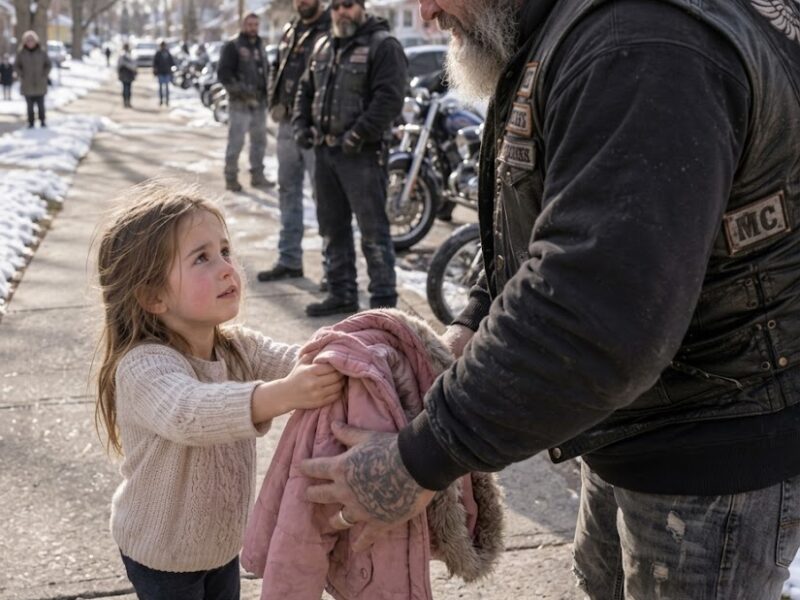
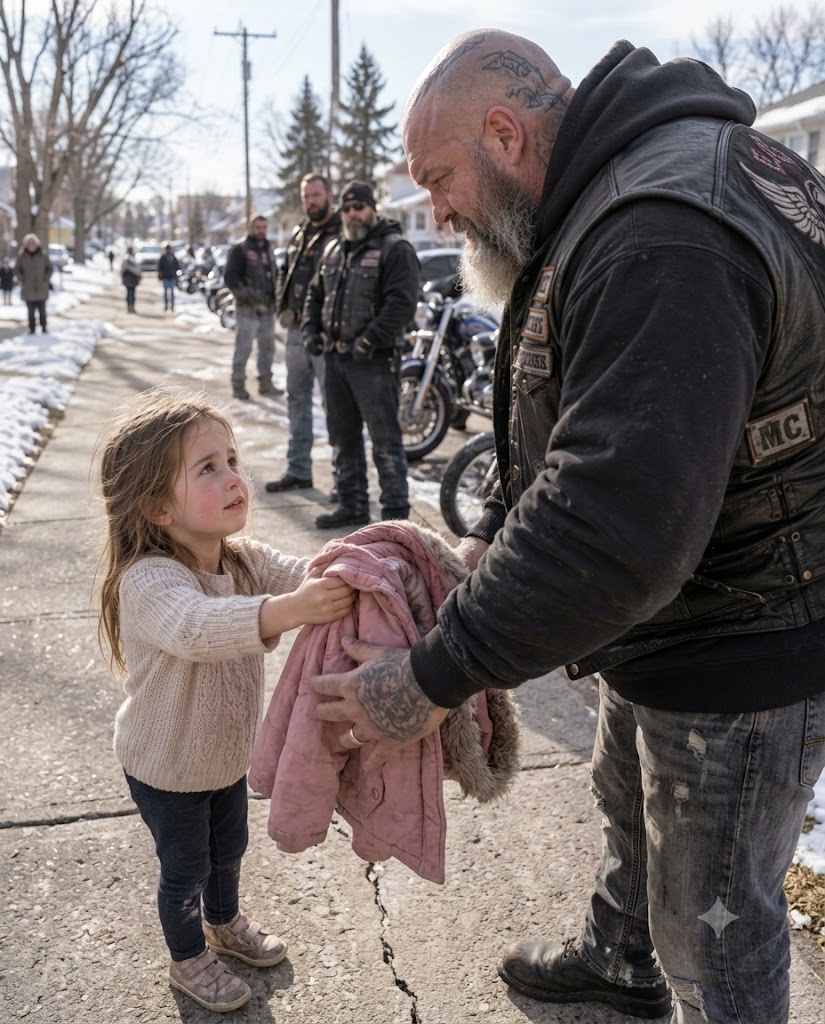
A girl gave her only coat to a freezing biker on a bitter winter night — and when 500 riders found out, they showed up the next day.
The thermometer nailed to the porch post read 11 degrees, and Sophie Bennett had stopped believing in numbers like that anymore.
Numbers were just another thing life threw at her these days — the balance on the electric bill, the days left before rent was due, the hours until her mother’s shift ended at the diner on Route 9.
Eleven degrees was just cold. She’d felt colder.
Millbrook, Ohio, in the last week of January looked like a photograph someone had drained of color. Snow lay gray along the roadsides, the sky sat low and heavy, and the wind came down from Lake Erie with nothing to slow it once it hit the flat county road that led past the Bennett house.
Sophie pulled her coat tighter — an old navy wool coat with a tear in the left pocket lining she’d sewn twice — and kept walking toward the gas station where she worked three evenings a week after school.
It wasn’t much of a life at seventeen, but it was hers.
Her father had died four years ago, a heart attack while shoveling the driveway. Since then, it had been just Sophie and her mother, Karen, stretching a waitress’s paycheck across a mortgage that never seemed to shrink.
Sophie didn’t complain. She’d learned early that complaining didn’t heat a house or pay a bill.
She worked and walked and kept her head down against the wind.
She was three-quarters of a mile from the gas station, passing the spot where County Road 12 curved along an open field, when she saw the motorcycle.
It was tipped against the guardrail, chrome dulled with road salt, and beside it sat a man on the frozen shoulder, hunched so far into himself that at first Sophie thought he might be asleep.
Nobody rode a motorcycle in January in Ohio unless something had gone very wrong, and something clearly had.
His jacket was leather, built for wind but not for 11 degrees, and his hands — bare — were tucked so deep into his armpits that his shoulders had curled forward like a man trying to disappear into his own chest.
“Sir,” Sophie called out.
When he lifted his head, she saw a face rawdened by the cold and eyes that looked more embarrassed than afraid.
“Bike ran out of gas about two miles back,” the man said, his voice rough. “Walked it this far. Wasn’t smart. Didn’t figure on the wind.”
“Do you have a phone?”
“Dead. Dropped it back at the last stop. Cracked the screen.” He tried to laugh, but it came out as more of a shudder. “Bad day.”
Sophie looked down the empty road in both directions. No cars. The gas station was still half a mile off, and by the time she got there and got someone to come back, this man’s body temperature would have dropped further.
And Sophie had sat through enough health classes to know what that meant.
His lips had gone a shade of purple-gray she didn’t like at all.
She didn’t think about it the way people think about big decisions in movies. She didn’t weigh the cost of a coat against the wind chill or calculate how she’d get through her own walk without it.
She just took it off — the navy wool coat with the mended pocket — and held it out.
“Put this on now. We’re not standing here arguing about it.”
The man stared at the coat like she’d offered him something impossible.
“I can’t take a kid’s coat, sweetheart. You’ll freeze.”
“I’ve got a hoodie under this, and I’m three minutes from indoor heat. You’re not. Put it on.”
Something in her voice — flat, certain, no room for argument — made him do it.
His hands shook too badly to work the buttons, so Sophie did them herself, tugging the collar up around his neck.
“Name’s Derek,” he said through chattering teeth. “Derek Whitfield.”
“Sophie. There’s a gas station a half mile up. I’ll call somebody for you from there — a tow truck or the sheriff, whatever you need. Can you walk?”
He could. Slowly, leaning on her more than either of them wanted to admit, and the two of them made their way up County Road 12 with the wind cutting through Sophie’s thin hoodie like it was nothing at all.
She didn’t tell him it hurt. She didn’t tell him her teeth were starting to chatter, too.
She just kept walking, one arm looped through his, because that was what you did when someone needed help and you were the only one there to give it.
At the gas station, the clerk — a heavyset man named Gary who Sophie had worked alongside for a year — took one look at Derek’s face and hustled him toward the space heater without asking a single question.
Sophie called the county sheriff’s non-emergency line, gave the mile marker where the bike sat, and sat across from Derek while color slowly returned to his face.
“You didn’t have to do that,” he said again, quieter this time. “Coat like that. Looked like it mattered to you.”
Sophie shrugged. It had been her father’s coat, actually, resized by her mother two winters ago because a good coat was a good coat and there hadn’t been money for a new one.
But she didn’t say that. Some things you didn’t hand a stranger along with your coat.
“You looked like you needed it more than I did today,” she said instead. “That’s all.”
Derek studied her for a long moment — the kind of look that made Sophie feel like he was trying to memorize her face.
Then he asked for her last name, which she gave without thinking much of it.
“Bennett,” she said. “Sophie Bennett.”
Because polite people asked names, and this had been, on the whole, a very polite and very cold half hour.
She didn’t ask why he wanted it. She had a shift to start and a coatless walk home ahead of her once it ended, and neither of those things left much room for wondering about a stranger’s motives.
She had no way of knowing that Derek Whitfield rode with two hundred men and women who considered him something close to family, or that within an hour of being loaded into a tow truck’s cab, he would be calling a number that half of Eastern Ohio’s motorcycle clubs had saved in their phones.
She only knew that the wind was murderous, that her shift started in eight minutes, and that somewhere behind her, a torn-up coat with a mended pocket was doing its job.
—
The clubhouse of the Steel Wolves Motorcycle Club sat on the edge of Ashford, twenty minutes from Millbrook, in a converted feed warehouse with a wood stove that ran hot enough to make grown men strip down to T-shirts in the dead of winter.
By the time Derek Whitfield walked through its doors that evening — wrapped in a blanket the tow truck driver had produced from somewhere, wearing a girl’s navy wool coat that fit him wrong in the shoulders — the story had already started to travel ahead of him.
“That the coat?” asked Marcus Hale, the club’s sergeant at arms, a broad-shouldered man in his fifties who’d ridden with Derek for going on eighteen years.
Hale had gotten the call from the tow company, who knew him because everybody in a fifty-mile radius knew the Steel Wolves, and he’d been the first one waiting at the clubhouse door when Derek arrived.
Derek nodded, still not quite over the shock of the last four hours.
“Kid gave me the coat off her own back. Middle of the county road. Didn’t ask my name till after. Didn’t hesitate for one second, Marcus. I’ve seen grown men flinch from less.”
Word moved through the Steel Wolves the way it always did — not through announcements, but through conversations at the bar, through phone calls between members who hadn’t made it to the clubhouse that night, through the particular gravity that certain stories carried among people who valued loyalty above almost everything else.
By the time the club’s president, a stocky, quiet man named Owen Pratt, walked into the main room and heard the story secondhand, it had already taken on the shape of something larger than one cold afternoon.
“You get her full name?” Pratt asked.
“Sophie Bennett. Works part-time at the Sunrise Gas Station off County 12. That’s all I got.”
Pratt was quiet for a moment, turning a coffee mug slowly on the bar top. He was not a sentimental man by nature — the club had learned that about him over the years, in the careful, measured way he handled disputes and the way he never raised his voice even when situations called for it.
But something about this particular story seemed to catch on him like a hook.
“Anybody know the Bennett family? Millbrook side.”
A woman near the back of the room — Riley Ford, who ran a small auto shop and had grown up two towns over — spoke up.
“Bennett? That’s Karen Bennett’s girl, I think. Karen’s a waitress, works the diner on Route 9. Husband died a few years back. Heart attack. I remember because my aunt used to sit with Karen at church functions before all that happened.”
The room went quieter at that.
It was one thing to hear that a stranger had shown kindness to a stranded biker. It was another to learn that the kindness had come from a girl whose family had already spent years scraping by, who had given away a coat she likely couldn’t afford to replace, without asking a single question about who Derek was or what he could do for her in return.
“That coat,” Derek said slowly, running a thumb along the mended pocket lining. “This wasn’t some spare jacket sitting in a closet. Look how many times this has been fixed up. This was probably the only good coat that girl owns.”
Nobody said anything for a while after that. The wood stove popped and hissed.
Outside, the wind that had nearly killed Derek Whitfield on County Road 12 kept moving east, indifferent, the way weather always was to the small human dramas playing out beneath it.
It was Hale who finally broke the silence.
“So, what do we do about it?”
Owen Pratt set his coffee mug down.
In his years leading the Steel Wolves, the club had done food drives for struggling families, had run supply routes to flood victims two counties over, had escorted funeral processions for veterans nobody else remembered to honor.
But something about this felt different to him — smaller in scope and larger in meaning at the same time.
“We don’t do anything small,” Pratt said finally. “A girl like that, who’d give a stranger the coat off her back without blinking — that’s not something you say thank you for with a card and a gift certificate. We do this right, or we don’t do it at all.”
—
Over the following days, what began as one man’s gratitude became something closer to a movement, though none of the Steel Wolves would have used a word so grand.
Pratt reached out to three other clubs the Wolves had ridden alongside over the years — the Ashford Riders, a smaller crew out of Kettering, and a veterans motorcycle association whose president, a retired Army sergeant named Nathan Cole, had lost his own daughter to leukemia six years before and had never quite recovered his footing since.
When Cole heard the story of the coat, something in his face changed, though he said little about why.
Meanwhile, in Millbrook, Sophie Bennett had no idea that any of this was happening.
She’d gone back to her routine — school, the gas station shift, the walk home in a spare jacket her mother had dug out of the hall closet. Thin and unsuited to the season, but the only thing left in the house.
She hadn’t mentioned Derek Whitfield to her mother beyond a brief “helped some guy whose bike broke down. Gave him my coat. He’ll probably send it back or something,” delivered over a dinner of grilled cheese and canned tomato soup.
Karen Bennett had looked at her daughter for a long moment across the kitchen table.
“You gave away your coat, Sophie. That was your father’s coat.”
“I know, Mom. But he was freezing. What was I supposed to do? Walk past him?”
Karen didn’t have an answer for that. Not really.
She’d raised her daughter to have exactly that kind of heart, and she couldn’t very well be angry about the outcome now.
But the loss of the coat sat uneasily with her all the same — one more small hardship layered onto a winter that had already asked too much of both of them.
The furnace at home had started making a knocking sound that the repairman quoted at four hundred dollars to fix. Karen’s hours at the diner had been cut back after the holiday rush ended.
The numbers — always the numbers — kept refusing to add up.
Sophie didn’t know that four counties away, a room full of leather-clad strangers were turning her name over like something precious, or that Owen Pratt had already begun making calls that would eventually reach far beyond Ashford and Millbrook both.
She only knew that it was cold and getting colder, and that somewhere out there was a coat with her father’s shape worn into the shoulders that she probably wouldn’t see again.
—
By the second week of February, the knocking sound in the Bennett furnace had gotten worse, and Karen Bennett sat at the kitchen table one evening with a stack of bills spread in front of her like a losing hand of cards.
Sophie watched from the doorway, still in her gas station uniform, and felt the particular helplessness of being seventeen and capable of nothing that actually mattered.
Not the mortgage. Not the furnace. Not the slow erosion of her mother’s optimism that Sophie had watched happen in small increments since her father’s death.
“We’ll figure it out,” Karen said, the way she always said it, but her voice had less certainty in it than it used to.
“I could ask for more hours at the Sunrise.”
“You’re already working three nights and keeping your grades up. I’m not taking more from you, Sophie.” Karen rubbed her eyes. “I’ll talk to the bank about the mortgage. Maybe there’s some kind of hardship program.”
Sophie went up to her room that night and sat by the window, looking out at a sky gone the color of a healing bruise — purple, black, with the last light dying at its edges — and let herself feel, for just a few minutes, something she rarely allowed.
The weight of being tired.
Tired of the math that never worked. Tired of watching her mother pretend everything was fine. Tired of missing a father who had been the one person who made all of this feel survivable.
She thought about the years right after her father died — how her mother had tried to shield her from the worst of it at first, paying bills late instead of admitting there wasn’t enough, until the pretending had simply become too heavy to sustain.
Somewhere along the way, Sophie had stopped being a kid who got shielded from things and started being a partner in keeping the household upright.
Most days she didn’t mind it.
Most days.
Tonight, watching the last light fade over the frozen field behind their house, she minded it more than she wanted to admit.
She thought about the coat sometimes, in idle moments — wondered if the biker, Derek, had made it home safely, wondered if he’d ever thought about her again once the emergency of that afternoon had passed.
She didn’t resent giving it away. She would have done it again in a heartbeat.
But some nights, walking home in her mother’s thin spare jacket, with the wind finding every gap in the fabric, she let herself miss its weight.
—
What Sophie didn’t know was that Derek Whitfield had, in fact, thought about her nearly every day since.
He’d returned to County Road 12 twice — once to retrieve his bike, and once a week later simply to look at the guardrail where he’d nearly frozen, trying to understand why a single act of kindness from a teenage stranger had lodged itself so deeply in his chest.
Derek had spent the better part of the last decade keeping people at arm’s length — a divorce eight years back, a falling out with his own daughter that had never properly healed, a slow drift toward isolation that the club had been the only thing preventing from becoming total.
Sophie Bennett’s coat had cut through something in him that he hadn’t expected to feel again.
He’d tried calling his daughter twice since that day on the road, both times losing his nerve halfway through dialing and setting the phone down before it rang through.
It wasn’t that he didn’t know what to say. It was that he’d spent so many years telling himself the silence between them was permanent — a fact of life rather than a choice either of them kept making.
That picking up the phone felt like admitting he’d been wrong the whole time.
A teenage girl on a frozen road had managed in four seconds what eight years of his own stubbornness hadn’t allowed him to attempt.
He wasn’t alone in that.
Nathan Cole, the veterans club president who’d lost his daughter to leukemia, had been unusually quiet since hearing the story.
And one evening in mid-February, he showed up at the Steel Wolves clubhouse with a folder of paperwork and a look on his face that told Hale something significant was coming.
“I did some digging,” Cole said, setting the folder on the bar. “Karen Bennett, the mother. She’s behind on the mortgage. Furnace is failing. Girl’s working three nights a week on top of school just to help keep the lights on. Husband died four years back. No life insurance payout worth mentioning. Hospital bills ate what little there was.”
The room absorbed this in silence.
Owen Pratt picked up the folder and flipped through it slowly — bank notices, a repair estimate for the furnace, the kind of quiet financial catastrophe that happened to good families every day without anyone outside noticing.
“She gave away the coat off her back,” Pratt said finally, “and her family’s barely holding the roof over their own heads. That’s not a coincidence I want to sit with for long.”
Derek, sitting near the wood stove, felt something shift in his chest — a mixture of guilt and resolve that he hadn’t experienced in years.
“I want to be part of whatever we do here. Whatever it costs, whatever it takes.”
“It’s not about one man covering a debt,” Pratt said. “A girl like that doesn’t need charity dropped on her doorstep like she’s a project. She needs to see, in a way she can’t misunderstand, that what she did mattered. That it moved something bigger than herself. That’s a different kind of gift than money.”
—
Over the next two weeks, Pratt’s calls multiplied.
The Ashford Riders committed twenty bikes and their own fundraising effort. The Kettering crew, smaller but fiercely loyal, offered to handle logistics — permits, road coordination, communication with the Millbrook County Sheriff’s Office to make sure five hundred motorcycles descending on a small town wouldn’t cause panic or chaos.
Nathan Cole’s veterans association began a fundraiser that spread through social media faster than anyone anticipated — veterans and civilians alike, contributing in Sophie’s name, without most of them ever having met her, moved simply by the shape of the story.
A girl with almost nothing, giving away the little she had to a stranger who could offer her nothing back.
By the first week of March, the fund had reached a number that made even Pratt sit back in his chair, stunned into something like reverence.
Clubs from three states had asked to join the ride. Local news in two counties had picked up rumors of something being planned, though nobody outside the clubs knew the details yet.
And Derek Whitfield — wearing his own coat again, but carrying Sophie’s memory like a stone in his pocket — found himself standing outside the Sunrise Gas Station on a Tuesday evening in early March, watching through the window as Sophie rang up a customer’s coffee and gas, unaware that in four days’ time her ordinary world was going to change in a way she could never have predicted.
He didn’t go in that night. He wasn’t ready yet, and besides, Pratt had been clear: this needed to be done right, all at once, in a way Sophie would never forget.
Derek got back on his bike — gassed up this time, engine running warm — and rode back toward Ashford under a sky finally, mercifully beginning to soften toward spring.
—
The morning of the ride, Sophie Bennett woke to a knocking sound that wasn’t the furnace.
It was her mother standing in the bedroom doorway with an expression Sophie couldn’t quite read — somewhere between confusion and disbelief.
“Sophie, you need to come look at this.”
From the front porch, the sound reached them before the sight did.
A low, rolling thunder building from the direction of County Road 12, growing steadily louder until it wasn’t a sound anymore so much as a physical presence pressing against the winter air.
Sophie stood barefoot on the cold porch boards, her mother’s hand gripping her shoulder, and watched as the first motorcycles crested the rise on the county road.
Then more. Then more.
Until the entire road, as far as she could see, was filled with riders — engines idling in formation, chrome catching the pale March sunlight like something out of a dream she hadn’t known she was having.
Five hundred riders.
Sophie would learn the exact number later, but in that moment all she understood was scale. An impossible, overwhelming scale.
More motorcycles than she’d ever seen in one place, moving slowly down her street and beginning to fill the field beside her house, engines cutting off one by one until the silence that followed felt almost as loud as the noise had been.
The cold March air carried the smell of exhaust and warm engines, and Sophie became aware, distantly, that half the neighborhood had come out onto their own porches to watch — drawn by the sound the way people are drawn to thunder before they understand whether it means a storm or simply a passing summer sky.
Her mother’s grip on her shoulder had tightened to the point of being almost painful, though Sophie didn’t think either of them noticed at the time.
A man dismounted from the lead bike and walked toward the porch.
It took Sophie a moment to recognize him without the frost and the pain on his face.
Derek Whitfield, in a clean leather jacket, his gray-streaked beard neatly trimmed, carrying something folded over one arm.
“Sophie Bennett,” he said, and his voice cracked slightly on her name. “I don’t know if you remember me.”
“Of course I remember you,” Sophie said, though her voice came out smaller than she meant it to. “Are you okay? You look—”
“I’m alive because of you,” Derek said simply. “That’s the short version. The long version is what brought all these people here today.”
He held out the folded item, and Sophie realized it was her coat.
Her father’s coat — cleaned and repaired, the torn pocket lining fixed properly this time by someone who clearly knew what they were doing with a needle and thread.
She took it with hands that had started to shake, though not from the cold.
“We didn’t just come to give this back,” Derek continued.
Behind him, Owen Pratt and Nathan Cole had dismounted and were walking up the path, along with dozens of others fanning out across the yard — some carrying boxes, some simply standing, watching.
“A girl who’d give away the coat off her back to a total stranger without a second’s hesitation — that’s rare. That’s the kind of person the world doesn’t deserve to lose to hard luck and bad bills. So we did some looking into your situation, and we want you to know that a group effort from riders in three states has covered your family’s mortgage arrears, your furnace repair, and set aside a fund for your college education. Whatever you decide to study.”
Sophie’s mother made a sound behind her that was somewhere between a laugh and a sob, one hand pressed hard against her mouth.
Sophie herself couldn’t speak at all for a long moment, staring at the assembled crowd, at Derek’s face, at the coat in her hands that felt suddenly immeasurably heavier than it had any right to be.
“Why?” she finally managed. “I didn’t do anything special. I just—”
“You gave away the only coat you had to a man who could have been anybody, without asking what was in it for you,” Nathan Cole said, stepping forward. His own eyes were wet, though his voice stayed steady. “I lost my daughter six years ago. Watched a lot of good people turn cold and small after loss like that — myself included, for a long while. And then I hear about a girl who’s had every reason to turn inward, to hold tight to the little she’s got left. And instead she gives it away to a stranger freezing on the side of the road. That’s not nothing, Sophie. That’s the whole thing. That’s what all of us are supposed to be and mostly aren’t.”
Sophie looked out at the field full of riders — men and women of every age, some in club colors from three different states, some veterans standing a little straighter than the rest.
All of them there because of a decision she’d made in about four seconds on a frozen county road, not even thinking of it as a decision at the time, just as the only possible response to a man who was clearly suffering.
“I don’t know what to say,” she admitted.
“You don’t have to say anything,” Owen Pratt told her, his quiet voice carrying easily across the yard. “You already said everything that mattered the day you took off that coat.”
Karen Bennett, still gripping her daughter’s shoulder, finally found her voice.
“This is—I don’t understand how any of you even found us. How you knew—”
“Word travels fast in this world,” Pratt said. “Faster when it’s got something true at the center of it.”
He gestured to the boxes being unloaded from several of the bikes — groceries, Sophie would learn later, along with a new winter coat sized properly for her, a stack of gift cards, and, strangest of all, a hand-carved wooden box that Derek explained had been made by a Steel Wolves member who worked in furniture restoration, meant to hold whatever mattered most to Sophie going forward.
Karen Bennett had gone very still beside her daughter, and when Sophie glanced over, she saw her mother crying openly now, not bothering to hide it, one hand still pressed against her chest as though trying to hold something inside that had grown too large to contain.
“Four years,” Karen said quietly to no one in particular. “Four years of feeling like we were invisible to everybody but the bank.”
“You’re not invisible,” Derek said gently. “You never were. It just took the right moment for the rest of us to notice.”
Sophie put her father’s mended coat on right there on the porch, feeling the familiar weight settle onto her shoulders again, and looked out at five hundred strangers who had become, in the space of one impossible morning, something closer to family than she would ever have imagined possible.
Somewhere in the crowd, someone started clapping.
And then the sound spread — hands and gloved palms coming together across the yard and the road and the field.
A strange and overwhelming ovation for a seventeen-year-old girl who had only ever meant to help a man survive one bad afternoon.
—
Spring came slowly to Millbrook that year, the way it always did in that part of Ohio.
But Sophie Bennett noticed it arriving in small signs long before the snow fully melted — the furnace running quiet, and even, for the first time in months, her mother humming while she cooked instead of staring silently at bank statements.
A stack of college brochures on the kitchen table that Sophie had once assumed were a fantasy reserved for other families.
There were harder adjustments, too — ones nobody had warned her about.
For weeks after the ride, Sophie found herself waiting for the catch, some hidden condition attached to all that generosity that would eventually reveal itself and take the gift away again.
She’d grown up believing that nothing good arrived without a cost hiding somewhere inside it, and it took most of March and April for that old instinct to finally loosen its grip on her.
The mortgage arrears had been cleared within a week of the ride, exactly as Derek Whitfield had promised.
The furnace repair had been handled by a contractor two of the Ashford riders knew personally, done at cost and finished in a single afternoon.
The education fund — administered through a small trust that Nathan Cole’s veterans association had set up with the help of a local attorney who volunteered his services once he heard the story — sat waiting for whatever decision Sophie eventually made about her future.
Nursing, she was leaning toward, though she hadn’t fully decided.
And for the first time in years, the decision felt like it belonged to her rather than to circumstance.
But it was the smaller things that changed Sophie most.
Derek Whitfield started stopping by the Sunrise Gas Station every couple of weeks — not with grand gestures anymore, just to buy a coffee and ask how school was going, the way an uncle might.
He’d started repairing his relationship with his own daughter, he told Sophie one afternoon in April, inspired, he admitted a little sheepishly, by watching a seventeen-year-old girl treat a stranger better than he’d been treating his own family for years.
“You did that,” Sophie told him. “Not me. I just gave you a coat.”
“You gave me a reason to remember who I used to be,” Derek said. “That’s a bigger gift than a coat, Sophie. Even if it doesn’t feel that way to you.”
Nathan Cole visited twice that spring.
Once to check on how the trust fund paperwork was progressing, and once quietly, without much explanation, to sit with Karen Bennett on the porch for an hour and talk about grief in the particular language shared by people who had lost someone the world expected them to simply get over.
Karen mentioned afterward that it was the first conversation about her husband’s death that had actually made her feel lighter instead of heavier.
And Sophie understood, in a way she hadn’t quite grasped before, that the ride hadn’t just been about fixing her family’s finances.
It had been about something larger circulating back around — kindness finding its way home to people who had been quietly starving for it on both sides.
—
The Steel Wolves Motorcycle Club held an informal cookout at their clubhouse that June, and Sophie and Karen were invited as guests of honor, though Sophie insisted, laughing, that she still didn’t feel like she’d done anything worthy of the title.
Owen Pratt found her by the wood stove — unlit in the summer heat, but still somehow the emotional center of the room — and told her something she carried with her long afterward.
“You know why this worked the way it did?” Pratt asked. “It wasn’t because you did something enormous. It’s because you did something small completely, without holding any of it back. Most people give half of themselves when they help somebody. Half their attention, half their comfort, keeping the rest in reserve for their own sake. You gave the whole coat. No hesitation, no calculation. People notice that. It’s rarer than you’d think. And when it shows up, it tends to call out the same thing in everybody standing close enough to see it.”
Sophie thought about that a lot in the months that followed — through the end of her junior year and into a summer spent partly at the Sunrise Gas Station and partly, increasingly, in the company of people who had once been complete strangers and now showed up at her family’s door like relatives.
Derek stopping by with his daughter, finally reconciled, introducing her to Sophie with unmistakable pride.
Nathan Cole bringing his wife to meet Karen properly.
Riley Ford from the auto shop offering to teach Sophie basic motorcycle maintenance, half joking that she ought to learn to ride herself someday, given how thoroughly she’d already been adopted by the community.
By the time the first frost of the following winter arrived, Sophie Bennett had a new coat of her own — a good one, sturdy and warm, purchased with her own gas station wages, as a matter of quiet pride.
But she kept her father’s old coat, too — cleaned and mended and hung carefully in the hall closet, not as something she needed anymore, but as something she wanted to keep close.
It had, after all, done more for her family than either she or her father could ever have imagined it might — not because of what it was, but because of what she’d been willing to do with it on one impossibly cold afternoon on County Road 12.
She thought sometimes about how close she’d come to walking past Derek Whitfield that day — how easy it would have been to tell herself that someone else would come along, that it wasn’t her responsibility, that keeping her coat mattered more than a stranger’s discomfort.
She never regretted the choice she’d made instead.
If anything, watching everything that had grown from that single decision — a community stitched a little tighter, a father and daughter finding their way back to each other, a widow finding room to breathe again, a girl discovering that her own instinct toward kindness had been worth trusting all along — Sophie understood that the coat had never really been the gift at all.
—
On the anniversary of that frozen afternoon nearly a year later, Derek rode out to the Bennett house alone, without fanfare, just to sit on the porch with Sophie and Karen and talk about nothing in particular over cups of coffee gone lukewarm in the cold.
It had become a small tradition between them by then — one nobody had planned, but everybody seemed to understand was worth keeping.
Sophie noticed, watching him settle into the porch chair with the easy comfort of someone who’d earned his place there, that he no longer looked like the frightened, half-frozen stranger from County Road 12.
He looked simply like family — which was, she supposed, exactly what one torn coat and one impossible morning had quietly made him.
The gift had been deciding, in the space of a few frozen seconds, that another person’s suffering mattered more than her own comfort.
Everything else — the five hundred motorcycles, the cleared mortgage, the new furnace, the trust fund, the friendships that followed — had simply been the world’s way of proving that decisions like that one rarely go as unnoticed as they feel in the moment they’re made.
—
Sophie started nursing school the following fall, commuting forty minutes each way in a used Honda Civic her mother had helped her buy with money from the education fund.
She kept a small photograph of her father taped inside her locker — the same one that had sat on the mantle for years, him squinting into the sun at a family picnic, the navy wool coat draped over his arm because even in July he’d brought it along, just in case.
She thought about him more now, not less — but differently. Not as a loss to be survived, but as a presence that had shaped her in ways she was only beginning to understand.
The coat had been his. The instinct to give it away had been his, too, she realized — something he’d planted in her long before he died, through a hundred small examples of what it looked like to put someone else’s need ahead of your own.
Derek’s daughter, Melissa, came to visit Sophie at school one weekend in October — a tall, quiet woman in her early thirties with her father’s eyes and a hesitance that Sophie recognized immediately.
She wanted to understand, she said, what had happened on that road. What her father had seen in Sophie that had made him pick up the phone after eight years of silence.
Sophie didn’t have a good answer for that.
She just told Melissa about the coat — how cold it had been, how quickly the decision had come, how she hadn’t thought about it again until Derek showed up in her yard with five hundred motorcycles and a repaired pocket lining.
“It wasn’t about me,” Sophie said. “It was about the coat. The coat did the work. I just happened to be wearing it.”
Melissa was quiet for a long time after that.
Then she said something that stayed with Sophie for years afterward.
“My father spent his whole life thinking he had to earn the right to be loved. That he had to be useful, or strong, or right about everything. And then a girl gave him a coat for free, and it broke something loose in him. Made him realize he’d been wrong about all of it.”
Sophie nodded, because she understood.
She’d spent years believing the same thing — that love was something you paid for, in labor or grades or quiet endurance, and that anything given freely came with a bill attached somewhere down the line.
The coat had taught her otherwise. Not all at once, and not easily, but gradually, the way frost melts off a window in the morning sun.
—
The Steel Wolves made Sophie an honorary member that winter — a gesture that meant more than she’d expected, though she still couldn’t ride a motorcycle to save her life.
Riley Ford kept her promise and taught her the basics in the auto shop parking lot, both of them bundled up against the cold, laughing every time Sophie stalled the engine.
She wasn’t good at it. She wasn’t sure she ever would be.
But there was something about the weight of the bike beneath her, the rumble of the engine, the wind cutting past her helmet — something that connected her to that afternoon on County Road 12 in a way she couldn’t quite explain.
It wasn’t about the coat anymore. It was about what the coat had set in motion.
A community that had been scattered and separate, pulled together by a story. A club that had been mostly about loyalty to each other, expanded to include loyalty to a girl they’d never met. A family that had been quietly drowning, given room to breathe.
And Derek — Derek, who had been drifting toward isolation for years, found himself surrounded by people who loved him, reconciled with his daughter, sitting on a porch in Millbrook every January with a cup of coffee gone cold in his hands.
“You know,” Derek said one afternoon, looking out at the frozen field behind the Bennett house, “I used to think the worst thing that ever happened to me was breaking down on that road.”
Sophie waited.
“Now I think it might have been the best.”
She didn’t argue with him. She just sat there, in her father’s coat, watching the light fade over the same field she’d stared at a year ago with nothing but exhaustion and grief in her chest.
The field hadn’t changed. The light hadn’t changed. But she had.
—
Sophie graduated nursing school three years later, with honors, and took a job at the county hospital in Ashford — the same hospital where Derek Whitfield had been treated for hypothermia exposure the night of the ride, though she didn’t know that until later.
She worked the night shift mostly, because it paid better and because she found she liked the quiet hours, the intimacy of caring for people when they were at their most vulnerable.
It reminded her of something, though she couldn’t always name what.
Derek came to her graduation, along with Melissa, Nathan Cole and his wife, Owen Pratt and Marcus Hale and about forty other Steel Wolves who had become, over the years, something between a family and a small army.
Karen Bennett sat in the front row, crying openly, the way she had on the porch the morning of the ride.
Sophie thought about her father, who should have been there.
And then she thought about the coat — still hanging in the hall closet at home, still mended, still warm — and understood that in a way, he was.
—
The anniversary ride became an annual thing.
Every March, riders from three states converged on Millbrook, not to recreate the original gesture — that couldn’t be recreated — but to remember it.
They called it the Coat Ride, though nobody could quite agree on when the name had started.
Sophie rode in it now, on a used motorcycle Riley had helped her pick out, and she was still terrible at it, and nobody cared.
They rode past the Sunrise Gas Station, which had changed owners twice but kept the same name. Past the guardrail where Derek had nearly frozen. Past the field where five hundred motorcycles had once stood in impossible formation.
And then they gathered at the Bennett house, which had a new furnace and a paid-off mortgage and a porch that had become, over the years, a kind of unofficial clubhouse for anyone who needed it.
Sophie never gave another coat away.
Not because she’d stopped believing in the gesture, but because she’d learned that the gesture itself wasn’t the point. The point was the willingness — the instinct to look at someone in trouble and decide, without calculation, that their comfort mattered more than your own.
She tried to carry that with her into every patient’s room, every night shift, every moment when someone needed something she wasn’t sure she had to give.
Sometimes she succeeded. Sometimes she didn’t.
But she never stopped trying.
—
On the tenth anniversary of the ride, Sophie was thirty years old, working as a nurse practitioner at the county hospital, and engaged to a quiet, steady man named James who had grown up in Millbrook and had never quite believed the story about the five hundred motorcycles until he’d seen the annual ride for himself.
They were planning a small wedding for the fall, and Sophie had already decided what she wanted to wear — not a white dress, exactly, but something simple and warm, with a pocket sewn into the lining where she could keep a small piece of her father’s coat.
Derek, now in his sixties, had agreed to walk her down the aisle.
He’d cried when she asked him. He’d tried to hide it, and failed.
“You know I’m not your father,” he’d said, his voice rough.
“I know,” Sophie said. “But you’re family. That’s enough.”
The ride that year was the biggest yet — seven hundred motorcycles, riders from six states, local news coverage that had long since stopped being surprised by the annual event and simply treated it as a tradition.
Sophie rode in the middle of the formation, the way she always did, with Derek on one side and Owen Pratt on the other.
It was cold, of course. March in Ohio was always cold.
But she had a good coat now — a heavy leather jacket with a wool lining, dark blue, almost the same shade as the one she’d given away all those years ago.
And underneath it, close to her heart, she kept her father’s coat. Not because she needed the warmth, but because she needed the reminder.
The reminder that kindness was never wasted, even when it felt like it might be.
The reminder that the smallest gestures could echo in ways you’d never predict.
The reminder that a girl on a frozen road, giving away the only thing she had, had set something in motion that had never really stopped.
—
After the ride that year, Sophie sat on the porch with Derek and her mother, watching the last of the motorcycles disappear down County Road 12.
The field was empty again, the way it had been before, the way it would be until next March.
But it didn’t feel empty. It felt full — full of memory, full of meaning, full of the particular weight that comes from knowing you were part of something larger than yourself.
“You ever think about that day?” Derek asked, not for the first time.
“Sometimes,” Sophie said. “Not as much as I used to.”
“What do you remember most?”
She thought about it.
Not the cold, though she remembered that. Not the fear, though she’d felt it. Not the sound of five hundred engines rolling down her street, though that had been impossible to forget.
“The moment before I took off the coat,” she said finally. “When I was looking at you, trying to decide. And I realized there wasn’t anything to decide. It was already done.”
Derek nodded slowly.
“That’s the thing about the coat,” he said. “It was never really about the coat. It was about what you were willing to do without thinking.”
Sophie looked out at the field, at the road, at the sky going purple-black at the edges the way it always did this time of year.
She thought about her father, who had worn that coat and taught her what it meant to give. She thought about Derek, who had been a stranger and had become something closer than family. She thought about the five hundred riders who had come to her yard because of a decision she’d made in four seconds on a frozen afternoon.
And she thought about the girl she’d been — seventeen, tired, cold, carrying more weight than she should have had to — and the woman she’d become.
The coat had been the start. But it hadn’t been the gift.
The gift had been deciding, in the space of a few frozen seconds, that another person’s suffering mattered more than her own comfort.
Everything else — the five hundred motorcycles, the cleared mortgage, the new furnace, the trust fund, the friendships, the family that had grown around her like a shelter — had simply been the world’s way of proving that decisions like that one rarely go as unnoticed as they feel in the moment they’re made.
Sophie pulled her father’s coat a little tighter around her shoulders.
It still fit. After all these years, it still fit.
And somewhere down the road, the sound of engines had faded into silence, leaving only the wind and the cold and the quiet certainty that some gifts never stop giving.
—









