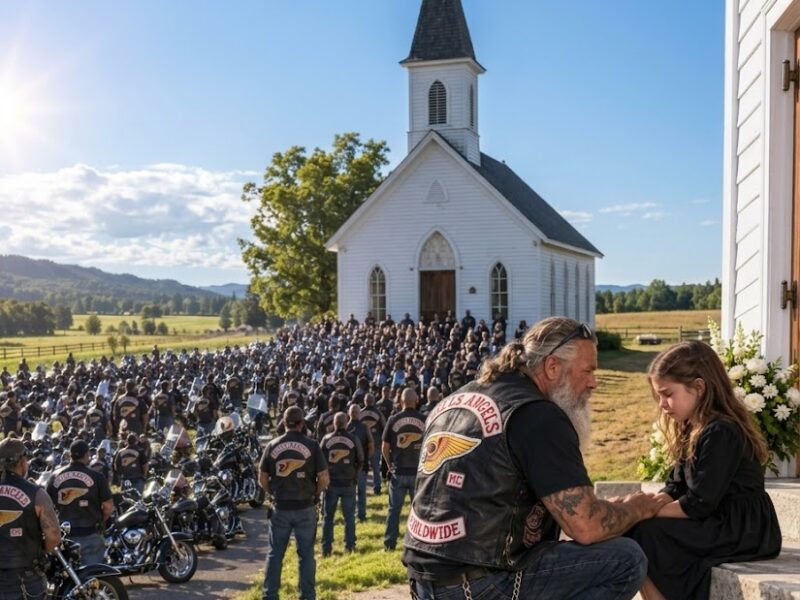
A Girl Asked for One Biker at Her Grandfather’s Funeral—800 Came and Waited Outside
The rain over Sandpoint had a particular sound in October, a soft drumming on cedar shingles that Claraara Winfield had grown up sleeping through.
On the third morning after her grandfather died, she woke to it and forgot for four whole seconds that he was gone.
Then she remembered, and the ceiling of her bedroom looked exactly the same as it had the day before, which felt like a kind of betrayal.
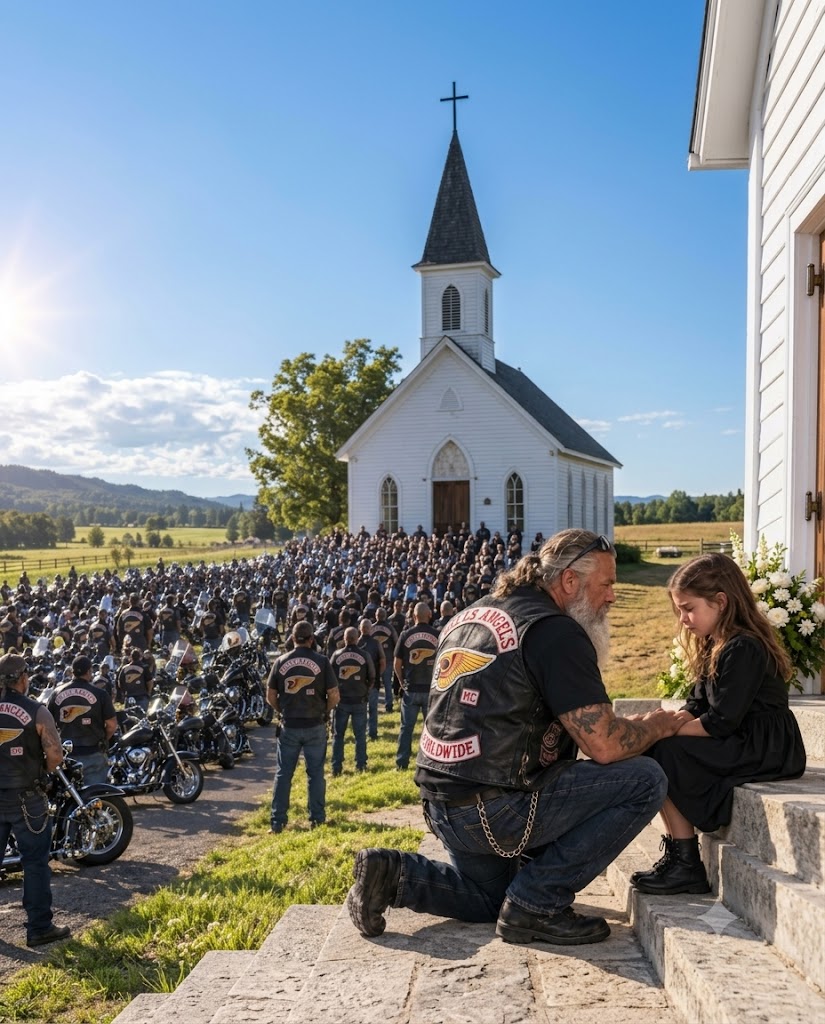
A 9-year-old girl stood on the church steps in a black dress two sizes too big, holding a photograph nobody in her family had ever seen.
She had asked for exactly one stranger to come say goodbye to her grandfather.
Every person lining that gravel road had already decided these men were troubled before a single engine went quiet.
They decided it before one boot touched the grass.
They decided it before a single hand was offered.
They decided it before anyone said a word.
One phone call had traveled further than anyone guessed, carried by riders who had gone 46 years without saying his name to a stranger.
What none of them told her until the dirt was back in the ground was the real reason her grandfather once refused to drive past a bleeding man on the highway.
—
Downstairs, her father, Preston, moved through the kitchen in the careful, overly organized way people move when they are trying not to fall apart in front of a 9-year-old.
He had made coffee he wasn’t drinking and toast he wasn’t eating, and he had already folded the same dish towel three times.
Claraara’s mother, Vera, was on the phone with the flower shop on Fifth Avenue, asking for the second time whether they could still do white chrysanthemums by Tuesday.
Tuesday.
The word had started to feel like a wall Claraara was walking toward.
Her grandfather, Elwood Winfield, had taught 8th grade science at Sandpoint Middle School for 41 years, retiring only when his knees gave out on the stairs to the lab.
He was the kind of man who kept a coffee can of grafted apple starts on his back porch and could tell you without looking whether a cloud over the cabinets meant rain or just wind.
He had died in his sleep on a Saturday night quietly, his heart simply stopping sometime after midnight, and the doctor at Bonner General had used the word peaceful, which Claraara had decided she did not like, because it made something enormous sound small.
Everyone in town agreed on the same handful of words for him.
Steady.
Reliable.
A little boring, if they were being honest.
God rest him.
The kind of man who alphabetized his spice rack and had opinions about pruning schedules.
Claraara had heard a neighbor say exactly that at the door two days ago.
Boring in the best way.
And she had wanted to throw something.
She knew things about her grandfather that boring did not explain.
She knew he’d once let a rattlesnake go instead of killing it, because he said it had somewhere to be, too.
She knew that every year on a day in October he never named, he drove alone up Sagle Road and came back quiet.
And that when she was little, he had let her sit on his lap and steer his truck through the empty part of the school parking lot, laughing the whole time in a way he almost never laughed otherwise.
And she knew about the cigar box.
It lived on the top shelf of his closet behind the winter blankets, and she had found it that morning while looking for a sweater of his to keep, because Vera had said she could choose one thing.
Inside, under a folded flannel shirt, was a photograph gone amber at the edges.
A much younger Elwood, maybe 40, standing beside a heavy-set young man in a leather vest, one arm in a sling, both of them squinting into a hard afternoon sun beside the wreck of a motorcycle.
There was a newspaper clipping folded so many times it had gone soft as cloth, the headline half worn away.
There was a leather patch, oval-shaped, the stitching faded to gray, that read: “Hell’s Angels, North Idaho.”
And tucked beneath all of it, in her grandfather’s blocky teacher’s handwriting on an index card, was a name and a phone number.
And beneath that, four words that Claraara had read maybe 20 times already.
If anything happens, call him first.
Not the name of any of his old teaching colleagues or the pastor or anyone else Claraara could think of.
Him first.
—
She carried the box downstairs like it might spill.
“Dad,” she said, setting it on the kitchen table between the untouched toast and the phone Vera had just hung up.
“We have to call this number.”
Preston looked at the card, then at the patch beneath it, and something in his face went very still.
He picked up the patch first, turning it over as though the back might explain the front.
“Clara, honey, where did you—”
“His closet. It says, ‘Call him first before anybody.'”
She pushed the card closer.
“Grandpa wanted him at the funeral, Dad. Not just invited. First.”
Aunt Plet, who had let herself in the side door in time to hear the last of it, set down the casserole dish she’d been carrying and picked up the patch with two fingers like it might be contagious.
“Motorcycle gang,” she said flatly, reading the stitching.
“Preston, this is a motorcycle gang patch. Your father taught 8th grade biology for 40 years. What in the world was he doing with this in his closet?”
“I don’t know,” Preston said.
And for the first time in three days, he sounded genuinely curious instead of just exhausted.
“I don’t know, Plet.”
“Well, whoever this Bennett Holt is, I don’t think we need him showing up at a funeral in front of the whole town.”
Claraara felt something hot climb up the back of her throat.
“Grandpa wrote it down. He wanted him there. Not the flower guy, not the neighbors. Him.”
Nobody answered that right away.
Rain kept ticking against the window over the sink, and Vera reached over and put her hand flat on Claraara’s back, not saying anything, just steadying her the way you’d steady something about to tip.
Preston looked at the index card a long moment, turning it the way his daughter had turned it, tracing his father’s neat handwriting with one thumb, like it might tell him something the words themselves hadn’t.
Then he picked up the kitchen phone from its cradle on the wall, the number already half dialed in his head before he decided anything at all.
“I’ll call,” he said. “For Clara. Just to see who answers.”
Plet opened her mouth to argue, and then, watching her brother’s face, closed it again.
Outside the rain kept falling on Sagle Road, on the mountains, on a cemetery that didn’t yet know how crowded its edges were about to get, and none of them in that kitchen had the faintest idea what they were about to set loose.
The phone rang four times before anyone answered.
And when a voice finally came through, it was low and rough.
The voice of a man who didn’t get many calls from numbers he didn’t recognize.
“Yeah.”
“This is Preston Winfield. My father was Elwood Winfield from Sandpoint. I found your name in his things and I was told to call you.”
Preston hesitated.
“He passed on Saturday night.”
There was a silence on the line so long that Preston checked the screen to see if the call had dropped.
When the voice came back, it had changed entirely, gone thick and unsteady in a way that made Preston grip the phone tighter.
“Elwood’s gone.”
“Yes, sir.”
Another silence, shorter this time, filled with what sounded like a hard breath being pulled in through a nose.
“46 years,” the voice said finally, mostly to itself.
“I owe that man more than your whole family will ever know, son. And I mean that with my whole chest. When’s the service?”
“Tuesday. 11:00 at Pinehurst Community Church out on Sagle Road. My daughter Claraara, she’s nine. She found your name. She’s the one who insisted.”
“Then I’ll come for her,” the man said.
“Just me. Quiet. I won’t make a scene. I promise you that. Elwood wouldn’t have wanted a scene, and I don’t much care to be a spectacle in a town that doesn’t know me.”
That was how Preston learned the man’s name was Bennett Holt.
—
It was two days later, on a gray Sunday afternoon, that Bennett rode into Sandpoint on a low rumbling Harley that turned heads all along Cedar Street.
Past the coffee shop where conversation actually paused as he idled at the light.
He was 79 years old, built like a man who had worked with his hands his whole life and never entirely stopped, with a beard gone the color of old snow and forearms inked with faded blue anchors and unit numbers that had blurred soft at the edges over the decades.
His leather vest carried the same oval patch Claraara had found in the cigar box.
Hell’s Angels, North Idaho.
Along with a smaller patch above the pocket that just said: Doc.
He parked in front of the Winfield house like a man walking into a courtroom, hat in hand.
And when Claraara opened the door before her parents could get there first, he stopped on the porch steps and simply looked at her for a moment, his eyes wet and pale blue.
“You must be the one who called me first,” he said.
“You’re Bennett.”
“Doc, mostly. But Bennett’s fine, too.”
He crouched slow and careful on a bad knee, so he was closer to her eye level.
“Your grandfather talk about me?”
“No,” Claraara admitted. “I found you in a box in his closet.”
Something moved across the old man’s face.
Half a laugh and half something sadder.
“Sounds about right. Elwood never did like to brag on things that mattered.”
He held out a scarred, enormous hand, and after a beat, Claraara shook it.
“I’m sorry about your grandfather, honey. I truly am. He was the best man I ever knew, and I’ve known some good ones.”
Plet, watching from the front window with her arms crossed, did not come out to introduce herself.
Inside, over coffee, Vera poured with visibly shaking hands.
Bennett sat on the edge of the good couch like he was afraid of breaking it, and he answered every careful question Preston asked with a patience that surprised him.
Yes, he’d known Elwood a long time.
Yes, they’d stayed close, mostly by phone, a call every month or two, sometimes a visit when Bennett rode through.
No, he didn’t want anything from the family.
He only wanted to stand at the back of the church on Tuesday and say goodbye properly, the way Elwood had done for him once, a long time ago.
“What do you mean, the way he did for you?” Claraara asked.
Bennett looked at her for a long moment, and something behind his eyes seemed to weigh the question before he answered it.
“46 years ago, your grandfather did something for me that most people wouldn’t do for their own brother,” he said quietly.
“I’ll tell you the whole thing sometime if your dad says it’s all right. Not today, though. Today’s for missing him, not for stories.”
He stayed only 40 minutes.
On his way out, he knelt by his motorcycle in the driveway and let Claraara sit on the seat, showing her which lever did what, patient as any grandfather, while two doors down, a curtain twitched.
And Sheriff Gordon Holsey’s cruiser slowed noticeably as it rolled past.
Holsey circled the block once and came back, parking across the street rather than pulling in, the way a man does when he wants to look official without quite committing to a confrontation.
He walked over with his thumbs hooked in his belt.
“Everything all right here, Preston?”
“Everything’s fine, Gordon. This is Bennett, an old friend of Dad’s.”
Holsey looked Bennett over, taking his time about it.
The vest.
The ink.
The patch that said Doc, like it might be some kind of joke.
“Don’t believe we’ve met,” he said in the voice of a man who intended to remember the face.
“No, sir, we haven’t,” Bennett said evenly, meeting his eyes without flinching and without pushing.
“Just here to bury my friend on Tuesday. I’ll be gone Wednesday morning, and you won’t hear another word about me.”
Holsey nodded slowly, unconvinced, but unwilling to make more of it in front of a grieving family, and eventually walked back to his cruiser.
Bennett watched him go, then swung a leg over his bike with a wince for his knee.
“Small towns,” he said, not unkindly.
“They’re not wrong to be careful. Just wrong about what they’re careful of.”
He looked at Claraara once more before he pulled his helmet on.
“Tuesday, I’ll be there before anybody else, and I’ll leave without a fuss. That’s the only promise I know how to keep.”
He rode off toward the highway.
—
That evening, from a motel room off Highway 95, Bennett Holt sat on the edge of a sagging bed and made one phone call to a man in Coeur d’Alene, meaning only to let a few old friends know that Elwood Winfield had died.
He had no idea, dialing that number, that it was the first of several hundred calls that would be made before Tuesday, each one traveling a little further than the last.
By Monday afternoon, Dwight Stroud had fielded 11 phone calls he did not know how to explain.
Dwight ran the only funeral home in Sandpoint, a low brick building on Third Avenue that he had inherited from his father and run without much drama for 22 years.
He was used to calls about flower arrangements and obituary wording, not calls from strangers in Spokane and Missoula, and bafflingly, one from a man in Bend, Oregon, all asking the same question in slightly different words.
Was it true the service for Elwood Winfield was open to the public?
And was it true that Doc Holt would be there?
He drove over to the Winfield house himself rather than explain it on the phone.
“I don’t quite know how to say this,” he told Preston on the porch, turning his hat in his hands.
“But I believe you may be looking at considerably more than a family funeral on Tuesday.”
“How many more?”
“The last fellow I spoke with said his chapter alone was sending 40 riders. He mentioned three other chapters doing the same. I did some arithmetic I didn’t love the answer to.”
Dwight cleared his throat.
“Preston, I think you should prepare for a few hundred people who are not on any guest list.”
Plet heard enough of it through the screen door to come outside white-faced.
“A few hundred bikers,” she repeated.
“At my father’s funeral. In this town. Preston, do you understand what people will say? Do you understand what the paper will make of it?”
“I don’t think Claraara can uninvite him now, Plet.”
“Then Claraara needs to understand that some decisions have consequences beyond what a 9-year-old wants.”
Plet’s voice cracked on the word consequences, grief and fear tangled together so tightly she could no longer tell one from the other.
“I love Dad, too. I don’t want his funeral turned into some kind of biker rally on the 6:00 news.”
Claraara, standing just inside the doorway where nobody had noticed her yet, felt the accusation land exactly where it was aimed.
She had wanted one person.
She had read the card 20 times and believed with the flat certainty of a child that granting her grandfather’s last written wish could only be a kindness.
Now it felt like she had lit a fuse she didn’t understand.
And the number climbing by the hour—40, then 200, then Dwight’s careful, worried estimate of possibly 500 or 600 by Tuesday morning—sat on her chest like something physical.
“I didn’t mean for it to be this many,” she said, and her voice came out smaller than she meant it to.
—
It was Bennett arriving that evening to walk the church grounds with Dwight and plan where 300 motorcycles might reasonably park without blocking Sagle Road entirely who found her sitting alone on the porch steps in the cold, arms wrapped around her knees.
“Heard you’re taking the blame for something that isn’t yours to carry,” he said, easing himself down beside her with a grunt.
“Aunt Plet says I ruined it.”
“Your aunt’s scared. And scared people say things they measure wrong.”
He was quiet a moment, looking out at the dark shape of the mountains.
“You want to know why there’s going to be more men on that road Tuesday than this town has seen in one place in its whole history?”
Claraara nodded.
“46 years ago, I laid down my motorcycle on a bad curve about nine miles south of here on the old stretch of 95 before they straightened it. Broke my collarbone, my wrist, cracked two ribs, and I was bleeding from a cut on my scalp bad enough that I couldn’t see straight. Three cars went right on by me. Didn’t slow down. I understood why. I looked like exactly what I was. And back then, this town didn’t look kindly on men who looked like me.”
He held up his forearms, the old ink gone soft blue.
“Your grandfather was the fourth car. He was 40 years old, driving home from grading papers, and he pulled over when nobody else would.”
“What did he do?”
“He got down in that ditch with me and he didn’t flinch once. Kept talking to me so I wouldn’t pass out. Kept my neck still. Used his own belt to splint my wrist. Stayed with me two and a half hours until the ambulance made it out from town, because back then it was 40 minutes each way on a good day. And when they got me to Bonner General, my own family didn’t come. Hadn’t spoken to me in six years by then. Your grandfather came every single day for three weeks. Brought me library books. Argued with me about Pinocchio. Never once asked what I’d done to end up looking the way I looked or riding what I rode.”
Claraara sat very still, trying to picture her grandfather.
Spice rack.
Apple grafts.
Grading papers.
Kneeling in a ditch beside a bleeding stranger.
“I learned some things in the army a long time before that crash,” Bennett went on, quieter now.
“Things about how to keep a hurt man breathing till help comes. I never told your grandfather that part. And for a long time I never told him it was the reason I started teaching other riders the same thing. How to pack a wound. How to keep somebody from bleeding out on a shoulder 40 miles from a hospital. Because I knew what it cost when nobody stopped. I’ve taught that to a few hundred men over the years, in garages and campgrounds all up and down the coast. Every one of those men riding down here Tuesday either learned it from me directly or learned it from somebody I taught.”
He looked at her.
“That’s not a biker rally coming, Claraara. That’s 46 years of men who are alive because your grandfather decided one afternoon that a stranger in a ditch deserved help. And I made sure the debt got paid forward instead of just paid back to me.”
—
Sheriff Holsey, informed by Dwight that estimates now ran past 600 riders, drove out that same night to find Bennett standing by his motorcycle in the church parking lot with a hand-drawn map of where every chapter would stage.
“I’ve got a town of 4,000 people and a two-lane road,” Holsey said without preamble.
“I don’t have the manpower for what you’re describing.”
“You won’t need it,” Bennett said.
“Every man coming Tuesday answers to somebody. And every one of those somebodies answers to me. They’ll park where I tell them. They’ll stand where I tell them. And not one of them will set foot inside that church unless the family invites him. You have my word on that, Sheriff. And where I come from, that still means something.”
Holsey studied him a long moment in the dark, the porch light catching the gray in his beard, the patch that said Doc, and did not look entirely convinced.
But he nodded once, got back in his cruiser, and did not close the road.
That night, Claraara lay awake listening to the wind pick up off the lake, replaying the number in her head.
46 years.
600 riders.
Three weeks of library books.
And could not decide whether she had done something wonderful or something the whole town would never forgive her for.
Somewhere past midnight, she finally slept.
And in the morning, Tuesday came, whether she was ready for it or not.
—
By 7:15 that Tuesday morning in October, fog was still sitting low over Sagle Road, thick enough that Preston couldn’t see the church steeple from the end of the driveway.
And for one brief, guilty moment, he let himself hope the whole thing had been exaggerated.
That maybe 40 or 50 riders would come and nothing more.
By 8:30, the first engines were audible from three miles off, a sound like distant thunder that didn’t roll away.
By 9:47, Highway 95 southbound had gone quiet with cruisers Holsey had in the end called in from two neighboring counties—not to block the riders, but to guide them, because there proved to be no controlling what was already moving.
The procession came in loose formation, headlights on in the fog, engines throttled low, and it did not stop coming.
Two abreast, then four, filling both shoulders of Sagle Road for over a mile past the little white church.
Until Dwight Stroud, standing in the gravel lot with a clipboard he’d stopped using 20 minutes earlier, simply put his hand over his mouth and said nothing at all.
At 9:52, with the church bell not yet rung, every engine on that road went silent within the same 60 seconds.
Cut in a ripple that moved from the front of the line to the back like a wave lying down.
Riders dismounted.
Helmets came off one after another, revealing gray hair and bald heads, and young faces, and old ones, men and women both, in leather worn soft from decades of weather.
Nobody spoke.
Nobody lit a cigarette or leaned against a fender.
They simply stood, hands folded in front of them, facing the church in a silence so complete that Claraara, watching from the porch of the parsonage where the family was gathering, could hear a single crow calling from the tree line.
She had expected noise.
Chaos.
Even the picture Plet had painted of a rally, a spectacle, cameras and engines and trouble.
What she saw instead was 800 people standing so still and so quiet that the fog seemed to hang around them out of respect.
The only movement along that whole length of road: the small white clouds of their own breath rising and disappearing in the cold.
Sheriff Holsey, positioned at the church gate with two deputies he’d brought expecting to manage a crowd, found himself simply watching.
At 9:58, he radioed his dispatcher to cancel the backup he’d requested from Bonner County.
“Stand down,” he said. “There’s nothing here to manage.”
—
Plet had stayed inside the parsonage since dawn, gripping a cold cup of coffee she hadn’t touched, rehearsing in her head every argument she’d made about consequences and the 6:00 news.
When Vera finally coaxed her to the window, she stood looking out at 800 silent strangers standing in the cold fog for a man most of them had never met.
And something in her face came apart, and reassembled itself into something else entirely.
She set down her coffee cup without a word, went to the kitchen, filled a carafe, gathered every mug the parsonage owned along with the extra blankets from the hall closet, and walked out the front door alone.
She did not say anything grand.
She simply began handing coffee to strangers, blanket after blanket to riders who’d been standing in 38-degree fog since before 8 in the morning.
Moving down the line the way she’d have moved down a church potluck table, murmuring, “Thank you for coming. Thank you. Thank you for coming.”
Face after tattooed, weathered face, until her hands were empty and her cheeks were wet.
And nobody, least of all Claraara, watching from the steps, said a single word about it.
One of the younger riders, a woman with a gray streak in her braid and a patch that read Prospect, tried twice to thank her, and both times Plet just shook her head and moved on to the next mug, as though stopping to be thanked might undo whatever had just shifted in her.
—
The service itself was small and plain, exactly as Elwood would have wanted it.
Reverend Milton Foss, speaking simply about a life well and quietly lived.
Vera reading a poem about apple trees that made half the church cry.
Preston’s voice cracking only once on his father’s name.
Bennett sat in the back pew as promised, alone, hat in his lap, and true to his word, not one of the 800 outside crossed the threshold.
But the doors had been propped open at Dwight’s suggestion, and the fall air carried the service out across the lot, and more than one grown man, standing in that fog, wiped his face with the back of a gloved hand during the closing hymn.
At the graveside after, under a sky that had finally begun to clear, the family gathered close, while the riders held their line at a respectful distance along the cemetery fence.
Close enough to witness.
Far enough not to intrude.
It was there, as the small crowd began to disperse toward their cars, that a cousin of Preston’s, a man named Curtis, who had driven up from Coeur d’Alene and heard only the barest outline of the story, approached Bennett with his arms crossed.
“I mean no disrespect,” Curtis said, “but I still don’t understand why all of them had to come. Uncle Elwood knew you. He didn’t know any of the other 799 people standing out there.”
Bennett looked at him a long moment, then out at the line of riders along the fence, silver-haired men standing at ease in the thin autumn sun.
“Judging a man by his leather and his ink is about the easiest mistake there is to make,” he said.
“Whole towns do it without thinking twice. Your uncle never made that mistake. Not once. Not with me, and not with anybody else I ever saw him meet. He stopped for a stranger in a ditch when three other cars didn’t because he didn’t see what the man looked like. He saw a man who was hurt. That’s the only reason I’m alive to stand here and bury him today.”
He nodded toward the fence.
“Every one of those riders learned one way or another how to do for somebody else what your uncle did for me. That’s not a motorcycle club standing out there, Curtis. That’s 46 years of a debt getting paid forward, one stranger at a time, because a science teacher from Sandpoint decided a man’s worth isn’t printed on his vest.”
Curtis had nothing to say to that.
He looked at the fence line a while longer, then walked away without another word.
Claraara stood beside Bennett as the last of the dirt was smoothed over her grandfather’s grave, watching the riders begin one by one to file past the fence in silence.
Some touching two fingers to their brow.
Some simply bowing their heads.
Before turning back toward their bikes without a single word spoken.
800 strangers who had come 300 miles to keep a promise none of them had made in person, for a man most of them would never have gotten the chance to thank.
—
By the following spring, the story of the funeral had shrunk in the retelling the way true stories in small towns often do, worn down at the edges into something people repeated at the diner counter without quite remembering they’d heard it firsthand.
The bikers who came.
800 of them, they say.
Stood outside in the fog the whole service and never made a sound.
Some folks doubled the number when they told it, and some cut it in half.
But nobody in Sandpoint told it anymore the way Plet had once told Preston it would be told.
As a scandal.
As something shameful the family would spend years living down.
Sheriff Gordon Holsey still worked the same stretch of Highway 95 he always had.
But Claraara noticed, riding with her father to the hardware store one Saturday in April, that when a pack of six or seven motorcycles passed going the other way, Holsey lifted two fingers off the wheel in a small, easy wave.
The same wave he gave to farmers he recognized in their trucks.
He never mentioned Bennett Holt by name again, not that Claraara heard.
But he didn’t need to.
Something in how he held the road toward riders had simply changed, quietly, the way most real changes happen.
—
Plet kept the number Bennett had given the family taped inside a kitchen cabinet, and twice that winter she called just to ask how he was doing.
Conversations that ran longer than she probably meant them to.
At Thanksgiving, without much fanfare, she suggested to Preston that they invite him.
And when Preston looked surprised, she only shrugged and said he was closer to Dad than half the people who will be at that table, and went back to peeling potatoes as though the matter were already settled.
She never apologized outright for the things she’d said in the days before the funeral.
The talk of consequences and the 6:00 news.
But Claraara noticed she didn’t need to.
The apology showed up sideways in small acts nobody made a fuss over.
The extra place setting at Thanksgiving.
The coffee she now kept in the pantry that she said, without explaining further, was the kind Bennett likes.
The way she stopped crossing to the other side of the street downtown whenever a rider was parked outside the hardware store.
Preston noticed it too, and said nothing about it either, because some corrections are better left unremarked upon, allowed to simply stand as the new shape of things.
—
At school that winter, a teacher asked the class to bring in something that told a story about their family.
And while most of Claraara’s classmates brought photographs of vacations or new babies, Claraara brought the folded newspaper clipping from the cigar box, carefully flattened now inside a plastic sleeve, and told her class about a science teacher who once stopped his car on a highway when three other cars didn’t.
She did not mention the word biker until a boy in the back asked who the man in the picture was.
And when she said Hell’s Angels, she watched something flicker across a few faces in the room.
The same flicker she now recognized from the funeral.
The quick, automatic sorting of a person before any of the facts were in.
She told them the rest of it anyway, all the way through to the bench on Highway 95.
And by the time she sat back down, the flicker on most of those faces had settled into something quieter.
—
Bennett came twice that first year, riding down from Coeur d’Alene each time, and on both visits he brought something for Claraara.
Not toys, but small, deliberate things.
The first time, a battered canvas kit with gauze and tape and a laminated card of instructions, and an afternoon spent at the kitchen table teaching her, seriously and patiently, how to keep pressure on a wound and how to tell when a person needed more help than she could give alone.
“Not because anything’s going to happen,” he told her when Vera hovered nervously in the doorway.
“Because your grandfather believed the worst thing a person can do is know how to help and stand there instead. I’d like you to grow up knowing how that’s done.”
The second visit, he brought the original photograph from the cigar box, now reframed in plain dark wood.
The young Elwood and the young Bennett squinting into that hard afternoon sun beside the wrecked motorcycle, 46 years gone.
Claraara hung it in her room, not hidden in any closet, where she could see it every morning when she woke.
He told her that same visit that the North Idaho chapter had quietly arranged, through a rider who did concrete work over in Bonners Ferry, for a plain granite bench to be poured at the pullout on Highway 95, nine miles south of town, near the curve where the crash had happened 46 years before.
No plaque.
No names.
Nothing that would draw attention or explain itself to a passing stranger.
Just a bench facing the mountains at the exact spot where a man had once decided to stop his car.
“Elwood wouldn’t have wanted his name on it,” Bennett said.
“He never wanted credit for a single thing he did his whole life. But I wanted somewhere to sit when I ride through, so I put a bench there instead of a sign. Some fellow doing his radiator work don’t ever have to know what it means. Doesn’t cost anything for the ones who do.”
—
Claraara thought about that a long time after he left.
How the whole town had spent decades calling her grandfather boring without ever imagining that the same quiet, unremarkable man carried a debt so large that 800 strangers would one day stand outside a church in the fog to help him pay the last of it back.
She thought too about how the whole town had spent decades being afraid of exactly the kind of man who taught hundreds of riders how to save a life on the side of a highway, simply because of what his vest looked like from a passing car.
She did not decide at 9 years old to become anything in particular because of it.
She simply started noticing things she hadn’t noticed before.
The way people at school sorted each other by shoes and haircuts before anyone had said a word.
The way her own mother had once locked the car doors briefly at a stoplight beside a man on a motorcycle and unlocked them a half second later, looking faintly embarrassed at herself.
—
Late that May, on an ordinary Tuesday afternoon, with nothing remarkable about the weather at all, Dwight Stroud sat behind the desk at the funeral home going over paperwork for an elderly widow’s arrangements, a routine he’d performed a thousand times in 22 years.
The bell over his door chimed, and a heavy-set man in a leather vest and gray beard walked in, hat in hand, asking in a low, careful voice whether Dwight had a few minutes to talk about pre-planning his own arrangements.
Nothing urgent.
Just wanting the paperwork settled early while his mind was still sharp.
Dwight recognized him instantly as one of the riders who’d stood outside the church back in October, though he couldn’t have named him.
Without pausing to think about it, the way you don’t think about breathing, Dwight stood, came around the desk, and held the door open a beat longer than strictly necessary as the man stepped fully inside out of the wind.
The same small courtesy he’d have shown anyone who walked through that door.
Exactly the same.
No more and no less.
“Have a seat,” Dwight said. “Let’s get you sorted.”
—
The bench on Highway 95 faced the mountains, and on clear days you could see all the way to the Selkirk range, a line of blue peaks that looked closer than they were.
Claraara went there with her father the first time in June, on a Saturday, with a thermos of iced tea and no particular ceremony.
They sat on the granite, warm from the sun, and watched the cars go by.
Most of them didn’t slow down.
Most of them would never know why the bench was there, or who had put it there, or what had happened on that curve 46 years before.
But every now and then, a motorcycle would come around the bend, and the rider would see the bench, and lift two fingers off the handlebar in a small, quiet wave.
The same wave Sheriff Holsey gave.
The same wave Claraara had started giving, without thinking about it, whenever she saw a rider on the road.
Her father noticed, the first time she did it, and didn’t say anything.
He just smiled a little, and kept his eyes on the road.
And Claraara understood, without needing it explained, that some things get passed down not through words or photographs or cigar boxes, but through the small, ordinary gestures that say: I see you.
I know what you did.
I remember.
—
The cigar box sat on Claraara’s dresser now, next to the reframed photograph.
She still opened it sometimes, just to look at the index card in her grandfather’s blocky handwriting.
If anything happens, call him first.
Four words that had started everything.
Four words that had brought 800 strangers to a small town in Idaho, to stand in the fog for a man they’d never met.
Four words that had taught her something no one else could have.
That the measure of a life isn’t in what people say about you at the diner counter.
It’s in the quiet debts you leave behind.
And the people who show up, years later, to pay them forward.
—
On the anniversary of her grandfather’s death, that October, Claraara asked her father if they could drive up Sagle Road.
Just the two of them.
They didn’t go to the cemetery.
They went to the church, and stood on the steps where she’d stood in her too-big black dress, holding a photograph nobody in her family had ever seen.
The fog was thick again, the same soft drumming of rain on cedar shingles.
And for a moment, Claraara closed her eyes and listened.
She could almost hear the engines.
The low rumble that had come from three miles off and hadn’t stopped.
The silence that had fallen, all at once, like a wave lying down.
She opened her eyes and looked at her father.
“I’m glad I called,” she said.
Preston put his arm around her shoulders.
“Me too, kiddo. Me too.”
They stood there a while longer, watching the rain fall on the gravel road, on the mountains, on a cemetery that had learned, that day, how crowded its edges could get.
And somewhere out on Highway 95, a rider passed the granite bench and lifted two fingers off the handlebar.
A small, quiet wave.
The kind you give to someone you recognize.
The kind that says: I remember.
—
Bennett called on Thanksgiving, and Claraara answered.
“You still got that kit I gave you?” he asked.
“I keep it in my backpack.”
“Good. You never know.”
She laughed, and he laughed too, a low, rough sound that reminded her of the first time she’d heard his voice on the phone.
Before she hung up, she asked him something she’d been thinking about for months.
“Bennett?”
“Yeah, honey?”
“Do you think Grandpa knew? That all those people would come?”
There was a long pause on the line.
“I think your grandfather knew exactly what he was doing,” Bennett said finally.
“He just didn’t think it was anything special. That’s the thing about men like him. They do the right thing, and then they forget they did it, and they go back to their spice racks and their apple trees and their grading papers. And the rest of us spend the rest of our lives trying to be worthy of it.”
Claraara was quiet a moment, thinking about that.
“Bennett?”
“Yeah?”
“I think you’re worthy.”
Another pause, longer this time.
Then a sound that might have been a laugh, or might have been something else.
“Your grandfather would’ve liked hearing you say that,” he said.
“He’d have said I was being dramatic.”
“Were you?”
“No,” Bennett said. “I was just telling the truth.”
—
The years passed, the way they do.
Claraara grew up, and went to college, and became a paramedic, which surprised no one who knew the story.
She kept the cigar box on her dresser, and the photograph on her wall, and the index card in her wallet, folded small, the words still legible in her grandfather’s handwriting.
If anything happens, call him first.
She never had to call Bennett in an emergency.
But she called him anyway, once a month, sometimes more, just to hear his voice.
And when he died, years later, at 91, in his sleep, in a small house in Coeur d’Alene with a Harley in the garage and a photograph of a young science teacher on the mantel, Claraara drove up for the funeral.
She stood at the back of the church, hat in her lap, and watched 300 riders file in silently, fill every pew, and stand along the walls.
Not one of them made a sound.
And when the service was over, and the dirt was back in the ground, Claraara walked to the front of the crowd and said the only thing that needed saying.
“He was the best man I ever knew,” she said.
“And I’ve known some good ones.”
The riders bowed their heads.
And somewhere, on a curve nine miles south of Sandpoint, a granite bench faced the mountains, waiting for the next rider to pass.
—
**THE END**









