A German Shepherd showed up at a Marine’s door with 5 puppies — and then he saw her collar. She was his missing K9
## Part 1
Before Staff Sergeant Mason Cole left for his final deployment with K-9 Raven, he touched the German Shepherd’s collar and promised, “I’ll bring you home.”
Mason came back.
Raven never did.
After a transport crash in Idaho, Mason was told his partner was dead, and for three years, he forced himself to believe it.
Then one spring morning, while repairing the fence on his family ranch, Mason froze.
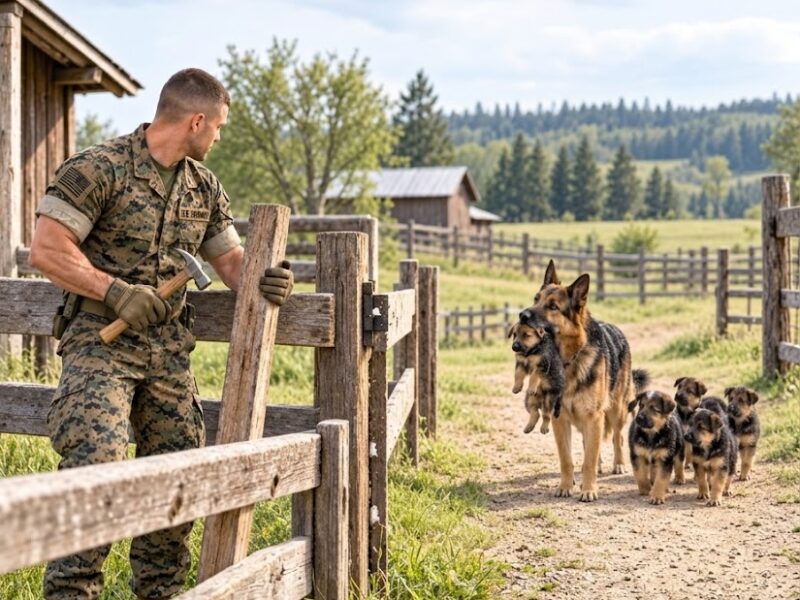
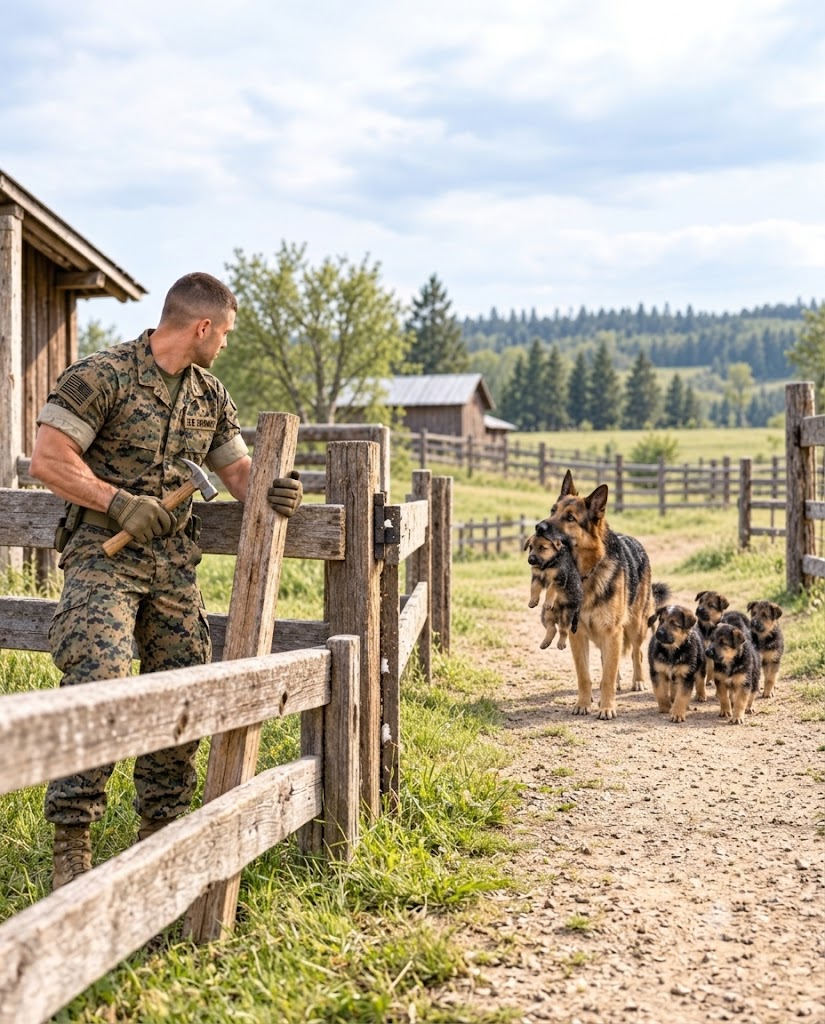
A thin German Shepherd was walking toward him with a puppy in her mouth and four more stumbling behind her.
Her right ear carried the same notch Raven had.
Mason gave one silent hand signal only Raven had known.
The dog set the puppy down, moved to his left side, and sat.
But there was one impossible problem.
She had no microchip.
If this really was Raven, where had she been for three years?
And why had she returned with five puppies?
Morning light spread across the fields outside Cordelane, Idaho, turning the wet grass silver beneath a clear spring sky.
Beyond the old barn, pine-covered hills rose above the Cole family ranch, while a dirt road curved past the back fence.
Staff Sergeant Mason Cole had been working there since sunrise.
Mason was thirty-nine, six-foot-two, broad-shouldered, and powerfully built after years in the United States Marine Corps.
His dark hair was cut short, light stubble covered his jaw, and his expression was usually controlled.
A former military working dog handler, Mason was patient and dependable.
But since losing his German Shepherd partner, Raven, three years earlier, he had become quieter and harder to reach.
His father died the following year, leaving Mason the ranch.
Now Mason was home on leave to repair the property and decide whether to sell it.
That morning, he was replacing a weathered fence post when something appeared on the dirt road.
Mason lowered the hammer.
A German Shepherd stood in the distance.
She was large but thin, her black and tan coat dusty from travel.
Gray had begun to show around her muzzle.
One front leg moved carefully, and the tip of her right ear carried a small notch.
Mason stared at it.
Raven had carried a notch in the same place.
Then he noticed the dog was not alone.
A puppy hung gently from her mouth.
Four more German Shepherd puppies followed behind her, stumbling through the dust in an uneven line.
The mother stopped about twenty yards away.
For several seconds, neither Mason nor the dog moved.
He forced himself to look away from her ear.
A scar meant nothing.
Working dogs collected scars.
Farm dogs did, too.
Three years of missing Raven had taught Mason how easily grief could turn a resemblance into something more.
He placed the hammer on the rail and stepped through the open gate.
The shepherd became tense.
Mason stopped immediately.
He did not call her.
He did not reach toward her.
Instead, he lowered his right hand and moved two fingers slightly toward his left leg.
It was a tiny signal, almost nothing.
Years earlier, Mason had created it for Raven during training exercises when silence mattered.
It was never part of standard military obedience.
It meant only one thing.
Come left.
Sit close.
Wait.
The shepherd stared at his hand.
Mason immediately wondered why he had done it.
Then the dog lowered the puppy carefully onto the road.
She took one step, then another.
She moved toward Mason, curved around him, and stopped at his left side.
She sat exactly where Raven used to sit.
Mason’s breathing changed.
For one moment, the fence, the ranch, and the three missing years seemed to disappear.
A voice came from behind him.
“Mason.”
He turned.
Eli Parker stood near the barn carrying a bucket of fence staples.
Eli was seventeen, tall and lanky with sandy hair falling across his forehead.
He lived nearby and often helped Mason with repairs.
Since his parents’ divorce two years earlier, he had become quieter around adults, but he remained gentle with animals and unusually observant.
Eli looked from Mason to the dogs.
“Where did they come from?”
“I don’t know.”
The shepherd heard Mason’s voice and stood, but she did not move closer to him.
She returned to the puppies.
Mason watched her lower her head, checking each one before nudging the smallest toward the others.
Whatever had made her obey the signal, the puppies mattered more.
Eli started forward.
Mason raised one hand.
“Slow.”
Eli nodded and stopped.
The smallest puppy was darker than the others, with a black mask and oversized paws.
It favored one rear leg as it tried to keep up.
“That little one’s struggling,” Eli said.
Mason had already noticed.
He went to the barn and returned with a shallow bowl of water and some plain dog food.
He placed both several yards away, then backed off.
The mother approached first.
She sniffed the food.
For a moment, Mason expected her to eat immediately.
Instead, she turned and nudged two of the puppies toward the bowl.
Only after they began eating did she lower her head to the water.
Eli looked at Mason.
“She brought them here.”
Mason said nothing.
The shepherd shifted her weight.
Sunlight moved across the fur beneath her left shoulder, revealing a thin, old scar.
Mason went still again.
Raven had undergone surgery in that same area years before the accident.
One matching ear could be coincidence.
One familiar signal could be training.
But the scar made it harder to dismiss what he was seeing.
Still, Mason refused to move closer.
Three years earlier, Raven had disappeared after a transport accident in the Idaho Mountains.
Mason survived.
Raven did not return.
The case was eventually closed, and Mason had spent years teaching himself not to question that ending.
Now, an older shepherd stood on his family ranch with five puppies gathered around her.
He did not know where she had come from.
He did not know why she had found this place.
And he did not know why she remembered a signal almost no other dog should have known.
The mother stepped back from the water and stood beside the smallest puppy.
Mason watched her for a long moment.
Then, almost too quietly for Eli to hear, he said one word.
“Raven.”
The shepherd stopped.
Her ears shifted.
Slowly, she turned her head and looked directly at him, but she did not come closer.
By eight the next morning, the sky over northern Idaho had turned pale and overcast.
Mason Cole stood beside his pickup outside a small veterinary clinic on the edge of Cordelane.
The German Shepherd sat in the rear compartment with her five puppies gathered around her.
She had allowed Mason to move them from the ranch without resistance, but she had remained watchful through the entire drive.
Eli Parker had come with him.
The seventeen-year-old sat quietly in the passenger seat, holding the smallest puppy against a folded towel.
The little male had a dark face, oversized paws, and a rear leg he used carefully whenever he tried to stand.
“He needs a name,” Eli said.
Mason looked at him.
“He needs a doctor.”
“That, too.”
Eli looked down at the puppy.
“Scout.”
Mason almost objected.
Then the puppy lifted his head and tried to climb higher against Eli’s arm.
Mason let the name stay.
Inside the clinic, Dr. Clare Bennett was waiting for them.
Clare was forty-two, medium height, with dark brown hair tied loosely behind her head and calm gray eyes that rarely seemed hurried.
She had spent nearly fifteen years treating family pets, police dogs, and retired working animals.
Years earlier, after watching an injured sheriff’s canine struggle with retirement, Clare had become especially patient with dogs that reacted badly to unfamiliar rooms, uniforms, or equipment.
She never forced trust when waiting would work better.
That mattered immediately.
The German Shepherd stopped just inside the examination room.
Clare did not approach.
She crouched several feet away and waited until the dog looked at her.
Only then did she begin.
The puppies were examined first.
Four were tired, but otherwise stable.
Scout needed more attention.
Clare moved his rear leg carefully, then explained that the injury did not appear permanent.
With rest, support, and follow-up care, she expected him to recover well.
Eli smiled for the first time that morning.
“He’ll run.”
“He should.”
Scout immediately tried to climb out of the towel.
Clare caught him gently.
Eventually, when it was the mother’s turn, Mason became quieter.
Clare examined her teeth, joints, coat, ears, and shoulders.
The dog stayed close to Mason, but never fully relaxed.
“She’s had puppies recently,” Clare said.
“About seven weeks ago.”
Mason looked toward the five small bodies sleeping together in a basket.
Clare continued the examination.
The shepherd was underweight, though not dangerously so.
Her condition suggested that food and rest had been inconsistent during the weeks before she reached Mason’s ranch.
There were also worn patches around her neck.
Clare separated the fur carefully.
“This looks like she wore something around here for a long time.
A collar, possibly, maybe another type of working restraint.
I can’t tell you more from the fur alone.”
Mason nodded.
He did not want guesses.
He wanted things that could be proven.
Clare picked up a microchip scanner.
Mason watched the device pass over the dog’s shoulders.
Nothing.
Clare tried again, then along the neck.
Still nothing.
Mason felt something tighten in his chest.
Raven had been chipped.
He remembered the identification number being checked during military veterinary appointments.
Clare put the scanner down.
“No chip.”
Mason stared at the dog.
Then Clare stopped.
Beneath the fur between the shoulders was a thin line of old scar tissue.
She touched the area lightly.
“There’s been some kind of procedure here.”
Mason looked at her.
“Where a chip would be.”
Clare hesitated.
“Close enough that I would document it, but a scar doesn’t tell us what caused it.”
That answer frustrated him.
It also made him trust her more.
Clare refused to give him the conclusion he wanted simply because he wanted it.
Mason had brought an old folder from the ranch.
Inside were copies of Raven’s military veterinary records.
Clare opened them on the counter.
The first useful comparison came from a canine tooth repaired after a training accident years earlier.
The location matched.
Then Clare checked the front leg.
Raven had suffered a small fracture early in her working life.
It had healed, but the old records described the exact location.
The dog standing beside Mason showed the same history.
The final comparison required an X-ray.
Mason waited beside the puppies while Clare completed it.
Eli sat on the floor with Scout asleep against his knee.
Ten minutes later, Clare returned carrying the image.
She placed it on the screen.
Mason knew what he was looking for before she pointed.
Two small surgical screws sat in the left shoulder.
Same location, same angle.
Clare opened Raven’s old X-ray beside the new one.
For several seconds, the room remained silent.
Mason looked from one image to the other, the damaged tooth, the old leg injury, the notched ear, the left shoulder surgery, the private hand signal, the scar where a microchip should have been.
Clare did not say, “This is Raven.”
She did not need to.
Mason lowered his eyes toward the shepherd.
The dog was watching the puppies, not him.
That detail mattered.
If she truly was Raven, then three years had passed somewhere Mason knew nothing about, and somewhere during those years, she had become a mother.
Clare examined the five puppies again before allowing them to leave.
“They need routine care, food, warmth, and time,” she said.
“Nothing complicated right now.”
Mason nodded.
The mother shepherd turned toward him as he gathered the puppies.
For the first time that morning, she followed without hesitation.
Back at the ranch, Eli began showing up every afternoon after school.
He helped clean the small unused tack room beside the barn and turned it into a quiet place for the dogs.
He carried water, folded blankets, and spent more time with Scout than he admitted.
By the third day, Scout had learned to recognize him.
The puppy would wobble across the floor whenever Eli entered.
The mother watched from nearby but no longer positioned herself between them.
That afternoon, Eli was replacing the water bowl when he suddenly looked toward Mason.
“I heard something.”
Mason was repairing a latch.
“About what?”
“The dog.”
Mason stopped working.
Eli explained that a man his mother knew had mentioned a private training property north of town about ten miles from the ranch.
Northridge Working Dogs.
The place handled German Shepherds and other working breeds.
Two weeks earlier, people living along the road had apparently seen a German Shepherd outside the property late at night, running alone.
No one knew where it had gone.
Eli glanced toward the tack room.
Mason followed his eyes.
The shepherd was lying beside the five puppies, her head resting across her front paws.
Mason said nothing.
But for the first time since she arrived at the ranch, the question was no longer only whether she was Raven.
It was where she had come from.
Three days after Eli mentioned Northridge Working Dogs, the weather over the Cole ranch turned warmer.
The last of the morning fog had lifted from the lower pasture when Eli noticed something beyond the back fence.
He had been carrying a bucket toward the tack room when he stopped beside a patch of soft ground.
“Mason.”
Mason looked up from the gate hinge he was tightening.
Eli pointed toward the grass.
A line of old paw prints crossed the damp soil behind the fence and disappeared between the pines.
They were not fresh.
Rain had softened their edges, and new grass had already begun growing through some of them.
Mason crouched beside the nearest print.
Large adult dog, several smaller ones nearby.
He looked toward the tack room.
Raven was inside with the puppies.
For the first time, Mason began wondering whether she had approached the ranch directly from Northridge at all.
The tracks suggested another possibility.
She had been somewhere nearby first.
Mason followed the trail after lunch.
Eli wanted to come, but Mason asked him to stay with the puppies.
Scout still needed extra rest, and Raven had become noticeably calmer when Eli was near the litter.
The tracks moved through a narrow stand of pine, crossed a shallow creek, and eventually climbed toward an abandoned section of wooded property nearly two miles from the ranch.
Mason recognized the place.
Years earlier, hunters had used a small cabin there during deer season.
No one had maintained it for a long time.
The roof sagged slightly, weeds grew around the steps, and one window had been covered with a weathered piece of plywood.
Mason approached slowly.
Nothing moved inside.
The door stood partly open.
He stepped through.
The interior was simple.
One room, a rusted stove, an old wooden table.
Dust lay over almost everything.
But one corner was different.
There were pieces of old burlap gathered against the wall.
Dark dog hair clung to the fabric.
The wooden floor carried faint scratches where paws had crossed it repeatedly.
Near the doorway, Mason found a torn nylon collar.
He picked it up carefully.
The buckle was still attached.
The rest had been damaged enough that it could no longer be worn.
Mason stared at it for several seconds.
Then he noticed the corner behind the stove.
The burlap there had been pressed flat into a shallow nest.
Small paw marks surrounded it.
Mason did not need Clare to explain what he was looking at.
The puppies had likely been born here.
He remained still in the middle of the room.
For weeks, Raven had apparently been living in this forgotten cabin, raising five puppies without anyone beside her.
There was a faint old stain on one piece of cloth.
Nothing dramatic, but enough to suggest that those first weeks had not been easy.
Mason looked toward the open doorway.
From there, the land sloped south toward his ranch.
That was when a memory returned.
Years before Raven disappeared, Mason had brought her home during two periods of leave.
His father had still been alive then.
Raven had slept outside the kitchen door, followed Mason through the pasture, and spent entire afternoons lying beside the same fence Mason was now rebuilding.
She knew this land.
She knew this road.
She knew where the house was.
Mason had spent days asking why she had appeared at his ranch.
Now he understood at least part of the answer.
She had not simply wandered there.
When Scout began struggling to keep up, and the food around the cabin became harder to find, Raven had moved the litter toward a place she remembered, toward safety, toward Mason.
That evening, Mason sat outside the tack room while the puppies played around Raven.
Scout remained slower than the others, but he had already begun putting more weight on his rear leg.
Mason watched Raven for a long time.
Then he tried something he had avoided since the veterinary appointment.
“Left.”
Raven stood.
She moved to his left side.
“Sit,” he said.
Mason felt a familiar ache in his chest.
He gave another command.
Raven completed it perfectly.
For a few minutes, it almost felt like three years had disappeared.
That feeling did not last.
The next morning, Mason opened an old storage cabinet in the barn.
Inside was a military working dog harness he had not touched in years.
Dust covered the straps.
He lifted it out.
Raven saw it from across the room.
Her entire posture changed.
She moved backward.
Mason stopped.
Raven looked toward the puppies.
Then she crossed the floor and positioned herself between Mason and the litter.
There was no aggression, only tension, protection.
Mason lowered the harness.
For years, he had remembered Raven as a dog who became excited when that equipment appeared.
Harness meant work.
Work meant Mason.
Now it meant something else, something he did not understand.
He placed it on the floor.
Raven did not move.
Later that afternoon, Mason called Clare.
He explained the cabin, the old collar, and Raven’s reaction to the harness.
Clare listened without interrupting.
When Mason finished, she remained quiet for a moment.
“You keep checking whether she remembers being Raven.”
Mason looked toward the tack room.
“She does remember.”
“That isn’t the same thing.”
Mason said nothing.
Clare continued.
“She knows your signals.
She knows the ranch.
She knows you.
But you’re asking her to step back into a life that ended three years ago.”
Mason looked through the open barn door.
Raven was lying in the grass while Scout slept against her front leg.
“What am I supposed to do?”
Clare’s answer was simple.
“Stop trying to find the dog you lost.”
Mason waited.
“Learn the dog who came back.”
That evening, Mason returned to the barn alone.
He collected the old harness, then the training leash, then the weathered equipment bag.
One by one, he placed them into a storage box.
He closed the lid.
Raven watched from the doorway.
Mason did not call her.
He did not give a command.
After a while, Raven walked inside on her own.
She crossed the room, passed the closed box, and lay down beside the puppies.
Mason sat several feet away.
For once, he did not look for proof that she was still the dog she had been.
He simply stayed, and after a few minutes, Raven lowered her head and closed her eyes.
Two mornings after Mason packed Raven’s old working gear into storage, rain settled over the ranch.
The puppies slept in the tack room while Raven rested near the doorway, no longer watching every movement Mason made.
Scout had begun using his rear leg more confidently, though Eli still insisted on carrying him whenever the ground was wet.
Mason spent the morning at the kitchen table.
In front of him lay the accident report from three years earlier.
He had read it dozens of times after coming home from the hospital.
Back then, he had focused on only two things.
Where Raven had last been seen and when the search had ended.
This time, Mason read everything else.
The report showed that after Mason was evacuated from the mountain, responsibility for injured animals and recovered working dogs had been transferred temporarily to a private contractor.
Mason stopped at the company name.
Frontier Animal Transport.
He had seen it before.
He simply had never had a reason to remember it.
Frontier was described as a regional animal transport service used during emergencies when county resources were overloaded.
According to the records, the company had collected animals from a temporary recovery point below the mountain.
Mason opened another file.
Frontier had closed approximately one year after the accident.
Its vehicles had been sold.
Its property had changed ownership.
Mason followed the business records until one name appeared repeatedly.
Calvin Rusk.
Rusk was fifty-four, broad-framed and heavy through the shoulders with close-cropped gray hair and the polished appearance of a man who preferred looking organized even when working around animals.
Public photographs showed him almost always in clean outdoor clothing, standing straight beside German Shepherds or Belgian Malinois.
Former clients described him as controlled, professional, and intensely private.
Rusk now owned Northridge Working Dogs.
Mason leaned back.
The same facility Eli had mentioned.
For several minutes, he did nothing.
Raven was outside the kitchen window with the puppies.
Mason could see only part of her body through the glass.
It was enough.
He returned to the records.
The original investigation included photographs, radio logs, transportation lists, and video collected from volunteer rescue teams.
Most of it was ordinary mud-covered roads, temporary tents, parked emergency vehicles, men and women moving equipment through cold morning fog.
Mason almost closed the folder.
Then a video file caught his attention.
It had been recorded the morning after the accident.
The picture shook slightly as whoever held the camera walked across the recovery area.
Mason watched people carrying supplies between vehicles.
Then something appeared near the left edge of the frame.
A German Shepherd.
Mason stopped the video.
He moved backward, played it again.
Two rescue workers were carrying an injured dog toward a white transport vehicle.
The image was distant.
Mason enlarged it.
The picture became less clear, but several details remained visible.
The dog’s right ear, a small notch at the tip.
One front leg wrapped for support.
And around the neck, Mason leaned closer.
A dark working collar.
Attached to it was a small rectangular identification plate.
He knew that collar.
He had fastened it around Raven’s neck himself.
Mason froze the image.
For three years, he had believed Raven vanished during the accident and was never recovered alive.
The video showed otherwise.
Raven had survived the night.
She had been found and somebody had put her into a transport vehicle while Mason was already being treated miles away.
The realization did not bring relief.
It brought a different question.
Why had no one returned her?
Mason copied the file and began checking the transportation records associated with Frontier.
The paperwork became less complete after the first few days.
Still, a pattern appeared.
A female German Shepherd approximately Raven’s age was entered into one temporary record under the name Sasha.
Months later, a dog matching the same age and physical history appeared in another record.
That dog was called Ember.
A later inventory simply listed female, 17.
Mason compared the descriptions.
Old front leg injury, working dog temperament, black and tan coat, small irregularity on the right ear.
Every description could have been Raven.
None of them mentioned the Marine Corps.
None included her original identification number, and none contained a microchip number.
Mason looked through the window again.
Raven had crossed the yard and was lying beneath the overhang while the puppies climbed over one another beside her.
Three years ago, she had a name, a unit, records, a history connected directly to Mason.
Then the records changed.
Raven became Sasha.
Sasha became Ember.
Ember became female 17.
Mason finally understood what bothered him most.
Raven had not simply been lost.
Somewhere along the way, the history attached to her had disappeared.
Late that afternoon, Eli arrived carrying his phone.
He found Mason still at the kitchen table.
“I think I found something.”
Eli had been searching old versions of Northridge’s website after school.
One archived advertisement showed two German Shepherds standing beside a wooden training platform.
The photograph was several years old.
The female stood partly behind a larger male.
Eli enlarged the image.
Mason recognized the right ear immediately, then the shoulder, then the face.
Raven.
Beneath the photograph was a short description.
“Proven working line female, strong temperament, excellent bloodline.”
Mason read it twice.
His eyes moved toward the puppies outside, five of them.
For days, he had assumed Raven had become a mother sometime during the missing years.
Now another possibility entered the room.
Perhaps the litter had not happened by chance.
Eli looked at Mason.
“You think they used her for puppies?”
Mason did not answer immediately.
He had no proof yet, only a photograph, a description, and five small German Shepherds sleeping beside their mother.
But the direction of the mystery had changed again.
Mason was no longer asking how Raven found her way home.
He was beginning to ask what had happened during the years someone else had decided she belonged to them.
## Part 2
The black pickup arrived just after noon.
Mason saw it from the barn before it reached the house.
Raven was lying in the shade beside the tack room doorway while four of the puppies slept nearby.
Scout was at Clare’s clinic for a scheduled corrective procedure on his rear leg, and Eli had gone with him.
The truck stopped beside the fence.
Calvin Rusk stepped out.
Seeing him in person felt different from seeing photographs online.
Calvin was fifty-four, broad through the shoulders with short gray hair, and a square face that rarely showed much emotion.
He wore a clean brown field jacket, dark work pants, and polished boots that looked strangely formal for a ranch.
Everything about him seemed controlled.
Even the folder beneath his arm was held carefully against his side.
Mason walked toward the gate.
Calvin stopped outside it.
“Staff Sergeant Cole.”
Mason nodded.
Calvin looked past him toward the barn.
“I believe you have one of my dogs.”
Mason’s expression tightened.
“Her name is Raven.”
Calvin opened the folder.
“Our records identify her as Ember.”
He removed several pages.
The paperwork showed transfers, veterinary visits, ownership forms, and Northridge inventory records.
According to those documents, Ember had belonged to the facility for years.
Calvin continued calmly.
“The litter belongs to Northridge as well.”
That sentence affected Mason more than the claim about Raven.
He looked toward the barn.
Four puppies were still asleep beside their mother.
“They’re not inventory.”
Calvin’s expression did not change.
“I didn’t say they were.”
“You brought ownership papers.”
“I brought documentation.”
Mason understood what Calvin was doing.
He was keeping his voice low, keeping his language careful, making the conversation look like a simple property dispute.
So Mason did the same.
“Wait here.”
He returned to the house and came back carrying his own folder.
He placed the documents across the hood of his truck, Raven’s original military veterinary records, her old X-rays, the new X-rays Clare had taken, the surgical history describing the repaired shoulder, the archived rescue video showing a living German Shepherd being carried toward a Frontier Animal Transport vehicle the morning after the accident.
Then Mason placed the old Northridge advertisement beside them.
Calvin looked through the documents.
His face remained controlled, but he took longer with the video still.
Mason pointed toward Raven’s original identification record.
“She had a microchip.”
Calvin closed the folder.
“Dogs lose chips. Sometimes.”
Mason held his gaze.
“But she also lost her name.”
For the first time, Calvin looked directly at him rather than at the paperwork.
Before either man spoke again, Raven appeared in the barn doorway.
She did not hurry.
The puppies remained behind her.
Calvin turned, his expression softened slightly.
“Ember.”
Raven stopped.
Nothing else happened.
Calvin called the name again.
Raven watched him but did not move.
Mason felt the old instinct to call her.
He almost said Raven.
Instead, he stayed silent.
He lowered one hand beside his leg.
Not a formal command, not even the old signal, just an open hand.
Raven looked at it.
Then she walked across the yard.
Mason expected her to take the position she had used years ago.
She did not.
She stopped several feet in front of him.
Then she turned sideways.
Her body was now between Calvin and the tack room, between the man from Northridge and her puppies.
Mason looked down at her.
That moment changed something.
For days, he had collected proof that Raven belonged to him: military records, medical records, photographs, signals, scars.
But Raven was not standing there to prove who had owned her first.
She was protecting what mattered to her now.
Calvin stepped toward the gate.
Raven remained still.
Mason lifted one hand.
“That’s far enough.”
Calvin stopped.
“If you believe she belongs to Northridge,” Mason said, “take it through the authorities.”
Calvin studied him for several seconds.
Then he gathered his papers.
“This isn’t finished.”
“No,” Mason said.
“It isn’t.”
Calvin returned to his truck.
Mason watched until the vehicle disappeared beyond the trees.
Only then did Raven turn back toward the puppies.
The dispute moved into official channels that same week.
One of the investigators assigned to the records review was Rachel Dunn, forty-six, a county animal welfare investigator with short auburn hair, narrow glasses, and a habit of speaking only after she had read every page in front of her.
Rachel had spent years handling complicated ownership cases involving working animals, and experience had made her careful about assumptions.
She visited the ranch once.
Mostly, she asked questions.
Where had Raven been found?
Who examined her?
What records did Mason possess?
Had anyone altered the documents after he received them?
Mason answered everything.
Then he stepped back.
For the first time since Raven returned, someone else was responsible for following the paper trail.
Over the next several days, investigators reviewed Northridge records.
Mason was told only the general findings.
Raven’s history was not the only one that raised questions.
Several working dogs had entered Northridge through incomplete transfer records.
Some identification numbers did not match earlier veterinary information.
In a small number of cases, veterinary records indicated that microchips had once existed, but were no longer detectable later.
The investigation expanded.
Mason did not ask for every detail.
Raven was enough.
Scout returned from Clare’s clinic two days later.
The procedure had gone well.
His leg was wrapped for support, and Clare expected a full recovery with time and controlled activity.
Eli carried him into the tack room like something priceless.
“You know he can walk,” Mason said.
“He’s recovering.”
“He’s spoiled.”
Eli looked down at Scout.
“Also true.”
Clare laughed.
Over the following days, Eli became more interested in everything she did.
He asked about rehabilitation, working dog behavior, veterinary school, search and rescue training.
Until then, Eli had always talked about leaving Idaho after graduation without knowing where he wanted to go.
Now his questions were different.
One afternoon, Mason found him sitting outside the barn with Scout asleep beside him and a veterinary program open on his phone.
“You thinking about staying around animals?” Mason asked.
Eli shrugged.
“Maybe not staying here forever.”
He looked toward Raven.
“But maybe doing something that matters.”
Mason nodded.
He understood that feeling.
Raven’s return had reopened part of his own past, but it had done something entirely different for Eli.
It had given him a direction.
That evening, Raven lay beneath the cottonwood near the barn while Scout rested beside her siblings.
Mason stood at the fence and watched them.
For three years, he had believed Raven’s story ended on a mountain road.
Now he understood that her return had changed more than one life.
And for the first time, the future beginning around her seemed larger than the mystery behind her.
The final letter arrived on a clear morning in early summer.
Mason found the envelope in the mailbox at the end of the ranch road, only a few feet from the section of fence he had been repairing the day Raven appeared with five puppies behind her.
He carried it back to the porch without opening it.
Raven followed at a distance.
Scout limped only slightly now, and even that was disappearing with each passing week.
The other four puppies chased one another through the grass while their mother settled beneath the cottonwood near the barn.
Mason finally opened the envelope at the kitchen table.
Most of the document concerned ownership records, identification history, and the ongoing investigation involving Northridge.
Then he reached the line that mattered.
“Military working dog Raven Cole recovered alive, permanently retired.”
Mason read it twice.
Northridge’s claim to Raven and the puppies had been rejected while the broader investigation continued.
Whatever happened with Calvin Rusk or the other records would now be handled by the proper authorities.
Raven was staying.
So were the puppies until Mason decided what was best for each of them.
For weeks, Mason had thought that decision would bring relief.
Instead, it brought another question.
What happened now?
Before Raven returned, Mason had planned to sell the ranch.
The buildings needed work.
The fences needed replacing.
The property carried too many memories of his father, of earlier years, and of a life Mason had slowly convinced himself he no longer needed.
That afternoon he stood beside the repaired fence.
Raven rested in the shade.
Five puppies ran across the pasture.
Mason looked toward the for-sale paperwork still sitting inside his truck.
Then he folded it in half.
He never mailed it.
The ranch was staying, too.
Over the following weeks, the unused western barn began changing.
Mason repaired the roof, replaced several interior gates, and cleared two quiet rooms where older dogs could rest away from noise.
Clare offered to help with veterinary care whenever retired working dogs came through.
Eli became the first volunteer before Mason had even officially asked for one.
He arrived after school carrying a notebook filled with questions about rehabilitation, behavior, and canine first aid.
Mason watched him measuring one of the kennels.
“You know, this place isn’t open yet.”
Eli kept measuring.
“Then I’m early.”
Mason almost smiled.
The idea was simple.
The ranch would become a temporary place for working dogs that had retired, aged out of service, or needed time before moving into permanent homes.
No uniforms, no assignments, no expectation that a dog prove what it could still do.
Just somewhere safe to land.
The puppies eventually needed homes of their own.
Mason refused to rush that part.
Scout stayed.
That decision had been made long before anyone said it aloud.
The small, dark-faced puppy followed Mason everywhere and slept close enough to Raven that separating them never felt necessary.
Copper went home with Deputy Mark Ellis, a forty-four-year-old county sheriff’s deputy with a stocky build, a patient manner, and two teenage daughters.
Mark had worked around police dogs for years, but he wanted Copper for only one purpose, to be a family dog.
June went with Clare.
The calm female puppy had developed a habit of sleeping beneath Clare’s desk during appointments, and eventually everyone stopped pretending the arrangement was temporary.
Bear was adopted by Thomas Reed, a sixty-one-year-old retired firefighter with a gray beard and broad weathered hands.
Thomas had lived alone since losing his wife several years earlier and wanted a companion for the long walks he took every morning.
Milo went to the Carson family who operated a small horse farm outside town.
Ben and Amy Carson were a friendly couple in their forties with two school-aged children and enough open land that Milo could spend most of his life outdoors without ever being far from the house.
Mason watched each puppy leave.
Raven watched, too.
At first, he worried about her, but the puppies were not disappearing forever.
Their new families returned regularly.
By late summer, the ranch had become the place everyone brought them back to.
One Saturday afternoon, all five puppies were together again.
Scout ran beside Mason.
Copper chased Milo through the grass.
June followed Clare toward the barn.
Bear rolled beneath the cottonwood while Thomas laughed nearby.
Raven lay in the shade, watching all of them.
Mason stood beside the fence.
Months earlier, that fence had been unfinished.
So had almost everything else.
Now the final board was in place.
Later that evening, Mason entered the barn and opened the storage box.
Raven’s old military harness rested on top.
He lifted it.
For a moment, he remembered the younger dog who had once waited eagerly for that harness because it meant another mission beside him.
Then he placed it back.
He closed the box.
From his pocket, Mason removed a simple leather collar.
Nothing tactical, nothing heavy.
Attached to it was Raven’s restored identification tag.
Raven USMC K9.
Mason knelt beside her.
Raven allowed him to fasten the collar.
The tag represented where she had been.
It no longer told her what she had to be.
That night, Raven followed Mason and Scout into the house.
She passed the doorway she had once watched as if someone might arrive to take her away.
She passed the storage room holding the harness.
She continued into the living room.
Then she stopped beside the fireplace.
Raven turned once and lowered herself onto the rug.
Scout curled against her.
Mason sat in the chair opposite them.
Three years earlier, he had believed Raven was dead.
Months earlier, when she returned, he had believed finding her meant getting his old partner back.
He understood now that both ideas had been wrong.
Raven had not returned to become the dog she used to be.
She had returned with five reasons to begin again.
The next morning, Mason woke to puppies running across the yard.
All five families had returned for another weekend visit.
Raven waited quietly outside his bedroom door.
No harness, no assignment, no mission.
Mason reached down and touched the simple leather collar.
For years, he had carried the memory of a promise he thought he had failed to keep.
This time there was no need to promise Raven she would be home before dark.
She was already home.
You know what gets me most about Raven’s story?
It wasn’t the missing microchip or the old records.
It was why she came back.
Raven returned carrying one puppy with four more following behind because she still remembered Mason’s ranch as a safe place.
When her puppies needed help, that memory brought all six of them home.
For years, Mason thought Raven was gone forever.
When she returned, he first wanted his old canine back, but Raven taught him that healing means accepting who someone has become.
Mason put away the harness.
Raven stopped watching the door.
Scout recovered.
Eli found a purpose.
And the ranch Mason planned to sell became a safe place for retired working dogs.
Maybe that was what God wanted Mason to understand.
Sometimes the thing we think we lost forever does not return in the same form.
Sometimes it comes back older, changed, carrying scars we cannot fully understand and bringing new lives that depend on us.
Tonight, I pray God blesses you, protects your family, heals the wounds you rarely speak about, and gives you the patience to recognize that second chances do not always look like the first chapter.
If Raven’s journey touched your heart, write amen in the comments.
And if you believe in loyalty, faith, family, and second chances, subscribe and stay with us.
But Raven’s story was not the last time a forgotten canine found its way back to the person who once loved it.
Wait until I tell you about the retired Marine who discovered an aging German Shepherd standing beside an abandoned military truck on a frozen mountain road.
The dog carried an old identification tag that should have been destroyed years earlier, refused to leave a sealed storage crate behind the vehicle, and reacted to one hand signal the Marine had not used since his final deployment.
And when that crate was finally opened, it revealed why the dog had spent years waiting beside a road everyone else had forgotten.
Subscribe now, because that next story begins with a promise nobody expected a dog to keep.









