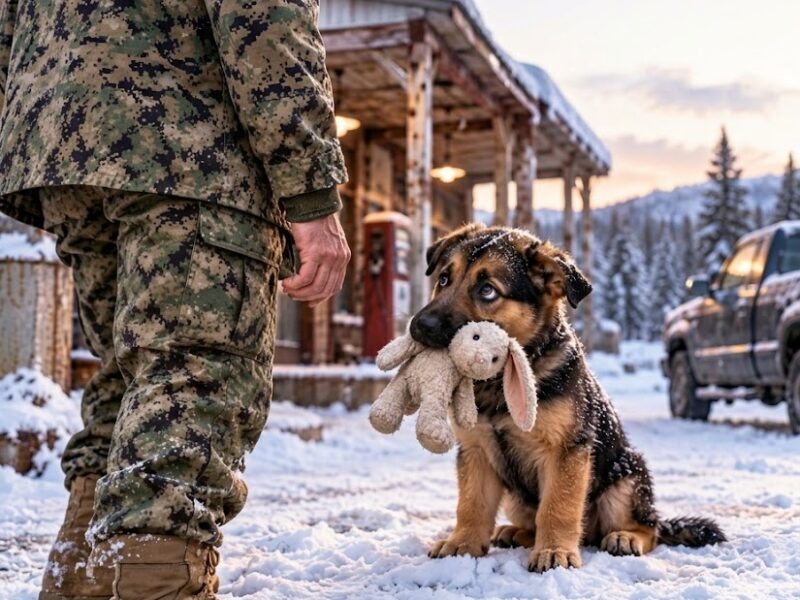
A German Shepherd puppy was found in the snow, refusing to let go of a white rabbit. A veteran saw him—and froze.
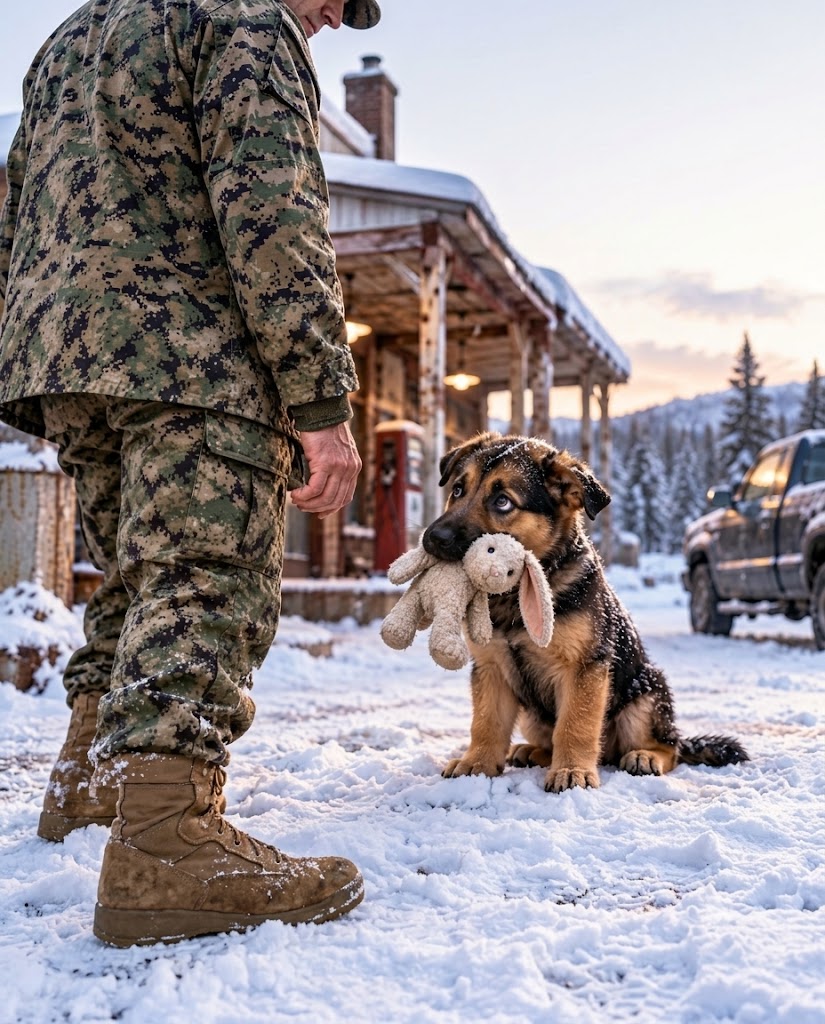
The late-winter sun over Silver Creek, Colorado, had that pale-gold quality that made the old snow on the roadside look almost warm. It was a lie, of course. The air was dry and sharp, the kind of cold that found the seams in your jacket. By five o’clock, most of the shop windows along Main Street were already going dark.
Ethan Cole preferred it that way. At forty-six, the former Army rescue specialist was a broad-shouldered man with short brown hair graying at the temples, a weathered face, and the reserved, deliberate manner of someone who trusted preparation more than people.
He ran Cole Mountain Repair just outside of town, a two-bay garage where folks brought their failing generators, ATVs, snowblowers, and anything else stubborn enough to quit at the worst possible moment. Ethan liked machines because machines made sense. A loose belt could be tightened. A dead battery replaced. A fuel problem traced to its source. Humans were less orderly.
His days followed a pattern with almost military precision. Open the garage at 7:00 a.m. Coffee at 7:10. Lunch at noon. Lock up at 5:00. Drive the twelve miles to the small cedar house he owned outside of town. He rarely attended community meetings, never stayed long when invited to dinner, and had become skilled at answering personal questions without actually answering them.
Years earlier, Ethan had served alongside Mason Reed, a close friend and fellow soldier whose life had fractured after a rescue operation went sideways in unforgiving terrain. Mason survived, but he never regained the mobility he’d once taken for granted. Ethan had replayed that day so many times the memory no longer came in order, just fragments. A route change. Incomplete intel. Critical minutes that slipped away.
The terrible certainty, afterward, that things could have been different if everyone had stayed exactly where the plan demanded. The lesson hardened in him. Procedures exist for a reason. Plans exist for a reason. Uncertainty was just another word for danger that hadn’t shown up yet. That afternoon, Ethan left the shop six minutes behind schedule because a stubborn old ATV refused to start.
The six minutes bothered him more than he cared to admit. He locked the side door, checked it twice, climbed into his dark pickup, and headed west along County Road 14. Halfway home, he passed the abandoned Cedar Ridge rest stop, a low concrete building that had been shut down for nearly eight years. Ethan had driven past it hundreds of times without a glance. This time, something under the sagging awning caught his eye. A large gray storage tote pushed against the wall.
He drove another hundred feet before easing off the gas. In the rearview mirror, the building shrank behind him. Probably just trash, he told himself. Then he noticed two fresh tire tracks veering toward the building and back out to the road. Ethan stopped. For several seconds, he sat behind the wheel, staring at the empty highway ahead. Then he sighed, backed up, and turned onto the cracked asphalt.
The outside air had the clean bite of a Colorado evening, and the snow under his boots was hardened by days of frost. He approached the tote slowly. The lid had been set loosely on top rather than clipped down. Ethan lifted one corner, and something moved inside.
He pulled the lid off completely and went still. Huddled on a thin towel was a German Shepherd puppy, maybe eight or nine weeks old, small and undernourished, its dark coat dulled with dust, its paws too big, its eyes amber, its ears still undecided. Tucked under its chin was an old white plush rabbit. The fabric had yellowed with age. One ear was partially torn, and its tiny embroidered nose had almost disappeared. The puppy held it between its front paws as if everything else were negotiable except this rabbit.
Ethan crouched down. “Well,” he said softly, “this wasn’t on the schedule.” The puppy watched him without making a sound. Ethan extended a hand and let it sniff. The little dog hesitated, then allowed Ethan to touch its shoulder. It was cold, not dangerously so, but enough that Ethan immediately reordered his priorities.
Heated truck. Vet clinic. Water. Identification. Shelter report. He slid his hands under the puppy to lift it, then tried to ease the rabbit aside for a better grip. The puppy instantly curled around the toy, pulling it back against its chest without a growl or a snap. Ethan stopped. “All right.” He looked at the rabbit, then at the puppy. “He comes too.” He scooped both into his jacket, carried them to the pickup, aimed the heater at the passenger seat, and drove straight back to Silver Creek.
Twenty minutes later, he walked into the Bennett Veterinary Clinic with a puppy pressed against his chest and a white rabbit sticking out from under his coat. Dr. Claire Bennett, a calm, pragmatic veterinarian in her fifties who had known Ethan long enough to spot worry even when he masked it with manufactured efficiency, looked up from the counter. “Well, that’s new.” “I found him near Route 14.” “Of course you did.” Claire led them into an exam room, where Ethan set the puppy on a heated blanket.
The rabbit stayed pinned under one paw. Claire worked gently, checking temperature, hydration, breathing, paws, ears, and overall condition. “He’s dehydrated and underweight, and he’s been cold for a while,” she said. “But I don’t see anything that suggests a serious injury.” “That’s good news.” Ethan nodded once, more relieved than his expression revealed. The puppy drank a little water, accepted a small amount of food, then immediately rested its chin on the rabbit. Claire ran a scanner over its shoulders. Nothing. She checked again. No microchip. While examining the toy, she noticed a small fabric tag near one of the back legs. A blue star was embroidered into the cloth. Neat, but faded. Claire snapped a quick photo with her phone. “Recognize it?” Ethan asked. “No, but it looks handmade, or at least from a small shop.” “You’re investigating the rabbit now?” “The rabbit seems better identified than the dog.” Ethan almost smiled.
Claire made several calls. There were no lost-dog reports matching a German Shepherd puppy in Silver Creek or the surrounding towns. The county shelter agreed to post a found-animal notice and check incoming reports. Before Ethan could decide on next steps, Lucy Harper, the shelter director, arrived to pick up medication for another dog. Lucy was an energetic woman in her forties who seemed capable of turning any problem into a checklist before anyone finished explaining it. She looked at the puppy, looked at Ethan, and said, “We’re full tonight.” Ethan immediately shook his head. “No. I haven’t even asked yet.” “You were going to.” Lucy smiled. “Three or four days, maybe. Just long enough to check reports and make space.” “No.” Ten minutes later, Ethan was at the counter, asking whether three or four meant three or four. Claire kept her face carefully neutral. Lucy didn’t bother. Ethan signed the temporary intake form with the expression of a man accepting responsibility for a minor logistical inconvenience rather than a living creature already asleep against his arm. As they left the clinic, Mia Carter was waiting near the entrance with her grandmother, who had come to pick up medication for an old terrier. Mia was twelve, bright-eyed and quick-tongued, though moments of silence sometimes revealed the grief she still carried after losing her mother a few years earlier, while her father’s work kept him away from Silver Creek more often than they would have liked. She knew Ethan from the garage, where she sometimes appeared after school to ask questions about tools and engines. “Mr. Cole, is that yours?” she asked carefully. Mia crouched a few feet away. Unlike most strangers, she didn’t immediately reach for the puppy. She simply extended her hand.
The little German Shepherd watched her, then moved forward slowly, the rabbit still in its mouth, and pressed its forehead against her fingers. Ethan noticed. The dog had tolerated Claire and Lucy, but this was different. He had chosen to close the distance himself. Mia smiled. “He likes me.” “Apparently, he has questionable judgment.” She laughed, and the puppy’s tail wagged once. On the drive home, Ethan found himself thinking about that small gesture more than he expected. At the house, he turned a corner of the laundry room into what he considered a perfectly reasonable temporary dog station: a folded blanket, a shallow water bowl, measured food, a training pad, and a small gate at the entrance. He set the puppy down. “This is where you sleep.” The puppy placed the rabbit on the blanket and looked up at him. Ethan went to the kitchen. Seven minutes later, he heard light scratching on the hardwood floor.
The puppy appeared beside the table with the rabbit in its mouth. Ethan carried him back. Laundry room. Eleven minutes later, the same small muzzle appeared in the hallway. Ethan returned him again and adjusted the gate. “You’re making things unnecessarily complicated.” The puppy sat behind the gate and watched him leave. Later, when Ethan turned off the kitchen light and headed for his bedroom, the house seemed quiet again. Almost. He opened his bedroom door and found the puppy curled against the wall just outside. The white rabbit tucked under its chin. Ethan stopped. Somehow, the little dog had escaped again. He stared for a long moment. The puppy opened one amber eye but didn’t move. Ethan looked toward the laundry room, then back at the small shape in front of his door. It was the third time. He could carry him back. He could rebuild the gate. He could close another door. Instead, Ethan lowered himself to one knee. “Three days,” he said. The puppy’s tail tapped softly against the floor.
Ethan stood, opened his bedroom door, and left it slightly ajar. The puppy didn’t follow him inside. He simply stayed where he was, standing guard over the old white rabbit, as if it were the one thing in his life that had never disappeared. Ethan turned off the hallway light. For the first time in years, the space outside his bedroom wasn’t empty. The three days Ethan had agreed to somehow became a week, then two. By the time Silver Creek began showing the first subtle signs that winter was losing its grip, no one had mentioned the word “temporary” in days. Sam gained weight steadily. His dark coat grew thicker and cleaner, and his legs seemed to lengthen faster than the rest of his body could keep up with. His right ear eventually stood straight up, while the left still tilted slightly, giving him the odd look of taking everything seriously while remaining permanently skeptical. Ethan responded to the growing puppy the way he responded to most unknown problems. He created rules. Breakfast at 6:30. A short walk before the garage opened. No furniture. No entering the tool shed. No chewing electrical cords. The white rabbit was allowed almost everywhere, because every attempt to assign it a place had failed. Sam seemed willing to learn the important rules but treated the rest as suggestions.
Within a week, he had discovered the exact corner of the garage where he could lie down without getting in customers’ way while keeping Ethan in sight. He learned that the sound of Ethan’s coffee maker meant the morning had officially begun, and he often arrived in the kitchen with his rabbit before Ethan had poured the first cup. In the evening, when Ethan sat at the dining table to review invoices or make notes on ongoing repairs, Sam usually ended up under the chair with his head resting on Ethan’s boot. Ethan had never invited him there. But he never moved his foot either. The change in the house was so gradual that Ethan only noticed it when it was gone. One afternoon, Claire kept Sam at the clinic for a routine check while Ethan drove home to grab some paperwork. The silence in the house felt heavier than before. Ethan stood in the kitchen longer than necessary before realizing what was missing. Claws clicking on the floor. A toy dragging across a doorway. The small, impatient sound Sam made when he wanted Ethan to notice him. Ethan immediately dismissed the thought as a simple habit of noise.
When Sam returned later that evening, Ethan opened the truck door before it had fully stopped in the driveway. “You missed him,” Claire said. “He has a schedule. Naturally.” The next afternoon, Mia appeared at the garage much earlier than usual, moving so quickly that Ethan understood something was wrong before she spoke. “I lost it.” She was holding one wrist with her other hand. The thin silver bracelet she usually wore was gone. It had belonged to her mother, and though Mia rarely talked about its importance, Ethan had seen her touch it whenever she was nervous. She thought it had slipped off somewhere behind the garage, where she had walked through the dry grass and patches of old snow on her way home from school. Ethan shut off the engine he was repairing and helped her search. They checked along the fence, under an old workbench stored outside, along the path toward the tree line, and around the small drainage ditch behind the property. Forty minutes became nearly an hour. Mia grew quieter with every place they searched.
“We’ll keep looking,” Ethan told her. “What if someone finds it first?” “There’s hardly anyone out here.” “What if it’s lost for good?” Ethan paused. He understood she wasn’t really talking about money. Before he could answer, Sam approached carrying the white rabbit. He looked from Mia to Ethan and back. “He can’t help,” Ethan said. Mia crouched and held out her bare wrist. “Maybe he can.” Ethan almost told her that wasn’t how tracking worked, then realized he had no good reason to say so. Sam sniffed her hand and the sleeve of her coat. He circled once, moved a few steps away, came back, and sniffed again. For a few seconds, nothing happened. Then his attention shifted. The rabbit dropped from his mouth. Sam lowered his nose and headed toward the back of the property. Ethan followed mainly because Mia followed. Sam crossed the narrow path they had already searched twice, paused near a clump of dried grass, then turned sharply toward an exposed tree root at the edge of the ditch.
He scratched lightly at the ground. Something glinted under a layer of leaves. Mia dropped to her knees. The bracelet lay there, wedged under the root. For several seconds, she just held it in both hands. Then she wrapped her arms around Sam’s neck. Sam responded by trying to climb halfway into her lap. Ethan stared at the tree root. “Lucky break,” he said. Mia looked up. “He didn’t guess.” “You don’t know that.” “Neither do you.” Ethan didn’t like how much sense that made. Three days later, Walter Hayes arrived at the garage looking for a green canvas tool bag he said had fallen from the back of his pickup. Walter was a retired laborer in his sixties with a gray mustache and the patient expression of a man who had spent decades waiting for other people to admit there was a problem. He had stopped at two properties that morning and driven several miles of county road. “Could be anywhere,” Walter said. Ethan glanced at Sam, who was sleeping near the desk with one paw on the rabbit.
“This might be a waste of time.” Walter brightened. “Those are usually your best ideas.” They drove to the stretch of road Walter had most recently traveled. Ethan let Sam sniff one of Walter’s gloves. The puppy first inspected a tire, a mile marker, and something under a pine tree that was clearly more interesting to him than the missing bag. Ethan was about to give up when Sam suddenly stopped. He raised his muzzle. He turned his head slowly into the breeze, then left the roadside and headed toward a shallow ditch nearly forty yards away. “Sam!” Ethan called. Sam kept going. Ethan followed, irritated by the deviation, until Walter pointed ahead. A dark green shape was partially hidden under old snow and pine needles. The bag. Walter laughed loud enough to startle Sam. “You train him to do that?” “No. Maybe I should.” That evening, Ethan bought a black notebook.
His first entry was brief. Bracelet. Unknown location. Personal scent present. Found near tree root. Second entry. Tool bag. Tracking object. Glove. Wind from the west. Dog abandoned ground track at probable. Object located approx. 40 yards from road. He stared at the phrase “abandoned ground track at probable” and crossed it out with a single stroke. He replaced it with “direction change after air sampling.” That felt less presumptuous. Over the following days, Ethan began testing Sam with old gloves, hats, shop rags, and small objects hidden around the property. At first, it was playful. Sam would search, find something, get praised, then run to fetch the rabbit as if reporting success to an invisible supervisor. Mia joined the games after school. Sometimes she hid behind the shed. Sometimes she walked to the pines behind the fence and waited quietly while Ethan released Sam. As soon as Sam found her, Mia threw her arms up and celebrated as if he had just completed the most important mission in Colorado. Sam loved it.
He would circle her, tail beating time, then run back to Ethan before immediately returning to Mia. Ethan began to notice that the celebration itself was the reward. Treats disappeared in seconds. A tennis ball could be forgotten. Finding Mia seemed to stay rewarding every single time. The trouble started when Ethan decided the games needed structure. He measured distances. He noted wind direction. He timed every search. When Sam deviated from the intended route, Ethan steered him back. When Sam paused too long, Ethan repeated the command. When the puppy became interested in something else, Ethan’s voice grew firmer. The more precise Ethan became, the less interested Sam seemed. One afternoon, Ethan hid a glove near the woodpile and sent Sam to search. Sam started correctly, then stopped in the middle of the yard and sat down. “Search.” Sam scratched his neck. “Sam, search.” Sam looked toward the porch. The white rabbit was lying near the door. He got up, walked back to it, picked it up, and went inside.
Ethan stood in the yard, stopwatch in hand. At the next vet visit, Ethan brought his notebook. Claire flipped through several pages. Wind direction, temperature, distance, search duration, correct. Distraction level? “I added that yesterday.” Claire closed the notebook. “Did you note whether he was having fun?” Ethan frowned. “That’s not measurable.” “Maybe that’s your problem.” She explained that a curious young dog can easily lose enthusiasm if every decision he makes gets corrected. Then she wrote a phone number on a clinic card. “Rachel Morgan. Search-and-rescue dog trainer. Call her.” “I’m not training a rescue dog.” Claire looked through the exam room window at Sam, who was carrying his rabbit toward Mia in the waiting room. “Then you’ll have nothing left to argue about.” Before Ethan could respond, Lucy called with news about the blue star sewn under the rabbit. She had traced it to a small children’s craft shop that had once operated in Denver.
The shop had closed years ago, but an old online catalog showed a white rabbit almost identical to Sam’s. Unfortunately, customer records were incomplete, and nothing yet linked the toy to a specific family. Ethan thanked her and told himself the information changed nothing. That same evening, he found an envelope in his mailbox. The sender’s name stopped him before he reached the front door. Mason Reed. Ethan carried the letter inside, set it unopened in the desk drawer, and closed it. Over the following days, he avoided the drawer with the same discipline he had once used to avoid unnecessary risk. Sam, utterly unaware of its importance, took to sleeping under the desk. Ethan found him there several times, the white rabbit under his chin, directly below the drawer. On Saturday, Ethan finally called Rachel. They met two days later at a county training field near Boulder. Rachel Morgan was in her forties, athletic and composed, with auburn hair tied back low and an easy confidence that made Ethan suspect she was used to having her methods questioned.
She listened as Ethan described the bracelet, Walter’s bag, and the object searches. Then she took the leash from his hands. “What are you doing?” “Getting acquainted with your dog.” She spent the first few minutes doing almost nothing Ethan considered training. She moved around the field, let Sam explore unfamiliar surfaces, tossed a tug toy, disappeared briefly behind a storage building, then reappeared before Sam could worry. Soon, Sam was following her with obvious excitement. Rachel finally handed Ethan a small piece of cloth she had been carrying. “Let him smell this.” She walked away while Sam was distracted, circled the storage building, then continued farther than Ethan would have guessed. When Ethan released him, Sam first followed her visible path. Halfway there, he stopped, nose up, head turning. Then he left the trail entirely and circled the building from the opposite side. Ethan started to call him back. Rachel’s voice came from somewhere out of sight. “Don’t do that.”
Ethan waited. Ten seconds later, Sam disappeared around the corner of the building, and Rachel laughed. She came back with Sam bouncing at her side, as if he had just discovered the secret of the universe. “Interesting,” she said. “He followed the wind instead of my track.” Ethan looked at Sam. “He does that a lot.” “Good.” Rachel crouched briefly and scratched Sam’s chest. Rachel’s first official training session disappointed Ethan almost immediately, mostly because nothing resembled the kind of training he had imagined. There were no complex search patterns, no dramatic commands, and no carefully marked scent trails. Instead, Rachel walked Sam through a series of surfaces behind the county training center near Boulder. A metal plate that shifted slightly underfoot, a narrow wooden bridge, loose gravel, rubber mats, concrete steps, and a dark storage corridor filled with unfamiliar smells. Sam hesitated at the metal platform, stepped back, then leaned forward again when Rachel tossed a tug toy across it.
Ethan instinctively reached for the leash. “Don’t help him yet,” Rachel said. “He’s thinking.” Ethan crossed his arms and watched Sam place one paw on the metal, then another. The surface moved. Sam froze, tested it again, and finally crossed on his own. Rachel praised him as if he had just accomplished something important. Ethan didn’t understand why. “He crossed a platform.” “He learned the platform won’t eat him.” Over the following weeks, Sam met volunteers wearing bulky coats and brown hats, a man walking with a cane, children running across the field, technicians carrying equipment, and groups entering buildings through different entrances. He worked near generators, idling utility vehicles, rolling carts, open stairwells, and echoing hallways. Rachel explained that a search dog couldn’t spend valuable energy deciding whether every unfamiliar object was dangerous. Sam needed to learn that strange didn’t automatically mean threatening.
Ethan, for his part, needed to learn something harder. Not every hesitation required a correction. Rachel often made him stand several yards back while Sam investigated at his own pace. “You know, standing here doing nothing is harder than most of the things you’ve asked me to do,” Ethan said one afternoon. “That’s why we keep doing it.” Sam gained confidence with each session, but Ethan’s real challenge appeared when they began simple person searches. Rachel used volunteers who ran short distances, disappeared behind buildings, or hid among trees while Sam watched. At first, the exercises were so easy they seemed childish. Mia sometimes joined on weekends, hiding behind a fence or inside an open shed, calling once before going quiet. Sam always exploded with joy when he found her. Ethan began to understand what Rachel was trying to show him. Sam wasn’t searching out of fear of being wrong. He was searching because finding someone had become the most exciting thing in the world.
The difference was everything. Rachel made the exercises progressively harder, allowing the hidden person to move farther away, cross different surfaces, or disappear before Sam could see the whole route. On one clear afternoon, they drove to an arid training area west of Boulder, where low hills rolled under pale grass and scattered rocks. A volunteer named Ben started from the staging point along a marked trail, walked behind a ridge, and then disappeared near a cluster of boulders. Ethan watched the entire route. Once Ben was hidden, Rachel handed Ethan the long line. Sam sniffed the scent article, lowered his nose, and moved forward. For the first fifty yards, everything went exactly as Ethan expected. Sam followed the track, paused where Ben had crossed a patch of bare dirt, then continued toward the ridge. Ethan felt the quiet satisfaction of a system working correctly. Then Sam stopped, nose up. A light current of air moved across the slope from the right. Sam turned away from the track.
“Sam,” Ethan said. The dog looked back. Ethan pointed toward the route. “Search.” Sam came back two steps, then stopped again. His head lifted higher. He turned toward the slope. Ethan shortened the line. “Wrong direction.” Rachel stood a few yards behind him. “According to what?” Ethan glanced at her. “I watched Ben go the other way.” “Not Sam.” Sam pulled gently toward the top of the slope. Ethan held firm. Rachel said, “Give him enough slack to answer the question.” Ethan hated that sentence because it forced him to admit there was a question. He loosened his grip. Sam climbed the slope, crossed through low brush, and vanished over the ridge. Less than thirty seconds later, Ethan heard Ben laugh. When Ethan caught up, Sam was circling the volunteer, tail sweeping frantically, his tug toy clamped proudly in his jaws. Ethan looked back down the long route Ben had taken, then at the wind moving across the ridge.
Sam had cut almost the entire distance. “Airborne scent,” Rachel said. “It was carrying up the slope.” Ethan frowned. “He left the track and found the person.” “That doesn’t mean every deviation is the right one.” “Exactly.” Rachel waited until Ethan looked at her. “So do you teach him to find people, or do you teach him to guess where you want him to go?” Ethan had no answer he liked. The question followed him home and stayed there. Over the next month, he began noticing details he had ignored before. Sam’s breathing changed when his curiosity sharpened. His tail sometimes lowered when he concentrated. There were moments when his whole body went still before he committed to a direction. His nose would lift, move through the air once or twice, then lock onto something Ethan couldn’t detect. Rachel taught him not to label behavior too quickly. “If you already know where the volunteer is, your brain will interpret everything Sam does as proof he’s going there.”
“Watch the dog before you watch your own expectations.” Ethan wrote that sentence in his black notebook. He learned the inverse lesson on a Saturday, when Sam abruptly abandoned a training track, pulled toward a row of bushes, and spent thirty seconds intensely examining what turned out to be half of an old sandwich wrapper. Rachel waited for Ethan to say something. “Outstanding professional judgment,” he muttered. “Good,” Rachel replied. “You’re starting to understand.” Confidence, she explained, wasn’t pretending Sam was always right. It was understanding him well enough to tell the difference between information, curiosity, distraction, and commitment. That idea was harder for Ethan to accept than obedience had ever been. At home, another problem was waiting. Mia had a school presentation to give about the person who had influenced her most. She wanted to talk about her mother, but every draft ended with half the page crossed out. One evening, she sat at Ethan’s workbench in the garage while Sam slept nearby and admitted she was considering choosing someone else.
“It’s easier,” she said. Ethan tightened a bolt on a generator and thought before answering. “Easier doesn’t always mean better.” “What if talking about her makes me feel like I’m stuck back there?” Ethan looked at her. “Remembering someone isn’t the same as living in the past.” Mia watched him for a moment. “Are you sure?” The question landed deeper than she probably intended. Ethan gave a short nod, but later that evening, he found himself standing near his desk with Mason’s unopened letter in his hand. Sam was lying under the chair, the white rabbit tucked against his chest. Ethan finally tore open the envelope. The letter was brief. Mason wrote that he had never blamed Ethan for what happened, not then and not now. He said there had been too many variables that day for one man to carry indefinitely. The last line was simpler. “I turned the page a long time ago, Ethan. I hope someday you’ll let yourself do the same.”
Ethan read it twice, then folded it carefully and left it on the desk instead of putting it back in the drawer. A few days later, Claire noticed that the rabbit’s damaged ear had split open again along the old seam. She repaired it while Sam watched from the exam table with unusual intensity. When she briefly moved the rabbit out of his sight to grab thread, Sam immediately stood up and looked for it. “He doesn’t panic,” Claire said, handing the toy back, “but he notices when it’s gone.” Rachel agreed when Ethan mentioned it. “Don’t use that rabbit as a reward.” “I wasn’t planning to.” “Good.” “Toys can be rewards.” “That one is different.” From then on, Ethan kept the rabbit in Sam’s secure crate during training. At the start of each session, Sam checked that it was there. At the end, he checked again. Ethan never timed the ritual, though the temptation remained. By early fall, Sam was working the field with growing assurance, and Ethan had learned to read the small shifts that preceded a decision. He still corrected when safety demanded it. He still made mistakes, but he no longer assumed every unplanned turn was disobedience.
One evening, after a short search exercise, Sam stopped at the edge of a field, lifted his nose into the cool air, and drifted slightly left. Ethan felt the old impulse to redirect him before he could be wrong. His hand tightened on the leash, then relaxed. Sam moved forward. Ethan followed, not because he had abandoned all responsibility, but because he was beginning to understand that sometimes the hardest part of command is knowing when the one beside you has information you don’t. More than a year after Sam first crossed Ethan’s threshold carrying a worn white rabbit, he no longer looked like the uncertain puppy that had once slept outside the bedroom door. He had become a powerful German Shepherd with a deep chest, broad shoulders, and a dark coat that caught bronze highlights in the sun. His right ear stood perfectly upright. The left still tilted slightly outward, preserving a small reminder of the clumsy puppy he had been. Ethan had changed too, though the difference was harder to see. His black notebook remained filled with hours, distances, weather conditions, and observations, but his notes served less to predict Sam’s actions than to understand them better.
When Rachel finally informed Ethan they were ready for their first operational evaluation, he read the message twice before replying with a single word: “Understood.” The test took place at an abandoned industrial complex near Denver, a sprawling property of aging warehouses, loading docks, fenced alleys, concrete buildings, and open yards where maintenance crews still occasionally moved equipment. The morning was cold and clear, with pale sunlight reflecting off patches of old snow along the shaded walls. Sam checked for the white rabbit in his travel crate before Ethan closed the truck door. “He stays here,” Ethan said. Sam looked at him, then back at the rabbit before jumping down. Daniel Brooks, the evaluator, was a lean man nearing sixty with a gray beard and a sober manner that made it difficult to tell whether he was impressed or concerned. He explained that the evaluation wasn’t simply about locating a hidden person. Obedience, environmental comfort, handler vigilance, recall, decision-making, and safety would all be considered. “You’re being tested as a team,” Daniel said.
Ethan nodded. That part he understood. The first exercises went better than expected. Sam crossed a metal grating bridge without hesitation, ignored another working dog twenty yards away, stayed focused while a vehicle started nearby, and moved through a dark warehouse where echoes bounced from wall to wall. During a simple tracking exercise, he worked across several overlapping human trails and correctly dismissed two before committing to the third. Ethan now noticed the small signs: the change in breathing, the low tail, the stillness before movement. Instead of correcting, Ethan let him work. Rachel watched from outside the evaluation area but said nothing. By midday, Ethan felt something he hadn’t allowed himself to feel before the test. Confidence. The final scenario began near the east side of the complex. A volunteer was hidden somewhere in a vast space of buildings and service roads. Ethan received the scent article, presented it to Sam, waited, then gave the search command. Sam moved quickly along a warehouse, checked the corner of a storage shed, crossed a patch of packed gravel, then slowed near a narrow service road.
Ethan saw the shift before Sam even turned. His nose lifted. His body went still. A light breeze was moving, and Sam oriented toward it. Ethan looked left and noticed a maintenance vehicle approaching in the distance. It was moving slowly, but the road was active. “Sam, here.” Sam turned immediately toward him and took a few steps back. Then he stopped. He lifted his head again. Ethan recognized the pattern. Sam had caught something stronger. “Here.” Sam looked at Ethan, then back across the road. Ethan called again. This time, the response was slower. Sam took one more step but continued working the wind. Ethan shortened the line and brought him fully back. The vehicle passed without incident. As soon as Ethan released him to resume the search, Sam crossed the road calmly, moved behind an old utility building, and gave his usual indication near a closed storage bay. The hidden volunteer emerged a few seconds later. Sam had found the target quickly. Ethan felt relief wash through him. The search was a success.
That should have been the most important thing. At the staging area, Sam accepted praise, drank some water, then walked straight to the truck. Ethan opened the crate, and Sam pressed his muzzle against the white rabbit before settling beside it. Ethan was still watching him when Daniel approached with the evaluation sheet. “His environmental work is solid,” Daniel said. “Very good problem-solving. Excellent scent focus.” Ethan waited. Daniel glanced at the paper. “But he’s not operational yet.” The words took a moment to land. “He found the target.” “He did.” “Quickly.” “Yes.” Ethan looked toward the service road. “So what failed?” Daniel didn’t react to the edge in his voice. “Recall under high scent concentration.” Ethan crossed his arms. “He came back.” “Eventually.” “There was no dangerous crossing.” “Because you had a long line and enough time.” Daniel lowered his clipboard.
“And what if next time the danger isn’t a slow truck? What if it’s a drop-off you can’t see? Thin ice? Machinery? A road where you don’t have several seconds to react?” Ethan had answers for almost everything. He had none for that. Daniel continued, more gently now. “That Sam thinks independently is an asset. You don’t want to remove that. But when you call him because the environment has become dangerous, he has to understand that returning is part of the job too.” Ethan looked through the truck window. Sam was lying down, one paw on the rabbit. “So the search worked.” “The search worked,” Daniel said. “The deployment evaluation did not.” On the drive home, Ethan left the radio off. Sam slept for most of the trip. Ethan kept returning to the same conclusion. Talent wasn’t enough. If he couldn’t guarantee Sam would respond at the critical moment, then maybe he had no right to put him in situations where the cost of hesitation could be high.
By the time he reached Silver Creek, he had almost decided to abandon the rescue path entirely. Sam could still train informally. He could still search for fun. He didn’t need a certification to have a good life. The next afternoon, Mia arrived at the garage as Ethan was putting his training gear into a cabinet. “Why are you putting that away?” she asked. “Taking a break.” Mia looked at the harness, then at Sam sleeping near the heater. “How long?” “Maybe permanently.” Her expression changed. “Because he failed one test?” “Because safety isn’t optional. Neither is learning.” Ethan closed the cabinet. “Mia, you’re always telling me not to give up on something because it’s hard. This is different.” “Because it’s Sam?” She shook her head. “Or because you only like mistakes when other people are allowed to make them?” Ethan stared at her. Mia looked immediately like she regretted the sentence, but she didn’t take it back.
“He’s not perfect,” she said more quietly. “You knew that already.” After she left, Ethan stood by the cabinet for several minutes. That evening, his phone rang. Mason’s name appeared on the screen. Ethan almost didn’t answer. Instead, he picked up. Their first conversation in years was awkward at first, full of silences and useless comments about work and Colorado weather. Finally, Mason said, “Rachel called me.” Ethan straightened. “She shouldn’t have.” “She didn’t tell me much, just that you were about to throw something away because it didn’t go perfectly.” Ethan closed his eyes. “You two would get along.” Mason laughed softly, then grew serious. “Ethan, the day everything changed for me wasn’t one single mistake.” Ethan said nothing. “The terrain scrambled our timing. Communications were a mess. Information arrived late. People made decisions with what they had. You keep looking for the exact point where you could have changed the outcome. There wasn’t one.”
Ethan looked at Sam, who had raised his head at the sound of Mason’s voice on the phone. “I should have seen more.” “Maybe. So should I. So should everyone. But I turned the page a long time ago.” A silence followed. “You’re the one still stuck there.” Those words stayed with Ethan long after the call ended. The next morning, Rachel arrived at the garage with a tablet. She set it on Ethan’s workbench and opened the evaluation video. “Watch Sam, not yourself.” They replayed the service road sequence. Rachel slowed the footage. Sam turned toward Ethan on the first recall, then stopped, nose in the wind, head sweeping the air, stillness, determination. Rachel replayed it. “He wasn’t ignoring you by accident.” “I know.” “Do you?” She let the video continue. Ethan watched Sam receive the second scent confirmation and hesitate between the recall and the source. “He had information I didn’t,” Ethan said.
“Yes.” “And Daniel was still right.” Rachel nodded. “Yes.” Ethan looked at her. Rachel pointed at Sam on the screen. “The problem isn’t that he thinks,” she said, then pointed at Ethan, “and the problem isn’t that you want to keep control when safety is at stake. The problem is that the conversation between those two things isn’t finished.” For once, Ethan didn’t try to decide which side was right. Both were. That afternoon, Lucy stopped by with another piece of the puzzle surrounding the white rabbit. The closed Denver craft shop had finally produced a surviving invoice from an old archived account. The customer name was Whitman. The address on the receipt was no longer current, and Lucy had found no immediate way to contact the family. Ethan read the name twice before handing the paper back. He looked at Sam, then at the rabbit beside his paws. Somewhere, there had apparently been a Whitman family who knew this toy before Ethan did.
It was another unanswered question, but for the first time, Ethan didn’t feel obligated to solve it immediately. That night, he sat at his desk with Mason’s letter beside the evaluation report. Sam was lying with the white rabbit under his chin. Ethan looked at the paused video on his laptop one last time. Sam turning toward a scent Ethan couldn’t perceive. Ethan calling him back because of a danger Sam couldn’t understand. Neither of them had been entirely wrong. Neither of them had been ready enough. Ethan closed the laptop and rested his hand briefly on Sam’s shoulder. Failure no longer felt like an ending. It felt like information. What he would do with it, he hadn’t decided yet. The next morning, Rachel arrived at the county training field just after sunrise and found Ethan’s truck already parked near the fence. Sam was sitting at Ethan’s left side, alert but calm, while the white rabbit waited in its crate. Rachel looked at the dog, then at Ethan. “You decided.” Ethan nodded. “I want to try the evaluation again, eventually.”
He looked down at Sam. “First, I want to fix what actually caused us to fail.” That answer was enough for Rachel. She set three orange cones on the field and called a volunteer carrying a tug toy. The first exercise seemed almost too simple. Sam was allowed to watch the volunteer walk away, get excited, and start following. Ethan waited until Sam was fully engaged, then called him back. Sam hesitated. Ethan felt the familiar irritation rise, but this time he didn’t repeat the command immediately or tighten the leash. Rachel said nothing. Ethan waited half a second, called once more, and took one step backward. Sam turned and came back. Ethan rewarded him generously, praised him, then surprised Sam by releasing him directly toward the volunteer. The dog shot forward with renewed enthusiasm. “Again,” Rachel said. That pattern became the foundation of the next four months.
They practiced recall near food, passersby, other dogs, idling vehicles, machinery, unfamiliar buildings, and volunteers disappearing around corners. But the hardest exercises were always scent-based. Rachel set up situations where Sam caught a strong odor, started following it, then heard Ethan call. At first, Sam returned reluctantly, throwing glances over his shoulder as if convinced Ethan was making a terrible mistake. Then Ethan rewarded him and said, “Search.” Sam learned that coming back didn’t erase the problem. It didn’t end the game. It didn’t mean Ethan no longer trusted his nose. Sometimes it only meant pause, check, and continue. Ethan learned the same lesson in reverse. He stopped seeing recall as a victory over Sam’s independence. It was simply another piece of communication between two members of the same team. On hard days, progress was measured in seconds. On better days, Sam turned back immediately, even when the hidden volunteer was close. Ethan wrote less in his notebook than before. When Rachel noticed, she asked if he had finally run out of categories.
“I’m observing more,” he said. “That’s alarming for your mental health.” Away from the training field, Silver Creek was changing too. Mason arrived one Saturday afternoon while Ethan was replacing a starter at the garage. Ethan recognized his truck before he saw the man himself. For a moment, neither of them moved. Years of avoided conversations seemed to stand between them. Then Mason crossed the shop and extended his hand. Ethan took it. The handshake turned into an awkward embrace that neither of them commented on afterward. They drank coffee at the workbench and talked about ordinary things at first—engines, roads, the price of parts, the town. Sam eventually appeared carrying a canvas pouch Ethan used for training games and dropped it at Mason’s feet. “What does he want?” Mason asked. “Apparently, you’ve been assigned a mission.” In less than twenty minutes, Mason was hiding an old glove behind stacked tires while Sam waited outside the bay. When Sam found it, Mason laughed so hard that Ethan laughed too.
Claire stopped by later with medication for one of Walter’s dogs and paused in the doorway when she heard them. She didn’t mention the sound, but on her way out, she said to Ethan, “You do that more now.” “Do what?” “Nothing.” She smiled and left before he could argue. Mia had also begun spending more time with the search-and-rescue program through her junior volunteer activities. She filled water jugs, organized clean towels, carried light equipment, and volunteered eagerly whenever the trainers needed someone to hide during public demonstrations. Ethan noticed she no longer seemed uncomfortable when people asked about her mother. Her school presentation had gone well. She had ended up talking about her after all. “I only cried once,” Mia told him proudly. “That’s not failure,” Ethan replied. She gave him a pointed look. “I know.” He understood exactly what she meant and chose not to respond.
Meanwhile, Lucy continued following the Whitman name. Several old records led nowhere before she finally located a family now living in Utah. She contacted them carefully, sharing only enough information to confirm whether a connection might exist. A woman named Rebecca Whitman responded a few days later. Years earlier, her son Noah had known a young German Shepherd puppy that looked remarkably like Sam. More importantly, Noah still had an old photograph. Lucy opened the image on her computer and stared at it for a long time. A much younger Sam, or a puppy nearly impossible to distinguish from him, sat beside a small boy. Between the puppy’s paws was a white plush rabbit with a blue star sewn near one foot. Lucy didn’t contact Ethan yet. The photograph was striking, but she wanted to be certain before opening a door that might change more than one life. As winter settled in, Rachel made the training progressively harder.
During one session, Sam was less than thirty yards from a hidden volunteer when Ethan called him back. Sam stopped so abruptly that the long line went slack. His head stayed turned toward the scent. Ethan called once. Sam looked back. For a second, Ethan could almost see the decision being made. Then Sam ran to him. Ethan rewarded him, waited, then released him again. Sam returned to the exact scent corridor he had left and found the volunteer moments later. Rachel watched him celebrate, then looked at Ethan. “That’s the conversation.” Ethan nodded. He finally understood what she meant. The second evaluation took place nearly four months after the first. It was held at a county public works training site, with gravel roads, maintenance buildings, fenced areas, and enough traffic to make safety part of every scenario. Ethan felt more nervous than the first time. Not because he doubted Sam—no—but because he now understood exactly what failure could look like.
Daniel greeted them at the staging area and showed no sign that their previous result mattered. Sam completed the obedience and environmental sections successfully. He ignored another dog, moved across unfamiliar surfaces, stayed calm despite machinery noise, and returned quickly despite several distractions. Then came the final search. Ethan presented the scent article. “Search.” Sam moved across the site, checked the side of a storage building, crossed an open lot, then slowed near a rutted access road. Ethan saw his nose lift. Sam veered toward the opposite side at almost the same moment. A county service truck appeared around the bend. “Sam, here.” Sam turned immediately, without hesitation. He ran back and stopped beside Ethan. Ethan shortened the leash and waited for the truck to pass. Sam looked toward the scent corridor but stayed with him. Once the road was clear, Ethan relaxed the line. “Search.” Sam crossed with control, lifted his nose, and returned almost precisely to the scent line he had left.
He moved behind an old pump station and disappeared around the corner. A few seconds later, he gave the trained indication. The hidden volunteer called out. Ethan closed his eyes for a moment, not just from relief. Sam hadn’t forgotten the scent because he came back. Ethan hadn’t stifled Sam’s independence because he called him back. Both things had survived the interruption. At the end of the evaluation, Daniel approached with his clipboard. Ethan waited. Daniel looked at Sam, then at him. “Better communication.” Ethan almost smiled. “Is that an official term?” “No.” Daniel turned the sheet around. One word was clearly printed at the bottom: deployable. Ethan stared at it longer than he meant to. Sam nudged his hand. Ethan crouched and rubbed the dog’s neck. “You did good.” Sam’s tail hit Ethan’s leg hard enough to make Rachel laugh.
When Ethan opened the crate in the truck, Sam ignored the toy near the door. He went inside, touched the old white rabbit with his muzzle, then settled beside it. Ethan watched silently. For months, he had worried that making Sam stronger meant teaching him to abandon something. The hesitation, the dependence, the part of him that still needed reassurance. But Sam had become more confident, more stable, and more capable without abandoning the small object that had once helped him through uncertainty. Ethan reached into the crate and tucked the rabbit back under Sam’s paw. The dog closed his eyes. Across the parking lot, Rachel and Daniel were still talking. Mason had texted Ethan that morning to tell him not to overthink the result. Mia had demanded a photo afterward. For once, Ethan had no desire to calculate what came next. The word on the evaluation sheet was enough.
They hadn’t come back to prove the first failure was a mistake. They had come back because their failure had shown them what they still needed to learn. And this time, they had learned it together. Sam’s first major mission came near the end of winter, when the mountains west of Gunnison were still covered in packed snow and the afternoon sun disappeared early behind long blue ridges. The call reached Ethan shortly after 3:00 p.m. A father and his fourteen-year-old son had not returned from a scouting trip, and their last confirmed location was somewhere on an old forest road where cell service was almost nonexistent. When Ethan and Sam arrived at the command post, county volunteers had already located the family’s ATV, disabled on the shoulder after a mechanical failure. The vehicle was intact, but there was no one around. Fresh snow and the passage of the first search teams had erased most obvious tracks. Mason was working inside the mobile command vehicle, surrounded by maps, radio logs, and GPS readouts.
His mobility had changed the kind of work he could do in the field, but not the value of his knowledge. He had spent years analyzing terrain under pressure, and the search-and-rescue team now relied on him for route analysis and communications. Ethan paused for a moment when he saw him wearing a county volunteer headset. Mason looked up. “Don’t make this emotional.” “I wasn’t planning to.” “Good. You’re bad at it.” Ethan almost smiled before Rachel called him over to the ATV. The missing man, David Mercer, had years of outdoor experience, but his son, Caleb, was only fourteen. Investigators believed the two had tried to continue on foot after the vehicle failed. A glove belonging to David had been left in the storage compartment. Ethan presented it to Sam, who sniffed carefully before looking toward the road ahead.
The white rabbit stayed secure in its crate at the command post. Sam had glanced at it once before getting out, then shifted fully into work mode. “Search,” Ethan said. Sam headed north along the road. For the first twenty minutes, his behavior was steady but unremarkable. He checked both sides of the path, moved through areas other searchers had already walked, and occasionally lifted his nose into the cold air before returning to the ground. Ethan watched without assuming. Rachel followed at a distance while a specialized volunteer, Marcus Lane, moved behind her with winter safety gear. Mason’s voice came over the radio periodically, keeping them informed of nearby teams and mapped hazards. After nearly forty minutes of searching, Sam began to slow. His tail lowered slightly. His breathing changed. Ethan saw his nose lift. Sam stopped short and turned southwest, where the terrain dropped into a narrow ravine.
The assigned search corridor continued north. Ethan studied the slope. Dense trees obscured most of the ground below. Years earlier, he might have corrected Sam immediately because the map said the search area was elsewhere. A year ago, he might have followed simply because Sam seemed certain. Now, he did neither. “Sam, here.” Sam took a few steps back, but halfway through, he stopped and lifted his nose again. His body went taut toward the ravine. Ethan keyed his radio. “Command, the dog is showing a significant behavior change southwest of our corridor. Nose lifted repeatedly, same direction, strong insistence after recall.” Mason answered first. “Copy. Stand by.” Ethan unfolded his map as Rachel moved to his side. A contour line cut sharply through the area. “The ravine gets steeper farther down,” Rachel said.
Sam pulled gently toward the slope. Ethan held him. “Wait.” Sam looked at him but stayed in place. That single response mattered. A strong scent was urging him to move, but he was still accepting the limit Ethan imposed. Mason came back on the radio. “There’s an old maintenance track east of your position, barely marked on the current map. An older forest layer shows it skirting the top of the ravine.” Ethan traced it with his finger. “Structures?” A pause. “Possible service cabin on a 2009 layer, unconfirmed.” Rachel studied the terrain. “Better than going straight down.” Ethan agreed. He contacted command and requested permission to open a secondary corridor. Authorization came with instructions to stay on the safest route and maintain contact. Ethan turned east instead of following Sam directly toward the scent. Sam resisted at first, casting frequent looks toward the slope. Ethan moved him forward without forcing him roughly.
“I know,” he said quietly. “We’re taking another way.” For several hundred yards, Sam seemed frustrated, but when they reached the faint trace of the maintenance track and skirted the ravine, his attitude shifted again. He caught the scent from a new angle. Ethan relaxed the line. “Search.” Sam surged forward. He stopped every twenty or thirty yards to sample the air, then corrected his trajectory. The old path narrowed under pine branches and drifted snow. Marcus probed uncertain sections before the team crossed. Rachel stayed close enough to monitor Sam’s behavior but let Ethan handle the work. The farther they went, the more focused Sam became. He no longer wandered or checked unrelated odors. His attention narrowed. Then he stopped and turned sharply toward a pile of fallen branches and young pines. Ethan saw nothing but snow and dark trees.
Sam moved forward and gave his trained indication near what looked like the edge of a roofline. Rachel moved closer. Hidden behind the trees was a small maintenance cabin, so old that its weathered walls almost blended into the forest. A thick branch lay across part of the roof, but the structure remained solid. Ethan approached the door and called out, identifying their search team. For a long second, silence held. Then a voice answered from inside. “We’re here.” Ethan closed his eyes briefly, then keyed his radio. “Command, subjects located. Two people, conscious. Requesting medical support via secondary access.” Sam stood beside him, tail beating hard but controlled. Inside, David and Caleb had made a series of sound decisions after the ATV failed. They had tried to repair the vehicle, then walked toward a maintenance structure David remembered from old topographical maps. On the way, David had twisted his ankle on uneven ground.
The injury wasn’t severe, but it made walking slower and less practical as darkness approached. Rather than continue, they had sheltered in the cabin to conserve energy. What no one at command knew was that a small ventilation opening at the back of the building still allowed warm air to escape from inside. The shifting wind carried the human scent across the ravine, over the trees, and into Sam’s original search corridor. Sam had caught something no map could have revealed. Yet that discovery would have meant nothing if Ethan had simply followed him down dangerous terrain. That realization stayed with Ethan while the medical team examined David and Caleb and prepared them for transport. Sam had been right about the scent. Ethan had been right to slow him down. The success lived in the balance between those two truths.
News of the rescue spread quickly through Silver Creek. By the next afternoon, people Ethan barely knew were stopping by the garage to ask about Sam. Walter brought him a new tug toy. Mia insisted the county should make Sam an employee badge. Ethan deflected most of the praise with brief answers, but Mason began spending more time at the rescue headquarters. His mapping work during the Mercer search had helped trace the safest route around the ravine, and the team coordinator asked if he would help regularly with terrain planning and radio operations. Mason accepted. Watching him work affected Ethan more than he expected. Mason had lost part of his old life, but not his usefulness, his judgment, his humor, or his ability to contribute. Ethan realized he had spent years remembering Mason mainly through what the accident had taken. Mason hadn’t done that to himself.
Two days after the rescue, Lucy asked Ethan to meet her at Claire’s clinic. She had finally verified the information she held. On her tablet was an old photo of a boy about seven years old, sitting on a porch step beside a German Shepherd puppy. Between the puppy’s front paws was a white plush rabbit with a blue star near one foot. Ethan stared at the photograph. Even younger, even smaller, the dog’s markings were unmistakable. “That’s Sam.” Lucy nodded. “The boy is Noah Whitman.” She explained that the Whitmans had gone through a severe financial crisis a few years earlier and had to move quickly. During the move, Sam had been left temporarily with someone they trusted, with the agreement that the puppy would join them later or be carefully placed with another family. Instead, the arrangement had fallen apart. The person responsible eventually admitted she had abandoned the puppy rather than continue caring for it. Lucy kept the explanation brief.
Noah had never known. He had grown up believing Sam had simply been rehomed somewhere safe. Ethan looked at the photograph again. Noah’s hand rested on the puppy’s back. Sam’s mouth was wrapped around the fabric body of the rabbit, exactly the way he still held it today. “Does the family want him back?” Ethan asked. “They haven’t said, but they know he’s alive. His mother knows. I verified everything before involving you.” Ethan was silent. The fear rising in him surprised him with its simplicity. He didn’t want to lose Sam. Claire, standing nearby, seemed to understand before he spoke. “If they ask to meet him, let them.” Ethan looked at her. “You think I should give him back?” “That’s not what I said.” Claire’s voice stayed gentle. “Sam deserves to know his past didn’t stop on that roadside. Noah probably deserves it too.”
Later that evening, Ethan sat at home with the photo open on his phone while Sam slept near the stove, the white rabbit tucked under his chin. Across town, Lucy had arranged a supervised video call between Mia and Noah, thinking two kids would make the first conversation easier than a room full of adults. They talked far longer than expected. Mia understood what it meant to carry the absence of someone important. Noah understood what it meant to wonder if something you loved had disappeared forever. By the end of the call, they were comparing stories about Sam as if assembling two halves of the same book. Ethan didn’t yet know what the Whitmans would ask of him. For the first time since he’d found Sam, uncertainty frightened him more than any evaluation. But when Sam woke, picked up the rabbit, and came to rest his head against Ethan’s knee, Ethan didn’t hold him tighter.
He simply placed a hand on the dog’s shoulder. Whatever happened, Sam’s past deserved what Ethan had learned to grant his own. Not a razor, not control, but the chance to be faced honestly. Early summer arrived gently in Silver Creek, turning the last remnants of winter into green slopes, clear roads, and long evenings scented with pine. On Saturday, the Whitmans came to town. Ethan opened the garage earlier than usual, even though there was nothing to repair. Sam followed him from room to room, carrying the white rabbit as if this morning were no different from any other. Ethan knew it was. He had slept poorly, checked the driveway too often, and reorganized an already organized shelf. Rachel arrived first, then Claire and Lucy. Mason came later with a folder of maps under his arm, claiming the visit was ordinary.
Mia stood near the garage doors, trying to look casual despite her video calls with Noah. When a dark SUV finally turned onto the gravel, Ethan felt the same tension he had before difficult missions. Except there was no procedure for this. Rebecca Whitman stepped out first. Noah followed, taller than Ethan had imagined, holding the old photo Lucy had shown him. For several seconds, no one spoke. Sam was lying near Ethan’s truck. At the sound of the car door, he lifted his head. Noah looked across the yard and stopped. His face changed before he said anything. Then he called out a name the others didn’t know, the name Sam had carried before he became Sam. The dog froze, ears up. For one suspended moment, Ethan wondered if memory could survive years in an animal without anyone knowing. Then Sam ran.
Noah dropped to his knees as Sam reached him. The boy wrapped his arms around the dog’s neck and buried his face in the dark fur. Sam circled him with excitement, came back, leaned against him, then circled again, as if trying to fit a familiar scent back into a life that had completely changed. Noah was crying openly now, but no one moved to interrupt. Rebecca pressed a hand to her mouth. Mia wiped her eyes with her sleeve. Ethan stayed several yards back, hands at his sides. Rachel rested a hand gently on his shoulder. He had spent the previous week preparing for the possibility that the most honorable thing to do would also be the thing he wanted least. If Sam belonged with Noah, Ethan had decided he wouldn’t stand in the way. He told himself that loving someone or something didn’t give you the right to keep it simply because letting go hurt.
But Sam eventually pulled away from Noah and looked across the yard. His eyes found Ethan. He trotted over, pressed briefly against Ethan’s leg, then turned suddenly toward the truck. Ethan opened the crate door. Sam grabbed the white rabbit and carried it back to Noah. He set it on the gravel between the boy and Ethan, then sat beside it. For a moment, the old toy seemed to connect two different lives—the frightened puppy Noah remembered and the working dog Ethan knew. Noah touched the rabbit’s ear. “He still has it.” “Every day,” Ethan answered. Noah smiled through his tears. “He used to sleep with it.” “He still does.” Rebecca eventually stepped closer. “Ethan, we didn’t come here to take him back.” Ethan watched her carefully. “Are you sure?” “We’re sure.” She explained that Noah had carried years of guilt, believing Sam had been sent to a safe home before disappearing.
When Lucy contacted them, Rebecca had been afraid to tell him until she was certain. Noah had asked only one question. “Is he okay?” Seeing him today had answered that. Noah looked up at Ethan. “Does he have a home?” Ethan tried to answer, but no words came for several seconds. He hadn’t realized how much he had been holding in until the pressure eased. Sam, apparently satisfied with everyone’s emotional progress, picked up the rabbit and settled against Noah again. The Whitmans stayed most of the day. Noah showed Mia old photos of Sam as a puppy. Ethan told him about the bracelet Sam had found, his training failures, the second evaluation, and the search near Gunnison. Noah laughed when he learned Sam still waited by the washing machine whenever the rabbit was being cleaned. Before leaving, he asked if he could come back. Ethan answered faster than he would have expected. “Whenever you want.”
That evening, after everyone had gone, Ethan walked to the back of the garage and faced an unused plot of land that had been empty for years. The old shed needed work. The fence was in bad shape, and part of the ground needed leveling. He had been thinking about it for months without admitting the idea had become a plan. Three weeks later, he asked Rachel, Claire, Lucy, Mason, and Mia to meet him behind the garage. Noah joined them by video from Utah. Ethan unfolded a rough site plan on the hood of his pickup. “I bought the property.” Rachel looked at him. “Why?” Ethan pointed at the sketch. “A training field, kennels, a small medical room, an indoor scent area, a storage building. The Second Trail K9 Project,” he said. No one spoke at first. Ethan continued before he lost momentum.
“The idea isn’t to make every rescue dog a search dog. Some might have the drive and confidence for rescue work. Others might become therapy dogs, companions for veterans, or simply better-prepared family dogs. Some might never work at all.” “Not every dog needs an impressive job,” Ethan said. “Sometimes a second chance is just finding where they belong.” Rachel was the first to agree. She offered to design the training program. Claire volunteered veterinary support and basic health screenings. Lucy said she could coordinate with shelters to identify dogs that would benefit from an evaluation. Mason leaned over the plan and immediately began criticizing the location of the equipment room, which Ethan correctly interpreted as agreement. Mia asked if junior volunteers could help. Noah’s voice rose from the phone. “I want to be part of it too.” By the end of summer, the empty lot behind the garage didn’t look empty at all.
The fence had been repaired. The old shed had become a clean training building. A simple sign near the entrance read: “Second Trail K9 Project.” The opening was deliberately modest, though half of Silver Creek seemed to show up anyway. Walter brought folding chairs. The rescue team brought equipment. Rebecca drove Noah back from Utah, and Mia welcomed him at the gate. Several rescue dogs were there for preliminary evaluations, including a young Labrador who had already stolen a glove and tried to carry two tennis balls at once. Rachel called it potential. Mason called it an inventory loss. Sam arrived wearing his work harness and carrying the white rabbit. The contrast made everyone laugh. Ethan looked down at him. “You had a chance to look professional.” Sam’s tail wagged. Ethan laughed with everyone, instead of pretending not to.
That evening, when the last vehicle had gone and the new field was quiet, Ethan sat on the porch with a sewing kit beside him. A corner of the rabbit’s ear was beginning to split again. Sam lay with his head on Ethan’s thigh, watching the needle move through the faded fabric. Ethan could see Claire’s old stitches next to his own uneven repairs. Years ago, he had thought the rabbit represented everything fragile about Sam. The fear, the abandonment, the dependence, the part of him that couldn’t let go. Now, Ethan saw it differently. The rabbit had survived because someone kept repairing it. Sam had survived because someone finally stayed. Ethan had spent years believing strength meant eliminating everything that could hurt, controlling every variable, correcting every weakness until no uncertainty remained.
Sam had shown him another kind of strength. You can carry the hardest parts of your life without letting them dictate what comes next. You can remember and still move forward. Ethan finished the stitch and set the rabbit on the porch. Sam picked it up gently and headed toward the training field. Mia and Noah were still there with their families, tossing a ball for one of the new dogs. Mason sat near a folding table covered with maps. Rachel was adjusting the young Labrador’s harness, while Claire and Lucy talked under the new sign. Sam moved among them with the rabbit in his mouth, as if this strange group of humans and dogs had always been connected. Ethan stayed on the porch for a moment, watching. Years ago, he had built his life on the conviction that safety came from controlling what could be lost. He understood now that control had never given him what he wanted most.
Sam had. The dog Ethan had found alone near an abandoned rest stop had learned to find missing people, but along the way, he had also found Mason for Ethan, brought Mia into his quiet house, and introduced him to Rachel, Claire, Lucy, Noah, and a whole community he had never thought he needed. Ethan stepped off the porch and walked toward them. Sam turned once, waited, then kept going. Ethan followed without needing to know where the path led. Sometimes healing doesn’t mean forgetting what hurt us. Sometimes it means learning to carry those wounds with more peace, more faith, and more love than before. Sam never needed to abandon his little white rabbit to become brave, and Ethan never needed to erase his past to open his heart again. Every day, we all carry memories, fears, and silent wounds others may never see.
What matters isn’t having a perfect past, but choosing to keep moving forward, to trust again, to forgive when we can, and to stay close to those who are truly there for us. Family, friendship, loyalty, and faith can give us strength when we feel lost, and sometimes a second chance arrives in the most unexpected way. If this story touched your heart, share in the comments what or who helped you hold on during a difficult time in your life. Tell us what you think Sam and Ethan learned from each other about loyalty, healing, and second chances. If you enjoy touching stories about courage, family, faithful dogs, and those who find their way back to hope, share this video with someone close to you and subscribe to the channel. May God bless you, your family, your home, and all those you love. May He give you strength on the hard days, gratitude on the peaceful ones, and good people beside you when the road seems uncertain. And wherever you’re watching from, never forget that needing comfort doesn’t make you weak, and carrying your past doesn’t mean you can’t move toward a better future.









