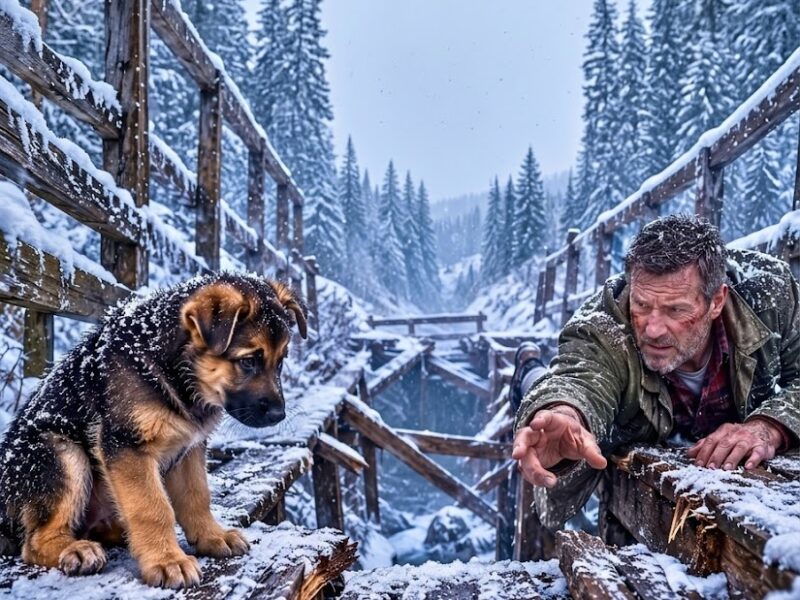
A German Shepherd puppy refused to leave a trapped Navy SEAL. What he did next brought tears to everyone who saw it.
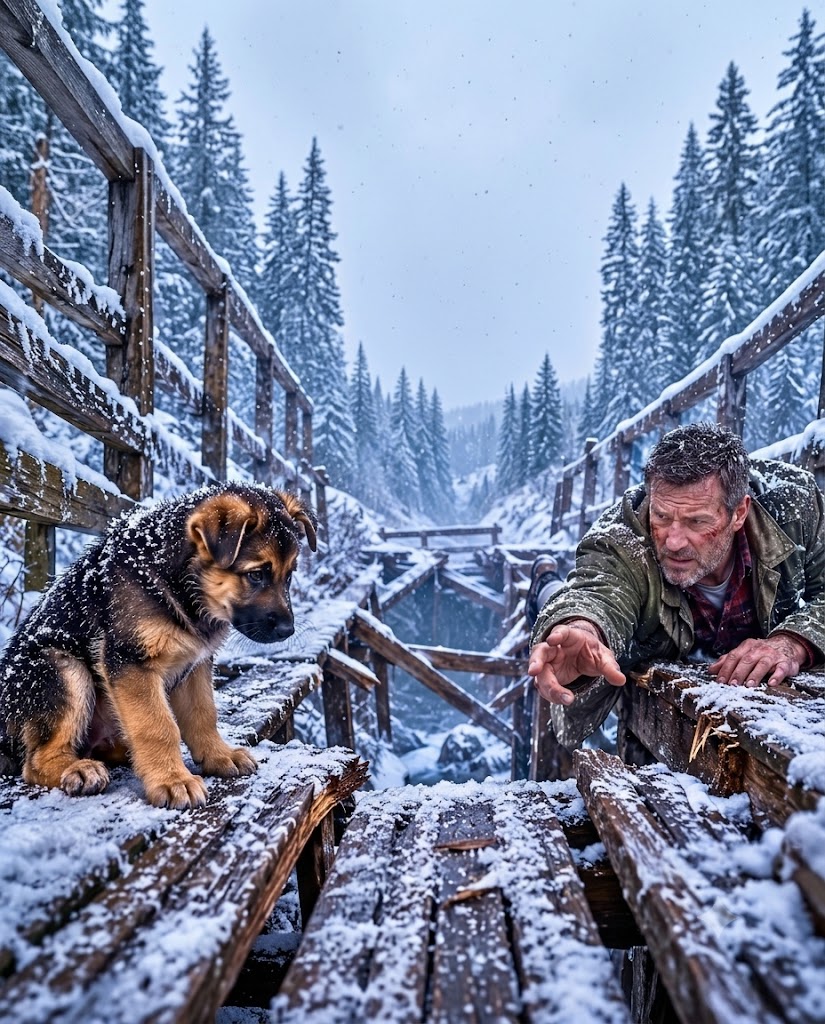
Snow had been falling over central Oregon since noon, turning the pines outside Sisters into dark towers with white shoulders. By late afternoon, the Deschutes National Forest had gone quiet in the way winter sometimes made quiet feel like a warning.
Cole Mercer drove his old black Chevy pickup along a narrow Forest Service Road with groceries on the passenger floor, a propane tank strapped in the bed, and enough coffee to survive either a storm or a difficult memory. At 44, Cole still carried the shape of the Navy SEAL he had once been.
He stood a little over six feet, broad through the shoulders, with strong forearms, short dark brown hair threaded with gray at the temples, and pale gray-blue eyes that noticed too much and revealed too little. A thin scar crossed the edge of his left eyebrow.
He wore a faded olive field jacket over a black thermal shirt, worn jeans, and winter boots still marked by old salt. His phone buzzed in the cup holder. Paige. Cole looked at the screen, then back to the road.
His daughter was 21 now, a senior at OSU Cascades in Bend, close enough to visit, and far enough for Cole to keep making excuses. Her graduation invitation had been sitting in his jacket pocket for two weeks.
He had read it so many times the paper had softened along the fold. He had not answered her last message. He told himself he would once he reached the cabin, once the road was clear, once he found words that did not sound like a man trying to repair a roof during a flood.
The phone buzzed again. Cole turned it face down. “Driving,” he said to the empty cab. The road curved toward Whychus Creek, where an old service bridge sat somewhere beyond the trees, long closed to trucks and supposedly blocked from both ends.
Cole slowed when something crossed the snow at the right shoulder. Paw prints. Small, deliberate. Not coyote, not deer. Dog. He drove another fifty yards before stopping.
For several seconds, he sat with both hands on the wheel while the storm whispered against the windshield. Then he sighed, killed the engine, and stepped into the cold. The tracks led toward a narrow trail he had not used in years.
Snow filled the old ruts, but the paw prints held their shape, moving straight as a line of stitching between young firs. Cole followed. The air smelled of wet bark, ice, and the metallic bite of a storm gathering strength.
The trail dropped toward the creek, and then he saw the bridge. It stretched across the dark water on old timber supports, patched in places, sagging in others, the rails leaning outward as if tired of standing.
A metal sign that should have barred the entrance lay half buried in brush, face down. That stopped him. “That’s not right,” Cole muttered. A movement flickered near the middle of the bridge.
A German Shepherd puppy stood there, half-grown and shivering, with a sable coat darkened by snowmelt and paws too large for his lean body. One ear stood up, the other tipped at the end. Under his chin was a small white mark, like someone had touched him with paint.
The puppy stared at Cole, then turned his head toward the far side of the bridge. He took three steps, stopped, and looked back. Cole raised both hands slowly. “Easy.”
The dog wore an old brown leather collar, but no tag. Cole crouched near the entrance. “Where’s your person?” The puppy made a low sound, not quite a whine, then walked toward the center, turned, and waited.
Cole knew that look. He had seen it in working dogs who were not lost, but waiting for a human to become useful. He tested the first plank with one boot. It held. The second held, too.
He moved carefully, keeping weight over the beams and one hand near the rail without trusting it. Beneath him, Whychus Creek moved black and cold between shelves of ice. The puppy watched him with bright brown eyes. Urgent.
Cole reached the broken metal plate bolted to one post. Snow had crusted across it, but yellow paint still showed around the edges. Closure paint. Somebody had moved the warning sign on purpose. “Come here, partner,” Cole said.
The puppy backed up two steps and looked toward the far trail again. Cole shifted his weight to follow, and the sound came before the fall. A dry crack under snow, like bones snapping beneath a blanket.
The plank under his right boot gave way. Cole grabbed at the rail, but the rail tore loose in his hand. He dropped through the walking surface and slammed into the lower framework of the bridge. For one hard second, there was no sound at all.
Then breath came back in a broken grunt. Snow drifted through the hole above him. He checked himself with the cold method his body remembered. Fingers moved, arms worked, back hurt. Right leg pinned between two heavy beams.
He could move his toes, but the leg would not come free. His phone had flown from his pocket. A small rectangle of light glimmered near the creek below, flickered once, and went black. Cole stared at it. Wonderful.
The puppy appeared at the broken edge above him, snow collecting on his muzzle. “Stay back,” Cole said, sharper than he meant to. The puppy stepped closer. “No, back.” Cole pointed toward the trail. “Go. Find somebody.”
The puppy turned and ran across the bridge. Cole listened to his paws fade, and relief touched him for maybe five seconds. Then the paws returned. The dog came back to the hole and lowered his head, eyes fixed on Cole.
“That’s not the assignment.” The puppy ran again, stopped near the end of the bridge, looked over his shoulder, then returned as if trying to correct Cole’s misunderstanding. Cole’s breath fogged in front of his face. The light had begun to drain out of the forest.
The storm covered the tracks that led from the road. He pointed once more, softer this time. “Go on, Scout,” he said, using the first name that came to him. “Run.” The puppy lay down on the snow-covered boards instead, front paws stretched toward the broken opening.
Cole lowered his hand. Above him, the little dog refused to move, and under Cole’s jacket, Paige’s unanswered invitation pressed against his chest like a second heartbeat. Darkness reached Whychus Creek before Cole expected it.
The last strip of gray vanished behind the pines, and the world narrowed to the smell of wet timber, the rush of black water below, and the steady fall of snow through the broken bridge. Cold entered him in layers, boots first, then knees, then the deep places around old scars.
Cole leaned against the lower support beam and forced his breathing into a slow count. Panic spent heat. Anger spent heat. Regret spent everything. He checked his trapped leg again, carefully, no heroics.
The right ankle screamed when he shifted, but his toes still moved inside the boot. Bruising, maybe a sprain. The beam would not budge. He could not reach his phone. He could not climb. He could not pretend this was just another inconvenience to muscle through.
That bothered him more than the pain. A man could build a whole life around being hard to trap and still end up pinned beneath a rotten bridge because one puppy had asked him to follow. Above him, Scout kept running the same small patrol.
The puppy disappeared toward the trail, returned to the hole, looked down, then tried again. Sometimes he barked once, sharp and frustrated. Sometimes he pressed his nose between the broken boards, as though Cole might be persuaded by proximity.
“You’re going to wear yourself out,” Cole said. His voice sounded strange in the dark, rougher than he meant it to be. The puppy vanished longer this time. Cole listened. Ten seconds. Twenty.
A slide of snow came from the bank below, followed by the quick scramble of paws. Scout had found a way down through the trees. He reached the creek slope, nearly lost his feet, recovered, and came straight to Cole.
The little dog sniffed his jacket, his gloves, the beam across his leg. Then he sat beside Cole’s hip with the certainty of a medic arriving late, but determined. Cole stared at him. “You don’t take orders well.”
Scout leaned against him. Warmth came through the field jacket, small but real. It made Cole’s throat tighten, which was ridiculous, so he blamed the cold. Wind hissed under the bridge.
Cole worked the scarf from his neck, a dark wool one Natalie had bought years ago, after telling him that military training did not make him immune to winter, no matter how confidently he misunderstood weather. He wrapped it loosely around Scout’s shoulders and chest.
The puppy blinked at him. “Don’t get sentimental,” Cole said. “It’s equipment.” Scout rested his chin on Cole’s thigh. Cole almost laughed, but the sound did not make it all the way out.
His gloved fingers brushed the dog’s leather collar. He had noticed the lack of a tag earlier, but now, by the dim light of snow and creek, he saw faint letters pressed into the inside of the band. Most had worn away.
Two words remained clear enough. Hawthorne K9. Cole frowned. The name scratched at something in his memory. Search dogs. A trainer west of Sisters, maybe. He had heard Dana mention it once after a missing hiker call.
“You came from a working place,” he murmured. Scout’s eyes stayed on him. “Then why are you alone?” Thirty miles away in Bend, Paige Mercer stood in the hallway of her apartment with her phone in her hand listening to her father’s voicemail greeting for the fifth time.
She had changed out of her campus sweatshirt into jeans and a red parka, though she had nowhere to go yet. Snow tapped against the window. The weather alert for the Cascades had grown worse every hour. Cole ignored messages. That was not new.
He ignored birthdays until the last minute, answered questions with six words when twenty were required, and treated emotional conversations like suspicious packages. But tonight felt different. Her message about graduation still showed delivered, not read.
She called again. Nothing. Paige closed her eyes and heard her mother’s voice from years earlier telling her that love sometimes looked like stubbornness wearing boots. “Then he should answer his phone,” Paige whispered.
She searched the road closures near Sisters, checked accident alerts, found nothing, and became no calmer. Under the bridge, Cole drifted in and out of shallow disciplined wakefulness. Every twenty minutes, or what felt like twenty, he flexed his fingers, shifted his shoulders, checked Scout’s breathing, and talked just enough to keep himself anchored.
He told the puppy useless facts. He told him Paige used to steal fries from his plate and pretend she was doing him a health favor. He told him Natalie had once painted the kitchen yellow because Oregon winters were too gray and Cole had no legal right to own only beige things.
He did not tell him how quiet the cabin had become after Natalie died. He did not say he had moved into the woods because every room in the old house had remembered her better than he could bear. Scout slept in small pieces, waking whenever Cole’s voice stopped too long.
Once the puppy stood, climbed the slope toward the road, listened hard, then returned. Near dawn, the storm weakened. Snow still fell, but the wind lost some of its teeth. Cole heard an engine before he trusted the sound.
Tires crunched faintly on packed snow. A door opened. A woman’s voice called from far off. “Cole?” He lifted his head. Scout sprang up, scrambled toward the bank, and disappeared between the trees. Cole tried to shout, but his voice came out rough.
Minutes later, Dana Whitaker appeared at the bridge entrance. Tall and solid in a forest green parka, black hair tucked under a knit cap, one gloved hand already on her radio. Scout ran ahead of her, turned back, and barked as if impatient with human speed.
Dana reached the broken section and looked down. Her hazel eyes widened, then narrowed in professional focus. “Mercer?” Cole raised one hand. “Morning.” “You always pick scenic places to nap?” “Only when the accommodations are terrible.”
Her face softened for half a breath. The joke told her he was conscious. Then she saw the shifted warning sign near the trees, the fresh tire marks on the closed road, and the way Scout stood between her and Cole like a small guard with snow on his whiskers.
Dana keyed her radio for county rescue. Her voice stayed calm, but her eyes had changed. Someone had made that bridge look safer than it was. And Cole understood from her silence that his fall was no longer just an accident.
By the time county rescue hauled Cole from beneath the bridge, the morning sky had brightened to a hard winter white. Mason Reed, the lead rescuer, braced the damaged frame, slid a padded board beneath Cole, and refused to hurry even when Cole made a dry remark about having other plans.
Scout paced beside the rescue team until one volunteer tried to guide him away from the edge. The puppy slipped past and returned to Cole’s shoulder. Mason looked at Dana. “His dog?” Dana watched Scout plant both oversized paws beside the stretcher. “The dog may have filed paperwork overnight.”
Cole, pale and shaking under thermal blankets, opened one eye. “He’s not mine.” Scout leaned against the stretcher. Dana said, “Tell him that.” Cole closed his eye again because answering required energy and because the puppy was warm.
The hospital in Bend smelled of disinfectant, wet coats, and coffee that had lost hope hours earlier. Doctors confirmed a severe ankle sprain, bruised ribs, and mild exposure, all of which Cole considered acceptable until a nurse handed him crutches.
He stared at them as if they were an insult. Paige arrived just after midnight having driven from Bend through ugly weather and worse thoughts. She stepped into the room wearing a burgundy parka, jeans tucked into snow-marked boots, and a canvas backpack hanging from one shoulder.
Her dark blonde hair had come loose from its tie and her light brown eyes looked too steady for someone who had been frightened all night. Cole started to say something practical. Paige beat him to it. “Do not say you’re fine.”
He paused. “I was going to say mostly fine.” “That is not better.” Scout lifted his head from the blanket beside Cole’s bed. Paige looked at the puppy. “And who is this?” “Temporary complication.” Scout thumped his tail once.
Paige’s mouth tightened around something that might have become a smile under kinder circumstances. Cole expected anger. He deserved it. Paige sat in the chair beside his bed and held the strap of her backpack so tightly her knuckles lightened.
“I called you six times.” “Signal was bad.” “Your phone was in a creek.” “That affected signal.” Her laugh was short and almost painful. “Dad.” One word. Enough weight for years.
Cole looked away. He could face men with guns easier than he could face the daughter who still tried to reach him after he had taught her to expect much. Dana appeared in the doorway before the silence could harden.
“Bridge is closed for real now,” she said. “And I found tire tracks where tire tracks should not be.” Cole’s expression sharpened. Paige noticed how quickly he could become alert for a mystery while remaining helpless around an apology.
Scout went to Dr. Leah Brooks the next morning. Her clinic sat near the north edge of Bend, a low cedar building with wide windows and a clean front room. Leah was 39, lean and quick, with auburn hair twisted into a knot, green eyes, and navy scrubs beneath a gray fleece jacket.
She met Cole in the exam room with one glance at his crutches. “You look like a man who argued with a bridge and lost.” “The bridge cheated.” “They often do.” Paige sat on the floor near Scout, not reaching, just letting him choose.
The puppy approached her after a minute, sniffed her sleeve, and leaned into her knee. Leah noticed. “Smart choice, buddy.” She examined Scout slowly. He was underweight but stable with worn paw pads from traveling through snow and brush. “No chip, no tag.”
Cole showed her the collar. “Hawthorne K9,” Leah read, turning the leather gently. “That is not nothing.” Dana called while Leah was still writing notes. She had traced the name to Warren Hawthorne, a search and rescue dog trainer who lived west of Sisters.
Cole insisted he could go. Paige looked at the brace on his ankle. Leah looked at the crutches. Dana on speaker laughed in a way that ended the conversation. “I am driving.” Warren’s property sat at the end of a plowed gravel lane bordered by juniper and ponderosa.
Old agility equipment stood behind a fence. Warren Hawthorne came onto the porch, tall and narrow, silver hair close-cropped, white beard neat, pale blue eyes still enough to make dogs trust him before people did. Then he saw Scout.
The color drained from his face. “Where did you get that collar?” Warren asked. Cole stood with his weight on one crutch. “Whychus Creek bridge.” Warren crouched. Scout stayed near Cole but stretched his neck to sniff the older man’s hand.
Warren did not grab or mistake longing for permission. “This collar was mine,” he said quietly. “Not his. Hers.” Inside the farmhouse kitchen beneath photographs of German Shepherds and volunteer search teams, Warren lifted a framed picture from a shelf.
It showed a black and red female German Shepherd with erect ears, an athletic chest, and amber eyes that seemed to understand the camera. “Juniper,” he said. “Best dog I ever worked with.” She had gone missing months earlier after a wind storm broke a rear fence.
Warren had searched for weeks. Snow came early. Paige looked from the photograph to Scout. Same head shape, dark saddle, steady eyes. Cole said what everyone was thinking. “You think she’s his mother?”
Warren nodded once. “I would bet my life on it.” The kitchen went silent except for the old refrigerator humming. Cole pictured the puppy on the bridge running forward, looking back, refusing to leave a stranger once the stranger became helpless.
Maybe Scout had not been lost. Maybe he had been on a mission before Cole interrupted it by falling through a bridge. “If Juniper is out there,” Cole said. “We find her.” Paige turned so quickly her chair scraped the floor.
“No.” Cole looked at her. “No?” Her eyes were bright but level. “Your leg is in a brace. You were in a hospital bed this morning. You do not get to hear one sad thing and decide everyone has to follow your orders into the woods.”
The old Cole would have shut the conversation down. One word, one look, the room would freeze and people would learn to walk around him. Scout chose that moment to press against Cole’s good boot and sigh.
Cole stared at the dog then at his daughter. Paige did not look away. “Stop deciding what everyone else can handle,” she said. The words landed harder than the fall, and for once, Cole had no defense ready.
Warren left the kitchen first, carrying empty mugs that did not need carrying. Dana followed him with the courtesy of someone who knew when an investigation could wait five minutes. That left Cole, Paige, and Scout beneath a wall of photographs where working dogs stared out from better years.
Snow slid from the farmhouse roof in soft thumps. Cole gripped the top of his crutch and felt the old instinct rise in him, clean and familiar. End the conversation, give an order, move to logistics. He had survived whole pieces of his life that way.
Paige had survived him surviving that way. She sat across from him with her hands folded tight enough to hurt. “You always do this,” she said. “You decide silence is protection. You decide distance is kindness. You decide what I can know, what I can carry, and what I am allowed to miss.”
Cole looked at the table. The wood grain blurred for a second. “I thought I was keeping the worst of it away from you.” “You were the worst part that kept going away,” Paige said. Her voice did not rise. That made it worse.
“Mom died. I know that broke you. It broke me, too, but you left me with a quieter house and no explanation except groceries on the porch sometimes, and a father who answered texts like a weather report.”
Scout shifted beside Cole’s boot. The puppy’s white-marked chin rested on the toe, an absurd little weight in the middle of all that truth. Cole inhaled slowly. He had trained himself to listen for danger in door hinges, engine sounds, loose gravel underfoot.
He had not trained himself to hear the daughter sitting three feet away. “I don’t know how to fix that,” he said. It was not enough. It was honest, though, and honesty looked awkward on him.
Paige’s face softened only a fraction. “You start by not deciding alone anymore.” Cole nodded. One small movement, not surrender. Something harder. Dana returned after the silence had changed shape.
She held a field map, two printed road reports, and the expression of a woman prepared to be unpopular. “Nobody is marching blindly after a puppy,” she said. “Especially not a wounded former SEAL with a talent for making bad ideas sound tactical.”
Cole opened his mouth. Dana lifted one finger. “That was not an invitation.” Paige looked down, hiding a quick smile. Dana laid out the plan. The bridge area would stay closed. She would document the moved sign and tire tracks.
Once weather cleared, they would search the northern drainage where old maintenance routes ran toward abandoned shelters. Warren would come because he knew Juniper’s habits. Leah would stay ready at the clinic. Paige could come if she followed instructions.
Cole could come only on easier terrain, with a walking stick, an ankle brace, and the understanding that Dana would personally put him back in the truck if he pretended pain was an opinion. Cole surprised everyone by agreeing.
The look Paige gave him was almost suspicion. “What?” he asked. “I expected more arguing.” “I’m injured. My argument supply is low.” It was a poor joke, but it worked.
Warren came back in with a folder of Juniper’s old training notes. He showed them maps of search areas he had covered months earlier, scent articles he had used, places where neighbors had reported possible sightings that never became proof.
His hands remained steady until he reached a photograph of Juniper lying in a field beside a group of tired volunteers. “She always knew how to bring people home,” he said. “Then the fire happened, and I shut down the training work. She was the only one I kept working with. Maybe I needed her more than she needed me.”
Cole understood that kind of imbalance. He had leaned on quiet until quiet became room with the door locked from inside. Back in Bend, Leah gave Scout a warm kennel, food measured in careful portions, and enough gentle attention to make him suspicious, but not frightened.
Paige sat on the floor outside the kennel while Cole filled out paperwork with his left hand because the right was busy pretending crutches were not humiliating. Scout watched Paige through the door. She did not coo at him. She did not reach through the bars.
She just sat shoulder against the wall talking softly about nothing important. After a few minutes, Scout came forward and placed one paw against the gate. Leah, walking by with a chart, stopped. “You have a gift for nervous animals.”
Paige glanced up. “I am doing nothing.” “Exactly.” Leah leaned against the counter. “I could use help here for a few days if you’re staying in town. Cleaning, restocking, sitting with dogs who need a calm body nearby. Nothing glamorous.”
Paige looked toward Cole before she could stop herself. He caught it. A month earlier he might have said she was busy or that driving back and forth made no sense or that school mattered more. This time he said, “You’d be good at that.”
Paige looked at him as though the sentence had arrived from a country she had stopped expecting mail from. “Maybe I would,” she said. Scout thumped his tail.
That evening Cole returned to the cabin with Paige driving his truck because everyone had formed a conspiracy around his ankle. Scout rode in the back seat and refused to lie down unless he could see both of them.
The cabin greeted them with cold cedar walls, stale coffee smell, and the embarrassed silence of a house that had not hosted family in too long. Paige made soup. Cole chopped nothing because he was banned from knives while leaning on one crutch.
Scout found one of Cole’s gloves near the mudroom and carried it proudly beneath the table. “That was mine,” Cole said. Scout blinked with no remorse. Paige laughed, a real one this time, small but clean.
Later, when Cole went to bed, Scout lay across the bedroom doorway. “Your bed is in the living room,” Cole told him. Scout put his head down and closed his eyes. Through the window, the forest stretched north beneath the storm’s last clouds.
Somewhere out there, if Warren was right, Juniper might still be waiting. Scout lifted one ear in his sleep, pointed toward the dark, and gave a soft sound that made Cole understand the search had not even truly begun.
Three days later, the storm broke open into a cold blue morning. Snow still filled the shaded hollows of the Deschutes Forest, but the wind had dropped, and the main access roads were passable if a person respected them.
Dana Whitaker did not trust optimism, so she arrived at Cole’s cabin with maps, a radio, and the expression of someone prepared to repeat herself until everyone behaved. Warren followed in an old white pickup with tire chains and a folded blanket that had once belonged to Juniper.
Paige climbed into Cole’s truck beside him, while Scout sat in the backseat, already trembling with focus. At the cabin, he had discovered the joy of stealing gloves and misjudging chair legs. Near Whychus Creek, all that puppy foolishness vanished.
His ears tipped forward. His nose lifted once toward the north. He knew something, or believed he did. Dana parked well short of the closed bridge and made everyone gather at the trailhead.
“We search slow. We document what we find. Nobody pockets souvenirs. Nobody steps into a structure until I say it is stable. Cole, this speech has your name on it.” Cole leaned on a walking stick instead of crutches, his ankle braced beneath his jeans.
“I feel singled out.” “Good. That means the system works.” Paige hid a smile. Scout tugged once at the leash, then stopped when Cole gave a quiet command. Warren watched closely. “He has his mother’s steadiness when it matters.”
The words touched Cole in a place he had not expected. Dana led the group onto a maintenance path almost swallowed by young ponderosa and snow-bent brush. It did not appear on the current map. Warren remembered hearing of it. Cole remembered avoiding it.
Scout remembered everything. For nearly an hour they moved through the forest in careful silence. The air smelled of sap, coal dust, and the faint mineral scent of the creek somewhere below.
Scout ranged thirty yards ahead on a long line, then stopped to look back until the humans caught up. At two forks he chose without hesitation. At a third he circled once, nose low, then took the left path into a shallow drainage.
Cole’s ankle began to throb. He said nothing. Paige said nothing either, but she slowed her pace to match him. The trail dropped toward old service buildings abandoned after a washout years earlier.
The first structure was a maintenance shed with gray boards, a low metal roof, and one window darkened by grime. Snow had drifted against the southern wall. The door hung shut, but not latched. Scout stopped ten feet from the entrance and whined once.
Warren’s face tightened. Dana crouched before anyone moved closer. Under the eaves, where falling snow had not erased everything, several boot prints marked the ground. Broad tread, adult male, likely heavy work boots.
A set of tire tracks curved behind the shed, half filled by new snow, but visible enough to matter. Dana photographed each impression and marked the location. “Someone has been here recently.” Warren swallowed. “Could be from searchers months ago.”
Dana shook her head. “These are newer than that.” Cole looked at the door. Scout looked at the door. Paige looked at Cole and said, “No.” He lifted one hand. “I didn’t move.” “You were thinking loudly.”
Dana snorted despite herself and pushed the shed door open with the end of a tool. The hinges complained. Inside the building smelled of damp wood, old oil, and cold cloth. Nothing lunged, nothing barked. Scout entered only when Dana nodded.
The shed held rusted shelves, a broken shovel, coils of wire, and a workbench with one cracked leg. Scout went straight to the back corner and pressed his nose to a folded blanket beneath the bench. It was dirty but not rotten, worn from use rather than storage.
Paige crouched beside it without touching. Several hairs clung to the fabric, black and deep red. Warren knelt slowly, his breath catching. “That could be hers.” Scout pawed once at the blanket, then stepped back as if waiting for someone else to understand.
Cole saw the next item first, tucked beside an old crate. A stainless steel bowl, scratched along the rim. A strip of faded blue tape clung to the bottom. Warren stared at it. His voice came out almost too soft.
“I used blue tape for Juniper’s gear. Every dog had a color. Volunteers mixed everything if I didn’t.” He did not pick up the bowl. He did not need to. The truth was already sitting in the dust between them.
Dana found a sealed bottle of water and a plastic container with dry dog food beneath a shelf. Not much, enough to prove intention. Paige stood, face pale with anger. “Someone fed her here.”
Cole felt his own anger come quieter, colder. If someone knew Juniper had been alive, Warren had spent months grieving a dog who might have been only miles away. Scout stood in the middle of the shed, tail low, staring at the empty blanket. He had expected someone to be there.
Warren touched the wall with two fingers to steady himself. “She was here.” Dana nodded. “And someone else was here, too.” Outside, she called her district office and requested old maintenance records for that drainage.
When Dana’s radio crackled back, she listened, wrote a name, and looked toward Cole before looking at Warren. “Russell Pike,” she said. Warren’s eyes changed at once. Cole caught it. “You know him.”
Warren nodded. “Twenty years. Used to maintain half these roads. After Juniper disappeared, he helped me search twice.” Dana scanned the record on her phone. “Former forestry maintenance worker. Laid off four years ago. Cited once for entering restricted access roads after closure. He worked the Whychus Creek zone before the bridge was condemned.”
Cole thought of the sign lying face down in brush and the tire tracks near his truck. Suspicion was not proof. Dana would say that. He respected her because she lived by it, but the shape of things was beginning to show through the snow.
Scout left the shed, walked to the northern edge of the clearing, and stared down a narrower trail. He took three steps, stopped, then returned to sit directly in front of the door. Paige crouched beside him. “He’s waiting,” she said.
Cole lowered himself carefully onto a fallen log. The puppy leaned against his injured leg, gentle as a promise. Cole looked at the dark trail ahead and understood they had found the first place, not the last.
The next morning, the search began before the sun fully cleared the ridge. Frost silvered the tips of rabbit brush, and the sky above the ponderosa held a pale washed blue that promised no warmth. Dana had spent half the night checking road reports, reviewing property boundaries, notifying county dispatch, and making sure Leah could respond with transport crates.
She also spoke with Russell Pike by phone. He claimed he had not been in that drainage for weeks. “His voice,” Dana said, “had sounded like a door closing too quickly.” Cole filed that away. He wanted to confront the man. Paige knew it before he spoke.
“No.” Cole looked at her across the cabin table. “I am starting to dislike that word.” “Then stop earning it.” Scout, lying under the table with Cole’s stolen glove between his paws, lifted his head as if agreeing with whoever seemed least reckless.
They returned to the abandoned maintenance shed, but did not enter. Dana had flagged it as part of an investigation, and she treated even a small rural mystery with the discipline Cole respected. Scout pulled north almost immediately.
This time he moved with less hesitation, though he still checked over his shoulder every few minutes to be certain Cole followed. The path narrowed until branches brushed their sleeves. Snow lay deep in shaded pockets and thin beneath exposed rock where the sun had touched.
Warren carried Juniper’s old blanket in a sealed bag, not as bait, but as memory. Paige stayed near Cole whenever the ground dipped. After half a mile, the trail descended into a basin where the trees grew denser and the air changed.
It smelled enclosed, like cold earth and old needles. Scout stopped so suddenly that Cole nearly stepped on him. The puppy’s body became a line of attention. His ears stood forward, both of them for once almost symmetrical.
Then he gave a low, urgent whine that trembled with recognition. “Easy,” Warren said, but his own voice shook. Through the trees, a small equipment shelter leaned against the hillside, half painted green and half stripped by weather.
One side of the roof sagged under snow. The door stood open by less than a foot. Dana checked the ground, the door frame, and the roofline. The building looked tired, but not ready to fall. “Slow,” she said.
Scout did not wait well. He squeezed through the gap before Cole could stop him. For one terrible second, silence held. Then came a sound from inside. Not a bark, not fear. Recognition.
Cole reached the doorway with Dana beside him. Light entered through a broken upper window and fell across old blankets near the back wall. A large German Shepherd lay there, head raised, amber eyes bright despite exhaustion.
Her black and red coat had dulled from weeks of weather, and her ribs showed more than they should, but her posture held a dignity that made the small room feel suddenly holy. Juniper. Scout pressed himself along her neck, whining, tail moving so hard his whole body shifted.
The older dog lowered her muzzle against him and breathed him in. Behind her, two smaller puppies stirred. One had a darker face, the other more tan along the chest and legs. They were thin and sleepy, but alert.
Paige put a hand over her mouth. Warren stood at the threshold as if a single step might wake him from the best dream and the worst guilt. Then he crouched. “It’s Junie,” he whispered. “It’s me, girl.”
Juniper watched him. Her ears moved. Warren did not rush. He did not reach. Years of training had taught him that love still needed permission, especially after a long absence. He sat on the cold floor several feet away and let his hand rest palm down.
“I have missed you,” he said. The big Shepherd stared for another long breath. Then her tail moved once against the blanket. Warren closed his eyes. Paige looked away, giving him privacy.
Cole did, too, though he pretended to study the roof. Scout left his mother’s side only long enough to press against Cole’s knee, as if reporting success. Cole touched the puppy’s head. “Two jobs,” he murmured.
Paige heard him. “What?” “He left to find help for them. Then he found me.” Scout looked up at him with the unbearable calm of an animal who did not need credit. Cole remembered the bridge, the puppy refusing to leave, the night cold enough to turn a man inward.
Scout had been carrying two loyalties at once. Leah arrived within an hour with a county rescue vehicle, insulated blankets, transport crates, warm water, and the calm tone of a veterinarian who knew people often made emergencies harder by loving too fast.
“Everybody slow down,” she said as she entered. “She has survived by controlling her space. We respect that.” Juniper accepted water and allowed Leah to examine her from the side while Warren remained within sight.
The two younger puppies were tucked into warmed blankets after Paige sat near them long enough for the darker one to approach her hand. Leah watched that happen. “You keep doing nothing beautifully.” Paige managed to smile. “Is that a medical skill?” “More than people think.”
Cole stood near the wall leaning on his stick trying to ignore the ache in his ankle. Juniper’s eyes moved from Warren to Scout to Cole. Her son had brought back a strange collection of humans, all inconvenient, all necessary.
Transporting them took patience. No loud voices. No grabbing. No drama for the sake of drama. Juniper walked on her own into the crate after Warren placed the old blanket inside and stepped back. The puppies were carried gently.
Scout tried to enter with his mother then turned and looked at Cole. The choice clearly offended him. Cole pointed to the truck. “Your assignment is with me.” Scout hesitated then climbed into the backseat beside Paige where he could see both the rescue vehicle ahead and Cole in front.
As they drove out, Dana stayed behind to photograph the shelter, boot prints, tire tracks, and fresh dog food hidden under a tarp. Near the access road her phone rang. She listened, said very little, and ended the call with her mouth pressed thin.
Cole already knew. “Russell?” Dana nodded. “He wants to explain.” Finding Juniper had answered the kindest question. It had also opened the uglier one. Russell Pike gave his explanation in a county office that smelled of copier toner, wet boots, and burnt coffee.
Dana handled the interview because Cole was not invited, which meant Cole sat in the hallway with Paige, Warren, and Scout while his imagination did unhelpful work. Russell was 58, heavy-shouldered, round-faced, with thinning gray-brown hair and hands shaped by tools.
Once Warren said he had been generous with time and directions, the kind of man who knew every culvert, washed-out spur, and forgotten gate in three counties. Then the department restructured. Russell lost his job. New closures went up on old roads he still considered his.
Resentment settled into him like damp in wood. Cole listened without pity and without surprise. Dana came out nearly an hour later. Her face did not announce triumph. “He found Juniper six weeks ago near the first shed,” she said.
Warren’s shoulders sank as if the sentence had physical weight. “He recognized her?” “Yes.” Paige’s mouth tightened. Dana continued. “He says she was nervous, and he convinced himself moving her would cause harm. He brought food and water. Later he found the puppies in the second shelter. He told himself he would notify someone once the roads improved.”
Cole heard the lie inside the logic. He also admitted he wanted to keep one of the pups. Warren turned toward the window. Scout pressed against his calf, and the older trainer lowered one hand to the puppy’s head.
“I spent months thinking she was dead,” Warren said. No anger in the words. That made them hurt worse. The bridge sign came next. Russell had removed it because it blocked easy access to the old route. He did not intend for anyone to be hurt.
He had planned to put it back. The facts sounded smaller every time Dana repeated them, and somehow more terrible. Cole’s fall had been a consequence of one private decision stacked on another. Each one explained as temporary until it almost became fatal.
Dana made clear the matter would move through forestry violations, public safety charges, and animal-related documentation. Warren would decide what else made sense once Juniper was stable. “You are not talking to him,” Dana told Cole.
“I didn’t ask.” “Your jaw did.” Paige made a small sound that might have been agreement. Cole looked down at Scout. The puppy gazed back with no interest in revenge. That helped. A little.
At Leah’s clinic, the air felt warmer, cleaner, alive with the low shuffle of recovering animals and the practical rhythm of needed work. Juniper rested in a large recovery run with the two puppies curled against her belly.
She had eaten, drunk water, and tolerated a careful exam. Leah reported dehydration, weight loss, and exhaustion, but no immediate crisis. “She is tougher than the rest of us deserve,” Leah said. Warren stood beside the run without crowding her.
Juniper lifted her head whenever he spoke. The bond had not vanished. It had been waiting under snow. Paige helped Leah label medications and prepare soft bedding. Scout moved between rooms like a little supervisor, checking Juniper, then Cole, then Paige, then back again.
“He counts people,” Paige said. Cole sat in a chair with his braced ankle elevated, unwillingly obeying medical advice because Leah had threatened to confiscate his truck keys. “Who?” “Scout. He checks where everyone is, like he has a list.”
Cole watched the puppy trot from Juniper’s run to Paige’s knee and then to Cole’s boot. “He likes keeping track of his problems.” Paige gave him a look. “Or his family.” That word hung between them.
Cole did not flinch exactly, but he felt it. Family had become a word he kept in locked drawers with photographs and unfinished apologies. Scout leaned against his boot as if drawers were not his concern.
Warren opened the recovery room door later and crouched. “Scout,” he called gently. The puppy looked toward Juniper. She looked back, calm and tired. Warren held the door open. “Come on, boy.”
Everyone went still without meaning to. Scout stood. He walked toward Warren three steps, stopped near Juniper, and pressed his nose to her muzzle. Juniper licked the white mark beneath his chin. Then Scout turned around.
He crossed the room and sat beside Cole’s left boot, leaning against him with the settled weight of a decision. Warren stared. Pain moved across his face, but so did understanding. Leah folded her arms. “Well,” she said, “somebody officially lost an argument.”
Cole looked at her. “What argument?” “The one where you kept saying he was temporary.” Paige smiled first. Dana, who had arrived to drop off paperwork, smiled next. Warren walked over and handed Cole the worn leather collar.
“He can keep this until you find him a new one,” he said. Cole’s hand closed around it. “Warren, I don’t want to take what belongs to you.” “You are not taking him.” “He chose where to stand.”
Scout thumped his tail once, as though the contract had been read into the record. On the way home, Paige asked Cole to stop at a pet supply store in Sisters. He frowned. “Leah gave us food, bedding, and instructions thicker than a boat manual.”
“Scout needs his own bowl.” “We have bowls.” “Not one with his name.” “That is not medically necessary.” Paige turned in the passenger seat and looked at him with her mother’s exact patience for foolish men.
Cole parked five minutes later. He came out carrying a heavy ceramic bowl painted dark blue with one word across the side: Scout. Paige took one look and raised her eyebrows. Cole placed it in the back seat. “Temporary equipment.”
Scout sniffed the bowl, then rested his chin beside it with a sigh of deep satisfaction. Paige looked out the window so he would not see all of her smile. As they drove toward the cabin, the winter trees stood black against a clearing sky.
Juniper was safe. Her puppies were safe. Warren had not lost everything. Cole had apparently acquired a dog, though he had not agreed out loud. Paige watched the road ahead and asked softly, “Are you going to stay this time?”
Cole understood the words, but the tone carried the deeper question beneath them. Stay. Keep showing up. Do not disappear again. He kept both hands on the wheel and said, “I’m trying.”
A month changed the cabin more than Cole would have believed possible. By late February, the hard snow around Sisters had begun to soften along the edges, and thin silver water ran beneath ice near the driveway. The porch held muddy paw prints.
A blue ceramic bowl sat beside the kitchen wall. One of Cole’s gloves had vanished so often that he stopped calling it stolen and began considering it retired. Scout had gained weight, grown into some of his oversized paws, and developed the confidence of a young German Shepherd who had survived wilderness, chosen a human, and discovered that socks were vulnerable.
Cole’s ankle improved slowly. He no longer needed crutches inside the cabin, but the brace stayed under his jeans because Leah Brooks had made threats with medical calm. Paige stayed in Bend longer than her original plan.
At first, she said it was because of the weather, then because Leah needed help at the clinic, then because her coursework allowed remote days. Cole did not challenge the explanations. He was afraid that if he named the better reason, it might leave.
Their routines formed without ceremony. Paige spent mornings at Leah’s clinic cleaning kennels, organizing supplies, and sitting beside dogs that trembled at sudden noises. In the afternoons, she came to the cabin or Cole picked her up in town.
Scout greeted her like a missing squad member every time, circling once, checking her hands, then running to Cole as if reporting she had returned intact. “He counts people,” Paige said one Saturday while filling the coffee maker. Cole looked over the rim of his mug. “You said that before.”
“Because you still don’t understand it.” Scout lifted one ear from beside the stove. “He knows who belongs in the room.” Cole looked at the dog, then at his daughter. For years he had kept rooms simpler by keeping them empty.
Paige’s textbooks now occupied one end of the kitchen table. Leah’s clinic schedule hung on the refrigerator beside a list of Scout’s feeding instructions. A photograph of Juniper and her two younger puppies sat near the window, printed by Warren and delivered without comment.
The cabin felt less efficient. Better, though Cole would not have chosen that word out loud. He began asking Paige questions. Small ones at first. What class was hardest? Which professor drove everyone crazy? Did she need new tires before spring?
The tuition question came later and made her stare at him as if he had asked whether she wanted the moon brought in from the porch. “I have financial aid,” she said. “That was not the question.” She looked down. “Maybe we can talk about it.”
“We.” Cole held that word carefully. At the clinic, Leah began trusting Paige with more than towels and storage shelves. She taught her how to read a dog’s posture before touching, how to chart appetite, and how to clean a recovery run so a frightened animal did not feel chased from its own space.
Paige asked good questions, the kind that watched the animal first. Warren noticed, too. He had started bringing Juniper to the clinic for short visits once her strength returned. The big shepherd’s coat regained its deep black and red shine, and her amber eyes carried more peace each week.
Sometimes Juniper lay near a nervous recovering dog, steady as a hearth, and the other animal relaxed enough to eat. “Therapy without paperwork,” Warren said. Leah shook her head. “There will absolutely be paperwork.”
Paige laughed, then grew quiet. Later she told Leah she had been researching veterinary medicine, especially rehabilitation for working dogs and rescue animals. Leah did not act surprised. “I was wondering when you would say it out loud.”
Scout began lessons with Warren in safe, simple ways. Nothing official, nothing dangerous. Short scent trails across the yard, finding Paige behind a cluster of juniper, carrying a soft bumper without celebrating by throwing it into a snowbank.
He loved the work with a seriousness that made Cole proud and uneasy. The first time Scout ran away from Cole on command, Cole’s hand tightened after the leash had already left his fingers. Warren saw. “He knows how to come back,” the older trainer said.
Cole watched Scout find Paige behind a pine bark once and race back with his whole body shining. “That’s the part I’m learning,” Cole said. Warren did not answer, which was kind. The one subject Paige and Cole did not discuss was graduation.
The ceremony was coming in March at the OSU Cascades campus. Paige had mailed the invitation before the bridge accident, back when her hope had been disciplined enough to look like indifference. It still sat in Cole’s olive field jacket.
He knew because he touched it every time he reached for his keys. She knew he had never mentioned it. Each waited for the other to step first, which meant they both stood still. On a gray afternoon, while Paige was at Leah’s clinic, Cole decided to clean the mudroom.
The olive jacket hung from a peg, smelling faintly of smoke, snow, and old bridge wood. He checked the pockets before washing it. Receipts, a pocket knife, two crushed dog treats Scout had somehow inserted into a sealed pocket, which raised questions about both dogs and physics, then paper.
Cole pulled out the invitation. The edges were wrinkled. Her name sat near the top in clean black letters. Paige Mercer. Behind the invitation was a photograph he had forgotten he carried.
Natalie stood beside a mountain lake in a pale summer jacket, wind lifting her honey-brown hair, laughing at something outside the frame. She had been the talker between them, the bridge builder, the woman who made grocery clerks feel remembered and made Cole explain himself when silence tried to pass as strength.
After she died, he had remembered all her wisdom and followed almost none of it. He sat at the kitchen table with the invitation in one hand and the photograph in the other. Scout came quietly, placed his chin on Cole’s knee, and looked up.
“You are not qualified for this conversation,” Cole said. Scout did not move. Cole read the date. Three days away. He had missed birthdays in spirit even when he mailed gifts. He had missed conversations while standing in the same driveway.
He had missed enough. Outside the thaw dripped from the eaves like a clock. Cole set the invitation beside his truck keys, where he would have to see it every time he tried to leave or stay.
On Thursday afternoon, Dana Whitaker stopped by the cabin with a paper cup of coffee for herself and nothing for Cole because, as she explained, he had coffee in his house. The sky had the low silver color that came before light snow, but the air smelled more like thaw than storm.
Scout met her at the porch carrying Cole’s retired glove tail high. Dana looked at the glove. “Evidence?” Cole leaned on the porch rail. “Hostage. Does he have demands? Usually dinner.” Dana scratched Scout behind the ear and handed Cole a folded notice from the Forest Service.
“Bridge update. County approved removal. The old span comes down as soon as the crew can get equipment in safely. Replacement starts after the ground firms up.” Cole studied the notice. The bridge printed in black and white looked smaller than the one in his memory.
“Good,” Dana nodded. “Long overdue.” They stood in companionable quiet, which was new for them. Dana used to fill silence around Cole because she assumed his meant withdrawal. Lately, she seemed to understand that some quiet was only quiet.
She looked toward the truck keys visible through the cabin window. Beside them lay Paige’s invitation, left there like a challenge Cole could not dodge without seeing himself do it. Dana followed his glance. “Tomorrow?”
Cole’s jaw shifted. “Who told you?” “Leah told nobody. Warren heard it from Leah telling nobody. Then I accidentally learned it from Warren not discussing it.” “Efficient network.” “Small towns are terrifying.”
Cole folded the notice. “I’m going.” Dana did not joke. That helped. She only nodded once. “Good.” Then because mercy had limits, she added, “Wear something without sawdust.”
Across Bend, Paige spent the afternoon at Leah’s clinic restocking gauze and pretending not to think about row four, seat twelve. She had reserved it when she mailed the invitation. Back before the bridge, before Scout, before all the half-repaired things at the cabin.
Hope had a face now, a braced ankle, and a habit of leaving sentences unfinished. Leah noticed Paige counting syringes twice. “Those still number fifty.” Paige looked down. “Sorry.” “Graduation brain?” Paige shrugged. Leah leaned against the counter. “You want him there.”
“I wanted him there before I knew whether wanting helped.” Leah accepted that. In the recovery room, Juniper lay outside her run during a supervised visit, calm beside a nervous spaniel. Paige watched Juniper’s steady breathing and thought of Scout refusing to leave Cole in the dark.
Animals did not make promises with words. Sometimes that made them easier to trust. Later, Warren arrived to pick up Juniper and found Paige sitting on the floor with a clipboard balanced on her knees. He lowered himself carefully into a chair.
“You look like someone deciding something.” Paige smiled faintly. “Veterinary medicine, maybe rehabilitation, maybe working dogs. I keep circling it.” Warren looked through the glass at Juniper. “Good work if you can bear seeing what people fail to understand.”
Paige nodded. “I think I can bear it better if I get to help fix some of it.” Warren’s face softened. “Then you will need strong knees, clean records, and someone who reminds you to eat lunch.” Leah called from the hall. “I heard that and support it.”
Paige laughed. The sound surprised her. A month earlier, laughter around this many unresolved things would have felt like betrayal. Now it felt like air. She wrote down two program names Leah had suggested, including one with rehabilitation prerequisites she could begin near Bend.
That evening, Cole stood in front of his closet like a man facing a locked door. Scout sat behind him, head tilted. Cole owned field jackets, work shirts, cold weather layers, and one charcoal sport coat he had worn to a memorial service years earlier.
He took it out, brushed lint from the shoulders, and remembered Natalie’s hands straightening that same collar. “You clean up better than you act,” she had told him once. He set the jacket on the bed. Scout grabbed a sock from the laundry basket and retreated two feet, which was his idea of crime.
“Not tonight,” Cole said. Scout dropped the sock. Cole placed Natalie’s photograph inside the jacket pocket behind Paige’s invitation. Going to a ceremony should not feel like stepping into live fire.
Yet if he showed up once, Paige might hope he would show up again. If he failed after that, the wound would have his fingerprints all over it. He called Leah before he could talk himself out of it. “Can Scout stay at the clinic tomorrow evening?”
Leah paused only long enough to enjoy the moment. “Because you are attending a significant family event and planning ahead responsibly because he will eat my house if left alone, naturally.” And because yes. Leah’s voice gentled. “Bring him by at five.”
After he hung up, Cole sat at the kitchen table. The invitation lay open. Paige Mercer. The letters seemed both ordinary and impossible. He had led men through darkness and held steady under pressure that did not belong in polite conversation.
Still, the hardest thing on that table was a folded piece of paper asking a father to sit in a chair. Scout came over, set his chin on Cole’s knee, and sighed through his nose. Cole scratched behind the dog’s ear.
“You think this is easy because you just follow the people you love.” Scout closed his eyes. Cole looked at the invitation until the decision no longer felt like a decision, only a direction. The next morning came clear and cold.
Paige called once, then hung up before the first ring finished. Cole saw the missed call, understood the hesitation, and did something he had not done often enough. He called back. Paige answered breathlessly, “Everything okay?”
“Yes.” He looked toward the charcoal jacket hanging near the door. “What time should I be there?” Silence filled the line. Not empty silence, full. “Doors open at 5:30,” she said. “Ceremony starts at 6:00.” “I’ll be there before 5:30.”
Another pause. “Okay.” Her voice held caution and hope. Cole closed his eyes. “Paige.” “Yeah?” He almost said he was sorry. Instead, he chose one promise he could keep by nightfall. “I’ll see you there.”
When the call ended, Scout barked once from the mudroom, ready for whatever mission came next. Cole picked up the keys beside the invitation. For once, he was not leaving because solitude called louder than love. He was leaving because his daughter had saved him a seat.
The auditorium at OSU Cascades glowed with warm light against the cold Bend evening. Families moved through the entrance in clusters, carrying flowers, programs, phones, and the nervous pride that made ordinary hallways feel important. Paige arrived early in a dark graduation robe over a simple blue dress.
Her dark blonde hair brushed straight and tucked behind one shoulder. She told herself not to look for him yet. Looking too soon was a way of asking the world to disappoint her on schedule. Backstage, classmates laughed too loudly, adjusted caps, and complained about the heat under their robes.
Paige smiled when spoken to. She checked her phone once. No new message. That was all right. He had called that morning. He had asked what time. It was more than she had expected.
Expectation, though, was a dangerous little flame. You could warm your hands on it. You could also burn down the room. At 5:20, Cole Mercer walked through the auditorium doors.
He wore the charcoal sport coat over a white button-down shirt, dark trousers, and the ankle brace hidden beneath one pant leg. His hair had been combed back with more care than usual, and his beard trimmed close along his jaw.
He looked uncomfortable in the way men look when they have dressed for respect and are afraid respect arrived late. Inside his jacket pocket, Natalie’s photograph rested behind Paige’s invitation. Row four, seat twelve. Paige had written it on the invitation. Cole found it.
An older woman with silver curls shifted her purse so he could sit. “Family?” she asked. Cole looked toward the stage curtains. “My daughter.” The woman smiled. “Big night.” Cole swallowed. “Yes, ma’am.”
He sat down five minutes before the ceremony began, early enough. Not heroic, just there. Backstage, Paige gave in and peeked through the side curtain. She scanned the first row, then the second, then the third. Her eyes reached the fourth and stopped.
Cole saw her at almost the same moment. He lifted one hand, no speech, no grand gesture, just a father in the seat she had saved, looking smaller and braver than memory usually allowed him to be. Paige stood still long enough that a classmate bumped her shoulder.
“You okay?” Paige nodded, though her eyes had filled. “Yeah, I think so.” When the graduates walked in, she kept her head forward, but she knew exactly where he sat. The knowledge steadied her. It did not erase the empty chair where Natalie should have been.
Nothing could. But Cole had brought her photograph. And when Paige crossed the stage, he stood with everyone else, one hand in his jacket pocket, the other clapping until his injured ribs reminded him of the bridge. He ignored them. Some pain deserved no authority.
After the ceremony, the campus courtyard filled with voices and camera flashes. The air smelled of cold pavement, pine, and flowers wrapped in plastic. Paige found Cole near a quieter walkway beside a low stone wall. For a moment, neither moved.
Then he held out a small bouquet, white daisies and blue irises, slightly crooked from being carried by a man who had spent twenty minutes in a grocery floral section looking hunted. “I asked the woman what was appropriate,” he said.
Paige took them, smiling through tears. “These are good.” She seemed confident. They stood while families flowed around them. Cole looked at his daughter in her robe, the cords at her shoulders, the cap slightly tilted because she had never tolerated pins well.
She was an adult. That truth struck him cleanly. An adult he had hurt, and who still stood close enough to receive flowers. “There’s something I should have told you years ago,” Cole said. Paige’s fingers tightened around the bouquet.
He looked past her once toward the darkening sky, then back. No escape route. “When your mom died, I did not know how to stay in that house. Every room had her in it. Every time I looked at you, I saw what I had lost and what I was failing to protect. So I told myself you needed stability. I told myself my distance made things calmer.”
He stopped. A family nearby burst into laughter over a photo, then moved away. “The truth is I was scared you would see how broken I was. I made that your burden without letting you speak.” Paige’s eyes shone. “I did see it,” she said.
Cole nodded. “I know that now.” His voice roughened. “I am sorry I made you feel like loving me meant waiting outside a locked door.” Paige looked down at the daisies, then back up. “I never needed you to be fixed, Dad.”
The word nearly undid him. “I needed you to come back.” “I want to,” he said. “Not just tonight.” The answer came too quickly to be polished, which made Paige trust it more. “Then come back tomorrow, too,” she said. “And next week. And when it is boring. Especially when it is boring.”
A laugh escaped him, small and unguarded. “I can try boring.” She stepped forward. He hesitated, only because he did not know whether he had earned the right. Paige solved that by hugging him first.
Cole closed his arms around her carefully, mindful of the flowers, the robe, the years. He could not go back. Time did not accept courage after the fact, but he could stand there now. That was what the night offered. A beginning, not an eraser.
Back at Leah’s clinic, Scout spent the evening beneath her desk with one of her new winter gloves between his paws. Leah discovered this after finishing charts. “Scout.” The puppy froze. That was new. He lowered his head with theatrical sorrow, but did not release the glove.
Juniper watched from a recovery mat with the weary patience of a mother whose child had chosen an odd career path. Leah took a photo and sent it to Paige with the message, “Your father owes me gloves.” Paige laughed in the parking lot when she saw it.
Cole read the message over her shoulder. “I authorized that dog to incur debt.” “He is your dog.” Cole looked at the picture of Scout’s guilty ears and Juniper’s calm eyes. “Apparently.” They drove back toward Sisters under a clear black sky.
Paige sat in the passenger seat, still holding the flowers. Cole did not fill the silence with explanations. He let it be shared. At the clinic, Scout lifted his head toward the door long before the truck arrived, counting his people in the dark.
The call from Leah came two evenings later, just as Cole was learning that Scout could open the lower kitchen cabinet if peanut butter was involved. “I have a favor to ask,” Leah said. Cole looked at the puppy, who had frozen with his nose inside a bag of treats.
“I am listening from a crime scene.” “One of the regional rescue groups has a retired detection dog recovering from surgery. Not dangerous, not medically unstable, but too anxious for a busy clinic and not ready for a regular foster home. He needs quiet space, controlled movement, and someone who understands working dogs. Do not stop thinking just because their bodies need rest.”
Cole said nothing. Then he looked through the mudroom window toward the long storage building behind the cabin. It had once held a fishing boat, broken furniture, tools, and every object he did not want to sort because sorting looked too much like remembering. “I might have space,” he said.
The next morning, Paige found him standing inside that building with a broom in one hand and the expression of a man ambushed by his own idea. Dust floated in bands of light from the high windows. Along one wall sat old shelves, paint cans, cracked coolers, and a workbench that had outlived several bad decisions.
Scout trotted through the open doors carrying the cabinet treat bag, now empty and useless. Paige set down her backpack. “What are we doing?” Cole looked around. “Thinking.” “That explains the smoke.” He ignored that.
“Leah needs quiet recovery space sometimes. Warren said the same about working dogs. The clinic gets loud. Foster homes are uneven. This building sits empty.” Paige was teasing faded. She walked the length of the room. “Flooring would need replacing. Washable walls, ventilation, separate runs, drainage if Leah wants any washing area.”
Cole looked at her. “I made a list.” “Let me see.” She read it, then lifted an eyebrow. “Not terrible.” “High praise.” Leah arrived that afternoon and immediately lowered the praise. “This needs more than sweeping.”
Cole nodded. “Paige already wounded me.” Leah moved through the building with a penlight and a notebook, marking hazards, airflow problems, and surfaces that would trap bacteria. “If we do this, we do it properly. Small capacity, temporary recovery only. Medical decisions stay with the clinic. No pretending this is a shelter because someone cannot say no.”
She looked directly at Cole for the last sentence. He accepted the hit. Warren came later and stood in the yard, imagining the outside space. “Low obstacles, shaded rest area, simple scent work for dogs cleared for it. No pressure. Recovery is not training. You give them a place safe enough to remember what they already know.”
Cole felt that sentence enter him and sit down. Maybe that was what the cabin was becoming, too. Dana connected them with the right county offices, which meant forms, inspections, and more forms wearing different names. She seemed to enjoy watching Cole discover civilian bureaucracy.
“Miss the military yet?” she asked as he stared at a permit application. “At least they labeled the confusing parts.” She also brought something unexpected. When the old Whychus Creek bridge was dismantled, Dana saved a short weathered section from near the approach. “Thought you might want it,” she said, suddenly less amused.
Cole ran a hand over the scarred grain. He remembered the crack, the fall, Scout’s face above the hole. “Thank you.” Later, he mounted the timber above the workbench inside the storage building. No label. It did not need one.
The work took most of spring. Cole replaced flooring with sealed, washable material and rebuilt the windows so they opened without sticking. Paige handled records, schedules, supply lists, and the growing binder Leah insisted would save them from chaos.
Leah chose disinfectants, bedding protocols, and the layout of four large recovery spaces along one wall. Warren helped design a small outdoor yard with low platforms, scent posts, and a quiet corner under shade cloth. Dana found a local carpenter willing to trade discounted labor for Cole repairing his old boat trailer.
Scout supervised everything by carrying tools to unhelpful locations and falling asleep in sawdust piles. Juniper had regained strength, her coat shining again, her movements easy. She tolerated Scout’s circling with maternal patience, then lay near the building entrance as if blessing the project by refusing to be impressed.
Paige spent weekends at the cabin. Her veterinary plans became more concrete, filling the kitchen table with program brochures, prerequisite lists, and handwritten notes from Leah. Cole never read anything private, but he noticed her seriousness.
One night he found her asleep over an anatomy diagram, pencil still in hand. He covered her with a blanket and turned off the lamp. Small fatherhood, late fatherhood, still fatherhood. The next morning he asked about application deadlines and did not panic when the conversation included money.
“I can help,” he said. Paige stirred oatmeal at the stove. “You don’t have to buy your way back.” “I know.” He leaned against the counter. “I am offering because I am your father and you are building something that matters.”
Paige looked at him for a long time. “Then maybe help with textbooks first.” Cole nodded as if receiving coordinates. “Textbooks.” By early June, the building no longer looked like a place where memories went to collect dust. Fresh gravel covered the approach.
Clean water bowls lined a shelf. Folded blankets sat in labeled bins. Four recovery spaces waited behind sturdy gates. Warm but not fancy, quiet without feeling lonely. Paige arrived from town carrying a wooden sign wrapped in brown paper.
Warren and Leah stood beside the doors. Dana leaned against her truck pretending she had only stopped by for inspection reasons. Cole unwrapped the sign. Second Trail Canine Recovery. Beneath the words was a simple outline of a German Shepherd paw.
He looked at Paige. “Second Trail?” “The first trail nearly killed you. The second one brought everyone home.” Cole studied the sign. “Too sentimental.” Paige pointed at the paw. “You drew that.” “I was unsupervised.”
She laughed and the others joined her. Scout barked once as if voting. Cole held the sign while Paige marked the placement. For the first time in years, he did not feel crowded by people standing close. He felt steadied.
When the screws went in and the sign settled against the wood, Cole looked at his daughter beside him and understood that the place was not only for dogs learning to heal. It had been built for all of them.
By July, the new bridge over Whychus Creek stood where the old one had failed. Fresh timber stretched across the water on stronger supports, with clean railings, bolted barriers, and warning signs that could not be lifted aside by one stubborn man with private intentions. Sunlight moved through the ponderosa branches and flashed on the creek below.
The snow and fear of January felt far away until Cole stepped from the truck and heard the water. Then the memory returned complete. The crack of wood, the drop, Scout’s young face above the hole, powdered white with snow, refusing to leave.
Cole stood at the trailhead with Paige beside him and Scout at his left knee. At nearly nine months old, the German Shepherd barely resembled the thin puppy from the storm. His sable coat had thickened into rich gold and charcoal, and both ears stood upright with the proud seriousness of a dog who believed the world needed supervision.
“You okay?” Paige asked. She wore jeans, hiking boots, and a light green jacket with a clinic badge still clipped to the pocket because she had forgotten to remove it. Cole looked at the bridge. “Yes.”
Then, because one-word answers had done enough damage in his life, he added, “I remember it, but it doesn’t own the place.” Paige nodded. Scout moved ahead to the start of the bridge, sniffed the new boards, and looked back. No fear, no urgency, just recognition.
Dana waited on the far side with a paper cup of coffee. “The county says the crossing officially opens Monday,” she said. “No scenic falling allowed before then.” Cole stepped onto the bridge. “I will restrain myself.”
Scout crossed first, tail high. Halfway over, he stopped and looked down at the creek. Cole stopped, too. Then Scout turned and came back to him as if checking the count.
Second Trail Canine Recovery welcomed its first dog the following week. The retired detection dog Leah had mentioned months earlier. He was a gray and black Labrador with careful eyes and a shaved patch from surgery, and he entered the recovery building as though every corner might ask too much of him.
Cole did not crowd him. Paige sat on the floor outside the run reading charts quietly. Leah handled the medical plan. Warren introduced scent games only after the dog began eating comfortably. Dana arranged referrals and insisted that Cole learn the scheduling software instead of writing everything on scraps of lumber.
Scout took his role seriously. He once carried Paige’s clipboard outside and dropped it beside the scent posts. Juniper visited with Warren twice a week, greeting Scout before settling near anxious dogs with her old calm. Her two younger puppies were growing strong at Warren’s place.
Russell Pike paid fines, faced restrictions, and wrote Warren a letter Dana described as not enough, but at least not nothing. Warren read it alone, then kept working with the animals in front of him. Some repairs were repeated choices made after the dramatic part was over.
Paige submitted applications for veterinary rehabilitation programs and arranged to continue part-time at Leah’s clinic while completing prerequisites. Cole helped with textbooks first, then application fees, then a used laptop after hers began making sounds no machine should make. Each offer was awkward. Each acceptance was careful.
On Sunday evenings, Paige came to the cabin for dinner. Sometimes they talked about Natalie. Sometimes Scout rested under the table with one paw on Cole’s boot and the other touching Paige’s shoe. One clear morning, Cole drove toward Bend with Paige in the passenger seat and Scout in the back.
Windows cracked to let in the smell of pine and sun-warmed dust. For years, that passenger seat had been empty more often than not. Cole had told himself he liked the quiet. The truth had been less flattering. Quiet asked no questions. Quiet did not need apologies.
Now Paige sat beside him with a folder of program materials on her lap while Scout watched the road as if personally responsible for Oregon transportation. They crossed the new Whychus Creek Bridge without slowing much. Cole glanced in the mirror. Scout looked out, ears high, then settled back down.
Paige looked over. “You still thinking about it?” Cole considered lying from habit, then let the habit pass. “Yes, but not the way I used to.” She waited. He tapped the wheel once. “I used to think strength meant needing nobody. Scout did not understand that rule.”
Paige smiled. “Smart dog. Stubborn dog.” Scout huffed from the backseat. They reached Bend before noon. Leah waved from the clinic entrance and Warren’s truck was already parked nearby with Juniper watching from the open rear door.
Dana had left donated blankets by the front desk with a note reminding Cole to enter them into inventory. The ordinary bustle of it all moved through him with unexpected force. This was family, not always by blood, but present.
Scout jumped from the truck, ran to Juniper, circled her once with wild joy, then returned to Cole’s side. He always returned. Cole rested a hand on the dog’s head and looked at Paige. “Ready?” he asked. She adjusted the folder against her chest. “Yeah.”
Together they walked toward the clinic. Cole Mercer had once followed a puppy into the snow believing he was saving a lost dog. In truth, Scout had been leading him toward the life he had been too afraid to enter. This time, Cole did not walk alone.
Some stories remind us that help often arrives in forms we do not expect. A small dog on a broken bridge, a daughter who refuses to give up, a friend who notices the missing sign, a quiet chance to begin again after years of silence.
Cole learned that strength is not the same as loneliness. Real courage can mean answering the call, accepting the hand, saying the apology, and showing up again when the first brave moment is over. Loyalty is not always loud.
Sometimes it lies beside you in the cold. Sometimes it runs ahead to find help. Sometimes it waits at the door until every person it loves comes home.









