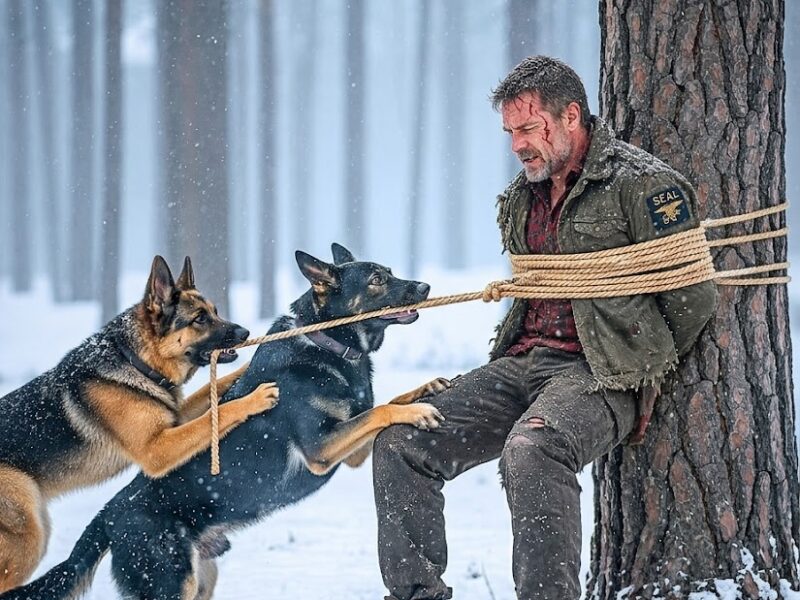
A German Shepherd found a Navy SEAL tied to a tree. What he did next saved his life
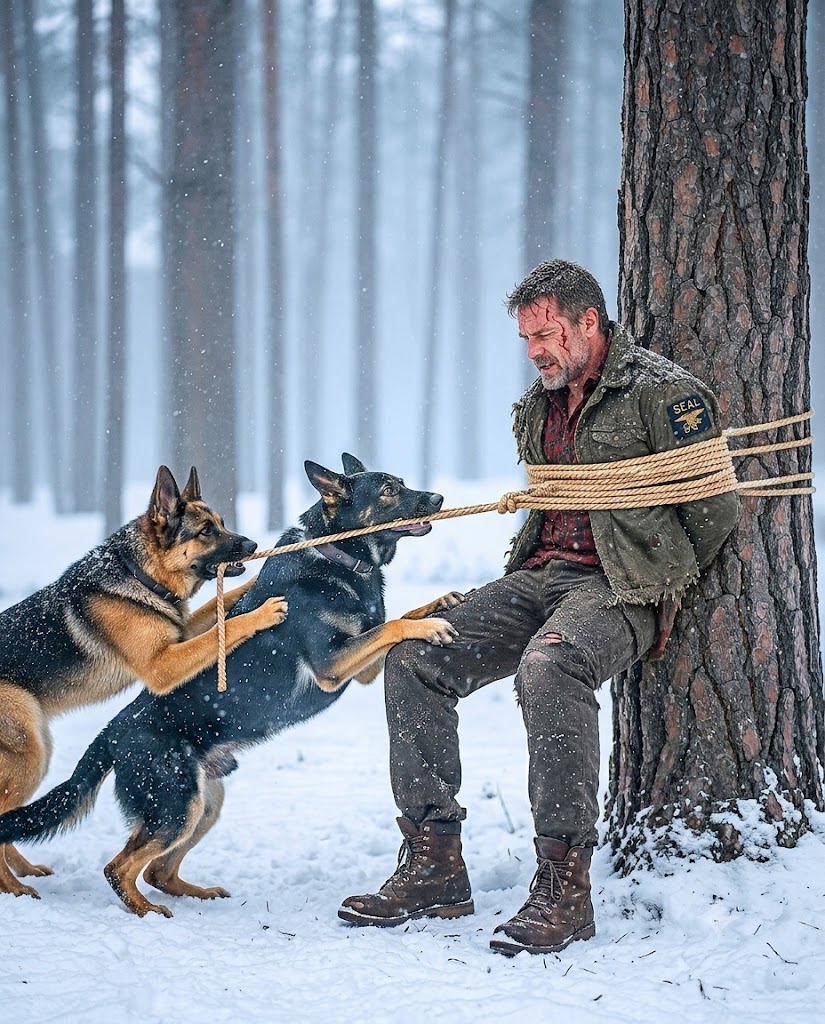
High in New Hampshire’s snowbound White Mountains, retired Navy SEAL Grant Holloway followed a young German Shepherd named Ekko into the pines and found an injured older Shepherd, Ranger, collapsed beside an abandoned rescue station. Ranger wore a tag marked MRT12, and Ekko refused to leave him as the storm closed in. Grant thought he was only saving two lost dogs. He had no idea Ranger was tied to his family’s past, or that the mystery would bring his estranged daughter Emily back into his life.
Weeks later, Grant would be captured, tied to a pine above a frozen ravine, and left helpless in another storm. Ranger would stay beside him while Ekko faced one choice: stay with Grant or run home for help.
By late afternoon, the White Mountains of New Hampshire had nearly disappeared behind falling snow. Pines blurred into gray shapes. The narrow road west of Lincoln was turning white, and the last daylight was fading behind the ridge line.
Grant Holloway kept his old Ford F-150 moving slowly through the storm. At 48, Grant looked like a man who had spent most of his life preparing for situations other people hoped would never happen. He stood a little over six-two, broad through the shoulders, with strong hands, dark hair beginning to gray at the temples, and a short beard that had grown rough during the winter. He wore a faded olive field jacket over a red and black flannel shirt. A worn Navy SEAL patch remained stitched to one shoulder.
Grant had served more than twenty years in the military before returning to New Hampshire. Later, he volunteered with Mountain Search and Rescue, where he became known for noticing things others missed. An unusual footprint. A broken branch. The direction snow had been disturbed. But years of carrying responsibility had made Grant quieter rather than more social. He preferred his cedar cabin outside town, where the mountains asked fewer questions than people did.
His phone vibrated in the cup holder. Grant glanced down. Three missed calls. Emily.
Emily Holloway was nineteen. Tall and slender, with long chestnut brown hair and gray-green eyes almost identical to Grant’s. She was studying in Boston. Unlike her father, Emily had always been patient with people. She listened before speaking and rarely forced conversations that someone clearly wanted to avoid. Years of Grant withdrawing whenever life became emotionally difficult had changed her, though. Emily no longer demanded explanations. She simply called less often.
Grant stared at her name for another second. Then something appeared in the road.
He immediately eased off the accelerator. A young German Shepherd stood almost directly ahead of the truck.
Grant stopped. The Shepherd was perhaps ten months old, black and tan, with long athletic legs, oversized paws, and upright ears dusted with snow. She was lean beneath her thick winter coat, but there was nothing confused about her expression. Her amber-brown eyes remained fixed on Grant.
For several seconds, neither moved. Then the dog ran toward the trees.
Grant expected her to disappear. Instead, she stopped at the edge of the forest and looked back. Then she ran between the pines. Five seconds later, she returned.
Grant frowned. The Shepherd stared at him again before turning toward the woods. That was not random behavior.
Grant pulled the Ford onto the shoulder. “All right.”
He stepped outside. Cold wind immediately pushed against his jacket. The young Shepherd retreated into the forest, but she did not run far. Every thirty or forty yards, she stopped and checked behind her.
Grant followed. The deeper they went, the quieter the road became behind them. He automatically began reading the snow. One set of young dog tracks. Another set, much larger. The second trail was uneven. Grant’s expression changed.
Nearly half a mile from the road, the Shepherd suddenly disappeared beyond a low rise. Grant followed her around a cluster of snow-covered rocks and stopped.
An abandoned fire lookout station stood beneath the trees, its weathered wooden walls leaning slightly beneath years of winter. Beside it lay another German Shepherd. This dog was older, perhaps six years old, with a large working-dog frame, broad chest, dark saddle coloring, and a serious face softened by intelligent brown eyes. Snow covered his back. He appeared exhausted, and one rear leg was troubling him enough that he remained down rather than trying to move.
The younger Shepherd immediately positioned herself between Grant and the older dog. Grant stopped several yards away. She lowered her body slightly—not aggressive, protective.
“You brought me here.”
Her ears shifted at his voice. Grant slowly crouched. He removed a small piece of dried meat from his jacket pocket and placed it on the snow between them. The young Shepherd looked at the food, then looked behind her.
The older German Shepherd lifted his head. Immediately, she returned to him. She never touched the food.
Grant watched her press her nose gently against the older dog’s face. “That answers that.”
He waited before moving closer. Eventually, the young Shepherd allowed him within several feet. Grant examined the older dog only enough to understand the situation. He needed warmth, rest, and professional care. Grant did not attempt anything unnecessary in the middle of a snowstorm.
Then he noticed the collar. Old brown leather. A scratched metal identification plate hung beneath it. Grant brushed snow from the surface.
MRT12.
No phone number. No owner’s name. Only those letters and numbers.
The older Shepherd tried to rise. Grant placed one hand low and calm in front of him. “Easy.”
The dog stopped struggling. Then something unusual happened. Instead of looking toward the road, the German Shepherd turned his head toward a narrow trail disappearing deeper into the forest.
Grant followed his gaze. For a moment, he wondered whether someone else might be out there. The dog tried to shift again but could not continue comfortably. Snow was falling harder now. Whatever mystery waited farther up that trail would have to wait.
Grant returned to the Ford for blankets. The young Shepherd followed halfway, then suddenly turned and raced back to the older dog. She refused to leave him alone, even for a minute.
When Grant returned, he carefully wrapped the larger Shepherd in a wool blanket. That was when he noticed a short length of bright orange nylon tangled loosely in the dog’s coat. Grant removed it carefully. He knew that material. It was not an ordinary leash. It resembled climbing or rescue line.
He slipped it into his pocket. Getting the older Shepherd back to the truck took time. The young dog remained beside them every step of the way. At the Ford, she jumped into the rear compartment before Grant could invite her. She immediately settled beside the injured Shepherd.
Grant looked at them. “Guess we’re doing this together.”
At the cabin, Grant placed both dogs near the wood stove. The younger Shepherd still watched his every movement. Grant eventually gave her a name. “Ekko.”
One ear tilted toward him. The older dog seemed steadier, quieter, almost disciplined despite his exhaustion. Grant looked at the metal plate again. “You look more like a Ranger.”
Ranger lifted his head.
Later, Grant placed food in two bowls. Ranger did not eat. Grant moved Ekko’s bowl beside his. Only then did Ranger lower his head toward his own food.
Grant noticed. “So those are the rules.”
Near midnight, both dogs were resting beside the fire. Grant sat alone in his chair. His phone remained on the table. Three missed calls from Emily. He still had not called back.
Sometime after two in the morning, Grant woke abruptly from a dream he could never fully remember afterward. His breathing was fast, and for several seconds, the cabin felt unfamiliar. Then something moved beside him.
Ranger. The German Shepherd had left his blanket and slowly crossed the room. He lowered himself beside Grant’s chair. Grant rested one hand against the dog’s shoulder. Neither needed anything else from the other.
Several minutes later, Grant noticed the collar again. He turned the leather beneath the light. Behind the MRT12 plate was a faded symbol he had missed earlier. Three mountain peaks inside a circle.
Grant stared at it. He knew that logo. Not from the military. Not from a shelter. From years earlier.
Grant slowly sat forward. Then the name finally returned to him. Mountain Response Team.
And suddenly, Ranger no longer looked like a lost dog.
By the time the county plows reopened the road into Lincoln, the storm had already moved east, leaving the White Mountains buried beneath nearly two feet of fresh snow. Grant Holloway did not wait for the roads to improve any further. Ranger had rested through most of the previous day, but he was still weak, and Grant had learned long ago that waiting became dangerous when it was confused with patience.
He covered the back seat of the Ford with blankets and lifted Ranger carefully into the vehicle. Ekko jumped in before Grant finished arranging the last one. The younger German Shepherd immediately settled against Ranger’s side, watching every movement with the same alert expression she had carried through the forest.
Grant closed the door and climbed behind the wheel. The drive into Lincoln took nearly an hour.
Dr. Hannah Brooks’s veterinary clinic stood at the edge of town in a low cedar building with broad windows and a narrow porch covered in fresh snow. Hannah was forty-one, tall and lean, with chestnut brown hair usually tied into a loose knot and hazel eyes that seemed warm until an animal needed help. Then they became focused enough to make everyone else in the room pay attention.
She had worked around mountain animals and working dogs for more than fifteen years. Early in her career, she had once lost valuable time because an owner insisted a dog was probably fine. Since then, Hannah had developed a habit of trusting what she could examine rather than what people hoped was true.
Grant had known her during his search and rescue years. She looked at him as he entered carrying Ranger. “You still only visit me when something has gone wrong.”
Grant placed Ranger carefully onto the padded examination table. “Seems efficient.”
Hannah noticed Ekko immediately. The younger Shepherd stood close enough that her shoulder nearly touched Grant’s leg. “And this one?”
“Ekko.”
Hannah glanced at Grant. “You named her?”
“That doesn’t mean anything.”
“It usually does.”
Grant ignored that.
The examination lasted nearly an hour. Hannah worked slowly, allowing Ranger time to settle before checking his breathing, hydration, weight, joints, and the rear leg that had kept him from moving properly in the forest. The injury needed treatment and rest, but Hannah was optimistic.
What interested her almost as much were the older marks along Ranger’s paws and chest. She ran her fingers gently along one calloused area. “This dog worked.”
Grant looked at her. “Meaning not yard work.”
Hannah explained that Ranger carried the physical signs of a dog accustomed to moving across rough ground for years. Rock. Ice. Snow. Steep terrain. Not proof by itself, but combined with his behavior, it suggested training.
Grant took the worn metal tag from his pocket. “MRT12.”
Hannah studied it. “Still mean nothing to you?”
“I remembered part of it last night.” Grant told her about the faded logo. Three mountain peaks inside a circle. “Mountain Response Team.”
Hannah turned toward Ranger. “Let’s see what he remembers.”
She stepped several feet away and gave a calm command. “Stay.”
Ranger remained still. Grant’s expression changed slightly.
Hannah tried another. “Search.”
Ranger’s head lifted immediately. His ears came forward, and his attention moved through the room as though waiting for direction.
Then Hannah said, “Return.”
Ranger turned toward Grant and moved directly to his side. Ekko followed.
For several seconds, nobody spoke. Grant looked down at Ranger. “You’ve done this before.”
Hannah folded her arms. “A lot.”
While Ranger rested in the treatment area, Grant called someone he had not spoken with regularly in several months. Deputy Aaron Blake answered on the second ring.
Aaron was forty-five, medium height and broad through the chest, with short sandy brown hair beginning to gray and a face permanently weathered from years outdoors. He worked with the county sheriff’s office but had spent much of his career assisting missing person searches across northern New Hampshire.
Aaron was patient in a way Grant had never been. He liked evidence, disliked assumptions, and had learned from years of search work that small facts usually mattered most when they appeared more than once.
Grant sent him photographs of the tag and logo. Aaron called back twenty minutes later.
“You remembered the name almost, right?”
Grant stood beside the clinic window while Ekko slept beneath a chair. “Almost.”
“Mountain Response Training Center. Private operation. They trained working dogs for volunteer rescue groups throughout New England.”
Grant looked toward Ranger. “What happened to it?”
“Bankruptcy. Closed seven years ago.” Aaron paused. “I’m sending you something.”
A document appeared on Grant’s phone. The records were incomplete, but the basic history was clear. Mountain Response Training Center had operated for more than a decade, providing dogs to regional search teams before financial problems forced it to close. Most animals were transferred, adopted, or placed with handlers.
Grant scrolled. Then he stopped.
MRT12. German Shepherd. Male.
A second line appeared beneath it. Missing during transport. Presumed dead.
Grant read it twice. Seven years.
He looked through the glass toward the dog resting inside Hannah’s clinic. Ranger was alive.
Aaron remained on the phone. “There’s more. After the center shut down, several pieces of training and rescue equipment were listed as missing during the final inventory. Harnesses. Field lines. Tracking supplies. Storage equipment.”
Grant remembered the orange nylon tangled in Ranger’s coat. He pulled it from his jacket pocket.
Hannah looked over. “What is that?”
“Something I found on him.”
Aaron heard the question. “Send me a picture.”
Grant did. Aaron was quiet for several seconds. “Could be nothing.”
“You don’t sound like you think it’s nothing.”
“I think I need records before I decide.”
Aaron continued looking through the old staff list. One name appeared repeatedly in logistics documentation. Warren Pike, former equipment supervisor. There was little else attached to the file, only that Warren had worked at the center during its final years.
Aaron told Grant not to make anything of the name yet. So Grant didn’t. Not officially.
Later that afternoon, Hannah posted a photograph of Ranger and Ekko on the clinic’s public page, asking whether anyone recognized them. Grant happened to be standing in the background wearing his faded olive jacket.
Three hours south, Emily Holloway saw the post on her phone. She recognized the jacket before she recognized the dogs.
Grant’s phone rang while he was carrying a bag of dog food into the cabin. Emily. This time, he answered.
“Hey.”
There was a pause. “Dad, why are there two German Shepherds living with you?”
Grant looked toward Ekko, who had already claimed a place beside the wood stove. “They’re not living here.”
Emily was quiet for half a second. “Hannah posted a picture.”
“Of course she did.”
“What happened?”
Grant gave her the short version. Snowstorm. Forest. Ranger. Ekko. Clinic.
Emily listened without interrupting. Then she asked, “Why did you take them in?”
Grant looked at Ranger. “Because they needed help.”
“You told me once you didn’t want anything depending on you anymore.”
Grant said nothing. Emily did not push.
Finally, Grant answered, “They’re staying until they’re healthy.”
From across the room, Hannah’s earlier expression came back to him. Even Grant knew how unconvincing it sounded.
Their conversation lasted longer than most calls they had shared in months. Before hanging up, Emily asked him to send a picture of Ekko. Grant did.
That evening, Ekko did not sleep beside Ranger. Instead, she carried her blanket down the hallway and dropped it outside Grant’s bedroom door. Grant looked at her. “You know he’s in the other room.”
Ekko circled once and lay down. Grant left the door open.
The next morning, he built Ranger a wooden ramp for the cabin steps. He told himself it was temporary.
By afternoon, Aaron sent one final message. He had found another archived record. MRT12 had once been assigned to a specific handler, but someone had deleted the handler’s name from the electronic file before the center closed.
Grant stared at the blank space on the document. Ranger lay near the stove. Ekko slept outside Grant’s bedroom.
And somewhere inside the history of Mountain Response Training Center, someone had taken the trouble to erase the name of the person who once worked beside MRT12.
Grant looked again at Ranger. The mystery had just become personal.
Six weeks changed Grant Holloway’s cabin more than the previous six years had. By the middle of March, winter still held the upper White Mountains in white, but the lower slopes around Lincoln had begun to soften. Snow slipped from the metal roof during warmer afternoons. Thin lines of meltwater appeared beneath the pines, and the road to Grant’s cabin no longer disappeared every time the wind changed direction.
Inside, the larger changes had four legs.
Ranger was walking normally again. The six-year-old German Shepherd had regained much of the weight he had lost. His black and tan coat was fuller, and the tired expression Grant had first seen beside the abandoned lookout station had almost disappeared. He still moved carefully after long walks, but there was discipline in everything he did. Ranger never rushed through a doorway, never crowded another animal, and rarely needed a command repeated.
Ekko was the opposite. At nearly a year old, she had grown into her long legs and oversized paws. Her chest had broadened, both ears stood sharply upright, and her energy seemed endless. She inspected every new object Grant brought into the cabin and had developed an unreasonable attachment to one of his old leather work gloves.
That glove eventually became part of her training. Every morning, Grant walked into the woods behind the cabin, hid it beneath a fallen branch or beside a snow-covered rock, then returned.
“Search.”
Ekko would disappear between the trees. At first, she needed several minutes. Within two weeks, she rarely needed more than one.
Ranger usually watched from beside Grant, calm and observant, almost as though he already understood exactly what Ekko was learning.
Grant told himself he was only keeping the young dog occupied. He knew better. Training had once been part of his life. Repetition. Patience. Small corrections. Clear expectations. Somewhere during the previous six weeks, Grant had begun using parts of himself he thought he had left behind.
One command mattered more than the others. “Home.”
Grant would walk Ranger and Ekko toward the edge of the property, point back toward the cabin, and give the word. At first, Ekko looked confused. Ranger did not. The older Shepherd turned immediately and headed toward the house. Ekko followed him.
Grant repeated the exercise every day. “Home.”
No matter where they were, that word meant return to the cabin. Grant had no particular reason for choosing it. At least, none he admitted to himself.
On the second Friday of March, his phone buzzed while he was repairing a loose board near the porch.
Emily. Can I come up this weekend?
Grant read the message twice. Then he typed one word. Sure.
Emily arrived shortly before noon Saturday. Her silver SUV came slowly along the gravel drive, stopping beside Grant’s truck. When she stepped out, Grant was surprised by how much older she looked than the girl in the photographs still hanging in the hallway.
At nineteen, Emily Holloway was tall and slender, with chestnut brown hair falling past her shoulders and the same gray-green eyes as her father. She had learned to watch people carefully before trusting what they said. The years after her parents’ separation had made her independent, but they had also taught her not to expect promises to last forever.
Grant stood on the porch. “Hey.”
“Hey.”
That might have been the entire conversation if Ekko had allowed it. The young Shepherd burst through the mudroom carrying a rubber ball, crossed the porch, and stopped directly in front of Emily. She dropped the ball on Emily’s boot.
Emily looked down. “So this is Ekko.”
Ekko pushed the ball closer.
Emily laughed. Grant had not heard that sound in his cabin before.
Ranger appeared behind him more slowly. He approached Emily with the same deliberate calm he showed everyone. She crouched and waited rather than reaching immediately. Ranger smelled her hand. Then he sat beside Grant’s boot.
“You really did keep them,” Emily said.
“They’re still recovering.”
She looked at Ranger, then at Ekko, who had already placed the ball on her shoe again. “Sure.”
Grant ignored the smile in her voice.
The first hour passed through safe subjects. School. The drive. Hannah’s clinic. Ekko’s ability to steal gloves. Ranger’s recovery.
Then Emily noticed Grant’s phone on the kitchen counter. The screen lit when a message arrived from Aaron. Several saved voicemail notifications appeared underneath it. Emily recognized her own name.
She picked up the phone and looked at Grant. “You kept these?”
Grant stopped. Most of the messages were months old. One was from her birthday. Another from Thanksgiving. Another from a night when she had called simply because she had wanted to hear his voice.
“Yeah. All of them. Most.”
Emily set the phone down. She did not sound angry. That somehow made the question harder. “Why did you listen to them if you weren’t going to call me back?”
Grant looked toward the window. “I don’t know.”
Emily waited, for once. Grant did not end the conversation there.
That evening, after dinner, they sat near the wood stove while Ranger rested between their chairs and Ekko slept with her head on Emily’s shoe. Grant spoke slowly.
He told Emily that somewhere along the way, he had convinced himself that disappointing people from a distance was easier than doing it while standing beside them. Every missed event made the next phone call harder. Every unanswered message made the next one feel heavier.
“I kept thinking I’d fix it when I knew what to say.”
Emily looked at him. “And you never did.”
“No.”
“So you disappeared instead.”
Grant nodded. For a long moment, neither spoke.
Then Emily said, “You could start by answering.”
It was not forgiveness. It was something more useful. A beginning.
The following week, Emily stayed two extra days and began helping Hannah at the clinic. Hannah discovered quickly that Emily had an unusual patience with nervous animals. She never crowded them. She sat nearby and allowed them to decide when to approach.
One afternoon, Ranger accompanied Grant to the clinic for a follow-up examination. The frightened Shepherd mix in the next room refused to settle until Ranger lay quietly several feet away. Within minutes, the nervous dog lowered its head.
Hannah noticed. “He’s done this before.”
Grant looked at Ranger. “Worked around injured dogs or frightened people. Maybe both.”
That question stayed with him.
Ekko’s training advanced as well. Emily volunteered to walk a short distance into the woods while Grant held one of her scarves.
“Search.”
Ekko smelled the fabric and disappeared between the trees. Less than five minutes later, she returned, touched Grant’s hand with her nose, then immediately turned back toward the forest. Grant followed. Emily stood behind a pine fifty yards away.
She smiled. “You trained her to come back for you.”
Grant looked at Ekko. “No. She figured that part out herself.”
Two days later, Grant joined a local search and rescue training exercise for the first time in years. He insisted it was only temporary. Aaron Blake did not believe him.
Aaron had other reasons for visiting the cabin that evening. He spread several photographs across Grant’s kitchen table. Orange nylon lines. Different locations. Same material.
“We’ve found more,” Aaron said.
Each piece had been recovered near natural wildlife corridors. Narrow passages between rocks. Creek crossings. Open routes through dense timber.
Grant studied the photographs. Aaron placed another image beside them. An old staff photograph from Mountain Response Training Center.
One man stood near several equipment crates. Warren Pike. In the picture, Warren was younger, broad-shouldered, with dark hair and the heavy build of a man accustomed to moving equipment rather than sitting behind a desk.
“Equipment supervisor,” Aaron said. “Just like the record showed.”
He had also spoken with a former MRT employee named Thomas Keane, a retired trainer in his early sixties with a thin frame, silver hair, and the careful manner of someone who disliked exaggeration. Thomas remembered Warren as capable but possessive. After the center began collapsing financially, Warren had repeatedly argued that some of the dogs and equipment should never have been transferred elsewhere.
“He used to say the dogs belong to the people who built the program,” Aaron explained.
“Thomas thought he meant the staff.”
Grant looked toward Ranger. “Maybe he meant himself.”
Aaron shook his head. “Maybe. Maybe not. We’re not there yet.”
The next morning, Grant walked the northern edge of his property with Ranger and Ekko. Near a line of pines, he stopped. Bootprints. Not his. They crossed the remaining snow and continued toward higher ground.
Ekko immediately lowered her nose. Grant called her back. Ranger had already seen them. The older Shepherd stood completely still, his ears moved forward. The relaxed dog Grant had known for six weeks disappeared in an instant.
Ranger stared toward the mountain. And for the first time since Grant had carried him out of the storm, he looked afraid.
The last week of March brought a deceptive kind of calm to the White Mountains. Snow still covered the higher slopes, but warmer afternoons had opened dark patches beneath the pines, and narrow streams of meltwater ran beside the old logging roads. Grant Holloway had learned long ago not to trust mountain weather simply because the morning looked clear.
Just after eight, he stepped onto the porch with coffee and immediately noticed Ranger was gone. Ekko stood near the edge of the yard, staring toward the northern tree line.
Grant set the cup down. “Ranger.”
No answer.
He was reaching for his jacket when movement appeared between the pines. Ranger emerged at a quick trot. The six-year-old German Shepherd crossed the clearing and stopped directly in front of Grant.
Something bright hung from his mouth. Orange nylon.
Grant’s expression changed. It matched the material Aaron had been finding along the wildlife corridors. Ranger released it onto the porch, then immediately looked back toward the forest. Ekko moved beside him.
Grant studied both dogs. “All right. Show me.”
He pulled on his faded field jacket, slipped his phone into one pocket, and followed them north. Ranger took the lead. The path crossed the same section of property where Grant had found unfamiliar bootprints days earlier. This time, Ranger did not hesitate. He moved through the timber with the steady confidence of a dog following something remembered rather than something newly discovered.
Ekko ranged several yards ahead, nose low, occasionally returning to check Grant before moving forward again. After nearly forty minutes, the slope steepened. Grant recognized traces of an old service road almost hidden beneath winter damage. Rusted marker posts appeared between the trees.
Farther uphill, the remains of a wooden sign leaned against a boulder. Only two letters were still readable. MRT.
Grant stopped. Ranger continued.
The old rescue station stood beyond the ridge. It was larger than the fire lookout where Grant had first found Ranger, but years of abandonment had worn it down. Weathered timber walls surrounded a low equipment building, and a collapsed section of fencing disappeared beneath the snow.
Ranger walked directly to the entrance. Grant felt something tighten in his chest.
Inside, the air smelled of old wood, dust, and cold metal. Empty transport kennels lined one wall. Several faded collars hung from hooks. Trail markers, storage cases, old harnesses, and photographs had been left behind as though someone had expected to return.
Grant moved slowly through the room. Ekko stayed beside him. Ranger did not.
The older Shepherd crossed directly toward a wall covered with photographs. Grant followed. One image showed a younger Ranger standing beside a man in winter rescue gear. Grant stopped breathing for a second.
The man was tall, leaner than Grant, with dark hair, a narrow face, and an easy smile Grant had not seen in eight years.
Daniel Holloway. Grant’s older brother.
Daniel had been three years older and almost everything Grant was not. Where Grant became quiet under pressure, Daniel talked. Where Grant planned carefully, Daniel trusted instinct. He had spent years volunteering with Mountain Rescue because he genuinely liked helping strangers, not because he needed the challenge.
Eight years earlier, Daniel had died in a climbing accident during a private trip in northern New England. Grant had rarely spoken about him afterward.
On the photograph, Daniel had one hand resting on Ranger’s shoulders. The dog looked younger, stronger, completely focused on him.
Grant turned toward a metal inventory board leaning against the wall. Rows of faded numbers filled the surface. Then he found it.
MRT12. Ranger.
His eyes moved to the next line. Handler: Daniel Holloway.
Grant stared. All the strange familiarity he had felt around Ranger suddenly made sense. The discipline. The way Ranger responded to old rescue commands. The calm presence beside frightened animals. Even the way the dog sometimes watched Grant as though comparing him to someone he remembered.
Grant crouched beside Ranger. “You knew him.”
Ranger pressed his head briefly against Grant’s shoulder. For a moment, the abandoned station disappeared. Grant remembered Daniel laughing in their parents’ garage. Daniel calling after difficult missions. Daniel insisting Grant come hiking even when Grant wanted to stay home.
Then a voice came from behind him. “I wondered how long it would take you to find this place.”
Grant stood slowly.
Two men were near the doorway. The older man was Warren Pike. At fifty-six, Warren was broad and heavy through the shoulders, with thinning gray hair, a square weathered face, and pale eyes that seemed to measure every reaction before deciding what to say next. Years of outdoor work had left his hands rough and his posture slightly stooped.
People who had worked with him at MRT once described him as capable and hardworking, but the collapse of the training center had apparently hardened something in him. He had come to believe that the people who closed the program had taken away what belonged to those who built it.
Beside him stood Dylan Cross. Dylan was thirty-four, wiry and narrow-faced, with short light brown hair and restless blue eyes. He wore a dark work jacket and kept shifting his weight as though he already regretted being there. Unlike Warren, he avoided Grant’s stare.
Grant glanced once toward the door. Warren noticed.
“You found the dogs.”
“Looks that way.”
Warren’s attention moved to Ranger. “He always did know these mountains.”
Grant said nothing.
Warren explained only what he needed to. After MRT closed, he had kept some of its equipment instead of surrendering everything during the final inventory. Over time, he had begun using old field materials around private hunting properties and mountain corridors without authorization.
Grant looked toward the orange line in Ranger’s trail. “And Ranger?”
Warren’s face tightened. “He got out.”
Dylan spoke quietly. “Warren, this has gone far enough.”
Warren ignored him.
Grant understood something immediately. Whatever Warren had been doing, Ranger had escaped from somewhere connected to it and ended up leading Ekko through the storm.
Grant reached slowly toward his pocket. Warren held out one hand. “The phone.”
Grant considered the distance, the dogs, and Dylan’s nervousness. He handed it over. There was no advantage in turning the moment into something worse.
Warren motioned toward the trail outside. Grant looked down at Ranger and Ekko.
“Home.”
Neither dog moved. Ekko stared at him. Ranger stepped closer.
Grant repeated the command. “Home.”
Ekko took two uncertain steps toward the trail. Ranger remained beside Grant. Grant looked at him. For the first time, he understood what Ranger might be feeling. The dog had already lost one Holloway. Now another was telling him to leave.
Grant lowered his voice. “Home, Ranger.”
The Shepherd stared at him for several long seconds. Then he turned. Ekko followed. Both dogs disappeared down the trail.
Warren moved Grant away from the station toward an old clearing near a frozen ravine. He restrained Grant securely to a large pine using material already stored in the area, then prepared to leave before worsening weather reached the ridge.
Dylan kept looking back. “This is wrong.”
Warren answered without stopping. “We’re leaving.”
Snow began falling lightly. Within minutes, both men disappeared into the trees.
Grant did not waste energy struggling. Instead, he memorized everything around him. Direction of the old road. Slope of the ravine. Tree line. Distance to the station. Search and rescue training had taught him that panic rarely improved a difficult position.
Several miles below, Emily was setting two plates on Grant’s kitchen table. She had planned to stay for dinner before driving back the next morning.
Then something hit the porch. Emily opened the door.
Ekko rushed inside. Ranger followed. Grant was not with them.
Emily’s face changed. Ekko walked directly toward her and dropped something onto the floor. Grant’s old leather training glove.
Ranger immediately turned back toward the open door and stared at the mountains. Emily looked at Ekko, then Ranger, then the glove.
She understood. Her father had not simply stayed out too long.
Something was wrong.
Emily Holloway was still holding Grant’s old leather glove when she called Aaron Blake. Her voice was controlled, but Aaron heard the fear underneath it immediately.
Ranger and Ekko had returned from the mountains without Grant. Ekko had carried back the glove Grant used during training, and Ranger had refused to settle, repeatedly turning toward the northern tree line as though waiting for someone to follow.
Aaron did not waste time asking unnecessary questions. “Stay at the cabin. I’m calling search and rescue now.”
But Ranger and Ekko had already made their decision. Before Emily could stop them, both German Shepherds ran across the clearing and disappeared between the pines.
Emily grabbed her jacket. By the time Aaron reached the cabin twenty minutes later, she was waiting on the porch.
A county search and rescue truck pulled in behind him. The team was led by Ethan Mercer, a fifty-two-year-old mountain rescue coordinator with a compact, athletic build, close-cropped gray hair, and a calm, deeply lined face. Ethan had spent more than two decades working winter searches across New Hampshire. Years of seeing people make bad decisions under stress had taught him never to add panic to an already difficult situation.
He spoke slowly, moved deliberately, and expected everyone around him to do the same.
Aaron showed him the last information he had. Grant’s cabin. The old MRT corridor. The abandoned station farther north.
Ethan looked toward the forest. “Dogs went that way.”
Emily nodded.
“Then we start there.”
Several miles uphill, Grant Holloway stood secured against the large pine near the frozen ravine. Snow had thickened. The wind pushed through the trees in uneven waves, carrying powder across the clearing and slowly erasing the tracks Warren and Dylan had left behind.
Grant could move his arms slightly, but not enough to free himself. One section of rope crossed his upper body tightly enough to limit how far he could turn. He did not fight it unnecessarily. Energy mattered. Warmth mattered. Time mattered.
He had spent much of his adult life solving difficult situations by turning them into smaller problems. But this problem had one uncomfortable answer. He needed someone else.
Grant lowered his head and concentrated on staying alert. Then something moved between the trees.
At first, he thought it was only wind pushing a branch. Then two dark shapes appeared against the snow.
Ranger. Ekko.
Grant lifted his head. Ranger reached him first. The older German Shepherd rushed across the clearing and pressed against Grant’s legs before stepping back to inspect him. Ekko immediately moved around the tree, nose low, searching the rope and the ground around the base.
Grant felt something close to relief, but he knew better than to mistake their arrival for rescue.
“You came back.”
Ranger stared up at him. Ekko found a lower section of rope and began pulling at it. Ranger joined her.
Grant kept his voice steady. “Easy.”
The two dogs worked from different sides. Ranger pulled at the section crossing the front while Ekko searched for a looser point closer to the base of the tree. Grant guided them with short commands.
“Here.”
Ekko shifted.
“Good.”
Ranger pulled again. The rope loosened slightly. Not enough, but enough for Grant to move one shoulder farther than before.
For several minutes, the dogs continued. Ranger pulled. Ekko repositioned. Grant directed them whenever one section changed. The scene would have looked almost impossible to anyone who did not understand working dogs. They were not solving the problem because they understood ropes. They were solving it because they understood Grant. They knew his voice. They recognized approval. They kept trying because he was still asking.
Eventually, one loop loosened enough for Grant to breathe more comfortably, but the main fastening remained behind the tree, completely beyond his reach.
Grant stopped them. “That’s enough.”
Ekko stood panting in the snow. Ranger remained beside him.
Grant looked toward the trail leading down the mountain. He knew what had to happen next.
“Home.”
Neither dog moved.
Grant repeated it. “Home.”
Ekko’s ears shifted. Ranger stepped closer.
Grant looked directly at him. Six weeks earlier, Ranger had been the one who could not continue through the storm. Ekko had stayed beside him until help came. Now Ranger was doing exactly the same thing. Grant understood. The dog had already lost Daniel. He was not leaving another Holloway behind.
Grant lowered his voice. “Ranger, stay.”
Ranger became still.
Grant turned toward Ekko. “Ekko. Home.”
The young Shepherd looked from Grant to Ranger. Then she ran.
Grant watched her disappear between the trees. Ranger immediately pressed against Grant’s legs. For the first time since the storm began, Grant smiled.
“Guess you got the easy assignment.”
Ranger settled on the windward side of him, using his body as a barrier against some of the cold air moving through the clearing. Grant rested one hand against the dog’s shoulders as far as the loosened rope allowed.
Down the mountain, Emily, Aaron, Ethan, and the rescue team were moving along the old service route when Ekko appeared. She raced toward them, stopped twenty yards away, then turned.
Emily recognized the behavior immediately. “She wants us to follow.”
Ekko ran ahead. After fifty yards, she stopped again.
Aaron looked at Ethan. “That’s lead-back behavior.”
Ethan nodded. “She’s checking whether we’re still behind her.”
The team followed. Ekko repeated the same pattern several times, moving ahead, stopping, looking back, then continuing only when everyone appeared. Emily stayed between Aaron and Ethan as instructed. Her fear had not disappeared, but now it had somewhere to go. Movement. Purpose. Direction.
At nearly the same time, Dylan Cross stood beside Warren’s vehicle on a lower mountain road. He had been quiet since leaving Grant behind. Whatever loyalty or fear had kept him following Warren had finally reached its limit.
Without Warren noticing, Dylan sent a location message to the county sheriff’s office. It included the vehicle location and a short sentence.
He left Grant Holloway near the old MRT ridge.
Officers intercepted Warren farther down the mountain. There was no dramatic confrontation. No chase. No one needed one.
At the abandoned MRT station, another team secured the old records, equipment crates, collars, and field materials connected to the site.
Forty minutes after Ekko left Grant, Ranger suddenly stood, his ears lifted. Grant listened.
Voices.
Then Ekko appeared through the trees. Behind her came Emily, Aaron, Ethan, and the rescue team.
“Dad.”
Grant looked up. Emily crossed the last stretch of snow as quickly as Ethan allowed. The team immediately focused on Grant’s condition and carefully released him from the tree. Ranger stayed pressed against his leg. Ekko circled once, then sat beside Emily.
When Grant was finally free, Emily stepped toward him. For years, Grant’s instinct had been to become still when emotion arrived too quickly. This time, he did something different.
He opened his arms.
Emily hugged him. Grant held her tightly.
“I thought—”
“I know.”
He did not let go first.
Later, as Aaron helped Grant toward the trail, Ranger’s collar shifted beneath the light from a rescue lamp. Grant noticed something scratched into the leather near the old MRT plate.
Two small letters. DH.
Grant touched them gently. “Daniel Holloway.”
His brother had marked Ranger’s collar years ago. Grant looked down at the old Shepherd walking beside him. Ranger had spent years carrying one Holloway’s initials. And now he had come back through the snow for another.
By early summer, the White Mountains looked nothing like the place Grant Holloway had crossed beneath falling snow months earlier. The lower valleys had turned green. Wildflowers appeared beside the gravel roads, and only thin white patches remained on the highest ridges.
The investigation surrounding Mountain Response Training Center ended almost as quietly as it had begun. County officials removed the unauthorized equipment from the mountain corridors. Old MRT records were cataloged, and the routes around Grant’s side of the mountains were inspected again.
Warren Pike was held responsible for the illegal activity connected to the abandoned equipment and for preventing Grant from leaving the mountain. Dylan Cross cooperated fully with investigators, helping identify additional storage locations and explaining what he knew.
Grant followed the case only as much as necessary. He had spent enough years believing closure came from official reports. This time, the part that mattered most was sleeping beside his wood stove.
Ranger was officially his now. So was Ekko. Grant completed the adoption paperwork through Hannah’s clinic without hesitation.
Hannah Brooks stood across the examination counter watching him sign the final page. She still carried the same calm confidence that had made animals trust her long before people understood why.
“Temporary?” she asked.
Grant signed his name. “Apparently not.”
Hannah smiled. “Took you long enough.”
The most important discovery came several weeks later when Aaron Blake arrived at the cabin carrying a small weathered file box recovered from archived MRT materials. Inside were training records, old photographs, handwritten evaluations, and several papers connected to Daniel Holloway.
Grant opened them alone that evening. One photograph stopped him immediately.
Daniel stood in deep winter snow wearing a red rescue jacket, smiling beside a much younger Ranger. The German Shepherd could not have been more than a year old. His ears looked slightly too large for his head, but the same intelligent expression was already there.
Grant turned the photograph over. Daniel’s handwriting filled one line across the back.
Some dogs don’t just find lost people. They bring them back.
Grant read the sentence several times. For eight years, he had thought of Daniel mostly through absence. An empty chair. An unanswered memory. A name Grant avoided because saying it out loud made the loss feel closer.
Now Daniel had returned through a photograph, a dog, and one sentence written before either brother knew what it would eventually mean.
Grant framed the picture. He placed it in the cabin above Ranger’s bed.
Emily found it there the following weekend. She stood beneath the frame for a long time.
“Uncle Daniel wrote that.”
Grant nodded.
Emily looked toward Ranger, who was lying near the open door. “He was right.”
Grant looked at his daughter. “Yeah.”
Emily had changed, too. Her weekends at Hannah’s clinic had become more regular, and what began as curiosity had started becoming a plan. She transferred several courses and began preparing for a pre-veterinary science program.
Emily had always possessed more patience than Grant, but working with nervous animals revealed something else about her. She never needed immediate trust. She could sit quietly beside a frightened dog for twenty minutes without trying to touch it, waiting until the animal decided the distance was safe.
Hannah noticed. Grant did too.
For the first time in years, conversations between father and daughter were no longer limited to careful updates. Emily called to tell him about classes, difficult clinic cases, or something ridiculous Ekko had done during her last visit.
Grant began answering before the second ring. Sunday dinner became routine whenever schedules allowed. Sometimes healing looked less like a dramatic apology and more like showing up often enough that nobody had to wonder whether you would.
Grant also returned to search and rescue. Not full-time. He made that very clear.
Aaron laughed when Grant told him. “Hugh said the same thing about the dogs.”
Grant ignored him.
Ekko began formal search training soon afterward. The young German Shepherd loved every part of it. Grant hid familiar objects across the property, sent volunteers into wooded areas, and taught her increasingly complicated search patterns.
Ekko learned quickly. She would locate the person, return to Grant, touch his hand with her nose, then turn toward the route she wanted him to follow.
The first time she completed a full training exercise without assistance, Grant crouched beside her. “You remembered?”
Ekko wagged once and immediately looked ready to do it again.
Ranger had a different role. At six, he was still strong. But Grant had no intention of pushing him back into demanding mountain work. Instead, something Hannah noticed months earlier became Ranger’s purpose.
He calmed other dogs.
The old workshop behind Grant’s cabin had spent years collecting tools, broken shelves, unused lumber, and equipment Grant never threw away because he might need it someday.
One afternoon, Hannah stood inside it and looked around. “You have space.”
“I have junk.”
“You have both.”
The clinic sometimes received retired search and rescue dogs or working animals recovering from illness and injury. Some struggled in crowded boarding environments. Others simply needed quiet, routine, and someone who understood that trust could not be forced.
Grant looked around the workshop. Then he looked at Ranger.
Several weeks later, the building barely resembled itself. Grant repaired the windows, insulated one wall, removed old shelving, built low recovery platforms, and divided the room into several quiet sections. Hannah helped plan the medical spaces. Emily organized supplies. Aaron contacted local search and rescue teams and told them Grant could temporarily accept a few retired or recovering dogs when needed.
Grant refused to call it a shelter. It was smaller than that. Quieter. More personal.
The first animal Hannah brought was an older Shepherd mix who remained near the back of the enclosure and watched everyone suspiciously. Emily sat several yards away. Ranger lay beside her.
Nobody approached. Twenty minutes passed. The nervous dog finally lowered his head.
Ranger did nothing except remain there.
Grant watched from the doorway. That was when he understood what the place could become.
The sign took him three evenings to finish. Simple dark wood. White lettering.
Second Summit K-9 Recovery.
Emily stood beside him when he mounted it near the driveway. “Why Second Summit?”
Grant looked toward the mountains. “Because reaching one bad place doesn’t mean the climb is over.”
Emily smiled. “That sounds suspiciously thoughtful.”
“Don’t tell anyone.”
By August, Ekko participated in her first supervised search assignment. Ranger remained at the recovery center, helping frightened dogs settle simply by being the calmest presence in the room.
On a clear summer morning, Grant stood outside the cabin beside his old Ford. Emily came down the porch carrying a backpack. Ekko ran circles around the truck until Grant told her to settle. Ranger lay in a patch of sunlight beneath the Second Summit sign.
Grant looked toward the White Mountains. Months earlier, those mountains had been the place where he hid from people. Now they had become the place people came when they needed help finding their way back.
Grant once believed strength meant never needing rescue. Ranger and Ekko had taught him something different. Sometimes strength meant staying beside someone who could not keep going. Sometimes loyalty meant leaving them long enough to bring help back. And sometimes being found required admitting you had been lost.
Grant opened the passenger door for Emily. Ranger rose. Ekko jumped into the back seat first. Ranger followed more slowly and settled beside her.
Grant climbed behind the wheel. The Ford rolled past the sign for Second Summit K-9 Recovery and started down the mountain road.
This time, Grant Holloway did not leave home alone.
You know what stays with me most about Grant’s story? It wasn’t the snow or the abandoned station. It was what Ranger and Ekko taught him.
Loyalty does not always mean staying. Sometimes love means refusing to leave. And sometimes it means running for help so you can come back.
Ranger had already lost Daniel once. So when Grant was trapped on the mountain, he stayed beside him. Ekko did the harder thing. She obeyed Grant’s command, ran through the storm, found Emily, and brought rescuers back.
Sometimes the strongest kind of faith arrives on four paws.
Maybe that was what Grant needed to learn. He had spent years believing strength meant carrying everything alone. But Ranger connected him to his brother. Ekko brought Emily closer. And the people around him reminded him he was never meant to face everything by himself.
From that second chance came Second Summit K-9 Recovery, a place where lost and wounded dogs could begin again.
Tonight, I pray God blesses your home, protects the people you love, heals the wounds you keep hidden, and gives you the courage to let someone help when the road becomes too heavy to walk alone.
If Grant, Ranger, and Ekko’s story touched your heart, write amen in the comments. And if you believe in loyalty, faith, family, and second chances, subscribe and stay with us.
But Grant’s story was not the last time a German Shepherd carried someone back from the edge. Wait until I tell you about the retired Marine who found an exhausted canine sitting beside an overturned pickup on a frozen Montana back road. The truck was empty. The driver was missing. And the dog refused to leave an old emergency blanket half buried in the snow. Around his neck was a service tag connected to a handler no one had heard from in years. And when that Marine finally followed the dog into the mountains, he discovered the missing man had left behind something nobody expected to find.
Subscribe now, because the next story begins with one loyal dog waiting in the cold—and a truth that had been buried for far too long.









