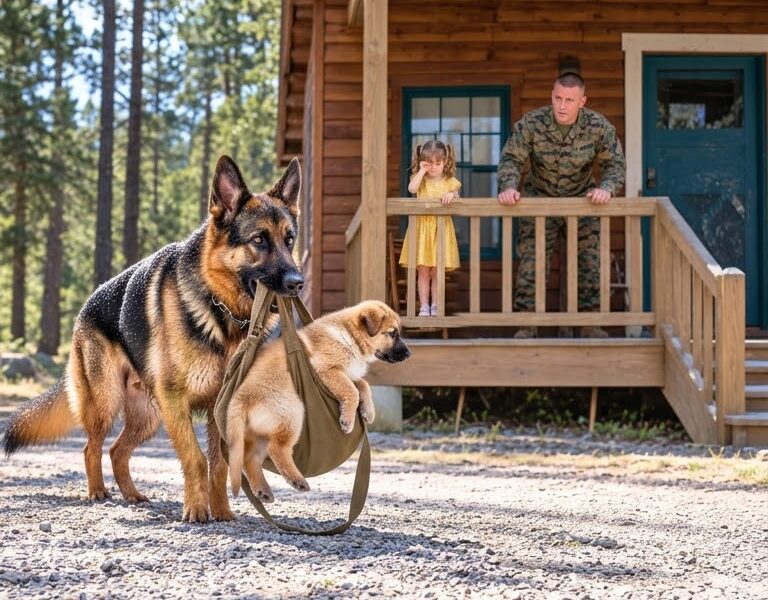
A German Shepherd came to his cabin with a puppy in her mouth. Then the Marine saw her tag—and froze.
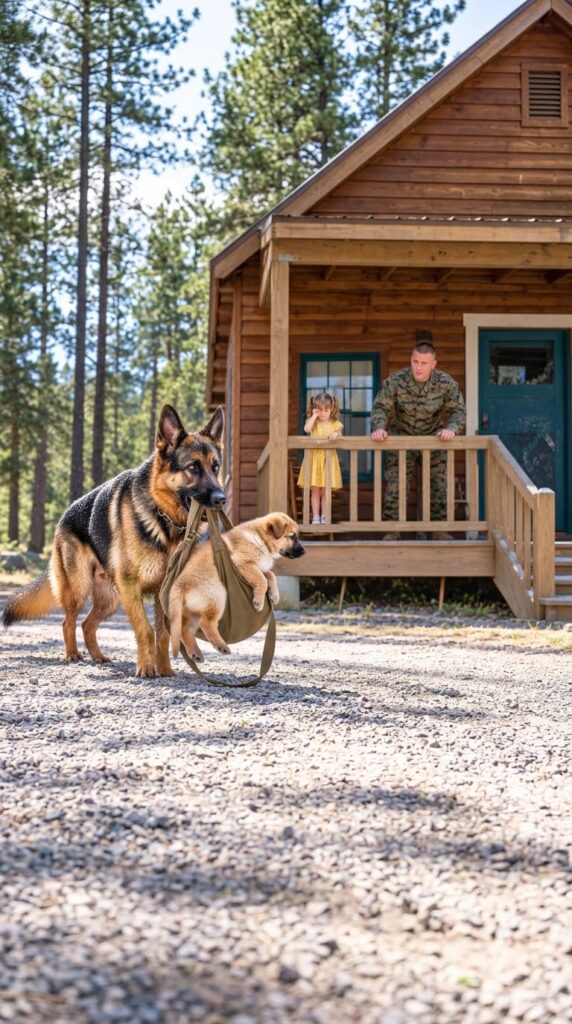
Daddy, look, Sophie cried from the porch.
Staff Sergeant Noah Bennett turned and froze.
A tired German Shepherd was emerging from the Oregon pines, gripping an old canvas bag in her teeth.
Inside, a tiny puppy trembled.
Noah stepped closer, but the dog gently placed the bag at Sophie’s feet, then turned toward the forest and looked back at him.
That was no stray behavior.
Noah followed her into the trees and found two more puppies hidden near a ravine.
The dog they named Willow wore a tag marked CRU19, and her microchip revealed she had once been a trained search and rescue canine who vanished three years earlier.
Following Willow’s past would uncover missing records, a forgotten handler, and a truth buried deep in the forest.
Early summer sunlight filtered through the tall pines outside Bend, Oregon, turning the forest floor gold where it reached between the branches.
Beyond the trees, the high desert country stretched quiet beneath a pale blue sky, cool enough in the morning that the windows of Noah Bennett’s cabin were still open.
Staff Sergeant Noah Bennett was halfway through replacing a loose section of porch railing when his daughter suddenly stopped talking.
At thirty-nine, Noah had the unmistakable build of a career Marine.
He stood just over six feet, broad across the shoulders, with close-cropped dark brown hair beginning to show faint gray near the temples.
Years of deployments, early formations, and long stretches of responsibility had left his face more serious than his actual personality.
Around strangers, Noah tended to listen before speaking.
Around Sophie, however, much of that hardness disappeared.
That morning, he wore an olive t-shirt, faded work jeans, and old boots instead of a uniform.
A hammer rested beside him on the porch.
Behind the front door, on a small table where he had deliberately avoided looking at it for three days, sat an unopened envelope from Oregon Emergency Management.
Noah already knew what was inside.
A possible new job, a different kind of service, and a decision he was not yet ready to make.
Daddy.
Noah kept tightening the screw beneath the railing.
Give me one second.
Daddy.
Something in Sophie’s voice made him stop.
Sophie Bennett stood near the center of the porch with both hands resting on the wooden rail.
At eight years old, she was small for her age, with pale blonde hair tied into two ponytails and blue-gray eyes that rarely missed anything interesting.
She wore a yellow summer dress beneath a light cardigan because the Oregon morning was still cool.
Sophie had inherited almost none of her father’s ability to hide what she was feeling.
If she was excited, everyone knew.
If she was worried, everyone knew that, too.
And when she saw something she believed needed help, reasoning with her usually became a negotiation Noah was unlikely to win.
She was staring beyond him.
There’s a dog.
Noah turned.
At first, he saw only the line of pine trees bordering the gravel clearing in front of the cabin.
Then something moved between them.
A German Shepherd stepped out of the shadows.
Noah slowly stood.
The dog was female, large-framed, and probably seven years old, although fatigue made her appear older from a distance.
Her coat was the traditional black and tan of a German Shepherd, darker across the back and shoulders, lighter along the chest and legs.
Dust clung to the fur around her sides, and a few shallow scratches showed through near one leg.
Nothing severe, but enough to suggest she had traveled through rough country.
She was tired.
That much was obvious.
But she was not wandering.
Every step had purpose.
And hanging from her mouth was the strap of an old olive canvas bag.
Noah frowned.
Sophie, stay on the porch.
But Dad.
She stopped immediately.
The German Shepherd continued forward.
The bag swung gently beneath her jaw.
Noah had seen working dogs throughout his Marine Corps career.
He had never been a handler, but years around military installations had taught him enough to recognize the difference between an animal moving randomly and one making a decision.
This dog was making one.
She crossed the gravel clearing without approaching Noah directly.
Instead, she stopped several feet from the porch.
Then she lowered the canvas bag.
Something inside moved.
Sophie gasped.
Daddy.
A tiny German Shepherd puppy lifted its head above the folded edge of the bag.
The puppy could not have been more than several weeks old.
Its coat was much lighter than the adult dog’s, almost sandy gold across its back with darker coloring beginning around its muzzle and ears.
Its paws seemed too large for the rest of its little body.
It blinked toward the sunlight, then toward Sophie.
Oh my gosh.
Sophie started down the steps.
Noah moved one arm across her path slowly.
But it’s a baby.
I can see that.
It needs us.
We don’t know that yet.
Sophie gave him the look she used whenever he said something she considered technically correct but emotionally ridiculous.
Noah crouched instead.
The adult shepherd watched him.
She did not bare her teeth.
She did not back away.
Her ears remained raised, her brown eyes moving first to Noah, then Sophie, then the surrounding trees, constantly checking, assessing, protecting.
Noah lowered one hand near his left thigh without giving the movement much thought.
The shepherd reacted immediately.
She took two controlled steps forward, moved to his left side, aligned herself beside his leg, and sat.
Noah became very still.
Sophie stared.
Did you tell her to do that?
No.
The dog looked up at him.
Noah had seen that position before.
Not something a frightened stray happened to invent.
Somebody had trained her.
He reached slowly toward her collar.
It was old nylon, faded nearly gray from weather and time.
Attached beneath it was a small scratched metal tag.
Noah rotated it carefully between his fingers.
Four characters remained readable.
C R U 1 9.
What does that mean? Sophie asked.
I don’t know.
The shepherd stood again and moved toward the bag.
She nudged it once with her nose, then looked at Sophie.
Sophie knelt on the lowest porch step.
Can I touch the puppy?
Let her decide.
For several seconds, the shepherd watched.
Then she pushed the canvas bag several inches toward Sophie.
That was permission enough.
Sophie reached carefully inside and touched the puppy across its back with two fingers.
The tiny dog leaned toward her hand.
Sophie smiled.
She’s warm.
We don’t know if it’s a she.
Sophie looked offended by his priorities.
Noah disappeared inside and returned with a wide bowl of water.
He placed it several feet away rather than forcing the adult shepherd closer.
She approached, drank briefly, stopped, then lifted her head.
Noah watched her.
You’ve got to be thirsty.
The shepherd took another small drink.
Then she turned toward the trees.
Sophie looked confused.
Where is she going?
The dog walked about ten yards toward the forest, stopped, looked back.
Noah’s expression changed.
The shepherd took several more steps, stopped again, looked directly at him, then toward the woods.
Sophie whispered, She wants us to follow her.
Maybe.
The shepherd waited.
Noah looked at the canvas bag, then at the trees, then back at the dog.
No, he said quietly.
Not maybe.
He went inside long enough to take a leash, a bottle of water, his phone, and a small first aid pouch from the kitchen cabinet.
When he returned, Sophie was holding the puppy gently against her chest.
I’m coming.
No, Dad.
Sophie.
The shepherd turned back toward Sophie, then waited.
Noah studied the dog for several seconds.
The route appeared to lead into the wooded property behind the cabin.
Terrain Noah knew well from years of walking there.
All right, you stay beside me.
You don’t go ahead.
You don’t leave the trail unless I do.
Sophie nodded rapidly.
I promise.
The German Shepherd began moving.
She did not need the leash.
Still, Noah clipped it loosely to her collar.
Almost immediately, she positioned herself along his left side.
Again, Noah looked down.
Definitely trained.
The three of them entered the trees.
For nearly half a mile, the shepherd followed an old service path through the forest.
She moved slowly enough that Noah began to understand just how exhausted she was.
Twice she paused beneath the shade, but each time she continued before he could encourage her.
Sophie carried the puppy inside the canvas bag against her chest.
I think we should call this one Sunny.
Noah stepped over a fallen branch.
You’ve known that puppy twelve minutes.
That’s enough.
According to who?
Sunny.
Noah looked at the puppy.
The little shepherd had already fallen asleep.
Apparently, I’m outnumbered.
The adult dog suddenly stopped.
Her head turned toward a shallow drainage ravine running between two stands of pine.
Then she left the path.
Noah followed carefully.
Several branches had fallen across the lower section of the drainage channel, creating a sheltered pocket beneath them.
The shepherd reached it first.
She lowered her body.
Sophie stopped beside her father.
Oh.
Two small puppies were curled together beneath the branches.
One was darker than Sunny with black coloring across much of its back.
The other was slightly smaller with tan fur around its face and chest.
Both lifted their heads when the mother approached.
The German Shepherd immediately lay beside them.
Only then did the tension seem to leave her body.
Sophie looked at Noah.
There were more.
Noah crouched several feet away.
Yeah.
She left them here to get help.
Sophie looked at the mother dog.
She brought Sunny all the way to us.
Noah said nothing.
He was thinking about the distance, the canvas bag, the repeated looks toward the forest, the deliberate stop at the cabin.
This dog had not stumbled onto their property.
She had carried one puppy to people, then returned to lead those people back to the others.
Noah slowly looked down at the tag.
CRU19.
Whatever she had been before appearing in their yard, she had known exactly what she was doing.
The trip back took longer.
Noah carried the two puppies together while Sophie carried Sunny.
The mother shepherd stayed beside them, pausing often to look behind before continuing.
By late afternoon, all three puppies were resting on clean towels inside the cabin.
Sophie sat cross-legged beside them.
The mother shepherd stood nearby.
You need a name, too, Sophie said.
Noah opened the refrigerator.
You’ve already named one dog today.
That doesn’t mean I’m finished.
She studied the shepherd.
Outside the window, willow branches from a small tree near the creek moved gently in the afternoon breeze.
Sophie smiled.
Willow.
The German Shepherd turned her head toward the girl.
Sophie pointed triumphantly.
She likes it.
That is still not scientific.
Her name is Willow.
Apparently, that decision had also been made.
That night, Noah placed food, water, and a folded blanket in the hallway.
Willow ate quietly, checked each room, paused at the front door, then walked upstairs.
When Noah went to check on Sophie sometime later, he found the German Shepherd lying directly outside his daughter’s bedroom.
Her head rested between her paws.
One ear remained raised.
Her eyes opened the instant Noah approached.
She did not move.
Noah looked at Willow for a long moment, then at the scratched tag hanging from her collar.
CRU19.
A few hours earlier, this dog had walked out of the Oregon forest carrying a puppy in an old canvas bag.
Now she was sleeping outside his daughter’s door as though guarding Sophie was something she had been trained to do.
Whatever had brought Willow to their cabin, Noah was beginning to understand one thing.
She had not come there by accident.
Morning came cool and bright over the high desert outside Bend, Oregon.
Thin sunlight slipped between the pines behind Noah Bennett’s cabin, touching the porch boards where three German Shepherd puppies slept in a shallow box lined with towels.
Willow was already awake.
She stood near the front window, looking first toward the driveway, then toward the hallway, then back toward Sophie’s bedroom, as though she had been assigned a watch sometime during the night and had never officially been relieved.
Noah noticed the routine before he noticed anything else.
He had come downstairs shortly after six and found Willow moving quietly from doorway to doorway.
She never entered a room without looking inside first.
She paused at the kitchen, checked the back door, glanced toward the stairs, then finally settled near the puppies.
There was nothing nervous about the behavior.
It was organized.
Sophie appeared fifteen minutes later wearing pajama pants patterned with tiny yellow stars and carrying a spiral notebook against her chest.
Her blonde ponytails had disappeared overnight, leaving her hair in a loose, uneven mess around her shoulders.
I made records, she announced.
Noah poured coffee.
Records for the puppies.
She opened the notebook.
On the first page, she had written Sunny in oversized letters, followed by several facts.
Light colored fur, sleeps a lot, likes warm towels, possibly brave.
Noah raised an eyebrow.
Possibly?
I’m still observing.
On the next two pages, she had left spaces for the other puppies.
Noah looked toward the box.
Maybe we should let a veterinarian observe them before you publish your research.
Sophie closed the notebook.
That’s why we’re going today.
Apparently, that decision had already been made, too.
An hour later, Noah loaded Willow and the puppies into his old dark blue pickup.
Willow climbed into the rear seat without hesitation, waited until Sophie settled beside the carrier, then positioned herself between the girl and the door.
During the twenty-minute drive into Bend, she rarely looked at the passing landscape.
Instead, she watched intersections, pedestrians, bicycles, and every vehicle that slowed near them.
Monroe Veterinary Clinic sat on a quiet street away from the busiest part of town.
A single-story building with cedar siding, broad windows, and a small garden of lavender near the entrance.
A hand-painted wooden sign showed the outline of a dog and cat beneath the clinic name.
Dr. Emily Carter met them in the examination room.
Emily was forty-one, tall and lean, with chestnut brown hair pulled into a low ponytail and thoughtful hazel eyes behind thin-framed glasses.
She wore navy scrubs beneath a light gray veterinary coat and moved with the calm economy of someone who had spent years learning that frightened animals noticed impatience faster than people did.
Earlier in her career, Emily had worked in a busy emergency animal hospital in Portland.
After several years of overnight cases and exhausted owners facing decisions they barely understood, she had moved back to central Oregon and opened a smaller practice where she could spend more time explaining care rather than rushing through it.
People sometimes mistook her quiet manner for distance.
It was actually the opposite.
Emily cared deeply, but she had learned to keep her emotions steady so animals and owners had something steady to lean on.
She entered the room, stopped several feet from Willow, and lowered herself slightly rather than approaching head-on.
Well, she said, studying the shepherd.
You’ve had an interesting twenty-four hours.
Sophie answered immediately.
She found us.
Emily smiled.
I heard there was a canvas bag involved.
Noah looked at his daughter.
I told the receptionist.
You told the receptionist everything.
She asked.
Emily examined Willow first.
The shepherd remained alert but cooperative, following the veterinarian’s hands with her eyes without becoming tense.
Her body condition showed that she had been traveling or living without consistent care for some time.
But Emily found nothing immediately alarming.
The scratches along one leg were superficial and already beginning to settle.
What Willow needed most was rest, reliable food, hydration, and time.
She’s tired, Emily said, removing her stethoscope.
Mildly dehydrated, but she’s much more stable than I expected from your description.
Sophie released the breath she had apparently been holding.
So she’s okay.
She needs looking after, but yes, I’m encouraged.
Emily examined the puppies next.
All three were young, vulnerable, and in need of routine monitoring, but they appeared responsive and reasonably strong.
Sunny objected to being moved from her towel by making a tiny, irritated noise, which Sophie immediately recorded in her notebook.
Emily noticed.
You really are keeping records.
Sometimes scientists need details.
Veterinarians, too.
That was enough to make Sophie sit a little straighter.
When Emily finished, Sunny’s towel slipped from the edge of the examination table and disappeared behind a cabinet while Sophie was moving the carrier.
Neither of them noticed immediately.
A few minutes later, Sophie frowned.
Where’s her blanket?
Noah looked beneath the chair.
Emily checked the counter.
Before either adult could continue, Willow stood.
Sophie picked up another small towel Sunny had been lying on earlier and held it uncertainly toward the shepherd.
Can you find it?
Noah almost told her not to confuse coincidence with training.
Willow sniffed once.
Then she turned, crossed the room, walked directly toward the cabinet, and stopped.
She sat.
Emily glanced at Noah.
He moved the cabinet slightly away from the wall.
The missing towel was behind it.
For a moment, nobody said anything.
Then Sophie wrote something in her notebook.
Noah looked over her shoulder.
Willow knows everything.
That may be overstating the evidence.
Sophie kept writing.
Emily, however, was no longer smiling.
What did you say was on her tag?
Noah reached beneath Willow’s collar and turned the scratched metal plate outward.
CRU19.
Emily studied it.
Could mean anything.
Kennel number, program identification, rescue unit.
That last one crossed my mind.
Emily walked to a cabinet and removed a handheld microchip scanner.
Let’s see whether somebody registered her.
She passed it slowly over Willow’s shoulders.
The scanner beeped almost immediately.
Sophie’s eyes widened.
She has one.
She does.
Emily wrote down the number and moved to the computer.
At first, nothing about her expression changed.
She entered the chip number into a national registry, waited for the page to load, then leaned slightly closer to the screen.
Noah noticed.
What?
Emily read silently for another moment.
Then she turned the monitor toward him.
The first line showed name: Willow.
Sophie pointed.
I picked her real name.
Noah barely heard her.
Below it appeared another entry.
Organization: Cascade Response Unit.
Handler: Aaron Whitaker.
Emily scrolled farther.
A final status field appeared at the bottom.
Transferred: Pine Hollow Canine Retirement Center.
Noah looked down at Willow.
The shepherd had lowered herself beside Sophie’s chair, but her eyes remained on the room.
Cascade Response Unit, Noah said.
Emily typed the name into a search engine.
The results were mostly old archived newspaper stories, community fundraising pages, photographs from volunteer search operations, and references to a regional nonprofit that had once worked throughout Oregon.
They weren’t police, Emily said as she read.
Volunteer search and rescue.
Missing hikers, storm response, wildfire evacuations.
That kind of work.
Sophie looked at Willow differently.
She rescued people.
It looks like she may have.
The organization had dissolved nearly three years earlier after a major wildfire season disrupted its facilities and scattered volunteers across several counties.
Some dogs had retired with handlers.
Others had been transferred to private retirement or rehabilitation programs.
Pine Hollow was listed among them.
Emily searched again.
Her expression tightened.
This place closed almost two years ago.
Can you contact anyone?
I can try.
She found an archived number connected to the former facility.
It forwarded to a general information service managing old records.
After several calls and twenty minutes of waiting, Emily reached someone able to access a limited intake list.
She wrote down several dates while Noah stood beside her.
Then she looked up.
Willow isn’t there.
What do you mean?
The registry says she was transferred to Pine Hollow.
Their intake list for that period doesn’t show a Willow, CRU19, or this microchip number.
Sophie looked between them.
Then where did she go?
Noah had no answer.
Emily returned to the registration screen.
There’s still the handler.
Aaron Whitaker.
The registry contained an old contact number.
Noah called from the examination room.
It rang four times.
A man answered.
Hello.
His voice was low and cautious, the voice of someone who did not receive many unexpected calls he wanted to take.
Is this Aaron Whitaker?
A pause.
Yes.
My name is Noah Bennett.
I’m calling from Bend about a German Shepherd.
Another pause, longer this time.
Noah looked at Willow.
Her name is Willow.
Her tag says CRU19.
Nothing came through the phone for several seconds.
Then Aaron spoke again, much more quietly.
Say that number again.
CRU19.
The silence that followed felt different.
Not confusion.
Recognition.
Aaron Whitaker was fifty-five, as Noah would learn during the conversation.
A former wilderness search volunteer who now repaired trail equipment for a county parks department near Eugene.
Photographs online showed a broad-shouldered man with graying brown hair, a weathered face, and deep-set blue eyes.
He had spent more than twenty years in Oregon forests, and friends once described him as patient enough to wait out bad weather and stubborn enough to keep searching when everyone else wanted to turn around.
After losing Willow, much of that certainty had disappeared.
He had continued working outdoors, but never partnered with another search dog.
That was Willow’s number, Aaron said.
Noah lowered his voice.
She’s here.
Aaron gave a short breath that was almost a laugh, but there was no amusement in it.
That’s not possible.
Noah explained the cabin, the puppies, the tag, the microchip.
Aaron listened without interrupting.
Finally, he said, I need to send you something.
A message arrived while they were still on the phone.
Noah opened the photograph.
A younger German Shepherd stood beneath a smoke-gray Oregon sky, wearing a bright search harness.
Her coat was darker, her posture stronger, her ears fully alert.
Beside her stood a younger Aaron Whitaker in an orange rescue jacket.
Around Willow’s neck was the same metal tag.
CRU19.
Sophie stepped closer to the phone.
That’s her.
Noah enlarged the image.
There was no reasonable doubt.
Aaron’s voice came through again.
She was my partner for six years.
He explained that during a major wildfire evacuation three years earlier, animals, equipment, handlers, and volunteers had been moved between temporary sites.
Willow had been separated from him during that confusion.
Later, he was told she had been transferred to Pine Hollow for retirement and eventually placed with a private family.
You never saw her again? Noah asked.
No.
Did they tell you who adopted her?
No names.
They said the family wanted privacy.
Aaron paused.
I believed them.
Noah looked at Willow, sleeping beside Sophie.
For three years, Aaron had believed his partner had gone somewhere safe.
But the dog beside them had emerged from the forest exhausted, carrying a puppy and an old canvas bag.
Something between those two facts did not fit.
That afternoon, back at the cabin, Sophie began a fresh page in her notebook.
Willow.
Underneath she wrote, Seven years old, maybe.
Search dog, very smart, finds towels, protects puppies.
Noah stood at the kitchen counter holding the unopened Oregon Emergency Management envelope.
He almost opened it.
Instead, he set it down again.
Across the room, Willow rose from beside the puppies, walked to the back door, checked the glass, then crossed toward the hallway.
Before settling, she looked through the entrance to Sophie’s room.
Only after seeing the girl inside did Willow lie down.
Noah watched her.
Yesterday, CRU19 had been four meaningless characters scratched into metal.
Now they belonged to a trained search dog, a former handler, and three missing years nobody had yet explained.
And somewhere in Eugene, Aaron Whitaker had just learned that the partner he thought had safely disappeared into retirement had been walking through the Oregon wilderness all along.
Three days after Noah Bennett learned that Willow had once belonged to Cascade Response Unit, the mystery had stopped feeling like an unusual coincidence and started feeling like something that needed structure.
The old photograph Aaron Whitaker had sent still sat open on Noah’s phone, showing a younger Willow in a search harness beneath an Oregon sky.
The same tag, CRU19, hung from the collar of the dog now sleeping beside Sophie’s chair.
Noah knew better than to confuse questions with evidence.
Years in the Marine Corps had taught him that instinct could point a person in the right direction, but facts were what allowed anyone else to follow.
So that morning, while Sophie updated her puppy notebook at the kitchen table, Noah called someone he trusted to separate the two.
Deputy Marcus Hale arrived at the cabin shortly before noon.
Marcus was forty-four, six feet tall, solidly built without looking imposing, with closely shaved black hair, deep brown eyes, and a quiet face that rarely revealed more than he intended.
He had spent eight years in the Army before joining the Deschutes County Sheriff’s Office, where his patience had become almost legendary among younger deputies.
Marcus did not enjoy dramatic theories.
He liked dates, documents, names, and the boring details other people skipped because they wanted answers too quickly.
Years earlier, after a difficult search for a missing hiker ended well only because one volunteer had carefully recorded a minor trail detail, Marcus had become even more committed to slow, methodical work.
He listened while Noah explained Pine Hollow, the missing intake record, Aaron Whitaker, and Willow’s three-year gap.
When Noah finished, Marcus looked toward the German Shepherd lying near the sliding door.
So the registry says Pine Hollow.
Yes.
Pine Hollow says no Willow.
Correct.
And you want me to tell you what happened?
I want to know whether there’s anything worth looking at.
Marcus nodded once.
That I can do.
He made no promises beyond that.
Over the next two days, Marcus contacted county licensing offices, archived animal service records, and people who had handled closure paperwork connected to Pine Hollow K9 Retirement Center.
What emerged was not a clean story.
Pine Hollow had once been a legitimate private retirement and rehabilitation facility for older working dogs.
In its final year, however, ownership changes, staffing problems, and financial instability had created administrative confusion.
Fourteen dogs identified in outside records as former working or rescue animals had supposedly passed through the facility during that period.
The problem was what happened afterward.
Several were listed as adopted.
Others were marked transferred.
Three were described only as privately fostered.
But in multiple files, there was no final receiving address, no named family, no second facility, no complete chain of custody.
Marcus called Noah from his patrol vehicle late one afternoon.
This doesn’t prove someone did anything wrong, he said immediately.
Noah stood on the cabin porch watching Sophie in the yard.
I figured you’d say that.
It proves the records are incomplete.
That’s different.
Fourteen dogs.
Fourteen that I can connect so far.
Noah looked toward Willow.
The shepherd was standing beneath a pine tree while the puppies explored the grass nearby.
What happens next?
I’m asking animal services to review the files properly.
They have access to records I don’t.
Marcus paused.
There’s one other thing.
In several transport documents, the same company name appeared repeatedly.
Timberline Pet Transit.
Sometimes it was listed beside a transfer date, sometimes only as a transportation provider.
In a few records, Marcus could find no destination beyond the company name itself.
No accusations, Marcus said.
Not yet.
I know.
I mean it, Noah.
So do I.
Marcus laughed softly.
That’s what worries me.
At the cabin, life around Willow was becoming much less mysterious in ordinary ways.
She was eating better, moving more comfortably, and spending longer periods outside with the puppies.
Sophie had finally named the other two.
Scout was the darkest of the three, a curious male puppy who seemed determined to investigate every shoe, chair leg, and corner of the cabin.
Poppy was smaller, a tan-faced female with a narrow white patch on her chest and a habit of falling asleep halfway through whatever she had been doing.
Sunny remained the calmest.
Sophie’s notebook now contained three separate personality profiles.
Noah had stopped pretending he did not find them funny.
One afternoon, he tossed a tennis ball across the yard to see whether Willow had any interest in playing.
She watched it bounce.
Then she looked at Noah.
That’s all you’ve got?
Sophie laughed.
She thinks your game is boring.
Noah picked up the ball.
Apparently.
But when Sophie hid one of her gardening gloves behind a porch planter and let Willow smell the matching glove, everything changed.
Willow’s posture sharpened.
She moved through the yard slowly, checked beneath a bench, passed the flower bed, then stopped beside the planter.
She sat.
Noah looked at Sophie.
That she understands.
Over the next several days, Noah experimented carefully with a few basic hand signals he remembered seeing working dog handlers use.
A lowered palm for down, a small movement near the left leg for heel, a flat hand held forward for stay.
Willow recognized more than he expected.
She was not perfect, and Noah never pushed her.
But each correct response made the missing years feel stranger.
Training like that did not simply appear.
It had been built over thousands of repetitions between Willow and someone who had once trusted her completely.
That someone was Aaron.
And somehow Willow had ended up in Noah’s yard instead.
The moment Noah fully understood what Willow was becoming to Sophie happened two days later.
Sophie had been flying a small red kite near the open meadow behind the cabin when the wind dropped suddenly.
The kite drifted sideways, passed over the grass, and caught in low brush near the tree line.
I’ll get it, Sophie called.
Noah was stacking firewood beside the shed.
Stay where I can see you.
She walked toward the edge of the trees.
Willow was lying nearby.
The moment Sophie stepped beyond the last open patch of grass, Willow stood.
She moved quickly but calmly, crossed in front of Sophie, and stopped sideways across the narrow trail leading deeper into the woods.
Sophie tried stepping left.
Willow shifted left.
Sophie stepped right.
Willow moved right.
She never growled.
She never touched the girl.
She simply refused to let Sophie continue.
Then Willow looked back toward the cabin.
Sophie followed her gaze.
Dad.
Noah had already started toward them.
He retrieved the kite himself.
On the way back, he looked at Willow differently.
She was not merely staying near Sophie because she liked her.
Willow had assigned herself a responsibility.
Later that week, Dr. Emily Carter suggested that Sophie visit High Desert Animal Haven, a small rescue organization outside Bend that often partnered with local veterinary clinics.
The property consisted of a farmhouse, several fenced exercise areas, and two long kennel buildings surrounded by open high desert land.
Rachel Moore met them near the entrance.
Rachel was forty-six, medium height, broad-shouldered, with curly auburn hair tied loosely behind her head and sun-freckled skin from years of outdoor work.
She wore jeans, work boots, and a faded green shirt with one sleeve rolled slightly higher than the other.
She had spent nearly twenty years coordinating foster programs before opening High Desert Animal Haven after her older dog had been rejected by several overcrowded shelters because of age.
Since then, Rachel had developed a reputation for being practical, direct, and almost incapable of turning away an animal when she believed another solution could be found.
That generosity created its own problems.
The large dog section was nearly full.
Part of the kennel roof still showed temporary repairs from the previous winter.
A stack of donated blankets sat beside a washing machine that appeared older than Noah.
Sophie noticed everything.
How do you help all of them?
Rachel smiled.
One dog at a time.
That seems slow.
It is.
Sophie considered that seriously.
Rachel showed her how donated food was sorted, how foster kits were prepared, and why good rescues sometimes needed to say no until space opened.
Sophie looked toward the old canvas bag Noah had brought along to show Rachel how Willow had carried Sunny.
Then she stared at a shelf filled with spare bowls, leashes, towels, and food.
An idea appeared on her face before she said anything.
What if people filled bags?
Noah knew that expression.
What kind of bags?
One bag could have food, towels, a leash, maybe money.
Rachel leaned against the shelf.
I’m listening.
Sophie pointed to Willow’s canvas bag.
One bag, one home.
By the time they left, she had already planned the first five.
At school the next week, Sophie made a poster for a community service project.
Noah expected something about the Marine Corps.
Instead, across the top, she wrote Willow’s name.
Below it, she drew a German Shepherd carrying a bag.
Her teacher had asked the students to choose someone they believed represented service.
Sophie chose Willow.
When Noah saw the poster that evening, he stood in the kitchen longer than he intended.
He had spent most of his adult life believing service meant going where he was sent.
Willow seemed to define it differently.
Find who needs you.
Stay until they are safe.
That night, Marcus called again.
Animal services had agreed to begin a formal review of the Pine Hollow records.
Timberline Pet Transit appeared often enough that the company would be included in the document search.
Before Noah could ask anything else, Marcus added, And I got another call today.
From who?
An older man named Frank Dalton.
Noah waited.
Marcus continued.
He saw Willow’s picture on High Desert Animal Haven’s Facebook page.
What did he want?
He says he recognizes her.
Frank Dalton was sixty-three, according to the basic information Marcus had gathered, a thin, gray-haired man living outside Bend who spoke slowly and seemed uncomfortable giving details over the phone.
Marcus had asked him to come in and talk.
Noah looked across the room.
Willow was lying beside Sophie while Scout, Sunny, and Poppy slept together near her front paws.
For the first time since she had walked out of the forest, someone from the missing three years had recognized her.
And this time, the answer had not come from a microchip.
It had come from a man Willow had apparently met before.
Frank Dalton arrived at the sheriff’s office two days later.
He was exactly as Marcus had described him.
Thin, gray-haired, with weathered skin and hands that seemed more comfortable holding tools than sitting still on a table.
He wore a clean plaid shirt, new jeans that still had the fold lines from a store shelf, and boots that had been recently brushed.
Noah noticed the effort.
Frank had dressed for something that mattered.
Marcus introduced them, then gestured toward a chair.
Frank sat slowly.
He kept both hands wrapped around a paper coffee cup he had not drunk from.
You recognized the dog, Marcus said.
Frank nodded.
I did.
Can you tell me how?
Frank looked toward Noah.
You’re the one who has her now?
Yes.
She looked good in the picture.
Tired, but good.
Noah waited.
Frank took a breath.
I worked at Pine Hollow for about seven months near the end.
Marcus leaned forward slightly.
Doing what?
Maintenance.
Whatever needed fixing.
I wasn’t involved with the animals directly.
Frank paused.
That’s why I didn’t think much about it at first.
Think about what?
The records.
Frank explained that Pine Hollow had been struggling long before he arrived.
Staff came and went.
Supplies ran low.
The owner, a man named Gerald Voss, spent more time in Portland than at the facility.
By the time Frank started, most of the daily operations had been handed off to a rotating group of temporary workers.
Some were decent.
Others barely knew how to handle a leash.
And the dogs?
Frank looked down at his coffee cup.
They kept disappearing.
Noah felt something tighten in his chest.
Disappearing how?
Not in a dramatic way.
At first, the differences seemed harmless.
A dog would be listed on a kennel chart one evening and gone the next.
Frank assumed the animal had been collected by a family, foster, or another facility.
Then he began noticing transport sheets.
Some dogs he saw leaving did not match the destination written on the paperwork he later found clipped near the office.
Other times, a kennel number appeared on one document while another sheet listed the same animal differently.
Nothing dramatic.
Nothing that allowed Frank to say something illegal was happening.
Just enough small inconsistencies that he stopped trusting his memory alone.
So you wrote everything down, Marcus said.
Frank nodded.
Dates, vans, plates if I could see them, kennel numbers, and dog names when they were posted.
He opened the notebook.
The handwriting inside was compact and uneven.
Some pages contained only three or four lines.
Others were crowded with dates, abbreviations, vehicle colors, kennel identifiers, and arrows showing direction.
Frank turned several pages, then stopped.
There it was.
CRU19.
Willow.
Noah leaned closer.
Beneath the entry, Frank had written a second line.
Sent north.
Timberline property.
For several seconds, nobody spoke.
Marcus broke the silence.
What does Timberline property mean at the time?
I didn’t know exactly.
Frank explained that Timberline Pet Transit handled a significant number of Pine Hollow’s outgoing animal movements during those months.
The company operated several vans and sometimes used temporary holding properties when animals were being moved between facilities.
Frank had heard drivers refer to one location simply as the north place.
A few months after leaving Pine Hollow, he found out where it was.
He had been doing temporary fence repair near Sisters, Oregon, when he recognized one of Timberline’s white transport vans on a rural road.
Curiosity had gotten the better of him, though he had never entered the property or done anything beyond observing from a public roadside.
That’s when I saw her, Frank said.
Noah looked at him.
Willow?
Frank nodded.
She was behind a fence near one of the outer buildings.
Are you certain?
I’m certain.
Frank remembered the crooked angle of one ear when she turned, the dark saddle across her back.
More importantly, he remembered the scratched metal tag.
CRU19.
She looked okay? Noah asked.
The question came faster than he intended.
Frank understood why.
She was standing, alert, watching everything.
I didn’t see anything that made me think she needed immediate help.
Noah released a quiet breath.
What happened after that?
I drove past a couple more times over the next few months.
Then the place shut down.
Frank had later heard that the company controlling the property had gone into financial trouble.
Vehicles disappeared.
The gate stayed locked.
Eventually, no one seemed to be there.
And Willow disappeared with everything else.
Frank had no idea where she went until he saw Sophie’s photograph online.
High Desert Animal Haven had posted an update about One Bag, One Home, including a picture of Sophie kneeling beside Willow and the three puppies.
Frank had stared at the photograph for nearly ten minutes before calling Marcus.
I figured I’d spent three years telling myself those notes didn’t matter, he said.
Then there she was.
Marcus carefully photographed each relevant notebook page.
He did not take the notebook immediately.
Instead, he asked Frank to keep it safe until animal services decided how the information should be formally documented.
By afternoon, Marcus had confirmed one important fact.
The rural property outside Sisters still existed.
Ownership, however, had become complicated.
The land was tied to a small holding company that had entered bankruptcy nearly two years earlier.
Timberline Pet Transit had used the property under a lease during Pine Hollow’s final period, but the company itself no longer operated from the address.
Animal services now had enough historical connection to include the property in its broader review.
Noah understood what that meant.
It did not mean anyone had solved Willow’s missing years.
It meant there was finally somewhere specific to look.
Back at High Desert Animal Haven, Sophie was helping Rachel Moore sort the first donations for One Bag, One Home.
The idea had traveled much faster than Noah expected.
Three families from Sophie’s school had donated unopened dog food.
Another brought towels and two new leashes.
A local feed store offered several canvas totes.
Emily Carter placed a collection box at her veterinary clinic after hearing Sophie explain the project to a waiting room full of clients.
Sophie took her new responsibilities seriously.
Each bag received a simple handwritten card listing what was inside.
Food, towel, bowl, leash, small donation envelope.
Frank arrived at the rescue two days later.
Sophie recognized him immediately from Noah’s explanation.
You’re the man who remembered Willow.
Frank seemed uncomfortable with the attention.
I remembered a tag.
That still counts.
He glanced toward Noah as if asking whether Sophie always spoke this directly.
Noah smiled.
She does.
Sophie pointed toward one of the kennel buildings.
Rachel says the roof still leaks when it rains.
Frank looked toward the patched section, then at Sophie.
That’s so you fix things sometimes.
Could you look at it?
Noah almost interrupted, but Frank was already walking toward the building.
For the next half hour, he examined the roof edge, checked the old flashing, and inspected several damaged boards beneath the overhang.
His posture changed as he worked.
The uncertainty disappeared.
His hands became confident.
Rachel stood beside Noah.
He knows what he’s doing.
He did maintenance for years.
I could use someone like that.
Frank overheard.
He pretended not to.
By the time he left, Rachel had asked whether he might return Saturday to help replace several sections properly.
Frank said he would think about it.
He returned Saturday at eight in the morning.
At the Bennett cabin, Willow continued changing, too.
The first week, she had slept directly outside Sophie’s bedroom.
Now she had chosen a new spot in the upstairs hallway, halfway between Sophie’s room and Noah’s.
Noah noticed it one night when he got up for water.
Willow lay stretched across the middle of the hallway where she could see both doors.
She lifted her head when Noah stepped out.
You expanding your responsibilities?
Her tail moved once against the floor.
Noah crouched beside her.
For the first time, he wondered whether Willow was no longer guarding only Sophie.
Maybe she had decided he belonged to the same group.
The thought stayed with him the following morning when another envelope arrived.
Oregon Emergency Management.
This one was not a general offer.
It contained a deadline.
Seven days.
If Noah wanted the emergency coordination position, he had to give them an answer.
He read the letter twice at the kitchen table.
The job would use much of what he had learned in the Marines.
Planning, logistics, crisis coordination, leadership.
But without the same cycle of long absences.
For months, Noah had told himself he was delaying because he needed more information.
That was no longer true.
He was delaying because saying yes would mean admitting that one version of his life might be ending.
Sophie walked into the kitchen carrying three One Bag, One Home labels.
She saw the paper.
That the job thing?
Noah looked at her.
Yeah.
Are you going to take it?
I don’t know yet.
Sophie accepted the answer without pushing him.
Willow walked in behind her and settled between their chairs.
Noah looked down at the old shepherd.
Three years earlier, Willow had been separated from Aaron during an emergency.
Then she had passed through Pine Hollow, then Timberline, then a property outside Sisters.
Every place had apparently been temporary.
And yet somehow she had continued doing the one thing she understood.
Watch.
Search.
Protect.
That evening, Marcus called again.
The review team is preparing to inspect the old Timberline property.
When?
Soon.
I’ll tell you when I’m allowed to.
Noah did not ask.
Not yet.
Then Marcus added something else.
Aaron Whitaker called me.
Noah straightened.
What about?
He wants to come to Bend.
Noah looked toward Willow.
She was asleep beside Sophie’s chair.
When?
He said tomorrow.
Noah waited.
Marcus’s voice softened.
He doesn’t want to see her yet.
Why not?
He’s scared she won’t remember him.
Across the room, Willow opened her eyes as if sensing Noah watching.
For three years, Aaron Whitaker had carried one version of Willow in his memory.
Young, strong, wearing a rescue harness, always beside him.
Tomorrow, he would be only a few miles away from the older dog resting inside Noah Bennett’s cabin.
But for now, Aaron was choosing to wait.
Not because he had forgotten Willow.
Because he was afraid Willow might have forgotten him.
The old Timberline property lay several miles beyond Sisters, Oregon, where the paved road narrowed into a county lane and the open high desert gradually gave way to stands of Ponderosa pine.
By sunrise, a thin layer of cloud still hung over the mountains from the previous night’s rain, and water collected in shallow depressions along the gravel entrance.
Nothing about the place looked dramatic.
There were no active transport vans, no crowds, and no confrontation waiting behind the gate.
Just two weathered kennel buildings, a faded office trailer, several fenced exercise runs, and the quiet remains of a business that had slowly stopped functioning.
Noah Bennett stood beside his pickup at a designated staging area with Willow on a loose leash.
He wore jeans, boots, and a dark work jacket rather than his Marine uniform.
Marcus Hale had been very clear about why Noah was there.
He was not law enforcement, and he would not take part in any official inspection.
Willow’s identity connected directly to the old Pine Hollow records, and Frank Dalton’s notebook had provided historical information useful to animal services, so Noah had been permitted to remain nearby as Willow’s current caretaker in case investigators needed clarification.
Noah was perfectly comfortable with that boundary.
If years in uniform had taught him anything, it was that a mission worked best when everyone understood which job belonged to whom.
Leading the animal services review was Dana Cole, a forty-eight-year-old field investigator with short, sandy blonde hair, a sturdy build, and calm gray eyes.
Dana had spent nearly two decades working with county shelters and licensing cases across central Oregon.
She had developed a reputation for being difficult to impress and almost impossible to rush.
Earlier in her career, she had watched one poorly documented shelter closure create years of confusion for adopters and foster families.
Since then, she had treated paperwork with nearly the same seriousness as the animals themselves.
She spoke quietly, asked precise questions, and never described uncertainty as proof.
The second person Noah noticed was Eli Turner, the property’s temporary caretaker.
Eli was fifty-eight, lean and sun-browned, with a white mustache and a faded canvas cap.
He had once worked seasonal ranch jobs around Sisters and had been hired by the bankruptcy administrator months earlier to keep water systems functioning, feed the remaining dogs, and make sure the empty buildings did not deteriorate completely while legal ownership was resolved.
He seemed relieved that someone had finally come to sort through the records.
There aren’t many dogs left, Eli explained to Dana.
Most were moved to approved places months ago.
The ones still here are waiting on paperwork.
That statement immediately shifted the mood.
Noah had spent weeks imagining the worst because Willow’s history contained so many blank spaces.
What investigators found instead was something less deliberate but still deeply troubling in its consequences.
A chain of organizations that had closed, changed ownership, transferred files incompletely, and passed animals from one temporary arrangement to another until records stopped matching reality.
Inside the office trailer were filing cabinets, cardboard boxes, old intake binders, transport sheets, and computer equipment that had not been used in months.
Frank Dalton arrived shortly after eight, carrying his black notebook and a clear document sleeve.
He seemed more comfortable here than he had in the sheriff’s office.
Familiar buildings, old kennel numbers, and faded company markings gave his memory something concrete to attach itself to.
Dana compared several entries in Frank’s notebook against the recovered files.
One matched.
Then another.
And another.
By late morning, a pattern had emerged.
A number of dogs had indeed passed from Pine Hollow through Timberline Pet Transit.
Some had later been transferred properly, but the records were never sent back to the earlier organizations.
Others were moved again after Timberline faced financial trouble.
A few were temporarily fostered under handwritten agreements that had never been entered into the original databases.
Noah stood outside with Marcus when Dana eventually brought them a photocopy.
At the top was an old identifying number.
CRU19.
Willow.
Noah read the page twice.
The record showed that she had arrived from Pine Hollow during the final months of that facility’s operations.
A later notation indicated temporary placement at the Sisters property.
After that, there was another incomplete transfer line with no final destination.
That was where the paper trail ended.
So nobody deliberately erased her? Noah asked.
Dana chose her words carefully.
I can’t tell you what every person involved knew at the time.
But based on what we have here, the larger problem appears to be failed administration, repeated closures, and incomplete transfers.
Records stopped following animals when organizations stopped functioning.
Marcus folded his arms.
Which is how Aaron was told she went one place while Willow actually went somewhere else.
Dana nodded.
And once enough links broke, nobody had the whole chain anymore.
Noah looked down at Willow.
For weeks, he had imagined a single secret powerful enough to explain three missing years.
Reality was stuffier.
There had been no single moment when Willow disappeared.
She had simply been lost between systems.
Across Bend, Sophie was spending the morning at Emily Carter’s clinic.
Several of the dogs still waiting at the Timberline property would be evaluated before being placed with approved fosters, and Sophie had insisted on helping prepare the intake area.
Emily gave her jobs appropriate for an eight-year-old.
Folding towels, setting out clean water bowls, writing temporary identification numbers on cards, and organizing unopened donation supplies from One Bag, One Home.
Sophie took each task as seriously as if the clinic had appointed her operations manager.
By ten-thirty, six filled canvas bags sat beneath the front desk.
Each contained a towel, a leash, a small bag of food, and basic supplies.
Emily watched Sophie straighten the labels.
You know, these dogs may only be here a few hours.
Sophie nodded.
Then they need things for those hours.
Emily smiled.
There was little she could add to that.
Back at Timberline, the inspection was nearly complete when Eli Turner approached Dana with concern.
A missing one.
Dana looked up from a transport list.
One what?
Young shepherd came here through a temporary county placement about a year ago.
Eli led her toward the rear runs.
The previous night’s rain had softened the ground beneath an older section of fence.
One low area had shifted enough to leave a gap near the bottom.
The run itself was empty.
The missing dog was a young German Shepherd mix named Juniper, approximately fourteen months old, with a tan coat, a black saddle, oversized ears, and a shy temperament.
Eli explained that Juniper was not aggressive or difficult.
She was simply uncertain around unfamiliar people and tended to retreat whenever routines changed.
She was here at first feeding, he said.
I thought she’d gone into the shelter box.
Dana immediately organized a careful search of the property perimeter.
Fresh tracks disappeared toward the tree line.
Noah saw Marcus glance at Willow, then at him.
Marcus did not need to say anything.
No, Noah said quietly at first.
Marcus nodded.
Fair.
Noah looked down at the older shepherd.
Willow had already noticed the activity.
Her head was raised, ears forward, eyes following Dana and Eli as they moved along the fence.
She’s seven, Noah said.
She’s only just getting her strength back.
Nobody’s asking her to prove anything that mattered.
Noah crouched beside Willow.
You hear that?
Willow looked at him.
Dana returned, carrying a clean towel Juniper had used inside the kennel shelter.
We can search conventionally, she said.
There’s no pressure.
Noah held the towel but did not put it beneath Willow’s nose.
He waited.
Willow stepped forward on her own.
She smelled the fabric once, then again.
Her posture changed.
Not dramatically.
Her back straightened slightly.
Her attention narrowed.
The tired family dog Noah had come to know did not disappear, but another part of her seemed to move forward.
CRU19.
Noah remembered Aaron’s photograph.
A younger Willow beneath a smoke-gray sky, wearing a search harness and staring toward something beyond the camera.
Willow turned toward the woods.
Noah looked at Marcus.
She wants to try.
They kept the search controlled.
Dana’s team remained in contact with them, and Noah carried water while Marcus accompanied him.
Willow moved at a steady walking pace, following the tree line before turning onto a narrow route between the pines.
Unknown to Willow, Aaron Whitaker stood nearly two hundred yards away beside Dana’s vehicle.
He had arrived in Bend the previous evening and had asked Marcus if he could observe without approaching Willow.
At fifty-five, Aaron looked much like the photographs Noah had seen, only older around the eyes.
His once dark hair was heavily gray now, and years of outdoor work had deepened the lines across his face.
He wore a blue work jacket and kept both hands in his pockets as though afraid any movement might betray how much the moment meant to him.
When Willow entered the trees, Aaron recognized her gait immediately.
He said nothing.
The trail wound along a dry seasonal creek bed before climbing gradually through open pine forest.
Willow stopped often.
Once she examined an intersection of game trails for nearly a minute before choosing the narrower path.
Noah never hurried her.
Twenty minutes passed.
Then thirty.
He offered water.
Willow drank briefly.
They continued.
The trees eventually opened onto an old forest service campground that had been closed for repairs years earlier.
Picnic tables stood beneath the pines, their wooden surfaces faded silver by weather.
An old fire ring was filled with pine needles.
Willow stopped, her nose lifted.
Then she turned toward the far end of the clearing.
Marcus saw the movement first.
Under the table.
Beneath an old picnic table, Juniper had tucked herself against the shadow near one wooden bench.
She was alert but frightened.
Noah stopped several yards away.
Willow did not approach immediately.
She lowered herself onto the pine needles and waited.
Juniper watched her.
No one moved closer.
A minute passed.
Then another.
Slowly, Juniper stretched her head forward.
Willow remained still.
The younger shepherd crept from beneath the table, paused, then took several cautious steps toward the older dog.
When she reached Willow, she touched her nose gently against Willow’s muzzle.
Only then did Noah kneel.
A few minutes later, Juniper allowed Marcus to secure a leash.
No cheering followed.
No celebration was necessary.
Willow stood beside Noah, breathing harder than usual, but calm.
He rubbed one hand gently across her shoulders.
That’s enough, old girl.
From the edge of the campground road, Aaron had arrived with Dana’s vehicle after being directed to the recovery location.
He remained beside the truck.
Willow never saw him, but Aaron saw everything.
The search, the waiting, the frightened dog choosing to come closer.
His eyes filled, though he quickly looked away.
That’s her, he said quietly.
Dana stood beside him.
The same dog?
Aaron shook his head.
No.
He watched Willow walking slowly beside Noah.
The same heart.
That afternoon, Noah sat on the tailgate of his truck while Willow rested at his feet.
The deadline letter from Oregon Emergency Management was still folded in his jacket pocket.
For months, Noah had treated the possible change in his own career as though stepping into a different role meant losing the person he had been.
Willow had just shown him otherwise.
She was older.
She was slower.
Her search career was over.
None of that had erased what years of training, experience, patience, and loyalty had built inside her.
Maybe experience did not become less valuable when the mission changed.
Maybe sometimes it became more valuable because it could finally be used differently.
Noah touched the envelope through his jacket.
For the first time, the decision waiting inside it no longer felt like an ending.
Nearby, Willow slept beneath the Oregon pines.
Her final search was finished, and this time every dog was accounted for.
Morning came clear over the Bennett cabin.
The previous day’s clouds gone from the Cascades and sunlight spreading slowly through the Ponderosa pines.
The forest looked almost ordinary again.
There were no search teams, no county vehicles, no paperwork stacked beneath fluorescent lights.
Only birds in the trees, three growing puppies asleep near the porch steps, and Willow stretched beneath Sophie’s chair as though the search at Timberline had belonged to another lifetime.
Noah Bennett stood near the kitchen window with a cup of coffee and watched the gravel road.
He knew who was coming.
Sophie knew, too.
She had asked four times before breakfast whether Aaron Whitaker was going to take Willow away.
Noah had answered the same way each time.
I don’t know.
It was the only honest answer he could give.
Sophie sat on the porch in her yellow cardigan with Sunny sleeping against one leg.
Scout and Poppy had already discovered that morning grass was more interesting than staying clean and were investigating the edge of the flower bed.
Willow rested beside Sophie but periodically lifted her head toward the road.
Shortly after nine, a dark green pickup appeared between the trees.
It slowed before turning into the driveway, then stopped.
For several seconds, the driver remained inside.
Noah understood why.
Aaron Whitaker had spent three years living with a memory.
Yesterday, from a distance, he had watched Willow search again.
But watching was not the same as standing in front of her.
The truck door finally opened.
Aaron stepped out.
At fifty-five, he carried the shape of a man who had spent most of his life outdoors.
He was broad through the chest but slightly stooped now, with graying brown hair, a weathered face, and blue eyes that seemed more tired than they had in the old rescue photographs.
He wore faded jeans, work boots, and a blue canvas jacket.
Nothing about him suggested drama.
Aaron had always been a patient man, according to everyone who knew him.
The kind of handler willing to spend an hour helping a frightened dog understand one simple task rather than demanding it happen in five minutes.
Losing Willow had changed him.
He had continued working, continued showing up, continued living, but he had never partnered with another search dog.
Aaron closed the truck door.
Willow stood.
Sophie’s hand immediately found Noah’s.
Aaron did not call Willow’s name.
He did not whistle.
He did not use a command from their years together.
He walked halfway across the yard and stopped.
Then he lowered himself onto one knee.
Willow stared at him.
Noah felt Sophie tighten her grip.
The old shepherd’s ears shifted forward.
Three years had changed Willow.
Gray had spread around her muzzle.
Her pace was slower.
Her once powerful working dog frame had softened with age and uncertain months on the road.
But something in her face seemed to sharpen as she studied the man kneeling in front of her.
Aaron stayed completely still.
Willow took one step.
Then another.
She paused.
Aaron’s mouth tightened.
Willow continued.
She crossed the remaining distance slowly and stopped directly in front of him.
For a moment, neither moved.
Then Willow leaned forward and pressed her head against Aaron’s chest.
Aaron closed both arms around her, his eyes shut.
Noah looked toward the trees, giving the man a little privacy, even though there was nowhere for the emotion to hide.
Sophie did not look away.
Aaron rested one hand against Willow’s neck and whispered something too quietly for anyone else to hear.
Willow’s tail moved once across the grass, then again.
There was no crowd, no applause, no dramatic reunion beyond a man kneeling in an ordinary yard and an old dog remembering exactly where she had once belonged.
After several minutes, Aaron sat beneath the porch with Noah while Sophie remained close to Willow.
He showed them photographs from Cascade Response Unit.
Willow crossing mountain trails in a search harness.
Willow sitting beside rescue volunteers after long training days.
Willow asleep with her chin resting across Aaron’s boots.
Sophie studied every photograph.
Then she asked the question she had been avoiding.
Are you taking her?
Aaron looked at her.
Sophie tried to appear brave, but her eyes immediately dropped toward Willow.
Aaron glanced at the shepherd.
Willow was sitting beside Sophie.
Sunny was curled near her front paws.
Scout wandered toward the porch steps, and Willow quietly reached one paw forward, stopping the puppy before he went too far.
Aaron watched that small movement.
Then Willow looked toward Noah.
Back to Sophie.
Back to the puppies.
Aaron smiled.
No.
Sophie looked up.
Aaron rubbed his hands together slowly.
She was my partner for six years.
I thought if I ever found her again, I’d bring her home.
He paused.
But that was before I understood she already had one.
Sophie’s face changed.
But she remembers you.
I hope she always does.
Aaron leaned forward.
That doesn’t mean I have to take her away from where she wants to be.
Willow shifted closer to Sophie’s leg.
Aaron noticed.
So she can stay.
She should stay.
Sophie immediately wrapped both arms around Willow’s neck.
Noah smiled.
Aaron looked toward him.
If you’re all right with it, I’d still like to see her.
You don’t have to ask.
That became the arrangement.
Willow remained with Noah and Sophie.
Aaron became part of the family around her rather than someone trying to reclaim a piece of the past.
Summer moved forward.
Sunny, Scout, and Poppy grew quickly.
Scout became the adventurous one Sophie had predicted.
A dark-coated male who seemed to believe every open door existed for his personal investigation.
Poppy remained smaller and gentler with the same habit of falling asleep in inconvenient places.
Sunny grew into a calm, light-colored young shepherd who followed Sophie almost everywhere.
Rachel Moore handled the eventual adoption process carefully through High Desert Animal Haven.
Scout went to Ben and Laura Miller, a middle-aged couple living on several fenced acres outside Redmond.
Ben was a high school science teacher with a quiet voice and endless patience, while Laura worked from home as a book editor and had owned shepherds for most of her adult life.
They visited Scout several times before taking him home and passed every check Rachel required.
Poppy was adopted by Grace Holloway, a forty-nine-year-old physical therapist whose older rescue dog had passed away the previous winter.
Grace was petite, silver-blonde, and gentle in a way animals seemed to understand immediately.
She did not want a high-energy dog.
Poppy, who preferred naps and following people from room to room, seemed to agree with the arrangement.
Sunny stayed.
Sophie never presented that as a decision.
She treated it as something the universe had settled on the morning Willow carried that old canvas bag out of the forest.
Noah allowed her to believe that.
His own decision came before summer ended.
The Oregon Emergency Management letter remained on the kitchen counter until the afternoon before the deadline.
Noah finally called.
He accepted the emergency coordination position.
Leaving regular operational service in the Marine Corps was harder to say aloud than he had expected.
The uniform had shaped nearly his entire adult life.
For years, service had meant being ready to leave when someone needed him somewhere else.
Willow changed the question.
She had spent years searching, years going where people needed her.
But when her life changed, the value of everything she had learned did not disappear.
Noah began to see his own transition the same way.
Emergency coordination would still require discipline, planning, leadership, and calm decision-making.
The difference was that most evenings would end with the same road through the pines leading him back to Sophie.
Service was not ending.
Its direction was changing.
Frank Dalton’s life changed, too.
The leaking roof at High Desert Animal Haven became several repaired gates, then a storage room, then a list of small jobs Rachel had meant to fix for years.
Eventually, she stopped pretending Frank was only helping.
She hired him part-time as maintenance coordinator.
Frank still lived in his trailer, but now three mornings a week, he arrived at the rescue before anyone else.
Dogs who once made him nervous with their attention began recognizing his truck.
For the first time in years, people expected him somewhere.
Aaron started volunteering there as well, assisting with basic confidence work for older working dogs and helping families understand how much patience retired animals sometimes needed.
One Bag, One Home grew beyond Sophie’s school.
Emily Carter kept a donation container at the clinic.
Local stores joined.
Families filled canvas bags with towels, bowls, food, leashes, and small donations.
By the end of the year, Rachel made it an official annual program.
One year after Willow walked out of the forest, High Desert Animal Haven opened a new section specifically for senior dogs and retired working animals.
Rachel called it Willow Haven.
Near the entrance hung the original canvas bag.
Sophie had washed it carefully but refused to repair the faded edges.
It’s supposed to look like itself, she explained.
Beneath it was a small plaque telling visitors why it mattered.
Willow had not walked out of the forest looking for someone to rescue her first.
She had carried Sunny to the cabin because she needed someone to help her puppies.
Everything else came afterward.
That evening, Noah returned home before sunset.
Sophie sat on the porch steps with Sunny beside her.
Willow lay between them.
The older shepherd’s muzzle was almost completely gray now, but her eyes still followed Noah the moment his truck turned into the driveway.
He climbed the steps and sat beside Sophie.
Willow shifted until one side rested against Noah’s boot and the other against Sophie’s leg.
Beyond the cabin, late sunlight streamed between the Cascade pines.
Noah had once believed service meant always being ready to leave home.
Willow had spent most of her life helping others find their way back to one.
In the end, both of them learned the same lesson.
Some of the most important missions do not end when you leave home.
They end when you finally understand why you are coming back.
You know what stays with me most about Willow’s story?
It wasn’t the old canvas bag or the CRU19 tag.
It was realizing she never came to Noah’s cabin for herself.
She carried Sunny through the forest because two more puppies were waiting, trusting that the right people would help bring them home.
Willow had spent years helping others find their way back.
Even after her own life became lost in broken records and forgotten places, she never forgot her purpose.
Protect those who depended on her.
And when Juniper disappeared, Willow searched one last time simply because loyalty was still part of who she was.
Maybe that was what God wanted Noah to understand.
Growing older or changing missions does not erase your value.
Because he followed Willow, three puppies were saved.
Aaron found his old partner.
Frank found purpose again.
Sophie created One Bag, One Home.
And Noah learned that coming home to his daughter could still be part of serving.
Sometimes the thing that looks like the end of one chapter is simply the beginning of a different kind of mission.
Willow was not the last German Shepherd whose past followed her out of the wilderness.
There was another story, one that began high in the Montana mountains, where a former Marine found an aging canine sitting alone beside an abandoned ranger station.
Around the dog’s neck was a faded search and rescue tag belonging to a handler who had vanished years earlier.
Every evening, the shepherd returned to the same mountain trail as if he were still waiting for someone to come home.
What the Marine eventually discovered inside an old storage locker would reopen a search the entire county had given up on.
But that is a story for another day.
For now, Willow slept beneath the Oregon pines, surrounded by the family she had found and the purpose she had never lost.
Her final search was finished.
Every dog was accounted for.
And somewhere in the quiet of that summer evening, a marine, a little girl, and an old German Shepherd understood something that no paperwork could ever record.
Home is not a place you return to.
It is the people who wait for you when you do.









