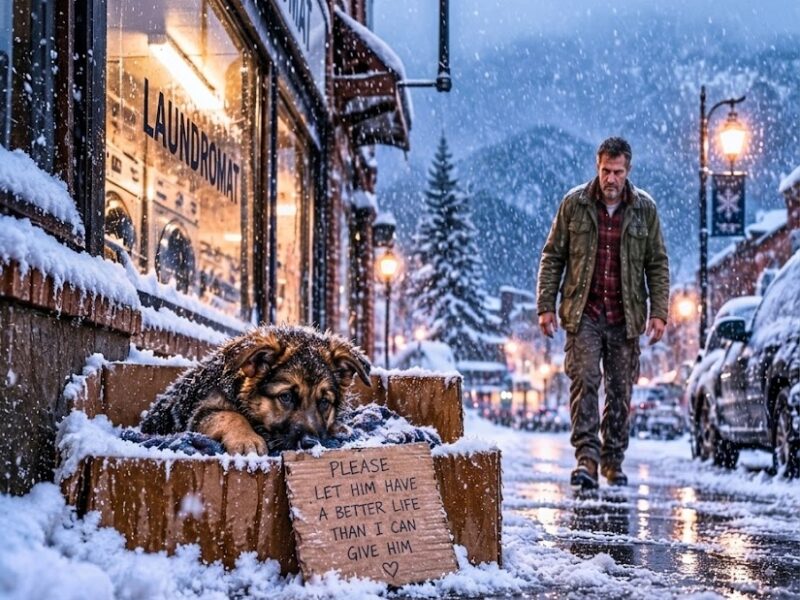
A freezing puppy lay alone in the rain—until a grieving Navy SEAL found him and changed everything.
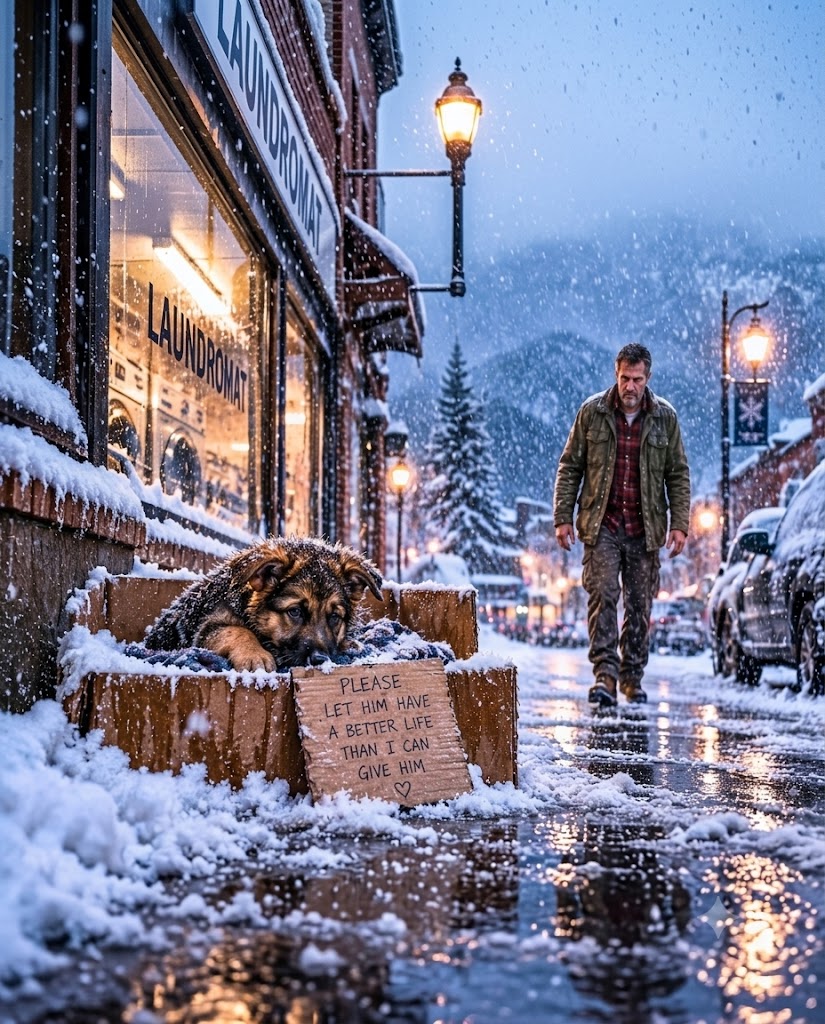
Rain came sideways across Port Angeles that night, sharp with salt from the strait and cold enough to make every streetlight look lonely.
Ethan Mercer drove past shuttered storefronts with both hands on the wheel, his old pickup rattling over puddles while wipers dragged the dark away one tired stroke at a time.
He had gone into town for coffee, canned soup, and a bundle of cedar he did not need—buying firewood gave a man a reason to speak to a clerk, pay in cash, and leave before conversation asked anything of him.
At forty-two, Ethan still carried the shape of a Navy SEAL: broad shoulders, lean strength, short dark hair graying at the temples, gray-blue eyes that made strangers lower their voices.
People in town knew his wife, Hannah, had died two years earlier on a wet curve of Highway 101.
They knew he lived alone near Morse Creek in a cedar house where the porch light burned every night.
Port Angeles was polite with grief—it waved from a distance and learned not to knock twice.
He turned down Water Street, passing the ferry terminal and an old laundromat whose sign had not glowed in years.
Under the sagging side awning, a small dark shape lay against the brick.
Ethan almost drove on.
First it looked like a soaked sweatshirt beside a rusted newspaper box, then it trembled.
He passed the corner, jaw tight—there were people for this, animal control, rescue groups, someone with a better house for mercy.
The rain hit the windshield harder.
In his mind, he saw Hannah’s yellow enamel mug on the kitchen shelf, chipped near the handle, untouched since the morning she left for Tacoma and never came home.
He made a hard turn and drove back.
The puppy did not run when Ethan approached—that was the first thing that struck him.
It did not bark either, only lifted its head and watched him with eyes too solemn for anything that young.
German Shepherd, maybe four months old, sable coat plastered flat by rain, a pale streak on the chest, paws too large for thin legs.
One ear tried to stand; the other folded sideways as if hope had gotten tired.
Ethan crouched several feet away and took off one glove—cold bit his fingers at once.
“Easy,” he said, low and quiet, using the old field voice meant for frightened men, trapped strangers, anyone close to panic.
He had not used it much in two years.
The puppy leaned forward and touched his knuckles with a wet nose—not trust, not yet, maybe only one last question.
Ethan lifted him carefully; the body stiffened, then sagged against his chest, too light and too quiet.
A faded blue cloth hung around the puppy’s neck, and tied to it was a folded note inside a damp plastic bag.
Ethan carried the dog to the truck first, wrapped him in his charcoal tactical jacket, then opened the note under the dome light.
The handwriting was uneven: *Please let him have a better life than I can give him.*
No name, no explanation, no easy villain.
Ethan read it twice and tucked it near the dog tags beneath his shirt.
The puppy sat swallowed in the jacket, shivering but watching him.
Ethan turned the heat higher.
“One night,” he said, though the dog had not asked. “Warmth, food, vet in the morning. That’s it.”
The puppy’s eyes stayed open all the way home.
—
The cedar house waited at the end of the gravel drive, one yellow porch light shining through rain.
Inside, it smelled of wood smoke, black coffee, dust, and faint lemon soap Hannah had loved—because, as she used to say, even a practical kitchen deserved one cheerful lie.
Ethan set the puppy on an old towel by the stove and got the fire going, moving with the efficient quiet of a man turning fear into tasks.
Bowl, water, soft food warmed with broth, another towel, a dry blanket.
The puppy watched everything.
When Ethan placed water down, it drank a few cautious laps.
When he set the food in a stainless bowl beneath the kitchen light, the dog rose shakily and approached.
Relief loosened Ethan’s chest.
Then the puppy did not eat—it gripped the rim gently in its teeth and dragged the bowl away, metal scraping across the floorboards.
Ethan stood still.
Inch by inch, stopping twice to breathe, the puppy pulled the full bowl into the dark space beside the woodbox.
It turned in a small circle, lay down, and put one paw near the food as if guarding treasure from a future that had already proved unkind.
Ethan lowered himself to the floor.
Rain ticked against the windows; the stove snapped once, throwing orange light across the dog’s narrow face and leaving the corner darker by contrast.
The puppy took one small mouthful, then rested its chin beside the bowl—its eyes did not close.
Ethan understood some of it—not all, but enough.
The animal was hungry; everything about him said so.
Yet hunger was not the strongest thing in the room—fear sat heavier.
Fear had turned food into evidence, a full bowl into a promise too fragile to spend.
Ethan looked toward the shelf above the counter where Hannah’s yellow mug sat behind a jar of tea she had loved and he had never touched.
He had told himself moving it would be pointless.
Now, watching a puppy protect food he could not bear to eat, he knew that was not the whole truth—some things were easier to guard than to use.
The dog gave a faint sigh.
“Scout,” Ethan said before he planned to name anything.
The upright ear twitched.
Ethan swallowed. “All right, Scout, just tonight.”
Outside, the rain washed away tire tracks; inside, a man who had forgotten how to invite life in sat with a small dog who had forgotten how to trust a full bowl, and neither moved toward the light.
—
Morning came gray over Port Angeles, the kind of coastal morning that seeped into the windows instead of rising.
Fog pressed low against the pines beyond Ethan Mercer’s kitchen, and rain had softened into mist.
Ethan had slept in the armchair with his boots on—sleep was too generous a word.
He had closed his eyes, opened them at every scrape of claws on wood, fed the stove twice, and told himself he was only keeping the room warm for the dog.
Scout lay near the stove on the towels, sable fur dry in uneven tufts.
In daylight, he looked even younger—his paws were ridiculous, his ribs too visible under the thickening coat, and his half-folded ear gave him the doubtful expression of a small judge.
Ethan stood at the counter holding coffee he had forgotten to drink.
“Still here,” he said.
Scout opened his eyes.
Ethan looked around the quiet kitchen. “That makes two of us.”
He followed common sense because the heart was not yet trustworthy—small portion, warm water, calm voice, no sudden reach.
He rinsed the food bowl, filled it with softened kibble, and placed it near the stove where light spread across the floor.
Scout rose carefully; each step seemed negotiated.
He lowered his nose, licked once, and Ethan made the mistake of breathing with hope.
Scout gripped the rim and dragged the bowl toward the shadow under the kitchen table—not as far as the woodbox this time, but far enough to make the rule clear.
The bowl belonged where danger could be watched.
He ate two bites and curled beside it, chin hovering near the edge.
Ethan waited five minutes—Scout did not eat again.
By noon, Ethan had tried three practical solutions and been defeated by all of them.
He switched to a ceramic bowl; Scout pushed it until it wedged against the wall.
He placed a spoonful of food on a saucer; Scout sniffed it, then returned to the guarded bowl as if food without a container could not be trusted.
Ethan sat nearby without looking directly at him—Scout still ate only enough to keep hunger from winning outright.
Ethan had known men who saved the last battery in a radio until the radio became useless, men who folded letters until the paper wore thin but never read them aloud.
Survival made strange churches out of ordinary objects.
Seeing that law in a puppy hurt differently—Scout was not stubborn; he was loyal to a fear that had once helped him live.
At one o’clock, Ethan called Port Angeles Animal Clinic.
The receptionist heard the words “found German Shepherd puppy” and put him on hold for less than ten seconds.
Dr. Meredith Walsh could see them before three.
Ethan almost corrected her when she said, “Bring your puppy in.”
He did not—instead, he said, “We’ll be there,” and hated how naturally the word *we* entered the room.
—
Scout tolerated the truck in daylight better than he had at night.
He sat on a folded towel in the passenger seat, clipped into a new black harness with blue trim that Ethan bought in the clinic lobby because carrying him everywhere seemed unwise and letting him loose seemed worse.
The harness looked too hopeful on him.
The clinic smelled of disinfectant, clean towels, and nervous animals.
Dr. Meredith Walsh entered the exam room without soft theatrics, which Ethan respected at once.
She was fifty-four, with brown hair threaded with silver and tied low, a calm, square face, and eyes trained to read pain in creatures who could not testify.
She glanced at Ethan, then at Scout, who stood pressed against Ethan’s boot.
“Well,” she said. “He looks like he argued with the weather and lost on points.”
Ethan looked down. “Weather reached.”
Her mouth tilted—not quite a smile, but enough.
The exam took time; Meredith did not grab.
She turned sideways, offered the back of her hand, waited for Scout to sniff, and accepted his retreat without offense.
She checked gums, temperature, heart, lungs, paws, ears, and belly—she scanned for a microchip twice.
Nothing.
“He’s underweight and tired,” she said. “A little dehydrated, but not in immediate danger. No obvious injury. Small meals several times a day.”
Ethan nodded.
Meredith read the note from the blue cloth and laid it carefully on the counter.
“I’ll file a found dog report—clinic page, rescue network, animal control. If someone is looking for him, they get a chance.”
“And if no one does?” Ethan asked.
Scout leaned against his leg, barely.
Meredith saw. “Then we talk foster placement or adoption. For now, can you keep him a few days? A kennel will not help this kind of fear.”
*No* stood ready in Ethan’s mouth—clean, reasonable, protective.
*No* would keep the house exactly as it had been: empty but predictable.
Scout shifted, the harness creasing over narrow shoulders.
Ethan heard himself say, “A few days.”
Meredith nodded as if she had expected nothing else, which irritated him because it felt too close to being known.
She printed temporary care paperwork; he signed.
She gave him recovery food, a feeding schedule, and one instruction that landed harder than expected: “Do not fight him over the bowl. Same place, same voice. Let him learn food returns.”
The phrase should have been simple.
On the drive home, Scout slept for nine minutes—Ethan knew because he counted.
—
By evening, the mist had turned back to rain.
Ethan placed the bowl near the table and sat in a chair—not over Scout, not too far away.
The yellow mug remained on the open shelf above them, dull in the low light.
Scout approached, sniffed, took one bite, then dragged the bowl away—but not to the woodbox, not to the farthest dark.
He pulled it under the table toward Ethan’s boot and froze as if surprised by his own map.
Ethan did not move.
Scout lowered himself beside the bowl, ate one bite, then another.
Then he stopped with his chin on the floor and his eyes open.
Ethan looked down at him, and victory felt too loud a word—this was smaller, a match struck deep in a cave.
The bowl had not moved away from him; it had moved closer.
Ethan sat there long after his coffee went cold, listening to rain and fragile breathing under his table.
The house was still wounded; so was the dog; so was the man.
But the distance between them had changed, and Ethan could not decide whether that was mercy or danger.
—
The third night after Scout came home, wind rolled off the strait and shook the cedar house as if the sea had climbed the hill to test the windows.
Rain snapped against the glass, softened, then struck again.
Inside, the kitchen glowed with stove light and one small lamp over the sink.
Ethan Mercer sat on the floor with his back against the lower cabinets, a plate balanced on one hand and no appetite in him.
Scout lay under the table with the food bowl tucked near one paw.
He had eaten a little more that morning, less at noon.
At dinner, he had dragged the bowl into half shadow, taken two bites, then folded around it as if the meal were not meant to be enjoyed but defended.
Ethan had followed every instruction Meredith gave him: small portions, warm food, predictable time, quiet voice, no pressure.
Hope, he was learning, could be exhausting when it had to move at the speed of fear.
“You know,” Ethan said quietly, “I have followed orders that made less sense than this.”
Scout’s eyes lifted—one ear stood, the other leaned sideways in mild disagreement.
“You pull the food closer, then act offended when I assume eating might be involved.”
Scout blinked.
Ethan almost smiled, but the smile hit something sore and fell apart.
He set the plate beside him.
The house gathered its old silence: chair legs, stove ticking, rain, the space where Hannah used to hum off-key while reading recipes she would abandon halfway through.
Ethan reached up for a towel and touched the cabinet handle instead.
He did not know why he opened the door—maybe fatigue, maybe the dog, maybe because three nights of watching Scout guard a bowl he could not use had made a certain truth too obvious.
The yellow enamel mug sat on the shelf behind a jar of tea and two clean glasses.
Ethan had moved it there after Hannah died, then never moved it again.
It was the color of late summer corn, chipped near the handle, with a dark line at the base that had never leaked despite Ethan’s distrust.
Hannah had bought it near Sequim and called it cheerful in a stubborn way—she had used it every morning for coffee and accused Ethan of making love to beans.
Memory did not arrive like thunder; it came softly, which was worse.
Hannah at the table, barefoot, hair loose, both hands around that mug.
Hannah laughing when he told her to stop buying cracked things.
Hannah saying cracked things were only dramatic if nobody loved them properly.
Ethan’s throat closed so quickly it angered him.
Scout shifted under the table; the food bowl clicked against a chair leg.
Ethan looked from the mug to the dog, and the truth stepped into the room without asking permission.
Scout was not the only one guarding something he could not bear to use.
The puppy kept food full because an empty bowl looked like tomorrow failing.
Ethan kept Hannah’s mug untouched because an empty chair looked like love ending in plain sight.
He breathed out—it almost became a laugh.
“Look at us,” he whispered.
Scout raised his head.
Ethan took the mug down.
Nothing broke; no judgment fell through the roof.
It was only ceramic—cool beneath his thumb, dust on the rim, the chip exactly where it had always been.
Also, it was not only ceramic.
He rinsed the mug gently, filled it with water because coffee felt too much like pretending, and placed it on the table in front of Hannah’s old chair.
Then he opened the lower cabinet and took out an off-white soup bowl Hannah had loved for reasons he had never understood—it had uneven glaze and a blue line around the rim.
He set it on the floor beside Scout’s food bowl.
Empty—not a trick, not a command, just there.
Scout stiffened.
Ethan sat again and brought his plate closer—bread, turkey, half an apple.
He tore off a small piece of bread, put it in the empty bowl, then took a bite himself.
Scout stared at the empty bowl first, not the bread.
His nose stretched forward; he sniffed once and pulled back.
Ethan ate another bite.
Keeping still was harder than moving—missions had taught him how to act under pressure; this required another kind of courage, the unimpressive kind where a man sits on a cold floor and lets time do work he cannot force.
Scout stood—one step, stop, another step.
His body stayed low, but he did not retreat.
He touched his own bowl with his nose, then looked toward the off-white bowl, then Ethan.
“I’m staying,” Ethan said.
The words were too large, yet once spoken, they did not feel false.
Scout lowered his head and ate one bite from his own bowl.
Ethan did not move.
Scout ate again—the second bite came sooner, the third was larger.
Ethan looked down at the apple because the room had blurred.
He had not cried at the funeral in any useful way—not when Laura, his sister, held him in the church hallway, not when the insurance papers came, not when he opened the closet and smelled Hannah’s raincoat.
His grief had become efficient instead: quiet, organized, dangerous.
But a puppy eating under his kitchen table, while a yellow mug sat full of water above them, broke something open with no respect for dignity.
The first tear felt like defeat; the second felt like breath.
Scout paused after several mouthfuls, then moved to the off-white bowl, took the piece of bread Ethan had touched, carried it back, and dropped it beside his food.
Maybe the bread smelled like him; maybe Scout was rebuilding the world one safe object at a time; maybe it meant nothing.
It did not feel like nothing.
Scout ate nearly half the meal.
When he stopped, he did not curl around the bowl like a guard—he lay with his head near Ethan’s boot and the bowl in the open.
—
Near noon the next day, Meredith called.
No one had claimed Scout.
Then she told him about Mark and Allison Reeves, a careful couple with a fenced yard, Shepherd experience, and a twenty-two-year-old daughter named Paige who volunteered with frightened dogs.
“They would like to meet him,” Meredith said.
Ethan looked at Scout asleep by the stove; the kitchen seemed to lose warmth.
“How soon?” he asked.
Temporary care had once seemed clean—now it felt like a door left open in winter.
—
The morning of the meeting broke bright and cold, which Ethan Mercer considered poor manners from the weather.
After days of rain, Port Angeles looked scrubbed clean.
Ethan drove to the clinic with Scout buckled on the passenger seat in his black harness with blue trim.
The puppy had eaten more at breakfast than he had the first morning—not enough for triumph, but progress.
His sable coat had softened around the neck and shoulders, the black saddle clear now, the pale streak on his chest visible when he lifted his head.
One ear stood; the other remained unconvinced by optimism.
Ethan told himself the meeting was good—good family, good yard, good chance.
Meredith met them in the lobby wearing a navy sweater under her coat and the expression of a woman prepared to notice everything without announcing it.
“He looks brighter,” she said.
“He ate some.”
“Some counts.”
“It does.”
She studied Ethan. “You can still say no to the meeting.”
“I said I would bring him.”
“That is not the same as wanting it.”
Ethan gave her a look; Meredith accepted it and led them to a larger exam room with rubber flooring, a window facing the parking lot, and several toys near the wall.
Ethan positioned himself by the door before he thought about it—old habit: know the exits, know the room.
Nothing was going to go wrong; that was the problem.
The Reeves family arrived five minutes early.
Mark came in first—mid-forties, tall, broad, with sandy hair cut short and a trimmed beard; his canvas jacket carried the faint clean smell of cedar sawdust.
Allison followed, a little younger, auburn hair tied in a low braid, eyes warm but steady.
Paige stepped in last—she was twenty-two, light brown hair in two uneven braids, a college sweatshirt under a gray coat, and the careful seriousness of someone who had been told an animal was frightened and believed that mattered.
She held a soft toy shaped like a little harbor tugboat.
She did not bend over Scout; she did not squeal.
She looked at Meredith and asked, “Should I sit here?”
Meredith nodded.
Paige sat cross-legged several feet away and placed the toy between them.
“Hi, Scout,” she said softly. “No rush.”
Ethan immediately began looking for flaws.
Mark’s fenced yard could have a loose board.
Allison’s gentleness might become worry if Scout refused meals for weeks.
Paige was careful now, but young adults had friends, music, sudden laughter, open doors—Scout needed quiet.
Then Scout stepped away from Ethan’s boot.
He moved low but curious, nose working.
Paige kept her hands folded in her lap.
Scout sniffed the toy, backed up, then returned.
Paige smiled with her whole face and somehow did not move—that made Ethan resent her; good people were harder to refuse than careless ones.
Mark asked about food, and Ethan answered too precisely: small portions warmed, same place, no pressure.
Allison asked what sounds startled him; Ethan named trucks, dropped pans, the clinic scale, and sometimes rain against metal.
Paige listened as if he were giving instructions for someone she might protect.
“Does he have something soft that is his?” she asked.
Ethan almost said yes—the towel by the stove, the folded throw, the corner near his boot.
None were Scout’s officially; all had become too personal to explain.
“Not really,” he said.
Paige nodded and touched the tugboat with two fingers. “Maybe he can keep this either way.”
Meredith suggested a short walk down the clinic hallway.
Ethan’s first answer was no—clean and instant—but he heard himself say, “Keep the leash loose.”
Mark took the leash low and relaxed.
Scout resisted for a heartbeat, looking back at Ethan.
Then Allison clicked her tongue softly—not a command, only an invitation.
Scout followed.
Paige walked beside her mother with her hands in her pockets so she would not reach.
Meredith waited twelve seconds; Ethan counted them.
“You are very quiet,” she said.
“I’m observing.”
“You are building a legal case against decent people in your head.”
“You do not know that.”
“I know your face.”
Ethan looked toward the hallway; he could hear Paige murmuring about the tugboat.
“He’s not ordinary,” he said.
“No,” Meredith agreed. “But needing patience does not make him impossible.”
“I didn’t say impossible.”
“No, you are working toward irreplaceable.”
That landed too close; Ethan’s jaw tightened.
“I’m making sure he is not abandoned twice.”
Meredith’s expression sharpened into recognition. “Are you sure that is all?”
Scout returned with the toy tugboat in his mouth.
He came straight to Ethan, placed it beside his boot, and sat.
Paige stopped several feet away. “He keeps checking where you are,” she said.
Ethan stared at the dog.
Paige added gently, “Maybe he thinks you’re the safe place.”
No one spoke—the sentence had come from a young woman who did not know she had just named the thing every adult in the room had been circling.
After the meeting, Allison did not ask for an answer.
“We would like him,” she said. “But moving him again should be done carefully. If it is done, you should think too.”
Paige crouched only when Scout stepped toward her.
“If you come with us, I’ll be careful,” she whispered.
Then she looked at Ethan. “And if you stay with him, I think that can be good, too.”
The Reeves family left without pressure, carrying disappointment like people who refuse to make it heavier for anyone else.
Ethan stood in the parking lot afterward with Scout at his side and sunlight flashing off windshields.
Meredith came to the clinic door. “You do not have to decide this second.”
“I know.”
“You do have to decide honestly.”
Ethan looked down—Scout chewed one soft corner of the tugboat, the gift Paige had left behind.
Honestly followed him home.
—
Near dusk, Wade Russell appeared at the fence with a covered pot and an expression that denied concern before being accused of it.
“Made too much stew,” Wade called.
Ethan opened the back door. “You live alone, and yet my ambition exceeds my appetite.”
Scout wagged once.
Wade glanced at the tugboat. “Meeting went badly?”
“It went well.”
Wade winced. “Ah, the cruelest kind.”
Then his humor thinned. “Do not give him away because wanting him scares you.”
Scout carried the tugboat to Ethan’s boot and lay down beside it.
Ethan looked at the yellow mug on the table—for the first time, it did not only hurt; it asked a question.
—
Night settled early over Morse Creek, bringing fog up from the low ground and pressing it against Ethan Mercer’s windows.
The house smelled of cedar smoke, stew, and wet wool from Wade Russell’s coat hanging on a chair no one had invited it to occupy.
Wade had arrived with a covered pot and a story so thin it would not have survived daylight—he had made too much; he had happened to walk by.
At seventy-four, Wade was narrow, white-haired, weather-lined, and armed with jokes because telling the truth directly seemed to embarrass him.
Scout lay near Ethan’s boot with the toy tugboat between his paws, watching Wade with the serious suspicion of a puppy who had begun to believe the world might contain useful old men.
“So,” Wade said, stirring his own stew as if gifts required inspection. “Good family wants the dog.”
Ethan stood by the sink. “Yes. Good yard, fenced, patient people.”
“Seems to be cruel fate.”
“Easier if they collected swords and shouted at curtains.”
Ethan looked at him; Wade lifted his spoon.
“Decency is inconvenient when a man needs an excuse.”
Scout chewed the tugboat’s rope handle.
Ethan wanted to tell Wade to mind his own business, but Wade had not wandered into this conversation by accident.
Wade’s humor softened. “After Ruth died, I kept her gardening gloves by the back door for three years. Didn’t use them. Didn’t put them away. Every spring I looked at them like they might tell me what to plant. One day I put them on—too small, of course. Woman had little hands and the will of a courthouse. I planted beans badly. They grew anyway.”
Ethan looked at the yellow mug on the table, filled with water he had not touched.
Wade followed his gaze but did not ask.
“Keeping love locked on a shelf does not preserve it,” Wade said. “Mostly it leaves your hands empty.”
Scout rose, carried the tugboat to Ethan’s boot, and dropped it there as if adding testimony long after Wade shuffled home.
The words stayed in the kitchen.
—
The next morning, before town had fully woken, Ethan called Meredith.
She answered with the clipped alertness of a woman used to emergencies.
“Is Scout all right?”
“Yes.”
A pause. “Then what happened?”
Ethan looked down—Scout sat on the rug, the tugboat under one paw, ears uneven but attentive.
“I want to adopt him,” Ethan said—plain words, no speech, no polished explanation.
Meredith was quiet for a moment. “Good. I’ll start the paperwork.”
Ethan frowned. “That’s it?”
“Were you expecting a choir?”
“No.”
“Excellent. We are short on choirs before breakfast.”
He almost laughed.
Later that morning, Meredith called the Reeves family.
Ethan expected disappointment—instead, Allison sent word that they were glad Scout had found the person he trusted.
Mark added that their yard would always be available if Scout needed another safe place.
Paige sent a photo of a note: *Tell Scout the tugboat is his.*
Ethan read it twice, then looked at Scout chewing the toy with solemn dedication.
“You have people,” he said quietly.
Scout glanced up.
Ethan realized the sentence had widened enough to include him, too.
—
At noon, he signed the adoption papers.
Meredith slid them across the counter without ceremony.
He signed *Ethan Mercer, owner*, and the word looked too large.
On the drive home, Ethan did not say *one night*; he did not say *temporary*.
When the cedar house appeared through the pines, he looked at Scout and said, “Home.”
The puppy’s ear flicked, and Ethan did not take the word back.
—
The house changed by inches.
A leash appeared on the hook beside the back door.
Puppy food claimed space in the pantry.
The off-white bowl stayed near Scout’s food bowl.
The yellow mug moved to the open shelf above the counter—not hidden, not worshiped, simply present.
Ethan bought a small green plant from Caroline Brooks at the bakery because she said it was hard to kill.
“That sounds like pressure,” he told her.
Caroline laughed as if he had made a real joke.
Scout made Ethan visible in town almost immediately.
People who had let him pass in silence now asked the dog’s name.
Caroline kept biscuits behind the counter; Scout accepted every compliment with grave humility.
Wade visited often, usually with excuses—a strong breeze could have torn apart something; he needed a screwdriver; he had extra chowder; his cat, Maple, had rejected a blanket, and perhaps Scout had lower standards.
Maple herself was a broad gray cat with the authority of a retired judge.
She first saw Scout from Wade’s windowsill, hissed once, and turned away.
Scout backed into Ethan’s shin.
Wade nodded. “High praise. She usually adds violence.”
Ethan laughed before he could stop it—short, rough, real.
Wade pointed. “Man thawing.”
“Don’t start.”
“Too late.”
—
Three afternoons later, Julia Price appeared at Wade’s house with a warning notice and the patient fury of someone tired of saving stubborn people from simple instructions.
She was thirty-nine, brown hair tied low, red rescue jacket zipped to her throat, radio clipped to one shoulder.
“Wade, if you go near the old rescue pier again, I will staple the next closure notice to your coat while you are wearing it.”
Wade lifted his coffee. “Good to see civic warmth alive.”
Julia turned serious. “The old pier near Ediz Hook is closed—rotten boards, winter surge, unstable pilings, water cold enough to steal strength fast.”
Wade waved a hand. “I walked near it.”
“That is the kind of sentence people use before paperwork.”
Before leaving, Julia looked at Ethan. “We run coastal safety sessions. Meredith mentioned your background. If you ever want to help demonstrate procedure, people would listen.”
Ethan’s answer came automatically. “I’m not interested.”
Julia accepted it without offense. “Offer stands.”
—
The next evening, wind rose hard off the strait.
Ethan fed Scout in the kitchen; the puppy ate half without dragging the bowl far.
Afterward, Scout carried the tugboat to the back door and set it down.
Across the dark yard, Wade’s porch light burned weakly.
The fishing-lure wind chime, which usually rang in anything short of a sealed room, hung silent.
Scout made a low sound, too focused to ignore.
Ethan dried his hands slowly; the puppy did not turn.
Ethan reached for his jacket, feeling readiness move through him.
He did not know what was wrong, only that Scout had learned to trust his own warning, and Ethan was learning to listen.
—
Ethan Mercer did not run at first—years of training had taught him that panic loved speed and survival preferred order.
When Scout stood at the back door with the tugboat at his feet and a warning sound pulled tight in his throat, Ethan slowed his breathing.
He pulled on his charcoal tactical jacket, clipped the leash to Scout’s blue-trimmed harness, checked his phone, and looked toward Wade Russell’s house.
The porch light glowed through mist; the pines leaned in the wind, but Wade’s chime made from bent spoons, fishing lures, and colored glass hung mute.
“All right,” Ethan said. “We check.”
The yard between the houses was slick with rain and fallen needles.
Scout moved with purpose, nose low, stopping once near the fence, then pulling toward Wade’s porch.
Ethan knocked—no answer.
He knocked harder.
Inside, nothing moved except a lamp glow beyond the kitchen window.
Ethan tried the handle; it opened.
He disliked that immediately.
“Wade.”
The kitchen was warm but wrong—a mug sat on the table, coffee gone dull on top, reading glasses lay beside a folded newspaper, one glove rested near the sink.
Only one.
Maple sat on a chair, tail wrapped around her feet, staring toward the back door with grave accusation.
Wade’s heavy coat was gone from the peg; so was his red scarf.
The back door stood unlatched.
Muddy prints led down the steps toward the trail to the old rescue pier.
Ethan felt the past rise behind him—another winter night, another road where he had arrived too late to change the ending.
Hannah’s accident had happened on a curve that looked harmless in daylight.
For months, people had told him there was nothing more anyone could have done.
*Nothing more.*
He hated those words.
Scout barked once, hard enough to bring him back.
Ethan called Julia.
“It’s Ethan Mercer. Wade is not in his house. Back door open. Tracks toward the old pier.”
Scout picked it up, and her voice sharpened. “Do not go onto the pier. Follow from shoreside if you have to. Keep the dog leashed. Keep me on speaker. I am sending two volunteers.”
“Understood.”
Scout led into the trees.
The path smelled of wet cedar, seaweed, and old leaves.
Ethan kept the leash short enough to control but loose enough to read Scout’s body.
The dog moved as if following a thread no human eye could see.
Halfway down the trail, Ethan found the red scarf snagged on a salmonberry branch.
“Julia,” he said into the phone. “Found his scarf. Trail continues toward the closed pier.”
“ETA five minutes. Shore approach only.”
“I heard you.”
“Hear me twice. Shore approach only.”
The trees opened near the water.
The old rescue pier stood crooked against the gray-black strait—boards slick, pilings scarred by storms.
A low shed leaned near the landward end; orange closure rope sagged between two posts.
The tide moved beneath the pier with a heavy sucking sound.
Scout pulled harder, then barked.
Ethan shortened the leash.
From beyond the shed came a dull knock, then another.
Ethan turned his head. “Wade.”
The answer was thin. “Took you long enough.”
Relief hit first; anger rode close behind it.
Wade lay half under the collapsed side platform beside the shed, one leg pinned between broken boards.
He had not fallen into open water, but surge slapped close enough to spray his coat.
Rain shone on his pale face; the edge beyond him dropped into cold churning water.
Scout lunged.
Ethan caught the harness and backed to a young cedar.
“No.”
Scout fought the leash, furious with caution.
Ethan looped it around the trunk so the harness would not twist.
“You stay. You did your part.”
Scout barked at Wade with all the authority of a small officer denied command.
Wade’s eyes opened wider. “Little tyrant. Save your breath. I prefer to spend it poorly.”
Ethan assessed the scene—rotten boards, cold exposure, trapped leg, no major visible bleeding.
The danger was not glory; the danger was hurry.
He kicked open the shed door and found two usable planks, an old rope coil, and a cracked life ring.
Not ideal, but enough to buy time.
Julia’s voice came from the phone. “Status.”
“Found him. Platform collapse. Leg trapped. Conscious, cold. I am staying shoreside and setting planks to spread weight.”
“Good. No solo extraction.”
“Not planning one.”
Scout barked as if filing an objection.
Ethan placed one plank across firmer ground and used another only to reach Wade’s upper body without putting weight on the failed platform.
He looped rope around a solid piling and slid the free end toward Wade.
“Can you get this under your arms?”
Wade tried; his hand shook too badly.
Ethan saw the tremor and felt helplessness open like a pit.
Not now—this needed patience; this needed Wade alive.
Scout went silent.
Ethan lowered onto one knee, reached, and guided the rope beneath Wade’s shoulders.
The board groaned.
Scout went still; Ethan froze.
The wood held.
Boots crashed through brush behind him—Julia arrived with Eli carrying a medical bag and Tessa with rope across her chest.
She took in the setup in one sweep. “Good work. Nobody moves fast.”
They anchored a second rope to a cedar, secured Wade’s upper body, stabilized the broken boards, and freed his trapped leg inch by inch.
Wade swore once under his breath, then apologized to no one, which told Ethan the pain was worse than he wanted to admit.
Whenever Wade’s eyes drifted shut, Scout barked.
“Yes, yes,” Wade muttered. “I remain alive under protest.”
At last, they pulled him onto solid ground and wrapped him in a thermal blanket.
Ethan untied Scout only when Julia nodded.
The puppy rushed to Wade’s side, still on leash, and sniffed his gloved hand.
Wade moved his fingers and touched Scout’s head. “Inconvenient little miracle,” he whispered.
Scout licked the edge of his glove.
Julia looked at Ethan, rain shining on her red jacket. “You called early. Scout noticed early. And you listened.”
Ethan looked at the dog pressed against his leg, shaking now that courage had no task to hide inside.
Julia’s voice softened. “Sometimes that is the part people miss.”
The transport team carried Wade toward the trail.
He lifted his head. “Dog biscuits in my right coat pocket. For the wolf.”
For the first time that night, something like laughter moved through the rain.
—
By the time Ethan Mercer and Scout returned home, the storm had thinned to a restless mist, and the strait lay hidden beyond the trees like something large breathing in the dark.
Ethan stopped at Wade Russell’s house first because the old man, even wrapped in a rescue blanket and being loaded for transport, had ordered him to check on Maple.
The gray cat sat in the middle of the kitchen table, a round monument to disappointment.
She stared at Ethan as if he had personally allowed civilization to decline.
Scout stood behind his leg and wisely did not approach.
Ethan found the dog biscuits exactly where Wade had promised, wrapped in wax paper in the right pocket of the heavy coat.
He gave Scout one.
After a brief negotiation with his conscience and Maple’s stare, he found plain turkey in Wade’s refrigerator and placed it on a saucer.
Maple accepted it without gratitude, which seemed to be the household style.
At home, warmth met them at the door.
The kitchen lamp glowed over the table; the yellow mug stood on the shelf beside the small green plant that had not died yet.
The off-white bowl sat near Scout’s food bowl like a quiet witness.
Ethan unclipped the leash.
Scout walked straight to his food and stopped.
Ethan held still.
The puppy sniffed, looked once toward the back door as if confirming the night would stay outside, then lowered his head.
He ate.
No dragging into shadow, no guarding, no tense paws after the first bite.
He stood under the kitchen light and ate nearly the whole meal.
Ethan sat down slowly because his knees seemed to have remembered fear all at once.
For a long time, Ethan had believed being needed was another word for danger.
Need meant attachment; attachment meant loss; loss meant another call, another road, another place where nothing more could be done.
Tonight need had sounded like a bark at the door.
It had led him through rain; it had made him call Julia before pride could make him foolish; it had kept Wade awake beside cold water.
Now it stood in his kitchen with crumbs on its nose, eating as if tomorrow had made a promise worth considering.
Scout stepped back from the bowl and looked surprised to find it empty.
He did not panic; he did not nose it toward the shadow under the table.
He came to Ethan’s chair, pressed his head against the old boot, and sighed.
Ethan bent and laid one hand along the dog’s narrow back.
—
Wade came home on the fourth afternoon looking offended by survival.
Julia drove him in her rescue truck, and Ethan stood at the bottom of the porch steps with Scout pressed against his left leg.
Wade wore a gray wool coat, one leg braced, mouth set in a line that warned the world not to start clapping.
“I can walk,” he said when Julia came around.
“You can complain,” Julia said. “Different skill.”
Ethan brought the crutch without comment—he had learned with Wade that help needed to stand nearby without waving its arms.
Scout saw the old man and wagged so hard his entire back half lost discipline.
Wade looked away quickly—tenderness embarrassed him more than pain.
“Well,” he said, “the noisy wolf.”
Scout barked once.
“Do not start. I am injured and therefore above criticism.”
Inside Wade’s house, Maple occupied the kitchen table as if she had inherited it legally.
Wade stopped in the doorway. “You let her on the table?”
Ethan looked at the cat. “I did not let her do anything. She seized it.”
Wade sighed. “First the table, then foreign policy.”
Scout sniffed a chair leg and chose peace.
—
Over the next week, Ethan became a regular presence at Wade’s house.
Although Wade never asked directly, he mentioned the porch rail had suspicious ambitions—Ethan fixed it.
He muttered that the back step wanted to murder someone—Ethan tightened it.
He complained the wood box had migrated to a foolish place—Ethan moved it.
Wade criticized every repair with the care of a man translating gratitude into sarcasm.
Scout supervised from the porch, harness on, tugboat nearby.
Whenever Wade leaned too far on the crutch, Scout whined.
Whenever Ethan worked near the wet edge of the steps, Scout barked once.
“You created a tyrant,” Wade said.
Ethan drove a screw into the rail. “He learned from Maple.”
In the window, Maple blinked slowly, accepting the promotion.
—
The errands should have felt like another burden—another person to worry over, another opening in the perimeter.
Instead, they gave Ethan’s days a shape that did not resemble punishment.
Morning became food for Scout, coffee in a plain mug, a check on the plant, a walk by the creek.
Afternoon might mean Wade’s porch or town, where Caroline always had a biscuit ready and pretended not to watch Ethan speak to people.
Scout improved slowly and honestly.
Some days he ate where the bowl was placed; some days he nudged it two inches toward Ethan’s chair before beginning.
Ethan stopped demanding miracles from healing.
One morning the green plant beside Hannah’s mug produced a new leaf—tiny, bright, completely unreasonable in its ability to hold his attention.
Ethan watered it with the seriousness of maintaining sensitive equipment.
Scout sat nearby, watching as if plant care might become part of his duties.
Afterward, Ethan stood with his phone in hand longer than necessary.
Laura Mercer’s name glowed on the screen.
His younger sister lived in Tacoma with her nineteen-year-old son, Connor, and a patience Ethan had used badly for years.
He had ignored more of her calls than he could bear to count.
He pressed dial before courage could turn administrative.
Laura answered on the fourth ring. “Ethan.”
Her voice was careful, as if one wrong note might make him vanish again.
He had planned an ordinary opening—weather, work, the kind of bridge that did not admit the river was deep.
Instead, he said, “I’m still here.”
Laura made a sound that was almost a laugh and almost a sob.
“I know,” she whispered. “I was hoping you knew, too.”
Scout came over and placed his head on Ethan’s knee.
The call lasted sixteen minutes—it fixed nothing completely; it changed everything enough.
When it ended, Ethan sat at the kitchen table with Scout half on his boot and the yellow mug shining quietly from the shelf.
Outside, Wade’s repaired wind chime rang once in the damp wind.
Ethan listened—he did not feel healed; he felt reachable.
—
Julia Price came by Ethan Mercer’s house two days later carrying a paper cup of coffee, a folded flyer, and the expression of someone who had already decided politeness would not be her main tool.
The morning was cold but changing—along the driveway, rain had chewed channels through the last dirty patches of snow, and the air held that faint looseness that sometimes came before a coastal thaw.
Scout spotted Julia from the porch and wagged once.
He remembered people by scent, by posture, by whether they respected danger.
Julia had passed his standards at the old pier.
She crouched without reaching, letting him inspect her glove.
“Morning, hero,” she said. “No dramatic rescues today.”
Scout sniffed the paper cup and decided coffee was not his calling.
Ethan opened the door wider. “Is this official?”
“The coffee or the ambush? Both. The coffee is from Caroline. The ambush is mine.”
Inside, Julia placed the flyer on Ethan’s kitchen table: *Port Angeles Coastal Safety Session—Cold Water Awareness, Throw Rope Basics, Safe Response Before Rescue Arrives.*
At the bottom in pencil, she had written *Ethan Mercer under demonstration support.*
Pencil, not ink—a dignified escape route.
Ethan noticed; Julia knew he noticed.
“I already said no.”
“You did. People grow.”
“Not usually.”
“In response to flyers.”
Scout took the corner of the paper gently in his teeth and walked three steps before Ethan caught it.
“Drop.”
Scout looked up, eyes bright, flyer damp at the edge.
Julia nodded solemnly. “He votes yes.”
Ethan removed the paper from the dog’s mouth. “He also tried to eat a receipt last week.”
“Democracy is complicated.”
Ethan leaned against the counter—the yellow mug sat on the shelf beside the green plant, no longer hidden, not yet ordinary.
“I am not giving speeches.”
“Good,” Julia said. “Speeches freeze before they reach people’s brains. Show them how to throw a rope bag. Tell them not to run onto rotten boards or into cold water because panic dressed as bravery is still panic. Stand there looking serious. You already do that for free.”
Ethan almost smiled; Julia saw it and had the mercy not to point.
“I am asking because people listened after Wade—not because you were a SEAL. Because you did not make it about being one.”
That stayed with him.
Ethan had believed his past offered only two options now: the parts that haunted him and the parts other people misunderstood.
Julia was offering a third skill without performance—protection without turning into a monument.
“One session,” Ethan said.
Julia picked up her coffee. “That is how many I asked for.”
—
The following Saturday, half of Port Angeles seemed to gather near the roped-off shoreline west of Ediz Hook.
Half, in Ethan’s private estimate, meant twenty-seven people, three dogs, and Caroline Brooks with a basket of educational muffins.
Wade Russell sat in a folding chair positioned far from the pier, and Maple was absent due to what Wade described as political censorship.
The sky had cleared to a hard blue; wind came off the strait with teeth in it, carrying salt and the cold mineral smell of wet rocks.
The old pier stood behind reinforced barriers, looking harmless in sunlight.
That was why Julia began by saying, “Never trust a beautiful place to be safe just because it wants its picture taken.”
Ethan liked the line; he did not say so.
He demonstrated from shore—how to brace one foot behind the other, how to throw a rope bag past the person and not at their face, how to lower the body instead of sprinting toward unstable boards, how to call rescue first and then act within reach, line, and sight.
His words were plain, clipped, useful.
He did not mention combat; he did not make himself the story.
Scout sat beside him in the black harness with blue trim, occasionally yawning with professorial boredom.
When a young man stepped past the marked line for a better view, Scout barked once.
The young man stepped back.
Wade called from his chair, “Dog has better judgment than half the county.”
Julia said, “That is the lesson.”
Caroline handed Wade a muffin.
“Rewarding me for wisdom?” he asked.
“For staying seated.”
“Cruel but fair.”
The Reeves family came too—Mark stood near the back, Allison beside him, and Paige holding something wrapped in tissue paper.
She waited until the session ended before approaching.
Scout saw her and wagged, then looked at Ethan as if checking the room’s rules.
Paige smiled. “For him, if it is okay.”
She handed Ethan a small stuffed lighthouse with a red top—not directly to Scout.
Permission first.
Ethan took it. “It is okay.”
Scout accepted the lighthouse by its base and carried it to Ethan’s boot, placing it beside the tugboat.
Paige’s face softened. “He looks stronger.”
“He is.”
Allison studied Ethan. “So do you.”
He had no answer ready—the old Ethan might have stepped away; this one said, “Some days.”
Allison nodded as if some days were plenty.
—
After the session, people drifted toward town.
Caroline loaded her empty basket; Julia packed gear; Paige waved to Scout from the parking area, and Scout—dignified owner of a tugboat and lighthouse—wagged once.
Ethan walked Scout along the shoreline path before returning to the truck.
Sunlight struck the water in pieces.
Port Angeles had not become a different town; Ethan had become visible enough to notice it.
Scout tugged gently toward Water Street.
Ethan let him lead.
They passed the bakery, the bait shop, the hardware store, and stopped in front of the old laundromat.
The awning still sagged; the rusted newspaper box still leaned near the wall, but the corner where Ethan had found Scout no longer looked like the mouth of an underworld.
Rain had washed the brick clean; someone had swept the sidewalk.
Scout sniffed the place carefully.
Ethan remembered the night with painful clarity—the rain, the note, the way Scout’s body had felt too light in his arms.
He remembered saying *one night* as if time obeyed frightened men.
Scout finished sniffing, turned, and looked up.
No human wisdom hid in the dog’s face—just trust, simpler and more devastating.
Ethan crouched and scratched behind the ear that still folded when Scout was tired.
“Yeah,” he said softly. “Let’s go home.”
—
At that moment, Caroline stepped from the bakery side door, holding an envelope addressed to Port Angeles Animal Clinic.
“Ethan,” she said, suddenly unsure. “Meredith asked me to give this to you if I saw you. It is about Scout.”
The envelope felt too light for the weight it put into Ethan Mercer’s hand.
Caroline Brooks stood beneath the laundromat awning with flour on one sleeve and concern softening her quick face.
Scout sat against Ethan’s boot, the stuffed lighthouse in his mouth, watching the paper as if it might speak.
The front was addressed to Port Angeles Animal Clinic in careful block letters—no return address.
Meredith had written Ethan’s name in the corner and asked Caroline to pass it along if she saw him before Monday.
“She said it is not urgent in the emergency sense,” Caroline said, “which is a terrible phrase.”
Ethan looked at the handwriting—the old note from Scout’s blue cloth returned at once.
*Please let him have a better life than I can give him.*
His fingers tightened.
“Thank you.”
Caroline did not ask to stay; she only touched Scout’s head when he leaned close, then returned to the bakery and left Ethan where the story had begun.
—
He drove home before opening it.
The afternoon had gone silver by the time he entered the kitchen.
Scout carried the lighthouse to the rug and settled with the tugboat beside it—two small harbor treasures guarded with less fear now and more ceremony.
Ethan placed the envelope on the table, washed his hands for no reason except delay, then opened it.
Inside was one sheet of paper and a photograph printed at a drugstore kiosk.
The photo showed Scout, younger and rounder, sitting on a porch beside a pair of men’s work boots.
No face appeared.
On the back, someone had written his old name—*Buddy*—and beneath it, *I am sorry.*
The letter was short.
The writer did not give a name.
He said the puppy had belonged first to someone who loved him, then to someone losing housing, money, and the ability to keep promises.
He did not dress abandonment as heroism.
He wrote that he left the puppy under the laundromat awning because it was lit, sheltered, and near a street where people still passed in bad weather.
He knew that was not enough; he knew it might never be enough.
He had seen the clinic post and recognized the dog.
He only wanted whoever had him now to know the puppy had once been held, once been named, and that the person who failed him prayed every day he was warm.
Ethan read it twice.
Anger came—it deserved to.
A puppy had been left in the cold, and no sorrow afterward could rewrite the night.
Then something else came with it—less welcome because it demanded more room.
Ethan did not know the whole story.
He knew people failed what they loved; he knew people were crushed by circumstances they could not explain from the outside without sounding guilty either way.
Scout rose and touched his nose to Ethan’s knee.
Ethan placed one hand on the dog’s head.
“Your name is Scout now,” he said.
Scout blinked, untroubled by paperwork or human attempts to make love tidy.
Ethan folded the letter and placed it beneath the old note in a kitchen drawer—not hidden, not displayed.
“Some things need a place.”
—
Meredith called that evening. “Do you want to respond?” she asked. “I do not know who he is.”
“I can pass a message if one more letter comes, or I can do nothing.”
Ethan looked at Scout, chewing the lighthouse with careful concentration.
“Tell him Scout is safe. Tell him he has a home and tell him I hope he finds help before he has to leave anything else behind.”
Meredith was quiet for a moment. “That is kinder than many would manage.”
Ethan looked at the drawer. “It is not absolution.”
“No,” she said. “It is mercy with its eyes open.”
The phrase stayed after they hung up.
—
The next morning, Laura called.
Ethan almost let it go to voicemail because progress did not cure reflex.
He answered on the last ring.
“Hey,” she said, surprised enough to make the word shine.
Her son Connor was home from community college for the weekend; they were making dinner Sunday—nothing formal, no pressure.
“Scout could come.”
“A dog invitation,” Ethan said. “Honestly, he may be the safer guest.”
In the background, a young man’s voice called, “Tell Uncle Ethan I said hi.”
The title hit harder than expected—*Uncle.*
He had been absent long enough for the word to feel borrowed.
Laura waited without filling the silence.
“I’ll try,” he said.
“That counts,” she answered.
—
Sunday brought steady rain and a road shining black all the way to Tacoma.
Ethan drove with Scout secured on the passenger seat, tugboat wedged beside the towel, lighthouse tucked in the door pocket because Scout had strong opinions about travel inventory.
Laura’s porch light was on, though it was not yet dark.
She opened the door before he knocked.
She was thirty-seven, five years younger than Ethan, with the same gray-blue eyes and a tired kindness around them that made him feel both loved and accused.
She hugged him; he stood stiff for one second, then hugged back—not well enough.
Connor appeared behind her—nineteen, tall and narrow with curly brown hair and a flannel shirt buttoned wrong at the cuff.
He looked at Ethan like someone meeting a childhood story that had become a man in the doorway.
Then Scout stepped in, and Connor relaxed.
“Hey, buddy,” he said, crouching but not reaching. “I made you a towel spot. Is that weird?”
Ethan looked at the folded towel near the hall. “Not to him.”
Dinner was awkward in the honest way of people rebuilding a bridge with their hands still shaking.
Laura made roast chicken; Connor talked about a marine biology class, then apologized for talking too much.
Ethan said, “Don’t,” and meant it.
Hannah’s name came up when Laura mentioned a recipe she had stolen from her.
Ethan put one hand on the table edge; Scout, under his chair, placed his chin on Ethan’s boot.
Laura saw but did not stop speaking.
“She burned the first version,” Laura said softly, then insisted blackened carrots were a coastal tradition.
Ethan breathed once.
“He said the smoke alarm was too sensitive,” Connor added carefully.
Ethan smiled too. It hurt; it did not kill him.
—
When he drove home, a message waited from Julia about a storm system coming hard off the Pacific by midweek—possible outages, downed branches, coastal flooding, check supplies, check neighbors.
Ethan looked toward Wade’s dark house and the repaired wind chime turning in the wind.
—
The storm arrived Wednesday afternoon with the patience of something that knew it owned the coast.
By noon, the sky over Port Angeles had lowered into one bruised sheet, and by three, the wind came hard enough to bend the cedars along Ethan Mercer’s driveway.
Rain struck the house in waves.
The power flickered once while Ethan stacked kindling by the stove.
Scout lifted his head from the rug.
“I saw it,” Ethan said.
The dog looked toward the window, unimpressed by electrical weakness.
At four, Ethan checked on Wade by phone.
“I am not helpless,” Wade said instead of hello.
“Good. Then you can answer a question.”
“I dislike this new leadership style.”
“Do you have flashlights where you can reach them?”
A pause. “Define reach.”
Ethan closed his eyes. “I’m coming over.”
“I did not invite you.”
“You rarely do anything useful before I arrive.”
Scout wore his harness under a rain jacket Meredith had recommended and Scout tolerated with visible shame.
The walk to Wade’s house soaked Ethan’s pants from knee to boot.
Wade opened the door before Ethan knocked, braced on his crutch, gray sweater buttoned correctly for once.
“The dog looks ridiculous.”
Scout shook rain onto Wade’s floor.
“He heard you,” Ethan said.
Maple sat on the back of the couch, round and dry, her expression making it clear that Scout’s wardrobe lowered property values.
Ethan placed two lanterns on Wade’s counter, moved a flashlight within reach, checked the stove, and carried extra wood from the porch.
Wade complained through all of it—beneath the complaints was relief; Ethan recognized the translation now.
—
On the way back, Julia’s truck rolled into the driveway, hazard lights blinking red through rain.
She lowered the window. “Low roads are flooding near the marina. Caroline lost power at the bakery and has two older customers waiting for rides. Wade settled enough to insult outerwear. Stable then.”
Her radio murmured.
She looked at Ethan’s house. “You have high ground, wood heat, room.”
He followed her gaze—the cedar house at the end of the drive, once arranged around absence, suddenly looked like what it had always physically been: sturdy, warm, available.
The thought made something inside him step backward.
Scout leaned against his leg.
Ethan heard himself say, “Bring whoever needs it.”
—
By six, the house had guests.
Caroline arrived first in Julia’s truck with a tin of muffins saved from the bakery and two older customers who lived near the water.
Helen Carter was seventy-eight, small, sharp-eyed, wearing a purple raincoat and holding a purse as if it contained municipal authority.
Frank Odell was eighty-one, a retired mail carrier with a white mustache and an oxygen machine battery Julia insisted was fully charged.
Wade came over next despite declaring that evacuation from a non-flooded house was tyranny.
Julia brought him anyway.
“She tried to carry Maple in a laundry basket,” Julia said.
Wade glared. “Maple refused all reasonable transport.”
Maple arrived in a hard carrier, offended beyond language.
Then Mark, Allison, and Paige Reeves appeared with extra blankets—their road had a downed branch, but their generator worked, and Julia had asked them to drop supplies before heading back.
Paige saw Scout and smiled. “Hi, Captain.”
Scout wagged so fiercely that his rain jacket shifted sideways.
Ethan looked around his kitchen—coats dripped near the door, Caroline put muffins on the table, Helen inspected the stove with approval, and Wade lowered into a chair and accused Ethan of hiding hosting skills.
“This is not hosting,” Ethan said. “This is weather.”
Caroline patted his shoulder. “That is how most hosting starts.”
—
At 6:43, the power went out and stayed out.
The house changed shape in lantern light—shadows climbed the walls, rain roared on the roof, and the wood stove became the center of the world.
Ethan moved through the room, checking windows, placing towels by the door, setting water to heat, and giving Scout his dinner in the usual place near the table.
Scout looked at the visitors, then at the bowl—too many people, too much sound.
Ethan crouched beside him but did not hover.
“Same place,” he said softly.
Scout sniffed the food, lifted his head when Maple hissed from the carrier, then lowered it again.
He ate three bites and stopped.
Paige, sitting several feet away, looked away on purpose—she understood kindness could mean not watching.
Scout did not drag the bowl into a corner; he nudged it two inches closer to Ethan’s chair and continued eating.
Caroline saw and pretended not to; Wade saw and blinked hard at the stove.
The room was full, but not unbearable—it was full of breathing, damp wool, coffee heated badly, muffled radio updates, Julia’s calm voice, Helen telling Frank not to flirt with disaster because it was too old for him, Paige folding towels, Mark checking the back door latch, and Wade insulting muffins he kept eating.
The house had not sounded like this since before Hannah died—not the same sound, never the same, but a living one.
Later, Julia stood beside Ethan at the kitchen window while rain blurred the dark glass.
“You all right?”
“Busy.”
“That is not an answer.”
“It is the one currently available.”
She accepted that with a small nod.
Scout moved from person to person in slow rounds, checking Wade’s chair, returning to Ethan, then lying near the stove where he could watch the door.
“He thinks he works here,” Julia said.
“He does. So do you.”
Ethan looked at her; she held up both hands slightly. “Observation, not recruitment.”
Through the storm, a branch cracked somewhere outside.
Everyone went still.
Mark checked from the porch and returned soaked but calm—driveway side, not on the house.
The room breathed again.
Near midnight, most guests slept or pretended to.
Ethan filled Hannah’s yellow mug with coffee—not water, coffee dark and bitter enough that Hannah would have made a face and drunk it anyway to prove a point.
He sat at the table beside the empty chair.
Scout curled under his feet, tugboat pressed to his chest, lighthouse near his nose.
Wade snored faintly in the other room, then denied it in his sleep.
Ethan lifted the mug—he did not need to say Hannah’s name aloud; the room knew.
Then Julia’s radio crackled from the counter with a fresh report: a delivery van stranded near the marina access, driver safe but unable to leave until the water dropped.
Julia sat up at once.
Ethan set the mug down before she could ask.
—
Blue hour hung over Port Angeles, though the storm had bruised it nearly black.
Julia Price stood in Ethan Mercer’s kitchen with her radio in one hand, listening to the dispatcher repeat the location near the marina access road.
A delivery van was stranded in shallow flood water at the edge of the closed lane—the driver was safe in the cab, but wind had dropped a branch behind her, and the water had made the shoulder invisible.
Just cones, a rope line, a second light, and someone who could help Julia mark the safe approach while the town crew cleared the branch.
Ethan knew that kind of call.
Julia looked at him. “I can wait for Eli.”
Ethan was already reaching for his jacket. “You have me.”
Wade’s voice came from the couch. “Terrible idea. Take the dog. He has sense.”
Ethan did not bring Scout into the hazard zone.
He settled the dog in his crate near Wade, left him with the tugboat, and told him to stay.
Scout objected with one sharp bark.
Wade lifted a hand from the couch. “I will supervise the prisoner.”
Ethan crouched in front of Scout. “Your job is here. Watch them.”
The puppy held his eyes for a long second, then lay down with the grave reluctance of a worker accepting a difficult post.
—
Ethan followed Julia into the rain.
The marina access smelled of diesel, salt water, and torn cedar.
Flood water spread across the low road in a black sheet reflecting emergency lights and trembling lines.
The delivery van sat at an angle near a signpost, tires half-covered but cabin dry.
The driver—a woman in her thirties with a knit cap pulled low—waved through the window.
Julia spoke to her first through the megaphone, calm and brisk: stay inside, engine off, help was present.
Ethan set cones along the visible edge, then helped Julia anchor a rope line between a metal post and the rescue truck.
Rain worked down his collar; his boots found pavement, then gravel, then pavement again.
He moved carefully—not because fear had vanished, but because he had learned to respect what looked simple.
Town crew arrived with chainsaws and a small utility truck.
Eli came twenty minutes later with extra lights and the expression of a man pulled from dinner.
No one rushed—that was the beauty of it.
The driver was guided out when the water stilled enough to judge footing, clipped to the line, one step at a time, Julia ahead and Ethan behind with a hand ready but not gripping.
The woman reached high ground, shaking from adrenaline and embarrassment.
“I thought I could make it,” she said.
Julia handed her a blanket. “Everyone does until they don’t.”
Ethan heard himself add, “Calling early is what kept this boring.”
The driver gave a wet laugh. “Boring sounds wonderful.”
It did—it truly did.
—
When Ethan returned home near two in the morning, the power was still out, but the house had settled into storm-camp quiet.
Caroline slept in the armchair with a blanket over her knees; Helen and Frank murmured in the guest room, apparently still debating snoring as a civic issue.
Wade sat awake on the couch, Scout beside him instead of in the crate, the dog resting his chin on Wade’s good knee.
Ethan paused in the doorway.
Wade looked defensive. “He negotiated release.”
“Did he?”
“I was overruled by morale.”
Scout’s tail thumped once.
Maple occupied the back of the couch above them like a gray storm cloud with whiskers.
Ethan hung his jacket by the stove.
Wade studied him. “You came back.”
Ethan glanced at him. “That was the plan.”
“Plans are improved by completion.”
There was no joke under it—not much.
Ethan nodded. “Yes.”
—
Morning came pale and wet.
The power returned at 7:18 with a click, a hum, and Frank cheering as if civilization had been restored by his patience.
Caroline packed her muffin tin and declared Ethan’s kitchen had excellent emergency acoustics.
Wade refused help standing, accepted it anyway, then accused Ethan’s couch of being too comfortable.
Mark came by with his truck to drive Helen and Frank home; Allison brought a thermos from their generator-warmed kitchen.
Paige returned Scout’s lighthouse, which she had found under the table.
“He knows this is home,” she told Ethan.
He looked down at Scout, standing in the doorway, watching everyone depart—not anxious exactly, only attentive.
“I think he does.”
After the last car disappeared down the wet driveway, the house seemed enormous for one breath.
Then Scout shook himself, picked up the tugboat, and trotted into the kitchen—not empty, just quieter.
Ethan began cleaning: towels into the washer, cups to the sink, blankets folded, mud wiped from the entry.
He found one of Caroline’s bakery napkins under a chair, Wade’s glove beside the couch, and a purple hairpin Helen had left near the stove.
Evidence once—other people’s things in his house—would have felt like invasion.
Now they felt like proof the door had opened and closed and opened again.
—
Meredith called near noon.
She had received a second letter from the unknown sender—this one brief.
*Thank you,* it said. *I am getting help. Please tell him I am glad Scout is loved.*
Ethan sat down while she read it.
The words did not fix the night under the awning—nothing would—but they gave it a wider frame.
*Mercy with its eyes open,* Meredith had said.
Ethan looked at Scout, who was nudging his empty breakfast bowl with his nose.
“Tell him Scout is loved,” Ethan said—his voice rougher than expected. “Use those words.”
—
That evening, Ethan fed Scout under the kitchen light.
The off-white bowl sat beside the food bowl; the yellow mug rested on the shelf with the plant, which now had two new leaves.
Scout lowered his head and ate all of it.
When he finished, he looked at the empty bowl.
Ethan’s breath caught despite himself—old fear had its own memory.
Scout gripped the rim gently in his teeth.
For one sharp second, Ethan expected retreat, shadow, the old guarding of absence.
Instead, Scout carried the empty bowl across the kitchen and set it at Ethan’s boot.
Then he sat, tail sweeping once.
Ethan looked down—the empty bowl no longer meant the end; it meant trust that more could come.
Tomorrow, food, people, love.
Ethan bent to pick it up, and the phone rang.
Laura’s name glowed on the screen.
This time he answered before the second ring.
—
Spring did not arrive in Port Angeles like a parade.
It slipped in sideways, hiding first in softer rain, then in a green edge along the road, then in morning birds arguing from the cedars as if they had never doubted the world would thaw.
Ethan Mercer noticed because Scout noticed first.
The German Shepherd was no longer the soaked little shape from beneath the laundromat awning, though some puppy remained in the oversized paws and the one ear that leaned when he was tired.
His sable coat had filled out, black saddle shining after brushing, pale chest bright against the blue-trimmed harness.
He still kept the tugboat and lighthouse close, but he no longer carried them like survival equipment—they had become treasures instead of evidence.
That was progress, Ethan thought—maybe for both of them.
The house near Morse Creek had changed by inches until one day Ethan realized it no longer resembled a place built only to contain absence.
The leash hung by the door; Scout’s mat sat near the stove, though the dog preferred Ethan’s boot when available.
The off-white bowl remained beside the food bowl—not because Scout needed it every day, but because some witnesses earned the right to stay.
Hannah’s yellow mug sat on the open shelf beside the green plant, now stubbornly alive with several leaves.
Ethan used the mug most mornings—not always; some days grief still asked for distance, but he no longer treated the ceramic like a sealed room.
Coffee tasted bitter in it, too strong, probably exactly as Hannah would have complained.
He drank it anyway.
—
People came now—not constantly, not in a way that turned solitude into performance, but enough.
Wade appeared with repairs he insisted Ethan had caused by proximity; Maple occasionally watched from a carrier during storms, offended but safe.
Caroline dropped by with day-old bread and gossip disguised as weather reports.
Julia brought rescue updates and once a terrible sandwich she defended with alarming confidence.
Mark and Allison became the kind of friends who did not crowd.
Paige visited when her nursing schedule allowed, and Scout greeted her with the solemn delight reserved for someone who had once offered kindness without grabbing for it.
Laura and Connor came from Tacoma on a Sunday in April.
Connor helped Ethan clear brush near the creek, then admitted he was nervous with chainsaws.
Ethan showed him how to stand, how to listen to the tool, how to stop before pride entered the work.
They both survived the lesson.
Laura cried once in the kitchen when she saw Hannah’s mug in use.
Ethan did not tell her not to—he put an arm around her shoulders, awkwardly at first, then less so.
—
On the first clear evening after Easter, they gathered at Ethan’s house for supper because Caroline said people who only met during crisis became suspiciously dramatic.
Wade sat on the porch with his leg healed enough to deny it had ever been a problem.
Julia leaned against the railing laughing at something Allison said.
Mark turned the grill with the seriousness of a man entrusted with national infrastructure.
Paige sat on the steps while Scout placed the lighthouse in her lap, took it back, then placed the tugboat there too—apparently expanding her security clearance.
Connor helped carry plates.
Laura stood beside Ethan at the kitchen window, watching the yard fill with ordinary movement.
“You look different here,” she said.
Ethan followed her gaze. “House looks different.”
“That, too.”
He did not argue.
—
After supper, when the dishes were stacked and the porch had cooled, Ethan fed Scout in the kitchen.
Several people were still nearby talking in the living room—once that would have been too much, too many feet, voices, possibilities.
Scout glanced at them, then at Ethan.
Ethan stood by the table with the yellow mug in one hand.
“Same place,” he said softly.
Scout lowered his head and ate—all of it, no hurry, no fear.
When the bowl was empty, he picked it up and carried it across the floor, nails clicking in a calm rhythm.
He set it at Ethan’s boot and sat.
The room seemed to notice without going silent—Paige smiled but did not point; Wade looked away suspiciously fast; Laura pressed her lips together.
Ethan bent and picked up the bowl—empty, offered, trusted.
The meaning still had the power to reach him.
The empty bowl was no longer proof that tomorrow would fail; it was a request, a confidence, a small plain statement that what is gone can be filled again.
Ethan rinsed the bowl, dried it, and set it back beside the off-white one.
Then he poured coffee into Hannah’s mug and returned to the porch, where evening had turned violet over the trees.
Scout curled at his feet with the tugboat under one paw and the lighthouse near his chin.
Ethan lifted the mug slightly—he did not make a speech; he did not need to say Hannah’s name for the moment to know who belonged in it.
The first sip still hurt a little; the second warmed him.
Around him were pawsteps, old friends, new friends, family, laughter, bad coffee, and the kind of silence that did not empty a room but made space inside it.
—
Ethan had thought he rescued Scout from the rain.
In the end, Scout had found the dark corner where Ethan had been waiting, too.
Together, they learned that guarding sorrow is not the same as honoring love, and neither of them had to guard the dark alone anymore.
Sometimes healing does not come as thunder from the sky.
Sometimes it arrives as a small life that needs breakfast, a neighbor who keeps knocking, a phone call answered before fear wins, or an old mug finally lifted from the shelf.
Ethan and Scout did not erase each other’s pain—real love does not erase what mattered.
It gives us courage to carry it in the light.









