A Freezing Grandma and Little Girl Knocked on a Marine’s Door—Then His K9 Recognized What She Was Carrying
## Part 1
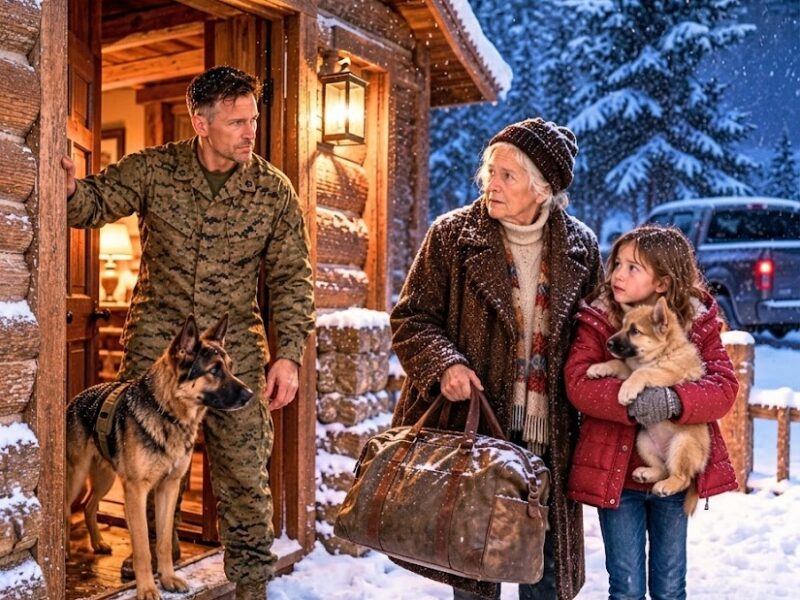
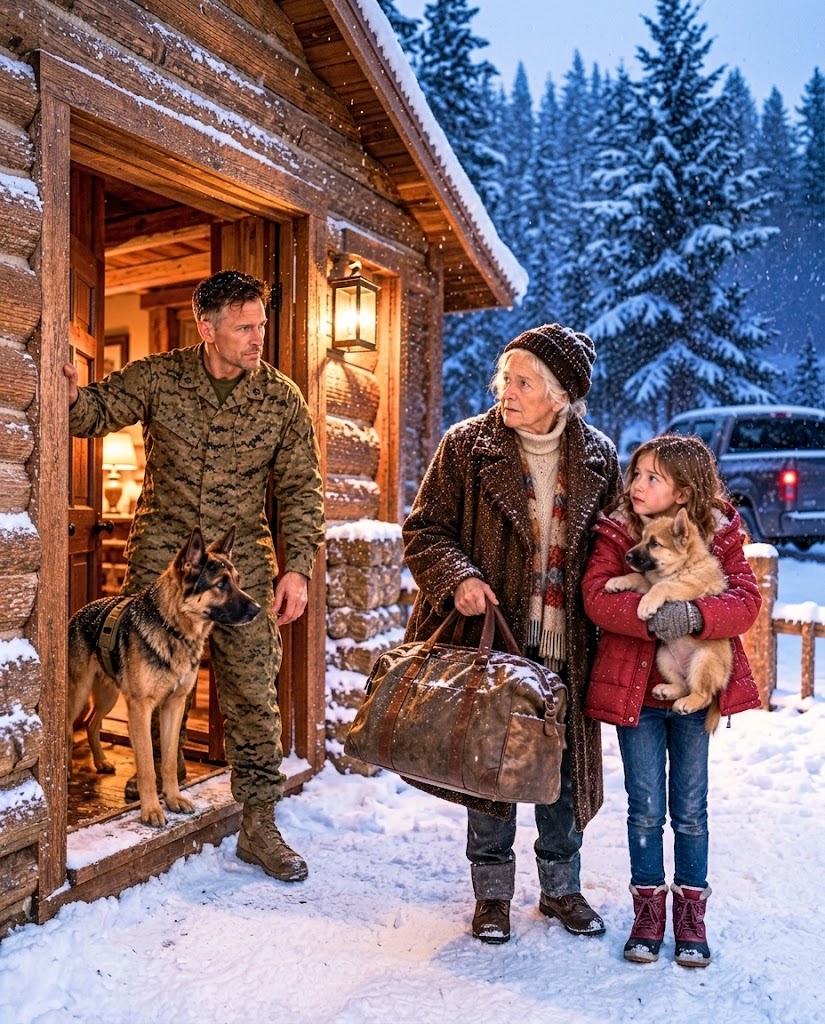
Three faint knocks broke the silence of a snowy November night in Bend, Oregon.
Gunnery Sergeant Declan Voss set down the split log he’d been holding and crossed to the front door, his gray-green eyes narrowing with the habitual caution of twenty years in the Marine Corps.
At forty-two, he stood just over six feet with broad shoulders that still filled a doorway, short dark brown hair touched with gray at the temples, and the kind of square jaw that suggested he’d never lost an argument he considered worth winning.
The knock came again—softer this time, almost apologetic.
Draven, his retired German Shepherd, lifted his head from the hearth and rose carefully, favoring his injured hind leg as he crossed the living room to stand beside his handler.
The dog’s amber eyes fixed on the door with the same disciplined alertness that had once made him invaluable in combat zones halfway around the world.
Declan opened the door.
A woman stood in the falling snow, her dark wool coat damp at the shoulders, silver hair escaping a loose knot beneath her hat.
She was short and slender, with deeply lined face and pale blue eyes that held both exhaustion and a fierce, unwavering pride.
One trembling hand gripped that of a little girl.
The other held a worn overnight bag that had clearly seen better decades.
Behind the woman’s legs, half-hidden by her coat, stood a golden retriever puppy no more than seven months old, shivering so hard his entire body seemed to vibrate.
“Please,” the woman whispered, and her voice cracked on the single syllable. “My granddaughter needs somewhere warm.”
Declan looked at the child.
She was about eight years old, with chestnut hair tucked behind her ears and fair cheeks reddened by the cold.
Her brown eyes were watchful in a way that made something in Declan’s chest tighten—the way children’s eyes looked when they’d already learned that safety was never guaranteed.
She clutched the puppy against her chest as though he might disappear if she loosened her grip.
The puppy’s oversized paws protruded from an old towel wrapped around his small body, and his damp ears hung beside a narrow, curious face.
The girl had tucked the towel around him so carefully that her own gloves were soaked through.
Declan stepped aside immediately.
“Both of you and the dog,” he said. “Come in.”
The woman’s name was Rosalind Thorne.
The girl was her granddaughter, Elodie.
The puppy was Taffy, seven months old and currently attempting to wriggle free of Elodie’s grip while simultaneously sniffing every corner of Declan’s living room.
“I wasn’t asking you to take us in,” Rosalind said as she crossed the threshold, her voice carrying the careful dignity of someone who had spent a lifetime learning not to impose. “Just the child and the puppy. I could have waited outside.”
Declan noticed how she kept adjusting the towel around Elodie’s shoulders even as snow melted against her own collar.
She stood near the doorway, leaving herself room to retreat if he changed his mind.
“You’re not waiting outside,” Declan said, and something in his tone—the same tone he’d used to give orders in places where hesitation meant death—left no room for argument.
He brought dry towels, prepared warm drinks and food, and pulled another chair toward the fireplace.
Rosalind accepted a towel only after Elodie had one.
The girl sat on the edge of the chair, keeping a small tin box tucked beneath her arm, while Taffy sniffed the rug with the enthusiastic curiosity of a puppy discovering an entire world of new smells.
When the puppy ventured toward Draven, the older dog lowered his head, studied him with the patient assessment of a veteran soldier inspecting a raw recruit, and quietly shifted aside.
Elodie’s mouth lifted in the smallest smile.
Declan noticed.
It had been a long time since a child had smiled in his house.
—
The house had been silent for three years.
Declan had bought it with his wife, Mira, when he was still a younger man with fewer scars and more optimism.
They had imagined filling it with children, music, and muddy boots tracked through the kitchen.
They had imagined a lot of things.
The room at the end of the hallway remained untouched—Mira’s room, though she’d never actually slept in it.
It had been her office, her sanctuary, the place where she’d kept her books and her plants and the small watercolor paintings she’d made on weekends when the rain kept them indoors.
Declan passed its closed door every morning without looking directly at it.
Sometimes he caught himself listening for her footsteps before remembering there would be none.
He had learned to endure that moment, but never to make it hurt less.
Draven had been his anchor through the worst of it.
The German Shepherd had served alongside Declan for five years in some of the most demanding environments the Marine Corps could offer.
When a roadside explosion had left Draven with a hind leg injury that made continued service impossible, Declan had adopted him through the proper process.
The Corps had offered to rehome the dog with a qualified civilian handler, but Declan had refused.
Draven had saved his life twice.
The least Declan could do was make sure the dog spent his retirement with someone who understood what he’d given.
Now Draven rested near the hearth, his black and tan coat thick and well-brushed, a small pale scar visible above his left foreleg.
He could still walk comfortably, but Declan never asked him to run hard or jump.
When duty called Declan away, a trusted neighbor named Margaret Chen helped care for him.
Margaret was a retired veterinary technician who lived half a mile down the road and had never once asked Declan why he kept to himself.
She simply showed up when he needed her, cared for Draven as though the dog were her own, and disappeared before he could thank her properly.
At 7:15 p.m., Draven lifted his head.
Declan paused with the log halfway to the fire.
The dog rose carefully, crossed the room, and stopped at the front door, ears forward.
Three faint knocks followed.
—
Rosalind explained their situation while Elodie sipped hot chocolate and Taffy explored the living room under Draven’s watchful supervision.
Her car had suffered an electrical failure on the road about 150 meters from Declan’s house.
She had called for roadside assistance, but the driver couldn’t reach them immediately due to the weather.
A friend was expecting them farther west, in Sisters, but that friend couldn’t collect them until morning.
Rather than make Elodie wait in the cold vehicle, Rosalind had followed the light from Declan’s windows.
“I reported the car and the location,” Rosalind said. “The tow operator will take it to a garage in the morning.”
Declan helped her call roadside assistance again, then stayed nearby while she telephoned her friend.
The friend—a practical, soft-spoken woman named Dorothy—had agreed to shelter them for several days once they could reach her.
Once Rosalind confirmed they were safe, Dorothy offered to collect them in the morning.
Only after Elodie had eaten and begun to doze did Rosalind explain why they had left home in the first place.
Her son, Lachlan, had worked as a maritime communications maintenance technician.
A quiet, meticulous man with dark hair and a patient manner, he had been the sort of father who repaired broken radios rather than throw them away.
He had died of a stroke nearly a year earlier.
Elodie’s mother had died of illness when the girl was four.
Rosalind had since become her granddaughter’s legal guardian.
Recently, Lachlan’s former supervisor, Conrad Sloan, had begun asking about work records Lachlan might have kept.
Conrad was a neatly dressed, middle-aged man whose controlled politeness had grown increasingly insistent.
He believed some records belonged to the company.
Rosalind did not know whether that was true, so she had refused to hand anything over without legal advice.
“He came through my gate after I told him to leave,” she said, her hands wrapped around her mug as though she were trying to warm something deeper than her fingers. “I reported it. Perhaps I’m making too much of it.”
Declan shook his head.
“You’re allowed to take precautions. Keep a record of what happened. Let a lawyer handle the documents.”
He did not call Conrad a criminal or promise to confront him.
He did not offer to solve a problem he didn’t fully understand.
He simply acknowledged that Rosalind’s fear was reasonable and that she had taken appropriate steps.
Rosalind seemed relieved that he had listened without making her feel foolish.
Later, the garage called.
The car needed a replacement electrical component, and the repair would take several days.
Rosalind thanked Declan and said her friend could collect them in the morning.
He glanced toward Elodie, asleep now with her tin box against her ribs and one hand resting on Taffy’s back.
“You can stay tonight,” he said. “You can decide about tomorrow when she’s rested.”
Rosalind looked toward the fire.
For a moment, the strain she had carried so carefully showed in her face.
She glanced at Elodie, then at the snow gathering beyond the window.
“Thank you,” she whispered.
—
Declan fetched blankets from the hall closet.
When he returned, Draven had settled beside the sleeping girl, his head turned toward the front door.
Taffy lay between the chair and the hearth, finally warm enough to sleep.
Declan stood still.
The house had not changed.
The same furniture, the same closed door down the hallway, the same fire burning low.
Yet Elodie’s hand rested trustingly on the puppy, and Draven had chosen to remain beside her.
Declan found himself wondering whether the girl would still be there when he came downstairs in the morning.
Outside, the snow kept falling.
For the first time in years, he hoped the night would pass slowly.
—
## Part 2
By morning, the snowfall had stopped, leaving a thin white covering on the roof and pine branches.
Sunlight reached the kitchen windows, where Declan found Rosalind standing over a pan of eggs.
She had already located the plates and set three places at the table.
When he offered to take over, she gave him a look that reminded him of a senior marine inspecting an unnecessary interruption.
“I know how to make breakfast, Mr. Voss.”
“Declan,” he corrected.
“Then you may call me Rosalind.”
Elodie appeared in the doorway, still sleepy, with Taffy stumbling after her.
Draven lifted his head from his bed but made no attempt to rise until the puppy approached his water bowl.
Declan gently redirected Taffy toward his own.
By the time breakfast was ready, Elodie was laughing at the puppy’s determined efforts to carry a dish towel twice the length of his body.
Rosalind’s friend called to check on them.
She remained willing to collect the family, but Rosalind asked for another day to consider her arrangements.
Declan drove her to the garage, where a mechanic confirmed that the replacement electrical component would take several more days to arrive.
On the return journey, Rosalind sat with her hands folded over her handbag.
“I can pay for a motel,” she said. “I know. I don’t want you thinking I expect anything. I don’t.”
She studied him, searching for the obligation hidden beneath his offer.
Declan kept his eyes on the road.
“Stay until the car is ready. If you’d rather go to your friend, I’ll drive you.”
After a long silence, Rosalind nodded.
She chose to stay, provided she could help with the cooking and laundry.
Declan agreed without argument.
He understood that she was not bargaining over chores.
She was asking to remain a person who contributed rather than someone whose troubles had made her helpless.
—
The next few days developed a rhythm neither had planned.
Rosalind cooked meals that filled the house with the smell of onions, butter, and fresh bread.
Elodie described school projects while drying cutlery beside her grandmother.
Taffy’s nails clicked across the wooden floor as he carried socks, gloves, and anything else small enough to fit between his teeth.
Declan retrieved the objects without scolding him, then began keeping the laundry basket beyond the puppy’s reach.
Draven watched these disturbances with the patience of an old professional.
When Taffy wandered too close to the hearth, he rose and nudged him gently away.
Once the puppy climbed into Draven’s bed, turned around three times, and settled with a satisfied sigh.
Draven stood, regarded the occupation of his territory, and moved to the rug.
Elodie laughed so hard she had to sit down.
“He let Taffy have it.”
“For now,” Declan said, placing a second blanket nearby. “Draven still needs a place where he can rest undisturbed.”
He showed Elodie how to brush the shepherd’s thick coat, keeping her movements gentle around his injured hind leg.
He also explained why Taffy needed regular meals, short periods of play, and time to sleep.
Elodie listened with intense concentration.
When Draven leaned into the brush, she looked up at Declan as though she had accomplished something extraordinary.
“He likes it.”
“He does.”
She returned to the task with a seriousness that made him smile.
Declan had spent years giving instructions that carried consequences far beyond a living room.
Teaching a child to care for an aging dog should have felt insignificant.
Instead, he found himself waiting for her next question.
—
One afternoon, Rosalind prepared dinner while Elodie arranged the contents of her tin box on the kitchen table.
There were photographs, a smooth pebble from a family trip, and a folded drawing of a dog with enormous golden ears.
Declan sat opposite her, repairing a loose cabinet handle.
“Dad used to fix radios,” Elodie said. “Sometimes they made funny noises before he got them working.”
“Did he let you help?”
“I held the screws. He said that was important.”
Declan set down his screwdriver.
“Sounds like he trusted you.”
Elodie touched the drawing.
“He said even a weak signal could help somebody find the right place.”
She explained that Lachlan had promised her a golden retriever when she was old enough to help care for one.
Five months earlier, Rosalind had adopted Taffy at two months old to honor that promise.
“Dad never got to meet him,” Elodie said.
Her voice remained steady, but her fingers tightened around the paper.
Declan did not tell her that her father would have been proud or pretend to know what Lachlan might say.
He waited.
“Sometimes I’m scared Taffy will go away, too.”
From the stove, Rosalind went still.
Declan looked at the puppy sleeping beneath the table.
“Then we’ll help you look after him,” he said. “And we’ll make sure the doors and gates are secure.”
Elodie considered this practical answer before returning the drawing to its box.
She seemed relieved that he had not promised something no one could guarantee.
—
As she packed the keepsakes away, Taffy emerged from the hallway carrying a faded canvas tool bag.
It had belonged to Lachlan.
Rosalind had brought it from home among their belongings.
The puppy dragged it beneath a chair and resisted Elodie’s attempts to retrieve it.
“Taffy, that isn’t yours.”
Declan crouched and offered the puppy a soft toy in exchange.
Once Taffy released the bag, Declan noticed a small zippered pocket beneath its worn lining.
The zipper had caught on the edge of the chair and opened slightly.
Inside lay a narrow brass key and a plastic card bearing a storage unit number.
Rosalind came to the table.
Her face changed when she read the name printed on the card.
“Lachlan rented a storage unit,” she said. “For tools and personal papers. I thought he’d closed it before he died.”
She turned the key over in her palm, then carefully set it beside the card.
Declan made no attempt to connect the discovery to Conrad’s visits.
A key proved only that Lachlan had once had access to a storage unit.
“Call the facility tomorrow,” he suggested. “They can tell you whether the unit still exists and what they need from you.”
Rosalind nodded, though her attention remained on the card.
Taffy, unaware of the discovery, had already located another sock.
Elodie burst into laughter as he trotted away with it.
—
That evening, after the dishes were cleared, Rosalind spoke quietly about Lachlan’s final months.
A coworker had been seriously injured in an accident.
Afterward, Lachlan had questioned the condition of certain emergency signaling equipment and submitted internal reports.
He had never received answers that satisfied him.
“I don’t know whether he was right,” Rosalind said. “I only know he was worried.”
“Then let the records speak for themselves,” Declan replied. “Talk to a lawyer before you decide what to do with anything you find. And don’t meet Conrad alone.”
Rosalind rose to wash the dishes.
When Declan offered to take over, she shook her head.
“I can manage.”
He picked up a towel instead and dried each plate she handed him.
Neither spoke for a while.
They did not need to.
—
Later, Elodie fell asleep beside Draven with Taffy curled on his own blanket near her feet.
Declan stood in the kitchen doorway, watching Rosalind turn off the light above the sink.
He had opened his door because a child needed warmth.
Somewhere between breakfast dishes, a borrowed dog brush, and a forgotten key, he had begun making room for them in the ordinary hours of his life.
—
## Part 3
Several days later, the snow had retreated to the shaded edges of the roads outside Bend.
Declan drove Rosalind and Elodie toward a storage facility on the outskirts of town, while Taffy and Draven remained comfortably at home.
Rosalind held Lachlan’s key and storage card in her lap.
She had checked them three times before leaving, though Declan had watched her place both inside her handbag.
At the facility, a gray-haired clerk with reading glasses and a patient manner confirmed that Lachlan had rented a unit for tools and personal belongings.
Automatic payments had continued for a time after his death, then stopped.
The contents had been retained while the overdue account awaited resolution.
Rosalind presented the documents identifying her as the legal representative of Lachlan’s estate.
After the clerk verified them and she settled the outstanding fees—$847.50 in back payments and late charges—they were permitted to collect his property.
Declan raised the storage door.
Inside stood a toolbox, two cardboard cartons, several work jackets, and a battered radio wrapped in a towel.
Elodie hurried toward it.
“That’s Dad’s.”
She lifted the radio with both hands.
One corner of its wooden casing was chipped, and a missing knob left a small metal stem exposed.
“He said we’d fix it together.”
Rosalind had stopped beside the hanging jackets.
She reached for a faded blue one, rubbing its worn cuff between her fingers.
Declan looked away, giving her a moment.
When she finally folded it, she did so with the care of someone handling a sleeping child.
They carried everything to the truck.
On the drive home, Elodie kept the radio beside her, occasionally touching its handle to make certain it was still there.
—
The maintenance notebooks required a different kind of attention.
Rosalind arranged a meeting with an attorney, Margaret Vale, a woman in her early fifties with closely cropped auburn hair, thoughtful dark eyes, and a habit of listening until people finished speaking.
She reviewed the records without promising an outcome.
“Some entries appear to describe shortcomings in equipment inspections,” she explained. “But they do not establish whether anyone deliberately concealed a problem. The documents might help the appropriate authorities determine what requires further examination.”
Rosalind authorized Margaret to retain copies while the originals remained safely stored.
Margaret also advised her on handling any company records that might be subject to ownership or confidentiality requirements.
Declan drove Rosalind to the appointment and occupied Elodie with a drawing pad in the waiting area.
He did not question company employees or attempt an investigation of his own.
At Margaret’s direction, further communication from Conrad Sloan was routed through the attorney.
The visits to Rosalind’s house stopped.
She still checked the driveway whenever a vehicle slowed outside, but she no longer felt obliged to answer every question alone.
—
Back at Declan’s house, the contents of the storage cartons covered the dining table.
Elodie recognized photographs of her father kneeling beside a bicycle, smiling behind a birthday cake, and holding her as a baby.
Rosalind identified places and people without rushing her.
Then, beneath a stack of pictures, she found an envelope addressed in Lachlan’s handwriting.
*For Elodie, on your next birthday.*
Rosalind sat down.
The letter had been written while Lachlan was still well, intended for a birthday he had never lived to see.
She offered it to Elodie, who held it for a moment before asking her grandmother to read it aloud.
Lachlan wrote about the small things he admired—the way Elodie noticed when someone was lonely, how she carried injured insects out of the house, and how she insisted that every stuffed animal have somewhere comfortable to sleep.
He told her that being gentle did not mean she had to be brave every minute.
There would be days when she felt angry, frightened, or terribly sad.
And she could tell the people who loved her.
Rosalind’s voice faltered near the end.
*If you miss someone, sweetheart, you are allowed to miss them. And when something makes you happy again, you are allowed to be happy. One feeling does not take the other away.*
Elodie pressed both hands over her mouth.
Then she began to cry.
Rosalind drew her close.
Declan quietly placed a box of tissues on the table and stepped back.
He knew the helpless urge to make grief stop, to find the sentence that would put everything right.
He also knew there was no such sentence.
Draven settled beside Elodie’s chair, and she reached down into his thick fur.
Taffy pushed his small head against her knee until she rested her other hand on him.
No one asked her to stop crying.
—
Over the following days, the radio became Elodie’s project.
Declan helped her clean its exterior and sort the loose knobs, but he refused to guess at the damaged electrical components.
They took it to a qualified repair technician who made it safe and restored its operation.
The cost came to $340, which Rosalind insisted on paying from the modest savings she had set aside for household emergencies.
When they brought it home, Declan placed it on the kitchen table and stepped aside.
“You do the honors.”
Elodie turned the switch.
A soft crackle filled the room, followed by the voice of a local radio presenter discussing the weather.
She smiled so suddenly that Declan smiled, too.
Then her expression crumpled.
“Dad was supposed to hear at work.”
Declan pulled out the chair beside her.
He waited until she looked at him.
“My wife liked listening to the radio when it snowed,” he said. “She used to turn it up while she cooked. I complained about the volume.”
“Did she stop?”
“Never.”
Elodie gave a watery laugh.
Declan glanced toward the hallway.
“I kept her room closed after she died. I thought if I changed anything, I might lose another piece of her.”
“Did it help?”
He considered telling her yes.
It would have been easier than explaining the truth.
“Not the way I hoped.”
Elodie wiped her cheeks.
“Maybe you could open it sometime.”
“Maybe I could.”
—
That evening, Rosalind found Declan standing outside the closed room.
She did not reach for the handle or ask what he intended to do.
“After Elodie’s mother died,” she said, “Lachlan kept her coat hanging by the front door. He couldn’t bear to put it away.”
Declan remained silent.
“Then Elodie grew tall enough to need her own hooks for school bags and jackets. Lachlan folded the coat into a keepsake box. He cried while he did it.”
Rosalind looked toward the kitchen, where Elodie was showing Taffy the repaired radio.
“He loved his wife just as much afterward.”
Declan rested his hand against the door.
He had spent years treating the room as the last place where his marriage still existed, but the photographs on the walls, the habits he remembered, even the ache he carried—none of them had depended on a locked door.
He turned the handle.
The room smelled faintly of cedar.
A folded quilt lay across the bed, and a book rested where his wife had left it.
Declan crossed to the window and drew back the curtains.
Soft light from the hallway fell across the floor.
He moved nothing else.
He was not ready for that.
But when he stepped into the hallway, he left the door open.
—
## Part 4
A few days before Declan’s leave ended, the snow had thinned to pale patches beneath the trees.
Rosalind’s car was finally repaired—the total bill came to $1,247, including parts and labor—and she was ready to return home.
She had collected it from the garage and left it at Declan’s house, where it would remain until she and Elodie returned for good.
That morning, Declan offered to drive them to Rosalind’s property so she could check the house, collect Elodie’s school things, and begin restoring the routine they had left behind.
With Draven and Taffy riding securely in the back, Rosalind accepted, though she reminded him that she could drive herself once everything was settled.
Her house stood on a quiet road outside Bend.
Behind it were an aging shed, a side gate, and a drainage ditch running toward lower ground.
Snow still covered the fence rails and several weathered boards near the shed.
Declan had never walked through the backyard and knew nothing about the ditch.
While Rosalind checked the rooms, he took Draven to the front of the house to retrieve a toolbox from his truck.
Elodie remained on the covered porch with Taffy under instructions to stay close.
At first, the puppy chased a fallen pine cone, skidding clumsily across the porch.
Then he noticed a gap beneath the side gate.
Before Elodie could catch his collar, he squeezed through and disappeared toward the shed.
“Taffy, come back.”
His golden tail flashed around the corner.
Elodie hesitated.
She knew she should call her grandmother, but Taffy was already getting farther away.
Her father had promised her a puppy before he died, and Rosalind had kept that promise.
The thought of losing Taffy made her move before she could think.
She stepped off the porch, certain she could catch him in a few seconds.
Near the shed, a snow-covered board shifted beneath her shoe.
The rotten wood snapped, and Elodie slipped into the shallow drainage ditch.
One foot caught between broken pieces, twisting her ankle as she fell.
She tried to stand, but pain shot up her leg.
“Taffy!”
The puppy scrambled backward, startled by the noise.
Then he returned to the edge and began barking.
He ran a few steps toward the corner of the shed, hurried back, and barked again.
Elodie reached for him, but he remained beyond her fingers.
“Please don’t go,” she whispered.
—
At the front of the house, Draven stopped beside Declan’s truck.
His ears rose, and he turned toward the backyard.
The barking continued.
Draven moved purposefully toward the side path, walking as quickly as his old injury comfortably allowed.
“Draven.”
The shepherd glanced back but kept his attention on the sound.
Declan followed, carrying the toolbox.
He could hear Taffy now—sharp, repeated barks unlike the puppy’s usual playful noise.
Draven reached the shed first and stopped beside the ditch, looking down before giving a single bark.
Declan saw Elodie below him, one hand gripping her ankle.
Her cheeks were wet, but she was trying not to cry.
“Declan, I’m sorry.”
He set down the toolbox.
“Look at me, sweetheart. Don’t try to stand.”
“I went after Taffy.”
“I know you told me. We’ll talk about that later. Right now, stay still.”
He checked the ditch.
It was shallow with no strong water flow, but the broken boards made the edge unsafe.
Approaching from firm ground, he steadied Elodie and carefully freed her shoe from the wood.
Then he lifted her out and carried her clear of the damaged area.
Rosalind came running at his call.
She stopped when she saw Elodie in his arms, her face suddenly pale.
“What happened?”
“She’s hurt her ankle. She’s awake and talking. We’re getting her checked.”
Rosalind knelt beside them.
Elodie reached for her, and the elderly woman gathered her close.
“I’m here,” she whispered. “I’m right here.”
Declan noticed that Rosalind’s hands were shaking again.
She held Elodie carefully, as though tightening her embrace might cause more pain.
For a moment, she seemed unable to look at the broken boards.
—
At a nearby urgent care clinic, a doctor confirmed a mild sprain and superficial scrapes with no serious injury.
The visit, including X-rays and a wrap for the ankle, came to $385 after insurance.
Elodie was sent home with instructions to rest and avoid unnecessary weight on the ankle.
Rosalind said little on the drive back to Declan’s house.
Once inside, she sat at the kitchen table and pressed her fingertips against her forehead.
“I should have seen that gate.”
Elodie’s eyes filled.
“I wasn’t supposed to leave the porch.”
Declan pulled out a chair beside her.
“You made a mistake,” he said gently. “Next time Taffy gets away, you call us. Even if you’re afraid he’ll disappear.”
“But Dad promised him to me.”
“I know.”
Declan waited until she met his eyes.
“And keeping Taffy safe means keeping yourself safe, too.”
Taffy lay beside Elodie’s uninjured foot, his chin on the floor.
Draven settled farther away where he could watch her without crowding the sore ankle.
Elodie stroked the puppy’s ears.
“I thought I was going to lose him,” she whispered.
Declan understood that she was speaking about more than a dog.
Taffy was part of a future her father had imagined for her.
He wanted to promise that she would never lose anything precious again.
Instead, he stayed beside her until her breathing steadied.
—
Rosalind arranged for a contractor to repair the gate and make the drainage area safe.
The estimate came to $2,150, which she would cover from her savings.
Until the work was complete, Elodie would not play in the backyard.
She remained at Declan’s house to rest during his remaining leave.
That night, after Elodie had fallen asleep, Rosalind found Declan at the kitchen sink.
“I was frightened today in a way I haven’t been since Lachlan died,” she said.
Declan turned off the water.
“I keep telling myself I can manage everything. I’m her grandmother. I’m supposed to be the one she can depend on.”
“She does depend on you.”
“But what happens when I can’t do something?”
Rosalind looked down at her hands.
“What if she starts believing I’m too old to care for her?”
Declan dried his hands.
He thought of the years he had spent keeping his own house unchanged, refusing invitations and calling it independence.
“Letting someone help you doesn’t take anything away from what you give her,” he said. “It means she has more people looking out for her.”
Rosalind gave a small nod.
She did not ask him to solve her future, and he did not offer to make decisions for her.
He simply remained beside her while she gathered herself.
—
During his final days of leave, Declan dusted the windowsill in his wife’s room and replaced the faded curtain.
Her photographs and treasured belongings stayed where they were, but the door remained open.
Elodie stood at the threshold one afternoon, keeping her weight off her healing ankle.
“Could we put a little plant by the window?”
Declan looked at the empty sill.
His wife had once kept plants there, turning their leaves toward the winter light.
“I think she would have liked that.”
Rosalind watched from the hallway.
Nothing precious had been removed, yet the room no longer felt sealed away from the rest of the house.
—
On the morning Declan drove them home, Rosalind’s repaired car followed behind, driven by Margaret Chen, who had agreed to help.
Once both vehicles were safely parked at Rosalind’s house, she thanked Margaret and went inside to prepare Elodie’s room.
The girl’s ankle was improving, and the backyard repairs were arranged.
Elodie hugged Declan tightly before he left.
“Will you call when you go back to your unit?”
“Whenever I can,” he promised.
She bent to stroke Draven’s head.
“I’ll miss both of you.”
Declan rested a hand on the shepherd’s back.
As Elodie waved from Rosalind’s doorway, he realized he was no longer counting the days until he could escape the silence of his house.
He was already wondering when he would see them again.
—
## Part 5
Spring returned slowly to the hills around Bend.
Snow withdrew from the roads, and the pines stood green against the clearing sky.
Declan was back with his unit, but the distance between him and Rosalind’s family no longer felt like an ending.
On evenings when duty allowed, he called to ask about Rosalind’s health, Elodie’s schoolwork, and whatever Taffy had stolen that day.
“Another sock,” Elodie announced during one call. “Grandma says he has a collection.”
“Draven would disapprove.”
“He misses Taffy.”
“You can tell him I said so.”
Declan sent a photograph of Draven sleeping beside the fireplace.
Elodie replied with one of Taffy carrying a sock nearly as long as his head.
Their conversations were sometimes brief, interrupted by homework or Declan’s schedule, but he called when he said he would.
On the nights he could not, Rosalind explained why, and Elodie learned that an unanswered phone did not always mean someone had gone away.
—
The repairs at Rosalind’s house were complete.
She returned to her routines, accepted occasional help from neighbors, and continued meeting with Margaret Vale about Lachlan’s records.
Elodie went back to school and gradually began inviting classmates home.
The drainage ditch was secured, the side gate latched properly, and Taffy had grown too large to slip through its former gap.
Several months after Rosalind recovered the notebooks, Margaret brought her the official findings.
The review had identified deficiencies in equipment maintenance and inspection procedures at Lachlan’s former workplace.
The company was required to correct the confirmed problems and update its safety practices.
Lachlan’s records had helped identify matters worth examining, though they did not establish that Conrad had deliberately caused the earlier accident.
Conrad was required to account for approvals within his managerial responsibilities.
Any further action would follow the appropriate process.
Rosalind read the notice twice.
She had expected to feel relieved, perhaps even triumphant.
Instead, she thought of Lachlan sitting at his kitchen table after Elodie went to bed, carefully writing down concerns he had been unable to put aside.
“He wanted someone to listen,” she said.
Margaret nodded.
“His notes helped them know where to look.”
—
The following morning, Rosalind took Elodie to the cemetery.
They placed fresh flowers at Lachlan’s grave, and Elodie set the repaired radio on the grass beside them.
Rosalind told her son that the problems he had worried about had finally received attention.
Elodie opened her tin box, touched a photograph of him, and looked toward the headstone.
“Taffy’s bigger now,” she said. “And I have a friend named Declan. He keeps his promises.”
She left the flowers, then carried the radio home.
—
When Declan returned to Bend on his next leave, Draven recognized Taffy before the truck had fully stopped.
The younger dog bounded toward him, no longer small enough to squeeze beneath his chest.
Draven greeted him with a patient sniff and a slow wag.
Elodie came running from the porch.
She stopped just short of Declan, smiling as though she needed a moment to believe he was really there.
Then she stepped forward and hugged him.
Rosalind welcomed him inside.
Over tea, she told him she had been considering what the next few years might look like.
She was well enough to care for Elodie, but the responsibility was growing heavier, and she wanted to make thoughtful arrangements before another emergency forced her hand.
“I don’t want her wondering what will happen if I need help,” she said.
Declan listened.
He offered continued support, but he did not ask her to surrender her home or independence.
They talked again the following day and several times afterward.
Elodie joined the conversations.
Declan explained that duty would still take him away and that he could not promise to be home every evening.
“Would Grandma come too?” Elodie asked.
“Only if she wants to,” Declan said. “And only if you do.”
Elodie considered this seriously.
She wanted to live near Draven.
She wanted a room where she could keep her father’s photographs.
Most of all, she wanted to know that Rosalind would be there when Declan was away.
—
Once they had discussed those questions together, Rosalind and Elodie chose to move into Declan’s house.
Rosalind retained ownership of her own property and arranged for a local management company to handle its rental.
The income—approximately $1,650 per month after management fees—would help preserve her financial independence.
Margaret also assisted with documents concerning Elodie’s future care.
Declan agreed to be considered as a backup caregiver if needed, subject to the required legal approvals.
Living together did not make him Elodie’s legal father, and no one asked her to call him anything other than Declan.
They planned around his absences, too.
Rosalind would remain Elodie’s guardian and primary caregiver, while Margaret Chen could help when necessary.
Their new arrangement was not built on the idea that Declan would always be present.
It was built on knowing who would be there when he was not.
—
Moving day brought more boxes than anyone expected.
Rosalind supervised the kitchen shelves.
Elodie carried her tin box herself, and Taffy attempted to steal a packing cloth.
Draven watched from his bed, lifting his head whenever the puppy passed.
That afternoon, Declan led Elodie to the room that had belonged to his wife.
He had moved her most personal belongings into a carefully arranged keepsake cabinet, preserving photographs and the objects he could not imagine parting with.
The walls had been repainted, and a small bed stood opposite a desk by the window.
The plant Elodie had suggested months earlier rested on the sill.
“Does it make you sad?” she asked.
“Sometimes.”
Declan looked at a framed photograph he had chosen to leave on a shelf.
“But changing this room doesn’t change what she meant to me.”
Elodie placed her tin box on the desk.
Inside were her father’s photographs, a small pebble, and the drawing she had carried through the winter.
She added a new picture taken on Rosalind’s porch—her grandmother, Declan, herself, Draven, and Taffy, all caught in an untidy moment of laughter.
“It used to be where I kept things I missed,” she said. “And now it has things I still have.”
Declan sat beside her without trying to improve on the words.
From the hallway came Rosalind’s voice telling Taffy to release a dish towel.
Elodie laughed and hurried out to help.
—
## Part 6
By early summer, the household had found its rhythm.
One morning, Rosalind read beside the window while Elodie measured food into the dogs’ bowls.
Declan worked on a loose hinge at the back door, his tools spread neatly on the step.
Taffy trotted past, carrying a stolen sock.
“Taffy, bring that back.”
The puppy ignored her and circled toward the porch.
Draven lay in a patch of sunlight, watching him approach.
Months earlier, he would have risen and moved to another spot.
This time, he stayed where he was.
Taffy dropped the sock, turned twice, and curled against the older shepherd’s side.
Draven closed his eyes.
Declan tightened the final screw and looked through the open doorway.
Rosalind had set her book aside to watch Elodie retrieve the sock.
Their laughter drifted out to him.
He remembered the November night when Rosalind had stood on his doorstep, asking only for warmth for a little girl and a wet puppy.
He had believed he was offering them shelter until the storm passed.
Now there was a school bag beside the door, a second dog bowl in the kitchen, and someone calling his name from inside.
“Declan,” Elodie called. “Breakfast is ready.”
He put down the screwdriver and went in.
—
Sometimes the miracles we need do not arrive with thunder or a brilliant light.
Sometimes they come as three quiet knocks on a snowy night, a frightened child holding a puppy, or a stranger who opens his door without asking for anything in return.
Declan, Rosalind, and Elodie remind us that healing can arrive through the simplest acts of kindness.
We cannot erase the people we have lost, but we can honor their love by making room for others.
Sometimes the family we need is not the one we expected, but the one who finds us when we least believe we deserve them.
In everyday life, a warm meal, a patient ear, or a helping hand may be the answer to someone’s silent prayer.
Never underestimate the difference your kindness can make.
If this story touched your heart, share it with someone who needs hope today.
Have you ever experienced an unexpected blessing from a stranger?
May your home be protected, your loved ones comforted, and your days filled with peace, hope, and love.
—









