A Freezing German Shepherd Blocked the Officer’s Car—Then He Recognized the Patch on Its Collar
## Part 1
At 6:10 on a bitter December morning outside Durango, Colorado, Officer Nathan Mercer spotted a German Shepherd standing alone beside a snow-covered logging road.
The dog was thin and trembling, but it refused to run.
When Nathan stepped closer, the shepherd tilted its head in a way that stopped him cold.
He raised one hand and gave a canine command he had not used in three years.
The dog obeyed instantly.
Nathan dropped to his knees.
Behind its right ear was a scar he knew by heart.
This was Ranger, his former canine partner, officially declared dead after a transport crash three winters earlier.
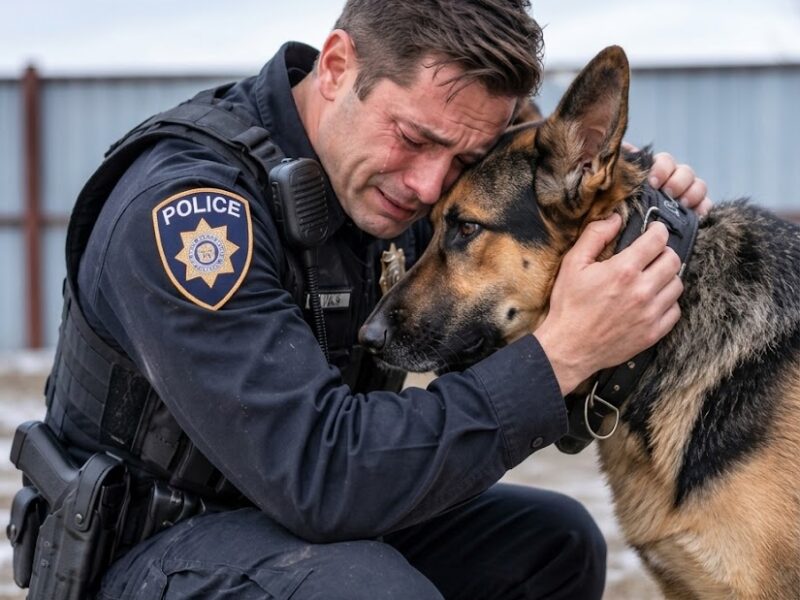
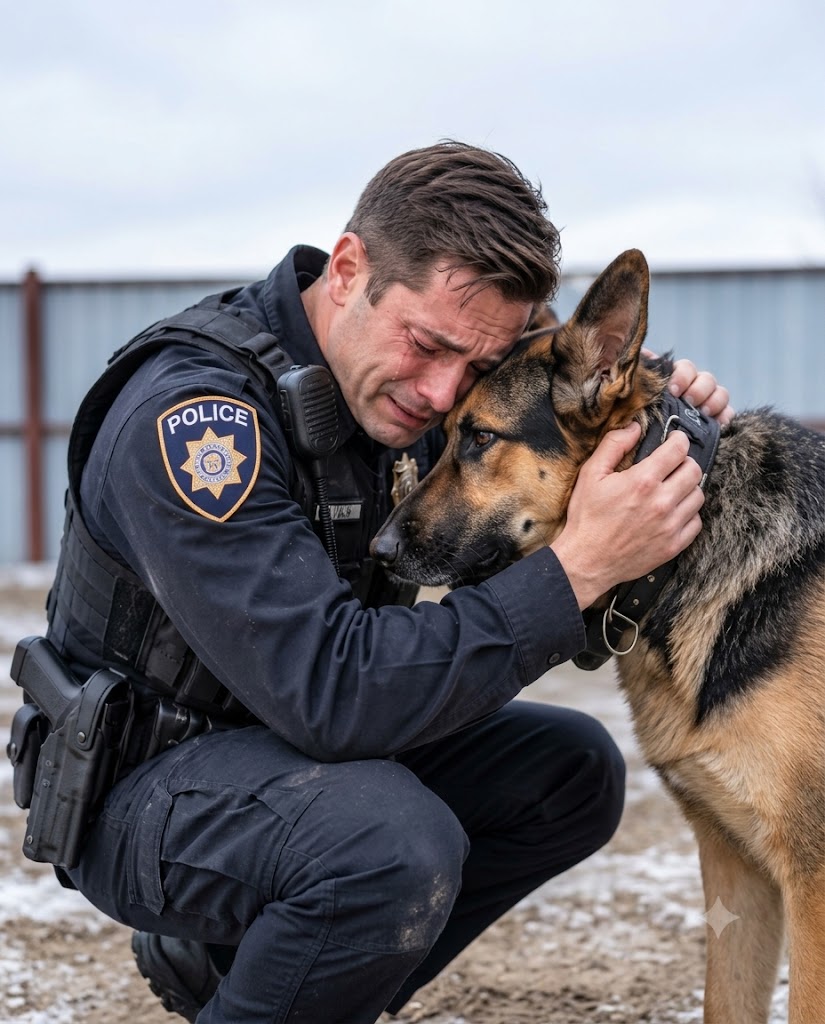
Nathan wrapped both arms around him, fighting tears.
But Ranger suddenly pulled away and stared toward the mountains.
He had not returned just to be found.
Somewhere beyond the snow, someone else was still waiting for help.
—
At 6:10 on a bitter December morning outside Durango, Colorado, fresh snow covered the narrow mountain road in an unbroken white sheet.
The storm had ended only a few hours earlier, leaving the abandoned lumber yard, the pine slopes, and the fence posts along the roadside almost completely still.
Officer Nathan Mercer was moving slowly through the northern edge of his patrol route when something dark appeared beyond his headlights.
Nathan was 39, tall and broad-shouldered with short brown hair beginning to gray at the temples and a steady face shaped by nearly 15 years of police work.
Three years earlier, however, he had left the canine unit after losing his partner during an emergency transport incident.
Since then, Nathan had become quieter whenever police dogs were mentioned and had learned to keep certain memories to himself.
He slowed the patrol SUV.
A German Shepherd stood beside the fence of the abandoned lumberyard.
The dog looked about eight years old, large framed but noticeably lean beneath a wet black and tan coat.
Snow clung to its lower legs and chest.
Its ears remained upright, though its body carried the tired stillness of an animal that had been outside for too long.
Nathan expected it to retreat when he stopped.
It did not.
The shepherd simply watched him.
Nathan radioed dispatch that he was checking a loose dog, then stepped outside.
He approached slowly, keeping his hands visible and his posture relaxed.
The dog neither barked nor ran.
That made Nathan pay closer attention.
He had worked around hundreds of dogs during his years in patrol and canine service.
Frightened animals usually created distance.
This shepherd did neither.
It stood as though it were waiting for something specific.
Nathan took another step.
The dog’s head tilted slightly to the left.
Nathan stopped.
He knew that movement.
A head tilt meant little by itself.
Still, the angle of the dog’s face, the raised right ear, and the steady focus in its eyes reached into a part of him he had avoided for three years.
Without thinking, Nathan raised his right hand and gave a small downward signal.
It was an old canine command he had not used since leaving the unit.
The shepherd sat immediately.
Nathan stared at it.
He told himself it could be coincidence, so he tried another.
This one was quieter and more specific, a gesture he and his former partner had practiced during training when verbal commands were unnecessary.
The shepherd lowered its body into the exact position Nathan remembered.
A tightness formed in Nathan’s chest.
Three years earlier, Ranger had been officially declared dead after a transport vehicle carrying several working dogs was caught in the confusion of a wildfire evacuation.
Nathan had not been there when it happened.
By the time he received the news, reports had already been completed.
He blamed himself anyway.
Ranger had worked beside him through years of patrols, searches, and ordinary shifts.
After the loss, Nathan transferred away from the canine unit because every kennel and training field reminded him of the partner he believed he had failed to bring home.
Now, a German Shepherd stood in the snow performing Ranger’s signals.
Nathan moved closer.
The dog allowed it.
Around its neck was an old brown leather collar, worn soft by time.
No police tag remained.
A short piece of frayed rope hung from one side, broken near the end, as though the dog had recently pulled free.
Nathan crouched.
The shepherd turned its head.
Behind the right ear, partly hidden beneath damp fur, was a long, narrow scar.
Nathan’s breathing caught.
Six years earlier, he had sat beside Ranger at a veterinary clinic after that exact spot had been treated.
Ranger had refused to settle until Nathan stayed beside him.
Nathan slowly extended one hand.
The dog stepped forward.
His fingers touched the side of its neck.
The shepherd pressed its head against Nathan’s chest.
For a moment, Nathan could not speak.
He dropped both knees in the snow and wrapped his arms around the dog’s shoulders.
The shepherd leaned into him with unmistakable familiarity.
“Ranger.”
The name came out quietly.
The dog’s tail moved once against the snow.
Nathan closed his eyes and held him tighter.
In his wallet, behind his driver’s license, he still carried a faded photograph from their first year together.
Ranger was young in that picture, sitting beside the patrol vehicle while Nathan rested one hand on his back.
For three years, Nathan had treated that photograph as the last piece of a life that was over.
Now Ranger was breathing against him.
When Nathan finally leaned back, he examined the dog more carefully.
Ranger was thinner than before, visibly tired, and one front paw showed a minor surface scrape.
Nothing looked immediately serious, but he had clearly traveled through difficult winter conditions.
Nathan reached toward his radio.
Ranger stepped away.
Nathan looked up.
The German Shepherd turned toward the dark pine forest north of the lumberyard.
He walked several yards, stopped, and looked back.
Nathan remained still.
Ranger took a few more steps toward the mountain road, then turned again.
The movement was deliberate.
Nathan rose slowly.
Their impossible reunion had lasted only minutes, yet Ranger was already asking something from him.
The German Shepherd looked toward the snow-covered road, disappearing into the mountains.
Then he looked directly at Nathan, and Nathan understood that Ranger had not come out of the storm simply to be found.
—
Nathan drove toward Durango with Ranger in the rear of the patrol SUV, but the impossible reunion from the lumberyard had done nothing to quiet the questions forming in his mind.
The heater ran steadily against the cold and melted snow gathered beneath Ranger’s paws.
Every few minutes, Nathan looked into the rearview mirror.
Ranger remained standing rather than lying down, his body angled toward the side window as the mountain road disappeared behind them.
Three years ago, Nathan had been given paperwork stating that Ranger was gone.
Now the dog was breathing ten feet behind him, watching the same mountains as though something there mattered more than warmth.
The nearest veterinary clinic opened early during winter because stranded animals were common after storms.
Dr. Hannah Reed met Nathan at the side entrance shortly after 7.
Hannah was 44, medium height and athletic with dark auburn hair pulled into a loose knot and thoughtful hazel eyes behind thin rectangular glasses.
She had worked with police dogs, ranch animals, and rescue organizations around La Plata County for nearly 16 years.
People trusted her because she rarely exaggerated either good news or bad.
After losing an elderly Labrador of her own several winters earlier, Hannah had become especially patient with older working dogs, whose bodies carried years of service, even when their instincts remained sharp.
Ranger allowed Hannah to examine him only after Nathan stood close enough for the dog to keep one shoulder against his leg.
She checked his heart, breathing, hydration, joints, and paws.
Ranger was underweight and mildly dehydrated, and his feet showed the ordinary irritation expected after traveling a long distance over frozen ground.
But Hannah found nothing suggesting an immediate emergency.
His old shoulder injury had stiffened with age, yet he still moved with surprising control for an eight-year-old German Shepherd.
“He’s tired,” Hannah said, looking toward Nathan.
“But he’s strong.”
Nathan nodded, although his attention remained on one thing, the microchip scanner.
Hannah passed the device slowly along Ranger’s shoulders.
Nothing happened at first.
Then she moved it closer to the left side of his neck.
The scanner beeped.
Nathan stopped breathing for a moment.
Hannah entered the number into the clinic system, waited several seconds, and then turned the monitor slightly so Nathan could see it.
Ranger. Durango Police K9 Unit.
There was no longer room for coincidence.
The dog Nathan had held in the snow was Ranger.
Hannah stared at the screen, then at the German Shepherd standing quietly beside him.
She knew enough about Nathan’s history to understand why he looked less relieved than stunned.
The medical record showed that Ranger had retired from active service three years earlier after a shoulder injury made prolonged fieldwork increasingly difficult.
He had then been transferred to a rehabilitation center for retired and injured working dogs near Cortez.
Nathan remembered signing the transfer papers himself.
He also remembered what came next.
Only weeks later, a fast-moving wildfire forced several facilities in the region to evacuate.
During the confusion, a transport van carrying multiple dogs left the rehabilitation property for a safer location.
An accident occurred on a mountain road during the evacuation.
Records from those hours were incomplete, and several animals could not immediately be accounted for.
Ranger was eventually listed as presumed deceased.
Nathan had received a memorial package afterward.
Inside had been Ranger’s retired service certificate, a photograph from the canine unit, and a small symbolic container prepared by the facility after officials believed there was no realistic chance he had survived.
Nathan had never opened it for three years.
It had remained on the top shelf of a closet at home.
Hannah continued examining Ranger while Nathan stood beside the table trying to reorganize a past he had believed was settled.
Near the lower edge of Ranger’s collar, she noticed something that made her pause.
The fur beneath it contained a narrow rectangular area that was cleaner and less weathered than the surrounding coat.
“It looks like something used to sit here,” she said.
Nathan bent closer.
The shape was about the size of a small identification plate.
The old brown leather collar was not police equipment.
Someone else had put it on Ranger.
Whatever tag had once been attached was gone now.
That detail changed the question.
Ranger had not simply survived three years alone in the mountains.
Someone had cared for him.
Hannah became quiet before telling Nathan something she had nearly forgotten.
About a year earlier, an older man had come into the clinic with a large German Shepherd that now seemed strangely familiar.
Hannah remembered the man because he had paid cash for joint medication and asked only practical questions about keeping an aging dog comfortable through winter.
She could not remember his name.
The man had been somewhere in his 60s, thin with a gray beard and a faded military-style cap.
He had called the dog Bear.
Nathan immediately asked whether the clinic still had security footage.
Hannah checked.
The recordings had been erased automatically months earlier under the clinic’s normal storage cycle.
It was not enough to identify the man, but it was enough to prove Ranger had almost certainly belonged to someone during the missing years.
—
Back at dispatch, another person had begun pulling at the same mystery from the opposite direction.
Claire Bishop, 56, had worked communications for the Durango Police Department for more than two decades.
She was a compact woman with short silver-blonde hair, quick blue eyes, and the calm patience of someone who had spent years listening to frightened callers while keeping her own voice steady.
Claire remembered Ranger well, partly because Nathan used to bring him through dispatch after late shifts, where the dog had learned exactly which desk drawer held biscuits.
When Nathan asked her to review the old evacuation files, Claire began searching archived incident notes.
Twenty minutes later, she called him.
Buried beneath several pages of transport information was one short line that had never made it into the final summary.
One canine possibly escaped east side of vehicle.
The note had been filed during the confusion and apparently never confirmed.
Nathan read it twice when Claire sent him the image.
For three years, one sentence had been sitting inside an old report.
That afternoon suddenly felt much larger than a reunion.
Nathan stepped into the clinic hallway and called his 12-year-old daughter, Grace.
He did not tell her the truth yet.
The words felt too strange to say over the phone.
“I found a very special dog this morning,” he told her.
Grace immediately asked, “What kind?”
Nathan looked through the glass toward Ranger.
“A German Shepherd.”
There was a pause on the other end.
Nathan changed the subject before she could ask anything more.
When he returned to the examination room, Hannah had placed water and food near Ranger.
The dog drank, ate only a small amount, then walked away from the bowl and stood beside the clinic door.
Nathan watched him.
Ranger looked at the door, then at Nathan, then back toward the door.
Nathan clipped a leash to the old leather collar and led him outside, intending to take him home.
The moment Ranger reached the parking lot, his entire posture changed.
He turned toward the mountains north of town and pulled forward.
Nathan stopped.
Ranger looked back at him, then pulled again.
Three years after disappearing from Nathan’s life, Ranger had returned, but whatever had brought him out of those mountains was not finished yet.
—
Nathan left the veterinary clinic with Ranger beside him in the rear compartment of the patrol SUV.
The morning had brightened, but the mountains north of Durango were still covered in pale winter cloud, and long bands of snow lay across the shoulders of the road where plows had not yet reached.
Nathan intended to return to town, finish the necessary reports, and then decide what came next.
Ranger had survived three missing years.
That fact alone felt large enough to fill an entire day.
Ranger clearly had other plans.
For the first few miles, the German Shepherd remained standing, shifting his weight from one paw to another and watching the passing road through the side window.
Nathan noticed the behavior but tried not to assign meaning to every movement.
Ranger had just been examined, fed, and warmed.
He could simply have been restless.
Then Nathan reached a junction where the main highway continued toward Durango while a narrower county road turned east toward the mountains.
Ranger rose sharply.
Nathan continued straight.
A few seconds later, Ranger began moving back and forth behind the barrier, looking over his shoulder toward the road they had passed.
A low, impatient whine followed.
Nathan slowed.
“Easy, Ranger.”
The dog did not settle.
Nathan drove another hundred yards, then made a careful turn and returned to the intersection.
The moment he took the eastern road, Ranger became quiet.
Nathan glanced into the mirror.
The shepherd lowered himself onto the floor.
That reaction stayed with Nathan.
Several miles later, he reached another fork.
One direction followed a cleared route past scattered houses.
The other climbed toward older logging country where snow covered most of the pavement.
Nathan deliberately chose the cleared road.
Ranger stood again almost immediately.
Nathan corrected course.
The dog relaxed.
Nathan tested the pattern once more at a smaller intersection.
The result was the same.
By then, he stopped treating Ranger’s behavior as coincidence.
Nathan radioed dispatch, gave Claire Bishop his location, and told her Ranger appeared to be guiding him along a specific route.
Claire did not dismiss the idea.
After more than 20 years behind a communications desk, she had learned that useful information did not always arrive in neat forms.
“I’ll keep your position logged,” she told him.
“Stay where I can find you.”
Nathan continued east.
The road narrowed steadily.
Houses disappeared, replaced by dense pine and steep slopes layered with snow.
Ranger remained alert but no longer restless.
Every few minutes, he looked toward Nathan through the barrier, then back to the road ahead.
Nathan remembered that habit.
When Ranger had worked as a police canine, he often checked Nathan’s position during searches.
He never moved so far ahead that he lost contact.
Even now, after three years apart, the behavior seemed unchanged.
Nearly 40 minutes after leaving the clinic, Ranger suddenly stood and pressed closer to the passenger side.
Nathan followed his gaze.
A narrow logging road disappeared between two rows of trees.
Fresh snow had nearly hidden the entrance, but faint compressed tracks remained beneath the newest layer.
Nathan turned carefully onto it.
The road was rough and uneven, forcing him to reduce speed.
Fallen branches rested along the edges, and in places the snow was deep enough to blur the difference between road and shoulder.
After less than a mile, Nathan saw a dark vehicle ahead.
It was an older Ford F-150, faded green beneath a thin layer of snow, parked at an angle near the side of the road.
One rear wheel had sunk into a drift, and the windshield was frosted from the inside.
Nathan stopped several yards behind it.
Ranger became intensely focused.
Nathan stepped out and approached the truck.
The driver’s door was unlocked.
Inside, nothing suggested panic or disorder.
A thermos rested in the cup holder.
A brown army cap lay on the passenger seat.
Behind it sat an unopened bag of high-quality dog food and a metal water bowl.
Nathan’s attention moved to a pharmacy bag on the floor.
The label carried a name: Eli Turner.
The prescription had been filled four days earlier.
Nathan picked up the receipt tucked beneath it and checked the date again.
Four days.
The truck’s battery appeared dead and the dashboard clock had stopped.
A half-empty bottle of water sat beneath the passenger seat.
In the back were winter gloves, an old wool blanket, and another bag containing canned soup and basic groceries.
Then Nathan noticed a photograph clipped beneath the sun visor.
He pulled it free.
An older man sat on the porch of a small log cabin surrounded by snow-covered pine trees.
He appeared to be in his early 60s, lean and weathered with a short gray beard and deeply lined features.
He wore a faded army cap and a heavy brown work jacket.
There was something reserved but steady in his expression, the look of a man accustomed to solving his own problems without asking much from anyone else.
Beside him sat Ranger.
Not Ranger as Nathan remembered him, older, heavier through the chest, calmer around the eyes, but unmistakably the same dog.
Nathan turned the photograph over.
Written in black ink were five words: “Me and Bear, Christmas two years ago.”
Nathan stared at the message.
Bear.
So Hannah had remembered correctly.
Someone had found Ranger, cared for him, named him, and apparently shared at least two winters with him.
Nathan returned to the SUV and called Claire.
Within minutes, she began checking public records connected to Eli Turner.
Claire learned that Eli was 62 and had served as an Army combat medic before leaving military service decades earlier.
He had moved to Colorado with his wife, Margaret, and after her death six years ago, he had gradually withdrawn from most community activities.
No children lived nearby.
His nearest listed relative was a nephew in Arizona.
Claire also found the name of a small general store Eli used regularly.
The store clerk, Meghan Cole, remembered him.
Meghan was 29, short and energetic with curly dark hair usually tied behind her head and the friendly memory of someone who spent her days noticing the routines of regular customers.
She described Eli as polite, quiet, and fiercely independent.
He rarely talked about himself, but he always bought better food for his German Shepherd than he bought for himself.
Meghan had not seen him in almost a week.
That was unusual.
Nathan looked back at the truck.
Ranger was already standing at the door of the SUV.
Nathan opened it.
The German Shepherd jumped down, lowered his nose toward the snow, then moved toward the tree line.
Nathan followed several yards behind.
Under the shelter of the pines, faint human footprints remained where the storm had not completely erased them.
Most were difficult to read, but several showed an uneven pattern.
One impression was deeper than the next, suggesting whoever made them had been favoring one leg.
Beside them were older dog tracks.
Ranger stopped and looked back at Nathan.
Then he continued toward the forest.
Nathan returned briefly to the SUV, collected a small emergency pack, and removed a roll of bright survey tape used for marking search routes.
He tied the first strip to a low branch near the road.
When he looked up again, Ranger was waiting between the trees, just as he had done years earlier during searches.
Nathan stepped toward him.
Ranger turned and moved deeper into the snow-covered forest, and this time, Nathan followed.
—
The forest closed around Nathan within the first few hundred yards.
Fresh snow softened the ground beneath the pines, and the tracks he had seen near Eli Turner’s truck became harder to follow whenever the trees opened to the wind.
Ranger did not hesitate.
The German Shepherd moved ahead through the white corridor, stopping every 30 or 40 yards to look back until Nathan caught up.
The behavior was almost identical to the search pattern Ranger had used years earlier, except there was no command now and no training exercise waiting at the end.
Whatever lay deeper in the woods mattered enough that Ranger had crossed miles of winter country to find help.
Nathan tied strips of emergency survey tape to lower branches as they traveled.
After nearly a mile, the ground began rising toward a dark rock slope.
Ranger suddenly increased his pace.
Through the trees, Nathan saw a small log cabin tucked beneath the base of the ridge.
Snow covered most of the roof, and part of the narrow porch awning had given way under the storm, leaving one side tilted toward the ground.
A woodshed stood nearby, with only a small amount of firewood remaining beneath its roof.
Ranger crossed the clearing before Nathan could call him back.
He reached the front door and began pawing urgently at the wood.
Nathan climbed onto the porch and called Eli Turner’s name.
No response came.
He tried again, identifying himself as a police officer.
Ranger stopped for only a moment, pressed his nose toward the bottom of the door, then resumed scratching.
Nathan checked the handle.
Locked.
A side window was partly obscured by frost, but he cleared enough of the glass to see inside.
A weak glow remained in a small wood stove near the far wall.
Beside it, an older man was lying on the floor beneath a blanket.
Nathan’s attention sharpened immediately.
He radioed dispatch, reported that he had located a person inside the cabin who appeared unable to respond normally, and requested medical assistance capable of reaching the remote location.
Because the nearest road ended almost a mile away, Claire began coordinating a small winter rescue team.
While Nathan focused on getting inside, he forced the old door open and entered.
The man on the floor was Eli Turner.
At 62, Eli was tall but lean with narrow shoulders, a weathered face, a short gray beard, and thick silver hair flattened on one side from lying down.
Even in exhaustion, there was something disciplined in his appearance.
A faded army sweatshirt rested beneath the blanket, and Nathan would later understand that Eli’s years as a combat medic had shaped the way he lived: independent, practical, and reluctant to ask another person to do something he believed he could handle himself.
After his wife Margaret died six years earlier, that independence had slowly hardened into isolation.
Eli opened his eyes when Nathan knelt beside him.
He appeared confused at first.
Ranger rushed inside and immediately settled against Eli’s side.
That changed Eli’s expression.
“Bear,” he whispered.
Nathan felt the name differently now.
To him, the dog was Ranger.
To the man lying beside the stove, he had been Bear for three years.
Nathan checked Eli’s condition only enough to make sure he remained stable while waiting for trained medical responders.
Eli was feverish, dehydrated, extremely weak, and unable to stand safely on his own.
One leg was clearly causing him difficulty, though Nathan avoided moving it unnecessarily.
He placed another blanket around Eli, encouraged him to remain still, and stayed nearby.
Eli looked from Nathan’s uniform to the German Shepherd and seemed to misunderstand why the officer was there.
“If this is about the dog,” he said weakly, “I didn’t steal him.”
Nathan shook his head.
“I know.”
The answer seemed to confuse Eli even more.
Nathan looked around the cabin while they waited.
Near the stove stood a small wooden dog bed made from pine boards, carefully sanded but obviously handmade.
A thick wool blanket covered it.
Above the bed, several photographs had been pinned to the wall.
Nathan stepped closer.
One showed Ranger standing beside Eli in autumn leaves.
Another showed him stretched across the porch in summer.
A third had been taken during a snowstorm with Eli sitting on the steps and Ranger beside him.
Three seasons, then another year, then another.
This was not a place where Ranger had merely survived.
It was a home.
Nathan crouched again beside Eli.
“Where did you find him?”
Eli looked toward Ranger before answering.
Three years earlier, only days after the wildfire evacuation, Eli had been checking an isolated piece of property east of the main highway.
Near an old bridge, he found a German Shepherd sheltering underneath it.
The dog was exhausted and in poor condition from whatever he had experienced during the evacuation.
He wore no usable identification, and the old collar he had once carried was damaged.
Eli brought him home.
“At first, I thought I’d keep him one night,” he said.
One night became several.
Eli contacted local offices and asked around whenever roads reopened, but the evacuation had displaced families, livestock, pets, and working animals across several counties.
Information was incomplete and changing constantly.
Eli never found an owner connected to the dog.
He began calling him Bear because of his size.
Months passed.
No one came.
Nathan listened without interrupting.
Eli had kept one item from the day he found Ranger.
He pointed toward a drawer beneath a narrow table.
Nathan opened it and found an older collar folded inside.
Whatever identification had once been attached was gone, leaving only a worn section where a tag might have been.
“That’s all he had,” Eli said.
Nathan closed the drawer.
For years, he had imagined Ranger’s story ending on a mountain road during a chaotic evacuation.
Instead, Ranger had survived long enough to reach a man who had also been living with a kind of absence.
After Margaret died, Eli explained, the cabin had become too quiet.
He stopped visiting town except when necessary.
He quit attending veterans’ breakfasts.
Some weeks he spoke to almost no one.
Then Bear arrived.
The dog forced routine back into his life.
Morning walks, regular meals, trips for supplies, a reason to keep the stove warm.
Nathan understood more than he expected to.
Ranger had once done something similar for him.
During Nathan’s most difficult years as a younger officer, the dog had given structure to long shifts and difficult nights.
Ranger had never solved Nathan’s problems.
He had simply stayed beside him until Nathan could carry them.
A movement outside announced the rescue team.
The lead paramedic, Laura Bennett, 47, entered first.
She was a sturdy, calm woman with short brown hair tucked beneath a winter cap and the direct manner of someone accustomed to making careful decisions in difficult conditions.
Two additional responders followed with equipment and a collapsible stretcher.
While Laura assessed Eli and prepared him for transport, Ranger refused to leave his side.
Nathan finally asked what had happened during the past few days.
Eli explained that he had been outside gathering wood when he lost his footing.
The fall had not seemed serious at first, but his leg became increasingly difficult to use.
At the same time, he began feeling ill.
He tried to manage alone, convinced he would improve after a day of rest.
He did not.
The firewood dwindled.
His water supply became harder to reach.
Ranger stayed beside him.
Eventually, Eli became too weak to move around the cabin reliably.
Then one morning, Ranger disappeared.
Eli had believed the dog had finally gone searching for food or shelter.
Nathan looked at the German Shepherd.
Now he understood.
Ranger had not abandoned Eli.
He had left because staying was no longer enough.
Somehow, the aging canine had traveled through the snow until he reached a road where someone might notice him.
And the person who stopped had been Nathan.
The coincidence was so unlikely that Nathan did not know what to call it.
As the rescue team prepared to move Eli, Nathan glanced again at the photographs on the wall.
An uncomfortable realization settled over him.
For three years, he had wanted Ranger back, but Ranger had belonged to someone else during those same three years.
Eli reached weakly toward the dog, and Ranger pressed his head beneath the older man’s hand.
Then Eli looked at Nathan.
“Officer,” he said, pausing to gather strength.
“If I make it through this, don’t take him away before I get to see him again.”
Nathan looked down at Ranger.
For the first time since finding him in the snow, bringing Ranger home no longer seemed like a simple thing.
—
## Part 2
By early afternoon, Eli Turner had been admitted to Mercy Regional Medical Center in Durango.
The rescue team had brought him down from the mountain slowly, and the first hours were spent warming him, replacing fluids, and evaluating the illness and weakness that had left him unable to care for himself at the cabin.
The doctors told Nathan that Eli had a mild case of pneumonia, significant dehydration, and a leg injury that would require rest and follow-up treatment, but they expected him to recover.
Ranger seemed less interested in the medical explanation than in the location of Eli’s room.
Hospital staff allowed the German Shepherd to remain in a quiet section of the hallway after Hannah confirmed that he was medically stable.
Ranger settled directly outside Eli’s door, his body stretched across the polished floor, his head resting between his paws.
He ate when Nathan brought food close enough, drank from a water bowl, and slept in short intervals.
Every time someone entered or left Eli’s room, his eyes opened.
Nathan sat against the opposite wall.
For three years, he had imagined what it would feel like if some impossible mistake had been made and Ranger walked back into his life.
In those private thoughts, there had never been another man on the other side of the reunion.
Now there was.
Eli had saved Ranger when Ranger had no one.
Ranger, in return, had given Eli companionship through years of isolation and then left the cabin only when staying beside him was no longer enough.
Nathan finally understood that Ranger was not simply part of his past anymore.
The dog had built an entire second life without him.
That realization hurt less than Nathan expected.
It also made the next decision harder.
Later that afternoon, Nathan called his daughter again.
This time, he told her the truth.
Grace Mercer arrived at the hospital less than an hour later with Nathan’s older sister driving her.
Grace was 12, slim and long-legged, with straight brown hair that reached just below her shoulders and the same gray-green eyes Nathan saw whenever he looked in the mirror.
She had been an outgoing child before Ranger disappeared, always asking to join training sessions or help fill his water bowl.
After Ranger was declared dead, she became noticeably quieter whenever Nathan mentioned the canine unit.
Unlike her father, however, Grace never put away every reminder.
Nathan met her near the hospital entrance.
“There’s something I need you to see,” he said.
Grace followed him down the hallway.
Ranger was asleep outside Eli’s room.
Nathan stopped several yards away.
Grace looked at the shepherd.
For several seconds, she said nothing.
Then Ranger opened his eyes.
His head lifted.
Grace’s hand rose slowly toward her mouth.
“No,” she whispered.
Ranger stood.
The years between them seemed to disappear in stages.
He stared at Grace, stepped forward, stopped again, then moved directly toward her.
Grace dropped to her knees.
Ranger pressed his head against her shoulder.
She wrapped both arms around his neck and began crying, not loudly, but with the helpless relief of someone discovering that a grief she had accepted was suddenly no longer true.
Nathan looked away for a moment.
When he turned back, Grace was reaching into the pocket of her winter coat.
She removed a small metal canine badge.
Nathan recognized it immediately.
Ranger’s old ceremonial badge had disappeared from a box in Nathan’s closet nearly three years earlier.
Nathan had assumed he misplaced it during the weeks after the memorial.
Grace had taken it.
“I wanted to keep something,” she said.
Ranger sniffed the metal, then rested his head against Grace again.
The sight answered something Nathan had not known he was still asking.
Ranger remembered both of them, but he also remembered the man behind the hospital door.
When Eli woke later that afternoon, Nathan and Grace entered his room while Ranger followed closely.
Eli looked stronger than he had in the cabin, though the effort of sitting upright still tired him.
His gray beard had been trimmed slightly by one of the nurses after melted snow and days of neglect had left it tangled, and his face already carried more color.
He looked first at Ranger, then at Grace.
“So this is part of his first family,” Eli said.
Grace nodded.
Nathan told Eli what the microchip had confirmed and explained more fully who Ranger had been.
Eli listened carefully.
There was no defensiveness in him now, only a sadness that Nathan understood immediately.
For three years, Eli had believed Bear had simply appeared in his life.
Now he knew the dog had once belonged somewhere else.
“I suppose you came to take him home,” Eli said.
Nathan looked at Ranger.
The shepherd stood between the bed and Grace.
“No,” Nathan replied.
Eli seemed surprised.
Nathan pulled a chair closer.
“He has two homes now.”
Eli studied him.
Nathan explained that he did not intend to turn Ranger into an argument over ownership.
Whatever documents eventually needed correcting could be handled later.
Ranger had spent years with Eli because Eli had saved him.
He had once spent years with Nathan because they had worked together.
Neither history erased the other.
“We let him decide,” Nathan said.
For the first time since being rescued, Eli smiled.
It was faint, but genuine.
“Seems to me,” he said, “that dog’s been deciding things for all of us.”
While Eli recovered, Claire Bishop continued reviewing the old evacuation records.
By the following morning, she had assembled enough information to explain how Ranger had disappeared without turning the mystery into something darker than it was.
There had been no deliberate cover-up.
The wildfire had forced multiple animal facilities to evacuate at once.
Paper records were separated from vehicles.
Some collars were damaged.
Several dogs were moved between temporary locations.
Ranger apparently escaped after the transport accident.
And one early witness note mentioned a German Shepherd moving east from the scene.
The note was never confirmed.
In the confusion, Ranger was eventually placed on the list of animals presumed lost.
Nathan read Claire’s report from beginning to end.
For years, he had searched for someone to blame, usually himself.
Now he saw something less satisfying but more truthful.
Sometimes disasters created gaps large enough for a living animal to disappear between one report and the next.
That evening, Nathan drove to a department storage building.
On the upper shelf of a locked cabinet was the memorial container he had received three years earlier.
He took it down.
He did not open it.
Instead, Nathan carried it to his truck and sat there for several minutes with the box beside him.
The object had represented an ending that had never actually happened.
For the first time, Nathan did not feel angry about that.
He simply felt ready to stop carrying it as proof that he had failed.
Over the next several days, Grace began visiting Eli after school.
She brought Ranger treats, then started bringing Eli coffee as well.
Hannah offered to continue Ranger’s veterinary care without charge until his weight and strength returned.
Several officers from Nathan’s department heard about Eli’s nearly empty woodshed and quietly organized a load of firewood for the cabin.
Ranger created his own routine.
During the day, he usually stayed beside Eli’s room, but whenever Nathan prepared to leave, Ranger followed him halfway down the corridor.
Then he stopped.
He looked toward Nathan, then back toward Eli, and every time he returned to the hospital room.
Nathan stopped taking it personally.
Ranger was not choosing one man over the other.
He was simply staying where he believed he was needed most.
And for the first time, Nathan was beginning to understand that loving Ranger did not mean asking him to erase the three years they had been apart.
—
Six weeks after the rescue in the mountains, winter had begun loosening its grip on Durango.
Snow still remained in the shaded places beneath the pines, but the roads were mostly clear.
The afternoons lasted longer, and water ran in narrow streams along the edges of parking lots where ice had begun to melt.
Eli Turner had recovered enough to leave the hospital.
His pneumonia had cleared, his strength had returned gradually, and his injured leg was healing well.
The doctors were satisfied with his progress, but they were less comfortable with the idea of him returning immediately to the remote cabin, where a simple illness had nearly become something much worse because no one knew he needed help.
At first, Eli resisted the idea of moving.
The cabin had been his home for years.
It had been the place where he lived with Margaret, the place where he learned how to be alone after she died, and eventually the place where Ranger—Bear—had given shape back to his days.
But something in Eli had changed during the hospital stay.
Independence no longer seemed as valuable if it meant nobody would notice when he disappeared.
With help from a local veteran support network, Eli rented a small single-story house on the northern edge of Durango.
It had a modest fenced yard, a covered porch, and enough room for a dog bed beside the front window.
More importantly, it was ten minutes from Nathan Mercer’s house.
Nathan spent the first Saturday after Eli moved in repairing a loose section of the backyard fence.
Grace came with him carrying a brand-new orthopedic dog bed that was almost too large for her arms.
Ranger inspected it carefully.
Then he walked past it and lay down beside Eli’s chair.
Grace laughed.
“Some things don’t change.”
Ranger had changed in other ways.
Regular meals had restored weight to his frame.
His black and tan coat had become fuller.
The stiffness in his old shoulder had improved with Hannah Reed’s treatment plan, and the tiredness Nathan had seen in the snow was almost gone.
Hannah continued checking him every few weeks, refusing payment until she was satisfied that Ranger had completely recovered.
By then, Ranger had created a routine of his own.
He spent many mornings at Nathan’s house.
Grace fed him before school, although Nathan quickly discovered she was generous enough with treats to ruin any carefully measured breakfast.
Ranger sometimes waited beside the front window until Nathan came downstairs in uniform, then followed him through the kitchen as though three years had never passed.
On certain days, Nathan brought him to the police department.
Ranger was retired and no longer worked operationally, but his presence drew nearly everyone from the canine unit into the hallway.
Several younger handlers had only heard stories about him.
Nathan found himself answering questions he had avoided for years: how Ranger had trained, how he behaved on long shifts, and why experienced handlers sometimes learned more from watching a dog than from trying to control every movement.
Those conversations slowly changed something in Nathan.
For three years, he had kept his distance from the canine unit because returning felt too much like reopening a wound.
Now he began helping again.
Not full-time, not as Ranger’s active handler.
Just as an experienced officer willing to observe training sessions, offer advice, and remind younger officers that trust with a working dog could not be forced or rushed.
In the afternoons, Ranger usually ended up with Eli.
Sometimes Nathan drove him over.
Sometimes Grace walked him there after school.
On days when Nathan worked a long shift, Ranger stayed overnight at Eli’s house.
Nobody created a formal schedule.
Nobody talked about custody.
Ranger simply moved between the two homes as naturally as if he had decided years earlier that one family would never be enough.
Eli changed as well.
He began attending veterans’ breakfasts again, something he had not done since Margaret died.
A few weeks later, he volunteered with a small community program that helped older veterans care for companion animals when medical appointments, mobility problems, or temporary illness made daily routines difficult.
Eli rarely talked about what had happened in the cabin.
He did not need to.
When someone asked why he had joined the program, he usually looked toward Ranger and answered with one sentence.
“Sometimes the dog notices before the people do.”
Sunday dinners became another routine.
Eli arrived at the Mercer house in his old pickup, usually ten minutes early.
Grace began keeping a chair for him near the end of the table, while Ranger slept somewhere between Nathan and Eli, as though maintaining equal distance had become part of his personal code.
During those evenings, Grace worked on a photo album.
The first pages showed Ranger during his police years: training fields, patrol vehicles, department ceremonies, and one photograph of Nathan kneeling beside him after their first successful search assignment.
The middle pages came from Eli: Ranger beside the cabin, Ranger under autumn trees, Ranger sleeping near the wood stove, Ranger standing beside Eli in snow.
The final pages were newer: Grace with Ranger at the hospital, Nathan repairing Eli’s fence, Ranger asleep beneath the kitchen table during Sunday dinner.
The album did not separate his life into before and after.
It simply showed one continuous story.
One early spring morning, Nathan stepped outside in uniform and found Ranger waiting beside the driveway.
The snow had nearly disappeared from the yard, and sunlight reached across the rooftops with the soft warmth of a season finally changing.
Nathan crouched beside him.
Around Ranger’s neck was a new leather collar.
Nathan adjusted the small metal plate attached to it.
One side read: RANGER K9214.
The other read: NATHAN MERCER / ELI TURNER.
Nathan rested both hands against Ranger’s neck.
For a moment, the position reminded him of that freezing morning beside the abandoned lumberyard when he had dropped into the snow and held a dog he believed he had lost forever.
But this time, there was no grief inside the embrace, only gratitude.
Grace stood on the porch behind them.
Across the street, Eli waited beside his pickup, one hand resting on the open driver’s door.
Ranger looked toward Nathan, then toward Eli.
Then he suddenly ran a wide circle through the yard, carrying more energy than either man had seen from him in years.
Nathan laughed.
Eli shook his head.
Three years earlier, Nathan had believed Ranger’s story had ended in a wildfire evacuation.
Eli had believed he had simply found an abandoned German Shepherd beneath a bridge.
Both of them had been wrong.
Ranger had never stopped being what he had always been: a dog who stayed close to the person who needed him and who went searching for help when staying was no longer enough.
Later that spring, Grace framed Ranger’s old canine badge between two photographs.
On the left was Nathan and Ranger during their first years together.
On the right was Eli and Ranger outside the mountain cabin.
Beneath them, Grace placed one sentence.
“He was never lost. He was still serving.”
Nathan hung the frame in his home office.
And for the first time in three years, when he looked at Ranger’s badge, he did not remember the day he thought he had lost his partner.
He remembered everything Ranger had done after that.
—
You know what stays with me most about Ranger’s story?
It wasn’t just the snow or the moment Nathan realized the dog he had mourned for three years was still alive.
It was what Ranger did next.
Instead of staying somewhere warm and safe, he turned back toward the mountains because Eli, the veteran who had once rescued him, was still waiting for help.
That is what makes loyalty so powerful.
Nathan had been Ranger’s partner.
Eli had become his family.
And when Eli could no longer reach anyone, Ranger crossed the winter searching for help and somehow found Nathan.
Some may call it coincidence.
Others may call it providence.
Sometimes the right soul simply appears on the right road at exactly the right moment.
Because Nathan stopped, Eli lived.
Because Eli had once stopped for a lost dog beneath a bridge, Ranger lived.
Grace got the friend she had never stopped remembering.
Nathan finally understood that he had spent three years blaming himself for something he could never have known.
Eli found his way back to people instead of returning to an empty life in the mountains.
And Ranger never had to choose between two families who loved him.
Tonight, I pray God protects you, brings healing to the losses you still carry quietly, and reminds you that sometimes what feels permanently lost may only be finding its way back by another road.
If Ranger’s story touched your heart, write amen in the comments.
And if you believe in loyalty, faith, kindness, and second chances, subscribe and stay with us.
But Ranger’s story was not the last time an old canine appeared where nobody expected him.
Wait until I tell you about the retired marine who found a starving German Shepherd waiting outside an abandoned ranger station during a midnight snowstorm.
The dog carried an old military tag that belonged to a handler officially listed as missing years earlier.
And every time the marine tried to take him toward safety, the canine turned back toward a forgotten road deep in the mountains.
What they eventually found there changed everything they thought they knew about the dog’s past.
Subscribe to the channel now, because the next story begins with one German Shepherd refusing to leave the snow and ends with a reunion no one believed was still possible.









