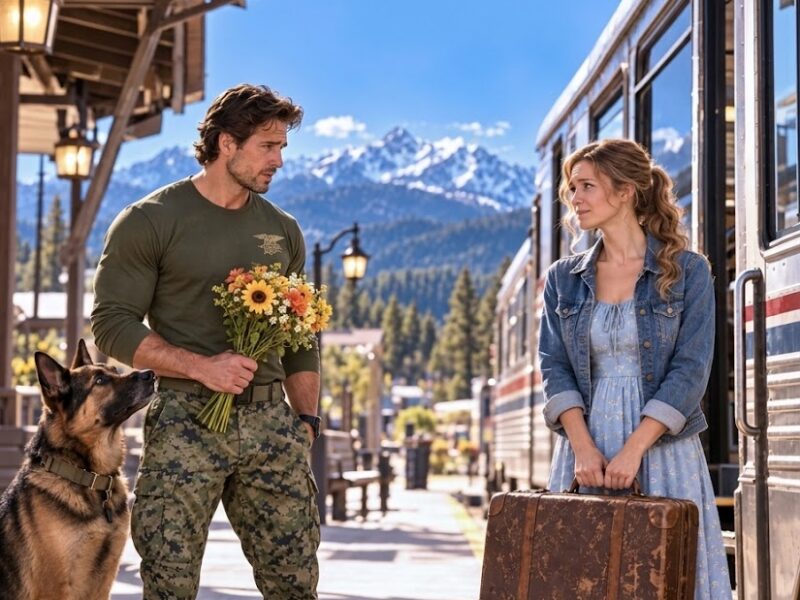
A former Navy SEAL waited at the train station for a woman he’d never met. Then another woman stepped off the train and said five words: “She isn’t coming.”
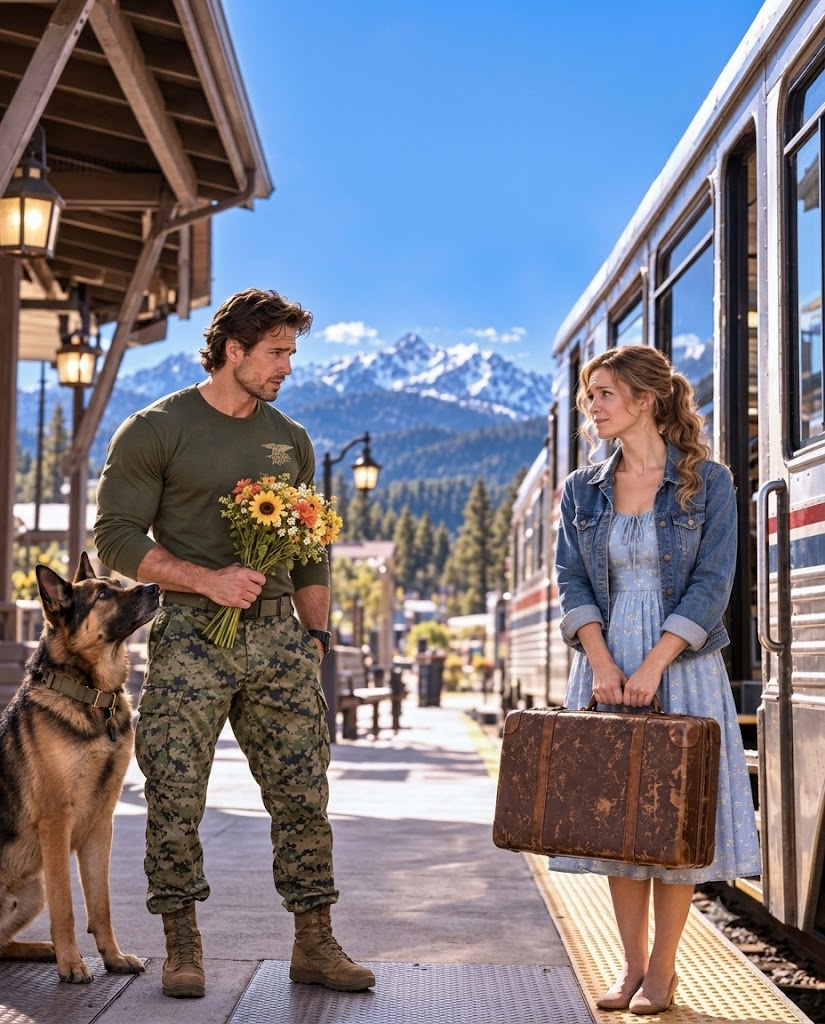
She should be here any minute.
Former Navy SEAL Owen Callahan glanced toward the arriving train, a bouquet of yellow and orange flowers in his hand. Beside him, Gus, his German Shepherd, sat patiently, watching the passengers step onto the platform.
Vanessa.
The woman stopped and looked at him apologetically. “I’m sorry. I’m not Vanessa. She isn’t coming. She asked me to give you this.”
Owen stared at the envelope, struggling to understand. “And you came all this way just to bring me a letter?”
“I promised her I would.”
“Did she tell you why?”
“I think you should read it yourself.”
Owen looked down at the flowers he had chosen so carefully, while Gus rested his head against his leg. The woman’s name was Megan Brooks, and she had every intention of leaving the next morning. But a missed train, a struggling ranch, and a secret from eight years earlier would soon turn this disappointing morning into a story neither of them could have planned.
—
Cedar Ridge Ranch occupied nine hundred acres of Montana countryside, twelve miles from Whitefish, where the lower pastures were beginning to turn green beneath mountains that still carried the last of winter’s snow. There were two barns, several horse corrals, a weathered farmhouse, and a six-bedroom guest house that had not welcomed a paying visitor in years. Farther south lay the hayfields that had helped the Callahan family feed its cattle through generations of long winters.
At thirty-five, Owen Callahan knew nearly every fence line on the property. His grandfather had expanded the original ranch. His father had spent a lifetime maintaining it, and Owen had come home eighteen months earlier after leaving the Navy, determined to keep it in the family. His years as a Navy SEAL had taught him to work under pressure, plan carefully, and rely on the people beside him. None of that had made the bank statements any easier to read.
His father had died four years earlier, leaving behind loans and maintenance costs that never seemed to decrease. His mother had passed away two years later, and his older sister now lived in Oregon with her own family. Most evenings, Owen ate dinner at a kitchen table large enough for eight. Gus, his eight-year-old German Shepherd, usually occupied the space beneath it.
The two had worked together during Owen’s final years of military service, and Owen had adopted him after the dog retired from duty. Gus still responded to familiar commands with remarkable precision, although he had developed a habit of stealing one of Owen’s boots and carrying it onto the porch whenever he felt neglected.
On the morning Vanessa Whitfield was due to arrive, Owen found his left boot beside the porch swing, where Gus had apparently left it sometime before breakfast. He retrieved it, gave the dog a disapproving look, and received an innocent tilt of the head in return. The swing itself had been repaired three days earlier. Owen had also cleaned the guest bedroom, replaced the towels, and asked Dale Henson, his sixty-eight-year-old ranch foreman, to make sure the driveway was cleared of the equipment that had accumulated over winter.
Dale had worked at Cedar Ridge since Owen’s father was a young man. He knew exactly what was happening and had been enjoying the preparations considerably more than Owen.
By the time Owen finished feeding the horses and checking the morning’s work, Dale was already leaning against the barn, watching him put Gus into the pickup. “Don’t worry about the cattle,” Dale said. “I’ll handle them. You just remember to say something when the lady gets off the train.”
Owen gave him a look and climbed into the driver’s seat.
Eight months earlier, he had met Vanessa at a fundraising event for veterans and retired working dogs in Spokane. Their mothers had known each other through community activities, although Owen and Vanessa had barely spoken before that afternoon. She had taken several photographs of Gus and sent them to Owen afterward, giving them a reason to begin exchanging messages. The messages eventually became regular Saturday evening phone calls.
Vanessa was twenty-eight, worked in event planning, and had a comfortable life in Spokane, where her parents still lived. She was easy to talk to, and Owen had gradually grown fond of the way she could make an ordinary conversation last an entire evening. For a man whose work had kept him away from home for much of his adult life, those conversations had come to mean a great deal.
He had begun imagining what Cedar Ridge might be like with someone else living there, someone who would share the ordinary pleasures of a place he had spent so many years trying to protect. Vanessa had agreed to spend a few days visiting him in Montana. It would be their first proper date since that brief afternoon in Spokane, and Owen had approached the occasion with the seriousness he usually reserved for matters he considered important.
What he did not know was that Vanessa had begun having second thoughts after their conversation two evenings earlier, when he finally told her how much financial trouble the ranch was facing.
On his way into Whitefish, Owen stopped at a small market where an elderly woman was arranging flowers outside her store. When he admitted he needed something for a first date, she recommended a generous bouquet of yellow and orange marigolds. She assured him they were hardy flowers that stayed beautiful for a long time. That sounded like a good quality to Owen, so he bought them without asking another question.
The train arrived while the morning was still cool. Owen stood on the platform with Gus beside his leg, the dog’s leash resting comfortably in his hand. Families gathered their luggage. A man in a baseball cap hurried toward the parking lot, and several passengers stopped to check their phones before continuing toward the station. Owen watched each person step down. He had looked at Vanessa’s photographs often enough to recognize her immediately, or so he believed.
Yet the passengers continued toward the station, and the woman he was waiting for was nowhere among them.
Then someone called his name.
The woman approaching him had brown hair, a faded denim jacket, and a leather suitcase that had clearly seen more than one journey. She looked at the flowers first, then at Gus, before meeting Owen’s eyes with an expression that made him lower the bouquet slightly.
“Are you Owen Callahan?”
He nodded.
“I’m Megan Brooks. Vanessa asked me to give you something.”
She took a sealed envelope from her bag. Owen accepted it, although he made no attempt to open it immediately.
“Where is she?”
Megan hesitated. “She stayed in Spokane. I’m sorry.”
For a moment, Owen glanced toward the train, where the last passengers were collecting their belongings. He looked back at the envelope and noticed Vanessa’s name written neatly across the front.
“She couldn’t call me?”
“She thought a letter would be more personal. She wanted you to have a proper apology.”
Owen finally opened it. The entire message had been typed, with Vanessa’s handwritten signature beneath the final paragraph. Megan noticed his expression and looked at the paper.
“Well, she did sign it herself.”
The remark might have been amusing under different circumstances. Owen folded the letter and slipped it back into the envelope, careful not to crease the page any further. Vanessa had explained that she had enjoyed getting to know him, but the conversation about Cedar Ridge had made her reconsider what a future together might require. She had grown up with a comfortable, predictable life and did not believe she was prepared for the financial uncertainty or the responsibilities that came with the ranch.
Owen could understand someone being frightened by the problems he was facing. What troubled him was that Vanessa had allowed him to prepare for her arrival while she was already considering whether to come at all. He had spent eight months treating their relationship as the beginning of something permanent. Now he realized they had understood those same months quite differently.
“Is she all right?” he asked.
Megan nodded. Vanessa was at home, and there was no emergency. She had simply decided that going through with the visit would be unfair when she was no longer certain about the relationship.
Owen put the envelope away. He was disappointed, but Megan had traveled a considerable distance to deliver news she had not created, and he saw no reason to make an already uncomfortable morning worse for her. Gus had remained quietly beside him throughout the exchange. When Owen rested a hand against the dog’s neck, Gus leaned into the familiar touch before settling again at his side.
Megan looked at the bouquet again, and a faint smile crossed her face. “Can I ask why you bought marigolds?”
Owen explained what the elderly woman at the market had told him. Megan listened with increasing amusement before admitting that marigolds were more commonly associated with gardens and seasonal decorations than romantic occasions.
“Well, it’s probably a good thing Vanessa didn’t come. With a bouquet like that, you might have gotten a slap instead of a letter.”
Owen looked at the flowers, then at Megan, and finally laughed. It was a brief, surprised laugh, but it made the morning a little easier to bear. He offered her the bouquet. Megan accepted it after a moment’s hesitation, carefully shifting her suitcase so she could hold the flowers without crushing them.
—
Their conversation turned to her journey. Megan explained that she had planned to spend the night in Whitefish before continuing to Shelby, where an aunt had offered her a place to stay for a while. She had known Vanessa since middle school, and delivering the letter had seemed a reasonable favor when she learned that her journey would take her through Whitefish.
Owen noticed the worn leather of her boots and asked whether she had worked around horses. Megan told him she had spent years caring for them and helping manage a boarding and training business in Spokane. That caught his attention. Dale had been talking about reducing his workload for months, and Owen was finding it increasingly difficult to handle both the daily work and the administrative responsibilities at Cedar Ridge.
He mentioned that the ranch could use someone with her experience, even if only for a few days. Megan seemed interested, although she reminded him that she already had somewhere to go. Owen took out his phone, sent her the ranch’s address, and told her she could call if she changed her mind. He made no effort to persuade her further.
Megan thanked him and started toward the parking lot, carrying the yellow and orange flowers that had been intended for someone else. Owen watched until she disappeared around the corner of the station, then took Gus back to the pickup.
That evening, Megan sat beside the window of her room at the Whitefish Motel. Her suitcase remained closed near the door, and the flowers stood in a drinking glass on the little table. She had already checked the following morning’s train and knew exactly when she needed to leave. Yet she kept thinking about the ranch Owen had mentioned.
She had come to Montana hoping that a change of surroundings would help her decide what to do with her life. Shelby would give her somewhere comfortable to stay, but she had no particular plans once she arrived. Working with horses again, even temporarily, was an opportunity she had not expected to find.
By the time she finished her coffee the next morning, she had changed her ticket and arranged a ride to Cedar Ridge.
—
Owen was repairing a gate near the barn when a taxi appeared on the gravel road. Gus lifted his head from the patch of morning sunlight where he had been resting, while Dale stopped what he was doing to watch the unfamiliar vehicle approach. Megan stepped out with the same leather suitcase she had carried at the station.
Owen set down his tools and walked toward her, plainly surprised to see her standing in his driveway.
“I thought you were going to Shelby.”
“I changed my plans. If the job’s still available, I’d like to give it a try.”
Owen glanced toward Dale, who had already begun smiling, then looked back at Megan. “How long?”
“Two days,” she replied. “That’s all I’m promising.”
Owen opened the gate for her, and Gus came over to investigate the visitor he had met only the day before. Megan bent slightly to greet him when Owen gave her permission, then followed the two of them toward the farmhouse. By the time Megan carried her suitcase onto the porch, Gus had already decided she deserved a second inspection. He sniffed the leather handle, circled once around her boots, and looked toward Owen as if waiting for instructions.
When Owen gave him permission, Megan offered the back of her hand and let the German Shepherd approach at his own pace. Gus accepted a brief scratch behind his ear before settling beside the front door. Apparently satisfied that the visitor could come inside, Owen showed Megan to a small bedroom at the back of the farmhouse where the window overlooked the eastern pasture.
There was a wooden dresser, a reading lamp, and a quilt that his mother had made years earlier. He explained that she could use the room during her stay and that it would not be deducted from her wages. They agreed on twenty-seven dollars an hour for the two-day trial. Megan would review the ranch’s records, help organize its purchasing arrangements, and assist Dale with the horses when needed.
Owen made it clear that she was free to leave after the trial, regardless of how much work remained. He spoke with the formality of a man hiring an employee, which was precisely what Megan wanted. Neither of them mentioned Vanessa.
After putting away her suitcase, Megan followed Owen outside for a tour of the property. Cedar Ridge was considerably better maintained than she had expected. The fences were sound, the cattle looked healthy, and the barns were old but clean and serviceable. A tractor was parked beneath a covered equipment shed, while two younger horses watched them from a corral beside the main barn.
The ranch needed attention, but it had not been neglected. Its difficulties were less obvious than the ones Megan had imagined during the drive from Whitefish. Owen introduced her to the daily routine and explained which responsibilities Dale had gradually taken over as his father grew older. Since returning from the Navy, Owen had assumed most of the remaining work himself, from equipment maintenance and livestock management to purchasing, accounting, and dealing with the bank.
Dale was sixty-eight, though he disliked any suggestion that his age should influence what he was allowed to do. He had worked at Cedar Ridge for so long that he could remember when the current equipment shed had been nothing more than an open patch of ground. He greeted Megan politely, but his manner suggested that he intended to reserve judgment.
Over the years, he had encountered plenty of people who admired ranch life from a distance. Some arrived with elaborate business ideas, while others discovered that caring for animals was considerably less romantic when it involved frozen water lines, unexpected veterinary bills, and working through holidays. Megan understood his skepticism and made no attempt to talk him out of it.
She spent the first morning at the office desk beside the kitchen, where Owen had collected several months of invoices, delivery slips, and handwritten notes in a cardboard file box. His records were reasonably organized, but the demands of running the property had left little time for checking them. By noon, Megan had identified two feed invoices that appeared to have been paid twice.
She checked the bank transactions against the delivery records before marking them for confirmation with the supplier. She also noticed that Cedar Ridge frequently placed smaller orders than necessary, paying additional delivery charges that might have been avoided with a more predictable purchasing schedule. None of the individual amounts was particularly alarming. Together, however, they represented money the ranch could not afford to lose.
Owen came inside shortly after lunch, carrying the smell of engine oil and damp earth from a morning spent repairing a tractor. Megan showed him what she had found, separating confirmed expenses from the transactions that still needed to be checked. He studied the figures without interrupting her.
“How much do you think we’re losing?”
“Enough that it’s worth fixing, but I want to speak to the suppliers before I put a number on it.”
Owen appreciated that answer. She was willing to identify a problem without pretending she already knew everything about it.
That afternoon, Megan joined Dale at the horse corral. Three young horses were being prepared for sale later in the summer, and one chestnut mare had been unusually reluctant to settle whenever someone entered her enclosure. Megan watched the mare for several minutes before stepping through the gate. She kept the lead rope loose, allowed the animal enough room to move, and paid attention to the position of its ears and shoulders.
When the mare became restless, Megan stopped and gave her time rather than trying to force the lesson forward. Dale leaned against the fence and observed her work. He offered a suggestion when the mare began drifting toward the gate, and Megan adjusted her position without taking offense. By the end of the session, the horse was following her calmly for short stretches, though Megan knew they would need several more sessions before the behavior became reliable.
Dale seemed considerably more interested in her qualifications after that. When Owen arrived to collect a set of tools from the barn, Dale informed him that Megan had already accomplished more with the mare than he had expected. He added that Owen might want to visit the train station more often if that was where he intended to find good employees. Megan laughed while Owen shook his head and continued toward the equipment shed.
—
The first disagreement came before supper. Megan had noticed an old hay rake parked behind the shed along with several pieces of equipment that appeared to be used infrequently. She suggested they identify anything that could be sold without affecting operations. Owen agreed with the general idea until she mentioned the rake.
His father had bought it secondhand when Owen was still a boy and rebuilt much of its mechanism himself. It was no longer their primary machine, but Owen had kept it in working condition as a backup. Megan pointed out that unused equipment still took up space and required maintenance. Owen replied that replacing an old machine in the middle of haying season could cost considerably more than keeping it.
The discussion ended without a decision. Later, Megan noticed an older photograph hanging beside the office door. Owen’s father stood next to the same rake, with a much younger Owen sitting on its frame and grinning at the camera. She crossed the rake off her preliminary list of equipment to sell. It was a small decision, but it reflected something she had begun to understand about Cedar Ridge. The ranch was a business, yet many of its ordinary objects belonged to a family history that could not be measured entirely in dollars.
Rain moved across the valley that evening, leaving the farmhouse windows streaked with water and filling the kitchen with the occasional sound of dripping from the porch roof. Owen cooked supper while Megan finished sorting the invoices. Dale had gone home, leaving the two of them to eat at opposite ends of the kitchen table with Gus stretched comfortably between their chairs.
Megan explained that consolidating certain orders, correcting the duplicate payments, and comparing suppliers could reduce unnecessary expenses. Even with those improvements, she could see that the financial pressure Owen was facing went beyond inefficient purchasing. She asked whether a substantial payment was coming due.
Owen set down his fork. He was accustomed to discussing difficult matters when there was a clear purpose, but talking about the ranch’s debts with someone he had met only two days earlier felt uncomfortably personal.
“There’s a payment at the end of August,” he admitted.
Megan waited, giving him an opportunity to say more. When he returned his attention to his plate, she understood that he was not ready to discuss the amount. She did not press him. Instead, she explained that reducing expenses would help the ranch operate more efficiently, but ordinary savings could not be expected to resolve a major financial obligation within a few months. Eventually, they would need to examine the wider business, its income, and what resources were available.
Owen nodded. He had known that for some time, although hearing it from another person made the problem harder to set aside.
The next morning brought clear skies and cold air that smelled of wet grass. Megan was already in the office when Owen came downstairs, having started a spreadsheet to compare feed prices, delivery schedules, and monthly purchasing costs. She spent part of the day contacting suppliers and confirming the duplicate payments. One agreed to issue a credit, while the other requested copies of the relevant records before making a correction.
By the afternoon, she had prepared a practical list of changes that could be introduced without disrupting the work Dale and Owen were already doing. She also separated the suggestions that required additional information from those that could be implemented immediately. Owen read through her notes at the kitchen table. He did not agree with every recommendation, but he could see that Megan had taken the time to understand how the ranch operated before proposing changes.
Her experience was useful, and the way she handled disagreement made it easier for him to consider ideas he might otherwise have dismissed. Before supper, he offered her a four-week position as a part-time operations coordinator. The arrangement would provide approximately twenty-four paid hours each week at the same hourly rate, with her room available for the duration of the agreement.
Megan considered the proposal carefully. She had left Spokane intending to put some distance between herself and the life she had spent nearly seven years building. During that time, she and her former boyfriend had operated a horse boarding and training business together. They had started modestly, expanded gradually, and eventually reached a point where she believed they had created something permanent.
Her boyfriend had begun making plans for a different business long before he admitted he wanted to leave. When their disagreements finally became impossible to ignore, the partnership and their relationship ended within the same difficult period. Megan had received the money and property legally owed to her, but the settlement did little to replace the work that had structured her days or the future she had expected to share with someone.
Her parents still lived in Spokane and would have welcomed her home. She loved them, but she had no desire to return to her childhood bedroom while everyone she knew offered advice about what she ought to do next. Her aunt in Shelby had offered her a place to stay while she considered her options. Until arriving at Cedar Ridge, Megan had been willing to accept that arrangement simply because she could think of nothing better.
Now she had the possibility of doing familiar work in a place where nobody expected her to explain what had gone wrong. She accepted Owen’s offer. He thanked her, then made a note to prepare the employment paperwork. Megan smiled at the seriousness with which he approached an arrangement they had already discussed in considerable detail.
Over the next few days, the farmhouse developed a routine that was new to both of them. Megan worked through the purchasing records each morning, spent time with the horses when Dale needed assistance, and gradually learned where Owen kept the tools, spare keys, and supplies. Gus became particularly interested in the changes. He began sleeping beside Megan’s desk during the afternoon, although he still followed Owen whenever there was work to be done outside.
One morning, Megan opened her bedroom door and discovered one of Owen’s boots placed neatly on the floor. Gus sat several feet away, watching her with evident satisfaction. When she carried the boot into the kitchen, Owen took one look at it and called the dog over. Gus obeyed immediately, then settled beside Megan’s chair as if the matter had nothing to do with him.
The incident gave them something to laugh about over breakfast, but Owen remained careful about allowing their growing familiarity to become something he did not yet understand. He liked having Megan at Cedar Ridge. He appreciated her practical judgment, her willingness to work, and the way she treated Dale without making him feel that his age had diminished his value. Nevertheless, the disappointment of Vanessa’s letter was still recent, and Owen had no intention of confusing gratitude with the beginning of another relationship.
On Saturday evening, after the supper dishes were put away, he sat at the kitchen table with his phone beside an unfinished cup of coffee. For eight months, Saturday had been the evening when Vanessa called. Owen had often arranged his work around those conversations, sometimes finishing late in the barn so that he could be inside when the telephone rang. This time, there was no call.
From the other room came the quiet sound of Megan turning pages, followed by the familiar tapping of Gus’s nails as he followed her across the floor. Owen looked toward the doorway, then returned his attention to the phone. It took him a little while to put it away.
—
The Sunday after Megan agreed to stay, Owen found her in the kitchen with a cup of coffee and a notebook open beside the window. She had no work scheduled that morning, but she was making a list of things she needed from town, including a better pair of gloves and a replacement charger for her laptop. Owen had already been outside to feed the horses. Gus followed him into the kitchen, stopped beside Megan’s chair, and waited until she acknowledged him with a scratch behind the ears.
Owen noticed the flowers on the windowsill. Megan had trimmed the stems of the marigolds he had given her at the station and placed them in a mason jar. He had expected her to throw them away by now.
As May settled over the Flathead Valley, their days developed a comfortable rhythm. Megan usually began with the purchasing records, then helped Dale with the horses on the afternoons they had scheduled for her. Having someone take responsibility for the paperwork allowed Owen to spend more time repairing equipment and catching up on maintenance that had been neglected during the winter.
The change was noticeable, although Owen had a peculiar way of making ordinary work more complicated than it needed to be. Years in the Navy had left him with a preference for preparation and clear instructions. His tools were arranged before each job. The truck was stocked the night before a long workday, and he rarely began something without deciding how he intended to finish it.
Unfortunately, he sometimes forgot that other people had not spent years learning to understand his abbreviated directions. One morning, Megan spent twenty minutes looking for a particular fitting because Owen had told her it was in the maintenance cabinet without mentioning that he meant the cabinet in the smaller barn. When she finally found him, she explained that a complete sentence would probably save them both a considerable amount of time.
Dale overheard the exchange and spent the rest of the morning informing Owen that civilian life was a wonderful place where people were permitted to ask questions. Owen accepted the criticism with reasonable grace, although he continued to prefer instructions that contained as few words as possible.
Gus, meanwhile, had begun dividing his attention between the two people who now lived in the farmhouse. He still accompanied Owen on his morning rounds, but he had discovered that Megan sometimes kept a biscuit in her desk drawer and was considerably more willing to interrupt her work than Owen’s. Megan also noticed that he needed longer periods of rest after accompanying Owen around the property. The dog remained healthy and interested in everything happening around him, but eight years had begun to make a difference.
She mentioned that the longer walks might be easier on him if Owen allowed more time for breaks. Owen initially dismissed the suggestion, then caught Gus settling beneath a cottonwood halfway through their afternoon round. The following day, he shortened their route.
By the middle of May, the duplicate feed payments had been corrected, and Megan had arranged more economical deliveries with the suppliers. The improvements saved money, though Owen knew they would do little to change the larger problem waiting for him at the end of summer.
That problem arrived in a silver SUV on a Thursday afternoon. Trevor Callahan stepped out wearing polished boots and carrying a leather folder. At forty-three, Owen’s older cousin had spent most of his professional life in real estate investment, and he approached Cedar Ridge with a practical understanding of land values that rarely included what happened on the land itself.
His father had inherited a minority interest in the family business after leaving Montana, and Trevor now held twenty-five percent of Callahan Land and Cattle LLC. He had no desire to manage cattle or spend his mornings repairing fences, but he believed his share of the property ought to produce a reasonable financial return.
Owen met him on the porch. Megan was working at the office desk near the kitchen, close enough to hear the conversation when Trevor began discussing the latest offer from Summit Ridge Development Group. The company wanted to purchase South Meadow, approximately two hundred twenty acres along the southern portion of Cedar Ridge, for a proposed vacation property development.
Trevor considered the offer generous. The sale would provide enough money to cover the most pressing debts and leave the company with a substantial financial cushion. Owen understood the numbers. What Trevor continued to overlook was that South Meadow contained the ranch’s principal hay fields, its irrigation pump, and the access route used to move equipment between several working areas.
Selling it would mean purchasing more winter feed and operating the remaining property at considerably higher expense. The immediate relief could leave Cedar Ridge in a weaker position within a few years. Trevor placed the folder on the porch railing.
“You’re protecting land you can’t afford to keep.”
“I’m protecting the part that helps us afford the rest.”
Trevor reminded him that ninety-five thousand dollars was due to Cedar Basin Agricultural Lending by August thirty-first. If the company failed to meet that obligation, its options would become considerably narrower, and Trevor had no intention of supporting another refinancing proposal without a convincing plan. He was not threatening to seize the property himself. The company had borrowed against its assets, and a payment default would place the ranch in a difficult position with its lender.
Trevor believed selling South Meadow beforehand was the sensible alternative. Owen refused to accept the offer that afternoon. When Trevor drove away, the silence he left behind was less comfortable than the one that had preceded his arrival. Owen went back to work without discussing the meeting, while Megan finished the records she had been reviewing. She had heard enough to understand that the ranch was facing a much larger problem than inefficient purchasing.
That evening, Owen brought a folder to the kitchen table after supper. Inside were the loan documents, payment schedule, recent financial statements, and a copy of the company’s operating agreement. He had kept the worst of the financial pressure to himself since returning home, partly because he considered the ranch his responsibility and partly because admitting how little progress he had made was difficult.
Megan read through the documents without interrupting him. She had managed the books for her former business and knew the difference between an operation that was losing money and one that could no longer meet its obligations when payments came due. Cedar Ridge still had productive land, livestock, equipment, and customers. Its problem was that too much of its money was committed before the season’s income arrived.
She made several notes, then worked through the figures a second time. The purchasing changes would help. So would better planning for equipment repairs and the sale of machinery the ranch no longer needed. Even combined, however, those measures would not produce ninety-five thousand dollars by the end of August.
Megan set down her pencil and asked Owen to show her the guest house. The building stood beyond the main barn, partly sheltered by a row of cottonwoods. Owen’s grandparents had once used its six bedrooms to accommodate relatives and visiting ranchers, but after they died, the house gradually became a place to store old furniture, spare bedding, and household items nobody wanted to discard.
Megan walked through the rooms, checking the windows, doors, floors, and plumbing. The building needed cleaning, minor repairs, and a thorough inspection before it could accommodate paying guests, but its basic structure appeared sound. She suggested opening a small number of rooms during the summer and expanding only if the arrangement proved worthwhile. With Whitefish and Glacier National Park attracting visitors throughout the warmer months, she believed Cedar Ridge could offer something different from a conventional hotel—a quiet stay on a working ranch with opportunities to enjoy the surrounding countryside.
Owen was skeptical. He had grown accustomed to the privacy of Cedar Ridge and could already imagine strangers wandering into the barns, leaving gates open, or asking him to interrupt his work for a photograph. Megan proposed limiting the number of guests, establishing clear boundaries around the working areas, and keeping the cattle operation separate from the lodging business. They would also need to confirm the applicable lodging requirements, insurance coverage, and building safety conditions before accepting reservations.
Dale inspected the guest house with them the next morning. He complained about the condition of the porch railing, examined the plumbing beneath the kitchen sink, and eventually admitted that the place was in better shape than he had expected. After comparing the necessary expenses with a conservative estimate of the possible income, Owen agreed to prepare two rooms as a trial.
—
The following weeks brought more work than any of them had anticipated. Owen repaired the plumbing, replaced damaged fittings, and dealt with a bathroom door that had apparently decided it no longer wished to close properly. Dale rebuilt part of the porch railing, insisting that the materials available twenty years earlier had been better than anything sold in town today. Megan sorted the linens, arranged the furnishings, developed a cleaning schedule, and began preparing the online listing.
She also worked with Owen to establish rules for guests, including the areas where visitors were permitted and the arrangements for anyone interested in activities involving the horses. Some jobs went smoothly. Others seemed determined to occupy an entire afternoon. Owen, who could repair a heavy ranch gate without much difficulty, spent nearly three hours assembling a new wardrobe for one of the bedrooms. Megan eventually discovered that he had installed one of the panels backward, and Dale offered to write a letter of complaint to the manufacturer on his behalf.
Gus contributed by lying directly in the doorway with a chew toy between his paws. Every time someone stepped over him, he looked up as though the interruption had been entirely unnecessary. Between those ordinary frustrations, Megan learned more about the man who owned Cedar Ridge. Every Sunday, Owen replaced the flowers beside a photograph of his parents in the farmhouse hallway. He called his sister in Oregon regularly, and although he rarely spoke about his years in the Navy, he sometimes mentioned people he had served with when a particular memory came naturally into conversation.
One evening, while they were carrying furniture into the guest house, Owen admitted that he had considered selling the ranch during his first months after leaving the service. His mother had been gone, the debts were mounting, and he had struggled to adjust to a life in which the responsibilities never seemed to end. He had stayed because he wanted to give Cedar Ridge a genuine chance, even if doing so meant accepting a future very different from the one he had imagined while still in uniform.
Megan listened without offering an easy answer. She understood what it meant to spend years building something and then face the possibility that it might no longer be part of her life. By the final week of May, the first two guest rooms were ready. The necessary arrangements had been confirmed, and Megan was preparing the last photographs for the listing.
As she reviewed their plans for the opening, she mentioned that they could consider preparing another room if the first few reservations went well. Owen noticed that she had begun speaking about Cedar Ridge as though she belonged to its future. He did not draw attention to it, but he found himself looking forward to the evenings when they reviewed the day’s work together.
The first reservation arrived in early June. A couple from Illinois booked several nights while planning a trip to Glacier National Park. Two more inquiries followed before the end of the week, and even Dale appeared impressed when Megan showed him the confirmation on her laptop. Owen allowed himself a cautious smile. The additional income was welcome, and for the first time in months, they had a practical reason to believe the business could improve.
Later that afternoon, an automated notice arrived from Cedar Basin Agricultural Lending. It confirmed the outstanding balance and reminded Owen that the required payment remained due on August thirty-first. He printed the notice and placed it beside Megan’s financial projections. The guest house was ready to welcome its first visitors, but Cedar Ridge still had a long way to go before the summer was over.
—
The first guests arrived at Cedar Ridge on a Thursday afternoon in early June, just as Owen was finishing a repair on the fence beside the eastern pasture. Martin and Elaine Price had driven from Illinois in a well-traveled SUV with a cooler in the back and a printed itinerary for their visit to Glacier National Park. They had been married for thirty-eight years and had spent much of their retirement traveling to places they had talked about visiting when they were younger.
Cedar Ridge was supposed to be a quiet stop before they continued north, but Elaine became interested in the ranch almost as soon as she stepped out of the vehicle. While Megan helped them settle into their room, Martin wandered toward the porch and spent several minutes admiring an old windmill that Owen had been meaning to repaint. Owen couldn’t understand what made an ordinary piece of ranch equipment worth photographing from three different angles.
The following morning, the couple asked whether they might watch the horses being fed. Owen explained the safety rules, showed them where to stand, and answered their questions with the same careful precision he had once used when instructing younger men during his Navy years. Unfortunately, his explanation sounded considerably more like a safety briefing than a conversation with two people on vacation. Megan stood nearby, occasionally adding a friendlier explanation whenever Owen became too technical. By the time the couple returned to the guest house for breakfast, even Owen had begun to enjoy their curiosity.
The Prices stayed four nights instead of three. They spent their mornings exploring the surrounding countryside and their evenings sitting outside with coffee, watching the sun disappear beyond the western fields. Before leaving, Elaine told Megan that Cedar Ridge had reminded her of the summers she had spent visiting her grandparents as a girl. She promised to recommend the place to several friends who preferred peaceful vacations to crowded resorts.
Their review appeared online two days later. Three more reservations followed before the end of the week. Megan gradually developed a routine for the lodging business. She adjusted the room rates according to demand, arranged cleaning between reservations, and organized small activities that allowed visitors to experience ranch life without interfering with the animals or the work.
Owen discovered that he enjoyed teaching people who were genuinely interested in learning. His instructions remained practical, but he became more patient with questions that would once have seemed unnecessary. Gus also adjusted to the unfamiliar activity. Owen had established a quiet area for him away from the guests, and nobody was permitted to approach the dog without permission.
During one afternoon gathering, a guest asked what happened to military working dogs when they retired. Owen explained that their needs varied according to their training, health, and individual temperaments. He described how Gus had become part of his civilian life and demonstrated a few familiar commands before allowing the dog to return to his resting place. Gus performed the exercises without difficulty, then promptly settled beside Megan’s chair, making it clear that his preferred activity involved considerably less effort.
The lodging business was beginning to produce income, although its expenses were still substantial. Repairs, supplies, insurance, utilities, and the work required to prepare additional rooms all reduced the money that Cedar Ridge could actually keep. Megan was pleased with their progress, but she continued to treat the new revenue as part of a larger plan rather than a solution to the ranch’s debts.
By late June, four guest rooms were ready, and Owen had grown accustomed to seeing unfamiliar vehicles in the driveway. He had also become accustomed to eating supper with Megan and Dale, something he had rarely done before Megan arrived. The kitchen was no longer a place where he hurried through a meal before returning to his paperwork. Sometimes Dale stayed long enough to tell a story about Owen’s father, and Megan seemed to possess a remarkable ability to encourage him without ever asking for another.
Owen had begun noticing other things about her as well. She preferred her coffee strong, left her reading glasses in inconvenient places, and had a habit of humming when she was concentrating on the accounts. Whenever he returned from a long day outside, he found himself wondering whether she had finished her work or was still sitting at the kitchen table. He was becoming fond of a life he had never intended to share with her.
—
On the first Saturday in July, Dale announced that he was going to a summer street fair in Whitefish. He intended to meet several old friends, listen to the local country band, and eat enough food to make his doctor’s next appointment unnecessarily complicated. He also insisted that Owen and Megan accompany him.
Owen initially refused, explaining that the following week would be particularly busy. Megan was willing to stay at the ranch, but Dale had already arranged for a neighbor to check on the animals that evening and saw no reason for either of them to spend another Saturday working. When Owen appeared downstairs shortly before they left, Dale studied him for a moment and asked whether the shirt he was wearing was new. Owen admitted that it was.
Dale seemed deeply satisfied with the answer, although he wisely waited until they reached the truck before informing Megan that Owen had apparently begun purchasing clothes for occasions other than work.
Whitefish was lively that evening. Strings of lights hung above the street. Food vendors served barbecue and homemade desserts, and a local band played near an open area where couples had begun dancing. Megan stopped to look at a display of handmade pottery while Dale disappeared toward a group of friends outside a nearby restaurant.
Owen followed her through the crowd, occasionally pointing out businesses he remembered from his childhood. They bought lemonade and listened to the music for a while. Megan had rarely seen Owen away from the responsibilities of Cedar Ridge, and she found his occasional awkwardness more endearing than the confidence he displayed when working.
When the band began playing something slower, Owen held out his hand and asked if she wanted to dance. He knew the basic steps, though he had little practice. Megan followed his lead without commenting when he lost the rhythm, and after a few minutes, he stopped worrying about what his feet were doing. For the length of the song, there was no need to discuss bank payments, reservations, or the work waiting for them.
The following morning, Megan rested her hand against his shoulder. Owen looked down at her and realized that he had been looking forward to this evening for reasons that had very little to do with Dale’s insistence that they attend the fair. When the music ended, neither was particularly eager to return to the truck.
During the drive home, Megan watched the lights of Whitefish disappear behind them. She had spent years with a man who could speak enthusiastically about plans they would supposedly share, only to discover that he had been preparing a different future without telling her. Owen rarely made promises he couldn’t keep. He could be stubborn and occasionally difficult to understand, but when he said he would do something, she had learned that she could depend on him. That was becoming more important to her than she cared to admit.
—
The following weeks brought hotter afternoons and several brief thunderstorms. Cedar Ridge remained busy, and Owen and Megan had little time alone beyond the ordinary hours they spent together after work. One afternoon in the middle of July, Owen decided to clear some personal belongings from the office to make room for additional guest records. He brought a wooden box from an upstairs closet and began sorting through its contents at the kitchen table while Megan organized a new set of booking confirmations.
The box contained photographs, military mementos, old letters from his parents, and several small objects Owen had kept during his years away from Montana. As he moved a stack of photographs, a little blue object slipped onto the table. Megan reached over to keep it from falling. It was a small enamel pin shaped like a horse, dark blue with a narrow brass border. One of its ears had a tiny chip where the enamel had broken away.
She turned it over in her hand, studying the familiar shape. “Where did you get this?”
Owen looked up from the photographs. He had nearly forgotten that the pin was in the box, although he remembered the circumstances under which he had received it. Eight years earlier, during a short period of leave, he had been driving near Spokane when he noticed a man having trouble with a truck and horse trailer. Owen stopped to help, and after they managed to get the vehicle somewhere safe, the man invited him to a nearby boarding and training facility while they waited for a repair service.
The man had been friendly and talkative. They spent much of the afternoon discussing horses, life in Montana, and Owen’s work in the Navy. Before Owen left, the man gave him the little horse pin as a thank you. Megan had stopped looking at the pin. She was watching Owen.
“Was the place called Brooks Equestrian?”
Owen considered the name. He remembered a broad gravel driveway, several low barns, and a wooden sign beside the entrance. The name sounded familiar.
“That was my father’s place.”
For a moment, Owen seemed to think he had misunderstood her. Megan turned the pin so that the damaged ear was visible and explained that she had designed a small collection of those pins for a fundraising event at the facility. The one Owen was holding had been set aside because it was damaged, and her father had apparently kept it in his desk.
She remembered the afternoon, too, although only in fragments. A young serviceman had helped her father with the truck, and the two men had spent most of their time talking while she was occupied with customers and preparations for an upcoming event. She had seen the visitor briefly when he came inside for coffee, and again as he was preparing to leave. She hadn’t learned his name, and the encounter had never seemed important enough to remain clear in her memory.
Owen remembered a young woman moving between the office and the stables, carrying a clipboard and answering questions from several customers. He had spoken mainly with her father and had no reason to imagine that their paths would cross again. Eight years had passed since that afternoon. Owen had completed his service and returned to Montana, while Megan had spent much of her twenties building a business that no longer existed. Neither had recognized the other at Whitefish Depot.
Now they sat across from each other, looking at a little blue horse that had traveled through most of Owen’s adult life. Megan laughed first, shaking her head at the improbability of it. Owen took out his phone and found a photograph of himself from that period, which only made her laugh harder when she recognized the young man she had barely noticed at her father’s facility.
She called her father that evening. He remembered Owen’s visit, particularly how the young sailor had refused payment for helping with the trailer. When Megan explained who Owen was and how they had met again, her father seemed delighted by the news.
The conversation continued after supper, moving from their unexpected connection to the different lives they had led since that afternoon. Owen spoke about the difficult transition from military service to managing Cedar Ridge, while Megan admitted that she had once believed the business in Spokane would remain her home for the rest of her working life. Neither tried to make the years between their first meeting and the present sound like part of some carefully arranged plan.
Their connection had grown from the work they shared, the disagreements they had resolved, and the quiet pleasure of being together. The little horse was simply one more thing they now had in common. As the evening grew late, Owen put the photographs back into their box. Megan was still holding the pin when he sat beside her, and after a moment, he gently took her free hand.
He leaned toward her slowly enough to give her time to move away. Instead, Megan closed the remaining distance, and their first kiss was quiet and unhurried. For several minutes afterward, they remained together at the kitchen table, listening to the familiar sounds of the farmhouse settling around them. Gus slept near the doorway, entirely uninterested in the significance of the occasion.
They both understood that the ranch still faced serious financial difficulties. Their relationship was also new, and neither wanted to make promises about a future they had barely begun discussing. But the following morning, when Owen found Megan preparing coffee, he greeted her with a kiss before going outside to feed the horses. Dale noticed the change before breakfast was over and seemed unusually pleased with himself, though he refrained from explaining why. Gus, meanwhile, had discovered that Megan was considerably more generous with his favorite treats than Owen had ever been.
—
By the middle of July, Cedar Ridge was receiving more reservations for the remaining summer weeks. Megan posted photographs of the guest house, the surrounding pastures, and some of the activities available to visitors. With their permission, she also shared a few pictures of the guests, including one of Owen and Gus standing beside the horses.
Several hundred miles away in Spokane, Vanessa Whitfield came across the photographs while looking through her social media feed. She had imagined Owen struggling alone on a failing ranch, burdened by debts and responsibilities that would eventually consume everything he had. The pictures showed a different life. Visitors enjoying the property, a thriving guest house, and Owen looking more relaxed than she remembered him.
She recognized Megan in one of the photographs. Vanessa knew that a few cheerful pictures couldn’t tell her everything about Cedar Ridge, but they made her reconsider the decision she had made in April. She had spent months avoiding the discomfort of what she had done, telling herself that ending the relationship had been the sensible choice.
Over the next several days, she returned to those photographs more often than she expected. Eventually, she decided that if she wanted to apologize properly, she would have to do it herself. This time, she made plans to drive to Montana.
By the last week of July, the gravel driveway at Cedar Ridge had become busier than Owen Callahan could remember. Guests arrived with suitcases, hiking boots, and plans to explore Glacier National Park. The four renovated rooms were regularly occupied, and several visitors had already asked about returning the following summer. Owen still found it strange that people were willing to pay to spend their vacations on a working cattle ranch. Nevertheless, he had begun enjoying the conversations that took place over breakfast and the occasional satisfaction of watching someone discover an interest in horses.
Megan handled reservations, purchasing, and the daily arrangements for guests, while a local cleaner helped prepare the rooms on busy weekends. Her paid hours and responsibilities were recorded separately from her personal relationship with Owen, and he had learned to trust her judgment without expecting her to seek his approval for every routine decision.
Dale considered the arrangement a considerable improvement. He could finally spend more time with the horses instead of trying to keep track of every supply order. And Owen no longer insisted on personally supervising work that someone else was perfectly capable of doing. The ranch was becoming a better place to work.
Unfortunately, that did not mean it was out of trouble. The guest house had brought in a welcome source of income, but renovations, wages, supplies, and ordinary operating expenses had absorbed a substantial portion of the revenue. Cedar Ridge still had ninety-five thousand dollars due to Cedar Basin Agricultural Lending by August thirty-first, and the money available was nowhere near enough.
Trevor Callahan had continued sending Owen updates from Summit Ridge Development Group. The developer remained interested in South Meadow, and Trevor believed the approaching deadline made selling the land the only sensible choice. Owen had reviewed the proposal more than once. A sale would resolve the immediate financial pressure, but the loss of the hay fields and irrigation system would make it considerably more expensive to maintain the remaining cattle operation. He had no intention of sacrificing the ranch’s future simply to make the next bank statement look better.
One particularly warm afternoon, Owen was working beside the equipment shed when an unfamiliar car came up the driveway. Gus, who had been resting beneath the shade of the porch, raised his head and watched the vehicle approach. Owen wiped his hands on a shop towel and stepped away from the shed.
When the driver’s door opened, he recognized Vanessa Whitfield immediately. For a moment, the sight of her brought back the morning at Whitefish Depot. He remembered the bouquet of marigolds, the empty space where she should have been standing, and the letter that had ended eight months of conversations.
Vanessa looked much as he remembered her, although she seemed less certain of herself as she walked toward him. She had driven from Spokane without telling him she was coming, and the journey had given her several hours to rehearse a conversation that suddenly seemed difficult to begin. She apologized for arriving unannounced and asked whether they might speak privately.
Owen led her to the shaded end of the porch. Gus followed them as far as his usual resting place, then settled down where he could see the yard. Vanessa began by apologizing for the way she had ended their relationship. She admitted that she should have called Owen herself instead of asking Megan to deliver the letter and that leaving him waiting at the station had been thoughtless.
She had been frightened when he told her about the ranch’s financial difficulties. Until then, she had pictured a quieter, more comfortable life in Montana, with plenty of time for the two of them to enjoy the countryside and travel together. The reality of managing a struggling business had been more than she felt prepared to accept.
Owen listened without interrupting. He had spent considerable time wondering why she had not been willing to tell him those things directly, and her explanation answered some of the questions that had remained with him since April. He accepted her apology.
Vanessa seemed encouraged by his response. She explained that she had seen the recent photographs of Cedar Ridge and was pleased that things appeared to be improving. The guest house, the visitors, and the positive reviews had made her reconsider what life with Owen might look like. She knew she had made a mistake. She told him, and she wondered whether they might give their relationship another chance.
Owen looked across the yard toward the barn. A few months earlier, the offer would have been everything he wanted to hear. He had imagined Vanessa sitting beside him on that porch and had worked hard to prepare a place for her in his life. But the house she would be entering now was different from the one he had prepared in April. And so was he.
“I’m glad you came to talk to me,” he said, “but I don’t think starting over is what I want anymore.”
Vanessa was quiet for a while. She had known there was a possibility he would refuse, but the photographs had made her believe that his disappointment might have faded without changing the feelings he once had for her. Before she could respond, Megan came around the side of the farmhouse carrying a folder of receipts from the guest house. She had been checking supplies and had no idea Vanessa was visiting until she saw the two of them on the porch.
She stopped, plainly surprised. Vanessa recognized her at once. For several seconds, neither woman spoke, and Owen became aware of how much the circumstances had changed since their last meeting. Megan greeted her politely and explained that she had been working at Cedar Ridge since shortly after their encounter at the station. She had taken a temporary position at first, then stayed as the ranch began expanding its operations.
Vanessa glanced at the folder in Megan’s hand, then toward the guest house. She had seen Megan in several of the photographs posted online, but she had assumed her old friend was simply helping Owen for a short time. Now it was clear that Megan had become an important part of the business, and the ease with which she and Owen stood beside each other suggested that their relationship extended beyond work.
Vanessa’s embarrassment gave way to a sharper disappointment. She had come prepared to apologize for walking away, but she had not expected to find that the friend who delivered her letter had taken a place in Owen’s life.
“So, you came here to help with the paperwork,” she said to Megan, “and somehow ended up with everything I was supposed to have.”
Megan had not expected the accusation, but she understood where it came from. She set the folder on a small table rather than continuing to hold it between them.
“I came here because Owen offered me a job and I needed one. What happened after that was our decision.”
Vanessa looked away, then returned her attention to Owen. She suggested that Megan had been hired to handle work he could not manage and had used his difficult circumstances to make herself indispensable. Megan’s expression became serious. She explained that she had been paid for her work from the beginning and had never asked Owen to make their professional arrangement into anything more. She had also arrived at Cedar Ridge with problems of her own, which she had no intention of using to justify taking advantage of anyone.
Owen stepped beside her. He had spent much of his adult life avoiding unnecessary confrontation, and the discipline he had learned in the Navy made it possible for him to remain composed even when a conversation became unpleasant. But he was not willing to let Megan’s character be questioned because of a decision Vanessa regretted making.
“That’s enough, Vanessa. Megan hasn’t taken anything from you.”
His voice was calm, but Vanessa stopped speaking. Owen explained that he had respected her right to choose a different future in April, even though the way she communicated that decision had hurt him. Since then, he had made choices of his own, and his relationship with Megan was one of them. He glanced at Megan before continuing.
“I love her. That has nothing to do with whether she can balance the books or help me run this place. I love her because I want to share my life with her, including the parts that aren’t going particularly well.”
Megan had known how he felt through the ordinary things they shared, but hearing him say the words so openly caught her by surprise. Vanessa looked at them for a moment, then lowered her eyes. She had come to Cedar Ridge believing she might recover something she had given up. Instead, she finally understood that Owen had begun building a future that no longer included her.
She apologized for what she had said to Megan. It was not a particularly graceful apology, and Megan did not pretend that the accusation had been harmless, but she accepted that Vanessa was trying to correct herself. Owen walked Vanessa to her car. Their farewell was polite, without promises of another meeting or any attempt to recover the closeness they once shared. Vanessa drove away, knowing that she had finally said the things she should have said in April, although the conversation had ended very differently from the one she had hoped to have.
—
Trevor had also arranged to visit Cedar Ridge that afternoon to discuss Summit Ridge’s proposal. He arrived as the day’s other business was winding down and spent a short time reviewing the latest figures with Owen in the office. His opinion had not changed. He still believed South Meadow should be sold, particularly now that the August payment was drawing closer. Owen acknowledged the financial argument but refused to approve the existing offer. Trevor left for Whitefish without an agreement.
By evening, the visitors had settled into their rooms. Dale had gone home, and the ranch was quiet, except for the occasional sound of a horse moving in its stall. Megan found Owen sitting on the porch with Gus stretched beside his chair. She brought two glasses of iced tea and sat down without immediately returning to the events of the afternoon.
Owen eventually admitted that he had wanted to tell her he loved her for some time. The words had been difficult to say while he was still uncertain whether he could keep Cedar Ridge, and he had worried that his financial problems would make any promise about their future feel premature.
Megan told him that she had been frightened of trusting someone again after the end of her relationship in Spokane. For nearly seven years, she had believed she was building a future with someone who was making different plans without her knowledge. Living at Cedar Ridge had gradually changed the way she thought about that experience. Owen could be stubborn and occasionally impossible to work with, but he was willing to listen when she disagreed with him, and she had never needed to guess whether he intended to keep his word.
She loved him, too. Neither suggested that their feelings would make the coming weeks any easier. They still had work to do, bills to pay, and difficult decisions to make. But they no longer needed to approach those responsibilities as though their relationship depended on one person protecting the other from every problem.
Gus lifted his head when Megan stood to take the empty glasses inside. He followed her through the doorway, prompting Owen to remind the dog that he was still the one who fed him every morning. Megan laughed from the kitchen, and Owen heard the familiar sound of a cupboard opening as she put the glasses away.
During the following days, their attention returned to the ranch. Owen and Dale began reviewing which cattle and horses could be sold at the end of August, while Megan contacted potential buyers and gathered the information needed to organize the sale. The preparations were practical, but the work was demanding. They had only a few weeks to find enough income to complete the bank payment, and even a successful summer at the guest house could not make up the difference on its own.
At the beginning of August, another offer from Summit Ridge arrived. The company had increased its proposed purchase price for South Meadow, and the amount was now high enough to cover the overdue obligations, clear other outstanding costs, and leave a substantial balance in the company’s account. Owen spread the documents across the kitchen table and studied the figure at the bottom of the final page.
He understood exactly what the money could do for Cedar Ridge. He also knew what the ranch would lose if he signed. Outside, the hayfields stretched toward the southern fence, and the irrigation pump was still running beneath the afternoon sun. Owen folded the documents back into their folder, knowing he would soon have to decide whether the security Trevor was offering was worth the land his family had spent generations keeping.
For three days, the new offer from Summit Ridge remained on Owen Callahan’s kitchen table. He had read it often enough to remember the important figures, but each morning before heading out to work, he found himself opening the folder again. The money would clear the payment due at the end of August, settle several smaller obligations, and leave Cedar Ridge with enough operating capital to get through the winter comfortably. For the first time in years, Owen could imagine running the ranch without constantly calculating how long the money in the bank would last.
But the offer required him to give up South Meadow. He drove out there one morning with Megan and walked along the edge of the hayfields while the irrigation system worked in the distance. The grass had grown well that summer, and the first cutting had already been stored. Losing the fields would mean buying more winter feed, paying for additional transportation, and depending on suppliers during years when hay was expensive or difficult to obtain. The proposed sale solved an immediate problem while creating several others that would be harder to control.
Megan had worked through both options with him. She had calculated the possible income from selling the land and compared it with the additional expenses Cedar Ridge would face over the following years. She made certain Owen understood that keeping South Meadow also involved considerable risk. Then she left the decision to him.
On the fourth morning, Owen called Trevor and told him he would not accept the offer. His cousin was openly frustrated. He argued that Owen was gambling the entire property on an uncertain auction and a lodging business that had been operating for only a few months. Owen understood the argument, but he had made his decision. After the call, he put the contract away and joined Megan and Dale in the barn.
The three of them had less than a month to prepare the sale that would determine whether Cedar Ridge could meet its obligations. Dale began by reviewing the herd with Owen. Thirty-seven calves had already been scheduled for sale that summer, and after considering their winter feeding requirements, they selected eleven additional animals. Four young quarter horses, including the chestnut mare Megan had been working with, would also be offered.
The decisions were not made lightly. Each animal represented months or years of care, and selling more livestock would reduce the ranch’s future income. Nevertheless, the smaller herd would also require less feed during winter and give Owen a better chance of rebuilding from a manageable position.
Megan contacted a professional livestock auction company to arrange the sale at Cedar Ridge. The company would provide an auctioneer, registration procedures, payment arrangements, and assistance with the necessary livestock documentation. She prepared photographs and descriptions of the horses, contacted buyers she knew from Spokane, and sent information to ranchers throughout western Montana. Owen and Dale handled the animals, facilities, and transport arrangements, while Megan coordinated the growing list of people interested in attending.
Owen’s least favorite responsibility involved picking up the telephone. His father had spent decades building relationships with cattlemen and horse breeders across Montana, Idaho, and Wyoming. Some of those relationships had continued after Owen returned home, while others had gradually faded during the years when the ranch’s financial problems consumed most of his attention.
Owen began calling those contacts and arranging visits whenever a personal conversation seemed more appropriate. He drove hundreds of miles over the following two weeks, sitting in farm kitchens, looking over livestock, and asking people to consider attending the sale. His years as a Navy SEAL had made him comfortable accepting difficult assignments. Asking people for help with his own problems was considerably less familiar.
One rancher near Kalispell remembered a disagreement with Owen’s father over an adjustment to a hay delivery several years earlier. The matter had never been properly resolved, and the man had little interest in doing business with Cedar Ridge again. Owen listened to the complaint, reviewed the old records, and acknowledged that his father should have settled the account. He apologized for the inconvenience and arranged to correct the outstanding difference. The rancher did not promise to attend the auction, but he shook Owen’s hand before he left.
For most of the drive home, Owen thought about how long he had avoided conversations that made him uncomfortable. In the Navy, he had relied on other people every day. Yet somewhere along the way, he had convinced himself that managing Cedar Ridge meant carrying every difficulty alone. He was beginning to understand how expensive that habit had become.
Back at the ranch, Megan had her own disappointments. Several potential buyers expressed interest in the horses but could not commit to attending. Others were concerned about transportation costs, and one buyer withdrew after deciding the timing was inconvenient. She adjusted the advertising, answered questions, and continued contacting people without assuming that interest would necessarily lead to a sale.
Dale kept everyone occupied with practical work. The holding pens needed checking. The parking area had to accommodate livestock trailers, and temporary signs were required to keep visitors away from the working sections of the property. During one afternoon’s preparations, Gus accompanied Owen to the corral. A dry wind had been moving through the valley, and the old wooden gate near the holding pens rattled occasionally against its frame.
Gus stopped beside it, his ears lifting toward the unfamiliar metallic sound. When the gate shifted again, he gave a short, sharp bark and looked toward Owen. Owen followed the dog’s attention and discovered that the upper latch had worked loose. The gate was still closed, but it would have been unreliable once cattle began moving through the adjoining pens. He secured the latch and checked the remaining hardware before continuing with the day’s work. Gus received a grateful scratch behind the ears, then accompanied Owen back toward the barn.
Later, Megan noticed that the dog was moving more slowly than he had that morning. She brought him fresh water, and Owen arranged for Gus to spend the rest of the afternoon in his usual resting place inside the farmhouse. There had been a time when Gus could accompany Owen through an exhausting day and still be ready for more. Those days were becoming less frequent, and Owen had learned to pay attention when his old partner needed a break.
By the evening before the auction, everything that could reasonably be prepared was ready. The animals had been checked. The paperwork was organized, and the auction company had confirmed its arrangements. After supper, Owen, Megan, and Dale sat around the kitchen table reviewing their final estimates. The projected income from the sale, combined with the money already available from the guest house and some equipment sold earlier that summer, gave them a reasonable chance of meeting the bank payment. But there was still no guarantee.
The cattle might bring less than expected. One of the horses might fail to attract a suitable buyer, or the people who had expressed interest might simply decide not to come. Dale eventually went home, leaving Owen and Megan to finish the last few details. Before going upstairs, Megan placed the registration folder beside Owen’s keys so he would not have to look for it in the morning. Owen remained at the table for another half hour, studying figures he could no longer improve by looking at them.
At sunrise, the driveway was empty. The auction staff arrived first, followed by several local ranchers who wanted an early look at the livestock. As the morning progressed, more trucks and trailers appeared along the gravel road. Some buyers had traveled from neighboring counties, while others had come from Idaho and Wyoming. Dale began directing vehicles toward the designated parking area. Before long, he had to enlist one of the auction company’s employees to help.
Megan was working at the registration table when Martin and Elaine Price arrived. The retired couple from Illinois had returned to Cedar Ridge during their summer travels, bringing a relative from Montana who had been involved in the horse business for many years. Elaine greeted Megan warmly and explained that they had enjoyed their earlier visit enough to rearrange their travel plans. Martin had also told several people about the sale, apparently with considerably more enthusiasm than Owen would have expected from a man who had spent his first visit photographing the windmill.
By mid-morning, the yard was busy with buyers, vehicles, and familiar faces. Owen recognized ranchers he had not seen since his father’s funeral, along with people he had met during the difficult weeks of preparation. Several stopped to ask about the horses. Others wanted to inspect the cattle before the bidding began. Owen spent much of the morning answering questions, checking arrangements with the auctioneer, and helping Dale keep the animals moving calmly through the designated areas. Megan managed the registration records and worked with the auction company’s staff as the sale progressed. Gus remained in the farmhouse, where the noise and unfamiliar visitors would not disturb his afternoon rest.
The auction lasted most of the day. The four horses attracted steady interest, and the chestnut mare sold to a buyer who had followed her progress through Megan’s contacts. The cattle brought fair prices, though not every animal met Owen’s most optimistic estimate. There were moments when he wondered whether the total would be enough. Each time, he returned his attention to the work immediately in front of him, knowing that worrying would accomplish nothing while the sale was still underway.
By late afternoon, the final animals had been sold and the remaining buyers were preparing to leave. Owen thanked the auction staff and helped Dale inspect the holding pens before returning to the farmhouse. Megan was already working with the settlement records. Once the sale expenses and other deductions had been accounted for, the net proceeds were transferred according to the auction company’s arrangements. She combined those figures with the available business funds and the money raised from earlier equipment sales.
Owen checked the total, then asked Megan to run the figures independently. She worked through them carefully, compared the numbers with the payment schedule, and finally set down her pencil.
They had enough.
After setting aside the money required for immediate operating expenses, Cedar Ridge could make the ninety-five-thousand-dollar payment without selling South Meadow. Owen sat quietly for a moment, looking at the figures that had occupied his thoughts for most of the year. Megan moved beside him, and when he stood, he pulled her into an embrace that lasted long enough for Dale to become interested in a completely unnecessary inspection of the barn.
The following days were devoted to confirming the settlement and completing the payment. On August thirtieth, Owen received confirmation from Cedar Basin Agricultural Lending that the required funds had been received and the company’s obligation had been satisfied. The ranch was not suddenly free of every debt. It would still require careful management, and the coming winter would bring expenses of its own, but the immediate danger had passed, and Cedar Ridge was no longer facing the default that had given Trevor so much leverage.
On September first, Trevor arrived with a legal adviser to review the updated financial position of Callahan Land and Cattle LLC. They examined the bank’s confirmation and the relevant provisions of the company’s agreement. With the payment completed, the financial grounds Trevor had relied upon to press for an immediate sale were no longer present. Any future sale of South Meadow would require the appropriate company approvals, and Owen had made his position clear.
The meeting ended without an argument. Trevor gathered his documents and returned to Whitefish while Owen went back outside to help Dale with the remaining work. He had little interest in celebrating his cousin’s disappointment. Keeping the ranch was enough.
—
During the first days of September, life at Cedar Ridge began to settle into a more manageable routine. The guest house was still accepting reservations. Dale was considering a shorter working schedule, and Gus had returned to his leisurely morning walks with Owen. For the first time in months, Owen and Megan could discuss plans for the autumn without immediately returning to the question of how they would meet the August payment.
One afternoon, while Megan was reviewing the next month’s reservations, an email arrived from the attorney handling the settlement of her former business in Spokane. The remaining documents were finally ready, and she needed to return to complete the transfer of her interests and collect several personal belongings that were still being stored at the old facility.
Megan read the message twice before closing her laptop. She had spent months building a new life at Cedar Ridge, but there was still one unfinished part of her old life waiting for her in Spokane. This time, she knew she could not keep putting it off.
Megan read the email from Spokane again the following morning, sitting at the kitchen table while the first light reached the eastern pasture. The attorney handling the settlement of her former business had finally prepared the remaining documents. Her share of the equipment and property had been accounted for, and several personal belongings were still waiting in a storage room at the old facility.
She had left Spokane in April because she could no longer bear the thought of walking into a place where she had spent nearly seven years building a future that no longer existed. Now she had a reason to return, and she wanted to finish what she had left undone.
Owen understood the practical necessity of the trip. Still, when he came downstairs two days later and found Megan’s leather suitcase beside the front door, he stopped halfway across the hallway. It was the same suitcase she had carried off the train in April when she had arrived with Vanessa’s letter and absolutely no intention of becoming part of his life.
Megan came out of the kitchen and found him looking at it. She explained that she needed to sign the papers in Spokane, collect her things, and spend some time with her parents. Afterward, she intended to visit her aunt in Shelby, completing the journey she had originally planned before meeting Owen. She had grown to love Cedar Ridge, but she wanted to return because she had chosen to build a life there rather than because she was avoiding the one she had left behind.
Owen listened without interrupting. He had spent years believing that a man ought to settle his responsibilities before asking someone to share them. The past several months had taught him how little that belief had helped either the ranch or the people who cared about him.
“I want you to come back,” he said. “But I want it to be because this is where you want to be.”
Megan took his hand. She loved him, and she had every intention of considering Cedar Ridge her home. What she needed now was the opportunity to put her old life in order without feeling that she was running away from it again.
Owen went upstairs and returned with the little blue horse pin he had kept for eight years. He placed it in her palm with the chipped ear facing upward and told her to take it along. She had helped design it long before either of them imagined they would share a home. He thought it belonged with her for the journey.
The following morning, Owen drove Megan into Whitefish. Gus came along for the ride, settling in the back of the pickup with considerably less enthusiasm than he usually showed for a trip into town. At the station, Owen helped Megan with her luggage and stayed with her until it was time to board. He kissed her goodbye and watched the train depart. This time, he knew where she was going, why she needed to leave, and that her plans deserved the same respect he would want for his own.
In Spokane, Megan found the old business much as she remembered it. The buildings had been repainted, several horses had new owners, and the familiar office smelled of fresh wood rather than the leather and feed she associated with the place. She met her former boyfriend to complete the remaining paperwork. Their conversation was polite and occasionally uncomfortable, but neither wanted to reopen arguments that had already exhausted them.
Megan collected the documents confirming the final settlement, gathered her personal belongings, and returned the keys she had carried for so many years. There were things she would always regret about the way their relationship had ended. Yet, when she drove away, she felt no desire to turn around and argue for a different version of the past.
She spent several days with her parents, helping her father with a few jobs around the house and accompanying her mother on an ordinary Saturday trip to the grocery store. They were pleased to have her home and naturally hoped she might consider staying in Spokane. Megan told them about Cedar Ridge, her work with the horses and the guest house, and the man who had offered her a job when she was uncertain where she wanted to go.
Her parents listened. They had seen how much the end of her former relationship had affected her, and although they would have preferred to have her living nearby, they could hear the difference in the way she spoke about her future. Afterward, Megan continued to Shelby, where her aunt welcomed her with a spare bedroom and an impressive list of repairs she had been saving for someone younger.
They spent several pleasant days together, visiting old friends, cooking supper, and taking short drives through the surrounding countryside. By the end of the visit, Megan had discovered something she had been unable to understand in April. She no longer needed to keep moving simply because she was afraid of returning to where she had been.
Meanwhile, Cedar Ridge continued without her. Owen and Dale managed the livestock, handled the remaining autumn preparations, and kept the guest house operating with the help of their part-time staff. Owen spoke with Megan regularly, sharing news about the ranch without asking her to hurry home.
Gus adjusted less readily. He sometimes settled beside Megan’s empty office chair, and one afternoon, Owen found him carrying one of her slippers toward the front door. Owen retrieved it before the dog could add it to his collection of stolen footwear.
When Megan finally called to say she was ready to return, Owen made arrangements to meet her at Whitefish Depot. He arrived with Gus and a bouquet he had chosen himself. This time, the flowers were a simple arrangement of pink and white roses, and Owen had made certain the florist understood exactly what the occasion was.
Megan stepped off the train with her familiar suitcase and spotted them waiting beyond the busiest part of the platform. She looked at the roses, then at Owen’s expression, and smiled.
“Much better than the marigolds.”
Owen admitted that he had been considerably more careful this time. Gus greeted her with a wagging tail and an eager inspection of her luggage. Megan knelt to give him the attention he had apparently been missing, then stood and wrapped her arms around Owen.
They returned to Cedar Ridge together, and the following weeks brought the ordinary adjustments of two people who had decided to build a life in the same place. Megan resumed her work as operations coordinator with a written agreement that preserved her salary, responsibilities, and financial independence. Owen began delegating more of the daily work, giving Dale the opportunity to reduce his hours without feeling that he was abandoning the ranch.
Trevor also became willing to reconsider his involvement in Callahan Land and Cattle. After an independent valuation, he and Owen agreed that Owen would purchase his cousin’s twenty-five percent interest through a five-year payment arrangement. Trevor would receive a fair return on his inherited share, while Owen could gradually gain full ownership without placing another large immediate burden on the business.
Winter arrived in Montana with frozen mornings and snow that remained along the fences for weeks. The guest house closed for a short period of maintenance. The cattle required their usual care, and Gus spent more time beside the kitchen stove than accompanying Owen on long rounds. There were disagreements over budgets, repairs, and the best way to arrange the coming summer’s bookings. Megan occasionally left her reading glasses in places Owen considered completely unreasonable, while he continued putting away tools that she was still using. Their home was becoming a place where both of them could be themselves.
By spring, Cedar Ridge was preparing for another busy season, and Owen and Megan had begun organizing a small wedding beneath the cottonwoods beside the farmhouse. One afternoon in late April, a familiar vehicle came up the driveway. Owen recognized Trevor’s car and went outside, expecting another conversation about the remaining business arrangements.
Trevor stepped out first. Then the passenger door opened, and Vanessa Whitfield appeared beside him. Megan joined Owen on the porch, equally surprised when Trevor took Vanessa’s hand, and the two admitted that they had been seeing each other for several months.
Vanessa explained that on the afternoon she left Cedar Ridge the previous summer, she had stopped at a café in Whitefish. Trevor had arrived there after his unsuccessful meeting with Owen. They recognized each other from the ranch and began talking about their particularly unpleasant day. One conversation had led to another. They stayed in contact, met again, and gradually discovered that they enjoyed each other’s company.
Neither had intended to keep the relationship secret indefinitely, but they had wanted time to understand it before involving the rest of the family. Trevor admitted that his pursuit of the development deal had made him too willing to dismiss the consequences for Owen. Vanessa acknowledged that she had judged Owen’s circumstances according to the comfort she expected for herself and had hurt him by avoiding an honest conversation when she changed her mind.
She apologized to Megan for the accusations she had made during her last visit. Trevor also apologized to Owen for allowing their disagreement over the ranch to damage their relationship as cousins. Owen accepted the apologies without pretending that the previous summer had been easy. Megan appreciated Vanessa’s willingness to take responsibility, and the conversation gradually became more comfortable.
Dale appeared just as Trevor and Vanessa were preparing to leave. After learning that they were a couple, he considered the news for a moment and remarked that the family gatherings were going to require a considerably larger table. Everyone laughed, and before the visitors departed, Owen and Megan invited them to the wedding.
The ceremony took place on a bright Saturday near the end of May. Owen’s sister traveled from Oregon with her family. Megan’s parents came from Spokane, and her aunt made the journey from Shelby. Several friends and neighbors attended, along with Martin and Elaine Price, who had arranged another visit to Montana.
Dale stood beside Owen with the solemn expression of a man determined to take his responsibilities seriously, although he had spent most of the morning giving the groom unwanted advice. Gus wore a simple new bandana and rested in a comfortable place nearby with fresh water and plenty of room away from the busiest part of the gathering.
Megan wore a modest ivory dress and carried a small bouquet that included a few yellow and orange marigolds. Owen noticed them immediately, and she smiled when she saw that he understood the joke. During the ceremony, Megan discovered that Owen had fastened the little blue horse pin inside his jacket. She had returned it to him after coming home from Shelby, believing it should remain with the man who had carried it through so many years. He told her later that he could think of no better occasion to wear it.
Vanessa and Trevor attended together, joining the family for supper and the dancing that followed. Dale maintained that he had no intention of retiring completely, particularly now that Cedar Ridge had finally learned how to keep him entertained.
When the last guests had departed, Owen and Megan sat together on the farmhouse porch. Beyond the yard, the fields were green again. The guest house already had reservations for the coming summer, and the cattle moved quietly along the distant fence.
Megan remembered how close she had come to continuing straight through Whitefish the previous April. Owen remembered waiting at the station with flowers intended for someone else, certain that his carefully arranged plans were finally going to give him the life he wanted.
Inside the farmhouse, beside the photograph of Owen’s parents, stood a new wedding picture. Beneath it was a little blue horse pin and a photograph Megan had taken of the marigolds in her motel room on the night before she first arrived at Cedar Ridge.
They had both traveled a long way to reach that porch, much of it along roads neither had intended to take. Gus came out through the screen door, settled beside their chairs, and rested his head against Owen’s boot. Megan reached down to scratch behind his ears while Owen looked across the yard at the place his family had spent generations building. For the first time since coming home from the Navy, he could enjoy the thought of tomorrow without feeling that he had to face it alone.
—
There’s a particular kind of quiet that settles over a house when a phone you used to wait for no longer rings. I keep thinking about that Saturday evening in Owen’s kitchen with his coffee growing cold while an old habit took a little longer to disappear. I suppose most of us have held on to something after we knew it was over. And sometimes, while we’re busy looking back, we barely notice the good things beginning to take shape around us.
That’s why I have a soft spot for Gus carrying Owen’s boot through the house. It’s such an ordinary, ridiculous little thing. Yet those are often the moments that make a house feel lived in. A little laughter, someone making coffee, a familiar pair of paws crossing the kitchen floor.
This story is fictional, but the experience of slowly learning to welcome someone into our daily lives is very real. If you’ve ever found comfort in an unexpected friendship or a small act of kindness, I’d love to hear your experience in the comments. And if you enjoy these heartfelt human and canine stories, you’re always welcome to like and subscribe.
May God bless you and your loved ones with good health, peaceful days, and people who make the difficult ones a little easier. And may there always be a little room beside your chair for a faithful friend.









