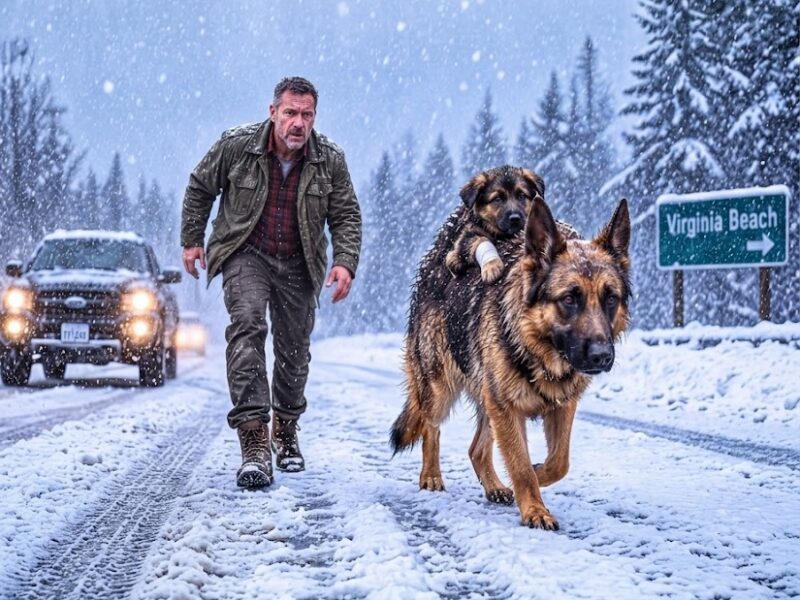
A Former Navy SEAL Found a German Shepherd Carrying Her Baby Pup—What She Did Next Left Him in Tears
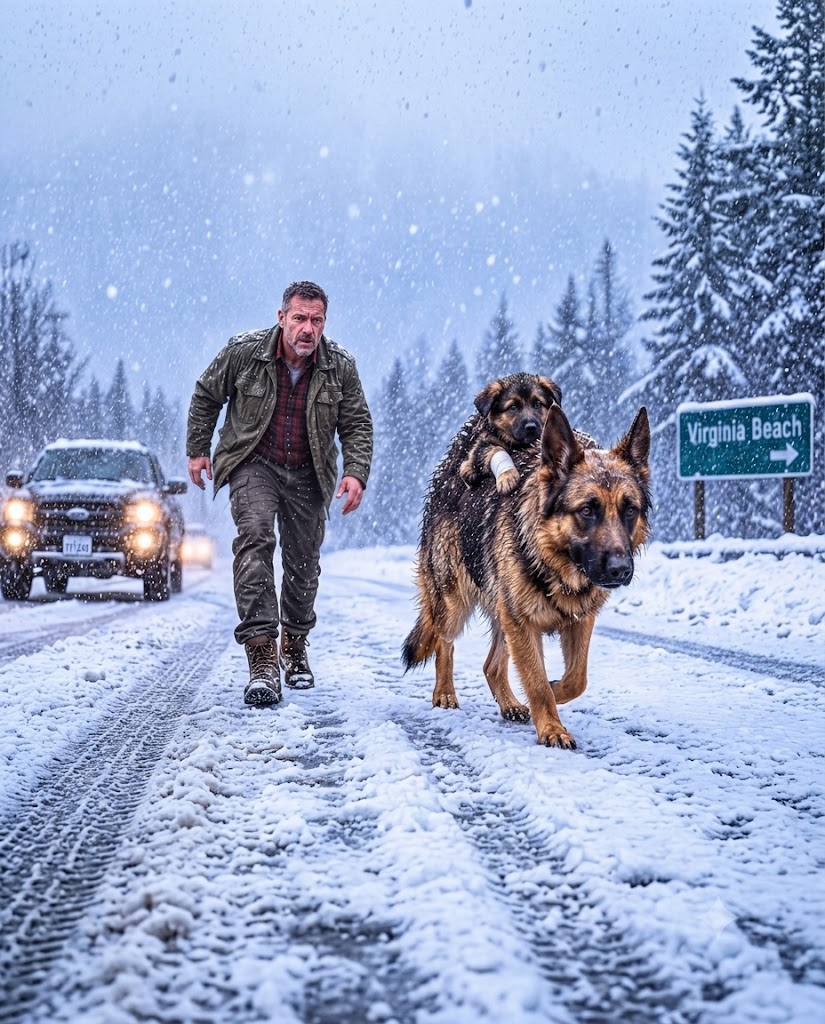
Freezing rain swept across Back Bay in Virginia Beach, turning the marsh grass silver and the narrow road black as bottle glass.
The storm had come in sideways from the Atlantic, hard enough to make the pine trees bend and whisper like men praying under their breath.
Ethan Walker drove through it with both hands steady on the wheel.
He was 43, a former Navy SEAL with short dark brown hair, broad shoulders, and blue-gray eyes that gave away less than they carried.
His old Navy jacket was zipped to his throat, and mud streaked his boots from a long afternoon helping a coastal rescue crew secure a flooded access road near Sandbridge.
He should have been home an hour ago.
Grace had made that clear in a text glowing on his dashboard screen: Dinner at 7. You promised.
Grace was 23 now, a nursing student and volunteer EMT with her mother’s strong chin and Ethan’s talent for stubborn silence.
She was no longer a child waiting by a window, and that made the disappointment worse.
Adults remembered absence with sharper edges.
The phone buzzed again: You alive, Commander?
Ethan almost smiled.
Grace only called him that when she was angry enough to joke.
He tapped the voice button.
“Running late. Roads are ugly. I’ll be there.”
He did not add soon, because the weather was already calling him a liar.
Something moved at the edge of the headlights.
Ethan eased off the gas.
At first, it looked like a branch sliding across the road.
Then it lifted its head.
A German Shepherd stood on the shoulder, soaked to the skin, her sable coat clumped with ice along her chest and legs.
A black saddle darkened her back, and her ears were forward, sharp with purpose.
Across that back, almost impossibly, lay a puppy.
The puppy was tiny, maybe 9 or 10 weeks old, dark fur flattened by rain, tan paws dangling on either side of the mother’s shoulders.
One front leg stayed tucked close, and his head sagged against her neck.
The mother took one step, trembled, then took another.
“No, girl,” Ethan murmured.
He pulled to the side, switched on his hazards, and stepped into the freezing rain.
Old training settled over him: assess the road, watch the animal’s eyes, do not rush a scared working breed.
“Easy.”
The Shepherd stopped.
She did not bark.
She looked straight at him.
Ethan had seen fear in dogs, challenge, hunger, confusion, trust.
This was different.
Her dark eyes were exhausted, but they were not lost.
They were asking for something.
No, demanding it.
“I see him,” Ethan said, keeping his hands open. “Let me help.”
The Shepherd turned her head toward the tree line where an old service road vanished between pines and winter reeds.
She took two steps that way, stopped, and looked back.
The movement hit him like memory.
Bishop had done that.
His German Shepherd, his military working dog, his partner through more nights than Ethan liked to count.
Bishop had lived with Owen Reed for nearly two years because Ethan could not look at him without seeing smoke, water, a failed extraction, and the man he could not bring home.
Bishop used to walk ahead, stop, look back, then move again when he wanted Ethan to follow.
The Shepherd did it again: 10 feet forward, stop, look back.
“You’re showing me something,” Ethan said.
He called 911 and requested animal rescue support.
Static chewed the answer, but the meaning came through clearly enough: flooded roads, multiple calls ahead, no unit for at least an hour.
The Shepherd swayed.
Ethan pulled a thermal blanket and a soft gear mat from behind the seat.
He approached slowly, crouching low.
“Let me help the pup first.”
She watched every motion.
When Ethan slid one hand under the puppy, her body tightened, but she did not move away.
The puppy was cold and frighteningly light, yet his ribs moved, weak but breathing.
Ethan settled him in the passenger footwell on the mat, tucked the blanket around him, and turned the heat low.
The puppy made a faint sound.
The mother’s ears flicked toward him.
“He’s here,” Ethan told her. “I’ve got him.”
He expected her to follow into the truck.
Instead, she turned again toward the trees.
“You have got to be kidding me.”
The Shepherd took one step onto the service road and nearly collapsed.
Ethan caught her before she hit the ice.
She shook so hard he felt it through his gloves.
Around her neck was a worn leather collar with a missing tag ring.
The inside held faint stamped letters hidden beneath mud.
She lifted her head and stared past him toward the pines.
That was when he saw the smaller paw prints in the slush.
More than one set leading away from the road.
Ethan’s stomach tightened.
“There are others.”
The Shepherd tried to stand.
Her legs refused.
Ethan wrapped his jacket around her shoulders and guided her to a sheltered patch beside the truck, close enough for her to see the puppy through the open door.
Then he took his flashlight and stepped onto the service road.
“Stay with him,” he said, though he did not know if she understood.
The storm swallowed the road behind him within seconds.
Branches scratched his sleeves.
Marsh water sucked at his boots.
He swept the flashlight across broken reeds, old tire ruts, and fence posts leaning like tired centuries.
After ever tougher ground, a weathered wooden cottage rose through the sleet near the backwater.
Beside it stood a low boathouse with part of its roof sagging under storm debris.
Ethan stopped and listened.
At first, there was only rain.
Then came a sound so small he almost missed it.
A thin cry from somewhere near the boathouse.
He tightened his grip on the flashlight and moved toward it.
The ice storm pressed low over Pungo, making the cottage appear and disappear behind curtains of sleet.
Water ran off the boathouse roof in trembling lines, and every gust pushed the smell of salt marsh, wet pine, and old wood into Ethan’s face.
He moved slowly, letting the flashlight travel before his feet.
The boathouse had once been painted white, but weather had stripped it down to gray boards and rusted hinges.
A section of roof had caved inward where a pine limb had fallen across it.
Ethan crouched near the wall and listened again.
There it was, a soft, broken whimper.
“Easy,” he said, though the word was for himself, too.
He lifted a loose board, testing the weight before committing.
Beneath it, behind old crab pots and a folded tarp, two small faces stared back at him.
German Shepherd puppies.
One male, larger than the puppy in Ethan’s truck, with a black mask and tan cheeks, stood braced in front of his sister as if he were a guard dog in miniature.
The female was smaller, with lighter markings on her chest and a narrow stripe of tan above each eye.
Both were damp, chilled, and frightened, but alert.
Their mother had left them in the safest shelter she could find.
“Well,” Ethan whispered, “you two are why she would not quit.”
The larger pup gave a tiny warning bark that cracked halfway through.
Ethan almost laughed.
“Fair enough.”
He took off his fleece liner and made a pocket with it.
The pups resisted for about three seconds.
Then warmth defeated pride.
He tucked the male inside first, then the female, holding them against his chest as he backed away from the damaged wall.
On the cottage door, a paper had been stapled beneath a cracked plastic sleeve.
Most of the ink had blurred, but one name remained readable under the beam: Walter Briggs.
Ethan photographed it and called 911 while walking back toward the road.
Static chewed the first attempt.
On the second, the dispatcher found the report.
Walter Briggs, 69, transported from this address three nights earlier after a neighbor requested a welfare check.
Fall injury.
No note about animals on property.
Ethan stopped in the service road, rain ticking off his hood.
No note about animals.
That meant nobody had known.
Walter had not left them.
The storm had simply closed its fist around the cottage after he was taken away.
“Copy,” Ethan said. “I have three puppies and an adult Shepherd. I’m transporting to Bayline Veterinary Emergency.”
“Animal control still delayed,” dispatch replied.
“I am not waiting.”
When the truck came into view, the Shepherd was still beside the open passenger door with his jacket across her shoulders.
She lifted her head the instant she saw him.
Not for Ethan.
For the pups.
“Found them,” he said.
Her ears came up.
Her whole body tried to rise, failed, then tried again.
Ethan knelt and opened the fleece enough for the puppies to wriggle toward her.
The female squeaked.
The male pressed his nose into his mother’s wet fur.
The Shepherd closed her eyes for one second, just one, and her breathing changed.
It was the sound of a mission confirmed.
Ethan loaded them carefully into the back seat, putting the two newly found puppies beside the first.
The injured one stirred when his siblings touched him.
The mother watched from the ground until all three were under the blanket.
Only then did she allow Ethan to help her into the truck.
She insisted on placing her head near the puppies before she let her body rest.
“You’re something else,” Ethan said.
Her eyes flicked toward him, unimpressed.
“All right, fair.”
The road back was worse.
Twice, Ethan eased through standing water deep enough to hide the painted lines.
His phone rang as he reached the main road.
“Grace,” he answered through the dash.
“Dad,” she said, worry hiding poorly inside annoyance. “I am safe.”
“That was not the question, but good start.”
He glanced in the mirror.
Three puppies lay in a pile beneath the blanket.
The mother had one paw stretched toward them, touching the edge of the fabric as if counting by feel.
“I found a dog in the storm.”
“You found a dog.”
“A mother Shepherd. She was carrying a puppy.”
Grace went quiet.
“Carrying on her back. Is the puppy alive?”
“Yes. Hurt maybe. Cold. I am taking them to Bayline. There were two more.”
She exhaled.
“I’m meeting you there.”
“Roads are bad.”
“I drive an ambulance in worse weather as a volunteer. Remember?”
Ethan gripped the wheel.
“Drive slow.”
Bayline Veterinary Emergency glowed like a ship in the storm.
Dr. Lauren Pike met Ethan at the side entrance before he finished lifting the first puppy.
She was 40, tall and lean, with auburn hair tucked under a knit cap and green eyes made steady by years of frightened people handing over animals they loved.
“Exam two,” she said. “Warm towels, fluids, soft voices.”
The injured puppy, whom Grace later named Colt because he had legs too long for his body, was examined first.
Lauren touched his tucked front leg with careful fingers.
“Fracture. Treatable. He needs surgery, but he has a very good chance.”
“Do it,” Ethan said.
“The cost will not be small.”
“Do it.”
The other pups were cold but stable.
Grace named them Brier and Juniper before anyone could stop her.
The mother was dehydrated and exhausted, but nothing suggested permanent damage.
Lauren placed water near her.
The Shepherd looked at the bowl, then at Colt.
She would not drink until Lauren moved all three puppies into view.
Grace whispered, “She was waiting to see them.”
Lauren lifted the mother’s worn collar.
“No tag. Let’s check for a chip.”
The scanner beeped over the Shepherd’s shoulders.
Lauren entered the number, waited, and leaned closer to the screen.
Ethan knew that look.
It meant a simple answer had just become something else.
“What is it?”
Lauren turned the monitor.
“Her registered name is Vega,” she said, “but her operational call sign was Beacon.”
By midnight, the storm had moved inland, but rain still scratched at the clinic windows like fingernails on glass.
Inside Bayline Veterinary Emergency, the air smelled of warm towels, antiseptic, wet dog fur, and coffee that had been reheated too many times.
Ethan stood near the surgery doors with his arms folded, not because he was angry, but because if he let them hang loose, everyone might see his hands.
They had been steady on the road and in the boathouse.
Now, while Colt was somewhere beyond the white double doors with a fractured leg, they wanted to shake.
Grace noticed.
Of course she noticed.
She wore an oversized college sweatshirt under her EMT jacket, her chestnut hair tied back, and her shoes still wet from the parking lot.
“He is in good hands,” she said.
“I know.”
“Do you?”
Ethan looked down at her.
“You are very mouthy for someone who ate my emergency granola bar without asking.”
“You left it in a truck full of freezing puppies. It became community property.”
Across the room, Vega lay on a thick blanket with Brier and Juniper against her belly.
Lauren had started fluids and warmed her slowly.
The Shepherd’s eyes opened whenever odor moved.
Each time she checked the room, counted the people, counted the puppies, and settled only when the count made sense.
Lauren came out with a tablet in one hand.
“Colt is under. The fracture is clean. We are placing a small pin. He is young, which helps. No promises, but I like his chances.”
Grace exhaled hard.
Ethan only nodded.
Speaking would have been too much.
Lauren tapped the tablet and showed them the record from the microchip.
“Registered name, Vega. Working call sign Beacon. Primary handler Aaron Briggs. Tidewater Coastal Search and Rescue. Certifications for shoreline tracking, missing person scent work, storm response support, and disaster area search.”
Grace stepped closer.
“She was a real search dog.”
“Very real,” Lauren said.
Ethan felt the puzzle settle.
The road, the controlled distance, the way Vega looked back to make sure he followed, the refusal to rest until every puppy was safe.
She had not wandered from home.
She had assessed, chosen a direction, carried the puppy in worst condition until she found a responder, then tried to return.
“She found the uniform,” he said.
Lauren looked at his old Navy rescue jacket and the clipped radio.
“She found someone who looked like help.”
Grace touched Vega’s blanket.
The Shepherd opened one eye, judged her harmless, and closed it again.
“Beacon,” Grace whispered. “That suits her.”
“Records show a second contact,” Lauren continued. “Walter Briggs, same address. I called the hospital, but patient information is limited. They confirmed he is stable. You may get more in person tomorrow.”
“I’ll go,” Ethan said.
“You should sleep first,” Grace said.
“I can sleep after.”
“That is your whole problem in one sentence.”
Lauren’s mouth twitched.
Vega, without opening her eyes, gave a long, tired sigh that somehow sounded like agreement.
“Fine,” Ethan said. “A few hours.”
He did not sleep at first.
Bayline had a small waiting room with vinyl chairs and a humming vending machine.
Grace curled in one chair with her jacket under her head.
Ethan sat by the window and watched rain slide down the glass.
His phone lay in his palm.
Owen Reed’s contact glowed on the screen because Ethan had opened it and closed it three times.
Owen had been his teammate first, then his friend, then the man who took Bishop when Ethan said it would only be for a month.
That had been nearly two years ago.
Bishop, black and tan, steady as a church bell, had once slept at Ethan’s door after hard missions.
After the failed extraction off the coast of Aden, Ethan could no longer bear the dog’s trust.
Bishop had been there.
Bishop had seen everything.
Ethan had decided the dog remembered the failure the way he did.
He had never asked.
The surgery doors opened at 2:17 in the morning.
Lauren came out wearing a clean scrub cap and tired eyes.
“Colt is through,” she said.
Grace woke instantly.
“Is he okay?”
“He did well. If healing goes normally, he should grow with good function.”
Those words loosened something in Ethan’s ribs.
Lauren let them see Colt briefly.
He lay under a warming blanket, bandaged leg supported, small face relaxed.
Brier and Juniper slept in a pile nearby.
Vega watched from her blanket, too weak to rise, but alert enough to track Lauren’s hands.
Ethan crouched at a respectful distance.
“You did it,” he told Vega.
The Shepherd looked at him with the expression of a supervisor acknowledging that an assistant had finally followed instructions.
Grace laughed quietly.
“She thinks you are slow. She may be right.”
Morning came pale and cold.
Ethan drank bitter clinic coffee, changed into a dry shirt Grace had brought, and drove to the hospital.
Walter Briggs sat propped in bed near a window.
A tall old man, narrowed by age and injury, with white hair combed badly and a gray beard covering a wind-worn face.
When Ethan introduced himself, Walter did not ask about the cottage.
“Vega,” he said. “Is my girl alive?”
Ethan pulled a chair close.
“She is alive. So are all three pups.”
Walter closed his eyes.
His mouth trembled once before he pressed it still.
“Thank God.”
He explained that Vega had belonged to his son Aaron first.
Aaron called her Beacon when they worked searches along the coast.
After Aaron died in a rescue accident, Vega stayed with Walter, carrying the memory of the son he missed every day.
Ethan showed him the emblem from the file, a lantern over a wave.
His breath caught.
He had seen that patch before during an old recovery operation with his SEAL team.
Walter noticed.
“You knew Aaron’s kind?”
“Yes,” Ethan said, and the old ache opened. “I did.”
Walter reached for a key on the bedside table.
“There is a cedar trunk in my cottage. Aaron kept Vega’s SAR vest there. If you are willing, I need someone to bring it to her.”
Ethan took the key.
“Be careful with that trunk,” Walter said softly. “It has a way of opening more than itself.”
The morning after the storm broke clear and hard with pale sun shining over Virginia Beach as if the night had never happened.
Along the back roads near Pungo, ice clung to fence wire and glittered on marsh grass, beautiful in the careless way dangerous things sometimes are.
Ethan drove Grace back to the cottage because she insisted and because arguing with her was like arguing with a tide chart.
She wore waterproof boots, jeans, and a red EMT jacket, a medical backpack on one shoulder, even though Ethan had told her they were only collecting a trunk.
“You always bring the whole hospital?” he asked.
“You always bring emotional constipation to routine errands.”
“That is a rude thing to say to the man holding the key.”
“A rude but medically accurate thing.”
The cottage looked lonelier in daylight.
A modest wooden house raised above damp ground, porch rails salt-worn, windows streaked with storm water.
The boathouse stood beside it with the broken roof section covered by the tarp Ethan had tied in place.
No dramatic ruin, just a life paused mid-sentence.
Inside, the cottage smelled of cedar, old coffee, and dust.
A mug sat beside the sink.
Work boots waited by the door, still holding the shape of Walter’s feet.
Grace grew quiet.
Ethan did too.
They found the trunk in a back room facing the water.
It was cedar with brass latches and AB burned into the lid.
Ethan knelt and opened it carefully.
On top lay a red and black search and rescue vest folded with a care that made his throat tighten.
The name Beacon was stitched in white across one side.
Beneath it were training logs, laminated maps, photographs, and a coil of old line.
Grace picked up one photograph.
A younger Vega stood on a beach at dawn, ears high, SAR vest bright against her sable coat.
Beside her was a man in his 30s with sandy hair, a wide grin, and one hand resting on her shoulders.
“Aaron Briggs,” Grace said. “She looks proud.”
“She knew her job.”
Ethan opened a notebook.
Aaron’s handwriting was blocky and neat.
Beacon worked shoreline grid for missing kayaker drill. Strong alert at reed bed. Refused false trail. Rewarded with tennis ball and half my sandwich because Dad spoils her.
Ethan turned another page.
Beacon will not quit until handler confirms subject safe. Must reinforce rest command. Dog has no sense of self-preservation when mission is active.
Grace read over his shoulder.
“That sounds familiar.”
“I know how to rest.”
“Dad, I know where beds are located. That is not the same thing.”
He closed the notebook, but the line stayed with him: no sense of self-preservation when mission is active.
He had built a life around that sentence and called it duty.
After the failed extraction, he kept moving because stopping meant hearing the names.
Grace had learned to schedule love around emergencies.
Bishop had learned to live with Owen.
At the bottom of the trunk lay another photograph.
Aaron stood with three men near a pier.
One wore a SEAL team ball cap.
Ethan stared.
The man was younger, thinner without gray at his temples, but the shoulders were unmistakable.
Grace looked from the photo to him.
“Is that you?”
“Yes.”
“You knew Aaron.”
“Not well. Our teams crossed paths during a search recovery after a training accident. His unit covered shoreline sectors. I remember the dog more than him.”
That sounded harsh, so he added, “Not because he was forgettable, because she worked like she had been born out of the weather.”
Grace sat on the edge of a chair.
“You never told me about that operation.”
“There are a lot of things I never told you.”
“I know.”
The answer was gentle.
That made it harder.
Ethan looked toward the window where sunlight flashed on the flooded yard.
“After the last mission with Bishop, I thought if I put enough distance between myself and that life, I could keep from bringing it home.”
“You brought the distance home instead.”
He flinched.
Not visibly enough for most people.
Grace saw it anyway.
“I’m not saying that to punish you,” she said. “I just want you to know I noticed. Mom noticed before she moved out. Bishop probably noticed, too.”
At Bishop’s name, Ethan looked down at the SAR vest.
“Bishop is better off with Owen.”
“Maybe. Or maybe Owen is better at not pretending dogs ask for perfect people.”
They returned to Bayline just after noon with the trunk, the vest, and Aaron’s records.
Lauren met them in the recovery room.
Colt was awake but groggy, bandaged leg supported.
Brier and Juniper were attempting to climb over each other as if fragility were a rumor.
Vega lay with her head up, eyes sharper than yesterday.
Ethan unfolded the red and black vest.
The change in Vega was immediate.
Her ears rose.
She drew in one long breath through her nose, then another.
Her body remained tired, but something inside her stood to attention.
Lauren did not speak.
Grace did not either.
Ethan placed the vest on the blanket in front of her.
Vega lowered her head and pressed her nose to the stitched name, Beacon.
Her eyes closed.
For a moment, the clinic seemed to hold all the weather that had ever touched her: sea wind, storm, rain, sun on wet sand, Aaron’s hand, Walter’s porch, three puppies breathing beside her.
Lauren’s voice was quiet behind him.
“She remembered who she was.”
Grace looked at Ethan.
“Maybe Bishop would like the same chance.”
Ethan kept his hand on the old vest, and Vega, for the first time, placed one paw gently over his wrist.
His phone buzzed.
A message from Owen Reed lit the screen, though Ethan had not called him.
Heard you pulled shepherds out of the ice. Bishop heard your name on the scanner recording and has been staring at the gate all morning. Come by when you stop running.
The next afternoon was cold but bright over Chesapeake, with sunlight lying thin across frozen puddles and the bare branches of backyard oaks.
Ethan parked outside Owen Reed’s farmhouse and sat for almost a full minute with the engine running, as if the truck needed courage before he did.
Owen lived on three fenced acres at the end of a gravel lane, far enough from neighbors for an old working dog to bark at leaves without complaint.
Beyond the barn, a black and tan German Shepherd stood motionless in the yard.
Bishop’s age had silvered his muzzle and softened the heavy muscles along his shoulders, but he still held himself like a dog who understood thresholds, wind direction, and the hidden language of a human heartbeat.
His ears came forward when Ethan stepped from the truck.
For one second, neither moved.
Then Bishop walked to the gate.
Not ran.
Walked, steady and deliberate, as if crossing the last two years required ceremony.
Ethan opened the latch.
Bishop stopped inches away and lifted his nose.
“Hey, boy,” Ethan said.
His voice broke on boy.
Ridiculous.
He had given orders under fire with less trouble than this.
Bishop sniffed his sleeve, his boots, his hands.
Then the old dog leaned forward and pressed his head against Ethan’s thigh.
No accusation.
Just weight.
Warm, familiar, alive.
Ethan’s hand found the fur behind Bishop’s ear.
Bishop exhaled, deep and old, and Ethan closed his eyes.
For two years, he had imagined this moment like punishment.
He pictured Bishop turning away, or worse, looking at him with the same trust as before.
Trust had felt unbearable because Ethan thought he had forfeited it.
But Bishop did not seem interested in Ethan’s private courtroom.
He smelled a man he knew.
That was all.
Owen Reed stood on the porch with a mug in one hand.
He was 45, shorter than Ethan but built like a post, with close-cropped blonde hair, a crooked nose, and the calm of someone who had survived enough noise to appreciate quiet.
“Took you long enough.”
Ethan kept his hand on Bishop.
“Good to see you, too.”
“I was talking to him.”
Bishop thumped his tail once, agreeing with the chain of command.
They sat at the porch table while Bishop lay across Ethan’s boots, pinning him in place with elegant strategy.
Owen listened as Ethan told the story of Vega, Colt on her back, the puppies in the boathouse, the microchip, Aaron’s vest.
He did not interrupt.
When Ethan finished, Owen looked toward Bishop.
“Dogs remember differently than we do.”
“You know that for sure?”
“I know Bishop never acted like you failed him. He acted like he missed you.”
Ethan’s jaw tightened.
Owen kept going.
“That last operation was bad. Nobody is pretending otherwise. But you built a shrine to the worst hour of your life and made Bishop live outside it.”
“I was trying to keep him from being dragged through it.”
“No, you were trying to keep yourself from being loved by a witness.”
That landed clean.
Bishop lifted his head, hearing tone if not words.
Ethan put a hand on him automatically.
The dog settled.
“See,” Owen said. “Still knows his job.”
Vega met Bishop a few days later in Owen’s yard under a sky the color of pewter.
Lauren brought her in the back of her SUV after she gained enough strength for a short outing.
Grace came too, because she had claimed official emotional oversight.
Vega stepped down slowly, thinner than she should have been, but balanced now.
The red and black SAR vest draped lightly over her shoulders.
Two working shepherds faced each other.
Everyone human went still.
Bishop raised his nose.
Vega did the same.
They circled once, formal rather than tense.
Bishop sniffed the edge of her vest.
Vega sniffed the scar along his shoulder, an old mark from service days.
Then she turned and walked to the porch, where she lay in a patch of weak sun.
Bishop watched, considered this, and lay a few feet away.
Grace whispered, “That felt like a military briefing.”
Owen nodded.
“She outranks him.”
“Absolutely,” Lauren said.
Ethan laughed, and the sound startled him.
It felt unused but not broken.
Vega opened one eye to check whether human noise meant anything important.
Bishop wagged his tail once without lifting his head.
From that day, Ethan divided his time differently.
He visited Bayline in the mornings, learning how to hold Colt during brief therapy movements while Lauren corrected his grip with blunt kindness.
He drove to Owen’s twice a week to walk Bishop along the fence line.
He met Grace for dinner every Thursday because she put it on both calendars and threatened to label it medical compliance if he missed it.
No single apology solved years of absence.
Some evenings Ethan still answered texts late.
Some mornings he woke with the old taste of salt water and smoke in his mouth.
But he began showing up.
Repeated presence, plain, awkward, holy in its own way.
Three weeks after the storm, Colt took his first careful steps on the clinic’s rubber mat.
His bandaged leg touched down, lifted, touched again.
Vega watched from beside Lauren, body rigid with focus.
Grace crouched at the far end, holding a soft toy shaped like a blue crab.
“Come on, handsome,” Grace coaxed. “This crab has insulted your honor.”
Colt wobbled toward her with the solemn determination of a tiny soldier.
Halfway there, he sneezed, startled himself, and sat down.
Ethan laughed so hard he had to turn away.
Lauren’s phone buzzed.
She looked at it, and the smile faded.
“Oh no.”
Grace stood.
“What?”
“Tidewater Animal Rescue. Their winter kennel heating system failed during the storm, and the electrical feed is unsafe. If they cannot repair it, they will have to transfer the large dogs out of the region.”
Ethan looked through the glass at Vega, Colt, Brier, and Juniper.
He thought of a mother crossing ice because she would not leave her family behind.
He thought of Bishop waiting by a gate.
Lauren looked at him.
“You do not have to fix everything.”
“I know,” Ethan said.
But for the first time in years, the words someone else’s problem did not come easily.
A damp wind moved through Virginia Beach the next morning, carrying the smell of thawing earth, brackish water, and diesel from trucks on the nearby road.
Tidewater Animal Rescue sat on several wooded acres west of the city, its chain-link runs and low kennel buildings patched together by years of donations and stubborn care.
Maria Torres met Ethan at the office door with a clipboard in one hand and keys in the other.
She was 52, compact and strong, with dark hair streaked silver and a face that looked as though it had survived every hurricane since the 1990s.
Her expression held the calm fatigue of someone who had learned to love animals without lying to herself about money.
“Dr. Pike said you were coming,” Maria said.
“I am looking.”
“That is what men say before they accidentally volunteer.”
He liked her immediately and decided not to show it.
“I brought coffee.”
“Then you may look.”
The winter kennel was warmer than outside, but not by much.
Temporary heaters hummed from guarded corners.
The taped extension cords made Ethan’s skin crawl.
Too many points of failure.
Large dogs watched from clean runs.
A yellow Lab with a gray face.
Two hound mixes curled together.
A young German Shepherd male who tracked Ethan with amber eyes.
An old Malinois sleeping so deeply that only one ear moved when Maria spoke.
“If this wing closes, where do they go?” Ethan asked.
“Some to Richmond if space opens. Some to North Carolina. Some wherever we can beg room.”
“How far from their vets, their volunteers?”
“Far enough that many will start over from fear.”
Maria’s voice stayed even, but her hand tightened on the clipboard.
“We do good work here, but good work with bad wiring is still bad wiring.”
She showed him the failed heater, the old electrical feed, the water intrusion near the back wall.
Ethan took photos, measurements, notes.
A problem became less frightening when reduced to parts, materials, labor, permits, timing.
Still, by the end, the number Maria gave him made even his disciplined face go still.
“That is not a repair,” he said. “That is a rescue operation.”
“I know.”
He almost said he could not help.
Then he pictured Vega lying asleep with his jacket over her shoulders, refusing warmth until she saw every puppy alive.
“Send me the estimates,” he said.
Maria’s eyebrow rose.
“There it is.”
That evening, Grace found him at the kitchen table, surrounded by printed bids and county forms.
Bishop lay near the back door, visiting for the weekend.
Vega slept in the den with the puppies, all temporarily fostered under Lauren’s supervision.
Colt wore a small support wrap and looked offended by its existence.
Grace dropped her backpack on a chair.
“This table says you have done something noble and financially alarming.”
“I looked at a kennel.”
“Tables do not look like this.”
Ethan rubbed his forehead.
“They may have to transfer the large dogs if repairs do not happen.”
“So we need people.”
“We need money, licensed labor, materials, permits, and people who do not vanish after making inspirational comments online.”
“So people,” Bishop sighed under the table.
Vega, from the den, gave one low huff.
Ethan looked toward the doorway.
“Are the dogs taking your side?”
“They have excellent judgment.”
Grace texted Lauren before Ethan could stop her.
Lauren arrived the next afternoon with a camera and the calm expression of a woman who had already decided his objections were background weather.
She photographed Vega in the yard beside Colt, who was standing carefully on all four feet while Brier attempted to chew the edge of a fallen leaf with grave concentration.
Bishop lay on the porch behind them, dignified until Juniper climbed onto his tail and fell asleep there.
“No,” Ethan said when Grace showed him the photo.
Lauren looked at the screen.
“Yes. This is not about me.”
“Exactly.”
Lauren said, “It is about the dogs that come after Vega.”
The post went up with a simple title: The Shepherd Who Crossed the Ice With Her Puppy.
Lauren wrote it plainly.
A German Shepherd mother had carried one injured puppy through freezing rain until she found help.
Ethan followed her back and found the rest of her litter.
Vega, once known as Beacon, had been a search and rescue dog.
Now the rescue that could help dogs like her needed help.
Ethan expected a few donations and several strangers arguing in the comments.
He was wrong.
By morning, the story had traveled across Hampton Roads.
A church group offered blankets.
A pet supply store donated food.
A hardware shop called Maria about materials.
Former handlers began sharing photos of retired working dogs who had needed quiet places after service.
Then Mark Ellison arrived.
Mark was 49, broad, bearded, and silent until he had examined every panel, conduit, breaker, and wall stud in the winter wing.
After an hour, he closed the main panel and looked at Ethan.
“Feed needs replacing. Heater circuit needs proper load separation. Back wall needs moisture work before any of it matters.”
“Can it be done?” Maria asked.
“Yes.”
“How much?”
Mark shrugged.
“Charge me for coffee?”
Maria blinked.
“Excuse me?”
“My old Shepherd came from here,” Mark said. “He gave my mother four good years after my father died. You people would not take a dime then, so charge me for coffee.”
The repair effort grew legs.
Volunteers arrived with trucks.
A contractor offered lumber at cost, then below cost.
Owen came with former military dog handlers and began reorganizing the exercise schedule because he claimed chaos was bad for morale.
Grace coordinated sign-in sheets, water, first aid, and snacks with alarming competence.
At dusk, Vega limped slowly beside Ethan through the yard, still recovering but alert.
She stopped near the winter wing and looked at the dogs inside.
“I know,” Ethan said. “We are working on it.”
His phone rang.
Walter Briggs’s voice came through thin but bright with purpose.
“Ethan, I saw the story. Aaron would have liked your stubborn mess.”
“It has become bigger than expected.”
“Good. Then it may be big enough for what I have in mind.”
Ethan leaned against a fence post.
“What do you mean?”
“There’s an old boat shed on my back acreage,” Walter said. “Four dry acres near the service road. Aaron used to say it would make a fine base for dogs who needed a second watch. I want you to come see it.”
Fog lifted from the marsh in slow white ribbons the next Saturday morning, softening the pines around Walter Briggs’s property and turning every fence post into a shadow.
The air was cold enough to sting, but beneath it waited the first damp hint of spring.
Ethan arrived with Grace, Lauren, Maria, Owen, and more reservations than he had brought people.
Walter came from the rehabilitation center in a transport van, bundled in a wool coat, moving with a walker and the offended dignity of a man who did not enjoy being helped.
When Vega saw him, she did not run.
She walked carefully across the cleared ground, slow because her body was still rebuilding, gentle because his was too.
Then she placed her head against his knee.
Walter’s hand disappeared into her sable fur, his face folded for a moment.
“There is my girl.”
Nobody spoke.
Even Owen looked at the sky and pretended to inspect clouds.
The old boat shed sat beyond the cottage, past wax myrtle and a narrow drainage ditch.
It was larger than Ethan expected, weathered but sound in its bones.
Wide sliding doors faced a gravel clearing.
Behind it spread four acres of high ground bordered by trees and marsh, enough space for exercise yards, quiet runs, storage, maybe even a training field if drainage was improved.
A rusted lantern still hung over the main door.
“Aaron called it Last Light,” Walter said. “When the search teams came back after dark, he would hang a lamp right there. Said a dog should always see where home was.”
Grace stood beside Ethan.
“Last Light K9 Harbor.”
Ethan looked at her.
“What?”
She said, “It named itself.”
Maria walked the perimeter with a practiced eye.
“Fencing would need replacing. Kennels would need climate control, permits, insurance, drainage, volunteer management, intake rules, quarantine space.”
“You make dreams sound like dental surgery,” Owen said.
“Dreams that involve living animals should include paperwork,” Maria replied.
Lauren nodded.
“She is right.”
“I hate when responsible people gather,” Owen muttered.
Ethan heard them, but his mind was already mapping.
Runs along the east side where shade lasted through afternoon.
Senior dogs in the quieter section near the shed.
Medical isolation close to the driveway.
Training yard on the high patch beyond the ditch.
Not fancy.
Useful.
Safe.
Then fear arrived.
Calm and familiar.
It asked who he thought he was.
It reminded him of unfinished promises, failed missions, Grace waiting alone at tables, Bishop living behind another man’s fence.
It asked what would happen when people trusted him and he could not carry the weight.
“No,” Ethan said.
Grace turned.
“No, it is too much. Land, money, legal structure, full-time care, dogs with medical needs, handlers with old grief, veterans who may show up because they heard a story and need more help than a leash can give.”
“All true,” Maria said.
“Thank you.”
“I was not agreeing with your no. I was agreeing with your assessment.”
Grace stepped closer, boots sinking into wet grass.
“Are you afraid it will fail, or are you afraid it might work and give you a reason to stay?”
That stopped him.
The others pretended not to listen badly.
Walter looked at the shed.
“Aaron wanted a place where search dogs could rest when the calls stopped. He knew too many handlers who did not know what to do with quiet. I told him we did not have money for every noble idea that crossed his mind.”
His voice softened.
“I regret that.”
Vega wandered to the boathouse door.
She sniffed the wood, then pawed once at the threshold.
Bishop, who had come with Owen, stood beside her.
Colt, on a short leash with Lauren, tried to imitate them and nearly tripped over his own feet.
“That puppy is not command material,” Owen said.
“He has heart,” Lauren said.
“So do potatoes.”
Colt sneezed at him.
Ethan laughed, and the fear loosened by half an inch.
Maria said, “We could structure it as a partner program with Tidewater. Large breed overflow. Retired working dogs. Short-term recovery cases. Not open intake. Not at first.”
Lauren added, “Bayline can support scheduled medical checks.”
Owen looked at Ethan.
“I can handle working dog assessment and placement rules.”
“You can handle not bossing everyone,” Grace asked.
“No, but I can handle assessment.”
Ethan looked from one face to another.
Nobody was asking him to be a hero.
They were asking him to stand inside a circle of people who would carry pieces together.
He had forgotten that was possible.
“Last Light K9 Harbor,” he said quietly. “Pilot program, limited capacity, proper legal setup, no emotional stampede.”
“Put that on the sign,” Owen said.
“No emotional stampede.”
Even Maria laughed.
Work began the following week.
It was mud, estimates, county offices, donated fencing, and Mark Ellison explaining electrical load to volunteers who nodded as if they understood.
Grace built a volunteer spreadsheet so detailed that Maria stared at it with reverence.
Lauren designed a medical intake form.
Owen evaluated the first two candidate dogs and rejected one plan so bluntly Ethan had to remind him civilians bruised.
Meanwhile, Vega healed.
She gained weight.
Her coat began to shine.
Brier became a bold explorer.
Juniper stayed quiet and watchful.
Colt recovered with dramatic enthusiasm.
The day Lauren allowed him a few supervised steps on soft ground, he strutted as if he had personally defeated winter.
One evening, after volunteers left, Ethan stood inside the boat shed with Walter.
Sunlight came through the open doors, catching dust in the air.
“You know Vega is not coming back to live with me,” Walter said.
Ethan turned.
“Walter—”
“Let an old man finish. She was Aaron’s, then mine. But that road changed things. She trusts you. More important, she has chosen Grace.”
He smiled faintly.
“And Colt thinks your shoelaces are prey. You do not have to decide now. I already did. I want visiting rights and veto power over bad treats.”
Outside, Grace shouted, “Dad, come quick.”
Ethan ran.
Vega stood rigid at the far fence, nose pointed toward a side gate half hidden by brush.
The latch had shaken loose.
Beyond it, the marsh path fell toward deep water.
Colt was trotting in that direction, curious and fast.
“Colt, stay!” Ethan called.
The puppy froze.
Vega held her position, blocking the gate until Ethan clipped the latch shut.
Grace scooped Colt up.
“She found it before anyone else did,” Grace said.
Behind them, Walter whispered, “Beacon is still working.”
March came to the Tidewater region with cold rain, gray mornings, and sudden gold afternoons that made everyone believe spring was closer than it truly was.
At Last Light K9 Harbor, mud became the common language, spoken fluently by boots, paws, tires, and every volunteer who thought they could keep jeans clean.
The boat shed changed one stubborn improvement at a time.
Mark Ellison replaced the old electrical feed and installed safe circuits for heat and ventilation.
A retired carpenter built raised sleeping platforms.
Maria brought spare kennel panels from Tidewater Animal Rescue.
Lauren argued for a medical prep room and won.
Owen marked out a quiet yard for retired working dogs, then stood in it with Bishop and declared the space acceptable.
Ethan became the point where all questions landed.
Where should donated food go?
Who had the permit copy?
Could three people install fencing on Saturday if only one knew how fencing worked?
Was Owen allowed to ban squeaky toys from the senior yard?
The answer to the last one was no, according to Grace, who bought Bishop a rubber chicken that made a tragic honking sound and called it enrichment.
Bishop carried the chicken once, realized what it did, and looked betrayed for the rest of the afternoon.
Vega watched the operation like a site supervisor.
She had regained strength steadily, though Lauren still limited her activity.
Her SAR vest hung inside during the day but rested over her shoulders when Walter visited, because it made his face soften.
Colt followed her everywhere, growing into his paws and developing the comic confidence of a puppy who thought the world owed him entertainment.
Brier and Juniper grew too.
Brier greeted approved visitors with bold little barks, then hid behind Ethan when a wheelbarrow squeaked.
Juniper preferred Grace sitting quietly beside her while she entered volunteer hours on a laptop.
The puppies were healthy now.
That was the blessing and the problem.
Healthy puppies did not remain foster stories forever.
The first adoption inquiry for Brier came from a couple near Suffolk.
Ellen and Howard Price were in their late 50s with a fenced rural property, experience with large breeds, and a quiet home recently emptied by the loss of an old Shepherd.
Maria reviewed their application twice.
Lauren called their vet.
Ethan drove out with Grace for a home visit and found secure gates, clean water bowls, and a framed photo of their former dog on the mantle.
“They are good people,” Grace said on the drive back.
“Yes. I hate that because it makes the right thing harder.”
She leaned her head against the window.
“Exactly.”
Ethan did not tell her not to be sad.
He had spent too many years treating sorrow like a problem to solve quickly.
“Rescue is supposed to end with someone going home.”
“I know.”
She was quiet for half a mile.
“You sound like a pamphlet, but I know.”
Brier’s adoption day arrived under a sky scrubbed blue after rain.
Ellen knelt in the visiting yard and let the puppy come to her.
Brier approached, retreated, approached again, then climbed into her lap as if he had always intended to conduct a formal inspection from there.
Howard stood nearby with tears in his eyes and pretended the wind was responsible.
Grace cried openly.
Ethan stood beside her, one arm around her shoulders.
Vega watched from the shade.
When Brier left, she did not panic.
She stepped forward, sniffed the air where his new family’s vehicle had been, then returned to Colt and Juniper.
Ethan wondered if dogs understood completion better than people did.
Juniper’s match came one week later.
A retired Navy nurse named Patrice Hammond from Norfolk wanted a calm young Shepherd to train slowly as a companion.
She lived alone, but not lonely, as she put it, in a small house with a fenced garden and neighbors who checked on one another.
During the visit, Juniper walked directly to Patrice, placed both front paws on her shoe, and sat down.
“Well,” Patrice said. “I suppose she has filed paperwork.”
Grace cried again.
This time, Ethan kept tissues in his jacket, because growth did not mean a man could not prepare.
After Juniper left, Last Light felt larger and emptier at the same time.
Colt remained all ears and enthusiasm, still under Lauren’s cautious rehabilitation plan.
He had become attached to Grace in a way that fooled nobody.
If she entered the yard, he found her.
If she sat down, he climbed half onto her lap, despite being increasingly less lap-sized.
When someone mentioned future placement, Grace discovered urgent tasks in other buildings.
Ethan noticed.
He noticed because he was doing the same thing.
One afternoon, Lauren cleared Colt for longer controlled runs on soft grass.
“No wild twisting yet,” she said. “No leaping off things because he believes gravity is negotiable. But the leg is healing beautifully.”
Colt celebrated by attempting to carry a traffic cone twice his size.
“Future tactical genius,” Owen said.
“He has persistence,” Grace replied.
“So does mold.”
Tidewater Animal Rescue’s winter wing reopened fully that evening.
It was not a grand ceremony.
Someone brought cupcakes.
Someone else spilled coffee.
The old Malinois from the temporary wing walked into his restored kennel, sniffed the bed, circled twice, and lay down with a grunt that sounded like approval from a tired king.
“No dogs transferred?” Ethan asked Maria.
“Not one,” she said.
Vega stood beside him, calm and watchful.
Ethan placed a hand lightly on her head.
“Hear that?”
She leaned into him for half a second before resuming her professional distance.
When Ethan returned home that night, Grace sat on the kitchen floor with Colt asleep across her legs.
The puppy’s healed leg twitched in a dream.
Bishop lay by the door.
Vega rested nearby, eyes half-closed but aware of everything.
“I know we cannot keep every dog,” Grace said.
“No, we cannot.”
“And I know Colt needs whatever is best for him.”
“He does.”
She nodded too many times.
“Good. Okay.”
Then she looked down at the sleeping puppy, and Ethan saw her brace for loss before it had even arrived.
Later, after Grace went to bed, Ethan sat alone at the table.
He pulled a small blue collar from his pocket.
A silver tag hung from it, newly engraved: Colt Walker.
Vega stood in the doorway watching.
“Do not tell her,” Ethan said.
Vega tilted her head, and Ethan had the uncomfortable sense that the dog considered secrecy another area where humans required supervision.
The first true warm day of spring arrived with gulls crying over Virginia Beach and sunlight flashing on the wet roads after dawn rain.
At Last Light K9 Harbor, the grass was still patchy, the fences still smelled of new lumber, and the sign by the entrance leaned slightly because Mark insisted perfection made people nervous.
Lauren chose that morning for Colt’s final major check.
She laid a blue mat in the yard, set up small cones, and watched him trot in controlled lines while Grace held her breath like a person waiting for a verdict from heaven.
Ethan stood beside Vega near the fence.
Bishop lay under the porch with the rubber chicken tucked beneath one paw.
Colt trotted once, then again.
His leg landed straight and strong, no limp, no hesitation.
On the third pass, he got bored, grabbed a pine cone, and pranced as if carrying classified material.
Lauren laughed.
“He is cleared.”
Grace put both hands over her mouth completely.
“Within reason,” Lauren added. “He is still a puppy, so reason will not be his personal strength. But yes, he can run, play, train, make bad decisions, and grow like any healthy young German Shepherd.”
Colt dropped the pine cone at Ethan’s boot and looked proud.
“Bad decisions already underway,” Owen called from the porch.
Grace knelt and hugged Colt carefully.
He tried to lick her ear, missed, and licked her hair.
Ethan watched them for a moment longer than he meant to.
The blue collar waited in his jacket pocket like a secret with weight.
He had planned to tell her that evening.
Then Walter arrived early with an old wooden board wrapped in canvas, and the day changed shape.
Walter moved better now, still using a cane but walking with more confidence.
He had gained color in his face, and the visits to Last Light had given him something that looked like appetite for the world.
Vega greeted him with her careful devotion.
He scratched her chest and looked toward Ethan.
“Aaron started something years ago,” Walter said. “Never finished it.”
He unwrapped the board on a worktable inside the shed.
It was cedar, sanded smooth, with carved letters partly completed across the center: No One Gets Left Behind.
Beneath the words was the outline of a lantern and a paw print.
Grace touched the edge.
“He made this for the SAR team.”
“For a place he had in his head,” Walter said. “A place for dogs who had done their duty and people who did not know how to come home afterward. At the time, I thought it was too sentimental.”
He smiled sadly.
“Age has corrected my vocabulary.”
Ethan ran his thumb over the unfinished letters.
He had heard those words in training, in briefings, in places where they sounded hard and operational.
Aaron had carved them into cedar for dogs and wounded men and fathers who missed sons.
Same words, different kind of courage.
“We can finish it,” Grace said.
Walter looked at Ethan.
“I was hoping you would.”
The board became the afternoon’s work.
Mark found proper tools.
Owen complained about font choices until Maria threatened to assign him bathroom cleaning.
Lauren painted a clean guideline.
Grace helped Walter sit close enough to watch without tiring.
Ethan took the carving knife and followed Aaron’s unfinished cuts slowly, afraid at first of ruining what another man had begun.
“Wood forgives more than you think,” Walter said.
“People, too,” Grace added quietly.
Ethan kept carving.
By late afternoon, the sign was done.
Not perfect.
Better than perfect, maybe, because Aaron’s older cuts and Ethan’s newer ones met in the same words.
They mounted it beneath the Last Light K9 Harbor sign near the entrance.
Vega stood beside Walter as if attending inspection.
Bishop came over slowly and sat near Ethan.
Colt tried to chew the corner of the ladder and was removed from the ceremony by Grace.
“He is moved by history,” Grace said.
“He is moved by wood,” Ethan replied.
Maria took a photo of them all: Walter with one hand on Vega, Grace holding Colt, Lauren smiling despite pretending not to, Owen beside Bishop, Mark with a drill still in his pocket, and Ethan standing slightly apart but not nearly as far apart as he used to.
The sign above them caught the light.
That evening, after the volunteers left, Ethan asked Grace to walk with him to the far yard.
Colt bounded ahead, then circled back because he disliked being more than 10 feet from her.
The grass smelled clean and green.
Somewhere beyond the trees, frogs had begun their spring racket.
“Lauren cleared him,” Ethan said.
Grace’s shoulders tightened.
“I know that means we need to make a permanent decision.”
“I know.”
She did not look at him.
Ethan could see the effort it cost her to sound mature.
He loved her for it and hated that she felt she had to prepare herself for another goodbye.
“We found his family,” Ethan said.
Grace swallowed already.
“They have been approved.”
“Okay.”
“Fenced yard. Good.”
“Experience with German Shepherds. That’s good.”
“A woman in the house who lets him steal socks and pretends not to notice.”
Grace turned her head slightly.
“A former SEAL who is learning slowly not to run from everything that needs him.”
Now she looked at him.
Ethan pulled the blue collar from his jacket and held it out.
The tag swung in the evening light.
Grace read it: Colt Walker.
Her face changed so quickly it broke something open in him.
She laughed and cried at the same time, then threw her arms around him.
Colt interpreted the emotion as a group game and began jumping in circles.
“You made me think he was leaving,” she said.
“Only for about 40 seconds.”
“That is 40 seconds of villain behavior.”
“Noted.”
Vega approached and stood beside them, tail moving slowly.
Ethan looked at her.
“You knew.”
Vega blinked once.
The adoption became official in the little office, with Lauren as witness, Maria pretending she had urgent paperwork, and Owen declaring Colt underqualified for leadership but suitable for morale.
That night, Colt slept in Ethan’s house for the first time as a Walker.
Vega settled where she could see Grace’s room, Ethan’s room, and the back door.
Bishop slept by the fireplace.
Ethan’s phone buzzed with a message from Maria.
Possible intake tomorrow. Retired patrol Shepherd. Handler died last month. Family overwhelmed. Can Last Light evaluate?
Ethan looked at Vega.
She opened her eyes.
“Looks like the next watch begins,” he said.
Rain fell gently over Last Light K9 Harbor the next morning, soft and steady, washing sawdust from the gravel and darkening the cedar sign by the gate.
The storm that had brought Vega into Ethan’s life was gone, but the weather still seemed to speak her language: water, wind, patience, and the long memory of a road.
The retired patrol Shepherd arrived just after 9 in a blue minivan that had seen better years.
His name was Ranger, a black and tan male with a graying muzzle, stiff hips, and eyes that searched every face for the one person who should have been there.
The handler’s sister, a tired woman named Denise, held his leash with both hands.
She was not careless.
She was grieving, overwhelmed, and honest enough to say she could not give Ranger what he needed.
Ethan met them in the quiet yard with Owen and Lauren.
Vega watched from behind the fence, not interfering.
Bishop lay near the porch, old head banned from intake because of excess friendliness, complained from inside with a series of dramatic squeaks.
“He was my brother’s partner for seven years,” Denise said. “After the funeral, Ranger stopped eating unless someone sat with him. He patrols the hallway all night. My kids love him, but he needs quiet. And I do not know how to be the person he is waiting for.”
No excuses, no cruelty, just sorrow and limits.
Ethan respected her immediately.
Owen crouched at an angle, not facing Ranger head-on.
“Hey, old man.”
Ranger stared at him, then at Ethan, then at Bishop.
Something passed between the dogs across the yard, silent and precise.
Bishop stood with effort and came forward.
Ranger’s ears shifted, his body softening by a fraction.
“Good,” Lauren murmured. “Let Bishop work.”
Bishop approached, sniffed once, and turned toward the senior yard as if inviting Ranger to inspect the accommodations.
Ranger followed.
Denise covered her mouth with one hand.
Ethan stood beside her while Owen handled the leash transfer with care.
“You are not abandoning him,” Ethan said.
She looked at him quickly.
“You brought him to people who understand his needs. That is different.”
Her eyes filled.
“My brother would have wanted to keep him forever.”
“Forever changes shape when someone dies.”
The words surprised Ethan.
They sounded like something he had needed months ago and found only now.
Ranger’s intake became Last Light’s first official senior working dog placement.
Not permanent adoption yet, Maria insisted, because process mattered: evaluation, medical workup, transition plan.
But by noon, Ranger had eaten half a bowl while Bishop slept nearby, and Denise left with grief still on her face but less fear in her shoulders.
That day set the pattern for what Last Light would become.
Not a shelter that took every animal.
Not a sanctuary built on emotion alone.
A bridge.
Large dogs from Tidewater needing more space.
Retired working dogs whose handlers were gone or ill.
Recovering dogs who needed quiet rehabilitation before adoption.
And slowly, people who came with them: widows, veterans, police families, old men with leashes and shaking hands, young EMTs learning that compassion required calendars and cleaning supplies as much as tears.
Grace thrived in it.
She balanced nursing classes, EMT shifts, and volunteer coordination with a ferocity that made Ethan worry and beam at the same time.
Lauren taught her basic veterinary support: gum color, stress signals, clean ears, and when a dog needed space more than affection.
“You know,” Lauren said one evening while they restocked shelves, “vet school is not a casual daydream.”
Grace glanced at Ethan, who was pretending not to listen while tightening a cabinet hinge.
“I know it is expensive, competitive, exhausting.”
“You are supposed to be encouraging.”
“I am. I tell the truth to people I think can handle it.”
Grace smiled slowly.
Ethan kept his eyes on the hinge.
“You would be good at it.”
The room went quiet.
Grace looked at him as if he had handed her something breakable and precious.
“You think so?”
“Yes.”
One word.
It carried years.
He had not said enough.
Not everything was soft.
A donor backed out.
A permit inspection required drainage changes.
Colt ate half a volunteer signup sheet and looked proud of contributing to administration.
Ranger barked through a thunderstorm until Vega stationed herself outside his run and stared him into silence.
Ethan still woke some nights with the old dream.
Sometimes he sat on the porch at 3:00 a.m., and Bishop came to lean against his knee.
The difference was not that pain vanished.
The difference was that Ethan no longer treated pain as proof he should leave.
Walter became Last Light’s unofficial historian.
Volunteers picked him up twice a week from the rehabilitation center, and he sat beneath the shed awning telling stories about Aaron, Vega, hurricanes, failed boat motors, and the time Beacon found a missing fisherman asleep in a duck blind and stole his sandwich as a reward.
The stories changed as grief loosened its grip.
They became less about the death and more about the life.
One late afternoon, Ethan found Walter looking at the cedar sign alone.
The sun was low, turning the carved words gold.
“I thought giving the land would feel like losing Aaron again,” Walter said.
Ethan stood beside him.
“Does it?”
“No. Feels like hearing his boots on the porch.”
As spring deepened, Last Light prepared for its first community open house.
Maria forbade the word gala with such intensity that nobody used it twice.
Just a Saturday afternoon for volunteers, donors, neighboring rescues, and families who had adopted Brier and Juniper.
Grace designed flyers.
Lauren arranged wellness demonstrations.
Mark installed extra outdoor lighting.
Owen drilled volunteers on gate discipline until even Maria told him to breathe.
The morning before the event, Ethan found an envelope taped to the office door.
Inside was an old photograph copied from Walter’s trunk.
Aaron Briggs stood beside younger Ethan near a pier, Vega at their feet, the lantern-wave emblem visible behind them.
On the back, Walter had written: Some people meet once and still carry each other forward.
Ethan stood with the photo for a long time.
Outside, Vega barked once.
Not alarm.
Announcement.
A dark SUV stopped near the gate, and a woman in a Coast Guard jacket climbed out holding Aaron’s old SAR notebook.
“I need to speak with whoever found Beacon,” she called. “There is something in Aaron Briggs’s records you should see before tomorrow.”
The afternoon turned restless over Pungo, with clouds crossing the sun and a salt wind rattling the new gate chains at Last Light K9 Harbor.
Ethan met the woman from the dark SUV in the office while Vega stood just inside the doorway.
Her name was Clare Dawson, 46, a Coast Guard rescue coordinator from Portsmouth with cropped brown hair, tired eyes, and the clipped patience of someone used to emergencies moving faster than paperwork.
She placed Aaron Briggs’s notebook on the desk carefully.
“Walter gave me permission to review old Tidewater Coastal Search and Rescue files,” Clare said. “We are rebuilding regional volunteer records after the storm exposed some gaps. Aaron’s notebook was misfiled with Coast Guard archive material years ago.”
Ethan looked at the worn cover.
“What did you find?”
Clare opened to a page near the back.
The handwriting was smaller, tighter than in the training logs.
Beacon responds strongly to veterans in distress. Body tension, breathing changes, avoidance patterns. Possible pilot idea: Harbor Watch. A rest day for retired working dogs and handlers who need somewhere safe to stand still.
Grace read the page twice.
“He wanted this. Something like this.”
Clare said, “The Coast Guard never formalized it. Liability, funding, timing. You know the usual villains.”
Owen snorted.
“Paperwork. The enemy with a stapler.”
Clare almost smiled.
“Aaron had another note.”
She turned the page.
If anything happens to me, Vega goes to Dad. If Dad cannot keep her, she should go to someone who understands mission dogs and does not mistake loyalty for obedience. Beacon chooses people before they choose her.
The room went quiet.
Ethan looked down at Vega.
She watched him with the same steady brown eyes that had looked back through sleet from a service road.
Beacon chooses people before they choose her.
Walter arrived an hour later for final open house preparations, and Clare showed him the notebook.
He held it in both hands for a long time.
Then he laughed softly and wiped his eyes with his thumb.
“That boy,” he said. “Always making plans and leaving his father to catch up.”
The open house took place the next morning beneath a clear blue sky.
Tidewater Animal Rescue brought information tables.
Bayline offered wellness check demonstrations.
The Prices arrived with Brier, now broader and more confident.
Patrice Hammond came with Juniper, who walked politely until she saw Grace, then forgot dignity and ran to her.
Grace ended up sitting in the grass with all three littermates around her: Brier licking her chin, Juniper pressed to her side, Colt trying to fit his entire body into the center of attention.
Vega watched from a few feet away, calm and unmistakably pleased.
The cedar sign stood finished at the entrance: Last Light K9 Harbor at the top, and beneath it Aaron and Ethan’s joined carving.
No One Gets Left Behind.
People stopped to photograph it, but Ethan noticed the ones who did not take pictures.
Older men stood quietly before the words.
Women touched a dog’s collar.
The sentence found people differently.
Ethan had agreed to say a few words because Grace had threatened to introduce him as the man who once lost an argument to a puppy.
He stood near the sign with Vega on his left and Bishop on his right.
Colt sat at Grace’s feet for almost four seconds before lying down dramatically.
“I am not much for speeches,” Ethan began.
“True,” Owen called.
Maria elbowed him.
Ethan waited until the laughter passed.
“A few months ago, during an ice storm, I saw Vega carrying Colt on her back. I thought I was stopping to help a dog. That was true, but incomplete. She was working. She found help, led me back, and refused to quit until every puppy was safe.”
Vega stood still, ears forward.
“Since then, this place has become more than a repair project. Tidewater kept its winter wing open. Retired dogs have a quiet yard. Families like Brier’s and Juniper’s found each other. Walter brought Aaron’s dream back into the light. Grace reminded me that showing up once is not the same as staying.”
The crowd went very quiet.
“Last Light is not here because one person saved the day. It is here because many people decided not to look away. That is the only model we have: dogs, handlers, families, volunteers. No one gets left behind.”
He stopped there.
Anything more would have become decoration.
Applause rose, gentle at first, then full.
Ethan looked down, because taking praise still felt like standing in bright sun after a long time indoors.
Vega pressed her shoulder lightly against his leg.
Bishop leaned against the other.
He accepted both as correction.
Afterward, the day unfolded in small, bright windows.
Lauren taught people how to approach a nervous dog respectfully.
Maria explained foster rules with the authority of a general.
Owen invited a former K-9 officer back next week, then pretended not to be moved when the man shook his hand too long.
Walter told Aaron stories while Vega slept beside him.
Near sunset, Grace found Ethan behind the shed stacking extra chairs.
“That was a good speech.”
“It was short.”
“That was part of why it was good.”
She grew serious.
“I am proud of you.”
The words hit harder than applause.
Ethan looked toward the yard, where Colt chased Brier in wild loops while Juniper supervised from Patrice’s feet.
Vega stood near Walter.
Bishop sat beside her.
The scene should have felt fragile.
Instead, it felt rooted.
“I am proud of you, too,” he said.
Grace blinked fast.
“For what?”
“For becoming someone who stays soft without becoming weak.”
She looked away, smiling through tears.
“That was almost poetic. Are you feverish?”
That night, after the last volunteer left and the lantern over the shed door glowed for the first official time, Ethan walked the perimeter with Vega, Bishop, and Colt.
At the far fence, Vega stopped and looked through the trees toward the road where Ethan had first seen her.
“You brought me here,” he said.
She did not move.
“I know. You meant to save them, not me.”
From the office, Grace called his name.
“Dad.”
Clare found one more photograph in Aaron’s notebook.
Ethan turned.
Grace stood in the doorway holding a faded picture.
Even from across the yard, he could see two figures on a storm beach: Aaron Briggs and a younger Ethan, both kneeling beside Vega after a search.
On the back, Aaron had written four words.
Ethan walked closer, took the photograph, and read them.
He came back, too.
Spring settled gently over Virginia Beach, warming the marshes and turning the high grass around Last Light K9 Harbor a deep, clean green.
In the mornings, fog lifted from Back Bay like a curtain, and the old lantern above the boathouse door glowed until the sun was strong enough to take over.
Colt grew into a handsome young German Shepherd with a sable coat that echoed his mother’s and ears that finally matched the size of his confidence.
His repaired leg carried him across the yard without hesitation.
Sometimes he ran too fast, skidded in the grass, and looked shocked that the earth had not adjusted to his plans.
Grace called him brilliant.
Owen called him a moving argument against optimism.
Colt loved them both.
Vega became the heart of Last Light.
She was no longer thin, no longer hollow-eyed from the storm.
Her coat shone, her gait was strong, and her gaze remained serious as ever.
Every morning she made her rounds: gate, senior yard, medical room door, water station, Walter’s favorite chair, Ethan’s truck.
She did not need a vest to work.
The mission had changed, but Vega had not forgotten who she was.
She still looked back to make sure the right people followed.
Bishop came home to Ethan for good that spring.
Owen pretended the decision was administrative, then spent 20 minutes giving Bishop instructions about behavior, diet, chain of command, and not letting Colt influence him.
Bishop listened with saintly patience and climbed into Ethan’s truck before Owen finished.
Later, Owen admitted the house felt too quiet.
Ethan told him Last Light had a spare coffee mug and plenty of opinions available.
Owen began stopping by more often than necessary.
Walter left the rehabilitation center and moved into a small assisted living apartment closer to the harbor.
Volunteers brought him twice a week, sometimes more.
He sat beneath the awning with Vega at his knee and told Aaron’s stories to anyone willing to listen.
The stories changed as grief loosened its grip.
They became less about the death and more about the life.
Aaron burning pancakes.
Aaron teaching Vega to ignore seagulls.
Aaron hanging the last light after every search because, as he used to say, a dog should never wonder where home is.
Brier and Juniper visited during the first summer picnic.
Brier arrived with the Prices, taller and bold, wearing a blue bandana and greeting Ethan as if they had been separated by a war rather than two months.
Juniper came with Patrice, calm and graceful until she saw Grace.
Then all composure vanished.
The three littermates tumbled in the yard while Vega watched from the shade.
She did not chase them.
She simply stood with her ears lifted, alive to every sound.
And Ethan understood that this was what victory looked like for a mother: not possession, but proof that every child had reached safety.
Tidewater Animal Rescue’s winter wing stayed open and grew stronger than before.
Maria and Last Light built a steady partnership, sharing resources, volunteers, and honest limits.
Mark kept maintaining the electrical systems, though he continued claiming coffee was an acceptable invoice.
Lauren became Last Light’s veterinary coordinator, arriving every Wednesday evening with a medical bag, a tired smile, and the authority to make even Owen follow cleaning protocols.
Grace began shadowing her regularly, and when she submitted her first serious plan for veterinary school prerequisites, Ethan read it twice and told her he believed she could do it.
This time, he said it without sounding surprised by his own tenderness.
Ethan still had difficult nights.
Healing did not erase history.
Some dreams still brought salt water and smoke.
Some days a helicopter overhead made his shoulders lock before he remembered where he stood.
But the difference was simple and enormous.
He no longer faced those moments alone by choice.
Bishop leaned against his knee.
Vega watched the doorway.
Grace answered when he called.
Owen understood without demanding explanation.
Lauren knew when to speak and when to hand him work gloves.
Walter prayed for him in the plain, unpolished way of old men who had lost enough to stop performing faith.
One evening in early summer, Ethan stood by the entrance sign while the sky turned peach over the marsh.
The cedar had weathered beautifully.
Last Light K9 Harbor.
No One Gets Left Behind.
Beneath the words, Grace had added a small brass plate with three names: Aaron Briggs, Beacon, Bishop.
Ethan had argued that Bishop was still alive and did not need memorial treatment.
Grace said it was not a memorial, it was honor.
Bishop seemed unconcerned, mostly because Colt had found a stick shaped like a question mark and was trying to persuade everyone it mattered.
Vega walked to Ethan’s side and sat.
The evening wind moved through her fur across the yard.
Grace laughed at something Lauren said.
Walter and Owen argued about whether old search teams or old SEAL teams made worse coffee.
Maria locked the medical cabinet.
Mark checked the gate one last time.
Bishop slept under the porch, one eye open.
Colt raced in wild circles, then slowed when Vega rose and moved toward him.
She did what she had done on the road months before.
She went ahead a little, stopped, and looked back.
This time, Ethan did not hesitate.
He followed her across the yard to the far fence where the marsh opened toward the water.
The same world that had once seemed cold and punishing now smelled of grass, salt, and life.
Ethan rested both hands on the rail.
He remembered seeing Vega in the headlights, soaked and shaking, Colt draped across her back, her eyes fixed not on her own suffering but on the path back to the ones who needed her.
He had thought he was being asked to save a dog.
He had been invited into a rescue larger than he could see.
Vega had saved Colt, Brier, and Juniper.
She had led help to Walter’s silent cottage.
She had brought Aaron’s dream out of a cedar trunk.
She had returned Bishop to Ethan, Ethan to Grace, Grace to a calling, and a whole community to dogs that might otherwise have been sent away and forgotten.
Ethan looked down at her.
“No one gets left behind,” he said.
Vega leaned against his leg, just enough for him to feel the weight.
For once, there was nowhere else he needed to be.
What stays with me most about Vega’s story is not only that she carried Colt through freezing rain.
It is that she still looked back, even exhausted, even afraid.
She believed someone would follow.
That kind of loyalty is a quiet sermon.
It reminds us that love is not always loud.
Sometimes love is a tired mother taking one more step.
Sometimes it is a father finally coming home in his heart.
Sometimes it is a community choosing repair instead of excuses.
God often sends help in humble forms: a paw print in the mud, a phone call, an old friend, a daughter who refuses to stop believing.
If this story touched your heart, write amen in the comments.
May God bless you and your family, protect the ones you love, heal the wounds nobody else can see, and give you courage to stop when someone quietly needs your help.
Share this story with someone who believes in loyalty, faith, compassion, and second chances.
And subscribe for more stories that remind us no one is truly beyond the reach of grace.









