A Former Marine Found a Mother Dog Lying Motionless—Then He Heard Something Moving Beside Her
Mason Carter had spent nearly two decades in the United States Marine Corps.
Now at 42, all he wanted was a quiet life in the snowy mountains of Idaho.
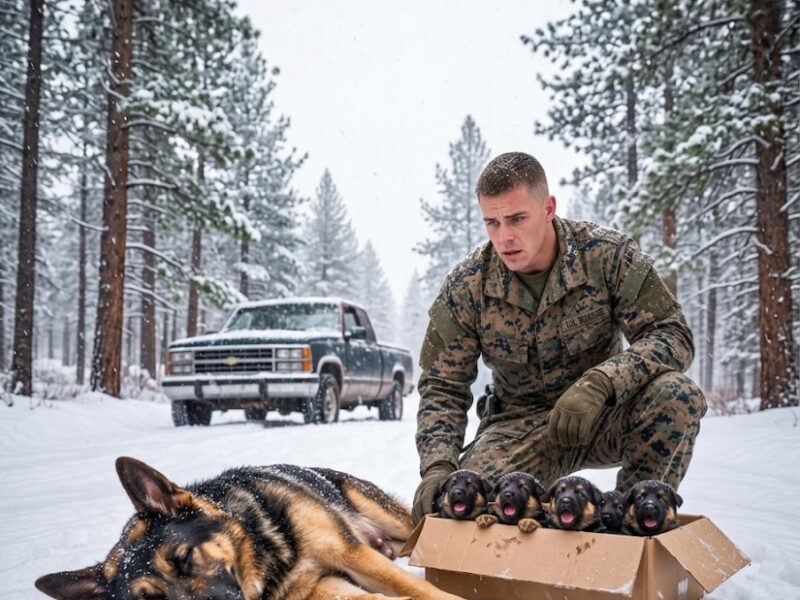
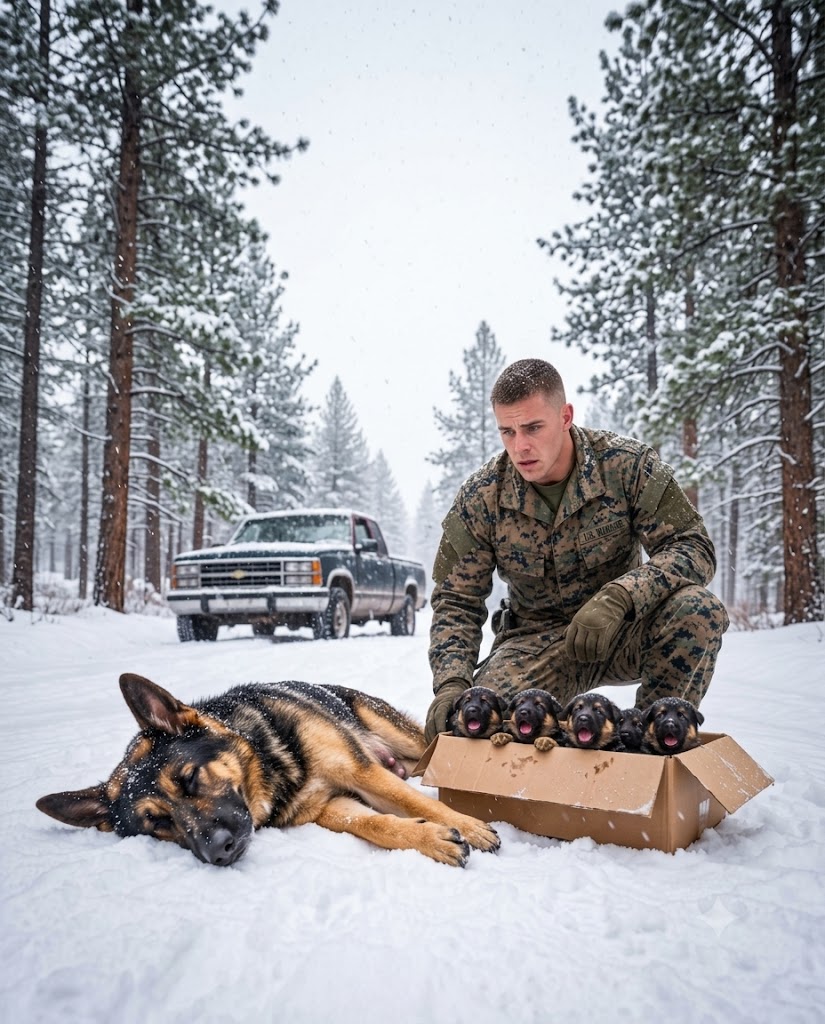
But one freezing morning, Mason found a German Shepherd mother lying lifeless beside a lonely forest road.
Next to her sat a soaked cardboard box holding five tiny puppies, cold, hungry, and barely moving.
The smallest kept trying to crawl toward its mother.
Mason had planned to sell his cabin and leave Idaho for good.
Instead, he carried all five puppies home.
What began as one night of temporary care soon became a reason to stay.
Then one puppy vanished into a blizzard, leading Mason to a discovery no one expected.
What happened next would change Mason, those five dogs, and an entire community forever.
If you believe second chances can arrive when we least expect them, please subscribe and stay with us until the end.
Snow had been falling over the mountains north of Sandpoint, Idaho since before sunrise, covering the narrow forest road, the pine branches, and the drainage ditches in a clean layer of white.
The sky was pale and heavy, and the only movement came from loose snow drifting between the trees.
Mason Carter drove his old dark gray Chevrolet pickup slowly through the storm.
At 42, Mason was a tall, broad-shouldered former Marine with short, dark brown hair cut close at the sides, light gray beginning to show near his temples, and a face that still carried the disciplined seriousness of a man who had spent nearly two decades being responsible for other people.
He had strong hands, a straight posture, and a habit of studying a situation before speaking.
Friends once described him as dependable.
Since his father died, they more often described him as distant.
That morning, several bundles of roofing material lay beneath a tarp in the truck bed.
Mason had driven into town before daylight because part of the roof on his father’s old cabin needed to be repaired before the property could be sold.
A brown folder rested on the passenger seat beside him.
Inside were documents from the real estate agent along with several places marked for his signature.
He planned to sign them before the weekend ended.
The cabin had belonged to his father for more than 30 years.
Mason had spent summers there as a boy, returned there between deployments, and eventually moved into it after leaving active service.
For a while, he had believed the familiar rooms would help him settle into civilian life.
Instead, every room seemed to remember someone who was no longer there.
His father’s coffee mug still occupied the back of a kitchen cabinet.
An old wool coat still hung beside the mudroom door.
Tools remained arranged above the workbench exactly as his father had left them.
Mason had spent months telling himself that keeping the cabin was practical.
Eventually, he admitted that staying there had become another way of refusing to move forward.
The road narrowed between two stands of ponderosa pine.
Mason reduced his speed as the tires crossed a patch of packed snow.
Then he noticed something beside the ditch.
It was 30 yards ahead, partly covered by fresh snowfall, dark brown against the white shoulder.
Mason eased off the accelerator.
At first he thought it might be a deer that had wandered too close to the road.
Wildlife often crossed that section of forest during winter, and after a storm it was difficult to judge shapes from a distance.
He drove several yards farther.
The shape did not move.
Mason pulled onto the shoulder, shifted the truck into park, and remained behind the wheel for several seconds.
Something about the shape was wrong.
He stepped outside.
Cold air immediately reached through the opening of his jacket.
Mason pulled on his gloves and walked toward the ditch, leaving deep tracks behind him.
The animal became recognizable before he reached it.
A German Shepherd.
She was an adult female, perhaps 5 years old, medium large, and strongly built beneath a black and tan coat.
Snow had collected lightly along her back and ears.
She wore no collar, and there was nothing visible that identified where she belonged.
Mason stopped several feet away.
He had been around enough working dogs during his military years to recognize when there was nothing more he could do.
He crouched anyway.
The shepherd was cold and still.
Whatever had happened, it had not happened moments earlier.
Mason lowered his eyes.
Where did you come from?
There was no house nearby, no driveway, no mailbox, only forest, snow, and the road disappearing through the trees.
He stood and looked around.
That was when he noticed the box.
It sat several feet farther into the ditch, partly sheltered beneath the low branches of a pine.
The cardboard had absorbed moisture until the bottom sagged against the snow.
One corner had collapsed inward.
Mason took a step toward it.
Something moved inside.
He stopped.
For several seconds, there was nothing.
Then the cardboard shifted again.
Mason crossed the ditch quickly and knelt beside the box.
He lifted one damp flap.
Five small faces looked back at him.
They were German Shepherd puppies, perhaps four weeks old, so young that their ears had barely begun to lift.
Their black and tan coats were damp and they were pressed tightly together beneath what remained of an old towel.
One puppy trembled against another.
A larger male tried weakly to push himself upright before settling again.
Mason counted them.
Five.
He removed one glove and touched the nearest puppy carefully.
The small body was cold.
One puppy was noticeably smaller than the others.
He had a dark muzzle, a narrow tan mark above each eye, and one ear that folded sideways.
While the others remained crowded together, the small male pushed toward the damaged side of the box.
Mason moved his hand in front of him.
The puppy climbed over it.
He slipped through the opening and began crawling across the snow, not toward the truck, toward the mother.
Mason watched him travel several inches before his legs weakened.
He lifted the puppy and returned him to the box.
Almost immediately, the little dog turned around and tried again.
Mason looked from the puppy to the motionless shepherd beside the road.
Then he noticed the mother’s underside.
Even beneath the winter coat, there were clear signs that she had recently been nursing.
Mason no longer had to wonder whether the dogs were connected.
“She’s your mother.”
The puppy rested against his glove for a moment, then pushed forward once more.
Mason held him gently.
You’re not going back out there.
The words came more firmly than he intended.
The small dog became still.
Mason would later call him Echo, because from the beginning he seemed determined to answer something the others could not hear.
For now, he was simply the smallest of five animals that needed somewhere warm.
Mason stood and studied the road.
No recent tire tracks entered the shoulder.
No tracks led away from it either.
The only fresh vehicle marks were from his Chevrolet.
Snow had fallen throughout the night, but not heavily enough to erase everything within minutes.
If someone had stopped there recently, Mason expected to see some evidence.
There was none.
He looked at the wet box again.
The cardboard had softened too deeply for the puppies to have been placed there only a short time earlier.
They had survived at least part of the night.
Mason returned to the pickup, opened the passenger door, and looked at the brown real estate folder.
For a moment, he simply stared at it.
Then he removed his heavy outer coat.
He carried it back to the ditch, spread it inside the box, and moved the puppies onto the warmer fabric one at a time.
Echo was last.
Mason placed him beside the others and folded one side of the coat over all five.
Before lifting the box, he turned once more toward their mother.
Something blue showed beneath the snow near her front leg.
Mason brushed the loose snow aside.
It was a short length of nylon rope.
One end had been broken or torn away.
The material was faded, but still bright enough to stand out against the white ground.
Mason examined it without reaching any conclusion.
Then he slipped it into his jacket pocket.
Whatever had brought the mother and her puppies to this isolated stretch of forest had left very little behind.
The blue rope was the first thing that looked like an answer.
Mason carried the box toward the truck.
Five puppies shifted beneath his coat.
On the passenger seat, the unsigned papers waited exactly where he had left them.
Mason looked at them once, moved the folder onto the floor, and carefully set the box in its place.
For the first time that morning, selling the cabin was no longer the only thing waiting for him at home.
North Valley Veterinary Clinic stood at the edge of Sandpoint behind a row of snow-covered spruce trees, a one-story building with faded green siding and a parking lot that had been cleared only hours earlier.
Mason Carter carried the cardboard box through the front door with both arms wrapped around it.
His heavy coat remained folded beneath the five puppies, leaving him in a dark thermal shirt despite the cold.
A woman appeared from the treatment hallway before the receptionist finished standing.
Dr. Emily Warren was 39, medium height and slender with dark auburn hair pulled into a loose ponytail and tired hazel eyes that seemed to notice everything at once.
She wore navy scrubs beneath a gray fleece jacket, and her movements were quick without becoming hurried.
Emily had inherited the clinic from her father, Dr. Peter Warren, who had treated animals around Bonner County for nearly 30 years before dying the previous winter.
Since then, she had developed a habit of taking on more than the clinic could easily manage.
People sometimes mistook it for stubbornness.
Those who knew her understood that she simply had difficulty turning away anything that still had a chance.
“What happened?”
“Found them north of town.”
Emily folded back Mason’s coat.
Her expression changed immediately.
She carried the box into the examination room and began working through the litter, one puppy at a time.
Mason stood beside the stainless steel table while Emily checked temperatures, gums, breathing, weight, and hydration.
The puppies were approximately 4 to 5 weeks old.
All five were cold.
All were underweight.
Several showed signs of mild dehydration, but they were alive.
“That matters,” Emily said.
The smallest male received the most attention.
He had been the one determined to crawl toward his mother beside the road.
Now he lay against Emily’s palm with his dark muzzle resting over her thumb.
“This one is behind the others.”
“How far?”
“Enough that I want to watch him carefully. Not enough that I’m giving up on him.”
Mason looked at the puppy.
Emily wrapped him in a warmed towel.
“A few more hours outside could have changed this conversation.”
That answer stayed with Mason.
He had spent years in environments where timing mattered.
Sometimes the difference between an ordinary day and a permanent loss was measured in minutes.
Nobody noticed until afterward.
Emily moved the puppies into a heated treatment area while Mason explained where he had found them.
He mentioned the dead mother, but not the blue nylon rope in his pocket.
There was no reason yet to turn an unanswered detail into a conclusion.
When the initial examination was finished, Mason looked toward the kennels.
“So they stay here?”
Emily hesitated.
The hesitation answered before she did.
“I wish they could. Two isolation kennels are already occupied.”
One held an elderly mixed breed dog recovering from illness.
The other contained a young hound brought in after becoming lost during the storm.
Every other usable space was committed to scheduled patients.
The county shelter was full.
Emily explained that animal control had removed 14 dogs from an abandoned rural property three days earlier.
Foster homes were stretched thin and the nearest rescues were calling each other looking for space that nobody seemed to have.
Mason rubbed a hand across the back of his neck.
“I can keep them tonight.”
Emily looked at him.
“One night?”
“One.”
She did not argue.
Instead, she packed puppy formula, softened food, a thermometer, absorbent pads, and written feeding instructions into a cardboard grocery box.
By late afternoon, Mason’s kitchen counter looked like a supply station.
The puppies occupied the small wood storage room beside the stove, a narrow space that Mason cleared by carrying split logs into the mudroom.
He spread blankets across the floor and positioned a shallow wooden box near the warm interior wall.
The larger male was the first to climb over the edge.
Mason returned him.
Two minutes later, he was out again.
“You’re Bear.”
The name seemed appropriate.
Another male wandered farther than the rest whenever Mason looked away, investigating chair legs, the broom closet, and the hallway rug with determined curiosity.
Mason called him Scout.
The two females behaved differently.
One had a calm face and stayed close whenever the others became restless.
Mason named her Maple.
The smaller female, Piper, remained hesitant around the bowls.
She sniffed the softened food, but refused to eat until Maple settled beside her.
Only then did Piper begin.
Echo remained closest to Mason.
The name came to him while the puppy followed his movement with tired eyes from beneath the blanket.
Every time Mason stepped away, Echo lifted his head.
Every time Mason returned, he relaxed.
By evening, Mason had already abandoned the feeding schedule he normally followed for himself.
His dinner sat untouched while he measured formula.
The house smelled of warm milk replacer and wet towels.
At 7, someone knocked.
Mason opened the door and found Jack Turner standing on the porch.
Jack was 68, tall but slightly stooped, with a heavy white mustache, weathered hands, and the square shoulders of a man who had spent most of his life building things.
He had worked as a carpenter across northern Idaho before retiring.
Since his wife Margaret died three years earlier, Jack had become quieter and increasingly private.
He remained friendly with neighbors, but rarely stayed anywhere long enough for conversation.
He looked past Mason.
“Heard you bought enough puppy food to start a kennel.”
Mason frowned.
“Small town.”
“Very.”
Behind Jack sat an old wooden puppy pen in the bed of his pickup.
“I built that for Maggie’s Labrador years ago.”
“I’ve got something set up.”
“I figured you would.”
Jack walked toward the truck anyway.
Mason followed him.
“You don’t have to bring that in.”
Jack rested one hand on the wooden frame.
“You don’t have to keep it. Just use it until they don’t need it.”
Mason had no answer that did not sound unnecessarily stubborn.
Together, they carried it inside.
It was the first time Jack had crossed Mason’s doorway in almost two years.
He did not stay long.
He looked at the puppies, nodded once, then returned home before the snow became heavier.
By midnight, Bear had escaped the pen twice.
Scout had discovered the bottom shelf beneath Mason’s coffee table.
Piper would not settle until Maple lay beside her.
Echo refused to sleep unless Mason rested his hand near the edge of the blanket.
Mason eventually gave up on going upstairs.
He stretched across the sofa with another blanket and left the hallway light on.
At 3:00 in the morning, something woke him.
The room was quiet.
Too quiet.
Mason sat up.
Four puppies remained together.
Echo was missing.
He found the little dog several feet away beside the mudroom door.
Echo had curled himself against Mason’s old Marine combat boots, his small body tucked between them as if he had chosen the safest place he could find.
Mason stood there for a moment.
Then he picked him up carefully.
“You’re supposed to be sleeping.”
Echo rested his head against Mason’s hand.
Mason carried him back to the others, placed him beside Maple, and remained kneeling until all five were still.
The stove clicked softly behind him.
A puppy shifted beneath the blanket.
Another stretched a paw across its sibling.
For months, Mason had believed silence was what he wanted.
That night, for the first time in a long while, the cabin did not feel empty.
Two weeks changed the cabin more than Mason Carter expected.
The five puppies no longer spent most of their time beneath blankets near the stove.
Bear had learned to climb over the wooden pen whenever Mason forgot to secure one corner.
Scout investigated anything left within reach.
Maple followed Mason calmly from room to room, while Piper still checked for Maple before settling anywhere unfamiliar.
Echo remained smaller than the others, but his legs were stronger now, and he had developed a habit of waiting beside the mudroom whenever Mason stepped outside.
The names Mason had chosen during that first chaotic night were no longer temporary.
Neither, apparently, was the noise.
One cold morning, Mason stood at the kitchen sink, watching all five puppies chase one another across the snow-covered yard.
His phone vibrated on the counter.
Dana Hol was calling again.
Dana, 45, was a compact, carefully dressed real estate agent with short blonde hair and the patient efficiency of someone who had spent 20 years turning uncertain decisions into signed contracts.
She had handled the sale of several rural properties around Sandpoint and had never pressured Mason openly, but she believed unfinished decisions usually became harder the longer people avoided them.
“The buyers still want to schedule another viewing,” she said.
Mason watched Scout disappear behind the porch step.
“I need another week.”
“You said that last week.”
“The back fence needs work.”
There was a pause.
“Does the fence need work or do you need more time?”
Mason looked toward the five small tracks crossing the yard.
“Both.”
Dana did not argue.
She moved the viewing again.
Later that afternoon, Jack Turner arrived carrying cedar boards, screws, and an old toolbox.
The western fence had leaned for years, but Mason had ignored it because there had never been anything in the yard that needed containing.
Now five puppies had turned every opening into an invitation.
Jack studied the fence once and pointed toward two rotting posts.
“Those are finished.”
Mason pulled on his gloves.
“Then we replace them.”
For the next two hours, the men worked without much conversation.
Jack measured twice before every cut, an old carpenter’s habit that retirement had never removed.
His hands moved more confidently around wood than they did around people.
When Mason mentioned that the puppies would eventually need a proper gate, Jack stopped.
“I can make one.”
“You don’t need to.”
“I know.”
Jack looked toward Bear and Scout wrestling beside the porch.
“My wife used to say I only built things when I couldn’t figure out what else to do.”
It was the first time Jack had spoken about Margaret directly.
He explained that after she died three years earlier, he had closed his workshop and covered most of his equipment.
Margaret had been the one who brought neighbors into their house, remembered birthdays, and found reasons for Jack to build benches, shelves, birdhouses, and toys for grandchildren who lived several states away.
After losing her, the projects stopped.
“So did most everything else,” Jack said.
That evening, Mason saw light coming from Jack’s workshop for the first time since moving into the cabin.
By the following morning, the blue nylon rope was lying on the examination counter at North Valley Veterinary Clinic.
Mason had finally shown it to Emily Warren.
She photographed the rope along with older photographs animal control had taken of the mother shepherd before arranging respectful care for her remains.
Emily sent the images to rescue groups across northern Idaho and western Montana.
The first useful answer arrived before lunch.
Rachel Pike, a 36-year-old volunteer coordinator from a small dog rescue near Libby, Montana, was a tall, energetic woman with dark curly hair and a reputation for remembering equipment almost as well as she remembered animals.
Before joining rescue work, she had managed kennels for several private trainers.
She recognized the rope.
“That type was used at a training property outside Bonners Ferry,” Rachel explained over the phone.
“Blue tether lines, same weave, same hardware. The place closed a while back.”
It was not proof of anything, but it was a direction.
Emily then asked animal control whether the shepherd had been scanned for a microchip.
A chip was found.
The registration was old, but the record contained a name.
Sadi.
Mason repeated it quietly.
The dead mother on the snowy roadside finally had something more than a description.
She had a name.
The registration also listed a former owner.
Thomas Avery.
Emily spent most of the afternoon tracing outdated contact information until she reached an assisted living community south of Coeur d’Alene.
Thomas Avery was 72, thin and silver-haired with a neatly trimmed beard and the measured voice of a man accustomed to staying calm when other people became frightened.
Before retirement, he had worked for nearly 25 years with a volunteer wilderness rescue team.
A stroke three years earlier had weakened his left side and forced him to leave his rural home.
When Emily explained why she was calling, Thomas went silent.
“Sadi had puppies.”
“Yes. All five survived.”
Another silence followed.
Thomas told them Sadi had belonged to him from the time she was eight months old.
She had not been a police dog or a military dog.
She had been trained for wilderness search work.
“She could find somebody in timber when I could barely find the trail myself.”
Thomas said Sadi had accompanied volunteer teams searching for lost hikers, elderly residents who had wandered from home, and children separated from families during camping trips.
After Thomas suffered the stroke, keeping her became impossible.
He had transferred Sadi through what he believed was a legitimate rescue organization.
He had received two updates, then nothing.
“I thought she found a family.”
Mason looked across Emily’s office toward Echo sleeping inside a travel crate.
Thomas sounded tired when he spoke again.
“She always stayed close to whoever needed her most.”
That sentence remained with Mason on the drive home.
By sunset, Jack had finished the new cedar gate.
It was simple, strong, and fitted perfectly between the repaired posts.
Jack stood beside it while the puppies explored the yard.
Bear charged through the snow.
Scout followed.
Piper stayed beside Maple.
Echo stopped near Mason’s boots before running after the others.
Jack watched them for several seconds.
“Workshop still works,” he said.
Mason smiled slightly.
“So does the gate.”
Across the yard, five young shepherds disappeared briefly behind a snowbank and returned together.
Mason touched the folded real estate papers inside his jacket.
He still had not signed them.
And now the cabin was beginning to look less like something he was preparing to leave.
It was beginning to look like somewhere five dogs expected to find him.
By the time the puppies were nearly eight weeks old, Mason Carter had stopped measuring their progress in ounces and feeding schedules.
He measured it by the damage they could do in five unattended minutes.
Bear had grown into the heaviest of the litter, broad through the chest and already beginning to look less like a helpless puppy and more like the large German Shepherd he would someday become.
Scout remained quicker and more curious, usually following Bear into whatever trouble the larger puppy discovered first.
Maple had developed a quiet confidence, while Piper still preferred to stay close to her sister whenever strangers appeared.
Echo remained the smallest, but he followed Mason from room to room with such determination that Mason had learned to look behind him before taking a step backward.
One Tuesday morning, his phone rang while he was carrying firewood into the cabin.
Sarah Mitchell was calling from Bonner County Animal Services.
Sarah was 47, short and sturdy with gray beginning to show through her dark hair and a practical way of speaking that came from 16 years of matching abandoned animals with families.
She was known for being careful rather than sentimental.
Sarah had seen too many failed placements to believe that good intentions alone made a good home.
“We’ve finished the applications,” she said.
Mason stopped beside the stove.
“All five?”
“All five. The families have been interviewed. Veterinary references have been checked. Fences have been photographed. Schedules have been discussed.”
Bear had been matched with a couple outside Spokane who owned several wooded acres.
Maple would go to a family in Coeur d’Alene.
Piper had been approved for a quiet household in western Montana.
Scout would go to Boise with a family experienced with working breeds.
Echo had been matched with a retired teacher less than 20 minutes outside Sandpoint.
On paper, Mason could find very little wrong with any of it.
That was the problem.
Every reasonable fact pointed toward letting them go.
Five adult German Shepherds would require space, food, training, medical care, and daily exercise.
Mason lived alone.
He was still uncertain what his life would look like six months from now.
Sarah scheduled the first placement for Saturday.
Piper would leave first.
Mason spent the next three days telling himself it made sense.
At North Valley Veterinary Clinic, Emily Warren listened while checking Piper’s weight.
“She’s healthy,” Emily said.
“That’s good. She’s ready.”
Mason looked through the open treatment room door.
Maple was sitting outside the travel crate watching Piper.
“You say that like you’re trying to convince me.”
Emily gave him a tired smile.
“I’m trying to convince both of us.”
The smile disappeared quickly.
Emily had been sleeping poorly.
Mason could see it in the shadows beneath her eyes.
When he asked whether the clinic’s heating system had finally been repaired, she leaned against the counter.
“The repair isn’t the biggest problem anymore.”
She explained that the clinic’s reserves were nearly gone.
Her father had carried the practice through difficult years by delaying upgrades and taking little salary for himself.
After his death, several major expenses arrived close together.
“If nothing changes,” Emily said, “I probably have two months.”
Mason looked around the clinic.
“You’d close?”
“I’d have to.”
The words were simple, but Emily kept one hand on Piper’s back while she spoke, as though continuing to care for the puppy made the possibility easier to say.
That afternoon, Jack Turner found Mason repairing another section of fence.
Jack watched him replace a board that did not actually need replacing.
“You planning to rebuild the whole property one piece at a time?”
“Maybe.”
Jack looked toward the puppies.
“Or maybe you’re trying not to think about Saturday.”
Mason did not answer.
Jack pushed his hands into the pockets of his work coat.
“I have an old equipment barn behind my workshop. Solid roof, concrete floor. Hasn’t held anything useful in years.”
“For what?”
“Temporary foster space.”
Mason finally looked at him.
“Jack, I’m selling this place.”
Jack’s expression barely changed.
“Then why haven’t you signed the papers?”
Mason opened his mouth.
Nothing came out.
The next morning, Jack showed him the barn anyway.
It stood behind the workshop beneath several tall pines larger than Mason remembered.
Inside were stacked cedar boards, folded wire panels, old workbenches, and rows of professional woodworking tools under canvas covers.
Jack removed one cover.
A table saw appeared beneath it.
Another revealed a planer.
“I thought you stopped using all this.”
“I did.”
Jack looked around the building.
“Doesn’t mean it has to stay stopped.”
Mason walked slowly through the space.
He could imagine kennels along one wall, a training area outside, a place where rescue dogs could stay temporarily instead of being moved between overcrowded shelters.
He could imagine Emily providing medical care.
Jack building gates and platforms.
Then Mason caught himself.
He was planning around a property he kept insisting he intended to leave.
Saturday arrived clear and cold.
The first adopting family came shortly after 10.
David and Caroline Hayes had driven from western Montana for Piper.
David was 41, tall and soft-spoken, with a trimmed brown beard and the careful manner of someone who preferred animals to approach him first.
Caroline, 38, was a slim elementary school librarian with long, dark hair and a warm expression.
They had recently lost an elderly shepherd mix and had waited almost a year before applying for another dog.
They did everything correctly.
They sat on the floor.
They did not reach for Piper immediately.
They let her decide whether to approach.
Piper did not.
She moved backward beneath Mason’s wooden kitchen table.
Caroline waited patiently.
Maple crossed the room.
She stopped directly in front of Piper.
Then she sat down.
Maple did not growl.
She did not bark.
She simply placed herself between her sister and the unfamiliar people.
Mason stared at them.
For a moment, he saw a snowy roadside again.
Sadi beside the wet cardboard box, a mother that had stayed with five puppies through a freezing night, protecting family with the only things she had left to give.
David looked toward Mason.
“Should we give her more time?”
Mason crouched beside Maple.
Piper pressed against her sister.
“Yes.”
Caroline nodded.
“How much?”
Mason did not know.
That was the truth.
He stood and took out his phone.
Sarah answered on the third ring.
“I need three days.”
There was a pause.
“Are you keeping them?”
“I don’t know, Mason. I’m not saying these families are wrong. I’m saying I need three days to find out whether there’s another way.”
Sarah remained silent for several seconds.
Then she agreed to postpone the remaining placements.
After David and Caroline left, Mason stood in the kitchen while five puppies moved around his boots.
Maple stayed beside Piper.
Bear chased Scout toward the hallway.
Echo sat directly against Mason’s leg.
Three days.
He had not decided to keep five dogs.
He had only decided that before separating them, he owed them one serious attempt to find something better.
And for the first time, that possibility no longer felt impossible.
The storm reached the Selkirk Mountains before noon.
By 1:00, the trees behind Mason Carter’s cabin were disappearing behind blowing snow, and the narrow road toward Sandpoint had turned almost completely white.
Mason had spent the morning inside Jack Turner’s old equipment barn, measuring one wall and sketching possible kennel spaces on the back of a feed receipt.
The idea was still rough.
Nothing had been approved.
Nothing had been paid for.
But for the first time, Mason was planning as if he might actually stay.
Outside, Jack was reinforcing the western fence.
The older carpenter had tied his white hair beneath a wool cap and worked with the same patient concentration he had once used on houses, barns, and church additions.
Three years of grief had slowed him socially, but his hands still trusted wood, measurements, and tools.
“Storm’s getting worse,” Mason called from the barn door.
Jack looked toward the treetops.
“Then we finish this section and go inside.”
A few minutes later, a heavy gust moved through the pines.
One of the younger trees near the rear boundary bent beneath the accumulated snow.
It came down across the fence, not violently, but with enough weight to push two rails loose and open a narrow gap near the ground.
Mason and Jack hurried toward it.
They cleared the branches and leaned temporary boards against the opening.
Neither man saw the small set of tracks already disappearing beyond the fence.
Inside the cabin, Bear was asleep near the stove.
Scout was trying to pull a towel from a chair.
Maple and Piper were pressed together beside the wooden pen.
Mason counted them automatically.
Four.
He counted again.
Echo.
Jack stopped near the mudroom.
Mason checked beneath the kitchen table, behind the sofa, beside the wood rack, and inside the storage room.
Nothing.
Then he saw the open gap through the back window.
He was outside within seconds.
The snow had already begun filling tracks, but several small paw prints remained visible beyond the fallen tree.
Jack crouched beside them.
“He went through here.”
Mason followed the trail toward the edge of the property.
The prints did not turn toward the road.
They continued toward the forest toward the same wooded area where Mason had found Sadi.
He stared at the fading tracks.
“Why would he go back there?”
Jack did not answer.
There was no time to guess.
Mason grabbed his coat, flashlight, emergency bag, and truck keys.
Jack climbed into the passenger seat before Mason could tell him to stay behind.
Emily Warren answered Mason’s call on the second ring.
She was closing North Valley Veterinary Clinic early because of the weather.
But when Mason told her Echo was missing, she changed direction immediately.
“I’ll take the county road from the south,” she said.
“If he crossed toward the old timber access, I may see tracks.”
“Emily, visibility is bad.”
“I know.”
Her voice remained calm.
“So drive carefully.”
The storm thickened as Mason pushed north.
The road that had been familiar two weeks earlier now looked completely different.
Snow covered the shoulders, the drainage lines, and most of the landmarks he remembered.
Jack watched the tree line.
Mason watched the road.
Neither spoke much.
Several miles later, Emily called.
“No tracks here.”
Mason tightened his grip on the steering wheel.
They continued near the place where Mason had first seen Sadi.
He slowed almost to a stop.
The ditch was nearly invisible beneath fresh snow.
The tree that had once sheltered the cardboard box stood farther back from the road, its lower branches now buried.
Mason stepped from the truck.
“Echo.”
The wind carried his voice away.
Jack searched near the shoulder while Mason moved deeper toward the trees.
Then he saw something small and dark ahead.
Echo.
The puppy stood near the edge of a shallow wooded ravine, his black and tan coat covered in snow.
He was not looking toward the road.
He was looking down.
“Echo.”
The puppy turned briefly toward Mason, then looked back into the ravine.
Mason approached carefully.
At the bottom, partially sheltered beside a snow-covered snowmobile, lay an older man.
He was conscious, but clearly exhausted.
Mason immediately understood why Echo had stopped.
The puppy had not returned to the place where his mother died.
He had found someone.
The man below was Richard Cole, 66, a broad-framed local businessman with silver hair, a trimmed gray beard, and the composed manner of someone accustomed to solving practical problems.
For more than 20 years, Richard had owned a building supply company serving northern Idaho.
He was also well known among local first responders because he had quietly funded equipment purchases for the volunteer fire department whenever town budgets fell short.
That afternoon, he had been checking a remote property when worsening weather forced him off the trail.
He had been unable to return to the road.
Mason reached him carefully and checked that he could respond.
“You’re going to be all right.”
Richard looked past him.
“That your dog?”
Mason turned.
Echo had followed only partway down and now stood watching from above.
“Something like that.”
Jack called 911 while Emily arrived from the opposite access road.
Within a short time, volunteer firefighters reached the area with proper winter rescue equipment.
There was no dramatic rush, no unnecessary risk, only careful teamwork.
Once Richard was safely stabilized and brought toward the road, Echo was wrapped in a blanket and placed beside him for warmth.
The puppy immediately settled against Richard’s chest.
Richard looked down at him.
“He found me before any of you did.”
Mason did not answer.
He was thinking about Thomas Avery, about Sadi, about the search dog she had once been, and about the small puppy that had crossed a snow-covered forest and stopped exactly where someone needed help.
The story traveled through Sandpoint quickly.
By the following morning, Mason’s phone had already received messages from people he barely knew.
Richard contacted him two days later.
He had learned about North Valley Veterinary Clinic.
He had learned about Sadi.
He had learned about the unfinished foster idea in Jack’s barn.
Mason expected Richard to offer money.
Instead, Richard asked a different question.
“What would it take to get the town involved?”
That weekend, he arranged a community fundraiser.
Jack built simple cedar signs for the event.
Emily offered free basic health checks for rescue animals brought by local families.
Several veterans from the area volunteered to repair walls, reinforce fencing, and clear the unused barn space.
For once, Mason did not try to do everything himself.
He stood near the workshop while people carried lumber, tools, food, and supplies across the property.
Jack worked beside two younger volunteers.
Emily moved between tables answering questions.
Richard spoke quietly with local businesses about donated materials.
Echo sat beside Mason’s boot.
Mason looked at the activity around him and understood something he had spent years resisting.
Strength did not always mean carrying every responsibility alone.
Sometimes it meant allowing other people to carry part of it with you.
And this time, Mason let them.
Spring arrived slowly in northern Idaho.
For weeks, the snow around Mason Carter’s cabin withdrew a few feet at a time, exposing brown grass, muddy tire tracks, and the cedar fence Jack Turner had repaired during the winter.
Water ran from the roof in steady drops.
The pines behind the property lost their heavy white covering, and for the first time since Mason had found Sadi beside the forest road, the yard looked open rather than buried.
One April morning, Mason stood at the kitchen table with the real estate folder in front of him.
The papers were still unsigned.
Dana Hol had given him more extensions than either of them had originally expected.
Mason picked up his phone.
“I’m not selling.”
Dana was quiet for a moment.
“Are you sure?”
Mason looked through the window.
Echo and Scout were chasing each other along the repaired fence.
“Yes.”
This time, there was no hesitation.
Later that afternoon, Mason removed the for sale sign from the side of the driveway and carried it into the garage.
The decision felt less like changing his plans and more like finally admitting that his plans had already changed months earlier.
Behind Jack Turner’s workshop, the old equipment barn had changed, too.
The concrete floor had been cleaned.
New kennel partitions lined one wall.
Jack had built raised wooden platforms, storage cabinets, feeding stations, training gates, and a wide entrance ramp that could accommodate older visitors.
A cedar sign hung above the doorway.
Sadi’s 5.
Beneath it, in smaller carved letters, “No Life Left Behind.”
Jack had made the sign himself.
He was still 68, still slightly stooped, still more comfortable holding a measuring tape than speaking in front of a group.
But the quiet withdrawal that had shaped the years after Margaret’s death had begun to loosen.
His workshop lights were on almost every day now.
He had even taken on two young apprentices from the local vocational program.
One of them, 17-year-old Noah Briggs, was a thin, serious high school junior with sandy hair and a habit of measuring everything three times because he was terrified of making mistakes.
Jack never mocked him for it.
Instead, he showed Noah how to slow down without being afraid.
“Wood gives you another chance if you pay attention,” Jack told him.
The same could have been said about people.
Sadi’s 5 was not a shelter.
Mason was careful about that distinction.
They did not have the space or staff to house dozens of animals.
Instead, the property became a small community foster and training program.
Rescue dogs could stay temporarily while permanent homes were arranged.
Local veterans could help with training.
Older residents were invited to spend time with calm dogs during supervised visits.
Teenagers needing volunteer hours cleaned kennels, filled water bowls, and learned basic animal care.
Families considering adoption could attend weekend sessions before deciding whether they were ready.
Emily Warren became the program’s veterinary partner.
North Valley Veterinary Clinic remained open.
The fundraiser Richard Cole had organized did not magically erase every financial problem, but it covered the most urgent repairs and brought new attention to the clinic.
More importantly, Sadi’s 5 signed an ongoing agreement with Emily to provide health examinations, vaccinations, and veterinary guidance for animals entering the foster program.
For the first time since her father died, Emily could plan several months ahead instead of several days.
She still wore navy scrubs most mornings, still kept her auburn hair tied back, and still accepted more work than Mason thought reasonable.
But she smiled more often.
The five puppies did not remain under one roof.
Mason adopted Echo and Scout.
Scout had become taller and faster with long legs he had not yet learned to control properly.
He continued investigating anything left unattended and had developed a particular interest in stealing Mason’s work gloves.
Echo remained slightly smaller.
What he lacked in size he replaced with focus.
He watched people carefully.
He noticed changes before the other dogs did.
During simple scent exercises, Echo repeatedly located hidden objects faster than Mason expected.
Thomas Avery had been right about Sadi.
Something of the search dog seemed to have continued through her son.
Mason began working with Echo on basic wilderness search and rescue foundations.
Nothing complicated.
Short scent trails, controlled woodland exercises, finding a familiar person hidden behind trees.
Echo treated each exercise as if nothing else existed.
Maple went home with Emily.
The calm female quickly claimed a bed beneath Emily’s office desk and somehow learned which clinic visitors needed quiet.
Jack adopted Bear.
The largest of the five followed Jack into the workshop every morning and slept beneath the workbench while sawdust collected around his paws.
Jack complained that Bear occupied too much floor space.
Nobody believed he minded.
Piper went to a family living less than 10 minutes away.
The home was quieter than Mason’s and suited her gentle nature, but her new family agreed that she would return every Saturday.
That mattered because every Saturday morning the five dogs came back together.
The first reunion had answered one question Mason had worried about.
They had not forgotten.
Bear usually reached the gate first.
Scout met him at full speed.
Maple searched immediately for Piper.
Echo waited only until Mason released him before joining the others.
By late spring, Saturday mornings had become part of the rhythm of the property.
On one clear morning, Mason opened his cabin door shortly after 8.
Echo ran outside first.
Scout followed, carrying one of Mason’s gloves.
Across the yard, Jack opened the training gate with Bear beside him.
Emily arrived moments later with Maple.
A vehicle stopped near the driveway and Piper appeared from the back seat.
Five German Shepherds saw one another.
Then they ran.
Mason stood near the porch while they crossed the green yard together.
Only months earlier, the same property had been covered in snow and silence.
Now Jack’s workshop doors were open.
Young volunteers were arranging training cones.
Emily was carrying a medical bag toward the barn.
The new cedar sign stood beside the entrance.
Beneath the words Sadi’s 5, Jack had mounted a small photograph of Sadi supplied by Thomas Avery.
Mason looked at it for several seconds.
Then he went inside.
The blue nylon rope still hung from a hook beside the mudroom door.
He had once kept it because it was the only clue explaining where Sadi had come from.
Now it meant something different.
It reminded him that five lives had arrived when he was preparing to leave his own life behind.
The real estate documents were no longer on the kitchen table.
Mason had torn them up weeks earlier.
Outside, Echo barked once.
Mason opened the door.
Five dogs were waiting in the yard.
This time, he did not hesitate to join them.
You know what stays with me most about Sadi’s story?
It wasn’t the blue rope or the snow-covered road.
It was knowing that even in her final hours, Sadi stayed close to the five puppies depending on her.
She had once searched the mountains for people in need.
In the end, she was still protecting lives.
This time, her own family.
Mason thought he was saving those puppies, but they slowly saved him, too.
Echo gave him a reason to stay.
Scout brought life back into the cabin, and the others helped Jack and Emily rediscover purpose.
Together, they inspired Sadi’s 5, a place built on one simple idea.
No life should be forgotten.
Maybe that was what Mason needed to learn.
Strength does not always mean carrying everything alone.
Sometimes it means accepting help, opening your door, and realizing that the life you rescued may be leading you toward your own second chance.
Sadi was gone, but every time her five puppies ran together, part of her was still there.
Tonight, I pray God blesses you, protects your family, brings healing to the places you keep hidden, and sends the right people, or perhaps the right pair of paws, into your life when you need them most.
If Sadi, Mason, and those five puppies touched your heart, write amen in the comments.
And if you believe in loyalty, faith, rescue, and second chances, subscribe and stay with us.
But Sadi’s story was not the last time a dog led someone toward a life that needed saving.
Wait until I tell you about the former Navy SEAL who found an exhausted German Shepherd standing alone beside an abandoned mountain cabin during a freezing night.
The dog refused food, refused shelter, and kept returning to the same locked door.
Inside was an old military duffel bag, a faded photograph, and a clue connected to a handler who had disappeared years earlier.
And when that SEAL finally followed the dog into the mountains, he discovered the German Shepherd had not been waiting for someone to rescue him.
He had been waiting for someone willing to finish the mission.
Subscribe now because the next story begins with one dog standing guard in the snow and ends somewhere no one expects.









