
A drunk man stumbled past two freezing puppies and did nothing. Then a Navy SEAL and his German Shepherd stepped in—and changed his life forever.
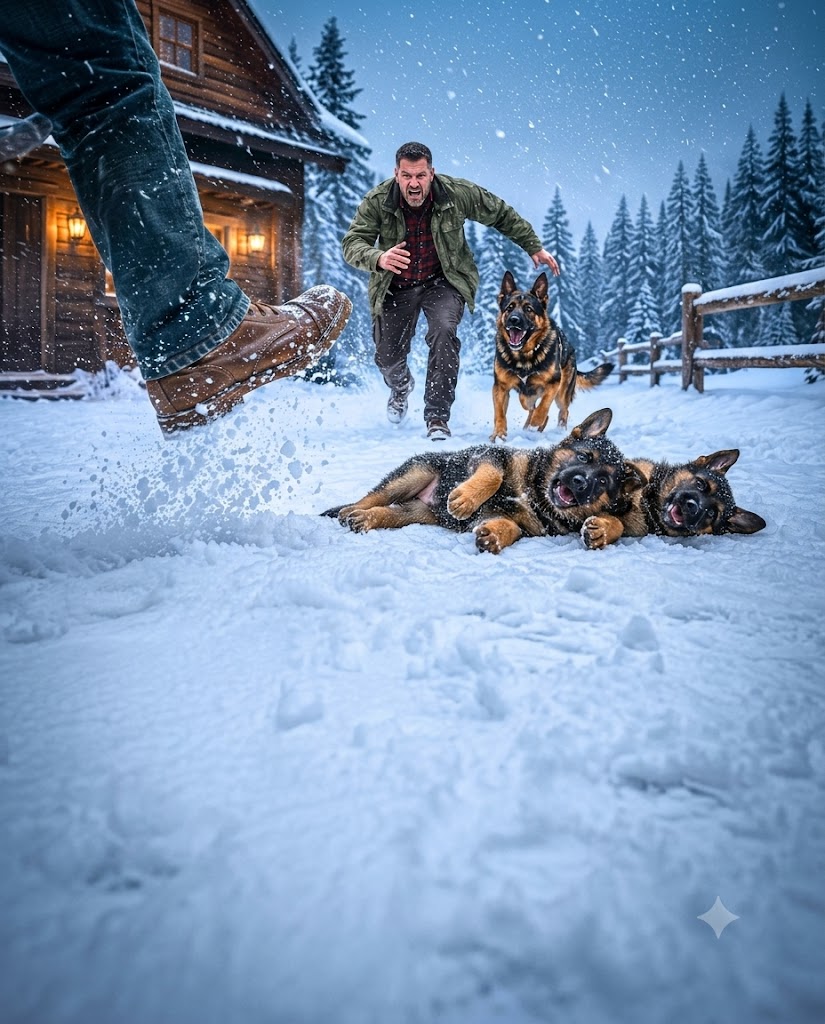
Snow came sideways over Marquette, Michigan, the kind of lake-effect fury that erased streets and turned Lake Superior into a great dark engine beyond the harbor.
Near the old ore dock by Lower Harbor, the service lot lay empty except for plow ridges, dead yellow lights, and the slow scrape of wind against chain-link fence.
Wayne Sutter walked there because sleep had given up pretending to be useful.
He was 39, tall and broad through the shoulders, with short dark brown hair silvered at the temples and gray-blue eyes that kept measuring distances even when there was nothing to measure.
His field jacket was zipped to his throat, his boots bit into the ice, and the old dive watch on his wrist ticked with a patience he had never learned to share.
Wayne was good in a crisis because ordinary peace still confused him.
Beside him moved Breaker, a six-year-old German Shepherd with a black-and-tan coat, a deep black saddle, honey-dark legs, and a small white mark beneath his chin, as if God had touched him once with a paintbrush and gotten distracted.
Breaker had been a military working dog before paperwork, age, and Wayne’s stubborn loyalty turned him into family.
He moved half a step ahead now, ears turning toward the harbor, then toward the fenced lot, then sharply toward a drifted corner near a stack of warped pallets.
Wayne stopped.
The sound came again, thin.
Not a cry exactly, more like breath trying not to disappear.
Breaker lowered his head and took three careful steps.
Wayne followed, one hand lifting in a silent signal that meant slow.
Under the wind, beneath the rattle of ice against metal, he heard it.
A small broken whimper from inside a plastic carrier half buried in snow.
Its door had jammed against a broken pallet.
Frost clung to the vents.
A shipping tag hung from the handle, iced over until only a few letters showed.
Then a man’s laugh rolled out of the storm.
Not happy, not even cruel in a clear way.
It was the sound of someone falling down a well and pretending the echo was company.
Alden Cross swayed ten feet away, one hand braced on a rusted post, the other wrapped around a brown paper bag.
He was 52, big through the chest and belly, with gray-brown hair under a knit cap and a beard shaved in angry patches.
His coat hung open, though the wind snapped at it.
His eyes were red and unfocused.
The smell of whiskey reached Wayne before the man did.
“Leave it,” Alden muttered. “Somebody else’s problem.”
Wayne looked at the carrier.
Through the vents, he saw two German Shepherd puppies pressed together, both trembling hard, their noses pale with cold.
One had tan markings bright against her small face.
The other was darker, black and tan, with paws too big for the rest of him.
Neither made a sound now.
“Step back,” Wayne said.
He did not raise his voice.
Years in dangerous places had taught him that volume often arrived when control had already left.
Breaker sat beside him, square and silent, eyes fixed on Alden without showing teeth.
Alden blinked at the dog, then at Wayne.
Something like recognition flickered beneath the alcohol.
Not of Wayne’s name—of posture, of a man who had crossed hard lines before and did not need to brag about it.
“You don’t know me,” Alden said.
“I know they need help. Everything needs help.”
Alden tried to laugh again, but it cracked.
“Nobody comes.”
Wayne’s hands stayed loose.
His pulse did not.
A blackwater memory flashed—then he buried it.
The carrier mattered now.
He moved between Alden and the puppies.
Breaker shifted with him, a shadow trained by love and repetition.
Alden took one unsteady step forward, then stopped when Breaker rose.
No growl, no drama—just presence.
“Do not make this harder,” Wayne said.
Alden stared at him for a long moment.
His face twisted, not with rage but with shame trying to become rage, because shame had no idea where to stand.
The bottle trembled in his hand.
Wayne crouched and freed the carrier door.
Ice fought him.
He removed one glove with his teeth, felt the cold bite his fingers, and worked the latch until it gave.
The smaller puppy barely lifted her head.
The larger one tried to crawl over her and failed.
“Easy,” Wayne murmured. “I have you.”
Alden made a sound behind him.
Wayne turned just enough to watch him without losing the carrier.
“I saw it fall,” Alden whispered. “The van took the corner too fast. Church people—I thought they’d come back.”
“Did you call 911?”
Alden’s mouth opened.
Nothing came out.
That silence answered.
Wayne pulled his phone free and called Sheriff Mara Beckett.
His report was brief: location, two puppies, intoxicated man, medical risk, possible shelter tag.
Breaker lay down beside the open carrier, pressing his warm body near the puppies without crowding them.
The smaller one—the tan-faced female Wayne would later name Minnow—pushed her nose toward Breaker’s fur.
The darker male, Cinder, shivered so hard his tiny shoulders shook.
The sheriff’s cruiser arrived through the snow, lights bleeding red and blue over the white lot.
Mara Beckett stepped out in a dark coat and winter hat, tall, lean, and composed.
“Alden,” she said, and the way she said his name made clear this was not their first conversation.
Alden looked down.
Mara took in the carrier, Wayne, Breaker, and the whiskey bag.
“You hurt them?”
Wayne answered before Alden could panic.
“I do not see signs of that. But he found them and did not call. He blocked the area when I approached.”
Alden’s knees seemed to loosen.
“I didn’t hurt them.”
“You also did not help them,” Mara said.
The words landed harder than a shout.
Wayne removed his jacket and wrapped the puppies in the inner lining, keeping the carrier close for evidence.
Breaker rose, nose brushing the bundle once, then looked toward Wayne’s truck as if the decision had already been filed.
Mara guided Alden toward the cruiser.
He did not resist.
At the door, he looked back, eyes clearer for one painful second.
“They’re alive.”
Wayne held the bundle tighter.
“They are here.”
That was all he could promise.
As he reached his truck, Breaker stopped and turned back toward the carrier.
He sniffed the frozen tag, then gave one sharp bark.
Wayne lifted the tag with his bare fingers.
Beneath the ice, two words emerged in faded ink: St. Agnes.
—
Morning came gray over Marquette with Lake Superior hidden behind blowing snow and the courthouse clock wearing a rim of ice.
Inside the county holding room, Alden Cross woke to the smell of disinfectant, old coffee, and shame.
His mouth tasted like pennies and whiskey.
His back hurt from the narrow bench.
For several seconds, he did not remember where he was, and those seconds were almost kind.
Then the night returned—the carrier, the puppies, the Navy man standing in the snow with a voice so steady it made Alden feel even more ruined.
He shut his eyes, but memory did not respect closed doors.
The holding room door opened.
Sheriff Mara Beckett stepped in carrying two paper cups of coffee.
She was 57, a former Marine MP with short black hair threaded in silver, a straight back, and a face that never hurried toward sympathy.
She set one cup on the metal table.
“Drink that,” she said.
Alden sat up slowly.
His hands shook as he reached for it.
“They alive for now. Dr. Vaughn took them to the emergency clinic. Sutter drove them there.”
The name meant nothing and too much at once.
Alden saw the man again—jacketed open in the storm, hands careful with those small bodies.
“I told him I didn’t hurt them.”
“I heard.”
“I didn’t.”
Mara pulled out the chair and sat.
“You found a carrier in a blizzard. You were drunk. You did not call dispatch. You stood between it and the person trying to help.”
Alden rubbed both hands over his face.
His beard rasped against his palms.
“I thought someone would come back.”
“That is a sentence people use when they want responsibility to belong to weather.”
Alden lowered his head and the room seemed to tilt with everything he had been refusing to hold.
“I didn’t decide to become this.”
Mara did not soften.
“Nobody decides it in one clean moment.”
The coffee steamed between them.
Alden stared at it until the curl of heat became another morning—three years earlier, when Norah had stood in his kitchen wearing scrubs under a parka, laughing because she had burned toast.
Norah Cross had been 23, stubborn, bright, and too convinced she could drive through any storm after a hospital shift.
The road along the lake had iced over.
A truck slid.
Her car went through a guardrail near a bend where the water never stopped moving.
By the time Alden reached the scene, the lights were everywhere and his daughter was nowhere he could call back.
His wife moved to Green Bay because the house had become a museum of pain.
The ore dock laid him off the next winter.
The bottle did not cure anything, but it blurred the edges, and Alden had mistaken blur for mercy.
“Norah loved dogs,” he said before he could stop himself.
Mara waited.
“She volunteered at St. Agnes when they had adoption days. She’d bring home fur on her coat and tell me I needed a better vacuum.”
He gave a dry laugh that broke in the middle.
“I saw that tag last night. St. Agnes. I knew what it meant.”
“Then you knew enough to call.”
He nodded once.
“It hurt.”
“Good. Maybe hurt was honest.”
—
Across town, Wayne Sutter sat in a plastic chair at Marquette Emergency Veterinary Care while Breaker lay at his boots.
The clinic lights were too bright for a man who had spent the night in snow and old memories.
Dr. Sheila Vaughn moved behind the glass with practiced calm, her blonde-brown hair tied low, her green scrub top covered by a fleece jacket.
She had already told Wayne three times that pacing would not improve anyone’s temperature.
He had stopped pacing—mostly.
Breaker watched the treatment room door without blinking.
Every few minutes he exhaled through his nose, not impatient, just reporting that the world had failed to open on schedule.
“You’re not subtle,” Wayne told him.
Breaker looked at him.
“Fine. Neither am I.”
Sheila came out holding a clipboard.
She was 46, with the weary steadiness of someone who could read panic before it spoke.
“They are responding,” she said.
Wayne stood.
“Both?”
“The female is smaller—dehydrated, cold, exhausted. The male is louder now, which I am choosing to call a clinical improvement.”
“The risk came from exposure,” Sheila continued. “I am not seeing evidence that a person struck them or intentionally injured them. I will document that carefully. They need warmth, fluids, monitoring, and somewhere stable tonight.”
Wayne nodded, but the words *somewhere stable* pressed in.
His room at the old motel smelled like dust and radiator metal.
His mother’s house was half boxed and colder than it should be.
“St. Agnes,” he said. “The tag came from there.”
Sheila’s expression changed.
“Eileen Porter runs the winter shelter there. They were moving supplies and a few rescue animals yesterday before the storm worsened. A volunteer van spun out near Lower Harbor. I heard nobody was hurt, but some crates scattered. They thought everything was recovered.”
“Not everything.”
“No,” Sheila said quietly. “Not everything.”
Wayne looked through the glass.
The puppies lay under warm towels, tiny sides rising in uneven rhythm.
Cinder twitched in sleep.
Minnow’s nose rested against a rolled cloth.
Breaker stood and pressed his head against Wayne’s leg.
Wayne placed a hand between the dog’s ears.
“We are not adopting two puppies.”
Breaker’s tail moved once—slow and profoundly unconvinced.
—
By midday, Alden was released with a summons and strict conditions: no alcohol, no contact with St. Agnes unless cleared, no approaching the puppies.
He stepped outside into a colorless day.
People passed in parkas, some recognizing him, some looking away with small-town politeness.
His feet carried him toward the bar out of habit.
He stopped at the corner before the door.
The neon beer sign buzzed in the window, warm and red, promising nothing would matter for a while.
His hand shook inside his glove.
Then he turned.
He walked the long way toward St. Agnes.
He did not cross the street when he reached it.
The church windows glowed gold through frost, and shapes moved inside.
He stood beneath a bare maple tree and watched from the far curb because he did not feel worthy of warmth.
Through one window he saw Wayne seated near a stove, Breaker stretched across the floor, and two small bundled shapes in a crate near a lamp.
Alden pressed a hand to his chest.
For the first time in years, grief did not arrive drunk.
It arrived awake.
—
Night settled over St. Agnes with snow still drifting across Marquette in soft, stubborn veils.
The church stood four blocks from the harbor—old red brick and stained glass, its basement windows glowing warm beneath rims of ice.
Wayne carried the crate inside with both hands while Breaker walked close enough to brush his knee.
The air changed at once.
Instead of diesel wind and lake cold, there was coffee, damp wool, floor polish, and the faint iron scent of an old radiator working above its dignity.
Folding cots lined the parish hall.
Blankets sat stacked beside a table of donated gloves.
A few men and women looked up from paper plates as Wayne entered, then looked down again with the practiced courtesy of people who knew what it meant to be seen at a hard hour.
Eileen Porter came toward him as if she had been expecting trouble and had already made space for it.
She was 64, tall and narrow, with silver hair twisted into a low bun and brown eyes sharp enough to check a pulse from across the room.
A retired VA nurse, she wore a navy cardigan over scrubs and moved with the speed of someone who considered panic a waste of oxygen.
“Bring them here,” she said.
Wayne obeyed near the cast-iron stove.
Eileen had cleared a table and laid out towels warmed in a laundry basket.
Dr. Sheila Vaughn arrived ten minutes later with a medical bag, her boots leaving wet half-moons on the linoleum.
Together they checked Minnow and Cinder with quiet efficiency.
No fuss, no drama—just thermometers, warmed fluids, notes, and hands that knew how to be gentle without becoming uncertain.
Breaker lowered himself beside the crate.
When Cinder made a small grumbling sound, the older dog touched his nose to the towel and went still.
Minnow pushed closer to the warmth.
Wayne watched the tiny movement and felt something behind his ribs loosen so suddenly it almost hurt.
“He is good with them,” Eileen said.
“He thinks he outranks everyone in the building.”
“Does he?”
Wayne looked at Breaker, who had already positioned himself where he could see the main door, the stove, the puppies, and Wayne’s boots.
“Unfortunately.”
Eileen gave the dog an approving nod.
“Charge nurse material.”
Breaker thumped his tail as if accepting the promotion.
The moment almost made Wayne smile—almost.
Then a pipe knocked somewhere beneath the floor.
Metal against metal, and his hand closed around the edge of the table.
The parish hall vanished for half a breath.
In its place came a steel deck slick with seawater, a night sky broken by rotor wash, a line tightening through his gloves, a man’s voice on the radio—not clear, not alive enough.
Wayne blinked and St. Agnes returned one color at a time.
Eileen saw it.
Of course she did.
“Sit,” she said.
“I am fine.”
“That is not a medical category.”
She pointed to a bench.
Wayne sat because arguing with women who had survived hospitals was rarely profitable.
Eileen set coffee in front of him.
It was black, hot, and strong enough to qualify as structural support.
“You military?” she asked.
“Former Navy.”
“Former does not always mean finished.”
Wayne stared into the coffee.
“No.”
She nodded, not asking for more.
That restraint made him more willing to speak, which annoyed him on principle.
“There was a rescue years ago. Bad weather, bad timing. I told myself I had made every right call.”
“And did you?”
“The review said yes.”
“That was not my question.”
He looked up.
Eileen’s expression held no trap—only the patience of a person who had watched too many strong men mistake silence for discipline.
“I do not know,” he said.
“Then tonight must be loud inside your head.”
Wayne gave a short breath.
That might have been laughter if it had grown up in a happier neighborhood.
“You always talk like that?”
“Only after nine. Sheriff Beckett gets the morning shift.”
This time he did smile—brief and tired.
—
The shelter filled slowly as the storm worsened.
A retired teacher arrived after her furnace failed.
Two dock workers came in with frost crusted on their eyebrows.
Darren Cole, the church’s volunteer firefighter and part-time maintenance man, stomped snow from his boots near the side door and carried a toolbox like it had personally offended him.
He was 28, stocky, fair-haired, with soot permanently settled in the creases of his hands and a grin that appeared whenever tension asked for identification.
“Radiator in the hall is singing again,” he told Eileen.
“Tell it we prefer hymns.”
“I did. It lacks reverence.”
Darren crossed the room, then stopped when he saw the crate.
His face softened for the puppies, then hardened when Eileen told him where they had been found and who had been standing nearby.
“Alden Cross,” he said, and the name came out flat.
Wayne heard old anger in it.
Not curiosity.
“History?”
“You know him?”
“I know enough.”
Darren opened his toolbox too sharply.
“My father drank himself into a fire, took half a duplex with him. People said he was grieving, too. Funny how grief always expects other people to pay rent.”
Eileen’s voice stayed calm.
“Darren.”
“What? We are all thinking it.”
“No,” she said. “You are saying it because if you do not, it sits in your throat.”
Darren looked away.
His jaw worked.
“People like that do not need second chances around vulnerable things.”
“Second chances are not keys without locks,” Eileen replied. “They are work with witnesses.”
Wayne listened, saying nothing.
He understood Darren’s anger too well to correct it.
He also understood the look on Alden’s face when Mara asked if he had called.
Shame did not make a man safe.
It did sometimes make a door.
—
Near midnight, the hall quieted.
Cots creaked.
The stove popped softly.
Minnow and Cinder slept in a rhythm that seemed too small to hold so much meaning.
Wayne leaned back against the wall, Breaker at his feet, and allowed his eyes to close.
Then metal knocked beneath the floor—once, twice.
Breaker lifted his head, his ears angled toward the basement door behind the kitchen.
The dog did not bark.
He listened harder.
Wayne knew that posture.
It had saved lives before.
Darren looked up from the radiator valve.
“That is new.”
Eileen straightened.
The old church breathed around them, warm above and unknown below.
Then a thread of bitter heat slipped into the room.
—
Dawn pressed weak blue light against the windows of St. Agnes, though the snow had not truly stopped.
Outside, Marquette looked buried to the knees, its sidewalks cut into narrow trenches, its street signs wearing white caps like tired old men.
Alden Cross walked home from the sheriff’s office with his summons folded in his pocket and Mara Beckett’s words walking beside him whether he wanted them there or not.
No alcohol.
No contact with St. Agnes.
Court next week.
He had nodded at each condition like a man receiving weather reports from a country he no longer belonged to.
The cold made his teeth ache.
It also made him sober enough to hate himself properly.
His house stood near Presque Isle Avenue—small, weather-beaten, and hunched under pines.
The porch light had burned out months ago.
Mail lay frozen in the box.
Inside, the air smelled of dust, old wood, and the sour ghost of unopened rooms.
Alden stood in the entryway with one glove half off, unable to move.
Norah’s coat still hung on the second hook.
It was ridiculous.
He knew that.
A blue wool coat, nothing more.
One button missing because she had promised to fix it and then decided life was too short for buttons that lacked commitment.
She had been 23 and full of opinions.
She had become a nurse because sick people, she said, were less annoying than healthy people who pretended not to need help.
Alden reached toward the coat, stopped, and let his hand fall.
On the kitchen table, a bottle waited where he had left it—not hidden.
He had passed the stage of pretending.
The glass caught the thin morning light, amber and patient.
He looked at it for a long time.
His body knew exactly how many steps it would take.
Three to the chair, one to the table, twist the cap, burn the throat, blur the edges.
Instead, he picked up the bottle and carried it to the sink.
His hand shook so hard the neck clinked against the faucet.
For a moment he hated Wayne Sutter—hated the puppies, hated Mara, hated the clean, bright fact that he had been seen.
Then Minnow’s small frozen face came back to him.
Cinder’s body pressed against hers.
His own voice saying *someone would come back*.
He poured the whiskey out.
The smell rose like a bad hymn.
Alden gripped the counter until the bottle emptied.
He did not feel noble.
He felt sick.
That seemed fair.
—
Across town, Wayne stood in Dr. Sheila Vaughn’s clinic while Breaker sat beside a row of stainless cages and supervised medicine as if disappointed by civilian standards.
Sheila checked Minnow’s temperature, then Cinder’s, and made notes with a purple pen capped between her teeth.
Wayne had learned that she trusted written logs more than reassuring faces.
“Both are improving,” she said. “They are still fragile, but the trend is good.”
“Any injuries?”
She shook her head.
“No signs of being struck, no fractures, no pattern I would associate with intentional harm. Exposure, stress, mild dehydration. I am documenting all of it.”
Wayne let that settle.
It mattered.
Not because Alden was innocent—he was not.
Neglect could kill as efficiently as violence.
But the truth deserved clean edges.
Sheila glanced at him.
“You look like a man who slept in a chair.”
“The chair started it.”
“Naturally. Furniture is known for aggression.”
Breaker huffed once.
Sheila pointed her pen at him.
“Do not encourage him.”
Wayne bent to scratch the dog’s neck, and for a second, the clinic felt almost normal.
Then his phone buzzed with a message from his supervisor in Virginia Beach.
*Weather delay noted. Report date may move up depending on class coverage.*
He read it twice and put the phone away without answering.
Duty had a way of finding the address.
—
At St. Agnes, Eileen Porter stood near the kitchen with Darren Cole and inspected the basement door.
The bitter smell from the night before had faded after Darren tightened a loose radiator valve and shut down an auxiliary heater that sounded like a coffee grinder full of nails.
“I do not like that unit,” Darren said.
“You do not like any unit installed before you were born.”
“Correct. I respect antiques in museums and nowhere near sleeping people.”
Eileen made a note on her clipboard.
“Then write the repair request with fewer insults.”
“The insults are load-bearing.”
They both looked toward the window when a figure moved across the snowy sidewalk outside.
Alden stood on the far side of the street, hands in his pockets, shoulders high against the wind.
He did not approach.
After a minute, he crossed just close enough to set a paper grocery bag on the church steps, then backed away as if the building might reject him.
Darren opened the door after Alden had gone.
Inside the bag were coffee grounds, paper towels, and two packs of hand warmers.
“No note,” Darren said. “That is not an apology.”
“No,” Eileen agreed. “It is coffee. He thinks supplies fix things. Maybe he does not know what else to bring.”
Darren stared down the street where Alden’s shape was already vanishing in white.
“My father brought flowers after every drunk promise. My mother started hating lilies.”
Eileen’s face softened, but her voice stayed practical.
“Then do not make Alden your father. Make him Alden. He has enough to answer for without borrowing another man’s sins.”
Darren closed the bag and said nothing.
—
That evening, the church filled again.
Wayne returned with Minnow and Cinder after Sheila cleared them for monitored overnight care.
The puppies slept in a padded crate near the stove, tucked beneath warm towels and a low lamp.
Breaker planted himself beside them.
Cinder woke once, tried to gnaw the corner of the towel, and lost the battle to his own sleepiness.
A woman on a cot whispered that he had spirit.
Wayne thought that was one word for it.
Outside, the wind shifted hard from the lake.
Darren crouched by the side hallway to check the heater again.
The vent breathed warm air across his hand.
He frowned, leaned closer, and froze.
There it was—not smoke yet, not exactly, but a thin sharp smell hidden under dust and hot metal, threading up from the basement like a warning trying to be polite.
—
Wind struck St. Agnes after midnight, driving snow against the brick like handfuls of salt thrown at glass.
In the parish hall, the lamps glowed low over rows of cots, and the old church held its warmth the way tired hands hold prayer.
Darren Cole smelled the problem before the alarm found its voice.
He was crouched near the side hallway, one palm under the vent when the sharp scent thickened.
Hot dust was normal.
Old radiators made their own weather.
This was different—bitter electrical and wrong.
“Eileen,” he called.
She turned from the coffee table.
One look at his face moved her faster than any siren.
“Everyone up,” she said, voice clear across the hall. “Coats on. Bring your shoes. Stay calm and follow the main aisle.”
Then the fire alarm screamed.
People woke in confusion, blankets tangling around knees.
A man knocked over a paper cup.
Someone coughed before there was enough smoke to make sense of it.
Wayne Sutter was already on his feet.
Breaker rose beside him, body aligned with the aisle, ears sharp, waiting for instruction.
The puppies stirred in their warmed crate.
Minnow tucked against Cinder, both startled but safe.
Darren yanked open the basement door.
Smoke pushed up the stairs in a gray breath.
“Basement heater!” he shouted. “It jumped the panel!”
Wayne took in the room the way he had once taken in compounds, docks, alleys, and ship corridors.
Exits.
People.
Heat.
Panic.
Eileen had the front half moving.
Darren was at the basement stairs.
The side door was likely drifted shut—maybe worse.
The puppies had to stay warm but mobile.
“Low and slow,” Wayne called. “Hands on the wall. Do not stop in the doorway.”
His voice cut through fear without becoming part of it.
Breaker barked once—a hardworking sound.
A retired teacher near the coat rack froze, staring toward the smoky hall as if her feet had forgotten their orders.
Breaker moved to her side and nudged her hip with his shoulder.
She blinked, grabbed her cane, and followed him.
He did not herd like a show dog.
He worked like breath itself had a schedule.
Eileen moved cot to cot, checking faces.
“Mary, with me. Gus, leave the suitcase. It has lived this long without you.”
Wayne wrapped the puppy crate in a heavy blanket, leaving the vents open and clear.
Cinder protested with one offended squeak, which under other circumstances might have been funny.
Heat rolled from the hallway.
The basement below gave a deep metallic pop.
Darren came up coughing.
“Rear joist is catching. I need to shut the gas.”
“No,” Eileen said.
“Yes.”
Wayne looked past him.
Smoke had thickened too fast.
“Where is the shutoff?”
“Basement, west wall.”
“Can it wait?”
Darren’s eyes answered before his mouth did.
“If it reaches the line, the back half goes.”
Wayne knew that kind of math.
Hated it.
Respected it.
“You have sixty seconds, then you leave. Move.”
Darren disappeared down the steps with his sleeve over his mouth.
—
Outside, three blocks away, Alden Cross sat at his kitchen table with both hands around black coffee he could barely drink.
The house felt enormous without alcohol muting its corners.
Norah’s coat hung in the entryway.
The empty bottle lay in the trash, rinsed but still accusing.
Then orange light flickered against his front window.
At first he thought it was a plow.
Then he heard the alarm through the wind.
St. Agnes.
Alden stood so quickly the chair fell backward.
For one terrible heartbeat his body refused him.
Fire meant loss.
Sirens meant arriving after.
Smoke meant too late.
He grabbed his coat and ran.
His boots were half-laced.
His lungs raw by the second block.
By the time he reached the church, people were spilling through the front doors into the yard, wrapped in blankets and terror.
Eileen stood at the entrance, counting heads.
Wayne emerged behind two men carrying the covered crate tight to his chest, Breaker at his flank.
Then Wayne stopped.
The side hallway behind him flashed with fire.
“Darren!” Eileen said.
Wayne turned toward the smoke.
Breaker turned with him.
Alden saw the side door by the old storage room, nearly hidden behind a drift and a toppled metal rack.
He had repaired it years earlier when Norah volunteered at an adoption event.
He knew the latch.
He knew the warped frame.
His hands remembered what the rest of him had tried to drown.
“This way!” Alden shouted.
Wayne looked at him through smoke and snow.
There was no time for trust—only time for use.
Alden slammed his shoulder into the rack.
It shifted an inch, then caught.
He hit it again.
Pain burst down his arm.
He dug his boots into the snow and heaved until the metal scraped aside.
Heat pressed through the wall.
Smoke poured around the door seam.
“Latch lifts, then pulls!” Alden yelled, coughing. “It sticks low!”
Wayne passed him the crate for one second while he worked the handle.
Alden took it carefully, terrified.
Minnow made a small sound under the blanket.
Alden almost broke apart.
The door gave.
Cold air blasted in, clearing a narrow path.
Wayne took the crate back and moved.
Breaker close.
Eileen guiding a coughing man out.
Darren appeared through the smoke, bent double, one hand dragging along the wall.
Alden lunged and caught him under the arm.
Darren tried to shove him away on instinct, then coughed so hard his knees buckled.
Alden did not let go.
Together, they stumbled through the side door into the snow.
Behind them, the rear roof groaned.
The sound rolled over the yard like thunder trapped in wood.
Everyone turned as the back corner of St. Agnes collapsed inward, sparks lifting into the storm.
For a moment, there was only snow, fire, and the hard, bright fact that everyone was outside breathing.
Alden dropped to his knees.
Darren sagged beside him.
Wayne set the puppy crate near Breaker, who curled around it against the cold.
Eileen counted again, lips moving fast.
“All here,” she said, and her voice shook only after the words were done.
Alden looked at Wayne, soot already streaking his face, eyes wide with disbelief at his own hands.
“I couldn’t leave them.”
Wayne held his gaze.
“You didn’t.”
Then Eileen turned, searching the yard.
“Where is Darren?”
Darren coughed once behind Alden, trying to raise a hand.
“Here,” he rasped.
But above them, the bell tower gave a long wooden crack, and every firefighter in the yard looked up at once.
—
Dawn rose the color of ash over Marquette, and smoke from St. Agnes drifted toward Lake Superior in slow gray ribbons.
Snow hissed where embers fell, and the churchyard looked like a battlefield made of blankets, fire hoses, bootprints, and trembling relief.
The bell tower held—barely.
Firefighters roped off the rear of the building while the last hot spots were soaked into submission.
The front parish hall stood damaged but upright.
The basement was a blackened mouth.
Volunteers stood in small groups, faces pale above donated scarves, each person counting the others again because the mind did not trust miracles.
On the first report, Wayne knelt beside the puppy crate near Sheriff Mara Beckett’s cruiser.
Minnow and Cinder were wrapped in dry towels inside, warmed by safe packs Dr. Sheila Vaughn had brought from her emergency kit.
Breaker lay along the open door, blocking the wind with his body and monitoring everyone who came too close.
His black-and-tan coat was dusted with snow and soot, but his breathing was even.
His eyes followed Wayne, then the puppies, then the firefighters.
“Everybody is out,” Wayne told him.
Breaker gave a low sigh—the kind that suggested humans could have made that happen with less noise.
Sheila crouched with her stethoscope, checking the puppies one at a time.
“They are stable, annoyed, which I endorse.”
Cinder mouthed the edge of her glove with the courage of a very small criminal.
Sheila gently removed it.
“See? A menace. Excellent sign.”
Wayne’s shoulders eased by a fraction.
Across the yard, Alden Cross sat on the snow with a blanket around him.
His hands had been wrapped in gauze where the metal rack had scraped and burned the skin.
He stared at the church ruins as if waiting for someone to accuse him of being alive.
The accusation did not come.
That seemed to frighten him more.
Eileen Porter walked over, stood on ceremony, silver hair half fallen from its bun.
She had refused transport twice and allowed oxygen once only because Mara stood there with the expression of a sheriff who enjoyed paperwork when people were stubborn.
Eileen looked at Alden’s bandaged hands, then at his face.
“You opened the side door,” she said.
Alden’s throat moved.
“I remembered the latch.”
“Good.”
He flinched at the word.
Praise did not know where to sit on him.
“I should have called about the carrier,” he said.
“Yes.”
“I should have done it right before anyone had to tell me.”
“Yes.”
He nodded as if each *yes* drove a stake into the frozen ground around him.
“But I did this part right.”
Eileen’s eyes softened.
“You did this part right.”
Alden covered his face with one hand.
The blanket slipped from his shoulder.
No one rushed to fix it.
Some dignity needs room to shake.
Darren Cole stood near the ambulance, wrapped in a thermal blanket until Mara ordered him inside.
As he climbed onto the step, his eyes landed on Alden.
Darren’s anger had not vanished.
It stood there, singed around the edges, confused by evidence.
Alden only lifted one bandaged hand—a small acknowledgement.
Darren looked away first.
—
By mid-morning, the story had already run faster than plows.
The shelter had burned.
Everyone survived.
Alden Cross, the same man taken in after the puppy incident, had opened the side door.
Phones buzzed.
Neighbors whispered.
At the temporary warming room, Wayne sat beside Breaker while Minnow and Cinder slept in a crate near Sheila.
Eileen moved between displaced shelter guests, taking names and medications, refusing to look tired.
Mara entered with snow on her shoulders.
Her expression told Wayne the day had turned from emergency into law.
“Prosecutor is reviewing the puppy case,” she said quietly. “Public pressure is loud. Some want confinement. Some want a medal. Neither group has read the report. Alden’s actions last night matter. They do. So does the night before.”
Wayne looked at Alden across the room.
He sat apart from everyone, holding a paper cup of coffee in both hands and not drinking it.
A man who had spent years disappearing into himself was now painfully visible.
“What do you want from me?” Wayne asked.
“Truth,” Mara said. “Clean truth. No polishing, no burying.”
He almost smiled.
“You and Sheila would get along.”
“We do. She insults my penmanship.”
Breaker lifted his head as Alden shifted in his chair.
The dog watched him—not tense, not welcoming—measuring.
Alden noticed and lowered his gaze.
Wayne stood and crossed the room before he could overthink it.
Alden did not look up until Wayne stopped in front of him.
“Are they okay?” Alden asked.
“They are better.”
“Good.” His voice cracked. “That is good.”
Wayne studied him.
“What happened at the side door does not erase what happened in the lot.”
“I know.”
“Do you?”
Alden lifted his eyes.
They were bloodshot, exhausted, and sober.
“I poured out the bottle this morning. Before the fire.”
Wayne said nothing.
“That does not make me fixed,” Alden added quickly. “I know that. I just thought somebody should know I tried once before anyone was watching.”
There it was—a small plank over deep water.
Not enough to cross.
Enough to start building.
Wayne nodded.
“Then keep trying when everyone is watching.”
Alden breathed out hard.
“I don’t know how.”
“Learn.”
The word was not gentle.
It was better than gentle.
—
That afternoon, firefighters declared St. Agnes unusable until repairs could be made.
Eileen stood before the damaged building with Mara, Wayne, Darren, and Sheila while snow began falling again—lighter now, almost shy.
The shelter guests had been moved.
The puppies were warm.
The church was wounded but not gone.
Eileen looked at the side yard behind the parish hall, where an unused maintenance shed stood beyond a sagging fence.
“We need a safer place,” she said.
Darren coughed into his sleeve.
“For people or dogs?”
“Yes.”
Mara looked at the shed, then at Alden, who stood several yards away as if he had no right to hear the future.
“Court is in four days,” she said. “Maybe the judge needs a project with supervision.”
Wayne followed her gaze.
Superior Shepherd Rescue did not have a name yet.
It had no walls worth trusting.
No money, no permit, no plan beyond a damaged churchyard and a handful of stubborn people.
Still, Breaker rose beside him and walked to the fence, tail low, nose working the air as if the place had already begun.
Then Wayne’s phone buzzed in his pocket.
*Virginia Beach report date moved up.*
—
The Marquette County Courthouse stood under a clear, hard sky, its brick front washed in winter sun and its steps salted white from a hundred careful boots.
Lake Superior glittered at the end of the street—beautiful in the distant way of things that could kill you without raising their voice.
Alden Cross sat alone on a wooden bench outside Courtroom 2, wearing a clean flannel shirt under the only good coat he still owned.
His bandaged hands rested flat on his knees.
He had shaved—not well.
A red patch under his jaw proved that sobriety did not improve coordination overnight.
He did not look toward the hallway where people gathered in small clusters and carried opinions like folded newspapers.
Wayne stood near the opposite wall with Breaker at his side.
The dog wore a simple working harness.
No decoration, no attempt to turn him into a symbol.
Breaker watched the room with grave patience.
Cinder and Minnow were not there.
Sheila had made that decision before anyone could ask.
Courtrooms were for people, papers, and consequences—not fragile puppies who had already survived enough human noise.
Darren Cole leaned against a window frame near Eileen, still smelling faintly of smoke.
He had tried to return to church repairs that morning and been sent away by three separate women.
His eyes kept drifting to Alden, then away.
The courtroom doors opened.
Judge Patricia Lel entered without ceremony ten minutes later.
A composed woman of 61 with silver hair cut in a neat bob and eyes that could separate regret from performance.
The room stood, then sat.
Alden’s face went pale.
Mara Beckett testified first.
She gave the facts plainly—the storm, the carrier near Lower Harbor, Alden intoxicated nearby, Wayne’s call, the failure to notify authorities, the risk to the puppies, the arrest.
Her voice held no cruelty and no softness.
*Facts*, Wayne thought, were their own kind of discipline when handled correctly.
The prosecutor asked about the fire.
Mara glanced once toward Alden.
“Mr. Cross opened a side exit blocked by snow and debris. Multiple witnesses, including myself, confirmed that his action helped evacuate people from St. Agnes.”
“Does that change your view of the original incident?” the prosecutor asked.
“It adds truth,” Mara said. “It does not remove truth.”
Wayne was called next.
He walked to the stand with Breaker waiting at Eileen’s feet.
The oath felt heavier than expected.
He had given statements before in louder rooms, but this one asked for the same clean truth.
He described the lot, the wind, the carrier, Alden’s condition, his refusal to call for help, the puppies’ cold bodies under his jacket.
He did not dramatize.
He did not excuse.
When asked whether Alden had intentionally harmed the puppies, Wayne answered only what he knew.
“I saw no evidence of him striking them. Dr. Vaughn’s report says the risk was exposure. His failure was not acting when action was needed.”
The prosecutor nodded.
“And during the fire?”
Wayne took a breath.
“He moved toward danger and opened the side exit. He helped me, Mrs. Porter, Breaker, and the puppy carrier reach the yard. He also helped Darren Cole out through the smoke.”
A murmur passed through the room.
Alden stared at the floor as if each word weighed more than praise should.
“Would you call him a hero?” the prosecutor asked.
Wayne looked at the judge, then at Alden.
“No. I would call that one choice brave.”
The room quieted.
Eileen testified next about the shelter, the puppies’ care, the evacuation, and the way Alden took the crate as carefully as any trained volunteer.
Sheila followed with medical documentation.
Minnow and Cinder had suffered exposure and stress but no injuries consistent with intentional human violence.
They would need stable care and delayed adoption after proper screening.
Darren was not on the list, but Judge Lel asked whether he wished to speak as a fire witness.
He stood too fast and looked embarrassed by it.
“I don’t like him,” Darren said, then winced as the room shifted.
Darren swallowed.
“My father drank a lot. He died in a fire and left damage other people had to fix. So when I heard about Mr. Cross and those puppies, I thought I knew exactly what he was. Maybe I still do not trust him. But in that fire, he came in, opened the side door, and helped me out when I could not see straight.”
He looked at Alden at last.
“That should count. It should not erase anything.”
Alden pressed his lips together and shut his eyes.
When his turn came, Alden stood with both hands gripping the rail.
“I won’t defend what I did,” he said. “I saw that carrier. I knew the church name on it. I was drunk and ashamed, and I told myself someone else would fix it. If Mr. Sutter had not come by, those two puppies might have died because I did nothing.”
He stopped, breath caught.
Judge Lel waited.
“My daughter Norah died three years ago,” he continued. “She was 23. I used that loss like permission to become useless. It was not permission. Grief explains the wreckage. It does not make the wreckage harmless.”
He looked down at his bandaged hands.
“I poured out my bottle before the fire. I am asking for work that proves me or fails me in the open.”
Silence followed.
Not soft.
Honest.
Judge Lel leaned back.
“Punishment without repair can become a locked room,” she said. “Repair without accountability becomes sentiment. This court will not choose either mistake.”
She ordered supervised community service tied to the new animal rescue project at St. Agnes, mandatory counseling, sobriety checks, restitution, and monthly reviews.
Alden would not handle animals alone or hold keys without approval.
He would work under Eileen, Darren, Mara’s office, and licensed veterinary guidance.
“This court cannot order forgiveness,” the judge said. “It can require accountable work.”
—
Outside, cold air met them like a second verdict.
People dispersed in murmurs.
Wayne stood on the courthouse steps with Breaker beside him.
Alden approached, stopping several feet away.
“I don’t expect forgiveness,” Alden said.
“Good,” Wayne replied. “Then you can focus on the work.”
Breaker stepped forward and sniffed Alden’s bandaged hand.
Alden went very still.
The dog sat—calm and unreadable.
Darren watched from the lower step, jaw tight.
Wayne’s phone buzzed again.
He glanced at the screen.
*Report to Virginia Beach sooner than planned, weather permitting.*
For the first time in years, leaving did not feel like escape.
It felt like bad timing.
—
Snow along the streets of Marquette turned gray at the edges as trucks cleared one lane at a time, and the wind off Lake Superior lost just enough teeth to let people pretend spring existed somewhere.
Behind St. Agnes, the damaged side yard became a work site with orange cones, stacked lumber, and a whiteboard Eileen Porter guarded like scripture.
Superior Shepherd Rescue began as a name written in marker on a folding table.
Nothing about it looked grand.
The old maintenance shed leaned left.
The fence sagged in three separate moral directions.
Half the donated tools had arrived without chargers.
Yet every morning people came with coffee, gloves, and the humble courage required to rebuild something that had not yet proven it deserved to stand.
Wayne stayed longer than planned, though his report date from Virginia Beach sat in his phone like a command clearing its throat.
He told himself weather delays made travel uncertain.
He told Mara he wanted to finish the volunteer handling basics.
He told Eileen the fencing needed better spacing.
Eileen listened to all of this and said, “Those are useful lies. Keep them short.”
He did keep working.
With Breaker at his side, Wayne taught volunteers how to approach a nervous dog sideways, how to read a tucked tail, hard stare, whale eye, loose mouth, and relaxed weight shift.
He made them practice opening kennel gates slowly and logging every feeding, medication, walk, and change in behavior.
Compassion, he told them, needed a clipboard more often than a speech.
“I thought we were saving dogs,” Darren said from atop a ladder. “This feels like boot camp with chew toys.”
Wayne looked at him.
“That may be the most accurate description of rescue work anyone has given.”
Breaker chose that moment to steal Darren’s left glove from the tool bucket and carry it to the far side of the yard.
Darren stared after him.
“Your dog has unresolved authority issues.”
“He resolves them by winning.”
It helped.
Not much, but enough.
—
Alden arrived before dawn every day.
He signed in with Eileen.
Took the breath test.
Mara’s deputy administered it without argument and accepted tasks from Darren.
He shoveled paths, sorted lumber, scrubbed smoke-stained crates, sanded rough boards, and repaired hinges with the silent care of a man afraid that one careless motion might reveal the old self still waiting underneath.
He did not ask to see Minnow and Cinder.
He did not even look through the clinic window when Sheila brought them for checkups.
That restraint was the first thing Wayne respected.
Alden’s hands healed slowly.
So did the shape of his back.
At the start, he moved folded inward, shoulders rounded as if expecting stones.
By the second week, he stood straighter when reading measurements.
By the third, he corrected a gate latch before Darren found the fault.
“That hinge is half an inch off,” Alden said one afternoon.
Darren looked at it, then at him.
“I know you were going to leave it.”
“I was testing community humility.”
“It’ll bind when the wood swells.”
Darren climbed down with theatrical suffering.
“Fine. Since apparently the gate has retained counsel.”
Alden almost smiled.
It was a small, rusty thing and gone quickly.
But Wayne saw it.
So did Eileen, who pretended to study the whiteboard because mercy sometimes embarrasses the person receiving it.
—
Minnow and Cinder grew stronger in the clinic room Sheila had set up near the temporary office.
Minnow remained small, tan markings soft around her face, with a habit of burrowing into the nearest towel and looking betrayed when discovered.
Cinder became louder—not in distress, but in opinion.
He objected to schedules, clean bedding, empty bowls, full bowls, and one particular stuffed lamb that had done nothing wrong.
Breaker visited under supervision, lying outside their pen while they climbed over each other to reach him.
He endured this with the solemn patience of a retired officer assigned to preschool.
Eileen watched Wayne watching them.
“You are going to miss this place.”
“No.”
“That was quick.”
“I have training work.”
“Having work and missing a place are not mutually exclusive.”
Wayne adjusted a crate label that did not need adjusting.
“Leaving is part of the job.”
“So is returning, if a man learns the road.”
He did not answer.
The old part of him preferred orders because orders did not ask what home meant.
Home had been his mother’s house with too many boxes, then deployments, then temporary rooms where he kept his boots pointed toward the door.
St. Agnes unsettled him because people here noticed absence.
They noticed if coffee was untouched, if a dog had not thumped his tail, if Alden missed a breath test by five minutes.
—
That Saturday, the work site reached its first real milestone.
The temporary kennel room had sealed walls, safe heat, washable flooring, and enough space for a handful of dogs under strict capacity.
Sheila approved the setup with cautious language that sounded almost like happiness.
“This will do for phase one,” she said.
Darren raised both fists.
“A glowing medical endorsement.”
“Do not make me withdraw it.”
Mara stopped by with paperwork and a thermos, reviewed the sign-in sheets, and found Alden tightening bolts near the gate.
“You missed lunch.”
He looked up.
“I wasn’t hungry.”
“That is not one of the approved food groups.”
Alden took the sandwich she handed him.
“Yes, Sheriff.”
Wayne noticed that Alden’s hands did not shake when he unwrapped it.
By dusk, the new wall stood painted white, bright against the snow.
Someone had hung a temporary sign: *Superior Shepherd Rescue*.
The letters were uneven.
Darren blamed wind.
Eileen blamed Darren.
Breaker lay beneath the sign as if accepting command of the facility.
—
Then morning came with a different kind of cold.
Darren arrived first and stopped at the gate.
Wayne pulled in behind him with Breaker in the passenger seat.
Alden’s truck was not there.
He was scheduled for 6:30.
The clock on Wayne’s dash read 7:10.
Across the fresh white wall, someone had written in black paint: *Drunks do not save anything.*
Darren’s face hardened.
Breaker stepped from the truck and lifted his nose to the wind.
Wayne looked toward the empty road where Alden should have been coming from, and the old rescue instinct woke him with both eyes open.
—
Morning broke bright over Marquette with the storm clouds pulled back and Lake Superior shining like hammered steel.
The cold sharpened every sound as Wayne studied the black words sprayed across the new white wall.
*Drunks do not save anything.*
Darren Cole stood with his fists clenched inside his gloves.
“Well,” he said, voice tight. “That is subtle.”
Eileen Porter arrived behind them carrying cleaning supplies and the expression of a woman who had already decided outrage could wait.
She read the wall once, her mouth thinned.
“Alden is late,” Wayne said.
“He signed for a 7:00 breath test yesterday,” Eileen replied. “He knew.”
Darren looked down the road.
“Maybe the wall told the truth harder than we wanted.”
Wayne turned toward him.
“Do you believe that?”
Darren’s jaw worked.
“I believe people run when they are ashamed.”
Breaker had already moved to the gate.
He sniffed a bootprint near the snowbank, then lifted his head toward the north road leading to Presque Isle Park.
Wayne knew the look.
Not alarmed.
Direction.
Mara Beckett pulled up just as Wayne opened his truck door.
She stepped out with a travel mug in one hand and read the wall.
“Charming. I will add vandalism to the town’s growing collection of bad ideas.”
“Alden is missing check-in,” Wayne said.
Mara looked at Breaker.
“And your dog has an opinion. Go. Keep your phone on. Do not turn this into a pursuit unless there is a reason.”
“Understood.”
Darren stepped forward.
“I am coming.”
Wayne studied him.
The younger man’s face held anger, worry, and humiliation.
“Then get in.”
They drove north through streets still narrowed by plow banks.
Breaker rode in the back, steady and alert, nose angled toward the cracked window.
Wayne did not speak.
Darren lasted four minutes.
“If he relapsed, I do not want to hear that.”
“Recovery is messy.”
“I said I did not want to hear it.”
“You did not ask for silence.”
Darren stared at the windshield.
“My father was sober for eleven days once. We celebrated with meatloaf. He burned the garage down three weeks later.”
Wayne let the words sit between them.
There was no good reply to a wound still doing its work.
After a while, he said, “Alden is not your father.”
“Everybody keeps saying that like it fixes something.”
“It does not fix it. It keeps the target clear.”
Darren swallowed.
“What if the clear target still scares me?”
“Then you are paying attention.”
Breaker gave a soft rumble from the back seat.
Not warning—just reporting.
Wayne followed his line of sight toward a turnout above the lake.
Alden’s old pickup sat crooked near a snowbank, engine off, windshield dusted white.
They found him on a bench facing the water.
Alden was sober.
Wayne saw it in the set of his shoulders, the untouched thermos beside him, the absence of that loose fog around his eyes.
He held a cracked badge in both hands: *Norah Cross, Nursing Trainee, Marquette Regional Medical Center.*
Her smile was lopsided, impatient, alive.
Alden did not turn when they approached.
“I was coming back.”
Darren made a sharp sound.
“You were forty minutes late.”
“I know.”
“You know that is it.”
Alden’s shoulders rose and fell.
“I saw the wall before anyone else. I came early. I had coffee in the truck. For a minute, I thought maybe the kindest thing I could do was leave before people had to keep deciding whether I was worth the trouble.”
“That is not kindness,” Wayne said.
Alden looked down at Norah’s badge.
“No. That is the old habit with better manners.”
The lake struck the rocks below, white water breaking under plates of ice.
Darren stood beside the bench, breathing hard through his nose.
“Did you drink?”
Alden lifted the thermos.
“Coffee. You can smell it if you need to.”
Darren looked offended, then ashamed.
Wayne opened the thermos, smelled black coffee strong enough to remove paint, and handed it back.
“You should have called,” Wayne said.
“I know. Being ashamed is not an emergency plan.”
Alden gave a humorless laugh.
“I am learning I have a lot of plans that are not plans.”
Darren stared at the lake.
“My dad used to vanish after he messed up. Then he came back with apologies. Then he vanished again. I hate that I looked at you and saw him so clearly. I stopped seeing you.”
Alden’s face tightened.
“Maybe you were not wrong to be afraid.”
“I know.” Darren’s voice lowered. “That is the problem. Fear keeps bringing receipts.”
For a moment, they were just three men and a dog above a frozen lake, each carrying a different version of *too late*.
Wayne thought of the rescue line in black water, and the part of him that had never agreed with the review.
He knew the shape of Alden’s thought because he had lived inside its cleaner uniform.
“Going back will be worse than staying gone for about ten minutes,” Wayne said.
Alden looked at him.
“After that, work takes over.”
Darren exhaled.
“And the wall?”
“We clean it,” Wayne said.
Alden stood.
His knees looked stiff.
“I should clean it.”
“You will help,” Darren said.
The words surprised all of them.
Darren most of all.
“I am not doing the whole thing alone just because someone with terrible penmanship has feelings.”
Alden blinked.
Then, very carefully, he nodded.
—
They returned to St. Agnes under a sky too blue for the mood.
Mara documented the vandalism.
Eileen handed Alden a scraper.
Darren filled a bucket with warm water and cleaner.
Wayne sanded the boards where the black letters had seeped into grain.
Breaker lay nearby, watching like a foreman disappointed by staffing quality.
It took most of the afternoon to remove the words.
Alden worked until his palms ached.
Darren corrected his pressure twice, then stopped hovering.
By sunset, the wall showed faint shadows, but paint would cover the rest tomorrow.
“Not gone,” Alden said quietly.
Wayne wiped the scraper clean.
“No. Covered properly after prep.”
Darren snorted.
“That is the least poetic redemption metaphor ever spoken.”
“Good,” Wayne said. “It might hold.”
They almost laughed.
Then Mara’s radio crackled from the gate.
A weather alert came through: storm surge along the lake shore, heavy snow by night, possible power failures across the city.
Eileen looked toward the temporary kennel room where Minnow and Cinder slept warm under Sheila’s schedule.
Darren’s face changed.
“The backup generator is not fully tested.”
Breaker lifted his head as the first hard gust came off the lake.
—
By nightfall, wet snow lashed Marquette in heavy sheets, clinging to power lines and bending the pines behind St. Agnes.
The lake roared beyond the streets, present in every gust that slapped the temporary rescue building and made the new walls flex.
Wayne stood in the kennel room with Eileen, Sheila, and three volunteers while Breaker watched the door.
Minnow and Cinder slept in a warmed pen away from drafts.
A shepherd mix from a county foster snored nearby.
Two older dogs borrowed from a closed shelter lay under blankets, offended by weather and most other developments.
Everything had been checked twice: heat, water, logs, emergency contacts, batteries.
Then the power went out.
The room fell into a darkness so complete that for half a second Wayne heard another place—black water, rotor chop, a clipped voice on comms.
He closed one hand into a fist, opened it, and found the present by touch.
Concrete floor under boots.
Breaker’s shoulder against his leg.
Eileen’s flashlight snapping on.
“Nobody moves fast,” Wayne said.
“That includes you,” Eileen replied.
“I am extremely calm.”
“Your jaw disagrees.”
Breaker bumped Wayne’s knee with his head.
*Traitor*, Wayne thought, and loved him for it.
The backup generator outside coughed once, rattled, then died.
Darren was not there.
A tree had fallen across Baraga Avenue, trapping him with a fire crew several blocks away.
He was on speakerphone, breathing hard from the other end while wind battered his line.
“Tell me exactly what it did,” Darren said.
Alden Cross knelt beside the generator housing under a pop-up canopy that was doing its best to become a kite.
Rain froze on his coat sleeves.
Mara stood near him with a flashlight and the firm posture of lawful suspicion.
Alden had signed in, passed his sobriety check, and asked permission before touching a single panel.
“It started, then choked,” Alden said. “Fuel line is clear, battery is fine. I think the choke linkage is iced or the old governor’s spring slipped.”
Darren swore softly.
“That spring is older than my student loans.”
“I know this engine,” Alden said. “The ore dock used two just like it.”
Mara leaned closer.
“Can he fix it?”
On the phone, Darren hesitated.
Wayne heard it through the static.
Trust did not arrive clean.
It limped in complaining about the floor.
“Yes,” Darren said at last. “But he does exactly what I say. No creative genius.”
Alden almost smiled.
“Never been accused of genius.”
“Good. Remove the side cover. Top right bolt first. It sticks inside.”
The temperature began to drop—not dangerously yet, but enough for Sheila to move with sharper purpose.
Volunteers wrapped the pens in insulated covers, keeping airflow clear.
Eileen read from the emergency sheet in a voice calm enough to loan out.
Wayne assigned tasks in clipped phrases.
Breaker stayed beside the door until he suddenly stood and turned toward the hallway.
Wayne followed his gaze.
“What?”
The dog stepped forward, ears high, nose working.
Then he gave one low bark.
“Eileen—how many volunteers in the building?”
“Four in this room. Two sorting blankets in the hall.”
Wayne counted faces.
“Where is Mrs. Landry?”
The older volunteer had been labeling medication bins ten minutes earlier.
Now her chair stood empty.
Breaker moved before Wayne spoke, trotting into the hallway with controlled urgency.
Wayne took a flashlight and followed.
The hall was dim, smelling of wet coats and cold electrical dust.
At the far end, near the storage closet, he heard a faint tapping.
“Mrs. Landry?”
“I am fine,” a thin voice answered, which was never the preferred opening from someone behind a stuck door.
The closet door had jammed when the power died and the frame shifted.
Wayne tested it.
Solid enough to be irritating, not dangerous yet.
Breaker sat beside him and looked at the handle as if disappointed in its choices.
“Step back from the door,” Wayne called.
“I only came for extra labels.”
“A dangerous mission.”
“Do not tease me while rescuing me, young man.”
He smiled despite the cold.
“Yes, ma’am.”
It took a pry bar from the hall cabinet and one careful shoulder push to free the latch.
Mrs. Landry emerged with a box of labels clutched triumphantly to her chest.
“I got them,” she said.
“We were all very concerned about the labels.”
“As you should be.”
—
When Wayne returned to the kennel room, the mood had steadied.
Cinder had woken and was chewing the corner of his bedding with the grave purpose of a creature improving public infrastructure.
Minnow slept through the outage as if she had authorized the darkness.
Outside, Alden worked by flashlight under Darren’s remote instructions.
His fingers were stiff but not shaking.
Mara watched every movement.
Snow slid down the canopy in wet clumps.
The generator smelled of cold metal and old fuel.
“Find the linkage arm,” Darren said through the phone. “Do not force it.”
“I see it.”
“Of course you see it. I am saying do not romance it with a wrench.”
Alden adjusted the iced linkage, replaced the slipped spring, and checked the line again.
He paused with his hand near the switch.
“Permission?”
He asked Mara.
She nodded.
“Start it.”
The generator coughed, shook, then caught with a low, steady growl.
Lights flickered inside the rescue room.
Heat began moving through the vents.
For a moment, nobody cheered.
They listened, not trusting it.
Then Cinder barked once—tiny and outraged—and the room broke into tired laughter.
Darren’s voice came through the speaker.
“Did it hold?”
Alden looked at the running machine.
“It is holding.”
“Good,” Darren said.
A pause followed, full of things he had not planned to say.
“Thank you.”
Alden closed his eyes briefly.
“You are welcome.”
—
By dawn, the storm weakened.
No dogs had been endangered.
No person was missing.
The emergency logs were messy but complete.
Sheila checked every animal, including Breaker, who submitted to inspection with theatrical patience and then placed his paw on Wayne’s boot as if filing a complaint.
The rescue had survived its first real test.
At nine, a county inspector arrived in a mud-spattered SUV, tired and unpleasantly official.
Eileen met him at the door with coffee and a clipboard.
“I received an anonymous complaint,” he said. “Unsafe facility, improper staffing, court-ordered labor concerns.”
Darren, newly arrived and still smelling of smoke and snow, stared at the paper.
“Anonymous has terrible timing.”
Wayne looked toward Alden, then the generator, then the wall freshly repainted over yesterday’s hate.
The inspector cleared his throat.
“Until review, the opening may have to be delayed indefinitely.”
—
The next morning, pale sun spread over Marquette and turned the ice on courthouse railings into thin lines of fire.
Inside the review room, the air smelled of wet wool, printer ink, and the kind of tension that makes every cough sound like an argument.
Judge Patricia Lel sat at the front.
This was not a full trial, but it carried weight for the people who had spent weeks building Superior Shepherd Rescue board by board.
Wayne stood near the wall with Breaker seated at his left.
Eileen had brought three binders.
Darren had brought one binder, two loose receipts, and pained respect for paperwork.
Alden sat at the end of the table, hands folded, face sober and still.
Mara Beckett presented the compliance record.
“Mr. Cross has completed all assigned service hours to date. Sobriety checks are documented and clean. No missed counseling appointments. No unsupervised animal contact. No key access beyond tool inventory under sign-out.”
The county inspector shifted in his chair.
“The complaint alleged he had unsupervised control of the generator during an emergency.”
“In fact,” Mara said, “he requested permission. I stood beside him. Mr. Cole supervised by phone. The repair was logged.”
Darren slid his receipt pile forward as if delivering evidence to a suspicious altar.
“Parts used, time started, time completed, test cycle. Also a note that the choke linkage should be replaced before next winter because apparently history repeats through small engines.”
Judge Lel glanced at him.
“Thank you, Mr. Cole, for both the record and the sermon.”
“Yes, your honor.”
Sheila Vaughn spoke next.
Her report was clear: Minnow and Cinder were healthy, gaining weight, and medically stable.
No animal had been placed in unsafe conditions during the outage.
Capacity remained limited, and she recommended phased opening with monthly veterinary review.
“The two puppies are not evidence mascots,” Sheila added. “They are living animals with care needs. The plan respects that.”
Eileen’s mouth twitched in approval.
The inspector reviewed the photographs, sign-in sheets, heat logs, cleaning logs, volunteer certifications, and emergency contact lists.
His skepticism began to lose its posture.
Paper did not make virtue, Wayne knew.
But good paper made lies work harder.
Then Judge Lel looked at Darren.
“You submitted a statement. Do you wish to summarize it?”
Darren stood.
He had shaved too, though less dangerously than Alden.
“I objected to Mr. Cross working on the rescue,” he said. “I thought letting him near this project would make the original incident seem smaller. My father was an alcoholic, and I carried that into my judgment. I still believe what Mr. Cross did in the lot was serious. I also believe he has followed every rule placed on him. During the outage, he fixed the generator under supervision, and no animal lost heat because he knew what he was doing.”
He glanced at Alden.
“I do not forgive him on behalf of anyone. That would be arrogant. But I can work beside him while he proves who he is today.”
Alden lowered his head.
Wayne saw his hands tremble once, then steady.
Judge Lel turned to him.
“Mr. Cross.”
Alden stood slowly.
“I have nothing to add except that I will keep following the conditions. If the rescue opens, I will work where assigned. If it does not, I will still report for service somewhere else. I am not owed this place.”
That sentence changed the room more than any plea could have.
Wayne felt it.
So did Eileen, whose eyes softened as she pretended to check a tab in binder two.
Mara watched Alden with the faint satisfaction of an officer seeing a report match reality.
The judge closed the file.
“The complaint does not support indefinite delay. Superior Shepherd Rescue may open under phase one conditions: limited capacity, no unsupervised court-ordered labor, weekly facility checks for the first month, monthly veterinary review, and continued sobriety compliance for Mr. Cross. Any violation returns this matter to my docket.”
Eileen exhaled.
Darren stared at the ceiling for half a second.
Alden did not move at all.
“Mr. Sutter,” Judge Lel said. “Your training logs were unusually clear.”
Wayne nodded.
“Dr. Vaughn threatened me.”
Sheila did not look sorry.
“I encouraged excellence.”
Breaker chose that moment to yawn with enormous dignity, which did more for the room than any applause would have.
—
Outside the courthouse, sunlight reflected off the snowbanks and made everyone squint.
Mara shook Wayne’s hand.
“You are leaving soon.”
“Tomorrow, if flights hold.”
“This place will stand.”
He looked toward St. Agnes in the distance.
“I know that does not make leaving easy.”
“No.”
Mara smiled slightly.
“Good. Means you are improving.”
—
At the rescue, the rest of the day passed in preparation.
Volunteers hung clean signs, checked latches, set out water bowls, and taped schedules where everyone could see them.
Eileen walked through each room with her clipboard, finding three small problems and one large attitude from Darren about label placement.
Sheila examined Minnow and Cinder again.
Cinder attempted to climb into her medical bag.
Minnow hid under Breaker’s chin and appeared convinced she had become invisible.
Wayne packed his gear that evening in the small room he had been using behind the church office.
His duffel lay open on the cot.
The old dive watch sat beside a folded shirt.
Virginia Beach no longer felt like escape, but duty had not become optional just because Marquette had found a place under his ribs.
Breaker watched from the doorway.
“Do not start,” Wayne said.
The dog walked to the empty puppy carrier, picked up one of Wayne’s gloves from beside it, and placed it carefully in the open duffel.
Wayne stared at him.
“Subtle.”
Breaker sat.
The room was quiet except for the wind easing around the repaired windows.
Wayne picked up the glove and held it longer than necessary.
For years, he had believed leaving quickly kept pain organized.
Now the idea felt thin.
From the hallway came Eileen’s voice.
“Wayne—we need you out front.”
He stepped into the hall and found Alden, Darren, Sheila, Mara, and half the volunteer crew gathered near the entrance.
No speeches, he hoped.
Then he saw the small wooden sign leaning against the wall, freshly painted and still smelling faintly of cedar.
*Superior Shepherd Rescue.*
Under it, smaller letters read: *Keep warm. Keep watch. Keep choosing.*
Darren cleared his throat.
“It was Eileen’s idea, so blame her for the feelings.”
Wayne looked down as Breaker pressed against his leg.
Tomorrow the doors would open.
Tomorrow he would leave.
For once, both truths were allowed to stand beside each other.
—
Spring came slowly to Marquette, Michigan—not as a grand announcement, but as water dripping from eaves, gulls returning to the harbor, and sunlight laying silver paths across Lake Superior.
Behind St. Agnes, the new sign for Superior Shepherd Rescue hung straight above a gate that no longer sagged.
Opening day was small by design.
Eileen Porter had forbidden balloons because they frightened some dogs and encouraged people to behave as if ribbon could replace discipline.
There was coffee, folding chairs, county forms, volunteer badges, and cookies Mrs. Landry had labeled with medical seriousness.
Darren Cole had inspected the heaters twice before sunrise.
Wayne stood near the fence with Breaker at his side.
He had returned after two months of training work in Virginia Beach, calling it a community obligation and telling himself nothing at all.
His field jacket was the same; his eyes less guarded.
Breaker looked convinced the rescue was a branch office.
Minnow and Cinder were no longer the fragile shapes Wayne had lifted from a snow-covered carrier.
They were lean young shepherds with oversized paws, bright eyes, and opinions about gravity.
Minnow still studied people before accepting affection.
Cinder had grown into his big feet poorly but enthusiastically and proved it by sliding into a pile of clean towels.
Darren closed his eyes.
“That was sorted by size.”
Eileen watched Cinder emerge wearing one towel over his head.
“Now it is sorted by humility.”
Breaker walked over, took the towel gently in his teeth, and returned it to the basket.
Cinder followed, delighted, as if he had invented teamwork.
The adoption board stood inside the office.
Sheila Vaughn had insisted on careful screening and had won every argument by using medical words until people surrendered.
Minnow’s adoption had been approved by Paul and Teresa Wittmann, a retired couple from Negaunee with Shepherd experience, follow-up sessions, and reunion visits on the calendar.
Minnow sniffed Teresa’s glove, leaned against Paul’s boot, then retreated to Breaker as if filing a report.
Breaker did not object.
Cinder would stay with Eileen for another month while applications continued.
Eileen claimed it was temporary.
Everyone noticed she had already bought a second food bin.
Nobody said this too loudly.
Mercy has ears.
Alden Cross arrived before the gate opened.
He wore a clean work coat, his beard trimmed, his eyes clear.
He signed in at the office even though half the town could see him.
His sobriety checks remained clean.
His counseling attendance was complete.
He had finished the court-ordered hours but kept showing up because the tool room needed order and because leaving right when he became useful felt too much like the old life.
He had not become a saint.
Wayne appreciated that.
Alden still went quiet when someone mentioned Norah.
He still stood outside the door on hard days and counted breaths before entering.
But he entered.
That was the work.
Darren handed him a ring with two labeled keys—supply closet and tool room.
Eileen approved.
Mara approved.
Sheila objected because she enjoys forms, then approved.
Alden looked at the keys as if they might burn him.
“Are you sure?”
“No,” Darren said. “That is why the labels are clear.”
Alden gave a small laugh, rough but real.
“Thank you.”
Darren shrugged, uncomfortable with sincerity but no longer fleeing it.
“Do not make me regret paperwork.”
“I will.”
Across the yard, Mara Beckett watched with her hands tucked in her coat pockets.
Judge Patricia Lel had come too—not in robes, just a wool coat and practical boots.
She stood beside Sheila near the gate, reading the emergency plan posted there, and nodded once.
The ceremony lasted seven minutes because Eileen threatened to cut the power if speeches multiplied.
Mara thanked the volunteers.
Sheila thanked the donors who bought washable flooring.
Darren thanked the fire crew and, after a visible struggle, thanked Alden for knowing obsolete engines better than anyone reasonably should.
Wayne did not give a speech until Eileen called him forward and looked impossible to refuse.
Breaker stood beside him, calm as a stone warmed by sun.
“I found two puppies in a storm,” Wayne said. “But none of this was built by one rescue. It was built by people coming back the next morning and the next. Keep doing that.”
Eileen nodded, satisfied.
“Miraculous. He used forty words.”
People laughed, and the laughter felt like a house with windows opened.
Later, after Minnow left with the Wittmanns and a folder thick enough to impress a bank, Wayne walked to the fence with Alden.
Cinder slept under Eileen’s chair.
Breaker lay in the shade of the porch, eyes half closed but tracking Wayne’s every step.
“I visited Norah’s grave yesterday,” Alden said.
Wayne looked at him but did not interrupt.
“I told her about the rescue, about the puppies, about the fire.”
Alden’s throat tightened.
“I told her I was sorry I made her memory into a place no living thing could survive.”
The wind off the lake moved softer now, carrying water instead of ice.
“What did you do after?” Wayne asked.
“Came here. Fixed a latch.”
Wayne nodded.
“Sounds like a good prayer.”
Alden breathed out.
“Maybe.”
—
When Wayne left that afternoon, there were no speeches.
Eileen hugged him hard.
Sheila handed him a copy of the care protocols because she said he looked like a man who missed homework.
Mara shook his hand.
Darren gave Breaker a new glove and told him not to get sentimental.
Breaker carried it to Wayne’s truck and refused to return it.
Alden stood near the gate.
“I’ll keep it standing,” he said.
Wayne looked at the straight sign, the secure fence, and the people still working after the ceremony ended.
“I believe you will keep showing up. That matters more.”
Alden nodded, eyes wet but steady.
The road out of Marquette curved along the lake.
Wayne drove with Breaker in the passenger seat, window cracked enough for spring air to move through the cab.
The old ache in him had not vanished.
Healing moved more like thaw—drop by drop, softening what had been locked in ice.
Breaker placed Darren’s stolen glove on Wayne’s thigh.
“You are not keeping that,” Wayne said.
Breaker looked out at the bright water, entirely unconcerned.
Wayne laughed—quiet and surprised.
Behind them, Superior Shepherd Rescue opened its gate for the next person, the next dog, the next hard morning.
Ahead, duty waited.
This time, Wayne carried home with him—not as an address, but as proof that some rescues continue long after the storm lets go.
Sometimes God places mercy in our path quietly—in a sound we almost miss, a neighbor we find difficult to love, or a second chance wrapped in hard work instead of easy comfort.
Wayne could have kept walking.
Alden could have kept hiding.
Darren could have let old anger decide every new judgment.
Yet one small rescue became a doorway for many hearts to change.
This story reminds us that grace does not excuse what is wrong.
Grace calls us to face it, repair what we can, and keep choosing the light when shame tells us to disappear.
In our own lives, we may meet people who are still rebuilding—and we may be rebuilding too.
May we hold truth and compassion together with firm hands and humble hearts.
If this story touched you, comment amen and share it with someone who needs hope today.
Please subscribe for more stories of faith, courage, and faithful love.
May God bless your home, protect your loved ones, and guide your next brave choice.









