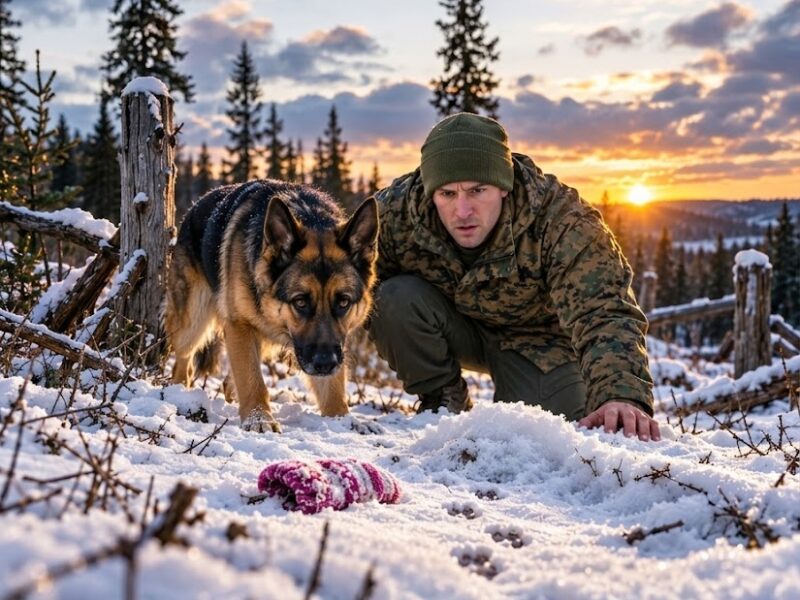
A dog dropped a frozen pink mitten into a Marine’s hand—then the match started moving on its own.
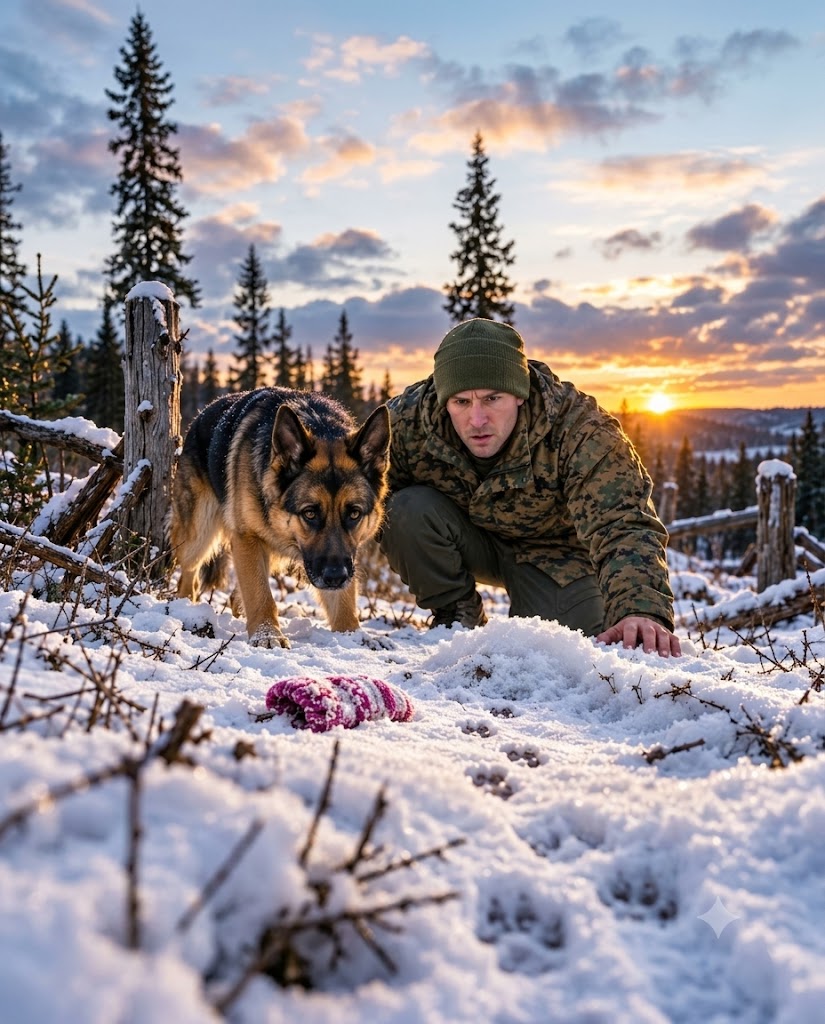
Staff Sergeant Grant Holloway hears his own voice before he realizes he has spoken. The pink mitten is moving beneath the snow. Just once, then again, weakly.
A few inches of bright fabric break through the white bank beneath a stand of cedar trees, trembling as if the ground itself is trying to breathe. Grant takes one step forward, but Scout moves across his path.
The six-year-old German Shepherd does not growl. He does not bark.
He simply plants himself sideways in front of Grant, black and tan coat dusted with snow, amber eyes fixed on the narrow hollow beneath the branches. Grant stops.
Easy. Scout looks back at the mitten, then at him.
The message is not fear. It is caution. Grant lowers himself to one knee.
Wind pushes loose snow through the trees, carrying the sharp scent of pine, frozen earth, and cold water somewhere below. The late afternoon light is already fading into blue.
Can you hear me? Grant calls toward the snowbank.
For a moment, there is nothing. Then a voice answers, so small he almost mistakes it for the wind. Please do not leave.
Grant’s chest tightens. I am not leaving.
Scout steps closer to the cedar hollow but stays clear of the mitten. Grant studies the ground instead of reaching for the hand.
The snow around it is deeper than it looks, packed unevenly over what appears to be a drainage ditch or covered entrance. Pulling upward could force whoever is beneath it against hidden branches or frozen debris.
Scout had seen something Grant had not. Stay still for me, Grant says. Can you tell me your name?
A pause. Avery.
The mitten moves again. Avery, I am Grant. I am right here.
There is a German Shepherd with me. You know him?
This time the answer comes faster. Scout.
The dog gives a soft breath through his nose and lowers his head. Grant looks at him differently now.
Eighteen minutes earlier, Scout had been nothing more than a dog standing alone in the middle of a county road during lake effect snow. No leash, no person, no vehicle nearby.
Grant had been driving north through Michigan’s Upper Peninsula, windshield wipers working hard against the thickening flakes. When the German Shepherd stepped out from the pines and stopped directly in front of his truck, Grant braked, put on the hazard lights, and climbed out.
Scout did not run. He walked straight toward Grant with something stiff and pink held carefully in his mouth. A child’s mitten, frozen, almost solid.
Scout placed it at Grant’s boots, backed away ten feet, and looked toward the woods. Grant picked it up.
Where did you get this? Scout returned, touched the mitten once with his nose, then turned toward an old logging spur barely visible through the snow.
When Grant did not follow, the dog came back again. That was when Grant noticed the handwritten label inside the cuff. Avery B.
Now eighteen minutes later, the matching mitten is moving beneath a snow-covered cedar hollow, and the child wearing it is whispering from somewhere Grant cannot yet see. Scout stands beside him, silent and waiting.
Grant reaches for his phone with one hand while keeping his eyes on the snow. Avery, listen to me.
I’m going to get you out, but I am going to do it slowly. The little voice answers from below. Okay.
Then, after a pause, she asks the question that changes everything. Did Scout find my mom?
Eighteen minutes earlier, Grant Holloway is still standing beside his truck with the frozen mitten in one hand and Scout watching him from the edge of the logging spur. Snow collects along the German Shepherd’s back, but the dog shows no sign of wanting shelter.
He takes several steps toward the trees, looks back, then returns when Grant does not move. All right, I am paying attention.
Grant turns the mitten over beneath the gray afternoon light. Pink wool, child-sized, stiffening at the cuff. Inside, written in black marker on a small fabric label, are two words.
Avery B. Grant feels the situation narrow immediately.
This is not something a dog found miles from its owner and carried for play. Somewhere nearby, there is a child connected to this mitten.
He reaches for his phone and calls 911, giving his location on the rural road and describing the German Shepherd, the mitten, and the old logging spur disappearing into the pines. The dispatcher tells him a deputy is being sent and advises him to remain near the road if conditions worsen.
Grant agrees, but Scout has already moved twenty feet into the spur. The dog stops and looks back, not restless, not confused. Waiting.
Grant takes the mitten with him. Scout turns and continues.
The logging road is barely more than two tire paths under new snow. Grant follows on foot, staying off the deeper shoulder where the drainage ditch disappears beneath white powder.
Wind moves through the pines in slow waves. The air smells of resin, wet bark, and cold metal from the truck behind him.
After about a hundred yards, an orange snowplow appears on the county road beyond the trees and slows near Grant’s parked vehicle. The driver lowers his window.
Everything okay? Grant walks back far enough to be heard. You see a silver crossover around here?
The man thinks, then points toward the logging spur about a mile in. Saw one earlier. Looked stuck near the bend.
Anyone with it? Did not see anybody. Snow was coming down harder then.
Grant shows him the mitten. The driver’s face changes. That from a kid?
I think so. Scout gives one short bark from the spur, then goes silent again.
Grant thanks him and calls dispatch with the new information. Silver crossover, old logging road, possible child missing. The urgency changes on the other end of the line.
Grant returns to Scout. They move deeper into the woods where the road curves away from the county traffic and the world becomes quieter.
A quarter mile in, Grant finds the first footprint. Small, partly filled with snow. A second appears beside it, larger, from an adult boot.
Scout lowers his nose, checks both, then continues. Grant does not rush him.
Every fifty yards, the prints become harder to see. Wind has softened their edges. Fresh snow hides the rest.
Then Grant notices something bright near a branch. A torn candy wrapper caught beneath the snow. Child-sized footprints continue past it. Adult prints beside them.
Scout pauses, checks the ground, and keeps going. Near the next bend, the trees open enough for Grant to see a silver crossover angled beside the road.
One wheel buried near the shoulder. No lights, no movement. He approaches carefully.
The doors are locked. Through the rear window, he sees a child’s booster seat, a small backpack, a thermos, and a pink scarf folded across the seat.
Scout does not stop at the vehicle. He smells near the passenger side, circles once, then turns toward the deeper trail. Grant looks down.
Three sets of tracks leave the car. One adult, one child, one dog. None return.
Scout takes ten steps into the snow, looks back at Grant, and waits. Grant does not follow Scout immediately.
He stays beside the silver crossover long enough to give county dispatch the exact location and describe what he can see through the windows. The dispatcher tells him Deputy Megan Callaway is less than five minutes away.
Scout remains ten steps down the trail, snow gathering along his shoulders, but he does not disappear into the trees. He waits.
Grant looks again at the tracks leaving the vehicle. Adult boots, smaller winter boots, dog prints. All three move in the same direction. Nothing comes back.
A county patrol vehicle arrives through the snowfall, headlights muted by the white air. Deputy Megan Callaway steps out in a dark winter jacket carrying a flashlight and a compact medical pack.
Grant gives her the story without exaggeration. The dog, the frozen mitten, Avery’s name, the snowplow driver, the empty crossover.
Megan listens, then checks the registration through dispatch. Vehicle belongs to Hannah Bennett. Thirty-four. Local address near Marquette.
She shines her flashlight through the rear glass. The backpack is purple with a child’s keychain hanging from one zipper. Beside it sits a knit cap, a small thermos, and a folded map of the surrounding forest roads.
Mother and daughter, Megan says quietly. Most likely.
Scout leaves the trail, walks back to the passenger side of the crossover, smells beneath the door, then returns to the same tracks. Grant watches him.
He knows where they went. Megan looks at the German Shepherd. Then we follow the evidence he is showing us.
They move into the woods together. The logging spur narrows after several hundred yards, and the trees press closer around them. Snow muffles their footsteps.
The child’s tracks become uneven. At first, they fall beside Hannah’s. Then they begin landing farther apart, as though Avery is struggling to keep pace.
Grant sees another candy wrapper half buried near a stump. Twenty yards later, there is a shallow place where the snow has been disturbed beside a fallen tree. Small boot marks stopped there for several seconds before continuing.
She rested here, Grant says. Megan sweeps her light across the ground, looks that way.
Scout lowers his nose, checks the spot, then moves forward more slowly. The adult prints remain steady. The child’s do not.
Another hundred yards pass. The little footprints drift toward the edge of the trail, return, then shorten again.
Grant feels the cold differently now. Not as weather, as time. How long before fresh snow covers all of this? he asks.
Megan looks at the flakes already filling the impressions behind them. Not long.
Scout stops beside a cedar branch and smells something caught beneath it. Grant reaches down. A strand of pink yarn, not from the mitten in his pocket. Too thin, too soft.
He leaves it where it is and points it out to Megan. She photographs it before they continue.
Then the trail reaches a shallow depression where several cedar trees grow close together over a drainage ditch. Hannah’s bootprints continue beyond it toward higher ground. Scout’s older paw prints remain nearby.
Avery’s footprints do not. Grant stops. They end here.
Megan circles the edge with her flashlight. No smaller tracks leave the hollow.
Scout walks beneath the cedars, turns once, then looks directly at Grant. The wind is weaker here, almost gone.
Grant takes one careful step forward. Beneath the lowest branches, something pink breaks through the snow. At first, it looks like another scrap of yarn.
Then it moves. Grant freezes the moment the pink mitten moves again.
Scout steps sideways across the narrow cedar hollow. Not aggressive, not frightened, simply blocking the most direct path.
Deputy Megan Callaway stops beside Grant and lowers her flashlight toward the snow. There is something underneath that bank.
Grant studies the ground before touching anything. The white surface is not solid earth. It slopes over a shallow drainage channel where branches and packed snow have formed a roof above a narrow culverted entrance.
Pulling the mitten upward could drag whoever is beneath it against frozen debris. We clear the opening first, Grant says.
Megan nods. Scout backs away two steps, as if the decision finally makes sense.
Grant drops to one knee and begins brushing loose snow from the lower edge of the hollow with both gloved hands. Megan works from the other side, careful not to collapse the packed layer above.
Cold air pushes through the small opening they uncover. Then Grant hears the voice. Please do not leave.
It is faint but close. We are right here, he answers. Avery, my name is Grant. Deputy Callaway is with me. Scout is here, too.
The German Shepherd gives a quiet whine at the sound of the girl’s name. A small face appears deeper inside the culvert, framed by an emergency blanket and the hood of a winter coat.
Avery Bennett is pale from the cold, but awake. Her right hand is still inside the moving pink mitten. Can you move your feet? Megan asks.
Avery nods. Are you hurt anywhere? No, just cold.
Grant widens the entrance another few inches while Megan calls for medical support and gives dispatch their location. They do not pull Avery through the snow. They make enough room for her to crawl forward slowly on her own while Grant keeps the opening clear.
Scout waits beside the cedar branches, body lowered, eyes fixed on her. When Avery finally reaches open ground, Megan wraps her immediately in a thermal blanket.
The girl looks past both adults. Scout. The German Shepherd steps forward only when Grant gives him space.
Avery reaches one hand from the blanket and touches the side of his neck. Scout presses his nose gently against her sleeve. You came back, she whispers.
Grant looks toward the adult boots continuing beyond the hollow. Avery, where is your mom?
The girl’s expression changes. Relief disappears almost instantly. She went to find the road.
Megan crouches beside her. How long ago?
Avery looks toward the trees as if time might be written there. Before it got this dark.
Grant glances at the fading sky. Why did you stay here?
Mom found this pipe. She said it blocked the wind. Avery pulls the blanket tighter. She told Scout to stay with me.
Grant looks at the German Shepherd. That explains the older paw prints around the hollow. Then how did Scout leave?
Avery looks at the frozen mitten still in Grant’s pocket. I dropped one when I was trying to fix the blanket. Scout picked it up. She pauses. Mom did not come back and I told him to find somebody.
Megan looks at Grant. You told him that. Avery nods. Dad taught him scent games before he died. Scout knows find.
The words land quietly. No miracle. No mystery command from nowhere. A familiar task given by a frightened child to a dog that already understood how to search.
Grant takes out the frozen mitten. Avery stares at it. He brought you that. He did.
She closes her eyes for one second, then opens them again. Then please make him find mom.
Grant does not answer Avery immediately. He looks at Scout, then at the adult bootprints fading beyond the cedar hollow. Snow is already softening their edges.
Whatever trail Hannah Bennett left behind is disappearing one flake at a time. We are going to look for her, he says.
Avery holds Scout’s neck for another second before Deputy Megan Callaway helps her stand. The girl is steady enough to move, but the cold has taken the color from her cheeks, and Megan does not let her walk farther than necessary.
The medical team reaches them within minutes, carrying blankets, warm packs, and a compact sled. Scout stays close while they check Avery’s breathing, hands, and feet, then wrap her more securely against the wind.
Can Scout come with me? she asks. Megan glances at Grant. For now, yes.
They bring Avery back toward the silver crossover where another deputy has positioned a heated county vehicle near the logging spur. Inside, the air smells faintly of coffee, wet wool, and heater vents.
Avery sits beneath two blankets with Scout pressed against her boots. Grant kneels near the open door. I need something that belongs to your mom. Something she wore today.
Avery points toward the crossover. Her hat is in my backpack. She took it off when we were driving.
Megan retrieves the purple backpack from the locked vehicle after confirming entry with dispatch. Inside, beneath a coloring book and a half-empty water bottle, she finds a dark blue knit cap.
Avery touches it once. That is hers.
Grant does not give Scout a dramatic command. He simply lets the German Shepherd smell the cap. Scout breathes across the fabric for several seconds, then lifts his head.
His ears angle toward the woods. Megan has already requested the county search team, but the nearest unit is still moving through heavy snow. Time matters.
Grant looks at the adult bootprints that continue from the cedar hollow toward a ridge west of the logging road. That is the visible trail, Megan says.
Scout steps forward for twenty yards. He follows it. Then he stops.
He turns his head into the wind, circles once, and walks back downhill. Megan watches him carefully. The prints go up.
Scout ignores the ridge. He moves toward a shallow creek bed below the road, nose low, checking the snow beneath overhanging branches.
Grant does not follow blindly. He walks to the place where the dog changed direction and studies the ground. At first, there is nothing.
Then he sees a pine branch bent beneath fresh snow. It is broken and still pale where the wood split. Below it, almost hidden near the trunk, is the edge of a boot impression pointing downhill.
She came back, Grant says. Megan crouches beside him. A few feet farther, another print appears beneath a cedar where the snowfall has not filled it completely.
The tread is consistent with the adult tracks near the crossover. Scout moves down the slope. Grant follows with Megan behind him.
The creek is narrow and partly crusted with ice. Dark water makes a low sound under the snow. Hannah’s footprints appear only in fragments now. One beneath a root, another beside a rock. Then none at all.
Scout pauses at the water, smells the air, and turns east along the bank. Grant notices a thin strand of fabric caught on the bark of a young pine. Not pink this time. Dark blue, the same color as Hannah’s knit cap.
Megan photographs it and looks toward Scout. He is not guessing. Grant watches the German Shepherd continue into the trees. Neither are we.
Ahead, the creek bends into deeper woods, away from the road, away from the ridge, and away from every direction Hannah was supposed to have gone. The creek pulls them farther from the logging road until the sound of engines disappears completely.
Grant can no longer see the glow from the county vehicles through the trees. Only Megan’s flashlight, his own light, and the pale reflection of snow remain.
Scout moves with his nose low, never fast enough to lose them, never slow enough to waste time. Every few yards, he checks the wind, turns once, then continues east.
Grant watches the dog, but he watches the ground more closely. A search is only as good as the evidence beneath it.
Near a cluster of young spruce, he finds another partial boot impression protected by a fallen branch. The heel points toward the creek. Fifty feet later, Megan spots a shallow scrape where someone has slid down a short bank and caught themselves against a tree.
No injury, no sign of panic. Just proof that Hannah came this way. She was still moving, Megan says.
Grant looks at the fading mark. And still choosing a direction.
The creek narrows and begins to curve north. Scout suddenly leaves the water line and climbs toward a strip of flatter ground hidden beneath the snow. At first, Grant thinks it is a natural shelf.
Then his flashlight catches two parallel depressions running through the trees. Old tracks. Too wide for footprints, too narrow for a road.
Megan kneels and brushes snow aside with one glove. Snowmobile trail. Grant looks ahead. The route is almost invisible beneath fresh accumulation.
Small pine trees have grown close to its edges. Current maps show it? Megan pulls out the folded county search map she carried from the patrol vehicle and checks under the flashlight.
Nothing here. She traces the creek with one finger. Closest marked route is almost half a mile west.
Scout continues along the abandoned trail. The snow beneath the trees is thinner, and Hannah’s passage becomes easier to read. A bootprint near an exposed root. A hand mark on the bark of a cedar. A broken crust where she stepped across a shallow ditch.
Grant feels something shift inside him. She did not wander without purpose. She was following something.
Why leave the ridge? Megan asks quietly. Grant looks through the trees.
Wind. The answer comes from the land itself. Up on the higher ground, the lake effect gusts move hard enough to shake the pine tops. Down here, the creek valley is quieter.
She may have been looking for cover. Scout stops. His head rises.
Grant stops, too. Megan almost speaks, then sees his hand lift and remains silent for several seconds. There is nothing but the whisper of snow landing on needles.
Scout turns his ears toward the darkness ahead. Grant follows his gaze. Through the trunks, perhaps two hundred yards away, a weak yellow point appears.
It lasts barely a second. Then it is gone. Megan narrows her eyes. Did you see that? Yes.
They wait ten seconds. Fifteen. The light appears again, lower than the tree line, dull and warm against the blue darkness.
Not a vehicle headlight. Too steady when visible. Too low to be a house on the ridge.
Megan checks the map again. There should not be anything out there.
Scout begins moving before either of them does. Grant follows, counting his steps, keeping the creek to his right. The old snowmobile trail bends toward the light, then splits around a stand of spruce.
On the nearest branch, something catches Grant’s flashlight. A short piece of yarn tied deliberately around the twig. Pink, but not the same shade as Avery’s mitten. Softer, finer.
Megan touches it without removing it. This was not torn off by accident. Grant looks toward the darkness where the yellow light has vanished again. No.
He thinks of the pink scarf folded inside the crossover. Then of the family photograph Megan had pulled up through registration records. Hannah smiling beside Avery, a knitted scarf around her neck.
Scout steps forward and stops at the edge of the trail. Beyond him, hidden somewhere among the trees, the weak yellow light flickers for a third time.
The yellow light appears once more, then disappears behind the trees. Scout does not rush toward it. He lowers his nose to the old snowmobile trail and moves carefully, checking each bend as if the darkness itself has changed shape.
Grant follows with Deputy Megan Callaway several steps behind him. The pink yarn remains tied to the branch at their backs. A small human decision left against the snow.
Grant keeps thinking about that knot. Someone cold enough to need shelter had still taken the time to mark a route. Hannah Bennett had not stopped thinking. That matters.
The trail narrows between spruce trees and drops gently toward the creek. Snow muffles everything except their breathing and the faint water moving beneath ice.
After fifty yards, Scout pauses beside another branch. This time, there is no yarn. Instead, Grant sees a shallow indentation in the snow where someone rested a hand against the trunk. Beneath it lies a partial bootprint. Same tread, same direction.
She was still on her feet here, Megan says. Grant nods. And she knew enough to leave signs.
They continue. The yellow glow returns, stronger now, coming from somewhere beyond a low rise. When Grant reaches the top, the shape below finally separates itself from the trees.
A small wooden structure sits near the creek, half buried in snow, with a sloped roof and a narrow window glowing faintly from within. The building looks old enough to have been forgotten by the county map.
A rusted metal sign leans beside the trail, nearly hidden under snow. Megan brushes it clean with one glove. The faded letters read: Warming Shelter.
Scout stops twenty feet from the door. His ears rise. Grant turns off his flashlight for a moment. Without the white beam, the weak yellow light inside becomes easier to see.
It flickers, steadies, then dims again. Battery lantern, Grant thinks. Maybe almost empty. He listens.
Nothing. Hannah, Megan calls. The trees give the name back softly. No answer.
Scout takes three slow steps forward, then stops again. He looks at Grant, then at the door. Grant notices something beside the threshold. A line in the snow where one boot has dragged slightly. Then two clear prints entering the shelter. No tracks come out.
He does not assume the worst. He only takes note. Hannah Bennett, he calls, louder this time. My name is Grant Holloway. Deputy Megan Callaway is with me. Avery is safe.
Silence. Scout moves to the porch and sits beside the door, not scratching, not barking, waiting.
Megan reaches for the handle, but Grant raises one hand. From inside comes a sound so faint it could be the wind settling in the cold. Then it comes again. Three slow taps.
Megan looks at him. Grant steps closer. Hannah, if that is you, tap once.
The shelter goes quiet. Snow settles on Scout’s back. One tap comes from inside.
Grant closes his eyes for half a second. Not relief yet. Just confirmation. We hear you, he says. Avery is warm. She is with the deputies. Scout found her and then he brought us here.
Something shifts behind the door. A woman’s voice follows, weak but clear enough to understand. Avery?
Grant moves closer without touching the door. She is safe. The yellow light flickers again through the small window.
Then Hannah says the only thing she seems to have been saving her strength to ask. Is she waiting for me?
She is waiting for you, Grant says.
The words seem to travel through the old shelter more slowly than the cold. For several seconds, Hannah Bennett does not answer. Then Grant hears a breath from the other side of the door, followed by the faint scrape of something being moved.
Deputy Megan Callaway tests the handle carefully. It turns, but the swollen wooden door opens only an inch before catching against snow packed along the threshold.
Grant and Megan clear the drift with their boots and gloved hands until the door moves far enough to reveal the dim interior. A small battery lantern sits on an overturned crate, its yellow light weakening every few seconds.
Hannah is seated against the far wall beneath two dusty wool blankets she must have found inside. Her winter coat is zipped to her chin. A pink knitted scarf circles her neck, several short pieces missing from one end.
She looks exhausted and deeply cold, but her eyes are clear. Avery, she asks again.
She is warm and being checked by medical personnel, Megan says. She talked to us. She asked us to find you.
Hannah closes her eyes. Her shoulders lower as if she has been holding them up for hours. Scout enters only after Grant steps aside.
The German Shepherd crosses the wooden floor and stops in front of her. Hannah reaches out with both hands and rests them against his face. You found somebody, she whispers.
Scout leans into her palms. Grant notices the silence that follows. No cheering, no dramatic celebration. Just a mother touching the dog that left her daughter in the snow and somehow returned with help.
Megan radios their location and requests the medical team meet them along the old snowmobile route. While they prepare Hannah for the walk out, Grant studies the shelter. An old emergency box hangs open near the wall. Inside are several wool blankets, matches sealed in plastic, and the nearly spent lantern.
Hannah notices where he is looking. I saw the roof through the trees, she says. Her voice is weak, but steady. I thought if I could get inside, I could warm up and go back for Avery.
Why did you come down from the ridge? Grant asks. Hannah looks toward the door. The wind got worse. I could not see the road anymore. I knew the creek was below me, and I remembered an old snowmobile trail from years ago.
She touches the damaged end of her scarf. I started tying pieces to branches. I thought if I had to turn around, I could follow them back.
Megan glances at Grant. The pink yarn had not been decoration. It had been a breadcrumb trail made by someone trying to remain rational while the storm erased everything else.
And the light? Grant asks. Hannah gives the lantern a tired look. It was almost dead when I found it. I kept switching it off to save the battery. Every few minutes, I turned it on and held it near the window.
That explains the flicker. Another signal. Another small thing that could easily have meant nothing to someone moving too quickly.
Grant looks down at Scout. The dog is sitting beside Hannah now, snow melting from his coat onto the old wooden floor. He did not follow the ridge, Megan says. He brought us along the creek.
Hannah manages the faintest smile. That is where I walked.
Outside, distant voices finally carry through the trees. The search team is approaching. Hannah hears them and looks at Grant. How did you find Avery?
Grant reaches into his coat and takes out the frozen pink mitten Scout placed at his boots less than an hour ago. Hannah stares at it, then at the German Shepherd beside her. Her eyes fill, but her voice remains quiet.
She gave him something to carry. Grant shakes his head gently. She gave him a reason to keep looking.
The search team reaches the warming shelter through the trees in a line of white headlamps and dark winter jackets. Their voices are low and measured as they step onto the old snowmobile trail.
A medic enters first, kneels beside Hannah Bennett, and begins checking her condition while Deputy Megan Callaway gives a brief account of how they found her. Grant remains near the doorway with Scout.
The German Shepherd watches every movement, but his body has changed. The tension has left his shoulders. For the first time since Grant found him on the county road, Scout looks tired. Snow has melted into the fur along his chest and legs, and his breathing is deeper now that there is nothing left to chase.
Hannah notices it, too. He needs to go back to Avery, she says. The medic looks at her. So do you.
They wrap Hannah in a thermal blanket, give her a warm pack to hold against her chest, and help her to her feet. She is unsteady for the first few steps, but she can walk with support.
Outside, the storm has softened. Snow still falls, but the wind has lost some of its force beneath the trees. Grant leads with Megan while the search team keeps Hannah protected in the center.
Scout walks beside her for several yards, then drifts ahead, nose lifting toward the direction of the county vehicles. He knows where the girl is waiting.
The return trail feels shorter, though Grant knows it is not. The pink yarn markers pass one by one beneath their lights. The dark blue fabric caught near the creek. The broken branch. The partial bootprints.
Clues that had felt fragile on the way now look like a line connecting two people who never stopped trying to reach each other. Near the cedar hollow, Scout suddenly quickens his pace.
Grant follows him around the bend and sees the glow from the county vehicle through the trees. Avery is sitting in the rear seat with a blanket around her shoulders and a paper cup of warm water in both hands. A medic stands nearby.
The moment Scout appears, Avery sets the cup down and leans forward. Mom.
Hannah hears her voice before she sees her. She stops walking for one second. Nobody moves.
Then Megan steps aside. Avery climbs carefully from the vehicle, still wrapped in the blanket. Hannah does not run. She cannot. She simply opens her arms.
Avery crosses the few feet between them and presses herself against her mother. Hannah closes her eyes and rests her cheek against the top of her daughter’s hood. Scout circles once around both of them, then sits at their feet.
Grant stands several yards away. He does not need to hear what they say. The storm makes their voices private.
Megan joins him and looks toward the family. You stopped for a dog in the road, she says. Grant watches Scout lower his head onto Avery’s boot. I stopped for something that did not make sense.
Megan gives him a small smile. Most people drive past things that do not make sense. Grant looks at the frozen mitten still in his hand. The wool has begun to soften from the warmth inside his coat, but the black marker on the label is still clear. Avery B.
He walks over and holds it out. Avery looks at the mitten, then at Scout. He really carried that all the way to you. He did.
She takes it carefully and presses it against the matching mitten on her other hand. For the first time, Grant sees both together. One warm, one still cold.
Hannah looks down at Scout. Your father taught him those scent games, she tells Avery softly. But you were the one who trusted him enough to send him.
Avery shakes her head. He knew what to do. Grant glances at Scout, then at the trail disappearing behind them into the snow. He knew how to keep looking.
Scout lifts his eyes toward him. The search is over, but something in that look feels less like an ending and more like a quiet reminder that sometimes the difference between being lost and being found is one small signal noticed by the right person.
By the time Hannah and Avery are settled inside separate heated vehicles, the storm has become little more than a steady curtain of snow drifting through the county lights. Grant stands near the edge of the logging road while paramedics finish checking both of them.
Scout lies on the packed snow between the vehicles, his head resting across his front paws, too tired now to follow every movement. For nearly an hour, he has carried information no person could read at first. A scent, a mitten, a direction, a memory of what the word find meant.
Megan walks over with a paper cup of coffee and offers it to Grant. He accepts it, warming both hands around the cardboard. Dispatch reached Hannah’s sister. She says she is meeting them at the ER.
Grant looks toward the vehicle where Avery sits beside her mother, both wrapped in blankets. Good. Megan nods toward Scout. What happens with him?
He goes with them. I figured.
She takes a slow breath. I keep thinking about that first mitten. Grant does too. The pink wool now rests on the seat beside Avery. No longer frozen stiff.
Avery gave him a familiar task. He says that does not explain why he chose the road. No.
Grant looks back toward the trees, but it explains why he kept searching until he found somebody. Hannah calls his name from the open vehicle door.
Grant walks over. Her face has more color now, and her voice is stronger. Avery sits beside her, holding both mittens in her lap.
There is something I need to tell you, Hannah says. Grant waits. Scout was my husband’s dog before he became Avery’s.
She reaches down and touches the German Shepherd when he comes near. My husband, Michael, volunteered with a local search group. Nothing official full-time. Mostly wilderness drills, lost hikers, community training days. Scout learned basic scent work with him.
Avery looks at the dog. Dad said Scout never quit while he still had a scent. Hannah gives a small smile that carries more memory than happiness. Michael died two years ago from an illness. After that, Scout stopped doing formal searches. He stayed with us.
Grant glances at Avery. The girl’s hands tighten around the mittens. One is dried. The other is still damp from snow.
When Mom did not come back, Avery says, I remembered what Dad used to say. What did he say? Grant asks.
Avery looks down at Scout. Give him something that smells like the person. Then tell him what you need.
Grant thinks about the sequence. Avery had no object belonging to her mother inside the culvert. Only her own mitten. Scout already knew Hannah’s scent from years of living beside her.
But the mitten gave him something else. A physical object connected to the child he was leaving behind. A marker. A reason to return if the search failed.
Perhaps he had carried it because that was what training and instinct shaped him to do. Perhaps he simply refused to leave Avery’s scent behind. No one could know exactly. Grant does not pretend otherwise.
You were smart to send him, he says. Avery shakes her head. I was scared. You can be scared and still make a good decision.
Hannah looks at Grant for a long moment. And you stopped. He was standing in the road. Plenty of people would have gone around him.
Grant looks toward Scout. The German Shepherd has returned to the space between mother and daughter, sitting with his shoulder against Avery’s boot. He made it difficult to ignore him.
Megan approaches with Hannah’s scarf sealed inside a clear evidence bag, only long enough to document the trail markers before returning it. Several inches of yarn are missing from one end. Hannah laughs softly when she sees it. That scarf was a Christmas gift.
Avery studies the uneven edge. You ruined it. Hannah pulls her daughter closer. Best thing I ever did to it.
Grant smiles, but his eyes move toward the forest again. Pink yarn, dark blue fabric, bootprints, a lantern blinking behind trees. None of them were miracles by themselves. They were ordinary things made important because someone noticed.
Scout lifts his head as an ambulance door opens. Avery reaches down and scratches behind his ear. Come on, Scout. We are going home after this.
The dog rises immediately. This time, no one needs to tell him which way to go.
The next morning, the storm has moved east, leaving the Upper Peninsula under a sky so clear it almost feels unfair. Grant stands outside the small county hospital with a paper cup of coffee cooling in his hand. Snowbanks along the parking lot glow blue beneath the early light.
Inside, Hannah and Avery have both been cleared of anything more serious than cold exposure and exhaustion. Scout is resting with them, stretched across the floor beside Avery’s chair, as if he has finally remembered that sleeping is allowed.
Grant had planned to leave quietly. He has already given Megan his statement. The silver crossover will be recovered from the logging spur later that morning. There is nothing else anyone needs from him.
Then the hospital door opens behind him. Staff Sergeant Holloway.
Grant turns. Avery stands just inside the entrance wearing borrowed winter boots, a thick coat, and both pink mittens. Hannah is beside her. One mitten looks slightly darker than the other where the wool has dried unevenly.
Scout walks between them, slower than yesterday, but alert. Avery comes outside and stops a few feet from Grant. I remembered something.
Grant waits. When Scout picked up my mitten, I thought he was taking it away. She looks down at her hands. I told him no at first.
Hannah rests a hand on her daughter’s shoulder. Avery continues. Then I remembered Dad’s training. Scout used to carry a scent cloth when they practiced finding people. Dad would say the cloth was not the person. It was just the beginning.
Grant looks at Scout. The German Shepherd is watching a snowplow move across the far end of the parking lot. So you let him take it.
Avery nods. I told him, Find help. Her voice grows quieter. But I did not know if he understood.
Grant crouches so they are closer to eye level. You gave him a word he knew and something he could carry. That was enough to start.
Avery studies him. Why did he bring it to you instead of just barking?
Grant thinks before answering. Maybe carrying something was part of how he learned to work. Maybe he knew the mitten belonged to you and did not want to leave it behind. Dogs do not explain their decisions the way people do.
He glances toward Scout. We only know what he did. Hannah smiles faintly. He kept the evidence simple.
Grant almost laughs. Better than most people.
Megan pulls into the hospital lot a moment later. She gets out carrying a clear plastic bag with something inside. Found this near the warming shelter, she says.
Hannah’s expression changes when she sees it. Megan removes a small metal tag attached to a faded leather loop. The engraving reads: Michael Bennett, Search Volunteer.
Hannah takes it carefully. That was on Scout’s old training pouch. Avery looks at the dog. How did it get there?
Megan answers gently. Probably fell out of the backpack or your mother’s coat pocket somewhere along the trail. We found it near one of the yarn markers.
Hannah turns the tag over in her palm. I put it in my coat years ago. I forgot it was there.
Grant says nothing. The object is ordinary. Scratched metal. A name. A role someone once held. Yet Scout walks over and smells it once before sitting beside Hannah.
Avery notices. He remembers. Dad.
Hannah looks down at Scout. I think so.
The parking lot is silent except for the distant scrape of a plow blade. Grant watches mother, daughter, and dog standing together in the clean morning light.
Yesterday, every object had been a clue. Today, they are becoming belongings again. A mitten, a scarf, a tag. Small things returning to the people who gave them meaning.
Three weeks later, the snow outside the Bennett home is softer around the edges, bright beneath the pale winter sun. Grant parks near the curb and walks toward the porch carrying nothing but a small paper bag of dog treats Avery insisted Scout liked best.
Before he reaches the steps, the front door opens. Scout appears first. The German Shepherd pauses, recognizes him, and crosses the yard with a slow confidence that has nothing to do with searching anymore.
Grant bends as Scout presses his head briefly against his hand. Good to see you, too.
Avery comes running behind him in a blue winter coat, followed by Hannah with two mugs of coffee. There are no deputies, no flashing lights, no radios breaking through the quiet. Only the smell of wood smoke, cold air, and cinnamon drifting from the kitchen.
Inside, something new hangs on the hallway wall. Grant notices it almost immediately. A small wooden shadow box holds both pink mittens side by side. Between them is a photograph of Scout standing in fresh snow, ears raised, looking toward the camera. Beneath the photograph rests Michael Bennett’s old volunteer search tag.
Nothing about the display feels like a monument to fear. It feels like a family putting scattered pieces back where they belong.
Avery stands beside Grant and studies the box. Mom wanted to buy me new mittens. Hannah smiles from the kitchen. You needed new mittens.
Avery raises both hands, now wearing a green pair. I got these. Grant looks at the shadow box again. And those are retired.
Scout walks over and sits beneath them. Avery kneels beside him. I still did not know why he took one.
Grant remembers the county road, the dog appearing through falling snow, the frozen wool placed carefully at his boots. He remembers how easy it would have been to see only a stray dog and an ordinary piece of clothing.
Maybe Scout does not know either, Grant says. Avery looks disappointed for half a second. Grant continues. Dogs do not need to understand the whole problem. Sometimes they just need to know what matters next.
Avery touches Scout’s shoulder. Find somebody. Exactly.
Hannah sets a coffee mug beside Grant and looks toward the photograph. Michael used to say something like that during training. One scent, one direction, one person at a time.
Scout rises suddenly and walks to the back door. A green tennis ball waits beside the mat. Avery laughs. He wants outside.
They step into the backyard together. Scout grabs the ball, trots across the snow, then drops it at Grant’s boots. Grant looks down at him.
Three weeks ago, another object had been placed in almost the same position. That one was frozen, pink, and heavy with a meaning Grant could not yet see. This one is only a tennis ball.
Scout nudges it closer. Grant picks it up. All right.
He throws it across the yard. Scout runs after it, snow lifting behind his paws as Avery follows several steps behind, laughing when the dog reaches the ball first.
Hannah stands near the porch, wrapped in Michael’s old scarf, watching them with a quiet smile. Grant looks once through the kitchen window at the two pink mittens resting safely behind glass. They no longer point toward a missing child or a mother alone in the woods.
They point nowhere now. That is what makes them beautiful.
Outside, Scout returns with the tennis ball and drops it at Avery’s feet. She throws it again. The German Shepherd turns and runs into the clean winter light. Not because anyone is lost, not because anyone needs saving, but simply because someone he loves asked him to come.









