A Disabled Little Girl Shared Her Last Bottle of Water With a Stranded Hells Angel—Days Later, 50 Bikers Returned to Her Door
The roar of heavily modified Harleys shattered the silence of the Mojave Desert.
Locals locked their doors.
But when a 300-pound outlaw collapsed from heatstroke on the boiling asphalt, a 19-year-old girl in a wheelchair made a choice that terrified her mother.
It was a choice that would set off a chain of events nobody in Needles, California ever saw coming.
It was mid-July, and the thermometer outside the Dollar General had already crested 112°F by noon.
The air above Route 66 shimmered like the surface of a pot about to boil, bending the horizon into a watery mirage.
Beside a crumbling stretch of cracked asphalt sat a faded blue pop-up canopy.
Under it sat Hannah Collins, with a cooler full of ice, a hand-lettered sign, and a bottle of water she had no idea would become the most expensive thing she ever gave away.
Five years earlier, Hannah’s life had been split in two by a single bad night.
A drunk driver crossed the center line on Interstate 40 and hit her family’s sedan head-on.
The crash took her father, Tom Collins, and left Hannah with a severe T12 spinal cord injury that paralyzed her from the waist down.
She was fourteen years old.
She remembered the sound of the crash less than she remembered the quiet afterward.
That quiet had never really left their house.
Since then, her mother, Diane, had been drowning in medical debt.
Diane worked double shifts at the Route 66 Diner, pouring coffee for truckers who tipped in quarters, just to keep the lights on in their sagging double-wide trailer.
She came home every night smelling like fryer grease and exhaustion, and every night she kissed Hannah’s forehead as if checking that her daughter was still there.
Hannah hated being a burden more than she hated the wheelchair.
So every summer she did the one thing she could.
She sold ice-cold bottled water and Gatorade to the tourists heading for the Colorado River.
It was never much.
A few crumpled dollar bills and a handful of quarters a day, kept in a coffee can under her bed.
But it was hers, and it was her way of fighting back against the crushing weight of being poor.
Her sign said it all in black marker: “ICE COLD WATER. $2. NO ONE LEAVES THIRSTY.”
The last line was her father’s idea, years ago, when he used to haul a cooler to Little League games and hand out water to every kid on the bench.
“You never charge a thirsty kid, Hannie,” he used to say.
“The desert doesn’t.”
Hannah had never decided whether that was a joke or a prayer.
On this particular Tuesday, the highway was dead.
The heat was so oppressive that even the cicadas had gone quiet.
Hannah had a paperback propped on her knee and a battery-powered fan clipped to her armrest, pushing warm air across her face like a sigh.
She was on chapter eleven when the ground began to hum.
It started as a low, guttural vibration she felt in the bones of her feet, the ones she could no longer feel at all.
Then it climbed into a deafening roar.
Over the ridge came a pack of motorcycles, at least thirty of them, riding in a tight, disciplined formation.
They wore heavy leather vests despite the lethal heat, and every back carried the same winged death’s head.
The Angels.
Hannah put her book down.
She felt two things at once, the way you do when you see a thunderstorm roll across open country.
Awe, and a cold little knot of fear.
Everyone in Needles knew the rules about outlaw clubs.
You didn’t stare.
You didn’t wave.
You went inside and you locked your door, and you told your kids it was nothing.
The main pack thundered down the highway and dissolved into the heat distortion like a school of dark fish in shimmering water.
But one rider did not go with them.
His massive, customized Harley was sputtering, and thick white smoke was pouring from the exhaust like the bike was trying to give up the ghost.
The rider wrestled the heavy machine onto the gravel shoulder and rolled to a stop barely twenty feet from Hannah’s stand.
He kicked down the stand and dismounted with a heaviness that made Hannah’s stomach tighten.
He was a mountain of a man, with a graying beard and tattoos creeping up the sides of his neck like ivy on an old brick wall.
Even from where she sat, Hannah could see he was in trouble.
He swayed on his boots.
He tore off his leather vest and flung it over the handlebars, and his black T-shirt underneath was soaked through, clinging to his chest.
He lurched toward the thin, striped shade of an old billboard, and his breathing came ragged and shallow, like a man trying to breathe through a wet towel.
Hannah knew exactly what she was looking at.
Heat exhaustion in the Mojave was no joke.
Her father had told her that when she was little, and the local news repeated it every August after somebody’s grandfather or somebody’s dog made the mistake of underestimating the sun.
It could turn into fatal heatstroke in a matter of minutes.
The smart thing, the safe thing, the thing her mother would have begged her to do, was to stay under her canopy and dial 911.
Hannah did not hesitate.
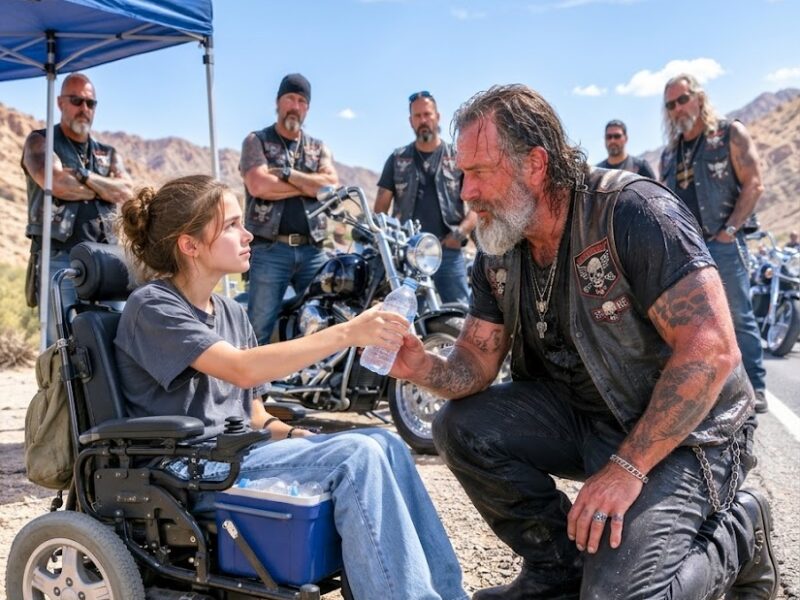
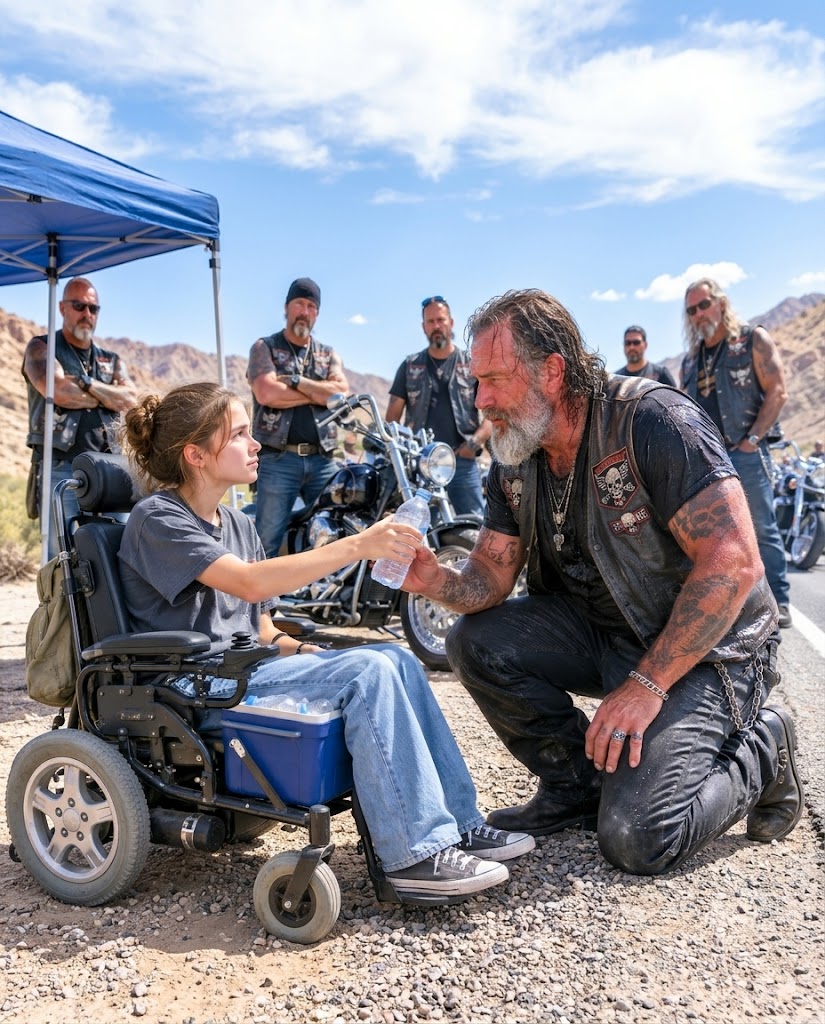
She pulled the two coldest bottles from the bottom of her cooler, the ones that were still dripping with ice, and set them in her lap.
Then she pushed the joystick of her chair and started across the bumpy, gravel-strewn shoulder.
The wheels jolted over every rock.
Her teeth rattled.
She kept going.
When she rolled up to him, the man looked up.
His eyes were bloodshot and glassy, and his face had gone a dangerous, blotchy red.
His knuckles were scarred in layers, like old tree bark.
The ink on his arms told stories of a violent, chaotic life, and none of those stories looked like they had happy endings.
The name patch on the vest he had discarded read: “GAGE. SERGEANT AT ARMS.”
Hannah held out the first bottle, frosted white, beads of condensation running down the plastic like tears.
“You look like you need this more than I need the two dollars,” she said.
Her voice was steady.
Her hand, she noticed with some surprise, was steady too.
Ronald Gage Mitchell blinked slowly, trying to bring the girl in the wheelchair into focus.
Men like Gage were used to people crossing the street when they saw them coming.
They were used to fear, to sidelong glances, to hostility dressed up as politeness.
What they were not used to, not in decades, was getting something for nothing.
He took the bottle with a trembling hand and twisted off the cap.
He drank half of it in three massive gulps, then tipped the rest over his own head and let the cold run down his neck.
His whole body shuddered.
He let out a long, ragged breath, and for the first time since he’d pulled over, the red began to drain from his face.
“Thought I was a goner for a second there,” Gage grunted, his voice like gravel in a coffee can.
“Engine overheated.”
“I pushed myself too hard trying to keep it running.”
He looked down at her then, really looked, for the first time.
He took in the worn rubber on her wheelchair grips and the faded tires, the cracked screen of the fan clipped to her armrest, and the plain, undeniable kindness sitting in her eyes.
He reached into his jeans and pulled out a thick money clip.
He peeled off a crisp $50 bill and held it out between two scarred fingers.
“Here, kid,” he said.
“Keep the change.”
Hannah shook her head and gently pushed his hand back toward him.
“No, sir.”
“I don’t charge people for surviving.”
“My dad used to say that when the desert tries to take you, everybody out here has to look out for each other.”
“Keep your money, Mr. Gage.”
Gage stared at her, stunned, with the bill still hanging in the air.
Then he slowly folded it back into the clip like he was putting away something fragile.
“It’s just Gage,” he said quietly.
“What’s your name?”
“Hannah.”
“Hannah Collins.”
Gage lowered himself into a crouch, his knees cracking like old floorboards, until his eyes were level with hers.
“Well, Hannah Collins,” he said, “I owe you one.”
“You ever need anything, you tell them Gage from the San Bernardino Charter sent you.”
Hannah smiled politely, the way you smile when a stranger makes a promise too big to take seriously.
It was the kind of thing people said.
She tucked it away in the back of her mind and forgot about it almost immediately.
Almost.
He spent the next twenty minutes sitting in the dirt beside her stand, letting his engine cool while the heat pressed down on both of them like a hand.
And something strange happened during those twenty minutes.
He didn’t talk to her like she was a child.
He didn’t tilt his head and use the soft, sugary voice people used when they saw the wheelchair first and the girl second.
He didn’t say “bless your heart.”
He didn’t offer pity, and Hannah, who could smell pity from across a parking lot, noticed.
Instead they talked about the highway, and the brutal heat, and the mechanical quirks of old engines.
He explained why a panhead sounded different from a shovelhead, and she told him about the cicadas, and how they went silent at a hundred and ten degrees like they knew something.
He laughed at that, a low rumble she felt in her chest.
When the bike had cooled enough to turn over, Gage stood, brushed off his jeans, and gave her a firm nod, the kind soldiers give each other across a crowded room.
He fired up the Harley, and its roar rolled across the desert like a wave.
Then he was gone down Route 66, chasing the dust of his brothers.
Hannah watched until he was nothing but a dark speck in the shimmer.
She smiled and picked her paperback back up.
She thought that was the end of it.
She had no idea that one cold bottle of water was about to collide with a nightmare brewing in her own backyard.
When Hannah rolled up the ramp to the trailer that evening, her mother was pacing the narrow, linoleum-floored kitchen like a caged animal.
Diane Collins looked wrung out.
Her diner uniform was stained with coffee and grease, her hair was coming loose from its clip, and she was gripping a dish towel so hard it had twisted into a rope.
But it wasn’t the exhaustion that stopped Hannah in the doorway.
It was the panic carved into her mother’s face.
“I saw them from the diner window, Hannah,” Diane said, her voice trembling.
“The bikers.”
“And Mrs. Higgins told me one of them stopped at your stand.”
“Are you out of your mind?”
“You can’t associate with people like that.”
“Mom, he was suffering from heat exhaustion,” Hannah said, gently, the way she spoke to customers who were upset about the price of Gatorade.
“His bike broke down.”
“I just gave him some water.”
“He was actually really polite.”
Diane sank into a kitchen chair and rubbed her temples with both hands.
“Honey, you don’t understand how the world works.”
“Men like that, they bring trouble.”
“And we have enough trouble of our own.”
Hannah opened her mouth to argue, and that was when someone pounded on the front door.
It was not a knock.
It was an announcement.
The flimsy door shuddered in its frame, and before Diane could even stand, it swung open.
On the rickety porch stood Kenneth Boyd.
Boyd was a local property manager and, in the plain language of the county, a predator.
He owned the land under their trailer, along with half the properties in the whole depressed corner of San Bernardino County.
He was notorious for squeezing vulnerable tenants until they cracked, then clearing the lots so he could sell them to commercial developers building distribution warehouses.
When families in Needles got behind on rent, they didn’t pray for a miracle.
They prayed that Kenneth Boyd would simply forget their address.
Boyd stepped inside without being invited, wiping sweat from his balding head with a monogrammed handkerchief.
He looked around the cramped trailer, at the peeling laminate and the water stain on the ceiling and the mismatched dining chairs, with a sneer of pure, unfiltered disgust.
“Afternoon, Diane,” he said.
“Hannah.”
His voice dripped with fake sympathy, thick and sweet as the syrup at the bottom of a rotten peach.
“I’m not going to beat around the bush.”
“You’re four months behind on lot rent.”
“Add in the late fees, and you’re looking at $4,200.”
“Kenneth, please,” Diane said, stepping between him and her daughter like she could block a bullet.
“I just picked up a third shift at the diner.”
“I can give you $800 on Friday, I swear on my life.”
Boyd laughed.
It was a dry, humorless sound, like a piece of paper tearing.
“Eight hundred doesn’t even cover the interest on the late fees, Diane.”
“I’ve been patient.”
“I’ve been a saint, really.”
“But business is business, and the developers want this lot cleared by the end of the month.”
He reached into his breast pocket, pulled out a folded sheet of paper, and slapped it down on the kitchen counter like a winning card.
“That’s a 48-hour notice to vacate.”
“Now, we both know you can’t move this rust bucket of a trailer.”
“So I’m going to be generous.”
“We have nowhere to go,” Diane whispered, and the tears she’d been holding for months finally spilled over.
“Please, Kenneth.”
“You know about Hannah’s medical bills.”
“You know what happened to her father.”
Boyd’s eyes narrowed, completely empty of anything resembling empathy.
“I do know,” he said.
“Which is why I also know you put your specially equipped Ford van up as collateral on that loan you took from me last year.”
He pointed a thick finger out the window at the wheelchair-accessible van parked in the dirt.
“If I don’t have the $4,200 in my hand by nine a.m. Friday, I’m taking the van.”
“And I’m putting a padlock on this door.”
“You can’t take her van,” Diane cried, the words ripping out of her.
“It’s the only way she gets to her physical therapy in Riverside.”
“It has the hydraulic lift!”
“We’ll never be able to afford another one!”
“Watch me,” Boyd said.
He turned on his heel and walked out, and the screen door slammed behind him so hard it bounced twice.
The silence that followed was suffocating.
Diane collapsed into one of the cheap chairs and buried her face in her hands, and her shoulders shook with sobs she was trying, and failing, to keep quiet for her daughter’s sake.
Hannah sat frozen in the middle of the kitchen with her heart hammering against her ribs.
The van was not just a vehicle.
The van was her lifeline to the outside world.
Without it, she would be trapped in that trailer like a bird in a shoebox, watching the highway through a window she could never reach.
That night, after her mother finally fell asleep sitting up at the kitchen table, Hannah wheeled quietly into her bedroom and pulled the old coffee can out from under the bed.
She dumped it on the blanket and counted.
Twice.
It came to $52 and sixty cents in crumpled ones and quarters.
The number sat there on the blanket, small and pathetic, next to the other number that had been burned into her brain.
$4,200.
It felt like trying to bail out the ocean with a thimble.
The next forty-eight hours were a blur of desperation.
Diane called every church, every charity, every cousin and distant relative she could think of, pacing the kitchen with the phone cord wrapped around her wrist.
The answers were always the same, delivered in the same soft, apologetic voices.
“We wish we could help, honey.”
“Times are tough.”
“We just don’t have that kind of money.”
By Thursday afternoon, Diane had stopped crying.
That scared Hannah more than the crying had.
She just sat there with the phone in her lap and a look on her face like someone watching a house burn down.
Hannah didn’t go out to the highway to sell water.
Instead she sat by the window, watching the dust blow across the yard in slow, lazy ribbons, feeling the weight of her disability more heavily than she had in years.
If she could walk, she could work a labor job.
If she were whole, she could protect her mother.
The thought circled in her head like a vulture.
She thought of the frosty bottle in her hand on Tuesday, of the way the stranger’s whole body had relaxed when the cold hit him.
It was the only thing she’d done all week that felt like it mattered.
And she had given it away for free.
Friday morning arrived with a bleak, oppressive heat that pressed against the windows like a hand.
At 8:55 a.m., a heavy-duty flatbed tow truck pulled into their dirt driveway, kicking up a rolling cloud of dust.
Behind it came Kenneth Boyd’s shiny silver Mercedes, gleaming like a shark in a shallow pond.
Hannah wheeled herself out onto the porch.
Her mother stood beside her, trembling, one hand resting on the back of Hannah’s chair as if she could hold the whole world still.
Boyd stepped out of his car, flanked by a burly tow truck driver carrying a set of heavy chains over one shoulder.
“Time’s up, Diane,” Boyd called out cheerfully, like he was announcing a raffle.
“Hook it up, Steve.”
“Kenneth, I am begging you on my hands and knees,” Diane said, stumbling down off the porch into the dirt.
“Take the trailer.”
“Evict us.”
“But leave the van.”
“My daughter needs it.”
Boyd didn’t even look at her.
He just waved the driver forward with two fingers.
Steve, who looked slightly guilty but not guilty enough to lose his paycheck, dragged the chains toward the front axle of Hannah’s van.
The hydraulic winch began to whine, a thin, high sound that went through Hannah’s chest like a blade.
She gripped the armrests of her chair so hard her fingers went numb, and tears of pure helplessness slid down her face and dripped off her chin.
The chains clanked against the van’s chassis.
Boyd smirked and crossed his arms over his chest.
“Should’ve paid your bills, Diane,” he said.
“The world doesn’t run on charity.”
And that was when the ground began to tremble.
Steve froze, and the chain slipped out of his gloved hands and hit the dirt.
Boyd frowned and turned toward the highway.
The noise was distant at first, like a summer storm still two counties away, but it grew with terrifying speed.
It wasn’t a storm.
It was the synchronized thunder of American V-twin engines.
Over the crest of the dirt road leading into the trailer park, a single headlight appeared.
Then another.
Then ten.
Then twenty.
A massive convoy turned off the main road and rolled into the dusty lot, and they did not park politely along the street.
They rode straight up onto the sparse, sun-bleached grass and fanned out into a huge steel semicircle that boxed in Boyd’s Mercedes and the tow truck like cattle in a pen.
Then, at some silent signal, every engine cut out at the same instant.
The silence that fell was heavy and ringing, thick enough to chew.
A dog barked once, somewhere behind the trailers, and then thought better of it.
At the front of the pack, the mountain of a man with the graying beard kicked down his stand.
Ronald Gage Mitchell swung off his bike, and his boots crunched on the gravel like bones.
He did not look overheated today.
He looked cold, calculated, and deeply dangerous, like a man who had spent his entire life learning exactly how much damage a quiet room could hold.
Behind him, two dozen patched members dismounted and stood in a line with their arms crossed.
Nobody said a word.
Gage walked slowly past the terrified tow truck driver without a glance and ignored Boyd completely.
He walked right up to the porch, and his eyes locked on Hannah.
“Morning, Hannah,” he said, and his deep voice carried across the yard without any effort.
“Hope you don’t mind the intrusion.”
“I heard you were having some car trouble.”
Hannah sat frozen, her knuckles white on the armrests.
The sheer physical presence of thirty bikers in her dusty yard was overwhelming.
The smell of hot engine oil and exhaust mingled with the dry desert air until the whole morning seemed to hum with the promise of something terrible.
Her mother made a small, strangled sound behind her.
Boyd had gone the color of skim milk.
He took a hesitant step backward and bumped into the side of his own pristine Mercedes, and then he swallowed hard and tried to dress his fear up as authority.
“Look here,” Boyd stammered, and his voice cracked in the middle like a teenager’s.
“I don’t know who you people think you are.”
“But you are trespassing on private property.”
“I want you off this lot right now, or I am calling the county sheriff.”
Gage still didn’t look at him.
His eyes stayed on Hannah, and he gave her a warm, reassuring smile that completely contradicted the winged skull stitched across his back.
“You didn’t answer my question, Hannah,” he said.
“Is this man bothering you?”
“He’s taking my van,” Hannah whispered.
Her voice trembled, but every word came out clear.
“My mom owes him money for the lot rent, and we put the van up as collateral.”
“He’s taking it right now.”
Gage finally turned his massive frame toward Boyd.
The air in the yard seemed to drop ten degrees.
The bikers behind him shifted without a sound, closing into a tighter ring around the tow truck.
Steve, the driver, slowly raised both hands and backed away from the winch controls like a man leaving a bomb.
“$4,200, isn’t it?” Gage asked softly.
His voice didn’t need volume.
It was the voice of a man who had walked through things Kenneth Boyd couldn’t even imagine, and had come out the other side without raising it once.
Boyd wiped a fat bead of sweat from his forehead.
“Yes,” he said.
“That’s the debt, plus late fees.”
“It’s a legally binding contract.”
“You can’t just ride in here and interfere with lawful business.”
“The sheriff will be here in ten minutes if I make the call.”
“Then make the call, Kenneth.”
The new voice came from behind Gage.
A younger man stepped out from the line, tall and wire-thin, with heavily tattooed forearms and a calm, almost friendly face.
His vest carried a patch that read “CALEB. ROAD CAPTAIN.”
Unlike the others, he wasn’t holding a wrench or a chain.
He was holding a sleek leather folio.
“Please, dial the sheriff,” Caleb said, and a shark-like grin spread across his face.
“Because I would love to show them these ledgers.”
“See, Kenneth, after my brother Gage here heard about Hannah’s situation from Martha Gable down at the diner, we did a little digging into your lawful business.”
Hannah’s head turned.
Martha Gable.
The lunch waitress who always slipped Diane an extra roll in her to-go bag and never said a word about it.
Caleb walked forward and slapped a thick stack of paper down onto the hood of the Mercedes with a crack like a gunshot.
Boyd flinched as if he had been struck.
“What is this?” he hissed.
“This,” Caleb said, tapping the top page with one long finger, “is a detailed record of your lending practices.”
“You’ve been charging 45% compounding interest on personal loans tied to property leases.”
“The state of California caps that at 10% for unlicensed personal lenders.”
“That’s not a business model, Kenneth.”
“That’s a felony.”
“And taking a medically necessary vehicle from a documented disabled dependent without a court order?”
“That’s a violation of the Americans with Disabilities Act, and on top of that, it’s a state extortion statute with your name on it.”
Diane gasped and covered her mouth with both hands.
Hannah stared at the thin young man in the leather vest in absolute shock.
These weren’t just outlaws who kicked in doors.
They were organized.
They had done their homework, and from the look on Boyd’s face, they had done it well.
His skin shifted from pale white to a deep, mottled purple.
“You’re a bunch of criminal thugs,” Boyd spat.
“You think a judge is going to listen to a motorcycle club over a respected property manager?”
Gage chuckled, a low rumble that bounced off the metal siding of the trailers like distant thunder.
He reached into his heavy leather jacket and pulled out a thick, rubber-banded brick of hundred-dollar bills.
He tossed it through the air.
It hit Boyd square in the chest, and he caught it clumsily against his shirt before it could hit the dirt.
“There’s five thousand dollars,” Gage growled, stepping into Boyd’s space until his shadow swallowed the landlord whole.
“That covers the rent, the fake late fees, and whatever imaginary interest you think you’re owed.”
“The debt is paid.”
“The van stays.”
Boyd clutched the money and looked frantically from the cash to Gage’s scarred face and back again.
“This doesn’t change the eviction,” he said, though his whole body was shaking now.
“They still have to be off my property.”
“About that,” Caleb said pleasantly, pulling one final document from the folio.
“The parent company that owns this trailer park is Mojave Desert Holdings.”
“We bought it this morning.”
“The club was looking for a new commercial investment in the county, and we wired the funds at eight a.m. sharp.”
“You don’t own this land anymore, Kenneth.”
“You’re fired.”
“And if you ever set foot near this family again, I won’t be using a briefcase to deal with you.”
Gage leaned in until his beard nearly brushed Boyd’s ear, and his voice dropped to a whisper that was somehow louder than anything he’d said so far.
“Unhook the van.”
“Get in your shiny car.”
“And drive away before I forget that I’m trying to be a polite guest in Hannah’s yard.”
Boyd did not say another word.
He scrambled away from Gage like a man backing off a cliff edge, clutching the cash to his chest with both arms.
He shoved past Steve and dove into the driver’s seat of the Mercedes, threw it into reverse, and floored it.
The tires spun and kicked up a rolling cloud of gravel as he fishtailed out of the trailer park, nearly clipping a mailbox on his way out to the highway.
Steve, the tow driver, was already on his knees at the winch.
“I’m unhooking it,” he yelled.
“I’m unhooking it right now.”
“Swear to God, ma’am, I didn’t want any part of this.”
He yanked the chains free, flung them onto his flatbed, and was gone within thirty seconds.
The yard fell into stunned, absolute stillness once again.
Diane Collins sank to her knees in the dirt.
The adrenaline finally left her body all at once, like a plug pulled from a drain, and she began to sob with her face in her hands.
Hannah reached for her joystick, but before she could even turn the chair, Gage was already there.
The massive biker knelt in the dust and wrapped one huge, leather-clad arm around Diane’s shoulders, and he helped her to her feet as carefully as if she were made of glass.
“It’s okay, Mama,” he said, in a voice so soft Hannah barely recognized it.
“You’re safe now.”
“He’s gone.”
Diane looked up at him through her tears.
“I don’t understand,” she said.
“Why did you do this?”
“We don’t have anything to give you.”
“I can’t repay you for this, not in a hundred years.”
“You already paid me,” Gage said, and he turned to look at Hannah.
“Your daughter saved my life on that highway.”
“I was minutes away from a stroke, and she handed me the only cold water she had, and wouldn’t take a dime for it.”
“In my world, a debt of honor like that doesn’t just go away.”
He pulled something from his back pocket then, and Hannah’s breath caught.
It was a plastic bottle.
Crushed flat in the middle, label peeling, the cap screwed tight.
The same bottle she had handed him on Tuesday, with the faint ring of condensation long gone.
He had carried it for three days.
“I kept it,” Gage said, a little embarrassed, turning it over in his scarred fingers.
“I don’t know why.”
“I guess I wanted something to remind me it wasn’t a dream.”
He slid it carefully back into his pocket like it was worth more than the money he had just thrown at Kenneth Boyd.
Then he stood up and whistled sharply.
The rest of the club sprang into action all at once, but nobody reached for a weapon.
Instead, they walked to their saddlebags and began pulling out tool belts, hammers, cordless drills, and heavy-duty tarps.
A burly biker named Duke, with forearms the size of fence posts, walked up to the rickety wooden ramp that led to the trailer’s front door.
He kicked it once with the toe of his boot, and a rotted plank cracked clean in half.
“Yeah, this is a death trap, Gage,” Duke grunted.
“We’re tearing it down.”
For the next eight hours, the Collins property became a construction site run by thirty outlaw bikers.
Hannah and Diane sat in the shade of Hannah’s faded blue canopy, bewildered, as men with skulls on their backs measured, sawed, and hammered their home back into one piece.
Duke and Caleb led a team that dismantled the old, dangerous ramp, and rebuilt it as a smooth, low-incline walkway of reinforced, pressure-treated lumber, complete with sturdy safety rails on both sides.
Another crew climbed onto the roof of the double-wide to patch the leaks that had turned the ceiling into a map of brown water stains, then sealed the whole thing against the harsh desert weather.
A third group gathered around Hannah’s van, changing the oil, rotating the tires, and lubricating the hydraulic lift until it glided up and down as smooth as silk.
One man, a gray-haired biker named Walt who looked like he’d spent forty years as a mechanic, insisted on replacing the van’s brake pads for free.
“My granddaughter rides in a chair,” he told Hannah without looking up from the wheel.
“I wouldn’t let her roll in a vehicle I hadn’t checked myself.”
Around one o’clock, a county sheriff’s cruiser pulled slowly into the park.
Everything stopped.
Every hammer, every drill, every conversation.
Hannah’s stomach dropped to her knees.
Boyd had made the call after all.
A tired-looking deputy named Ramirez climbed out of the car, one hand resting on his belt, and surveyed the yard.
He saw thirty bikers.
He saw lumber, sawhorses, a half-finished ramp, a woman in a diner uniform carrying a tray of sweet tea, and a girl in a wheelchair with a paintbrush in her lap.
He took off his hat and scratched his head.
“I got a report of a hostile takeover out here,” he said slowly.
“A gang of outlaws terrorizing a landlord.”
Caleb stepped forward with the leather folio held open in front of him like a menu.
“Deputy, I think you’re going to want to read this before you do anything else,” he said politely.
“It’s a copy of the deed transfer, and a copy of a very interesting set of loan ledgers.”
Ramirez read for a long time.
He turned pages.
He looked up once at Hannah, once at the van, and once at the ramp.
Then he closed the folio and handed it back to Caleb with a long, weary exhale.
“I’ve been hearing about Kenneth Boyd for six years,” Ramirez said quietly, so that only Caleb and Gage could hear.
“Nobody ever brought me paperwork.”
“Just whispers.”
He put his hat back on and nodded toward the yard.
“Looks like a community project to me,” he said.
“I’ll let dispatch know it was a false alarm.”
He paused beside Hannah’s chair on his way back to the cruiser, and he held out a hand.
“Good work with the ramp, miss.”
“That old one was a hazard.”
That was the moment Hannah understood something that her mother, still gripping the sweet tea tray, hadn’t quite caught up to yet.
In a single morning, the biggest bully in Needles had been stripped of his land, his money, and his power, and the only reason it had happened was that a girl in a wheelchair had refused to charge a thirsty man two dollars.
By late afternoon, the brutal heat finally began to break, giving way to a soft purple Mojave sunset that turned the dust into gold.
Diane had made three pitchers of sweet tea.
She carried plastic cups out to the bikers, who treated her with the utmost respect, calling her “Ma’am” and “Mom,” and thanking her so many times she started to blush.
One of them, a boy who couldn’t have been twenty-five, took his cup with both hands, as if it were communion.
“My own mom passed three years ago,” he said, looking at his boots.
“This is the best tea I’ve had since.”
Diane, who had spent the better part of five years bracing for the next blow, simply put a hand on his cheek.
When the paint came out, it was Hannah’s idea.
The bikers had finished the new ramp, and it stood there, long and clean and golden, waiting.
“Can I do something?” she asked Gage shyly.
He handed her the brush.
With Duke steadying the can, she rolled to the foot of the ramp and painted one thing on the first board.
A small, simple water bottle, drawn in blue, with three little beads of condensation sliding down its side.
Gage looked at it for a long time.
Then he walked over, knelt in the sawdust, and pressed his thumb gently against the wet paint, leaving a print beside it.
“There,” he said hoarsely.
“Now it’s official.”
Afterward, he sat down on an overturned milk crate next to Hannah’s wheelchair, wiping grease from his hands with a rag.
He looked at the new ramp.
Then he looked at Hannah, and kept looking.
“I have a confession to make, kid,” Gage said quietly, and his dark eyes had softened.
Hannah looked at him over the rim of her cup.
“You didn’t really buy the trailer park, did you?”
Gage laughed, a real laugh this time, deep and unguarded.
“No, we actually did.”
“Caleb wasn’t bluffing about that.”
“It’s a good real estate investment, and as of this morning, we’re officially your new landlords.”
“But don’t you worry about rent.”
“You two have a lifetime pass.”
He paused, looking down at his scarred hands, and the long quiet stretched between them like a rope pulled tight.
“The truth is,” Gage said at last, his voice barely above a whisper, “when I rode past your stand the other day, I wasn’t just overheated.”
“I was hurting.”
“It was the anniversary.”
“The anniversary of what?” Hannah asked gently.
“Of the day I lost my daughter, Maya,” Gage said, looking out toward the long, empty horizon.
“She was exactly your age when she passed.”
“When she was twelve, she had a terrible accident.”
“She was paralyzed, just like you.”
“T10 spinal injury.”
“My wife and I, we didn’t have money back then.”
“We couldn’t afford the good physical therapy, the right equipment, the proper care.”
“She got a bad infection, and because we lived in a run-down place with a landlord just like Kenneth Boyd, we couldn’t keep her safe.”
“She didn’t make it.”
Hannah felt a lump rise in her throat so fast it hurt.
She reached out and laid her small hand over Gage’s massive, tattooed knuckles.
He didn’t pull away.
“When I broke down on that highway,” Gage continued, and a single tear slid out of the corner of his eye and vanished into his beard, “and I looked up and saw a beautiful, strong-willed girl in a wheelchair offering me her own water, it felt like Maya was looking right at me.”
“Telling me to wake up.”
“Telling me to quit being angry at the world and actually do something good for once.”
He turned his hand over and gently squeezed her fingers.
“You didn’t just give me water, Hannah.”
“You gave me my heart back.”
“Taking care of this house, and of you and your mom, it’s the least I can do.”
The bikers finished their work just as the first stars began to appear in the desert sky.
The trailer was sealed.
The ramp was pristine.
The van purred like a cat in a sunbeam.
As the club swung onto their motorcycles, Gage walked over to Diane and pressed a plain white card into her palm.
It had a single phone number on it, written in ballpoint pen.
“You ever need anything,” he said.
“A light bulb changed.”
“A ride to the ER.”
“Or if anybody ever gives you a hard time.”
“You call that number, day or night.”
“You have thirty brothers looking out for you now.”
The engines roared to life, shaking the ground one last time, and the sound rolled through Hannah’s chest and settled somewhere she hadn’t known was empty.
Gage gave her a two-finger salute from the saddle.
Then he kicked his bike into gear and led the pack back onto Route 66, until their taillights shrank into red embers and faded into the warm desert night.
Hannah sat on the porch long after they were gone.
She ran her hand along the new rail, smooth as river stone.
She looked at the little blue bottle painted on the first board, and she had the odd, impossible feeling that she was looking at the first line of a story she hadn’t finished writing yet.
She had no way of knowing that the story was only getting started.
By Saturday morning, the whole town knew.
In a place like Needles, news doesn’t travel by phone or by post.
It travels by diner booth and by gas pump and by the long, slow gossip of people who have been neighbors for forty years and have nothing better to do on a hundred-degree afternoon.
Martha Gable told it first, over the counter at the Route 66 Diner, with her hands on her hips like a woman delivering a sermon.
“I don’t care what colors they wear,” she announced to a room full of truckers and retirees.
“I watched Kenneth Boyd run out of that trailer park like his pants were on fire, and it was the finest thing I’ve seen in thirty years of pouring coffee.”
A retired schoolteacher in the corner booth lowered her newspaper.
“I heard they wired five thousand dollars in cash,” she said.
“Mrs. Higgins says they bought the entire park before breakfast.”
“Mrs. Higgins also said the moon landing was filmed in Barstow,” Martha shot back.
But the story spread anyway, and it grew a little every time somebody told it.
By noon, people who had spent years locking their doors when a Harley rumbled past found themselves wondering how many other things in their small town they had gotten wrong.
On Sunday, Diane Collins walked into First Baptist for the first time in two years.
She had stopped going when the medical bills started arriving in envelopes with red stamps on them, because she couldn’t stand the soft, pitying looks, or the casserole dishes people dropped off with a sigh and never asked to have returned.
This time, she sat in the third pew with Hannah’s chair parked in the aisle beside her, and she kept her chin up.
People came to her after the service, one at a time, the way you approach a campfire.
“Diane, I had no idea it was that bad,” said a woman she had known for fifteen years.
“Why didn’t you tell us?”
“I did,” Diane said, quietly and without anger.
“I told you in March.”
“I told you in April, and in June.”
The woman opened her mouth and then closed it again.
She stood there with her purse clutched against her stomach, and Hannah watched something shift in her face.
Shame, maybe, or just recognition.
“I’m so sorry,” the woman said finally.
“I think we all told ourselves somebody else was handling it.”
That was the thing about Needles, Hannah thought on the ride home.
Nobody in town was cruel.
They were just tired, and scared of their own bills, and very good at looking the other way.
It had taken thirty strangers in leather vests to make them look back.
On Monday, Boyd fought back.
He didn’t do it with fists, because Kenneth Boyd had never won a fight in his life with anything but a signature.
He did it with a lawyer from Las Vegas in a navy suit, and a press release.
By ten a.m., a reporter from the Needles Desert Star was standing at the foot of the new ramp with a notebook and a nervous smile.
Her name was Priya Nair, she was twenty-six, and she had the haunted, hungry look of a journalist who had spent two years covering fender benders and county budget meetings.
“Ms. Collins, I’m sorry to just show up,” she said.
“Mr. Boyd’s attorney is claiming that your family was the victim of a coordinated intimidation campaign by an outlaw motorcycle club.”
“He says he was robbed, essentially.”
“He says he’s considering charges.”
Diane let out a short, ugly laugh.
She was standing in the doorway in her diner uniform, with her car keys already in her hand.
“He was handed five thousand dollars in cash,” she said.
“He was told to leave, and he left.”
“I think that’s called a refund.”
Priya wrote that down, and then she looked at Hannah.
“Miss Collins, can I ask you something off the record first?”
“You can ask,” Hannah said.
“Were you afraid of them?”
Hannah thought about it.
She had been afraid on Tuesday, when the pack came over the ridge.
She had been terrified on Friday, when they filled her yard.
But somewhere between the sweet tea and the paint, the fear had become something else, something she didn’t have a name for yet.
“I was afraid of Mr. Boyd,” she said.
“That’s who I’d been afraid of for five years.”
“The men with the motorcycles were the first people who ever stood between him and me.”
Priya’s pen stopped moving.
“Can I put that on the record?”
“You can put all of it on the record,” Hannah said.
“I don’t have anything to hide.”
She was nineteen years old, she lived in a double-wide with a patched roof, and in that moment she was the bravest person in San Bernardino County.
The story ran on Wednesday morning.
It wasn’t long, and it wasn’t polished, and it didn’t need to be.
The headline was seven plain words: “A Glass of Water, and a Landlord Undone.”
The photograph was Hannah at the foot of her new ramp, with the little blue bottle painted at her wheels.
By noon, the Desert Star’s website had crashed twice.
By two o’clock, the phone in the trailer started ringing, and it didn’t stop for three days.
Most of the calls were from people Diane had never met.
A retired nurse in Flagstaff offered to mail a box of adaptive equipment.
A high school in Bullhead City held a car wash and sent a check for $812.
A man in Ohio left a long, rambling voicemail about his own daughter, and then wept for forty seconds into the machine before he hung up.
But the call that mattered most came from a woman named Delia Ortiz, who lived at the far end of the park in a trailer even smaller than the Collinses’.
She knocked on their door on Thursday evening with a manila envelope pressed to her chest.
She was sixty-eight years old, and she was shaking.
“Mrs. Collins,” she said in a small voice.
“I read the paper.”
“I think I got the same kind of paper he gave you.”
She pulled out a loan agreement.
Hannah scanned it before her mother could.
The interest rate printed in the corner was 43 percent.
Then another knock came, and another envelope.
Then a third.
By Friday afternoon, there were nineteen households standing in the dirt outside the Collinses’ trailer, holding folders and shoeboxes and grocery bags full of crumpled paper, and every one of them had the same look on their face.
They looked like people who had been holding their breath for years and had just been told they could stop.
That was how the meeting happened.
It wasn’t planned.
Nobody sent out flyers.
But at seven o’clock on Friday evening, one week to the hour after the engines had cut out in the yard, forty-one tenants crammed into the old laundry room at the center of the park.
There were folding chairs, a flickering light, and a smell of detergent and dust.
There were also, standing along the back wall with their arms folded and their eyes on the floor, eight members of the San Bernardino Charter.
They did not speak.
They had been very clear about that when they arrived.
“This is your meeting,” Gage had said to Diane at the door, his hat in his hands like a boy at a funeral.
“We’re just here in case somebody needs a chair carried.”
Caleb did most of the talking, though, because someone had to, and because his folio had turned out to be more terrifying than any of the Harleys.
He stood at the front with a laser pointer and a projector borrowed from the library, clicking through slide after slide of anonymized ledger entries.
The numbers were so ugly that a few people in the audience looked away.
“In eleven years, Kenneth Boyd collected approximately $212,000 in interest that was illegal under California law,” Caleb said evenly.
“Forty-one families in this room, and thirty more in the county, were charged rates between 38 and 52 percent.”
“Seventeen households lost property, vehicles, or both when they fell behind.”
A man near the front, in a work shirt with a name patch that read “RAY,” lowered his head into his hands.
“And every one of those cases,” Caleb went on, “is documented.”
“Every signature.”
“Every receipt.”
“Every time somebody wrote a check they couldn’t afford, there’s a copy.”
Delia Ortiz raised her hand like a student.
“Where did you get all this?”
“Did you break into his office?”
Caleb smiled.
“No, ma’am.”
“Seven of Mr. Boyd’s own former employees came to us.”
“A bookkeeper, two secretaries, a handyman.”
“They’d been keeping copies in their kitchens for years because they were too scared to do anything with them.”
“They just needed somebody to be scared with.”
It was the most honest sentence anyone said that night, and nobody breathed for a moment.
Then Mrs. Higgins, the same Mrs. Higgins who had once told half of Needles that the club was cooking meth in the desert, stood up from her folding chair with a cane in her fist.
She was eighty years old, and she was shaking with a rage that had clearly been fermenting since the Eisenhower administration.
“I have lived in this park for thirty-one years,” she announced.
“I have paid that man more than my house is worth.”
“I want every one of you to know that I called these gentlemen criminals last week.”
She turned slowly to face the back wall, where eight big men in leather were suddenly very interested in their boots.
“I take it back,” she said.
“Every word.”
The room erupted.
It wasn’t quite applause.
It was louder and rawer than that, the sound of forty-one households exhaling at once.
And Hannah, sitting in the middle of the room with her hands in her lap, realized with a dizzy flutter that her little water stand had started something that was bigger than her family, and bigger than the club, and bigger than Kenneth Boyd.
That was the week the club’s new landlords made their first official move.
They did not raise the rent, as everyone expected.
They did not hire a property manager, or install a gate, or put up a single No Trespassing sign.
Instead, Gage stood on the steps of the laundry room and, in a voice that carried to every trailer in the park, announced three rules.
“One,” he said.
“Every lot rent in this park goes down to what it was in 2009.”
“Two.”
“Every dollar of illegal interest that Boyd collected gets credited back against what you owe, starting today, with a lawyer in San Bernardino who works for free and a bad temper.”
“Three.”
He paused, and for the first time all evening he looked uncomfortable.
“If any one of you ever feels afraid to knock on a door and ask for help, you knock on mine.”
“We’re not going anywhere.”
A week after that, the second shoe dropped.
On a rainless Tuesday morning, two unmarked state sedans pulled into the lot of Boyd Property Management, and four investigators from the California Department of Financial Protection and Innovation walked inside with a warrant.
They did not knock.
They walked out forty minutes later with eleven banker’s boxes and Kenneth Boyd himself, in handcuffs, with his tie hanging loose around his neck like a noose.
The local news reported that he had been arrested for felony fraud, extortion, and usury, and that he was facing up to fifteen years in prison.
The evidence had arrived at the district attorney’s office three days earlier, in a plain brown envelope with no return address.
Inside was a sleek leather folio, tied shut with a strip of black ribbon, and nothing else.
No note.
No name.
No explanation.
The DA’s investigator who opened it supposedly sat there at his desk for ten full minutes without moving.
When Hannah heard the news, she was in the shade of her canopy, which she had put back up by the highway out of nothing but habit.
Diane read the article aloud to her off her phone, in a flat voice, as though she didn’t trust it.
Then she lowered the phone.
“Hannah,” she said.
“Did you ask them to do that?”
“Mom, no.”
“I swear.”
“I never asked them for anything.”
“I know,” Diane said, and she wiped her eyes with the back of her wrist.
“That’s what scares me.”
“I spent five years begging God for help, and the answer didn’t come from the people I begged.”
She looked at her daughter for a long moment, and in the heat shimmer her face looked suddenly younger, like the woman Hannah remembered from before the crash.
“It came from the one thing you did that I told you not to do.”
“I was wrong, baby.”
“I’m sorry I was wrong.”
Hannah rolled forward until her armrest touched her mother’s knee.
“You were scared,” she said.
“You were trying to keep me safe.”
“That’s not wrong.”
“It just wasn’t the whole story.”
That was the day Diane finally gave her a hug without crying, and Hannah decided it was the best hug she had ever gotten.
The mail came on a Thursday.
Among the electric bill and a flyer for a mattress sale was a thick envelope with the Riverside Community Hospital logo in the corner.
Diane stared at it for a long time, because that logo had appeared on her kitchen counter in angry red ink every month for five years.
She opened it with her thumbnail.
Inside was a single sheet of paper, and at the bottom, in plain black type, was a number.
$0.00.
The cover letter was two sentences.
“Your account balance of $61,300 has been paid in full by an anonymous donor.”
“No further payments are required.”
There was a second envelope behind it, from the rehabilitation center in Riverside, with the same two sentences and a different number.
Then a third, from the orthopedic supplier, then a fourth.
In the end, the total came to $87,640, and the only thing any of the hospital clerks could tell Diane over the phone was that the check had been drawn on a bank in San Bernardino.
She held the stack against her chest, and this time she didn’t fall to her knees.
She just stood there in the middle of the kitchen with the late-summer light pouring through the window, and for the first time in five years, she let out a breath that went all the way to the bottom of her lungs.
Hannah didn’t need to ask who had done it.
She pulled the old coffee can out from under her bed and pulled out the $52.60 she had been saving, and she walked it to the first mailbox on the road, and she put it into a plain envelope with a single sheet of notebook paper.
She wrote one sentence on the paper.
“The water was free, but this is for the next bottle.”
She addressed it to the number written on the white card in her mother’s drawer.
Three days later, a package arrived at the trailer.
Inside, wrapped in newspaper, was an old, dented, silver-edged water bottle with a rusted hinge, the kind men carry on long rides.
On the bottom, someone had scratched three words with a nail.
“FOR MAYA’S GIRL.”
There was no money in the package, and the $52.60 was not returned.
But taped to the inside of the box was a small patch of black cloth, about the size of a playing card.
It was embroidered in blue thread, and the design was so simple it took Hannah a moment to recognize it.
A little water bottle, with three beads of condensation running down its side.
Beneath it, in careful white stitching, were the words “DEBT OF HONOR.”
Someone in the club had made that patch, and Hannah knew, with a certainty she couldn’t explain, that Gage was wearing its twin on the front of his vest.
That September, she went back to college.
It wasn’t a miracle.
It was mostly paperwork, a handful of scholarships from donors she had never met, and a mother who sat at the kitchen table until three in the morning filling out forms in her careful diner handwriting.
But when the first day of the fall semester arrived, Hannah drove her own van, with its smooth hydraulic lift and its new brake pads, forty miles to the community college campus in Bullhead City.
She rolled up the ramp to the Kinesiology building, past a pair of freshmen who didn’t even look twice, and found the front row of the classroom.
She was studying to become a physical therapist.
The professor on the first day asked each student why they had picked the field.
Most said things like “I like sports” and “My mom said it pays well.”
When the professor got to Hannah, the room went quiet, because everyone had already noticed the chair.
Hannah looked around at the faces, and she smiled.
“Because somebody once treated me like a person before they treated me like a patient,” she said.
“I think that’s the whole job.”
The professor, a tough old woman with silver hair and a Navy tattoo, nodded slowly.
“Miss Collins,” she said, “you’re going to be dangerous.”
In October, the call came.
It was a Sunday, and Hannah was at the kitchen table, drowning in anatomy flashcards, when her mother’s phone buzzed with a number she didn’t recognize.
Diane answered, listened for about ten seconds, and then held the phone out across the table with an expression Hannah couldn’t read.
“It’s for you,” she said.
“It’s Gage.”
Hannah took the phone.
There was a long pause on the line, thick with the rumble of an engine idling somewhere in the background.
“Hannah,” Gage said.
His voice was rougher than she remembered, as if he hadn’t slept.
“Tomorrow would have been Maya’s thirty-first birthday.”
“The club rides out to see her every year.”
“I was wondering if you and your mom might want to come along.”
“You don’t have to.”
“I just—I’d like her to meet you.”
The cemetery was in a small valley outside San Bernardino, with a view of the foothills and a line of old cottonwoods that had turned gold.
The Collinses drove there in the van, with a convoy of thirty-one Harleys rumbling in formation behind them like an honor guard, and on the freeway, strangers in minivans stared at them in open amazement.
Hannah sat in the passenger seat with her hands folded around a cold bottle of water that she had packed in her own cooler that morning.
She did not know why.
The club parked in a long silver line along the gravel path.
They took off their sunglasses and their gloves and walked, in twos and threes, between the rows of headstones, with a silence so complete that even the wind seemed to hush itself.
Gage led the way.
He stopped in front of a small white marker at the end of a row, and Hannah read the name carved into the stone.
MAYA ROSE MITCHELL.
Beloved daughter.
Born in July, gone at nineteen.
Her birthday and her last day were exactly twelve days apart, which was why, Gage explained in a voice scraped raw, that stretch of summer had always been the hardest of his year.
He knelt and ran his thumb across the carved letters the way you’d touch a child’s cheek.
“Hey, baby girl,” he whispered.
“I brought somebody I want you to meet.”
Hannah rolled forward over the grass.
She was afraid her voice would break, so she didn’t say anything at all.
She just leaned down and set the bottle of water at the foot of the stone, upright, with its frosted label facing the sky.
In the October sunlight, a few small beads of cold slid down the plastic and dripped onto the grass.
Behind her, thirty big men in leather lowered their heads.
Nobody made a sound for a very long time.
When Gage finally stood up again, his face was wet, and he made no effort to hide it.
He put one scarred hand on Hannah’s shoulder and left it there.
“You know what she used to say?” he asked.
“When I’d get mad at the world?”
“She’d say, ‘Dad, you can’t fix everything, but you can fix something.’”
He let out a shaky laugh.
“I spent fourteen years forgetting that.”
“I think I just needed somebody to hand me a glass of water to remember.”
The following summer, Hannah set her stand up again.
She didn’t need to, and everyone in her life told her so.
But she had the same faded blue canopy and the same cooler, and the old sign her father had suggested, with a few new words written in the corner in a different color of marker.
“ICE COLD WATER. FREE TO ANYONE WHO NEEDS IT. PAY IT FORWARD.”
She sold nothing that season.
She gave away a little under four thousand bottles.
Travelers pulled over at the side of Route 66 and stared at the sign, and some of them left twenties in the cooler without saying a word.
By August, Hannah had enough in the jar to fund a scholarship for the next girl in a wheelchair who wanted to study physical therapy.
It was the first of nine she would eventually fund.
And every summer after that, without fail, on the last Tuesday of July, the ground at the edge of Needles would begin to hum.
First it was a low murmur you felt in your feet.
Then a growl.
Then a roar that shook the dust off the billboards and set the town’s dogs howling.
A massive pack of Harleys would come over the ridge in a tight, glittering line, thirty or forty bikes, sometimes more, riding straight down Route 66 with their headlights on in the middle of the day.
They would slow at the double-wide trailer with the golden ramp.
They would honk their horns, one long blast after another, like a salute.
And on the front of the lead rider’s black leather vest, over the place where his heart was, a little blue patch with three beads of condensation would catch the light.
Hannah would be sitting under her canopy with a paperback on her knee and a cold bottle in her lap, and every year she would raise it, just slightly, in her hand.
She understood now what her father had been trying to tell her all those years ago, what the desert had been trying to tell all of them.
The world does not run on charity, as Kenneth Boyd had once said.
It runs on the small, stubborn, unprofitable moments when one person looks at another and decides that they are worth a bottle of water.
Everything else, the ramps, the ledgers, the thunder, the patches, the papers, was just what happened when enough of those moments added up.
Sometimes guardian angels wear black leather and ride on two wheels.
And sometimes, if you are very lucky, they only show up because you were kind when nobody was watching.









