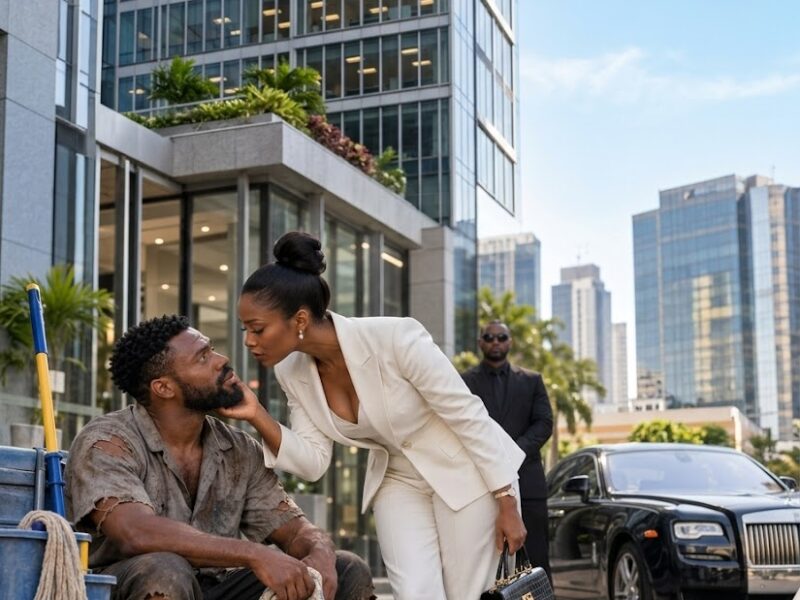
A Desperate CEO Married Her Company’s Janitor to Save Her Empire—Then She Saw His Name on a $2 Billion Contract
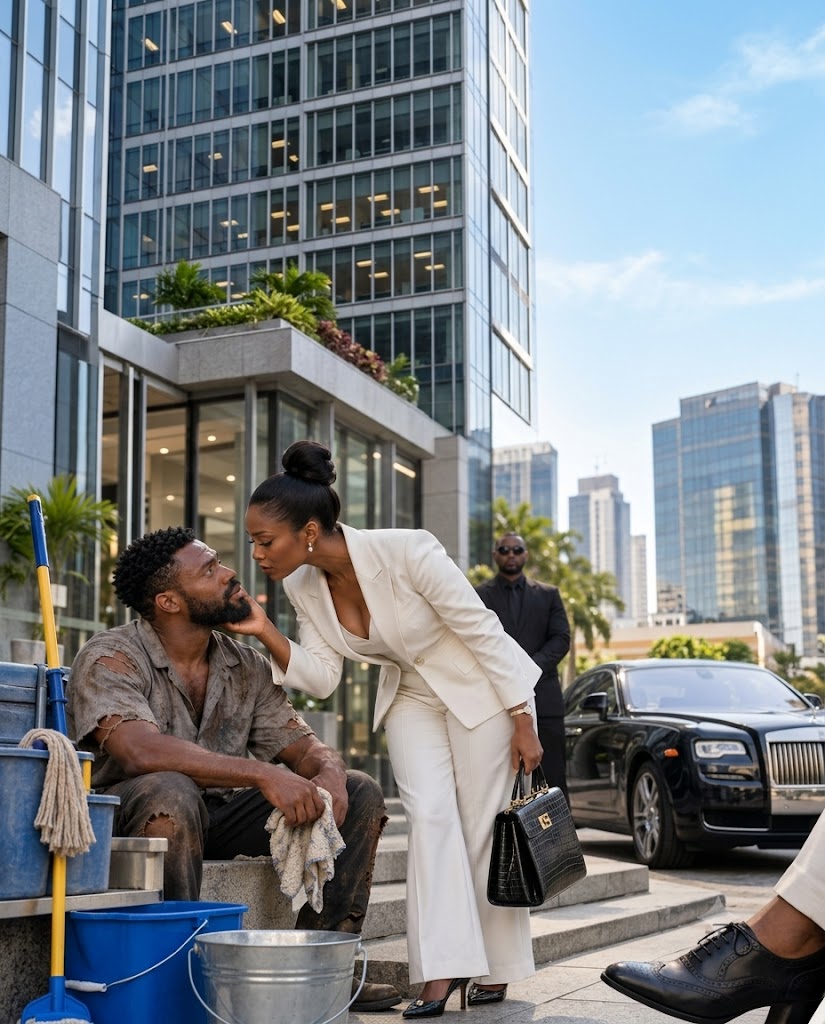
The boardroom on the 27th floor smelled like expensive coffee and quiet panic. Amara Okafor stood at the head of the mahogany table, staring at the final page of a trust document that had just turned her life into a countdown.
Outside the glass wall, cranes moved above the Savannah harbor like long metal birds. Inside, twelve directors avoided her eyes.
Nana Boateng, the family lawyer, cleared his throat. “The language is old, but it is enforceable. Your grandfather created the family stewardship trust in 1998. The controlling shares assigned to your father’s line transfer to you on the annual vesting date only if the managing beneficiary has established what the trust calls an independent household.”
He paused. “Under the definition section, that means legal marriage.”
Amara looked at him. “How long?”
“Twenty-one days.”
Her uncle leaned back in his chair. Chuck Okafor had spent thirty years beside Amara’s father—first carrying files, then negotiating cargo contracts, then becoming deputy chairman. He wore grief well: a dark suit, a black tie, and a silver watch that had belonged to Amara’s grandfather.
“If Amara cannot satisfy the condition,” Chuck said, “the voting proxy passes to the next senior family trustee for eighteen months. Which happens to be me.”
“I did not write the trust,” Amara said. “But you seem very comfortable with it.”
His son, Amecha, smirked. “Maybe because some of us prepare for responsibilities before they arrive.”
Amara’s fingers tightened around the papers. Twenty-one days. Thirty-two percent of Blue Harbor’s super-voting shares. Enough to control the board. Enough to decide who ran the company her father had spent forty-one years building from a rented warehouse and two trucks.
Chuck glanced through the glass wall toward the corridor. A man in a gray maintenance uniform was pushing a cleaning cart past the boardroom doors. Kletchi Nosu. Night janitor. Quiet. Invisible to most people in the building.
“You have always said titles do not matter,” Chuck said. “Marry him then. At least someone will still be here to clean your office after we move you out of it.”
The laughter came again. This time, Amara looked through the glass.
Kletchi had stopped because one wheel of his cart had jammed. He crouched, turned the wheel with both hands, and pushed again without looking inside.
Amara heard herself say, “All right.”
The room went still. Chuck’s smile thinned. “What did you say?”
Amara folded the trust document once. “I said, all right.”
She walked out of the boardroom before anyone could ask another question.
Kletchi was halfway to the service elevator when she called his name. He turned slowly. He was thirty-eight, tall without trying to look imposing, with a face people forgot because he had learned how to let them. His work gloves were tucked into the back pocket of his uniform. A faint line of dust crossed one sleeve.
“Mrs. Okafor, I need to ask you something.”
He looked at the boardroom behind her, then at the directors now pretending not to watch through the glass. “That usually sounds expensive when someone from that room says it.”
Amara did not smile. “Will you marry me?”
The elevator opened behind him. Kletchi did not move. Somewhere inside the boardroom, a chair scraped against the floor.
“I am sorry,” he said. “I thought you asked if I would marry you.”
“I did.”
His eyes settled on her face. Not her watch. Not her suit. Not the directors watching. Her face. “Why?”
“Because I have twenty days to satisfy a trust condition or my uncle takes control of this company for eighteen months. If that happens, I may never get it back.”
“And your solution is the man who empties your waste basket.”
“My solution is someone who has worked in this building for fourteen months, has never asked me for a favor, has never sold a story about my family, and once returned an envelope containing forty thousand dollars in cash to accounting when nobody knew you had found it.”
Kletchi’s jaw shifted almost imperceptibly. “You remember that?”
“I remember everything that happens in my company.”
For the first time, something close to amusement moved through his eyes. “No, you don’t.”
The answer irritated her more than it should have. “This would be legal. Temporary. If you want it to be, you would have your own room, your own counsel, and a written agreement protecting you. I would compensate you fairly.”
“How fairly?”
“Name a number.”
He looked past her at the cranes outside. “That is exactly the wrong answer.”
“What do you want me to say?”
“I want you to understand that if I say yes, I will not let you buy the right to treat me like a chair you rented for a meeting.”
Amara’s shoulders stiffened. “I don’t treat people that way.”
Kletchi glanced toward the boardroom. She followed his eyes. Chuck was standing inside watching them.
“Maybe not on purpose,” Kletchi said.
The elevator doors began to close. He stopped them with one hand. “Give me until tomorrow morning.”
“I don’t have much time.”
“Neither do people who make bad decisions because they are afraid.”
Then he stepped into the elevator and disappeared.
That night, Amara slept for forty-three minutes. At 2:17 a.m., she sat in her father’s old study with the trust document open in front of her and rain tapping against the windows.
Her father, Benjamin Okafor, had hated that trust. He had told her so years earlier. His own father had written it after watching cousins sell family shares during a bitter divorce. Convinced that marriage somehow proved stability, Benjamin had tried twice to amend it, but the other family branches refused. Then he died from a heart attack six months before the final transfer date, leaving Amara with a company and a rule from another generation.
On the desk sat a photograph of him in 1994, younger than she was now, smiling beside three trucks with cracked windshields. “You left me a beautiful mess, Papa,” she whispered.
At 6:40 the next morning, her phone rang.
“Kletchi. I will do it,” he said.
Amara stood so quickly her chair rolled backward. “You will?”
“On three conditions. No money beyond my normal wages while we are married. You can pay legal costs, but I am not selling my name.”
“Go ahead.”
“Second, nobody in your house or your company speaks to me as if I am property you purchased. If they do, you correct it.”
“And third?”
“When this ends, you tell the truth. You do not let anyone say I trapped you, seduced you, or stole from you because that version is convenient.”
Amara stared at the rain on the window. “Why would you agree without payment?”
There was a pause. “Because I know what it looks like when a family uses paperwork to destroy itself.”
Before she could ask what he meant, he said, “Your office at ten.”
They were married eleven days later. There were no flowers, no choir, no banquet hall—only a civil registrar, two witnesses, Nana Boateng, Amara’s assistant Afua, and a stunned clerk who kept looking from the famous CEO to the man in a simple navy suit as if waiting for someone to admit it was a joke.
When Kletchi signed the certificate, his hand was steady. When Amara signed, hers was not.
Outside the registry, reporters crowded the pavement. Questions came from every direction. Was this marriage connected to the family trust? How much had Amara paid him? Was Kletchi really a janitor?
When one reporter called him “the poorest man ever to marry into the Okafor family,” Kletchi only said, “You would need to see my bank account to know that, and I don’t remember inviting you.”
Even Amara almost smiled.
Chuck arrived in time to turn the moment cruel. “Congratulations, nephew. I hope married life is cleaner than the office floors.”
Cameras swung toward him. Before Kletchi could answer, Amara stepped forward. “His name is Kletchi Nosu. He is my husband. You will use his name.”
Chuck smiled for the cameras, but his eyes did not.
That evening, Kletchi moved into Amara’s house with one suitcase. She had filled his closet with expensive clothes for investor events. He kept two suits and asked that the rest be returned.
“I agreed to help you,” he said. “I did not agree to become a costume.”
Amara wanted to argue, then realized he was right.
Five days later, Nana Boateng confirmed that the marriage satisfied the old family trust. The thirty-two percent voting block vested in Amara’s control. Chuck lost the temporary proxy he had expected, congratulated her in public, and began attacking from the edges instead.
Committees delayed approvals. Anonymous memos questioned her judgment. A newspaper printed a photograph of Kletchi pushing his cleaning cart beneath a headline mocking the marriage.
Kletchi kept working nights. When Amara ordered facilities to promote him, he refused. “I was cleaning offices before I married you. Did the work become dishonest overnight?”
She had no answer.
Then he began to attack from the edges. A procurement committee delayed approvals. Two regional directors suddenly questioned her port expansion plan. An anonymous memo accused her of marrying for corporate advantage and called her judgment unstable. A business newspaper ran a photograph of Kletchi pushing a cleaning cart beneath the headline: “The CEO and the Janitor: Love Loophole or Corporate Fraud?”
Amara threw the paper into the bin. Kletchi picked it out when he came into her office that evening.
“Why are you here?”
“To collect your trash. Apparently, marriage does not change the cleaning schedule.”
“I told facilities to move you to a supervisory role.”
“I told facilities I was not interested.”
Amara stared at him. “You are still cleaning offices after marrying the CEO.”
“I was cleaning offices before I married the CEO. Did the work become dishonest overnight?”
“The press is using it to humiliate you.”
“No, the press is using it to humiliate you. I am not embarrassed by work.”
He folded the newspaper and put it back on her desk. “You should not be either.”
She looked at him for a long moment. “You enjoy disagreeing with me.”
“It is one of the few free benefits in this marriage.”
He turned to leave, then stopped beside a stack of port expansion files. “Your fuel index is wrong.”
Amara looked up. “What?”
He pointed at the top page. “The escalation formula. It uses last quarter’s marine diesel index, but the supplier contract resets monthly. If the index moves another three percent, the gap becomes your cost.”
She stared at him. “Kletchi.”
He seemed to realize what he had said.
“How do you know that?”
“I read things.”
“That is a procurement schedule.”
“It was upside down from where I was standing, and you calculated currency exposure upside down.”
He picked up the trash bag. “Maybe your font is very clear, Kletchi.”
He walked out.
Amara called the CFO. The next morning, Mensah arrived at 7:10 with a pale face and three revised spreadsheets.
After that, Amara began watching him more carefully. She noticed the books beside his bed: maritime finance, corporate law, forensic accounting. She heard him speak fluent French to a lost Senegalese contractor. She watched him scan a page of bond yields and frown as though numbers spoke to him in a language he had known for years.
At home, though, he remained stubbornly ordinary. He preferred the small kitchen to the formal dining room, fixed broken hinges himself, and made jollof rice so badly that Amara finally told him, “Money may not impress you, but seasoning should.”
One night, she found him on the veranda after midnight. The sea was only a dark sound beyond the wall.
She told him how her father used to sit there after her mother died, when the house felt too quiet. Kletchi listened without trying to repair the grief.
“What about your family?” she asked.
“My mother is dead,” he said.
“I’m sorry.”
“My father is alive.”
“Are you close?”
He looked toward the darkness. “No.”
She let the silence remain. For the first time in years, sitting beside another person without speaking did not feel like something she had to manage.
Three weeks into the marriage, Blue Harbor received final approval to enter exclusive negotiations on the Kea Deep Water Terminal, a massive regional infrastructure project backed by a consortium of African and European banks. The full financing package was valued at $2.18 billion.
If Blue Harbor secured it, the company would become one of the largest privately controlled port infrastructure operators in West Africa.
Chuck suddenly became helpful. He attended every meeting. He praised Amara’s leadership in public. He stopped making jokes about Kletchi.
That change frightened her more than the jokes had.
On a Thursday evening, Amara returned to the office after dinner because she had left a signed environmental compliance schedule in the executive archive. The building was nearly empty. Rain streaked the glass.
At 10:47 p.m., the lights in the legal records room were still on. She entered and found a black document folder open on the central table. It carried the seal of the Atlantic Development Banking Consortium: “Confidential—Kea Deep Water Terminal Financing Facility.”
Amara frowned. The original financing documents were supposed to be in outside counsel’s vault until the signing ceremony.
She turned the first page. Blue Harbor Africa Group. Government Concession Guarantees. Senior Lending Syndicate. Political Risk Coverage.
Then she saw a familiar surname. Nosu.
She turned another page. A schedule listed one of the anchor guarantee vehicles: “Nosu Continental Infrastructure Trust—Authorized Contingent Beneficiary Representative: Kletchi Ezekiel Nosu.”
Amara stopped breathing for a second.
She read it again. Kletchi Ezekiel Nosu. Below the name was a commitment figure: USD 2 billion maximum guarantee exposure across the trust’s infrastructure portfolio.
The room seemed to narrow around her.
She heard a sound behind her. Kletchi stood in the doorway. He was not wearing his cleaning uniform. He wore dark trousers and a white shirt with the sleeves rolled to his elbows. In one hand was a key card she had never seen.
Amara placed her palm flat on the document. “Tell me this is another man.”
Kletchi did not answer.
“Tell me there is another Kletchi Ezekiel Nosu whose name sits on a two-billion-dollar guarantee facility connected to my company.”
“Amara, no.”
“You explain first.”
His eyes moved to the folder. “You were not supposed to see that tonight.”
Something inside her went cold. “Tonight. So there was a better day planned for discovering my husband is listed inside a financing agreement worth more than this company earned in five years.”
“The two billion is not mine.”
“Your name is on it.”
“As a contingent beneficiary representative. That is not the same thing as ownership.”
“You clean toilets for a living.”
Kletchi flinched—not at the accusation, but at the way she said it. Amara heard herself and hated it. She was too angry to take it back.
“Who are you?”
He closed the door behind him. “I am the same man you married.”
“That is not an answer.”
“My father founded Nosu Continental.”
The name hit her a moment later. Ezekiel Nosu. Even Amara, who avoided society gossip, knew that name. Twenty years earlier, Nosu Continental had helped finance power plants, telecom networks, and ports across several African countries. Ezekiel had been called brilliant, ruthless, impossible. Then the family disappeared from public life after a vicious succession dispute.
Amara stared at Kletchi. “Ezekiel Nosu is your father.”
“Yes.”
“And you thought that was not worth mentioning before we got married.”
“You did not ask for my family tree.”
“Do not do that.”
“Do what?”
“Turn this into a technicality. You have had access to my home, my office, my files. You knew I was fighting for control of this company while your family trust was connected to its largest financing deal.”
Kletchi’s voice lowered. “My family’s trust is one of several guarantors. I receive no distributions from it. I have not taken money from my father in eleven years.”
“Why is the document here?”
He said nothing.
Amara stepped toward him. “Why is the document here, Kletchi?”
The silence answered before he did.
She walked past him. “Amara, wait.”
“Do not follow me.”
At home, she went directly to the guest room. Kletchi arrived twenty minutes later and found her standing beside his open suitcase. On the bed lay three folders she had taken from the locked compartment beneath it.
Photographs of Chuck meeting a procurement broker at a hotel in Abidjan. Bank transfer summaries. Copies of Blue Harbor vendor invoices. A chart showing eleven years of payments through companies Amara had never heard of.
Kletchi stopped in the doorway.
“You searched my things.”
“You searched my company.”
“That is not the same.”
“You are right. Yours is worse.”
She picked up one photograph. “How long have you been investigating my uncle?”
His face hardened. “Put that down.”
“How long?”
“Before I met you.”
The words landed heavily between them.
Amara laughed once, but there was no humor in it. “There it is.”
“Listen to me.”
“Was the marriage part of it?”
“No.”
“Was I?”
“No.”
“Then why were you inside my company pretending to be someone you are not?”
Kletchi took one step forward. “I was not pretending to clean floors. I cleaned floors. I took the job because the night maintenance contractor gave me access to areas external auditors could not enter without creating alerts. Someone inside Blue Harbor had been altering procurement records after business hours. I needed to know who.”
“You could have come to me.”
“I did not know whether I could trust you.”
That hurt more than she expected.
She looked down at the papers. “But you married me.”
“Because by then I knew enough to believe you were not part of it.”
“How generous.”
“Amara, who sent you?”
He looked at her. “Your father.”
The room became very quiet.
Amara’s fingers loosened around the photograph. “My father is dead.”
“He contacted me four months before he died.”
“You’re lying.”
“I have the letters.”
“Then show me.”
Kletchi did not move.
“Show me.”
“Not yet.”
Amara stared at him in disbelief. “You do not get to say that.”
“If I reveal everything now and we are wrong about even one person, the remaining records can disappear before we secure them.”
“We?”
“Yes.”
“There is no we.”
He took a breath. “Your father believed money was being taken from Blue Harbor through inflated dredging contracts and false equipment purchases. He suspected someone close enough to influence procurement and the board. He did not give me a name. He asked me to trace the money without using Blue Harbor’s internal audit team.”
“And for fourteen months, you have been walking through my building, smiling at me, sleeping in my house, letting me think—”
She stopped.
“Letting me think what?”
That the quiet moments were real. That he had begun to matter.
Kletchi seemed to hear the unfinished sentence. “The marriage was not part of the investigation,” he said. “Neither was what happened after it.”
Amara’s eyes burned. “Get out.”
“Amara—”
“Get out of this room. Get out of this house.”
“If I leave now, Chuck will know something changed.”
“I don’t care.”
“You should.”
She pointed toward the door. “I married you because I thought you were the one man in this building with no reason to lie to me.”
His face changed then, only slightly. It was enough.
“I know,” he said.
“Go.”
He packed in silence. At the doorway, he turned once. “I never wanted your company.”
Amara looked at the folders on the bed. “I don’t know what you wanted. That is the problem.”
Kletchi left.
By 9 the next morning, Chuck knew. Amara never discovered who told him Kletchi had moved out. Perhaps a house employee. Perhaps a driver. Perhaps he had been watching all along.
Chuck entered Amara’s office with a folder and a sympathetic expression that did not reach his eyes. The board, he explained, had learned that one of the Kea financing vehicles was connected to her husband’s family.
“At best, it is an undisclosed conflict,” he said. “At worst, it makes the entire transaction look manipulated.”
After he left, Amara opened Kletchi’s investigation files. She read until sunset.
Three vendors—Koba Marine Works, Red Palm Procurement, and Volta Technical Systems—had received inflated contracts for years. Their money moved through consulting firms in Mauritius and the British Virgin Islands. A note in Kletchi’s handwriting told her to compare Volta invoices with reserve transfers.
She did. For six years, large invoices had been approved within forty-eight hours of internal reserve movements.
She called CFO Wame Mensah and quietly requested the matching records. His first question was, “Is this about Kletchi?”
Amara ended the call with a chill in her stomach. Too many people already knew too much.
At Monday’s board meeting, Chuck asked careful questions instead of making accusations. Had Amara known who Kletchi was before marrying him? Had he accessed company files? Could she guarantee the Kea financing was free of hidden influence?
By the end of the meeting, the board created a special governance committee controlled by Chuck.
That night, Kletchi called from an unknown number.
“Tomorrow they will accuse you of moving $48.7 million into an account called AO Strategic Reserve. It is false. Ask the bank for the original account creation timestamp. Ask it which hardware token approved the first transfer. Yours ends in 7314. The false approval used 2089.”
The report arrived at 8:02 the next morning, exactly as he predicted. It carried Amara’s signature, her credentials, and eight months of backdated transactions.
By afternoon, directors were demanding her suspension, and Blue Harbor’s bonds were falling. Chuck came to her office and urged her to step aside for the good of the company.
Amara slid two pages across the desk. The supposed reserve account had been created only twenty-two days earlier. The authorization token was not hers.
For one brief second, Chuck’s face forgot to perform.
“Someone is trying very hard to make me look guilty,” Amara said.
He recovered quickly. “Then you should hope your janitor husband is not the one doing it.”
After he left, Amara called Kletchi.
“You were right.”
“About which part?”
“All of it.”
There was a quiet breath on the line.
“I need to see you,” she said.
They met at a small roadside restaurant outside Savannah, far from the company and farther from anyone who would expect to see Amara Okafor eating grilled tilapia beneath a plastic awning. Kletchi arrived first. He looked tired. His beard had grown slightly. He wore the same plain steel watch.
Amara sat across from him for several seconds. Neither spoke. Finally, she said, “I am sorry for the way I spoke about your work.”
He looked at her.
“I was angry. That does not excuse it.”
“No,” he said. “It doesn’t.”
She nodded. “I know.”
A waitress placed water between them. Kletchi waited until she walked away. “Your apology is accepted.”
Amara did not expect the relief that moved through her. “Now tell me everything you can.”
Kletchi reached into a canvas bag and took out a sealed envelope. Inside was a letter written in her father’s hand.
“Kletchi, you do not know me well, but your father once told me you were the only man in his family who walked away from money when everyone else was fighting to control it. I need someone who understands what money does to frightened people and who is not impressed by mine.”
Amara stopped reading. The handwriting blurred.
She finished reading Benjamin’s letter with both hands flat on the table. Her father described altered vendor files, unexplained cost increases, and his fear that internal audit reports were being cleaned before they reached him. At the bottom, he had written one final instruction if he died before finding the truth: Kletchi should protect the company if he could, and protect Amara only if she proved she wanted the truth more than she wanted to be right.
“That sounds like him,” she whispered.
“It annoyed me too,” Kletchi said.
A broken laugh escaped her. Then her eyes filled.
Kletchi did not reach across the table or tell her to stop crying. He simply stayed while she held the last letter her father had written about her.
When she could speak again, she asked why he had accepted Benjamin’s request.
Kletchi told her his own family had once destroyed itself over wealth. His father, Ezekiel Nosu, built Nosu Continental. His uncles fought him for control. Lawsuits replaced family conversations. Private investigators appeared at weddings and funerals. Kletchi’s mother suffered a stroke during the worst of it and later died after a second one.
After her funeral, Ezekiel offered Kletchi control of a fortune. Kletchi refused the distributions, kept only the legal rights he could not surrender without triggering another succession battle, and left. He worked construction, freight, and night security before studying forensic accounting.
Benjamin’s request was supposed to take six weeks. It became fourteen months.
“And the two-billion-dollar contract?” Amara asked.
“Nosu Continental Infrastructure Trust is one of the anchor guarantors,” Kletchi explained. “Because I remain a contingent beneficiary, I can inspect certain risk records when the trust is exposed. The two billion is a maximum guarantee facility across projects. It is not a bank balance with my name on it.”
“So you are not secretly carrying two billion dollars around while cleaning offices.”
“No. That would make the mop unnecessarily expensive.”
Despite herself, Amara smiled.
Then Kletchi spread the financial records between them. The smile disappeared.
The shell companies led back to people close to Blue Harbor. Amecha through a private holding trust. Procurement chief Kojo Badu through consulting payments. And finally, Chuck through entities that had siphoned at least $126 million over eleven years.
Amara stared at her uncle’s name. He had taught her to drive. He had stood beside her at both her parents’ funerals.
“Why would he do this?”
“Bank records can prove theft,” Kletchi said. “They cannot prove what a man tells himself at night. But your father became chairman. Chuck spent decades one step behind him. Sometimes resentment begins as a story about what you are owed.”
“The signing ceremony is in nine days,” Amara said.
“That is why he moved now. If he removes you before the Kea financing closes, he can control the final vendor framework and protect the shell companies.”
“So we wait while he destroys my name.”
“We collect enough evidence that he cannot survive denying it.”
Amara looked down at her father’s letter. “Nine days,” she said.
They brought in Sade Bello, a former regulator and forensic accountant who trusted documents more than family stories. She examined everyone, including Benjamin.
“If your father signed something improper, I need it,” she told Amara.
After a long silence, Amara answered, “Then find it.”
On the fifth night, Sade found a decisive link. One shell company had paid $34 million into a private vehicle tied to Amecha’s family office. Hours later, she found a personal guarantee signed by Chuck for debt belonging to another shell company. He could no longer claim ignorance.
But Kletchi wanted proof tying them to the false $48.7 million case as well.
That proof came from Wame Mensah.
Two mornings before the Kea ceremony, the CFO asked to meet Amara away from the office. He arrived shaking and admitted that years earlier, while drowning in debt from his son’s medical treatment, he had accepted money from a vendor to move an invoice. Chuck discovered it and used the secret to control him.
“I approved the internal mapping for the false AO account,” Mensah said. “Amecha gave the instructions. They used an old executive token, backdated the ledger, and attached your name.”
Amara stared at him. “You let them accuse me of stealing forty-eight million dollars.”
“Yes.”
“You asked whether this was about Kletchi as if you were trying to help me.”
“Do not give cowardice a noble name,” she said.
He placed a small encrypted drive on the table. It contained original token records, emails, and a saved voice note from Amecha ordering him to map the false reserve entries before the signing ceremony. Mensah had kept the evidence because Chuck planned to hand the fraud case to investigators afterward and needed someone to blame.
“He was going to send you to prison for the fraud you helped create,” Amara said.
Mensah nodded.
“You will testify.”
Fear crossed his face, but this time he did not hide behind it. “Yes.”
When Amara returned to Kletchi, she handed him the drive. He listened to Amecha’s voice note once, then again.
“That is the final link,” he said.
Amara looked toward the harbor through the window. “Then let him walk onto the stage, thinking he has already won.”
The Kea signing ceremony arrived on a Friday. Blue Harbor’s headquarters had been transformed for the event. Flags lined the lobby. A temporary stage stood inside the glass conference hall overlooking the harbor. Bank executives, government officials, foreign investors, union representatives, reporters, and cameras filled the room.
The financing package would unlock a project expected to employ thousands of workers over six years.
Amara wore white. Chuck wore navy. Kletchi was nowhere in sight.
At 9:18 a.m., just before the signing, Chuck requested the microphone.
Nana Boateng looked toward Amara. She gave a small nod. “Let him finish.”
Chuck stepped onto the stage. “I had hoped today would be only a celebration,” he began. “Unfortunately, leadership sometimes requires us to address painful matters before they become disasters.”
The room quieted. Amecha sat in the front row beside three board members.
Chuck continued, “Over the past week, serious financial irregularities have been identified within Blue Harbor Africa Group. These irregularities involve forty-eight point seven million dollars in unauthorized transfers linked to an account associated with our chief executive, Amara Okafor.”
Cameras turned toward her. Amara kept her hands folded in her lap.
“In addition,” Chuck said, “questions have emerged regarding undisclosed connections between her husband, Mr. Kletchi Nosu, and one of the financing vehicles supporting today’s transaction.”
Whispers moved across the room.
“For the protection of shareholders and the integrity of this project, I have asked the board to place Amara on immediate administrative leave and appoint temporary leadership until investigators complete their work.”
Amecha stood. “I second the motion.”
A reporter shouted, “Mrs. Okafor, did you move the money?”
Another asked, “Did your husband arrange the financing?”
Chuck raised both hands as if trying to calm chaos he had carefully created. “Please, please. This is painful for our family.”
Amara stood. “Are you finished?”
Her uncle looked at her. For the first time that morning, uncertainty touched his face.
“I believe the shareholders deserve—”
“Are you finished presenting your evidence?”
Chuck straightened. “Yes.”
Amara looked toward the rear doors. “Good.”
The doors opened. Kletchi walked in beside Sade Bello and two lawyers carrying sealed document boxes. He wore one of the suits Amara had bought him—the cheaper one. For some reason, that nearly made her smile.
A banker in the second row stood abruptly. “Mr. Nosu.”
Several heads turned. Another man rose, then another.
Chuck’s face changed.
Kletchi walked to the front but did not take the stage. He stopped beside Amara.
“My name is Kletchi Ezekiel Nosu,” he said. “I am a contingent beneficiary of the Nosu Continental Infrastructure Trust. I do not own the two billion dollars being discussed today. No individual does. The figure refers to the trust’s maximum guarantee exposure across its infrastructure portfolio.”
He looked at the reporters. “I have taken no distributions from that trust for eleven years. I entered Blue Harbor as an employee of its night maintenance contractor fourteen months ago for a different reason.”
Chuck stepped forward. “This is absurd. He admits he entered the company under false pretenses.”
“No,” Kletchi said. “I applied for a cleaning job. I cleaned. Every paycheck is real. What I did not disclose was that Benjamin Okafor had asked me to investigate suspected procurement fraud before his death.”
The room erupted.
Nana stood. “I have reviewed the original correspondence and verified Mr. Okafor’s signature through the estate records.”
Chuck’s eyes snapped toward him.
Kletchi nodded to Sade. The large screen behind the stage changed. A chart appeared showing eleven years of vendor payments. Three vendors received abnormal contract increases.
Sade said, “Koba Marine Works, Red Palm Procurement, and Volta Technical Systems. Certified banking records show that funds from these companies moved through four offshore entities before reaching accounts and investment vehicles beneficially connected to Amecha Okafor, Kojo Badu, and Chief Chuck Okafor.”
Amecha shot to his feet. “That is a lie.”
Sade changed the slide. A signed personal guarantee appeared. Chuck’s signature.
“This document was filed with a commercial bank in Dubai four years ago,” Sade said. “Chief Chuck Okafor personally guaranteed debt for one of the shell companies he now claims not to know.”
Chuck’s face went gray. He looked toward the exit. Two plainclothes investigators were standing near the doors.
Amara watched him see them.
“And the forty-eight point seven million,” a reporter called.
Kletchi looked at Amara. She nodded.
He changed the screen. “The account labeled AO Strategic Reserve was created twenty-two days ago. The internal ledger was backdated. The first transfer approval used hardware token serial 2089, not Amara Okafor’s assigned token, which ends in 7314.”
Another slide. An email chain. Another. A voice message transcript.
Amecha’s words appeared across the screen: “Map the reserve entries to AO before Friday. Uncle wants the full trail ready before the signing. If she fights, the board will already have what it needs.”
The room went completely still.
Amecha’s chair tipped backward as he stepped away from it. “You recorded me?” he shouted toward the back.
Mensah stood from the last row. His hands were trembling. “I kept the voice note,” he said. “And the original token records. I helped alter the ledger. I will testify to that.”
Chuck looked at him with naked fury. “You coward.”
Mensah swallowed. “Yes. For years. Not today.”
Chuck seized the microphone. “This is a coordinated attack. A disgruntled employee. A janitor with a hidden inheritance. A CFO protecting himself.”
“And your bank guarantee?” Amara said.
He turned toward her.
She stepped onto the stage. “And your emails, your shell companies, your son’s voice, your procurement director’s payments. Which one of those is part of the coordinated attack?”
Chuck stared at her. The cameras were close enough to capture the pulse beating in his temple.
Then something in him broke. Not loudly. His shoulders dropped.
“Your father took everything,” he said.
Amara’s face tightened. “What?”
“Do you think Benjamin built this alone?” Chuck’s voice shook now, years of resentment slipping through the polished public mask. “I slept in warehouses with him. I drove trucks when we could not afford drivers. I negotiated with customs officers while he went home to your mother. When the company became something, he became founder, chairman, visionary. I became the brother standing half a step behind him in photographs.”
No one moved.
“So you stole from him,” Amara said.
“I took what I told myself I had earned. One hundred twenty-six million dollars.”
His eyes flickered. “It did not begin that way.”
And there it was. Not innocence, not excuse. Just the small, ugly beginning of a large crime.
Chuck looked at the screen behind him. “At first, it was a contract commission. Then another. I thought I would stop when I had enough to know I had not wasted my life building another man’s name. Then there was always another reason, another debt, another secret to protect.”
His voice dropped. “By the time Benjamin started asking questions, stopping would have destroyed me.”
Amara’s eyes shone, but her voice remained steady. “So you decided to destroy me first.”
Chuck looked at her for a long time. “Yes.”
Amecha stepped backward. “Dad, stop talking.”
Chuck barely seemed to hear him. “I kept telling myself the company should have been mine, too,” he said. “Then I spent years stealing pieces of it until there was nothing left in me that knew the difference between owning something and ruining it.”
The investigators approached. One of them spoke quietly to him. Chuck removed the microphone from his hand and placed it on the table.
As they led him away, he stopped beside Amara. “Your father was proud of you,” he said.
She said nothing.
His mouth tightened. “That used to make me angry too.”
Then he walked out.
Amecha tried to leave separately. He did not get far.
The signing ceremony was suspended for three hours. By noon, after emergency consultations with the banks, regulators, and Blue Harbor’s independent directors, it resumed.
Amara could have taken the microphone and declared victory. She did not. She signed the financing agreement with a hand that trembled only once.
Kletchi stood at the back of the room. When the applause came, he did not join the line of people waiting to shake her hand. He left.
That evening, Amara found him in the basement staff corridor of Blue Harbor headquarters. He was emptying his locker. The gray maintenance uniform hung from a hook beside him.
For a few seconds, she watched without speaking.
“You are leaving again,” she said.
Kletchi looked over his shoulder. “The investigation is finished. Mostly. The company still has floors.”
“I have heard rumors.”
She stepped closer. “The board reinstated me fully. Kojo Badu has been suspended. Amecha resigned and is cooperating with investigators. The banks are staying in the Kea project.”
“I know.”
“Of course you do.”
He folded the uniform carefully. Amara looked at the locker. A pair of work gloves, two books, a chipped mug. Nothing that explained how a man connected to a billion-dollar family trust had spent fourteen months in a room like this without telling anyone.
“What happens to us?” she asked.
Kletchi’s hands stopped. “The trust shares are yours. Chuck cannot challenge the transfer now. You do not need the marriage anymore.”
“That was not my question.”
He looked at her.
Amara removed the wedding ring from her finger. His face became still. She placed it in his palm.
“The first time I asked you,” she said, “it was because I was terrified of losing a company.”
Kletchi closed his fingers around the ring.
“Amara, I—”
“I am not finished.”
He waited.
She took a breath. “I chose you because I thought you were safe. Then I discovered you had secrets large enough to fill a bank vault. I hated you for that. Then you helped me anyway. You protected my father’s work when I did not trust you. You told me the truth even when it made you look worse. And somewhere in the middle of all of this, I stopped coming home because the house was mine and started coming home because you were there.”
Kletchi’s eyes lowered for a moment. When he looked up, the careful distance he wore around other people was gone.
“You are making this very difficult,” he said.
“Good. You have made several months of my life difficult.”
A small smile touched his mouth.
Amara nodded toward the ring in his hand. “If you ever put that on my finger again, I do not want a trust document in the room. I do not want lawyers. I do not want a board vote.”
“What do you want?”
Her voice softened. “I want you to ask me when neither of us needs anything from the other.”
Kletchi stared at the ring. Then he slipped it into his pocket. “All right.”
Amara frowned. “That is all? You said ask later.”
“I did not say much later.”
He laughed, and the sound echoed strangely through the basement corridor. She laughed too. It was the first time either of them had done so in that place.
The criminal case lasted eight months. Investigators froze properties and accounts in several countries and recovered tens of millions of dollars for Blue Harbor. Mensah pleaded guilty to falsifying records and conspiracy. His cooperation reduced his sentence, but he lost his career. Kojo Badu was convicted for helping create false procurement bids. Amecha surrendered assets and received a five-year sentence after cooperating with prosecutors.
Chuck fought longest. On the morning his trial was due to begin, he changed his plea. The court ordered forfeiture of assets linked to the scheme and sentenced him to eleven years for fraud, conspiracy, forgery, and money laundering.
Amara attended the sentencing. Before he was taken away, Chuck looked toward her.
“I used to think your father stole my future,” he said. “I repeated it until every bad thing I did felt like repayment. Then I watched my own son learn from me.”
He swallowed. “I wanted a chair at the head of the table. I ended by burning the table and calling the ashes mine.”
Amara did not forgive him in the courtroom. She listened.
Outside, Kletchi was waiting beneath a jacaranda tree.
“How did it go?” he asked.
“It ended.”
He nodded. “That was enough.”
Blue Harbor changed afterward. Amara dismantled the family-controlled procurement committee, expanded independent oversight, and published a restitution report instead of hiding the scandal behind polished statements. Some shareholders complained. The company recovered anyway, and the Kea Deep Water Terminal broke ground.
The following year, Kletchi refused every executive role Amara offered him. Instead, he and Sade opened a small forensic procurement firm. His relationship with his father also began to heal slowly and without headlines. Eventually, Kletchi accepted voting authority over an education fund his late mother had created and used it for accounting scholarships and vocational training.
Their marriage remained legally intact through all of it. Neither mentioned the ring.
For months, Amara wondered whether he had forgotten.
Then one evening, almost a year after the boardroom joke that started everything, Kletchi asked her to come to Blue Harbor after everyone had left. She found him on the 27th floor. The boardroom lights were off. The harbor outside glowed with ship lights and moving cranes.
“Why are we here?” she asked.
Kletchi pointed toward the corridor. A cleaning cart stood beside the wall.
Amara stared at it. “You stole company property.”
“Borrowed. Your facilities manager is an accomplice.”
She laughed. “This is becoming criminal again.”
He took something from his pocket. The ring.
Amara stopped smiling.
Kletchi walked to the exact place where she had first asked him to marry her.
“The first time you asked me here, you had twenty-one days to save a company.”
“I remember.”
“I said yes because I thought I was helping you survive a bad trust document. Then I discovered you were difficult, suspicious, controlling, and completely incapable of making jollof rice.”
“You make terrible jollof rice.”
“This is my proposal. Please do not interrupt it with lies.”
Her eyes filled before she could stop them.
Kletchi’s voice softened. “You also walked into a room full of people who thought my work made me small and told them to use my name. You apologized when you were wrong. You chose evidence over family pride. Even when the truth broke your heart. And when you finally had the power you were fighting for, you did not use it to become the thing you hated.”
He lowered himself onto one knee. Amara covered her mouth.
There were no cameras, no lawyers, no directors behind glass—only the soft hum of the building and the distant harbor below.
Kletchi held up the ring. “Amara Okafor, there is no trust deadline, no board vote, no money attached to this question. If you say no, you keep your company, your shares, and your terrible cooking.”
A tear slipped down her cheek. “That last part is unnecessary.”
“Will you marry me again? This time because you want to?”
Amara looked at the man her uncle had once pointed to as a joke. The man she had mistaken for simple because he was quiet. The man she had mistaken for dishonest because his truth was larger than she expected. The man who had walked away from wealth, then walked into her company with a mop and a dead man’s letter because he believed some things were worth protecting even when nobody would know his name.
She held out her hand. “Yes.”
Kletchi slid the ring onto her finger. Then he stood, and she pulled him toward her before he could say anything clever.
Later, they held a small ceremony on the coast outside Elmina. No business press was invited. No family trust was mentioned. Amara wore a simple ivory dress. Kletchi’s father sat in the second row beside Sade Bello and cried without trying to hide it. Afua laughed through most of the vows. Nana Boateng brought the original marriage certificate and joked that technically nobody needed his services this time.
Amara and Kletchi wrote their own vows. His were short. Hers were shorter.
When the officiant asked whether she took Kletchi freely, Amara looked past him for one second at the sea, at the people who had stayed, at the empty chair she had quietly left for her father.
Then she looked back at her husband.
“I do,” she said.
This time, her hand did not shake.









