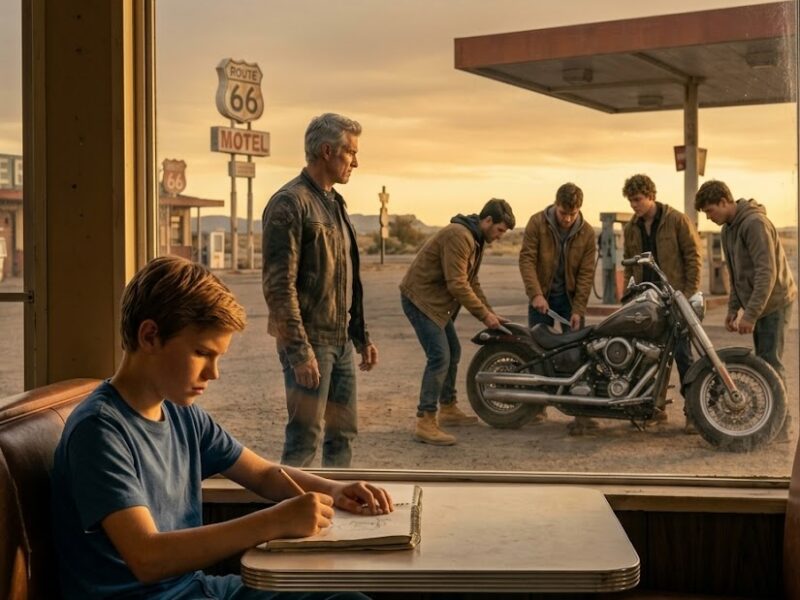
A Deaf Boy Saw Four Men Damage a Biker’s Tires—His Silent Warning Brought 310 Riders to Town
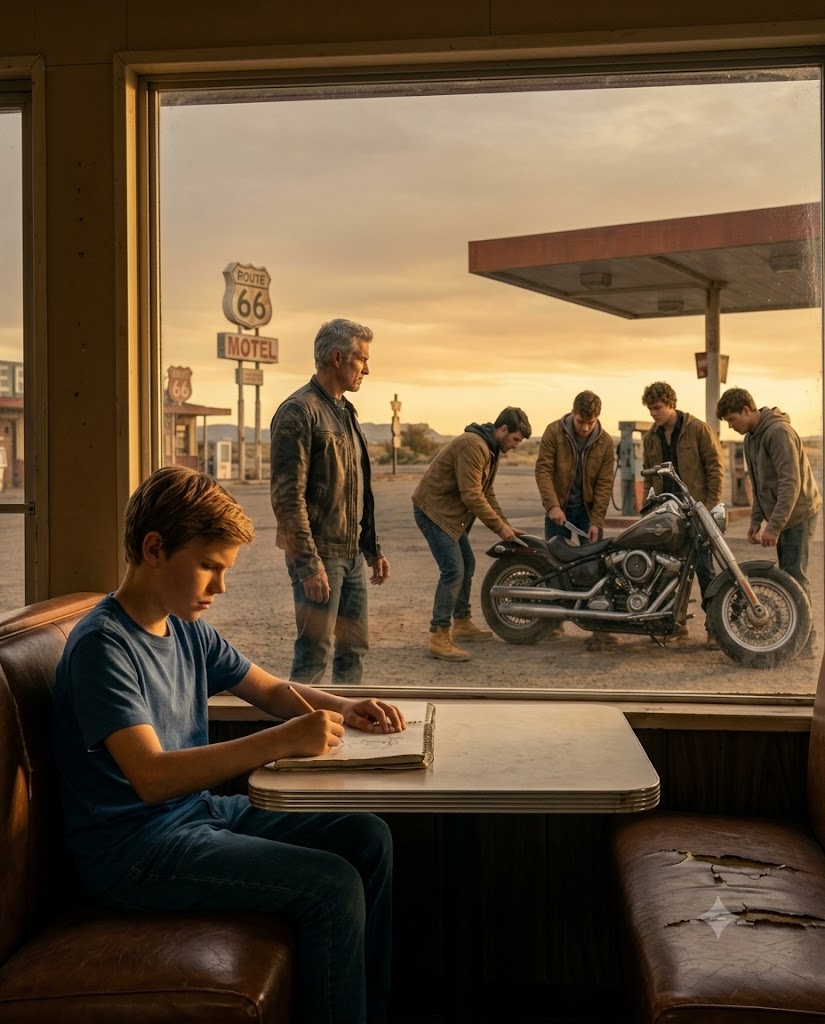
The Arizona sun had turned the asphalt of the Route 66 truck stop into something that stuck to boot soles like tar.
Garrett “Reaper” Cole stood six-foot-five in his riding boots, his leather cut dark with sweat, the Nomad rocker on his back catching the light as he stepped away from his Road King.
He’d been riding since dawn, crossing from New Mexico into Arizona’s high desert, and his throat was dust.
The truck stop squatted low and flat against the scrubland—gas pumps, a convenience store, and a diner with a blinking open sign.
Garrett pulled off his sunglasses and scanned the lot.
A dozen semis, a few cars, nothing unusual.
He headed for the diner, his boots crunching gravel.
—
Inside, the AC hit him like a blessing.
The place was half empty—a trucker at the counter, a family in a booth, and in the far corner, a kid sitting alone with a sketchbook.
Maybe twelve years old, skinny, wearing a faded Captain America shirt.
The boy didn’t look up when the door chimed.
Garrett slid into a counter stool and ordered black coffee and a burger.
The waitress, name tag reading Sandy, had the weathered look of someone who’d worked this shift for twenty years.
“Passing through?” she asked.
“Always.” Garrett’s voice was gravel and smoke.
Sandy glanced toward the corner booth, then back to Garrett.
She lowered her voice.
“That kid’s been here four hours. Ordered one Coke, won’t talk to anybody.”
Garrett looked over.
The boy was drawing, his hand moving in quick, precise strokes.
His face was locked in concentration, completely absorbed.
“Parents?”
“Haven’t seen any.” Sandy shook her head. “I asked if he was okay. He just nodded and kept drawing.”
Garrett filed it away—not his problem yet.
He ate his burger and drank his coffee, watching the highway through the window.
Heat shimmer made the distant mountains ripple like water.
Twenty minutes later, he pushed back from the counter and walked out into the furnace.
—
That’s when he saw them.
Four men clustered around his motorcycle.
Early twenties, drunk or high, maybe both.
Three wore the same bar t-shirt from a dive thirty miles back.
The fourth, bigger in a stained tank top, held a knife.
Garrett stopped ten feet away.
“Step back from the bike.”
The big one grinned. “Or what, old man?”
“Or you’re going to regret it.”
They laughed.
The big one crouched and jabbed the knife into Garrett’s front tire.
The hiss of escaping air cut through the afternoon.
Then he moved to the back tire and slashed it, too.
Garrett felt the heat in his blood, the old rage that had put him in county lockup twice before he learned control.
He counted to five, flexed his fists, watched.
“That’s what you get for parking in our spot,” the big one said.
“Your spot?” Garrett’s voice was flat.
“That’s right.”
The four spread out, circling.
The big one flipped the knife, showing off.
Garrett assessed angles and distances.
Four on one, all younger, all stupid.
He could drop two before they knew what hit them, but the knife complicated things.
And if he ended up in lockup out here, the brothers wouldn’t reach him for days.
He was calculating his first move when something small and fast darted between them.
—
The kid from the diner.
The boy ran straight to Garrett’s bike and stood in front of it, arms spread wide, placing himself between Garrett and the four men.
His face was fierce, protective.
He pointed at the slashed tires, then at the men, shaking his head violently.
The big one laughed. “Get lost, kid.”
The boy didn’t move.
He pointed at his ear, then his mouth, and shook his head again.
“What’s wrong with you? You stupid or something?”
The boy pulled out his sketchbook and scribbled something, then held it up.
Block letters: “Leave HIM alone.”
Garrett understood then—the kid was deaf.
That’s why he hadn’t responded to the door chime, why Sandy said he wouldn’t talk.
“Cute.” The big one stepped toward the boy. “Now move before you get hurt.”
The boy stood his ground.
Something shifted in Garrett’s chest.
He moved forward, putting himself between the kid and the knife.
“You want to finish this? Finish it with me. Leave the kid out of it.”
The big one looked between them, then at his friends.
The moment stretched, then sirens wailed in the distance.
Someone must have called 911 from inside the diner.
The four men scattered, piling into a pickup and spraying gravel as they peeled out.
Garrett watched them go, memorizing the license plate.
Then he looked down at the boy, who was staring up at him with enormous dark eyes.
“You got a death wish, kid?”
The boy didn’t hear him, just pointed to the tires, then made a writing gesture.
Garrett nodded and pulled out his phone.
The boy grabbed it and typed: “I saw them. I can draw them. Their faces, their truck, everything. I remember.”
Garrett read it twice.
“You can draw them.”
The boy nodded and opened his sketchbook.
On the page were four faces rendered in perfect detail—the big one with his knife, the others with their bar shirts and sneers.
The truck’s license plate, even the bar’s logo.
“How old are you?”
The boy typed: “12. My name is Danny.”
“Where are your parents, Danny?”
The typing stopped.
The boy’s face went blank, then he typed: “Don’t have any. I ran away from the group home in Flagstaff. They were going to split me and my sister up.”
Garrett felt the ground shift.
A deaf kid, alone, protecting a stranger because it was right.
“How long you been running?”
“4 days.”
Garrett looked at the slashed tires, then at Sandy watching through the diner window, then at the boy with his sketchbook full of evidence.
He made a decision.
“Danny, I’m going to make a phone call. You’re going to stay right here with me. Understand?”
The boy nodded.
—
Garrett scrolled to a name—Smoke, chapter president in Phoenix.
The call connected.
“Reaper, what’s up?”
“I’m at the Route 66 stop outside Winslow. I’ve got slashed tires, four punks who did it, and a deaf kid who witnessed the whole thing. Kid’s a runaway, smart as hell, alone.”
Silence.
Then: “What do you need?”
“New tires, a place for the kid tonight, and I want those four men found.”
“Consider it done. I’ll have brothers there in two hours.”
Garrett hung up and looked at Danny, who was watching him with cautious hope.
He typed into his phone and showed the boy: “You protected my bike. Now I protect you. Fair?”
Danny read it, and for the first time, he smiled.
—
Two hours later, the lot filled with Harleys.
Sixteen brothers from the Phoenix chapter rolled in, led by Smoke—a man as wide as a refrigerator with a gray beard down to his chest.
They brought new tires, tools, and sandwiches.
Danny watched from the diner booth as they worked, his eyes huge.
Garrett sat across from him.
Between them, Danny’s sketchbook lay open.
The drawings were extraordinary—photorealistic faces, every detail sharp.
The kid had a gift.
Smoke slid into the booth beside Garrett.
“Kid drew these?”
“Everyone. He’s good.”
Smoke studied Danny, who was watching their lips carefully.
“You know sign language?”
“No.”
“I do a little. My daughter’s deaf.”
Smoke turned to Danny and signed something.
The boy’s face lit up.
He signed back rapidly, his hands flying.
“What’d he say?” Garrett asked.
“He said nobody signed to him in four days. He’s been reading lips and writing notes.”
Smoke signed again and Danny responded.
“He says his sister Emma is eight. She’s hearing. They were in different group homes after their parents died—car accident, eighteen months ago. The state was going to move Emma out of state. Danny ran so he could find her before she left.”
Garrett felt the old rage again, the kind that had nothing to do with fists.
A system that would split up a kid and his sister.
“Where is she now?”
Smoke signed the question.
Danny pulled out a crumpled piece of paper—a letter from a social worker.
“Emma Mitchell, placed with a foster family in Prescott, pending permanent placement in California. Transfer date, six days from now.”
“He’s got less than a week to find her,” Garrett said. “And then what? He’s twelve, deaf, on the run.”
Smoke shook his head. “Reaper, I get it, but this isn’t like helping a vet or standing up to a crooked sheriff. This is the foster system. We can’t just roll in and take a kid.”
“We can make them listen.”
“How?”
Garrett looked at Danny, who was watching them both, trying to read their expressions.
“You said your daughter’s deaf. You know lawyers who work with deaf kids?”
“Yeah, disability advocates, but—”
“Call them tonight. I want to know what Danny’s rights are, what he can petition for, what he needs to stay with his sister.”
Smoke was quiet for a long moment, then he nodded.
“All right, I’ll make the calls.”
—
Outside, the brothers had finished replacing the tires.
One of them, a younger guy named Axel, came inside.
“Bikes ready, and I got an address on those punks. Bartender at the dive bar in Holbrook recognized the logo. They’re regulars.”
Garrett stood. “How far?”
“Thirty miles.”
“Let’s go.”
Danny grabbed Garrett’s arm and typed on the phone: “Take me with you.”
“No, too dangerous.”
“I’m the witness. I need to identify them for the police.”
Garrett read it twice.
The kid was right.
“You stay on the bike with me. You don’t get off. Understand?”
Danny nodded.
—
They rode in formation—seventeen bikes.
Garrett in the lead with Danny holding on tight behind him.
The kid’s thin arms wrapped around Garrett’s waist, trusting completely.
Through the mirrors, Garrett watched Danny’s face—eyes wide, wind whipping his hair, a grin splitting his face.
The kid had probably never ridden a motorcycle before.
Now he was riding with a brotherhood.
They found the bar as the sun set.
The pickup was in the lot, same plates.
Garrett parked and turned to Danny, signing for him to stay put, but Danny pulled out his phone and typed: “I’m coming. I want them to see me.”
Smoke read over Garrett’s shoulder and signed something to Danny.
The boy signed back, firm and resolute.
“What’d he say?” Garrett asked.
“He said they need to know he’s not afraid anymore, that he’s got people now.”
Garrett looked at the boy—twelve years old, deaf, alone in the world, and braver than most men.
“All right, but you stay between me and Smoke. Always.”
—
They walked into the bar, a wall of leather and iron.
The place went quiet.
At a corner table, the four men from the truck stop looked up.
The big one’s face went pale.
Garrett walked straight to the table.
Danny followed, flanked by Smoke and Axel.
The boy pulled out his sketchbook and held up the drawing of the big one with the knife.
Then he pointed at the man’s face.
The big one started to stand.
Smoke put a hand on his shoulder and pushed him back down.
“Sit.”
“We didn’t do nothing.”
“You slashed my brother’s tires,” Garrett said, “in front of a witness. A kid.”
“That kid’s a freak. He can’t even—”
Garrett’s fist slammed into the table so hard the bottles jumped.
“Finish that sentence. Please.”
Silence.
“You’re going to pay for the tires. Five hundred dollars tonight, cash.”
“And if we don’t?”
Garrett leaned down, his face inches from the big one’s.
“Then we call the sheriff and we press charges, and this kid testifies with his drawings, which are better than any photo. Or you pay and we leave and you never come near him again.”
The big one looked at his friends, at the seventeen bikers filling the bar, at Danny standing calm and unafraid.
“Fine. Five hundred.”
They pooled their money.
Garrett counted it and handed it to Smoke.
“For the kid. Food, clothes, whatever he needs.”
—
Outside, Danny typed: “Why did you do that?”
“Because you stood up for me. Now I stand up for you.”
“Nobody’s ever done that before.”
Garrett crouched down to the boy’s level.
“Listen to me. You’re not alone anymore. We’re going to find your sister. We’re going to make sure you stay together. That’s a promise.”
“How?”
“You’ll see.”
—
That night, Smoke made calls.
By midnight, a lawyer had agreed to take Danny’s case pro bono.
By morning, they had a court date for a hearing on sibling placement rights.
But the hearing was in Prescott, where Emma was.
And that meant a ride.
Garrett looked at his phone, at the group chat, and he typed: “Brothers, we’ve got a kid who needs his sister back. Who’s willing to ride to Prescott and make some noise?”
The responses came like thunder.
—
The Yavapai County Courthouse in Prescott had never seen anything like it.
They arrived at dawn—310 motorcycles rolling into the parking lot in perfect formation.
Riders from Arizona, New Mexico, Nevada, and Utah.
Nomads like Garrett, chapter members, independents who rode with the brotherhood.
Men and women, young and old, all wearing their colors.
Danny sat behind Garrett on the lead bike, his hands gripping tight, his face a mixture of terror and wonder.
They’d ridden through the night, stopping only for gas.
The boy had slept in a motel with Smoke and his wife, eaten a hot breakfast, and put on new clothes the brothers had bought him.
He looked less like a runaway now, more like someone protected.
The engines cut.
The silence was immense.
—
Garrett dismounted and helped Danny down.
The courthouse opened, and people streamed out—clerks, lawyers, civilians—all staring at the sea of leather and chrome.
A bailiff approached.
“You can’t park here.”
“We’re here for a hearing,” Smoke said. “Danny Mitchell, 9:00 a.m., family court.”
The bailiff looked at Danny, then at the three hundred bikers standing in formation behind him.
“All of you?”
“Everyone.”
—
Inside, the courtroom was small, designed for maybe forty people.
The gallery filled instantly with as many brothers as could fit.
The rest lined the hallway, the lobby, the steps outside—visible, present.
And they were there because a deaf boy had seen four men slashing a biker’s tires and done what no one else would do.
He’d stood between them and wrong.
Danny sat at the plaintiff’s table with his lawyer, a woman named Rachel Morneau, who specialized in disability rights.
Across the aisle, a social worker shuffled papers nervously, glancing at the packed gallery.
The judge entered—a woman in her sixties with steel-gray hair and sharp eyes.
She looked at the packed gallery, at the leather cuts and bearded faces, and raised an eyebrow.
“Ms. Morneau, I assume these gentlemen are with you.”
“They are, Your Honor. They’re here because of what my client did for one of them.”
The judge studied Danny.
“This is a petition for sibling placement rights filed by Daniel Mitchell, age twelve, requesting to remain with his sister Emma Mitchell, age eight, currently in foster care. Mr. Mitchell is deaf and has been in state custody for eighteen months following the death of his parents.”
“Yes, Your Honor. And I’d like Mr. Garrett Cole to testify on my client’s behalf.”
—
Garrett stood and approached the witness stand.
The bailiff swore him in.
Rachel began: “Mr. Cole, how did you meet Daniel Mitchell?”
“Four days ago at a truck stop outside Winslow. I was inside the diner when four men slashed my motorcycle tires in the parking lot.”
“And what did Daniel do?”
Garrett looked at Danny.
“He stepped between them and me. He couldn’t hear them threaten him, couldn’t hear the knife open, but he stood there anyway and told them to stop. A twelve-year-old deaf kid protecting a stranger’s property from four grown men with a weapon.”
The courtroom was silent.
“Why do you think he did that?” Rachel asked.
“Because it was right. Because he saw something wrong and couldn’t walk past it. Most adults wouldn’t have done what he did. He didn’t know me, didn’t know if I’d help him or hurt him, but he stood up anyway.”
Rachel nodded. “And what did you do?”
“I asked my brothers for help. Word spread through the clubs—Arizona, New Mexico, Nevada, Utah. When bikers heard what this kid had done, how he’d been split from his sister, how he’d run away to find her before the state sent her to California, they wanted to help. That’s why 310 of us rode here. Because Danny stood up first.”
The judge leaned forward.
“Let me understand this. Three hundred people rode to my courthouse because of this boy’s actions at a truck stop.”
“Yes, Your Honor. In our world, you protect the people who protect you. Danny protected me when he had every reason to run. He was homeless, scared, alone—but he stayed. Now we stay for him.”
—
Rachel addressed the court.
“Your Honor, the state separated these children without considering alternatives. My client walked away from his group home not because he was troubled, but because he’s loyal. The system failed him. These men answered when the system wouldn’t.”
The social worker stood.
“Your Honor, with respect, the state made its determination based on approved protocols.”
“Protocols that split up siblings,” Rachel interrupted. “Tell me—has Danny ever been violent? Failed school? Broken laws?”
“No, but—”
“Has he shown any inability to care for himself or communicate his needs?”
The social worker hesitated. “He has challenges due to his disability.”
“Being deaf isn’t a disability that prevents family bonds,” Rachel said. “The only challenge my client faces is a system that treated him like a case file instead of a child.”
The judge made a note.
“Where is Emma Mitchell now?”
“With her foster family, outside.”
“Bring her in. And I want to see the four men who slashed Mr. Cole’s tires.”
The bailiff looked startled. “Your Honor—”
“You heard me. Ms. Morneau, do we have their names?”
Rachel nodded. “The Holbrook police arrested them two days ago after Mr. Cole and his brothers identified them. They posted bail yesterday.”
“Get them here now.”
—
Twenty minutes later, Emma entered the courtroom.
She saw Danny and screamed his name.
Danny ran to her and they collided in the aisle, holding each other and crying.
Emma was signing frantically and Danny signed back, his face wet with tears.
The judge watched them for a long moment.
Then the four men from the truck stop were escorted in by a deputy.
They looked smaller now, surrounded by bikers.
The big one who’d held the knife wouldn’t make eye contact.
The judge studied them.
“You’re the four charged with criminal damage.”
The big one mumbled, “Yes, ma’am.”
“Look at that boy.”
The judge pointed at Danny, still holding his sister.
“He’s twelve, deaf, alone. And when he saw you breaking the law, he stood between you and your victim. Did any of you think about what you were teaching him? That might makes right? That cruelty wins?”
Silence.
“He taught you something instead.”
The judge continued.
“He taught you that courage doesn’t require size or hearing or power—just heart. And now three hundred people rode through the night because he showed them what honor looks like.”
She turned to Danny.
“Young man, approach the bench.”
Danny walked forward, Emma holding his hand.
Garrett moved beside them and Smoke translated in sign.
The judge spoke slowly, looking at Danny.
“You ran away to save your sister. You protected a stranger. You brought three hundred people to this courthouse just by being brave. I’m ordering your case reassessed immediately. You and Emma will be placed together, today. And if the state objects, they’ll answer to me.”
She banged her gavel.
—
The courtroom exploded.
Three hundred bikers rose as one, their applause like thunder.
Danny and Emma clung to each other.
The four men from the truck stop stared at the floor, seeing exactly what they’d created—a boy who turned their cruelty into justice.
Outside, Garrett knelt beside Danny.
The boy signed something.
Smoke translated: “He says because of them, he found you.”
Garrett looked at the four men being led away in cuffs, then at the three hundred bikers who’d ridden because one deaf kid refused to walk past wrong.
“Sometimes the worst people bring out the best in everyone else,” Garrett said.
—
Six months later, Garrett rode through Prescott.
He stopped at a small house with a fenced yard.
Danny and Emma were in the front playing with a dog.
The foster mother—now their adoptive mother—waved from the porch.
Danny saw the motorcycle and sprinted over, grinning.
He’d grown taller, filled out.
His eyes were bright.
He typed: “They made it official yesterday. We’re a family.”
“Because of what you did,” Garrett said. “You stood up for a stranger. That brought three hundred angels.”
“No,” Danny typed. “They were already angels. I just showed them where to fly.”
Garrett felt something warm in his chest.
The kid was right.
The brotherhood had always been there.
They just needed someone to prove they mattered.
Danny signed something.
Garrett had been learning.
He signed back, clumsy but sincere: “Brother.”
Danny nodded, signed it again: “Brother.”
—
Garrett mounted his bike.
As he rode away, he thought about four men slashing tires in a parking lot.
How their cruelty had sparked something they never intended.
A boy’s courage.
A brotherhood’s answer.
A family made whole.
Sometimes the darkness just shows you where to aim the light.
And when you do, three hundred engines roar to life.
—
The sun was setting over the Bradshaw Mountains as Garrett pointed his Road King west toward California.
He had a run to make, a delivery in Barstow, but his mind kept drifting back to the courthouse steps.
Three hundred bikes.
Three hundred brothers and sisters who’d dropped everything for a kid they’d never met.
That was the thing about the club life nobody understood.
It wasn’t about the leather or the patches or the noise.
It was about showing up when it mattered.
Danny had shown up for him at that truck stop.
Didn’t matter that he couldn’t hear the threats or the insults.
Didn’t matter that he was outnumbered and alone.
He saw wrong and he stood in front of it.
That was the whole code, really.
Stand in front of wrong.
—
Garrett pulled into a gas station outside Kingman and filled his tank.
An older couple in a minivan stared at him from the next pump.
He nodded politely and they looked away quickly.
He was used to that.
The cuts, the beard, the size—people saw what they wanted to see.
They didn’t see the phone in his pocket with Danny’s number saved under “Little Brother.”
They didn’t see the photo on his lock screen of a twelve-year-old boy holding up a sketchbook with a drawing of a motorcycle.
They didn’t see the text messages Danny sent him every few days.
Updates about school.
Pictures of Emma.
Questions about motorcycles.
Garrett always answered.
Every single one.
—
The kid had changed something in him.
Not in a soft way—Garrett was still who he was, still rough around the edges, still prone to solving problems with his fists when words failed.
But Danny had reminded him why the brotherhood mattered.
Why the patches meant something.
Why you never rode past someone who needed help.
He thought about the four men from the truck stop.
They’d gotten probation, community service, a fine.
The big one had lost his job at the warehouse.
The others had scattered—one moved to Texas, one joined the Army, one just disappeared.
Garrett didn’t feel sorry for them.
But he didn’t hate them either.
They’d been the spark, whether they knew it or not.
Their cruelty had lit a fire that warmed a whole lot of people.
Sometimes that was how it worked.
The worst of humanity accidentally creating the best.
—
He finished filling the tank and went inside to pay.
The clerk, a young guy with acne and a nervous twitch, looked at his cut and swallowed hard.
“That’ll be forty-two dollars.”
Garrett handed him a fifty.
“Keep the change.”
The clerk blinked. “Thanks, man.”
Garrett nodded and walked out.
He didn’t need thanks.
He never did.
He just needed to keep riding, keep showing up, keep standing in front of wrong wherever he found it.
That was the promise he’d made to Danny.
Not in words—Danny couldn’t hear words.
But in actions.
In showing up.
In staying.
—
He mounted his bike and pulled back onto I-40.
The desert stretched out around him, all red rock and sagebrush and endless sky.
His phone buzzed in his pocket.
He pulled over at the next rest stop and checked it.
A text from Danny: “Guess what? I made the honor roll.”
Garrett smiled.
He typed back: “Proud of you, Little Brother.”
Danny responded immediately: “Emma too. She got a perfect attendance award.”
Garrett typed: “Even prouder.”
Danny sent a photo—him and Emma holding up their certificates, grinning at the camera.
Behind them, the small house with the fenced yard.
The dog, a scruffy mutt they’d named Captain America.
The adoptive mother, a kind-faced woman named Linda who’d fostered six kids over the years and adopted two.
Danny had found his family.
Not the one he was born into, but the one that chose him.
The one that fought for him.
The one that rode three hundred strong to make sure he stayed with his sister.
—
Garrett saved the photo to his phone.
He had a whole album now—Danny’s drawings, photos of Emma, pictures from the adoption ceremony.
The brothers had shown up for that too.
Not three hundred this time—just fifteen, the ones who lived closest.
But they’d filled the small courtroom, and when the judge declared Danny and Emma officially adopted, they’d stood and applauded like it was the Super Bowl.
Danny had cried.
Garrett had too, though he’d never admit it.
—
He got back on the road.
The miles rolled by.
He thought about the truck stop outside Winslow, how different his life would be if he’d just ridden past.
If he hadn’t stopped for coffee.
If Danny hadn’t been in that corner booth.
If the four men hadn’t been in that parking lot.
So many moments had to line up just right.
So many choices had to be made.
And somehow, they all had been.
—
He reached Barstow just after midnight.
The delivery was quick—a package for a brother who ran a garage.
Garrett handed it over, accepted a cup of coffee, and sat for a while in the office, listening to the old man talk about the good old days.
When he finally left, the sky was starting to lighten.
He had a long ride back to Phoenix.
But he wasn’t tired.
He never was when he was riding.
The road had a way of clearing his head, of reminding him what mattered.
—
He thought about Danny’s question from the courthouse steps.
Why did you do that?
Because you stood up for me.
It was that simple.
That was the whole code.
You stand up for people.
You protect them.
You show up.
And sometimes, that means riding three hundred strong to a courthouse in Prescott.
Sometimes it means sitting with a scared kid in a diner booth.
Sometimes it means learning sign language so you can talk to your little brother.
—
Garrett had started taking classes online.
American Sign Language.
He was terrible at it.
His hands were too big, too stiff, too used to gripping handlebars and throwing punches.
But he practiced.
Every night, in motel rooms and at chapter meetings and in the quiet moments between rides.
He wanted to be able to talk to Danny without a phone.
Wanted to see the kid’s face light up when Garrett signed something correctly.
Wanted to be the kind of brother who showed up in every way that mattered.
—
He pulled into a diner outside Needles as the sun came up.
Same kind of place as the one outside Winslow.
Same cracked vinyl booths, same blinking open sign, same weary waitress with a name tag that said “Darlene.”
He ordered coffee and eggs and sat by the window.
No sketchbooks in the corner.
No deaf kids reading lips.
No four men with knives.
Just an ordinary morning in an ordinary diner.
But Garrett knew better.
Every ordinary moment was a chance to do something extraordinary.
Every stranger was a potential brother.
Every wrong was an opportunity to stand in front of it.
—
He finished his breakfast and paid his bill.
Darlene smiled at him.
“Ride safe.”
“Always.”
He walked out into the morning sun.
His bike was waiting.
The road was calling.
And somewhere in Prescott, a twelve-year-old boy was waking up in a house with a fenced yard, his sister in the next room, his dog at the foot of his bed.
He was safe.
He was loved.
He was home.
And all because he’d stood in front of a stranger’s motorcycle and refused to move.
Garrett started his engine.
Three hundred miles to Phoenix.
Three hundred reasons to keep riding.
Three hundred angels, already flying.
He smiled and pulled onto the highway.
The sun was warm on his back.
The road stretched out ahead.
And somewhere, a boy was drawing.
—
Garrett made it back to Phoenix by noon.
The chapter clubhouse was quiet—most of the brothers were at work, earning honest money to fund the next ride.
He parked his bike and went inside.
Smoke was in the office, going over paperwork.
“You’re back early.”
“Delivery went smooth.”
Smoke nodded. “Danny called. Wanted to make sure you got home safe.”
“He called you?”
“He calls everyone. That kid’s got a phone tree going. Checks in on all of us.”
Garrett laughed. “He’s twelve. He shouldn’t be worrying about us.”
“He’s got a big heart. Reminds me of someone I know.”
Garrett sat down across from Smoke.
“You ever think about how different things could’ve been?”
“All the time. If you hadn’t stopped at that truck stop. If Danny hadn’t been there. If those punks hadn’t been so stupid.”
“But they were.”
“They were.”
Smoke leaned back in his chair.
“The lawyer called. Rachel. She wants to use Danny’s case as a model for other sibling placements. Wants to train advocates on how to handle deaf kids in the system.”
“That’s good.”
“It is. Danny’s already agreed to help. He wants to be a lawyer when he grows up.”
Garrett shook his head. “Of course he does.”
“He’s got the brains for it. And the heart.”
“He’s got more heart than anyone I know.”
—
Smoke reached into his desk and pulled out a folder.
“Speaking of Danny—I’ve been working on something. Wanted to run it by you.”
“What’s that?”
Smoke opened the folder.
Photos, documents, a proposal.
“The Danny Mitchell Fund. For deaf kids in the foster system. Legal aid, advocacy, family reunification. We’ve got donations from chapters across four states. Enough to hire a full-time coordinator.”
Garrett stared at the folder.
“You did all this?”
“I had help. Rachel, some of the other lawyers. The brothers pitched in. It’s not much yet, but it’s a start.”
“It’s a lot.”
Smoke shrugged. “The kid inspired people. What can I say?”
—
Garrett flipped through the pages.
Letters from bikers, from foster families, from deaf kids who’d heard Danny’s story.
One letter from a girl in Texas: “I saw my brother every day for a year before they split us up. I wish someone had ridden for us like that.”
One from a foster parent in Nevada: “We adopted two deaf siblings last month. Your story gave us the courage to fight.”
One from a lawyer in California: “I’ve used the Mitchell case in three hearings already. We’re winning.”
Garrett closed the folder.
“This is incredible.”
“It’s just the beginning.”
—
They sat in silence for a while.
Then Garrett’s phone buzzed.
A text from Danny: “Did Smoke show you the fund?”
Garrett typed: “Just saw it. I’m proud of you.”
Danny responded: “It was Smoke’s idea. I just said yes.”
Garrett typed: “You said yes. That’s everything.”
Danny sent back a photo—him and Emma at the kitchen table, working on homework.
Linda in the background, making dinner.
Captain America at their feet.
An ordinary evening in an ordinary house.
But Garrett knew better.
There was nothing ordinary about it.
—
He thought about the chain of events.
Four men with a knife.
A deaf boy with a sketchbook.
A biker with a choice.
Three hundred riders with a purpose.
A family made whole.
And a fund that would help countless others.
It all started with a single moment of courage.
A boy who refused to move.
A man who refused to walk past.
And a brotherhood that refused to let either of them stand alone.
—
That night, Garrett sat outside the clubhouse and watched the stars come out.
The desert sky was vast and dark and full of light.
He thought about his own life.
The wrong turns, the mistakes, the years he’d spent angry at the world.
He’d never expected to be here.
Never expected to care so much about a kid he’d met in a diner.
Never expected to learn sign language or sit in a courtroom or help start a fund for deaf kids in foster care.
But here he was.
And he wouldn’t trade it for anything.
—
His phone buzzed again.
Danny: “Did you practice your signs today?”
Garrett typed: “Yes. My hand still hurts.”
Danny: “You’re getting better. I can tell.”
Garrett: “How can you tell? You haven’t seen me sign.”
Danny: “I can tell because you’re trying. That’s all that matters.”
Garrett stared at the screen.
The kid was twelve.
Twelve years old, and he understood more about life than most adults Garrett knew.
Trying was all that mattered.
Showing up was all that mattered.
Standing in front of wrong was all that mattered.
—
He typed back: “I’m trying. Every day.”
Danny: “Me too.”
Garrett: “Goodnight, Little Brother.”
Danny: “Goodnight, Big Brother.”
—
Garrett put his phone away and looked up at the sky.
Somewhere out there, four men were living with the consequences of their choices.
Somewhere out there, a judge was thinking about a case that had changed her perspective.
Somewhere out there, a social worker was reconsidering the protocols that split up families.
Somewhere out there, a lawyer was using Danny’s story to fight for another kid.
Somewhere out there, a foster family was holding their new children a little tighter.
Somewhere out there, three hundred bikers were sleeping soundly, knowing they’d done something that mattered.
And somewhere out there, a boy was drawing.
—
The next morning, Garrett woke early.
He had a ride planned—a solo trip up to Flagstaff, then over to Winslow.
He wanted to see the truck stop again.
Wanted to stand in the parking lot where it all began.
Wanted to remember.
He packed light—a change of clothes, a toothbrush, his phone charger.
And the photo of Danny and Emma, tucked into his saddlebag.
He stopped at a coffee shop on his way out of town.
The barista, a young woman with purple hair and a nose ring, smiled at him.
“Nice bike.”
“Thanks.”
“You ride far?”
“Always.”
She laughed. “That’s what they all say.”
Garrett smiled. “It’s what we mean.”
—
He hit the road.
The desert unfolded around him—mesas and canyons and wide-open sky.
He thought about the first time he’d ridden this route.
He’d been younger, angrier, running from something he couldn’t name.
Now he was running toward something.
A promise.
A purpose.
A brotherhood that meant more than he’d ever imagined.
—
He reached Winslow by early afternoon.
The truck stop was still there.
Same gas pumps, same convenience store, same diner with the blinking open sign.
He parked his bike in the same spot.
Stood in the same place where four men had slashed his tires.
Where a deaf boy had stood between him and danger.
Where everything had changed.
—
He walked into the diner.
Sandy was still there—same weathered face, same tired smile.
She looked up when the door chimed.
“Reaper.”
“Sandy.”
She poured him a cup of coffee without asking.
“Been a while.”
“Six months.”
“I heard about the courthouse. Three hundred bikes.”
“Three hundred and ten.”
She shook her head. “I’ve been here twenty years. Never seen anything like it.”
“Neither had I.”
—
He sat at the counter and drank his coffee.
The diner was quiet—a trucker in the corner, a family in a booth, a kid with a sketchbook.
Wait.
Garrett looked again.
The kid was maybe ten, dark hair, headphones on.
Not Danny.
But close enough to make his heart ache.
He finished his coffee and walked over to the booth.
“Hey, kid.”
The boy looked up, startled.
Garrett pulled out a twenty and set it on the table.
“For whatever you’re drawing. Keep at it.”
The boy stared at him. “Thanks, mister.”
Garrett nodded and walked out.
—
He stood in the parking lot and looked at the sky.
Danny had been here.
Right here.
Scared, alone, hungry.
But he’d stayed.
He’d stood in front of wrong.
And it had changed everything.
Garrett got back on his bike.
He had a long ride home.
But he wasn’t in a hurry.
The road stretched out ahead, endless and open.
And somewhere, a boy was drawing.
—
**THE END**
—
*Author’s Note: This story is dedicated to every child in the foster care system who has ever fought to stay with their siblings. You are braver than you know.*









