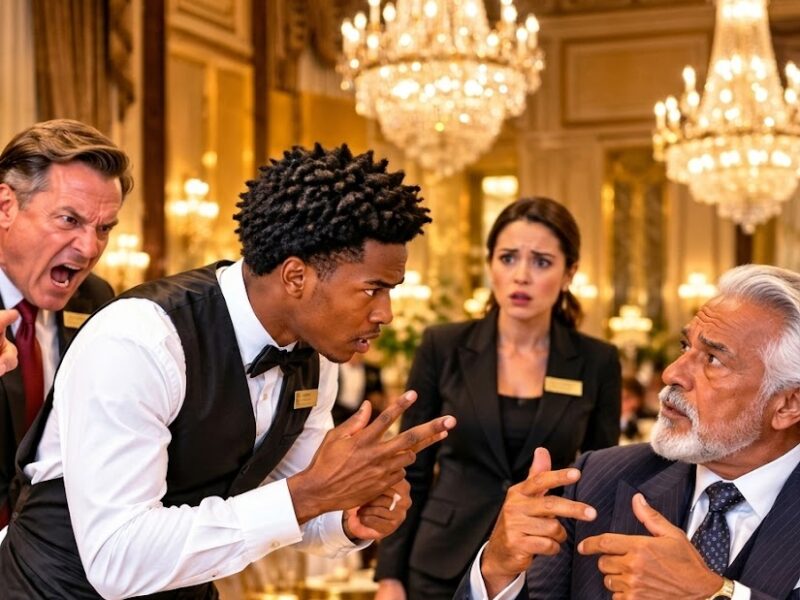
A Deaf Billionaire Trusted His Interpreter for 14 Months—Until a Black Busboy Read One Sign She Deliberately Hid
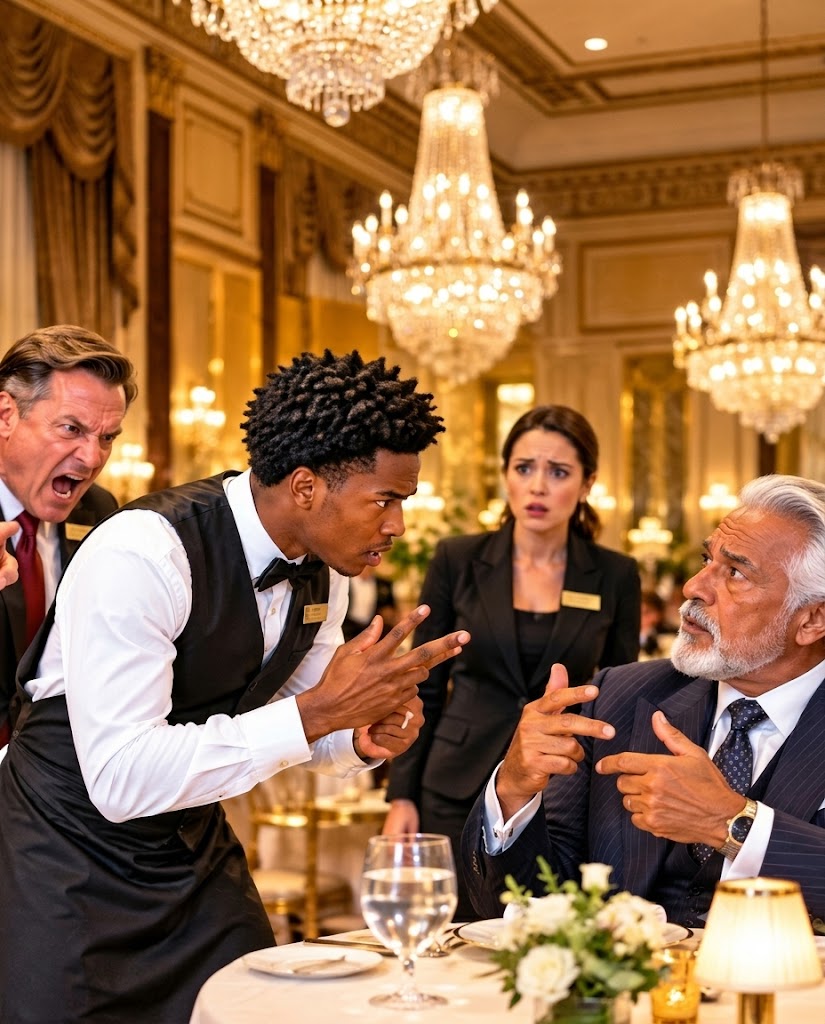
The napkin sat folded on table nine like a white flag nobody had thought to wave.
Inside it, a wedding ring waited for a billionaire who couldn’t hear the room around him.
Elijah Brooks had exactly two minutes before service began, and in those two minutes, his phone buzzed with the call he’d been dreading all week.
It was his sister, Kiara, and her voice cracked on the first word.
The Retina Center had called back.
They needed $3,800 by Friday, or their mother’s surgery slot would go to the next person on the list.
The next opening wasn’t until February.
Elijah told her he’d find the money.
He asked her to tell their mother he’d be home late.
Kiara said their mother already knew — she was reading his text at that very moment, holding it up to her magnifier.
There was no time to think about it.
Clay Mercer, the manager, was already gathering everyone together near the kitchen line.
“Table nine,” he announced, “belongs to Harrison Wells of Wells Hospitality.”
The man was a billionaire, and he was buying this hotel — maybe, if tonight went right.
Mr. Wells had given his interpreter the night off.
“He’s deaf,” Clay explained, “so nobody should bother him.”
“Food down, plates up, and smile.”
Then Clay’s eyes landed on Elijah’s shoes.
He demanded to know what that was.
Elijah told him it was tape, and that it was black.
Clay said nobody looked at a busboy’s feet, and Elijah should keep it that way.
His instructions were simple.
Bust the tables, clear the plates, and keep his mouth shut.
Under no circumstances was he to talk to Mr. Wells.
Elijah said, “Yes, sir.”
Then, under his breath, he repeated the manager’s words to himself.
“Nobody looks.”
Sure.
Later that evening, at table nine, a waiter named Kyle asked Mr. Wells whether everything was all right.
Mr. Wells tried to answer him out loud, struggling to form a word.
It sounded like napkin, but Kyle couldn’t make it out.
He apologized and said he didn’t understand.
Clay came over to ask what the problem was.
Kyle said Mr. Wells wanted something, but he couldn’t tell what.
Clay reminded him that the man couldn’t hear a word.
Then he added that Mr. Wells sounded like he’d had a few drinks, too.
His advice was to smile, nod, and comp the wine.
But Elijah was watching Mr. Wells’s hands, and he understood every word.
Something had been in the napkin Mr. Wells was signing.
His wife’s ring.
The waiter had taken it away with the plates.
Elijah signed back that he would find it.
Clay called his name sharply.
Elijah told him there was a ring in the napkin from table nine.
Clay ignored that and told him table 12 needed clearing.
Elijah said he would do it right after, and he went to search for the ring.
He found it in the dirty linen and brought it back to Mr. Wells.
Mr. Wells looked at the young man in front of him and asked whether he signed.
Elijah told him he had signed since before he could talk.
Mr. Wells told him to sit down.
When Clay objected, Mr. Wells instructed Elijah to tell the manager that he was his guest.
Elijah turned to Clay and passed it along.
Mr. Wells said he was his guest.
So Elijah sat, and Mr. Wells began to talk about his wife.
Her name was Eleanor.
She could hear, and for 38 years, she had been his voice.
In private, she used to fight with him about what he made her say out loud.
Every anniversary, they had eaten dinner together at this very table.
This was the first anniversary without her.
Elijah noticed that there was no interpreter at the table tonight.
Mr. Wells explained that he had given Gordon the night off.
He hadn’t wanted anyone translating this dinner.
Then, Mr. Wells told him something else.
The Eleanor Wells Foundation paid for a program at this hotel called Clear Signs.
It employed 12 deaf workers.
That program, he said, was the reason he was buying the building.
He asked Elijah whether he had met them.
Elijah told him the truth.
He worked six nights a week in this hotel, and until tonight, he had never seen anybody sign inside this building.
He had applied twice to interpret for that program.
Both times, he had been told it was full.
Just then, Gordon Pierce, Mr. Wells’s interpreter, arrived at the table.
He explained that the sellers had let him go early, and he apologized for not coming straight there.
Mr. Wells told him that Elijah had him tonight.
Gordon answered, “Of course.”
Soon after, Clay pulled Elijah aside with news.
Mr. Wells wanted Elijah walking with him for the rest of the week, through the tours and the meetings, using his hands.
Clay told him not to ask why.
Mr. Wells already had Mr. Pierce, and Elijah would still be working his regular night shifts.
Elijah asked what the rate would be.
Clay said they would sort that out after the sale.
Elijah asked whether he could get the hours and the rate in writing.
Clay snorted and asked whether he really wanted a contract for walking.
“For interpreting,” Elijah corrected him.
Clay simply told him good night.
Out of Elijah’s sight, Clay and Gordon had a conversation of their own.
Clay remarked that the busboy signed as if it were his first language.
Gordon said it was.
Mr. Wells had told him so.
Gordon understood exactly what that meant.
Every room he was in, Elijah would hear both halves of the conversation — what Mr. Wells signed and what Gordon said out loud.
And Mr. Wells had already asked about the 12 right after the busboy sat down at his table.
Gordon told Clay to keep Elijah busy and keep him tired.
Elijah got home late that night.
His mother, Bernice, told him to sit where she could see him.
She asked whether they had paid him.
He told her not yet.
When he referred to Mr. Wells as a rich man, she corrected him.
“Billionaire, not rich man. Be exact.”
Elijah said, “Yes, ma’am.”
Then she asked whether Mr. Wells had looked at him when he signed.
Elijah told her he had, the whole time.
His mother said that meant he had been heard.
Now he needed to get paid.
And whatever she had put up, she told him, would stay up until it was gone.
The next day, Elijah walked the hotel with Mr. Wells.
During the tour, he interpreted as Mr. Wells asked one of the staff members how long she had worked there.
She told him 19 years.
Then Mr. Wells said he wanted to meet the 12 that very day.
Gordon answered that they were at a certification in Charleston through Thursday.
A company called Keystone ran the program, and he called them great people.
The message was relayed to Mr. Wells.
The 12 were in Charleston until Thursday, and they had asked for their thanks to be sent in Mrs. Wells’s memory.
Mr. Wells said he understood.
Not long after, Clay confronted Elijah.
Someone had found $3,800 in a guest envelope taped inside Elijah’s locker door.
Elijah said he had never seen that envelope before.
Clay insisted it had been in his locker.
Elijah said that in that case, he would ask whose envelope it was, and he turned to Mr. Wells.
Gordon voiced Mr. Wells’s answer.
The envelope was his.
He had left it at the front desk for Elijah along with a card.
Clay asked where the card was.
There had been no card, he said, just cash in a locker.
Mr. Wells made it clear that he had written that card at 10 minutes past 3:00 in front of Clay’s own clerk.
The money was for Elijah’s mother’s eyes, and it was not a loan.
Clay called it a desk mix-up.
Mr. Wells told him that in that case, he would handle the desk himself.
Then he told Clay to give Mr. Brooks his envelope.
Elijah thanked Mr. Wells and said he would pay it back.
Mr. Wells repeated that it had come with a card, not as a loan.
Then Elijah asked for one thing.
The next time Mr. Wells heard something about him through somebody else’s hands, he should look at Elijah and ask him directly.
Mr. Wells promised that he would look.
The schedule changed soon after.
Clay told Elijah he would take Mr. Wells’s lunch up to suite 1201 at noon, then go to the kitchen and clock out at 3:45.
Elijah pointed out that his shift ran until 5:00.
Clay told him, “Not today.”
Elijah said, “Yes, sir.”
Behind closed doors, Gordon laid out the rest for Clay.
Elijah would be in the suite at noon, and everyone would remember that.
Mr. Wells swam every day from 2:30 to 3:20, and the ring sat on a little dish next to Eleanor’s picture.
Gordon added that he didn’t need to know which door.
Clay replied bitterly that he never did.
At 3:45, Elijah was told to step back from his locker.
It was a locker check on the manager’s orders.
Clay said he had called it in himself.
The ring was found in Elijah’s apron.
Elijah turned to Mr. Wells and signed desperately, “Look at me. Look at me. I found it for you. Why would I take it?”
Gordon voiced him for the room.
He said Elijah was asking Mr. Wells not to call the police.
Elijah said out loud that this was not what he had said.
Gordon kept going.
He reminded Mr. Wells that Elijah had been in his suite at noon.
He was the only one there who knew what that ring meant to him.
He had already gotten the deposit, and the surgery cost 10 times that much.
Clay announced that, out of respect for Mr. Wells, there would be no police.
Then he demanded Elijah’s badge.
Mr. Wells turned his back.
And Reggie from security walked Elijah out of the building.
When Elijah got home in the middle of the day, his mother asked him why he wasn’t at work.
Then she told him not to talk.
She wanted him to sit down and sign it to her.
All of it.
When he was done, she told him she knew where those hands had been because she had made them.
The hotel had taken his job.
They did not get his back, too.
Kiara said they needed a lawyer.
Elijah asked her what they were supposed to pay one with.
Word traveled quickly.
Hattie, who ran the diner nearby, had heard the whole story from Bernice.
She told Elijah she wasn’t going to tell him she was sorry because sorry didn’t pay his light bill.
Elijah said, “No, ma’am.”
Then Hattie started counting on her fingers.
Miss Henderson’s grandbaby across the street was deaf.
So was the Dawson boy on the corner.
So was her cousin’s husband.
“Half this block,” she said, “had somebody deaf sitting at the dinner table, and nobody at that table could ask him to pass the salt. So who was teaching them?”
Her back room was empty after 7:00.
$10 a head.
The coffee was free.
The pie was not.
So Elijah started teaching.
In the back room of Hattie’s Diner, he stood in front of his neighbors and showed them the signs, one at a time.
Milk. Fire.
They laughed.
They made mistakes, and they tried again.
One Friday night, a woman walked into that back room carrying a folder.
Her name was Patricia Dale, and she worked in payroll at the hotel.
She had heard that the class met on Fridays.
She told Elijah what she had brought.
It was the Clear Signs payroll for the past 22 months, covering 12 deaf employees.
Every two weeks, she keyed in their hours.
And in all that time, she had never met a single one of them.
Not at the time clock, and not at the Christmas party.
Elijah looked through the papers and turned to his mother.
According to the records, she had been teaching at the Lennox for two years at $3,100 a month.
Bernice told him she had taught there exactly one Saturday two years ago for four hours.
She had been paid $200 and a sandwich.
Patricia explained that this was when they had gotten her W-9.
Every month since then, there had been an approval with Bernice’s name on it.
Elijah looked at the paper and said that was not his mother’s signature.
Patricia laid out how the money moved.
The foundation paid the hotel.
The hotel paid Keystone.
Elijah remembered that name.
Keystone had been on the poster, but he wanted to know why she was coming forward now when she’d had this for two years.
Patricia said she had typed those names for two years.
Then she had watched Reggie walk Elijah out of the building.
If she didn’t bring it forward, who was ever going to read it now?
Elijah took the papers to Mr. Wells.
Mr. Wells admitted that he had turned his back.
Elijah agreed that he had.
Mr. Wells explained that it was Gordon who had brought Keystone to the board.
Gordon had told him that Eleanor had chosen them before she died.
Elijah had one more thing to say.
In the locker room, Mr. Pierce had told everyone that Elijah was begging Mr. Wells not to call the police.
He had never said that.
Mr. Wells asked him what he had actually signed.
Elijah told him.
He had found the ring for him.
Why would he take it?
Then Mr. Wells understood what had been happening.
Gordon talked and Mr. Wells watched his hands.
Whatever came out of Gordon’s mouth, Mr. Wells never saw.
For 14 months, it had been that way in every meeting and at every bank.
Elijah had a plan.
If Gordon was going to talk, then let him talk where Elijah could hear him.
Mr. Wells should call the staff together before the closing and ask to thank the 12 employees and their instructor by name.
And he should let Gordon voice Elijah’s mother.
Mr. Wells warned that they would say she couldn’t come.
Elijah said to let Gordon say it in front of everybody.
Gordon could not know they were coming.
And his mother would say what she had to say with her own hands.
Mr. Wells agreed, but word was moving in the other direction, too.
Someone who lived two streets over from the diner reported to Gordon and Clay that on Friday night, Patricia Dale had walked into the back of Hattie’s with a folder this thick.
Elijah had some kind of sign class going back there.
Clay realized that Patricia had printed the entire program.
And on top of that, Mr. Wells wanted an all-staff meeting on Friday at 10:00.
He wanted to thank the 12 and the lead instructor by name.
Gordon was calm about it.
The 12 were in Charleston and Mrs. Brooks would send her regrets.
Patricia was just a clerk who wanted to keep her job, so they should leave her alone.
Paper needed a voice to matter.
So, they would take the voice.
Clay agreed.
Then he picked up the phone and called the police.
He said he wanted to report a theft from a guest suite, a wedding ring.
The name, he said, was Elijah Brooks.
Elijah was in the middle of teaching his class, walking his neighbors through the sign for where does it hurt, and asking them to go slower and try again, when a man appeared at the door.
He introduced himself as Detective Frank Callahan of the Charlotte Police Department.
He had a few questions and he said they could talk outside.
The detective explained that Elijah’s former manager had filed a complaint.
A guest’s ring had been found in Elijah’s apron.
Elijah told him he had not taken that ring.
He had found it Monday night in the dirty linen and given it back to its owner.
The detective asked how it had ended up in his apron on Wednesday then.
Elijah told him to ask who had the master key to suite 1201.
It was Mr. Mercer.
The key was MGR01 and it hung on his lanyard.
Detective Callahan said he wasn’t charging anybody that night.
He would pull the door log himself.
The next morning, he would be at the hotel to see Mr. Mercer.
In the meantime, he told Elijah not to leave town.
Elijah told him that was fine.
He had class on Tuesday.
On Friday at 10:00, the staff of the hotel gathered for the meeting.
The announcement was made that Mr. Wells wished to thank the 12 Clear Signs employees and Mrs. Bernice Brooks, and he would like them to stand.
Unfortunately, the Clear Signs team was in Charleston that week, and Mrs. Brooks sent her regrets.
Then Bernice Brooks walked into the room.
Gordon recovered quickly.
He greeted her as their lead instructor and called it a wonderful surprise.
He welcomed her and said he would voice for her.
Bernice began to sign.
Gordon spoke to the room.
He said Mrs. Brooks wanted everyone to know it had been an honor to teach there.
And he said she apologized for her son.
Then Elijah spoke, and he gave the room her real words.
“I taught here one Saturday two years ago. Four hours. $200. I have never met a deaf employee in this building. That is not my signature.”
Elijah pointed out what had just happened.
Gordon had told everyone that she was honored.
He had told them she was apologizing for Elijah.
Gordon tried to explain it away.
He said Mrs. Brooks was confused, that it was her eyes, and that he should be allowed to handle it.
But Mr. Wells had been watching her hands himself.
“That is not what she said.”
Patricia stepped forward.
She told the room about the Clear Signs payroll.
22 months and 12 names she had never seen.
Every check had gone to Keystone, and everyone had been approved by Mr. Pierce.
Then Detective Callahan stepped in and turned to Clay.
He said he had come for him.
Clay’s statement claimed that Elijah Brooks had taken the ring from suite 1201 on Wednesday afternoon.
But the door log showed that key MGR01 had opened suite 1201 at 2:58.
At that time, Elijah’s badge had been in the kitchen.
Clay protested that anybody could have used the key, but it was pointed out to him that the key was on his lanyard and it never left it.
And there was one more problem.
Clay had ordered the locker search at 3:45, but Mr. Wells hadn’t even known his ring was missing until after 4:00.
Clay turned on Gordon.
Keystone was Gordon’s company, he said.
And it had been Gordon’s idea.
Clay had only signed what Gordon put in front of him.
He blamed Gordon for the key and the door, too.
Mr. Wells told Gordon that he was finished with the Eleanor Wells Foundation.
Detective Callahan told Clay Mercer that he was under arrest for theft and for filing a false report and asked him to turn around.
Then he told Mr. Pierce that he would be coming down to the station that day to explain those signatures.
Then Harrison Wells did something nobody in that room had seen him do.
He spoke out loud.
He told them he didn’t use this voice.
On Monday night in their dining room, he had been told he sounded drunk, so he had put it away.
But he was using it now because they should hear this from him, not through anybody’s hands.
On Wednesday, he said, Elijah Brooks had told him the truth to his face and he had turned his back on him.
Where Harrison came from, that was the worst thing you could do to a man while he was talking.
They had all watched Elijah walk out through that kitchen.
So they could all watch this.
Then he turned to Elijah.
He needed someone, he said.
A chief of staff and an interpreter at every meeting and every bank.
Elijah could name his number.
Elijah told him no.
For 14 months, one man had stood between Mr. Wells and everybody else.
Mr. Wells didn’t need a better man standing in that spot.
He needed fewer people standing in it.
So, Elijah told him what he wanted instead.
The staff would learn to sign right there at the hotel on Wednesdays, and the Lennox would pay for every seat.
And Clear Signs would hire real people, deaf people with faces who actually clocked in.
His mother would sit on the hiring board.
Mr. Wells asked what Elijah wanted for himself.
Elijah said he had one condition, a real lamp for his mother, not that thing she had been using.
His mother protested that the thing had been sitting on her good shelf, and the room filled with laughter.
But from then on, she would have real light.
And on Wednesdays, the class went on.
Elijah stood at the front of the room, in front of people who had never signed a word before, and showed them one more.
The sign for community, he told them, looked like this.
It meant bringing everyone together.









