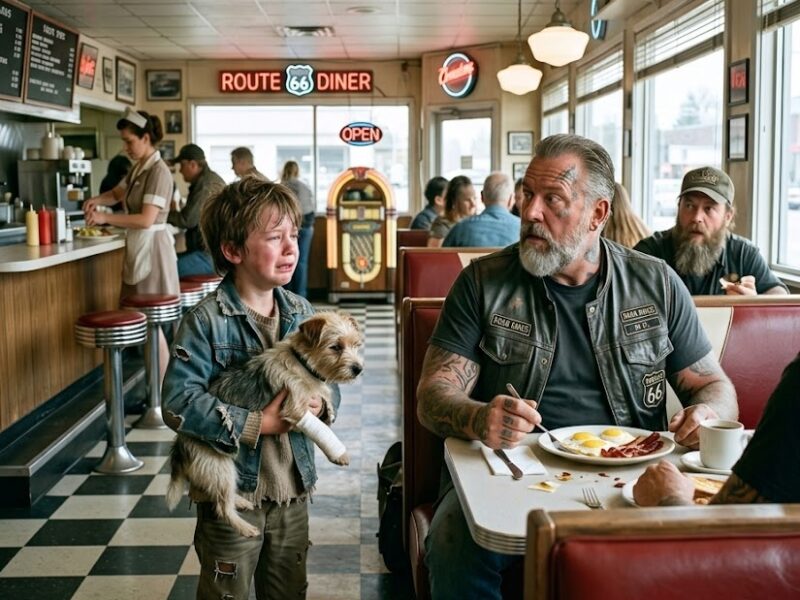
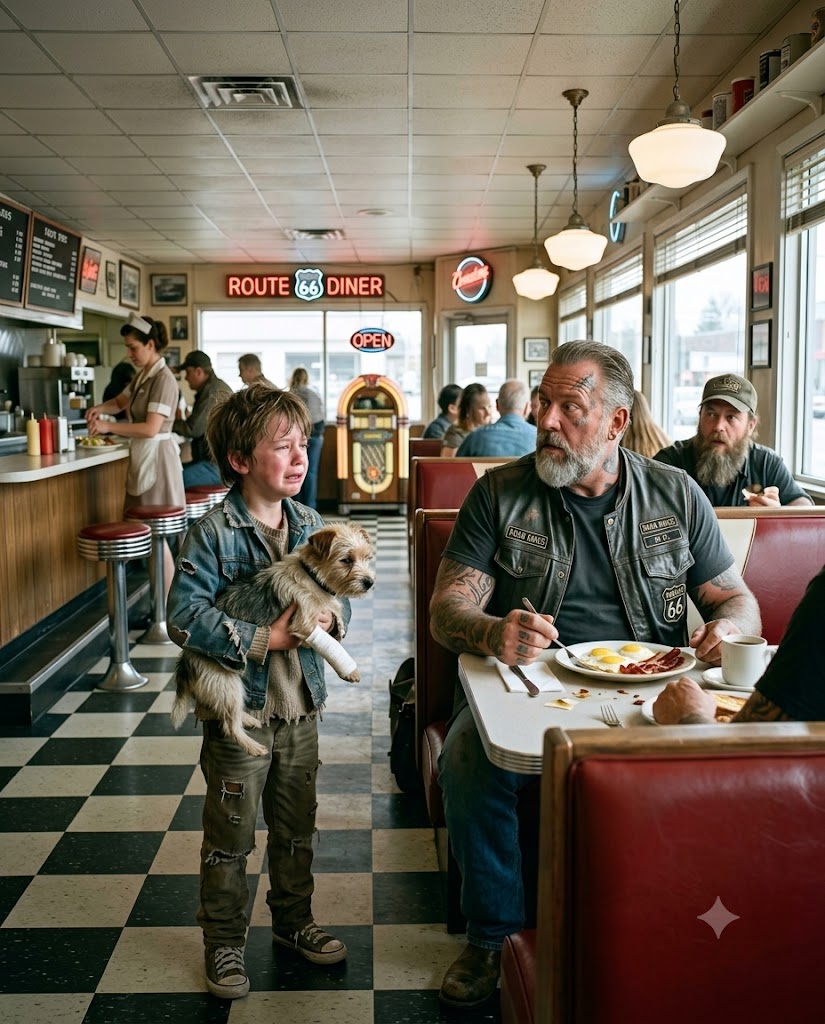
A crying boy ran up to a Hells Angel and said four words: “He kicked my dog.” What that biker did next shocked the entire town.
Chrome pipes ticked as the engine cooled.
Garrett lit a crushed cigarette, staring at the weeping kid and his limping mutt.
People expect violence from a man wearing the death’s head patch.
They expect blood.
But what this Hells Angel did next left the whole town completely speechless.
Asphalt radiating heat in waves can play tricks on your eyes, but Garrett knew what he was looking at.
He sat on the cracked curb outside an Exxon station on the edge of town, the heavy leather of his cut sticking to his back.
It was mid-July.
The kind of oppressive, suffocating heat that made sensible people stay indoors with the blinds drawn and the air conditioning rattling.
Garrett wasn’t sensible.
He was 52, saddled with two bad knees, a spine that ached when it rained, and a rap sheet he didn’t care to discuss.
He took a slow drag from his cigarette.
The smoke burned his throat, a familiar and welcome discomfort.
Beside him, his Harley-Davidson sat like a resting beast, smelling of hot oil, exhaust, and road grime.
He was halfway through his smoke when the kid appeared.
The boy couldn’t have been older than nine.
He walked with a strange, uneven gait, dragging his worn-out sneakers across the gravel shoulder of the highway.
His face was streaked with dirt and snot.
Tears had cut pale rivers through the dust on his cheeks.
He was breathing in sharp, jagged hiccups.
Garrett didn’t move.
He just watched.
Kids usually avoided him.
Mothers usually pulled their kids away from him.
The Hells Angels bottom rocker on his back wasn’t an invitation for neighborly chats.
It was a warning.
But this kid didn’t stop.
He walked straight past the pumps, ignoring the glare of the gas station attendant through the bulletproof glass, and stopped three feet from Garrett’s steel-toed boots.
Garrett exhaled a cloud of gray smoke, squinting through it.
“You’re blocking my sun, kid.”
The boy didn’t flinch.
Instead, he shifted his weight.
That was when Garrett saw what the kid was carrying.
It was a dog, a scruffy, wire-haired terrier mix, entirely too large for a kid that size to be hauling around.
The animal was trembling violently, its head tucked against the boy’s collarbone.
One of its back legs dangled at a sickening, unnatural angle.
The kid swallowed hard.
His chin quivered.
“Help,” he whispered.
The word barely made it past his teeth.
Garrett leaned forward, resting his forearms on his knees.
The leather of his cut creaked.
“I look like a veterinarian to you?”
“He kicked my dog.”
The boy’s voice broke.
The dam gave way, and the tears came back, hot and fast.
“He kicked Scout. He kicked him so hard he flew into the bushes.”
Garrett stared at the dog.
The animal let out a low, wet whine.
The sound wasn’t dramatic.
It was pathetic.
It was the sound of something small and helpless that didn’t understand why it was in pain.
Garrett knew that sound.
He’d heard it before in alleys and dive bars and lockups.
It was the sound of the powerless.
“Who?” Garrett asked.
His voice was flat and motionless.
“Mr. Lawson,” the boy sobbed, tightening his grip on the dog.
“Scout got off his leash. He just ran into the yard. He didn’t bite nobody. He was just sniffing the grass. Mr. Lawson came out with his golf club and he kicked him. He told me if I didn’t get my trash off his lawn, he’d shoot him.”
Richard Lawson.
Garrett knew the name.
Everyone in the county knew the name.
Lawson owned the local dealership, a sprawling McMansion up on the ridge, and half the local zoning board.
He was the kind of man who wore pastel sweaters tied around his neck and treated the town like his personal fiefdom.
Garrett looked at the boy.
“What’s your name?”
“Leo.”
“Put the dog down, Leo. Let me look.”
Leo hesitated.
He looked at the massive man in front of him.
The faded tattoos climbing up his thick neck, the silver rings on his scarred knuckles, the grim, weathered lines of his face.
Then, gently, Leo lowered the dog to the sun-baked concrete.
Scout collapsed immediately, panting shallowly.
Garrett knelt.
He didn’t reach out fast.
He let his large, calloused hand hover near the dog’s nose.
Scout sniffed it, smelling tobacco and motor oil, and let out another soft whine.
Garrett carefully ran his hands over the dog’s ribs.
The dog yelped, a sharp, piercing sound that made Leo flinch.
Garrett’s jaw tightened.
Two ribs, at least.
Maybe a punctured lung, given the shallow breathing.
The back leg was definitely fractured.
A clean, brutal break from blunt force trauma.
A heavy boot.
A deliberate, vicious swing.
A nine-year-old boy and a twenty-pound mutt.
That was what made a man like Richard Lawson feel powerful.
Garrett stood up slowly.
His bad knees popped.
He looked down at Leo, who was furiously wiping his nose with the back of his hand, terrified he had made a mistake by stopping here.
“You got a dad at home, Leo?” Garrett asked.
“No, sir. Just my mom. She’s at work. She works at the diner. She can’t leave or she’ll get fired.”
Garrett pulled his phone from his pocket.
He stared at the cracked screen for a moment.
He was supposed to be heading north.
He had a run to make.
Brothers waiting for him across the state line.
He was supposed to get back on the highway and leave this miserable, dust-choked town behind.
He put the phone away.
“Pick him up.”
Garrett ordered.
Leo looked confused.
“What?”
“Pick the dog up. Carefully. Don’t squeeze his ribs.”
Garrett walked over to his bike.
He popped the leather saddlebag and pulled out a heavy wool blanket he kept for cold nights.
He walked back and draped it over Leo’s arms, creating a makeshift sling.
“Keep him steady.”
“Where are we going?” Leo asked, his voice trembling.
Garrett straddled his Harley and kicked up the stand.
“We’re going to fix the dog. Then we’re going to fix Mr. Lawson.”
Doc Miller’s Veterinary Clinic was a cinder block building wedged between a feed store and a defunct laundromat.
The bell above the door jingled a cheerful, tinny tune that severely contrasted with the scene entering the waiting room.
Garrett walked in first.
The waiting room fell dead silent.
An elderly woman clutching a Persian cat shrank back into her plastic chair.
The receptionist, a young girl with braces, froze with her hand hovering over a ringing telephone.
The smell of antiseptic and wet fur hung heavy in the air.
“Get the doc,” Garrett said.
He didn’t yell.
He didn’t have to.
The bass in his voice rattled the cheap ceiling tiles.
Leo shuffled in behind him, cradling Scout in the wool blanket.
The dog was lethargic now, his eyes half-closed, panting shallowly.
The receptionist blinked.
“Dr. Miller is in an exam.”
“Get him,” Garrett repeated, taking a step toward the counter.
“Now.”
A moment later, Dr. Miller pushed through the swinging door.
He was a tall, reedy man with thinning hair and a stethoscope draped over his neck.
He took one look at Garrett’s cut, then at the crying boy, and finally at the dog.
The fear in the vet’s eyes vanished, replaced instantly by professional urgency.
“Exam room two. Bring him in,” Miller said, holding the door open.
Garrett nodded to Leo.
“Go on.”
Inside the brightly lit room, Leo laid Scout on the stainless steel table.
The dog whimpered as the cold metal touched his bruised ribs.
Dr. Miller went to work immediately, his hands moving with gentle precision.
He checked the dog’s gums, listened to his heart, and ran his fingers over the broken leg.
“Blunt trauma,” Miller murmured, his brow furrowing.
“Severe. Who hit him?”
“Lawson,” Garrett said from the doorway.
He leaned against the frame, his arms crossed over his massive chest.
Dr. Miller paused for a fraction of a second, his eyes darting to Garrett.
He knew Lawson.
Everyone knew Lawson.
“I need x-rays. I’m going to have to sedate him. The leg needs to be set, and I’m worried about internal bleeding.”
Leo grabbed Garrett’s leather sleeve.
The boy’s knuckles were white.
“Is he going to die, mister? Is he going to die?”
Garrett looked down at the boy’s hand on his sleeve.
Most men would catch a beating for touching a patch member’s cut without permission.
Garrett just looked back up at the vet.
“Well, doc, is he?”
“No,” Miller said firmly.
“But it’s going to be expensive. The surgery, the overnight observation, the medication. It’s going to be north of two thousand dollars.”
He looked at Leo.
“Does your mother know you’re here, son?”
Leo shook his head, fresh tears welling up.
“We don’t have two thousand dollars. We don’t even have a car.”
Garrett reached into his front pocket.
He pulled out a thick, folded wad of bills held together by a heavy silver money clip.
He didn’t count it.
He just peeled off twenty-one hundred-dollar bills and dropped them onto the stainless steel table next to the dog.
The green paper starkly contrasted with the sterile environment.
“Fix the dog, doc,” Garrett said.
“Whatever’s left over, keep it for the kid’s future visits.”
Dr. Miller stared at the cash.
He opened his mouth to speak, but Garrett was already turning away.
“Leo,” Garrett said.
“Stay here with your dog. You don’t leave this room until he wakes up. Understand?”
“Yes, sir,” Leo whispered, his eyes wide.
“But what are you going to do?”
Garrett didn’t answer.
He walked out of the clinic, the bell jingling behind him.
The oppressive heat of the afternoon hit him like a physical blow as he stepped back onto the pavement.
He walked over to his bike, pulled out his phone, and dialed a number.
It rang twice.
“Yeah,” a gruff voice answered.
“It’s Garrett. Where are you?”
“Sitting at the diner off Route 9. Me, Jax, and about fifteen of the boys. We were waiting on you. You’re late.”
“Change of plans,” Garrett said, lighting another cigarette.
He took a deep drag, his eyes narrowing as he looked up toward the wealthy ridge overlooking the town.
“We aren’t riding north just yet. Fire up the bikes. Bring everyone. We’re paying a house call to a guy named Richard Lawson.”
“Lawson? Who the hell is Lawson? He owe the club money?”
“No,” Garrett said softly, letting the smoke drift from his nose.
“He owes a kid a dog.”
“We knocking heads, brother?”
“No,” Garrett replied, his voice cold and precise.
“We’re going to teach a rich man how to apologize. No blood, no fists, just a quiet conversation. Get here in ten.”
Garrett hung up the phone.
He leaned against his bike, crossing his arms and waited.
The town of Creston was usually quiet on a Tuesday afternoon.
The only sounds were the distant hum of lawn mowers and the occasional passing truck.
But ten minutes later, that silence was shattered.
It started as a low rumble in the distance.
A vibration you could feel in the soles of your feet before you could hear it.
Slowly, the rumble grew into a roar.
The people on the street stopped what they were doing.
Shop owners stepped out onto the sidewalks, shading their eyes against the sun.
Down the main street, a column of motorcycles appeared through the heat haze.
Sixteen heavy American V-twins riding in a tight, disciplined two-by-two formation.
The sun glinted off the chrome forks and the black leather.
The noise was deafening, a mechanical symphony of raw horsepower that shook the glass in the storefronts.
They pulled into the parking lot of the veterinary clinic, the riders killing their engines in unison.
The sudden silence was almost as deafening as the roar had been.
Jax, a massive man with a braided beard and a scar running through his left eyebrow, kicked down his stand and walked over to Garrett.
He looked at the clinic, then at Garrett.
“All right,” Jax grunted, spitting a stream of sunflower seeds onto the asphalt.
“We’re here. Talk to me.”
Garrett pushed himself off his bike.
He flicked his cigarette stub onto the ground and crushed it under his heel.
He looked at his brothers, sixteen hardened men who had ridden through hell and back together.
Men who didn’t ask questions when a brother called.
“Up on the hill,” Garrett said, pointing toward the sprawling houses on the ridge.
“There’s a guy who likes to kick puppies and threaten kids. Thinks because he’s got money, he can do whatever he wants to, whatever is smaller than him.”
Jax raised an eyebrow.
The other bikers exchanged dark, knowing glances.
“We aren’t breaking his bones,” Garrett continued, his voice carrying over the idle ticking of the hot engines.
“We break his bones, the cops get involved, the kid gets targeted when we leave. No. We’re going to do this the hard way.”
“Which is?” Jax asked, a slow, dangerous smile spreading across his face.
“We’re going to help Mr. Lawson find his conscience,” Garrett said.
“Mount up.”
The ride up to Creston Ridge took less than five minutes, but the shift in atmosphere was absolute.
Down in the valley, the town was cracked asphalt, faded billboards, and the smell of fry grease.
Up here, the air felt cooler.
The roads were freshly paved, flanked by old-growth oaks and manicured hedges that looked like they had been trimmed with nail scissors.
Seventeen Harley-Davidsons shattered the suburban tranquility.
The deep, guttural roar of unbaffled exhaust echoed off the brick facades of the million-dollar homes.
Sprinklers ticked rhythmically over aggressively green lawns.
A woman in tennis whites dropping a bag of groceries on her driveway froze.
Her mouth agape as the column of black leather and chrome rolled past.
Garrett rode point.
He didn’t look at the sprawling estates.
He kept his eyes locked on the GPS mounted to his handlebars, counting down the house numbers.
There.
Number 442.
It was a massive faux colonial monstrosity with towering white pillars, a circular driveway, and a three-car garage.
A silver Mercedes SUV sat out front, gleaming under the afternoon sun.
Garrett didn’t park on the street.
He turned his heavy front wheel directly onto the immaculate, brick-paved driveway.
He rode right up to the front steps.
The rest of the pack followed suit.
Sixteen other riders swarmed the property.
Jax parked his bike right on the pristine, chemical-treated grass, the heavy kickstand sinking deep into the turf.
Another biker, a lean guy named Tommy, backed his chopper up right behind the Mercedes, boxing it in.
They cut the engines.
The sudden, deafening silence was broken only by the chorus of ticking pipes and the hiss of a lawn sprinkler hitting hot chrome.
The heavy mahogany front door swung open almost immediately.
Richard Lawson stormed out.
He was a man in his late fifties, sporting a forced tan, a pastel blue polo shirt, and khaki shorts.
He held a smartphone tightly in his right hand.
His face was a mask of aristocratic outrage.
The kind of anger reserved for people who had never been told no in their adult lives.
“What the hell is this?” Lawson barked.
He took two steps out onto his porch, waving his phone.
“Get these machines off my property. You’re leaking oil on my pavers. I’m calling the police right now.”
Garrett didn’t say a word.
He casually swung his heavy boot over his bike and planted his feet.
He reached into his vest, pulled out a pack of cigarettes, and lit one.
The flame from his Zippo clicked loud in the quiet air.
Jax stepped up beside Garrett, then Tommy, then fourteen other heavily tattooed, scarred, and seasoned men.
They didn’t yell.
They didn’t brandish weapons.
They just stood there, a solid wall of denim, leather, and menace staring up at the man on the porch.
Lawson’s hand stopped moving toward his phone’s keypad.
The outrage on his face faltered, cracking at the edges.
He looked at the death’s head patches on their backs.
He looked at the sheer, overwhelming size of the men occupying his yard.
Reality set in, cold and sharp.
He was alone.
His money couldn’t build a wall fast enough to keep them out.
“Who are you?” Lawson’s voice lost its brassy edge.
It dropped an octave, tight with sudden panic.
“What do you want?”
Garrett took a slow drag of his cigarette.
He exhaled a thick plume of smoke toward the colonial columns.
He walked up the steps.
He didn’t stop until he was standing on the same tier as Lawson, less than two feet away.
Garrett stood six foot three and he had fifty pounds of muscle and scar tissue on the dealership owner.
“You Richard Lawson?” Garrett asked softly.
“Yes.”
Lawson swallowed hard.
Sweat beaded on his upper lip.
“Look, if this is about money, I have cash inside. You can take it. Just leave.”
“We don’t want your money,” Garrett said.
“I hear you like to golf, Richard.”
Lawson blinked, entirely thrown off balance.
“What?”
Garrett pointed down the hill toward the valley.
“About an hour ago, a kid named Leo walked up to me. He was carrying a twenty-pound dog. The dog had two broken ribs and a shattered hind leg. The kid told me you took a golf club to it.”
Lawson’s face flushed red, then went entirely pale.
“That—that animal was on my property. It was aggressive. It snapped at me.”
“The kid said it was sniffing your grass,” Garrett replied, his voice devoid of any inflection.
“It’s my legal right to defend my property.”
Lawson stammered, stepping back.
His shoulders hit the heavy mahogany door.
He had nowhere else to go.
“You can’t come here and threaten me over a stray mutt. I know the chief of police. I sit on the board of the town council. You lay a finger on me and every cop in the state will hunt you down.”
Jax let out a low rumbling laugh from the driveway.
It wasn’t a friendly sound.
Garrett leaned in closer.
He smelled of road dust, tobacco, and old leather.
“Richard, look at me. Look at my eyes.”
Lawson forced himself to look.
He saw dead, flat calm.
It was the look of a man who had long ago made peace with consequences.
“You can call the chief of police,” Garrett whispered.
“They might arrest me. They might arrest all of us. We’ll do a few nights in county holding. We have lawyers on retainer who cost more than your house. We’ll be out by Friday.”
Garrett paused, letting the silence hang.
“But here’s the thing, Richard. The Hells Angels are a big family. We have chapters in every state. We have brothers who don’t wear the patch, who you’ll never see coming. You put us in jail today, and tomorrow a hundred more of us know your name. They know where you live. They know where you sell your cars.”
Lawson’s breath grew shallow.
The smartphone in his hand trembled so violently it slipped from his grip, clattering against the porch planks.
He didn’t bend down to pick it up.
“I’m not going to break your jaw, Richard,” Garrett said.
His voice dropping to a gravelly rasp.
“I’m not going to burn your house down, but you are going to fix what you broke.”
Lawson stared at him, his eyes wide, dilated with raw primal fear.
“What do you want me to do?”
“Walk down these stairs,” Garrett commanded.
“Get in your expensive car. You’re going to drive to Dr. Miller’s clinic. We will be right behind you. You’re going to pay the vet bill in full, and then you’re going to look that nine-year-old boy in the eyes, and you are going to beg his forgiveness. If you do that, we ride out of your town, and you never see us again. If you don’t—”
Garrett flicked his cigarette stub onto the spotless porch.
“We stay.”
The procession back into town was painfully slow.
Lawson drove his silver Mercedes exactly at the speed limit.
His knuckles were bone white on the leather-wrapped steering wheel.
In his rearview mirror, his side mirrors, and right off his front bumper, all he could see was chrome, black leather, and the grim faces of men who rode like wolves escorting a wounded deer.
They pulled into the dirt lot of the veterinary clinic.
The townspeople who had gathered earlier were still there watching from the sidewalks, whispering behind hands.
Lawson put the SUV in park.
He sat there for a long moment staring at the cinder block building.
He didn’t want to get out.
He wanted to lock the doors and close his eyes.
But there was a heavy rap on his driver’s side window.
Garrett was standing there.
Lawson opened the door and stepped out into the oppressive heat.
His legs felt like lead.
Garrett put a heavy hand on Lawson’s shoulder.
It wasn’t a supportive gesture.
It was a vice.
He steered the rich man towards the clinic doors.
Jax and Tommy flanked them.
The bell above the door jingled its cheerful tune.
The receptionist was gone.
The waiting room was empty.
From the back hallway, the low murmur of Dr. Miller’s voice echoed against the tile.
Garrett pushed Lawson down the hall and into exam room two.
Leo was sitting on a metal stool next to the stainless steel table.
Scout was awake but heavily drugged.
His back leg was wrapped in a thick rigid cast.
A wide bandage bound his ribs.
The dog breathed in a slow steady rhythm.
Leo held the dog’s paw, his small face still streaked with dried dirt and tears.
When Leo saw Lawson, he flinched.
He instinctively threw his arms over the dog, shielding the animal with his own small body.
Garrett stepped into the room, filling the space.
He looked at Lawson.
He didn’t speak.
He just waited.
Lawson stood awkwardly in the sterile room.
He looked at the boy.
He looked at the bruised, battered animal on the table.
The anger and arrogance that had driven him to swing a golf club at a helpless creature evaporated under the heavy, judgmental stares of the bikers packing the hallway behind him.
For the first time in a very long time, Richard Lawson felt small.
He swallowed the dry lump in his throat.
He took a step forward.
“I’m—” Lawson started.
His voice cracked.
He cleared his throat and tried again.
“Leo, I’m sorry.”
Leo didn’t look up.
He kept his eyes locked on his dog.
“You hurt him,” the boy whispered.
“I know,” Lawson said.
He wiped the sweat from his forehead.
“I lost my temper. I was wrong. I shouldn’t have done it. I am very, very sorry.”
Dr. Miller stood in the corner, his arms crossed, his face an unreadable mask.
He had dealt with Lawson before.
He had seen the man bully zoning clerks and scream at waitresses.
Watching him stand here, broken and compliant, was surreal.
Garrett gestured to the vet.
“Doc, the bill.”
Miller walked over to a small counter and grabbed a clipboard.
“Surgery, anesthesia, x-rays, the cast, and a week’s worth of painkillers, plus overnight observation.”
He pulled off the top sheet.
“Twenty-two hundred dollars.”
Lawson didn’t argue.
He didn’t ask for an itemized receipt.
He reached into his back pocket, pulled out a designer leather wallet, and extracted a sleek, heavy metal credit card.
He handed it to Dr. Miller with a trembling hand.
“Run it,” Garrett said to the vet.
Miller stepped out of the room to process the payment.
The silence in the exam room was suffocating.
Lawson stared at the floor tiles.
Leo stroked Scout’s head.
Garrett leaned against the door frame.
A minute later, Miller returned.
He handed the card and a receipt to Lawson.
Then, the vet reached into his white coat pocket and pulled out the thick wad of hundred-dollar bills Garrett had left on the table earlier.
He held it out to the biker.
Garrett took the cash.
He peeled off five hundred and handed it back to the vet.
“For the dog’s checkups.”
He turned to Lawson.
The rich man was clutching the receipt like a shield.
“You’re done,” Garrett said quietly.
“Walk to your car. Drive home. Don’t look back.”
Lawson didn’t need to be told twice.
He brushed past the bikers in the hallway, his head down, keeping his eyes glued to the floor.
The bell jingled as he practically ran out the front door.
Garrett walked over to the stainless steel table.
He looked down at Leo.
The boy finally looked up.
His eyes wide and full of awe.
“He’s going to be okay, kid,” Garrett said.
His voice was softer now.
The dangerous edge was gone.
“Thank you, sir,” Leo whispered.
“Thank you for saving my dog.”
Garrett reached out.
His massive, scarred hand dwarfed the boy’s shoulder.
He gave it a firm, reassuring squeeze.
“Men like that, they only have power if you let them think they do. Remember that.”
Garrett turned and walked out of the exam room.
He strode down the hallway, pushed through the front doors, and stepped out into the blinding afternoon sun.
Jax and the rest of the boys were already mounting up.
“Good?” Jax asked, pulling his riding gloves on.
“We’re good,” Garrett said.
He swung a leg over his Harley and turned the key.
The engine fired up with a thunderous bark, vibrating through his boots.
He kicked up the stand.
He didn’t look back at the clinic.
He didn’t need a parade or a thank you from the town.
He dropped the bike into first gear, rolled the throttle, and let the clutch out.
Seventeen bikers pulled out of the dirt lot, turning onto the highway, riding back into the heavy, suffocating heat of July.
Within minutes, the roar of their engines faded into the distance, leaving the town of Creston quiet once again.
But it was a different kind of quiet now.
It was the quiet of a town that had just learned what real respect looked like.
—
The story didn’t end when the engines faded.
Word travels fast in a small town, faster than any motorcycle.
By Wednesday morning, the tale of the Hells Angel and the crying boy had spread through Creston like wildfire.
It started at the diner where Leo’s mother worked.
She had come home Tuesday night to find her son sitting on the front steps of their tiny rental house, a sleeping terrier in his lap and a story on his lips.
She had listened with wide eyes as Leo recounted the afternoon.
The big man with the tattoos.
The ride to the vet.
The rich man who had stood in the exam room and apologized.
She had held her son tight and cried into his hair.
Not from fear.
From relief.
From gratitude.
By the time she walked into the diner Wednesday morning, she was still processing it all.
The other waitresses crowded around her.
They had heard bits and pieces from customers who had seen the motorcycles.
They wanted the whole story.
She told them.
By noon, the regulars at the counter knew.
By evening, the whole shift knew.
And by Thursday, the entire town knew.
Richard Lawson had kicked a nine-year-old’s dog.
And a Hells Angel had made him pay for it.
The story took on a life of its own.
Some versions were exaggerated.
Some were completely fabricated.
But the core of it remained true.
A boy had been wronged.
A stranger had stepped in.
And justice, real justice, had been served.
The fallout for Richard Lawson was swift and brutal.
Not in the way of violence.
No one laid a hand on him.
No one keyed his Mercedes.
No one threw a brick through his window.
But something far more insidious happened.
Something far more devastating for a man like Richard Lawson.
He lost his reputation.
The town council called an emergency meeting on Friday.
They had received complaints.
Dozens of them.
From constituents who had heard the story.
From people who had been bullied by Lawson for years.
From zoning clerks he had screamed at.
From waitresses he had belittled.
From neighbors he had threatened over trivial disputes.
The council voted to formally censure him.
It was a symbolic gesture, but it carried weight.
Lawson sat in the front row during the meeting, his face a mask of controlled fury.
He didn’t speak.
He didn’t defend himself.
He just sat there and absorbed the humiliation.
His dealership took a hit too.
It started slowly.
A few canceled appointments.
A few customers who decided to take their business elsewhere.
Then it snowballed.
The local newspaper ran a small piece about the incident.
It didn’t name Lawson directly, but everyone knew who it was about.
The headline read: “Local Businessman Apologizes After Animal Cruelty Incident.”
The story spread to neighboring towns.
Then to the internet.
Lawson’s dealership website was flooded with negative reviews.
People from all over the country left comments.
Some were angry.
Some were sarcastic.
Some were just sad.
The man who had once ruled Creston with an iron fist was now a pariah.
He stopped showing up at the dealership.
He stopped attending council meetings.
He stopped leaving his house.
The McMansion on the ridge, once a symbol of his power, became a prison.
His wife left him two weeks after the incident.
She had tolerated a lot over the years.
The affairs.
The temper tantrums.
The casual cruelty.
But this was different.
This was public.
This was humiliating.
And it had all started because of a dog.
A scruffy, wire-haired terrier mix that had wandered onto his lawn.
A dog that had done nothing wrong.
A dog that had simply been in the wrong place at the wrong time.
And a nine-year-old boy who had loved that dog more than anything in the world.
—
Leo and Scout became local celebrities.
The story of the Hells Angel and the crying boy spread through Creston like a folk tale.
People stopped Leo on the street to ask about his dog.
They brought treats for Scout.
They offered to help Leo’s mother with groceries and bills.
The diner where she worked was suddenly packed every day.
People came from neighboring towns just to meet the boy who had stood up to Richard Lawson.
The boy who had trusted a stranger.
The boy who had saved his dog.
A local reporter did a feature story on Leo and Scout.
It was supposed to be a small piece, just a few paragraphs in the community section.
But it went viral.
The story of the Hells Angel who had stepped in to help a boy and his dog resonated with people.
It was shared thousands of times on social media.
It was picked up by national news outlets.
It was even mentioned on a late-night talk show.
Leo didn’t understand any of it.
He was just a kid who loved his dog.
He didn’t care about viral stories or national news.
He just cared about Scout.
Scout, who was healing slowly but surely.
Scout, who was learning to walk again on his casted leg.
Scout, who still whimpered in his sleep but wagged his tail whenever Leo came near.
Dr. Miller waived the remaining fees.
He had been paid more than enough by Garrett.
And by Lawson.
He didn’t need the money.
What he needed was to see Scout recover.
What he needed was to see Leo smile again.
The vet visited the boy and his dog every week.
He checked Scout’s ribs.
He adjusted the cast.
He brought toys and treats and medicine.
He became a friend.
He became a fixture in their lives.
And he wasn’t the only one.
The bikers came back too.
Not all of them.
Not the whole chapter.
But a few.
Jax showed up at the diner one afternoon, his braided beard freshly trimmed, his scarred eyebrow raised in greeting.
He sat at the counter and ordered a cup of coffee.
He didn’t say much.
He just sat there and drank his coffee and watched the town go by.
When Leo’s mother came to refill his cup, he slid a hundred-dollar bill across the counter.
“For the kid,” he said.
“For Scout,” she corrected, smiling.
Jax nodded.
“For Scout.”
He finished his coffee and left.
He didn’t come back for a while.
But when he did, he brought more.
Toys for Scout.
A new leash.
A collar with a little silver tag that read “SCOUT” in bold letters.
Leo wore that collar around his wrist like a bracelet.
He never took it off.
Not even to sleep.
Not even to bathe.
It was a reminder.
A reminder of the day a stranger had stepped in.
A reminder of the day his dog had been saved.
A reminder of the day he had learned that not all heroes wear capes.
Some wear leather.
Some ride motorcycles.
Some have tattoos and scars and rap sheets.
But they still have hearts.
—
Months passed.
Summer turned to fall.
The oppressive heat of July faded into the crisp cool of October.
Scout’s cast came off.
His ribs healed.
His leg mended.
He ran and jumped and played like nothing had ever happened.
He was a different dog now.
He was a happy dog.
He was a loved dog.
And Leo was a different boy.
He was more confident.
He was more hopeful.
He was more trusting.
Not of everyone.
But of the right people.
He had learned that there were good people in the world.
People who would help you when you needed it.
People who would stand up for you when you couldn’t stand up for yourself.
People like Garrett.
Garrett, who had disappeared back into the world of highways and open roads and brotherhood.
Garrett, who had never asked for thanks or recognition.
Garrett, who had simply done what was right.
Leo thought about him often.
He wondered where he was.
He wondered if he was okay.
He wondered if he would ever see him again.
He didn’t know that Garrett thought about him too.
He didn’t know that Garrett kept a small photo in his wallet, a photo of a boy and a dog that he had taken with his phone on the day everything changed.
He didn’t know that Garrett looked at that photo sometimes, late at night, when the road was dark and the world felt heavy.
He didn’t know that Garrett was proud of him.
Proud of the boy who had stood up to a bully.
Proud of the boy who had fought for his dog.
Proud of the boy who had trusted a stranger.
—
One year later, almost to the day, a familiar rumble echoed through the streets of Creston.
It was a Tuesday afternoon.
The same oppressive heat.
The same cracked asphalt.
The same dusty sky.
But something was different.
Something had changed.
The town was different.
The people were different.
And Leo was different.
He was ten now.
He was taller.
He was stronger.
He was standing on the sidewalk outside the diner, holding Scout’s leash, watching the column of motorcycles approach.
Scout barked excitedly, his tail wagging so hard it was a blur.
He remembered.
He remembered the rumble.
He remembered the leather.
He remembered the man who had saved him.
The bikes pulled into the parking lot.
Seventeen of them.
The same bikes.
The same riders.
The same formation.
And at the front, the same man.
Garrett.
He cut the engine and swung his leg over his Harley.
He walked over to Leo, his bad knees popping, his face weathered and tired but his eyes bright.
“Hey, kid,” he said.
“Hey, Garrett,” Leo replied, grinning.
Scout pulled at the leash, desperate to get to the man who had saved him.
Garrett knelt down, ignoring the pain in his knees.
He let Scout sniff his hand.
The dog licked it eagerly.
“He looks good,” Garrett said.
“He’s all healed,” Leo said.
“He runs and jumps and plays. He’s the happiest dog in the world.”
Garrett stood up, his knees popping again.
He looked at Leo.
“You look good too.”
“I’m ten now,” Leo said proudly.
“I know,” Garrett said.
“I heard.”
Leo tilted his head.
“You heard?”
Garrett nodded.
“I keep tabs on the important things.”
Leo smiled.
He reached into his pocket and pulled out something small.
Something silver.
A tag.
The tag Jax had given him.
“SCOUT.”
He held it out to Garrett.
“Jax gave this to me. I wanted to give it to you. As a thank you.”
Garrett looked at the tag.
He looked at Leo.
He shook his head.
“You keep it, kid. It belongs to Scout.”
“But I want you to have something,” Leo insisted.
“I already have something,” Garrett said.
He reached into his back pocket and pulled out his wallet.
He opened it and showed Leo the photo.
The photo of a boy and a dog.
The photo he had taken on the day everything changed.
Leo stared at it.
His eyes welled up with tears.
“You kept it?”
“I keep the important things,” Garrett said.
He closed his wallet and put it back in his pocket.
He looked at Leo.
He looked at Scout.
He looked at the town that had learned what real respect looked like.
“I’m proud of you, kid,” he said.
“You stood up for what was right. You fought for your dog. You trusted a stranger. That takes guts.”
Leo wiped his eyes with the back of his hand.
“Thank you,” he whispered.
“For everything.”
Garrett nodded.
He turned and walked back to his bike.
He swung a leg over and turned the key.
The engine fired up with a thunderous bark.
He kicked up the stand.
He dropped the bike into first gear.
He rolled the throttle.
He let the clutch out.
And he rode.
Seventeen bikers pulled out of the parking lot, turning onto the highway, riding into the distance.
Leo watched them go.
He watched until the last bike disappeared over the horizon.
He watched until the roar of the engines faded into silence.
He watched until the town was quiet again.
But it was a different kind of quiet.
It was the quiet of a town that had learned something important.
Something about courage.
Something about kindness.
Something about respect.
And something about a Hells Angel who had done the unthinkable.
He had helped a crying boy and his limping dog.
He had stood up to a bully.
He had made a difference.
And he had never asked for anything in return.
That was the kind of man Garrett was.
That was the kind of man Leo wanted to be.
—
Scout lived a long and happy life.
He ran on the beach.
He chased squirrels in the park.
He slept at the foot of Leo’s bed every night.
He was loved.
He was cherished.
He was safe.
And Leo grew up.
He grew up strong.
He grew up kind.
He grew up brave.
He never forgot the man who had saved his dog.
He never forgot the lesson he had learned.
Men like Richard Lawson only have power if you let them think they do.
Leo never let anyone think they had power over him.
Not bullies.
Not fear.
Not doubt.
He stood up for what was right.
He fought for the underdog.
He trusted the right people.
He became a man his mother was proud of.
He became a man Garrett would be proud of.
And when he was old enough, he got a motorcycle.
A Harley-Davidson.
He rode it down the highway, the wind in his hair, the sun on his face.
He rode it to the edge of town.
He rode it past the Exxon station where everything had started.
He rode it past the spot where a nine-year-old boy had stood with a limping dog in his arms.
He rode it past the spot where a Hells Angel had sat on the curb, smoking a cigarette, minding his own business.
He rode it past the spot where everything had changed.
And he smiled.
Because he knew.
He knew that some things never fade.
Some things never die.
Some things live forever.
Like courage.
Like kindness.
Like respect.
And like the memory of a man who had done the unthinkable.
A man who had helped a crying boy and his limping dog.
A man who had made a difference.
A man named Garrett.
—
The story of the Hells Angel and the crying boy became a legend in Creston.
It was told and retold.
It was passed down from generation to generation.
It was whispered in diners and shouted in bars.
It was written in the hearts of everyone who heard it.
And it was never forgotten.
Because it wasn’t just a story.
It was a lesson.
A lesson about standing up for what’s right.
A lesson about helping those who can’t help themselves.
A lesson about the power of one person to make a difference.
And it was a lesson about a Hells Angel who had done the unthinkable.
He had shown kindness.
He had shown compassion.
He had shown respect.
And he had changed a town forever.
—
Years later, a young man walked into a diner on the edge of Creston.
He was tall and strong, with kind eyes and a warm smile.
He sat at the counter and ordered a cup of coffee.
He looked around the diner, at the people, at the memories.
He saw an old woman in a corner booth, her Persian cat long gone but her smile still bright.
He saw a waitress with graying hair, her apron stained with coffee and grease, her eyes tired but happy.
He saw a veterinarian with thinning hair, his stethoscope draped over his neck, his hands still gentle.
He saw a town that had changed.
A town that had learned.
A town that had grown.
And he saw a plaque on the wall.
A small, brass plaque.
Engraved with words that made his heart swell.
“In memory of Garrett. A man who showed us what real respect looks like.”
The young man smiled.
He reached into his pocket and pulled out a small silver tag.
“SCOUT.”
He held it in his hand, feeling the weight of it, the memory of it.
He thought of the man who had saved his dog.
He thought of the man who had changed his life.
He thought of the man who had taught him what it meant to be brave.
He thought of Garrett.
And he knew.
He knew that Garrett was still out there.
Riding the highways.
Living the life.
Making a difference.
And he knew that he would never forget.
He would never forget the day a Hells Angel had saved his dog.
He would never forget the day a Hells Angel had saved him.
He would never forget Garrett.
—
Tears, leather, and a lesson in respect.
That was the story of Garrett and Leo and Scout.
A story that started with a crying boy and a limping dog.
A story that ended with a town forever changed.
A story that proved you can never judge a book by its cover.
A story that proved that heroes come in all shapes and sizes.
A story that proved that even a Hells Angel can have a heart.
If Garrett’s unexpected brand of justice moved you, don’t keep this story to yourself.
Hit that like button.
Share this video with fellow animal lovers.
Subscribe to our channel for more unforgettable, real-life stories that prove you can never judge a book by its cover.
Drop a comment below.
What would you have done if you were in Garrett’s boots?









