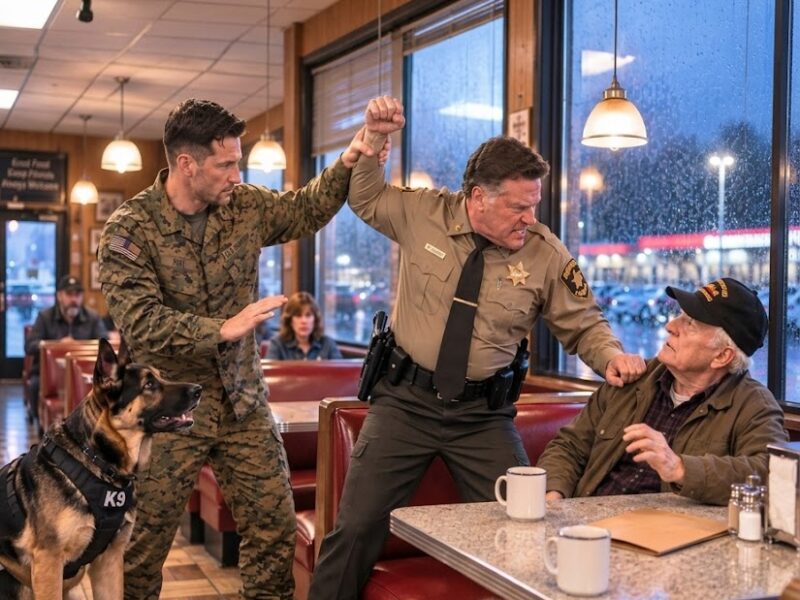
A Corrupt Sheriff Raised His Hand Against an Elderly Marine Veteran—Then a Marine’s K9 Exposed What He Wanted Hidden
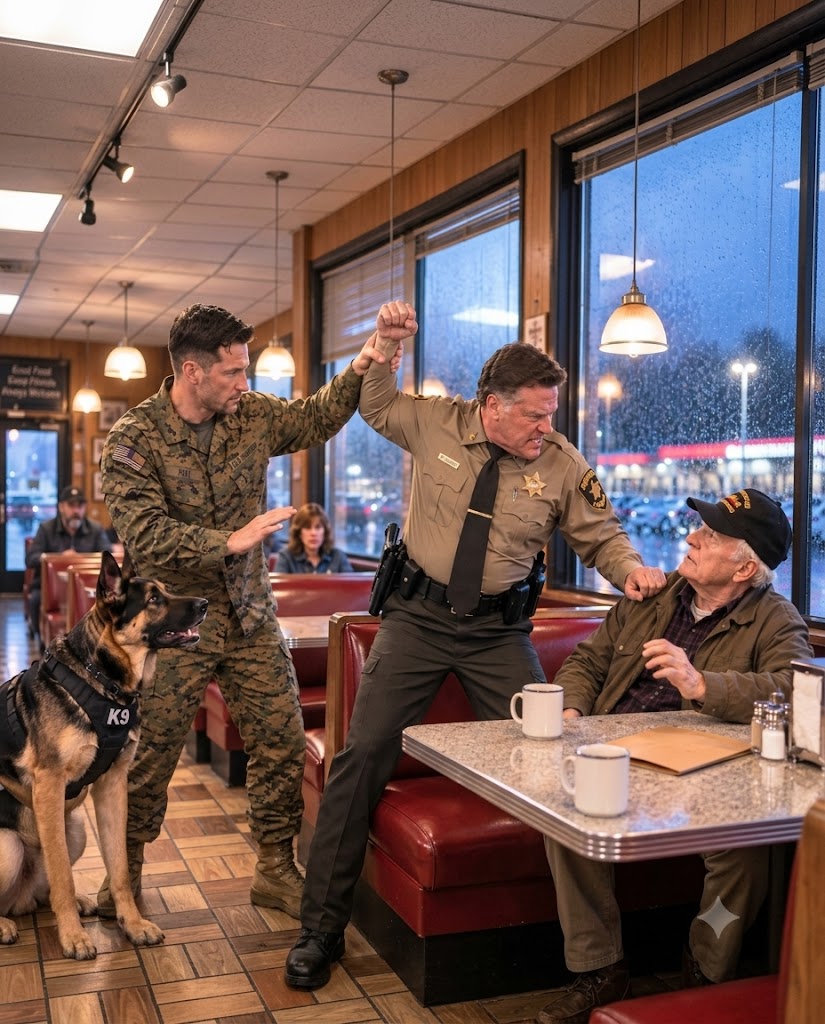
Cold rain had been falling over the outskirts of Cordelane, Idaho since late afternoon, washing the highway black beneath the headlights and turning the pine covered hills beyond it into dark shapes behind a veil of water.
Gunnery Sergeant Silas Corbett had been driving through that rain long enough for the steady sweep of the windshield wipers to become part of his breathing.
At 41, Silas stood six foot one with the compact, hardened build of a man who had spent most of his adult life asking more from his body than comfort ever required.
His dark brown hair was clipped close, gray eyes set beneath a heavy brow, and a narrow scar beside his right jaw sharpened an already angular face.
He wore civilian clothes tonight, a charcoal thermal shirt beneath a weathered field jacket, dark jeans, and boots.
But nothing about the way he carried himself suggested softness.
Years in the Marine Corps had taught him to conserve movement, words, and judgment.
Experience had taught him something harder.
Not every tense situation required intervention, but every dangerous one required attention.
In the passenger side rear space rode Vesper, his seven year old German Shepherd canine.
The dog was large without being oversized, black across the saddle with rich tan along his chest and legs, amber brown eyes alert beneath upright ears.
A small notch marked the edge of his right ear.
Vesper possessed the unusual calm of a working dog that did not confuse stillness with inattention.
He could sleep through highway noise and wake at the smallest change in Silas’s breathing.
After hours behind the wheel, Silas spotted the diner glowing beside the highway and turned into the wet gravel lot.
Inside, warmth smelled of coffee, fried onions, and old wood.
He took the rear booth automatically, back protected, front door and counter visible.
Vesper settled beside his left boot without being told twice.
A waitress approached carrying a coffee pot.
Mara Keen looked to be in her early fifties, short and slightly heavy through the shoulders, with auburn hair streaked with gray and gathered loosely behind her head.
Fine lines framed kind brown eyes, though something cautious lived beneath them, as if years of serving strangers had taught her which conversations were safe to enter, and which were better left alone.
“Long drive,” she said.
“Long enough,” Silas replied.
Her gaze dropped toward Vesper.
“He working?”
“Always a little.”
That earned the faintest smile.
Mara returned with a stainless steel bowl of water and placed it near Silas’s boot without reaching for the dog.
Silas noticed that restraint and appreciated it.
While waiting for his meal, his attention drifted toward the window booth.
The old man sitting there was perhaps seventy nine, thin enough that his faded canvas coat hung loosely from once broad shoulders.
Harlon Voss had close cut silver hair, a deeply lined face, and pale blue eyes that seemed older than the rest of him.
His veined right hand trembled slightly when he lifted his spoon, but his spine remained straight.
A red and gold Marine veteran cap rested on the seat beside him near worn brown boots planted squarely on the floor.
A scuffed brown document envelope lay beside his soup, and there were two cups of coffee.
Silas looked briefly toward the empty seat opposite Harlon.
No coat, no bag, nobody walking back from the restroom.
The second cup sat untouched, its thin ribbon of steam already fading.
Earlier, someone had apparently been at the booth.
Silas had noticed a nervously looking man leaving through the entrance just as he pulled into the parking lot, but something told him the second coffee had nothing to do with that man.
Harlon never glanced toward the door as though expecting him back.
Instead, once while reaching for his soup, the old man’s eyes settled on the empty chair with an expression Silas couldn’t name.
Not expectation, something quieter.
Silas looked away.
Some silences belonged to the person carrying them.
His meal arrived, and for the next several minutes, the diner returned to its small evening rhythm.
Forks touched plates.
Rain ticked against glass.
A radio murmured somewhere near the kitchen.
Yet Silas found himself noticing Harlon again.
The old man never fully turned his back on the entrance.
Each time the door opened, his eyes moved first and his head followed.
When a tray fell behind the counter, his shoulders tightened before anyone else reacted.
Old habits, Silas thought.
The kind that survived long after a uniform was put away.
He didn’t ask.
Twenty minutes later, headlights swept across the windows.
A county sheriff’s SUV stopped near the entrance.
The change inside the diner happened before the door opened.
Mara’s conversation with a customer ended mid sentence.
An elderly couple near the counter exchanged a glance and reached for their check.
Through the kitchen pass through, the cook lowered his eyes toward the grill.
Silas stopped chewing.
Sheriff Boyd Renshaw entered first.
He was fifty four, broad through the chest and stomach, with a thick neck, graying temples, and a fleshy face permanently flushed around the cheeks.
His uniform fit tightly across his shoulders, and he carried himself with the expansive confidence of a man accustomed to other people moving before he had to ask.
Three deputies followed.
Two were heavy set men in their forties.
The third was younger, blonde, lean, and visibly less comfortable than the others.
Renshaw didn’t greet Mara.
He didn’t need to.
The room had already greeted him with silence.
Silas had seen that kind of silence before.
Respect and fear could look similar from a distance.
Up close, they were nothing alike.
There were six empty booths.
Renshaw ignored everyone.
He walked directly toward Harlon.
Harlon watched him approach but made no move to rise.
Renshaw stopped beside the table.
“You’re sitting in my booth, old man.”
Harlon slowly lowered his spoon.
His pale eyes traveled across the empty diner before returning to the sheriff.
“Then tonight, you’ve got six others to choose from.”
One deputy chuckled.
Renshaw didn’t.
His gaze fell on the marine cap beside Harlon.
Something mean and amused crept across his face.
“That thing real?” he asked.
“Or did you buy it somewhere so people would pick up your coffee?”
Harlon’s fingers tightened once around the spoon, then relaxed.
He said nothing.
Renshaw leaned closer.
At the rear of the diner, Silas slowly placed his fork beside his plate.
Under the table, Vesper lifted his head, and for the first time that evening, the German Shepherd’s eyes locked on the sheriff.
Rain whispered against the diner windows as Boyd Renshaw remained beside Harlon’s booth, close enough that the old man’s only easy way out was blocked by the sheriff’s body.
“You deaf, too?” Renshaw asked.
“I said that’s my booth.”
Harlon lifted his eyes without lifting his voice.
“And I said I’d like to finish my supper.”
The younger deputy looked toward the floor.
One of the older deputies smirked, but the sound died when nobody else joined him.
Mara stood behind the counter with the coffee pot held motionless in one hand.
Silas watched from the rear booth, measuring distances rather than insults.
Renshaw to Harlon, deputies to the door, civilians to the counter, his own position to Vesper.
The sheriff was being cruel, but cruelty spoken aloud was not yet a reason to turn a crowded diner containing four armed officers into something worse.
Silas had learned long ago that restraint was not passivity.
Sometimes restraint was the hardest form of readiness.
Vesper remained beside his left leg, head raised now, ears forward.
Silas lowered two fingers beside his thigh.
Stay.
The German Shepherd obeyed.
Renshaw glanced at Harlon’s weathered hands.
“How old are you anyway?”
“Eighty.”
“Close enough. And you’re still playing marine?”
Something changed in Harlon’s eyes, but only for a second.
“I don’t play at things I already did.”
Silas almost looked up at the marine cap again.
That answered one question.
Renshaw’s mouth tightened.
His gaze moved across the table and stopped at the brown envelope.
“What have you got there?”
Harlon placed one hand over it.
“Nothing that belongs to you.”
Renshaw pulled it away.
The motion was casual enough to look almost harmless, but the envelope caught beneath Harlon’s wrist and opened.
Several photocopied pages slid across the tabletop.
One landed against the spilled sugar packets.
Another stopped beside the untouched second coffee.
Silas couldn’t read everything from where he sat, but he caught headings and fragments.
Towing invoices, property seizure forms, dates, vehicle descriptions, handwritten statements attached to official looking records.
Renshaw could read them.
The mockery left his face.
Harlon saw it happen.
Nearly two years earlier, another old marine had sat at Harlon’s kitchen table with paperwork spread between them.
Elias Pruitt had been Harlon’s closest friend for more than four decades.
A fellow Marine from their youth who had aged into a narrow shouldered man with white hair, a weathered face, and the stubborn patience of someone who hated asking for help.
Time had softened Elias’s stride, but not his humor.
He was the kind of man who apologized to waitresses when someone else bumped his table and who would drive twenty miles to help a neighbor repair a fence, then refuse gas money.
What happened to Elias had not made Harlon an investigator.
It had made him angry.
Elias had become one of several people caught in a pattern of questionable towing, property seizures, intimidation, and complaints that seemed to disappear before anyone outside the county took them seriously.
By the time he showed Harlon the papers, the old marine spoke less about what he had lost than about how small the experience had made him feel.
That was the part Harlon could not forgive.
Not the money, not even the property, the humiliation.
So Harlon began listening.
When someone trusted him enough to talk, he wrote down what they said.
When a person had a receipt, notice, photograph, or letter, he kept a copy.
He forwarded what he could to people with authority beyond Renshaw’s immediate reach.
Other residents were doing their own part, some openly and some quietly, and evidence from multiple sources eventually began moving through the proper investigative channels.
Harlon never imagined himself exposing an entire system.
He was simply one old man refusing to throw away another piece of paper.
Elias never lived to see where those papers went.
His death came later from natural causes.
Quietly and without the dramatic ending Harlon’s anger sometimes seemed to demand.
Near the end, when Harlon’s bitterness had become harder to hide, Elias had made him promise only one thing.
“Don’t let them do it to somebody else.”
Harlon had carried those words for nearly two years now.
Renshaw picked up one of the photocopies.
“You’re still doing this?”
Harlon said nothing.
Renshaw scanned another page and gave a short laugh, but Silas heard something different in it now.
The sheriff wasn’t amused anymore.
He was calculating.
“All those complaints,” Renshaw said.
“All those envelopes. How many places you mailed this garbage to?”
Harlon carefully retrieved one dampening sheet from beside his soup.
“Enough.”
“And what happened?”
Renshaw tossed the page down.
“Nothing.”
Harlon smoothed the corner with two fingers.
Renshaw leaned closer.
“That’s what I thought. Nobody reads this stuff, old man.”
For the first time since the sheriff had approached the booth, Harlon smiled.
It wasn’t triumph.
It was certainty.
“Someone finally read this one.”
Silas saw the instant the words landed.
Renshaw’s smile disappeared.
His palms slammed onto the table.
Coffee jumped from both cups.
The untouched one rocked against its saucer and dark liquid spread across several photocopies before dripping from the table’s edge.
Mara flinched behind the counter.
The elderly couple who had been preparing to leave froze near the register.
Harlon did not, but beneath the table, hidden from Renshaw’s view, his right hand began to tremble.
Silas saw that, too.
Renshaw bent until his face was only a short distance from Harlon’s.
“You live alone out there, don’t you?”
The question was quieter than everything that had come before.
Harlon’s expression hardened.
Renshaw continued.
“Winter roads get slick around here, especially after dark. Man your age ought to be careful.”
Silas felt something cold settle beneath his ribs.
That wasn’t mockery.
That was a threat designed to remain just barely deniable.
What Renshaw did not know was that it was not the first.
Earlier intimidation had already persuaded investigators outside his immediate authority to take precautions.
They knew Harlon intended to be at this diner tonight because he had told them about a brief meeting with a frightened local source.
The man Silas had seen leaving before he entered had departed early, worried about being recognized.
No one had expected Renshaw to appear.
No one had arranged a confrontation.
But because of previous threats, Harlon had been asked to carry a small alert and recording device in case someone tried to intimidate him again.
It remained concealed.
Harlon made no move toward it.
He simply looked up at the sheriff.
“You finished?”
Renshaw stared at him.
“No,” he said.
“I don’t think I am.”
At the rear booth, Silas’s hand rested loosely beside his plate.
His face remained calm, but every part of his attention had narrowed toward the window booth.
Under the table, Harlon’s fingers trembled harder.
Beside Silas, Vesper rose slowly onto all four paws.
Silas had not commanded him to stand.
The dog had simply understood that the room had changed.
For several seconds, nobody moved.
Rain rattled softly against the glass while Vesper stood beside Silas’s booth, silent and watchful, and Boyd Renshaw stared down at Harlon as though deciding how much fear an old man ought to show.
Apparently, Harlon wasn’t showing enough.
“Pack it up,” Renshaw said.
“You’re leaving.”
Harlon glanced at the soup he had barely finished, then at the coffee spreading through the edges of his papers.
“Did the owner ask me to leave?”
Renshaw’s jaw shifted.
“I’m asking.”
“That wasn’t my question.”
A faint sound escaped one of the deputies.
Almost a laugh, quickly swallowed.
Renshaw turned just enough to silence him with a look.
Harlon carefully gathered two damp pages and returned them to the brown envelope.
“I paid for my meal. I haven’t threatened anyone. I haven’t broken a law. Unless the owner wants me gone, I think I’ll finish what I came here to do.”
Silas watched the deputies now.
The two older men had widened their stances, less amused than before, but the youngest was the one Silas kept returning to.
Tate Mullen looked no older than twenty seven, tall and narrow through the shoulders, with sandy blonde hair cut close at the sides, and a clean shaven face that had not yet learned to hide every thought passing across it.
His pale complexion had gone nearly colorless.
Unlike Renshaw, Tate carried no swagger.
His uncertainty showed in small movements, a shifting heel, a tightening jaw, eyes repeatedly checking his sheriff before returning to the room.
Most troubling was his right hand.
Twice it drifted toward his holster.
Twice it stopped.
Fear made people unpredictable.
Harlon noticed it, too.
His gaze rested on Tate for several seconds, then shifted toward the rear booth.
“Watch the young one, Marine. He’s scared.”
Silas met Harlon’s eyes.
There it was.
Not the cap, not the posture, not even the old man’s refusal to be intimidated.
Harlon had read the room exactly as Silas had, ignored the loudest threat long enough to identify the uncertain man with a firearm.
That kind of awareness was learned somewhere.
Consequences arrived faster than explanations.
Silas gave the smallest nod.
Renshaw looked between them.
“Marine?”
He gave a humorless laugh.
“What? You two got some secret handshake now?”
Silas didn’t answer.
He had risen from the booth, but remained beside it, both hands visible and empty.
Vesper stood near his left leg.
The German Shepherd’s weight had shifted slightly forward, yet he remained exactly where Silas expected him to remain.
“Sit down,” Renshaw told Silas.
Silas’s voice stayed level.
“I’m fine here.”
That answer seemed to irritate Renshaw more than open defiance might have.
He turned back toward Harlon.
“Last chance.”
Harlon slid the papers fully inside the envelope.
“For what?”
“To walk out of here without making this difficult.”
Harlon looked toward Mara.
She stood behind the counter, frightened, but silent.
Then he looked back at Renshaw.
“You’re the only one making it difficult.”
Renshaw reached down and seized the front of Harlon’s canvas jacket.
The movement changed everything.
He jerked Harlon forward hard enough that the old man’s hip struck the edge of the table.
One coffee cup tipped onto its side.
Harlon caught himself with his left palm against the tabletop, his veined fingers spreading for balance.
Vesper’s ears snapped forward.
Silas lowered his hand beside his thigh.
Hold.
The dog froze.
Renshaw tightened his fist in Harlon’s jacket.
“You think being old means nobody can touch you?”
Harlon’s breathing had changed.
Silas could see it now, shorter, shallower.
But the old man did not grab Renshaw’s arm.
He did not swing.
He did not give the sheriff the excuse he seemed to be searching for.
Instead, Harlon straightened as much as Renshaw’s grip allowed.
“I wore a uniform, too,” he said.
“It never made me the law.”
Something broke behind Renshaw’s expression.
His free hand came up.
Not a gesture, not a pointed finger, a strike.
Silas moved.
Three quick steps carried him across the distance.
He caught Renshaw’s raised wrist before the hand could reach Harlon, redirected the arm away from the old man’s face, and used only enough leverage to force Renshaw to release the jacket.
Harlon stumbled backward.
Silas immediately let go and created distance.
No punch, no takedown, no second move, just separation.
“Take your hand off the veteran.”
The diner went completely still.
Renshaw stared at Silas as though nobody had physically denied him anything in years.
Behind him, leather creaked.
One deputy’s hand moved toward his holster.
Then Tate’s did, too.
Silas saw both.
“Vesper, block.”
The German Shepherd moved instantly.
Vesper crossed in front of Harlon and settled into a low, controlled stance between the old man and the deputies.
His mouth was closed now.
His ears stood forward.
His eyes tracked the hands nearest the holsters, shifting from one deputy to the other without barking, lunging, or making contact.
“Hands away from your weapons,” Silas said.
It wasn’t shouted.
That made it carry farther.
Tate stopped first.
His fingers hovered inches from the holster before slowly spreading away from it.
The older deputy hesitated, then did the same.
Renshaw’s face reddened.
“You have any idea what you just did?”
“I stopped you from hitting an unarmed man.”
“You put your hands on a sheriff.”
“I stopped an armed man from striking an unarmed seventy nine year old in front of a room full of witnesses.”
Renshaw stepped toward him.
Vesper did not turn toward the sheriff.
Silas had given him a job and the dog stayed with it.
“You just ended your career,” Renshaw said.
“Whatever branch you’re in, whatever command you crawl back to, I’ll make sure they know exactly what you did.”
Silas studied him calmly.
“Make sure you tell them the whole part.”
Renshaw blinked.
“The part where I released you the moment you released him.”
Behind the counter, Mara’s eyes moved toward the security camera mounted near the ceiling.
Renshaw noticed.
For the first time, uncertainty entered his face.
Behind Vesper, Harlon steadied himself against the booth.
His jacket collar sat crooked where Renshaw had grabbed it.
His hand was still trembling, but he was standing and he was watching, not Silas.
Renshaw.
Harlon slipped one hand beneath the edge of his coat.
Silas saw the movement, but recognized immediately that he wasn’t reaching toward a weapon.
Harlon’s thumb pressed something small concealed beneath the fabric.
Once.
The alert.
No dramatic signal followed, no light flashed, no voice answered.
Harlon simply let his hand fall back to his side.
Renshaw saw none of it.
He pointed at Silas.
“You’re going to regret stepping into something that has nothing to do with you.”
Harlon’s voice came from behind the dog.
“Boyd.”
Renshaw turned.
Harlon stood with one hand resting against the booth, breathing carefully, his pale eyes steadier than his fingers.
“I told you someone finally read the file.”
The sheriff stared at him.
Outside, rain continued drumming against the diner roof.
For one long moment, that was the only sound.
Then Vesper’s right ear turned toward the windows.
Silas heard it a second later, faint at first.
Distant but growing sirens.
The sirens grew until blue and red light began washing across the rain streaked diner windows, turning every wet surface inside into a trembling reflection.
Silas kept his attention on the deputies until the front door opened and voices outside identified the arriving state personnel.
Once the first investigators entered and the deputies were ordered to keep their hands visible, he gave a quiet command.
“Vesper, here.”
The German Shepherd immediately left his blocking position and returned to Silas’s left side.
The tension remained in Vesper’s posture for several seconds before Silas touched two fingers lightly against his shoulder.
Only then did the dog settle.
The woman leading the arriving team introduced herself as investigator Lena Ward, a forty six year old state investigator with a lean frame, dark hair pulled into a practical knot, and an angular face made more severe by tired hazel eyes.
She spoke without wasted words, and listened without interrupting, carrying the deliberate patience of someone accustomed to separating what people knew from what they merely believed.
Two uniformed state officers remained near the entrance while another investigator began speaking separately with Mara and the customers.
Harlon did not stand before the room and explain two years of records.
He didn’t need to.
He confirmed that Renshaw had taken his envelope without permission, threatened him, grabbed his jacket, and raised a hand toward him.
Then he surrendered the recording device and the copies investigators requested.
Mara confirmed what she had seen.
The security camera remained above the counter.
Silas gave a concise account of his own intervention.
The evidence could speak later.
Tonight, the people only had to tell the truth.
Tate Mullen asked to speak with Ward privately, then changed his mind.
“No,” he said, swallowing.
“Maybe everybody should hear this part.”
His face was still pale.
“I kept copies. Tow reports, a couple seizure forms. Things I was told to change after the fact.”
Renshaw turned toward him.
“Shut your mouth.”
Tate flinched, but this time his hand didn’t move toward his holster.
“I was scared of you,” he said.
Ward raised one hand before anyone could respond.
“Deputy Mullen, cooperation doesn’t determine responsibility. We’ll take your statement, preserve whatever records you have, and establish your involvement separately.”
Tate nodded.
Silas respected that answer.
Fear could explain a decision without erasing it.
Renshaw was escorted outside so the legal process could continue.
No one in the diner announced what charge would ultimately survive review.
No one predicted a sentence.
There would be statements, records, lawyers, evidence, and questions beyond this room.
At the door, Renshaw stopped.
Rain blew across the threshold behind him.
He looked back at Harlon.
“Why?”
Harlon said nothing.
“You’re almost eighty. Why spend what you’ve got left doing this?”
Harlon’s gaze moved to the old marine cap on the booth seat.
When he answered, his voice was quiet.
“Because the last man you frightened asked me not to look away.”
Renshaw had no answer for that.
The door closed behind him.
For several seconds, the diner remained silent.
Then somebody exhaled.
A chair scraped.
The cook appeared in the kitchen opening.
Mara pressed her fingertips against her mouth, her eyes shining as though she had been holding something inside for years and had finally been given permission to release it.
But Harlon did not look relieved.
He sat down.
His hands began to shake.
Not the faint tremor Silas had noticed earlier.
Both hands trembled now enough that Harlon placed them flat against the table as if ashamed of what his body was admitting.
Silas waited until Ward and the others moved away.
Then he sat in the chair opposite him.
“You all right, Gunny?”
Harlon stared at the coffee stained papers.
A tired smile touched his mouth.
“You figured that out eventually.”
Harlon looked toward the second cup.
“I thought this would feel better.”
Silas said nothing.
“I’ve been angry for almost two years,” Harlon continued.
“Kept telling myself it had a purpose. Every receipt I copied, every call I made, every person I listened to. I thought if that man ever had to answer for what he’d done, something in here,” he touched his chest, “would finally let go.”
His eyes moved toward the door through which Renshaw had disappeared.
“He’s gone.”
Harlon swallowed.
“Elias is still dead.”
Silas let the silence remain.
After Harlon’s wife died, he explained, the house had become a place he no longer recognized, not because anything had changed, but because nothing moved.
Her chair stayed where it had always been.
Her coffee mug remained in the cabinet.
At night, the refrigerator motor sounded impossibly loud.
Elias had understood without being asked.
Every Sunday morning, he came over carrying two coffees.
“He never knocked after the first month,” Harlon said.
“Just walked in and complained that I made the place too cold.”
Some Sundays they talked for hours.
Old deployments, bad knees, baseball, men whose names they could still remember, but whose faces were getting harder to picture.
Other Sundays, Elias sat across from Harlon, and neither man said much at all.
“That was the thing about him,” Harlon whispered.
“He knew silence wasn’t always something you had to fix.”
Then Elias was gone, too.
The first Sunday afterward, Harlon drove to the diner.
He ordered two coffees.
He had been doing it ever since.
One for himself, one for the empty chair.
Silas looked at the cup near his hand.
Without thinking, he pulled it closer.
Harlon’s eyes followed it.
“That was Elias’s seat.”
Silas stopped.
His hand immediately moved to return the cup.
Harlon watched him for a long moment.
Then something in the old man’s face softened.
“It’s all right, Marine.”
Silas looked at him.
“He wouldn’t mind.”
Silas slowly pulled the cup back.
The coffee was cold.
He drank anyway.
Vesper walked beneath the table and lowered himself between them, his back near Silas’s boots and his front paws stretching toward Harlon’s side.
Neither man spoke for a while.
Rain softened against the windows.
Harlon looked down at the old dog between them.
“I kept thinking justice would finish the grief.”
Silas rested both hands around the cold cup.
“Maybe it just finished the promise.”
Harlon’s eyes lifted.
Silas didn’t add anything else.
There was nothing else to add.
For nearly two years, Harlon had given his anger a job because grief without a job had been harder to carry.
Renshaw, facing consequences, mattered.
Elias’s last request mattered, but neither could make Sunday morning sound the way they once had.
Silas finally understood what the old marine across from him needed.
Not another investigation, not another fight, not another man trying to save him, just someone willing to remain in the chair.
So Silas stayed and between two Marines from different generations, Vesper lowered his head onto his paws while the second cup slowly became empty.
A week later, morning sunlight broke through thinning clouds above Cordelane, catching on the wet highway as Silas turned into the diner parking lot with Vesper riding quietly behind him.
His schedule had brought him through the area again.
At least that was the reason he gave himself when he parked.
Inside, Mara recognized him immediately.
She looked toward the window booth before Silas did.
It was empty.
He ordered coffee, stayed twenty minutes, and left without asking where Harlon was.
The following week, Silas stopped again.
Same empty booth.
This time, Mara answered the question he hadn’t asked.
“He hasn’t been coming in much.”
Silas looked toward the two person table since that night.
“Pretty much.”
Mara wiped her hands against her apron.
“For almost two years, that man woke up knowing exactly what he had to do. Now everybody keeps telling him he won.”
Her expression softened.
“Maybe nobody thought to ask what he was supposed to do the morning after.”
The words followed Silas back to his truck.
He understood more than he wanted to.
Months earlier, a Marine Silas had served beside for years had suffered an injury serious enough to end his career.
Silas had watched a capable man lose not only his uniform, but the structure around which he had built his identity.
The injury healed better than the silence that followed it.
Since then, an uncomfortable question had begun visiting Silas during long drives.
Someday he would take off the uniform for the last time.
Someday Vesper’s muzzle would gray, his joints would stiffen, and duty would become retirement.
The Corps would continue, the unit would continue.
Who would Silas Corbett be when nobody needed Gunnery Sergeant Corbett anymore?
He had never found an answer.
Two days later, he drove to Harlon’s house with Vesper and two coffees.
There was no plan that mattered.
Harlon opened the door wearing an old flannel shirt and looked from Silas to Vesper, then to the cups.
“You lost?”
“Probably.”
Harlon almost smiled.
Silas noticed a loose porch step when he turned.
He crouched and pressed one corner.
The board shifted.
“I can still fix my own porch.”
Silas looked up.
There was no humor in Harlon’s face now.
Silas understood immediately.
Help could become humiliation when offered carelessly.
He stood, reached toward the small toolbox beside the porch wall, took out a wrench, and held it toward Harlon.
“Never said you couldn’t.”
Harlon stared at him, then took the wrench.
They fixed the step together.
That became the pattern.
Silas returned when his schedule allowed.
He never arrived with a list.
Sometimes there was something small to repair, and sometimes Harlon told him to leave it alone.
Silas learned to respect both answers.
Some mornings they drank coffee on the porch while Vesper stretched across the boards in a patch of sunlight.
Other days they spoke barely ten words.
Eventually Harlon began talking, not because Silas asked because silence had stopped feeling dangerous.
He told stories about Elias that had nothing to do with Renshaw.
Elias ruining a fishing reel and blaming the manufacturer.
Elias showing up every Sunday with coffee so bad Harlon accused him of buying it as punishment.
He spoke about his wife, too, sometimes stopping halfway through a memory because grief had arrived unexpectedly.
Silas never rushed to fill the pause.
One afternoon, he finally told Harlon about the marine who had been forced out by injury.
Then he admitted the part he had told nobody.
“I keep wondering what happens when it’s my turn.”
Harlon looked toward Vesper, sleeping near the porch steps.
“My turn to leave. His turn to retire. Everybody keeps moving.”
“You think service belongs to the uniform?”
Silas considered it some days.
Harlon nodded as though he understood exactly why.
“The Corps teaches you how to serve, Marine.”
He lifted his coffee.
“Life decides where you do it next.”
That was all.
No speech, no promise the transition would be easy.
Silas remembered it anyway.
The first real change in Harlon came through a phone call from Mara.
An elderly veteran in town had received a benefits related letter he didn’t understand.
He was embarrassed to ask for help and afraid of signing the wrong thing.
Mara remembered that Harlon had spent nearly two years sorting records and finding the right offices.
Harlon stood in his kitchen holding the phone after the call ended.
Silas happened to be there.
“I don’t do that anymore,” Harlon said.
Silas didn’t argue.
Vesper lay near the doorway watching them both.
A minute passed.
Silas picked up his keys.
“Need a ride, Gunny?”
Harlon looked at him, then toward the coat hanging beside the door.
“No.”
He took it from the hook.
“But you can follow me.”
Silas smiled.
“Yes, Gunny.”
That one visit became another.
Harlon didn’t become a lawyer, investigator, or savior.
He became something simpler and perhaps more useful.
A man willing to sit beside someone who was confused.
He helped older veterans organize letters, identify which office to call, find qualified assistants, or write down questions before appointments.
Sometimes there was nothing he could solve, so he listened.
Silas recognized the irony before Harlon did.
Elias had once taught Harlon that silence wasn’t always something to fix.
Now Harlon was giving that same gift away.
Weeks later, Silas entered the diner with Vesper beside him.
Mara didn’t ask where he wanted to sit.
Harlon was already at the window booth.
Two cups arrived.
Silas sat opposite him.
Vesper walked to Harlon’s side and gently placed his muzzle across the old man’s knee.
Harlon’s veined hand settled behind the German Shepherd’s ear, rubbing the small place dogs always seem to find impossible to reach themselves.
After a while, Harlon looked at Silas.
“When did you know?”
“Know what?”
“That I was a marine.”
Silas smiled.
“Before you told me how.”
Silas glanced toward the entrance.
Harlon had chosen the same seat again, facing the door.
“You never stopped being one.”
Harlon looked down at his coffee.
Once the chair opposite him had belonged to absence.
Now Silas sat there.
That did not make him Elias.
Nobody could be Elias.
But Harlon was beginning to understand that memory did not demand loneliness as proof of loyalty.
Letting another man sit in the chair did not remove the one who had sat there before.
Across from him, Silas understood something, too.
A mission could end.
A uniform could come off.
A good dog could grow old.
And purpose could remain.
Morning light filled the diner while two Marines drank their coffee and Vesper settled between them.
Sometimes the last patrol is simply making sure another Marine never has to walk home alone.
Sometimes God’s miracles do not arrive by changing what happened.
They arrive by changing what happens next.
Harlon could not bring Elias back.
Silas could not erase his grief.
But perhaps God placed two Marines and a faithful dog on the same road to remind them that no season of service, love, or purpose truly ends when we are willing to keep showing up for one another.
In everyday life, we all know someone carrying an empty chair in their heart, a loved one gone, a purpose lost, a chapter suddenly closed.
We may not have the words to heal them.
Maybe we were never meant to.
Sometimes the greatest gift is simply to sit beside them, listen, share a cup of coffee, and remind them they do not have to walk home alone.
If this story touched your heart, share it with someone who may need that reminder today.
Tell us in the comments where you’re watching from and who you’re remembering tonight.
And subscribe to the channel for more stories of faith, loyalty, courage, and second chances.
May God bless you, protect your family, comfort those you miss, and place good people beside you whenever the road feels too lonely to walk alone.









