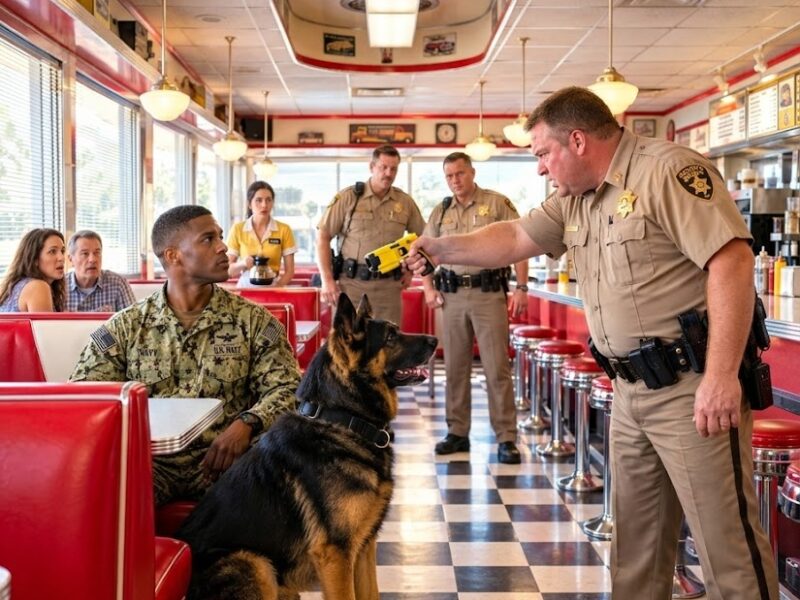
A corrupt captain threatened a Black soldier and his dog, thinking he had all the power. He had no idea he was an active-duty Navy SEAL.
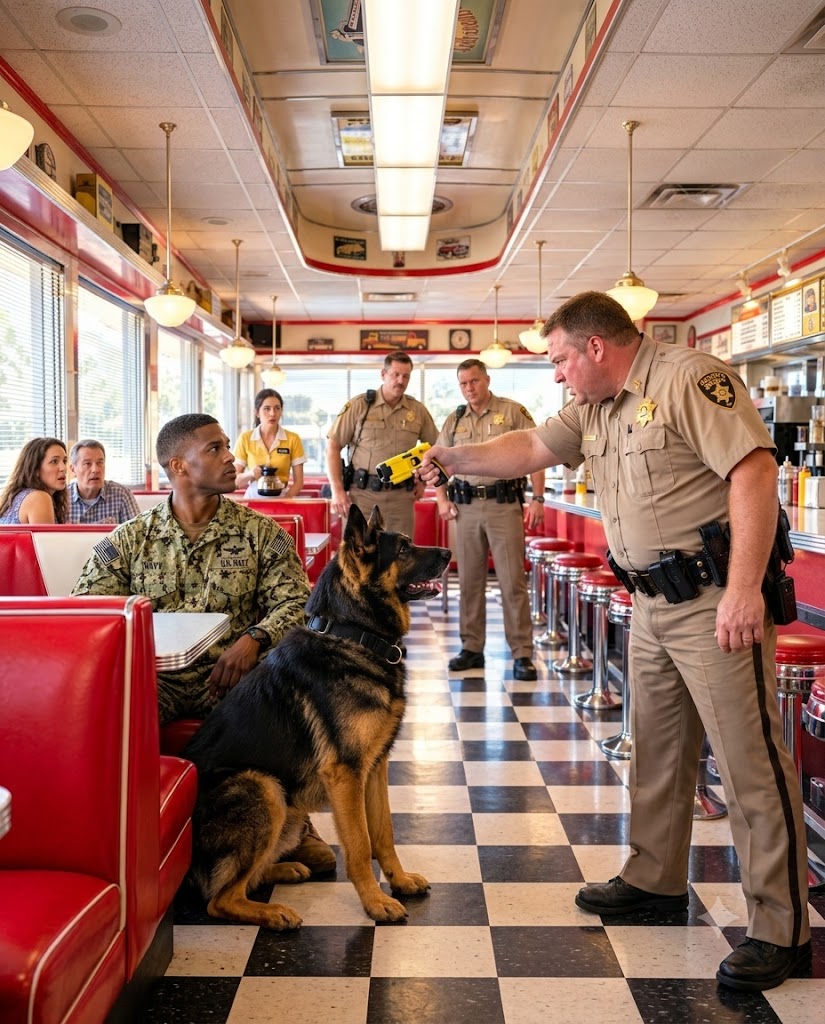
The August heat in South Georgia wasn’t like heat anywhere else in America. It was dense and personal, the kind that stuck to your skin like a second layer and followed you inside every air-conditioned building you tried to escape into. Captain Garvis Hollis had been running law enforcement in this forgotten corner of Worth County for eleven years, and he’d learned to wear the heat like a badge of honor. He sat in the corner booth of Fuller’s Crossroads Diner with his two deputies, watching the door the way a hawk watches a field mouse, waiting for something interesting to happen in a town where nothing ever did.
The bell above the diner door rang at 2:47 PM, and Garvis looked up from his sweet tea. A Black man walked in wearing a faded civilian t-shirt, worn jeans, and boots with red Georgia clay still packed into the treads. He moved with a quiet economy that Garvis immediately recognized as military, though he’d never admit it out loud. The man chose a booth along the side wall, back to solid brick, with clear sightlines to both exits. A massive German Shepherd followed close against his left leg, shoulders brushing the man’s knee, and disappeared under the table like a shadow melting into darkness.
Garvis watched the dog settle into position under the table, facing outward, and felt something cold crawl up his spine. He didn’t like big dogs. He didn’t like men who moved like they’d been trained to kill. And he especially didn’t like either of those things showing up in his county without his permission. He took a long sip of his sweet tea and waited, because patience was a virtue, and Garvis Hollis considered himself a virtuous man.
—
Develin had been driving for eleven hours when he pulled into Fuller’s Crossroads. His Ram 1500 had groaned along Highway 84, the AC fan rattling on its last bearings, the fuel gauge dipping well below a quarter tank. He had one hand on the wheel and the other resting on the center console where Rebel had wedged his enormous head, panting steadily, watching the flat pine country scroll past the passenger window. Rebel was a four-year-old German Shepherd with a coat the color of midnight and rust, 89 pounds of muscle and obedience. He had been trained alongside Develin through three overseas rotations, had earned his keep in places nobody filmed and nobody wrote about. He was not a pet in the conventional sense. He was a partner. He just happened to also love gas station jerky and sleeping on motel bedspreads.
Develin reached over and scratched behind the dog’s ear. Rebel leaned into it without breaking his surveillance of the highway. “We’re close,” Develin said. Rebel huffed and shifted his chin onto Develin’s thigh. The reason for this particular drive was a folded piece of paper in the glove compartment. On it was an address in Harlow, Georgia, written in Develin’s own handwriting nine months ago in a forward operating base outside Kandahar. He’d written it down the night his teammate Perry had died. Perry had bled out in a ditch while Develin held compression on his side and talked to him about Georgia sweet tea and his daughter Amara. Amara was seventeen, bouncing between foster placements since Perry deployed. In three weeks, she turned eighteen and the system would cut her loose entirely.
Perry’s last coherent words had been a question, not a statement. He’d looked at Develin and said, “You’ll check on her.” SEALs did not break promises, not the ones that mattered. The fuel gauge ticked lower. Develin spotted a hand-painted sign half swallowed by kudzu: Fuller’s Crossroads Gas and Eats. He pulled off the highway onto a cracked asphalt drive that led to a squat brick building with a corrugated tin awning over two gas pumps. A painted sign above the door read Fuller’s Diner, Est. 1961. A county sheriff’s cruiser sat parked dead center in the lot as though whoever drove it wanted to make sure it was seen. Develin noted it, filed it, drove to the pump farthest from the entrance.
He climbed out into the heat. It was like opening a furnace door. He walked around to the passenger side, opened it, and Rebel dropped down onto the asphalt with a soft grunt. Develin pulled a collapsible bowl and a water bottle from behind the seat, filled the bowl, set it on the ground. Rebel drank without ceremony. Develin put the nozzle in the tank and leaned against the truck while the pump ticked. Four vehicles in the lot besides the cruiser. Two flatbeds with farm mud on the wheel wells. A minivan with a cracked windshield. Nothing alarming, just the quiet of a Tuesday afternoon in a town that the interstate had bypassed years ago and left to shrink at its own pace.
He capped the tank, stowed the bowl, and walked toward the diner entrance with Rebel moving close against his left leg, shoulders brushing. He pushed through a glass door with a sun-faded decal of a peach on it. A small bell rang above his head. The cold air hit him like a reward. He read the room in three seconds. Eight customers in booths. Older couples. A man in overalls eating alone. A teenage boy with earbuds in. A young woman behind the counter in a yellow uniform, maybe twenty, with her dark hair pulled back and a coffee carafe in her hand. Her name tag read Tilly. She was already watching him. Not the way a server watches a new customer, but the way someone watches a situation they have seen go wrong before.
Her eyes moved to the back of the room. Develin followed them. Three men in County Sheriff’s tan occupied the corner booth. The two deputies, one lean and long-armed with a thin mustache, the other compact and flush-faced, had the practiced posture of men accustomed to looking ready without actually being ready. They watched Develin with the casual contempt of people who had never had to account for it. The man in the center was their captain. Captain Garvis was thick through the neck and thick through the gut, his uniform shirt straining at the second button. He had the face of a man who had spent decades having his way. Jaw like a cinder block, small gray eyes that moved slowly and rarely blinked.
He was chewing something methodically, watching Develin the way a man watches something he has already decided to step on. Develin chose a booth along the side wall. Good sightlines back to solid brick. He slid in. Rebel moved underneath the table, positioned himself facing outward, and went still. Only his eyes moved, tracking. The diner had gone quieter. The man in overalls paid his check without looking up and left. The teenage boy pulled out one earbud and stared at his phone, but wasn’t reading it. Tilly came to the table. Her hand trembled slightly against the laminated menu. She didn’t make eye contact.
“Just coffee, please,” Develin said. “Black, and whatever sandwich is fastest. Whatever your dog gets out back. Ground beef, table scraps, anything. I’ll pay double for a bowl of it.” “Yes, sir,” she said. A thread of relief in her voice, like his quiet made the air in the room slightly more breathable. She slipped away toward the kitchen. Then the sound of boots. Garvis came down the aisle the way men with unearned authority always move. Unhurried, deliberate, filling up the available space. His deputies came with him. They stopped at Develin’s booth. The captain planted both thick hands on the table edge, leaning in.
Develin looked up. “You passing through?” Garvis said. He did not say it like a question. “Yes, sir.” “Where from?” “Naval Air Station Jacksonville.” Garvis looked at the faded civilian t-shirt, the worn jeans, the boots with red Georgia clay still in the treads. He made a sound in the back of his throat, something between a laugh and a dismissal. “You don’t look military.” “I’m on personal leave.” Under the table, Rebel issued a sound so low it was more vibration than noise. Develin’s hand found the dog’s neck, firm. Still. Garvis shifted his gaze to the floor under the table. He looked at Rebel for a long moment. He straightened up slightly and turned to the lean deputy.
“Bodin, is there a leash law in this county?” Bodin, the lean one, pulled at his mustache. “Yes, sir, Captain. Posted at the county line.” “That right.” Garvis looked back at Develin. “You got a leash on that animal?” “He’s a trained military working dog. He doesn’t require a leash. He requires what I say he requires.” Garvis put one finger against the table and tapped it twice. Slow. “ID.” Develin reached into his front pocket. He drew out his wallet, removed his military common access card, and held it across the table. Garvis snatched it. He held it up, squinting. Then he handed it to Bodin the way you hand something obviously fake to a colleague so they can confirm it’s a joke.
Bodin turned the card over. He handed it to the stocky deputy, Cutter, who looked at it briefly and placed it on the table without handing it back to Develin. “I’d say this is a serious federal offense to forge,” Garvis said. “It’s not forged. The number on the back connects to the DoD verification line.” “I don’t need a phone call to tell me what I’m looking at.” Garvis leaned in again. He spoke softer now, which made it worse somehow. “I’ve been running this county for eleven years. I know the difference between a soldier and a man with a laminated card. What I can’t figure out is why you would drive through my town with a dog that size and no leash, no collar tag visible, no documentation. That animal looks aggressive to me.”
Rebel heard the shift in tone. The vibration in his chest deepened. “Easy,” Develin said quietly. Garvis looked at the dog. His expression changed just slightly, just enough. Something behind his eyes recalculated. He stepped back from the table and unclipped the yellow taser from his belt. He held it casually at his side, aimed nowhere in particular, which was also aimed at everything in particular. “That dog bites a citizen in this county, I have the authority to have it destroyed same day,” Garvis said. “You understand what I’m telling you? Destroyed before sundown.” Develin looked at the taser. He looked at Garvis. He kept his breathing even.
Nobody spoke for a long moment. Then Tilly came through the kitchen door with a coffee mug in one hand and a small bowl in the other. She stopped when she saw the taser. The coffee mug clinked once against the ceramic bowl. She looked at Develin as though she was genuinely sorry for whatever was about to happen to him. Some men break easy. They apologize. They comply. They surrender the space and the dignity together, and they call it being smart. Develin had spent fifteen years being shaped by institutions that demanded something different. He had been dropped into darkness and asked to find the exit. He had been compressed under pressure until everything soft had cooked off.
And what remained was the essential thing. Steady, quiet, unremarkable to look at, extraordinarily dangerous to underestimate. He did not look afraid. “You can call the verification line,” Develin said. “Or you can leave my dog alone and let me drink my coffee. Those are the two reasonable options I’m offering you.” Garvis’s face shifted through a shade Develin had seen before on men who couldn’t accept that someone wasn’t going to fold. His jaw tightened. He raised the taser to roughly chest level and pointed it at Rebel. “Cutter.” The stocky deputy snorted. Bodin crossed his arms and looked at a spot on the wall just above Develin’s head, the way people do when they’re watching something they want to pretend they’re not watching.
Tilly set the mug and bowl down on the nearest table without getting any closer and backed against the counter. Here is where the worst thing would have happened if worse things hadn’t arrived first. The front window of Fuller’s Diner exploded inward. The sound was enormous. Not a crack, a detonation. A black Suburban with its front grille ripped clean off smashed through the plate glass and half the brick facing. The engine screaming before it finally stalled six feet inside the dining room. Booths collapsed under the impact. A ceiling fan dropped from its mount and hit the counter, sending ceramic mugs spinning across the tile.
The dust came next, white and thick, swallowing the room. Develin was off the bench and under the table before the second fragment of glass hit the floor. Rebel was already beneath him, flat, silent, waiting. Three men came through the wreckage. They wore black tactical gear and balaclavas, moving fast and low, rifles up, professional entry. They had done this before. One took the left wall, one took the right, and the third, the tallest, moving with the kind of coiled precision that meant he was the one in charge, swept the center of the room and fired a three-round burst into the ceiling. “Everybody on the floor now! Hands where I can see them! Anyone moves, anyone screams, we start shooting!”
The screaming happened anyway. Short, reflexive, terrified, and then cut off as people dropped. The teenage boy overturned his table getting down. The couples in the booths pressed themselves flat against the linoleum. Tilly slid behind the counter and crouched against the cabinets, covering her head with both arms. Garvis and his deputies stood frozen in the center aisle. The tall leader tracked to them. He leveled the rifle. “On your knees. All three of you. Drop the hardware.” Bodin’s gun belt hit the floor before the man finished the sentence. Cutter’s taser followed. Garvis did not move for one long exposed second, and then something behind his eyes collapsed all at once, and he lowered himself to his knees with the slow, humiliated motion of a man whose entire identity had just dissolved.
His service weapon stayed holstered. He did not reach for it, not once. From his position beneath the overturned booth, Develin observed through a gap in the fallen table edge. Three shooters inside. One had stayed with the Suburban near the entrance. He could hear the engine turning over, trying to restart. Four total. The three inside were moving fast, ripping phones and wallets off the floor, off hostages, stuffing them into a duffel. They were not cartel. The movements were too rushed. The body language too jangled. Robbers, probably running from something. The interstate was twelve miles east and a burned Suburban meant a vehicle exchange. They needed the lot outside. They needed time. They were going to leave a body to buy that time.
Develin understood it the way you understand weather, not by thinking, but by reading what was already in the air. He reached to his right boot. The combat knife came free without sound. Matte handle, four-inch blade. He held it against his forearm and waited. The leader walked toward the kneeling police officers. He grabbed Garvis by the collar and shoved the barrel of his rifle into the underside of the captain’s jaw. “You’re the law out here, right? Sheriff? Captain? Whatever you call yourself in this hole.” Garvis said nothing. His face had gone the color of old wax. “I asked you a question, Captain.” Garvis said nothing. His voice was barely sound. “You got a radio. You call in this location, people die. You understand that?”
He released the collar, stepped back, and turned to sweep the room one more time. His eyes moved across the destroyed front wall, the cowering customers, the two kneeling deputies, and missed the gap in the fallen booth where a pair of dark eyes watched him without blinking. Develin had already chosen his sequence. He looked down at Rebel. Two taps on the shoulder. The dog’s ears came forward. He knew that touch. They had practiced it at Camp Lejeune, in warehouses, in total darkness, in conditions designed to break the partnership down to its smallest working unit and see if it held. It always held.
Develin pointed toward the far wall near the restrooms. Rebel moved like poured water. No sound, no hesitation. Body low against the floor. He disappeared into the shadows past the end of the fallen counter. Three seconds later, a metal utility shelf near the back hallway toppled over with a crash. Both flanking shooters spun toward the sound, their rifles tracked left. Develin came out from beneath the table. He covered the distance to the nearest man in four strides. Before the shooter could realign, Develin had the knife handle driving into the soft tissue below the man’s ear and his left arm wrapping the throat from behind.
He lowered the body to the floor in the same motion, controlling the descent, so it made no sound worth noting over the din of panic in the room. He took the man’s rifle, clicked the safety on, and shoved it beneath a toppled booth. Rebel appeared from the shadows on the right flank, moving parallel to the second shooter. The man was still tracking his rifle toward the collapsed shelf. Rebel covered eight feet in two seconds and hit the shooter at the knees from the side. The man went down hard, his rifle clattered. Rebel’s jaws locked onto the forearm above the weapon hand and held. Develin was there before the man could cry out. A precise strike with the heel of his palm to the jaw. The shooter went still.
The leader heard the commotion and spun. He fired twice into the dark toward the sound. Both rounds punching through plaster above the dropped counter. Then silence. He was breathing hard. His flashlight swept the room in jerking arcs, catching dust and overturned furniture, but nothing that moved. “Rise? Cortez?” he called. Nothing came back. A human being can recognize fear in their own chest and name it. What is harder to do is move through it. The leader was still moving. That was what made him dangerous. He swept back toward the hostages, raising the rifle, looking for leverage. Develin had circled behind him through the dark, using the ambient noise of the idling Suburban and the creaking of the settling roof debris to mask each step.
He was four feet behind the man. Three. Two. Rebel came from the left. The dog did not bite. He hit the back of the leader’s knees with ninety pounds of momentum, exactly as trained. The man’s legs folded. He was already going down when Develin moved in from behind, controlled the weapon arm with both hands, applied a joint lock, and used the man’s own collapsing weight to drive his face against the tile floor. It was over before the flashlight beam stopped moving. Develin zip-tied all three men with their own flex cuffs. He used dishcloths from behind the counter to secure their ankles and muffle potential noise. He carried each one clear of the exit path.
He found the fourth man, the driver, trying to restart the Suburban, having heard nothing clearly from outside over the engine noise. Develin opened the door, reached in, and had the man’s wrists behind his back before he could locate the door handle with his free hand. He pressed his encrypted military phone against the Suburban’s roof and hit the federal distress beacon. Fourteen characters, three seconds, it pinged the nearest federal coordinating office. Develin walked back inside. He found the electrical panel behind the counter, switched the lights on, and stood in the center of the ruined dining room with Rebel sitting at his left side, watching the room settle.
People looked up from the floor. They saw the three bound men near the counter. They saw the fourth outside through the broken wall, zip-tied to the steering column of the Suburban. They looked at Develin. Tilly stood up slowly from behind the counter. She stared at him for a long moment. Her hands were pressed flat against the cabinet behind her like she needed the surface to confirm the room was solid. “Are they—” she started. “They’re secure,” Develin said. “Stay where you are until federal response arrives.” Garvis was still on his knees in the center of the aisle. His deputies had risen to a crouch on either side of him, but had not moved further.
The captain’s hands hung at his sides. His face carried something that looked like the first honest expression he’d worn all day. Not fear exactly, but the particular blankness of a man watching the story he had told about himself become impossible to believe. He looked at Develin. He looked at Rebel. He looked at the three bound shooters. He looked at the taser still clipped to his belt, which he had not once raised against a real threat, only against a man and a dog in a diner booth. He opened his mouth. Nothing came. Develin crossed to his table. His military ID was still sitting on the edge where Cutter had left it. He picked it up, wiped the surface with the edge of his shirt, and returned it to his wallet.
Sirens reached them before the dust had fully settled. Special Agent Teague arrived in the first vehicle, a black SUV that stopped hard in the gravel lot. She was in her forties with close-cropped silver hair and the unhurried precision of someone who had stopped being impressed by chaos years ago. She cleared the entrance, took in the scene in about three seconds, and holstered her weapon. “Who activated the beacon?” she asked. Develin raised a hand. Teague looked at the four bound men. She recognized the leader. Develin could tell by the way her jaw shifted. She crouched next to him, checked his face, and stood back up. “That’s Harlon Cobb. We’ve been running his crew for eight months.”
She looked at Develin. “Four of them. Just you?” “Me and my dog.” Behind Teague, two of her agents were already photographing the scene. A third was on a radio. Beyond the broken wall, additional vehicles were arriving, parking in a wide perimeter around the lot. Garvis found his voice. He used it badly. He stepped forward and addressed Teague with the practiced authority of a man who had never once had that authority refused. “Agent, this individual was the source of the disturbance in my establishment. He provoked these men with his animal. He refused lawful ID verification and when the situation became dangerous, his actions endangered every civilian in this room. I am requesting—”
“Captain.” Teague did not raise her voice. She simply said the word with a specific weight. “I’m going to need you to wait outside.” Garvis stopped. “I am the ranking law enforcement officer in this—” “Tilly,” Teague said, turning to the young woman behind the counter. “Is there a security camera in here?” Tilly pointed to a small black unit mounted above the kitchen door, its red indicator light blinking steady. “Battery backup,” she said. “Cloud upload. It’s been running the whole time.” A long silence filled the room. Garvis looked at the camera. Something passed through him, through his shoulders, through his chest, through whatever it was that had kept him standing upright for eleven years in this county. He looked like a structure after the load-bearing wall has been removed. Still standing, technically. Not for long.
Teague did not arrest him there. She asked for his badge and his weapon, and she got both without resistance. She asked him to wait by his cruiser with two federal agents stationed nearby, and he went. Bodin and Cutter followed without being asked. Teague walked over to Develin. She extended her hand and he shook it. “We’ll need a statement,” she said. “It can wait until you’ve eaten something.” Develin nodded once. He looked at Tilly, who had set a fresh cup of coffee on the counter and was sliding a plate next to it. She’d also found a bowl somewhere and filled it with what looked like chopped roast beef from the kitchen.
Rebel sat at Develin’s feet while he ate. The dog’s ears stayed up and rotating for the first twenty minutes, tracking the federal agents moving through the space. Then, gradually, they lowered. His head dropped to his paws. The room was safe. Nothing left to watch. Develin finished his coffee and carried the bowl to Rebel, who cleaned it without rushing. He paid Tilly in cash, overtipping by a margin that made her stare at the bills for a moment before looking up at him with something in her face he didn’t have a name for. He shook Agent Teague’s hand again outside, gave his statement in full, provided his command contact information, and declined a ride.
His truck was untouched near the far pump, sitting exactly where he had left it, under the thin shade of a roadside pine. Rebel jumped in first. Develin started the engine. There was a folded piece of paper in the glove compartment with an address in Harlow. He pulled it out and set it on the dash. Then he pulled out of Fuller’s Crossroads and back onto Highway 84. Heading south, the windows cracked, the late afternoon light going amber across the pine fields. Some people in that diner would spend years trying to explain what they saw. They would tell the story at kitchen tables and church breakfasts and on phone calls with cousins.
They would describe a man who didn’t shout, didn’t run, didn’t beg, and didn’t break. Not when a taser was pointed at his dog, and not when automatic rifles filled the room. They would struggle with the part where they admitted they hadn’t seen him move. One moment the room was chaos. The next it was over and he was standing in the middle of it with the same stillness he’d walked in with. Power announces itself loudly because it is afraid of what happens when the room goes quiet. Real strength doesn’t announce anything. It just shows up when the darkness comes, does what needs doing, and drives away on a highway nobody else is watching.
Develin had a promise to keep. The road ahead was long and flat and clear all the way to the horizon. Rebel put his head out the window and let the wind take him. Somewhere south on that highway, there is a seventeen-year-old girl named Amara who doesn’t know yet that her father’s last thought was of her, or that a man she has never met has been carrying that thought across eleven hours of Georgia highway to make sure she doesn’t disappear from the world the way her father did. She will find out soon. And that is the only ending that ever mattered.
—
The federal investigation into Captain Garvis Hollis unfolded over the following weeks like a slow-motion collapse. Agent Teague’s team pulled the diner’s security footage, which showed everything: the taser pointed at Rebel, the threats, the captain’s complete failure to act when real danger arrived. But that was just the beginning. A routine audit of Worth County Sheriff’s Department records revealed discrepancies going back years. Evidence logs that didn’t match case files. Civil asset forfeiture accounts that had been drained and replenished in patterns that made forensic accountants blink twice. Arrest records for Black residents that outnumbered white residents by a ratio of 7 to 1 in a county that was 34 percent Black.
The numbers told their own story. In eleven years, Captain Hollis had overseen 2,847 arrests. Of those, 2,103 were Black men and women. Of the 2,103, only 187 had resulted in convictions. The rest had been released without charges, but not before their cash, their vehicles, and in forty-three cases, their homes had been seized under civil forfeiture laws. The total value of assets seized during Hollis’s tenure was estimated at 2.3 million dollars. Only 180,000 dollars could be accounted for in department records. The rest had disappeared into a network of accounts that Agent Teague’s team was still untangling when the first federal indictments came down.
The diner footage went viral within seventy-two hours. Not because anyone leaked it, but because Tilly had posted it herself, from her phone, standing behind the counter with shaking hands. She’d watched the whole thing unfold, had seen the captain point a taser at a man and his dog for no reason, had seen that same man save every life in the room without breaking a sweat. She posted the video with a simple caption: “This is what happened at my job today. Make of it what you will.” The video had 4.7 million views by the end of the week. The hashtag #FullersCrossroads was trending in eleven countries.
Develin didn’t watch the news. He didn’t have social media. He was too busy keeping a promise. He found Amara in a rundown foster home on the outskirts of Harlow, a town that made Fuller’s Crossroads look like a metropolis. She was sitting on a front porch step with a backpack between her feet, waiting for a caseworker who was three hours late. She was seventeen, with her father’s eyes and her mother’s stubborn jaw, and she looked at Develin the way a stray dog looks at a hand reaching toward it. Not quite afraid, but not quite ready to trust. “You knew my dad?” she asked. “I served with him,” Develin said. “He asked me to check on you.”
She was quiet for a long moment. Then she said, “He always said he’d come back. He always said he’d get me out of this place.” “He tried,” Develin said. “He ran out of time. But he didn’t run out of love. That’s why I’m here.” Amara looked at Rebel, who was sitting patiently at Develin’s side, watching her with calm brown eyes. “That your dog?” “That’s my partner.” “He bite?” “Only bad guys.” She almost smiled. Almost. “You got a place to stay?” Develin asked. “Not really. Caseworker’s supposed to find me something before my birthday. But she’s not exactly reliable.”
Develin reached into his pocket and pulled out the folded piece of paper. He handed it to her. It was the address of a small house in Harlow, a place he’d arranged through a veterans’ housing program, paid for with his own savings. The paperwork was already done. The keys were in his truck. “Your dad wanted you to have a home,” he said. “This isn’t much, but it’s a start. You turn eighteen in three weeks. You can either take a chance on the system, or you can take a chance on me.” Amara stared at the paper. Her hands were trembling. “Why would you do this?” “Because your father was my brother. And because I made him a promise. And because you deserve better than what you’ve been given.”
She looked at him for a long time. Then she picked up her backpack and stood. “Okay,” she said. “Okay.” They drove to the house in silence. It was small, two bedrooms, a kitchen that needed work, a yard that needed mowing. But it was hers. Amara walked through every room, touching the walls, opening closets, standing in the kitchen with her hands on the counter like she was testing whether it was real. When she came back to the living room, her eyes were wet. “My dad used to talk about Georgia sweet tea,” she said. “He said it was the best thing in the world. He said he’d make it for me someday.” Develin nodded. “I know. He told me that too.”
He walked to the kitchen, found a pitcher in the cabinet, and made sweet tea the way Perry had described it: three family-sized tea bags, a cup of sugar, a pinch of baking soda, cold water, and patience. He set the pitcher in the refrigerator and handed Amara a glass. She took a sip and closed her eyes. “It’s good,” she said. “It’s really good.” Rebel wagged his tail once, slowly, like he understood. And maybe he did. He was a smart dog. He’d seen a lot of things in his four years. He’d seen darkness and danger and the worst that people could do to each other. But he’d also seen this: a promise kept, a girl saved, a family found.
—
The trial of Captain Garvis Hollis lasted six weeks. The federal prosecutor, a sharp-eyed woman named Martinez, built her case with the precision of a surgeon. She called forty-three witnesses. She introduced 2,847 pages of documents. She showed the jury the diner footage three separate times, each time pausing on the moment when Hollis pointed his taser at Rebel and grinned. “This is what corruption looks like,” Martinez said in her closing argument. “It looks like a man who has been given authority and has used it to terrorize the very people he swore to protect. It looks like a man who saw a Black man with a dog and decided, without evidence, without cause, without a single legitimate reason, that he was going to destroy them both. It looks like a man who forgot that the law applies to him too.”
Hollis was convicted on seventeen counts: civil rights violations, evidence tampering, theft of government funds, and one count of attempted assault with a deadly weapon. He was sentenced to twenty-three years in federal prison. Bodin and Cutter, his deputies, received lesser sentences for their complicity. The 2.3 million dollars in seized assets was ordered returned to the victims, though by then, many of them had moved away, unable to wait for justice. Some had lost their homes, their businesses, their savings. The money helped, but it didn’t undo the damage. Nothing could undo the damage.
Agent Teague called Develin the day the verdict came down. “I thought you’d want to know,” she said. “He’s going away for a long time.” “Thank you,” Develin said. “That’s good to hear.” “The department is under new leadership. The governor appointed a special overseer. They’re going through every case Hollis touched. There’s going to be a lot more indictments before this is over.” “Good.” “You know, we couldn’t have done this without you. The footage was the key. But you’re the one who made it happen. You’re the one who stopped them.” Develin was quiet for a moment. “I was just in the wrong place at the right time.” “No,” Teague said. “You were exactly where you needed to be. And you did what needed to be done. That’s not luck. That’s character.”
Develin didn’t know what to say to that, so he said nothing. Teague filled the silence. “How’s Amara?” “She’s good. She’s starting community college in the fall. Wants to study criminal justice.” Teague laughed. “Of course she does.” “She’s got her father’s stubbornness. And his sense of right and wrong.” “Sounds like she’s got a bright future.” “She does. She’s got a lot of people looking out for her now.” “Including you?” Develin looked across the room. Amara was sitting at the kitchen table, studying for her GED, with Rebel asleep at her feet. She looked up and caught his eye, and smiled. “Yeah,” Develin said. “Including me.”
—
Six months later, Develin received orders for another deployment. He’d known it was coming. He’d been on personal leave for long enough. The Navy needed him back. But before he left, he did something he’d been thinking about since the day at Fuller’s Crossroads. He drove back to the diner. The building had been repaired, the windows replaced, the brick facing restored. A new sign above the door read “Fuller’s Crossroads Diner and Family Restaurant.” Tilly was still working there, still wearing the yellow uniform, still pulling her dark hair back. When she saw Develin walk in with Rebel at his side, she smiled. “You came back,” she said. “I came back.” “You want the usual?” “Coffee. Black. And whatever sandwich is fastest.”
She laughed. “You got it.” She brought the coffee and a turkey club on sourdough. Rebel got a bowl of chopped roast beef, on the house. Develin ate slowly, watching the room. It was full now, filled with families and couples and teenagers and old men in overalls. The corner booth where Garvis had sat was occupied by a young couple with a baby. The ceiling fan had been replaced. The floor was new tile, polished and clean. It was just a diner. Just a place to eat. But it was also a reminder. Of what had happened. Of what had been stopped. Of what could happen anywhere, in any town, to anyone.
Tilly came back with a fresh cup of coffee. “You hear about the captain?” she asked. “I heard.” “Twenty-three years. He’s going to die in prison.” “He should have thought about that before he pointed a taser at your dog.” Develin smiled. “He should have.” “You know, I still have the video. I keep it on my phone. I watch it sometimes, when I need to remember that there are still good people in the world.” “There are,” Develin said. “More than you think.” Tilly looked at Rebel, who was licking the last of the roast beef from his bowl. “He’s a good dog.” “He’s the best.” “You going to be okay? Wherever you’re going?”
Develin thought about it. He thought about the darkness and the danger and the places nobody filmed and nobody wrote about. He thought about the men he’d lost and the promises he’d kept. He thought about Amara, who was safe and studying and smiling. He thought about Rebel, who was loyal and brave and always ready. “Yeah,” he said. “I’m going to be okay.” He finished his coffee, paid his bill, and walked out into the Georgia heat. It was still dense and personal, still stuck to his skin and followed him outside. But it didn’t bother him. He’d been through worse. He’d survive this too.
Rebel jumped into the truck and settled into the passenger seat, head on the center console, eyes on the road ahead. Develin started the engine and pulled out of Fuller’s Crossroads. He had a long drive ahead of him. He had a promise to keep. And he had a dog who would help him keep it. Somewhere south, a seventeen-year-old girl named Amara was studying for her finals. Somewhere north, a corrupt captain was sitting in a federal prison, counting the days until he died. And somewhere in between, a Navy SEAL was driving down a highway nobody else was watching, doing what needed to be done, one mile at a time.
The road stretched out before him, long and flat and clear all the way to the horizon. Rebel put his head out the window and let the wind take him. Develin turned up the radio, found a country station, and listened to a song about home. He wasn’t sure where home was anymore. Maybe it was a diner in the middle of nowhere. Maybe it was a small house in Harlow with a girl who drank sweet tea and a dog who slept on the bedspread. Maybe it was wherever he was, as long as he was doing the right thing. He didn’t know. But he knew this: he had a promise to keep. And he would keep it. No matter how long the road. No matter how dark the night. No matter what.
That was what it meant to be a SEAL. That was what it meant to be a man. That was what it meant to be alive.









