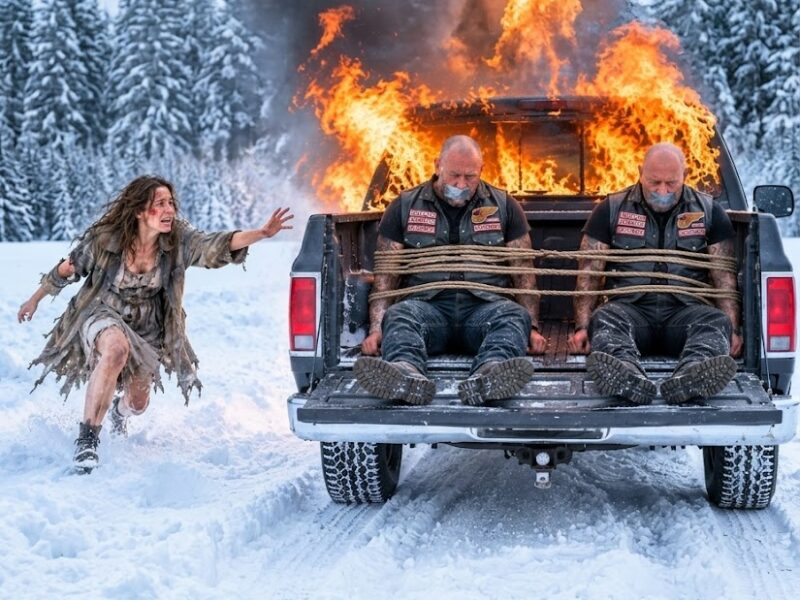
A burning truck. Four Hells Angels trapped inside. Everyone ran. Then a poor old lady walked toward the flames.
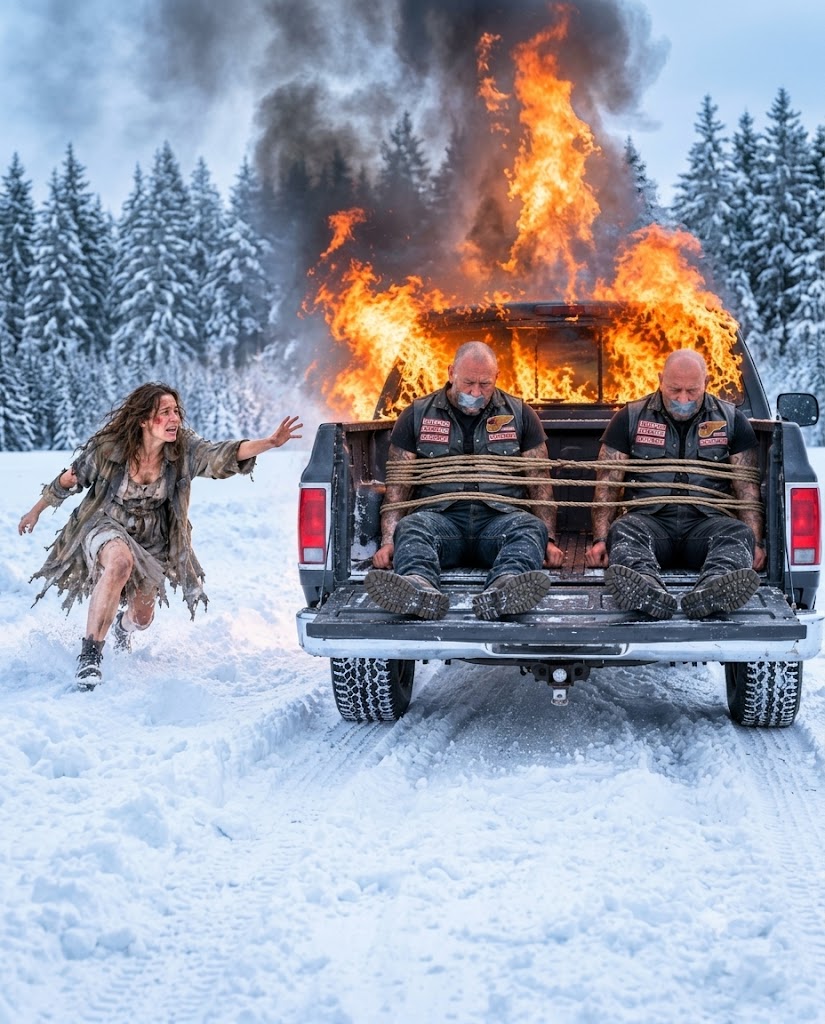
A boot slammed into the side of a flatbed truck. Flame licked up from under the hood, orange and hungry.
A man screamed for water. Three others beat at the fire with their bare hands and got nothing but burns.
Smoke rolled black across the parking lot. Phones went up. Dozens of them.
Nobody moved to help. People just laughed and filmed the men choking on the heat.
Then a screen door banged open at the back of the diner. An old woman came out at a dead run, gray hair loose, a steel extinguisher hugged against her chest and a soaked horse blanket over one shoulder.
71 years old. Her name was Naen Voss, and she ran straight into the smoke while the whole town watched and did nothing.
What made a frail widow charge a burning truck for men everyone else despised? Stay with me on this one.
Let me take you back about 20 minutes, because you need to understand who this woman was before you understand what she did.
Naen Voss had worked the counter at the Red Mesa Diner for 31 years. Same cracked vinyl booths. Same coffee that tasted like it had been poured through an old boot.
The place sat alone off Route 66, just east of Barstow, where the highway runs flat and the heat comes up off the blacktop in waves you can see. In the summer, the thermometer on the wall by the register regularly hit 110.
That afternoon, it read 106, and it wasn’t even 3:00.
She was a small woman. Thin wrists, hands that shook a little now when she carried a full tray. Her husband Earl had been gone four years.
His heart gave out one morning while he was feeding the mule, and she found him sitting against the fence post like he was just resting. After the funeral, there wasn’t much left. The bank took most of it.
What stayed was the little lot behind the diner, the single-wide she lived in, and Dutch.
Dutch was the mule. Old, blind in both eyes, gray around the muzzle. Earl had rescued him off a kill truck 20 years back, and the two of them had been inseparable.
Now Dutch was Naen’s. She couldn’t afford him, couldn’t really afford herself, but she’d sooner have stopped eating than sell that animal.
He was tethered out back of the diner that day in a patch of shade. And when things started happening, he was the first one to know.
Now, here’s the thing you have to understand about that town. It was small, and it was mean in the way small places sometimes get mean.
There was a man named Cole Hagerty who ran the towing yard and the only garage for 40 miles. Big fellow, loud, the kind of man who’d never been told no in his life and had decided that made him important.
He held paper on half the businesses on that stretch of road, and he’d been circling Naen’s lot for a year, telling her the land would make a fine truck yard, and she’d be smart to sell before the county condemned her trailer.
She always told him the same thing. The land wasn’t for sale. Earl was buried on it.
So that was the stage. A worn-out diner, a broke widow, a blind mule, a bully with money. And on a day hot enough to cook an egg on the hood of a car, six riders came rolling off the highway with their bikes loaded on a flatbed hauler, because one of them had blown a transmission near Needles, and they were trailering the dead bike home to the coast.
They pulled into the lot to cool the engine and grab water. And that old flatbed, pushing a load in that heat, just gave up. A fuel line cracked.
By the time the lead rider popped the hood, there was fire.
The men were big, like the patches promised. Military big. Some of them thick-necked, crew cuts going gray, forearms like fence rails. They wore the colors, the death’s head, the bottom rocker.
And the second this town saw those patches, something ugly woke up. Because nobody came to help.
That’s the part that matters.
Cole Hagerty’s yard was 200 yards up the road. He had a tanker truck. He had extinguishers lined up on a wall. He had everything those men needed. And he stood in his own lot with a cold drink in one hand and his phone in the other, filming, grinning, calling out to the men to let the bikers burn.
His buddies gathered around him. The folks who’d been eating lunch drifted out into the lot, and not one of them lifted a finger.
They filmed. They cheered. A couple of them cheered when the flames jumped higher. One man yelled that it was the best show the town had seen all year.
Six men, one burning truck, 106 degrees, and an entire town standing in a half circle with their cameras up, waiting to watch something terrible happen.
Inside the diner, Naen Voss was wiping down the counter when she smelled the smoke. She looked up through the window and saw the flames, saw the men swatting at the fire, saw the crowd, and she saw something the crowd didn’t bother to see because they were too busy enjoying it.
She saw that one of those men was trapped.
The passenger door of the truck cab had jammed. And the youngest of the riders, a kid really, couldn’t get out, and the fire was climbing the frame toward the fuel tank.
She didn’t think about who they were. She didn’t think about the patches.
She grabbed the big red extinguisher off the kitchen wall, the one Earl had made her promise to check every spring, and she snatched the horse blanket off the hook by the back door, the one she used on Dutch in the cold months.
She dunked it in the mop sink on her way past, and then this 71-year-old woman shoved through the screen door and ran. Not walked. Ran toward a fire everyone else was running away from.
So now you’re caught up to where we started. The screen door banging, the old woman in the smoke.
Let me tell you what happened next, because this is where everything turned.
Naen hit the pin on that extinguisher without breaking stride and swept it low across the base of the fire, the way Earl had taught her a lifetime ago. Earl had been a volunteer with the county back when the county still had volunteers. And he drilled it into her: low and side to side, hit the fuel, not the flame.
White powder blasted into the fire and knocked it down a foot. Then another foot.
The men stared at her for half a second like she’d fallen out of the sky. Then the lead rider, the old one with the long gray beard, understood what she was doing and moved in beside her.
She shoved the wet blanket at him and pointed at the kid trapped in the cab. He threw the blanket over the kid and wrenched the jammed door with both arms until the hinges screamed and gave. And he hauled the boy out through the smoke by the back of his vest.
Naen kept working the extinguisher until it sputtered and died. The fire wasn’t out. She dropped the empty can, grabbed the smoking blanket off the ground, and started beating the flames along the truck bed where the bikes were strapped, driving them back inch by inch.
Her forearms blistered. She didn’t stop.
Two of the riders snapped out of it and started throwing dirt from the lot, big double handfuls of it, choking the fire where she knocked it down. And the whole time, out back, Dutch was braying.
That old blind mule had smelled the smoke and heard his person’s voice pitched high and scared, and he was stamping and pulling at his tether and calling out across the lot in that broken-horn bray of his over and over, like he was trying to come help her himself.
They got it out. Six men and one old woman and a mule screaming in the background, and they got that fire out before it reached the tank.
When the last of the flames died into black smoke and the smoke thinned off to nothing, Naen was on her knees in the gravel, coughing so hard she could barely breathe. The ruined blanket still clenched in both fists.
The lead rider knelt down next to her, put one huge scarred hand on her shoulder, careful like she might break. He asked if she was all right.
She couldn’t talk yet, so she just nodded.
And then, because she was Naen Voss, and because the gear mattered to those men whether anybody else cared or not, she pointed at the saddlebags and the duffels that had been thrown clear of the cab, smoldering in the dirt a few feet from the fire. She tried to crawl toward them.
The rider stopped her, told her, “Easy, easy.” And he and his brothers dragged the men’s gear clear of the hot metal themselves and stamped out the embers.
Across the lot, the crowd had gone quiet. The phones were still up, but nobody was cheering now. Cole Hagerty’s grin had gone stiff on his face, because a 71-year-old waitress had just done, with a rusty extinguisher and a horse blanket, the thing that 40 grown men had stood there and refused to do.
The young rider, the kid who’d been trapped, was sitting in the dirt with his face in his hands, shaking. One of the older men crouched over him, checking him for burns. He had a few on his hands, nothing that wouldn’t heal.
He was alive. A minute later, and he wouldn’t have been. Everyone in that lot knew it.
Naen finally got her breath. She looked around at these six enormous strangers covered in soot. And the first thing she said, the very first thing, was, “Did anybody need water?”
Because she had a whole icebox of it inside, and it was free, and they all looked half cooked.
The lead rider laughed. It came out rough, almost broke in the middle. He helped her to her feet, and then he did something that made the crowd murmur. He took off his sunglasses, and there were tears cutting clean lines down through the soot on his face.
And he said, “Ma’am, I have been riding 50 years, and I have never seen anything like what you just did.”
She waved it off. Told him it was nothing. Told him anybody would have done the same.
But they wouldn’t have. That was the whole point. Forty people hadn’t.
She took them inside, out of the heat. Sat them down in her booths, these giant men who didn’t fit in the booths, and she brought them ice water and wet rags for their burns, and a first aid kit from under the register.
She fussed over the kid like he was her own grandson. She made them coffee nobody wanted and apple pie everybody ate. And for a little while, the fear drained out of the afternoon, and it was just a tired old woman taking care of six men because that’s who she was.
She told the owner she’d pay for the pie out of her own tips. That’s the kind of broke she was. She just saved a man’s life, and her first worry was that she’d given away $3 of someone else’s pie.
The men thanked her. They tried to give her money, a thick fold of it, and she wouldn’t take a dollar. The lead rider wrote something on a napkin and tucked it under the sugar jar.
Then they went back out to see what could be saved of the truck. The fire was out. The danger was over. The crowd had wandered off, bored now that nothing had burned down.
Naen went back behind her counter and picked up her rag and started wiping down the Formica like it was any other Tuesday. Her heart finally slowing, thinking the worst of the day was behind her.
She was wrong about that. The worst of it hadn’t even started.
The screen door opened again. But it wasn’t a biker who walked in. It was Cole Hagerty.
He came in slow, filling the doorway with two of his yard hands behind him, and he wasn’t grinning anymore. He was furious.
He walked up to Naen’s counter, leaned over it, and he said in a low, mean voice that she just made the whole town look like trash in front of a pack of criminals. That there were cameras. That it was going to be all over the internet by nightfall, and it was going to be on her.
See, that’s the part Naen hadn’t understood yet. She thought she’d put out a fire. What she’d actually done was hold up a mirror, and every soul in that lot had seen exactly what they looked like in it.
And people will forgive you almost anything before they’ll forgive you for that.
Hagerty told her the county was condemning her trailer at the end of the month. Said he had the paper signed. Said her lot was going to be his truck yard after all, and the mule was going to the auction. And if she had a problem with it, she could take it up with his cousin, who happened to be the man who signed condemnation orders for the county.
He said it right there at her counter, loud enough for the last customers to hear, and nobody said a word in her defense, because this wasn’t about a fire anymore.
This was about a woman who’d shamed a town, and a rich man who held the paper on her life, and the law being his cousin.
The story had changed its nature right in front of her. It had stopped being about flames. Now it was about whether a broke old widow could keep the only two things she had left: her land and her mule. And every piece of power in that county was lined up on the other side.
Naen stood there with her rag in her hand and felt her legs go weak under her, because she knew Hagerty wasn’t bluffing. She’d seen the surveyor’s stakes in her lot last week and told herself they were nothing.
They weren’t nothing. The man had been building this a long time, and today had just given him the excuse to swing the hammer.
He told her she had 30 days. He turned to leave, and on his way out, loud so the whole diner could hear it, he said it was a shame a woman her age didn’t have the sense to mind her own business.
The door banged shut behind him.
And I want to pause here, because if you’ve ever watched somebody small get crushed by somebody big just for doing the right thing, this is the part where it sits in your chest.
Naen put out a fire that would have killed a man. And her reward was losing her home and her mule and getting called a fool in front of her neighbors. That’s how it goes a lot of the time. The good thing gets punished.
But not this time.
If you’re still with me, and I hope you are, do me one favor and hit that subscribe button, because the turn that’s coming is the whole reason I wanted to tell you this story, and I don’t want you to miss it.
Here’s what Naen didn’t know. While Hagerty was threatening her, the lead rider, the old gray-bearded one, had come back inside for the napkin he’d left under the sugar jar, and he’d heard every word of it from the back booth.
He hadn’t said anything. He just stood there in the shadows by the kitchen with his jaw tight, and then he’d walked back out to his brothers.
And here’s the other thing Naen didn’t know. When they’d been dragging the men’s gear clear of the fire, one of the saddlebags had come open, and some of her own things had gotten mixed in, because she dropped the burnt blanket right on top of the pile.
When the riders were sorting it out, the lead rider found a folded patch in the dirt, half scorched, that hadn’t come off any of their vests. It was old, older than any colors he was wearing.
And he knew it the second he saw it, because there were only a few dozen of them ever made.
It was a memorial patch, a specific one made for the men of a charter that had ridden together in the ’60s and ’70s. Most of them Vietnam vets. A lot of them gone now.
He turned it over, and stitched on the back, with thread gone brown with age, was a name. Voss.
The rider stood very still in that lot, holding a patch with the name Voss on it, and then he looked back at the diner, at the little gold letters on the door.
Voss, it said, under the hours. Property of N. Voss.
He walked back inside. Naen was leaning on her counter with her eyes shut, trying not to cry in front of the last customers.
He set the scorched patch down gently on the Formica in front of her, and he asked her, real quiet, where she’d gotten it.
She opened her eyes, and when she saw what was lying there, her face just came apart. She picked it up with both shaking hands and held it to her chest.
She said it belonged to her Earl. And she said it like a prayer.
The rider asked her to say the name again. She said it again. Earl Voss.
And this huge old man who’d ridden 50 years and had seen about everything a life on the road can show you put one hand over his mouth and had to sit down, because he’d known Earl Voss 50 years back.
They’d been boys together in a jungle on the other side of the world. And they’d come home broken the way those boys came home broken, and they’d found each other again on two wheels when nobody else would have them.
Earl had pulled him out from under a burning jeep in 1969 and carried him half a mile with a bullet in his own leg. Earl Voss had saved his life in the war.
And then Earl Voss had faded out of the life, quiet, when he married a girl named Naen and settled down to grow old in the desert. The club had lost track of him. They’d never known he died.
And now, 50 years and 10,000 miles later, Earl’s widow had just run into a fire and pulled his brother’s son out of a burning truck. And she hadn’t known any of it.
She’d done it for nothing, for strangers, because it was right.
That boy in the cab, the one she saved. He was that old rider’s grandson.
The rider’s name was Clyde Mercer. They called him Preacher, because he’d buried more brothers than any man should.
And Preacher stood up in that diner, and he looked at Naen Voss, and he told her everything. How he’d known her husband, what Earl had done in the war, that the boy she’d saved was his own flesh and blood, and that she wasn’t a stranger to them and never had been.
She was family. She’d been family for 50 years and just hadn’t known it.
Naen sat down in a booth and cried like the four years since Earl died had all come at once.
Now, this is the payoff. So let me slow down and tell it right, because it all happened over the next three days, and the whole town got to watch.
Preacher made some calls. You have to understand what that means when a man like that makes some calls.
By the next morning, the lot of the Red Mesa Diner was full of motorcycles. Not six. Sixty. Then more.
They came in off the highway in a thunder you could feel in your back teeth, from charters all over the state and some from further than that. Every one of them there for one reason.
Earl Voss’s widow had stood alone in a fire for a brother’s kin, and the club does not forget a thing like that. Ever.
That’s the one thing those men keep when they’ve lost everything else. They remember who stood up for them, and they pay it back.
They didn’t come to make trouble. That’s what everybody in town was braced for. And it’s not what happened.
They came to work. They rebuilt her. That’s the simplest way I can say it.
A crew of them tore the rotten skirting off her single-wide and found the real reason the county was condemning it, which was a cracked foundation pier that Hagerty’s own cousin had flagged. And they poured a new one in an afternoon.
They had tradesmen in that club. Electricians and welders, and a man who did nothing but inspect buildings for a living, and he walked the county inspector through every line of code until there was no condemnation left to sign.
They fixed the roof. They fixed the diner’s sign so it lit up at night for the first time in a decade. They built Dutch a real shelter, with a shade roof and a water line, so that old blind mule never stood in the sun again.
And then there was the matter of Cole Hagerty.
Preacher paid him a visit. Took a dozen men and did it in broad daylight, in the middle of Hagerty’s own truck yard, with phones filming, because Preacher wanted it on the record.
He didn’t lay a hand on the man. Didn’t have to.
He stood there, this mountain of a man, and he told Hagerty, calm as Sunday, exactly what was going to happen.
He laid out that the club’s lawyers, and they had good ones, were already looking into how a county inspector came to be condemning the property of the one business owner his cousin wanted to buy out. He mentioned, real friendly, that the state attorney general’s office had a tip line for exactly that kind of thing, and that 50 bikers with phones had footage of Hagerty standing in his own lot with a tanker truck full of water, filming six men almost burned to death and telling his men to let them cook.
He asked Hagerty how he figured a jury would feel about that footage. He asked how the man’s insurance company would feel. How the bank that Hagerty leaned on would feel, once they understood their favorite customer was about to be the most famous coward in California.
Hagerty folded like a paper chair.
The condemnation order disappeared. The cousin took early retirement two weeks later, right before the county opened a review of every order he’d signed in five years. The surveyor stakes came out of Naen’s lot.
And the paper Hagerty held on the diner, the note he’d been using to squeeze her, got bought out and torn up, because the club took up a collection. Sixty men, and then 600 online once the video went around, and they paid Naen Voss’s debt down to zero and handed her the deed free and clear.
Free and clear. First time in 31 years that land had belonged to anybody but the bank.
The video, by the way, went everywhere. Not Hagerty’s cruel one. A different one. Somebody in the crowd had filmed the whole thing. The old woman running into the smoke while the town laughed. And once the real story got attached to it, it got watched a few million times.
The town that had stood there filming got to see itself exactly as it was. And the woman they’d called a fool got letters and cards and money from strangers all over the country who’d seen what she did and needed to believe people like her still existed.
She gave most of it away. Of course she did. She fixed up the diner, took care of Dutch, and the rest went to the county food bank and the volunteer fire outfit Earl used to ride with.
That was Naen.
Let me take you to the last morning, because it’s where this ends, and it ends the way it started, except turned all the way around.
It was early, before the heat. Naen came out the back of the diner with a bucket for Dutch, same as every morning for 20 years. Only now the lot wasn’t empty, and the mule wasn’t standing in the dirt.
Dutch had his new shelter, and the shade roof over it, and the water line Preacher’s men had run. The old mule heard her boots on the gravel and let out that broken-horn bray of his, happy, and leaned his blind gray head against her chest the way he always did.
And parked in a long row across the whole front of the lot were the bikes.
The men had stayed. Not all 60, but Preacher had stayed, and his grandson, the boy she’d pulled out of the fire, and a handful of the others, and they’d made it known up and down that highway that the Red Mesa Diner was under the club’s protection now, and that the woman who ran it was Earl Voss’s widow, and that was the end of any conversation anybody wanted to have about it.
The boy, the one she’d saved, had started showing up every morning to help her open. He wasn’t much of a cook, but he was learning. He called her Miss Naen. He’d lost his own grandmother young, and something in the way this old woman fussed over him had gotten hold of him, and he didn’t want to leave.
She didn’t want him to either.
Preacher came and stood next to her by the mule’s shelter that last morning. The two of them watching the sun come up, flat and orange over the desert. He didn’t say much. Men like him don’t.
But before he left, he took the folded memorial patch, Earl’s patch, the one with the name stitched on the back, and he pressed it back into her hands and closed her fingers over it. He told her Earl would have been proud but not surprised.
He said Earl always did talk about a girl who ran toward trouble instead of away from it. He said now he knew it was all true.
Then he told her the one thing that stayed with her the rest of her life. He said, “Ma’am, you ran into that fire for men you didn’t know and expected nothing back. And that’s the only kind of thing in this whole world that ever gets paid back in full.”
He put on his sunglasses, and he and the boy swung up onto their bikes, and the engines came alive in that thunder that shakes the ground. But they didn’t ride off into the distance and leave her waving in the dust. That’s the thing. They just rode up the road to get coffee and come right back, because this was where they were now.
The widow who had nobody had more family than she could feed.
Naen stood in the early light with her husband’s old patch warm in her hand and her blind mule leaning against her and the whole lot alive with the sound of those engines. And she thought about that fire, about how she’d run toward it when every other soul ran away.
She’d done it without a thought for herself and without the first idea who those men were or what it would bring down on her head. And here’s the thing I keep coming back to, and then I’ll let you go.
She didn’t do the right thing because she knew it would be rewarded. She had no idea. For all she knew, running into that fire would cost her everything. And for about a day there, it looked like it had.
She did it because that was simply who she was, down at the bottom where it counts.
A broke old waitress nobody in that town thought was worth anything turned out to be the only person there with any worth at all. The big men with the patches understood something the rest of the town never would. The toughest person in that parking lot was the 71-year-old woman who weighed next to nothing and ran at the fire with a horse blanket.
And they spent the rest of her days making sure the world knew it, and that she never stood alone again.
Naen Voss poured Dutch’s water, scratched the old mule behind his ears, and went inside to open up the diner. The sign lit up over the door, and the coffee was still terrible. But the booths were full of people who loved her, and out front the engines rumbled.
And for the first time in a very long time, the widow who ran into the fire was not afraid of anything at all.









