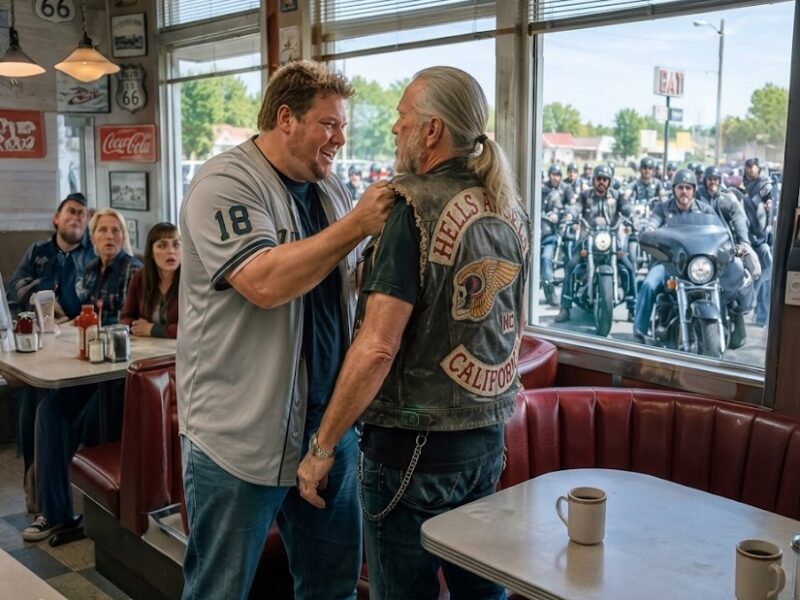
A bully laughed at a biker’s worn-out old vest — then 1,000 Hell’s Angels revved their engines outside his door.
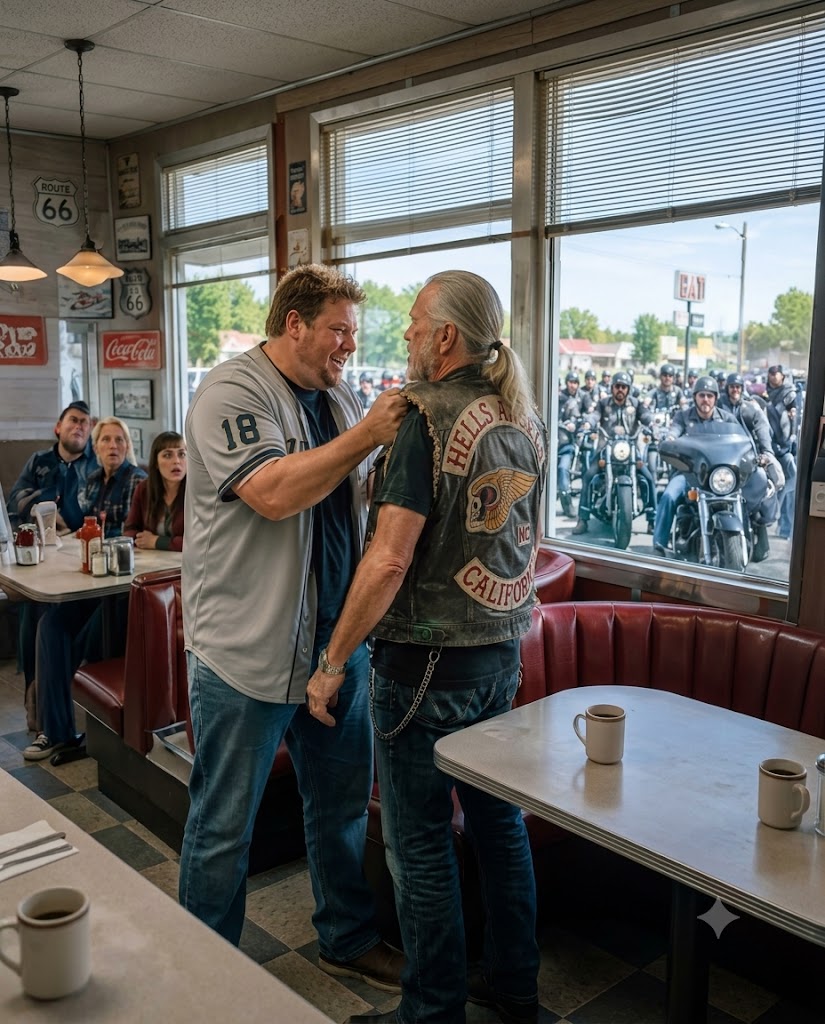
Heat rolled off the asphalt in visible waves, but the sudden chill settling inside O’Neal’s Diner had nothing to do with the sputtering air conditioner.
Garrett thought it was just a joke, just a harmless loudmouth jab at an old man swimming in a ratty, moth-eaten leather vest.
He didn’t look closely at the faded winged death’s head on the back.
He didn’t understand the religion of the patch.
By sunset, the horizon wasn’t humming with summer cicadas.
It was shaking with deafening, earth-shattering thunder.
One thousand Hells Angels were coming.
Grease coated the roof of Garrett’s mouth, a lingering film from a plate of burnt hash browns and cheap pork sausage.
He washed it down with coffee that tasted like copper and burned earth.
Thirty-four years old, thick around the middle, and wearing a faded softball jersey from a league he washed out of a decade ago.
Garrett was a man who lived on the fumes of past relevance.
He chewed with his mouth open.
He laughed too loud.
He occupied space in a way that dared people to ask him to move.
Dust motes danced in the shafts of sunlight slicing through the diner’s dirty front windows.
The bell above the door chimed, a brittle, annoying jingle.
Footsteps followed, slow, heavy.
The dull scuff of worn rubber soles on yellowing linoleum.
Garrett didn’t bother to look up until the smell hit him.
It was a dense, complicated odor cutting through the diner’s ambient aroma of bleach and frying oil.
It smelled like stale tobacco, damp wool, raw gasoline, and decades of road dirt baked into old cowhide.
An old man stood at the counter waiting for Brenda to pour him a cup.
He was rail thin.
His shoulders stooped under the invisible weight of his years.
His hair was thinning, pulled back into a pathetic wispy gray ponytail held by a rubber band.
But it was the vest that caught Garrett’s eye.
It was a catastrophic piece of clothing.
Once black, the leather had bleached into a bruised mottled brown.
The edges were frayed, curling inward like dead leaves.
Faded patches clung to the front, their embroidery unspooling in chaotic tufts of thread.
It looked like something pulled out of a roadside ditch.
It looked pathetic.
To a man like Garrett, weakness was an invitation.
“Hey, pops.” Garrett barked, wiping his mouth with the back of a calloused hand. “Halloween isn’t until October.”
The diner went quiet.
The scrape of a fork against a plate two booths down stopped abruptly.
The old man didn’t flinch.
He didn’t turn.
He just kept staring at the dark surface of the coffee Brenda had poured him.
Brenda, a woman who usually had a sharp retort for everything, stood frozen with the glass pot in her hand.
Her knuckles were white.
Garrett smirked, mistaking the silence for an audience hanging on his next word.
He shifted his bulk, the vinyl booth groaning under his weight.
He wanted the laugh.
He needed the validation.
“Seriously.” Garrett pushed, his voice echoing off the cheap tin ceiling. “Did you lose a bet? Or did you pull that roadkill out of a dumpster behind a thrift store? Looks like it’s holding you together. Smells like it’s holding the whole room hostage.”
Still, the old man didn’t move.
He raised his mug, taking a slow sip.
The coffee was boiling hot, but his throat didn’t even spasm.
Garrett felt a flush of irritation climbing his neck.
He wasn’t used to being ignored.
He slid out of his booth, his work boots thudding against the floor.
He crossed the short distance to the counter, closing the gap.
The smell of the old leather grew stronger, acrid, rich, deeply imposing.
“I’m talking to you, Grandpa.” Garrett said, reaching out.
It was a split-second decision, a casual, arrogant flick of the wrist.
Garrett’s thick, grease-stained index finger flicked the back of the old man’s vest, right near the center patch.
The fabric was stiff.
It felt less like clothing and more like dried tree bark.
The moment Garrett’s skin made contact with the colors, the atmosphere in the room shattered.
The old man turned.
It wasn’t a fast movement.
It was horrifyingly slow.
Garrett found himself staring into a face mapped with deep, jagged crevices.
Sun-damaged skin pulled tight over sharp cheekbones.
But the eyes.
The eyes stopped Garrett’s breath in his throat.
They weren’t the cloudy, timid eyes of a senior citizen.
They were flat, dead.
They possessed the terrifying calm of an apex predator looking at a struggling insect.
There was no anger in them, only a cold, absolute certainty.
“You have a bold hand, son.” the old man said.
His voice was a raspy whisper, like dry leaves scraping across concrete.
Yet, it carried to every corner of the dead silent diner.
Garrett tried to swallow, but his mouth was suddenly full of sand.
The smirk slipped off his face, feeling unnatural and heavy.
“Just making a joke, old-timer. Lighten up.”
“Some things,” the old man whispered, turning his head back to his coffee. “Aren’t punchlines. You touched the patch. You touched the club. You touched Oakland.”
The old man placed a crumpled dollar bill on the counter.
He didn’t look at Garrett again.
He walked out, the bell chiming its brittle song one more time.
Through the window, Garrett watched the frail figure swing a leg over a massive, pristine Harley-Davidson Knucklehead that looked entirely too heavy for him.
The engine kicked over with a violent concussive roar that rattled the diner’s cheap window frames.
Then, he was gone.
Garrett stood by the counter, his hand still suspended in the air where he had flicked the vest.
He forced a laugh, a harsh, bark-like sound that echoed pathetically.
“Crazy old bastard,” Garrett muttered, looking around. “Right?”
Nobody met his eyes.
Brenda slowly lowered the coffee pot onto the burner.
The glass clinked loudly in the quiet room.
She looked at Garrett, her lips pressed into a tight, bloodless line.
There was no annoyance in her expression, no judgment, just a profound, hollow pity.
“Pay your tab, Garrett,” she said softly.
Her voice trembled.
“What’s your problem?” Garrett snapped, trying to summon his usual bluster.
He slapped a twenty-dollar bill onto the Formica counter.
“Guy looked like a homeless drifter.”
“That was Kevin,” Brenda whispered, leaning in closer so the rest of the diner couldn’t hear.
Her breath smelled of peppermint gum and stale nicotine.
“He’s an original. Hells Angels, Oakland charter. That vest you just put your greasy fingers on? He’s been wearing it since before you were a bad idea in your daddy’s head.”
Garrett felt a cold drop of sweat slide down his rib cage.
“It’s just a motorcycle club, Brenda. Bunch of old men riding around on weekends. You watch too many movies.”
He said the words, but his body didn’t believe them.
His heart was knocking against his sternum in an erratic, painful rhythm.
“He wasn’t wearing a rocker that said weekend,” Brenda said, her eyes welling with an unexplainable moisture. “He’s full patch. You don’t touch a patch member. You don’t insult the colors. You just signed a check you have absolutely no money in the bank to cover.”
“Whatever,” Garrett muttered, turning away.
He walked out into the blinding afternoon heat, but he couldn’t feel the sun.
The humidity pressed down on him, thick and suffocating, yet he felt freezing cold.
He climbed into his rusted Ford F-150, the vinyl seats scalding the back of his legs.
He shoved the key into the ignition, but his hand was shaking so badly he missed the slot twice.
“Stupid,” he hissed to himself, finally starting the truck. “It’s nothing. Just an old guy. Nothing.”
But Garrett knew violence.
He grew up in a town where blood settled arguments in gravel parking lots.
He knew the difference between a loudmouth barfighter and the kind of men who broke bones with administrative efficiency.
Kevin’s eyes hadn’t promised a fistfight.
They had promised an eradication.
He drove home, his eyes darting to the rearview mirror every three seconds.
Every pickup truck behind him looked suspicious.
Every loud muffler made his shoulders flinch up toward his ears.
Home was a single-story vinyl-sided bungalow sitting on a patch of dead grass at the dead end of Elm Street.
It was a miserable, lonely house.
Peeling paint around the window frames, a porch sagging under the weight of rotting wood, and the perpetual smell of mildew and stale beer lingering in the carpets.
Garrett locked the front door.
Then he locked the deadbolt.
He stood in the dim living room, the blinds drawn tight against the afternoon sun.
He turned on the television, cranking the volume up to drown out the oppressive silence of the house.
But the canned laughter of a daytime sitcom only made the quiet underneath feel heavier.
He paced.
He went to the kitchen and opened the fridge, staring blindly at a half-empty jar of mayonnaise and two cans of cheap lager.
He wasn’t thirsty.
He wasn’t hungry.
His stomach was a tight, acidic knot.
He cracked a beer anyway, the aluminum hiss sounding like a gunshot in the kitchen.
He took a long swallow.
It tasted like ash.
You touched the patch.
You touched the club.
The old man’s raspy whisper echoed in his skull, looping relentlessly.
Garrett tried to rationalize it.
What were they going to do?
Drive over here and beat him up?
He could call the cops.
He had a shotgun in the closet.
He was a grown man.
He walked to the hallway closet, pushed aside winter coats that smelled like mothballs, and pulled out the twelve-gauge Remington.
The steel of the barrel was cold.
It felt heavy and reassuring in his hands.
He pumped the action, checking the chamber.
Loaded.
He set the shotgun on the coffee table in the living room and sat heavily on the sagging sofa.
The cushions puffed out a cloud of dust that caught in the TV’s glow.
He waited.
Hours bled into the late afternoon.
The sun began its slow dip below the horizon, painting the slits of the blinds in bloody, bruised shades of purple and orange.
The sitcoms turned into evening news.
The news turned into prime-time garbage.
Garrett’s eyelids grew heavy.
The adrenaline crash was setting in, replacing panic with an exhausting, bone-deep fatigue.
Maybe Brenda was crazy.
Maybe the old man was just some lone lunatic who lived in a trailer park.
Maybe it was all a misunderstanding.
A sound vibrated through the floorboards.
Garrett’s eyes snapped open.
The beer can in his hand tilted, spilling lukewarm liquid onto his jeans.
It wasn’t a loud noise, not yet.
It was a low, resonant frequency that he felt in his teeth before he actually heard it with his ears.
A deep, guttural thrum.
He stood up, his knees popping in the quiet room.
He reached down and picked up the Remington.
His palms were sweating so much the polished wood of the stock felt slippery.
He moved to the front window, pressing his back against the peeling wallpaper beside the frame.
With one trembling finger, he pulled a single plastic slat of the blinds downward, creating a narrow slit to look through.
The streetlights on Elm Street flickered, buzzing with a faulty electrical hum.
Underneath the glow of the amber light directly across from Garrett’s house, the dust was swirling.
Three motorcycles sat idling by the curb.
They weren’t the sleek plastic-covered sport bikes the kids in town rode.
These were massive, custom-built machines, Harley-Davidsons stripped down and built back up for war.
Chrome glinted menacingly under the streetlight.
The exhaust pipes were fat, spitting a rhythmic, concussive pop pop pop that rattled the loose panes of glass in Garrett’s front windows.
Three men sat on the bikes.
They didn’t cut their engines.
They didn’t put their kickstands down.
They just sat there, their boots planted firmly on the asphalt, the engines vibrating between their thighs.
Garrett’s breath hitched in his chest.
He tasted bile at the back of his throat.
They were massive men, wide at the shoulders, clad in heavy denim and black leather.
Even from across the street in the dim, muddy light of the street lamp, Garrett could see the white patches glowing on their backs.
The winged death heads.
The top rocker curving over the skull.
Hells Angels.
They weren’t doing anything.
That was the most terrifying part.
They weren’t yelling.
They weren’t walking toward the house.
They were simply looking at his front door.
“Go away,” Garrett whispered to the empty living room, the shotgun trembling against his shoulder. “Just go away.”
One of the bikers, a man with a thick braided beard that spilled down his chest, casually reached into his leather vest and pulled out a pack of cigarettes.
He tapped a cigarette against the handlebars, put it in his mouth, and lit it with a Zippo.
The flame briefly illuminated a face that looked like it had been carved out of granite.
He took a long drag, the cherry of the cigarette glowing a violent red, and blew the smoke out in a thick plume toward Garrett’s house.
The psychological warfare had begun.
Garrett backed away from the window, his chest heaving.
His mind raced, sprinting through a maze of terrible options.
Call the police.
And say what?
There are three guys sitting on motorcycles across the street looking at my house.
The cops in this town were notoriously slow, and half of them wouldn’t dare mess with a full patch club if they could avoid it.
He looked at the phone on the wall.
He looked at the shotgun.
The low rumble of the three engines outside remained constant.
It was a droning, hypnotic sound.
It seeped through the cracks in the door frame, under the window sills, vibrating through the soles of Garrett’s boots.
It felt like the house itself was breathing with them.
Ten minutes passed, then twenty.
Garrett crept back to the window, unable to stop himself.
He pulled the blind down again.
They were still there, unmoving, statues cast in leather and iron.
Then the pitch of the ambient noise shifted.
The deep vibration rattling Garrett’s floorboards began to change.
It swelled.
The pop pop pop of the three idling Harleys was suddenly joined by a distant harmony.
A low thunderous growl was building at the far end of town.
Garrett frowned, pressing his forehead against the cold glass.
The sound grew louder.
It didn’t sound like one motorcycle.
It didn’t sound like ten.
It sounded like an avalanche rolling down a mountain, consuming everything in its path.
It sounded like a mechanical beast waking up hungry.
The street shook.
A framed photograph of Garrett’s deceased mother vibrated off a side table and crashed to the floor, the glass shattering over the cheap rug.
Garrett didn’t even flinch.
He was paralyzed, staring down the long dark corridor of Elm Street.
Headlights pierced the gloom.
First a pair, then four, then a dozen.
They rolled around the corner two blocks down, a disciplined tight formation of blinding halogen and roaring metal.
The noise was no longer a vibration.
It was a physical force.
It slammed into the front of Garrett’s house like a shockwave.
Garrett dropped the shotgun.
It clattered against the floorboards, completely forgotten.
He gripped the edges of the windowsill with both hands, his knuckles turning white, his jaw hanging open as the oxygen left the room.
They just kept coming.
Biker after biker, row after row.
The street filled with the stench of high-octane fuel, burning oil, and hot exhaust.
The red tail lights painted the surrounding houses in the color of fresh blood.
The earth literally trembled.
The seismic activity of hundreds of V-twin engines moving in perfect, terrifying unison.
The original three bikers who had been waiting across the street finally kicked their stands down.
They dismounted, stepping onto the sidewalk, making room as the incoming tide of chrome and leather flooded Elm Street.
Fifty, one hundred, two hundred.
They parked on the lawns.
They parked in the driveways of his neighbors.
They blocked the intersection.
They filled every square inch of visible asphalt.
Garrett couldn’t breathe.
His lungs flatlined.
The air in his house felt heavy, toxic.
He fell backward, his legs giving out, and scrambled on his hands and knees across the carpet until his back hit the sofa.
He curled his knees to his chest, clamping his hands over his ears, squeezing his eyes shut.
But he couldn’t block out the sound.
He couldn’t block out the violent, synchronized revving of a thousand Hells Angels outside his door.
The house rattled, the walls groaning under the acoustic assault.
It was a deafening chorus of retribution.
He hadn’t just insulted a man, he had summoned an army.
And as the roar reached a crescendo that threatened to shatter his eardrums, a single, heavy boot kicked Garrett’s front door.
Crack.
The wood splintered.
Wood did not just break, it screamed.
The second kick hit right next to the deadbolt, ripping the metal housing cleanly out of the cheap pine frame.
Splinters the size of kitchen knives exploded into the living room, raining down on the stained beige carpet.
The door swung violently inward, slamming against the drywall with a hollow concussive boom that sent a shockwave of dust rolling across the ceiling.
Then a signal was given.
It wasn’t a shout.
It was a gesture unseen from inside the house, but its effect was instantaneous and terrifying.
The engines stopped.
They didn’t all die at once.
It was a rapid cascade of localized silence rippling down Elm Street block by block.
A thousand roaring Harleys choked off in a matter of seconds, leaving behind a sudden suffocating vacuum.
The absence of noise was heavier than the thunder had been.
The only sound left in the neighborhood was the rhythmic metallic tink tink tink of hundreds of exhaust pipes rapidly cooling in the humid evening air.
Garrett pressed his spine against the front of his sofa.
His legs splayed out awkwardly.
His bladder betrayed him.
A hot, humiliating dampness spread down the inside of his denim jeans.
He didn’t care.
His lizard brain had taken over, stripping away decades of loudmouth bravado and leaving behind a terrified, shivering animal.
Dust settled in the shaft of light bleeding from the porch lamp.
Through the ruined doorway, a thick, toxic draft rolled into the house.
It smelled of unburnt hydrocarbons, hot iron, sweat, and cheap tobacco.
Heavy boots stepped over the shattered doorframe.
Two men walked into the living room.
They didn’t rush.
They didn’t draw weapons.
They simply occupied the space, bringing the imposing, suffocating reality of the street right into Garrett’s miserable sanctuary.
One of them was the bearded man who had been smoking under the streetlight.
Close up, he was even larger.
His shoulders threatening to brush the sides of the narrow hallway.
A faded patch on his chest read “Eric.”
The man beside him was younger.
His face marked by a jagged slick scar that ran from his earlobe to his collarbone.
Garrett’s eyes darted frantically to the floor, landing on the Remington twelve-gauge lying two feet from his left hand.
Eric followed his gaze.
The massive biker looked down at the shotgun, then back up at Garrett.
Eric didn’t reach for his own waist.
He didn’t yell a warning.
He just stared, his eyes flat and dead, offering Garrett a silent, terrible invitation.
Reach for it.
See what happens.
Garrett pressed his hands flat against his chest, interlacing his fingers so tightly his knuckles throbbed.
He shoved himself further back, trying to merge with the cheap fabric of the sofa.
He shook his head.
A pathetic whimpering sound leaked out of his throat.
Eric stepped forward, the floorboards groaning under his weight.
He placed a heavy leather boot directly onto the barrel of the shotgun, pinning it to the carpet.
“Stand up,” Eric said.
His voice wasn’t loud.
It didn’t carry the adrenaline-soaked pitch of a bar fight.
It was a flat, administrative command.
Garrett tried to obey.
He forced his legs under him, but his knees felt like they were made of wet paper.
He grabbed the armrest of the sofa, hauling his heavy frame upward.
He swayed, his urine-soaked jeans clinging uncomfortably to his thighs.
He kept his eyes glued to the floor, unable to look the massive biker in the face.
“Look at me.”
Garrett slowly raised his head.
His chest was heaving, pulling in ragged, shallow breaths.
“You got a lot of miles on that mouth of yours,” Eric said quietly, pulling a fresh cigarette from his vest.
He struck a match off his thumbnail, the sulfur flaring bright in the dim room.
He inhaled deeply, the cherry glowing orange.
“You think you’re tough because you can yell at a waitress, because you can pick on an old man.”
Eric blew the smoke out, a thick cloud that washed over Garrett’s face, stinging his eyes.
“He’s coming in,” Eric said, looking past Garrett to the ruined doorway. “You’re going to keep your mouth shut until he tells you to open it. If you blink wrong, my brother here is going to break your jaw in three places. Do you understand?”
Garrett nodded frantically, tears finally spilling over his lower lids.
“Yes, I understand. I swear.”
Eric took another drag and stepped aside.
The younger biker with the scar stepped back, too, flanking the hallway.
Footsteps approached from the porch, slow, deliberate.
The dull scuff of worn rubber soles on wood.
Kevin stepped into the living room.
He looked exactly as he had in the diner, the wispy gray ponytail, the sunken cheeks, the stooped shoulders.
He didn’t look like a warlord.
He looked like a man who should be sitting on a park bench feeding pigeons.
But behind him, framed in the broken doorway, was a sea of leather and chrome.
A thousand silent men waiting in the twilight, their eyes locked on the front of Garrett’s house.
Kevin walked past Eric, ignoring the shotgun pinned beneath the biker’s boot.
He took in the living room.
He looked at the half-empty beer cans spilled on the carpet.
The cheap television playing a mute commercial for car insurance, the shattered picture frame on the floor.
He looked at Garrett’s stained jeans.
Disgust flickered briefly in Kevin’s eyes, quickly replaced by an exhausted heavy resignation.
Kevin walked over to Garrett’s faux leather recliner and turned around.
He sat down slowly, letting out a quiet sigh as his joints popped.
He rested his elbows on the armrests, interlacing his gnarled arthritis-swollen fingers.
The silence in the room stretched out, agonizing and deep.
Garrett felt the blood pounding behind his ears.
He wanted to apologize.
He wanted to beg, to scream, to offer them his truck, his house, his pathetic life savings.
But Eric’s warning echoed in his skull.
Keep your mouth shut.
“You called it roadkill,” Kevin finally spoke.
His raspy whisper seemed to scrape against the drywall.
Garrett flinched.
He opened his mouth, then snapped it shut.
Kevin reached a trembling hand up and touched the lapel of his vest.
The mottled bruised brown leather, the fraying edges, the chaotic unspooling threads of the patches.
“To a man like you, I suppose that makes sense,” Kevin said, his eyes drifting over the ruined fabric. “You buy your clothes at a department store. You wear them until they get a hole, and then you throw them in the garbage. You don’t know what it means to earn a garment. You don’t know what it costs.”
Kevin pointed a crooked finger at a dark, hardened stain near the right pocket.
The leather there was stiff, almost black.
“This,” Kevin whispered, “is motor oil from a panhead that blew apart outside Barstow in 1974. I pushed that bike twelve miles in the July sun. My brother rode out with water and a tow strap. He died of liver cancer three years ago.”
Kevin’s finger moved up, tracing a jagged tear in the shoulder that had been crudely stitched back together with thick, black nylon thread.
“This tear,” he continued, his voice dropping an octave, “is from a county sheriff’s baton in Altamont, 1969. They swung hard that day. We swung back harder.”
Kevin leaned forward.
The chair creaked loudly.
The flat, dead look in his eyes from the diner returned, pinning Garrett to the wall like a butterfly on a corkboard.
“You flicked this patch,” Kevin said, his voice dropping to a terrifying hiss. “You put your grease-stained fingers on a ledger of blood, miles, and dead men. Men who were better than you. Men who actually stood for something in a world that stands for absolutely nothing.”
Garrett couldn’t hold it back anymore.
A sob broke free from his chest.
“I’m sorry,” he wept, his face contorting. “I’m so sorry. I’m a nobody. I’m just a stupid nobody. Please, I didn’t know.”
Kevin leaned back again.
He looked tired, deeply, profoundly tired.
“I know you’re a nobody,” Kevin said, the cruelty of the truth hitting Garrett harder than a closed fist. “That’s why you’re still breathing. If you were a man of consequence, Eric would have already put a hammer through your kneecaps.”
Garrett choked on his own saliva, his chest hitching.
“We don’t beat dogs for barking,” Kevin said, standing up. “It’s in their nature.”
He walked slowly toward Garrett.
Garrett shrank back against the sofa, his hands coming up in a pathetic attempt to guard his face.
But Kevin just stopped two feet away.
The smell of the vest washed over Garrett again.
The stale tobacco, the damp wool, the decades of baked-in dirt.
It didn’t smell like roadkill anymore.
It smelled like history.
It smelled like consequences.
“I could have your house burned to the foundation with you inside it,” Kevin whispered, leaning in so close Garrett could feel the heat radiating off the old man’s skin. “It would take one nod. Thirty seconds.”
“Please,” Garrett whimpered. “Don’t.”
“I’m not going to,” Kevin said, straightening up. “Killing you is a waste of gasoline.”
Kevin turned his back on Garrett and walked slowly toward the ruined door.
Eric and the younger biker fell in step behind him.
“But you aren’t leaving this town.”
Kevin stopped at the threshold, looking over his shoulder.
The streetlights caught the jagged edge of his silver death’s head ring.
“You don’t get to pack your bags and run away to start over. You’re going to stay in this rotting house. You’re going to keep eating those burnt hash browns at O’Neal’s.”
Garrett stared at him, tears tracking through the dust on his face, his mind struggling to process the reprieve.
“And every time you hear a motorcycle,” Kevin said softly, his voice cutting through the humid night air, “whether it’s one block away or on the highway three miles out of town, your heart is going to stop. You’re going to check your locks. You’re going to look out your window because you’ll never know if it’s just a passing rider or if we decided to come back and finish the job.”
Kevin stepped out onto the porch.
“You belong to the noise now,” Kevin said.
Eric bent down, picked up the Remington shotgun, and effortlessly snapped the wooden stock over his knee with a sickening crack.
He tossed the broken pieces onto the stained carpet at Garrett’s feet.
Then, they walked out.
Garrett remained frozen against the sofa.
He listened to the heavy boots walk down the driveway.
A few seconds later, a single engine kicked over.
The massive Knucklehead.
Then, the street erupted.
A thousand engines roared back to life.
A synchronized explosion of internal combustion that shook the plaster dust from Garrett’s ceiling.
The sound was deafening, physical, absolute.
It was the sound of a god clearing its throat.
Garrett didn’t move.
He sat in his own urine, trembling violently in the dark, listening as the thunder rolled slowly out of his neighborhood, leaving him entirely, utterly alone.
Dust settled onto the ruined carpet like gray snow, illuminated only by the buzzing amber glow of the streetlamp outside.
Garrett remained on the floor for a long time after the final distant vibration of the motorcycle exhaust faded into the humid night.
He didn’t move because his brain could not bridge the gap between the command to stand and the physical execution of it.
His body felt hollowed out, entirely drained of the aggressive, expansive energy that had defined his thirty-four years of existence.
Silence reclaimed Elm Street, but it was not the peaceful quiet of a suburban evening.
It was a dense, suffocating absence of noise.
It felt heavy.
It felt like a threat.
Eventually, the chill of his damp, urine-soaked jeans forced him to shiver.
The involuntary muscle spasm snapped the paralysis.
He placed his palms flat against the stained carpet, feeling the grit of shattered pinewood and drywall dust pressing into his skin.
He pushed himself up.
His joints popped, sounding unnaturally loud in the empty house.
He looked at the front door.
It hung at a crooked, unnatural angle, its hinges screaming in mute agony.
The deadbolt mechanism lay on the welcome mat, a useless chunk of mangled brass.
A warm breeze drifted through the gaping wound in his home, carrying the faint, lingering scent of unburnt fuel and exhaust.
Garrett stumbled into the bathroom.
He didn’t turn on the light.
The darkness felt safer.
He stripped off his soiled clothes, leaving them in a pathetic heap on the cracked linoleum floor, and stepped into the shower.
He turned the handle all the way to cold.
The icy water hit his shoulders like a physical blow, shocking his system, forcing his lungs to pull in deep, ragged gulps of air.
He scrubbed his skin with a bar of cheap soap until his chest and arms were flushed red, trying desperately to wash away the smell of the leather, the smoke, and his own profound cowardice.
But the chill remained in his bones.
He dried off, put on sweatpants and a clean T-shirt, and walked back into the living room.
The broken pieces of the Remington twelve-gauge still lay on the floor, the splintered walnut stock resting near the cold steel barrel.
Eric had broken it over his knee with the casual ease of a man snapping a dry twig.
Garrett picked up the pieces.
He didn’t put them back in the closet.
He walked into the kitchen and dropped them into the aluminum trash can.
They clattered against empty beer cans and stained takeout containers.
It was the only place they belonged now.
The immediate problem was the front door.
He couldn’t sleep with it open.
He couldn’t exist with the night staring directly into his living room.
He found a hammer and a handful of rusted nails in a kitchen drawer.
He dragged a heavy oak dining chair to the entryway and tried to wedge the broken door back into its frame.
It was a futile, pathetic effort.
The wood was too severely splintered, the frame hopelessly compromised.
He hammered a nail into the jamb, but the wood simply crumbled around the iron spike.
He tried another and another.
His hands shook violently.
Every time the hammer struck the nail, the sharp bang echoed down the quiet street, making his shoulders flinch, his eyes darting to the black square of the open window.
After ten minutes of useless labor, he dropped the hammer.
He dragged a heavy wooden bookshelf from the hallway, shoving it across the carpet.
He grunted, his back screaming in protest, until the bookshelf was pressed flat against the broken door.
It wouldn’t stop a determined teenager, let alone a man like Eric, but it provided an illusion of a barrier.
Garrett collapsed onto the sofa.
He stared at the ceiling.
The digital clock on the microwave in the kitchen read 11:42 p.m.
He closed his eyes.
Exhaustion pulled at him, a heavy dark tide threatening to drag him under, but the moment his consciousness began to slip, his ears betrayed him.
A low rumble vibrated through the floorboards.
Garrett’s eyes snapped open.
His heart slammed against his ribs, injecting a fresh, toxic dose of adrenaline directly into his bloodstream.
He sat up, his hands gripping the sofa cushions.
He held his breath, straining to listen.
The rumble grew.
It was a truck, just a commercial semi-truck downshifting on the interstate two miles away.
Garrett let out a shaky breath, pressing the heels of his hands into his eye sockets until colors burst behind his eyelids.
“Just a truck,” he whispered to the empty room. “Just a truck.”
He laid back down.
Twenty minutes passed.
Pop, pop, pop.
Garrett sat up again, a cold sweat breaking out across his forehead.
He swung his legs off the sofa, his bare feet hitting the carpet.
He crept to the window, pulling the blind back just a fraction of an inch.
Down the street, Mrs. Gable’s teenage son, Dennis, was trying to start a flooded lawn mower in his driveway under the harsh glare of a garage floodlight.
The engine sputtered, popped, and died.
Garrett backed away from the window, his chest heaving.
He went to the kitchen and drank a glass of tap water.
His hands trembling so badly the glass rattled against his teeth.
Kevin’s raspy, whispering voice coiled around his thoughts, a permanent parasite in his brain.
Every time you hear a motorcycle, your heart is going to stop.
You’re going to check your locks.
You’re going to look out your window.
The old man had not delivered a threat.
He had delivered a prophecy.
Garrett did not sleep that night.
He paced the short distance between the kitchen and the living room.
Every passing sedan, every faulty muffler, every distant siren, every groan of the house settling in the cool night air sent a jolt of pure, unadulterated panic through his nervous system.
He was trapped in a cycle of chemical terror.
His body reacting to auditory stimuli with the fight or flight response of hunted prey.
By the time the first gray light of dawn bled through the blinds, Garrett was a hollow shell.
His eyes were bloodshot, surrounded by deep, bruised bags.
His jaw ached from clenching his teeth.
He sat on the floor, his back against the wall, staring at the bookshelf blocking the broken door, waiting for an engine that wasn’t there.
Three weeks dragged by.
They were twenty-one days of slow, grinding psychological erosion.
Garrett managed to hire a local carpenter, a quiet guy named Greg, to replace the front door and repair the frame.
Greg did the work on a Tuesday morning.
He didn’t ask how the door had been completely ripped off its hinges, and Garrett didn’t offer an explanation.
The town rumor mill had already done the heavy lifting.
In a community this small, a thousand Hells Angels vibrating the foundation of Elm Street was not an event that could be swept under the rug.
People talked.
They whispered in the aisles of the grocery store.
They gossiped over backyard fences.
They knew Garrett had done something incredibly stupid.
They knew the wolves had come to his door, and they knew somehow the wolves had let him live.
This did not make Garrett a figure of awe.
It made him a pariah.
He carried the stench of marked prey.
He felt it the first time he forced himself to return to O’Neal’s Diner.
It was a Thursday afternoon.
The heat was oppressive, baking the asphalt parking lot until it shimmered.
Garrett needed to prove to himself, and to the town, that he was still functioning.
He needed to sit in his usual booth, order his burnt hash browns, and act like a normal human being.
He pushed through the glass door, the annoying chime ringing above his head.
The diner was half full.
As the chime faded, the ambient chatter of the room died with it.
It wasn’t a sudden, dramatic silence, but a gradual tapering off of conversation.
Heads turned.
Eyes flicked over him, then quickly darted back to their plates.
Garrett swallowed hard.
He kept his head down, walking past the counter to his usual booth in the back corner.
He slid onto the vinyl bench.
It squeaked, sounding aggressively loud in the quiet room.
Brenda was wiping down the counter near the coffee machines.
She saw him sit down.
She didn’t grab a menu.
She didn’t reach for the glass coffee pot.
She just stood there, the damp rag in her hand, staring at the Formica surface in front of her.
Two minutes passed, then five.
Garrett shifted uncomfortably.
His hands were sweating.
He wiped them on his thighs.
“Brenda,” he called out.
His voice, usually a booming, arrogant baritone, came out thin and reedy.
Brenda slowly looked up.
Her expression was entirely devoid of warmth.
The pity she had shown him three weeks ago was gone, replaced by a cold, weary distance.
She walked over to his booth, a blank order pad in her hand.
She didn’t look him in the eye.
She looked at a spot on the wall slightly over his left shoulder.
“What can I get you, Garrett?” she said.
It wasn’t a question.
“Coffee,” Garrett said, his throat tight. “And the hash browns, crispy.”
Brenda scribbled on the pad, tore the sheet off, and walked away without a word.
Garrett sat in the quiet isolation of his booth.
The other patrons had resumed their conversations, but their voices were hushed, conspiratorial.
He could feel the weight of their judgment.
Before, they had disliked him because he was obnoxious.
Now, they avoided him because he was a walking ghost.
He was bad luck.
He was a man living on borrowed time, and nobody wanted to be caught in the blast radius when the debt was finally called in.
Brenda returned with his coffee.
She set the mug down so carefully it didn’t even clink against the saucer.
She walked away before he could thank her.
He wrapped his hands around the warm ceramic.
The coffee smelled like copper and burned earth, just like it always did.
He took a sip.
It tasted like ash.
He looked toward the front windows, staring out at the sun-baked highway.
His mind drifted, replaying the sequence of events over and over.
What if he hadn’t spoken up?
What if he hadn’t flicked the patch?
What if he had just eaten his food and gone home?
The regret was a physical weight, pressing down on his chest until breathing became a conscious, labored effort.
Then the vibration started.
It was faint at first, a low, rhythmic thrumming in the distance.
Garrett froze.
The coffee mug in his hands hovered halfway to his mouth.
His pupils dilated.
The sound grew louder.
It was coming down the main highway, approaching the diner.
A deep, guttural growl of heavy machinery.
Pop pop pop pop.
Garrett’s breath caught in his throat.
The walls of the diner seemed to shrink inward.
The air conditioning unit above him cut out, plunging the room into a sudden, suffocating silence that made the approaching rumble sound ten times louder.
His brain bypassed rational thought.
It bypassed logic.
It went straight to the ruined door, the splintered wood, the massive boot on his shotgun, the cold, dead eyes of the old man.
They’re back.
The rumble escalated into a roar.
It was shaking the cheap tin ceiling of the diner.
It was right outside.
Garrett dropped his coffee mug.
It shattered against the table, scalding brown liquid splashing across his jeans and dripping onto the linoleum floor.
He scrambled out of the booth, his legs tangling in panic.
He knocked his knees against the table leg, stumbling into the aisle.
“Garrett!” Brenda shouted, startled by the sudden violence of the breaking ceramic.
He didn’t answer.
He couldn’t.
His throat was completely closed.
He pushed past a bewildered older man in the aisle, bursting through the front doors of the diner, ignoring the sharp chime.
He hit the blinding sunlight of the parking lot, his hands thrown up in front of his face, anticipating the sea of leather, the chrome, the judgment.
He stood in the middle of the parking lot, chest heaving, sweat pouring down his face, bracing for impact.
A rusted flatbed tow truck rattled past the diner on the highway.
The truck was hauling a massive diesel-powered wood chipper.
The chipper’s engine was running idle, a deep, rhythmic, concussive pop, pop, pop that echoed off the surrounding buildings.
The driver of the tow truck, a kid wearing a baseball cap backward, didn’t even look at Garrett as he drove by.
The truck slowly lumbered down the highway, taking its terrifying noise with it.
Garrett stood alone in the parking lot.
The intense summer heat beat down on his shoulders.
He slowly lowered his hands.
Through the large glass windows of the diner, he could see the patrons staring at him.
Brenda was standing near his table, looking at the spilled coffee dripping onto the floor, and then looking out at him.
There was no fear in their eyes, only disgust, only a deep, uncomfortable embarrassment for the broken man standing outside.
Garrett looked down at his trembling hands.
Kevin hadn’t needed to burn his house down.
He hadn’t needed to break his kneecaps or leave him bleeding in a ditch.
The old man in the frayed vest had done something much more permanent, much more devastating.
He had reached into Garrett’s chest, ripped out his nerve, and replaced it with a permanent coiled spring of terror.
He was a prisoner.
His cell had no bars.
It had no walls.
His cell was the open road.
His cell was a revving engine.
His cell was the rest of his life.
Garrett slowly turned away from the diner, leaving his truck in the parking lot.
He began the long, quiet walk back to his empty house on Elm Street, flinching at every passing shadow, his ears straining to catch the sound of thunder on a clear blue day.
Leaves turned brown, brittle, and eventually surrendered to the biting November wind, scraping across the asphalt of Elm Street like dry bones.
For most people, the onset of winter meant holidays, heavy coats, and the quiet insulation of snow.
For Garrett, the dropping temperature brought a cruel, contradictory mercy.
Ice meant motorcycles stayed in their garages.
Ice meant the roads were dead.
Yet, the silence of winter was its own kind of torture.
It was a blank canvas upon which Garrett’s ruined mind painted auditory hallucinations.
He lost his job at the municipal lumberyard just three days before Thanksgiving.
It wasn’t because he was late, though he often was, dragging his exhausted, insomniac body out of bed after hours of staring at the ceiling.
It was the machinery.
The yard ran on massive diesel forklifts and heavy flatbed trucks.
Every time Tom, the yard foreman, keyed the ignition on the primary loader, the deep guttural chug chug chug of the cold diesel block sent Garrett into a downward spiral.
On his final day, Garrett was stacking two by fours near the loading bay.
A delivery truck pulled in, its exhaust pipe rattling against a loose bracket.
It wasn’t a Harley, but the frequency was close enough.
It hit the exact pitch of the idle rumble that had vibrated his floorboards back in August.
Garrett dropped a stack of pine boards, clamping his dirty, splintered hands over his ears, and backed himself into a corner of the storage shed.
He stayed there for forty minutes, hyperventilating, crying openly into the sawdust, while the rest of the crew watched in uncomfortable silence.
Tom handed him his final paycheck in a manila envelope that afternoon.
He didn’t ask questions.
He just looked at Garrett with the same heavy, weary pity Brenda had shown him at the diner.
Unemployment bred isolation.
Isolation bred a deeper, more profound sickness.
Garrett’s world shrank to the dimensions of his property line.
He stopped cutting the dying grass.
He stopped checking the mail, letting grocery circulars and final notice utility bills spill out of the rusted box by the curb.
The interior of the house became a reflection of his internal decay.
Stacks of unwashed dishes festered in the sink, emitting a sour, rancid odor of spoiled milk and rotting meat that permeated the living room.
Dust gathered thick on the television screen, which remained perpetually off.
He self-medicated with cheap, bottom-shelf whiskey.
The plastic bottles piled up by the kitchen trash can, a testament to his desperate need to numb the nerve endings Kevin had exposed.
He drank until his vision blurred, hoping the alcohol would slow his racing heart.
But it only amplified his paranoia.
Drunk, he was clumsy.
He bumped into walls, knocked over chairs, and every loud noise he made himself caused him to flinch, convinced he had summoned the thunder back to his door.
Winter deepened.
January brought a bitter, bone-chilling cold that seeped through the poorly insulated walls of the bungalow.
The baseboard heaters clicked and ticked as they struggled to keep the temperature above freezing.
Garrett sat on the floor of the living room, his back against the new solid oak door Greg the carpenter had installed.
It was sturdy.
It had a heavy brass deadbolt.
It meant absolutely nothing.
Garrett knew that if they wanted to come back, a piece of wood wasn’t going to stop them.
The door was a prop.
He wore two pairs of sweatpants and a heavy, moth-eaten wool sweater.
His beard had grown out into a patchy, unkempt mess, itching terribly against his jaw.
He reeked of stale sweat, cheap liquor, and unwashed hair.
He held a half-empty plastic bottle of whiskey loosely in his right hand, the plastic crinkling sharply under his grip.
Tick, tick, tick.
The baseboard heater expanded in the cold.
Garrett froze.
He lowered the bottle.
His bloodshot eyes darted towards the window.
The blinds were drawn tight, sealed with duct tape along the edges, so not a single sliver of the outside world could peer in.
Tick, tick, tick.
It sounded like hot metal cooling down.
It sounded like an exhaust pipe after a long ride.
He pressed his ear against the cold wood of the front door.
He strained.
His jaw clenched so tightly his molars ached.
He listened past the wind rattling the siding.
He listened past the hum of the refrigerator in the kitchen.
Nothing.
Just the dead, frozen winter.
He slid down the door until his rear hit the floorboards, pulling his knees to his chest.
He took a long, burning swallow of the whiskey.
It tasted like solvent.
It clawed its way down his throat, pooling hot in his empty stomach.
Sometimes, in the darkest, quietest hours of the night, Garrett caught himself wishing they would just come back.
The anticipation was hollowing him out.
If they came back, maybe they would finally finish it.
Maybe Eric would bring a bat instead of just stepping on a shotgun.
Maybe Kevin would give the nod and a Molotov cocktail would come crashing through the front window, turning the house into a blazing funeral pyre.
It would be violent, and it would be terrifying, but it would be an ending.
The not knowing, the permanent hanging sentence, was worse than any beating.
Kevin’s words echoed in the cold, empty house, playing on a loop that Garrett could not switch off.
You don’t get to pack your bags and run away to start over.
You belong to the noise now.
He squeezed his eyes shut, pressing the heels of his hands into his temples.
“I’m sorry,” he whispered to the empty room. “I’m so sorry.”
There was no one to hear him.
The wolves had done their work and moved on, leaving the prey to eat itself alive.
March broke the freeze.
The snowbanks lining Elm Street melted into ugly piles of gray slush, exposing the winter-worn asphalt beneath.
The air lost its sharp, biting edge, replaced by the damp, earthy smell of thawing mud and dead leaves.
To Garrett, the rising temperature was a death sentence.
Spring meant the ice was gone.
Spring meant the roads were clear.
Spring meant the hibernation was over.
His money had run out completely.
The electricity had been cut off two weeks ago.
He existed in the dark, eating cold canned beans straight from the tin with a dirty spoon.
He was dangerously thin, his collarbones jutting out painfully against his T-shirt.
His skin carrying a pale, sickly yellow hue.
It was a Saturday afternoon.
The sun was shining brightly, casting harsh, uncompromising light through the gaps in the duct-taped blinds.
The house was stiflingly warm, baking in the sudden springtime heat.
But Garrett couldn’t bring himself to open a window.
Opening a window meant letting the outside in.
He sat in his faux leather recliner.
The padding was worn flat, the springs digging uncomfortably into his lower back.
He was staring at the blank screen of the dead television, his hands resting limply in his lap.
He was entirely numb.
The adrenaline reserves that had fueled his panic for the last seven months were finally depleted, leaving behind a profound, heavy exhaustion.
Then it happened.
It wasn’t a hallucination.
It wasn’t a delivery truck.
It wasn’t a flooded lawn mower.
It was the unmistakable deep-throated growl of a V-twin engine.
Garrett didn’t jump.
He didn’t scramble to the floor.
He simply stopped breathing.
The sound was a mile away, carrying clearly on the crisp spring air.
It wasn’t just one engine.
It was a pack.
The harmonized aggressive drone of heavy motorcycles riding in formation.
Pop pop pop pop.
The sound grew louder.
They were coming down the main highway, heading toward the intersection that led into Garrett’s neighborhood.
His body reacted independent of his exhausted mind.
A cold sweat broke out across his forehead, stinging his eyes.
The familiar acidic knot formed in the pit of his stomach.
His heart, weak and tired, began to hammer a frantic painful rhythm against his ribs.
They were turning onto Elm Street.
Garrett slowly pushed himself out of the recliner.
His legs trembled under his weight.
He didn’t go to the window.
He didn’t hide in the bathroom.
He walked towards the front door.
He grabbed the heavy brass deadbolt and turned it.
It clicked loudly in the quiet house.
He turned the knob and pulled the door open.
The sunlight hit him like a physical blow, blindingly bright after weeks in the dark.
The damp warm air washed over his face.
He stepped out onto the sagging wooden porch.
He didn’t cower behind the railing.
He stood at the top of the short flight of stairs, his arms hanging loose at his sides, exposing himself entirely to the street.
The rumble was deafening now, vibrating through the rotted wood beneath his bare feet.
They came around the corner.
There were six of them.
They rode massive, expensive touring bikes gleaming with freshly polished chrome and custom paint jobs.
But as they drew closer, the panic tightening Garrett’s chest suddenly gave way to a hollow, devastating clarity.
They weren’t Hells Angels.
They weren’t wearing bruised, mottled leather vests.
They weren’t wearing death heads.
They were wearing expensive, matching textile jackets with padded elbows.
They had brand new, DOT approved full-face helmets.
They weren’t an invading army of outlaws.
They were a group of dentists, accountants, and middle managers enjoying the first warm weekend of the year.
They rode past Garrett’s house at a careful, legal twenty-five miles per hour.
One of the riders, a heavy-set man on a bright red bagger, noticed the gaunt, filthy figure standing on the ruined porch.
The rider didn’t scowl.
He didn’t rev his engine as a threat.
He simply raised his left hand off the clutch, giving Garrett a friendly, casual two-finger wave as he rolled by.
Garrett didn’t wave back.
He couldn’t move his arms.
He watched them ride down the street, their tail lights flashing red as they braked for the stop sign at the end of the block.
They turned the corner, and the heavy rumble of their engines slowly faded away, swallowed by the ambient noise of the town waking up to spring.
Garrett remained on the porch.
The realization washed over him, colder and more absolute than the winter ice had been.
Kevin was never coming back.
Eric was never coming back.
They didn’t need to.
They hadn’t just broken into his house.
They had broken the fundamental architecture of his reality.
They had taken a loud, arrogant man and reduced him to a twitching, paranoid ghost.
They had weaponized the very air around him.
Every sunny weekend, every warm summer evening, every time a group of friends took to the open road to feel the wind in their faces, Garrett would bleed.
He would sweat.
He would hide.
He looked down at his trembling hands, at his filthy fingernails, and the prominent blue veins standing out against his pale skin.
He looked at the dead, yellow grass in his yard.
He looked at the quiet, indifferent street.
He wasn’t a man anymore.
He was a monument to his own stupidity.
He was a living, breathing cautionary tale trapped in a rotting house.
Garrett slowly sat down on the top step of the porch.
The wood was warm under his legs.
He rested his elbows on his knees and buried his face in his dirty hands.
He didn’t cry.
He was too empty to cry.
He just sat there in the afternoon sun, waiting for the next rumble, listening to the vast, terrifying expanse of the open road, forever a prisoner of the noise.
That’s what happens when you mistake quiet restraint for weakness.
You don’t just lose an argument, you lose your peace of mind forever.
The road always keeps the score, and some debts can never be fully paid off.









