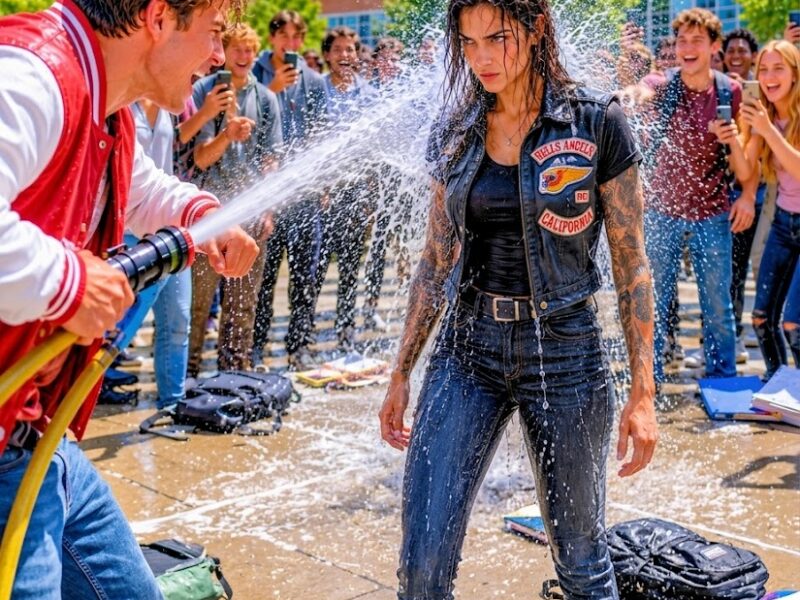
A bully hosed a freshman in front of the whole school. He had no idea she was the Hells Angels boss’s daughter.
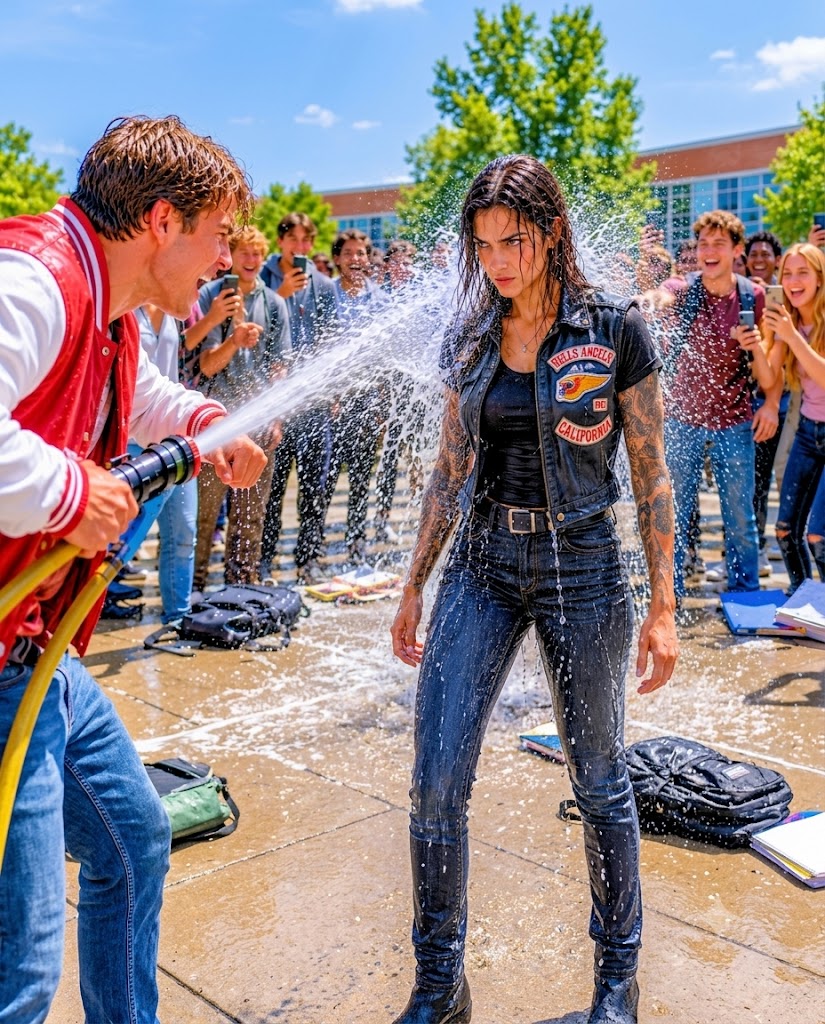
A blast of cold water slammed into her back.
She pitched forward, hands scrabbling across the wet concrete. Books spilled out of her bag and floated in the spreading puddle, their pages swelling like drowning lungs.
The hose kept coming.
It hit her shoulders, her neck, the side of her face until her hair clung flat and her clothes stuck to her skin like a second layer of shame. Somewhere behind her, people were laughing. Phones went up like a firing squad of tiny screens.
Nobody moved to help.
She climbed to her knees, dripping, and did not scream. She did not swing. She reached into her soaked backpack, pulled out her phone, and made one quiet call.
Then she stood, picked up her ruined books, and walked back to class.
Her name was Delia Ruark, 18 years old, one week into her freshman year at Oak Ridge Community College in Michigan. What that one phone call brought down on the boy who hosed her is something he will never forget.
Stay with me on this.
Let me take you back a few days because you need to understand who this girl was before any of that happened.
Delia showed up at Oak Ridge the same way she did everything. Quiet. Early. She sat in the back of every lecture hall, close to the door, with her hood up and her eyes down.
She never raised her hand. She never asked a question out loud.
When people talked to her, she gave short answers and a small nod and went back to her notes. The other freshmen figured she was shy. Some figured she was stuck up.
Most of them didn’t figure anything at all because Delia had spent 18 years learning how to be the person nobody looks at twice.
Here’s the thing. That was on purpose.
Every morning she rode in on an old Ford F-150 pickup, not a bike. She parked it at the far end of the lot, nose out. The way her father had taught her to park everything, so you could leave fast if you had to.
She wore plain jeans and a plain gray jacket. And inside her backpack, folded under her laptop and her textbooks, was a worn leather vest.
A cut.
On the back of it was stitched a set of wings, and a name most people in that part of Michigan knew enough to be afraid of.
The Hells Angels.
But nobody at Oak Ridge knew that. Nobody was supposed to.
Delia wanted a normal life. That was the whole point of community college. She wanted to sit in a classroom and learn something that had nothing to do with the world she came from.
She wanted to be just a student. A regular 18-year-old.
For one semester, she wanted to keep her two lives in separate boxes and never let them touch.
You have to understand what she was walking away from to do that.
She’d grown up in a house where men came and went at all hours. Where the kitchen table doubled as a place to count things and settle things. Where her father’s word was the only law that mattered for 40 miles in any direction.
She loved him. She did.
But she’d watched that world take a toll on everyone in it. She’d seen what it did to the wives, to the kids, to the men themselves.
And somewhere around 16, she made a quiet decision that she was going to be the first Ruark in three generations to walk out the front door with a diploma instead of a record.
College was the first step.
Nobody in that world even knew she’d enrolled. She wanted it clean.
Now let me tell you about Brett Vandermeer.
Brett was a sophomore, which at a two-year college makes you close to the top of the food chain. He was tall, broad through the shoulders, and he walked like the sidewalks had been poured just for him.
He had a crew that followed him everywhere. Three or four guys who laughed at whatever he said and filmed whatever he did. And Brett liked to be filmed. He liked an audience.
He had built his whole little kingdom on being the guy everybody watched.
It helped that his father ran the place. Not literally the president, but close.
Gerald Vandermeer was the dean of students at Oak Ridge. The man who handled complaints. The man who decided who got suspended and who got a warning and a handshake.
And every student on that campus knew what that meant.
If Brett did something to you, there was no point reporting it. The report landed on the desk of the one man in the world who would never let his son take the fall.
So, Brett did what he wanted.
For two years, he’d made a sport out of finding the quiet ones. The kids who wouldn’t fight back. The ones who would just take it and go home and cry about it where nobody could see.
He had a gift for picking them out of a crowd. He studied them the way a hunter studies a field. He watched how they walked, whether they made eye contact, whether they ate alone.
And the first week of that fall semester, scanning the courtyard for his next bit of entertainment, his eyes landed on a girl in a gray jacket sitting alone at the edge of a bench eating a sandwich and reading.
He thought he’d found the easiest target he’d ever seen.
Believe me, he had no idea what he was looking at.
Delia had noticed him, too.
She noticed everything. It was how she was raised. She clocked the way the other students stepped out of his path. She clocked the way the smaller kids went quiet when he walked by.
She knew exactly what Brett was because she’d grown up surrounded by men who were a hundred times harder than him.
She’d seen real danger. She’d sat at a table while her father settled things that would have put Brett in the hospital just for watching.
To her, Brett wasn’t frightening.
He was a boy playing dress up as a dangerous man. And she could have told him in about one sentence exactly how a real one would have ended him.
A boy like Brett only worked because nobody around him had ever seen the genuine article.
But she had.
She lived with it.
But she wasn’t there to settle anything. She was there to get through the week. So when Brett started circling, when he started dropping comments as he passed her bench, she did what she trained herself to do.
She kept her head down. She let it roll off. She told herself it would pass, that he’d get bored, that he’d find someone else.
She was wrong about that.
For three days, Brett kept at it.
First, it was words. Then, it was knocking her book off the bench as he walked by, grinning, waiting for her to say something.
Then, it was his crew circling her table at lunch, filming her while she ate, narrating it like it was a nature documentary.
And every time, she gave him nothing.
She just packed up her things and moved.
To most people, that would have read as weakness. To Brett, it read as a challenge.
Being ignored was the one thing his whole fragile kingdom couldn’t survive.
By the end of that week, he decided the quiet girl in the gray jacket needed a proper introduction to Oak Ridge Community College.
It happened on a Friday, a little after noon, when the courtyard was packed.
Delia was crossing the open square between the science building and the library, her bag over one shoulder, her mind already on the exam she had that afternoon. The benches were full. A couple hundred students were scattered around eating lunch and killing time between classes.
Brett was waiting for her.
He’d found a janitor’s cart parked by the maintenance door, and coiled on the side of it was a long green garden hose, hooked to a spigot the grounds crew used to water the planters.
He’d planned it.
That’s the part people forget. This wasn’t a thing that happened in the heat of a moment. He had walked out to that cart. He had tested the valve. He had arranged his boys in a loose half circle with their phones already up, already recording, because Brett never did anything worth doing without making sure the whole internet could watch.
“Hey,” he called out. “New girl.”
Delia didn’t stop.
That was the mistake in Brett’s mind. She didn’t turn around. She didn’t give him the reaction he wanted.
She just kept walking like he wasn’t there.
And to a guy like Brett, being ignored was the one thing he could not stand.
So, he opened the valve.
The first blast caught her square in the back, and it was not a gentle spray. It was a hard, pressurized jet that hit her like a shove from behind.
She stumbled forward and went down onto her hands and knees on the concrete. Her bag flew off her shoulder. Her books slid out across the wet ground.
And Brett laughed.
His whole crew laughed.
And then the water kept coming.
He walked toward her with the hose, hosing her down like she was a dog that had rolled in something. He hit her back, her shoulders, the back of her head.
When she turned to get up, he brought it around to her face, and she had to throw an arm up just to breathe.
Her hair plastered flat. Her gray jacket turned black with water. Her notebooks turned to pulp in the puddle around her.
A whole semester’s worth of careful, quiet planning to be invisible washing away on the concrete in front of 200 people.
“Welcome to Oak Ridge!” Brett shouted and the crowd roared.
Here’s what you have to understand about that moment.
There were 200 people in that courtyard. And not one of them stepped in.
Some of them laughed. More of them just watched, frozen, the way people always do, holding their phones up to catch it rather than putting them down to stop it.
A girl was on her knees on the concrete, soaked to the bone, humiliated in front of the entire school, and the whole world just watched it happen.
Nobody wanted to be next.
That’s the ugly truth of a place ruled by a boy like Brett. Everyone decides, very quietly, that as long as it’s happening to somebody else, they can live with it.
Delia stayed down for a second longer than she needed to.
Not because she was hurt. Because she was deciding.
I want you to really sit with what was going through her head right then.
She had options most people will never have in their whole lives. She knew exactly what one phone call could do. She’d watched grown men beg. She’d seen what the Hells Angels did to people who crossed them.
And crossing a member’s daughter was the kind of thing that didn’t get forgiven.
One word from her, and Brett Vandermeer’s life would stop being his own.
There was a version of that afternoon where she stood up, said a name, and let the worst of her father’s world come down on a 19-year-old boy in a parking lot.
And part of her, the part that was cold and furious and on her knees in dirty water, wanted exactly that.
She could have screamed it right there. She could have stood up and told the whole courtyard exactly who her father was and watched Brett’s face fall.
She didn’t, though.
She got to her knees in the spreading puddle, water running off her chin, and she did not scream and she did not swing.
She reached into her soaked backpack, past the ruined laptop, past the folded leather cut nobody could see, and she pulled out her phone.
The screen was wet. Her hands were steady.
She made one call. She said six words into it, quiet enough that nobody around her heard.
Then she hung up, stood, gathered her dripping books off the ground, and walked across the courtyard toward the science building without looking back.
Brett watched her go with a grin on his face.
“Yeah, that’s what I thought,” he said, and he dropped the hose and raised both arms like a man who just won something.
His crew clapped him on the back. The videos were already uploading. By the time Delia reached the door, half the campus had seen it.
And then, nothing.
That’s the part that matters.
For the next 20 minutes, absolutely nothing happened.
Delia sat down in the back of her afternoon class, soaked through, a small puddle forming under her chair, and her professor glanced at her and said nothing.
The other students snickered and then forgot about her.
Brett went off to the campus cafe with his crew, riding high, laughing about it, replaying the clip on his phone.
He’d done this a dozen times before. It always ended the same way. The target took it and disappeared, and Brett moved on to the next one.
As far as Brett Vandermeer knew, it was over.
Just another Friday. Just another quiet kid who learned her place.
He ordered a coffee and leaned back in his chair and figured he’d already won. He even started drafting a caption for the video. Something clever. Something that would get shares.
He had no idea what was already rolling toward that campus.
It started as a sound.
At first, nobody could place it. A low rumble far off, like thunder on a clear day.
It came in through the open windows of the cafe and the classrooms, soft at first, then growing, then impossible to ignore.
Students lifted their heads. Conversations trailed off.
The rumble deepened until you could feel it in the floor, in the glass, in your teeth.
It wasn’t thunder.
It was engines. A lot of them.
Brett set down his coffee.
Out in the parking lot, the first motorcycle rolled through the main entrance, chrome flashing. Then a second. Then a third.
Then they came in a column that didn’t seem to end. Two by two. Filling the drive and spreading across the lot like floodwater.
Ten. Twenty. Thirty. Forty.
Forty motorcycles. Engines growling. Forming up in neat rows across the campus parking lot while students pressed their faces to the windows.
And the whole school went silent.
On the back of every rider was the same patch. Wings. A name.
The Hells Angels.
And at the front of the column rode a giant.
He was easily six and a half feet. Broad as a doorway. With a gray beard down to his chest and arms like bridge cables.
He killed his engine and swung off the bike like a man half his size. And when his boots hit the pavement, the whole lot seemed to go quieter.
Trotting at his heel was a pit bull. Thick and low to the ground. One ear torn ragged with an old scar. The dog sat when the big man stopped and looked out at the campus with the same flat calm its owner had.
This was Hollis Ruark. President of the Hells Angels Michigan chapter.
Delia’s father.
And the six words Delia had said into that phone, kneeling in a puddle in front of 200 laughing strangers, had been these:
“Dad. Somebody hosed me down.”
Now if you’ve ever wondered what real power looks like, keep watching because this is it.
Not a shout. Not a threat. A girl makes one quiet call and 20 minutes later the ground itself starts to shake.
Brett came out of the cafe with his crew, drawn by the noise like everybody else, still half grinning, still not understanding.
He thought it was a show. A biker rally. Something cool to film.
He actually lifted his phone again. That’s how far gone he was. A man had just ridden onto his campus at the head of 40 motorcycles and Brett’s first instinct was to make content out of it.
Hollis Ruark walked across the lot and the crowd of students parted in front of him without anyone saying a word.
He didn’t look at Brett. He didn’t look at anyone.
He walked straight to the science building and he met his daughter at the door as she came out, still dripping, her hair still flat against her head.
He stopped in front of her and looked her over slow, head to toe, checking for blood, checking for bruises, finding only water and ruined books and a daughter who was holding it together with everything she had.
“You hurt?” he asked. His voice was low, but it carried.
“No,” Delia said. “Just wet.”
“Who?” Hollis said.
Not a question. A door closing.
And that is the moment everything changed.
Because up until then, this had been a story about a cruel kid and a quiet girl. A campus prank. The kind of thing that gets filmed and laughed at and forgotten by Monday.
But the second Hollis Ruark asked that one word, it stopped being about Brett’s pride and became about something else entirely.
It became about the fact that Brett had just humiliated the daughter of a man who answered to no dean, no college, no complaint form.
He hadn’t picked on a nobody.
He’d put his hands on the one person in the state the Hells Angels would cross any line to protect.
Delia didn’t point. She didn’t have to.
Her eyes moved just for a second to the knot of boys by the cafe door, to the tall one in the middle still holding up his phone.
Forty Hells Angels turned their heads at the same time.
Brett felt it. You know how an animal feels a shadow pass over it. That’s how Brett felt 40 pairs of eyes land on him all at once.
The grin finally came off his face. His phone came down.
His crew, who had laughed with him an hour ago, took one look at the parking lot and quietly stepped away from him, one by one, until Brett Vandermeer was standing alone in the middle of the courtyard with a crowd forming a wide, nervous circle around him.
Hollis Ruark started walking toward him.
Deacon, the pit bull, rose and padded along at his boot, unhurried.
Brett did what cornered people always do. He reached for the only weapon he’d ever had.
“Do you know who my father is?” he blurted, his voice cracking in the middle of it. “My dad’s the dean. The dean of students. You can’t just— You can’t come on this campus and—”
Hollis stopped a few feet from him.
Up close, the man blotted out the sun. He looked down at Brett the way you’d look at a puddle you were deciding whether to step around or through.
“I don’t care who your father is, son,” Hollis said. “I care that you put a hose on my daughter.”
And right on cue, the doors of the administration building banged open and Gerald Vandermeer came striding out across the courtyard with two campus security guards trailing behind him, his tie flapping, his face red.
The dean himself. The man who’d spent two years making sure his son never faced a single consequence.
He’d seen the bikes from his office window and he’d come down to do what he always did.
Make it go away.
“That’s enough!” Gerald shouted as he approached. “This is private property. I’m the dean of students and I am calling the police right now. You people need to get on your bikes and leave this campus immediately or every one of you is going to be arrested for trespassing and—”
He got to within 10 feet of Hollis and ran out of steam.
Because up close, the math of the situation became very clear.
Two campus security guards with pepper spray and flashlights. Forty Hells Angels. A giant. And a scarred pit bull sitting at the giant’s boot, watching the dean with mild, patient interest.
Hollis didn’t even look at him at first. He kept his eyes on Brett.
“Your boy here,” he said slowly, “waited for a girl to walk by and he knocked her down with a pressure hose. In front of the whole school. While his friends filmed it and laughed.”
Now he turned and he looked at Gerald and his voice stayed quiet.
“You want to call the police? Call them. Let’s all of us watch that video together. Let’s let a judge see what your son does for fun. And let’s see whose name ends up in the paper first. Yours for raising him. Or the college’s for letting him do it twelve times before mine.”
Gerald opened his mouth and nothing came out.
“Twelve,” Hollis said. “That’s how many kids filed complaints about your son in two years. You want to know how I know that number? Because I made one phone call on the ride over here. And it turns out people talk to us. People who were too scared to talk to you.”
He let that sit.
“Every one of those complaints landed on your desk. And every one of them disappeared. Didn’t it?”
The crowd had gone dead silent.
Two hundred phones were up now. But nobody was laughing anymore. Every one of them was pointed at Gerald Vandermeer and his son. And both of them could feel the whole thing turning.
The way a crowd always turns when it realizes the bully was never actually the strong one in the room.
You could watch it happen on their faces. The students who laughed an hour ago were starting to remember that they’d laughed. And starting to want to be on the right side of whatever this was becoming.
Brett was shaking now. The tough guy walk, the kingdom, the audience, all of it was gone.
“I’m sorry,” he said, and his voice was tiny. “It was a joke. It was just a joke, man, I swear. I didn’t know she was—”
“You didn’t know whose daughter she was,” Hollis finished for him. “That’s the part that’s eating you. Not that you did it. That you did it to the wrong girl.”
He crouched down slow until he was almost at the boy’s eye level. And Deacon settled onto the pavement beside him with a low, rumbling sigh.
“Let me tell you something, son. It was always the wrong girl. Every single one of those twelve kids was the wrong kid. You just never had anybody show up for them.”
Then Hollis straightened, and he turned to his daughter, and his whole face changed.
“Delia,” he said. “Come here a second.”
Delia walked over, still soaked, and her father put one enormous hand on her shoulder and turned her to face the crowd.
And then he reached into her backpack himself. Past the ruined books, and he pulled out the folded leather cut she’d hidden there for a week.
He shook it open. He held it up so the wings and the name caught the light, and 200 students saw at last what Brett had been too stupid to see.
“My girl wanted to do this the normal way,” Hollis said to the courtyard, his voice carrying to every corner of it. “She wore plain clothes. She kept her head down. She hid this in her bag because she didn’t want anybody treating her different. She wanted to be a regular student at a regular school.”
He draped the cut over Delia’s shoulders, and even wet and small and 18 years old, she stood a little straighter under it.
“She took the hit. She took it on her knees in front of all of you. And she didn’t even tell me the boy’s name. She left that for the rest of you to remember.”
He looked at Brett one last time.
“I’m not going to lay a hand on you,” Hollis said. “You know why? Because you’re not worth what it would cost her. She came here to build something, and I’m not going to burn it down on your account.”
He nodded toward the 40 riders in the lot, the engines, the whole impossible weight of it.
“This wasn’t to hurt you, son. This was so that every person at this school knows from today on that this girl is not alone. Not ever. You understand me? She has 40 of us. And you have a video.”
And that right there was the whole of it.
No fists. No blood. Just the truth laid bare in front of everyone.
Which for a boy like Brett was worse than any beating. Because a beating heals, and you can tell yourself a story about it. You can be the guy who took a punch and got back up.
There was no story to tell about this.
Two hundred witnesses had watched him beg. Two hundred phones had caught it. And the videos he’d been so proud of, the ones of a girl on her knees, were about to become the videos that ended him.
Hollis Ruark turned and walked back toward his bike.
And his daughter walked beside him with a leather cut on her shoulders and her chin up for the first time all week. And Deacon trotted along between them.
And the crowd parted again without a sound.
Here’s what happened after. Because the aftermath is where these things really land.
The videos went everywhere over the weekend. Not the one Brett wanted. The other one. The one where a dean’s son begged a girl’s father for mercy in front of the whole school.
And tangled up in it, dragged back into the light by every student who’d been too scared to speak before, came all the other clips.
Two years of them.
Every kid Brett had ever cornered suddenly felt safe enough to post what he’d done to them. Because for the first time somebody had shown them it could be answered.
The college had no choice.
With that many cameras on it, and that many old complaints surfacing all at once, even Gerald Vandermeer couldn’t bury it. A review board that had looked the other way for two years suddenly found its spine.
Brett was expelled by the end of the month.
And the quiet investigation that followed, the one into how twelve complaints had vanished off the dean’s desk, cost Gerald his job by Christmas.
The man who’d built his son a kingdom where there were no consequences got to watch them both lose everything to the one thing he couldn’t control.
A camera and a crowd that finally stopped laughing.
Delia, though— Delia went back to class.
That’s the part I keep coming back to.
She didn’t transfer. She didn’t quit. The Monday after, she walked back into the same courtyard where she’d been hosed down in front of everyone. And she sat on the same bench, and she ate her lunch and read her book.
Only now she wore the cut out in the open. She’d stopped hiding it.
Not to scare anybody. She didn’t need to anymore. Everyone already knew.
And a funny thing happened.
The kids who’d watched her get soaked and done nothing, some of them came up to her over the next few weeks. Awkward at first.
One of the twelve, a skinny kid Brett had tormented all of freshman year, sat down next to her one afternoon and didn’t say much. Just ate his lunch beside her like it was the most natural thing in the world.
Then another.
By midterms, there was a little cluster of them. The quiet ones, the ones who’d always eaten alone, and they’d found their way to the one bench on campus where nobody would ever bother them again.
Delia never talked much about her father’s world, and she never brought the club back to campus. She didn’t need to. The point had been made once, and once was enough.
She finished her first semester with straight A’s, because that, in the end, was the thing she’d actually come there to do.
Her father called her every Sunday. He never once asked if anybody was giving her trouble, because he already knew the answer.
Nobody was. Not anymore.
I think about that first scene a lot.
A girl on her knees in a puddle, soaked, humiliated, 200 people laughing, and not one willing to help her up.
And I think about how the world looked at that and saw someone weak. Someone easy. The quietest person in the room, the one who takes it and disappears.
They had it exactly backwards.
Because the strongest person in that courtyard was never the loud one with the hose. It was never the dean with the title, or the crew that laughed on cue.
It was the girl who stayed on her knees one second longer than she had to, deciding, with the whole world against her, not to scream and not to swing.
The one who knew exactly what she could unleash and chose to make a single quiet call instead.
She didn’t need to be the loudest. She never did.
She just needed to not be alone.
And she wasn’t.
She had 40 of them, and she always would.









