A Bully Dumped Leftover Food on a New Black Inmate—Unaware He Was a Hells Angels Chapter Leader
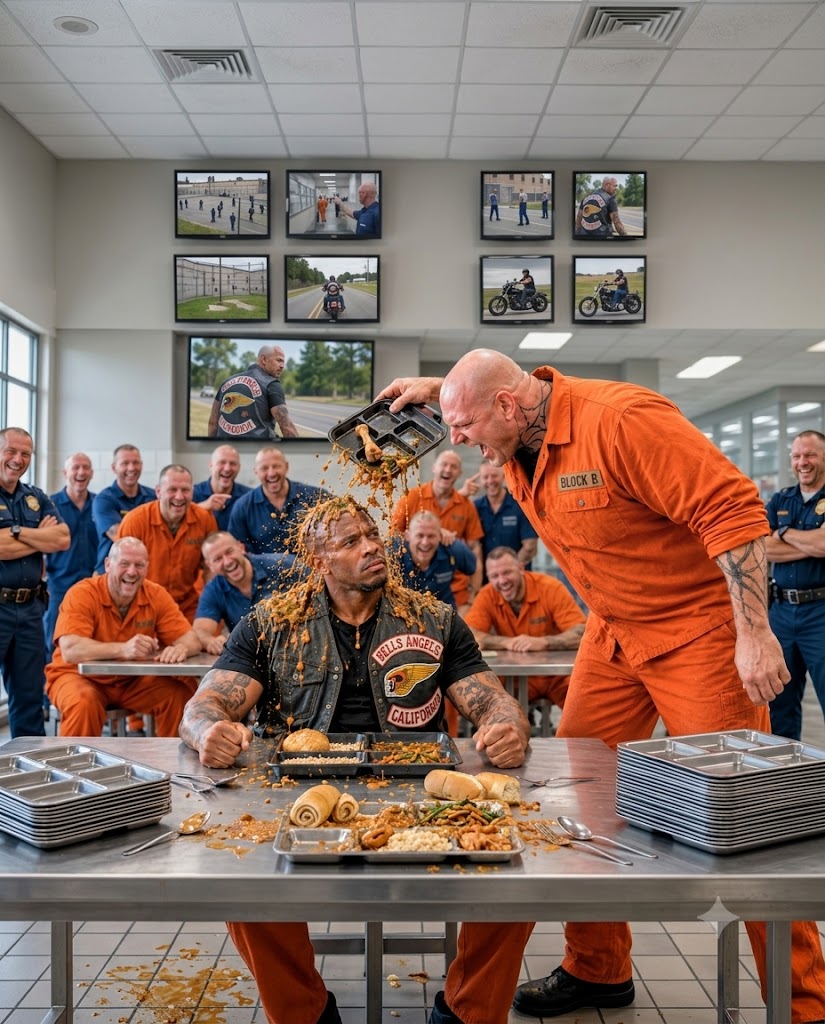
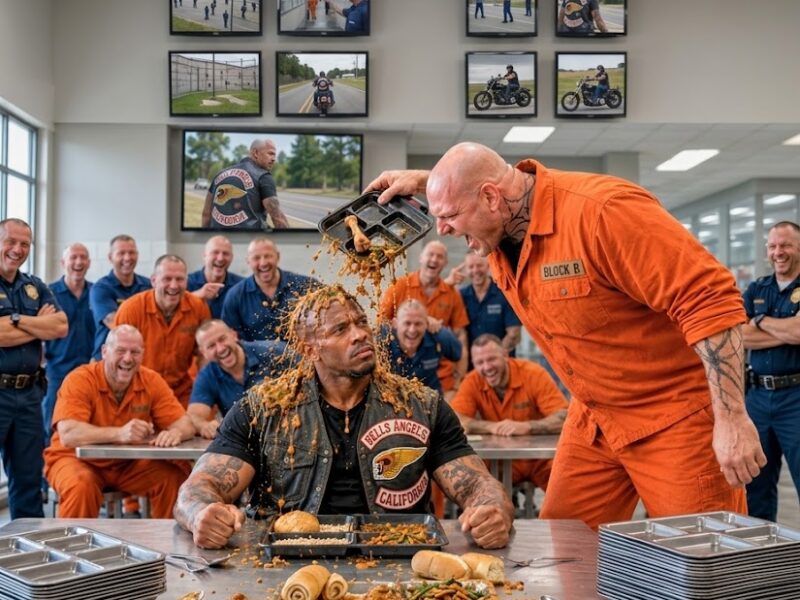
A metal tray swung down hard and dumped cold food over a man’s head. Gravy slid down his neck and soaked into the collar of his prison blues.
Peas rolled off his shoulders and bounced across the floor like tiny green marbles. A chunk of meatloaf stuck to his ear for a second, then fell with a wet slap onto the concrete.
The whole chow hall went quiet. Not the kind of quiet where people stop talking, but the kind where two hundred men stop breathing.
Forks froze halfway to their mouths. Every eye locked on the man at the end of the long steel table.
The one who dumped the tray stood over him, grinning, waiting for the laugh. It didn’t come.
The man who’d been hit didn’t jump up and didn’t swing. He reached up slow, wiped the gravy out of his eyes with the back of his hand, and set his fork down on the table.
That’s when a scarred pit bull padded across the floor, nails clicking on the concrete, and sat at his feet. The dog turned its head and looked up at the man with the empty tray.
The dog didn’t growl. It didn’t have to.
His name was Marcus Teague, and the men at the next table were already standing up. What happened in that room next, nobody there ever forgot.
Stay with me here on this one, because you need to understand the math of a place like Kern Valley State Prison. On day one, everybody is watching.
The guards watch to see who’s trouble. The old heads watch to see who’s weak.
The enforcers watch to see who hasn’t been claimed yet. A new man with no friends is a new man you can use.
That’s the equation. That’s the whole game.
The transfer bus came in before sunrise. Kern Valley State Prison sat out in the flat brown middle of California, miles from anything, behind two fences and a lot of wire.
The heat shimmered off the asphalt in waves, and the air tasted like dust and diesel. Marcus Teague came off that bus in chains like everybody else.
Wrists, ankles, a chain running between. He was a big man, not gym big, just built thick through the shoulders and the neck.
The kind of big that comes from work and from years. His hair was going gray at the sides, and his face didn’t show much.
He shuffled across the cold yard with the rest of the new arrivals. He didn’t look at anybody and didn’t say a word.
You watch a man in chains and you learn things. The ones who look around are scared, and the ones who look down are beaten.
The ones who look straight ahead with nothing in their eyes are the ones you gotta watch. Marcus looked straight ahead with nothing in his eyes.
He got processed with fingerprints, a photo, and a number. They handed him a bedroll and a set of blues and put him in a cell on the second tier of C block.
His cellmate was an old Mexican man named Reyes who’d been inside longer than some of the guards had been alive. Reyes looked him over once, nodded, and went back to his book.
He didn’t ask questions. In there, you don’t ask.
You wait, you watch, and you let a man show you who he is. And there was the dog.
I know how that sounds, a dog in a maximum security prison, but it happens more than people think. Somewhere along the line, a stray had gotten in through a gap under the fence, and instead of chasing it off, the guards let it stay.
A scarred-up pit bull, brown and white, one ear chewed to a stub. They called him Diesel.
He roamed the block and slept wherever he wanted. The men fed him scraps and the guards looked the other way because a dog gave the place a little something soft in all that concrete.
Even hard men need a little something soft, or they go crazy. Diesel took to Marcus right away.
Nobody knew why. The dog walked past a hundred men that first morning and came straight to Marcus’s cell and lay down outside the bars like he’d been doing it for years.
Reyes noticed, because Reyes noticed everything. “That dog don’t like nobody,” Reyes said, not looking up from his book.
“Took him two years to like me.” Marcus crouched and scratched the dog behind its one good ear.
“Dogs know things,” he said. First words he’d spoken since the bus.
Now let’s talk about Dale Brickman, because you can’t understand what happened in that chow hall without understanding him. Brickman ran the yard, not officially, because officially the guards ran it.
But everybody knew the real order of things inside, the who gets what and who goes where, got decided by men like Brickman. He was white, shaved head, arms covered in ink, doing a long stretch for things he’d done outside and a few he’d done inside.
He had a crew, maybe a dozen men who did what he said. And he had a nasty habit of testing every new man who came through.
A shove, a spilled drink, a tray of food dumped on a head. Then he’d watch what the new man did.
If the new man cried or ran or went to the guards, that man belonged to Brickman from then on. If the new man fought, well, Brickman had a dozen men and the new man had none, so that didn’t go well either.
That was the trap. There was no right answer.
That was the point. Brickman had done this maybe forty times over the years, and it always went one of those two ways.
But he’d never done it to Marcus Teague. And that was the problem.
Marcus walked into the chow hall that first evening and didn’t know any of this, or didn’t act like he did. He took his tray, cold meatloaf and gray peas and a scoop of something that was supposed to be potatoes, and sat down at the end of a long steel table by himself.
Diesel followed him in and lay down under the table by his feet. Brickman watched him from across the room.
He watched the way a man eats because that tells you things. He watched Marcus eat slow and steady and calm, not hunched over his food, not guarding it, not rushing.
A man who eats calm on his first day either doesn’t know where he is or doesn’t care. Brickman didn’t like either one, because both meant the man hadn’t learned his place yet.
So Brickman stood up. His crew saw him stand and watched.
The men who weren’t his crew saw him stand, too, and got quiet because they knew what standing up meant. Brickman walked the length of that chow hall slow, taking his time, carrying his own tray of scraped-together leftovers.
He stopped behind Marcus, and here’s the part that matters. He looked around the room first, because he wanted an audience.
A thing like this is no good without an audience. Then he dumped the tray.
And you already know what happened. The food came down, and the room went dead quiet.
Marcus Teague wiped the gravy out of his eyes and set his fork down on the table, slow and deliberate, like a man who had all the time in the world. What Dale Brickman didn’t know, what nobody in that room except four or five men knew, was whose head he just dumped that tray on.
And those men were about to make it very clear. Let me tell you what Brickman thought he was looking at.
A quiet man who’d just been humiliated and had two bad choices. Fight and lose, or sit there and take it.
But Marcus didn’t do either one. Marcus didn’t even look up at Brickman.
He looked down at the dog. Diesel had come out from under the table and was sitting at his feet now, facing the room, and a low sound was starting up in the dog’s chest.
Not quite a growl, just a warning. Marcus put one hand flat on the dog’s head, gentle, and the sound stopped.
Then three men at the next table stood up. They weren’t loud about it; they just stood.
Three men in prison blues, and the way they stood made the whole room turn. Because standing up like that in that moment was a statement, and everybody in a place like that can read a statement.
One was a huge man with a long gray beard. The other two were younger, hard-faced, covered in ink.
And the ink is what did it. Because a man near Brickman, one of his own crew, looked at those three men’s arms and his face changed.
He leaned over and whispered something. And Brickman’s face changed, too.
Brickman didn’t see it yet. He was still riding his little moment, standing over Marcus with his hands on his hips, waiting for the fear to show up on Marcus’s face.
“You got something to say?” Brickman said, loud so the room could hear. “Go on, say it.”
Marcus reached up and picked the pea off his shoulder. He set it on the table next to his fork, slow.
And then, finally, he spoke, and his voice was so quiet that men leaned in to hear it. “You’re going to want to go back to your seat,” Marcus said.
That was all. He didn’t threaten and didn’t raise his voice.
He said it flat, like he was telling Brickman the weather. And Brickman laughed.
Of course he laughed. A man who runs a yard can’t let a line like that slide, not in front of two hundred people.
He laughed and looked around for everybody to laugh with him, but the laugh died in his throat because the room wasn’t laughing. The room was watching those three men who’d stood up.
And now a fourth stood, and a fifth. One of Brickman’s own crew, the one who’d whispered, grabbed his sleeve.
“Dale,” he said, low and fast. “Dale, look at their arms, look at the patch.”
Brickman looked, and for the first time, something moved behind his eyes that wasn’t confidence. The three men who’d stood first had the same thing inked on them, a skull with wings, the death’s head.
Every man in that chow hall who’d spent any time in the system knew that mark. And they knew you did not put a tray of food on the head of a man those three men were willing to stand up for.
Marcus Teague wasn’t just some quiet new transfer. Marcus Teague ran the Nomad Charter of the Hells Angels.
He was the boss, and three of his people had just been sitting at the next table, because of course they had, because men like Marcus don’t go anywhere, not even to prison, without people around them. They’d come in on earlier transfers, and they’d been waiting for him.
And Brickman, with his little tray, had just walked into the middle of all of it without knowing a thing. But here’s where it gets interesting.
Marcus held up his hand. His people were standing ready, and the room was a half second from coming apart into a brawl that would have put a dozen men in the infirmary.
And Marcus just held up one hand, flat, palm out, the same way he’d quieted the dog, and they stopped. They didn’t sit down, but they stopped.
Marcus turned around on the bench, slow, and for the first time looked Dale Brickman full in the face. He had gravy drying in his gray hair and a chunk of potato on his collar, and he looked at Brickman with no anger at all, which was somehow worse than anger.
“Sit down, Dale,” Marcus said. “Finish your dinner, we’re not doing this tonight.”
And then he turned back around and picked his fork back up and started eating again. Cold food, gravy in his hair, like nothing had happened.
The whole chow hall watched him take that bite. Two hundred men, and you could hear the fork scrape the tray.
That was the sound, and that was the moment. Dale Brickman stood there with his hands at his sides and didn’t know what to do with them.
So he turned around and walked back to his seat. And the room watched him walk.
That was worse than any punch. The guards up in the booth had seen the standing and keyed the yard shut and ordered everybody back to their cells, and the whole thing broke up before a single punch got thrown.
Brickman went back to his block with his crew. Marcus went back to his cell with the dog trailing behind him.
And the men talked about it half the night. The quiet man and the three angels and the thing Brickman had done without knowing.
Back in the cell, Reyes was sitting up on his bunk waiting. The old man had heard about it already, because word travels fast in there, faster than you’d believe.
Reyes looked at Marcus with new eyes. “You could have let them take him apart,” Reyes said.
“He had it coming, so why’d you stop them?” Marcus sat down on the edge of his bunk, and the dog put its head on his knee.
He was quiet a long time. “Because that’s what he wanted,” Marcus finally said.
“A man like that, he wants a reason. He wants me to be what he already thinks I am.
The second my guys stomp him, I’m just another animal in here and he gets to be the victim. His crew comes back for mine, my guys do something back, and then we’re in a war over a tray of peas.”
He shook his head. “No, I didn’t come here to run a yard, old man. I came here to do my time and go home.”
Reyes thought about that. “And what if he doesn’t understand mercy?” he said.
“Some men only understand the other thing.” Marcus didn’t answer, because that right there was the problem.
Now here’s where the whole thing changes shape. See, Marcus thought he’d ended it with mercy.
He thought he’d let Brickman keep his dignity, and in return Brickman would back off and they’d do their time apart. That’s how it works between reasonable men.
But Dale Brickman wasn’t reasonable. And more than that, Brickman was afraid.
Because now the whole yard had watched the big man who ran everything get told to sit down and finish his dinner like a scolded kid. And a man like Brickman, his whole life is built on people being afraid of him.
The second they stop being afraid, he’s got nothing. He’s just another con doing time.
And he knew, he absolutely knew, that if he let this stand, he was finished on that yard. So three days later, Brickman made his move.
And it wasn’t a fist fight, that’s the thing. If it had been a fist fight, Marcus would have been fine.
His people would have handled it, or he’d have handled it himself. But Brickman didn’t come at him with fists.
Brickman went to the guards. There was a lieutenant on that block, a man named Oaks, and Oaks was dirty.
Everybody knew it. He moved things for Brickman, phones and tobacco and worse, and took his cut.
And in return, he looked the other way. So Brickman went to Oaks and told him a story.
He told Oaks that Marcus Teague was organizing, that the Angels were moving to take over the yard, to push out the existing order, which meant pushing out the men who paid Oaks. He said Marcus had made threats, and he gave Oaks something that made his dirty little eyes light up.
He said Marcus had a phone in his cell and drugs, a whole stash moving through his people. None of it was true, but it didn’t have to be true.
It just had to give Oaks a reason. And now you see how the fight changed.
It wasn’t a fist fight anymore. It wasn’t about pride, about who got humiliated in a chow hall.
Now it was Marcus against the institution itself. Against a system that could put him in the hole, add years to his sentence, break up his charter, move his men to other prisons across the state.
One tray of food, and now Marcus Teague was fighting for the one thing he’d actually come in there wanting. His way home.
They came for him at four in the morning. That’s when they always come, because that’s when a man is slowest.
The cell door racked open, and six guards in riot gear had Marcus on the floor before he was all the way awake. A knee in his back, his wrists zipped behind him.
Reyes was yelling from the top bunk. The dog was going insane, barking, snapping, until one of the guards kicked it hard into the wall and it yelped and went quiet in the corner.
Marcus heard that. Out of everything, the one time his face changed that whole week was when he heard that dog hit the wall.
They tore the cell apart. And here’s the thing, they found the phone.
They found a bag of pills taped up under the sink. Marcus had never seen either one of them before in his life.
Oaks had planted them. Of course he had.
Brickman had handed them over, and Oaks had tucked them in that cell sometime in the night. And then they’d found them, nice and official, with a report and everything.
Marcus looked at that phone in the guard’s hand and understood exactly what had happened. And understood that understanding it wouldn’t help him one bit.
They dragged him down to the hole. Administrative segregation, a concrete box, no window, a slot in the door for a tray, and they left him there.
Now let me tell you what it’s like in the hole, because most people don’t know. It’s not the dark, because they leave a light on, a bad flickering one, so you lose track of day and night.
It’s the nothing. No voices, no sky, no dog, no sound but the drip of a pipe and your own breathing.
Men lose their minds in there. Strong men.
And Marcus sat in that box and didn’t know how long he’d be there and didn’t know what was happening to his people outside. And that’s the kind of thing that eats a man alive.
But Marcus had one thing going for him that Brickman and Oaks hadn’t counted on. He had people, and his people had people.
While Marcus sat in that concrete box, things were moving. Because a thing like this, a man set up by a dirty lieutenant, that doesn’t stay secret.
The old man Reyes had seen the whole arrest, had seen the guard reach under the sink like he knew exactly where to reach. Because a man doesn’t find something that fast unless he put it there.
And Reyes told the three angels. And the three angels got word out.
A visit, a phone call made by a wife to a lawyer, and that lawyer to another, up the chain, out of the prison, into the world, to the kind of people a man who runs a charter can reach even from inside a concrete box. The gray-bearded one, the big one, his name was Tunnel.
He did something quieter and smarter. He found out which guard had planted the stash.
He found out that another inmate, a kid working the night porter shift mopping the tier, had seen Oaks go into that cell at three in the morning carrying something and come out carrying nothing. The kid was terrified, because nobody wants to be a witness against a guard.
But Tunnel made it clear, in the way these things get made clear, that the kid was a lot safer telling the truth to the right people than staying quiet. But that took time.
And in the meantime, Brickman was running the yard again. Back on top.
Telling everybody how he’d gotten the angel boss thrown in the hole with one phone call. How that’s real power, not standing up in a chow hall.
Real power is making a man disappear. And for about two weeks, it looked like Brickman had won.
It looked like the quiet man had gotten chewed up by the machine and that was that. The yard went back to its rhythms, and men ate, lifted weights, played cards, and counted days.
And Dale Brickman walked through the middle of it all with his chest out, because he’d done the thing that mattered. He’d taken the new man down without laying a finger on him.
That’s what he told his crew, and that’s what he told anybody who’d listen. “You see that?” he said.
“You see how it’s done? You don’t need fists, you need friends in the right places.”
And his crew nodded, because that’s what crews do. But some of them were doing the math in their heads.
Because a man who needs a guard to fight his fights is a man who can’t fight his own. And in a place like that, the math always catches up.
Here’s where the whole thing pays off. Here’s what everybody had been waiting for.
They brought Marcus up out of the hole for what they call a disciplinary hearing. A captain sat at a table, and Oaks stood off to the side with his report, and Brickman wasn’t there, but his story was written down in black and white.
Phone and drugs found in the cell, clear violation. The recommendation was simple: a year in segregation, loss of all good time, and a note in the file that would make parole a joke.
And Marcus stood there in his chains and said almost nothing. The captain asked if he had anything to say for himself.
“The phone and the pills aren’t mine,” Marcus said. “Lieutenant Oaks put them there.
You’ve got a witness who saw him do it. You’ve got a porter named Delgado who was mopping that tier at three in the morning, so ask him.”
Oaks went pale, because Oaks had thought this was airtight. Nobody fights these, and you can’t fight these.
It’s a guard’s word against a con’s, and the con always loses. But here’s what Brickman and Oaks had both forgotten.
A man who runs a charter doesn’t just have muscle, he has reach. That phone call his wife made had gone all the way to a civil rights lawyer who’d been building cases against corruption at that exact prison for years.
Who’d been waiting, just waiting, for one solid case with a witness. And that lawyer had filed paperwork, real paperwork, the kind that lands on the desk of the warden and the state and can’t just be shuffled under a sink.
The captain, who was not dirty, just lazy, looked at Oaks. And then he looked at a second piece of paper in front of him, one that Oaks hadn’t known was there.
A statement signed by the porter Delgado describing exactly what he saw at three in the morning. The room got very quiet, the same kind of quiet as the chow hall two weeks before.
“Lieutenant,” the captain said slowly, “you want to tell me about this?” And that was the moment it turned.
That was the moment the whole thing came down, not on Marcus, but on the men who’d set him up. Oaks started talking fast, too fast, and every word made it worse.
They walked Marcus out of that room and back toward his block, not the hole, his block. And behind him he could hear it already falling apart, voices rising, the captain calling for someone to get the warden on the phone.
Oaks was done. Within a month he’d be gone, stripped of his badge, under investigation, looking at charges of his own.
The lawyer wasn’t going to stop at one dirty lieutenant, either. A thing like this, once it opens up, it keeps opening.
But I want to be careful here, because the real payoff wasn’t the hearing and wasn’t Oaks getting caught. The real payoff was what Marcus did next, and it’s the thing nobody in that prison expected, least of all Dale Brickman.
They put Marcus back on the yard, and the whole yard was watching, because everybody knew what was supposed to happen now. The angel boss had been set up and thrown in the hole, and he’d come out clean.
And the man who did it to him was standing right there by the weight pile, and he had it coming. Everybody knew he had it coming.
Marcus’s people were ready. Tunnel and the other two fell in beside him the second he walked out, and the whole yard went still, waiting for the word.
And here’s what Marcus did. He walked across that yard straight at Brickman.
And Brickman, for all his talk about real power, backed up against the fence with nowhere to go. And you could see it on his face, the fear he’d spent his whole life putting on other people finally showing up on his own.
His crew didn’t move. His crew had seen which way the wind was blowing.
A man set up by a lieutenant, and the lieutenant goes down for it, that’s a man you don’t stand next to. Marcus stopped a foot in front of Brickman, and the whole yard waited for him to break the man in half.
“You went to Oaks,” Marcus said quiet the way he always talked. “You couldn’t take me yourself, so you got a guard to do it.
You put me in a box for two weeks over a tray of food.” He let that sit.
“You know what I kept thinking about in that box? I kept thinking I had you figured for a certain kind of man.
The kind that at least does his own dirty work.” Brickman didn’t say anything, because there was nothing to say.
And then Marcus did the thing. He turned around.
He turned his back on Dale Brickman in front of the whole yard, which in that world is the biggest insult there is. Bigger than any beating, because it says this man is not even worth my hands.
“We’re not doing this,” Marcus said loud enough now for everyone to hear. “Nobody touches him.
He’s got to live in his own skin. That’s worse than anything I do to him.”
And he walked away. And the dog Diesel, who’d been shut in a kennel out back since the night of the arrest and had been let loose that morning, came tearing across the yard and jumped up on Marcus like he’d been gone a year.
And Marcus went down on one knee right there in the dirt and let the dog knock him flat. And for the first time since he’d come off that bus, the man actually laughed.
Let me tell you how it all settled, because it did settle. And the way it settled is the whole point of the thing.
Dale Brickman never ran that yard again. Nobody had to lay a hand on him.
Marcus had seen that right from the start. The moment the whole yard watched Marcus turn his back and walk away, Brickman was finished, because his power had never been real in the first place.
It was only ever other men’s fear, and fear is a borrowed thing. And the day it runs out, you’ve got nothing left.
His crew drifted off to other men. Within a few months, Brickman put in for a transfer himself just to get off a yard where he’d become a ghost, a man people stepped around and didn’t look at.
He left quiet. Nobody said goodbye.
Oaks went down hard. The lawyer who’d taken Marcus’s case used it to crack the whole thing open, and by the time it was done, there were three guards gone and a warden explaining himself to the state.
Marcus never asked for any of that. He just told the truth once in a small room, and the truth did the rest because for once somebody had made sure it couldn’t be buried.
And Marcus did the thing he’d said he came in there to do. He did his time, quiet, head down.
He worked in the prison library, of all places, checking books in and out. Because a man who runs a charter is first of all a man who’s good at keeping track of things and keeping the peace.
He kept the peace on that yard better than any enforcer ever had. Not with fists, but with the plain fact of who he was and the way he carried it.
New men came in scared, and the old heads would tell them, “You want to know how this yard works? Watch Teague.
Don’t start trouble, and trouble won’t find you.” He broke up more fights than he ever started.
He started none. The three angels did their time alongside him, and when their numbers came up, they went home, one by one.
And each time Marcus saw one of his people walk out that gate, it was the only thing that ever put a shine in his eye. And the dog stayed.
Diesel never left his side again. He slept outside his cell every night, and when Marcus worked the library, the dog lay under the desk.
Nobody ever had the heart to get rid of that dog, because by then the dog belonged to the whole block, and the block belonged, in its quiet way, to Marcus. When Marcus Teague finally made parole, years later, he walked out that gate a free man with his record clean of everything Oaks had tried to pin on him.
And on his last morning, the whole yard did a thing I’ve never heard of happening anywhere else. Two hundred men, every color, every crew, stood at the fence and didn’t say a word as he walked to the gate.
They just stood. The same way three men had stood for him in a chow hall on his first day.
It was the only way they knew to say what they wanted to say. He couldn’t take the dog with him, and that’s the one sad part.
A parolee with no money and nowhere steady can’t take a dog. So he knelt down one last time by that fence and scratched Diesel behind his one good ear and told the old man Reyes, who still had years left to serve, “You keep him for me.
Dogs know things.” And Reyes nodded and took the leash, and that was that.
Now think back to how this whole thing started. A man with a tray of cold food dumped over his head, gravy in his hair, two hundred people waiting for him to break.
And everybody in that room was so sure they knew what power looked like. Power was the man standing over him holding the tray.
Power was the man who could call a dirty guard and make somebody disappear. But Marcus Teague showed them all what it actually was.
Power was the man who could have ended Dale Brickman at any second with a word, with a nod, and chose not to. Power was wiping the food off your own face and setting your fork down and deciding quietly that you would not become the thing somebody was trying to turn you into.
The strongest man in that prison was the one who almost never used his strength. And the only time anybody ever saw him come close to losing his temper the whole time he was inside, it wasn’t when they dumped food on his head and it wasn’t when they threw him in the hole.
It was when somebody kicked a dog. That’s who he was.
And that’s why, out of everybody who ever passed through that place, Marcus Teague is the one they still tell stories about.









