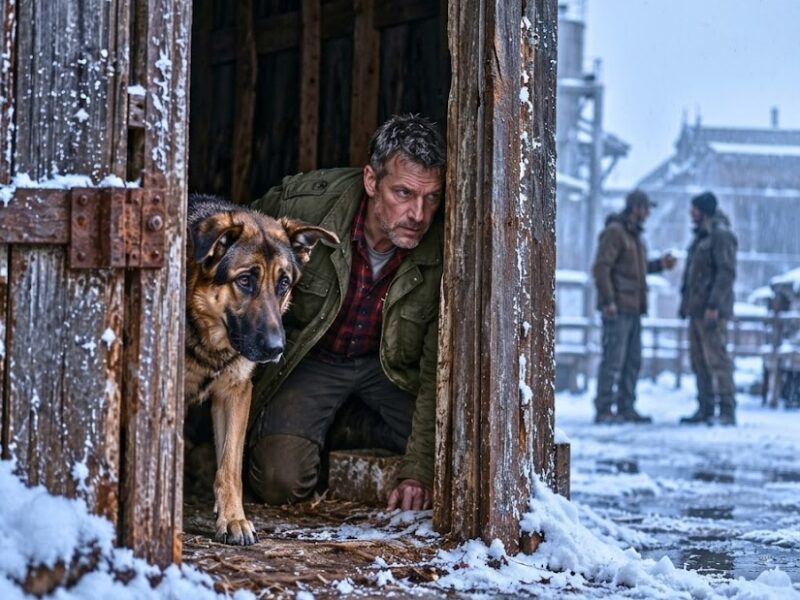
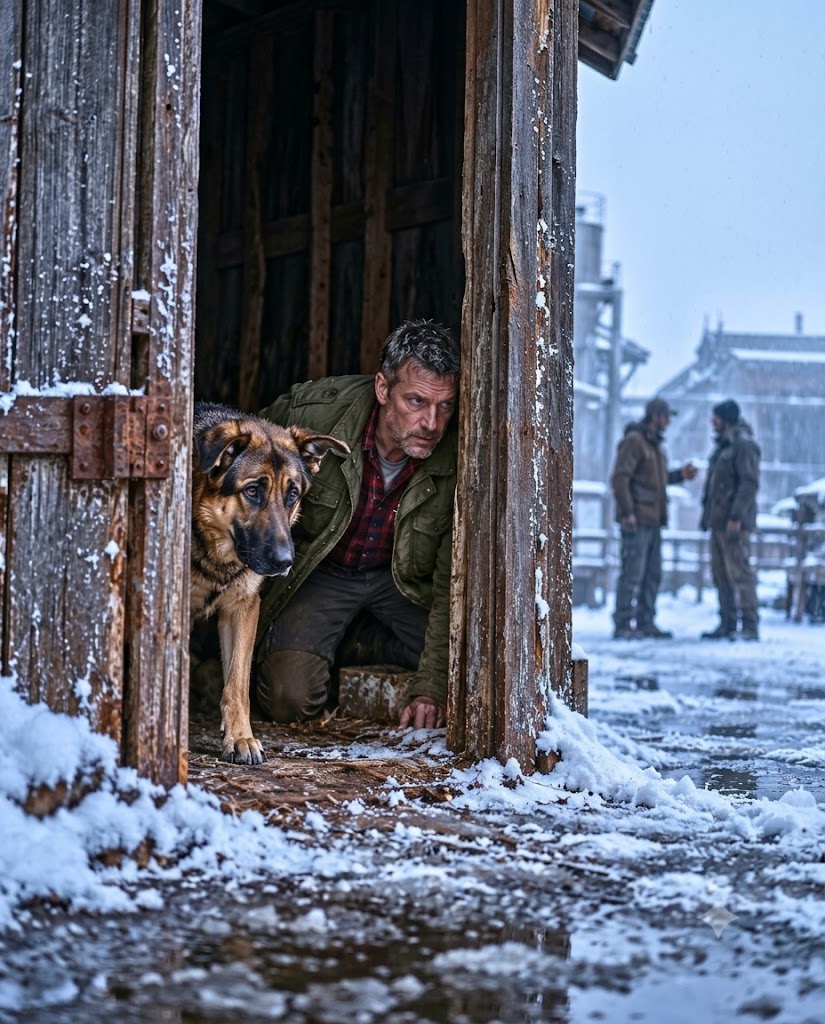
A broken German Shepherd hid in the dark, too scared to come out. Then a Navy SEAL heard his cry—and chose him.
**Part 1**
Rain came sideways across the Oregon coast before sunrise, rattling the windows of a small timber house above Yaquina Bay. In Newport, the winter sky often looked like old steel, and Nathan Cole Harris trusted that color more than he trusted promises. He sat alone at the kitchen table with cold coffee in a chipped mug, watching water crawl down the glass.
At 39, Nathan still carried the Navy in his bones. He stood a little over six feet, lean and hard through the shoulders, with dark brown hair cut short and silver at both temples. His eyes were gray-blue, steady, and difficult to read. He wore a faded gray military T-shirt under a dark olive tactical jacket, earth-brown cargo pants, scuffed boots, and a scratched field watch.
The dog tag that should have hung against his chest lived instead in a dented metal box under his bedroom cabinet. Dr. Lauren Wells had given him a card three days earlier, Cascade K9 Training. “Not for protection,” she had said. “Not for work. For company.”
Nathan told her he had a radio, a coffee maker, and a neighbor who delivered muffins without clearance. Lauren only said, “You need something alive in the house that does not take orders from your guilt.”
The sentence followed him home and sat there, so he drove south through rain and fir trees toward a training property outside Toledo. Cascade K9 stood behind a chain-link gate, all steel doors, gravel runs, and practical signs. Barking rolled across the yard before Nathan stepped out. German Shepherds and Malinois moved behind fences with hard, bright focus.
Rick Donovan came from the main building wiping rain from his hands. He was in his fifties, square through the chest with salt-and-pepper hair and a face weather had used without asking. A whistle hung at his collarbone.
“You Harris?”
“Yes.”
“Lauren said former Navy.”
“Former enough.”
Rick studied his posture, his hands, the way he stood where no one could come up behind him. “I do not sell ornaments.”
“I am not looking for one.”
For nearly an hour, Rick showed him excellent dogs. A sable shepherd named Duke snapped into obedience positions as if command had built his bones. A dark Malinois found a scent tin behind a pallet in seconds. A young black shepherd stayed calm when Rick slammed a gate. Nathan respected them. Their eyes asked for work. He did not want any of them in his house.
Rick’s patience thinned. “What are you looking for?”
Nathan watched rain drip from a roof edge. “A dog that can stand still with me.”
“That is a strange answer.”
“Most honest ones are.”
Rick gave a dry breath. “You want quiet? Go to a rescue. Find something lazy with soft ears.”
Nathan almost left. His hand had reached the Bronco door when he heard it beneath the rain and barking. Not a bark, not a proper whine. A thin, swallowed sound from the rehab wing behind the kennels. He turned.
Rick’s face changed first. “Equipment room. Something is in there.”
“A dog not available.”
“Show me.”
The rehab room smelled of rubber mats, disinfectant, old towels, and warm dog. In the far corner beside stacked balance boards and training cones stood a young German Shepherd with a sable coat, black saddle, smoky cream chest, and one ear that leaned a little as if it had its own opinion. His left rear leg set down carefully. His brown eyes had amber at the edge, too watchful for a dog barely grown.
“Boon,” Rick said. “Good heart, bad fit.”
Nathan crouched several feet away and did not reach. Boon froze, head low, body ready to fold into the wall without touching it.
“What does bad fit mean?”
“Sensitive to metal. Hates hollow flooring. Rear left leg is not right. He will not push through pressure the way a working dog has to.”
“Some dogs want the problem.”
“This one listens to the room and believes the room.”
Nathan looked at Boon. Boon looked at his boots as if boots were safer than eyes. “Is he healthy?”
“Vet says manageable. Not patrol material by my standards. He needs a calm home and somebody who will not expect him to become a machine.”
Nathan almost laughed. It came out as air. “How much?”
Rick blinked. “For him?”
“Yes. You passed on Duke.”
“Duke already knows who he is.”
Rain ticked against the roof. Rick rubbed one hand over his jaw. “Three hundred covers records and transfer. No guarantees. There never are.”
In the office, Nathan signed forms under a humming light while Boon waited somewhere behind the half-closed door. Printer ink, coffee, and wet leather filled the room. He had just set down the pen when claws skidded in the hall. Boon pushed through the gap and crossed the slick floor too fast for his uneven leg. He stopped at Nathan’s boots, lowered his head, and caught one wet bootlace gently between his teeth, not biting.
“Holding.” Rick stepped forward. “Boon, leave it.”
The shepherd went lower, bracing before any correction came. Nathan moved without planning to, placing himself between Rick and the dog. His voice was quiet enough to make the room listen. “Leave him.”
Rick stopped. Boon’s eyes lifted. Nathan crouched, one hand flat on the floor, not touching. “I am coming back,” he said. “I am just finishing the paper.”
Boon could not know the words. Maybe he knew the shape of a promise. Slowly, he released the lace, but he did not move away.
Outside, the rain softened to mist. Nathan opened the Bronco’s passenger door and lifted Boon carefully, one hand under the chest, one hand supporting the hips. The dog weighed less than he looked, all heat and bone and watchful breath. When the engine started, Boon flinched. Nathan rested one hand near the gearshift. “Just the truck,” he said. “Nothing hunting us.”
The words sat between them, strange and true. Behind them, the trained dogs barked in strong voices. Ahead, the coast road bent toward Newport, toward a house too quiet for one man and a dog who had chosen his boot like a lifeline. Boon trembled for the first mile. At the second, he raised his head. At the third, he leaned his narrow shoulder against Nathan’s thigh, and Nathan kept his eyes on the road because the gesture felt too large to look at directly.
By late afternoon, fog crawled over Newport and softened the roofs near Yaquina Bay into gray shapes. Nathan’s house stood above a narrow road lined with shore pine and wet grass, its porch boards dark from rain. Boon did not enter it like a rescued dog. He entered like a man stepping into court, certain the room already knew more than he did.
Nathan opened the front door and stood sideways, giving the shepherd space. Inside, the air smelled of coffee, wood smoke, old wool, and the lemon oil Grace Holloway brought over because, in her words, “A man can be sad without making the furniture suffer.” The living room was plain: couch, low table, two books Nathan rarely read, no photographs on the mantel, though a pale rectangle in the dust showed where one had been.
Boon’s nose moved, his ears tipped forward, then back. His left rear foot touched the threshold and lifted again. “No tricks,” Nathan said. “No speeches.”
Boon took one step inside, then another. The floorboard beneath him creaked. He folded low and slid into the corner beside the front door, body pointed toward the room, eyes pointed toward escape. Nathan closed the door slowly. The latch clicked. Boon flinched so hard the harness shifted against his chest.
Nathan froze with his hand on the knob. He knew that kind of flinch, not from dogs, not originally. He knew it from men who ducked before the blast, from his own shoulders in grocery stores when someone dropped a pallet in the next aisle. The body could learn a language the mind hated admitting it understood.
“Kitchen,” he said after a moment. “Water. Food. No ceremony.”
He filled a bowl and set it far enough from the corner to be an invitation, not a demand. The metal rim touched the floor with a faint ring. Boon’s ears went flat. Nathan picked it up, placed a folded dish towel beneath it, and lowered it again. No ring. The dog watched his hands. Always the hands.
Nathan boiled chicken, warmed rice, and cut everything small while the house filled with ordinary sounds. Water heating. Knife on board. Rain in the gutter. His own breath when he remembered to take it. Boon did not move. Nathan sat on the kitchen floor with his back against the cabinets, one knee complaining at once. “Eat when you want,” he said. “Nobody is keeping score.”
Ten minutes passed, then twenty. Boon’s nose twitched. Hunger betrayed him, small and honest, but he stayed folded in the corner. At last he rose in stages, front legs first, a shift of weight, the uneven hind leg finding its place. He took one step toward the food. The furnace clicked in the wall with a metallic tick. Boon dropped flat.
Nathan closed his eyes. “Old house,” he said softly. “It complains. So do I.”
The dog did not try again until Nathan stood in the hallway and pretended not to care. Pretending not to care required more discipline than most missions. By evening Boon had drunk water and eaten two cautious mouthfuls from a towel-lined plate. Nathan moved through the house slowly, naming small things in a voice almost too low to hear. Lamp, shade, stove, door. He touched the lock without rattling it. Boon cataloged everything.
At one point, Nathan reached for a mug and brushed a spoon from the counter. It hit the sink with a bright metal clatter. Boon shot backward into the corner, chest to floor, head low, eyes squeezed shut. Nathan stood still. The spoon lay in the sink, ridiculous and guilty. A small thing. Small things were the trouble. Wars did not always follow men home as thunder. Sometimes they hid inside spoons, keys, hollow floors, and words said too sharply in rooms that were supposed to be safe.
“It’s a spoon,” Nathan said. His voice came out rough. Boon did not open his eyes. Nathan wrapped the spoon in a towel and set it on the counter. Then he sat on the floor again, not closer, not farther. No one gets sent away over a spoon.
Boon stayed low for a long time. When he rose, he returned to the corner instead of the food. That was when Nathan understood what troubled him most. A wild young dog would have been easier. A dog that stole socks and declared war on chair legs would at least believe he was allowed to take up space. Boon behaved as if space were a privilege reviewed hourly.
Night came with rain tapping the roof and fog against the glass. Nathan placed an old wool blanket near Boon’s corner, then added a folded towel under it for the uneven hip. Boon sniffed the blanket but did not lie down. He sat facing the door. Nathan went to the bedroom, left the door open, and lay on top of the covers with his boots beside the bed. Sleep came shallow.
Sometime after midnight, he woke with one hand clenched in the sheet and cold dust in his mouth. For a moment, Oregon was gone. There was a tunnel under snow, a map made useless by ice, Echo standing ahead in the white dark, refusing to move while Nathan ordered the team forward. A soft scrape came from the front room. Nathan walked to the hall and found Boon exactly where he had been. Seated by the door, thin body rigid, eyes fixed on the knob.
The blanket lay untouched. The dog was not guarding the house. He was guarding against the house changing its mind. Nathan almost laughed. It was not funny. Maybe that was why. Two damaged creatures in one quiet house, both convinced danger would enter if they looked away. He took the blanket from the couch and lowered himself to the floor between Boon and the door. His spine complained. Boon turned his head, confused for the first time instead of afraid.
“Enough.” Nathan whispered. “Tonight I will watch.”
The words surprised him. Still, something inside his chest loosened. Near dawn, Nathan woke with one arm numb and saw Boon lying on the folded towel. Not relaxed, not careless, but down. Then from the bedroom, a faint metallic click sounded under the cabinet and both man and dog lifted their heads at once.
Morning came pale and wet over Newport with gulls crying beyond the fog and gutters ticking from the night’s rain. In Nathan’s bedroom, the sound under the cabinet had already gone silent, but silence did not erase it. Boon stood in the doorway, one paw lifted, ears half pinned. Nathan stared at the low cabinet as if it had moved. It had not. Nothing supernatural lived under there. Only a dented green metal box, pushed forward just enough that its latch had shifted when the old floor settled.
Nathan knew the sound. He had known it for years. He simply had not expected Boon to know what it meant before he did. “Leave it,” Nathan said, then heard the command in his own voice and hated it. Boon stepped back. Nathan softened. “Not you. Me.”
He slid the box back with one boot instead of picking it up. Coward, some honest part of himself said. He let the word stand. Then he took Boon to the porch for the day’s first lesson. Not sit, not heel. Something smaller and harder.
“I am going to the mailbox,” Nathan said, holding his keys where Boon could see them. “Then I am coming back.” Boon stared at the keys as if they were a warning device. Nathan stepped outside, closed the door, walked down the wet gravel drive, and forced himself not to hurry. At the mailbox he found a bill, a flyer for storm windows, and a grocery advertisement promising peaches in February, which felt like fraud against the Pacific Northwest.
He came back and found Boon low to the floor but still in the house. “Back,” Nathan said. Boon looked at him like a tired magician had performed a miracle. They practiced again after breakfast. Two minutes. Five. Nathan stood on the porch in the rain long enough for water to slide down his collar while Boon learned that doors could close without turning into betrayal. The dog ate half his meal from a towel-lined plate while Nathan faced the sink. Progress came quietly. A man could miss it if he needed applause.
That afternoon, Nathan drove him to Newport Animal Clinic between a hardware store and a bakery that smelled like cinnamon through closed windows. Boon disliked the automatic door. He disliked the scale. He held a low but passionate opinion about the poster of smiling puppies near reception. Dr. Abby Turner came out in dark jeans, waterproof boots, a pale sweater, and an olive canvas jacket. Her red-brown hair was tied low at the neck.
“This must be Boon,” she said. Boon retreated behind Nathan’s leg. “Fair,” Abby said. “I also distrust medical professionals before coffee.” Nathan liked her for that. The exam took time because Abby allowed time to exist. She let Boon sniff the room, the chair legs, the cabinet, and the towel in her hand. When she touched him, she used the back of her fingers first. Boon trembled, but he did not collapse.
Abby checked his hips, spine, paws, and reflexes. She watched him cross the rubber mat twice, then sat back on her heels. “Left rear is a structural issue,” she said. “Developmental, most likely. He needs controlled exercise, good nutrition, no forced high-impact work, and someone who does not confuse courage with speed.”
“He came from a working dog program.”
Abby gave a soft snort. “Then someone ordered a hammer and received a tuning fork.”
Nathan looked down. Boon’s ear twitched. “He is sensitive,” Abby said. “That is not the same thing as useless.”
Nathan told her about the metal sounds, the hollow floor, the way Boon watched rooms instead of people. Not the box, not Echo. Enough. Abby listened without trying to make the story neat. Then she said, “Some dogs read environments. Air movement, vibration, scent pooling, voids under floors. Humans like labels after the fact. Dogs just notice. Rick said he was not detection material. Rick trains for certain tests. Boon may fail those tests and still be valuable in the world.”
Boon sneezed once, which Abby accepted as a second opinion. Back home, low winter light turned the bay silver. That evening, Boon followed a scent into Nathan’s bedroom while Nathan folded laundry. The dog moved past the boots, the chair with the olive jacket, then stopped at the cabinet. His nose lowered toward the shadow beneath it.
Nathan’s hands went still around a folded shirt. “Boon.” The shepherd touched the metal box with one paw. The latch clicked softer than the spoon, but older somehow. Boon flattened. Nathan froze. For one second, the room disappeared. Snow filled his mouth. Radio static broke in his ear. Echo stood ahead in the white dark, black and sable body rigid, refusing the tunnel. Nathan had trusted the map. He had trusted the clock. He had trusted everything except the dog.
He came back with his left hand shaking. Boon was still on the floor, eyes fixed on Nathan, not the box. That was worse. The dog had found fear and looked up to see whether the man would become it. Nathan sat beside the cabinet, not close to Boon, close to the box. He pulled it into the light. Inside lay a folded map in plastic, a worn length of cord, a photograph curled at one corner, a patch faded by snow glare, and a small metal tag on a broken ring.
“Echo,” Nathan said. Boon’s breathing quickened, but he did not run. “Military working dog. Not mine officially. Out there, official was a thin word.” Nathan picked up the tag. Metal kissed his ring with a tiny click. Boon flinched, then held.
“He warned us. Old service tunnel. Bad map, bad weather. He stopped and I pushed. One man came home missing part of his leg. Echo did not come home at all.”
The house settled around them. Boon crept forward until his nose touched Nathan’s pant leg. The dog was shaking. So was Nathan. Neither pretended otherwise. Nathan set Echo’s tag on the floor between them. Boon sniffed it once, pulled back, then tried again. Outside fog lifted from the bay. Inside the box stayed open and Boon sat beside it, afraid and present, while Nathan realized the room had not collapsed.
—
**Part 2**
The next week brought hard blue mornings to Newport, cold enough to silver the docks and ditch frost along every rope on the bayfront. By afternoon, the town shook itself awake for Harbor Lights Festival, hanging gold and green lanterns along storefronts, fish houses, and the old Pacific Cannery at the edge of the wharf. Nathan had never trusted festivals. Too many bodies. Too many exits. Too many ordinary sounds pretending they could not become alarms.
Boon needed the world to grow larger than the house, so Nathan took him anyway. They began with the mailbox, then the road, then Grace Holloway’s fence, where Grace stood with a basket of fabric scraps and a measuring tape looped around her neck like a weapon. Boon wore the red brick bandana she had made, uneven at one corner and tied with more affection than skill.
“There,” Grace said. “Now he looks like a working gentleman.”
“He looks like he lost an argument with upholstery.”
“That is how fashion begins.”
Boon sniffed the fence post and declined to debate. He no longer hid when Grace spoke. In Nathan’s private system of measurement, that was progress nearly large enough for fireworks. Though fireworks were not welcome and would be treated as hostile.
Grace’s memory quilt had taken over her front room. She had collected fabric from old cannery uniforms, church picnic tablecloths, bait shop aprons, a Coast Guard sweatshirt, and one floral curtain Arthur Bell claimed had once hung in the break room before good taste arrived too late to save anyone. Arthur was a retired cannery mechanic, 77, tall and thin with white hair and a face that still held mischief when memory did not carry him somewhere else. He came by most afternoons to identify patches.
“That blue canvas,” he told Nathan, tapping a square, “refrigeration crew. Coldest corner in that whole building. We had service ducts under the front wharf.”
Grace looked up. “You said those were filled.”
Arthur frowned as if the sentence had entered wearing another man’s hat. “Some were. Some were not. Depends which foreman lied less.”
Nathan stored that away. Old men sometimes forgot breakfast and remembered the bolt pattern on a door removed thirty years ago. Memory had its own map.
The Pacific Cannery sat beyond the north end of town, long and weathered with boarded windows and silver-gray siding worn smooth by wind off the water. “Once,” Arthur said, “trucks lined up there before dawn and the smell of fish, diesel, coffee, and wet rope filled the air like another weather system.” Now the building leaned into retirement with a sagging roof and a sign so faded the letters looked embarrassed.
The town council wanted it reborn. Harbor Lights Festival would place the main stage on the old front wharf, string lanterns across the safer yard, and invite donors to see Newport honoring its past while selling cider in compostable cups. Boon hated the place quietly. The first time they passed the rear loading bay, he slowed, not stopped, slowed. His uneven hind legs set down with extra care, his nose lowered toward the planks, and his ears angled not toward gulls or workers, but toward the ground.
Nathan let him look. A dog’s world was written in scent, air, pressure, and vibrations men only noticed after something broke. Not every unread sentence was a warning. On the third walk, Boon refused to move.
The afternoon was bright and cold, the kind of coastal cold that slipped under cuffs and found skin. Nathan and Boon stood near a chain barrier behind the cannery, where rainwater gathered in shallow puddles between warped boards. Boon pressed his nose to a narrow seam near the base of the rear deck. He inhaled, stepped back, then set one paw on the board without weight testing.
“Boon,” Nathan said. The dog did not look at him. Nathan crouched and held bare fingers near the seam. At first, he felt only damp cold. Then came a breath of warmer air, faint and wet, rising from below as if the old wharf had exhaled.
Nathan called Chief Mark Delaney. Delaney arrived fifteen minutes later in a county SUV salted white along the doors. He was broad, silver-haired, and calm in the way men became calm after decades of finding trouble in small towns. Deputy Sophie Grant climbed out behind him. Dark hair tied back, navy tactical jacket zipped to the chin, expression skeptical before anyone gave her a reason.
“You reported warm air under the rear deck,” Delaney said.
“Boon found it.”
Sophie glanced at the dog. “The dog reported it?”
“I translated.”
Delaney crouched, removed one glove, and held his palm near the seam. The warmth brushed his skin. His brow tightened. “Huh.”
Sophie looked at him. “Chief, in Oregon, ‘huh’ can mean a lot.”
The next morning, Megan Porter came with a hard hat, a flashlight, and plans under one arm. She was 38, quick-moving, black hair cut short beneath a wool cap, charcoal quilted jacket zipped over a work shirt. She preferred measurements to reassurance. Nathan liked that immediately. She photographed the seam, tested boards, checked the slope of the deck, and asked Delaney who held the restoration plans.
The answer was Dale Whitaker. Dale appeared from the front yard as if summoned by discomfort. He was tall, clean, and well-dressed for a construction site in a charcoal wool coat and polished boots that had not introduced themselves to mud. He smiled with professional warmth and looked past Boon as if the dog were a misplaced tool.
“Chief, the festival area has been reinforced,” Dale said. “The rear deck is restricted. Old structures breathe. It does not mean the public area is unsafe.”
Megan did not smile back. “Which survey did your crew use?”
“A town-approved file.”
“Then I need that file and whatever came before it.”
Dale’s smile thinned. “Of course.”
Workers continued stringing lanterns across the front wharf. A temporary stage rose over fresh boards, far enough from the rear section for people to feel comforted by distance. Comfort, Nathan had learned, loved a clean map. Boon sat beside him in the bandana, crooked and intent, staring not at the seam where warm air rose, but toward the stage. His body went still. Beneath hammers, gulls, and bay water slapping pilings, something old seemed to shift under the wharf. Nathan could not hear it yet. Boon could.
Fog came in low from the bay that morning, thick enough to turn Newport streets into pale corridors and soften every sound except the horn at the harbor mouth. Nathan had planned only a short walk for Boon, down past Grace Holloway’s fence and back before the damp settled into the dog’s uneven hip. Plans, he had learned, were polite guesses the world enjoyed correcting.
Grace was not at her fence. That was the first wrong thing. The second was the way her front door stood open while her screen door slapped gently in the wind. Nathan crossed the yard with Boon at his left knee, and Grace came out holding a phone in one hand and a scarf in the other. Her face had lost its usual mischief.
“Arthur is missing,” she said.
Arthur Bell had left the bakery after breakfast and never made it home. He was 77, proud, stubborn, and beginning to lose pieces of the present while keeping strange treasures from the past. Chief Delaney organized volunteers near the community hall within half an hour. People gathered in raincoats and boots, carrying flashlights, thermoses, and opinions. Someone said Arthur always walked toward the old Coast Guard stairs. Someone else swore he liked the dock trail. Grace snapped that if everyone already knew where he was, perhaps someone should go there and collect him.
Nathan stayed near the edge with Boon, letting the dog absorb the crowd without drowning in it. Boon’s red bandana sat crooked under the harness strap. He was tense, but not folded. That counted.
Deputy Sophie Grant unfolded a map on the hood of Delaney’s SUV. “We split in three groups: bayfront, church road, and the dock trail.”
Boon lifted his head toward the west, away from all three. Nathan followed the line of his ears. Beyond the community hall, a narrow estuary trail slipped between reeds, shore pine, and wet blackberry canes. Wind moved differently there, lower and broken by brush. It was not the obvious route.
“Chief,” Nathan said. Delaney looked over. “Boon wants the estuary trail.”
Sophie exhaled through her nose. “The dog found warm air once. That does not make him a compass.”
Boon pulled once, not frantic, just certain. Delaney studied him, then the map, then the fog thickening over town. “Take them, Sophie.”
Sophie looked as if she had been handed a wet box of problems. To her credit, she moved. “Fine. But if your dog leads us to a sandwich wrapper, I am writing that in the report.”
The trail dropped behind the last houses and entered a world of wet grass, mud, and dripping branches. Fog hung among the reeds in torn sheets. The bay smell faded into the darker scent of fresh water, rotting leaves, and cold earth. Boon did not follow the trail itself. He worked beside it, nose low, pausing near broken grass, then angling toward a creek bank where roots had clawed into the mud.
“There are no footprints,” Sophie said.
“Wind erased the easy ones.”
“That sounds convenient.”
“Most true things do at first.”
Boon stopped. His ears tipped forward. He gave a small sound, almost a question, and moved down the bank with careful steps. Nathan followed, keeping the leash loose. Sophie came behind them, her skepticism changing shape as she saw the mud disturbed beneath a leaning pine. Then they heard a voice, not a shout, a thin embarrassed sound below the creek bank.
Arthur Bell sat wedged among roots and wet leaves, one boot caught under a branch, his cap gone, his cheeks red with cold. He looked up as if they were late. “Well,” he said weakly, “this is inconvenient.”
Sophie slid down first, suddenly all business. Nathan wrapped his jacket around Arthur’s shoulders while she radioed Delaney. Boon sat near Arthur’s knee with grave concern, his nose twitching at the old man’s muddy sleeve. Arthur squinted at him. “That yours?”
“Yes,” Nathan said.
“Good dog.”
Boon sneezed. Modest, too.
Grace arrived before the ambulance, moving across the field with a speed that proved age had been negotiating with her, not ruling her. She dropped to her knees beside Arthur and called him a fool with such tenderness that Sophie looked away. Arthur tried to apologize. Grace told him to conserve his limited wisdom for medical professionals.
By evening, the story had traveled through Newport faster than gulls found french fries. The uneven-legged shepherd had located Arthur when three search routes missed him. The dog who disliked spoons had done what maps and committees had not. At the bakery, Rachel Carter slipped Boon a piece of plain turkey until Nathan said he was trying not to turn the dog into a local politician. Rachel laughed, then sobered.
“Emily is helping with lanterns at the cannery this week,” she said. “She heard about him. She will want to meet him.”
“He is taking appointments reluctantly.”
Rachel smiled, but her eyes stayed tired. Small towns carried worry communally. Everybody held a corner.
That night, Grace brought soup to Nathan’s house and refused to leave until Arthur called from the clinic to prove he was warm, ashamed, and under supervision. Boon lay near her boots while she stroked the air above his head without touching him.
“Arthur remembered something,” she said after the call ended. Nathan looked up. “He said the front wharf was never as solid as the town thinks. There were ducts, refrigeration crawl spaces, drainage pockets. He said the old men filled what they could see and trusted the tide with the rest.”
Boon lifted his head at the word wharf, or perhaps at the change in Nathan’s breathing. Grace’s voice lowered. “He said if they put a stage over the front section, they may be standing on the worst part.”
Rain began again against the windows. Nathan looked toward the dark bay, and Boon stared at the closed door as if something beneath Newport had started knocking.
—
**Part 3**
The next afternoon was white with rain, the kind that erased the far side of Yaquina Bay and made the cannery look like a ship half sunk on land. Nathan stood under the hood of Chief Delaney’s SUV with Megan Porter, Grace, and a very damp Arthur Bell while three sets of plans tried to disagree on one metal hood. Megan anchored the corners with a flashlight, a radio, a roll of tape, and Sophie’s glove, which Sophie surrendered with visible distrust.
The newest restoration plan showed a clean front wharf, reinforced and simple. The mid-century plan marked several filled ducts with neat slashes. The oldest sheet, browned at the edges and smelling faintly of mildew, showed thin lines running under the rear loading bay toward the public yard.
“Those are not decorative,” Megan said.
Arthur leaned close, squinting. “Refrigeration ducts. Service crawl. Drainage, too, if that line is what I think it is.”
Dale Whitaker arrived from the stage area in his charcoal coat, rain sliding from the shoulders without seeming to touch him. “I hope we are not turning Arthur’s memories into engineering policy.”
Grace lifted one finger. “Careful. His memories fixed your generator during the crab feed of 2019.”
“I respect him for it,” Dale said smoothly. “But the festival opens in four days. We have vendors, hotel bookings, donors, local businesses depending on this. The rear section is restricted. The front stage was reinforced according to approved plans.”
Megan looked at him. “Approved plans can be wrong.”
“Then prove it before you frighten a town that cannot afford another canceled season.”
That was the trouble. Dale was not entirely wrong. The bakery needed festival traffic. The bait shop needed winter customers. Families had rented booths and bought inventory they could not return. Fear had a price, so did denial.
Delaney closed the folder. “Rear stays restricted. Megan keeps reviewing. I am not shutting down the front without more.”
Boon stood beside Nathan, harness dark against his sable coat, nose pointed toward the loading bay. He had not barked once. His silence made Nathan more uneasy than noise would have.
Later, after workers left for the day and rain softened into mist, Nathan brought Boon back along the rear fence. He told himself it was only to understand. He did not tell himself that understanding had always been the word men used before walking toward danger.
Boon moved slowly beside the chain barrier, nose low. Paws careful on wet boards. He stopped near a loose panel where old siding had bowed away from the frame. “No,” Nathan said softly. “Not inside.”
Boon slipped through before the word finished. Nathan’s pulse hit hard. “Boon.”
For three seconds, there was no sound. Then claws scraped on wood. Boon emerged through the gap, mud darkening his paws. Something yellow hung from his mouth. He came straight to Nathan and released it into his gloved hand.
A strip of fleece, bright yellow. Soft, clean except for wet mud along one torn edge. Not old. Not trash.
Nathan called Delaney. The chief arrived in eight minutes, though later he insisted it had been seven. Sophie came with him, one hand on her radio and a look already braced for another impossible dog report. Delaney took the fleece, turned it over, and went still.
“Rachel Carter’s daughter wears this color,” he said.
“Emily,” Sophie said. Her skepticism vanished so quickly it left no echo. “She was at the lantern table this afternoon.”
Emily Carter was 22, a community college student with honey blonde hair, practical boots, and the habit of volunteering before thinking about how tired she already was. She had been helping assemble paper lantern kits near the cannery. Within twenty minutes, the front yard became a search point. Workers stopped stringing lights. Volunteers arrived in rain jackets. Rachel Carter came running from the bakery with flour still on one sleeve, her husband Tom close behind, his face red from cold or fear.
“She was right there,” Rachel kept saying. “She went back for a box of yellow lanterns. I thought she came out with the others.”
Lives turned on smaller hinges than a box. Delaney took command with quiet force. He cleared the rear section, called fire rescue, and requested certified K9 support from the county. Two trained dogs worked the visible paths first, then the parking area, then the edge of the bayfront. They were good. Nathan could see that. Clean, disciplined, eager. But the cannery fought them. Old fish oil, wet lumber, diesel, lantern glue, boot tracks, rainwater, rust, mold, and sea wind broke scent into pieces.
Boon did not compete. He stood near Nathan’s left leg and stared at the loose panel. Sophie noticed. “Chief.” Delaney followed her gaze.
“He is not air scenting like they are,” Nathan said.
“What is he doing?”
“Listening down.”
Megan arrived with the old plans in a plastic sleeve, hair damp under her hard hat. She knelt by the panel, shone a light through the gap, then spread the oldest plan across the SUV hood. Arthur leaned on Grace’s arm, pale but stubborn.
“There,” Megan said, tapping a line almost hidden under a water stain. “Service crawl from the loading bay toward the old refrigeration room. It is not on the restoration file.”
Dale, standing under the eave with rain on his polished boots, said nothing. Rachel made a small sound and Tom put both hands on her shoulders. Boon gave one low whine, not pleading, urgent. Nathan felt the old cold open under his ribs. Bad map, hidden passage, a dog warning people before people were ready.
Delaney looked at him. “Can he locate from here?”
Nathan looked at Boon. The shepherd’s body trembled, but his eyes stayed on the gap. “He can try.”
Sophie clipped a rescue line to Nathan’s belt without another argument. That, more than anything, told him the weather in the room had changed.
Evening settled over the cannery in wet blue layers with rescue lights cutting through rain and turning every puddle into a broken mirror. The rear loading bay smelled of old salt, damp boards, and machine oil trapped in the grain of wood. Nathan crouched in front of Boon at the loose panel while firefighters braced two weak boards near the opening.
“You do not have to be brave,” Nathan said quietly. “Just honest.”
Boon looked at him with amber-brown eyes, then lowered his nose and stepped through. The crawl space beyond was narrower than Nathan expected. He moved on one knee and one hand, keeping his weight spread the way Megan instructed from the entrance. His shoulder light skimmed over rusted hooks, broken slats, insulation hanging like dirty wool, and black mud shining under the floor.
Boon went ahead slowly. The uneven rear leg made each step deliberate, but he did not quit. Outside, radios crackled. Inside, sound changed. It became close and private. Nathan’s breath, Boon’s claws, water dripping below. Somewhere overhead, boards shifted under the weight of men moving carefully. A metal bracket ticked in the cold. Boon flinched. Nathan stopped, too. Not because the tick frightened him, though it did, because Boon had stopped.
“Still here,” Nathan whispered. He did not know if he meant himself, the dog, or Emily somewhere in the dark. Boon moved again.
They found the first opening behind a stack of rotted planks. It was partly hidden by fallen insulation and a warped piece of plywood. Cold air came from the bay side, but from below rose damp warmth, human scent, and fear. Boon lowered himself toward the gap.
“Easy,” Nathan said. The shepherd slipped down a slope of dirt and broken boards, landed awkwardly, recovered, and looked back. Nathan followed with the rope at his waist, pulling lightly from above. The passage pinched around his shoulders. Old support timbers crouched overhead like tired backs. He had been in smaller places, worse places, places where men counted their breaths because numbers were easier than prayers. This one held Emily.
“Emily Carter,” Nathan called. “This is Nathan Harris. Your parents are outside.” No answer. Boon turned left, nose almost touching the earth. Nathan spoke into the radio near his shoulder. “We are moving left from the rear loading bay. Air flow present. Boon has scent.”
Sophie answered from the entry. “Copy. Keep talking.”
Boon moved another twenty feet, then stopped at a place where the earth dipped into a lower pocket. Boards had rotted through above it. A person could fall and slide farther than expected. Nathan lowered the light. At first, he saw only mud, broken crate wood, and the shine of standing water. Then a voice said, “Please tell my mother I did not ruin the festival.”
The sentence was so ordinary and so ashamed that Nathan’s throat tightened. “Emily,” he said. “I am more interested in getting you out than reviewing your event planning.”
A shaky breath came from below. Almost a laugh. “I went back for lantern kits.”
“Yellow ones?”
“They were for the veterans booth.”
“Of course they were.”
Emily sat wedged in a sloped pocket beneath broken boards, one leg trapped under a light crate, her yellow rain jacket muddy, her hair stuck to her cheek. She was conscious, cold, frightened, and trying hard not to be. No visible bleeding, no unnatural angle. Nathan let himself feel exactly one second of gratitude, then put it to work.
Boon slid down beside her before Nathan could stop him. He was smaller, lighter, more careful. Emily stared at him. “Is that Boon?”
“Yes.”
“Grace said he has a better public face than most people.”
“Grace says many dangerous things.”
Boon pressed his body against Emily’s side, offering heat he barely had to spare. She placed one trembling hand on his back. The dog held still, though a drop of water hit a metal pipe nearby and made his skin jump. Nathan radioed her position. Megan guided the team from above, using the old plan and Arthur’s memory to find a safer access point. Firefighters widened a section of flooring, passed down a blanket, then a sling. Sophie stayed at the entry, voice steady, no longer impatient. Rachel Carter’s voice broke somewhere outside and disappeared into Tom’s.
It took 28 minutes to bring Emily out. When the sling cleared the opening, the sound that moved through the yard was not applause. It was release. Rachel caught her daughter with both arms and nearly fell to her knees. Tom covered his face with one hand. Delaney stood with his jaw tight, eyes bright in the rain. Emily was cold, bruised, and embarrassed, but alive.
Boon emerged muddy and blinking in the rescue lights. Grace wrapped the red bandana around his neck again as if restoring state honors. “Dignity,” she said, voice rough. “A necessary public service.” Boon sneezed mud onto Sophie’s boot. Sophie looked down at it, then at him. “That is going in the report as evidence.”
For the first time in days, Nathan felt something in the yard almost smile. The rear loading bay was sealed before full dark. Megan ordered no one inside without structural clearance. Delaney posted deputies at the barriers. Dale told a cluster of festival committee members that the incident had occurred in the restricted rear area, not the reinforced public grounds. Technically, he was right. Nathan had always distrusted people who were right in pieces.
As workers tested the lanterns on the front wharf, warm gold light spilled over wet wood and made the old cannery look forgiven. Boon stood beside Nathan at the barrier. He did not look back at the crawl space where Emily had fallen. He looked toward the stage, toward fresh planks over black water and old ducts. His ears lifted. His body went still.
The town exhaled because Emily Carter was alive. Boon did not exhale with them.
—
**Part 4**
The morning after Emily’s rescue, Newport woke under low clouds and a hard wind that slapped flags against storefronts. By ten o’clock, Nathan sat in the conference room above the post office with Boon lying beside his chair, still tired but alert. The room smelled of paper, radiator heat, and old varnish. Everyone looked slightly guilty under the fluorescent lights.
Chief Delaney sat at one end of the table with a folder open. Sophie leaned against the wall, arms crossed, quieter than usual. Grace had inserted herself into the meeting under the title of concerned taxpayer, which no one had authorized and no one seemed brave enough to challenge. Arthur sat beside her with a thermos wrapped in a wool scarf, looking pleased to have escaped medical supervision.
Megan Porter stood over three plans spread across the table. “These do not agree,” she said. No one mistook her tone for good news. She tapped the oldest sheet. “This one shows refrigeration crawl spaces, drainage channels, and service ducts under the front wharf. This mid-century plan marks some as filled. The restoration file removes nearly all of them under the event zone.”
Delaney tapped the newest plan. “Could they have been properly filled?”
“Some, yes. All, no.” Megan slid a photo across the table. It showed a dark cavity beneath the rear loading bay where Emily had fallen. “We know at least one omitted line is real. The question is whether the others were missed, assumed safe, or made inconvenient.”
The door opened before anyone could answer. Dale Whitaker entered wearing a clean charcoal coat and the expression of a man arriving at a meeting he believed should have waited for him. He nodded to Delaney, Megan, Grace, then Nathan.
“Before this gets out of hand,” Dale said, placing a folder on the table, “the festival committee needs clarity. Emily Carter wandered into a restricted rear area. I am grateful she is safe. We all are. But the public grounds were reinforced.”
“Using which survey?” Megan asked.
“The approved one. The town approved what it was given.”
Grace raised a hand. “As concerned taxpayer, I would like to say that sentence made my bones itch.”
Dale’s polite smile remained, but the warmth left it. “With respect, delaying Harbor Lights now could cost this town more than it can absorb. Vendors bought stock. Families booked rooms. Donors are coming from Portland. Local shops planned around this weekend.”
“And if the wharf opens under them?” Nathan asked.
Dale turned toward him. His glance dropped briefly to Boon, then returned to Nathan’s face. “If every old building in America were condemned because a nervous dog disliked it, we would have no towns left.”
Boon did not move. Nathan looked at the clean blank space on the new plan where old ducts should have been. “Missing evidence is not safety.”
Delaney closed the folder. “Rear section stays closed. Megan keeps reviewing the front. I am not signing final approval until she does.”
“Come on,” Dale said. “Delay has a way of sounding like suspicion.”
“That is because it is,” Delaney answered.
Dale left without slamming the door. Somehow that made the room colder.
After the meeting, Sophie walked beside Nathan down the stairwell. Boon moved slowly between them, stiff from the rescue. “I was wrong about him,” she said. Nathan looked at her. Color rose in her cheeks. “Not completely. He is still not trained like the county dogs. But he knew something. I saw it.”
Boon sneezed. “That is not commentary,” Sophie told him.
“It might be,” Nathan said.
That evening, Dr. Abby Turner came to Nathan’s house with a folder tucked under one arm and rain on her boots. She checked Boon’s leg in the living room while the dog submitted with the dignity of a reluctant patient. She watched him walk, flexed the joint, and felt the muscles along his hips.
“Sore,” she said. “Not damaged. Two quiet days would help.”
“Quiet is not coming, I noticed.”
“This town is turning danger into a committee.” She opened the folder. “I called a search and rescue trainer I trust. I described Boon without making him sound like a miracle wearing fur. Environmental alerting, confined space search potential, air movement, warm scent, voids under old structures. He would fail a high-pressure patrol test. He might be exactly right for broken buildings and coastal collapse zones.”
Nathan looked toward Boon. The shepherd had gone to the low table where the metal box sat unlocked. He sniffed it once, then lay down beside it. Abby followed his gaze. “He does not have to be what they wanted him to be.”
“No,” Nathan said. “Neither do you, for what it is worth.”
Nathan gave her a look. She raised both hands. “Veterinarian, not therapist. But I have eyes.”
After she left, the house settled into a quiet that no longer felt empty. Nathan’s phone buzzed. Unknown number. He almost ignored it. Then something in him, some tired hinge, gave way.
“Harris.” For a second, only static. Then a man’s voice, lower than memory, roughened by distance. “Still answering like somebody might shoot at you.”
Nathan closed his eyes. “Caleb.”
Caleb Ross breathed out on the other end. He had been in the tunnel with Echo. He had come home missing part of his right leg. Nathan had ignored two messages from him in the first year because silence had felt like penance.
“Lauren Wells called me,” Caleb said. “Do not get mad. She said you might need someone who was actually there.”
Nathan looked at the box. “I did not listen to Echo.”
“No,” Caleb said, “you did not.” The truth hit cleanly. Caleb continued. “You also were not the weather, the ice, the bad map, or the only man making calls. You made a wrong call. That is real. But you built a prison from one wrong call and moved in permanently.”
Nathan’s hand closed around the table edge. “Lauren says you have a dog now,” Caleb said. “Does he trust you?”
“Some days.”
“Then do not make him live with your ghosts like they outrank him.”
Nathan swallowed. “There is an old cannery here. Bad maps.”
Caleb gave a humorless breath. “Of course there is. The dog keeps warning on it?”
“Yes.”
“Then hear him.”
The call ended later, but those two words stayed. Hear him. Not save everyone. Not fix the past. Just hear him. Nathan opened the box, took Echo’s tag, and slipped it into the inside pocket of his olive jacket. Boon watched from the floor, eyes steady in the lamplight.
—
**Part 5**
The day of Harbor Lights Festival arrived bright, bitter, and windy with clouds moving fast over Newport like gray sails torn loose from the sea. By late afternoon, lanterns glowed along the bayfront in ribbons of gold, green, and blue. Cold made every breath visible. The bakery sold cider and cinnamon rolls. The bait shop had become a place where people bought raffle tickets with the solemnity usually reserved for medicine. Music drifted from speakers near the Pacific Cannery, cheerful enough to make Nathan suspicious.
He came anyway. Boon walked beside him in the black harness with dark blue trim, no bandana. Grace Holloway objected from behind the memory quilt booth where she stood beside Arthur Bell under strings of lanterns and damp bunting. The quilt hung behind them, stitched from old uniforms, tablecloths, aprons, and pieces of Newport history that had survived being useful.
“He needs color,” Grace called.
“He needs nothing loose if he has to work.”
“Paranoia is unattractive.”
“So is a rescue dog caught on a nail.”
Arthur leaned toward Grace. “He has a point.”
“You are on thin ice, Arthur.”
Arthur looked down at the wet boards. “Not the best phrase today.”
That almost made Nathan smile. Almost. He glanced at Boon, who was not listening to the joke. The shepherd’s nose had lowered before they reached the main stage. His ears tilted down toward the planks, then toward the fresh boards laid over the wharf’s front edge. The crowd moved around them laughing, eating, greeting neighbors, pretending winter could be defeated by lanterns and paper cups.
Emily Carter stood near the veterans booth wrapped in a borrowed coat. One cheek still bruised from the rescue, but her chin lifted in stubborn good health. Rachel and Tom Carter stayed close without looking as if they were staying close, the way parents of grown children try to hide terror out of respect. Emily saw Boon and raised one hand.
“Tell him I am staying above ground tonight,” she called.
Nathan looked at Boon. “He appreciates policy changes.”
Chief Delaney stood near the stage with his radio open, scanning the crowd instead of the decorations. Sophie Grant was posted by the vendor row. Megan Porter moved along the edge of the wharf with a flashlight and a small measuring tool, her mouth tight. Dale Whitaker stood near a cluster of donors in a clean coat, smiling with the careful relief of a man who believed the weather had missed him. That worried Nathan more than fear would have.
Boon slowed again. Nathan felt the leash change, not a pull, a brace. The dog placed one paw on the board nearest the stage, lifted it, and set it down farther back. His body tightened from nose to tail.
“What is it?” Nathan whispered.
Music played. Children were not part of the crowd, only adults, families, students, shop owners, retirees, and tourists stamping cold feet on old boards. A ladle rang against a cider pot. Someone laughed too loudly near the raffle table. Lanterns brushed each other overhead with soft paper taps. Beneath all of it came a sound so small Nathan would have missed it a month ago. A tick. Metal settling under wood.
Boon’s ears flattened, then sprang forward. Nathan’s hand went to the inside pocket of his olive jacket. Echo’s tag lay there, cold and real against his fingers. Tick. Megan heard the second one. Her head snapped toward the stage. She dropped to one knee near a seam between fresh boards and shone her flashlight down. Her face changed.
Dale saw her. His smile faltered. Boon raised his head and let out a sharp, broken howl. People turned. A few laughed nervously. Someone near the cider booth said, “What is wrong with that dog?”
Nathan moved before doubt could find his shoulder. He stepped onto the low edge of the stage, took the microphone from the surprised host, and let the old command voice come up from a place he had tried to bury.
“Everyone move away from the stage now.”
The crowd hesitated. That was the terrible thing about danger before it showed itself. People wanted proof. They wanted the ground to explain itself politely before they changed their plans. Nathan pointed toward the street.
“Parents, move your families back. Vendors, leave the carts. Walk toward Bay Boulevard. Do not run.”
Dale pushed through the crowd, face tight. “This is unnecessary, Chief. He is creating panic.”
Delaney was already moving. He had seen Boon at the rear deck. He had seen Emily pulled alive from a place the maps forgot. He had seen three plans refuse to tell the same truth. “Clear the stage,” he shouted into his radio. “Sophie, west side. Fire crew to the front. Move people back.”
Sophie did not argue. That alone told Nathan the world had changed. Megan crawled closer to the seam, keeping her weight low. “Nathan,” she called, “line is opening.”
Boon barked once, furious and afraid. The first crack was almost polite, a dry sound beneath the music, easy to mistake for old wood shrinking in cold air. Then a black line appeared between two planks and widened by the width of a breath. Lantern light shook above the crowd. The stage dipped at the front corner. Someone screamed. The wharf answered with a deeper groan, and the ground beneath Harbor Lights Festival began to give way.
Night dropped fast over the bayfront, cold and sharp, while lanterns swung wildly above the Pacific Cannery. The wharf did not collapse like a movie. It did not roar all at once or leap into flame. It sighed, cracked, sagged, and surrendered in tired pieces, which somehow made it worse. Old wood and older air gave up beneath fresh boards, and a section near the stage sank with a groan that moved through the crowd like a hand on every spine.
“Back,” Chief Delaney shouted. “Everyone back.”
Nathan scanned the scene the way training had carved into him. Count the fallen. Count the moving. Listen for voices. Watch the edges. Keep rescuers from becoming victims. The front left corner of the stage dipped. A vendor table slid sideways and stopped against a post. One strand of lanterns snapped loose and swung in a bright arc over the rain-dark planks. A cider pot rolled, steaming into the cold like a small foolish volcano.
Boon lunged toward the sunken section. Nathan held the leash. For the first time that night, the dog looked back at him, confused and urgent. Boon wanted to go. Nathan wanted to go. Every old part of him rose at once. The part that believed forward solved fear, that speed could outrun consequence, that command meant movement.
“Wait,” Nathan said. The word cut deeper than he expected. Wait was the word he had not honored with Echo. Wait was what the black and sable dog had asked of him in a tunnel under snow, and Nathan had answered with orders and a map.
Boon trembled, eyes bright. Nathan looked to Megan. “Secondary risk?”
Megan was pale, but her voice held. “Front edge unstable. Left side worse. Right approach only. Keep weight low. No one on the main boards.”
Delaney heard. “Fire crew, right approach. Sophie, hold the crowd. Nobody crosses tape.”
A voice cried out from below the tilted vendor floor. That ended all hesitation, but not all caution. Nathan unclipped the long leash and switched to the short lead on Boon’s harness. He crouched until his forehead almost touched the dog’s.
“Last time I did not listen,” he said. “This time I am listening.”
Boon shook so hard the harness trembled under Nathan’s hand. The sounds around them battered him. Radios, people crying, metal ticking, boards settling. Nathan felt his own ghosts gather, too. Snow tunnel, bad map, Echo’s tag, Caleb shouting through static. He closed his fingers around the tag in his pocket. Cold metal, real metal, present metal.
Boon’s tremor changed. It did not vanish. Fear did not leave because a man said the right sentence, but it loosened its grip. The dog lowered his nose and moved toward the right edge of the collapse.
They went in. Boon did not run. He could not, and the ground could not be trusted. He worked slowly, more like water finding a path than a dog chasing scent. Nose to wood, pause, breathe, one step, listen. Nathan stayed close enough to read him and far enough not to crowd him.
The first person Boon marked was a woman caught beneath a tilted booth counter, her coat sleeve pinned under a broken shelf. She kept apologizing though no one had accused her of anything. Nathan called the location. Sophie and two firefighters moved in from the right, lifted just enough, and passed the woman back to waiting hands. Boon did not stay for praise.
He moved on to a man wedged beside a lantern frame, one boot trapped between boards. The man was conscious, red-faced with fear, and angry in the useless way panic sometimes chose. “I told Dale this felt soft,” he gasped.
“Tell Delaney when you are above ground,” Nathan said. The firefighter freed him.
The wharf groaned again, lower this time. Boon flinched at the metallic tick of a support bracket, then recovered faster than Nathan expected. Maybe faster than Nathan did. Near the edge of the old front wharf, Boon stopped at a shallow depression where snowmelt and rainwater had pooled into a dark skin. He pawed once, not digging, testing.
“Not there,” Megan called. “That section may be hollow.”
Boon whined low and insistent. Nathan dropped to one knee and held his hand near the gap between two boards. Warmth rose from below, faint, human, alive. “Someone is under this pocket,” he said.
Megan checked the old plan under her flashlight. “There is a crawl line under that route. Narrow. It may connect to the rear system.”
Delaney moved closer. “Can we open it?”
“Very carefully,” Megan said.
Boon suddenly pulled left, away from the weak depression, around a sagging post, and toward what looked like a dead stack of old timbers half hidden behind fallen festival bunting. Sophie frowned. “I thought the pocket was there.”
Nathan looked at Boon. The dog had stopped beside the timbers, waiting. Not uncertain. Waiting. “Follow him,” Nathan said.
No one argued. Behind the timbers was a lower access gap, almost invisible under rain-black canvas and paper lantern strips. Damp air moved out of it. Nathan heard a voice, muffled and faint. He clipped the rescue line to his belt. Delaney caught his arm.
“You do not have to be the one.”
Nathan looked at the gap. “Yes,” he said. “I do.”
He lowered himself into the opening. Boon could not fit past the first pinch, but he stayed at the entrance, head low, guiding with tiny shifts of breath and body. Nathan crawled through mud and broken shadow until his flashlight struck a boot.
“I have someone,” he said.
The man beneath the vendor row turned his face toward the light. It was Luis Moreno, one of Dale’s lighting crew, pinned at the waist, conscious and shaking. His fingers clutched a broken lantern pole. “My buddy,” Luis whispered. “Dale, too. They went under to check the support line.”
Boon barked once from the entrance, sharp as a command. Nathan looked into the dark passage beyond Luis and felt the wharf breathe warm against his face.
Rain returned over Newport in a fine silver mist, slipping through lantern light and rescue beams until the whole bayfront seemed suspended between water and fire. Beneath the Pacific Cannery stage, Nathan lay on his stomach in mud while Luis Moreno tried not to panic under a tangle of boards. The crawl space smelled of wet wood, rust, cold fish oil, and fear. Above them, voices moved like distant weather.
“Stay with me,” Nathan said.
Luis swallowed. “I am trying.”
“Good. Trying counts.”
The rescue took patience, which was another word for pain when time mattered. Firefighters above shifted debris inch by inch while Megan guided them away from weak supports. Sophie lay near the access gap, arm extended into darkness to pass straps and receive tools. Boon remained beside her, front paws at the lip of the opening, ears forward, body shaking at every metal click, but refusing to leave.
When they freed Luis, he made a sound halfway between a laugh and a sob. Hands pulled him into the cold air. Boon touched his nose to the man’s sleeve as he passed, then turned back toward the gap. Not finished.
Nathan went deeper. The crawl space narrowed until his shoulders brushed both sides. Mud pressed cold through his sleeves. His light found old beams, dangling wire, and frost along the underside of boards where the bay wind breathed through hidden cracks. Megan’s voice came through the radio, thin but steady. “If you are where I think you are, left should take you under the stage.”
Nathan turned left. The route was shorter. He could hear a voice ahead, low and broken. For a moment, training pulled at him with familiar hands. Move. Close distance. Save time. The map said left. The voice said left. His body wanted left.
At the entrance, Boon growled low, hard, certain. Nathan stopped. The beam of his flashlight trembled over the support above the left passage. A thin fresh split ran along the wood, so narrow it looked like a pencil mark. A few years ago, he would not have seen it. Or he would have seen it and told himself the risk belonged to later.
Boon growled again. Nathan backed up. Two seconds later, the left passage gave way. Dirt, boards, and old insulation poured down into the space where his shoulders would have been. The collapse was small compared to the damage above, but in the crawl space, it sounded like the end of a world.
Silence followed. Nathan pressed his forehead briefly to the mud. His breath shook once. “I heard you,” he whispered.
He took the right passage. It was longer, tighter, and colder. The floor dipped toward standing water. Nathan moved slowly, calling his position into the radio, listening to Megan adjust from the plans and Arthur’s remembered warnings shouted from somewhere above. At the next bend, his flashlight caught a sleeve, then a face gray with dust.
Dale Whitaker stared back from a cramped pocket beneath the stage. His perfect coat was torn at one shoulder. Mud streaked his cheek. Beside him, another worker lay curled against a beam, breathing too fast but conscious.
“Do not talk,” Nathan said. “Save air.”
For once, Dale obeyed.
Getting them out took forty minutes. There was no spectacle to it, no grand music. Only mud, rope, aching shoulders, careful leverage, and people doing the next right thing because the next wrong thing would kill someone. Megan’s voice stayed sharp. Delaney kept the perimeter clear. Sophie passed straps with both arms buried to the elbows in darkness. Boon stayed at the access point, trembling at every clink. But when Nathan paused, the dog shifted his head, guiding him away from weak places as if fear had become part of the work instead of the master of it.
The second worker came out first, gasping in the cold, then Dale. The crowd behind the barrier made a raw sound, not quite applause, not quite forgiveness. Dale sat in the rain wrapped in a rescue blanket and looked at the cannery as if the building had betrayed him personally.
Nathan climbed out last. Boon drove into him so hard the dog nearly knocked himself over. Nathan caught the harness and held him there, one hand buried in damp fur along the neck. For a long moment, neither moved.
Lanterns still glowed above the damaged wharf. Some were broken, some burned on, swaying gently in wind off the bay. Rick Donovan stood near the sheriff’s tape. Nathan had not seen him arrive. Cascade K9 had sent handlers for event support, and there he was in a dark field jacket, rain on his gray hair, face unreadable. His eyes moved from the collapse zone to Boon’s uneven stance, to the mud on the dog’s chest, to the people being checked by paramedics.
For once, Rick looked like a man whose measurements had failed him. He approached slowly. Boon leaned against Nathan’s leg, but he did not hide.
“I misread that dog,” Rick said.
Nathan kept one hand on Boon’s harness. “You read him like equipment.”
Rick looked down. “Maybe I did. He was never equipment.”
Rick had no answer. That was answer enough.
By midnight, the injured had gone to the hospital for evaluation. The crowd had gone home. The Pacific Cannery stood under floodlights, barriers, and sheriff’s tape, no longer romantic, no longer forgiven by lantern light. Delaney repeated the sentence people needed to hear. “No one died. No one died.”
Dale would face questions he could not smooth away. Missing reports, altered assumptions, and clean blank spaces on dirty maps would not vanish beneath polite words this time. Newport would argue about blame later, money, permits, reputations, survival. All of it mattered. But under the floodlights, Nathan looked at Boon and understood the deeper question had only begun. The town had listened to the dog in time. Now it had to listen to the files.
—
**Part 6**
Spring came slowly to Newport, arriving in small green permissions along fence lines and in the dark shine of water beneath the docks. Three months after Harbor Lights Festival, the Pacific Cannery no longer wore lanterns. It wore scaffolding, warning tape, engineering marks, and the honest ugliness of repair. Nathan preferred it that way. Beauty was better when it did not need to lie.
Dale Whitaker’s investigation moved through town like a tide, slow and difficult to stop. There were hearings, records requests, contractor interviews, and a great deal of careful language from men who suddenly valued caution. The truth was not as neat as anger wanted. Some documents had been incomplete. Some assumptions had been convenient. Some warnings had been softened because everyone wanted the festival to save a hard winter. Dale had not set out to hurt anyone. That did not make the danger harmless. By spring, Newport had learned that good intentions could still rot a floor if no one checked beneath it.
Chief Delaney formed a volunteer search and rescue team before the daffodils fully opened. He called it practical. Grace called it repentance with clipboards. Megan Porter wrote the structural hazard protocols and trained volunteers to read old buildings as if beams, cracks, damp air, and missing plans were sentences. Dr. Abby Turner built Boon’s conditioning plan, then informed Nathan that heroic dogs still required rest days, and that arguing with a veterinarian was not a recognized branch of military service.
Sophie Grant became one of Boon’s fiercest defenders, though she described it as professional respect. Luis Moreno joined the team after his ribs healed. Emily Carter organized supplies, mostly because she said if people were going to crawl under things, someone should label the ropes correctly. Grace and Arthur made the first team banner from quilt scraps. Arthur insisted on adding a patch of old blue refrigeration canvas. Grace insisted the stitching was straight. It was not, but no one said so.
The patch they designed showed a German Shepherd standing slightly uneven on his rear leg, head lifted toward a line of old boards. Beneath him were four words: Listen before it gives way.
Boon did not become a police dog. He did not become perfect. He remained sound-sensitive, suspicious of spoons, unimpressed by automatic doors, and occasionally offended by festival decorations. He still trembled when metal rang too brightly. But in old sheds, coastal slide zones, storm-damaged garages, wharf voids, and crawl spaces where damp air carried secrets upward, Boon became something Newport had not known it needed. He worked slowly. He stopped often. He trusted his nose, his ears, and the man who had finally learned not to rush him.
Rick Donovan visited once in April with a box of donated harness gear. He stood in Nathan’s yard while Boon sniffed the box and looked at him with calm suspicion.
“He looks good,” Rick said.
“He is good.”
Rick nodded. “Different thing, yes.”
That was all. Sometimes repair did not need a speech. Sometimes it only needed a man to admit the ruler he had used was too small.
On the first warm morning after Easter, Nathan opened his front door and did not check the lock twice. The house behind him was still orderly, but it no longer felt arranged against life. Grace’s jam sat on the counter. Abby’s written exercise schedule clung to the refrigerator. A muddy towel lay by the door because Boon had decided puddles were a spiritual calling.
On the low table, the green metal box sat open to the light. Inside lay the folded map, the worn cord, Echo’s tag, and a small piece of Boon’s first red bandana folded beside them. Not buried, not worshipped. Kept.
Boon stepped onto the porch, sniffed the thawing air, and trotted into the yard with his uneven gait. At the road, Emily waved from her truck. Sophie called something about a training drill that afternoon. Grace shouted from her porch that Boon’s public image required a spring bandana. Arthur, beside her, wisely said nothing.
Nathan stood in the doorway a moment longer. Healing, he had learned, was not becoming the man he had been before the tunnel. It was opening the door anyway. It was carrying Echo without turning Boon into a ghost. It was letting a house hold muddy towels, bad jokes, and the sound of another living creature breathing in the next room.
Boon looked back from the yard, ears uneven, eyes bright. Nathan stepped outside and followed him into the sun.









