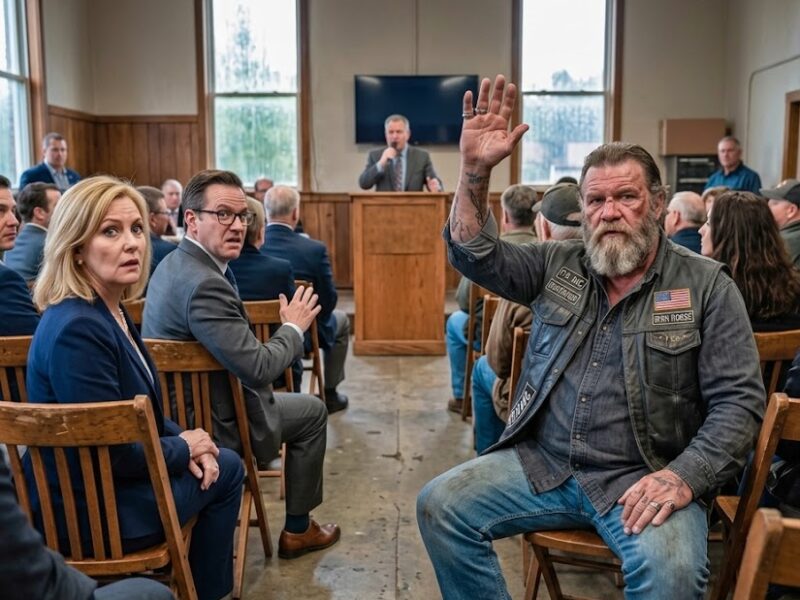
A broke Hell’s Angel walked into a county auction and bought an abandoned Harley dealership for just $13 — but the truth hidden inside was worth millions.
PART 1
$13 doesn’t buy a decent bottle of whiskey anymore.
It barely buys a pack of smokes and a lighter, and these days it won’t even get you a decent meal at a truck stop off I-80.
But for Cole, a washed-up Hell’s Angel with two bad knees and an empty bank account, 13 bucks bought a ghost.
It bought a boarded-up Harley dealership hiding a 60-year-old secret, and it bought him a reason to wake up in the morning when everything else in his life had gone quiet.
Cole sat in the back row of the county municipal building, smelling like stale tobacco and two-day-old motor oil.
He was 58 years old, carrying 60 pounds of bad memories and a spine that ground like a bad transmission every time it rained.
The leather cut on his back bore the winged death head of the Hell’s Angels, and it was a heavy patch.
It meant you were a brother.
It meant you never backed down.
It didn’t mean you had a retirement fund, and it sure didn’t mean the world owed you a soft landing.
Most civilians think the 1% life is a continuous loop of high-speed runs and illicit cash.
They don’t see the arthritis.
They don’t see the brothers fading away to prison, to the graveyard, or to the grim reality of a fixed income in a decaying Rust Belt town.
Cole was broke, and not the kind of broke where you skip a vacation.
He was the kind of broke where you count the quarters in your ashtray to buy bread, where you let the phone ring because you can’t afford the bill, where you learn to drink your coffee black because cream is a luxury.
He was at the tax auction because it was raining and the municipal building had free coffee.
That was the whole plan.
At the front of the room, a bored county clerk clicked through slides on a projector, his voice a flat drone that made the fluorescent lights seem louder than they were.
Investors in cheap suits and Patagonia vests sat near the front, tapping on iPads and snapping up foreclosed split-levels and repossessed commercial lots.
They were vultures picking over the bones of Oak Haven, Pennsylvania, a town that had been dying since the mills closed in the seventies and nobody had bothered to tell the bones.
Cole hated them.
He hated their clean shoes and their soft hands and the way they talked about “distressed assets” like they were talking about stray dogs.
Item 42, the clerk droned.
The projector clicked, displaying a grainy, washed-out photograph of a brick building swallowed by ivy and graffiti.
404 East Main Street, formerly Henderson Motors.
Tax delinquent since 1988.
Condemned in ’95.
The county is absorbing the back taxes.
Opening bid is the administrative transfer fee, $13.
The room went dead silent, and Cole looked at the screen.
He knew that building.
Every biker in a 50-mile radius knew it.
Henderson Harley-Davidson had been a staple in the seventies, an independent dealer run by an old crank named Arthur Henderson.
The story went that Arthur’s only son died in Vietnam and the old man just slowly went crazy.
One day in the late eighties, Arthur locked the heavy iron doors, walked away, and died in a nursing home a few years later.
The state had been tied up in probate hell for decades.
The building sat there rotting, catching fire twice, becoming a haven for junkies and rats and kids who wanted to prove they were brave enough to tag the walls.
The investors didn’t move.
A condemned brick box with asbestos insulation, a caved-in roof, and a basement likely flooded with toxic runoff.
It would cost 200 grand just to demolish it and clear the EPA environmental hazards.
It was a liability, not an asset, and these people hadn’t gotten rich by buying liabilities.
Do I have $13? the clerk asked, checking his watch.
Going once.
Cole stared at the photo, and the rain lashed against the municipal building windows like it was trying to get in.
His rent on his drafty garage apartment was due in three days, and he didn’t have it.
If he got kicked out, he’d be sleeping on a cot in the clubhouse, and he was a proud man.
Too proud to let the younger brothers see him reduced to a charity case, too proud to admit that the road had finally run out from under him.
$13.
He had a 20 in his wallet, folded thin and soft from being carried too long.
Cole didn’t think about the asbestos.
He didn’t think about the structural integrity or the EPA or the fact that the roof was probably one good storm away from becoming a floor.
He thought about the 3,000 square feet of concrete floor.
He thought about a roof, even a broken one, a place to park his Shovelhead, a place to die without anyone bothering him.
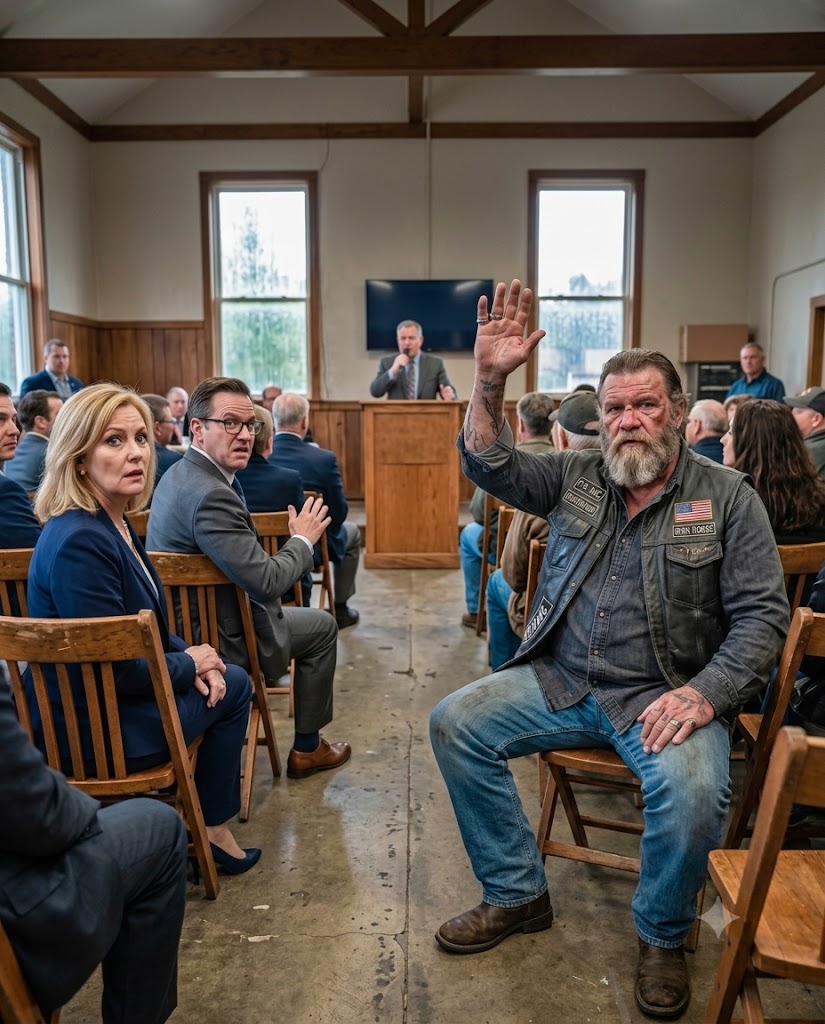
Cole raised a thick, scarred hand.
The Patagonia vests turned around.
They looked at his heavy boots, the greasy denim, the death head patch on his back.
Some sneered, some just looked confused, and one woman in a cashmere scarf actually clutched her purse like he was going to rob the place.
$13 to the gentleman in the back, the clerk said, mildly surprised.
Do I hear 50?
No.
Sold.
See the cashier on your way out.
Thirty minutes later, Cole stood on the courthouse steps.
The rain was letting up, leaving the gray town looking slick and defeated, like a fighter who’d already lost the decision.
He held a manila folder containing a quit claim deed.
He was the sole proprietor of 404 East Main Street, and it had cost him $13 and five minutes of paperwork.
He walked to his bike, an ancient oil-leaking Shovelhead that sounded like a tractor and rode like a brick.
He kicked it over, and the engine roared to life, shaking his bones and vibrating through his bad knees.
He put it in gear and rode toward the east side of town.
He was a property owner now, and that was a sentence he never thought he’d say.
He pulled up to the curb on East Main, and the reality of his purchase hit him like a physical blow.
The picture at the auction had been generous.
The building was a massive square brick tomb.
The front windows, where gleaming motorcycles used to sit on display, were boarded over with warped, blackening plywood.
The chain-link fence surrounding the side lot was bent and twisted, choked with dead weeds and faded plastic bags.
Someone had spray-painted KEEP OUT across the steel roll-up door in fading white letters, and the paint had dripped like tears.
Cole killed the engine.
The silence that followed was heavy.
The neighborhood was dead.
Abandoned mills across the river, a boarded-up diner down the street, a church with a collapsed steeple that nobody had the money to fix.
Nobody was coming to bother him here.
He unhooked a heavy pair of bolt cutters from the side of his saddlebag and walked up to the rusted chain locking the front gates.
The lock was thick, brown with decades of rust, and it looked like it had been there since before Cole had first thrown a leg over a bike.
Cole clamped the cutters on the shackle, gritted his teeth, and put his weight into it.
Pain flared in his shoulders, sharp and bright, and he pushed harder.
With a sharp crack, the metal gave way, and the lock tumbled into the wet weeds.
Cole pushed the gates.
They screamed on their hinges, scraping a deep arc into the cracked concrete driveway, and the sound echoed off the empty buildings across the street.
He walked toward the side entrance, a heavy steel door set deep into the brickwork.
It was secured by another padlock, but the wood frame around it was so rotted that Cole didn’t even bother with the cutters.
He just kicked it.
The door splintered and slammed inward, kicking up a cloud of dust that tasted like dirt and old pennies.
Cole stepped inside his $13 empire.
The smell hit him first.
It was the scent of total abandonment, dead trapped air mixed with the sharp tang of mildew, pigeon guano, and the faint lingering metallic ghost of old motor oil.
He pulled a heavy Maglite from his jacket and clicked it on.
The beam cut through the gloom, illuminating a massive cavernous space, and it was worse than he thought.
The showroom had been stripped down to the studs.
Whatever Arthur Henderson hadn’t sold off before he closed, the looters had taken.
The drop ceiling had collapsed in the center of the room, leaving exposed, water-rotted rafters that looked like broken ribs.
Puddles of dark water gathered on the cracked linoleum floor, and in the corner, an overturned metal desk sat marooned among a sea of soggy, mold-covered paperwork.
Cole walked slowly, his heavy boots crunching on broken glass and fallen plaster.
He felt a bitter laugh rising in his throat.
He had literally bought a dumpster.
The city would probably slap him with a demolition order by the end of the month.
He couldn’t afford to fix a leaky faucet, let alone clean up a biohazard site, and for a second he wondered if he’d just made the dumbest decision of a life that had its fair share of dumb decisions.
He moved toward the back of the building.
The archway leading to the parts department was framed by rotted pegboard, and empty hooks still hung in the walls, waiting for clutch cables and gasket kits that had been gone for 40 years.
Past the parts department was the service bay.
Cole stepped into the garage area, and it was massive.
The concrete floor here was stained a deep permanent black, the kind of stain that comes from decades of oil and grease and honest work.
This was where the real work used to happen.
The smell of oil was stronger here, and it was a comforting smell.
It reminded him of better days, of being young and invincible, turning wrenches with his brothers in the California sun when the whole world was wide open and nothing could touch them.
He swept the flashlight beam around.
Three rusted hydraulic lifts sat frozen in the floor.
Workbenches lined the walls, cleared of tools but covered in a thick, velvety layer of dust.
The roll-up doors leading to the back alley were welded shut, and the welds were old and ugly, like whoever did them was in a hurry.
He sighed, his breath pluming in the damp air.
Well, he muttered to the empty room.
It’s got a roof.
Mostly.
He walked the perimeter of the service bay, looking for structural damage.
He tapped the brick walls with the heavy end of his flashlight, and they felt solid, which was the first good news of the day.
As he walked along the back wall, his brow furrowed.
Something was wrong with the dimensions.
Cole had spent half his life in garages.
He knew how buildings were laid out, knew how space was supposed to feel, and this space felt wrong.
He had walked the exterior of the building before he came in.
The footprint of 404 East Main was a long rectangle, but standing in the service bay, the back wall cut the space off too soon.
He traced his steps back to the parts department, then returned to the garage, counting his paces and doing the math in his head.
There was a solid 20 feet of building missing.
He walked up to the back wall.
It wasn’t drywall.
It was solid cinder block painted a dirty, peeling industrial white.
He ran his hand along the coarse surface.
It was a firewall, but why put a firewall 20 feet from the actual rear of the building?
He followed the wall to the far corner near a collapsed rack of rusted exhaust pipes.
The pipes were tangled together like steel spaghetti covered in spiderwebs and pigeon droppings, and they looked like they hadn’t been touched since the first Bush administration.
Cole grabbed a heavy iron pipe and dragged it out of the way.
It screeched against the concrete, a sound like a wounded animal.
He pulled another, coughing as dust plumed into his face and coated his tongue with grit.
Behind the pile was a heavy steel security door.
It was recessed into the cinder block, no handle, just a heavy-duty deadbolt lock at the top and a massive thick steel hasp welded to the center, secured by an old-school master lock.
The lock was nearly the size of his fist, oxidized to a dull, chalky gray, and it looked like it had been designed to keep out something more serious than junkies.
Cole’s heart did a strange, heavy thump.
Looters hadn’t found this.
Junkies hadn’t found it.
You don’t weld a steel hasp to a fire door to protect a mop closet.
He grabbed his bolt cutters, but one look told him it was useless.
The hasp was designed to protect the shackle of the lock.
He couldn’t get the jaws of the cutters around it.
He needed power.
Cole jogged back out through the showroom, out into the gray afternoon, his knees complaining with every step.
He opened his saddlebag and dug beneath his rain gear, pulling out a battery-powered angle grinder.
He checked the battery indicator.
Two bars, enough for a few minutes of cutting.
He grabbed a fresh cutting wheel, tightened it down, and walked back into the darkness of the dealership.
He stood in front of the steel door.
He felt a sudden, irrational spike of adrenaline, the feeling he used to get right before a brawl or right before dropping the clutch on a quarter-mile run.
The air felt heavy, charged, like the building itself was holding its breath.
He flipped the switch on the grinder.
The high-pitched whine echoed off the cinder block walls, loud and aggressive, and it felt like a violation of the silence that had ruled this place for decades.
He pressed the spinning wheel against the thick steel shackle of the master lock.
A shower of brilliant orange sparks cascaded to the floor, cutting through the gloom and painting the walls in flickering light.
The smell of burning metal filled the air, sharp and acrid, and Cole leaned his weight into it.
The grinder bogged down, the motor groaning in protest, and he eased up, let it regain speed, and pressed again.
His arms shook.
His bad shoulder burned like a hot wire was being driven into the joint.
He ignored it.
He ground his teeth, sweat beading on his forehead despite the chill in the air.
Come on, he thought.
Give.
The battery indicator flashed red.
The whine of the motor started to drop in pitch, and with a sudden violent snap, the grinder chewed through the last millimeter of steel.
Cole pulled the tool back, breathing hard.
The motor spun down into silence.
He grabbed the heavy lock.
It was searing hot through his leather glove, and he pulled it free of the hasp and let it drop.
It hit the concrete with a dull, heavy thud that seemed to echo through the whole building.
Cole stood there for a second, catching his breath.
He put his hands flat against the cold steel of the door.
He pushed.
It didn’t move.
Rusted shut into the frame.
Cole stepped back, raised his heavy steel-toed boot, and kicked the door right next to the hasp.
The metal boomed like a bass drum, and the sound rolled through the empty service bay.
He kicked it again.
The hinges groaned.
He kicked it a third time, putting all of his weight, all of his frustration, all of his tired, broken years into the strike.
With a sickening screech of tearing rust, the door popped open, swinging inward by about two inches.
Dead air rushed out.
But it didn’t smell like the rest of the building.
It didn’t smell like rot or dampness or decay.
It smelled like cosmoline.
It smelled like dry rubber, sweet bearing grease, and varnished gasoline.
It was a mechanic’s perfume, and it hit Cole like a memory he didn’t know he had.
Cole pulled the Maglite from his pocket.
He wrapped his fingers around the edge of the heavy steel door and hauled it open.
The hinges screamed, echoing in the cavernous dark.
He stepped over the threshold into the pitch black.
He raised the flashlight.
He clicked the button.
The beam of light shot into the darkness, cutting through dust that hadn’t moved in four decades.
Cole stopped breathing.
The flashlight trembled in his hand.
He swept the beam slowly from left to right, his brain refusing to process what his eyes were seeing.
There, sitting in perfect, undisturbed rows, was the dull gleam of pristine chrome reflecting the light back at him.
The flashlight beam cut a pale yellow path through the dead air.
Dust motes drifted lazily in the light, disturbed for the first time since Ronald Reagan was in his second term.
Cole stood frozen, his breath caught in his throat, a dry rasp in the absolute silence.
He wasn’t looking at an empty storage room.
He was looking at a graveyard that refused to die.
Lined up in perfect militant rows were wooden shipping crates, heavy industrial timber stamped with faded black ink.
Harley-Davidson Motor Co., Milwaukee, WI.
The crates were stacked two high in some places, dozens of them, and the sight of them made Cole’s chest ache in a way he hadn’t felt in years.
He stepped inside.
The air was remarkably dry, and the heavy cinder block walls and the sealed steel door had created a perfect vacuum against the rot and humidity that had eaten the rest of the building alive.
He walked up to the nearest crate.
A heavy opaque plastic tarp covered the wooden slats.
Cole reached out with a trembling, calloused hand.
He grabbed the plastic and pulled.
The heavy material cracked and peeled back, sending a shower of dry dust onto the concrete floor.
Beneath the plastic, sitting securely on a wooden pallet and bound by heavy steel straps, was a motorcycle.
It wasn’t just any motorcycle.
It was a 1981 FXB Sturgis, the dual belt drive model, and the factory original black paint on the tank caught the flashlight beam and held it.
Flawless and deep as deep water.
The orange and red decals were pristine.
The rubber tires still had the factory injection mold nubs sticking out of the tread.
The engine cases were coated in a thick yellowish layer of protective cosmoline, the anti-rust grease the factory used for long-term shipping.
Zero miles.
Never prepped by a dealer.
Never fueled.
Never started.
Cole wiped a thumb across the chrome speedometer housing.
It gleamed perfectly, and he could see his own reflection in it, an old man with a broken face staring back at something that had never been broken at all.
Jesus Christ, he whispered.
He moved to the next crate.
He ripped the plastic down.
A 1978 FXS Low Rider, silver and black, same cosmoline coating, same zero-mile odometer.
He kept walking, moving faster now, his bad knees forgotten.
He tore tarp after tarp.
A 1979 Super Glide.
An FLH Electra Glide in original factory birch white, still wrapped in protective foam around the fiberglass fairing.
There were Panhead parts sitting on heavy steel shelving along the right wall.
Rows and rows of new old stock parts in original cardboard boxes.
Gasket sets, OEM carburetors, original exhaust pipes wrapped in brown wax paper, cases of straight-weight oil.
Arthur Henderson hadn’t just closed down.
He had built a fortress.
He had taken the entire high-value inventory of the dealership, rolled it into this reinforced bunker, built a cinder block wall to hide the dimensions of the room, and walked away.
But why?
At the very back of the room, tucked behind a row of boxed Shovelhead engines, sat a small metal desk.
An old gooseneck lamp stood next to a rotary telephone, and the whole scene looked like a museum exhibit about a world that had already ended.
Cole walked over.
On the center of the desk sat a leather-bound ledger covered in a thin veil of dust.
Next to it was a framed photograph.
Cole blew the dust off the glass.
It was a picture of Arthur Henderson, looking 20 years younger than the day he locked the doors.
Beside him stood a young kid, maybe 19, wearing a faded denim cut and sitting on a stripped-down rigid frame chopper.
The kid had Arthur’s jawline.
Tommy Henderson, the son who never came back from the jungle in 1969.
Cole opened the ledger.
The pages were brittle, and most of it was standard inventory logging, part numbers, dealership transfer codes.
But the final page, dated October 14th, 1988, was different.
It was written in a hurried, heavy scrawl, the pen pressing so hard it tore the paper in spots.
They want to take it all, the bank, the state, the vultures in their clean suits.
They think they can bleed me dry for the taxes.
They think this is just metal and rubber.
It’s not.
It’s Tommy’s blood.
It’s his sweat.
He loved these machines.
He built this place with me.
I won’t let them auction off his soul to pay off a suit.
Let them have the dirt.
Let them have the rotting roof.
They will never touch the heart.
Cole stared at the ink.
The hair on the back of his neck stood up.
He knew that kind of grief.
It was the same hollow, angry grief that lived in the clubhouse every time they rode behind a hearse.
Arthur Henderson hadn’t been crazy.
He had been heartbroken, and he had been stubborn, and he had chosen to bury his treasure rather than let the system cannibalize the last connection he had to his dead son.
Cole closed the ledger.
He looked out over the rows of pristine, untouched history.
$13.
He had just purchased millions of dollars of perfectly preserved American motorcycle history for the cost of a cheap lunch.
But a cold, heavy realization hit him.
The second he stepped out of this room, he was in danger.
He was a broke biker with a bad reputation, standing on a gold mine in a town full of vultures.
If the county realized what he had bought, they would find a zoning loophole to nullify the tax sale.
If the local street gangs found out, they’d cut the roof off the place and strip it bare by morning.
He couldn’t leave, and he couldn’t do this alone.
Cole pulled his burner phone from his cut.
He checked the signal.
One bar.
Good enough.
He dialed a number he knew by heart.
It rang four times before a gruff, sleep-heavy voice answered.
Yeah.
Boon, it’s Cole.
A heavy sigh on the other end.
Cole, it’s 3:00 in the afternoon.
I work nights now.
What is it?
You need bail?
No, Cole said, his voice deadly quiet.
I need you to get the heavy trailer, the enclosed one you use for the run to Sturgis, and I need you to get over to the old Henderson place on East Main.
Bring heavy chains.
Bring a welder.
Tell no one.
Boon paused, and Cole could hear the sleep dropping out of his voice entirely.
Henderson?
That place is a condemned rat trap.
What did you do?
I bought it, Cole said.
And Boon, you’re going to want to see what I bought.
By nightfall, the rusted gates of the dealership were chained shut from the inside with thick boron steel links.
Boon’s black F350 and a massive enclosed triple-axle trailer were backed silently into the crumbling alleyway behind the shop.
Boon was a giant of a man, bearded and scarred, a fellow one-percenter who ran a legit fabrication shop on the county line.
When Cole had finally managed to pry the back alley loading doors open and let Boon into the hidden crypt, the big man had dropped to his knees.
He hadn’t said a word for 10 minutes.
He just walked among the crates, tears pooling in his hard eyes, touching the dusty chrome like he was in a cathedral.
They’re perfect, Boon had whispered, choking on the words.
They’re absolute ghosts, Cole.
Where did they come from?
A father keeping a promise, Cole replied.
They worked in near silence for three days.
They didn’t sleep.
They lived on black coffee, cold sandwiches, and the sheer adrenaline of the heist.
Only this wasn’t a heist.
It was a legally binding salvage.
They backed the trailer up to the rusted loading dock.
Using Boon’s portable winch, they carefully dragged the heavy wooden crates out of the crypt one by one.
They didn’t dare start the engines.
They didn’t even clean them.
They left the dust exactly where it sat.
Provenance was everything.
They moved the bikes in batches to Boon’s secure, climate-controlled warehouse outside of town.
Every trip felt like carrying unexploded ordnance.
Cole watched his rearview mirrors constantly, expecting flashing lights or trailing headlights.
But the town slept on, ignoring the two old bikers hauling rotting wood out of a condemned building.
When the last crate was out, they cleared the NOS parts, the carburetors, the sheet metal, the vintage leathers.
Cole swept the floor of the crypt spotless.
He took Arthur Henderson’s ledger and the photograph of Tommy, wrapping them carefully in a soft cloth and putting them in his saddlebag.
Then Boon fired up his portable rig, and they welded the heavy steel door completely shut.
They sealed the tomb for good.
Two weeks later, an auctioneer from a high-end vintage automotive broker flew in from Los Angeles.
He met Cole and Boon at the warehouse.
The man wore a tailored suit and an expensive watch, and he looked at Cole like a stain on the floor.
Then Boon unlocked the warehouse bays.
The auctioneer’s clipboard slipped from his hand and clattered against the concrete.
This is impossible, the man breathed, walking toward the first row of uncovered zero-mile Shovelheads.
This is an untouched hoard.
The matching numbers, the factory cosmoline.
I’ve seen barn finds, but this is a dealership trapped in amber.
We know what it is, Cole said, crossing his heavy arms.
The question is, what’s it worth?
The man swallowed hard.
To the right collectors, unrestored zero-mile AMF-era and pre-Evo bikes in original crates, plus the NOS parts inventory, you’re looking at well over $3.5 million.
Maybe four.
Boon let out a low whistle.
Cole didn’t flinch.
His face remained stone.
He thought about his rent.
He thought about his knees grinding like broken glass.
He thought about the $13 he had handed a bored clerk in a rainy municipal building.
Sell 20 of them, Cole said.
And all the parts.
Put them in your fancy catalog.
The auctioneer blinked.
Only 20, sir?
The entire collection sold as a single lot would generate an astronomical premium.
I said 20, Cole growled, stepping closer, letting his size and the heavy leather cut do the talking.
The Sturgis, the Low Rider, and three of the Electra Glides stay with me.
The man nodded quickly, adjusting his tie.
Understood.
Whatever you prefer.
Six months later, the spring thaw came to Oak Haven, Pennsylvania.
The old Henderson dealership on East Main was gone.
In its place was an empty, leveled lot, the toxic dirt scraped away and replaced with fresh gravel.
Cole had paid for the demolition in cash.
He didn’t want the ghosts of Arthur and Tommy Henderson sitting in a rotting brick box anymore.
On the edge of town, right on the county line, a new steel building sat gleaming in the sun.
The sign out front was matte black steel, laser cut with simple letters.
Henderson and Cole Restorations.
Inside, the shop smelled of fresh paint, clean motor oil, and hot coffee.
Cole walked across the smooth epoxy floor.
He wasn’t limping.
The titanium replacements in his knees had cost a fortune, and they worked perfectly.
He wore clean denim and his old cut, the death head patch resting proudly on his back.
His bank account was full.
His club dues were paid 10 years in advance, and his brothers never had to worry about sleeping on the streets.
In the center of the showroom floor, sitting under warm track lighting, was a 1981 FXB Sturgis.
It was wiped clean of its cosmoline, the black paint polished to a mirror finish.
It wasn’t for sale.
It would never be for sale.
Boon walked out of the back bay, wiping his hands on a shop towel.
You got a guy from Ohio coming down to look at that ’79 Super Glide, he said.
See, Cole said, running a hand over the cold steel of the Sturgis handlebars.
I don’t sell to guys who just want to park it in a living room.
If he doesn’t respect the road, he doesn’t get the bike.
Boon grinned.
You’re getting worse than old Arthur.
Cole looked at the framed photograph sitting on the polished front counter.
Arthur and Tommy Henderson smiling in the black and white past.
Maybe, Cole said softly.
But a man’s got to protect the things that matter.
He walked out the front doors of the shop and stood in the sun.
The air was warm.
He reached into his pocket, pulled out a beat-up Zippo and a cigarette, and lit it.
The first drag filled his lungs, sharp and familiar.
He was 59 years old.
He had fought the world, the law, and the miles, and he was still standing.
A broke biker who bought a ghost for 13 bucks and found out that sometimes the dead pay their debts.
He exhaled the smoke into the bright blue sky, turned around, and went back to work.
Cole’s story proves that sometimes the greatest treasures aren’t found in a bank vault.
They’re hidden in the forgotten corners of our lives, waiting for someone with the grit to look closer.
If you enjoyed this journey from a $13 gamble to an unbelievable piece of motorcycle history, hit that like button.
Share this story with a fellow rider and subscribe for more incredible true tales.
Keep the rubber side down and we’ll see you in the next video.









