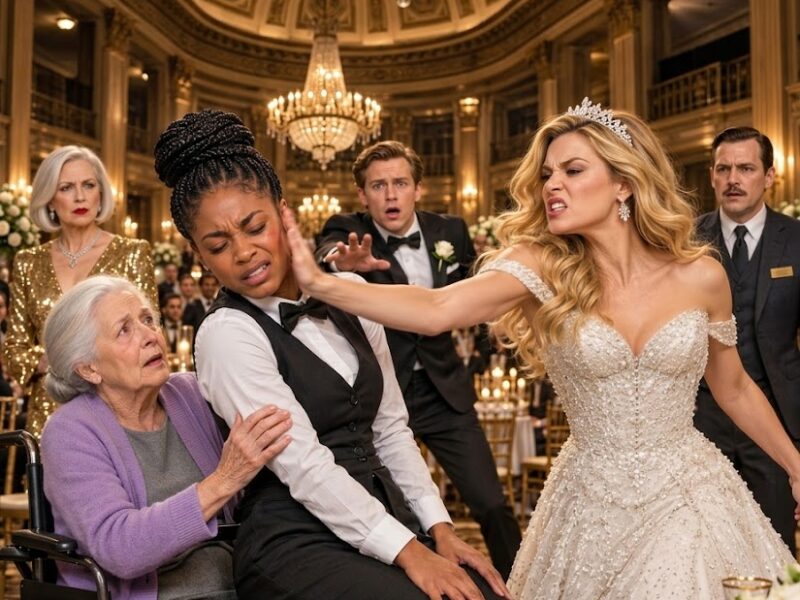
A Bride Slapped the Black Waitress Who Saved an Elderly Guest—Unaware the Woman Owned the Entire Hotel
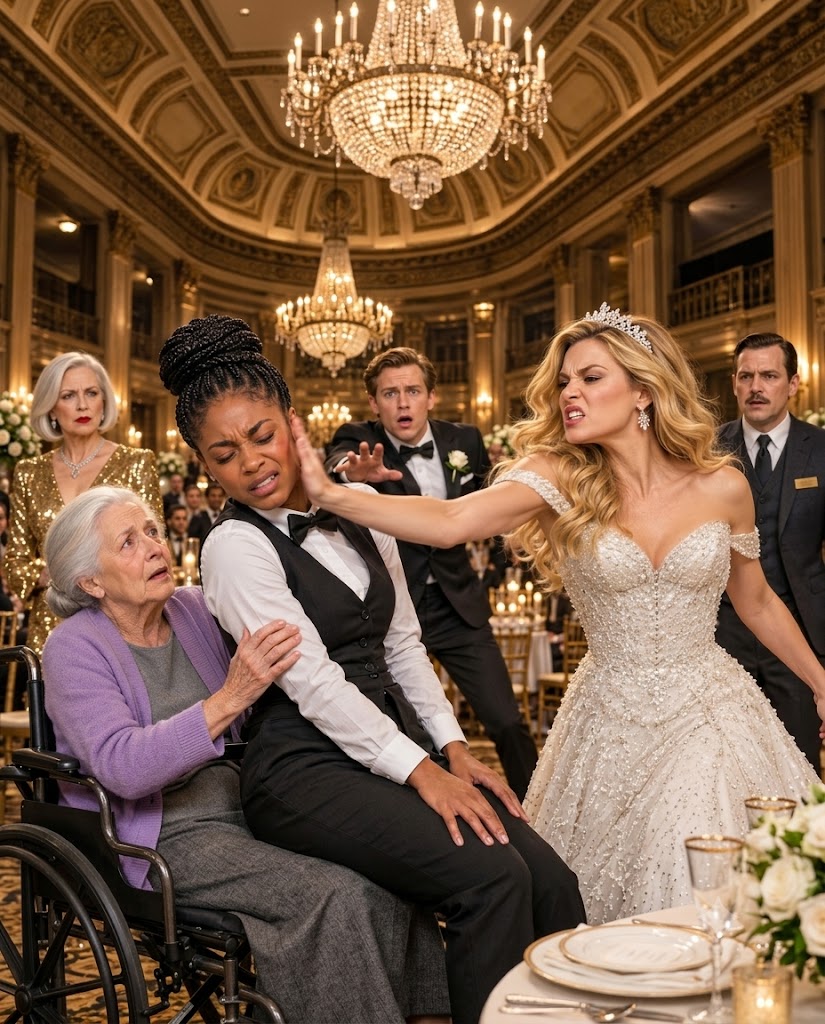
The ballroom smelled like lilies and money, and Amara Lewis had been on her feet since four a.m. folding napkins into swans that nobody would remember.
Her black uniform still had the tag from the uniform shop, a small thing that scratched the back of her neck every time she turned toward the kitchen doors.
She was twenty-two, six years of trays and spilled coffee and church shoes that pinched, and tonight the Whitcomb Grand was hosting the Crane wedding, which meant every inch of the place had to look like it cost more than her entire future.
Mrs. Chain, the wedding planner, moved through the room like a general, checking centerpieces, tasting the soup, adjusting a fork by half an inch.
“Faster, Lewis,” Mrs. Chain said without looking up. “Mrs. Crane wants everything perfect tonight.”
“Yes, ma’am. Right away.”
Tonight is perfect. Everything in this room is perfect. Just like my daughter.
That was Patricia Crane, mother of the bride, standing near the head table in a silver gown that caught every light in the room.
She was smiling for the photographer, but her eyes were doing math on every guest, every flower, every inch of the Whitcomb Grand.
Then her gaze landed on the kitchen doors.
“Colin, who is that old woman in the cardigan? She is not on my list, Mrs. Green.”
Colin, the hotel’s event manager, followed her stare to a small figure seated on a chair near the service doors.
The woman was maybe eighty, wearing a faded blue cardigan with a missing button, hands folded in her lap like she was waiting for a bus.
“Move her by the kitchen doors,” Patricia said. “She is ruining my photos.”
“Sir, please,” the old woman said when Colin approached. “The brake on my chair is loose.”
“Then sit still and do not bother the guests.”
Amara was balancing a tray of champagne when she saw it, the old woman’s chair wobbling every time a server brushed past.
She set the tray down on a side table and walked over, kneeling so she could meet the woman’s eyes.
“Ma’am, are you all right back here? Can I bring you a plate?”
The old woman looked up, and something in her face softened.
“Nobody has spoken to me all night, dear.”
“Then I will check on you every chance I get.”
“What is your name, dear?”
“Amara Lewis.”
“Amara,” the old woman repeated, like she was filing it away.
“Head table now, Amara,” Colin snapped from across the room.
She squeezed the old woman’s hand once and stood up, and that was the moment the night split into before and after.
“Has anyone found my grandmother?” Ethan Crane asked from the head table, scanning the room. “She said she would come tonight.”
“Babe, forget her,” Madison said, touching his sleeve. “Tonight is about us. I am sure she got lost on the way from her farm.”
The band started playing, the lights dimmed, and Patricia Crane raised her glass for the toast.
Amara was carrying a tray of iced tea toward the back of the room when she heard the first crack.
It was small, the sound of a brake giving way, and it came from the top of the staircase where the old woman’s chair had been moved.
Amara did not think. She dropped the tray.
Glasses shattered on the marble floor, tea ran in a brown river across the runner, and she was already running, heels slipping, hands out.
The chair tipped forward, and the old woman’s arms flew up, and Amara caught her under both shoulders just as the chair went over the edge.
They landed in a heap at the top of the steps, the old woman shaking, Amara’s knees burning through her stockings.
“I have got you, ma’am. I have got you.”
“My dress,” Madison screamed from the bottom of the stairs. “My dress.”
The tea had splashed down the front of the bride’s white gown, a stain the shape of a hand.
“You stupid, clumsy girl. I am so sorry, ma’am. She was about to fall down the stairs.”
“I do not care about some old woman. That is for ruining my wedding.”
Madison’s hand moved before anyone could stop it, a slap that cracked across Amara’s face and sent her stumbling into the banister.
“Colin, is this how your staff behaves at a Crane wedding?”
“Lewis, you are fired. Get out of my ballroom.”
“Sir, the brake on her chair was off. Somebody left it.”
“And take your mess with you.”
“Stop this.”
The voice came from the old woman, still on the floor, still in her faded cardigan, but there was iron in it now.
“That girl just saved my life.”
“Nobody asked you, Grandpa.”
The word hung in the air like a dropped glass, and for a second nobody moved.
“Security,” Madison said. “Take the waitress out the back.”
“What is going on here?”
Ethan was pushing through the crowd, his face pale, and when he saw the old woman on the floor his whole body went still.
“Grandma? Why are you sitting at the edge of the stairs?”
“A waitress caught me at the top of those stairs, and your bride slapped her for it.”
Ethan turned to Madison, and his voice was very quiet.
“Madison. I did not know it was her.”
“That is exactly the problem, dear.”
Amara was already being walked toward the service exit, one hand pressed to her cheek, the other still shaking.
“Amara,” Ethan called after her. “Colin says you will never work in this city again.”
She stopped at the door and turned back, and her voice did not waver.
“I would do it again, Jade. Every single time.”
“It is Amara,” the old woman said. “And she kept your tips. Three weeks of tips.”
“Let him keep them. She is alive.”
The door swung shut behind her, and the ballroom went back to being a ballroom, music and champagne and a bride in a ruined dress.
But the old woman stayed on the floor, and she was not looking at her grandson.
She was looking at the service door.
At four a.m., Amara was sitting on the edge of her mother’s bed in a two-bedroom apartment that smelled like cinnamon and rain.
“What happened to your face?”
“A bride slapped me.”
“Mama, I dropped a tray to catch an old woman.”
“Then you did exactly right.”
“I lost the job. Rent is due Friday, and the nursing school deposit is due Monday.”
Her mother, Jade, was a nurse’s aide who had worked doubles for eleven years and still called everyone baby.
“We have been poorer than this, baby. We were never unkind.”
“She posted it, Mama. She cut out the part where I caught the chair.”
On Madison’s social media, the video had two million views by sunrise.
It showed a waitress dropping a tray, tea flying, a bride screaming, and a slap that sounded like a gunshot.
It did not show the chair. It did not show the catch. It did not show the old woman.
“The truth has a way of finding the light,” Jade said, and kissed her daughter’s forehead.
At nine a.m., a black car pulled up outside the apartment, and a woman in a gray suit knocked on the door.
“Miss Lewis, my grandmother wanted to thank you in person.”
Amara rode to the Whitcomb Grand in the back seat, watching the city go by, and when she walked into the lobby, the old woman was waiting by the fireplace.
“Ma’am, you came all this way.”
“You let go of a full tray to catch a woman you had never met. Why?”
“You were about to fall. Nothing else mattered.”
“You are studying to be a nurse.”
“I start in January if I can pay the deposit.”
The old woman nodded slowly, and then she said something that made Amara’s stomach drop.
“Forty thousand dollars for the dress. She cannot be serious.”
The lawyer’s letter was on the table, a demand for payment, itemized, notarized, and cold.
“I do not have forty dollars, Mr. Whitcomb.”
“Call me Eleanor. And do not pay a cent. This Sunday, my family is hosting a brunch at the hotel. I want you there as my guest.”
“Ma’am, I was fired from that hotel.”
“Not by me, dear.”
Two million views. Everyone is on my side, Mom. And our lawyer sent that waitress the bill. Forty thousand. She can pay it in tips.
That was Madison, in the kitchen of the Crane house, scrolling through comments that called Amara a clumsy liar and a gold digger.
“Mrs. Crane, I made some calls. No hotel in this city will hire Amara Lewis.”
“Good. People like that need to learn their place.”
“Madison, stop acting like a child. This wedding is happening, and you will wear the dress I chose.”
“No, I won’t. I’m not letting you control this day, too.”
“You will do as you’re told. You owe me this.”
“I don’t owe you anything. Not anymore. And your grandmother by the kitchen in that awful cardigan.”
“I was the one humiliated, Ethan. She raised me. She is coming to brunch on Sunday.”
“Then seat her somewhere nobody can find her.”
Patricia Crane laughed into her coffee.
“Do you think his family has any money at all? His grandmother wears a thrift store cardigan. Darling, you married down.”
“I married a handsome face. The money will be mine to make.”
On Sunday, the Whitcomb Grand was full of flowers again, and Amara walked through the front doors in a dress her mother had pressed the night before.
“Look who it is. The waitress who ruined my wedding.”
“Good afternoon, Mrs. Whitcomb.”
“Do not call me that. Not you.”
Madison was standing by the bar with a glass of champagne, and she smiled the way people smile when they think they have already won.
“There. Your favorite drink. You can drown my resume, but you cannot drown what happened.”
“Who will believe a waitress over a bride? Anyone who watches the whole video.”
“Tell me why you really ran, Amara.”
“When I was nine, my grandma fell on the church steps. I froze. I just stood there. She was never the same after that fall. I promised myself I would never freeze again.”
“And you did not. Not for one heartbeat.”
Eleanor Whitcomb was standing behind them, and she was not wearing a cardigan today.
She was wearing a black suit that cost more than the bar, and every server in the room had gone still.
“Now, I will tell you something nobody in that ballroom knows. You were a waitress for six years in that very ballroom. Sixty-one years ago, a bride slapped me there for one spilled glass of lemonade. They fired me that same night.”
“What did you do?”
“I came back twenty years later and bought the building.”
“You own the Whitcomb Grand and forty-one hotels like it.”
“Even Ethan does not know the whole of it.”
“Then why sit by the kitchen and say nothing?”
“Because I wanted to find out who would be kind to an old woman in a cardigan. Only you were.”
In the security office, the screens were cued to camera six.
“The top of the staircase. He put her there right at the edge. And watch his hand. He flicks the brake off and walks away. She could have fallen all forty steps.”
“I heard it, too. Mrs. Crane told Colin to move her because she was ruining the photos.”
“Will you say that on Sunday?”
“That is my best friend,” a voice said from the door.
It was one of the servers, a girl named Priya who had been standing behind the curtain with her phone.
“And Madison posted only the part with the spilled tea, not my video. Two million people think Amara is the villain.”
“Does my grandmother know about all of this?”
“Mr. Whitcomb, your grandmother knows everything that happens in her hotels.”
“Tomorrow the brunch is hosted by the owner of the hotel in person.”
“The owner of the Whitcomb Grand is here.”
“Wear the pink. First impressions are everything.”
“Mom, is the owner related to Ethan?”
“Darling, his grandmother shops at thrift stores. It is a common name.”
“Colin says Amara Lewis is on the guest list for tomorrow.”
“What? Then take her off it. When she walks in, I want her thrown out again.”
“I will take care of it, darling.”
The brunch was set under a ceiling of crystal, and Patricia Crane had already claimed the seat beside the empty head chair.
“Where is the owner? I want a seat right beside her.”
“Arriving at noon, Mrs. Green.”
Amara walked in at eleven fifty-eight, and Colin was on her before she had taken three steps.
“You. Security. Get her out of here.”
“Miss Lewis is a guest of the owner, Colin.”
“Well, well. Look who’s here.”
Ladies, is there a problem?
Ethan was standing at the head of the table, and his grandmother was beside him, and the room had gone very quiet.
“Ethan, why is your grandmother dressed like that? And why is she at the front of the room?”
“Madison.”
“Ethan, you can’t use that tone with me.”
“Ethan, what ails you, draw you.”
“Ethan, how healthy can you be.”
The words were nonsense, the way they always are when a room is waiting for a bomb.
“Good afternoon. I own this hotel and forty-one others.”
Grandma, I mean Mrs. Whitcomb.
“Last Saturday, I sat by the kitchen doors for three hours. Only one person in this ballroom spoke to me. Amara, come sit beside me.”
“Mrs. Whitcomb, I did not know who you were.”
“You did not need to know who I was, dear. You needed to be kind.”
“That was an accident.”
“You were told the brake was loose, Colin. On camera.”
“I only asked for her to be moved. You said she was ruining your photos, Mrs. Crane. I was standing right there.”
“She caught you at the very last step, Grandpa, with both hands, while everyone else just watched. And this is how my grandson’s bride said thank you.”
“I was upset about my dress.”
“Your dress? Your lawyer sent this girl a bill for forty thousand dollars. Ethan, read it.”
Demand for payment. Forty thousand dollars.
“Send the bill to me, Patricia. I will pay it the day your daughter apologizes properly.”
“Fine. I am sorry about your face.”
“That is not an apology, Madison.”
“I am on the side of the woman who caught my grandmother.”
“Mr. Hayes, you left an old woman at the top of a staircase with the brake off.”
“Mrs. Whitcomb, I can explain.”
“You will never work in a Whitcomb hotel again. Your badge, Colin. And the three weeks of tips you kept from Amara. Every dollar, today.”
Sixty-one years ago, I carried trays in this very ballroom. A bride slapped me for one spilled glass. I swore that if I ever owned this room, nobody would be slapped in it again. And on my first visit in ten years, my own grandson’s bride did it.
“Madison, I cannot be married to the woman in that video.”
“Ethan, it was one bad night.”
“It was who you are when you think nobody important is watching.”
“Mom, do something.”
“Come, Madison. We are leaving.”
“The Whitcomb Foundation. A full nursing scholarship every year until you graduate.”
“Mrs. Whitcomb, I cannot accept.”
“You already earned it at the top of those stairs. And until classes begin, I want you as head of guest care at this hotel so nobody sits alone by the kitchen again.”
“Yes, ma’am.”
“Mrs. Whitcomb, may I ask for one thing?”
“Anything, dear.”
“Let Jade run the banquet floor. She stood up for me.”
“Use the staff exit. The reporters are all out front.”
“Colin, call me a car.”
“I do not work for anyone anymore, Mrs. Whitcomb.”
The Hendersons canceled dinner. The club suspended my membership. Two million people think I am a monster now.
“He filed for an annulment after eight days.”
“Sign nothing.”
“Baby, they are showing the whole video now.”
“I do not want her hated, Mama. I only wanted the truth.”
“Rent is paid, Mama. And the deposit.”
“That is my girl.”
“Amara.”
“Hi, Madison. Two coffees, please.”
“I am sorry. I am so sorry.”
“It is okay. Everyone drops a tray sometimes.”
“I was horrible to you. I lost everything, and I deserved it.”
“You did not deserve to lose everything. You needed to learn something.”
“Let’s go.”
One year ago, a waitress, yes, dropped a tray in this room. Tonight, forty hotel workers start school because of it. Amara Lewis, first in her nursing class.
“You really put it on the wall right where you caught me.”
“If you ever notice someone about to fall, drop the tray. Glasses can be replaced.”
“Glasses can be replaced.”
“Grandma made me promise to say thank you every single year.”
“Once is plenty.”
“Not in this family, baby.”
“Ma’am, are you all right back here? Can I bring you something?”
“That is why I gave her the job. Not because of the catch. The catch was one moment. This is every day.”
The plaque on the wall of the Whitcomb Grand said four words, and every new hire read them on their first morning.
Drop the tray. Catch the person.
Amara read them every day for four years, and every day she thought of a faded blue cardigan and a chair with a loose brake and a room full of people who had looked away.
She thought of her grandmother on the church steps, and she thought of the old woman who had sat alone by the kitchen doors, and she thought of the moment when she had chosen the person over the glass.
Glasses can be replaced. People cannot.
That was the whole story, and it was enough.
The brunch became a tradition, every first Sunday of the month, and Eleanor Whitcomb always sat at the head of the table with Amara on her right.
Madison Crane moved to another state and changed her name and never posted another video.
Colin Hayes sold insurance for a while and then moved back in with his mother.
Patricia Crane kept her money and lost her daughter, and some nights she sat alone in a house full of silver and wondered where it had all gone wrong.
Ethan Crane married a kindergarten teacher two years later, and at the wedding, his grandmother wore a cardigan on purpose.
“This one has a button missing,” she said, and the whole room laughed.
Amara graduated first in her nursing class and took a job at a children’s hospital, and on her first day she told the new nurses the same thing Eleanor had told her.
“Notice the person nobody else notices. That is the whole job.”
She kept the receipt for the forty-thousand-dollar dress in a frame on her wall, not because she had paid it, but because Eleanor had.
She kept the old cardigan, too, the one with the missing button, folded in a box under her bed.
Every time she looked at it, she remembered the top of the stairs, the chair tipping, the choice between a tray of glasses and a woman she had never met.
She had chosen the woman. She would choose her again. Every single time.
And on the wall of the Whitcomb Grand, where the whole thing had started, the plaque still said the same four words, and the staff still read them every morning, and nobody sat alone by the kitchen doors.
Not anymore.
Not ever again.
The end.









