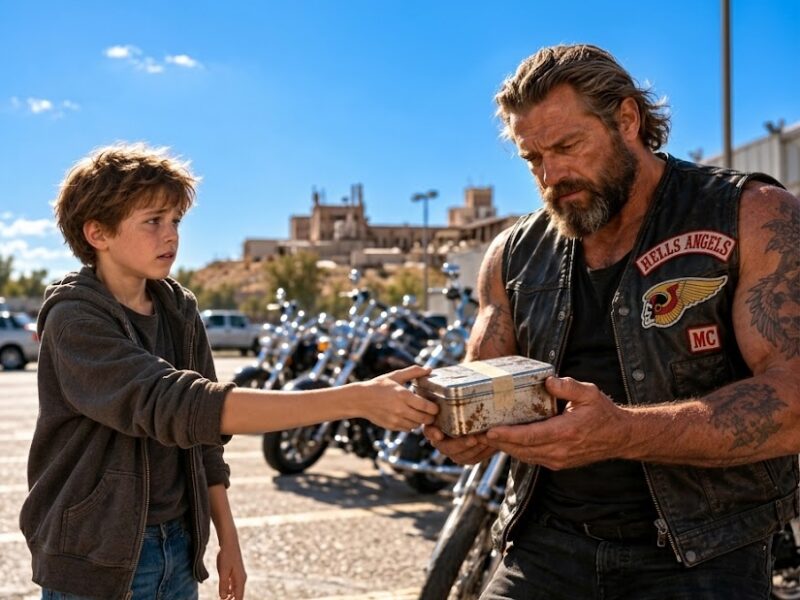
A boy walked up to a Hells Angel and asked him to hold something—”just until Friday.” Friday came. He didn’t.
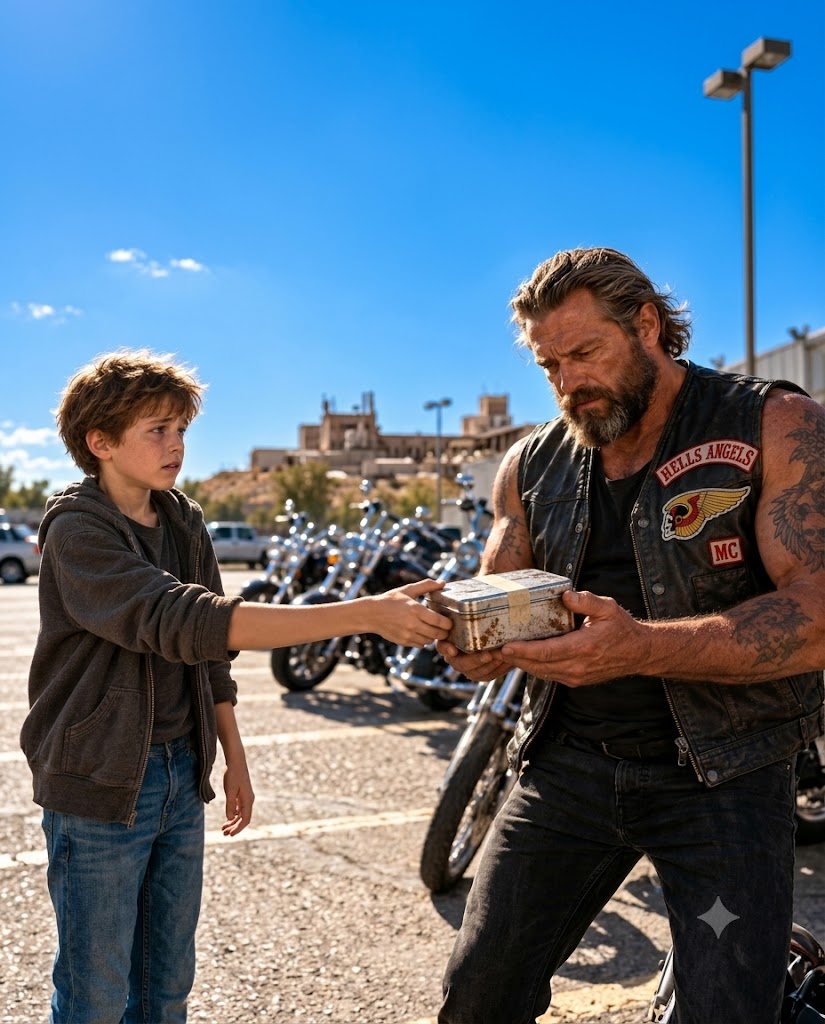
The boy was ten years old, and for five hours he had been folded into a crack beneath a concrete staircase, shaking so hard his teeth clicked together like dice in a cup.
Then a shadow filled the opening.
Two hundred and forty pounds of black leather, gray beard, and scarred knuckles, with a winged skull stretched across the chest. Every neighbor watching from those doorways had already decided what kind of man that was.
He did not reach in. He did not use a flashlight. He did not raise his voice. He did not ask a single question.
He sat down on the wet concrete, set a rusted tin on the ground, and spoke to the dark.
Ten days earlier, that boy had trusted him with one thing. What the boy whispered back is something none of them ever forgot.
For eleven minutes, Dwight Maddox had been the most frightening thing in the parking lot of Tri-State Cycle and Supply, and he had not moved a muscle to earn it.
It was ten minutes to four on Tuesday afternoon, the fifteenth of October, seventy-four degrees by the bank sign across the road.
Fourteen motorcycles stood in a chrome row along the east edge of the lot, where they had stood every Tuesday and Friday for twenty-one years.
Dwight sat sideways on his black Road King with a paper cup of coffee going cold in his hands. He was fifty-six years old and six-foot-two, built like a stack of railroad ties, with long hair the color of wet gravel and a graying beard.
A black leather vest hung from his shoulders, a winged skull stitched across the chest, and the words Hells Angels curved above it. Ink ran down both forearms to his knuckles. On the inside of the right one, in small black numerals, was a date.
A woman leaving the store with her little girl saw the vest and steered the child around the far side of a minivan. Dwight noticed, as he always did, and let it be.
Behind the front window, the store manager watched with his arms folded. Gordon Pettibone had come down from a regional office in March, and he looked at the row of motorcycles the way a man looks at a stain on a new shirt. He had read the date on Dwight’s forearm once, decided it was a prison release, and never looked again.
Then Dwight noticed the boy.
He had been there twenty minutes, half hidden behind the air pump, a thin kid of ten or so in a faded charcoal hoodie, brown hair standing up in every direction, freckles across his nose, both arms wrapped around something held tight against his stomach.
Twice he had started across the asphalt, and twice he had turned back. Dwight had not once looked at him directly. He had learned long ago that a frightened child needs to feel unwatched until he is ready to be seen.
On the third try, the boy kept coming. He stopped six feet away. Dwight set the coffee down and rested his hands open on his knees where they could be seen.
“Sir,” the boy’s voice cracked. “Are you a Hells Angel?”
“I am.”
“Is it true nobody can make you do anything you don’t want to?”
“That isn’t true of anybody,” Dwight said. “Why do you ask?”
The boy brought his arms out. In his hands was a tin about the size of a loaf of bread, battered silver gone brown with rust. A strip of tan masking tape wound across the lid and down both sides. Two letters were printed on the tape in pencil, pressed so hard the paper had dented: C.R.
“Would you hold something for me?” he said. “Just until Friday.”
Dwight did not reach for it. “Does anyone at home know you’re bringing it to me?”
“No, sir.”
“That’s why. If it stays home, it gets found. And there’s big kids at my apartments who take stuff. They took my lunch money in September and my bike in August.”
His eyes flicked toward the road. “Nobody would take anything from you. What’s your name?”
“Caleb. Just Caleb. My mama says not to give strangers my whole name.”
“Your mama is right.” Dwight kept his voice low. “Caleb, one thing matters more than the tin. Is anybody hurting you at home or anywhere?”
The boy looked at him as though he had spoken another language. “No, sir. My mom is just tired. She works nights.”
Dwight studied his face and found nothing behind it but nerves. He nodded.
“Then here’s what I’ll do.” He lowered himself onto the curb so the boy stood taller than he did. “I’ll hold it. I won’t open it. And I won’t let anybody else open it. And I’ll be right here Friday at four o’clock. If something happens and you can’t make Friday, I’ll be here the Friday after that and the one after that until you come.”
“Why would something happen?”
“Because things do sometimes.” He held out his hand. “That’s a promise. Want a shake on it?”
Caleb’s hand disappeared inside his, cold and damp, holding on a second longer than a handshake needed.
Then the tin came across, a little over a pound. Something soft shifting inside, and something small and hard that tapped once against the metal.
“Be careful with it,” Caleb whispered.
“I will.”
The boy ran. He crossed Rangeline at the light and vanished behind the brick wall of the mini mart.
Dwight wrapped the tin in a clean shop towel and laid it in his saddlebag gently, the way he might have set down something asleep.
The glass door banged. Gordon Pettibone covered the distance in six strides.
“A ten-year-old walks up to a man like you, hands you a sealed box, and you don’t say a word to anyone.” His phone was already in his hand. “I’m calling the police.”
“You should do whatever you think is right,” Dwight said. “If I stood where you’re standing, I’d be thinking the same thing.”
That unsettled the manager more than an argument would have. He went back inside.
Friday the eighteenth came in bright and windy. Dwight was in the lot by three. Ward Eastman, the chapter president, wide as a barn door, parked beside him and asked nothing. By four o’clock, there were twelve bikes in the row, and nobody had said why.
Four-thirty. The shadow of the light pole stretched halfway across the lot. At five, Rufus Lambert, the road captain, pulled his gloves back on.
“Brother, kids forget.”
“Not this one.” Dwight looked across Rangeline at the corner where the boy had disappeared. “A kid who says just until Friday has been counting the days. Something happened to him.”
The others left in ones and twos as the sky went red. By seven, Dwight sat alone on the curb with his hand on the shop towel. He had waited on a Friday once before, thirty years ago, and a very long way from here, and he had made himself a promise afterward. He did not intend to break it over a rusted tin.
At eight-ten, he buckled the saddlebag, started the engine, and said it aloud to the empty lot the way he had said it to a boy.
“I’ll be here the Friday after.”
On Saturday morning, Dwight Maddox did something he had not done in two years. He left his vest folded in the saddlebag. It wasn’t shame. It was arithmetic. A man who goes around asking questions about a missing child should not look like the last thing a mother warned her son about.
The Rangeline Mini Mart was a squat brick building with a faded Pepsi sign and a hand-lettered card taped inside the window: Day Old Bread, Half Price.
Behind the counter, a woman of nearly eighty sat on a tall stool with her reading glasses on a beaded chain, and she watched him come through the door the way a lighthouse keeper watches weather. Her name tag read Opal.
“We don’t sell to your kind after dark,” she said. “But it’s ten in the morning, so I expect we’re both safe.”
“Yes, ma’am.”
“Thirty-one years behind this counter. I’ve been robbed four times, and not one of them walked in the front door in a pressed shirt.” She tilted her head. “You’re the one who parks at the cycle shop. What do you want?”
“I’m looking for a boy named Caleb. Ten years old, gray hoodie, freckles. He ran into your building on Tuesday afternoon.”
Her pen stopped moving. “Why?”
He told her the truth. All of it. The tin, the promise, the empty Friday.
When he finished, Opal Krenshaw took off her glasses and let them drop on their chain. The silence went on so long that the cooler compressor kicked on and off behind her.
“Caleb Rainey,” she said at last. “He lives over at Sycamore Court with his mother, Tamara. Tammy. She’s a nurse’s aide at Cedar Hills. Works the overnights. His daddy fell off a roof two winters ago, and that tin was his tackle box. I know because Caleb told me, and I haven’t seen it out of his hands in two years.”
Something cold settled in Dwight’s stomach. “Where is he now?”
“That’s what I can’t tell you.” Her voice thinned. “Thursday night about eleven-twenty, a pickup truck ran the light at Thirty-Second and Main and hit Tammy’s car on the driver’s side. The Globe says the man had been drinking since noon. She’s at Freeman West in intensive care, last I heard. And that boy was alone in the apartment asleep, and nobody knew it.”
She pressed her mouth flat. “A police woman and a girl from the children’s division came for him at seven on Friday morning. I called around all day yesterday. Nobody will tell an old woman at a gas station where a child went.”
Dwight nodded slowly. “Emergency placement. They’d have a hearing within seventy-two hours. A foster home, most likely, in the county to keep him near his school.”
Opal looked at him over the counter for a long moment. “You talk like a hospital.”
“I’ve spent a lot of time in them.”
She did not push. “Friday was Tammy’s birthday, you know. Thirty-four. That boy has swept my sidewalk every afternoon since March. Five dollars a week. I made it out of my own pocket and called it wages because he wouldn’t take it as charity, and he saved every cent. I asked what for, and he said something for her work, not another word.”
She almost smiled. “He has a place, too. Somewhere at those apartments where the big boys can’t find him. He goes there to count his money. Wouldn’t tell me where. Said it was the one spot in the world that belonged to him.”
Dwight thanked her at the door. She said, “Mister.” He turned. “If you find him—” She stopped, started again. “Just find him.”
On Sunday, he rode to Freeman West on Thirty-Second Street. At the information desk, a volunteer in a pink vest took one look at his forearms and explained that the hospital could not confirm any patient was admitted, and that he was not family.
“I know that,” Dwight said. “Could you ask whoever’s on call in social work to phone me? Tell them it’s about Tamara Rainey’s son, and that a man is holding something for him and will be on Rangeline at four o’clock every Friday.”
He wrote his number on the back of a gas receipt. The volunteer accepted it between two fingers as though it might stain.
On Monday morning at a quarter to eight, his phone rang.
“Mr. Maddox, this is Detective Francis Oaks with the Joplin Police Department. I understand you’ve been asking questions about a child. I’d like you to come in.”
The interview room was gray on gray with a steel table bolted to the floor and a camera in the corner with a red light. Detective Oaks was somewhere in her late forties, with a streak of silver in her dark hair, reading glasses pushed up on her head, and a face like a closed door with a good lock.
She laid a folder on the table and opened it without hurry. “1997. Disturbing the peace. A tavern on Main Street. Nothing since.” She looked up. “And a membership in an organization the Department of Justice classifies as an outlaw motorcycle gang.”
“Yes, ma’am.”
“A case worker named Joyce Ambrose called me Friday afternoon. Her client, a ten-year-old boy in emergency foster care, told her he gave a sealed container to a man in a Hells Angels vest. He has been asking her every night since whether that man kept his promise.”
She let it sit. “Do you know how that sounds to me?”
“I know exactly how it sounds.”
“Then tell me what’s in the tin.”
“I don’t know. I haven’t opened it.”
“Where is it?”
“Locked in a cabinet at my house, wrapped in a shop towel.”
She tapped her pen against the folder. “Mr. Maddox, I’m going to ask you to bring it here. We’ll inventory it, log it, and return it when the boy is cleared. If there’s nothing in it, nobody is the worse. And if there’s something in it, you’ll open it.”
“If it’s evidence of anything, yes.”
“Of what?”
“That’s what we’d find out.”
For the first time that morning, Dwight leaned forward. “Detective. In about seventy-two hours, that boy lost his home, his mother, his bed, and his school. Every adult he knows is taking something away from him, and every one of them has a good reason. I won’t be one more, not unless a judge orders it.”
He kept his voice quiet. “And if a judge does, I’ll carry it into the courtroom myself, unopened, and ask that Caleb be the one to cut the tape.”
Oaks studied him for a long time. If she was moved, nothing on her face admitted it.
“I’ll have the juvenile officer ask for that order,” she said. “Friday at the latest.”
“Friday at four o’clock I’ll be on Rangeline,” Dwight said. “I told him I would. After that, you can have me until midnight.”
“I’ll be there, too,” said Oaks, and she closed the folder.
By Tuesday night, the tin had spent a full week in Dwight Maddox’s house, and he had not slept through any of it. At ten past one in the morning, he sat at the kitchen table in a gray T-shirt with the tin in front of him under the yellow light. Beside it lay a utility knife from the junk drawer, blade retracted.
He had picked it up twice. He had put it down once.
“You’re holding that thing like a man holding a lit match.”
Lorraine stood in the doorway in her robe with a silver braid over one shoulder. She was fifty-five and had driven a school bus for twenty-six years. She could hear a fight begin in the back row over the roar of a diesel engine, and she could hear a man lying to himself from two rooms away.
“Just a name,” Dwight said. “A phone number on a scrap of paper. Oaks is going to get her order, Lorraine. And then somebody in a uniform is going to cut that tape in a room with a camera on it. And Caleb will never get to.”
He stopped. “Maybe I’m wrong to keep it. Maybe the boy is better off if somebody opens it and finds his people.”
“Then open it.”
“No, Dwight. No.”
He pushed up his right sleeve and turned his forearm under the light. The numerals sat in old ink, blurred by thirty years: 9-9-94.
“I never told the club what this was. I let them think whatever they liked. It’s the day we landed in Port-au-Prince.”
Lorraine said nothing. She had heard it once years ago in a hospital parking lot, and she knew better than to hurry it.
He told it anyway, slowly, to the tin.
He had been twenty-six, a staff sergeant, a chaplain’s assistant with a rifle he never expected to fire. His job was to keep a plywood chapel tent standing, and the coffee hot, and to sit with young soldiers who could not sleep.
A mile past the wire, there was a mission orphanage, and every afternoon a boy of about nine sat on the wall and watched him. The boy never said his name. Mostly he wanted the English words for things. Peaches had been his favorite, because the army issued them in cans with pictures on the labels. He asked whether Dwight could bring him a whole can.
“I said Friday,” Dwight said. “I’ll bring it Friday.”
Thursday morning, our orders changed. We had two hours’ notice, and we were on a truck before I could walk the mile. I was twenty-six, and I thought somebody would tell him.”
His thumb moved along the edge of the tin. “Thirty years. I don’t know if he sat on that wall on Friday. I’ve never known.”
Lorraine crossed the kitchen. She laid her hand over his, then slid the utility knife out from under the light and carried it to the drawer.
“Then you don’t open it,” she said.
On Wednesday at ten past two, Dwight was under a pickup in the garage when his phone buzzed on the concrete.
“Mr. Maddox, this is Janelle Carver. I’m a social worker at Freeman West. I got your note. Odd place to leave a number. The back of a gas receipt.”
“I’m sorry to bother you.”
“You don’t remember me.” He heard her smile. “Emergency department, 2009. My first Monday. You told me to sit down. You said a standing adult is a threat to a frightened child, and I should never talk to one from above. I’ve sat down in every room since, Janelle.”
He slid out from under the truck. “I hoped it might be somebody who knew the rules.”
“Then you know I can’t tell you where Caleb is or how his mother is doing.” Her voice dropped. “But the case worker has your message. And I can tell you what you taught me. That a child in placement quits believing adults keep their word by about the third day. Don’t make him right.”
“I won’t.”
He sat on the cold concrete a long while after she hung up.
On Thursday evening, three miles east, Caleb Rainey pushed macaroni around a plate in a kitchen that smelled of onions and dish soap and nothing like home.
The foster mother, Bonnie Sturgill, was a broad, soft-voiced woman in her sixties, with a gray permanent and a habit of touching the back of a chair before she sat in it, as if checking that it would hold. She had been kind for six days straight, and Caleb had been careful not to notice.
Across from him, Joyce Ambrose, the case worker, sat with a folder she hadn’t opened and a lanyard twisted around one finger.
“Your mama is coming out of intensive care tomorrow,” Joyce said. “They’ll move her to a regular room, and if the doctors agree, you can see her Saturday.”
His head came up. “Saturday?” Something loosened in his chest and tightened again in the same breath. “Did the man come Friday?”
“Sweetheart, we talked about this.”
“Did he come?”
“I don’t know. The police are speaking with him. Until they’re finished, nobody can take you to see him.”
“Why? He didn’t do anything. I gave it to him.”
“I know you did. But he’s a grown man you’ve met one time, holding something that belongs to a child in our care. We have to be sure.” Joyce chose her words the way a person crosses ice. “The detective may need to open it.”
Caleb stood so fast the chair scraped. “They can’t. It’s for Mama. It’s her—”
He clapped a hand over his mouth. Joyce waited, gentle. “It’s her what?”
He shook his head hard. Tears came anyway, hot and furious. “If somebody opens it, it’s not a surprise anymore. It’s just a thing. It’s ruined.”
And then, smaller: “Is he in trouble because of me?”
“No,” Joyce said. “No, honey. Nobody’s in trouble.”
He did not believe her. Children in his position learn early to tell the difference between what adults say and what adults do.
That night he lay in a borrowed bed under a quilt that smelled of someone else’s laundry soap, watching the red numbers on the clock climb toward midnight. His father used to say that anything worth keeping should go in a tin that looks like junk, because nobody steals junk. Caleb had thought about that a great deal this week. A tin that looked like trash, a man who looked like trouble, and somehow the two safest things he owned.
The school bus would let him off at 3:20. Mrs. Sturgill ran the washing machine in the basement every afternoon at a quarter to four with the radio on loud. Twenty-fourth Street ran straight to Rangeline. Three miles, fifty minutes if he never stopped. He lay in the dark and walked it in his head, block by block, until the streetlights ran together.
He had never once broken a promise in his life. He did not mean to start on Friday.
Friday, the twenty-fifth of October, began warm and ended in a way no forecast had promised. By three, a bruise-colored line of cloud had stacked along the western horizon. Fourteen motorcycles stood in the row. Nobody had been asked to come. Dwight did not say thank you, because every man in that row would have been embarrassed by it.
At two minutes to four, a gray sedan turned in off Rangeline. Detective Oaks parked beside the light pole and crossed her arms. At the entrance behind her, a marked patrol car pulled to the curb with its engine idling.
“A black and white at the entrance,” Dwight said quietly. “To a ten-year-old, that’s a locked door.”
“It’s a precaution in case the juvenile officer’s paperwork arrives.”
He let it go. He had no way yet of knowing what it would cost.
At two minutes to five, Oaks’s phone buzzed. She listened, and Dwight watched the closed door of her face open a crack.
“That was Joyce Ambrose. Caleb walked out of his foster home at five minutes to four. Mrs. Sturgill was in the basement with the washing machine running.” Oaks had gone pale. “Is he with you?”
“No, he’s walking here. Three miles is fifty minutes. He’d have arrived an hour ago.”
“Then something stopped him.”
The store door banged open. Gordon Pettibone crossed the pavement as the first fat drops of rain began to fall, holding out his phone like a man carrying a hot dish.
“I pulled the exterior camera,” he said. His voice shook. “I couldn’t stop thinking about what I said to you last week.”
The video was grainy. At 4:41, a small figure in a gray hoodie stood at the edge of the lot beside the air pump, a backpack hanging from one shoulder. He looked at the long row of leather and chrome. He looked at the woman with the badge. He looked at the patrol car idling at the entrance, and his whole body went rigid, as though a hand had closed around him.
Then he turned and ran.
“He saw my car,” Oaks said. “My car and the club and the badge.”
“He thinks he got somebody hurt,” Dwight said. “He thinks the tin did it.”
Oaks lifted her radio and gave an order that was not what she had walked in planning to say. “All units, off lights and sirens. No uniforms approach a ten-year-old boy on foot.”
She lowered it. “Tell me where to look.”
“Frightened children who run from police do not run toward more of them. They run to the last place that felt like theirs, and they go to ground.”
He sent riders out in pairs to the rail line, the culverts, the car wash. By six, the rain had turned cold, and the numbers on the bank sign dropped like a stone down a well: 60, 54, 48. Two officers checked the Sycamore Court Apartments at a quarter to six, tried the Raineys’ door, walked the laundry room and the breezeway, and reported nothing. By eight, nothing.
At twenty past nine, the riders drifted back, soaked and silent. Pettibone was waiting under the awning with an armload of rainsuits still sealed in plastic and a steaming thermos. He handed them out without a word.
“That’s a thousand dollars of inventory,” Rufus Lambert muttered.
“Take them,” said Pettibone.
Oaks lowered her phone. “The highway patrol can have a helicopter and a dog here in forty minutes.”
“A dog and a floodlight will drive him deeper,” Dwight said. “He’s been running from lights since 4:40.”
He stared into the rain until Opal’s voice came back to him, dry and plain across a counter. Somewhere at those apartments where the big boys can’t find him. Your officers checked where a grown person would look. Where else is there where a ten-year-old can fit and a grown man can’t?
Sycamore Court was three tired brick buildings around a cracked courtyard, each with a concrete staircase up the back. In a few doorways, neighbors stood with their phones lit, watching the huge man in the black vest and the small woman in the blazer with the look of people who had already decided what they were seeing.
Dwight crouched in the mud behind the last building, a penlight cupped in his palm. Behind a straggling juniper was a gap beneath the stairs, barely two feet high. In the soft ground in front of it was the print of a small shoe, pointing in.
He switched off the penlight. “Detective, no flashlight, not even pointed at the ground. Please stay at the corner of the building.”
Oaks hesitated, her flashlight half raised. Nineteen years of training told her a child in the cold and dark needed light. She looked at the man in the vest, folding himself down onto the wet concrete, making himself as small as a man his size could be.
She clicked the flashlight off.
At 9:47 on Friday night, the twenty-fifth of October, Dwight Maddox sat down in the rain beside the black gap under the stairs and spoke to it.
“Caleb, it’s Dwight. The man from the cycle shop. I’m going to sit right here, and I’m not going to reach in. Nobody’s going to grab you. There’s a detective at the corner of the building, and she’s not coming closer unless you say so. She turned her flashlight off.”
Silence. Then from the dark, a voice so small it might have been the rain.
“I saw her car. I didn’t mean to bring the police.”
“You didn’t. A lot of grown-ups got scared for you all at once, and some of us were clumsy about it. I’ve got your tin.”
“Is it still Friday?”
“Still Friday. I told you Friday, so here I am.”
He drew the tin from inside his jacket, where he had kept it dry, and set it on the wet concrete at the mouth of the gap with the tape facing up.
“I never opened it. I want you to see the tape.”
A small hand slid out of the dark, pale, and touched the pencil letters. C.R. A sound came from inside, half hiccup, half sob.
“You didn’t open it.”
“No.”
“Even when they said you had to?”
“Even then.”
The hand drew the tin back into the dark. Then Dwight noticed the voice slurred around the edges and the breath behind it coming in shuddering waves.
“Caleb, I need you to come out now so I can get you warm. Your hands and feet are going to hurt, and that’s good. It means they’re waking up.”
He came out on his stomach, dragging the tin, his lips gray-blue, his hoodie hanging off him like a sack of water, shaking in hard rolling waves.
“Mild to moderate, still shivering,” Dwight said in the flat voice of a man who had said those words in a hundred hospital rooms. He peeled off the sodden hoodie, wrapped the boy in his riding jacket, and when the wind found the small shoulders, he pulled off his vest and laid it over them, too. The winged skull spread across a ten-year-old’s back.
He lifted him into his lap and held him against his chest. “Detective, ambulance to the courtyard. Hypothermia, ten years old, still shivering. Dry blankets, warm packs on the chest, not the hands and feet.”
Oaks was already speaking into her radio. Then she crossed the courtyard without a sound and knelt in the mud a yard away.
“Caleb, my name is Francis. I’m a police officer. I’m not going to ask you anything tonight.”
The boy’s eyes shifted to her. “You’re the car.”
“I’m the car,” she said. “I’m sorry about the car.”
Across the courtyard in a lit doorway, a woman slowly lowered her phone.
When the medics lifted him onto the stretcher, Caleb’s fingers locked around the tin, and he turned his head. “Can I still give it to her?”
“The second they let us,” Dwight said.
At nine on Saturday morning, Dwight Maddox sat in a plastic chair on the third floor of Freeman West with his vest back on and a cup of hospital coffee going cold in his hands. Down the hall, behind a door with a paper sign taped to it, a woman with a fractured pelvis and a cast on her left arm was waiting for her son.
Caleb had spent the night on the pediatric floor, warmed slowly under heated blankets with a nurse checking his temperature every hour. By dawn, the doctor had pronounced him cold, exhausted, and fundamentally intact. At eight, the juvenile officer had approved the visit.
Detective Oaks came down the hall carrying two coffees. She wore the blazer from the night before, dried stiff, and looked like a woman who had not slept. She handed him one cup, took the chair beside him, and sat for a while in silence.
“I ran you,” she said. “Friday night, after the ambulance left. Not the criminal file. The state registry.” She turned her cup in her hands. “Dwight R. Maddox, licensed clinical social worker, twenty-one years, retired in 2022.”
He said nothing.
“I called Janelle Carver at one in the morning. She stayed on the phone with me for twenty minutes.” Oaks looked at the wall rather than at him. “She told me about the tornado, a borrowed gymnasium, nine days, and a man on a cot in the corner who matched wristbands to names until the last child on the list was in somebody’s arms. She said you never told anyone it was you who kept that list.”
“That was a long time ago.”
“She also said the first thing you taught her was to sit down. I flagged you, Mr. Maddox. A man like you, a child’s secret, a sealed tin. I’d do it again.”
“You should,” Dwight said. “Twenty-one years. I’d have written that report on me myself. Somebody ought to ask what a grown man wants with a ten-year-old’s secret. When nobody asks, that’s when something goes wrong.” He turned the cup. “You asked. That’s your job.”
“The juvenile officer withdrew the request this morning,” she said. “Nobody’s taking that tin.”
The elevator opened at the end of the hall, and a small figure in a quilted church coat carrying an enormous black purse stepped out. She stopped, looked at the two of them, and crossed the linoleum with the briskness of a woman who had never once been late to anything.
“Opal,” Dwight said, rising.
“Sit.” Opal Krenshaw set a paper sack in his lap. “Day-old bread, half price, and I’ve charged you for it.” She turned to Oaks. “You’re the police woman.”
“Detective Francis Oaks, ma’am.”
Opal lowered herself into the chair across from them with the purse on her knees. “I’ll tell you something, Detective. Since you look like someone who listens once she’s been wrong. Thirty-one years behind that counter. I’ve sold cigarettes to deacons and milk to a man I later read about in the Globe for what he did to his wife. A vest tells you who a man rides with. It doesn’t tell you what he’ll carry for somebody else’s child.”
She nodded toward Dwight, who had suddenly become very interested in the bread. “You only find that out by watching what he carries.”
Oaks was quiet a moment. “I’ve been watching since Monday.”
“Then you’re slower than most,” said Opal. “But you got there.”
At ten o’clock, a tired woman with a lanyard appeared in the hallway, and Dwight knew who she was before she spoke.
“Mr. Maddox, I’m Joyce Ambrose. Someone in there would like you to come in.” She hesitated. “He asked for you before he asked for breakfast.”
Room 312 was small, with a window full of gray sky. Tamara Rainey lay propped on a mountain of pillows with her left arm in a cast and a bruise the color of a thundercloud along her jaw. She was thirty-four years old, and she looked fifteen minutes from collapse and entirely awake.
In a chair pulled up beside the bed, wearing a hospital sweatshirt three sizes too big, sat Caleb with the rusted tin on his knees.
He looked up. “That’s him, Mama.”
Tamara looked at the vest, the beard, the ink, the size of him. Dwight watched the flinch she tried to hide. And the second look that came after it.
“I should be afraid of you, I guess,” she said. “Everybody told me to be.”
“Everybody should be careful,” he said. “Anyone who takes a child’s secret ought to be checked. I checked.”
Her voice wobbled. “Joyce told me what you did. What you didn’t do.” She held out her one good hand. “Thank you for holding it.”
He took her hand. It was warm. “Caleb did the hard part.”
“Mama,” Caleb said. He stood and laid the tin carefully on the blanket over her knees. His voice was formal, as if he had rehearsed it for a week, which he had. “Happy birthday. It’s late.”
Tamara looked at the rust, the masking tape, the pencil letters. “Baby, this is Daddy’s tackle box. It’s not fishing stuff. Open it.”
Caleb peeled the tape himself, strip by careful strip, folded it, and set it aside. Then he lifted the lid.
Inside lay a folded index card, a wad of small bills and coins held together with a rubber band, and a square of paper towel wrapped around something little.
Tamara unwrapped it with her good hand, one finger at a time. It was a wristwatch, a plain silver practical one with a white face, a black silicone band, and a thin red second hand sweeping smooth and steady around the dial.
The room went completely still.
“In September, they wrote me up,” Tamara whispered, “for using my phone on the floor. I was timing a resident’s pulse because my watch broke in August and I couldn’t afford another one, and my supervisor said it was against the rules.”
She pressed her mouth to the back of her wrist. “I never told anybody. I sat at the kitchen table after Caleb went to bed and cried about it quietly so he wouldn’t hear.”
“I heard,” Caleb said. He looked at the floor. “The card says the rest.”
She unfolded it. The pencil letters wandered a little. Mama, now you don’t have to use your phone to count. Happy birthday. Love, Caleb. P.S. The second hand is real. I checked it four times against the microwave. P.P.S. There’s six dollars left over. I didn’t know how to buy a cake.
Tamara laughed and sobbed in the same breath and pulled him in against her good side. In the doorway, Joyce Ambrose took off her glasses and pressed her fingers to her eyes.
Dwight stepped back to give them the room. A small hand caught the hem of his vest.
“Mr. Dwight.”
“Yes.”
“You want to know why I picked you?” Caleb’s face was blotchy and fierce. “It wasn’t because you look scary. Everybody thinks that’s why.”
He took a breath. “I saw you hold the door for Mrs. Crenshaw, and you waited until she got all the way to her car, and you didn’t know anybody was looking.”
Dwight could not make a sound. He nodded once, and the boy let go of his vest.
At five minutes to four on the first Friday of November, Gordon Pettibone carried a folding chair out of the stockroom of Tri-State Cycle and Supply. He crossed the lot with it under his arm, set it down beneath the light pole at the east edge of the pavement, and wiped the seat with his sleeve.
Behind him, fourteen motorcycles stood in a chrome row. He did not say a word to anyone about it. He went back inside to sell a man a set of brake pads, and the chair stayed.









