A Boy Threw Rocks at a Hells Angel—Then Everyone Saw the Driverless Truck Rolling Down the Hill
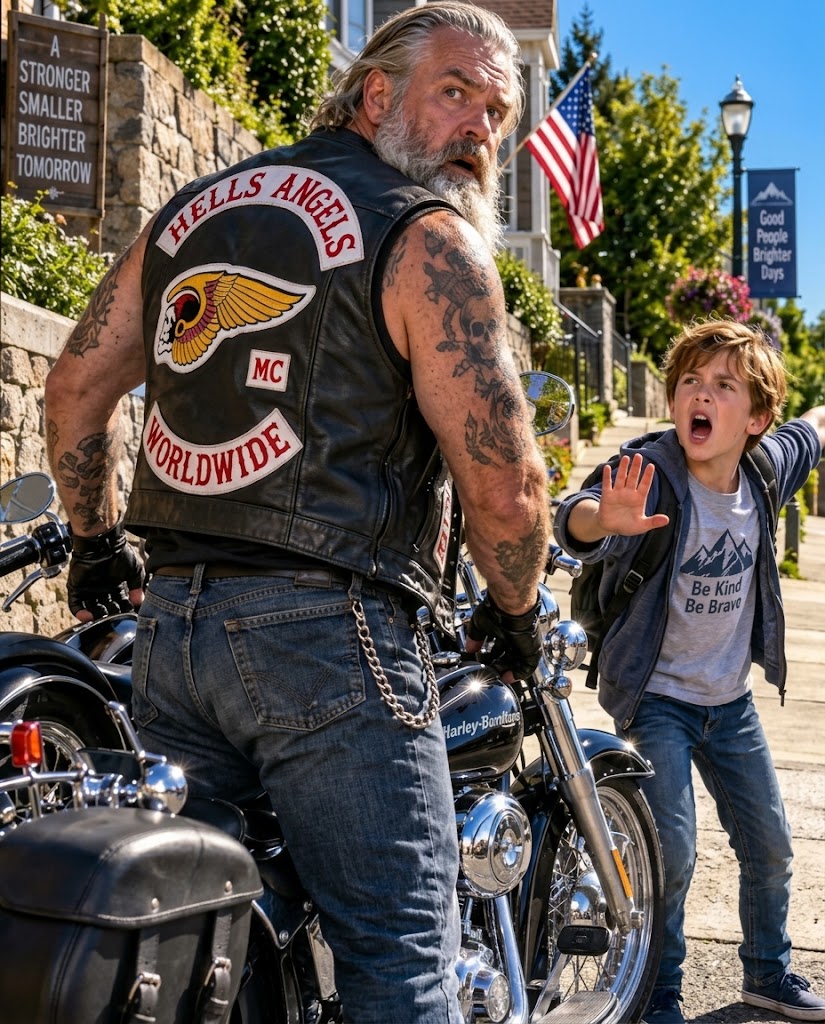
He was nine years old and about to do the one thing that would make every adult on that hill despise him for the next six seconds.
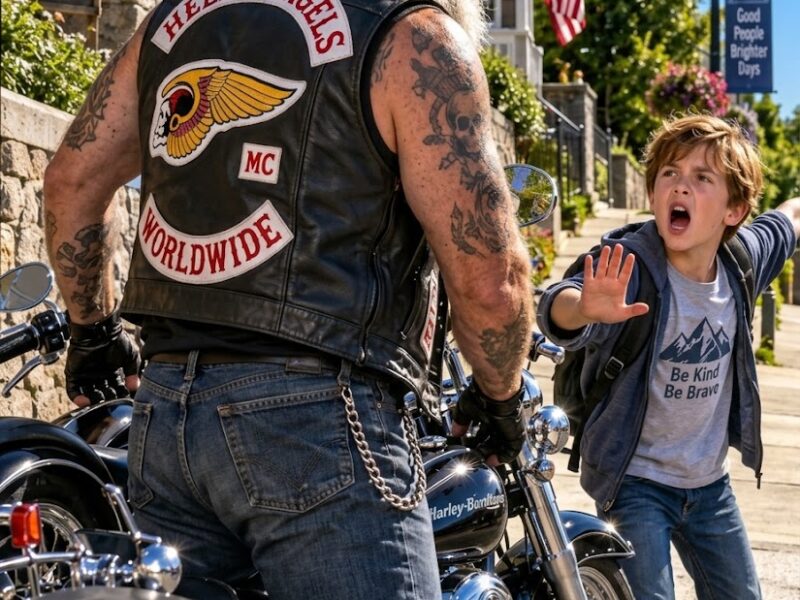
Behind him stood a man built like a doorframe, leather stretched over shoulders wide enough to block the sun, both arms sleeved in faded ink, a patch on his back that made grown men cross the street rather than walk near him.
He picked up one stone, he picked up another.
He picked up a third, then a fourth, just in case.
Every grown-up on that block had already decided who the villain was, and it wasn’t the truck rolling silently down the hill behind them both.
Nine years old, with maybe ten seconds to be wrong about that man, or watch what was coming crush everyone he loved.
The fog over Astoria, Oregon, broke the same way every September morning.
First the white steeple of Grace Episcopal Church came up out of the gray like the mast of a ship.
Then the rooftops below it one by one sliding down the hill toward the water.
Then last of all the river itself, three miles wide where it met the sea.
The Astoria-Megler Bridge stretched across it like a seam somebody had stitched between Oregon and Washington a long time ago and never bothered to remove.
By nine o’clock, the fog was gone and the light came down hard and clean.
The kind of light that made the whole hillside town look freshly painted.
Beckett Sorenson was nine years old, and he knew that fog schedule better than he knew his multiplication tables because his bedroom window on Grand Avenue faced east, and he had been watching that river disappear and reappear since he was old enough to climb onto the window sill by himself.
It was the second Sunday of September, which in Astoria meant only one thing: market day.
Down at the bottom of the hill on 12th Street, between the old canary buildings and the river, the Sunday market would already be setting up.
Striped awnings unrolling, folding tables scraping open, the smell of kettle corn and grilled salmon starting to climb the hill before the vendors had even finished counting their cash boxes.
Beckett’s mother, Lauren, had promised him a cinnamon twist from the bakery stall if he helped carry the folding chairs down without complaining about the hill.
The hill was the one part of Astoria that never got easier.
Grand Avenue dropped from the shoulder of Coxcomb Hill, where the old gray column stood watching over the whole town like a lighthouse that had wandered inland, all the way down to the flats by the river.
And it did it in about eleven blocks of pure calf-burning grade.
Beckett had lived on that hill his whole life.
He knew which sidewalks buckled from tree roots, which stone retaining walls had loose caps you could pry free if you wanted a rock to skip, and which driveways were steep enough that people set their parking brakes twice just to be sure.
One of those driveways belonged to Mr. Pelatier, three houses up from the Sorensons, who owned a truck older than Beckett’s mother.
It was a faded blue and white 1979 Chevrolet, the kind with a bench seat and a hand crank for the passenger window, and it had a reputation on the block.
“That truck of his creeks like it’s thinking about running off,” Lauren had said more than once, watching it from the porch.
“I don’t know why he doesn’t just leave it in gear and be done with it.”
Mr. Pelatier always laughed it off.
Forty years on that hill, he said, never so much as rolled an inch.
Beckett didn’t think much about the truck that morning.
He was thinking about the bikers.
They had started arriving on Friday.
A dozen motorcycles, then two dozen, thundering in off Marine Drive and filling the gravel lot behind the fairgrounds.
All of them decorated in the same black leather and the same red and white patches on their backs.
A grinning winged skull.
The words Hells Angels arched above it.
Worldwide arched below.
Every September they came through for the Lower Columbia Toy Run, a charity ride that ended at the Sunday market with a truckload of donated toys for the children’s ward at the Coast Hospital.
Beckett’s teacher called it a wonderful tradition.
His mother called it something to be careful around.
“You stay clear of those men, Beck,” she told him at breakfast, buttering toast without looking up.
“I know they’re here for a good cause. Doesn’t mean you go wandering up and talking to strangers in leather vests.”
So when Beckett came around the stone wall at the corner of Grand and 15th, chairs stacked in his arms, and found one of them parked directly in his path, he did what any sensible nine-year-old would do.
He stopped and he stared, and he did not say a word.
The man was enormous.
Not fat, just built the way old barns were built, wide through the shoulders and solid all the way down, with a beard the color of the fog itself, silver white and thick enough to hide his collar.
His hair was long and pushed back, the same silver gray, and both his forearms were sleeved in tattoos gone soft and blue green with age.
A skull wrapped in roses on one arm, something Beckett couldn’t quite make out on the other.
He had his back to the sidewalk, crouched beside a black Harley-Davidson, parked nose out against the stone wall, working at something low on the frame with a wrench that looked too small for his hands.
He didn’t turn around.
He didn’t seem to notice Beckett at all.
Beckett shifted his armload of chairs and edged past on the far side of the sidewalk, the way his mother would have wanted, close enough to the stone wall that a loose cap rock wobbled under his sneaker.
He glanced back once.
The way you glance at something you’ve been told is dangerous.
Half hoping to see something terrible and half hoping not to.
What he saw was just a big tired-looking old man alone fixing his motorcycle on a Sunday morning, patient as a stone.
Beckett didn’t know his name.
Nobody on Grand Avenue did.
They only knew the patch on his back.
And the patch, as far as anyone in town was concerned, told them everything they needed to know.
He kept walking.
Behind him, up the hill, past the biker and his motorcycle, past the stone wall and the flowering rosemary hedge, Mr. Pelatier’s truck sat exactly where it always sat, nose pointed down the grade, back tires resting against a wheel chock that had done its job for forty years.
Nobody was in the cab, nobody was anywhere near it.
The morning went on being ordinary for exactly eleven more minutes.
Lauren caught up with Beckett at the bottom of the hill, and together they carried the folding chairs the last two blocks to the market, where Jinny Talmage was already elbowed deep in dahlias behind her flower stand on 12th Street.
Jinny had run the flower table at the Astoria Sunday Market for eleven years, ever since her husband passed, and she knew everyone’s business within four blocks in every direction, which made her either the town’s best source of information or its worst, depending on whether you were the one being talked about.
“Morning, Lauren. Morning, Beckett, honey.”
Jinny straightened up, brushing dirt from her apron.
“You believe this crowd already? Toy Run always brings them out early.”
“The bikers.”
Lauren set her stack of chairs down beside the stall.
“The bikers, the tourists, everybody who wants to see the bikers.”
Jinny nodded up the hill toward the fairgrounds gravel lot where the motorcycles were parked in neat rows.
Chrome catching the sun.
“Half the folks setting up this morning are more worried about their bumpers than their booths.”
Beckett looked back up Grand Avenue the way he’d come.
From here he could see almost the whole climb, the retaining walls, the flowering hedges, the church spire near Coxcomb Hill.
He could just make out the big biker still crouched by his motorcycle at the corner of 15th, a small dark shape against the pale stone.
“Can I go get my ball?” he asked his mother.
“I left it on the porch. I want to play catch while you set up.”
Lauren was already unfolding a table.
“Straight there and straight back. Don’t dawdle and don’t talk to strangers.”
“I know.”
Beckett was already moving.
He jogged back up the hill alone, past the bakery stall where the cinnamon twists were just coming out of the oven, past the trolley tracks where the old riverfront streetcar sometimes rattled by on weekends, and up into the steeper blocks where the market noise thinned out, and the only sounds were his own sneakers on the sidewalk, and somewhere above him a wind chime knocking against somebody’s porch rail.
He was nearly to his own block, ball forgotten, when he heard it.
It wasn’t loud.
That was the strange thing he would try to explain later and never quite manage.
It wasn’t loud at all.
It was a low, grinding creak, tires rolling over old asphalt.
And underneath that, a faint metallic tick, tick, tick, like something had let go and was slapping against the undercarriage with every turn of the wheel.
Beckett looked up the hill.
Mr. Pelatier’s truck was moving.
It was moving slowly at first, an inch, then a foot.
The old blue and white Chevy sliding backward off its wheel chock and beginning to roll down the grade of Grand Avenue, gathering itself the way a boulder gathers itself at the top of a hill before it understands what gravity is for.
There was no one behind the wheel.
There was no one anywhere near it.
Mr. Pelatier’s front door was shut, his porch light still on from the night before, and forty years of never so much as an inch had just run out all at once.
Beckett’s stomach dropped straight through the sidewalk.
He knew exactly where that hill went.
It went past his own house, past the stone wall, past the corner of 15th, where the man on the motorcycle was still crouched with his back to the road, and past that, if nothing stopped it, all the way down eleven blocks of grade to 12th Street, where his mother was unfolding a table forty feet from a bakery stall crowded three deep, where the Sunday market was filling up with strollers and folding chairs, and a bounce house some Rotary volunteer had just finished staking to the pavement, where two hundred people who had no idea what was coming were standing directly in the truck’s path.
“Truck!” Beckett screamed, his voice cracking on it.
“Somebody stop it! The truck’s rolling!”
Up and down the block, exactly two people heard him, and neither of them understood what he meant fast enough to matter.
A woman watering hanging baskets on her porch looked up, confused.
A man walking a dog paused midstride.
Nobody moved.
The biker didn’t hear him at all.
He was still crouched at the base of his motorcycle, wrench in hand, working at a stubborn kickstand bolt, market music and generator hum and the general Sunday noise of the hill swallowing a nine-year-old’s voice before it traveled fifty feet.
Beckett ran toward him anyway, lungs burning, the truck picking up speed behind him now, rolling faster than he could outrun even if he turned to face it, and he understood with a cold, clean certainty that he did not have time to reach the man and grab his arm and explain.
He had maybe ten seconds, maybe less.
There was a low stone wall beside him, the same wall with the loose caprocks he’d noticed that morning, half buried in flowering rosemary.
Beckett didn’t decide to do what he did next so much as his hands simply did it faster than his mind could argue him out of it.
He grabbed a fist-sized stone off the top of the wall and threw it as hard as he could at the biker’s back.
It missed, skittering off the pavement past the man’s boot.
Beckett grabbed another and threw that one too, and it caught the leather square between the shoulder blades with a flat, ugly thud.
The man surged upright so fast his wrench clattered against the motorcycle frame, spinning around with a look on his face that made Beckett’s whole body go cold.
Not confusion, not yet, but the sudden focused fury of someone who has just been struck from behind and intends to know why.
“Hey!”
A woman’s voice, sharp with alarm, cut across the street.
Jinny Talmage, who had wandered up from her flower stand chasing a delivery van, had arrived just in time to see a nine-year-old boy hurling rocks at a Hells Angel three times his size.
“Hey, stop that, Beckett Sorenson! What in the world?”
Down the block, a man in an Astoria Police Department windbreaker, Officer Trent Ridley, working the market’s foot patrol, had already broken into a jog, one hand rising toward the radio clipped to his shoulder.
From where he stood, it looked exactly like what it looked like.
A child assaulting a member of a motorcycle club and a very large, very tattooed man about to do something about it.
Nobody was looking up the hill yet.
Nobody but Beckett had seen the truck.
He didn’t have breath left to explain.
He didn’t try.
He just flung his arm out, pointing past the furious biker’s shoulder, up the grade at the blue and white shape, gathering speed and swinging wide around the bend by the linkfist place.
Tires screaming faintly now against the pavement, aimed like an arrow at everyone he loved at the bottom of that hill.
The big man’s eyes followed the boy’s shaking finger.
Whatever fury had been building in his face simply emptied out of it, replaced by something else entirely, a stillness.
And then underneath the stillness, a kind of readiness Beckett had no name for yet.
The look of a man who has done this exact thing, or something enough like it, more times than he could easily count.
He didn’t ask a question.
He didn’t waste a second on the boy who’d just put a rock-sized bruise between his shoulder blades.
He was already moving, boots hitting pavement in a dead run up the hill, faster than a man his size had any right to move, straight toward the runaway truck.
The man’s name was Harvey Norwood, and he was sixty-nine years old, and none of the people watching him run knew either of those two facts, or would have cared if they had.
What they saw was a very large stranger in a leather vest sprinting up a hill after a truck.
And what Harvey felt underneath the pounding of his own heart was something older than fear.
A kind of muscle memory that didn’t need his permission to take over.
He had done this before.
Not this exact thing.
Not on this exact hill.
Not at sixty-nine with a knee that complained on cold mornings and a lower back that had opinions about running uphill.
But some version of this, more times than he liked to count, on logging roads slicked with rain in the Coast Range, on gravel switchbacks above the Nehalem River, guiding runaway log trucks down grades that would have swallowed lesser drivers whole.
Thirty-one years hauling timber for two different outfits before his knees gave out on him for good.
And before that, longer ago than most of the people watching him could imagine, back when his beard was black instead of white, three years in the United States Army, stationed with a heavy equipment recovery unit near the Fulda Gap in West Germany, learning on M88 recovery vehicles exactly what happened to eighty thousand pounds of steel when something failed and gravity took the wheel.
Nobody had asked him to remember any of that in over a decade.
His body remembered it anyway.
The truck had a head start and gravity on its side, but Harvey had the angle.
Grand Avenue curved slightly at the linkfist place, a long lazy bend that would slow the truck for half a second as its tires fought the camber, and Harvey cut across a corner lawn to close the gap.
Boots tearing through somebody’s dahlia bed, one hand slapping flat against a mailbox post to keep his balance on the turn.
He caught the truck at the passenger side as it came out of the bend, close enough to grab the door handle, and he understood in that instant exactly how much trouble he was in.
The engine was off.
Mr. Pelatier hadn’t so much as touched the key when he set his chock that morning, which meant no power steering, no power brakes, nothing but a two-thousand-pound antique running on nothing but momentum and a hand-operated emergency brake mounted low on the column, the kind Harvey hadn’t seen in a working vehicle in twenty years.
He wrenched the door open, swung himself up onto the running board, and threw his weight into the cab in one motion, landing hard across the bench seat with his boots still hanging out the open door.
The emergency brake lever was there, exactly where an old man’s memory told him it would be, but it fought him, rusted, stiff from disuse, the cable behind it groaning instead of catching.
Harvey hauled on it with both hands and felt it give an inch, maybe two, not nearly enough.
The truck didn’t slow.
If anything, cresting the last of the flatter grade before the steepest stretch of the hill, it picked up speed.
Down below, chaos was starting to spread the way it does, not all at once, but in widening rings.
Officer Trent Ridley had abandoned his pursuit of the boy the second he understood what was actually happening and was now sprinting downhill himself, radio pressed to his mouth, shouting something about a runaway vehicle on Grand Avenue, requesting units, requesting an ambulance, requesting anyone.
Jinny Talmage had turned and was running for her own flower stand, screaming for people to clear the street, clear the sidewalk, get the kids out of that bounce house.
And marketgoers, who had no idea what she meant, were nonetheless moving, herd instinct doing what explanation couldn’t yet.
And behind all of them, still climbing the hill on legs that had already run harder than they had in years, was Beckett, screaming the same warning over and over.
“Truck! Runaway truck! Move! Move! Move!”
And to anyone who would listen, his voice finally carrying now that there was real terror behind it instead of just alarm.
His mother heard him before she saw him.
Lauren Sorenson turned from her half-built table, and for one suspended second, the only thing she understood was that her son’s voice was coming from the wrong direction, up the hill instead of down at her side where she’d left him five minutes ago, and that something in it did not sound like a boy asking for a ball.
Inside the cab, Harvey abandoned the emergency brake and threw his shoulder against the steering wheel, wrestling it hard right, aiming the truck’s nose toward the low stone retaining wall that ran along the sidewalk’s downhill edge.
Better a grinding scrape against granite than a clean shot down the center of the road.
Without power steering, the wheel fought him at every degree.
Heavy as wet concrete, and for one terrible half second, his hands, sixty-nine years old, arthritic in the knuckles, not the hands that had wrestled a two-ton recovery winch into place in 1979, simply would not turn it fast enough.
A gray hatchback was parked half a block down, nose out from a driveway.
Harvey saw it coming and hauled the wheel another few degrees, feeling the truck’s back end swing wide, tires shrieking thin and high against the pavement, missing the hatchback’s bumper by no more than the width of a dinner plate.
Somewhere behind him, a dog he never saw yelped and scrambled clear of the gutter just in time.
For one flickering moment, something old and heavy settled onto Harvey’s chest that had nothing to do with the truck at all.
He was not thirty anymore.
He was not the young corporal who used to laugh at greener soldiers’ nerves, who used to sleep like a stone the night before a live recovery exercise.
His reflexes had a half-second delay now that hadn’t been there before.
And a half second on a hill like this at this speed might be exactly the margin that mattered.
The thought arrived and left almost too fast to name, a cold flash of doubt.
“Old man,” it said, “you are not what you were.”
And then it was gone.
Burned off by the same discipline that had gotten him through every recovery he’d ever run.
You do the job in front of you, not the job you used to be able to do.
He got his right hand back onto the emergency brake lever and hauled on it again, bracing his boot against the transmission hump for leverage, this time putting his whole back into it the way he would have put his back into a stuck winch cable.
The cable groaned, caught, groaned again, and finally bit, the rear drums clamping down hard enough that the truck’s back end shuddered and the whole cab lurched sideways.
It wasn’t enough to stop the truck.
It was enough, combined with the wheel he’d already dragged hard right, to send it scraping along the stone retaining wall in a shower of orange sparks and tearing chrome, bleeding speed with every foot of granite.
It dragged against the noise like the whole hill tearing open at the seams.
Below at the bottom of Grand Avenue, the Sunday market crowd had finally scattered clear of the entrance archway.
Jinny Talmage screaming for the last few stragglers.
A Rotary volunteer hauling two toddlers out of the bounce house by their overalls.
And the truck, scraping, screaming, shedding sparks, came down on all of them like something out of a nightmare nobody in Astoria had ever expected to have.
It was 10:47 on a Sunday morning in September when the truck finally stopped.
It came down the last stretch of Grand Avenue sideways, scraping stone, shedding its side mirror and half a fender in a trail of orange sparks.
And Harvey Norwood, both hands locked white-knuckled on a wheel that no longer had anywhere useful to turn, did the only thing left to do.
He aimed the last of the truck’s dying momentum at the low wooden barricade the Rotary Club had built that morning for a fall display.
A wall of stacked hay bales and pumpkins meant for nothing more dangerous than a photo backdrop, standing at the very edge of the market’s entrance archway on 12th Street.
The truck hit the hay bales at maybe fifteen miles per hour, plowed through six feet of them in a burst of gold straw and split pumpkin, clipped the corner of an empty vendor cart hard enough to send it spinning, and came to a shuddering, grinding, absolute stop eleven feet short of the archway, eleven feet short of the bounce house, the strollers, the folding tables, and every single person who had not quite managed to clear the entrance in time.
For a moment, nobody moved at all.
The only sound on 12th Street was straw settling and one wheel still spinning, ticking slower and slower against its own fender well.
Then the noise came back all at once, a gasp that seemed to come from two hundred throats simultaneously.
Someone’s crying toddler, the bounce house generator still cheerfully humming as if nothing at all had happened.
And underneath it, running feet, dozens of them, converging on the wreck from every direction.
Officer Trent Ridley reached the truck first, wrenching the driver door open, already reaching for his radio to call off the ambulance he’d requested for a collision, and request one instead for a very large, very shaken man, slumped sideways across a bench seat, straw in his beard, both hands still locked around a steering wheel that had stopped moving three seconds ago and hadn’t yet gotten the message to his fingers.
“Sir, sir, can you hear me?”
Ridley had a citation pad clipped to his belt that twenty minutes ago he had fully intended to use on a nine-year-old boy for assault.
He didn’t reach for it now.
He reached instead for Harvey’s shoulder, steadying him as the old man swung his boots down out of the cab and stood, swaying once on legs that had just run harder than they had in a decade.
“I’m fine,” Harvey said, which wasn’t entirely true, but was true enough to matter.
“Anybody hurt down here?”
“No, sir. No, nobody. Because of you.”
Ridley said it slowly, like a man revising a sentence he’d already started writing in his head, and something in his face was working hard to catch up with what his eyes had just watched happen.
“I saw that boy throwing rocks at you. I was two seconds from putting hands on him.”
“Good thing you didn’t.”
Harvey looked past him, scanning the crowd, and found what he was looking for.
A small white-faced boy standing frozen at the edge of the wreckage.
Straw dust and hay caught in his hair, staring at the ruined truck like he still wasn’t sure it had actually stopped.
Harvey walked to him and went down slowly onto one knee, bringing himself level with the boy instead of standing over him.
“Hey,” he said, quiet now, the fury from twenty minutes ago long gone and replaced with something gentler.
“You did good, son. You know that? You did exactly the right thing.”
Beckett’s chin was trembling.
“I hit you with a rock. Twice.”
“You did.”
Harvey almost smiled.
“Left a mark, too. I’ll be feeling that tomorrow.”
He nodded toward the wrecked truck, toward the crowd now pressing closer, toward Lauren Sorenson shoving through the front of it at a dead run, and toward Jinny Talmage standing a few feet off with one hand pressed flat over her mouth.
“But you didn’t have another way to reach me fast enough, and you knew it, and you did it anyway. That took more nerve than most grown men have got.”
Jinny lowered her hand from her mouth.
“I called you a boy who was going to get himself killed,” she said, mostly to herself, mostly ashamed of it.
“I didn’t even look up the hill. I just saw what I expected to see.”
“Most folks do.”
Harvey pushed himself back up to standing, one hand braced on his own knee, straw still caught in his beard.
He looked out at the crowd that had gathered around the wreck.
Vendors, tourists, off-duty deputies, a dozen of his own club brothers who’d come running down from the fairgrounds lot at the sound of the crash.
All of them staring at him now with an expression that had shifted in the space of about ninety seconds from weariness to something else entirely.
“Folks look at this vest, this ink, this face, and they figure they’ve already got the whole story before I say a word. This boy didn’t know the first thing about me either. Didn’t know I used to run trucks down grades a lot worse than this one back before my knees quit on me. Didn’t know the army ever taught me a thing about stopping something that outweighs you. He just knew something was wrong and he found a way to make me turn around, even though it meant every single person on this street was about to think the worst of him for it. That’s not something you teach a kid. That’s just who he is.”
Lauren reached Beckett at last, dropping to her knees on the straw-covered pavement and pulling him into her arms hard enough to knock the breath out of him, saying his name over and over the way you say a word you’re afraid might stop being true if you stop saying it.
Beckett let himself be held, and over his mother’s shoulder he watched the old man in the leather vest sit down heavily on the running board of a truck that would never run again, straw in his beard, hands finally starting to shake now that there was nothing left for them to do.
Someone brought him a cup of water.
Someone else brought a blanket, unnecessary on a warm September morning, but offered anyway, the way people offer things when they don’t know what else to give.
Harvey Norwood took the water, drank it, and said nothing else for a long while, letting the adrenaline drain out of him the same slow way it always had, every single time, for fifty years.
Down the block, one of Harvey’s club brothers, a wiry gray-mustached man named Merl Quaid, who had ridden beside Harvey for eleven toy runs and had never once heard him mention a word about log trucks or the army, stood at the edge of the crowd with his helmet still under one arm, staring at his oldest friend like he was seeing him for the first time.
“Fulda Gap,” Merl said slowly, half to himself.
“Thirty years riding next to you and you never said a word about any of that.”
“Never came up,” Harvey said, and left it there the way he’d left it there for thirty years.
The Daily Astorian ran the story on Tuesday under a headline that made Lauren Sorenson wince.
“Biker gang member, local boy, avert market disaster.”
As though the two of them were separate, unequal categories of person who happened to collide that morning by accident.
By Thursday, the paper ran a follow-up with a better headline, one that used both their names in full.
Beckett Sorenson and Harvey Norwood, side by side, with no gang member attached to either.
Jinny Talmage kept both clippings taped to the register at her flower stand for the rest of the season, and told anyone who asked that she’d learned more from the second headline than the first one, and it hadn’t cost her a thing but a little pride.
Mr. Pelatier, it turned out, had a snapped parking brake cable he’d been meaning to fix for three years, and a garage full of receipts to prove he’d meant to.
He came down the hill personally to shake Harvey’s hand, apologizing so many times that Harvey finally had to tell him gently that the cable was the least interesting thing that had happened on Grand Avenue that morning, and that Mr. Pelatier ought to go fix it now, so nobody had to find out twice.
Officer Trent Ridley requested the foot patrol route past the fairgrounds lot for the rest of the Toy Run weekend, which nobody had asked him to do, and spent most of Sunday afternoon and all of Monday morning talking motorcycle maintenance with men he would have crossed the street to avoid one week earlier.
He apologized to Beckett directly in front of his mother for how close he’d come to handling things badly.
And Beckett, who had decided he liked Officer Ridley now that the man had proven he could admit a mistake out loud, told him it was fine.
“Everybody makes mistakes.”
And Ridley laughed for the first time all week.
Harvey stayed in Astoria three extra days past when the rest of the Toy Run riders packed up and headed south, mostly because his knee needed the rest, and partly, though he never quite said so out loud, because he wasn’t in any hurry to leave.
Lauren invited him to dinner on the second of those nights, more out of a debt she felt she owed than any particular comfort with the idea, and found herself two hours later still sitting at her own kitchen table, listening to an old man explain, patiently and without a trace of bragging, exactly how a hand-operated emergency brake worked on a forty-year-old truck, while her son sat across from him, asking every question he could think of and writing the answers down in a spiral notebook like it was the most important homework he’d ever been given.
“You could teach me that stuff,” Beckett said somewhere around the second helping of dinner.
“The truck stuff, the brake stuff.”
Harvey considered this the way he considered most things.
Slowly, and with more weight than the question seemed to call for.
“I could teach you how to check if a parking brake’s actually holding before you trust it,” he said.
“That’s not the same as teaching you to jump into a moving truck. And I’d be obliged if you never tried that particular trick again as long as you live. But the checking part, that I can teach you. Every kid on this hill ought to know it, given the grade you people live on.”
He kept his word.
Twice more that fall, and then again the following spring when the Toy Run rolled back through Astoria, Harvey Norwood spent an afternoon on Grand Avenue showing a rotating cast of neighborhood kids, Beckett always first among them, exactly how to test whether a parking brake was doing its job.
Exactly what a snapped cable sounded like before it snapped all the way.
Exactly how much weight gravity was quietly holding at bay on every steep street in town, waiting for somebody to stop paying attention to it.
Parents who had once told their children to stay clear of the Toy Run bikers started walking their kids up the hill on purpose that second spring just to listen.
Beckett grew half an inch that year and stopped flinching when a motorcycle idled past his house, which his mother noticed even if she never said so directly.
He kept the notebook.
He filled two more just like it by the time he turned eleven.
Most of the pages about brakes and gear ratios and grades, some of them just about an old man’s stories from a base in West Germany that Beckett couldn’t have found on a map before that September, and could have found blindfolded after.
Harvey never did fully explain to Beckett, or to anyone else in town, why a nine-year-old’s rock throwing had mattered enough to forgive on the spot.
Why the fury that flashed across his face for half a second on Grand Avenue had drained out of him so completely and so fast the moment he understood what it was for.
Some things a person just knows without needing to say them out loud twice.
He had spent forty years being looked at and sorted at a glance into a category some stranger had already decided on before he opened his mouth.
It had happened to him at gas stations and grocery stores and now and then at his own daughter’s school functions back when his daughter still spoke to him, which was a story for some other year, some other telling.
He knew exactly what it cost a person to be misjudged on sight.
He also knew better than most what it cost the person doing the misjudging later, when the truth came due.
The Toy Run returned to Astoria every September after that.
Same as it always had, the same thunder of motorcycles rolling in off Marine Drive, the same red and white patches on the same black leather.
But the town met it differently now.
Officer Ridley waved the lead riders through the 12th Street intersection personally each year instead of watching from a distance.
The Rotary Club started leaving a reserved spot at the edge of the market for the Norwood crew, as they’d started calling it, whether Harvey rode down that particular September or not.
And every single Sunday morning the market was open, rain or shine, Toy Run weekend or any ordinary weekend in between, Jinny Talmage set one ripe peach from her fruit crate, whichever was the best one in the box that week, down on the low stone wall at the corner of Grand and 15th, right where a big man on a black motorcycle used to park while he waited for the market crowd to thin.
She never made a show of it.
Most Sundays nobody was there to take it, and by afternoon the peach would be gone anyway, carried off by a bird or a kid or the tide of ordinary Sunday foot traffic, and Jinny would set out a fresh one the following week without comment, the same small habit repeating itself quietly at the top of the hill, long after anyone remembered exactly why she’d started.
—
The years did what years do, which is to say they kept coming whether anyone was ready for them or not.
Beckett turned twelve the following summer, and then thirteen, and the notebook that had started as a single spiral-bound record of emergency brake mechanics had grown into a shelf of them, three more by his fourteenth birthday, each one fatter and more cryptic than the last.
He learned how to read a grade with a carpenter’s level and a piece of string.
He learned why a loaded logging truck needed a different braking rhythm than an empty one, and why the difference mattered more on wet asphalt than dry, and why neither of those things was the same as what a passenger car needed on a Sunday morning hill in town.
Harvey came through every September, and then, after the third year, every spring too, because his knee had gotten bad enough that the long ride down from Washington was easier to split into two trips than one.
He never stayed long.
A few days at the motel out on Marine Drive, a few afternoons on Grand Avenue with whoever showed up to listen, a dinner or two at Lauren’s kitchen table, where the conversation had long since stopped being about debt and started being about whatever Beckett was building in the garage that month.
The garage projects were Harvey’s fault, more or less.
He had mentioned once, offhand, that a man who understood leverage could move almost anything, and Beckett had taken that sentence home and not slept properly for a week.
By fifteen, he had rebuilt a come-along winch from parts he found at the swap meet in Portland, and rigged it to a frame of two-by-fours in the driveway, and used it to drag a dead washing machine up the hill from the curb when the appliance truck couldn’t make the grade.
Mr. Pelatier watched the whole operation from his porch with a cup of coffee and a look of profound and complicated emotion.
By sixteen, Beckett had a job at the auto shop down on 11th Street, part-time after school and full-time in the summers, and he had learned the difference between a brake that held and a brake that merely hadn’t failed yet, which is a distinction that sounds academic until you are the one standing downhill from it.
By seventeen, he had his driver’s license and a truck of his own, a 1987 Toyota pickup with a bad clutch and a worse paint job, and he had learned to set the parking brake twice on Grand Avenue, the way his mother had always said people should, and to check it once more before he walked away, the way Harvey had taught him.
Harvey was seventy-three the year Beckett graduated from high school.
He came down for the ceremony, which surprised everyone except Lauren, who had called him three weeks in advance and told him plainly that he was expected, and that she would not accept any excuses about his knee.
He sat in the third row of the auditorium in a collared shirt, no vest, no patches, just an old man with silver hair and a face that had weathered more than most, and he watched Beckett Sorenson walk across the stage and shake the principal’s hand and accept a diploma that had taken four years and a great deal of stubbornness to earn.
Afterward, in the parking lot, Beckett found him standing by his truck, looking up at the hillside where the whole town climbed toward Coxcomb Hill and the column that watched over all of it.
“You know,” Harvey said, not looking at him, “I never did tell you the whole story about that morning. About why I turned around so fast when you hit me with that rock.”
Beckett had heard pieces of it over the years, from Merl, from Ridley, from his mother, who had pieced it together from the things Harvey said and didn’t say across a decade of dinners.
But he had never heard it from Harvey himself.
“I was mad,” Harvey said.
“I was mad because it was a rock, and it hurt, and I was sixty-nine years old and my back already hurt, and I didn’t need some kid adding to it. That’s what I felt for about half a second. And then I saw your face, and I saw your arm pointing up the hill, and I understood. And the mad went away. Just like that. Gone. Because I knew what it cost you to do it. I knew you’d already decided I was the kind of man who might hurt you, and you did it anyway, because the truck was worse. That’s the part people never understand. You didn’t throw those rocks because you thought I was safe. You threw them because you thought I was dangerous and you did it anyway. That’s the whole thing. That’s the whole difference between a coward and whatever you are.”
Beckett didn’t say anything for a long moment.
The parking lot was emptying out, families drifting toward their cars, the last of the graduation balloons catching the wind and tugging at their strings.
“I was terrified,” he said finally.
“I know,” Harvey said.
“That’s what I’m telling you. Being terrified and doing it anyway, that’s not the same as not being terrified. That’s the only thing that ever counts.”
He pushed himself off the truck with a grunt that had more years in it than the last time Beckett had heard it, and clapped Beckett once on the shoulder with a hand the size of a dinner plate.
“You’re going to do fine,” he said.
“You’ve been doing fine since you were nine years old and throwing rocks at strangers. I just wanted you to know I knew it.”
He got in his truck and drove away, and Beckett stood in the parking lot for a long time after the taillights disappeared around the bend, thinking about all the things you don’t say out loud because you’re afraid they’ll stop being true if you say them.
—
Harvey Norwood died two years later, in November, at his daughter’s house in Tacoma, which was a fact that surprised almost everyone in Astoria because almost no one in Astoria had known he had a daughter at all.
Merl Quaid called Beckett to tell him, and Beckett sat on the edge of his bed in his apartment above the auto shop on 11th Street and listened to a gruff old man try to explain something that didn’t have a good explanation.
The funeral was small.
Harvey had asked for that, apparently, in a letter he’d left with his lawyer, along with instructions that his ashes be scattered at the base of the column on Coxcomb Hill, looking out over the river and the bridge and the whole town below.
The letter also said that he wanted Beckett Sorenson to say something, if Beckett was willing, and if he wasn’t, that was fine too, and no one should make a fuss about it.
Beckett was willing.
He stood at the front of a small chapel in Tacoma on a gray November morning, in front of maybe thirty people, most of them old men with gray beards and leather vests, a few of them with tears running down faces that looked like they hadn’t cried in decades.
He was twenty years old and he had never spoken at a funeral before, and his hands were shaking, and he had written and rewritten what he wanted to say so many times that the words had started to lose their meaning.
But when he stood up and looked out at the faces, the words came back to him, the way they do when you’ve been carrying them for a long time.
“I met Harvey Norwood when I was nine years old,” Beckett said.
“I threw rocks at him. Two of them. One of them hit him in the back, hard enough to bruise. And he turned around, and he was angry, and then he wasn’t, because he understood something I was too young to understand. He understood what it cost me to do what I did. He understood that I was more afraid of the truck than I was of him, and that I chose the danger I could see over the danger I couldn’t. And he forgave me for it, in about half a second, without me ever asking, without me ever explaining. He just knew.”
“He spent the rest of his life teaching me things. How to check a parking brake. How to read a grade. How to move something heavy without hurting yourself. How to be careful without being afraid. But the thing he taught me that mattered most wasn’t anything he ever said out loud. It was just the way he turned around that morning. The way he understood what I was doing before I understood it myself. The way he forgave me for something that didn’t need forgiving. That’s the thing I’m going to carry with me. That’s the thing I’m going to try to pass on.”
He sat down.
Merl Quaid stood up and said something short and funny that made everyone laugh, and then someone else said a prayer, and then it was over, and they all went out into the gray November morning and stood around in the parking lot not knowing what to do with themselves.
Lauren was there, and she found Beckett by the door and put her arm around him and didn’t say anything, which was the right thing to say.
Jinny Talmage was there too, which surprised everyone, because Jinny had never met Harvey in person before that day, and had only ever known him as the man who used to park his motorcycle at the top of the hill on Sunday mornings.
But she had driven all the way up from Astoria anyway, and she stood in the back of the chapel with her hands folded in front of her, and afterward she found Beckett and pressed something into his hand.
It was a peach.
A single ripe peach, perfect and soft, the best one in the box, the way she had set one out on the stone wall every Sunday morning for years and years, long after anyone remembered exactly why she had started.
“I thought he might like one,” she said.
“For the road.”
—
The Toy Run still comes to Astoria every September.
The motorcycles still thunder in off Marine Drive, the same red and white patches on the same black leather, the same winged skull grinning above the words that make some people cross the street without knowing a single thing about the men wearing them.
But the town meets it differently now, the way a town does when it has learned something it can’t unlearn.
Officer Ridley is retired now, but he still comes down to the market on Toy Run weekend and shakes hands with the riders he used to avoid.
The Rotary Club still leaves a reserved spot at the edge of the market for the Norwood crew, and the Norwood crew still takes it, even though the man they named it after has been gone for years.
And every Sunday morning the market is open, rain or shine, summer or winter, Jinny Talmage still sets one ripe peach on the low stone wall at the corner of Grand and 15th, right where a big man on a black motorcycle used to park while he waited for the crowd to thin.
She is older now, and her hands are not as steady as they used to be, and some Sundays she forgets and has to go back.
But she always sets out the peach.
And some Sundays, if you are walking up Grand Avenue early enough, before the fog has lifted all the way, you can see a young man in a mechanic’s jacket stop at the stone wall and look at the peach for a minute before he keeps walking.
He never takes it.
It isn’t for him.
But he always looks, the way you look at something that reminds you of who you used to be and who you decided to become, and then he puts his hands in his pockets and climbs the hill toward whatever is waiting for him at the top.
The fog breaks the same way every September morning.
First the white steeple of Grace Episcopal Church comes up out of the gray like the mast of a ship.
Then the rooftops below it, one by one, sliding down the hill toward the water.
Then last of all the river itself, three miles wide where it meets the sea.
And somewhere on the hill, a nine-year-old boy is learning something he doesn’t have words for yet.
That the difference between a villain and a hero is almost never what you can see from across the street.
That the person you’ve been told to fear might be the only one who can save you.
That sometimes you have to throw a rock at a stranger, and sometimes the stranger is the one who understands.
And that the real story, the one that matters, is almost never the one people tell first.









