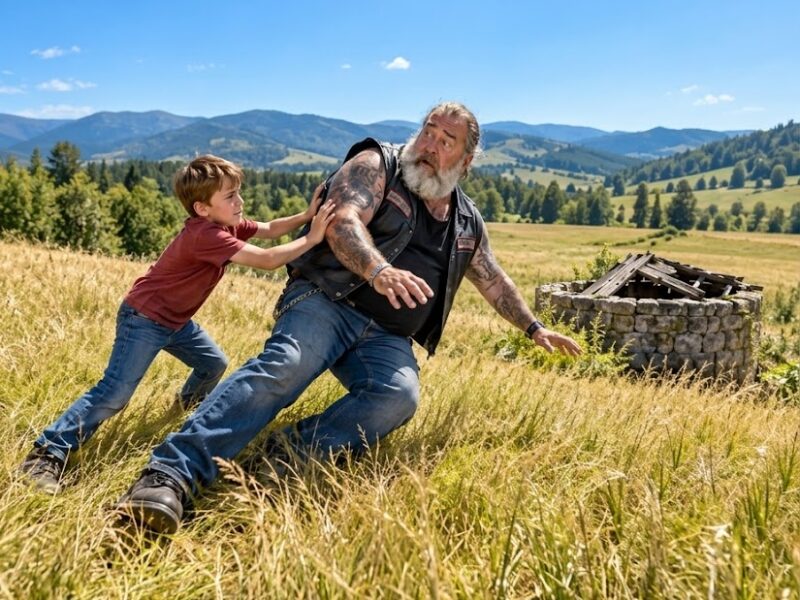
A Boy Tackled a Hells Angel Into the Grass Two Steps From an Open Well Nobody Knew Was There
Part 1
The boy was no bigger than a fence post. Maybe seventy pounds soaking wet. He threw himself at a mountain of leather and ink anyway.
Every grown adult standing near that field was certain they had just watched a child attack a dangerous man. Nobody asked why. Nobody looked at the ground.
Nobody remembered what waited two steps behind those boots, hidden under grass nobody had cut in forty years. Nobody wanted to remember.
The man weighed two hundred and sixty pounds easy. Scars threaded his forearms like old rope. The whole town had already decided long before that Saturday exactly what kind of man he was.
They were wrong. What the boy’s small hands uncovered beneath that field would make every one of them wish they had asked a single question first.
Western Hail knew the sound of thunder before it arrived. In September, the mountains around Marlington, West Virginia, always sent it ahead first. A low hum through the valley. Then a rattle that shook the loose porch boards under his sneakers.
But on the second Saturday of that month, the sound rolling up Route 219 wasn’t thunder at all. It was forty motorcycles.
He counted them from the porch rail. The way he counted deer in the back pasture. Or stars over Droop Mountain. Quietly, carefully, like the number itself was a kind of secret he could keep.
Chrome flashed between the maples. Leather vests, black as creek mud after rain, carried patches Western couldn’t read from that distance. His grandmother, Pearl Hail, stood behind the screen door with her arms folded so tight her knuckles had gone pale.
“Get inside, Wes,” she said, not looking away from the road.
“They’re not doing anything.”
“They never look like they’re doing anything. That’s how it works.”
Pearl had raised that particular worry since Weston’s father, Holt Hail, had died in a logging accident two winters back. On a ridge not far from where the bikers now rode. Grief had made her careful in a way that sometimes felt more like fear than caution.
Weston had learned not to argue with her about it. Even when he thought she was wrong. Especially when he thought she was wrong.
Every September, for as long as Western could remember, the same ride came through Marlington. On its way up into the hills above Nap Creek. Past the old Sutton homestead, where nothing had stood for thirty years but a collapsed chimney and a rusted-out hand pump.
Nobody in town could say exactly why the bikers came. Only that they came. Parked their machines along the gravel shoulder. Walked the overgrown field for an hour in near silence. Left again before dark.
Marlington had built a whole mythology out of that hour. Some folks said it was a burial ground for outlaws. Some said drugs. Some said it was nothing but old men reliving a war nobody wanted to ask them about.
Weston’s mother, Carla Hail, worked the counter at the Trail Head Diner on 9th Street. Close enough to Route 219 that she watched the whole procession roll past the window every year. She’d told Weston more than once, in the flat voice she used when she didn’t want an argument, that the men on those bikes were not the kind of men you waved at.
Not the kind of men you spoke to. Certainly not the kind of men you let inside a nine-year-old’s curiosity.
Weston had never once believed her all the way. He believed the leather and the tattoos and the noise. He just didn’t believe that was the whole of it.
That morning, while the convoy idled outside Fern Witam’s general store for gas and coffee, Weston slipped down through the side yard. Past his grandmother’s tomato stakes. Out toward the tree line separating the Hail property from the old Sutton Field.
It was the one place in Marlington that belonged to him and nobody else. An accident of geography. The field sat between three properties, and none of the owners cared enough to fence it.
Weston had spent two summers there building forts out of collapsed fence rail. Hunting crawdads in the runoff ditch that fed down toward Nap Creek. He’d also spent enough time there to notice things.
The field smelled different depending on the season. Cut hay and diesel in summer. Wet stone and rot come October. Weston had come to know that smell the way other kids knew the layout of their own bedrooms in the dark.
Two weeks earlier, after four straight days of hard rain, Weston had found a patch of grass near the old chimney that sagged when he stepped on it. Like the ground itself had gone soft and hollow underneath.
He poked at it with a stick and found wood. Old black rotted wood laid out in a rough circle. Half buried under dirt and creeper vine.
He hadn’t told his mother. He hadn’t told his grandmother. He wasn’t entirely sure what he’d found. Only that it made the hair stand up on his arms every time he thought about it.
And that the last thing he wanted was for someone to fill it in with a bulldozer before he figured out what it was.
He was thinking about that patch of grass, in fact, when the bikers came up the gravel road behind him for their yearly hour of silence. He pressed himself flat against a fallen oak to watch.
They came slower than usual that year. At the front of the pack, on a bike so old the tank had been repainted more times than anyone could count, rode a man Weston had seen every September of his life without ever learning his name.
He was enormous. Not fat, but built the way an old oak is built. Wide through the shoulders. Wider through the forearms. His beard a heavy fall of gray and white that reached the top button of a black leather vest gone soft and cracked with age.
Patches Weston still couldn’t read from a distance covered both shoulders. Faded ink crawled up both arms in shapes long since blurred into shadow.
The man dismounted first. Always first. Always at the same spot near the collapsed chimney. The exact spot, Weston realized with a small lurch in his stomach, that sat less than ten feet from the soft patch of grass he’d found two weeks before.
Weston didn’t know his name yet. He would learn it soon enough. And he would learn a great deal more than that before the month was out.
But on that Saturday morning, hidden behind a fallen oak, with his heart going quick and light in his chest, all Weston Hail knew for certain was that the biggest, most frightening man he had ever seen in his life was about to walk directly toward something the whole town had forgotten was there.
His name, Weston learned by the end of that week, was Sherman Coyle. Finding it out took some doing. Nobody in Marlington seemed to know him so much as know of him.
Fern Witam, who ran the general store on 9th Street and had done so for thirty-one years, was the one who finally said it out loud. Only because Weston asked her three times in a row while she rang up a gallon of milk.
“Coyle,” she said, like the word tasted bad. “Sherman Coyle rides with that same club every year. Same week. Same field. Never buys more than gas and black coffee. Never says two words unless you count thank you, which he always does. Which is more than I can say for half the folks who think they’re respectable in this town.”
She looked at Weston hard over the register.
“Doesn’t mean you go near him, Wes. Big man like that. All that ink. All that leather. Men like that carry trouble the way a truck carries exhaust. Just comes off them.”
Weston hadn’t argued. He’d learned a long time ago that arguing with Fern Witam was like arguing with the weather. But he’d also learned in nine years of watching adults very closely that people said men like that about anybody they hadn’t bothered to actually look at.
Sheriff Gordon Lachlan felt the same way and made less effort to hide it. Weston watched from the diner’s back step, where his mother let him do homework some afternoons, as the sheriff’s cruiser rolled slow past the line of parked motorcycles outside Fern’s store. Windows down. Sunglasses on. The way a man drives when he wants to be seen driving.
Gordon Lachlan had been sheriff of Pocahontas County for eleven years. In eleven years, Weston’s mother said, he had never once found a single thing to charge the Marlington bikers with. Not that it stopped him looking.
“They’re not from here,” Gordon told Carla Hail one afternoon at the counter, loud enough for Weston to hear from the corner booth. “Man like that Coyle riding in every year. Walking that old field like he’s got some kind of claim to it. It’s not natural, Carla. People don’t do things like that without a reason. And it’s rarely a good one.”
“Maybe he lost somebody,” Carla said, not quite looking up from the coffee she was pouring.
“Maybe he’s casing something,” Gordon said. “You ever think of that?”
Weston thought about that a long time, chewing the end of his pencil. He decided he didn’t believe it. Casing something took secrecy. There was nothing secret about forty motorcycles idling outside the only gas pump in town.
It was three days later, on a Tuesday, that Weston finally got close enough to find out for himself. He hadn’t meant to. He’d gone back to the Sutton Field after school, the way he had almost every day since the storm, to sit with the soft patch of grass and turn the question over in his mind.
Tell somebody or don’t. Dig it up or leave it buried.
He’d forgotten in his hurry to beat the bus schedule that Tuesday was not a September Saturday. The field should have been empty.
It wasn’t. Sherman Coyle was standing at the edge of the old chimney stones. Alone. No club behind him. No bike in sight except the single one leaning against a fence post a hundred yards back.
He had a canvas bag open at his feet. He was crouched low, running one broad, scarred hand across the ground. The way a man reads Braille.
Weston should have run. He knew that even at nine, in the clean animal part of his brain that understood danger before words caught up to it. Instead he stepped on a fallen branch. The crack of it cut through the field like a gunshot.
Sherman Coyle turned around fast enough that Weston saw, for one unguarded second, something on the old man’s face that had nothing to do with anger. It looked like fear. It looked like a man caught doing something he had hoped never to have to do again.
“You’re standing too close,” Sherman said. His voice was low and rough. Gravel under a boot heel. But there was no threat in it. “Right there, where your feet are. Move back toward me. Slow. And don’t stomp when you do it.”
Weston, more curious than scared now, moved back toward him instead of away. Which surprised them both.
“Why?” he asked.
“Because the ground’s been telling me something for the last ten minutes. And I don’t think it’s finished.”
Sherman straightened up, joints cracking audibly, and looked at Weston properly for the first time. Not the way Fern Witam looked at him, like a nuisance to be managed. Not the way Sheriff Lachlan looked at every biker in town, like evidence waiting to happen. But the way a man looks at somebody he is trying to decide whether to trust with something heavy.
“You’re the Hail boy,” Sherman said. “Carla’s.”
“You know my mom?”
“I know of her. Small towns work that way whether a man rides a motorcycle or not.”
He crouched back down. This time Weston noticed the canvas bag properly. An old hand auger, its wooden handle worn pale and smooth. A coil of rope. Something small and heavy wrapped in oilcloth that Sherman didn’t unwrap.
“You ever notice this ground go soft anywhere else out here? Besides where you’re standing right now?”
Weston’s stomach dropped clean through his shoes.
“How do you know I found something?”
Sherman looked up at him for a long moment. Something moved behind his eyes that Weston wouldn’t understand for another two weeks. Grief, old and load-bearing. The kind that gets carried so long it starts to look like anger from the outside.
“Because I dug the first one,” Sherman said quietly. “Forty years ago. And I’ve been trying to remember exactly where ever since.”
Weston didn’t answer right away. Somewhere back toward the road, the rest of the club had started their engines one by one. The sound rolled low across the field like distant weather.
Sherman rose to his feet, gathered his canvas bag, and looked at the boy one more time before he walked away.
“Don’t go digging at that patch on your own,” he said. “Whatever you found, it’s older and heavier than it looks. I’ll be back before those bulldozers get any ideas about this field. You have my word on that. For whatever a stranger’s word is worth to you.”
He was gone before Weston could decide whether he believed him.
The rest of that conversation stayed with Weston for exactly six days. Because that was how long it took Preston Jarnell to stand up at the Pocahontas County Courthouse and announce that Cole Grove Development had closed on sixteen acres, including the old Sutton parcel. Groundbreaking on twelve new homes would begin the second week of October.
Weston wasn’t supposed to be at that meeting. He’d come with his mother, who worked three doors down, and had ducked in on her break because half the town had. Drawn by curiosity or worry or the free coffee somebody had set up in the back.
Weston sat on the hard bench beside her and watched Preston Jarnell unroll a set of blueprints across a folding table. Like a man dealing cards he already knew were winners.
“Twelve homes,” Jarnell said, smiling the way men smile when they’ve already gotten what they came for. “Starter homes. Good for young families. Good for this town’s tax base, which, no offense to anybody in this room, could use it.”
A ripple of nervous laughter went through the crowd.
“We’ve done our due diligence. Soil samples. Drainage. The works.”
“Wells.”
The voice came from the back of the room. It took Weston a second to place it, because he’d never heard it raised above a low rumble before.
Sherman Coyle stood near the door. Alone. Still wearing the same cracked leather vest. Every head in the room turned like he’d fired a gun into the ceiling.
Jarnell’s smile didn’t move. But something behind it did.
“Excuse me?”
“That field’s got at least one abandoned well on it. Maybe more. And it’s old. Pre-1950. No state record, because nobody filed one back then. You clear that land with heavy equipment before somebody surveys it properly, you’re going to open a hole in the ground somebody’s kid could fall straight down into.”
“And you’d know that how exactly?”
Sheriff Gordon Lachlan had turned in his front-row seat. One arm draped over the back of his folding chair. The posture of a man who already knew how this was going to go and meant to enjoy it a little.
“Didn’t realize the club had a survey crew.”
A few people laughed. Weston didn’t. He was watching Sherman’s hands. They had curled slowly into fists at his sides. Not with violence in them. With the strain of a man trying to explain something true to a room that had already decided he was lying before he opened his mouth.
“I’d know,” Sherman said, “because I spent thirty years capping wells exactly like it for half this county before any of you can remember. Records office has my name on file if anybody bothered to look.”
“Records office,” Gordon repeated, and let it hang there.
Weston understood, watching Preston Jarnell’s mouth twitch toward another smile, that nobody in that room intended to look. It was easier to picture a man like Sherman Coyle as a threat to keep an eye on than as a resource anyone owed the courtesy of five minutes in a filing cabinet.
The meeting moved on. Groundbreaking October. No changes.
Weston found Sherman outside afterward, sitting on his bike with both boots on the pavement, staring at nothing.
“They didn’t believe you,” Weston said.
“No.”
“Is it true? What you said?”
Sherman was quiet long enough that Weston thought he wasn’t going to answer at all. When he finally did, his voice had gone somewhere else. Somewhere Weston couldn’t follow yet.
“Before I ever dug a well in this county, I dug trenches for the 82nd Airborne outside Santo Domingo back in 1965. When this country sent soldiers into the Dominican Republic to hold a bridge nobody back home ever bothered to learn the name of. Learned more about how ground moves and settles in six months over there than I learned in ten years afterward.”
He paused, turning one broad hand over as if checking it was still his own.
“A man comes home from something like that, he wants work that keeps him close to the dirt instead of running from it. So I went to work for the state extension office. Sealing old hand-dug wells before some farmer’s cow or some farmer’s kid found them the hard way. Sealed forty-one of them in this county between 1971 and 1988.”
“That’s a lot,” Weston said, because he didn’t know what else to say.
“Wasn’t enough.”
Sherman’s jaw worked once, hard.
“I had a boy of my own back then. Elton. About your age. Maybe a year older. Didn’t get to the well on my own family’s old home place in time. He found it before I did. Summer of ’88.”
Weston didn’t say anything. He didn’t know what a nine-year-old was supposed to say to that.
“After that, I stopped digging,” Sherman went on. “Couldn’t stand the sound of an auger biting dirt. His mother, Vera, tried to hold both of us together for years. But grief’s got its own gravity. It pulled us apart instead of together. She passed a decade later. Quieter every year, until there wasn’t much sound left in her at all.”
He looked out toward the mountains.
“I got on a bike about the same time. Never quite got off. A man can outrun a lot of things at sixty miles an hour. Doesn’t outrun much of anything, if I’m honest. But the wind makes it feel that way for a minute.”
“Is that why you come back every year? To that field?”
Sherman nodded once.
“That’s where he’s buried. Little stone under the sumac by the fence line, if you know where to look. Same field where he fell. I’ve been trying, on and off, to remember exactly where that well sits. So I can finally do the one thing I never managed to do for my own son. Seal it properly. So it can’t happen to anybody else’s.”
Weston thought of the soft patch of grass by the old chimney. A cold, certain feeling settled into his chest.
“I think I found it,” he said. “Two weeks ago. Before you even got here.”
For the first time since Weston had known him, Sherman Coyle looked less like a mountain and more like a man. Old. Tired. Suddenly, desperately hopeful.
But it was already Tuesday. The bulldozers were coming the second week of October. Nobody with the authority to stop them had any reason left to listen to either one of them.
It was Opal Rehner, three days later, who finally gave them one. Opal ran the Pocahontas County Historical Society out of two rented rooms above the old depot. When Weston showed up asking about well accidents from the ’80s, she didn’t ask a single question before disappearing into a back room and returning with a manila folder gone soft and brown at the corners.
Inside was a clipping from the Pocahontas Times dated August 1988. Beneath a grainy photograph of a young man kneeling by a capped well, a caption that made Weston’s breath catch.
“Local well-sealing specialist Sherman Coyle, credited with more than forty safety closures across the county, mourns personal tragedy.”
“Everybody forgets,” Opal said quietly, watching Weston read it twice. “That the men we’re most afraid of are usually just the men we never asked a single question.”
She let him keep the clipping. It wasn’t enough, not yet, to stop a bulldozer. But it was enough, Weston thought as he ran the whole three-quarters of a mile home, to make somebody finally ask.
Part 2
The clipping did exactly what Weston hoped and exactly what he feared. It made his mother believe him. It made her tell Sheriff Gordon Lachlan.
It made Gordon Lachlan promise, in the non-committal tone of a man who had already stopped listening, that he would look into it before the crew broke ground. Nobody promised to delay the Saturday visit. Nobody thought to.
So on the second Saturday of October, the last Saturday the old Sutton Field would exist as an open field at all, since Cole Grove Development’s excavators were scheduled to arrive Monday morning, the club rode up Route 219 one final time. Forty bikes strong.
Sherman Coyle dismounted first, as he always did. Walked alone toward the collapsed chimney and the sumac thicket beyond it, as he always did.
Weston was not supposed to be there. His mother had told him in a voice that left no room for negotiation that he was to stay on the porch with his grandmother until the club had come and gone.
But Weston had spent three days turning the clipping over in his hands. Reading the words mourns personal tragedy until they stopped looking like words at all. He could not make himself sit still on that porch knowing what he knew about the ground Sherman Coyle was about to walk across.
He went the back way through the tree line. Past the same fallen oak he’d hidden behind a month before. Got there just as the light was starting to go long and gold across the field, the way it does in the mountains in October. Throwing everything into a soft amber haze that made the world look gentler than it was.
Crickets had started up somewhere near the runoff ditch. The air had that particular October chill to it. Damp and mineral. Which meant the ground was still holding on to three days of rain it hadn’t finished giving back yet.
Sherman had found the little stone by the sumac. Elton’s stone. Half swallowed by a creeper vine. He was kneeling in front of it with his head bowed.
The rest of the club held a respectful distance the way they did every year. Nobody speaking. Thirty-nine grown men and one grieving father standing in a field that would be gone by Monday.
Weston had come to warn him. He meant to march straight up and say the words he’d been rehearsing the whole way over. It’s still there. I marked it with a stick. Don’t go past the third fence post.
But grief has a gravity of its own. Watching Sherman Coyle’s shoulders shake silently over a stone the size of a shoe box, Weston found he couldn’t make himself interrupt it. Not yet. Not for one more minute.
That minute was the mistake.
Weston would spend a long time afterward turning that minute over in his mind. The way he’d once turned over the question of whether to dig up the soft patch of grass or leave it buried. He would decide eventually that there hadn’t really been a choice to make at all.
That some moments only look like decisions after they’re already over. And in the middle of them, a body simply does what it was always going to do.
Sherman rose slowly. Wiped his face with the back of one broad hand. Turned to say something to Garland Pike, the club’s road captain, who had stepped forward to stand beside him.
He took one step backward as he turned. An old man’s unthinking step. The kind a body takes a thousand times a day without looking.
Then another. His boot heels sinking half an inch into ground gone soft from three days of steady October rain.
Weston saw the grass give. He saw it the way he’d seen it a month before under his own sneaker. That same slow, sickening sag. Except this time there were two hundred and sixty pounds of grieving old man standing directly on top of it.
One heartbeat from a hole that had already taken one member of his family. And had been waiting, patient as stone, for thirty-eight years to take another.
There was no time to shout a warning. A shout might have made him flinch the wrong direction. Might have sent that boot heel down instead of back.
Weston didn’t think about any of that. There wasn’t room in his body for thinking. Only for the clean animal certainty that had once told him to run and now told him to move.
His legs were moving before the rest of him caught up to the decision. Tearing across fifteen feet of wet grass faster than he had ever run anything in his life.
The last thing he remembered clearly before impact was the sight of the dark, splintered wood tilting under Sherman’s boot. Like the lid of something that had been waiting a long time to open.
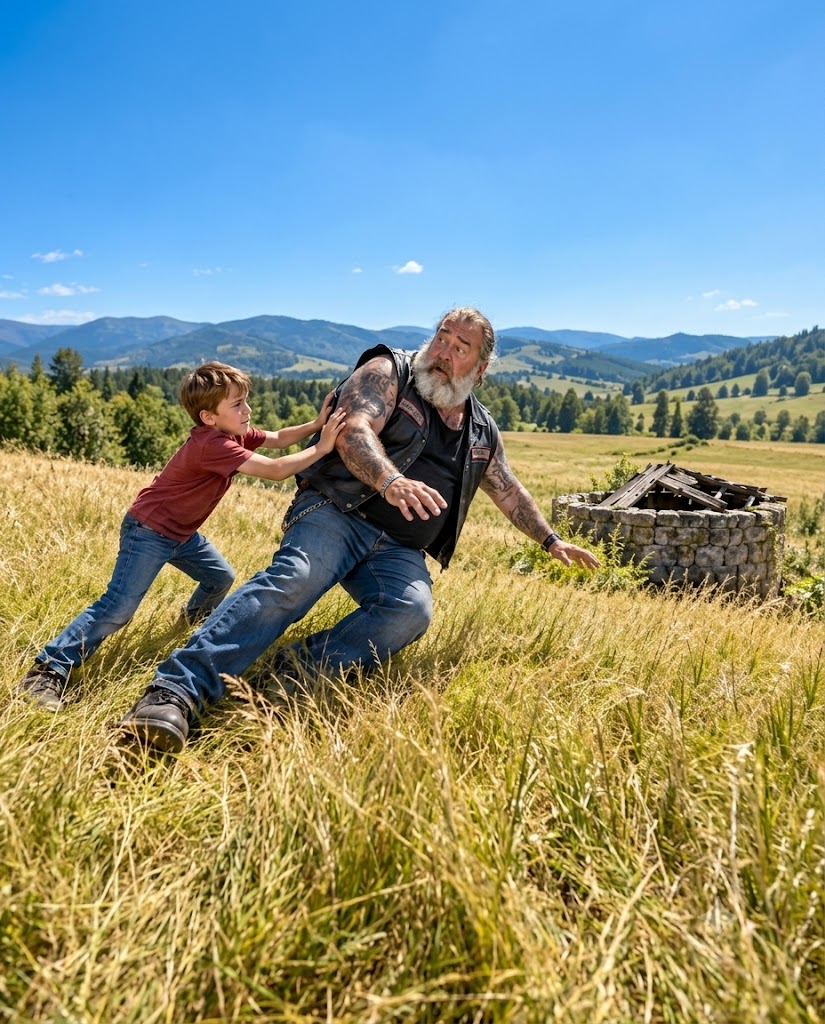
He threw both arms around Sherman Coyle’s waist and pulled with everything a sixty-two-pound nine-year-old body had ever owned.
They went down together into the grass, hard. Sherman’s considerable weight nearly crushing the breath clean out of him.
Two full strides from the black, gaping mouth of a well that had lain hidden under rotted boards and creeper vine since before Weston’s mother was born.
For one long second, nobody in that field made a single sound.
The watch on Garland Pike’s wrist read 5:17 that Saturday evening in October. He would remember it exactly for the rest of his life. Because it was the last ordinary second before thirty-nine grown men started shouting all at once.
Sherman lay stunned in the flattened grass, staring up at the darkening sky. Then he turned his head and looked at the boy still wrapped around his middle. Then past the boy at the black hole in the earth, two steps from where his own boots had been standing.
Something broke open in his face that had nothing to do with fear.
“Elton,” he said, so quietly only Weston heard it. Then, correcting himself, his voice cracking wide open around the word: “Weston. Weston. You—”
He couldn’t finish it. He didn’t need to.
Carla Hail was already running across the field, screaming her son’s name loud enough that it carried all the way to the tree line. Gordon Lachlan was radioing for rope and lights. Garland Pike was on his knees at the edge of the well with a flashlight, its beam sinking down into a darkness that seemed to go on far longer than a hole in a Sutton County field had any right to.
None of it mattered yet. Not for one more minute.
Because Sherman Coyle had both arms wrapped around a nine-year-old boy who was not his son. In a field where his own son had died thirty-eight years before. And he was shaking too hard to let go.
Carla reached them seconds later. Dropped to her knees in the wet grass. Pulled Weston half out of Sherman’s arms and into her own. Checking his face. His hands. The length of both arms. As if she could not quite believe there was nothing broken.
Sherman let him go without being asked. The way a man releases something he has no right to keep holding. Sat back hard in the flattened grass. Stared at the dark opening in the earth like it might still change its mind and reach for one of them.
By Monday morning, when Cole Grove Development’s excavators were supposed to break ground on twelve new homes, there was instead a length of yellow tape strung between four fence posts. A single sheriff’s cruiser parked at the edge of the field. Gordon Lachlan himself standing beside it in the cold with a cup of Fern Witam’s coffee he hadn’t paid for.
“Pocahontas County building code requires a full hazard survey before any excavation on undeveloped parcels,” he told Preston Jarnell, reading it off his own phone in a voice that suggested he’d looked it up sometime around two in the morning. “Should have been done before you closed on the land. My mistake for not catching it sooner.”
Jarnell’s face went through several colors before settling on a tight, professional calm.
“And who exactly is qualified to conduct that survey on short notice?”
Gordon didn’t answer right away. He looked past Jarnell across the field. To where Sherman Coyle was crouched at the edge of the well with a coil of rope and a battery lantern. Exactly the way he must have looked a hundred times across three decades, before grief took the tools out of his hands.
“Man’s got his name in the state extension records for over forty closures between ’71 and ’88,” Gordon said. “Reckon he’s about as qualified as anybody left standing in this county.”
It wasn’t an apology. Not exactly. But Weston, watching from the fence line with his mother’s hand heavy and warm on his shoulder, saw the sheriff nod once at Sherman across that field. Saw Sherman nod back.
And understood that between two men, sometimes that was the whole of an apology either one of them knew how to give.
Carla Hail had said considerably more than that to Sherman the night before. Once the ambulance had confirmed Weston had nothing worse than a bruised elbow and a grass stain that wouldn’t come out of his good jeans.
She hadn’t thanked him so much as stood in front of him on the porch, arms crossed the same way Fern Witam’s always were. Told him plainly that she’d spent two years teaching her son to be careful around men exactly like him. And that she didn’t know yet what to do with the fact that her son’s carefulness had saved a stranger’s life instead of the other way around.
Sherman hadn’t tried to argue with her. He’d only said that he intended to spend whatever years he had left making sure no other mother in that county ever had reason to worry about a hole in a field again.
Carla had decided, standing there in the cold, that she believed him.
The well took four days to seal properly. Sherman refused every offer of modern equipment. Insisting on doing it the old way. Hand-packed stone. A poured concrete cap. A steel grate set beneath it, so no amount of settling earth would ever open it again.
By the second day, half the club had rolled up their sleeves to help him do it. By the third, so had half the town.
Fern Witam sent sandwiches. Opal Rehner brought a folding table and read Elton’s name aloud from the old clipping, slow and careful, like giving it back to the wind.
Even Preston Jarnell, whose homes would now be built eleven lots wide instead of twelve, sent a case of water out with one of his foremen and didn’t ask for credit.
Weston worked beside Sherman most of those four days. Handing him tools whose names he was only just learning. Tamper. Trowel. Come-along. Listening to him explain in that same low rumble exactly why a hand-dug well from before 1950 could sit safe under packed earth for decades and then give way in a single wet October without any warning at all.
“Ground doesn’t forget what’s buried under it,” Sherman told him on the last afternoon, tamping the final course of stone into place with the flat of his palm. “People forget. Ground just waits.”
It was Garland Pike, sitting on an overturned bucket nearby, who finally said what half the town had been dancing around since Saturday.
“Man carries himself around this county for forty years looking like the last thing anybody’d want walking up their driveway. Turns out he’s the reason half this county’s kids didn’t grow up falling down holes their granddaddies dug and forgot about.”
He shook his head.
“Funny how that works. Funny how.”
Sherman straightened, wiping his hands on a rag, and looked at Weston for a long moment before he answered. Not at Garland. Not at the small crowd that had gathered to watch the last stone go into place. At the boy who had thrown a sixty-two-pound body at a man three times his size without stopping once to ask whether it was safe.
“Folks look at the leather and the beard and figure they’ve got the whole man sorted before he said a word,” Sherman said, loud enough for the fence line to hear it. “Took an old fool nearly forty years and a nine-year-old boy to remind him that the ground under a thing is never what the surface tells you. People included.”
He set a broad, scarred hand on Weston’s shoulder. The same hand that had once run across a field like Braille, searching for what his own grief had never let him find in time.
“You looked past the leather before anybody told you to. That’s rarer than you know, son. Don’t ever let this county talk you out of it.”
Weston didn’t have anything to say back that felt big enough, so he didn’t try. He just nodded the way Gordon and Sherman had nodded at each other across the field. And found that it was enough.
The club stayed one more night than usual before riding out of Marlington that October. An unplanned thing. Nobody quite willing to say out loud that it had anything to do with a boy or a well or forty years of silence finally set down properly in the ground.
Sherman visited Elton’s stone alone at dawn before the bikes lined up on Route 219. This time, Weston noticed from his porch, he didn’t need anybody to hold a respectful distance. He knelt. He spoke too quietly for anyone to hear. And when he rose, his shoulders were not shaking.
Fern Witam was the last one to see the club off that year. Standing outside her store the way she always did. Arms crossed the way she always had.
But when the first bike rolled past, she didn’t lock the door and watch through the glass the way she had every September before. She’d set a card table out on the gravel that morning without telling a single soul why. With a pitcher of lemonade and a stack of paper cups weighted down against the wind.
As Sherman Coyle rolled by at the head of the line, she lifted one hand and waved him down long enough to hand him a cup through the open window of his helmet. The way she might have for any neighbor headed out on a long drive.
Sherman took it. Nodded his thanks the way he always did. Rode on toward the mountains with a paper cup of lemonade balanced against his handlebar.
And Fern Witam went back inside to refill the pitcher for whoever came through next. Already forgetting, in the small and ordinary way that towns eventually forget most things, that she had ever been afraid of him at all.
Part 3
Weston Hail went back to school that Monday with a bruise on his elbow the color of a thunderhead and a story he couldn’t tell at recess without sounding like he’d made it up.
He told it anyway. To anyone who would listen. Which, by Tuesday afternoon, was most of the fifth grade.
Tommy Fitzsimmons said it was the coolest thing he’d ever heard. Marcy Deel said Weston was lying. Jared Wick said his dad said the biker probably pushed Weston down on purpose and Weston was just too embarrassed to admit it.
Weston let them think whatever they wanted. He’d learned something in that field that no amount of recess argument could touch.
The truth didn’t need everybody to believe it. It just needed one person to look at the ground.
That was the thing Sherman had taught him without ever saying it out loud. Most folks spent their whole lives staring at the surface of things. The leather. The beard. The noise. The reputation. They built their whole picture of a man out of what they could see from a distance.
And then they wondered why the ground kept opening up under them.
Weston started noticing it everywhere after that. The way people in Marlington talked about the Feldmans, who’d moved down from Pittsburgh and kept to themselves, like they were hiding something. The way they talked about old Mrs. Petry, who lived alone with fourteen cats and hadn’t spoken to her neighbor in nine years, like she was crazy.
The way they talked about the bikers every September. Like they were a storm coming through. Something to be endured and forgotten.
Nobody ever asked Mrs. Petry why she didn’t talk to her neighbor. Weston found out, three weeks later, from Opal Rehner at the historical society. The neighbor had been the one who’d sold Mrs. Petry’s family farm out from under her back in 1979. Had forged a signature on a deed. Nobody had ever proven it. But Mrs. Petry knew. And she’d been carrying that knowledge alone for forty years, the way Sherman had carried his.
“Ground just waits,” Weston said out loud, sitting in Opal’s little office above the depot, and Opal looked up from her filing and smiled a sad, knowing smile.
“Your friend Sherman tell you that?”
“Yes, ma’am.”
“He’s right. Most folks around here have forgotten more than they ever knew. And they’re proud of it. That’s the trouble.”
She went back to her filing. Weston sat there a while longer, looking at the old photographs on the wall. Loggers. Miners. Farmers. A whole county of people who’d dug into the ground for a living and never once thought about what they were leaving behind.
His father had been a logger. Holt Hail. Died two winters back on a ridge not far from the Sutton Field. A tree had come down the wrong way. Or the ground had given way under the equipment. Weston had never gotten the full story. Nobody had ever told him the whole of it.
He wondered, sitting there in Opal’s office with the dust motes floating in the afternoon light, whether his father had left something buried too. Something the ground was still waiting to give back.
He didn’t ask. Not then. He wasn’t sure he was ready for the answer.
But he filed the question away, the way he filed away everything else. In the part of his mind that never stopped turning things over. Looking for the soft patch.
Sherman Coyle wrote him a letter in November. A real letter, on paper, in handwriting so cramped and careful it looked like it had taken him an hour to write a single page.
Weston found it in the mailbox one afternoon after school. No return address. Just his name in blue ink, and a West Virginia postmark from a town three counties over that Weston had never heard of.
The letter said:
“Weston. I don’t write many letters. Never was much good at it. But I wanted you to know the well is sealed proper. State inspector came out last week and signed off on it. The county’s going to put a marker up so nobody forgets.
I also wanted to tell you something I should have said in the field that day. You didn’t just save my life. You gave me back something I thought I’d lost for good. The feeling that a man can still do something that matters. Even after he’s spent thirty-eight years thinking he can’t.
Elton would have liked you. You’ve got the same stubbornness. The same habit of looking at things nobody else bothers to look at.
Your mom’s probably still mad at me. She’s got every right to be. But tell her I said thank you. Tell her she raised a good one.
The club rides again next September. Same week. Same field. If you want to come say hello, I’d be glad to see you.
Sherman Coyle.”
Weston read the letter four times. Folded it carefully. Put it in the wooden box under his bed where he kept his father’s pocket knife, a fishing lure he’d found in Nap Creek, and the old clipping from the Pocahontas Times about the well-sealing specialist who had mourned a personal tragedy.
He didn’t show the letter to his mother. Not right away. Some things you kept for yourself a while first. Turned them over. Made sure you understood them before you let anybody else have an opinion about them.
But he did tell her, at dinner that night, that Sherman had written to say the well was officially sealed. She stopped chewing for a second. Then she nodded.
“Good,” she said. “That’s good.”
And she didn’t say anything else about it. But Weston noticed the next morning that she’d left a note in the mailbox for the mail carrier, asking about the process for getting a historical marker put up at the county level. For the Sutton Field well.
She hadn’t asked anybody’s permission. She hadn’t checked with the historical society. She’d just written the note and left it there, the way a person does when they’ve decided something matters and they’re not going to wait for the rest of the town to catch up.
Weston smiled into his cereal bowl and didn’t say a word.
September came around again. Weston counted the motorcycles from the porch rail the way he always did. Forty again. Same as before.
But something was different this time. Pearl didn’t stand behind the screen door with her arms folded. She came out on the porch and stood next to Weston, looking at the road, her hands loose at her sides.
“Your mother tell you what she did?” Pearl asked.
“About the marker? Yeah.”
“That woman’s got more of her father in her than I ever gave her credit for.”
Weston didn’t know what to say to that. His grandmother didn’t talk about his grandfather much. He’d died before Weston was born. A heart attack, in the field behind the house, on an ordinary Tuesday.
The ground just waits.
The club rode up Route 219 and parked along the gravel shoulder like always. Sherman Coyle dismounted first, like always. But this time, instead of walking straight to Elton’s stone, he stopped at the fence line and looked toward the Hail porch.
Weston raised a hand. Sherman raised one back.
Then he walked on. Toward the sumac and the little stone and the field where his son had died and a boy had reminded him why he’d spent thirty years capping wells in the first place.
Weston didn’t go down to the field that day. He’d thought about it. He’d even started toward the tree line once, before his mother’s voice called him back from the kitchen window.
“Let him have his hour, Wes. You’ll get your time.”
She was right. He knew she was right. But it was hard, watching from the porch, knowing what he knew. Knowing that the ground could still give way. That a man could still fall. That the only thing standing between a person and the dark was somebody who cared enough to look at the soft places.
He waited. And when the club started up their engines an hour later, he watched them roll out one by one. Sherman last. As always.
But before he rode away, Sherman pulled something from his saddlebag. Walked it up the gravel path to the Hail mailbox and dropped it in. Then he got back on his bike and rode out toward the mountains without looking back.
Weston waited until the sound of the engines had faded to nothing. Then he walked down the path, opened the mailbox, and found a small package wrapped in brown paper. No note. Just the package.
Inside was a hand auger. Old. Wooden handle worn pale and smooth. The same one Weston had seen in Sherman’s canvas bag the first day they’d talked.
Weston turned it over in his hands. It was heavier than it looked. The metal cold against his palms. The wood warm.
He understood, without needing to be told, that Sherman had just given him the one thing he’d never been able to give himself. A tool for finding what was buried. A way to look at the ground and know what was underneath.
He carried it up to his room. Set it on the shelf above his bed, next to his father’s pocket knife and the fishing lure and the old clipping.
And he made himself a promise. Not out loud. Not to anybody else. Just to himself, and to the ground, and to whatever was waiting under it.
He would never stop looking. He would never let the town talk him out of it. He would ask the question first, every time, no matter what kind of man was standing in front of him.
Because the ground just waits. And somebody had to be ready when it decided to open.
Part 4
The years went by. Weston grew. Not fast enough to suit him. But he grew.
By the time he was thirteen, he was tall for his age and thin as a fence rail. His grandmother said he had his father’s build. His mother said he had his father’s stubbornness. Both of them said it like it was a compliment and a warning at the same time.
He saw Sherman Coyle every September. The club still came. The field was still there, though a row of new houses now stood along the eastern edge, eleven lots wide instead of twelve. The historical marker went up in the spring of Weston’s thirteenth year.
A small bronze plaque on a stone post at the corner of the field. It said:
“Sutton Field Well. Hand-dug, pre-1950. Sealed 2019 by Sherman Coyle, well-sealing specialist, in memory of Elton Coyle and in gratitude to Weston Hail.”
Weston had read it a hundred times. It never stopped looking strange. His name on a bronze plaque. Next to a man he’d tackled into the grass. Next to a boy who’d died before Weston was born.
Opal Rehner had written the text. She’d asked Weston if he wanted his name on it. He’d said no at first. Then yes. Then no again. Then finally yes, because Sherman had asked him to.
“Folks need to know it wasn’t a stranger,” Sherman had said. “It was somebody who looked at the ground. Somebody who was paying attention. That’s the whole point.”
So Weston’s name went on the plaque. And every September, when the club rode through, Sherman would stop at the marker and stand there a while. Not long. Just long enough.
Weston would watch from the porch. Or from the tree line, if his mother let him. And he’d think about the soft patch of grass. And the dark opening in the earth. And the two hundred and sixty pounds of grieving old man who’d almost fallen into it.
He’d think about how close it had been. How one minute, one step, one unthinking movement, could have changed everything.
And he’d think about how he’d moved without thinking. How his legs had known what to do before his brain caught up. How the clean animal part of him had made the decision that mattered.
He never told anybody about that part. Not even his mother. It felt too private. Too strange. Like something that had happened to somebody else, in a different field, in a different life.
But he carried it with him. Every day. The way Sherman carried Elton. The way his mother carried his father. The way the ground carried everything that had ever been buried in it.
Just waiting.
When Weston was fifteen, he started working summers at the historical society with Opal Rehner. Filing old documents. Cataloging photographs. Listening to the stories that people brought in.
It wasn’t a job, really. Opal couldn’t pay him. But she let him read anything he wanted. And what Weston wanted, more than anything, was to understand the ground.
He read about the mines. The logging camps. The farms that had come and gone. He read about the wells that had been dug and forgotten. The cellars that had collapsed. The graves that had been moved when the highway came through in the ’60s.
He started keeping a notebook. A small one, black cover, that fit in his back pocket. Every time he found something interesting, he wrote it down. The location. The date. The story.
By the end of that summer, he had forty-three entries. By the end of the next, he had ninety-one.
Opal noticed. Of course she noticed. She noticed everything.
“You’re making a map,” she said one afternoon, looking over his shoulder at the notebook.
“Not exactly.”
“You’re making a map of everything this county forgot. That’s what you’re doing.”
Weston didn’t argue. She was right.
“You know what your friend Sherman did for a living?”
“Capped wells.”
“He didn’t just cap wells. He remembered them. Every single one. He kept records. He knew where they were, how deep they were, what kind of ground they were dug into. He was the only person in this county who ever bothered to keep track.”
She tapped the notebook with one finger.
“You’re doing the same thing. Just with everything else.”
Weston looked down at the pages. At his cramped handwriting. At the dates and locations and half-finished stories.
“Somebody has to,” he said.
Opal smiled. The same sad, knowing smile she’d given him years ago, when he’d first walked into her office asking about well accidents from the ’80s.
“Your friend Sherman would be proud.”
Weston didn’t answer. He didn’t need to. He just kept writing.
Sherman Coyle died in February of Weston’s junior year. It was sudden. A heart attack, in his sleep, in a motel room in Ohio where the club had stopped for the night on their way back from a winter run.
Weston heard about it from Garland Pike, who called the house because he didn’t know who else to call. Carla took the message. She stood in the kitchen with the phone pressed to her ear for a long time, not saying anything. Then she hung up and told Weston.
He didn’t cry. Not right away. He went up to his room and sat on the bed and looked at the hand auger on the shelf. The old wooden handle. The cold metal. The tool that Sherman had given him six years before.
He thought about the field. The soft patch of grass. The dark opening in the earth. The way Sherman had looked at him that first day, when he’d said “You’re standing too close.”
He thought about the letter. The cramped handwriting. The words “Elton would have liked you.”
He thought about the last time he’d seen Sherman. September before last. Standing at the historical marker with his head bowed. Then riding away without looking back.
Weston hadn’t gone down to the field that day. He’d stayed on the porch. Watched from a distance. Told himself there would be time.
There wasn’t time.
That was the thing about the ground. It waited. But people didn’t. People ran out of time. People fell into holes they never saw coming. People left things unfinished.
Weston sat on his bed for a long time. Then he got up. Put on his coat. Walked down through the tree line to the Sutton Field.
It was February. Cold. The grass brown and dead. The sumac bare. The historical marker dark against the gray sky.
He stood at the edge of the field and looked at the spot where the well had been. The concrete cap. The steel grate beneath it. The stone post with the bronze plaque.
He thought about Elton. The boy he’d never met. The boy who’d fallen into a hole before Weston was born. The boy whose death had sent his father on a thirty-eight-year search for the place where it had happened.
He thought about Sherman. The man everyone had been afraid of. The man who’d spent thirty years capping wells so no other family would have to go through what his had.
He thought about himself. The boy who’d thrown himself at a mountain of leather and ink. The boy who’d saved a life without thinking. The boy who was still here, still looking, still writing things down.
“Ground just waits,” he said out loud, to nobody, to the field, to the sky.
And then he walked back home. Put the hand auger back on the shelf. Opened his notebook. And started writing.
He wrote about Sherman. About the wells. About the field. About the day he’d tackled a Hells Angel into the grass two steps from an open well nobody knew was there.
He wrote it all down. Every detail. Every number. Every word he could remember.
Because that was what Sherman had taught him. That was what the ground had taught him. Somebody had to remember. Somebody had to keep track. Somebody had to be willing to look at the soft places and ask the question first.
Weston Hail was that somebody.
Part 5
The club still rides through Marlington every September. Forty motorcycles. Same week. Same field.
But now there’s a different man at the front of the pack. Garland Pike. Older than he was. Grayer. Slower. But still riding.
And every year, when they stop at the field, Garland walks to the historical marker and stands there a while. Not long. Just long enough.
Weston watches from the porch. He’s eighteen now. Tall. Still thin. Still stubborn. Still looking at the ground.
His mother stands next to him. Her arms are crossed. But not tight. Not the way they used to be.
“You ever think about going with them?” she asks.
“Sometimes.”
“You could, you know. He’d have liked that.”
Weston doesn’t answer right away. He watches the club. The leather. The patches. The chrome flashing between the maples.
“I’ve got other things to do,” he says finally.
“Like what?”
He pulls the notebook from his back pocket. Shows her. The black cover. The worn pages. The ninety-one entries that have become two hundred and forty-three.
“I’m making a map,” he says. “Of everything this county forgot.”
Carla looks at the notebook. Then at her son. Then at the field, where Garland Pike is standing at the marker, head bowed.
“Your friend Sherman would be proud,” she says.
Weston nods. “I know.”
He puts the notebook back in his pocket. Looks out at the road. At the mountains beyond. At the September sky, clear and blue and wide.
Somewhere out there, a storm is coming. It always is. The thunder will roll up Route 219. The ground will wait. The soft places will give.
But somebody will be ready. Somebody will be watching. Somebody will ask the question first.
That’s the whole point.
That’s what Sherman taught him. That’s what Elton’s stone taught him. That’s what the well taught him, the day it almost swallowed a man whole and a boy threw himself into the gap.
Ground just waits.
But so does Weston Hail.
And he’s not going anywhere.
The End
—
Author’s Note: This story is a work of fiction. Names, characters, places, and incidents are either the product of the author’s imagination or used fictitiously. Any resemblance to actual events, locales, or persons, living or dead, is entirely coincidental.









