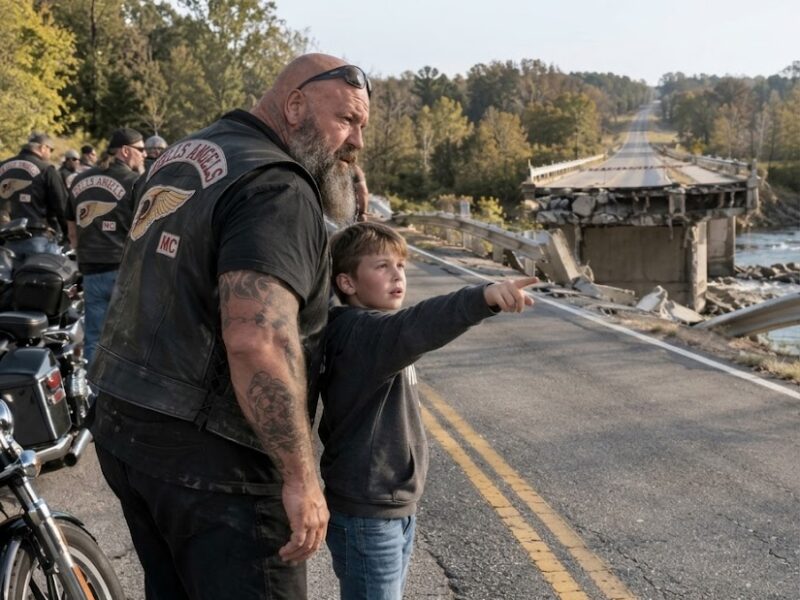
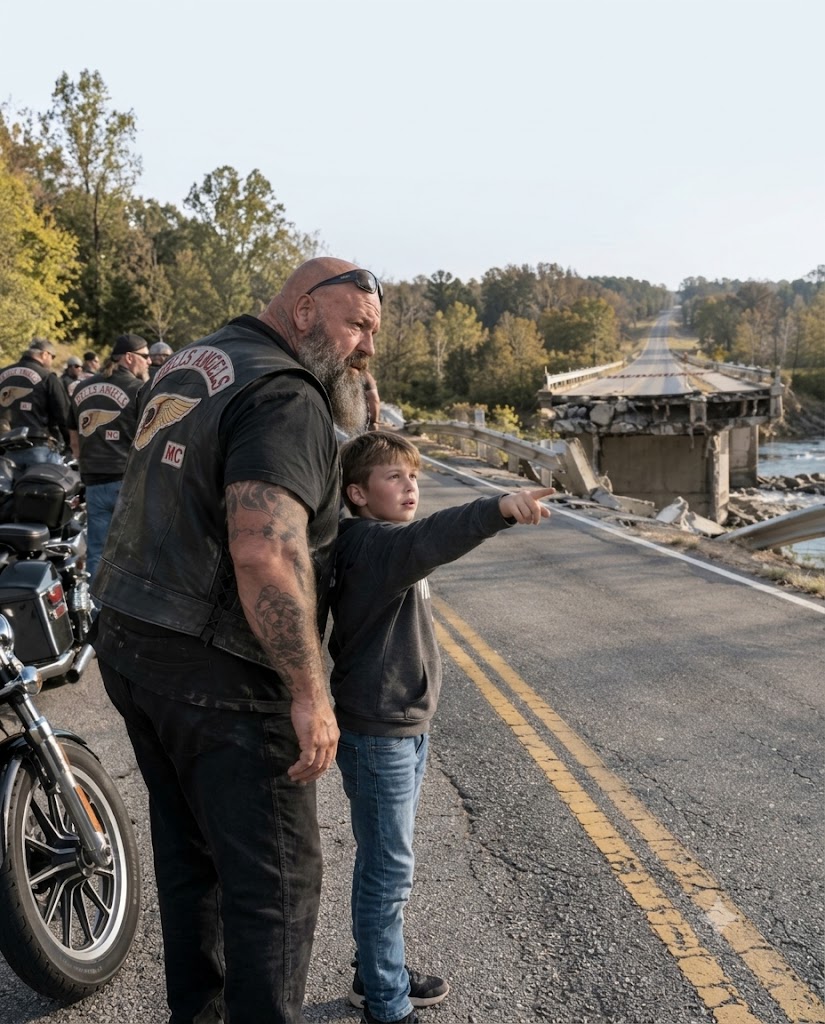
A boy stood in the middle of the road and stopped 200 bikers from crossing a bridge. They thought he was crazy—until they saw what was waiting on the other side.
Part 1
The morning broke cold and gray over the Copper River, mist sitting low on the water the way it did most October mornings in Milfield Hollow, Tennessee.
By 6:30, the fairgrounds parking lot had become a sea of chrome and leather, engines idling in low, rumbling clusters while riders checked tire pressure and traded the easy jokes of people who had done this eleven years running.
Roy Callahan stood at the front with a bullhorn, silver-bearded and barrel-chested, going over the sixty-mile loop one final time.
Nobody in that lot was thinking about a thirteen-year-old boy standing alone at the foot of Miller’s Crossing with a hand-painted sign and his grandfather’s spiral notebook tucked inside his jacket like something sacred.
But that boy had been thinking about them for five days straight, and he was not moving.
His name was Matthew Turner, and he had learned to read the Copper River the way other boys read comic books — carefully, page by page, never skipping ahead.
He was narrow-shouldered, with a habit of chewing the inside of his cheek when he was thinking hard, which was most of the time.
Every morning before school and every evening after his chores, he walked the quarter mile from his house on Larkpur Lane down to the old truss bridge at the edge of town.
The bridge was called Miller’s Crossing, though nobody remembered who Miller was anymore.
It had been built in 1958, a steel and concrete structure with two rusted green trusses arching overhead like the ribs of something long dead.
For as long as Matthew could remember, his grandfather, Henry Turner, had walked that same stretch of riverbank with him, pointing out things most people never noticed — the way water moved differently around a weakened pier, the particular color of rust that meant surface corrosion versus the color that meant the steel underneath was eating itself alive.
Henry had spent thirty-one years as a maintenance supervisor for the Tennessee Department of Transportation before he retired.
And in the two years before he died of a heart attack in his sleep, he had made it something like a mission to teach Matthew everything he knew about bridges, as if handing down a language only the two of them spoke.
“Most folks look at a bridge and see something finished,” Henry used to say, crouching by the water with his flashlight aimed up at the underside of a support beam.
“But a bridge is never finished. It’s always either getting stronger or getting weaker. Your job, if you want it, is to notice which.”
Matthew had wanted it.
He still walked the route every day, eight months after his grandfather’s funeral, half out of habit and half because it was the only place he still felt close to him.
Milfield Hollow was a town that ran on small rhythms — the Baptist church bell at eight, the diner opening at six, the volunteer fire department testing its siren on the first Saturday of the month.
But the biggest rhythm of the year, the one that turned the whole town inside out for two days every October, was the Ridge Riders Poker Run, a charity motorcycle ride that had started nineteen years earlier as a fundraiser for the Children’s Hospital in Knoxville.
Nearly two hundred riders came from four states, gathering at the fairgrounds before dawn and riding a sixty-mile loop through the hills, crossing Miller’s Crossing at the halfway point before climbing back toward town for a barbecue and an auction that last year had raised almost eighty thousand dollars.
Matthew’s mother, Jennifer Coleman, worked as a night shift nurse at the regional hospital and always took the Saturday of the ride off so she could set up the lemonade stand outside their church with the other volunteers.
She was proud of the event in the uncomplicated way people are proud of things that ask nothing of them and give something back.
“Best day of the year in this town,” she’d say. “Even your grandpa used to come down and watch them cross the bridge, remember? Said it was the only day two hundred grown men acted like kids at a parade.”
Three nights before the ride, a storm rolled through the hollow that the local news called a significant rain event — nearly five inches in six hours, enough to close two low-water crossings on the far side of the county and send the Copper River up nearly four feet above its normal level.
Matthew watched it from his bedroom window, listening to the wind pull at the shutters.
And the next morning, before school, he did what he always did.
He walked down to the bridge.
The water was still high and the color of coffee with too much milk in it, churning hard against the concrete piers.
Matthew stood on the bank the way his grandfather had taught him, not looking at the whole bridge at once, but breaking it into pieces — deck, trusses, piers, the joints where one piece met another.
And that was when he saw it.
At the base of the second pier from the north bank, right where the concrete met the waterline, there was a crack that hadn’t been there before the storm.
It ran diagonally, maybe eight inches long, and where it met the surface, a thin, dark stain was already bleeding outward into the wet concrete.
Not the orange-brown of ordinary rust, but a darker, wetter color that Henry had once described to him in exactly one sentence, delivered with more weight than Matthew had understood at the time.
“If you ever see that color coming out of a crack in a pier,” his grandfather had said, “you get somebody with authority down there before another vehicle crosses, because that’s the concrete telling you the steel inside it is already failing.”
Matthew stood there for a long time, his backpack still slung over one shoulder, school forgotten.
Two hundred motorcycles were going to cross that bridge in three days.
He didn’t know yet that almost nobody in Milfield Hollow was going to believe him.
He only knew, with a certainty that settled into his chest like a stone, that somebody had to.
Matthew told his mother first, over dinner that night, describing the crack and the dark stain and everything his grandfather had taught him about what it meant.
Jennifer listened, mostly because she always listened to her son, but he could see the polite distance in her eyes, the look of a tired adult humoring a child’s worry.
“Sweetheart, that bridge has been inspected. The county does it every year. I’m sure if there was something wrong, they’d have caught it.”
“Grandpa said sometimes storms open up cracks that weren’t there before the last inspection,” Matthew said.
“He said that’s exactly how bridges fail — not because nobody ever checked, but because something changed after the last time they checked.”
Jennifer reached over and squeezed his hand.
“I know you miss him. I know walking down there makes you feel close to him, but baby, you’re thirteen. You’re not a bridge inspector.”
It wasn’t unkind, but it landed like a door closing.
The next day, Matthew went to the source he thought would actually matter: Warren Buckley, the town’s part-time code enforcement officer, who also happened to serve on the county roads committee.
Buckley’s office was a single room above the hardware store, and he was buried under a stack of permit applications when Matthew knocked.
“A crack,” Buckley repeated, not unkindly, but with the exhausted patience of a man three weeks behind on paperwork.
“Son, that bridge gets a state inspection every two years, and county eyes on it every fall before the poker run on account of all the traffic. Last inspection was clean. I appreciate you keeping an eye out. I really do. Your granddaddy would be proud — he always did care about that bridge more than most. But I can’t shut down a county road on the say-so of — no offense — a description of a stain.”
“Can you at least go look at it?”
Buckley promised he would when he got a chance.
Matthew believed, correctly, that he would not get a chance before Saturday.
He tried the sheriff’s department next, catching Deputy Daniel Whitfield outside the diner on Thursday morning.
Whitfield was younger than most of the deputies, only twenty-nine, and at least listened all the way through before responding, which Matthew appreciated even as the answer disappointed him.
“Look, I hear you, and for what it’s worth, I don’t think you’re making it up. But I don’t have engineering authority over a bridge. That’s a state and county call. And if Buckley’s already looked at the inspection records and they’re clean, my hands are tied unless someone with the right credentials tells me otherwise.”
“Nobody with the right credentials has actually gone and looked at it since the storm,” Matthew said. “That’s the whole problem.”
Whitfield didn’t have an answer for that, and Matthew walked away with the distinct hollow feeling of being right and powerless at the same time.
By Friday afternoon, word had spread through the small machinery of a small town that the Turner boy was going around saying the bridge was going to collapse.
The reactions ranged from gentle amusement to mild irritation.
Roy Callahan, the president of the Ridge Riders Motorcycle Club and the man who had organized the poker run for the last eleven years, heard about it secondhand from one of the volunteers setting up registration tables at the fairgrounds.
“Kid’s probably just spooked from all that rain,” Roy said, not unkindly, waving off the comment as he checked routes on a laminated map.
“We ride that bridge every single year. It’s been standing since Eisenhower was president. It’ll outlive all of us.”
Roy Callahan was not a cruel man.
He had ridden motorcycles for thirty-eight years, had buried two friends to accidents on the road, and had raised through the Ridge Riders more money for sick kids than most charities in three counties combined.
But he had also organized this ride eleven times without incident, had a laminated route map that hadn’t changed in a decade, and two hundred riders arriving from as far as Ohio expecting a smooth, well-run event.
A thirteen-year-old’s warning, filtered through three other adults who’d already decided it wasn’t credible, did not register on his list of things to take seriously.
Matthew heard through his mother that Roy had laughed it off.
It stung more than he expected.
He went down to the bridge one more time that evening, alone, and stood at the edge of the water, watching the dark stain, which had spread another two inches since Tuesday.
The river had dropped some, but the crack was still there.
And now that the water had receded, he could see something new — a hairline fracture running up from the original crack into the underside of the pier cap itself, right where the beam met the concrete.
He took three photographs with his mother’s old phone, the one she’d given him for emergencies, but the light was failing and the pictures came out blurry, more suggestion than evidence.
He stood there a long time thinking about his grandfather, about the particular loneliness of being the only person who believed something true.
Two days left before two hundred motorcycles rolled across that pier.
Saturday was two days away.
Then it was one, and Matthew spent Friday night unable to sleep, replaying every conversation, wondering if he’d explained it wrong, if there was some magic combination of words that would have made Buckley or Whitfield or his own mother understand what he’d seen.
He pulled out the notebook his grandfather had left him — an old spiral-bound thing full of sketches of bridge trusses, notes on rebar corrosion, a whole private language of care — and read through it by flashlight until almost one in the morning, looking for anything that would sharpen his argument.
He found something.
On a page dated four years earlier, in Henry’s blocky handwriting, there was a note: Bridges rarely fail all at once.
They fail at a joint that’s already been compromised, under a load event that finally exceeds what the compromised joint can bear.
A hundred trucks can cross safely. The 101st crosses when the joint finally lets go, and it looks sudden, but it was never sudden.
It was years, and then it was a moment.
Matthew copied the passage onto a fresh sheet of paper, added his own description of the crack and the fracture line and the dark seepage, and the next morning — the Friday before the ride — he rode his bike the two miles to the county extension office, where he knew a retired civil engineer named Arthur Puit sometimes did consulting work for local farmers on drainage issues.
Puit was seventy-four, hard of hearing in one ear, and initially just as skeptical as everyone else had been, but he read Henry Turner’s notebook page twice, then asked to see Matthew’s blurry photographs, squinting hard at the phone screen.
“Turner,” Puit said slowly. “Henry Turner’s grandson.”
“Yes, sir. I worked with your grandfather for six years on the county roads crew before I went into private consulting. He was one of the only men I ever met in that department who actually understood concrete, not just steel.”
Puit set the phone down.
“I can’t tell you for certain what’s happening under that pier from a bad photograph, son, but I can tell you that if Henry Turner taught you to read that dark stain the way you just described it to me, I wouldn’t dismiss it. That specific coloration right at a crack site, right after a major rain event — that’s consistent with what we call efflorescence mixed with corrosion byproduct. It’s not proof, but it’s the kind of finding that ought to at least get a flashlight and a set of eyes on it before two hundred motorcycles cross.”
It was the first time in five days an adult had said his concern deserved to be checked rather than dismissed, and Matthew felt something in his chest loosen slightly, only to tighten again when Puit admitted he no longer had any official standing with the county and couldn’t order an inspection himself.
“Best I can do is write you a short note explaining what I just told you. Whether anyone reads it before tomorrow morning is out of my hands.”
Matthew took the note.
He tried Buckley’s office again that afternoon and found it locked, a handwritten sign reading, “Gone to help set up the fairgrounds. Back Monday.”
He tried Whitfield, who read Puit’s note with more attention this time, but explained honestly, and with something like regret in his voice, that without Buckley or a state inspector physically confirming a hazard, he had no legal authority to close a county road the night before its single largest annual event — especially not on a note from a man with no current official title.
“I believe you’re on to something,” Whitfield said. “I just don’t have the power to act on a belief. I need a finding, and there’s nobody left tonight who can give me one.”
That night, lying in bed, Matthew thought seriously for the first time about whether he was wrong.
Maybe grief had made him see danger where there wasn’t any.
Maybe he wanted some buried part of him to matter the way his grandfather had mattered, to be the boy who noticed what nobody else noticed, and maybe that wanting had colored what he actually saw at the river.
He almost talked himself out of it twice before he got up, turned on his lamp, and reread his grandfather’s notebook one more time.
It was years, and then it was a moment.
He set his alarm for 4:45 in the morning, two hours before the riders were scheduled to gather, and lay awake most of the night anyway, listening to the wind, thinking about the word moment, and wondering if tomorrow was going to be his.
Part 2
Matthew got to the bridge at 5:15, having walked the two miles in the dark with his bike because he was afraid the sound of pedaling on gravel would wake his mother.
He had brought two things: a piece of plywood he’d found in the garage, on which he’d painted in red letters still slightly wet, BRIDGE UNSAFE — DO NOT CROSS, and his grandfather’s notebook tucked inside his jacket like something sacred.
He stood in the middle of the road on the near side of Miller’s Crossing, sign propped against his legs, and waited.
The lead riders came into view a little after seven, engines echoing off the hillsides before he could see them, and Matthew felt his heartbeat climb into his throat as the first cluster of motorcycles rounded the bend.
Six, then twenty, then what looked like the whole world in leather jackets and reflective vests, red taillights strung out behind them like a slow-moving constellation.
He picked up the sign, walked to the exact center of the road at the foot of the bridge, and stood there.
The lead rider braked, boots skidding slightly on the wet asphalt, and behind him the whole column concertinaed to a stop in a rolling wave of engine noise, shouted questions passing backward down the line.
Roy Callahan, riding near the front, pulled his bike out of formation and rode up alongside the stopped column until he reached the boy standing in the road holding a hand-painted sign.
“Matthew Turner,” Roy said, recognizing him now, killing his engine and swinging off the bike with the particular heaviness of a big man moving fast.
“Son, you cannot be standing in the middle of a county road with two hundred motorcycles bearing down on you. Get off the road now.”
“I can’t let you cross,” Matthew said.
His voice came out steadier than he expected.
“There’s a crack at the base of the second pier. It opened up after the storm. There’s dark staining coming out of it, and last night I found a fracture running up into the pier cap. I think the load-bearing capacity is compromised. And I think two hundred motorcycles crossing at once is enough weight over enough time to be the load that finally breaks it.”
Behind Roy, engines were cutting off one by one as riders realized this wasn’t a quick pause, murmurs rippling backward through the line.
What’s going on? Some kid — a bridge thing. Hold up.
And Roy felt the particular pressure of two hundred people watching him decide something in real time.
“Kid, I heard about this Wednesday. The county inspected that bridge. It’s fine.”
“The county inspected it before the storm,” Matthew said. “Nobody’s looked at it since. I have a note from Arthur Puit. He used to work the roads crew with my grandfather. He said the staining is consistent with corrosion and it needs eyes on it before anything heavy crosses.”
“And where is Mr. Puit now? He doesn’t have authority to close the road anymore. I know how that sounds. I know I’m thirteen, but I’m not asking you to believe me because I’m smart. I’m asking you to send one person down to the water to look, because it’ll take five minutes, and if I’m wrong, you lose five minutes. And if I’m right—”
He didn’t finish the sentence.
He didn’t need to.
A voice cut through the tension from somewhere in the crowd of riders that had begun gathering closer, dismounting, curious.
“Roy, let me take a look.”
The speaker was an older man, maybe sixty, gray ponytail beneath his helmet, wearing a vest patched with decades of ride badges.
His name was Sal Bruno, a retired iron worker from Ohio who had been riding with the Ridge Riders for eight years and who, unlike most of the club, had spent thirty years actually building the kinds of structures Matthew was describing.
Roy hesitated a beat, then nodded.
“Five minutes.”
Sal climbed down the embankment with two other riders, flashlights out, and Matthew watched from the road, sign still gripped in both hands, as the beams swept along the underside of the bridge.
He heard Sal call something up that he couldn’t make out, and then watched Roy Callahan’s face change as he half climbed down the slope himself to see it directly.
The crack, wider now than it had been even the night before.
The dark stain, spread nearly a foot along the pier.
And a fresh pale fracture line, newly visible in the morning light, running clean up into the underside of the deck itself.
And then, as if the bridge had been waiting for an audience, a chunk of concrete no bigger than a dinner plate broke free from the edge of the crack and dropped into the river with a sound like a slap.
Nobody spoke for a long moment.
Two hundred riders stood in the gray morning light, engines silent, looking at a bridge they had crossed without a second thought eleven years running — and at a thirteen-year-old boy who had spent five days trying to make them look at it once.
Roy Callahan climbed back up the embankment slower than he’d gone down it.
He walked over to where Matthew was still standing, plywood sign now lowered to his side, and for a moment neither of them said anything.
“How long have you known?” Roy asked finally.
“Since Tuesday morning after the storm.”
“And you’ve spent five days trying to get somebody — anybody — to listen to you?”
Matthew nodded.
Roy took off his sunglasses, rubbed a broad hand across his face, and turned to address the riders, most of whom had gathered close enough to hear, engines silent.
The only sound was the river moving below them and, somewhere down the line, a hawk calling.
“Change of plans,” Roy called out, his voice rough.
“We’re rerouting to Route 12 and picking up the loop from the far side. It’s an extra eleven miles. And every single one of you is going to thank this young man on your way past, because he just did something none of us managed to do in eleven years of running this ride.”
He paused.
“He actually looked.”
The rerouted ride took an extra forty minutes and, if anything, generated more conversation and more donations than any previous year, as word of what had happened at Miller’s Crossing spread rider to rider down the line before they’d even reached the halfway mark.
County crews closed the bridge within the hour, and a state inspection the following Tuesday confirmed what Sal Bruno’s flashlight had already shown in the gray morning light — a compromised pier, a fracture that engineers determined had likely been building for months and had finally opened after the storm’s added hydraulic pressure, and a genuine risk that any heavy sustained load crossing that week could have caused a partial structural failure.
Warren Buckley apologized to Matthew in person, awkwardly, the following week, admitting he should have made the time to go look himself instead of waiting on the schedule.
Deputy Whitfield stopped by the Turner house to say, with more warmth than Matthew expected, that he’d learned something about the difference between authority and correctness and that he intended to remember it.
Arthur Puit sent a short note that just read: “Your grandfather would be proud. So am I.”
But it was Roy Callahan who came back two weeks later, on a quiet Saturday afternoon, and knocked on the Turner family’s front door.
He wasn’t wearing his club vest this time, just a plain jacket, and he was carrying something wrapped in brown paper.
“The club voted,” Roy said when Jennifer invited him in and Matthew came down from his room, still a little unsure why the president of the Ridge Riders was sitting at their kitchen table.
“We do a scholarship every year, goes to a kid in the county doing something that matters. This year it’s yours, if you want it — for whatever you want to study, engineering or otherwise. And we’re naming the bridge fund after your grandfather. County’s rebuilding that pier this spring. And there’s going to be a plaque. Henry Turner Memorial Crossing.”
Matthew didn’t say anything for a moment, throat tight in a way that had nothing to do with fear this time.
“I should have listened to you the first day,” Roy added, quieter now.
“Not because you’re some kind of expert — because you were careful and specific, and you didn’t back down even when every adult in this town told you that you should. That’s not a kid thing or an adult thing. That’s just character. And I was too set in eleven years of doing things the same way to see it.”
Part 3
The following spring, when Miller’s Crossing reopened with its reinforced pier and a small bronze plaque at the north end, the Ridge Riders rode across it for the first time as part of a smaller, quieter ceremony, engines idling low instead of roaring out of respect for the moment.
Roy Callahan asked Matthew, now fourteen, to ride across on the back of his motorcycle, first in line, ahead of the other 199.
Matthew held onto the older man’s jacket as they crossed the new concrete, the Copper River running clear and ordinary beneath them, and thought about his grandfather’s notebook still sitting on his desk at home — the sketches of trusses, the notes on rebar corrosion, the whole private language of care that had turned out to be a public language after all.
He thought about the particular kind of courage that has nothing to do with volume and everything to do with refusing to stop being right just because nobody wants to hear it yet.
He thought about the dark stain that had bled out of a crack for days while every adult in town told him to go home, and about the five minutes that had changed everything.
Some bridges, he understood now, take years to fail.
And some take exactly one boy standing in the road at dawn to save.
The plaque at the north end was small and unassuming, the way Henry Turner would have wanted it.
It read, simply: HENRY TURNER MEMORIAL CROSSING — BUILT 1958, REBUILT 2024. IN HONOR OF A MAN WHO TAUGHT OTHERS TO NOTICE.
Matthew visited it every morning before school, the way he used to walk the riverbank with his grandfather, and he always paused at the same spot on the bank where he had first seen the crack.
He kept the plywood sign in his garage, the red letters faded now, the edges warped from rain.
Sometimes the younger kids in Milfield Hollow asked him about it, and he told them the truth — that a bridge is never finished, that it’s always either getting stronger or getting weaker, and that their job, if they wanted it, was to notice which.
He told them about his grandfather’s notebook and the sentence that had stayed with him through the worst of it: it was years, and then it was a moment.
And he told them that being right and being believed were two different things, and that the space between them was where courage lived.
The Ridge Riders still rode through Milfield Hollow every October, and every year they took the Route 12 loop instead of the crossing, out of habit and out of respect.
Every year, Roy Callahan stopped at the Turner house and shook Matthew’s hand, and every year he said the same thing: “You saved us all, kid. Don’t ever let anybody tell you that a kid can’t.”
And every year, Matthew said the same thing back: “I just noticed. My grandpa taught me how.”
The scholarship money went into a savings account with Matthew’s name on it, and he used part of it to buy a used laptop and a set of engineering textbooks that arrived in a box so heavy he had to drag it up the stairs one step at a time.
He read them the way he had read the river — carefully, page by page, never skipping ahead — and he understood, finally and completely, that his grandfather had not just taught him about bridges.
He had taught him how to pay attention in a world that was always in a hurry, how to stand in the road at dawn with a hand-painted sign and refuse to move, and how to be the boy who noticed what nobody else noticed, even when nobody wanted to hear it yet.
Some bridges take years to fail.
Some take exactly one boy standing in the road at dawn to save.
And some, Matthew learned, are saved twice — once when a thirteen-year-old refuses to go home, and once when a whole town finally looks at what he saw, and decides to be the kind of place that listens the next time.









