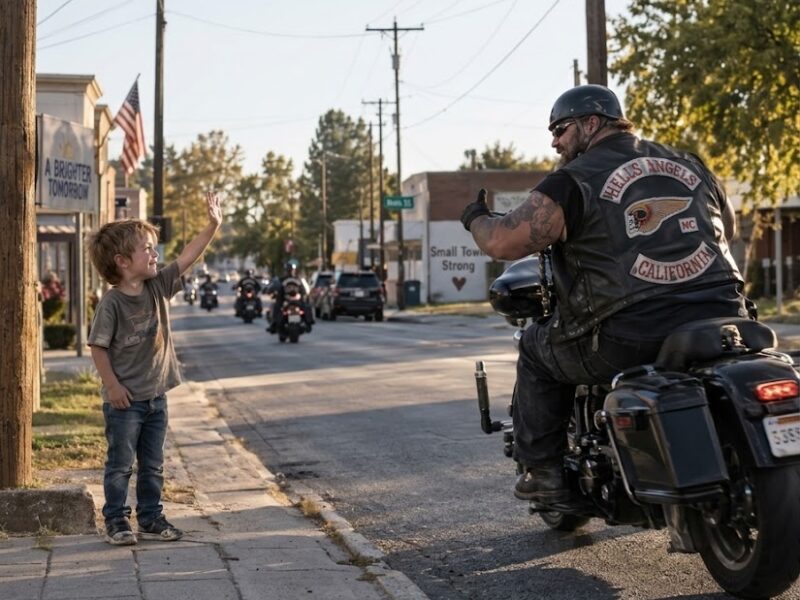
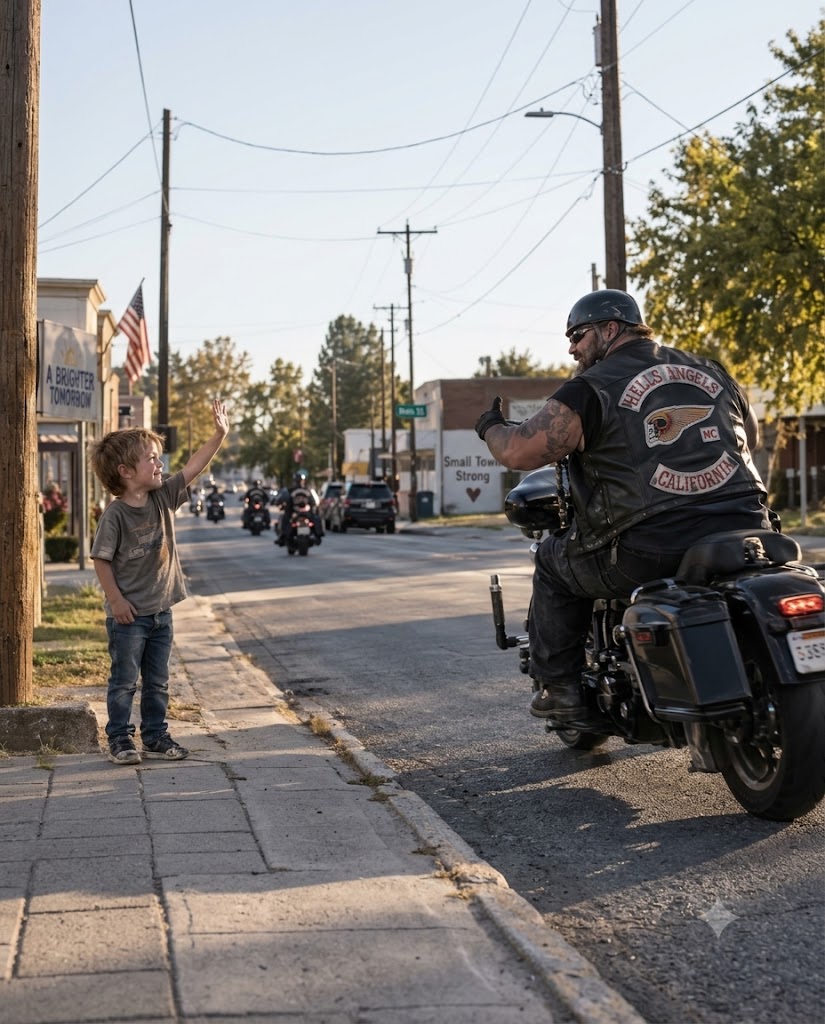
A boy stood at the same corner every single day. No one knew why. No one asked. Until one biker finally stopped and said four words: “What are you waiting for?”
Part 1
Every morning at 7:40, a nine-year-old boy stood alone on the same street corner in Youngstown, Ohio, staring down an empty road like his whole life depended on who might turn onto it.
No bus stop. No parent waiting beside him. Just a boy in a thin gray hoodie freezing in the wind off the Mahoning River, refusing to move.
I rode past him for weeks before I finally stopped.
What I didn’t know yet was that this corner wasn’t about hope. It was about escape.
Behind a small blue door two streets away, something was happening that no child should have to survive alone.
And once I saw the bruise on his wrist, there was no going back to minding my own business.
Some doors, once you knock on them, change everything on both sides.
The corner of Fifth Street and Elm had never meant anything to Cole Whitfield until the boy started showing up.
It was late September in Youngstown, Ohio, and the mornings had taken on that particular Midwestern chill that crawled under a leather jacket no matter how tight you zipped it.
Cole rode his Harley-Davidson Road King down Fifth Street every weekday at 7:40 a.m. on his way to the machine shop where he’d worked for the last eleven years, ever since the steel mill that used to run this town had closed its doors for good.
He knew every crack in the asphalt, every stop sign, every pothole that could rattle a man’s teeth if he wasn’t paying attention.
He did not know at first that he would come to know a nine-year-old boy named Nathan Bracken better than he knew some of his own relatives.
The first time Cole noticed him, it was raining.
Nathan stood at the corner in a thin gray hoodie, backpack slung over one shoulder, staring down the street like he was waiting for a bus that never came.
Cole didn’t think much of it. Kids waited for buses. That was normal.
But the second time and the third and every morning after that, the boy was there, rain or shine, cold or colder, standing in the exact same spot three feet from the stop sign, looking down Elm Street toward the row of duplexes that lined the block.
He never got on a bus. There was no bus stop sign at that corner at all.
By the second week of October, Cole had started slowing his bike down without meaning to.
He told himself it was nothing. Kids were strange sometimes.
Maybe the boy was waiting for a friend or a ride to school that was running late.
But something about the stillness of him, the way he stood with his arms crossed over his thin frame, the way his eyes tracked every car that passed like he was hoping and dreading at the same time, stuck in Cole’s chest like a splinter he couldn’t work loose.
Cole was thirty-eight years old, a man built from hard work and harder years.
He’d been divorced for six years, no kids of his own, and he’d made peace with the quiet, uncomplicated shape his life had settled into.
He worked, he rode, he drank coffee alone at the diner on Federal Street on Saturday mornings, and he didn’t go looking for trouble.
But trouble, it seemed, had a way of finding a man who paid too much attention to the world around him.
One morning, when the frost had turned the grass along Elm Street a pale, crunching white, Cole finally pulled his bike to the curb.
He killed the engine and sat there for a moment, watching the boy watch the street.
“Hey.” Cole called out, keeping his voice easy, the way you’d talk to a spooked dog. “You waiting on somebody?”
The boy startled, then went very still, the way kids do when a stranger speaks to them and they’ve been taught, carefully, deliberately, not to answer.
Cole recognized that stillness. He’d seen it in men who’d done time, men who’d learned that saying the wrong thing to the wrong person could cost you.
“I’m not going to bother you,” Cole said. “I just ride by here every morning. Seen you standing here a lot.”
The boy’s eyes flicked to the motorcycle, then back to Cole’s face, cataloging him.
The beard, the leather vest with the patches from the Steel Valley Riders Club, the tattoos crawling up one forearm.
Cole understood. He looked like exactly what he was, a rough man on a loud machine, not the kind of person a careful kid was supposed to talk to.
“I’m fine,” the boy said finally, quietly.
“All right.” Cole didn’t push. He’d learned a long time ago that pushing people, especially scared ones, only made them run faster in the wrong direction. “Name’s Cole. I’ll see you around, maybe.”
He rode off, and in his mirror, he watched the boy’s eyes follow him all the way down the block.
That night, Cole couldn’t stop thinking about it.
He mentioned it almost as a joke to his friend Derek Ashby at the clubhouse where the Steel Valley Riders gathered on Thursday nights to work on bikes and drink beer that was, by unspoken rule, never more than two per man on a work night.
“Kid’s probably just weird,” Derek said, wiping grease off his hands with a rag. “Kids are weird.”
“Maybe,” Cole said, but he didn’t believe it, not really.
He’d spent enough years watching men lie to know what a lie sounded like, and he’d spent enough years watching scared people to know what fear looked like on a face too young to have learned to hide it well.
And that boy, Nathan, he’d later learn, was scared of something.
Cole just didn’t know what yet.
The next morning, he slowed down again, and the morning after that.
By the end of the week, he’d started parking his bike a block away and waiting out of sight, just to see who or what the boy was really watching for.
Nobody ever came.
Nathan stood there every single morning, sometimes for twenty minutes, sometimes for closer to forty, before he’d finally turn and walk back down Elm Street toward a small duplex with peeling blue paint and a chain-link fence with a broken gate.
Then he’d disappear inside, and a few minutes later a school bus, a different one from a different corner, would rumble past three streets over, the one Nathan should have been catching.
He was skipping his real bus every day to stand on a corner and wait for someone who never showed.
Cole didn’t know yet what that meant, but he knew, with the same instinct that had once told him not to trust a man’s smile in a bar fight, that something in that quiet blue duplex was wrong.
It took Cole almost three weeks to learn the boy’s name, and he only managed it because he started showing up not on his motorcycle, but on foot, dressed down in a plain jacket instead of his cut, sitting on the bench outside the corner store like a man just enjoying his coffee.
“Nathan,” the boy said when Cole asked again, softer this time. “Nathan Bracken.”
“Cole Whitfield.” He didn’t offer a hand. Kids that skittish didn’t need to be touched by strangers.
“You go to Harding Elementary?”
Nathan nodded, eyes still fixed down Elm Street.
“That’s a good three streets from here. Your bus stop for Harding’s over on Youngstown Avenue, isn’t it?”
The boy’s shoulders tensed. “How do you know that?”
“I got a niece goes there,” Cole lied smoothly. He didn’t, but the lie bought him a foothold. “So, what’s out here that’s worth missing your bus for?”
Nathan didn’t answer for a long time. Long enough that Cole almost gave up and let the silence stand.
Then in a voice so small it nearly disappeared into the wind, the boy said, “My dad said he’d come get me. Said if I waited right here every day, one day he would.”
Something in Cole’s chest went tight and cold.
“Your dad doesn’t live with you.”
“He used to.” Nathan pulled his backpack straps tighter over his shoulders, a nervous self-soothing motion Cole recognized from men in recovery meetings, from guys trying to hold themselves together with their own two arms.
“Before the accident.”
“Before Gary.”
“Who’s Gary?”
Nathan’s face changed then, shut down the way a door closes when a draft comes through. “Nobody. I got to go.”
He turned and walked quickly back toward Elm Street, faster than Cole had ever seen him move, and Cole let him go because chasing a scared kid down a street was the surest way to make sure he never spoke to you again.
But he had two names now. Gary and an accident.
That night Cole did something he hadn’t done in years. He asked around.
He knew a woman named Rachel Doyle who worked the front desk at the county courthouse.
Someone he’d helped once with a flat tire on Market Street and who owed him in the small-town way people keep tabs on debts of kindness, a favor.
He called her Friday afternoon.
“Bracken,” Rachel said after a pause on the line long enough that Cole knew she was already looking something up before he’d even finished asking.
“There was a custody case about two years back. Father, Marcus Bracken, lost custody after a DUI accident. Kid was in the car, nobody hurt bad, thank God, but the state took him out of the home for a stretch. Mother remarried since then. Guy named Gary Voss.”
Cole’s stomach dropped an inch.
“You got anything on this Voss?”
“Nothing official,” Rachel said carefully, “but Cole, if you’re thinking about getting involved in a family thing, you know that’s a minefield. CPS doesn’t move on nothing. You’d need something solid.”
“I know,” Cole said, though in truth he didn’t know anything of the kind. He’d never navigated a system like that in his life.
He fixed engines. He rode bikes. He drank his two beers on Thursdays and minded his business.
Mostly because minding your business was how a man like him stayed out of trouble in a town that had learned to distrust bikers on principle.
But there was a boy standing on a corner every morning waiting for a father who Cole was beginning to understand might never come.
While something happened behind that blue duplex’s door that made a nine-year-old’s whole body go rigid at the mention of one word. Gary.
He started watching the house more carefully after that.
Not obsessively. He wasn’t a fool and he didn’t want to end up looking like a threat himself, a grown man loitering near a child’s home. But enough.
He noticed the way Nathan flinched when a door slammed somewhere down the block.
He noticed the long sleeves the boy wore even when the October sun was strong enough to warm bare skin.
He noticed that Nathan’s mother, a thin, tired-looking woman named Hannah, rarely left the house before dark and when she did, she moved like someone carrying an invisible weight on her spine.
One morning, Cole caught Nathan again at the corner. This time in a light rain that had started without warning.
“You’re going to catch a cold standing out here.” Cole said, pulling his bike alongside the curb.
“I don’t got a coat that fits right.” Nathan admitted, shivering slightly. “Gary said the other one made me look like a bum.”
Cole kept his face still, though something inside him wanted very badly to put his fist through something. “That’s right.”
“He’s not so bad.” Nathan added quickly, the way kids do when they’ve learned to defend the person who scares them because the alternative, admitting the truth, is more frightening than the fear itself. “He just gets mad sometimes. Mom says it’s cuz of his job.”
“What’s his job?”
“He don’t got one right now.”
Cole nodded slowly, filing it away. A man with no job and a short temper living with a woman and her nine-year-old son from a previous marriage.
It was a story Cole had heard before in different houses with different names, and it rarely ended in a place anybody wanted to visit.
“Listen,” Cole said, “You keep waiting here for your dad?”
Nathan’s chin trembled just slightly. “He said he would come. He promised.”
“When did he promise that?”
“Before he went away.”
“Before the—”
Nathan stopped himself, the word accident dying in his throat.
Cole understood then with a clarity that settled into his bones like cold water that this boy was standing on a corner every single morning, not because he believed his father was coming, not really, but because believing it was the only thing keeping him from having to go straight home to whatever waited for him behind that blue door.
November came in hard and gray, and so did the first real crack in the quiet Cole had been keeping about the whole situation.
He’d started giving Nathan rides, not on the motorcycle, which would have drawn too much attention and probably would have made Hannah Bracken suspicious in all the wrong ways, but in his old pickup truck.
On the mornings the rain turned to something colder, he’d wait a block down and if Nathan wanted the ride, he’d wave and if he didn’t, Cole would drive on without a word.
It became, without either of them naming it, an arrangement built on trust that neither one fully understood yet.
It was during one of those rides that Cole saw the bruise.
Nathan was reaching for his seatbelt when his sleeve rolled up and there it was, a dark yellowing mark circling his wrist like a bracelet made of pain.
Days old, the kind of bruise that comes from a hand gripping too hard, too fast in anger.
“Nathan.” Cole’s voice came out rougher than he meant it to. “What happened to your wrist?”
The boy yanked his sleeve down so fast he nearly dropped his backpack. “Nothing. I fell.”
“Nathan.”
“I fell,” the boy repeated louder. His voice cracking with the particular desperation of a child begging an adult to accept a lie because the truth is too heavy to carry into the light.
“Please don’t— Please don’t say anything.” He said if anybody found out he’d—”
He stopped himself again and this time the silence that followed was worse than anything he could have said.
Cole pulled the truck over to the curb three blocks from the school and put it in park.
He didn’t reach for the boy. He didn’t raise his voice. He just sat there, hands on the wheel, and let the quiet stretch until it felt safe enough for Nathan to breathe in it.
“I’m not going to make you say anything you don’t want to say,” Cole said finally. “But I need you to hear me. Whatever’s happening in that house, it’s not your fault, and you don’t have to carry it by yourself anymore.”
Nathan’s eyes filled, and for the first time since Cole had met him, the boy allowed himself, for just a moment, to look like exactly what he was, a frightened child who had been holding himself together with nothing but hope and habit.
“He grabbed me,” Nathan whispered, “because I spilled juice on his boots. He said it was an accident, that he didn’t mean to grab so hard, but Mom cried after, and she told me not to tell nobody, cuz if the state people came again, they might take me away, and she said I was all she had left.”
Cole felt something in his chest crack open.
Not rage, exactly, though there was plenty of that, too, but something closer to grief.
Grief for a boy who had learned to protect the very people who were supposed to be protecting him.
Grief for a mother so frightened of losing her son that she’d chosen silence over safety.
He understood it in a distant way. He’d grown up around families that operated on the same broken logic, where the fear of the system felt bigger than the fear of the man in the house, but understanding it didn’t make it easier to sit with.
“I’m going to help you,” Cole said, “but I need you to trust me a little longer. Can you do that?”
Nathan nodded, wiping his face with his sleeve, careful not to touch the bruised wrist.
That afternoon, Cole drove straight to the county services office and sat in the parking lot for twenty minutes before he found the nerve to go inside.
He’d never in his life walked into a government building to report anything.
His whole upbringing had trained him toward a deep, reflexive distrust of institutions, but he thought of the boy on the corner waiting every morning for a rescue that never came, and he walked through the doors anyway.
The case worker who met with him, a woman named Lauren Whitaker, listened carefully, but was, as Rachel had warned him, cautious.
“A bruise alone isn’t always enough to open an emergency case,” she explained, “but a pattern, repeated marks, a documented history, corroborating witnesses, that’s different. Has anyone else seen anything?”
Cole thought of the teachers at Harding Elementary, of neighbors who might have noticed something, of anyone who might be willing to speak up in a town where people had learned, for their own survival, to look away from things that weren’t their business.
“I don’t know yet,” Cole admitted, “but I’m going to find out.”
He left the office that day with a case number and a business card, and for the first time since this whole thing started, he felt something other than helpless anger.
He felt purpose.
It took two more weeks of careful, quiet work before things came to a head.
Two weeks of Cole talking to Nathan’s third-grade teacher, a soft-spoken woman named Kayla Pierce, who admitted, with visible guilt, that she’d noticed Nathan flinching at loud noises and wearing long sleeves in warm weather, but hadn’t known how to raise it without solid proof.
Two weeks of a neighbor, an elderly man named Bradley Coates, who lived two doors down from the Brackens, admitting he’d heard shouting some nights, the kind that makes you turn your TV up so you don’t have to listen.
Two weeks of Cole building, piece by piece, exactly the kind of pattern Lauren Whitaker had told him the system needed.
Then, on a cold Tuesday morning in late November, everything broke open at once.
Cole was two blocks from the corner when he saw Nathan running, not walking, running down the middle of Elm Street.
No backpack, no jacket, his breath coming out in ragged white clouds in the freezing air.
Cole slammed the truck into park in the middle of the road and was out the door before the engine had even settled.
“Nathan!”
The boy collided into him sobbing, words tumbling out too fast to fully catch.
Something about his mother. Something about Gary and a bottle he’d found in the kitchen empty and the shouting that had started before Nathan had even finished his cereal.
And how this time, this time Gary hadn’t just grabbed his wrist.
“Where’s your mom now?” Cole asked, crouching to the boy’s level, hands steady on his shoulders even as his own heart hammered against his ribs.
“She’s still there. He wouldn’t let her leave. I climbed out my window.”
Cole didn’t hesitate.
He called 911 with one hand while pulling Nathan into the truck with the other, giving the dispatcher the address in a voice far calmer than he felt because he understood, with the clarity of a man who had, in his younger years, been on both sides of doors the police had knocked on, that panic would only slow everything down.
The police arrived within eight minutes.
Cole stood with Nathan on the sidewalk across the street, one hand resting on the boy’s shoulder, watching two officers approach the blue duplex with the peeling paint and the broken gate.
He heard raised voices from inside. He heard a door. He heard, finally, the particular metallic finality of handcuffs, and a few minutes later, Gary Voss was led out of the house, red-faced and shouting obscenities that the officers ignored with practiced patience.
Then Hannah Bracken came out, wrapped in a blanket one of the officers had given her, a fresh cut above her eyebrow that she kept touching like she couldn’t quite believe it was real.
She saw Nathan across the street and broke into a run, and the two of them collapsed into each other on the sidewalk, mother and son, both of them crying in a way that seemed to release something that had been building for years.
Cole stood back, giving them the space, but Hannah looked up at him over her son’s shoulder, and in her eyes he saw something complicated.
Gratitude, yes, but also shame and grief for the years she’d spent believing silence was the safer choice.
“He told you,” she said, not quite a question.
“He didn’t have to tell me everything,” Cole said. “I just kept my eyes open.”
A caseworker arrived not long after, Lauren Whitaker herself, moving quickly, already documenting the scene with the practiced efficiency of someone who had done this too many times to count, but never let it become routine.
She spoke gently to Hannah, explaining the process ahead.
An emergency protective order, a temporary separation, resources for both her and Nathan, a path forward that didn’t have to include the man now sitting in the back of a patrol car.
“You don’t have to do this alone anymore,” Lauren told her.
Hannah nodded, still holding tight to her son, and for the first time in longer than she could remember, she let herself believe it might be true.
Three months later, on a cold but clear morning in February, Cole rode his Harley down Fifth Street the way he had for eleven years, and for the first time in what felt like a long while, there was no boy standing alone at the corner of Fifth and Elm.
Instead, Nathan was waiting outside a different house now, a small rental two streets over, one Hannah had moved into with the help of a domestic violence support program Lauren had connected her with.
And he wasn’t waiting alone.
He stood beside his mother, backpack properly fitted over both shoulders, a real winter coat zipped up to his chin, watching for the yellow bus that would take him to school the normal way, the way kids were supposed to.
Cole slowed his bike anyway, the way he always did now, and Nathan’s face broke into a grin the moment he spotted him.
“Cole!” the boy called, waving with the unrestrained enthusiasm only children seem capable of. “Guess what? I got a B+ on my math test.”
“That’s real good, kid.” Cole pulled over, letting the engine idle. “Told you those fractions weren’t so bad.”
Hannah gave Cole a small, warm smile, the kind that had taken months to return to her face, but had finally, gradually become familiar there again.
Gary Voss had pleaded guilty to charges of domestic assault and child endangerment, and was serving time upstate.
Hannah had begun rebuilding slowly, with the help of a support group Lauren had introduced her to, a room full of other women learning together that silence had never been the safety it pretended to be.
Cole visited when he could, not as a savior, he was careful never to let himself think of it that way, but as something more ordinary, and in its own way more meaningful, a steady presence, a man who had noticed a boy at a corner and refused to look away.
“You still waiting for your dad?” Cole asked once gently, a few weeks after everything had settled.
Nathan considered the question with the seriousness only children give to things that matter deeply.
“No,” he said finally. “I think I was just waiting for somebody, anybody, and you came instead.”
Marcus Bracken, Nathan’s biological father, had reached out through a family court mediator not long after the incident, expressing a genuine, if long overdue, desire to reconnect, slowly, supervised, on Nathan’s terms and timeline, guided by professionals who understood how carefully a child’s trust needed to be rebuilt once it had been broken.
Nathan wasn’t ready yet to say whether he wanted that relationship back, but he wasn’t standing on corners waiting for it anymore, either.
He’d learned, in the hardest way a nine-year-old could learn anything, that some promises take time to become real, and that in the meantime, it was all right to let other people show up instead.
Cole thought about all of it as he rode home that February evening, past the corner of Fifth and Elm, now just an ordinary intersection again, empty in the way ordinary things are empty.
Not with absence, but with the quiet relief of nothing being wrong anymore.
He’d spent eleven years riding this same street without ever truly seeing it.
It had taken one boy standing still while the whole world moved around him to remind Cole that sometimes the bravest thing a person could do wasn’t to look away from what made them uncomfortable, but to slow down, park the bike, and ask one simple question.
“Are you waiting for somebody?”
Sometimes the answer changed everything.
Part 2
The weeks after the arrest didn’t feel like victory.
They felt like the quiet after a storm, when the air is still charged and nobody quite trusts the silence yet.
Cole kept riding to work, kept drinking his coffee at the diner on Federal Street, kept showing up at the clubhouse on Thursday nights, but something in him had shifted, tilted on its axis.
He found himself noticing things he’d never noticed before.
The way a mother held her child’s hand a little too tight in the grocery store parking lot.
The way a kid at the gas station flinched when his father raised his voice about the price of diesel.
The way silence in a house could be louder than any shout.
Derek noticed the change before anyone else did.
“You’re different,” Derek said one Thursday, passing Cole a wrench. “Since when do you care about anything but bikes and beer?”
Cole turned the wrench over in his hands. “Since I saw something I couldn’t unsee.”
“That kid?”
“Yeah.”
Derek didn’t push. That was the thing about men who’d ridden together for years. They knew when to let a silence breathe.
But Derek did something else. He started asking around, quietly, the way bikers do when they want to know something without making it official.
And what he found made Cole’s stomach turn.
Gary Voss had a record. Not a big one, not the kind that made headlines, but a pattern.
A disorderly conduct charge in Akron when he was twenty-three.
A domestic disturbance call in Canton when he was twenty-eight, no charges filed, the girlfriend at the time refusing to press.
A restraining order from a former coworker who’d accused him of threatening her after she reported him for stealing from the register.
Small things. Things that got overlooked. Things that added up to a man who had been sliding under the radar for years, leaving a trail of fear behind him like breadcrumbs nobody wanted to follow.
Cole sat with that information for a long time.
He thought about all the mornings Nathan had stood on that corner, waiting for a father who wasn’t coming, while a man with a history of violence slept two streets away.
He thought about Hannah, who had married Gary Voss believing he was something different, something better, and had spent two years learning the truth one bruise at a time.
And he thought about how close it had come to ending differently. How close Nathan had come to being another statistic, another name in a file, another kid who slipped through the cracks because nobody wanted to get involved.
The case against Gary Voss moved slower than Cole expected.
He’d thought, naively, that once the police were involved, once the handcuffs clicked, everything would resolve itself.
But the legal system had its own rhythm, its own weight, its own way of dragging things out until the people involved felt like they were drowning in paperwork.
There was a preliminary hearing, then a continuance, then another.
Hannah had to tell her story to a prosecutor, then to a victim’s advocate, then to a judge.
Each time, she had to relive it. Each time, she had to explain why she’d stayed, why she hadn’t left sooner, why she’d believed, for so long, that silence was the only way to keep her son safe.
Cole drove her to two of those hearings.
He sat in the hallway outside the courtroom, drinking bad coffee from a vending machine, watching the parade of people who moved through those doors.
Other women with the same haunted look. Other children with the same guarded eyes.
He understood, then, that Nathan and Hannah weren’t exceptions. They were part of a pattern so common it had become invisible.
And he understood, too, that the only reason anyone noticed them at all was because he’d happened to ride down the same street at the same time every morning and happened to be the kind of man who paid attention.
One afternoon, a few weeks after the arrest, Cole got a call from Lauren Whitaker.
“I wanted to let you know,” she said, “that we’ve been able to connect Hannah with a support program. Housing assistance, counseling, legal aid. She’s going to need time to rebuild, but she’s not alone anymore.”
“Good,” Cole said. “That’s good.”
“There’s something else.” Lauren paused. “The prosecutor’s office is looking at additional charges. Based on what Nathan disclosed, and what the neighbors reported, they think they can make a stronger case. It might mean a longer sentence.”
Cole let out a breath he hadn’t realized he’d been holding. “What do you need from me?”
“Nothing formal. But if you’re willing to be a witness, if this goes to trial, it would help. You saw things. You documented things. That matters.”
“I’ll be there,” Cole said. “Whatever you need.”
The trial, when it finally came, lasted three days.
Cole sat in the back of the courtroom, his hands folded in his lap, watching Gary Voss sit at the defense table like a man who still believed he could talk his way out of anything.
The prosecutor was a woman named Diane Kowalski, sharp and steady, with the kind of voice that made you want to sit up straight and tell the truth.
She walked the jury through the evidence piece by piece. The bruise on Nathan’s wrist, documented by a doctor. The testimony of Kayla Pierce, the teacher, who described the changes she’d seen in Nathan over the school year. The testimony of Bradley Coates, the neighbor, who described the shouting, the slammed doors, the nights he’d turned up his TV to drown out the sound of a man losing control.
And then she called Cole to the stand.
He stood, walked to the front of the courtroom, and swore to tell the truth.
Diane asked him about the first time he’d seen Nathan, about the mornings he’d watched him stand on that corner, about the day he’d seen the bruise.
She asked him why he’d stopped.
Cole thought about the question. He thought about all the mornings he’d ridden past, all the times he’d told himself it wasn’t his business, all the years he’d spent minding his own business because that was what men like him were supposed to do.
“Because he was a kid,” Cole said finally. “And he was standing there every day, waiting for somebody who wasn’t coming. And I figured somebody had to show up.”
The defense attorney cross-examined him, tried to poke holes in his story, tried to suggest he was exaggerating, mistaken, maybe even motivated by something other than concern.
Cole answered every question the same way. Calmly. Directly. Truthfully.
When he stepped down from the stand, he caught Hannah’s eye from across the room. She nodded, just once, and he nodded back.
The jury deliberated for four hours.
When they came back, the verdict was guilty on all counts.
Domestic assault. Child endangerment. Aggravated menacing.
The judge sentenced Gary Voss to seven years in state prison, with a no-contact order that would remain in effect for ten years after his release.
Cole watched Gary get led out of the courtroom in handcuffs, and he felt nothing but a quiet, exhausted relief.
Hannah cried when the verdict was read.
Nathan, who had been kept out of the courtroom for most of the trial, was brought in afterward by a victim’s advocate.
He ran to his mother and held her tight, and for a moment, the whole room seemed to hold its breath.
Cole stayed in the back, watching, letting them have their moment.
But when Nathan looked up and saw him, the boy’s face broke into a smile that made everything worth it.
“Cole,” Nathan said, running over. “We won.”
“Yeah, kid,” Cole said, crouching down to his level. “We won.”
Part 3
The months that followed were quieter.
Hannah found a job at a diner on the north side of town, working the morning shift so she could be home when Nathan got out of school.
They moved into a small two-bedroom apartment, the kind with thin walls and a landlord who didn’t ask too many questions, and slowly, carefully, they started to build something that looked like a life.
Nathan started seeing a counselor, a patient man named Dr. Ellis who specialized in working with kids who’d experienced trauma.
It wasn’t easy. There were nights when Nathan woke up screaming, nights when he couldn’t sleep at all, nights when he sat in the corner of his room with his arms wrapped around his knees, waiting for a danger that was no longer there.
But there were other nights, too.
Nights when he laughed at something on TV. Nights when he helped his mother cook dinner. Nights when he fell asleep on the couch with his head in her lap, safe in the way that children are supposed to be safe.
Cole became a regular presence in their lives, not in a way that felt intrusive, but in a way that felt steady.
He’d stop by on Saturday mornings with donuts and coffee, and he’d sit at the kitchen table while Hannah talked about her week and Nathan showed him his latest drawings.
He’d take Nathan to the park sometimes, or to the library, or to the little diner on Market Street where they served the best milkshakes in Youngstown.
He never tried to be a father. He knew he wasn’t.
But he was something else, something Nathan needed just as much. He was proof that there were men in the world who didn’t hurt you. Men who showed up. Men who stayed.
And for a nine-year-old boy who had spent years learning to expect the worst from the people who were supposed to protect him, that was a kind of healing all its own.
One Saturday, about six months after the trial, Cole took Nathan to the Steel Valley Riders clubhouse.
It was a quiet afternoon, just a few of the guys working on their bikes, the radio playing something old and slow in the background.
Derek was there, wiping down his Harley, and he looked up when Cole walked in with Nathan trailing behind him.
“This the kid?” Derek asked.
“This is the kid,” Cole said.
Derek set down his rag and walked over. He looked at Nathan for a long moment, then stuck out his hand.
“Name’s Derek,” he said. “I hear you’re pretty tough.”
Nathan looked at the hand, then at Cole, then back at Derek. “I don’t know,” he said quietly. “I get scared sometimes.”
Derek nodded, like that was the most reasonable thing in the world. “Everybody gets scared, kid. The trick is not letting it stop you from doing what matters.”
He glanced at Cole, and something passed between them, a look that said more than words could.
“Come on,” Derek said, jerking his head toward his bike. “You ever seen a Harley up close?”
The months turned into a year, and the year turned into something that looked almost normal.
Nathan turned ten, then eleven. He grew four inches and lost his baby teeth and started playing little league baseball on a team coached by a firefighter named Miguel who had a son Nathan’s age.
He still had bad days. He still flinched sometimes when someone raised their voice.
But the bad days came less often, and the good days came more, and somewhere along the way, Nathan stopped being a boy who stood on corners waiting for something that would never come.
He became a boy who ran home after school to tell his mother about his day. A boy who had friends and hobbies and a favorite pizza place and a thousand small, ordinary things that made up a childhood.
Cole watched it happen, and he felt something he hadn’t expected. Pride.
Not the pride of a father, exactly, but something close. The pride of a man who had seen a kid at his lowest and watched him climb back up, one small step at a time.
There were hard conversations along the way.
Nathan asked about his father sometimes, about Marcus, about why he’d left, about whether he would ever come back.
Hannah answered as honestly as she could, which wasn’t always easy.
She told Nathan that his father had made mistakes, that he’d gotten into trouble, that he’d lost the right to be part of their lives for a while.
She told him that maybe, someday, if Marcus got better, if he did the work he needed to do, there might be a chance for them to know each other again.
But she also told him that it wasn’t his job to fix his father. That he was allowed to be angry, allowed to be sad, allowed to feel whatever he felt.
Nathan listened. He asked questions. He thought about it in the serious way he thought about everything.
And eventually, he came to a conclusion that surprised everyone, including himself.
“I don’t want to see him right now,” he told his mother one night. “Maybe someday. But not right now.”
Hannah hugged him tight and told him that was okay. That he could take all the time he needed.
That he was in charge of his own story now.
Cole heard about that conversation from Hannah, and it stuck with him for a long time.
He thought about all the ways a child could be robbed of their voice. All the ways they could be taught that their feelings didn’t matter, that their pain was inconvenient, that their job was to make the adults in their lives comfortable.
And he thought about how Nathan, against all odds, had found his voice again.
Not all at once. Not without help.
But slowly, carefully, with the help of a mother who was learning to fight for him, a counselor who listened without judgment, a community of people who showed up when it mattered.
And, maybe, a biker who had stopped on a corner one morning and asked a simple question.
Part 4
Two years after the arrest, Cole got a letter.
It was from Nathan, written in the careful, looping handwriting of a twelve-year-old who was just starting to figure out how words worked.
“Dear Cole,” it said. “I’m writing this because my teacher said we should write a letter to someone who changed our life. I picked you. I don’t know if you know this, but before you stopped that day, I used to think nobody saw me. Like I was invisible. Like I could disappear and nobody would notice. But you noticed. You stopped. You asked. And because of you, my mom and me got out. We’re okay now. I’m okay now. I know you’re not my dad. But you’re something. You’re the person who showed up. And I wanted to say thank you. Your friend, Nathan.”
Cole read the letter three times. Then he folded it carefully and put it in the inside pocket of his leather vest, right next to the patch that said Steel Valley Riders.
He carried it there for years.
There were other kids, after Nathan.
Not many, but a few. Kids who reminded Cole of the boy on the corner. Kids who flinched at loud noises. Kids who wore long sleeves in summer. Kids who stood in the background at family events, watching, waiting, hoping somebody would notice.
Cole noticed.
He started keeping a list of resources in his wallet, numbers for hotlines, addresses for shelters, names of caseworkers who actually gave a damn.
He talked to Derek and the other guys at the clubhouse, not in a preachy way, but in a way that said: this is what happened to me. This is what I learned. Maybe it matters to you, maybe it doesn’t. But I’m telling you anyway.
Some of them listened. Some of them didn’t. Some of them started to pay a little more attention to the world around them, just in case.
It wasn’t a movement. It wasn’t a revolution.
It was just a handful of men on motorcycles, learning that showing up was the most radical thing a person could do.
One cold November morning, exactly three years after the first time he’d stopped on that corner, Cole rode down Fifth Street on his way to work.
The sun was just coming up, casting long shadows across the asphalt, and the air had that crisp, clean smell that comes after a hard frost.
He passed the corner of Fifth and Elm, and for a moment, he let himself remember.
The boy in the thin gray hoodie. The empty road. The question he’d almost been too scared to ask.
He thought about how different everything would have been if he’d just kept riding. If he’d told himself it wasn’t his business. If he’d looked away, like so many people had looked away before him.
Nathan would still be standing on that corner, maybe. Hannah would still be trapped in that blue duplex, learning to measure time by the sound of a man’s footsteps.
And Cole would still be the same man he’d been before, the man who drank coffee alone and minded his own business and never stopped to ask why.
He was glad he wasn’t that man anymore.
He was glad he’d stopped.
He was glad he’d asked.
That afternoon, he picked Nathan up from school, like he did most Wednesdays.
They went to the diner on Market Street and sat in their usual booth, the one by the window, and Nathan told him about the science project he was working on, a model volcano that was supposed to erupt with baking soda and vinegar.
“If you use enough vinegar,” Nathan said, his eyes bright, “the explosion is really big. Like, really big.”
“Sounds like a good time,” Cole said, grinning. “Just make sure you don’t get it on your teacher.”
“Mom says you’re coming for Thanksgiving,” Nathan said, switching topics with the ease of a kid who had learned that change wasn’t always bad. “She’s making turkey and everything.”
“I heard that.”
“Are you gonna bring your motorcycle?”
“I might.”
“Can I sit on it?”
“Maybe. If you do your homework.”
Nathan groaned, but he was smiling.
And Cole, watching him, felt something settle in his chest, something warm and steady and quiet.
This was what it looked like, he thought. This was what it looked like when things got better.
Not perfect. Not easy. But better.
And that was enough.
Part 5
The years went by.
Nathan grew up. He went to high school, played baseball, got his driver’s license, started thinking about college.
He still saw Cole regularly, though less often as he got older, as his world expanded and new people filled the spaces that had once been empty.
That was how it was supposed to work. Kids grew up. They moved on. They built their own lives from the pieces of the ones they’d been given.
But Nathan never forgot.
When he graduated from high school, he invited Cole to the ceremony. Cole sat in the audience, in his leather vest and his worn boots, and watched Nathan walk across the stage to get his diploma.
When Nathan turned eighteen, he came to the clubhouse and asked Cole to teach him how to ride a motorcycle. Cole spent three weekends with him, teaching him the basics, watching him wobble and fall and get back up again.
When Nathan got accepted to Ohio State, he came to the diner with his acceptance letter and a grin so wide it looked like it might split his face.
“I did it,” he said. “I got in.”
“I knew you would,” Cole said.
“I’m gonna study psychology,” Nathan said. “I want to help kids. Kids like me.”
Cole nodded, and for a moment, he couldn’t speak.
Because this was it. This was the thing he’d been waiting for without knowing he was waiting for it.
The proof that the boy on the corner had become a man who would stand on other corners, for other kids, and ask the question that mattered.
“That’s a good plan,” Cole said finally. “A real good plan.”
Nathan left for college in the fall.
Cole drove him to the bus station, helped him load his bags, shook his hand, and told him to call if he needed anything.
Nathan promised he would. And he did, for a while. Then the calls became less frequent, as they always do, and Cole understood.
He went back to his life. His bike. His shop. His Thursday nights at the clubhouse.
But something had changed. Something he couldn’t quite name.
He was still the same man. He still rode the same streets. He still drank his coffee at the same diner.
But he paid more attention now. To the world around him. To the people in it.
He noticed when a neighbor’s kid was acting strange. He noticed when a coworker flinched at a raised voice. He noticed when a stranger on the street looked like they were carrying a weight they couldn’t put down.
And he did what he could. A kind word. A listening ear. A phone number for a hotline that might help.
It wasn’t much. It wasn’t heroic.
It was just showing up.
And that, he’d learned, was the most important thing a person could do.
One day, when he was fifty years old, Cole got a call from Nathan.
He hadn’t heard from him in months, and his first thought was that something was wrong.
But Nathan’s voice was calm, steady, happy.
“I got a job,” he said. “At a counseling center in Cleveland. I’m gonna be working with kids.”
“That’s great,” Cole said. “That’s really great.”
“There’s something else,” Nathan said. “I met someone.”
“Oh yeah?”
“Her name’s Sarah. We’ve been dating for a year. I think I’m gonna marry her.”
Cole smiled. “You think, or you know?”
“I know,” Nathan said, and Cole could hear the grin in his voice. “I know.”
“Congratulations, kid.”
“Thanks. I want you to be there. The wedding, I mean. I want you to come.”
Cole felt his throat tighten. “I’ll be there,” he said. “I wouldn’t miss it.”
The wedding was in June, at a small park outside Cleveland, with a reception at a hall that had seen better days but was filled with people who were happy and loud and full of life.
Cole sat in the back, in his leather vest, watching Nathan and Sarah exchange vows.
He watched them laugh and cry and hold each other like the world was finally, truly safe.
And he thought about the boy on the corner. The thin gray hoodie. The empty road. The question he’d almost been too scared to ask.
He thought about how one moment, one decision, one act of paying attention, could change everything.
Not just for Nathan. For Hannah. For the whole messy, beautiful, complicated network of lives that had been touched by one man’s refusal to look away.
He thought about all the corners in the world, all the kids standing on them, waiting for someone to show up.
And he hoped, quietly, fiercely, that they would.
That someone would always show up.
That someone would always ask.
After the ceremony, Nathan found Cole in the crowd.
His tuxedo was slightly crooked, and he’d lost his boutonniere somewhere between the vows and the reception, but he was glowing.
“You came,” Nathan said.
“I said I would.”
“Yeah.” Nathan smiled. “You always do.”
They stood there for a moment, two men who had been through something together, something that had started on a street corner and ended in a park outside Cleveland, with a wedding and a future and a life that had once seemed impossible.
“Thank you,” Nathan said.
“For what?”
“For showing up. For not walking away. For asking the question.”
Cole nodded. He didn’t trust himself to speak.
“Cole,” Nathan said, “I’m gonna be a counselor. I’m gonna work with kids like me. And I’m gonna teach them what you taught me.”
“What’s that?”
“That they’re allowed to let people help them. That they don’t have to do it alone. That there are people who will show up, if they just keep standing on the corner long enough.”
Cole looked at Nathan. At the man he’d become. At the boy who had refused to give up, even when everything was stacked against him.
“I’m proud of you,” Cole said. “I don’t know if I ever said that.”
“You didn’t have to,” Nathan said. “You showed up. That was enough.”
The reception went late into the night.
Cole stayed until the last dance, then slipped out quietly, the way he preferred to do most things.
He rode home under a clear June sky, the stars spread out above him like a map of everything that was possible.
He thought about the corner of Fifth and Elm, and how it had become, over the years, a kind of sacred place.
Not because of what had happened there, but because of what had started there.
A question. A conversation. A choice.
He pulled into his driveway and killed the engine, and for a moment, he just sat there, letting the silence settle around him.
He reached into his jacket and pulled out the letter Nathan had written him, years ago, when he was twelve years old.
The paper was worn now, folded and unfolded so many times the creases were soft, but the words were still there.
“I used to think nobody saw me. But you noticed. You stopped. You asked.”
Cole folded the letter and put it back in his pocket.
Then he went inside, poured himself a cup of coffee, and sat by the window, watching the world go by.
The world that was full of kids standing on corners, waiting for someone to show up.
And he hoped, quietly, that someone would.
That someone always would.
Part 6
The years kept moving, the way they always do, and Cole kept riding.
He wasn’t a young man anymore. His knees ached in the cold, and his back complained when he sat too long on the bike.
But he still rode. Every weekday morning at 7:40, he rode down Fifth Street, past the corner of Fifth and Elm, where a boy had once stood waiting.
He couldn’t pass that corner without thinking about it. Without remembering the thin gray hoodie, the empty road, the look on Nathan’s face when he’d finally asked.
He never saw another kid standing there. At least, not the same way.
But once in a while, he saw other things. A woman walking with her head down. A man sitting on a curb, looking lost. A child holding a parent’s hand, eyes wide and watchful.
And Cole would slow down. He’d pull over if he could. He’d ask if everything was okay.
Sometimes it wasn’t.
And sometimes, when it wasn’t, he’d do what he could. Make a call. Offer a ride. Sit with someone until help arrived.
He wasn’t trying to save the world. He knew better than that.
He was just trying to be the person who showed up.
Because that was the thing he’d learned, more than anything else, from the boy on the corner.
You didn’t have to have all the answers. You didn’t have to be a hero.
You just had to stop. To ask. To pay attention.
And sometimes, that was enough.
Nathan graduated from Ohio State with a degree in psychology and a job offer at a counseling center in Cleveland.
He and Sarah moved into a small apartment near the lake, and they started their life together the way most people do, one day at a time, with equal parts hope and fear.
Cole came to visit when he could. He’d ride up on his Harley, and Nathan would meet him at the door with a hug and a beer, and they’d sit on the porch and talk about everything and nothing.
Nathan told him about the kids he was working with, the ones who reminded him of himself, the ones who were still learning that they were allowed to ask for help.
Cole told him about the shop, the clubhouse, the rides he was planning for the summer.
They didn’t talk about the past much. They didn’t need to.
But sometimes, on quiet nights, when the sun was going down and the lake was turning gold and pink, Nathan would look at Cole and say something simple.
“Thank you.”
And Cole would nod, and they’d sit in comfortable silence, two men who had been through something together and had come out the other side.
Not unscathed. But alive. And grateful.
Hannah died when Nathan was thirty.
It was sudden, a heart attack, the kind of thing that comes out of nowhere and changes everything in an instant.
Cole got the call from Nathan, his voice broken and raw, and he drove up to Cleveland that same night.
He sat with Nathan in the hospital hallway, not saying much, just being there.
That was the thing about showing up. Sometimes you couldn’t fix anything. Sometimes all you could do was sit with someone in the dark.
Nathan cried. Cole cried, too, though he tried not to let Nathan see.
They buried Hannah on a cold November morning, in a cemetery on the outskirts of Youngstown, and Cole stood beside Nathan as they lowered her into the ground.
She had lived long enough to see her son become a man. To see him married, successful, happy.
She had lived long enough to know that the escape she’d made, the one that had started with a biker on a corner, had been worth everything.
Cole hoped she knew that. He hoped she knew how much she’d done, how hard she’d fought, how much she’d loved.
He hoped she knew that she was the reason Nathan had survived.
After the funeral, Cole and Nathan went back to the diner on Market Street.
They sat in the same booth they’d sat in when Nathan was a kid, and they ordered the same milkshakes, and they talked about Hannah.
“She was so scared,” Nathan said. “For so long. But she never gave up on me.”
“She fought for you,” Cole said. “She fought harder than anyone I’ve ever known.”
“I know.” Nathan stirred his milkshake with his straw. “She told me once that you were the reason she found the courage. That you showed up, and she realized she didn’t have to do it alone.”
Cole shook his head. “She did the hard part. She got out. She built a new life. I just… I just asked a question.”
“That question changed everything,” Nathan said. “It changed my mom. It changed me. It changed the whole direction of our lives.”
Cole didn’t know what to say to that. So he just nodded, and they sat there, together, two men who had shared a story that neither of them had expected.
And the story was still going. That was the thing about stories. They didn’t end when you wanted them to. They kept going, long after you thought you’d reached the last page.
But that was okay. That was good.
Because it meant there was still time. Time to show up. Time to ask. Time to change the world, one corner at a time.
Part 7
The last time Cole rode down Fifth Street, he was eighty-four years old.
He’d sold the Harley years ago, when his hands started shaking too much to grip the handlebars, and had bought a smaller bike, a simple cruiser he could handle.
But he still rode. Every morning at 7:40, he rode down Fifth Street, past the corner of Fifth and Elm.
He couldn’t help it. The route was written into his bones.
That morning, the sun was coming up, casting long shadows across the asphalt, and the air had that crisp, clean smell that comes after a hard frost.
He slowed his bike at the corner, the way he always did, and for a moment, he just sat there, looking at the spot where a boy had once stood.
The boy was a man now. A husband. A father. A counselor who had helped hundreds of kids.
And Cole was an old man, with a letter in his pocket and a lifetime of memories behind him.
He thought about all the things that had happened since that first morning. All the people he’d met. All the lives he’d touched.
He thought about Nathan. About Hannah. About all the kids who had stood on corners and waited for someone to show up.
And he thought about how different everything would have been if he’d just kept riding. If he’d told himself it wasn’t his business. If he’d looked away, like so many people had looked away before him.
He was glad he hadn’t.
He was glad he’d stopped.
He was glad he’d asked.
He reached into his jacket and pulled out the letter.
It was worn now, the paper soft and faded, but the words were still there.
“I used to think nobody saw me. But you noticed. You stopped. You asked.”
He smiled, a small smile, the kind that comes from a lifetime of things done right.
Then he folded the letter and put it back in his pocket.
He started his bike and pulled back onto Fifth Street, heading home.
And as he rode, he thought about the question he’d asked all those years ago.
“Are you waiting for somebody?”
And he thought about the answer.
Sometimes the answer changed everything.
Sometimes the answer was just the beginning.
Sometimes the answer was a whole life, full of moments and people and stories that never would have existed if one man hadn’t stopped on a corner and asked a simple question.
Cole smiled again.
It was a good day to ride.
It was a good day to be alive.
And somewhere, maybe, a child was standing on a corner, waiting.
He hoped someone would stop.
He hoped someone would ask.
He hoped someone would show up.
Because that was the thing about corners. They were always there.
And so were the kids who stood on them.
Waiting.
Hoping.
For someone to notice.
THE END









